Pharmaceutical Warehouse Temperature and Humidity Monitoring Deployment Guide
Key Takeaway
A pharmaceutical warehouse monitoring system should be designed from storage requirements and temperature-mapping results, with sensors placed at verified hot, cold, and high-risk locations. The complete system—including power, network, cloud platform, alarms, calibration, and data records—should be tested and validated before routine use.
Introduction
Once a pharmaceutical company has approved the business case for continuous environmental monitoring, the project moves into a more demanding phase: deciding where sensors belong, how the network should be built, which alarms require action, and how the system will be validated. The hardware alone does not make a warehouse compliant. Compliance depends on whether the monitoring points represent the actual storage risks and whether the complete workflow produces reliable, reviewable records.
Four problems commonly delay implementation. Teams may install permanent sensors before completing temperature mapping; they may select locations for convenience rather than risk; they may configure alarms without a documented excursion process; or they may connect devices to a cloud platform without defining user permissions, data retention, calibration status, and change control. A successful deployment addresses these questions as one system rather than as separate IT, facilities, and quality tasks.
The guidance below is intended for ambient pharmaceutical warehouses, controlled-temperature rooms, refrigerated zones, quarantine areas, and distribution facilities. Product-specific storage instructions and local regulations always take priority. In the United States, 21 CFR 211.142 requires written warehousing procedures and storage under appropriate temperature, humidity, and light conditions. EU Good Distribution Practice and WHO guidance add practical expectations for risk assessment, mapping, calibrated monitoring equipment, alarms, and controlled records.
1. Prepare the Warehouse and Quality Requirements Before Selecting Hardware
The deployment should begin with a documented warehouse survey and a clear user requirements specification. The survey converts product requirements, building conditions, IT constraints, and quality procedures into measurable system requirements. Without this step, equipment selection becomes a comparison of technical features rather than a controlled response to storage risk.
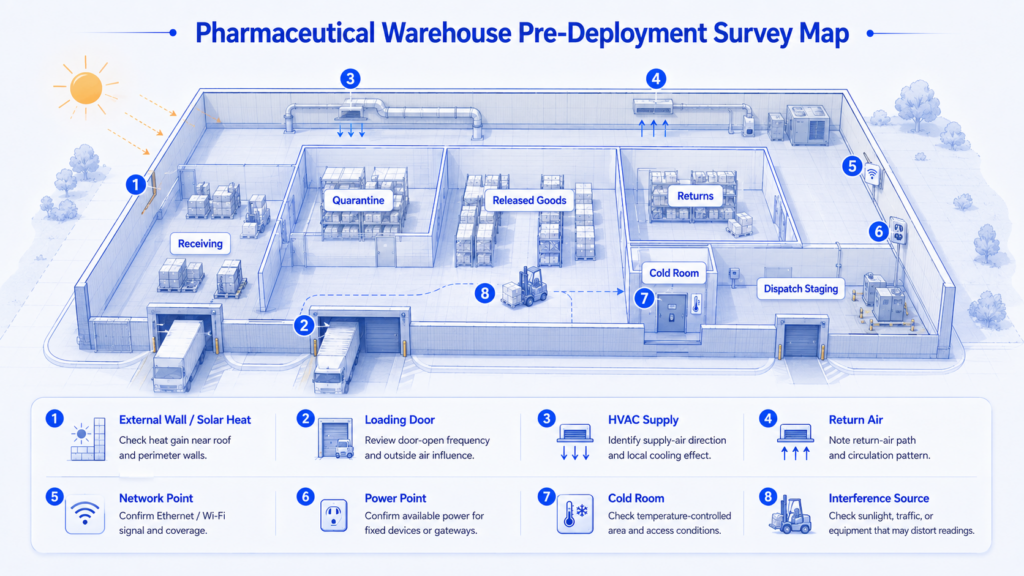
Pharmaceutical warehouse pre-deployment survey map
Start with the products and zones. Record the approved storage range for each product family, whether relative humidity is a formal specification or only an investigative parameter, and whether any products require protection from freezing, condensation, light, or rapid temperature change. Separate ambient storage, refrigerated rooms, freezers, quarantine stock, returned goods, sampling areas, receiving docks, dispatch lanes, and temporary staging. A warehouse that holds both controlled-room-temperature products and cold-chain products should not be treated as one uniform monitoring space.
Next, document the physical drivers of temperature and humidity variation. These normally include external walls and roofs, solar exposure, loading doors, air curtains, HVAC supply and return points, racking height, mezzanines, refrigeration evaporators, defrost cycles, lighting, forklift traffic, and changes in occupancy. The team should also identify areas where sensors could be damaged, covered by stock, exposed to wash-down, or moved during maintenance.
The network survey should be completed at the same time. Confirm the availability and ownership of Ethernet ports, WiFi coverage, VLAN and firewall rules, cellular signal, RS485 cable routes, equipment power, backup power, and permitted cloud services. Pharmaceutical sites often separate operational technology from corporate IT, so the project should identify who approves network access, who owns cybersecurity review, and whether the customer requires a public cloud, an on-premises platform, or API transfer into an existing environmental monitoring system.
The quality team should define the intended use of the data before configuration begins. Some systems support routine warehouse supervision only; others become part of batch-release, deviation, investigation, or audit evidence. The intended use determines the level of validation, calibration traceability, access control, backup, auditability, and change management required. A platform should not be described as compliant with 21 CFR Part 11, EU Annex 11, or another electronic-record requirement unless the complete configured system and operating procedures have been assessed for that intended use.
Deployment decision rule: do not purchase permanent monitoring hardware until the storage ranges, mapped risks, network architecture, alarm ownership, and record-use requirements have been documented.
2. Use Temperature Mapping to Define Permanent Monitoring Points
Permanent sensors should be positioned from temperature-mapping evidence, not from a fixed rule such as one device per square metre. Mapping records the three-dimensional distribution of temperature across the warehouse and identifies locations that repeatedly become warmer, colder, or less stable than the surrounding space. WHO describes temperature mapping as a process for three-dimensional spaces and treats mapping and continuous monitoring as integral to appropriate pharmaceutical storage.
A mapping protocol should state the warehouse configuration, logger locations, study duration, sampling interval, acceptance criteria, loading condition, season, and operating events to be observed. The study should capture normal HVAC cycles, door openings, working hours, nights and weekends, and any refrigeration defrost cycle. Depending on the risk assessment, the qualification may also examine power failure, restart, unusual loading patterns, or the effect of a door being held open. Empty and normally loaded conditions can behave differently because stock changes airflow and thermal mass.
Mapping loggers are normally distributed across length, width, and storage height. The densest placement should be around suspected risk areas: external walls, roofs, doors, corners, HVAC supply and return paths, high racking, floor level, refrigeration equipment, and isolated areas with weak airflow. Sensors used only for a mapping study are temporary. After the results are analysed, permanent monitors are normally placed at locations that represent the identified hot and cold extremes, plus any operationally important zones that require independent control.
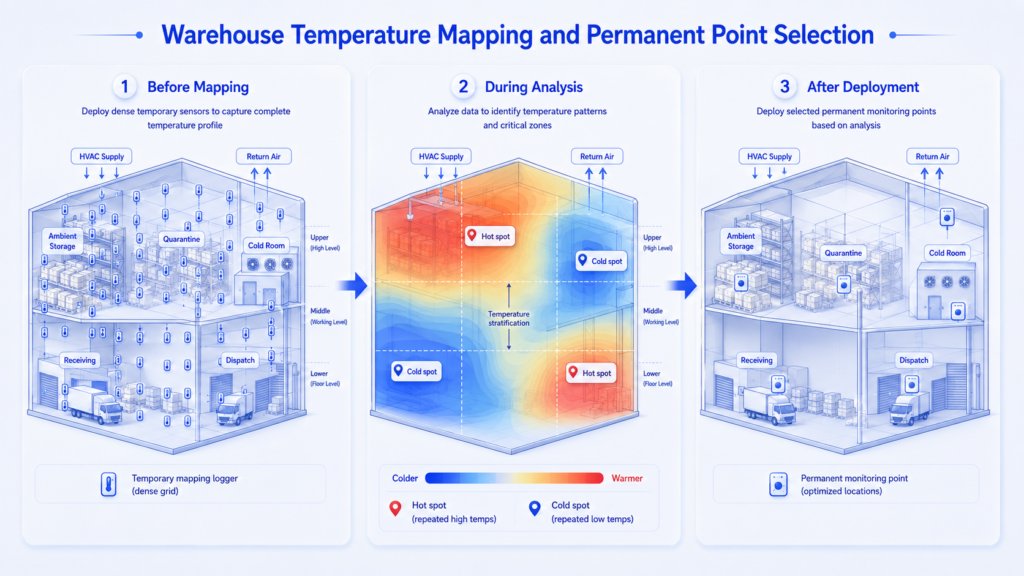
From temperature mapping to permanent sensor placement
Receiving and dispatch areas require careful interpretation. They may be intentionally exposed to outside conditions and may not have the same acceptance range as long-term storage. A permanent point near a dock can be useful for investigating exposure during handling, but it should not be treated as representative of the main warehouse unless mapping supports that conclusion. The same distinction applies to quarantine cages, returns areas, and enclosed high-value storage zones.
Installation height should follow the mapped vertical gradient and the actual storage envelope. A sensor placed at eye level may be convenient but irrelevant if products are stored near the floor and at the top of eight-metre racking. Large warehouses may need permanent points at more than one height, especially where roof heat, cold floors, or stratification creates repeatable differences. Small rooms with demonstrated uniformity may need fewer points, but that decision should be supported by mapping rather than assumed from floor area.
Avoid positions that measure an artificial microclimate unless the position is a deliberate risk point. These include direct supply-air discharge, direct sunlight, a warm control cabinet, an uninsulated wall surface, the immediate path of a door, the floor, the roof structure, or a location that can be blocked by cartons. The sensing element needs free air movement and a stable mounting arrangement. If an external probe is used, protect the cable and connector from forklifts, pallet movement, cleaning, and condensation.
Permanent point planning after mapping
| Mapped finding | Permanent monitoring response | Common installation mistake |
|---|---|---|
| Stable central zone | Use as a reference or representative control point if it reflects occupied storage. | Installing only this point and missing the mapped extremes. |
| Repeatable warm location | Place a permanent monitor close enough to capture the risk without direct heat bias. | Mounting against a hot wall or directly in sunlight. |
| Repeatable cold location | Monitor for low-temperature or freezing risk; consider a separate low alarm. | Using only the warehouse average and overlooking local cold exposure. |
| Vertical stratification | Monitor at two or more relevant storage heights. | Mounting all sensors at eye level. |
| Door or dock influence | Use a dedicated operational-risk point and configure appropriate alarm delay. | Treating every brief door opening as a warehouse-wide excursion. |
| Refrigerated room or freezer | Use a suitable probe range, protected cable route, and mapped hot/cold positions. | Mounting the device head where condensation or wash-down can damage it. |
3. Select Sensors, Probes, Power, and Network Architecture
Device selection should follow the mapped temperature range, required uncertainty, installation environment, communication path, and record-use requirements. A warehouse monitor that is technically accurate but cannot retain data during a network outage, cannot be calibrated as required, or cannot be protected from physical damage may be unsuitable for the project.
The UbiBot GS1-AETH1RS is designed for fixed Ethernet/WiFi deployment and supports selected RS485 external sensors. The official specification lists a built-in temperature range of -20°C to 60°C, a humidity range of 10% to 90% RH without condensation, stated accuracy of +/-0.2°C and +/-2% RH, and local memory for 300,000 sensor records. Connectivity includes 2.4 GHz WiFi and RJ45 Ethernet through a 100 Mbps or lower switch. The same specification lists a rechargeable 2,900 mAh internal lithium battery, Type-C 5 V input, and DC 12 V input.
For a normal ambient warehouse, the built-in temperature and humidity sensor can simplify installation because the device, display, local memory, and network interface are combined. In a cold room, freezer, or location with persistent condensation, the sensing point and the main device may need to be separated. The GS1-AETH1RS supports external probes including the UbiBot TH30S-B, PT100, soil, wind, and CO2 options, with one of each supported type connected at a time. The project must verify the exact external-probe range, accuracy, calibration certificate, cable length, and connector protection for the selected SKU before approval.
Ethernet is usually the most predictable choice for a permanent pharmaceutical warehouse. It avoids radio-coverage variation and can be placed on a controlled network. Where the installation supports it, an approved PoE arrangement can reduce local power adapters, but the exact PoE splitter and voltage requirements must be confirmed. WiFi is useful for retrofits and points that may move, but the site should be surveyed with warehouse doors closed and racking loaded because metal structures and stock can attenuate signals.
RS485 is appropriate when multiple industrial sensors must be wired into a controlled bus or integrated with an existing BMS, PLC, or gateway. The installer must define cable type, topology, termination, shielding, device addresses, baud rate, and isolation. Long RS485 runs should not be designed as ad hoc star wiring. Cellular connectivity can provide resilience or support remote facilities without trusted local IT, while LoRaWAN can reduce cabling across a large campus if a qualified gateway and coverage survey are included. These architectures add components and should be validated as complete signal paths, not only as individual sensors.
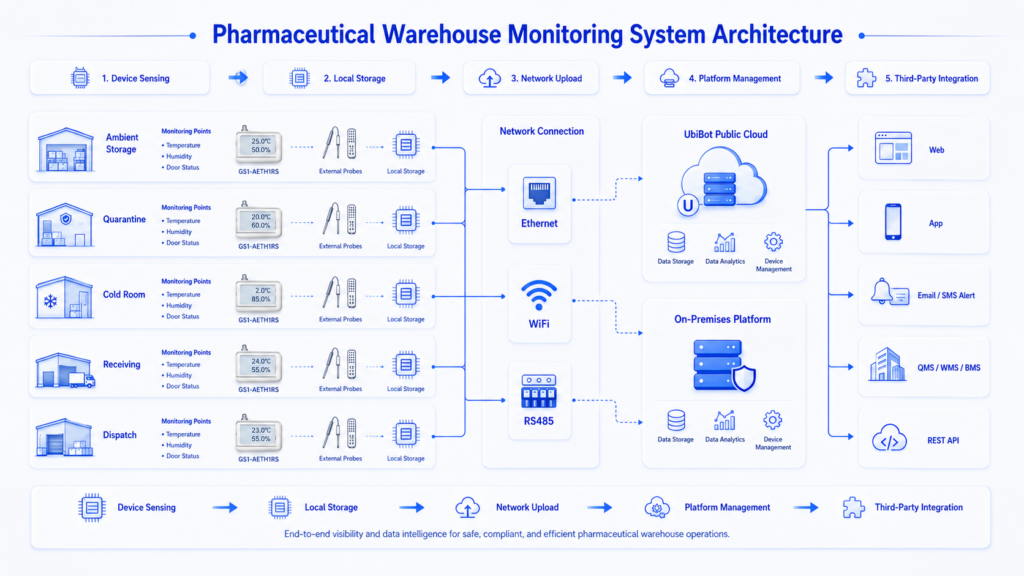
Pharmaceutical warehouse monitoring system architecture
Power design is part of monitoring reliability. A fixed monitor should normally use continuous protected power, with its internal battery treated as short-term backup rather than the primary operating method. The commissioning test should confirm how long the complete chain – sensor, gateway, network, and cloud alarm path – remains operational during a power failure. If the platform provides device-offline or low-battery alarms, those functions should be enabled and tested.
4. Install the Hardware and Build a Repeatable Device Structure
Installation should produce the same physical and digital result at every monitoring point. Standard brackets, labels, cable protection, device naming, and photographic records make later maintenance and audit review far easier than a series of one-off installations.
Mount the sensor where air can circulate around it and where staff cannot easily move or cover it. The mounting height and location should match the approved mapping report. Keep the device away from direct supply air unless the point is deliberately monitoring that risk. In high-traffic areas, use a protective guard that does not enclose the sensor. External cables should be routed in conduit or protected channels, with drip loops where condensation may travel along the cable.
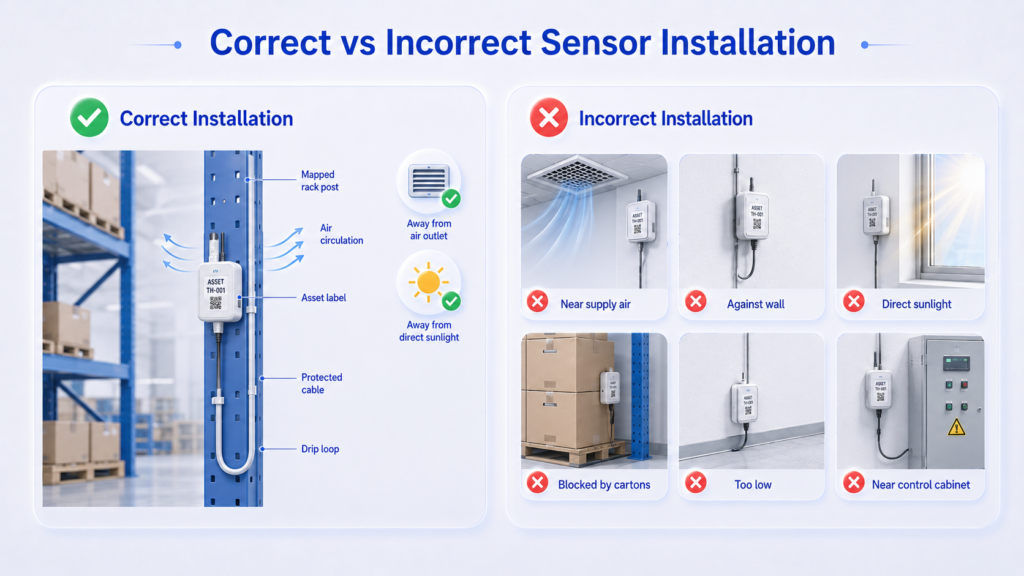
Correct and incorrect sensor installation in a pharma warehouse
For Ethernet installations, assign the switch port, network segment, IP method, DNS and outbound communication rules before the installer arrives. Label both ends of every cable. If a device uses WiFi as backup, document the intended priority and test automatic recovery. For RS485 sensors, record the address and serial number at the physical point and in the platform. A commissioning photograph should show the mounting position, surrounding racking, cable entry, and asset label.
A useful naming convention links the cloud object to the physical warehouse. For example: Site – Building – Zone – Rack or Position – Height. A point named ‘EU-DC02-Ambient-Z03-Rack14-High’ is more useful than ‘GS1-026’. The same identifier should appear on the device label, mapping drawing, calibration record, maintenance schedule, alarm matrix, and platform channel.
Changes after installation need control. Moving a rack, adding a partition, changing HVAC balance, replacing a refrigeration unit, changing product height, or altering door use can invalidate the original sensor location. The maintenance process should require facilities and operations teams to notify Quality when changes could affect airflow or storage conditions.
5. Configure the IoT Platform Around the Quality Workflow
The cloud or on-premises platform should be configured around the warehouse operating process, not left at its default settings. Device groups, alarm limits, notification routes, user roles, reporting, and API integration should be approved before the system is released for routine use.
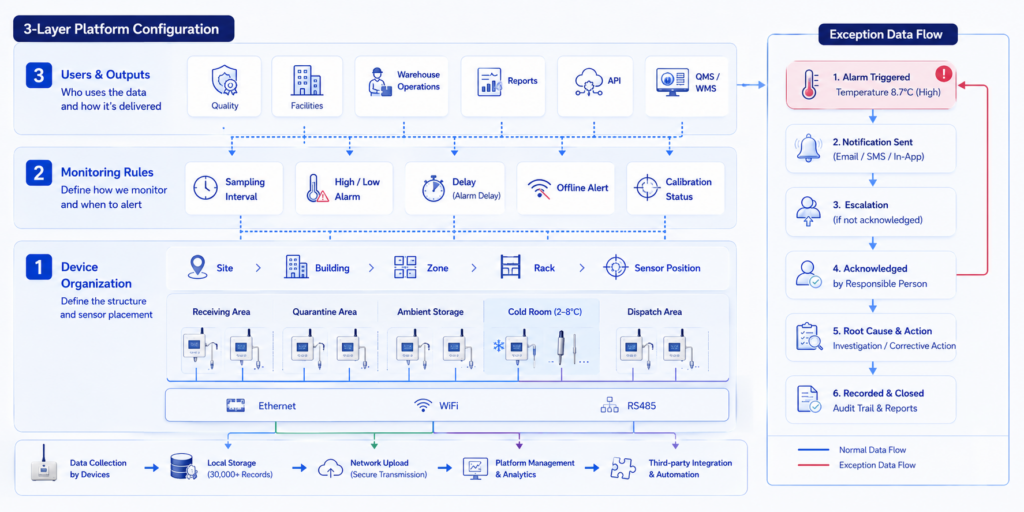
IoT cloud platform deployment for pharmaceutical warehouses
Create groups that match the controlled organisation: site, building, storage regime, zone, and responsibility. Avoid a single flat device list for a multi-site network. UbiBot’s public platform provides device management and sharing, real-time and historical charts, data import/export, calibration settings, alerts, data forwarding, third-party integrations, and REST API access. UbiBot also offers an on-premises platform for local network deployment, local data storage, group and authority management, batch device management, and enterprise API integration [6-9]. Availability and limits differ by subscription and deployment option, so the approved feature set should be documented.
Set the recording interval separately from the upload and reporting workflow where the device allows it. The interval must be short enough to detect a meaningful excursion but not so short that normal HVAC cycling creates unmanageable data. The quality risk assessment should consider product sensitivity, warehouse recovery time, alarm response time, network data use, and local memory capacity. A pilot period with a shorter interval can help establish normal patterns before final settings are approved.
Alarm limits should come from approved product and zone requirements. A practical configuration may use high and low alert limits, a time delay, hysteresis or recovery logic, an offline-device alarm, power-loss alarm, and escalation if the first recipient does not acknowledge the event. A brief dock-door event should not be handled in the same way as a sustained storage excursion. The alarm delay and response procedure should be justified together; a delay that prevents nuisance alerts can also postpone a genuine intervention.
Define who can view data, acknowledge alarms, modify thresholds, change calibration offsets, add users, export records, or delete devices. Quality-critical changes should require approval and documentation. If a public cloud account does not provide the required audit trail, electronic signature, or retention controls, the company should use an appropriate validated platform, on-premises deployment, or controlled integration rather than assuming that a general IoT dashboard meets GxP electronic-record requirements.
Reporting and integration should use the same identifiers as warehouse operations. CSV or PDF exports are useful for review, while APIs and data forwarding can connect measurements to a WMS, QMS, BMS, data lake, or customer portal. Integration testing must confirm units, timestamps, time zones, missing-data handling, duplicate records, device replacement, and the relationship between a sensor point and the correct warehouse zone.
6. Commission, Validate, and Maintain the Complete Monitoring System
The completed system should be accepted only after the sensor, network, local storage, platform, alarm route, user permissions, and operating procedures have been tested together. A device displaying a plausible value is not evidence that the full monitoring process is reliable.
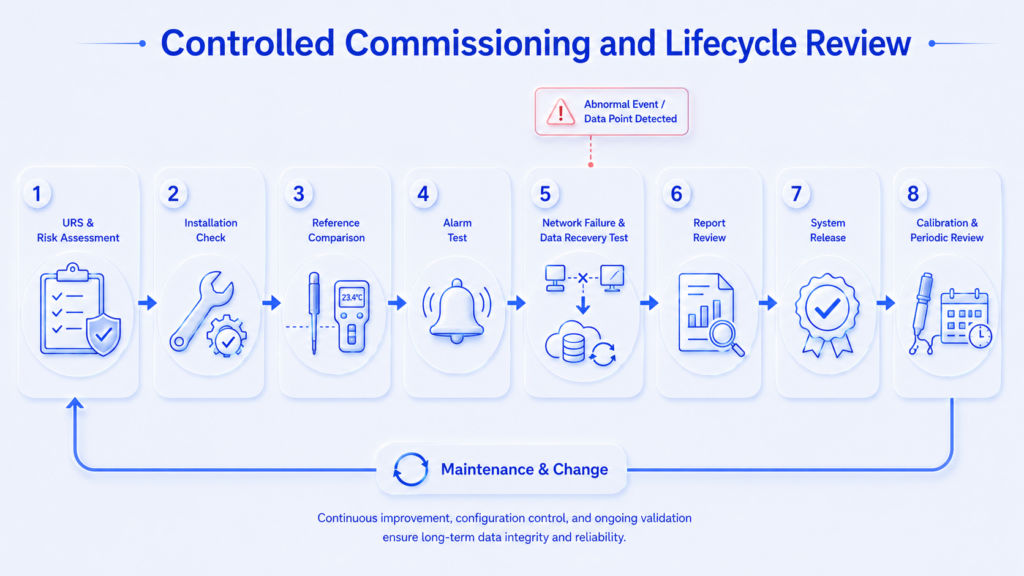
Pharmaceutical monitoring system commissioning and validation workflow
The validation approach should match the intended use and the company’s quality system. A typical regulated project starts with a user requirements specification and risk assessment, then documents installation qualification, operational testing, and performance under routine warehouse conditions. The exact terminology may vary, but the evidence should show that the approved design was installed correctly, functions as intended, and remains suitable in normal operation.
At commissioning, compare each permanent sensor with a traceable reference under stable conditions. Record the device and probe serial numbers, reference standard, certificate status, test points, observed error, acceptance criteria, date, and responsible person. Platform calibration offsets should be controlled because changing the displayed value can affect historical reports and investigations. EU GDP expects monitoring equipment to be calibrated at defined intervals based on risk and reliability, and WHO provides specific guidance for checking the accuracy of monitoring devices.
Alarm testing should include high and low thresholds, time delays, recovery behaviour, offline detection, loss of power, and escalation to each responsible role. Disconnect the network long enough to verify local recording, then restore communication and confirm that stored data appear in the correct sequence without changing original timestamps. Test time synchronisation, daylight-saving changes where relevant, report exports, account lockout, user-role separation, and the process for replacing a device or probe.
Routine maintenance should be planned rather than reactive. Review device health, communication status, backup power, physical condition, calibration due dates, alarm contacts, platform subscriptions, and data-storage capacity. Test alarms periodically and after configuration changes. Replace or recalibrate sensors through a documented process that preserves point identity and calibration history. Repeat mapping or conduct a documented assessment after major HVAC changes, warehouse expansion, new racking, insulation work, refrigeration replacement, or repeated unexplained excursions.
Deviation handling should connect the technical record to a quality decision. The monitoring system can show when and where a limit was exceeded, but the product-impact assessment should also consider duration, product stability information, packaging, location, airflow, and previous conditions. The system should preserve the original data and the investigation should document acknowledgement, containment, root cause, corrective action, and approval.
7. Scale the Deployment and Compare Monitoring Architectures
A pharmaceutical warehouse monitoring project should scale by adding controlled structure, not simply by adding devices. Small sites may use independent Ethernet monitors and a public cloud. Large or multi-site networks need standard naming, templates, permission models, calibration governance, API integration, redundancy, and change control.
| Deployment scale | Typical architecture | Platform approach | Main implementation concern |
|---|---|---|---|
| Small warehouse or controlled room | A small number of Ethernet/WiFi monitors; external probes where required; local battery backup. | Public cloud with a limited user group and documented exports. | Mapping evidence, correct point placement, and alarm ownership. |
| Single large distribution centre | Multiple zones and heights; Ethernet backbone, RS485 points, or qualified LoRaWAN coverage. | Central groups, role-based access, alarm templates, automated reports, and maintenance dashboard. | Consistent installation, network resilience, calibration scheduling, and changes to racking/HVAC. |
| Multi-site pharmaceutical network | Standard device kit per site, cellular backup where needed, controlled integration to QMS/WMS. | Central or on-premises platform with API, governed master data, regional permissions, and data retention rules. | Global standardisation while meeting local regulation, cybersecurity, data residency, and service response. |
| High-compliance cold-chain or validated storage | Mapped hot/cold points, calibrated probes, redundant monitoring where justified, controlled backup power. | Validated platform environment with documented auditability, backup, restoration, and change control. | Qualification evidence, traceability, alarm response, electronic records, and periodic review. |
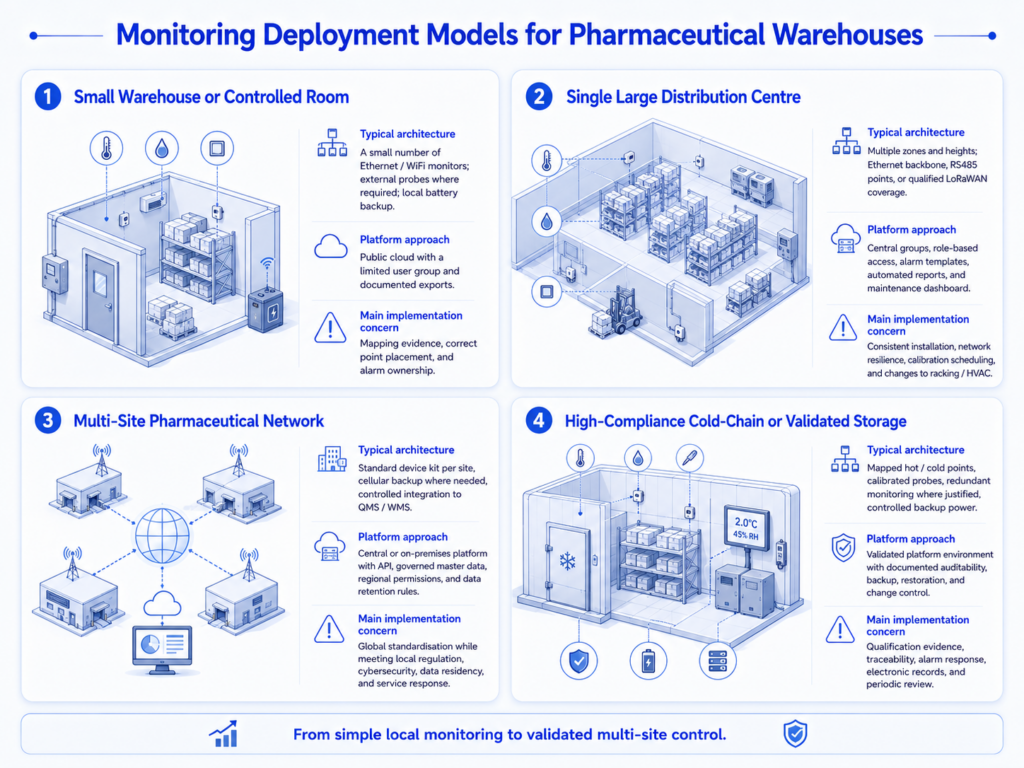
Pharmaceutical warehouse monitoring deployment scale schematic diagram
The products below represent different deployment models rather than four identical devices. The comparison uses current official product pages with publicly verifiable specifications. Where a manufacturer does not publish a parameter on the current page, the table states ‘Not publicly specified’ rather than estimating it.
Verified Product Comparison for Pharmaceutical Warehouse Deployment
| Comparison item | UbiBot GS1-AETH1RS | Sensitech TempTale Ultra Humidity | Dickson Cobalt XS + Cordless Smart-Sensor | Sensaphone Sentinel Pro + FGD-0110 |
|---|---|---|---|---|
| Deployment model | Fixed all-in-one Ethernet/WiFi monitor with optional RS485 external sensors. | Standalone temperature/humidity logger that generates secure files after download. | LoRaWAN data logger with replaceable calibrated temperature/humidity Smart-Sensor. | Central Ethernet panel with 12 analog/digital inputs, 64 Modbus registers, and wired Modbus T/RH sensor. |
| Temperature range | -20° to 60°C (built-in sensor). | -30°C to 70°C. | -40°C to 100°C. | 0°C to 50°C for FGD-0110 sensor. |
| Temperature accuracy | ±0.2°C (0 to 60°C). | Not publicly specified on current product page. | Expanded uncertainty ±0.3°C to +±0.5°C. | ±0.2°C. |
| Humidity range | 10% to 90% RH, non-condensing. | 10% to 90% RH. | 0% to 100% RH, non-condensing. | 0% to 100% RH, non-condensing. |
| Humidity accuracy | ±2% RH. | Not publicly specified on current product page. | Expanded uncertainty ±2% to ±4% RH. | ±2% RH. |
| Communication | 2.4 GHz WiFi and RJ45 Ethernet; selected RS485 external sensors. | USB/file-based workflow, no real-time warehouse cloud connection stated on current page. | LoRaWAN to Dickson monitoring infrastructure; cloud and on-premises options. | Ethernet, Modbus RTU/RS485 and Modbus TCP supported by Sentinel Pro. |
| Local/offline data | 300,000 sensor records. | Local logger, exact memory capacity not publicly specified on current page. | Not publicly specified on current Cobalt XS page. | Unlimited samples stored on Sentinel Pro servers; local buffering not publicly specified on current page. |
| Power and backup | Internal rechargeable lithium battery; Type-C 5 V and DC 5 ~ 12 V. | Not publicly specified on current product page. | Not publicly specified on current Cobalt XS page. | Plug-in power supply with 8-hour internal battery backup. |
| Environmental protection | IP65 device; installation must still control condensation and wash-down exposure. | Not publicly specified on current product page. | Smart-Sensor IP65. | FGD-0110 intended for clean, dry indoor use; Sentinel Pro enclosure details depend on configuration. |
| Platform and alerts | UbiBot web / app platform, alerts, charts, PDF/CSV export, API, data forwarding, public-cloud and on-premises options; features vary by plan. | Secure PDF and encrypted raw-data file; not a continuous real-time warehouse alarm architecture by itself. | OCEAView Cloud/on-premises and DicksonOne, programmable high/low alarms and reading intervals. | Web/mobile access, unlimited email/text/phone notifications, cloud logging, reports, and user-activity audit trail. |
| Calibration and traceability | Project must confirm certificate and traceability options for the selected device/probe. Platform supports calibration settings. | Sensitech states that TempTale, monitors include a NIST-traceable validation certificate; verify exact certificate scope. | ISO/IEC 17025, certified non-accredited, and NIST-traceable options; calibration data stored in the Smart-Sensor. | Calibration service/certificate requirements must be confirmed for the selected FGD-0110 sensor. |
| Best fit | Cost-conscious fixed monitoring where Ethernet, local memory, multi-network options, and open integration are priorities. | Post-event evidence or shipment/storage studies where manual file retrieval is acceptable. | Life-science sites that prefer a dedicated LoRaWAN ecosystem and hot-swappable calibrated sensors. | Facilities needing a multi-input alarm panel, Modbus integration, long backup time, and extensive notification options. |
The UbiBot GS1-AETH1RS is the least infrastructure-heavy option in this comparison when a warehouse already has Ethernet or approved WiFi. It combines sensing, display, local storage, and cloud connectivity in one device, and it can connect selected RS485 sensors. The main project checks are calibration traceability, the exact external probe required, current power specification, and whether the chosen platform configuration meets the customer’s validation and electronic-record requirements.
TempTale Ultra Humidity represents a different workflow. It is a standalone logger that creates secure files after retrieval. That approach can be suitable for mapping, qualification, shipment evidence, or locations where real-time alarm response is unnecessary. It does not replace a continuously connected warehouse monitoring system when staff must respond during an excursion.
Dickson Cobalt XS is designed around a dedicated LoRaWAN monitoring ecosystem and replaceable Smart-Sensors that carry calibration data. This can reduce downtime during recalibration and is attractive in regulated life-science facilities. The architecture requires Dickson infrastructure and platform planning rather than a direct Ethernet connection at every sensor.
Sensaphone Sentinel Pro is a multi-input monitoring panel rather than an all-in-one warehouse logger. Combined with the FGD-0110 Modbus temperature/humidity sensor, it supports Ethernet, Modbus integration, extensive notifications, cloud logging, and an eight-hour backup. It is well suited to sites that also need power, water, equipment-status, or relay monitoring, but it involves more panel, sensor-power, and wiring work than a self-contained device.
8. Frequently Asked Questions
How many temperature and humidity sensors does a pharmaceutical warehouse need?
There is no reliable universal rule based only on floor area. The number and location should come from a documented temperature-mapping study, the warehouse geometry, storage height, HVAC layout, door activity, product risk, and the number of independently controlled zones. Permanent monitors should cover mapped hot and cold extremes and any operationally critical areas.
Where should permanent sensors be installed after temperature mapping?
Place them at representative locations that repeatedly show the highest and lowest acceptable conditions, plus separately controlled or high-risk zones. The sensing element should have free airflow and should not be placed directly in supply air, sunlight, against a wall, on the floor, or where stock can cover it unless that location is intentionally being monitored as a risk point.
Should a pharmaceutical warehouse monitor humidity as well as temperature?
Monitor humidity when the product specification, packaging system, regulatory filing, quality risk assessment, or building-control strategy makes it relevant. Even when humidity is not a formal release condition, it may help investigate condensation, packaging damage, mould risk, or HVAC performance. Alarm limits should not be invented if no approved humidity requirement exists.
Is Ethernet better than WiFi for a GMP or GDP warehouse?
Ethernet is normally more predictable for permanent fixed points and is easier to place on a controlled network. WiFi is valuable for retrofit projects and locations where cabling is impractical, but coverage should be tested with racks loaded and doors closed. The correct choice depends on site IT policy, resilience, power, future changes, and whether a backup path is required.
How should alarm delays be set for warehouse temperature monitoring?
Use product stability, mapped recovery behaviour, door-opening patterns, HVAC response, and the time available for corrective action. A delay can prevent nuisance alarms from brief handling events, but it must not hide a meaningful excursion. The alarm threshold, delay, escalation path, and written response procedure should be approved as one controlled workflow.
How often should warehouse monitoring sensors be calibrated?
The interval should be defined in the quality system based on regulatory requirements, sensor reliability, risk, manufacturer guidance, and historical drift. EU GDP calls for calibration at defined intervals based on risk and reliability; it does not establish one universal interval for every warehouse device. Recalibration or accuracy checking is also appropriate after damage, repair, unexplained drift, or sensor replacement.
What should happen if the network or cloud connection fails?
The device or local architecture should continue recording for the required outage period, generate an offline alarm where possible, and upload records with original timestamps after communication returns. This behaviour must be tested during commissioning. A cloud dashboard cannot compensate for a field device that stops recording when the network fails.
Does an IoT monitoring platform automatically make the system 21 CFR Part 11 compliant?
No. Compliance depends on the complete intended-use system, configuration, validation, security, auditability, electronic signatures where applicable, procedures, training, backup, retention, and change control. Platform features can support compliance, but the customer must assess and validate the deployed system against its own regulated use.
A dependable pharmaceutical warehouse monitoring system begins with product requirements and mapping evidence, then connects permanent sensor placement, reliable communication, controlled platform configuration, validation, and maintenance. The correct architecture may be a small group of Ethernet monitors, a LoRaWAN network, a central Modbus panel, or an integrated multi-site platform. The decision should be based on the warehouse risk and operating model rather than on a single headline specification.
For facilities that need a straightforward Ethernet/WiFi deployment with local storage, remote alarms, open API access, and optional on-premises management, the UbiBot GS1-AETH1RS can provide a practical foundation. Before publication or procurement, the project should still confirm the current hardware revision, probe and calibration options, platform plan, and the customer’s electronic-record requirements.
Related Resources
No related resources found


learn
See More >>
Pharmaceutical Warehouse Temperature and Humidity Monitoring Deployment Guide
Key Takeaway
A pharmaceutical warehouse monitoring system should be designed from storage requirements and temperature-mapping results, with sensors placed at verified hot, cold, and high-risk locations. The complete system—including power, network, cloud platform, alarms, calibration, and data records—should be tested and validated before routine use.
Introduction
Once a pharmaceutical company has approved the business case for continuous environmental monitoring, the project moves into a more demanding phase: deciding where sensors belong, how the network should be built, which alarms require action, and how the system will be validated. The hardware alone does not make a warehouse compliant. Compliance depends on whether the monitoring points represent the actual storage risks and whether the complete workflow produces reliable, reviewable records.
Four problems commonly delay implementation. Teams may install permanent sensors before completing temperature mapping; they may select locations for convenience rather than risk; they may configure alarms without a documented excursion process; or they may connect devices to a cloud platform without defining user permissions, data retention, calibration status, and change control. A successful deployment addresses these questions as one system rather than as separate IT, facilities, and quality tasks.
The guidance below is intended for ambient pharmaceutical warehouses, controlled-temperature rooms, refrigerated zones, quarantine areas, and distribution facilities. Product-specific storage instructions and local regulations always take priority. In the United States, 21 CFR 211.142 requires written warehousing procedures and storage under appropriate temperature, humidity, and light conditions. EU Good Distribution Practice and WHO guidance add practical expectations for risk assessment, mapping, calibrated monitoring equipment, alarms, and controlled records.
1. Prepare the Warehouse and Quality Requirements Before Selecting Hardware
The deployment should begin with a documented warehouse survey and a clear user requirements specification. The survey converts product requirements, building conditions, IT constraints, and quality procedures into measurable system requirements. Without this step, equipment selection becomes a comparison of technical features rather than a controlled response to storage risk.
Pharmaceutical warehouse pre-deployment survey map
Start with the products and zones. Record the approved storage range for each product family, whether relative humidity is a formal specification or only an investigative parameter, and whether any products require protection from freezing, condensation, light, or rapid temperature change. Separate ambient storage, refrigerated rooms, freezers, quarantine stock, returned goods, sampling areas, receiving docks, dispatch lanes, and temporary staging. A warehouse that holds both controlled-room-temperature products and cold-chain products should not be treated as one uniform monitoring space.
Next, document the physical drivers of temperature and humidity variation. These normally include external walls and roofs, solar exposure, loading doors, air curtains, HVAC supply and return points, racking height, mezzanines, refrigeration evaporators, defrost cycles, lighting, forklift traffic, and changes in occupancy. The team should also identify areas where sensors could be damaged, covered by stock, exposed to wash-down, or moved during maintenance.
The network survey should be completed at the same time. Confirm the availability and ownership of Ethernet ports, WiFi coverage, VLAN and firewall rules, cellular signal, RS485 cable routes, equipment power, backup power, and permitted cloud services. Pharmaceutical sites often separate operational technology from corporate IT, so the project should identify who approves network access, who owns cybersecurity review, and whether the customer requires a public cloud, an on-premises platform, or API transfer into an existing environmental monitoring system.
The quality team should define the intended use of the data before configuration begins. Some systems support routine warehouse supervision only; others become part of batch-release, deviation, investigation, or audit evidence. The intended use determines the level of validation, calibration traceability, access control, backup, auditability, and change management required. A platform should not be described as compliant with 21 CFR Part 11, EU Annex 11, or another electronic-record requirement unless the complete configured system and operating procedures have been assessed for that intended use.
Deployment decision rule: do not purchase permanent monitoring hardware until the storage ranges, mapped risks, network architecture, alarm ownership, and record-use requirements have been documented.
2. Use Temperature Mapping to Define Permanent Monitoring Points
Permanent sensors should be positioned from temperature-mapping evidence, not from a fixed rule such as one device per square metre. Mapping records the three-dimensional distribution of temperature across the warehouse and identifies locations that repeatedly become warmer, colder, or less stable than the surrounding space. WHO describes temperature mapping as a process for three-dimensional spaces and treats mapping and continuous monitoring as integral to appropriate pharmaceutical storage.
A mapping protocol should state the warehouse configuration, logger locations, study duration, sampling interval, acceptance criteria, loading condition, season, and operating events to be observed. The study should capture normal HVAC cycles, door openings, working hours, nights and weekends, and any refrigeration defrost cycle. Depending on the risk assessment, the qualification may also examine power failure, restart, unusual loading patterns, or the effect of a door being held open. Empty and normally loaded conditions can behave differently because stock changes airflow and thermal mass.
Mapping loggers are normally distributed across length, width, and storage height. The densest placement should be around suspected risk areas: external walls, roofs, doors, corners, HVAC supply and return paths, high racking, floor level, refrigeration equipment, and isolated areas with weak airflow. Sensors used only for a mapping study are temporary. After the results are analysed, permanent monitors are normally placed at locations that represent the identified hot and cold extremes, plus any operationally important zones that require independent control.
From temperature mapping to permanent sensor placement
Receiving and dispatch areas require careful interpretation. They may be intentionally exposed to outside conditions and may not have the same acceptance range as long-term storage. A permanent point near a dock can be useful for investigating exposure during handling, but it should not be treated as representative of the main warehouse unless mapping supports that conclusion. The same distinction applies to quarantine cages, returns areas, and enclosed high-value storage zones.
Installation height should follow the mapped vertical gradient and the actual storage envelope. A sensor placed at eye level may be convenient but irrelevant if products are stored near the floor and at the top of eight-metre racking. Large warehouses may need permanent points at more than one height, especially where roof heat, cold floors, or stratification creates repeatable differences. Small rooms with demonstrated uniformity may need fewer points, but that decision should be supported by mapping rather than assumed from floor area.
Avoid positions that measure an artificial microclimate unless the position is a deliberate risk point. These include direct supply-air discharge, direct sunlight, a warm control cabinet, an uninsulated wall surface, the immediate path of a door, the floor, the roof structure, or a location that can be blocked by cartons. The sensing element needs free air movement and a stable mounting arrangement. If an external probe is used, protect the cable and connector from forklifts, pallet movement, cleaning, and condensation.
Permanent point planning after mapping
| Mapped finding | Permanent monitoring response | Common installation mistake |
|---|---|---|
| Stable central zone | Use as a reference or representative control point if it reflects occupied storage. | Installing only this point and missing the mapped extremes. |
| Repeatable warm location | Place a permanent monitor close enough to capture the risk without direct heat bias. | Mounting against a hot wall or directly in sunlight. |
| Repeatable cold location | Monitor for low-temperature or freezing risk; consider a separate low alarm. | Using only the warehouse average and overlooking local cold exposure. |
| Vertical stratification | Monitor at two or more relevant storage heights. | Mounting all sensors at eye level. |
| Door or dock influence | Use a dedicated operational-risk point and configure appropriate alarm delay. | Treating every brief door opening as a warehouse-wide excursion. |
| Refrigerated room or freezer | Use a suitable probe range, protected cable route, and mapped hot/cold positions. | Mounting the device head where condensation or wash-down can damage it. |
3. Select Sensors, Probes, Power, and Network Architecture
Device selection should follow the mapped temperature range, required uncertainty, installation environment, communication path, and record-use requirements. A warehouse monitor that is technically accurate but cannot retain data during a network outage, cannot be calibrated as required, or cannot be protected from physical damage may be unsuitable for the project.
The UbiBot GS1-AETH1RS is designed for fixed Ethernet/WiFi deployment and supports selected RS485 external sensors. The official specification lists a built-in temperature range of -20°C to 60°C, a humidity range of 10% to 90% RH without condensation, stated accuracy of +/-0.2°C and +/-2% RH, and local memory for 300,000 sensor records. Connectivity includes 2.4 GHz WiFi and RJ45 Ethernet through a 100 Mbps or lower switch. The same specification lists a rechargeable 2,900 mAh internal lithium battery, Type-C 5 V input, and DC 12 V input.
For a normal ambient warehouse, the built-in temperature and humidity sensor can simplify installation because the device, display, local memory, and network interface are combined. In a cold room, freezer, or location with persistent condensation, the sensing point and the main device may need to be separated. The GS1-AETH1RS supports external probes including the UbiBot TH30S-B, PT100, soil, wind, and CO2 options, with one of each supported type connected at a time. The project must verify the exact external-probe range, accuracy, calibration certificate, cable length, and connector protection for the selected SKU before approval.
Ethernet is usually the most predictable choice for a permanent pharmaceutical warehouse. It avoids radio-coverage variation and can be placed on a controlled network. Where the installation supports it, an approved PoE arrangement can reduce local power adapters, but the exact PoE splitter and voltage requirements must be confirmed. WiFi is useful for retrofits and points that may move, but the site should be surveyed with warehouse doors closed and racking loaded because metal structures and stock can attenuate signals.
RS485 is appropriate when multiple industrial sensors must be wired into a controlled bus or integrated with an existing BMS, PLC, or gateway. The installer must define cable type, topology, termination, shielding, device addresses, baud rate, and isolation. Long RS485 runs should not be designed as ad hoc star wiring. Cellular connectivity can provide resilience or support remote facilities without trusted local IT, while LoRaWAN can reduce cabling across a large campus if a qualified gateway and coverage survey are included. These architectures add components and should be validated as complete signal paths, not only as individual sensors.
Pharmaceutical warehouse monitoring system architecture
Power design is part of monitoring reliability. A fixed monitor should normally use continuous protected power, with its internal battery treated as short-term backup rather than the primary operating method. The commissioning test should confirm how long the complete chain – sensor, gateway, network, and cloud alarm path – remains operational during a power failure. If the platform provides device-offline or low-battery alarms, those functions should be enabled and tested.
4. Install the Hardware and Build a Repeatable Device Structure
Installation should produce the same physical and digital result at every monitoring point. Standard brackets, labels, cable protection, device naming, and photographic records make later maintenance and audit review far easier than a series of one-off installations.
Mount the sensor where air can circulate around it and where staff cannot easily move or cover it. The mounting height and location should match the approved mapping report. Keep the device away from direct supply air unless the point is deliberately monitoring that risk. In high-traffic areas, use a protective guard that does not enclose the sensor. External cables should be routed in conduit or protected channels, with drip loops where condensation may travel along the cable.
Correct and incorrect sensor installation in a pharma warehouse
For Ethernet installations, assign the switch port, network segment, IP method, DNS and outbound communication rules before the installer arrives. Label both ends of every cable. If a device uses WiFi as backup, document the intended priority and test automatic recovery. For RS485 sensors, record the address and serial number at the physical point and in the platform. A commissioning photograph should show the mounting position, surrounding racking, cable entry, and asset label.
A useful naming convention links the cloud object to the physical warehouse. For example: Site – Building – Zone – Rack or Position – Height. A point named ‘EU-DC02-Ambient-Z03-Rack14-High’ is more useful than ‘GS1-026’. The same identifier should appear on the device label, mapping drawing, calibration record, maintenance schedule, alarm matrix, and platform channel.
Changes after installation need control. Moving a rack, adding a partition, changing HVAC balance, replacing a refrigeration unit, changing product height, or altering door use can invalidate the original sensor location. The maintenance process should require facilities and operations teams to notify Quality when changes could affect airflow or storage conditions.
5. Configure the IoT Platform Around the Quality Workflow
The cloud or on-premises platform should be configured around the warehouse operating process, not left at its default settings. Device groups, alarm limits, notification routes, user roles, reporting, and API integration should be approved before the system is released for routine use.
IoT cloud platform deployment for pharmaceutical warehouses
Create groups that match the controlled organisation: site, building, storage regime, zone, and responsibility. Avoid a single flat device list for a multi-site network. UbiBot’s public platform provides device management and sharing, real-time and historical charts, data import/export, calibration settings, alerts, data forwarding, third-party integrations, and REST API access. UbiBot also offers an on-premises platform for local network deployment, local data storage, group and authority management, batch device management, and enterprise API integration [6-9]. Availability and limits differ by subscription and deployment option, so the approved feature set should be documented.
Set the recording interval separately from the upload and reporting workflow where the device allows it. The interval must be short enough to detect a meaningful excursion but not so short that normal HVAC cycling creates unmanageable data. The quality risk assessment should consider product sensitivity, warehouse recovery time, alarm response time, network data use, and local memory capacity. A pilot period with a shorter interval can help establish normal patterns before final settings are approved.
Alarm limits should come from approved product and zone requirements. A practical configuration may use high and low alert limits, a time delay, hysteresis or recovery logic, an offline-device alarm, power-loss alarm, and escalation if the first recipient does not acknowledge the event. A brief dock-door event should not be handled in the same way as a sustained storage excursion. The alarm delay and response procedure should be justified together; a delay that prevents nuisance alerts can also postpone a genuine intervention.
Define who can view data, acknowledge alarms, modify thresholds, change calibration offsets, add users, export records, or delete devices. Quality-critical changes should require approval and documentation. If a public cloud account does not provide the required audit trail, electronic signature, or retention controls, the company should use an appropriate validated platform, on-premises deployment, or controlled integration rather than assuming that a general IoT dashboard meets GxP electronic-record requirements.
Reporting and integration should use the same identifiers as warehouse operations. CSV or PDF exports are useful for review, while APIs and data forwarding can connect measurements to a WMS, QMS, BMS, data lake, or customer portal. Integration testing must confirm units, timestamps, time zones, missing-data handling, duplicate records, device replacement, and the relationship between a sensor point and the correct warehouse zone.
6. Commission, Validate, and Maintain the Complete Monitoring System
The completed system should be accepted only after the sensor, network, local storage, platform, alarm route, user permissions, and operating procedures have been tested together. A device displaying a plausible value is not evidence that the full monitoring process is reliable.
Pharmaceutical monitoring system commissioning and validation workflow
The validation approach should match the intended use and the company’s quality system. A typical regulated project starts with a user requirements specification and risk assessment, then documents installation qualification, operational testing, and performance under routine warehouse conditions. The exact terminology may vary, but the evidence should show that the approved design was installed correctly, functions as intended, and remains suitable in normal operation.
At commissioning, compare each permanent sensor with a traceable reference under stable conditions. Record the device and probe serial numbers, reference standard, certificate status, test points, observed error, acceptance criteria, date, and responsible person. Platform calibration offsets should be controlled because changing the displayed value can affect historical reports and investigations. EU GDP expects monitoring equipment to be calibrated at defined intervals based on risk and reliability, and WHO provides specific guidance for checking the accuracy of monitoring devices.
Alarm testing should include high and low thresholds, time delays, recovery behaviour, offline detection, loss of power, and escalation to each responsible role. Disconnect the network long enough to verify local recording, then restore communication and confirm that stored data appear in the correct sequence without changing original timestamps. Test time synchronisation, daylight-saving changes where relevant, report exports, account lockout, user-role separation, and the process for replacing a device or probe.
Routine maintenance should be planned rather than reactive. Review device health, communication status, backup power, physical condition, calibration due dates, alarm contacts, platform subscriptions, and data-storage capacity. Test alarms periodically and after configuration changes. Replace or recalibrate sensors through a documented process that preserves point identity and calibration history. Repeat mapping or conduct a documented assessment after major HVAC changes, warehouse expansion, new racking, insulation work, refrigeration replacement, or repeated unexplained excursions.
Deviation handling should connect the technical record to a quality decision. The monitoring system can show when and where a limit was exceeded, but the product-impact assessment should also consider duration, product stability information, packaging, location, airflow, and previous conditions. The system should preserve the original data and the investigation should document acknowledgement, containment, root cause, corrective action, and approval.
7. Scale the Deployment and Compare Monitoring Architectures
A pharmaceutical warehouse monitoring project should scale by adding controlled structure, not simply by adding devices. Small sites may use independent Ethernet monitors and a public cloud. Large or multi-site networks need standard naming, templates, permission models, calibration governance, API integration, redundancy, and change control.
| Deployment scale | Typical architecture | Platform approach | Main implementation concern |
|---|---|---|---|
| Small warehouse or controlled room | A small number of Ethernet/WiFi monitors; external probes where required; local battery backup. | Public cloud with a limited user group and documented exports. | Mapping evidence, correct point placement, and alarm ownership. |
| Single large distribution centre | Multiple zones and heights; Ethernet backbone, RS485 points, or qualified LoRaWAN coverage. | Central groups, role-based access, alarm templates, automated reports, and maintenance dashboard. | Consistent installation, network resilience, calibration scheduling, and changes to racking/HVAC. |
| Multi-site pharmaceutical network | Standard device kit per site, cellular backup where needed, controlled integration to QMS/WMS. | Central or on-premises platform with API, governed master data, regional permissions, and data retention rules. | Global standardisation while meeting local regulation, cybersecurity, data residency, and service response. |
| High-compliance cold-chain or validated storage | Mapped hot/cold points, calibrated probes, redundant monitoring where justified, controlled backup power. | Validated platform environment with documented auditability, backup, restoration, and change control. | Qualification evidence, traceability, alarm response, electronic records, and periodic review. |
Pharmaceutical warehouse monitoring deployment scale schematic diagram
The products below represent different deployment models rather than four identical devices. The comparison uses current official product pages with publicly verifiable specifications. Where a manufacturer does not publish a parameter on the current page, the table states ‘Not publicly specified’ rather than estimating it.
Verified Product Comparison for Pharmaceutical Warehouse Deployment
| Comparison item | UbiBot GS1-AETH1RS | Sensitech TempTale Ultra Humidity | Dickson Cobalt XS + Cordless Smart-Sensor | Sensaphone Sentinel Pro + FGD-0110 |
|---|---|---|---|---|
| Deployment model | Fixed all-in-one Ethernet/WiFi monitor with optional RS485 external sensors. | Standalone temperature/humidity logger that generates secure files after download. | LoRaWAN data logger with replaceable calibrated temperature/humidity Smart-Sensor. | Central Ethernet panel with 12 analog/digital inputs, 64 Modbus registers, and wired Modbus T/RH sensor. |
| Temperature range | -20° to 60°C (built-in sensor). | -30°C to 70°C. | -40°C to 100°C. | 0°C to 50°C for FGD-0110 sensor. |
| Temperature accuracy | ±0.2°C (0 to 60°C). | Not publicly specified on current product page. | Expanded uncertainty ±0.3°C to +±0.5°C. | ±0.2°C. |
| Humidity range | 10% to 90% RH, non-condensing. | 10% to 90% RH. | 0% to 100% RH, non-condensing. | 0% to 100% RH, non-condensing. |
| Humidity accuracy | ±2% RH. | Not publicly specified on current product page. | Expanded uncertainty ±2% to ±4% RH. | ±2% RH. |
| Communication | 2.4 GHz WiFi and RJ45 Ethernet; selected RS485 external sensors. | USB/file-based workflow, no real-time warehouse cloud connection stated on current page. | LoRaWAN to Dickson monitoring infrastructure; cloud and on-premises options. | Ethernet, Modbus RTU/RS485 and Modbus TCP supported by Sentinel Pro. |
| Local/offline data | 300,000 sensor records. | Local logger, exact memory capacity not publicly specified on current page. | Not publicly specified on current Cobalt XS page. | Unlimited samples stored on Sentinel Pro servers; local buffering not publicly specified on current page. |
| Power and backup | Internal rechargeable lithium battery; Type-C 5 V and DC 5 ~ 12 V. | Not publicly specified on current product page. | Not publicly specified on current Cobalt XS page. | Plug-in power supply with 8-hour internal battery backup. |
| Environmental protection | IP65 device; installation must still control condensation and wash-down exposure. | Not publicly specified on current product page. | Smart-Sensor IP65. | FGD-0110 intended for clean, dry indoor use; Sentinel Pro enclosure details depend on configuration. |
| Platform and alerts | UbiBot web / app platform, alerts, charts, PDF/CSV export, API, data forwarding, public-cloud and on-premises options; features vary by plan. | Secure PDF and encrypted raw-data file; not a continuous real-time warehouse alarm architecture by itself. | OCEAView Cloud/on-premises and DicksonOne, programmable high/low alarms and reading intervals. | Web/mobile access, unlimited email/text/phone notifications, cloud logging, reports, and user-activity audit trail. |
| Calibration and traceability | Project must confirm certificate and traceability options for the selected device/probe. Platform supports calibration settings. | Sensitech states that TempTale, monitors include a NIST-traceable validation certificate; verify exact certificate scope. | ISO/IEC 17025, certified non-accredited, and NIST-traceable options; calibration data stored in the Smart-Sensor. | Calibration service/certificate requirements must be confirmed for the selected FGD-0110 sensor. |
| Best fit | Cost-conscious fixed monitoring where Ethernet, local memory, multi-network options, and open integration are priorities. | Post-event evidence or shipment/storage studies where manual file retrieval is acceptable. | Life-science sites that prefer a dedicated LoRaWAN ecosystem and hot-swappable calibrated sensors. | Facilities needing a multi-input alarm panel, Modbus integration, long backup time, and extensive notification options. |
The UbiBot GS1-AETH1RS is the least infrastructure-heavy option in this comparison when a warehouse already has Ethernet or approved WiFi. It combines sensing, display, local storage, and cloud connectivity in one device, and it can connect selected RS485 sensors. The main project checks are calibration traceability, the exact external probe required, current power specification, and whether the chosen platform configuration meets the customer’s validation and electronic-record requirements.
TempTale Ultra Humidity represents a different workflow. It is a standalone logger that creates secure files after retrieval. That approach can be suitable for mapping, qualification, shipment evidence, or locations where real-time alarm response is unnecessary. It does not replace a continuously connected warehouse monitoring system when staff must respond during an excursion.
Dickson Cobalt XS is designed around a dedicated LoRaWAN monitoring ecosystem and replaceable Smart-Sensors that carry calibration data. This can reduce downtime during recalibration and is attractive in regulated life-science facilities. The architecture requires Dickson infrastructure and platform planning rather than a direct Ethernet connection at every sensor.
Sensaphone Sentinel Pro is a multi-input monitoring panel rather than an all-in-one warehouse logger. Combined with the FGD-0110 Modbus temperature/humidity sensor, it supports Ethernet, Modbus integration, extensive notifications, cloud logging, and an eight-hour backup. It is well suited to sites that also need power, water, equipment-status, or relay monitoring, but it involves more panel, sensor-power, and wiring work than a self-contained device.
8. Frequently Asked Questions
How many temperature and humidity sensors does a pharmaceutical warehouse need?
There is no reliable universal rule based only on floor area. The number and location should come from a documented temperature-mapping study, the warehouse geometry, storage height, HVAC layout, door activity, product risk, and the number of independently controlled zones. Permanent monitors should cover mapped hot and cold extremes and any operationally critical areas.
Where should permanent sensors be installed after temperature mapping?
Place them at representative locations that repeatedly show the highest and lowest acceptable conditions, plus separately controlled or high-risk zones. The sensing element should have free airflow and should not be placed directly in supply air, sunlight, against a wall, on the floor, or where stock can cover it unless that location is intentionally being monitored as a risk point.
Should a pharmaceutical warehouse monitor humidity as well as temperature?
Monitor humidity when the product specification, packaging system, regulatory filing, quality risk assessment, or building-control strategy makes it relevant. Even when humidity is not a formal release condition, it may help investigate condensation, packaging damage, mould risk, or HVAC performance. Alarm limits should not be invented if no approved humidity requirement exists.
Is Ethernet better than WiFi for a GMP or GDP warehouse?
Ethernet is normally more predictable for permanent fixed points and is easier to place on a controlled network. WiFi is valuable for retrofit projects and locations where cabling is impractical, but coverage should be tested with racks loaded and doors closed. The correct choice depends on site IT policy, resilience, power, future changes, and whether a backup path is required.
How should alarm delays be set for warehouse temperature monitoring?
Use product stability, mapped recovery behaviour, door-opening patterns, HVAC response, and the time available for corrective action. A delay can prevent nuisance alarms from brief handling events, but it must not hide a meaningful excursion. The alarm threshold, delay, escalation path, and written response procedure should be approved as one controlled workflow.
How often should warehouse monitoring sensors be calibrated?
The interval should be defined in the quality system based on regulatory requirements, sensor reliability, risk, manufacturer guidance, and historical drift. EU GDP calls for calibration at defined intervals based on risk and reliability; it does not establish one universal interval for every warehouse device. Recalibration or accuracy checking is also appropriate after damage, repair, unexplained drift, or sensor replacement.
What should happen if the network or cloud connection fails?
The device or local architecture should continue recording for the required outage period, generate an offline alarm where possible, and upload records with original timestamps after communication returns. This behaviour must be tested during commissioning. A cloud dashboard cannot compensate for a field device that stops recording when the network fails.
Does an IoT monitoring platform automatically make the system 21 CFR Part 11 compliant?
No. Compliance depends on the complete intended-use system, configuration, validation, security, auditability, electronic signatures where applicable, procedures, training, backup, retention, and change control. Platform features can support compliance, but the customer must assess and validate the deployed system against its own regulated use.
A dependable pharmaceutical warehouse monitoring system begins with product requirements and mapping evidence, then connects permanent sensor placement, reliable communication, controlled platform configuration, validation, and maintenance. The correct architecture may be a small group of Ethernet monitors, a LoRaWAN network, a central Modbus panel, or an integrated multi-site platform. The decision should be based on the warehouse risk and operating model rather than on a single headline specification.
For facilities that need a straightforward Ethernet/WiFi deployment with local storage, remote alarms, open API access, and optional on-premises management, the UbiBot GS1-AETH1RS can provide a practical foundation. Before publication or procurement, the project should still confirm the current hardware revision, probe and calibration options, platform plan, and the customer’s electronic-record requirements.
分享


.svg)
Related Resources
No related resources found