UbiBot vs Milesight vs Monnit vs Aranet: Which Greenhouse Monitoring System Fits Your Operation?
Quick Answer
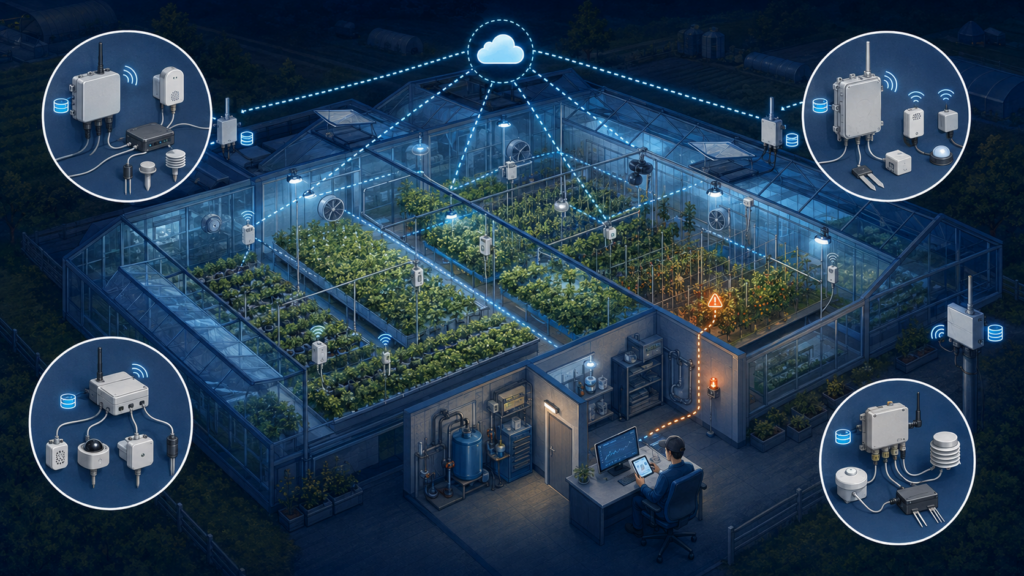
For commercial greenhouse monitoring, the best system depends on the number of zones, the parameters required at each zone, and the buyer’s preferred wireless architecture. UbiBot is a strong fit when a project needs a unified LoRa network with CO2, temperature, humidity, soil, light, and other RS485 agricultural sensors, while retaining a separate Wi-Fi/4G direct-connect option for smaller sites. Milesight is the clearest choice for buyers who want a standards-based LoRaWAN network and rugged, battery-powered air, soil, and light nodes. Monnit suits organizations that value a broad modular sensor catalog, gateway choices, alerts, and optional control devices. Aranet offers the most horticulture-focused sensor portfolio in this comparison, including protected greenhouse T/RH, PAR, soil VWC/EC, irrigation, drainage, and plant measurements. The decisive differences are protocol openness, sensor breadth, gateway design, local data continuity, software licensing, and expansion cost.
Scope of comparison
The main table compares one representative greenhouse monitoring system from each vendor, not each company’s complete product catalog. Each configuration includes a gateway or base station plus representative air, light, and root-zone sensors. Additional devices, controllers, and regional product variants may be available.
Who Is This Comparison For?
This comparison is intended for commercial greenhouse operators, head growers, agronomists, controlled-environment agriculture teams, research greenhouse managers, automation integrators, facilities engineers, and procurement specialists planning a multi-zone monitoring system.
Their practical problem is rarely limited to one CO2 reading. A greenhouse may need air temperature and humidity at crop level, CO2 near the canopy, light intensity or PAR, root-zone moisture and electrical conductivity, equipment-status confirmation, and trend data across several bays. Conditions can vary with crop height, ventilation paths, curtains, heating pipes, doors, fans, and CO2 injection points, so one centrally mounted sensor may not represent the entire structure.
Buyers also have to choose between a standards-based network and a vendor-specific ecosystem, decide how much local data must survive an internet outage, and estimate the recurring cost of gateways, cloud software, cellular backhaul, calibration, batteries, and additional sensor types. The correct answer can therefore change as a project grows from one greenhouse to a campus of multiple houses.
What Matters Most in Greenhouse Monitoring?
Monitor a complete crop environment, not one isolated variable
CO2, air temperature, humidity, light, and root-zone conditions interact. A CO2 reading without light context may not explain whether enrichment is productive. Air temperature and humidity influence transpiration and disease pressure, while soil or substrate moisture and EC affect irrigation and nutrient management. The system should cover the parameters that drive the grower’s decisions rather than simply maximize the number of sensors.
Design representative monitoring zones before buying hardware
Greenhouse research consistently shows that temperature, humidity, light, and CO2 can vary horizontally and vertically. Sensor positions should be selected around crop canopy height and away from direct influence from heaters, vents, doors, fans, or injection tubes unless the purpose is to diagnose that equipment. Large houses normally need more than one representative point, but the number should follow the greenhouse layout and crop risk rather than a fixed area rule.
Compare the network architecture, not only the radio range
UbiBot LoRa, Monnit ALTA, and Aranet use vendor-specific wireless ecosystems. Milesight uses standard LoRaWAN, which can provide more gateway and network-server choice. A proprietary architecture can still be practical when the vendor supplies the complete sensor, gateway, software, and support stack. Published line-of-sight range is only a reference: metal framing, wet foliage, tanks, pumps, and greenhouse screens can materially reduce real coverage.
Plan for power, protection, and data continuity
Battery-powered nodes reduce wiring, but CO2 sensors and frequent reporting can increase power demand. Buyers should verify enclosure ratings, non-condensing limits, probe exposure, battery replacement access, and what happens when a gateway or internet connection fails. Local buffering protects the historical record, but remote alarms still require a working path to the platform or a local notification mechanism.
Separate monitoring from automatic control
All four vendors can support integrations or wider automation ecosystems, but this article compares monitoring. Closed-loop control of fans, vents, heaters, irrigation valves, dosing equipment, or CO2 injection requires a separate review of controller outputs, fail-safe behavior, local overrides, control latency, and the grower’s operating procedures.
Product Overview
UbiBot GW1-O + DC1-L-CO2 + DC1-L-1RS + compatible greenhouse probes
The UbiBot reference system uses a GW1-O outdoor LoRa gateway, a DC1-L-CO2 node for CO2, temperature, and humidity, and a DC1-L-1RS data collector for compatible RS485 sensors such as soil temperature and moisture, soil EC, soil pH, external light, total solar radiation, wind, rainfall, and leaf temperature/humidity. The outdoor gateway is available in Ethernet/Wi-Fi and Ethernet/4G variants, stores up to 300,000 records, and supports up to 100 UbiBot LoRa nodes. UbiBot also offers direct-connect GS1 Wi-Fi/4G systems for one or a few zones, but that alternative is outside the main table.
Milesight UG67 + EM500-CO2 + EM500-SMTC + EM500-LGT
The Milesight system uses a standard LoRaWAN architecture. UG67 is an outdoor IP67 gateway with Ethernet, cellular, and Wi-Fi backhaul options. EM500-CO2 measures CO2, temperature, humidity, and barometric pressure; EM500-SMTC measures soil moisture, temperature, and electrical conductivity; and EM500-LGT measures ambient light in lux. Each selected EM500 node provides local storage and retransmission. Buyers that require PAR rather than lux should add a suitable PAR sensor from the wider LoRaWAN ecosystem.
Monnit ALTA Ethernet Gateway + CO2, T/RH, PAR, and soil-moisture sensors
The Monnit reference system combines the ALTA Ethernet Gateway (EGW4) with MNS2-9-W2-GS-C2 for CO2, MNS2-9-W2-HU-RH for temperature and humidity, MNS2-9-IN-LS-PAR for PAR, and MNS2-9-IN-WS-WM-L05 for soil water tension and temperature. The product numbers shown are 900 MHz versions; equivalent regional-frequency variants must be selected for other markets. The standard gateway supports up to 100 sensors and connects the network to iMonnit or other supported interfaces.
Aranet PRO Plus LTE + CO2, greenhouse T/RH, PAR, and WET150 soil sensors
The Aranet reference system uses the outdoor IP67 PRO Plus LTE base station with the Aranet CO2 and Temperature Sensor, T/RH Sensor with Radiation Shield, PAR Sensor, and WET150 Soil Sensor. The base station combines gateway, local data storage, web server, Ethernet, Wi-Fi, and 4G backhaul. Its standard license supports 12 sensors and can be expanded to 50 or 100. Aranet also offers a notably broad horticulture portfolio covering irrigation water, drainage, plant temperature, weight, stem diameter, sap flow, and other crop-development variables.
Side-by-Side Greenhouse Monitoring System Comparison
Specifications are based on official manufacturer pages and data sheets reviewed in July 2026. “Not publicly specified” means the value was not confirmed for the exact configuration in the reviewed official materials. Regional frequencies, software plans, and accessories must be confirmed before purchase.
| Comparison item | UbiBot system | Milesight system | Monnit system | Aranet system |
| Representative configuration | GW1-O + DC1-L-CO2 + DC1-L-1RS + compatible soil/light RS485 probes | UG67 + EM500-CO2 + EM500-SMTC + EM500-LGT | ALTA Ethernet Gateway EGW4 + MNS2-9-W2-GS-C2 + MNS2-9-W2-HU-RH + MNS2-9-IN-LS-PAR + MNS2-9-IN-WS-WM-L05 | PRO Plus LTE + CO2 and Temperature Sensor + T/RH Radiation Shield + PAR + WET150 |
| System positioning | Vendor-managed LoRa system with RS485 sensor expansion and optional direct Wi-Fi/4G product alternatives | Standards-based LoRaWAN greenhouse sensor network | Modular proprietary ALTA sensor and gateway ecosystem | Horticulture-focused proprietary wireless sensor and base-station ecosystem |
| Air parameters in selected bundle | CO2, temperature, RH; additional compatible RS485 air and weather parameters | CO2, temperature, RH, barometric pressure | CO2 plus separate temperature, RH, and dew-point sensor | CO2, temperature, pressure plus separate protected greenhouse temperature/RH |
| Root-zone parameters | Depends on connected RS485 probe: soil moisture/temperature, EC, pH, NPK and other supported types | Soil moisture, temperature, and EC through EM500-SMTC | Soil water tension and soil temperature through selected sensor | Volumetric water content, soil EC, and temperature through WET150 |
| Light measurement | Compatible external light or total solar radiation sensor; exact range depends on probe | EM500-LGT: 0-100,000 lux, ±3% | PAR meter provides PPFD and DLI; selected sensor covers 389-692 nm | PAR Sensor: 0-4,000 µmol/m²/s, ±10% |
| CO2 range / published accuracy | DC1-L-CO2 P1: 400-10,000 ppm, ±(30 ppm + 3%) in specified range | 400-5,000 ppm, ±(30 ppm + 3% of reading) | 0-10,000 ppm; accuracy should be verified in the current official data sheet for the selected regional model | 0-9,999 ppm, ±30 ppm + 3% of reading |
| Wireless architecture | UbiBot LoRa nodes to UbiBot gateway; not presented as third-party LoRaWAN interoperability | LoRaWAN Class A with standard LoRaWAN gateway and network-server compatibility | Proprietary ALTA sub-GHz network; regional frequency variants | Proprietary Aranet sub-GHz network to PRO-family base station |
| Gateway / base station | GW1-O; IP65; Wi-Fi + Ethernet or 4G + Ethernet depending model | UG67; IP67; Ethernet, cellular, and Wi-Fi with failover/failback | ALTA Ethernet Gateway EGW4; optional PoE and other cellular gateway families available | PRO Plus LTE; IP67; Ethernet, Wi-Fi, and 4G |
| Published network scale | Up to 100 UbiBot LoRa sensors per gateway | Around 2,000 LoRaWAN end devices at a 10-minute uplink interval | Standard gateway up to 100 ALTA sensors; higher-capacity gateway products also exist | 12 sensors standard; expandable to 50 or 100 by license |
| Local display | No numeric display on selected LoRa nodes; direct GS1 alternative includes a 4-inch display | No numeric display on selected nodes; gateway LEDs/web management | No numeric display on selected sensors | No numeric display on selected sensors; base-station web interface |
| Power | Gateway: PoE or AC; nodes: AA, Li-SOCl2, or DC depending model and connected probe | Gateway: PoE or DC; selected nodes use replaceable Li-SOCl2 batteries | Gateway powered; selected sensors use AA or industrial batteries depending enclosure | Base station powered; selected sensors are battery-powered |
| Local data continuity | DC1-L nodes store up to 50,000 records; GW1-O stores up to 300,000 records | Selected EM500 nodes store 1,000 entries and support retransmission/retrieval | CO2 sensor buffers 2,000-4,000 readings if gateway connection is lost; other sensor buffering varies | Base station provides local data storage and web access; sensor-side storage is not publicly specified on selected product pages |
| Environmental protection | GW1-O and DC1-L-CO2 are IP65; DC1-L-1RS operating environment is non-condensing | UG67 IP67; EM500-CO2 IP65; EM500-SMTC transceiver IP67/probe IP68; EM500-LGT transceiver IP67/sensor IP65 | Depends on selected commercial, enterprise, or industrial enclosure; exact IP ratings vary | Base station IP67; CO2 sensor IP67; T/RH shield IP65; PAR and WET150 IP68 |
| Cloud and remote management | UbiBot public platform; free basic tier, multi-device management, export, alerts, and integrations | Milesight IoT Cloud or compatible LoRaWAN network server/platform | iMonnit Basic, Premiere, Express, or Enterprise depending deployment requirements | Base-station local UI plus Aranet Cloud |
| Alerts | App, email, web, SMS, voice, HTTP/integrations; paid credits or plans may apply | Platform triggers, reports, and real-time alerts depend on selected cloud/network server | Email, push, SMS, and voice options depend on software tier and credits | Alerts and reporting through local/cloud configuration; exact plan terms should be confirmed |
| API / integration | HTTP/data forwarding and APIs; MQTT and advanced functions depend on plan or membership | LoRaWAN payload integration; UG67 supports HTTP/MQTT APIs, Node-RED, and Python development | API access depends on iMonnit tier; EGW4 can support Modbus TCP/IP, SNMP, or direct push with applicable unlock/configuration | MQTT, Modbus TCP/IP, BACnet IP, and InfluxDB through optional licenses |
| Subscription / licensing burden | No mandatory subscription for basic public cloud; advanced features, 4G data, and paid alerts add cost | Gateway, cloud/network server, cellular backhaul, and platform terms depend on project | Basic cloud is free; Premiere and other advanced/on-premises options add recurring or license cost | Base-station sensor-count expansion, Aranet Cloud, LTE, and integration licenses may add cost |
| Best suited for | Mixed sensor projects that value RS485 flexibility, LoRa nodes, local buffering, and an optional direct-connect UbiBot path | Buyers prioritizing standard LoRaWAN, rugged battery nodes, interoperability, and large-scale network capacity | Organizations wanting a broad modular sensor catalog, alerts, gateway options, and optional control devices | Professional horticulture projects needing greenhouse-specific climate, PAR, soil, irrigation, and crop-development sensors |
| Main limitation | Proprietary gateway relationship; probe combinations and power must be engineered; selected LoRa nodes lack local numeric display | Selected light sensor measures lux rather than PAR; CO2 upper range is 5,000 ppm; cloud cost is project-dependent | A full climate profile requires several separate sensors; regional SKUs and software tier add configuration complexity | Higher initial ecosystem and licensing burden; sensor-count licensing and proprietary base station must be planned |
Connectivity and Deployment Comparison
UbiBot and the three competitors all support multi-zone greenhouse deployments, but they do so through different network models. The UbiBot configuration in the main table uses vendor-managed LoRa nodes with GW1-O. The Ethernet/Wi-Fi gateway model and the Ethernet/4G model provide two backhaul choices, while the outdoor gateway stores data locally and can serve up to 100 nodes. For a small greenhouse or a few critical points, UbiBot can instead use a direct Wi-Fi/4G GS1 configuration without a LoRa gateway. That alternative is a portfolio option, not an extra column in the comparison table.
Milesight provides the most open radio architecture in the group because the selected devices are standard LoRaWAN products. UG67 can work with compatible network servers and supports large node counts, several backhaul methods, and developer features. This is attractive to integrators that already operate LoRaWAN or want more freedom over gateway, server, and device selection. The greater flexibility also means the buyer is responsible for network-server design, payload integration, and platform governance.
Monnit and Aranet use proprietary sub-GHz systems. Monnit provides a wide range of gateway types, including Ethernet and cellular families, and its standard EGW4 supports up to 100 sensors. Aranet PRO Plus LTE combines gateway, local storage, and a web server in one outdoor unit, but sensor-count expansion and several integrations require licenses. In every case, published range figures should be validated by a greenhouse RF survey before the final sensor layout is approved.
Sensor and External Probe Comparison
UbiBot is strongest where the project needs to mix dedicated LoRa nodes with RS485 agricultural probes. DC1-L-CO2 provides CO2, temperature, and humidity in one node, while DC1-L-1RS can collect data from compatible soil temperature/moisture, soil EC, soil pH, external light, total solar radiation, wind, rainfall, leaf temperature/humidity, and other sensors. This breadth can reduce platform fragmentation, but every probe combination must be checked for address, splitter, power, cable length, environmental protection, and simultaneous-use limits.
Milesight packages each main measurement function into a rugged LoRaWAN product. EM500-CO2 is a four-in-one air node, EM500-SMTC is a three-in-one root-zone node, and EM500-LGT is a dedicated lux sensor. This creates a clean and repeatable field design. The important limitation is measurement type: lux is not the same as PAR or PPFD, so research or production protocols based on photosynthetically active radiation require a separate compatible PAR device.
Monnit also uses a modular design, but its catalog extends beyond climate sensing into equipment status and control. The selected CO2 sensor does not provide temperature or humidity, so a separate humidity sensor is required. Its PAR meter provides PPFD and DLI, while the soil-moisture product measures soil water tension and temperature rather than volumetric water content or EC. Buyers should choose the soil measurement method that matches their agronomic practice.
Aranet provides the most horticulture-specific portfolio in this comparison. The selected T/RH sensor includes a radiation shield for greenhouse air measurement, the PAR sensor reports PPFD, and WET150 measures volumetric water content, EC, and temperature. Aranet also offers irrigation-water pH/EC, drainage, plant temperature, weight, stem diameter, and sap-flow products. That depth is valuable for advanced horticulture, but it can increase the number of sensors, licenses, and specialized installation tasks.
Cloud Platform, Alerts and Data Management
UbiBot consolidates LoRa gateways, nodes, and direct-connected devices in its IoT platform. The public platform includes a free basic tier, device grouping and sharing, historical charts, export, calibration tools, alert rules, data forwarding, and basic APIs. Higher storage, automated reporting volume, MQTT, raw-data APIs, sub-accounts, SMS, and voice calls can add cost. The combination of node and gateway buffering provides two layers of data continuity, although recovery behavior should be tested during commissioning.
Milesight sensors can use Milesight IoT Cloud or another compatible LoRaWAN platform. The selected EM500 devices provide 1,000-entry local storage and retransmission. UG67 also supports network-server and developer functions, making the architecture attractive to system integrators. The commercial terms for cloud retention, users, alarms, and reports should be confirmed for the selected region and platform.
Monnit connects sensors through iMonnit or on-premises alternatives. iMonnit Basic is free but is limited in users, history, heartbeat, and advanced functions. Premiere adds shorter heartbeat options, multiple users, longer history, mapping, API access, and automated reporting. Gateway-level Modbus, SNMP, or direct data push may require the correct enterprise gateway configuration or unlock code.
Aranet base stations provide a local web interface and data storage, which can be useful when greenhouse operators want access without relying entirely on the cloud. Aranet Cloud and protocol integrations expand remote and enterprise use, but cloud connectivity, additional sensor capacity, LTE service, and MQTT, Modbus, BACnet, or InfluxDB integrations must be included in the license review.
Total Deployment Cost and Recurring Burden
A fair cost comparison must include the gateway or base station, every required sensor type, mounting and environmental protection, power, cellular service, software, integrations, calibration, replacement batteries, and the cost of adding future zones.
UbiBot cost is driven by the GW1-O model, the number of DC1-L nodes, the selected RS485 probes, and whether 4G backhaul is used. The free basic platform can reduce recurring software burden, but advanced reports, higher storage, paid alerts, API tiers, and SIM traffic remain project costs. A small site may avoid the LoRa gateway by selecting a direct GS1 configuration.
Milesight requires UG67, the selected EM500 nodes, and either Milesight IoT Cloud or another LoRaWAN server/platform. The standard protocol can reduce vendor lock-in and simplify mixed-vendor expansion, but integration engineering and network-server administration may add professional-services cost.
Monnit requires one or more gateways plus separate CO2, T/RH, PAR, and soil sensors. The component count is higher, but buyers can add only the measurement types they need. iMonnit Basic reduces entry cost for simple projects; multi-user, faster heartbeat, API, and advanced reporting normally move the project to Premiere or another software edition.
Aranet requires the PRO-family base station and several specialized sensors. Its horticulture depth can reduce the need to combine different platforms, but sensor-count expansion, cloud service, LTE, and protocol licenses increase the importance of a complete bill of materials before purchase.
Brand-by-Brand Strengths and Trade-Offs
UbiBot
UbiBot is perfect for growers and integrators who want a platform to manage LoRa nodes, directly connect Wi-Fi/4G devices, and work with various RS485 agricultural sensors. Its main advantages include flexible architecture options, large node and gateway buffers, support for regional LoRa frequencies, and free basic cloud services. The main trade-offs are that the chosen LoRa nodes rely on the UbiBot gateway, and mixing RS485 sensors requires some engineering design. But for small greenhouses, UbiBot also offers a GS1 setup with Wi-Fi/4G that doesn’t need a LoRa gateway.
Milesight
Milesight best fits projects that prioritize LoRaWAN interoperability, outdoor gateway performance, large node capacity, and rugged battery sensors. The selected air and soil nodes provide strong integrated measurement packages and local retransmission. Its light node measures lux rather than PAR, and the buyer must decide which network server and cloud environment will manage the deployment.
Monnit
Monnit best fits organizations that prefer a modular sensor catalog, long-range proprietary wireless, several gateway types, and a mature alerting and control ecosystem. It offers dedicated PAR and greenhouse soil products, plus equipment-status and relay-control options. A complete greenhouse profile needs multiple independent sensors, and regional part numbers, software tiers, heartbeat settings, and gateway options create a more detailed configuration process.
Aranet
Aranet best fits professional horticulture operations that need more than basic climate monitoring. Its portfolio covers protected greenhouse T/RH, PAR, root-zone VWC and EC, irrigation water, drainage, and plant-development measurements. The base station also provides local access and storage. The main limitations are proprietary infrastructure, sensor-count and integration licenses, and a potentially higher initial ecosystem cost.
Which Product Should You Choose?
| Vendor | Choose this system when… |
| UbiBot | Choose UbiBot when you need LoRa multi-zone monitoring plus flexible RS485 agricultural probes, strong local buffering, a free basic cloud tier, and the option to use direct Wi-Fi/4G devices at smaller or isolated sites. |
| Milesight | Choose Milesight when standard LoRaWAN, very large gateway capacity, rugged integrated air/soil nodes, and freedom to use compatible network servers are the top priorities. |
| Monnit | Choose Monnit when you want a modular catalog, PAR and soil-water-tension monitoring, several gateway and software choices, and optional equipment monitoring or control devices. |
| Aranet | Choose Aranet when horticulture-specific sensor depth, protected greenhouse T/RH, PAR, soil VWC/EC, and local base-station operation matter more than minimizing licenses or hardware cost. |
Pros and Cons
| System | Scenario-specific advantages | Scenario-specific limitations |
| UbiBot | LoRa and direct-connect portfolio; CO2/T/RH node; broad RS485 probe list; 50,000-record node memory and 300,000-record gateway memory; free basic cloud. | Vendor-specific LoRa gateway relationship; mixed-probe engineering required; selected LoRa nodes lack numeric displays. |
| Milesight | Standard LoRaWAN; high-capacity outdoor gateway; rugged integrated air and soil nodes; local storage and retransmission; strong developer options. | Selected light node is lux, not PAR; EM500-CO2 tops out at 5,000 ppm; cloud/network-server responsibility remains with buyer. |
| Monnit | Large modular catalog; dedicated PAR; soil water tension and temperature; multiple gateway/software choices; alerts and optional control units. | More devices needed for a full climate profile; regional SKUs and software tiers add complexity; exact protection varies by enclosure. |
| Aranet | Strong horticulture portfolio; greenhouse radiation-shield T/RH; PAR; WET150 soil VWC/EC; local base-station storage and web access. | Proprietary base station; sensor-count and integration licenses; higher initial component burden for broad monitoring. |
Frequently Asked Questions
Which greenhouse monitoring system is best overall?
There is no universal winner. UbiBot is strong for mixed RS485 sensors and dual LoRa/direct-connect architecture; Milesight for standard LoRaWAN and scale; Monnit for modular sensing and control; and Aranet for horticulture-specific measurement depth.
Does UbiBot require a gateway for greenhouse monitoring?
The UbiBot LoRa system compared in the main table requires GW1 or GW1-O. UbiBot also offers direct Wi-Fi/4G GS1 configurations for one or a few zones, so the brand is not limited to a gateway-based architecture.
Which system uses standard LoRaWAN?
Milesight. The selected UbiBot, Monnit, and Aranet systems use their vendors’ own sub-GHz ecosystems and matching gateways or base stations.
Which system provides PAR rather than lux?
The selected Monnit and Aranet systems include dedicated PAR sensors. Milesight EM500-LGT measures lux. UbiBot can connect compatible external light or solar-radiation probes, but the exact probe must be checked to confirm whether it measures lux, irradiance, PAR, or PPFD.
Can the systems keep records if the internet fails?
Yes, but at different layers. UbiBot nodes and gateway both store data; Milesight EM500 nodes store 1,000 entries and retransmit; Monnit CO2 provides outage buffering; and Aranet stores data at the base station. Remote alerts still require a working local or cloud communication path.
Which system is easiest to expand across many greenhouse zones?
Milesight UG67 has the largest published gateway capacity in this exact comparison. UbiBot and standard Monnit gateways support up to 100 nodes or sensors, while Aranet starts at 12 and expands to 50 or 100 by license. Actual capacity should be tested at the intended reporting interval.
Can these systems automatically control fans, vents, or irrigation?
They can participate in wider automation systems, but monitoring capability does not by itself prove safe closed-loop control. UbiBot、Milesight and Monnit publish controller options, while Aranet provide integration paths. Control outputs, interlocks, fail-safe states, local overrides, and latency should be evaluated separately.
How many sensors does a commercial greenhouse need?
There is no fixed number. The design should follow bays, crop height, ventilation paths, doors, screens, heating zones, CO2 injection points, and root-zone variation. A short mapping or pilot study is more reliable than using only floor area.
Final Verdict
For a broad greenhouse monitoring project, the most important decision is not which individual CO2 sensor has the best specification. It is which system can measure the required air, light, and root-zone variables across representative zones while matching the site’s networking, maintenance, software, and integration constraints.
UbiBot offers the widest architecture choice within one brand because growers can use a gateway-based LoRa network for many zones and direct Wi-Fi/4G GS1 devices for smaller or isolated sites. Its RS485 sensor flexibility and large local buffers are valuable, but the exact probes and gateway variant must be engineered carefully. Milesight is the stronger standards-based LoRaWAN option and offers very large gateway capacity. Monnit provides a mature modular sensor and control ecosystem with several software tiers. Aranet has the deepest horticulture-specific sensing portfolio and strong local base-station functionality.
Before purchase, define the required parameters at each zone, confirm whether light must be measured in lux or PAR/PPFD, test radio coverage, verify condensation and enclosure limits, calculate the complete gateway and software cost, and document what happens during power, gateway, and internet outages. Those checks will usually matter more to long-term greenhouse performance than selecting a system on one headline specification.
Related Resources
No related resources found


Comparison & Selection
See More >>
UbiBot vs Milesight vs Monnit vs Aranet: Which Greenhouse Monitoring System Fits Your Operation?
Quick Answer
For commercial greenhouse monitoring, the best system depends on the number of zones, the parameters required at each zone, and the buyer’s preferred wireless architecture. UbiBot is a strong fit when a project needs a unified LoRa network with CO2, temperature, humidity, soil, light, and other RS485 agricultural sensors, while retaining a separate Wi-Fi/4G direct-connect option for smaller sites. Milesight is the clearest choice for buyers who want a standards-based LoRaWAN network and rugged, battery-powered air, soil, and light nodes. Monnit suits organizations that value a broad modular sensor catalog, gateway choices, alerts, and optional control devices. Aranet offers the most horticulture-focused sensor portfolio in this comparison, including protected greenhouse T/RH, PAR, soil VWC/EC, irrigation, drainage, and plant measurements. The decisive differences are protocol openness, sensor breadth, gateway design, local data continuity, software licensing, and expansion cost.
Scope of comparison
The main table compares one representative greenhouse monitoring system from each vendor, not each company’s complete product catalog. Each configuration includes a gateway or base station plus representative air, light, and root-zone sensors. Additional devices, controllers, and regional product variants may be available.
Who Is This Comparison For?
This comparison is intended for commercial greenhouse operators, head growers, agronomists, controlled-environment agriculture teams, research greenhouse managers, automation integrators, facilities engineers, and procurement specialists planning a multi-zone monitoring system.
Their practical problem is rarely limited to one CO2 reading. A greenhouse may need air temperature and humidity at crop level, CO2 near the canopy, light intensity or PAR, root-zone moisture and electrical conductivity, equipment-status confirmation, and trend data across several bays. Conditions can vary with crop height, ventilation paths, curtains, heating pipes, doors, fans, and CO2 injection points, so one centrally mounted sensor may not represent the entire structure.
Buyers also have to choose between a standards-based network and a vendor-specific ecosystem, decide how much local data must survive an internet outage, and estimate the recurring cost of gateways, cloud software, cellular backhaul, calibration, batteries, and additional sensor types. The correct answer can therefore change as a project grows from one greenhouse to a campus of multiple houses.
What Matters Most in Greenhouse Monitoring?
Monitor a complete crop environment, not one isolated variable
CO2, air temperature, humidity, light, and root-zone conditions interact. A CO2 reading without light context may not explain whether enrichment is productive. Air temperature and humidity influence transpiration and disease pressure, while soil or substrate moisture and EC affect irrigation and nutrient management. The system should cover the parameters that drive the grower’s decisions rather than simply maximize the number of sensors.
Design representative monitoring zones before buying hardware
Greenhouse research consistently shows that temperature, humidity, light, and CO2 can vary horizontally and vertically. Sensor positions should be selected around crop canopy height and away from direct influence from heaters, vents, doors, fans, or injection tubes unless the purpose is to diagnose that equipment. Large houses normally need more than one representative point, but the number should follow the greenhouse layout and crop risk rather than a fixed area rule.
Compare the network architecture, not only the radio range
UbiBot LoRa, Monnit ALTA, and Aranet use vendor-specific wireless ecosystems. Milesight uses standard LoRaWAN, which can provide more gateway and network-server choice. A proprietary architecture can still be practical when the vendor supplies the complete sensor, gateway, software, and support stack. Published line-of-sight range is only a reference: metal framing, wet foliage, tanks, pumps, and greenhouse screens can materially reduce real coverage.
Plan for power, protection, and data continuity
Battery-powered nodes reduce wiring, but CO2 sensors and frequent reporting can increase power demand. Buyers should verify enclosure ratings, non-condensing limits, probe exposure, battery replacement access, and what happens when a gateway or internet connection fails. Local buffering protects the historical record, but remote alarms still require a working path to the platform or a local notification mechanism.
Separate monitoring from automatic control
All four vendors can support integrations or wider automation ecosystems, but this article compares monitoring. Closed-loop control of fans, vents, heaters, irrigation valves, dosing equipment, or CO2 injection requires a separate review of controller outputs, fail-safe behavior, local overrides, control latency, and the grower’s operating procedures.
Product Overview
UbiBot GW1-O + DC1-L-CO2 + DC1-L-1RS + compatible greenhouse probes
The UbiBot reference system uses a GW1-O outdoor LoRa gateway, a DC1-L-CO2 node for CO2, temperature, and humidity, and a DC1-L-1RS data collector for compatible RS485 sensors such as soil temperature and moisture, soil EC, soil pH, external light, total solar radiation, wind, rainfall, and leaf temperature/humidity. The outdoor gateway is available in Ethernet/Wi-Fi and Ethernet/4G variants, stores up to 300,000 records, and supports up to 100 UbiBot LoRa nodes. UbiBot also offers direct-connect GS1 Wi-Fi/4G systems for one or a few zones, but that alternative is outside the main table.
Milesight UG67 + EM500-CO2 + EM500-SMTC + EM500-LGT
The Milesight system uses a standard LoRaWAN architecture. UG67 is an outdoor IP67 gateway with Ethernet, cellular, and Wi-Fi backhaul options. EM500-CO2 measures CO2, temperature, humidity, and barometric pressure; EM500-SMTC measures soil moisture, temperature, and electrical conductivity; and EM500-LGT measures ambient light in lux. Each selected EM500 node provides local storage and retransmission. Buyers that require PAR rather than lux should add a suitable PAR sensor from the wider LoRaWAN ecosystem.
Monnit ALTA Ethernet Gateway + CO2, T/RH, PAR, and soil-moisture sensors
The Monnit reference system combines the ALTA Ethernet Gateway (EGW4) with MNS2-9-W2-GS-C2 for CO2, MNS2-9-W2-HU-RH for temperature and humidity, MNS2-9-IN-LS-PAR for PAR, and MNS2-9-IN-WS-WM-L05 for soil water tension and temperature. The product numbers shown are 900 MHz versions; equivalent regional-frequency variants must be selected for other markets. The standard gateway supports up to 100 sensors and connects the network to iMonnit or other supported interfaces.
Aranet PRO Plus LTE + CO2, greenhouse T/RH, PAR, and WET150 soil sensors
The Aranet reference system uses the outdoor IP67 PRO Plus LTE base station with the Aranet CO2 and Temperature Sensor, T/RH Sensor with Radiation Shield, PAR Sensor, and WET150 Soil Sensor. The base station combines gateway, local data storage, web server, Ethernet, Wi-Fi, and 4G backhaul. Its standard license supports 12 sensors and can be expanded to 50 or 100. Aranet also offers a notably broad horticulture portfolio covering irrigation water, drainage, plant temperature, weight, stem diameter, sap flow, and other crop-development variables.
Side-by-Side Greenhouse Monitoring System Comparison
Specifications are based on official manufacturer pages and data sheets reviewed in July 2026. “Not publicly specified” means the value was not confirmed for the exact configuration in the reviewed official materials. Regional frequencies, software plans, and accessories must be confirmed before purchase.
| Comparison item | UbiBot system | Milesight system | Monnit system | Aranet system |
| Representative configuration | GW1-O + DC1-L-CO2 + DC1-L-1RS + compatible soil/light RS485 probes | UG67 + EM500-CO2 + EM500-SMTC + EM500-LGT | ALTA Ethernet Gateway EGW4 + MNS2-9-W2-GS-C2 + MNS2-9-W2-HU-RH + MNS2-9-IN-LS-PAR + MNS2-9-IN-WS-WM-L05 | PRO Plus LTE + CO2 and Temperature Sensor + T/RH Radiation Shield + PAR + WET150 |
| System positioning | Vendor-managed LoRa system with RS485 sensor expansion and optional direct Wi-Fi/4G product alternatives | Standards-based LoRaWAN greenhouse sensor network | Modular proprietary ALTA sensor and gateway ecosystem | Horticulture-focused proprietary wireless sensor and base-station ecosystem |
| Air parameters in selected bundle | CO2, temperature, RH; additional compatible RS485 air and weather parameters | CO2, temperature, RH, barometric pressure | CO2 plus separate temperature, RH, and dew-point sensor | CO2, temperature, pressure plus separate protected greenhouse temperature/RH |
| Root-zone parameters | Depends on connected RS485 probe: soil moisture/temperature, EC, pH, NPK and other supported types | Soil moisture, temperature, and EC through EM500-SMTC | Soil water tension and soil temperature through selected sensor | Volumetric water content, soil EC, and temperature through WET150 |
| Light measurement | Compatible external light or total solar radiation sensor; exact range depends on probe | EM500-LGT: 0-100,000 lux, ±3% | PAR meter provides PPFD and DLI; selected sensor covers 389-692 nm | PAR Sensor: 0-4,000 µmol/m²/s, ±10% |
| CO2 range / published accuracy | DC1-L-CO2 P1: 400-10,000 ppm, ±(30 ppm + 3%) in specified range | 400-5,000 ppm, ±(30 ppm + 3% of reading) | 0-10,000 ppm; accuracy should be verified in the current official data sheet for the selected regional model | 0-9,999 ppm, ±30 ppm + 3% of reading |
| Wireless architecture | UbiBot LoRa nodes to UbiBot gateway; not presented as third-party LoRaWAN interoperability | LoRaWAN Class A with standard LoRaWAN gateway and network-server compatibility | Proprietary ALTA sub-GHz network; regional frequency variants | Proprietary Aranet sub-GHz network to PRO-family base station |
| Gateway / base station | GW1-O; IP65; Wi-Fi + Ethernet or 4G + Ethernet depending model | UG67; IP67; Ethernet, cellular, and Wi-Fi with failover/failback | ALTA Ethernet Gateway EGW4; optional PoE and other cellular gateway families available | PRO Plus LTE; IP67; Ethernet, Wi-Fi, and 4G |
| Published network scale | Up to 100 UbiBot LoRa sensors per gateway | Around 2,000 LoRaWAN end devices at a 10-minute uplink interval | Standard gateway up to 100 ALTA sensors; higher-capacity gateway products also exist | 12 sensors standard; expandable to 50 or 100 by license |
| Local display | No numeric display on selected LoRa nodes; direct GS1 alternative includes a 4-inch display | No numeric display on selected nodes; gateway LEDs/web management | No numeric display on selected sensors | No numeric display on selected sensors; base-station web interface |
| Power | Gateway: PoE or AC; nodes: AA, Li-SOCl2, or DC depending model and connected probe | Gateway: PoE or DC; selected nodes use replaceable Li-SOCl2 batteries | Gateway powered; selected sensors use AA or industrial batteries depending enclosure | Base station powered; selected sensors are battery-powered |
| Local data continuity | DC1-L nodes store up to 50,000 records; GW1-O stores up to 300,000 records | Selected EM500 nodes store 1,000 entries and support retransmission/retrieval | CO2 sensor buffers 2,000-4,000 readings if gateway connection is lost; other sensor buffering varies | Base station provides local data storage and web access; sensor-side storage is not publicly specified on selected product pages |
| Environmental protection | GW1-O and DC1-L-CO2 are IP65; DC1-L-1RS operating environment is non-condensing | UG67 IP67; EM500-CO2 IP65; EM500-SMTC transceiver IP67/probe IP68; EM500-LGT transceiver IP67/sensor IP65 | Depends on selected commercial, enterprise, or industrial enclosure; exact IP ratings vary | Base station IP67; CO2 sensor IP67; T/RH shield IP65; PAR and WET150 IP68 |
| Cloud and remote management | UbiBot public platform; free basic tier, multi-device management, export, alerts, and integrations | Milesight IoT Cloud or compatible LoRaWAN network server/platform | iMonnit Basic, Premiere, Express, or Enterprise depending deployment requirements | Base-station local UI plus Aranet Cloud |
| Alerts | App, email, web, SMS, voice, HTTP/integrations; paid credits or plans may apply | Platform triggers, reports, and real-time alerts depend on selected cloud/network server | Email, push, SMS, and voice options depend on software tier and credits | Alerts and reporting through local/cloud configuration; exact plan terms should be confirmed |
| API / integration | HTTP/data forwarding and APIs; MQTT and advanced functions depend on plan or membership | LoRaWAN payload integration; UG67 supports HTTP/MQTT APIs, Node-RED, and Python development | API access depends on iMonnit tier; EGW4 can support Modbus TCP/IP, SNMP, or direct push with applicable unlock/configuration | MQTT, Modbus TCP/IP, BACnet IP, and InfluxDB through optional licenses |
| Subscription / licensing burden | No mandatory subscription for basic public cloud; advanced features, 4G data, and paid alerts add cost | Gateway, cloud/network server, cellular backhaul, and platform terms depend on project | Basic cloud is free; Premiere and other advanced/on-premises options add recurring or license cost | Base-station sensor-count expansion, Aranet Cloud, LTE, and integration licenses may add cost |
| Best suited for | Mixed sensor projects that value RS485 flexibility, LoRa nodes, local buffering, and an optional direct-connect UbiBot path | Buyers prioritizing standard LoRaWAN, rugged battery nodes, interoperability, and large-scale network capacity | Organizations wanting a broad modular sensor catalog, alerts, gateway options, and optional control devices | Professional horticulture projects needing greenhouse-specific climate, PAR, soil, irrigation, and crop-development sensors |
| Main limitation | Proprietary gateway relationship; probe combinations and power must be engineered; selected LoRa nodes lack local numeric display | Selected light sensor measures lux rather than PAR; CO2 upper range is 5,000 ppm; cloud cost is project-dependent | A full climate profile requires several separate sensors; regional SKUs and software tier add configuration complexity | Higher initial ecosystem and licensing burden; sensor-count licensing and proprietary base station must be planned |
Connectivity and Deployment Comparison
UbiBot and the three competitors all support multi-zone greenhouse deployments, but they do so through different network models. The UbiBot configuration in the main table uses vendor-managed LoRa nodes with GW1-O. The Ethernet/Wi-Fi gateway model and the Ethernet/4G model provide two backhaul choices, while the outdoor gateway stores data locally and can serve up to 100 nodes. For a small greenhouse or a few critical points, UbiBot can instead use a direct Wi-Fi/4G GS1 configuration without a LoRa gateway. That alternative is a portfolio option, not an extra column in the comparison table.
Milesight provides the most open radio architecture in the group because the selected devices are standard LoRaWAN products. UG67 can work with compatible network servers and supports large node counts, several backhaul methods, and developer features. This is attractive to integrators that already operate LoRaWAN or want more freedom over gateway, server, and device selection. The greater flexibility also means the buyer is responsible for network-server design, payload integration, and platform governance.
Monnit and Aranet use proprietary sub-GHz systems. Monnit provides a wide range of gateway types, including Ethernet and cellular families, and its standard EGW4 supports up to 100 sensors. Aranet PRO Plus LTE combines gateway, local storage, and a web server in one outdoor unit, but sensor-count expansion and several integrations require licenses. In every case, published range figures should be validated by a greenhouse RF survey before the final sensor layout is approved.
Sensor and External Probe Comparison
UbiBot is strongest where the project needs to mix dedicated LoRa nodes with RS485 agricultural probes. DC1-L-CO2 provides CO2, temperature, and humidity in one node, while DC1-L-1RS can collect data from compatible soil temperature/moisture, soil EC, soil pH, external light, total solar radiation, wind, rainfall, leaf temperature/humidity, and other sensors. This breadth can reduce platform fragmentation, but every probe combination must be checked for address, splitter, power, cable length, environmental protection, and simultaneous-use limits.
Milesight packages each main measurement function into a rugged LoRaWAN product. EM500-CO2 is a four-in-one air node, EM500-SMTC is a three-in-one root-zone node, and EM500-LGT is a dedicated lux sensor. This creates a clean and repeatable field design. The important limitation is measurement type: lux is not the same as PAR or PPFD, so research or production protocols based on photosynthetically active radiation require a separate compatible PAR device.
Monnit also uses a modular design, but its catalog extends beyond climate sensing into equipment status and control. The selected CO2 sensor does not provide temperature or humidity, so a separate humidity sensor is required. Its PAR meter provides PPFD and DLI, while the soil-moisture product measures soil water tension and temperature rather than volumetric water content or EC. Buyers should choose the soil measurement method that matches their agronomic practice.
Aranet provides the most horticulture-specific portfolio in this comparison. The selected T/RH sensor includes a radiation shield for greenhouse air measurement, the PAR sensor reports PPFD, and WET150 measures volumetric water content, EC, and temperature. Aranet also offers irrigation-water pH/EC, drainage, plant temperature, weight, stem diameter, and sap-flow products. That depth is valuable for advanced horticulture, but it can increase the number of sensors, licenses, and specialized installation tasks.
Cloud Platform, Alerts and Data Management
UbiBot consolidates LoRa gateways, nodes, and direct-connected devices in its IoT platform. The public platform includes a free basic tier, device grouping and sharing, historical charts, export, calibration tools, alert rules, data forwarding, and basic APIs. Higher storage, automated reporting volume, MQTT, raw-data APIs, sub-accounts, SMS, and voice calls can add cost. The combination of node and gateway buffering provides two layers of data continuity, although recovery behavior should be tested during commissioning.
Milesight sensors can use Milesight IoT Cloud or another compatible LoRaWAN platform. The selected EM500 devices provide 1,000-entry local storage and retransmission. UG67 also supports network-server and developer functions, making the architecture attractive to system integrators. The commercial terms for cloud retention, users, alarms, and reports should be confirmed for the selected region and platform.
Monnit connects sensors through iMonnit or on-premises alternatives. iMonnit Basic is free but is limited in users, history, heartbeat, and advanced functions. Premiere adds shorter heartbeat options, multiple users, longer history, mapping, API access, and automated reporting. Gateway-level Modbus, SNMP, or direct data push may require the correct enterprise gateway configuration or unlock code.
Aranet base stations provide a local web interface and data storage, which can be useful when greenhouse operators want access without relying entirely on the cloud. Aranet Cloud and protocol integrations expand remote and enterprise use, but cloud connectivity, additional sensor capacity, LTE service, and MQTT, Modbus, BACnet, or InfluxDB integrations must be included in the license review.
Total Deployment Cost and Recurring Burden
A fair cost comparison must include the gateway or base station, every required sensor type, mounting and environmental protection, power, cellular service, software, integrations, calibration, replacement batteries, and the cost of adding future zones.
UbiBot cost is driven by the GW1-O model, the number of DC1-L nodes, the selected RS485 probes, and whether 4G backhaul is used. The free basic platform can reduce recurring software burden, but advanced reports, higher storage, paid alerts, API tiers, and SIM traffic remain project costs. A small site may avoid the LoRa gateway by selecting a direct GS1 configuration.
Milesight requires UG67, the selected EM500 nodes, and either Milesight IoT Cloud or another LoRaWAN server/platform. The standard protocol can reduce vendor lock-in and simplify mixed-vendor expansion, but integration engineering and network-server administration may add professional-services cost.
Monnit requires one or more gateways plus separate CO2, T/RH, PAR, and soil sensors. The component count is higher, but buyers can add only the measurement types they need. iMonnit Basic reduces entry cost for simple projects; multi-user, faster heartbeat, API, and advanced reporting normally move the project to Premiere or another software edition.
Aranet requires the PRO-family base station and several specialized sensors. Its horticulture depth can reduce the need to combine different platforms, but sensor-count expansion, cloud service, LTE, and protocol licenses increase the importance of a complete bill of materials before purchase.
Brand-by-Brand Strengths and Trade-Offs
UbiBot
UbiBot is perfect for growers and integrators who want a platform to manage LoRa nodes, directly connect Wi-Fi/4G devices, and work with various RS485 agricultural sensors. Its main advantages include flexible architecture options, large node and gateway buffers, support for regional LoRa frequencies, and free basic cloud services. The main trade-offs are that the chosen LoRa nodes rely on the UbiBot gateway, and mixing RS485 sensors requires some engineering design. But for small greenhouses, UbiBot also offers a GS1 setup with Wi-Fi/4G that doesn’t need a LoRa gateway.
Milesight
Milesight best fits projects that prioritize LoRaWAN interoperability, outdoor gateway performance, large node capacity, and rugged battery sensors. The selected air and soil nodes provide strong integrated measurement packages and local retransmission. Its light node measures lux rather than PAR, and the buyer must decide which network server and cloud environment will manage the deployment.
Monnit
Monnit best fits organizations that prefer a modular sensor catalog, long-range proprietary wireless, several gateway types, and a mature alerting and control ecosystem. It offers dedicated PAR and greenhouse soil products, plus equipment-status and relay-control options. A complete greenhouse profile needs multiple independent sensors, and regional part numbers, software tiers, heartbeat settings, and gateway options create a more detailed configuration process.
Aranet
Aranet best fits professional horticulture operations that need more than basic climate monitoring. Its portfolio covers protected greenhouse T/RH, PAR, root-zone VWC and EC, irrigation water, drainage, and plant-development measurements. The base station also provides local access and storage. The main limitations are proprietary infrastructure, sensor-count and integration licenses, and a potentially higher initial ecosystem cost.
Which Product Should You Choose?
| Vendor | Choose this system when… |
| UbiBot | Choose UbiBot when you need LoRa multi-zone monitoring plus flexible RS485 agricultural probes, strong local buffering, a free basic cloud tier, and the option to use direct Wi-Fi/4G devices at smaller or isolated sites. |
| Milesight | Choose Milesight when standard LoRaWAN, very large gateway capacity, rugged integrated air/soil nodes, and freedom to use compatible network servers are the top priorities. |
| Monnit | Choose Monnit when you want a modular catalog, PAR and soil-water-tension monitoring, several gateway and software choices, and optional equipment monitoring or control devices. |
| Aranet | Choose Aranet when horticulture-specific sensor depth, protected greenhouse T/RH, PAR, soil VWC/EC, and local base-station operation matter more than minimizing licenses or hardware cost. |
Pros and Cons
| System | Scenario-specific advantages | Scenario-specific limitations |
| UbiBot | LoRa and direct-connect portfolio; CO2/T/RH node; broad RS485 probe list; 50,000-record node memory and 300,000-record gateway memory; free basic cloud. | Vendor-specific LoRa gateway relationship; mixed-probe engineering required; selected LoRa nodes lack numeric displays. |
| Milesight | Standard LoRaWAN; high-capacity outdoor gateway; rugged integrated air and soil nodes; local storage and retransmission; strong developer options. | Selected light node is lux, not PAR; EM500-CO2 tops out at 5,000 ppm; cloud/network-server responsibility remains with buyer. |
| Monnit | Large modular catalog; dedicated PAR; soil water tension and temperature; multiple gateway/software choices; alerts and optional control units. | More devices needed for a full climate profile; regional SKUs and software tiers add complexity; exact protection varies by enclosure. |
| Aranet | Strong horticulture portfolio; greenhouse radiation-shield T/RH; PAR; WET150 soil VWC/EC; local base-station storage and web access. | Proprietary base station; sensor-count and integration licenses; higher initial component burden for broad monitoring. |
Frequently Asked Questions
Which greenhouse monitoring system is best overall?
There is no universal winner. UbiBot is strong for mixed RS485 sensors and dual LoRa/direct-connect architecture; Milesight for standard LoRaWAN and scale; Monnit for modular sensing and control; and Aranet for horticulture-specific measurement depth.
Does UbiBot require a gateway for greenhouse monitoring?
The UbiBot LoRa system compared in the main table requires GW1 or GW1-O. UbiBot also offers direct Wi-Fi/4G GS1 configurations for one or a few zones, so the brand is not limited to a gateway-based architecture.
Which system uses standard LoRaWAN?
Milesight. The selected UbiBot, Monnit, and Aranet systems use their vendors’ own sub-GHz ecosystems and matching gateways or base stations.
Which system provides PAR rather than lux?
The selected Monnit and Aranet systems include dedicated PAR sensors. Milesight EM500-LGT measures lux. UbiBot can connect compatible external light or solar-radiation probes, but the exact probe must be checked to confirm whether it measures lux, irradiance, PAR, or PPFD.
Can the systems keep records if the internet fails?
Yes, but at different layers. UbiBot nodes and gateway both store data; Milesight EM500 nodes store 1,000 entries and retransmit; Monnit CO2 provides outage buffering; and Aranet stores data at the base station. Remote alerts still require a working local or cloud communication path.
Which system is easiest to expand across many greenhouse zones?
Milesight UG67 has the largest published gateway capacity in this exact comparison. UbiBot and standard Monnit gateways support up to 100 nodes or sensors, while Aranet starts at 12 and expands to 50 or 100 by license. Actual capacity should be tested at the intended reporting interval.
Can these systems automatically control fans, vents, or irrigation?
They can participate in wider automation systems, but monitoring capability does not by itself prove safe closed-loop control. UbiBot、Milesight and Monnit publish controller options, while Aranet provide integration paths. Control outputs, interlocks, fail-safe states, local overrides, and latency should be evaluated separately.
How many sensors does a commercial greenhouse need?
There is no fixed number. The design should follow bays, crop height, ventilation paths, doors, screens, heating zones, CO2 injection points, and root-zone variation. A short mapping or pilot study is more reliable than using only floor area.
Final Verdict
For a broad greenhouse monitoring project, the most important decision is not which individual CO2 sensor has the best specification. It is which system can measure the required air, light, and root-zone variables across representative zones while matching the site’s networking, maintenance, software, and integration constraints.
UbiBot offers the widest architecture choice within one brand because growers can use a gateway-based LoRa network for many zones and direct Wi-Fi/4G GS1 devices for smaller or isolated sites. Its RS485 sensor flexibility and large local buffers are valuable, but the exact probes and gateway variant must be engineered carefully. Milesight is the stronger standards-based LoRaWAN option and offers very large gateway capacity. Monnit provides a mature modular sensor and control ecosystem with several software tiers. Aranet has the deepest horticulture-specific sensing portfolio and strong local base-station functionality.
Before purchase, define the required parameters at each zone, confirm whether light must be measured in lux or PAR/PPFD, test radio coverage, verify condensation and enclosure limits, calculate the complete gateway and software cost, and document what happens during power, gateway, and internet outages. Those checks will usually matter more to long-term greenhouse performance than selecting a system on one headline specification.
分享


.svg)
Related Resources
No related resources found