UbiBot vs Dickson vs Testo vs Monnit: Which Is Better for Cold Storage Warehouses?
Key Takeaway
Best choice depends on warehouse scale and network architecture
For most small and medium cold storage warehouses with Ethernet or reliable Wi-Fi, UbiBot GS1-AETH1RS with UB-DT-P1 offers the most balanced no-gateway architecture: direct RJ45/Wi-Fi, optional PoE, an IP65 main unit, 300,000 local records, a stainless-steel probe covering -55°C to 125°C, RS485 expansion, and a free basic cloud plan. Dickson DWE2 is better when replaceable calibrated sensors, local audible alarms, a 72-hour battery backup, and structured quality reporting justify a mandatory subscription. testo Saveris 2-T1 is the clearest temperature-only option when a compact IP65 Wi-Fi logger and TÜV Süd testing according to EN 12830 matter, but it has no external probe or Ethernet. Monnit ALTA is strongest for large multi-point warehouses and difficult Wi-Fi coverage because many long-range battery nodes can share a gateway. The decisive difference is system architecture, probe placement, and lifecycle cost—not headline accuracy alone.
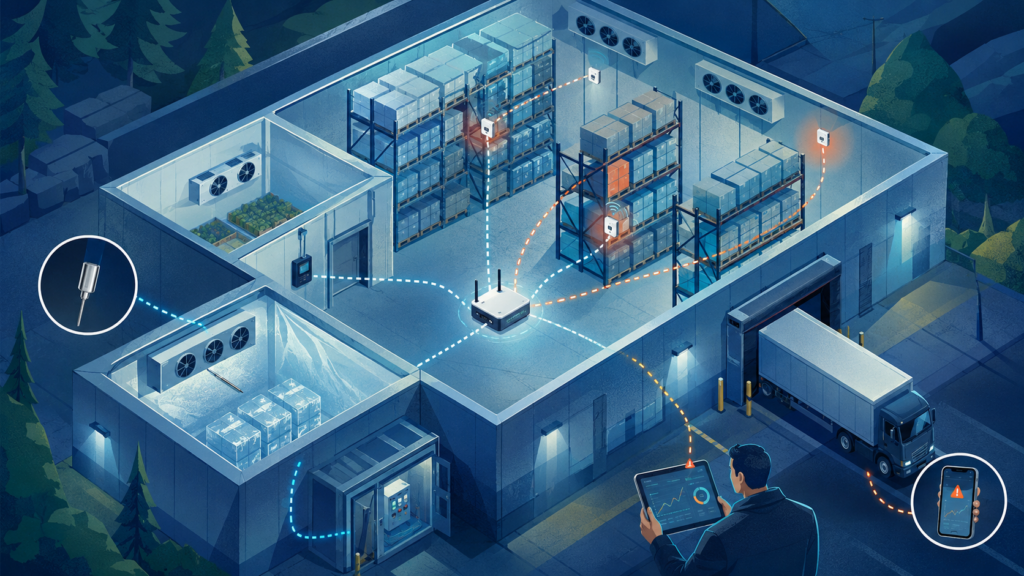
Cold storage monitoring systems differ in sensor placement, connectivity, data continuity, and multi-zone scalability.
Important
Temperature limits, calibration, alarm response, and record retention must follow the stored product, facility hazard analysis, applicable law, contracts, and the organization’s SOP. The FDA Food Code is a model for retail and food-service adoption; EN 12830 matters when specified for European temperature-recorder procurement.
Who Is This Comparison For?
This comparison is for cold-storage managers, food-safety and quality teams, 3PL operators, facilities engineers, and procurement staff selecting monitoring for chilled rooms, freezer areas, staging zones, loading docks, or multiple warehouses.
The operational risk is not a lack of readings. It is a missed warm zone near a door, an overnight refrigeration fault, a network data gap, or an alarm that reaches nobody. Manual checks show one moment; continuous records reveal duration and trend.
The products use different architectures. UbiBot, Dickson, and testo connect directly to a local network; Monnit uses an ALTA gateway. UbiBot emphasizes Ethernet and sensor expansion, Dickson quality workflows, testo temperature-only simplicity, and Monnit long-range multi-node coverage.
What Matters Most in Cold Storage Warehouse Monitoring?
Zone coverage and sensor placement determine whether the data is useful
Door openings, loading, evaporator airflow, ceiling height, racking, defrost cycles, and blocked circulation can create temperature differences that one wall logger will miss. Begin with the required monitoring zones and risk points, not a device count chosen only from budget.
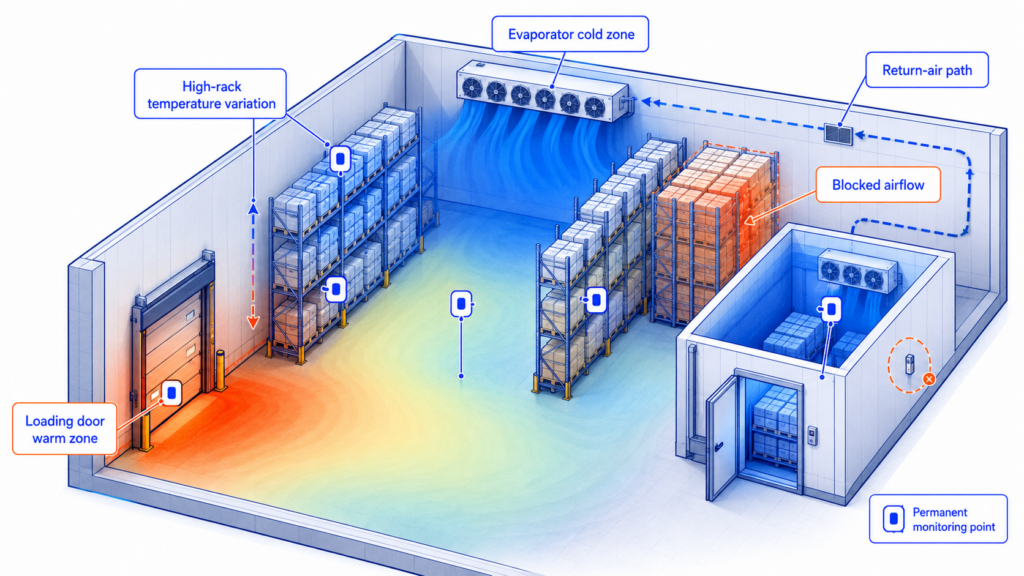
Temperature mapping helps identify persistent warm and cold locations before permanent monitoring points are installed.
Temperature mapping can identify persistent warm and cold locations before permanent sensors are installed. Fixed points should reflect mapped risks such as doors, high racks, return-air paths, loading areas, and separately controlled freezer rooms.
Temperature range, accuracy, and calibration must fit the stored product
Chilled foods, frozen foods, ingredients, beverages, and other temperature-sensitive goods may require different limits. The sensor must cover the actual range with margin, and accuracy should be evaluated at the SOP temperatures. Calibration evidence often matters more than an unusually wide headline range.
Connectivity and offline resilience affect response time
Insulated panels, metal racking, machinery, and long aisles can create Wi-Fi dead zones. Ethernet or PoE can stabilize fixed points, while long-range radio can reduce access-point needs. Local memory preserves records during outages, but remote alerts still require a working sensor-to-cloud path.
Enclosure and probe design affect installation in cold, wet spaces
Condensation, washdown, icing, and low temperatures can affect electronics even when the probe covers the range. Review the logger enclosure, operating limits, cable routing, wall sealing, and cleaning exposure. A leaded probe can keep the electronics outside the refrigerated zone.
Cloud workflow and total cost matter over the life of the system
Useful systems provide threshold and offline alerts, multiple recipients, historical trends, reports, access control, and multi-site management. Lifecycle cost includes probes, gateways, calibration, subscriptions, messaging, batteries, and network work. Gateway economics usually improve as more nodes share the infrastructure.
Product Overview
UbiBot GS1-AETH1RS with UB-DT-P1
UbiBot GS1-AETH1RS connects through 2.4 GHz Wi-Fi or RJ45 Ethernet and can use an optional PoE splitter. The IP65 main unit combines internal temperature, humidity, and light sensing with a 4-inch display and local storage for 300,000 records. For cold rooms and freezers, the GS1-AETH1RS configuration can use one UB-DT-P1 stainless-steel DS18B20-Audio probe, allowing the sensing tip to remain in the monitored zone while the display and networked logger remain outside.
UB-DT-P1 overs -55°C to 125°C and is specified at ±0.5°C from -10°C to 85°C. GS1 also supports compatible RS485 probes for additional parameters, but exact port combinations and simultaneous probe limits should be confirmed for the ordered configuration. The device needs no gateway and includes 200 MB of basic cloud storage per device without a mandatory subscription; paid add-ons may apply for higher-volume reports, messaging, APIs, and data forwarding.
Dickson DWE2 with a Warehouse-Appropriate Replaceable Sensor
Dickson DWE2 is a Wi-Fi/Ethernet display logger with field-replaceable sensors and up to three channels. It provides resettable minimum/maximum values, a local audible alarm, approximately 400,000 backup sample points, and a 72-hour battery backup. The 12 VDC-powered logger is rated IP21.
RTMP temperature and RTRH temperature/humidity sensors are presented by Dickson for warehouse use, with NIST or A2LA calibration options. Exact performance depends on the chosen sensor. DWE2 requires DicksonOne, adding recurring cost but supporting reports, permissions, alerts, and structured quality records.
testo Saveris 2-T1
testo Saveris 2-T1 uses an integrated NTC sensor with a -30°C to 50°C range, ±0.5°C accuracy, and 0.1°C resolution. It has IP65 protection, a local display, 10,000-value memory, four-AA-battery power, and an optional mains supply.
T1 sends data over 2.4 GHz Wi-Fi to Testo Cloud and supports email plus optional SMS alerts. Testo states that the model was tested by TÜV Süd according to EN 12830. It has no external probe or Ethernet, and some regional Testo pages direct new customers toward the testo 162 series.
Monnit ALTA Wireless Digital Temperature Sensor MNS2-9-W2-TS-SD-L10
This Monnit ALTA model includes a 10-foot stainless-steel probe, four-digit display, and two AA batteries. The probe covers -40°C to 125°C; standard accuracy is ±1°C at 25°C and calibrated accuracy is ±0.25°C. It requires an ALTA gateway, buffers 2,000-4,000 readings if the link is lost, and lists 14+ years at default settings. With ALTA XL, stated range is 2,000+ feet through 18+ walls, subject to conditions. Keep the commercial enclosure outside wet or excessively humid areas.
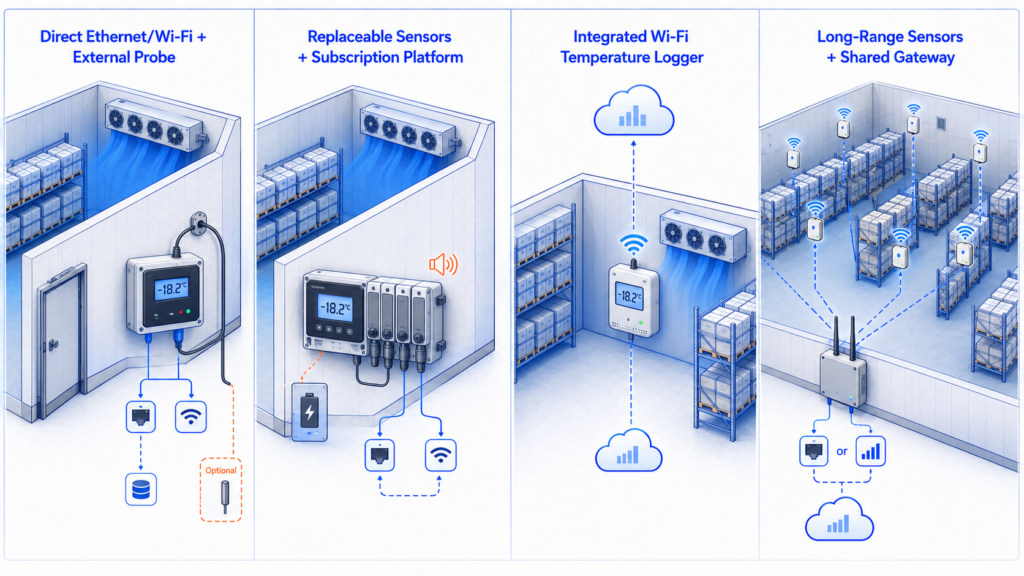
The four products differ most clearly in how sensors connect to the local network and cloud platform.
Side-by-Side Comparison Table
Important: Specifications are based on official manufacturer pages and data sheets reviewed in July 2026. Where a feature depends on a sensor, gateway, software tier, region, or calibration option, the table states that dependency rather than assigning a universal value.
| Comparison item | UbiBot GS1-AETH1RS + UB-DT-P1 | Dickson DWE2 + RTMP/RTRH | testo Saveris 2-T1 | Monnit ALTA MNS2-9-W2-TS-SD-L10 |
| Product positioning | Direct Wi-Fi/Ethernet multiparameter monitor with one UB-DT-P1 probe and RS485 expansion | Direct Wi-Fi/Ethernet cloud logger with field-replaceable sensors | Self-contained Wi-Fi temperature logger for cold rooms and warehouses | Long-range battery temperature sensor with a leaded probe and gateway architecture |
| Measurement parameters | External UB-DT-P1 temperature; internal temperature, RH, and light; supported RS485 parameters | Temperature, temperature/RH, thermistor, RTD, thermocouple, or differential pressure depending on sensor | Integrated temperature only | Temperature only |
| Measurement range | UB-DT-P1 : -55°C to 125°C; internal: -20°C to 60°C; RH: 10% to 90% non-condensing | Depends on sensor; RTMP: -30°C to 50°C; RTRH: -40°C to 85°C and 5% to 95% RH | -30°C to 50°C | Leaded probe: -40°C to 125°C; enclosure: -10°C to 60°C operating range |
| Accuracy | UB-DT-P1 : ±0.5°C from -10°C to 85°C; internal temperature ±0.2°C; RH ±2% | Depends on sensor; RTMP ±0.7°C from -7°C to 50°C; RTRH humidity ±2% from 5% to 95% RH | ±0.5°C; resolution 0.1°C | Standard ±1°C at 25°C; calibrated accuracy ±0.25°C |
| Connectivity | 2.4 GHz Wi-Fi and RJ45 Ethernet; optional PoE splitter | 2.4 GHz Wi-Fi or Ethernet | 2.4 GHz Wi-Fi only | ALTA proprietary radio to a regional-frequency gateway; Ethernet or cellular gateway options |
| External probe support | Supports one UB-DT-P1 (DS18B20-Audio); RS485-compatible temperature, RH, CO₂, and other probes subject to configuration | Field-replaceable sensor modules; up to 3 channels | No; integrated NTC sensor | Exact model includes a 10-foot stainless-steel leaded probe |
| Gateway requirement | No separate gateway | No separate gateway | No separate gateway | Compatible ALTA gateway required for remote monitoring |
| Local display | 4-inch screen | Segmented LCD with resettable minimum and maximum values | Current value, threshold status, and battery status | 4-digit display with read and power buttons |
| Power supply / protection | Internal lithium battery, Type-C, DC 5-12 V, or optional PoE splitter; IP65 | 120-240 VAC / 12 VDC with 72-hour battery backup; IP21 | 4 x AA batteries; optional mains supply; IP65 | 2 x AA batteries; 14+ years at default settings; commercial enclosure not for wet/excessively humid locations |
| Local data storage | 300,000 sensing records | Approximately 400,000 backup sample points | 10,000 values per channel | 2,000 to 4,000 readings if the gateway connection is lost |
| Cloud access | UbiBot Public IoT Platform; free basic plan with 200 MB per device | DicksonOne | Testo Cloud | iMonnit Basic or paid Premiere/Enterprise |
| Alert methods | App, email, and IFTTT; paid SMS/voice and configurable integrations available | Phone call, SMS, email, and local audible alarms | Email; SMS and system alerts under applicable cloud plan | SMS, email, and voice alerts through iMonnit |
| Data export / reporting | CSV/PDF import/export; scheduled PDF/CSV/HTML reports with plan limits | CSV data export and scheduled/standard reports in DicksonOne | Manual and automatic PDF/CSV reports under applicable plan | Data export and reports; available functions depend on iMonnit tier |
| API or integration | RESTful and MQTT options; capabilities and limits depend on plan/service | Not publicly specified on the DWE2 product page; confirm DicksonOne entitlement | Optional API in the reviewed Advanced cloud offering | REST and webhook APIs require iMonnit Premiere or Enterprise |
| Subscription requirement | No mandatory subscription for basic cloud; paid upgrades and messaging may apply | DicksonOne subscription required | Testo Cloud access required; Basic/Advanced terms vary by region | Basic is free for one network/one registered user; paid tier needed for broader use and APIs |
| Installation complexity | Low to medium: direct network connection; route UB-DT-P1 without compromising the cold-room seal and confirm port configuration | Medium: sensor selection, calibration, subscription, power, and network setup | Low where Wi-Fi is proven; entire logger must remain inside the monitored zone | Medium initially because a gateway is required; efficient incremental expansion at scale |
| Best suited for | Small/medium warehouses needing Ethernet, no gateway, an external cold-zone probe, multiparameter expansion, and lower software burden | Quality-driven facilities needing replaceable calibrated sensors, local alarms, backup power, and structured quality reporting | Temperature-only Wi-Fi monitoring where IP65 protection and TÜV Süd testing according to EN 12830 matter | Large, distributed, or difficult-to-cover warehouses with many battery-powered points |
| Cold-storage limitation | Published ±0.5°C probe accuracy applies from -10°C to 85°C; lower-temperature accuracy/calibration, port combinations, and backup runtime require confirmation | IP21 base logger and mandatory subscription; range/accuracy depend on the ordered sensor | No external probe or Ethernet; regional pages may direct new buyers to testo 162 | Gateway required; enclosure should remain outside wet/humid areas; standard accuracy is ±1°C unless calibrated |
Connectivity and Deployment Comparison
UbiBot and Dickson support direct Wi-Fi and Ethernet without a sensor gateway. UbiBot adds optional PoE; Dickson adds a 72-hour backup and local audible alarms. At a small site, either can reduce infrastructure components compared with a gateway network.
testo Saveris 2-T1 is Wi-Fi only. It is efficient where WLAN coverage has been verified, but each point depends on that infrastructure and there is no Ethernet fallback. Local memory continues recording, while cloud access and alerts depend on the network path.
Monnit sensors use ALTA radio and share an Ethernet or cellular gateway. This adds gateway cost but can simplify coverage across large warehouses. The value increases as more nodes share the gateway. Frequency, gateway model, antenna placement, and local radio rules must be confirmed.
Sensor and External Probe Comparison
UbiBot combines internal sensors with RS485 expansion; Dickson uses replaceable modules; testo uses an integrated sensor; Monnit places a leaded probe in the zone while the radio enclosure can remain outside. This affects placement, calibration, maintenance, and available parameters.
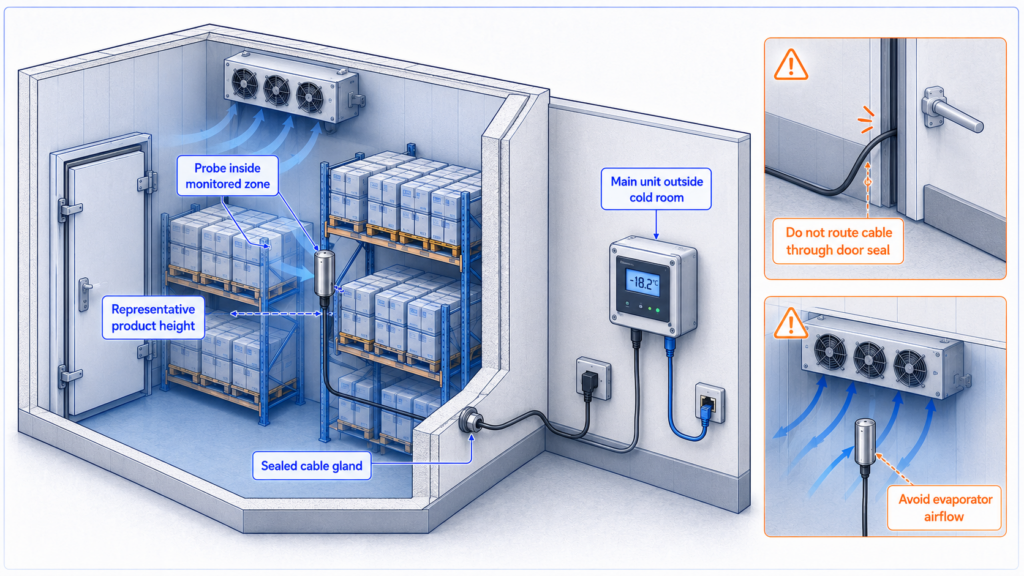
A leaded probe can remain inside the refrigerated zone while the logger, display, and network connection remain accessible outside.
UbiBot’s cold-storage advantage is the defined UB-DT-P1 configuration rather than reliance on the internal sensor alone. The stainless-steel probe covers -55°C to 125°C and is specified at ±0.5°C from -10°C to 85°C, so it can cover chilled rooms and many freezer setpoints while the IP65 main unit remains accessible outside the cold zone. For freezer temperatures below -10°C, buyers should confirm the applicable accuracy and calibration evidence. The GS1 family can also accept compatible RS485 probes for humidity, CO2, and other parameters; confirm the ordered port configuration and the number of probes required for mapped zones.
Dickson offers the most modular sensor choice, from ambient temperature and humidity to thermistors and RTDs. That suits mixed chilled and frozen zones but requires exact sensor and calibration specifications. Testo avoids probe selection, yet the whole logger must be inside the zone and it measures temperature only.
Monnit’s 10-foot probe can enter a freezer while the enclosure stays outside. The probe reaches -40°C, but the standard unit is ±1°C at 25°C unless the calibrated option is ordered. Acceptance criteria should reference the purchased calibration, not the optional figure alone.
Cloud Platform, Alerts and Data Management
UbiBot provides charts, grouping, sharing, threshold/offline alerts, CSV/PDF exchange, and scheduled reports. App, email, and IFTTT alerts are listed; SMS/voice use paid credits. RESTful and MQTT capabilities vary by plan.
DicksonOne supports multiple locations, phone/SMS/email alerts, local audible alarms, reports, CSV exports, role-based access, and quality-oriented records. DWE2 adds approximately 400,000 backup sample points and a 72-hour battery backup. A DicksonOne subscription is required, and exact reporting, retention, integration, and user entitlements should be confirmed for the selected plan.
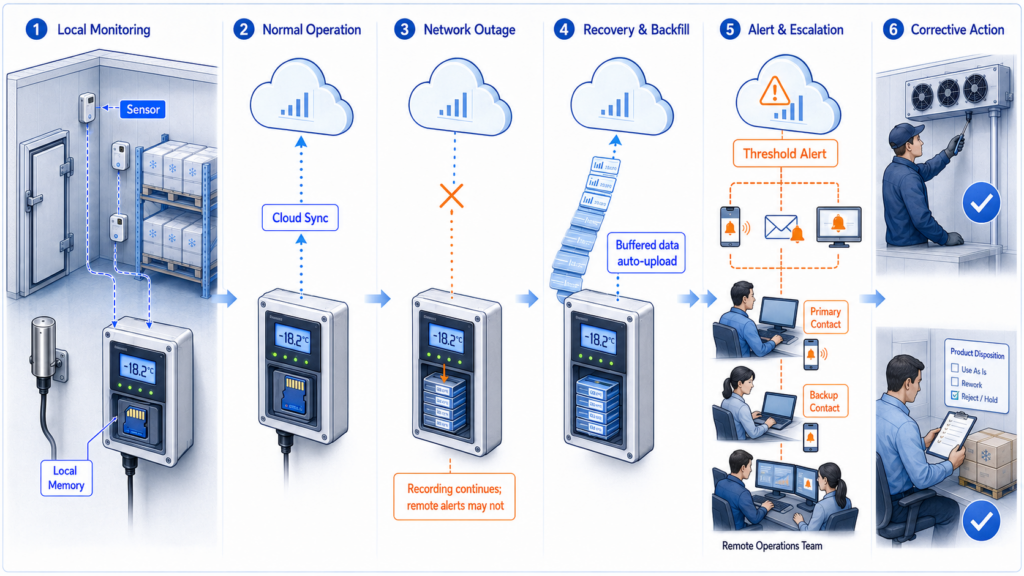
Local memory can preserve records during an outage, but remote alerts still require a working sensor-to-cloud connection.
Testo Cloud controls the Saveris 2 system. The reviewed Advanced offering includes configurable intervals, up to two years of storage, manual/automatic PDF and CSV reports, multiple users, email, optional SMS, and an optional API. Regional plans and pricing vary.
iMonnit Basic is free but limited to one network and one registered user. Premiere expands management, and Premiere or Enterprise is required for REST and webhook APIs. The sensor supports SMS, email, and voice alerts and buffers readings when the gateway link is lost.
Platform features do not replace an escalation procedure. Define primary and backup recipients, delay/repeat rules, after-hours coverage, and product-disposition responsibility. Thresholds must match the stored commodity and mapped risks.
Total Deployment Cost and Recurring Burden
UbiBot cost includes the GS1-AETH1RS, UB-DT-P1 probe, power and mounting, networking, calibration, and any optional RS485 sensors. No gateway or mandatory basic subscription is required. More users, reports, API traffic, messaging, data forwarding, or storage may add cost.
Dickson cost includes DWE2, selected sensors, calibration, installation, and DicksonOne. The recurring burden supports local alarms, large backup memory, battery backup, reporting, and quality controls. Every channel and calibration option should appear in the purchase specification.
Testo cost includes the T1 logger, batteries or mains power, Wi-Fi setup, cloud access, and calibration. Advanced reporting, SMS, API access, and retention may add cost. Confirm regional availability and whether testo 162 is now preferred for new projects.
Monnit requires sensors plus an ALTA gateway. Initial infrastructure cost is higher, but additional battery nodes can be economical at scale. Budget for calibrated accuracy, regional frequency, gateway backhaul or redundancy, paid iMonnit features, and battery service. The 14+ year figure depends on settings.
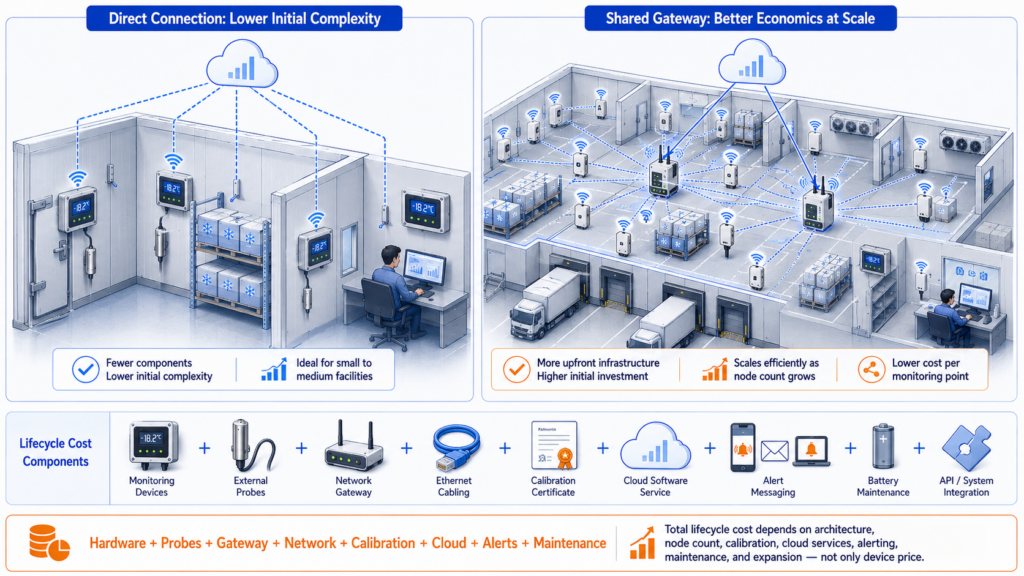
Deployment cost changes with warehouse scale, gateway architecture, software subscriptions, and calibration requirements.
Brand-by-Brand Strengths and Trade-Offs
UbiBot GS1-AETH1RS with UB-DT-P1
UbiBot fits warehouses seeking direct Ethernet/Wi-Fi, optional PoE, no gateway, IP65 protection, large memory, an onsite screen, and a free basic cloud tier. UB-DT-P1 places a stainless-steel probe in the cold zone while the main unit can remain accessible, and its -55°C to 125°C measurement range covers chilled and many frozen applications. Its published ±0.5°C accuracy applies from -10°C to 85°C; lower-temperature accuracy, full-system calibration, probe/RS485 port combinations, and exact battery-backup duration should be confirmed before specification.
Dickson DWE2
Dickson fits quality-driven operations needing replaceable calibrated sensors, local min/max and audible alarms, Ethernet, 72-hour backup, and structured reporting. Its sensor catalogue is the most modular in this comparison and can cover different chilled and frozen zones. The trade-offs are an IP21 base logger, mandatory DicksonOne subscription, and a total cost that depends on the selected sensors, calibration, and software plan.
testo Saveris 2-T1
testo fits temperature-only cold rooms with reliable Wi-Fi where IP65 protection and TÜV Süd testing according to EN 12830 matter. It avoids gateways and external-probe selection. Limits are no humidity, no external probe, no Ethernet, and regional differences in cloud terms and product availability.
Monnit ALTA MNS2-9-W2-TS-SD-L10
Monnit fits many dispersed points or difficult Wi-Fi environments. The 10-foot probe can remain in the cold zone while the enclosure stays outside, and many battery nodes share a gateway. Limits include gateway dependence, proprietary radio, paid multi-user/API tiers, ±1°C standard accuracy, and enclosure restrictions in wet areas.
Which Product Should You Choose?
| Choose this product | When this purchasing condition matters most |
| UbiBot GS1-AETH1RS + UB-DT-P1 | You need direct Wi-Fi and Ethernet, optional PoE, no gateway, an IP65 main unit, 300,000 local records, a stainless-steel cold-zone probe, RS485 expansion, and a free basic cloud tier. |
| Dickson DWE2 | You prioritize replaceable calibrated sensors, local min/max and audible alarms, Ethernet, 72-hour battery backup, and structured quality reporting, and you accept a mandatory subscription. |
| testo Saveris 2-T1 | You need a compact temperature-only IP65 Wi-Fi logger with published ±0.5°C accuracy and TÜV Süd testing according to EN 12830 for a covered temperature range. |
| Monnit ALTA MNS2-9-W2-TS-SD-L10 | You are deploying many points across a large warehouse or Wi-Fi is difficult, and long-range battery nodes sharing a gateway are more practical than direct networking at every point. |
Pros and Cons
| Product | Scenario-specific advantages | Scenario-specific limitations |
| UbiBot GS1-AETH1RS + UB-DT-P1 | Direct Wi-Fi/Ethernet; optional PoE; no gateway; IP65 main unit; 300,000 records; UB-DT-P1 range -55°C to 125°C; ±0.5°C from -10°C to 85°C; internal temperature/RH/light; RS485 expansion; free basic cloud. | One UB-DT-P1 on the GS1-AETH1RS port; published ±0.5°C accuracy does not cover temperatures below -10°C; no 4G on this exact model; calibration package, port combinations, and backup runtime require confirmation. |
| Dickson DWE2 | Replaceable sensor range; up to 3 channels; resettable min/max; local audible alarm; Wi-Fi/Ethernet; 72-hour backup; approximately 400,000 backup points; calibration options. | IP21 logger; DicksonOne subscription required; cost and performance depend on selected sensors and calibration. |
| testo Saveris 2-T1 | Integrated sensor; ±0.5°C; IP65; 10,000 values; AA battery or mains; simple Wi-Fi deployment; tested by TÜV Süd according to EN 12830. | Temperature only; no external probe; no Ethernet; cloud-plan terms and successor status vary by region. |
| Monnit ALTA MNS2-9-W2-TS-SD-L10 | Wide -40°C to 125°C probe range; 10-foot lead; calibrated option ±0.25°C; long-range radio; 2,000-4,000 offline readings; 14+ year conditional battery specification. | Gateway required; proprietary ecosystem; commercial enclosure not for wet/humid locations; ±1°C standard accuracy; multi-user/API functions require paid software. |
Frequently Asked Questions
Which system is the best fit for a typical cold storage warehouse?
For a small or medium networked warehouse, UbiBot is the most balanced no-gateway option. Large multi-point sites may find Monnit more scalable; quality-driven facilities may prefer Dickson; European specifications requiring explicit EN 12830 evidence may favor testo.
Does UbiBot GS1-AETH1RS require a gateway?
No. GS1-AETH1RSconnects through 2.4 GHz Wi-Fi or RJ45 Ethernet and supports an optional PoE splitter. The UB-DT-P1 probe connects directly to the GS1-AETH1RS port. Monnit requires an ALTA gateway; Dickson and testo connect directly to the local network.
Which product works best when warehouse Wi-Fi coverage is poor?
UbiBot and Dickson can use Ethernet where cabling exists. Monnit can cover large areas through ALTA radio and a shared gateway. testo Saveris 2-T1 is Wi-Fi only, so it depends most directly on verified WLAN coverage.
Can these systems continue recording during an internet outage?
Yes. UbiBot stores 300,000 records, Dickson about 400,000 backup points, testo 10,000 values, and Monnit 2,000-4,000 readings when its gateway link is lost. Remote alerts still require a working path; test recovery during commissioning.
Which product is suitable for freezer rooms below -20°C?
UbiBot’s UB-DT-P1 probe is specified for -55°C to 125°C, while its published ±0.5°C accuracy applies from -10°C to 85°C; confirm calibration and acceptable accuracy at lower freezer setpoints. Dickson offers lower-range replaceable modules. testo T1 is rated to -30°C. Monnit’s leaded probe is rated to -40°C, with standard versus calibrated accuracy depending on the ordered version.
Is a cloud subscription required?
UbiBot and iMonnit offer limited free basic access; Monnit Basic allows one network and one registered user. DicksonOne is mandatory. Testo Cloud terms vary by country. More users, reports, SMS, APIs, or retention may require paid services.
Which product provides the clearest EN 12830 evidence?
Testo explicitly states that Saveris 2-T1 was tested by TÜV Süd according to EN 12830. The reviewed official pages for the other three exact products do not make the same statement. Request the current certificate or test documentation and confirm that the application, range, calibration, and local requirements are covered.
Can one account manage multiple warehouses?
Yes. All four platforms support centralized management, but user limits, permissions, reports, architecture, and pricing depend on the plan. Their free tiers are not equivalent: UbiBot includes grouping and sharing, while Monnit Basic is limited to one network and one user.
Final Verdict
For small and medium warehouses with Ethernet or reliable Wi-Fi, UbiBot GS1-AETH1RS with UB-DT-P1 is the most balanced no-gateway choice: direct networking, optional PoE, IP65 protection, 300,000 local records, an external probe, RS485 expansion, and a free basic cloud tier.
Dickson suits calibrated-sensor and backup-power workflows; testo suits simple IP65 Wi-Fi monitoring with ±0.5°C accuracy and TÜV Süd EN 12830 testing; Monnit suits large gateway-based networks. Before purchase, map each zone, verify calibration, test recovery, and confirm the final UbiBot probe and port configuration. No logger is automatically FSMA- or HACCP-compliant.
Related Resources


Comparison & Selection
See More >>
UbiBot vs Dickson vs Testo vs Monnit: Which Is Better for Cold Storage Warehouses?
Key Takeaway
Best choice depends on warehouse scale and network architecture
For most small and medium cold storage warehouses with Ethernet or reliable Wi-Fi, UbiBot GS1-AETH1RS with UB-DT-P1 offers the most balanced no-gateway architecture: direct RJ45/Wi-Fi, optional PoE, an IP65 main unit, 300,000 local records, a stainless-steel probe covering -55°C to 125°C, RS485 expansion, and a free basic cloud plan. Dickson DWE2 is better when replaceable calibrated sensors, local audible alarms, a 72-hour battery backup, and structured quality reporting justify a mandatory subscription. testo Saveris 2-T1 is the clearest temperature-only option when a compact IP65 Wi-Fi logger and TÜV Süd testing according to EN 12830 matter, but it has no external probe or Ethernet. Monnit ALTA is strongest for large multi-point warehouses and difficult Wi-Fi coverage because many long-range battery nodes can share a gateway. The decisive difference is system architecture, probe placement, and lifecycle cost—not headline accuracy alone.
Cold storage monitoring systems differ in sensor placement, connectivity, data continuity, and multi-zone scalability.
Important
Temperature limits, calibration, alarm response, and record retention must follow the stored product, facility hazard analysis, applicable law, contracts, and the organization’s SOP. The FDA Food Code is a model for retail and food-service adoption; EN 12830 matters when specified for European temperature-recorder procurement.
Who Is This Comparison For?
This comparison is for cold-storage managers, food-safety and quality teams, 3PL operators, facilities engineers, and procurement staff selecting monitoring for chilled rooms, freezer areas, staging zones, loading docks, or multiple warehouses.
The operational risk is not a lack of readings. It is a missed warm zone near a door, an overnight refrigeration fault, a network data gap, or an alarm that reaches nobody. Manual checks show one moment; continuous records reveal duration and trend.
The products use different architectures. UbiBot, Dickson, and testo connect directly to a local network; Monnit uses an ALTA gateway. UbiBot emphasizes Ethernet and sensor expansion, Dickson quality workflows, testo temperature-only simplicity, and Monnit long-range multi-node coverage.
What Matters Most in Cold Storage Warehouse Monitoring?
Zone coverage and sensor placement determine whether the data is useful
Door openings, loading, evaporator airflow, ceiling height, racking, defrost cycles, and blocked circulation can create temperature differences that one wall logger will miss. Begin with the required monitoring zones and risk points, not a device count chosen only from budget.
Temperature mapping helps identify persistent warm and cold locations before permanent monitoring points are installed.
Temperature mapping can identify persistent warm and cold locations before permanent sensors are installed. Fixed points should reflect mapped risks such as doors, high racks, return-air paths, loading areas, and separately controlled freezer rooms.
Temperature range, accuracy, and calibration must fit the stored product
Chilled foods, frozen foods, ingredients, beverages, and other temperature-sensitive goods may require different limits. The sensor must cover the actual range with margin, and accuracy should be evaluated at the SOP temperatures. Calibration evidence often matters more than an unusually wide headline range.
Connectivity and offline resilience affect response time
Insulated panels, metal racking, machinery, and long aisles can create Wi-Fi dead zones. Ethernet or PoE can stabilize fixed points, while long-range radio can reduce access-point needs. Local memory preserves records during outages, but remote alerts still require a working sensor-to-cloud path.
Enclosure and probe design affect installation in cold, wet spaces
Condensation, washdown, icing, and low temperatures can affect electronics even when the probe covers the range. Review the logger enclosure, operating limits, cable routing, wall sealing, and cleaning exposure. A leaded probe can keep the electronics outside the refrigerated zone.
Cloud workflow and total cost matter over the life of the system
Useful systems provide threshold and offline alerts, multiple recipients, historical trends, reports, access control, and multi-site management. Lifecycle cost includes probes, gateways, calibration, subscriptions, messaging, batteries, and network work. Gateway economics usually improve as more nodes share the infrastructure.
Product Overview
UbiBot GS1-AETH1RS with UB-DT-P1
UbiBot GS1-AETH1RS connects through 2.4 GHz Wi-Fi or RJ45 Ethernet and can use an optional PoE splitter. The IP65 main unit combines internal temperature, humidity, and light sensing with a 4-inch display and local storage for 300,000 records. For cold rooms and freezers, the GS1-AETH1RS configuration can use one UB-DT-P1 stainless-steel DS18B20-Audio probe, allowing the sensing tip to remain in the monitored zone while the display and networked logger remain outside.
UB-DT-P1 overs -55°C to 125°C and is specified at ±0.5°C from -10°C to 85°C. GS1 also supports compatible RS485 probes for additional parameters, but exact port combinations and simultaneous probe limits should be confirmed for the ordered configuration. The device needs no gateway and includes 200 MB of basic cloud storage per device without a mandatory subscription; paid add-ons may apply for higher-volume reports, messaging, APIs, and data forwarding.
Dickson DWE2 with a Warehouse-Appropriate Replaceable Sensor
Dickson DWE2 is a Wi-Fi/Ethernet display logger with field-replaceable sensors and up to three channels. It provides resettable minimum/maximum values, a local audible alarm, approximately 400,000 backup sample points, and a 72-hour battery backup. The 12 VDC-powered logger is rated IP21.
RTMP temperature and RTRH temperature/humidity sensors are presented by Dickson for warehouse use, with NIST or A2LA calibration options. Exact performance depends on the chosen sensor. DWE2 requires DicksonOne, adding recurring cost but supporting reports, permissions, alerts, and structured quality records.
testo Saveris 2-T1
testo Saveris 2-T1 uses an integrated NTC sensor with a -30°C to 50°C range, ±0.5°C accuracy, and 0.1°C resolution. It has IP65 protection, a local display, 10,000-value memory, four-AA-battery power, and an optional mains supply.
T1 sends data over 2.4 GHz Wi-Fi to Testo Cloud and supports email plus optional SMS alerts. Testo states that the model was tested by TÜV Süd according to EN 12830. It has no external probe or Ethernet, and some regional Testo pages direct new customers toward the testo 162 series.
Monnit ALTA Wireless Digital Temperature Sensor MNS2-9-W2-TS-SD-L10
This Monnit ALTA model includes a 10-foot stainless-steel probe, four-digit display, and two AA batteries. The probe covers -40°C to 125°C; standard accuracy is ±1°C at 25°C and calibrated accuracy is ±0.25°C. It requires an ALTA gateway, buffers 2,000-4,000 readings if the link is lost, and lists 14+ years at default settings. With ALTA XL, stated range is 2,000+ feet through 18+ walls, subject to conditions. Keep the commercial enclosure outside wet or excessively humid areas.
The four products differ most clearly in how sensors connect to the local network and cloud platform.
Side-by-Side Comparison Table
Important: Specifications are based on official manufacturer pages and data sheets reviewed in July 2026. Where a feature depends on a sensor, gateway, software tier, region, or calibration option, the table states that dependency rather than assigning a universal value.
| Comparison item | UbiBot GS1-AETH1RS + UB-DT-P1 | Dickson DWE2 + RTMP/RTRH | testo Saveris 2-T1 | Monnit ALTA MNS2-9-W2-TS-SD-L10 |
| Product positioning | Direct Wi-Fi/Ethernet multiparameter monitor with one UB-DT-P1 probe and RS485 expansion | Direct Wi-Fi/Ethernet cloud logger with field-replaceable sensors | Self-contained Wi-Fi temperature logger for cold rooms and warehouses | Long-range battery temperature sensor with a leaded probe and gateway architecture |
| Measurement parameters | External UB-DT-P1 temperature; internal temperature, RH, and light; supported RS485 parameters | Temperature, temperature/RH, thermistor, RTD, thermocouple, or differential pressure depending on sensor | Integrated temperature only | Temperature only |
| Measurement range | UB-DT-P1 : -55°C to 125°C; internal: -20°C to 60°C; RH: 10% to 90% non-condensing | Depends on sensor; RTMP: -30°C to 50°C; RTRH: -40°C to 85°C and 5% to 95% RH | -30°C to 50°C | Leaded probe: -40°C to 125°C; enclosure: -10°C to 60°C operating range |
| Accuracy | UB-DT-P1 : ±0.5°C from -10°C to 85°C; internal temperature ±0.2°C; RH ±2% | Depends on sensor; RTMP ±0.7°C from -7°C to 50°C; RTRH humidity ±2% from 5% to 95% RH | ±0.5°C; resolution 0.1°C | Standard ±1°C at 25°C; calibrated accuracy ±0.25°C |
| Connectivity | 2.4 GHz Wi-Fi and RJ45 Ethernet; optional PoE splitter | 2.4 GHz Wi-Fi or Ethernet | 2.4 GHz Wi-Fi only | ALTA proprietary radio to a regional-frequency gateway; Ethernet or cellular gateway options |
| External probe support | Supports one UB-DT-P1 (DS18B20-Audio); RS485-compatible temperature, RH, CO₂, and other probes subject to configuration | Field-replaceable sensor modules; up to 3 channels | No; integrated NTC sensor | Exact model includes a 10-foot stainless-steel leaded probe |
| Gateway requirement | No separate gateway | No separate gateway | No separate gateway | Compatible ALTA gateway required for remote monitoring |
| Local display | 4-inch screen | Segmented LCD with resettable minimum and maximum values | Current value, threshold status, and battery status | 4-digit display with read and power buttons |
| Power supply / protection | Internal lithium battery, Type-C, DC 5-12 V, or optional PoE splitter; IP65 | 120-240 VAC / 12 VDC with 72-hour battery backup; IP21 | 4 x AA batteries; optional mains supply; IP65 | 2 x AA batteries; 14+ years at default settings; commercial enclosure not for wet/excessively humid locations |
| Local data storage | 300,000 sensing records | Approximately 400,000 backup sample points | 10,000 values per channel | 2,000 to 4,000 readings if the gateway connection is lost |
| Cloud access | UbiBot Public IoT Platform; free basic plan with 200 MB per device | DicksonOne | Testo Cloud | iMonnit Basic or paid Premiere/Enterprise |
| Alert methods | App, email, and IFTTT; paid SMS/voice and configurable integrations available | Phone call, SMS, email, and local audible alarms | Email; SMS and system alerts under applicable cloud plan | SMS, email, and voice alerts through iMonnit |
| Data export / reporting | CSV/PDF import/export; scheduled PDF/CSV/HTML reports with plan limits | CSV data export and scheduled/standard reports in DicksonOne | Manual and automatic PDF/CSV reports under applicable plan | Data export and reports; available functions depend on iMonnit tier |
| API or integration | RESTful and MQTT options; capabilities and limits depend on plan/service | Not publicly specified on the DWE2 product page; confirm DicksonOne entitlement | Optional API in the reviewed Advanced cloud offering | REST and webhook APIs require iMonnit Premiere or Enterprise |
| Subscription requirement | No mandatory subscription for basic cloud; paid upgrades and messaging may apply | DicksonOne subscription required | Testo Cloud access required; Basic/Advanced terms vary by region | Basic is free for one network/one registered user; paid tier needed for broader use and APIs |
| Installation complexity | Low to medium: direct network connection; route UB-DT-P1 without compromising the cold-room seal and confirm port configuration | Medium: sensor selection, calibration, subscription, power, and network setup | Low where Wi-Fi is proven; entire logger must remain inside the monitored zone | Medium initially because a gateway is required; efficient incremental expansion at scale |
| Best suited for | Small/medium warehouses needing Ethernet, no gateway, an external cold-zone probe, multiparameter expansion, and lower software burden | Quality-driven facilities needing replaceable calibrated sensors, local alarms, backup power, and structured quality reporting | Temperature-only Wi-Fi monitoring where IP65 protection and TÜV Süd testing according to EN 12830 matter | Large, distributed, or difficult-to-cover warehouses with many battery-powered points |
| Cold-storage limitation | Published ±0.5°C probe accuracy applies from -10°C to 85°C; lower-temperature accuracy/calibration, port combinations, and backup runtime require confirmation | IP21 base logger and mandatory subscription; range/accuracy depend on the ordered sensor | No external probe or Ethernet; regional pages may direct new buyers to testo 162 | Gateway required; enclosure should remain outside wet/humid areas; standard accuracy is ±1°C unless calibrated |
Connectivity and Deployment Comparison
UbiBot and Dickson support direct Wi-Fi and Ethernet without a sensor gateway. UbiBot adds optional PoE; Dickson adds a 72-hour backup and local audible alarms. At a small site, either can reduce infrastructure components compared with a gateway network.
testo Saveris 2-T1 is Wi-Fi only. It is efficient where WLAN coverage has been verified, but each point depends on that infrastructure and there is no Ethernet fallback. Local memory continues recording, while cloud access and alerts depend on the network path.
Monnit sensors use ALTA radio and share an Ethernet or cellular gateway. This adds gateway cost but can simplify coverage across large warehouses. The value increases as more nodes share the gateway. Frequency, gateway model, antenna placement, and local radio rules must be confirmed.
Sensor and External Probe Comparison
UbiBot combines internal sensors with RS485 expansion; Dickson uses replaceable modules; testo uses an integrated sensor; Monnit places a leaded probe in the zone while the radio enclosure can remain outside. This affects placement, calibration, maintenance, and available parameters.
A leaded probe can remain inside the refrigerated zone while the logger, display, and network connection remain accessible outside.
UbiBot’s cold-storage advantage is the defined UB-DT-P1 configuration rather than reliance on the internal sensor alone. The stainless-steel probe covers -55°C to 125°C and is specified at ±0.5°C from -10°C to 85°C, so it can cover chilled rooms and many freezer setpoints while the IP65 main unit remains accessible outside the cold zone. For freezer temperatures below -10°C, buyers should confirm the applicable accuracy and calibration evidence. The GS1 family can also accept compatible RS485 probes for humidity, CO2, and other parameters; confirm the ordered port configuration and the number of probes required for mapped zones.
Dickson offers the most modular sensor choice, from ambient temperature and humidity to thermistors and RTDs. That suits mixed chilled and frozen zones but requires exact sensor and calibration specifications. Testo avoids probe selection, yet the whole logger must be inside the zone and it measures temperature only.
Monnit’s 10-foot probe can enter a freezer while the enclosure stays outside. The probe reaches -40°C, but the standard unit is ±1°C at 25°C unless the calibrated option is ordered. Acceptance criteria should reference the purchased calibration, not the optional figure alone.
Cloud Platform, Alerts and Data Management
UbiBot provides charts, grouping, sharing, threshold/offline alerts, CSV/PDF exchange, and scheduled reports. App, email, and IFTTT alerts are listed; SMS/voice use paid credits. RESTful and MQTT capabilities vary by plan.
DicksonOne supports multiple locations, phone/SMS/email alerts, local audible alarms, reports, CSV exports, role-based access, and quality-oriented records. DWE2 adds approximately 400,000 backup sample points and a 72-hour battery backup. A DicksonOne subscription is required, and exact reporting, retention, integration, and user entitlements should be confirmed for the selected plan.
Local memory can preserve records during an outage, but remote alerts still require a working sensor-to-cloud connection.
Testo Cloud controls the Saveris 2 system. The reviewed Advanced offering includes configurable intervals, up to two years of storage, manual/automatic PDF and CSV reports, multiple users, email, optional SMS, and an optional API. Regional plans and pricing vary.
iMonnit Basic is free but limited to one network and one registered user. Premiere expands management, and Premiere or Enterprise is required for REST and webhook APIs. The sensor supports SMS, email, and voice alerts and buffers readings when the gateway link is lost.
Platform features do not replace an escalation procedure. Define primary and backup recipients, delay/repeat rules, after-hours coverage, and product-disposition responsibility. Thresholds must match the stored commodity and mapped risks.
Total Deployment Cost and Recurring Burden
UbiBot cost includes the GS1-AETH1RS, UB-DT-P1 probe, power and mounting, networking, calibration, and any optional RS485 sensors. No gateway or mandatory basic subscription is required. More users, reports, API traffic, messaging, data forwarding, or storage may add cost.
Dickson cost includes DWE2, selected sensors, calibration, installation, and DicksonOne. The recurring burden supports local alarms, large backup memory, battery backup, reporting, and quality controls. Every channel and calibration option should appear in the purchase specification.
Testo cost includes the T1 logger, batteries or mains power, Wi-Fi setup, cloud access, and calibration. Advanced reporting, SMS, API access, and retention may add cost. Confirm regional availability and whether testo 162 is now preferred for new projects.
Monnit requires sensors plus an ALTA gateway. Initial infrastructure cost is higher, but additional battery nodes can be economical at scale. Budget for calibrated accuracy, regional frequency, gateway backhaul or redundancy, paid iMonnit features, and battery service. The 14+ year figure depends on settings.
Deployment cost changes with warehouse scale, gateway architecture, software subscriptions, and calibration requirements.
Brand-by-Brand Strengths and Trade-Offs
UbiBot GS1-AETH1RS with UB-DT-P1
UbiBot fits warehouses seeking direct Ethernet/Wi-Fi, optional PoE, no gateway, IP65 protection, large memory, an onsite screen, and a free basic cloud tier. UB-DT-P1 places a stainless-steel probe in the cold zone while the main unit can remain accessible, and its -55°C to 125°C measurement range covers chilled and many frozen applications. Its published ±0.5°C accuracy applies from -10°C to 85°C; lower-temperature accuracy, full-system calibration, probe/RS485 port combinations, and exact battery-backup duration should be confirmed before specification.
Dickson DWE2
Dickson fits quality-driven operations needing replaceable calibrated sensors, local min/max and audible alarms, Ethernet, 72-hour backup, and structured reporting. Its sensor catalogue is the most modular in this comparison and can cover different chilled and frozen zones. The trade-offs are an IP21 base logger, mandatory DicksonOne subscription, and a total cost that depends on the selected sensors, calibration, and software plan.
testo Saveris 2-T1
testo fits temperature-only cold rooms with reliable Wi-Fi where IP65 protection and TÜV Süd testing according to EN 12830 matter. It avoids gateways and external-probe selection. Limits are no humidity, no external probe, no Ethernet, and regional differences in cloud terms and product availability.
Monnit ALTA MNS2-9-W2-TS-SD-L10
Monnit fits many dispersed points or difficult Wi-Fi environments. The 10-foot probe can remain in the cold zone while the enclosure stays outside, and many battery nodes share a gateway. Limits include gateway dependence, proprietary radio, paid multi-user/API tiers, ±1°C standard accuracy, and enclosure restrictions in wet areas.
Which Product Should You Choose?
| Choose this product | When this purchasing condition matters most |
| UbiBot GS1-AETH1RS + UB-DT-P1 | You need direct Wi-Fi and Ethernet, optional PoE, no gateway, an IP65 main unit, 300,000 local records, a stainless-steel cold-zone probe, RS485 expansion, and a free basic cloud tier. |
| Dickson DWE2 | You prioritize replaceable calibrated sensors, local min/max and audible alarms, Ethernet, 72-hour battery backup, and structured quality reporting, and you accept a mandatory subscription. |
| testo Saveris 2-T1 | You need a compact temperature-only IP65 Wi-Fi logger with published ±0.5°C accuracy and TÜV Süd testing according to EN 12830 for a covered temperature range. |
| Monnit ALTA MNS2-9-W2-TS-SD-L10 | You are deploying many points across a large warehouse or Wi-Fi is difficult, and long-range battery nodes sharing a gateway are more practical than direct networking at every point. |
Pros and Cons
| Product | Scenario-specific advantages | Scenario-specific limitations |
| UbiBot GS1-AETH1RS + UB-DT-P1 | Direct Wi-Fi/Ethernet; optional PoE; no gateway; IP65 main unit; 300,000 records; UB-DT-P1 range -55°C to 125°C; ±0.5°C from -10°C to 85°C; internal temperature/RH/light; RS485 expansion; free basic cloud. | One UB-DT-P1 on the GS1-AETH1RS port; published ±0.5°C accuracy does not cover temperatures below -10°C; no 4G on this exact model; calibration package, port combinations, and backup runtime require confirmation. |
| Dickson DWE2 | Replaceable sensor range; up to 3 channels; resettable min/max; local audible alarm; Wi-Fi/Ethernet; 72-hour backup; approximately 400,000 backup points; calibration options. | IP21 logger; DicksonOne subscription required; cost and performance depend on selected sensors and calibration. |
| testo Saveris 2-T1 | Integrated sensor; ±0.5°C; IP65; 10,000 values; AA battery or mains; simple Wi-Fi deployment; tested by TÜV Süd according to EN 12830. | Temperature only; no external probe; no Ethernet; cloud-plan terms and successor status vary by region. |
| Monnit ALTA MNS2-9-W2-TS-SD-L10 | Wide -40°C to 125°C probe range; 10-foot lead; calibrated option ±0.25°C; long-range radio; 2,000-4,000 offline readings; 14+ year conditional battery specification. | Gateway required; proprietary ecosystem; commercial enclosure not for wet/humid locations; ±1°C standard accuracy; multi-user/API functions require paid software. |
Frequently Asked Questions
Which system is the best fit for a typical cold storage warehouse?
For a small or medium networked warehouse, UbiBot is the most balanced no-gateway option. Large multi-point sites may find Monnit more scalable; quality-driven facilities may prefer Dickson; European specifications requiring explicit EN 12830 evidence may favor testo.
Does UbiBot GS1-AETH1RS require a gateway?
No. GS1-AETH1RSconnects through 2.4 GHz Wi-Fi or RJ45 Ethernet and supports an optional PoE splitter. The UB-DT-P1 probe connects directly to the GS1-AETH1RS port. Monnit requires an ALTA gateway; Dickson and testo connect directly to the local network.
Which product works best when warehouse Wi-Fi coverage is poor?
UbiBot and Dickson can use Ethernet where cabling exists. Monnit can cover large areas through ALTA radio and a shared gateway. testo Saveris 2-T1 is Wi-Fi only, so it depends most directly on verified WLAN coverage.
Can these systems continue recording during an internet outage?
Yes. UbiBot stores 300,000 records, Dickson about 400,000 backup points, testo 10,000 values, and Monnit 2,000-4,000 readings when its gateway link is lost. Remote alerts still require a working path; test recovery during commissioning.
Which product is suitable for freezer rooms below -20°C?
UbiBot’s UB-DT-P1 probe is specified for -55°C to 125°C, while its published ±0.5°C accuracy applies from -10°C to 85°C; confirm calibration and acceptable accuracy at lower freezer setpoints. Dickson offers lower-range replaceable modules. testo T1 is rated to -30°C. Monnit’s leaded probe is rated to -40°C, with standard versus calibrated accuracy depending on the ordered version.
Is a cloud subscription required?
UbiBot and iMonnit offer limited free basic access; Monnit Basic allows one network and one registered user. DicksonOne is mandatory. Testo Cloud terms vary by country. More users, reports, SMS, APIs, or retention may require paid services.
Which product provides the clearest EN 12830 evidence?
Testo explicitly states that Saveris 2-T1 was tested by TÜV Süd according to EN 12830. The reviewed official pages for the other three exact products do not make the same statement. Request the current certificate or test documentation and confirm that the application, range, calibration, and local requirements are covered.
Can one account manage multiple warehouses?
Yes. All four platforms support centralized management, but user limits, permissions, reports, architecture, and pricing depend on the plan. Their free tiers are not equivalent: UbiBot includes grouping and sharing, while Monnit Basic is limited to one network and one user.
Final Verdict
For small and medium warehouses with Ethernet or reliable Wi-Fi, UbiBot GS1-AETH1RS with UB-DT-P1 is the most balanced no-gateway choice: direct networking, optional PoE, IP65 protection, 300,000 local records, an external probe, RS485 expansion, and a free basic cloud tier.
Dickson suits calibrated-sensor and backup-power workflows; testo suits simple IP65 Wi-Fi monitoring with ±0.5°C accuracy and TÜV Süd EN 12830 testing; Monnit suits large gateway-based networks. Before purchase, map each zone, verify calibration, test recovery, and confirm the final UbiBot probe and port configuration. No logger is automatically FSMA- or HACCP-compliant.
分享


.svg)
Related Resources