

.svg)
University of South China Uses UbiBot GS1 to Monitor Temperature and Humidity in a Uranium Mill Tailings Pond Cover-Layer Experiment
Published: August 10, 2026
Update: September 2, 2026
By Allen Lee
Research Overview
| Paper Title | Temperature-humidity evolution and radon exhalation mechanism of red clay-bentonite covering layer in uranium mill tailings pond |
| Publisher | Springer Nature |
| Journey | Scientific Reports |
| Publish Time | January 2024 |
| Authors / Institutions | Chao Xie, Wenjun Lu, Hong Wang, Xiangshuai Wang, and Tao Yu; University of South China; Key Laboratory of Advanced Nuclear Energy Technology Design and Safety, Ministry of Education |
| UbiBot Product | UbiBot GS1 industrial temperature and humidity recorder |
| Data Collected | Temperature and humidity of the uranium mill tailings pond cover layer |
| Sampling Frequency | Continuous temperature and humidity monitoring; radon concentration was sampled every 10 minutes during each 3-hour measurement period, and corresponding temperature and humidity data were extracted at the same time |
| Research Period | Two cover-layer models were placed under the same natural outdoor environment for 7 days; five radon measurement periods were used for comparative analysis |
| Application Scenario | Uranium mill tailings pond remediation, cover-layer temperature and humidity monitoring, radon exhalation mechanism analysis, red clay-bentonite cover-layer performance evaluation |
| Original Link | https://doi.org/10.1038/s41598-023-50733-w |
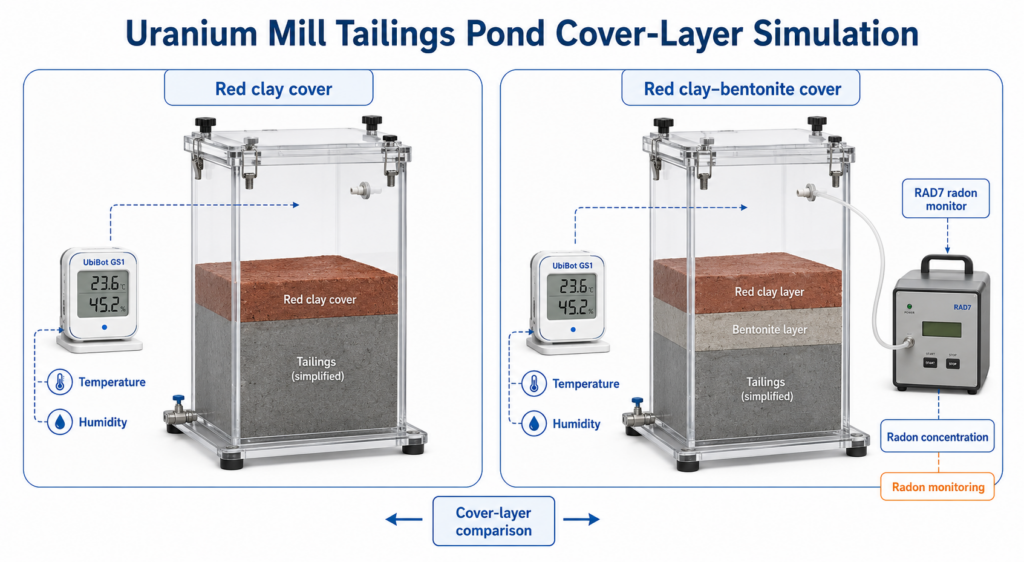
Study overview: UbiBot GS1 monitored cover-layer temperature and humidity while RAD7 measured radon concentration.
Research Background: What Problem Did This Study Address?
Uranium mill tailings ponds are facilities used to store uranium tailings. Because uranium tailings contain radium, they can continuously produce radon, a radioactive gas that can migrate through soil, water, and air. If radon escapes from a tailings pond into the surrounding environment, it may create health risks for nearby residents and workers.
Covering the surface of decommissioned uranium mill tailings ponds is one of the most common methods for reducing radon release. The basic principle is to slow radon migration through the cover layer, allowing more radon to decay inside the layer before reaching the surface. However, the radon reduction performance of a cover layer depends strongly on material properties, pore structure, moisture retention, permeability, compaction, and environmental conditions.
This study focused on whether adding bentonite to red clay could improve the radon reduction performance of a uranium tailings cover layer. Bentonite is known for its water absorption, swelling, and low-permeability properties. These characteristics may help reduce soil pores and limit radon migration.
To examine this mechanism, the researchers compared two simulated cover layers: a red clay cover layer and a red clay-bentonite cover layer. UbiBot GS1 was used to continuously monitor the temperature and humidity evolution of the cover layers under natural outdoor conditions, while a RAD7 radon monitor measured radon concentration. The combined dataset helped the researchers analyse how temperature and humidity were related to radon exhalation behaviour.
The Specific Role of UbiBot GS1 Uranium Tailings Monitoring
In this study, UbiBot GS1 was used as a real-time temperature and humidity monitoring device for the cover layers in a uranium mill tailings pond simulation experiment. The paper does not state that UbiBot directly measured radon or independently proved the radon reduction mechanism. Instead, UbiBot collected cover-layer temperature and humidity data, which were then analysed together with radon measurements from a RAD7 radon monitor.
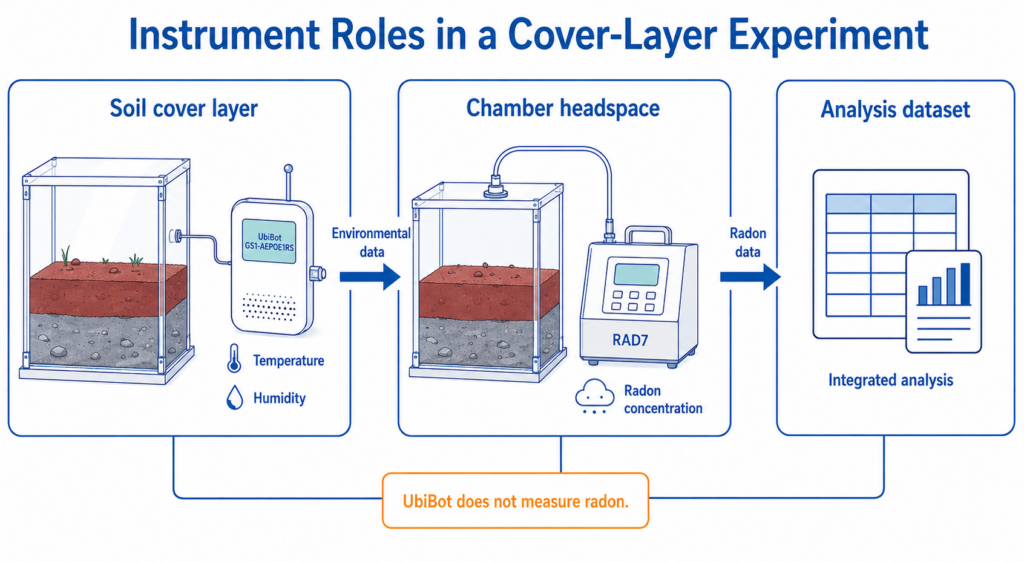
UbiBot GS1 provided temperature and humidity context; RAD7 measured radon concentration.
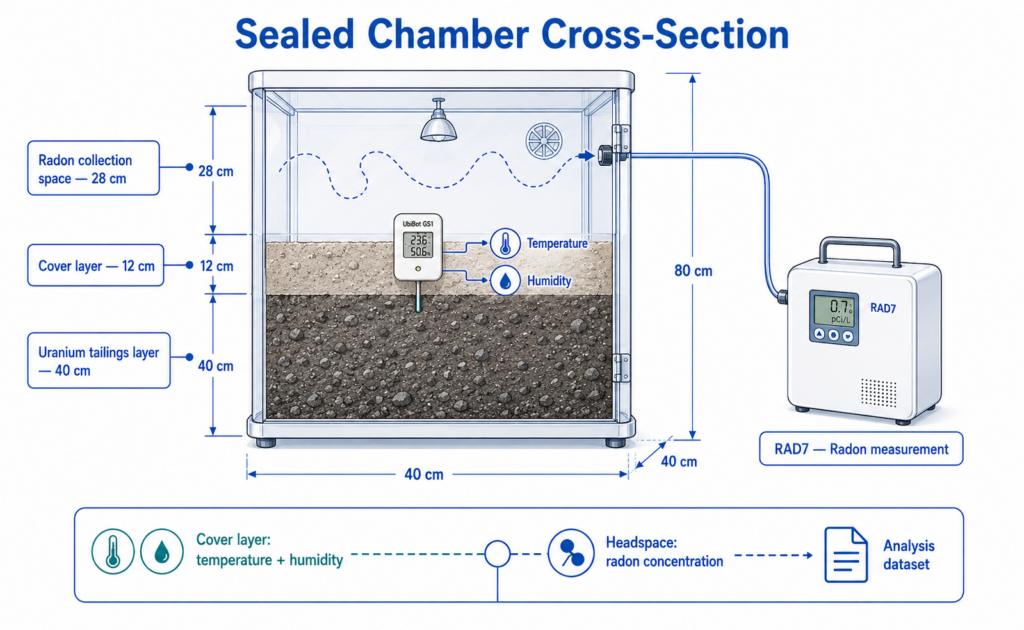
The experiment used two model chambers to simulate uranium mill tailings pond beach-surface covering. Each model chamber was a sealable cube box with dimensions of 40 cm × 40 cm × 80 cm. The lower and bottom walls were equipped with polyurethane foam insulation to reduce the influence of ambient temperature on the uranium mill tailings layer. The model included a 40 cm uranium tailings layer, a 12 cm cover layer, and a 28 cm radon collection space.
Two types of cover layers were prepared. The first was a red clay cover layer, labelled RC. The second was a red clay-bentonite cover layer, labelled RC-B, prepared as a 1:1 mixture of red clay and sodium bentonite. After preparation, both models were placed in the same natural outdoor environment for 7 days.
The UbiBot GS1 industrial temperature and humidity recorder was used to continuously monitor the temperature and humidity of the covering layer. According to the paper, the UbiBot GS1 had a temperature measurement range of 20 °C to 60 °C and a humidity range of 10% to 90%, with accuracy of ±0.5 °C and ±2%, respectively.
The UbiBot data were used in three important ways.
First, they documented the temperature and humidity evolution of the red clay and red clay-bentonite cover layers under the same outdoor conditions. This allowed the researchers to compare whether bentonite changed the thermal and moisture behaviour of the cover material.
Second, UbiBot data were extracted during the same time periods as radon measurement. The researchers collected five groups of radon concentration data. Each radon measurement lasted 3 hours, with radon concentration sampled every 10 minutes. Temperature and humidity data from UbiBot were extracted at the corresponding times, allowing the researchers to connect cover-layer environmental conditions with radon exhalation rates.
Third, the temperature and humidity dataset helped support mechanism analysis. The study found that the red clay-bentonite cover layer had better water retention than red clay, while the temperature curves of the two materials followed similar trends. By comparing these environmental records with radon exhalation rates, the researchers concluded that soil temperature was the dominant factor affecting radon exhalation variation under unsaturated moisture conditions.
Therefore, the specific role of UbiBot was environmental monitoring and mechanism-supporting data collection. UbiBot recorded real cover-layer temperature and humidity conditions, while RAD7 measured radon. Together, these data supported the analysis of how red clay-bentonite cover layers reduce radon exhalation.
Research Methods and Data Collection Approach
The research team prepared two simulated uranium mill tailings pond cover-layer models. Both models used uranium mill tailings collected from a tailings pond in southern China. Red clay was used as the base cover material, and calcium or sodium bentonite was used as the modifying material according to the experimental context.
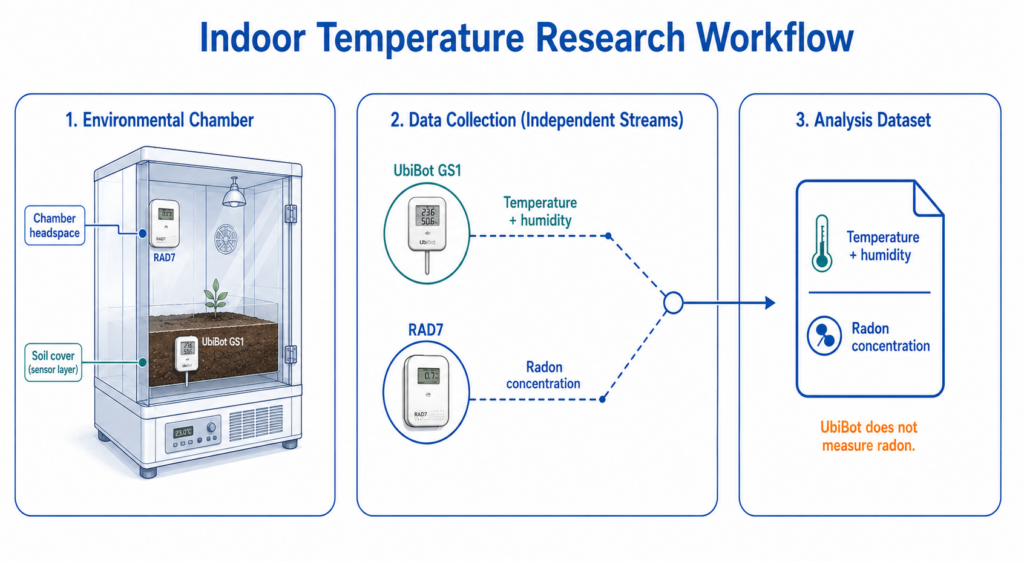
The model chamber included a uranium tailings layer, a cover layer, and a radon collection space.
The model chamber measured 40 cm × 40 cm × 80 cm. Uranium mill tailings were filled into the chamber in four layers, each about 10 cm thick, producing a 40 cm tailings layer. The cover layer was filled in two layers, forming a 12 cm covering layer. Above the covering layer, a 28 cm radon collection space was reserved.
Two cover-layer types were compared:
- RC: red clay covering layer.
- RC-B: red clay-bentonite covering layer, prepared as a 1:1 mixture of red clay and sodium bentonite.
After preparation, both models were placed in the same natural outdoor environment for 7 days. UbiBot GS1 continuously monitored the temperature and humidity of the cover layers. RAD7 was used to measure radon concentration through the closed-loop method.
Radon data collection was conducted during five measurement periods, labelled measurement points 1 to 5. During each measurement period, radon concentration data were sampled every 10 minutes for 3 hours. The researchers extracted temperature and humidity data at the same time, so that radon behaviour could be analysed together with cover-layer environmental conditions.
The radon exhalation rate was calculated using the closed-chamber method. In the paper, the simplified formula J = kH was used, where k represents the slope of the fitted cumulative radon concentration curve, and H represents the height of the radon collector.
The research then compared temperature evolution, humidity evolution, cumulative radon concentration, radon exhalation rate, and radon reduction efficiency between the RC and RC-B cover layers.
The study compared red clay cover material with a red clay-bentonite cover material prepared as a 1:1 mixture.
Key Research Findings
The study found that the red clay-bentonite cover layer had a stronger radon reduction effect than the red clay cover layer. At the five measurement points, the cumulative radon concentration from the red clay cover layer was significantly higher than that from the red clay-bentonite cover layer.
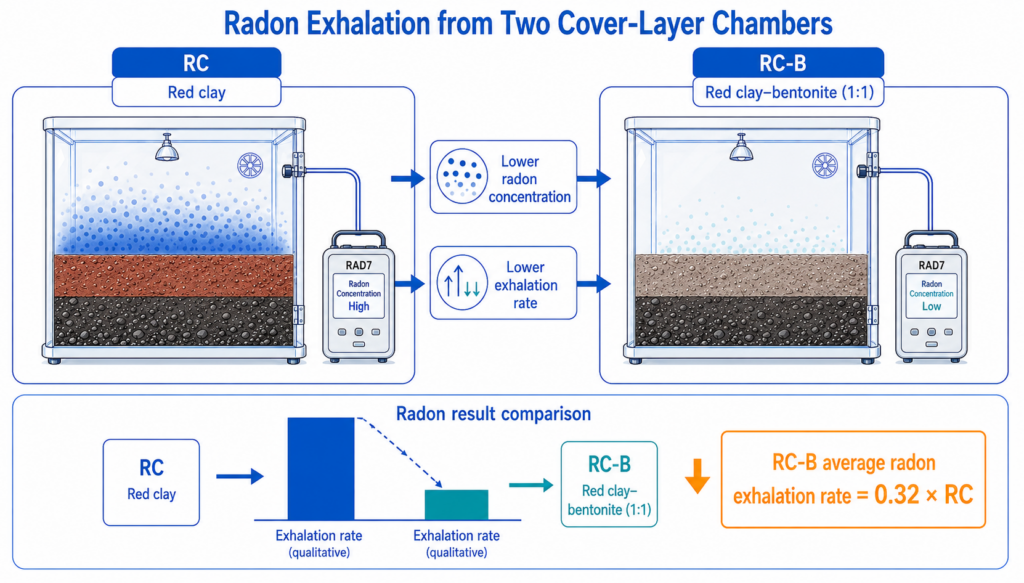
The red clay-bentonite cover layer showed stronger radon reduction performance than red clay alone.
At 180 minutes, radon concentrations from the red clay cover reached approximately 24,973, 21,511, 28,654, 22,215, and 28,933 Bq·m⁻³ across the five measurement periods. In contrast, the red clay-bentonite cover produced approximately 12,516, 3,387, 15,098, 4,731, and 10,076 Bq·m⁻³.
The average radon exhalation rate from the red clay-bentonite cover layer was only 0.32 times that from the red clay cover layer. This means the red clay-bentonite mixture showed a much stronger radon reduction performance in the simulation experiment.
The temperature monitoring showed that the red clay and red clay-bentonite cover layers had similar temperature evolution trends under the same outdoor conditions. Their temperature curves overlapped closely, suggesting that adding bentonite did not significantly improve the heat insulation performance of the cover layer.
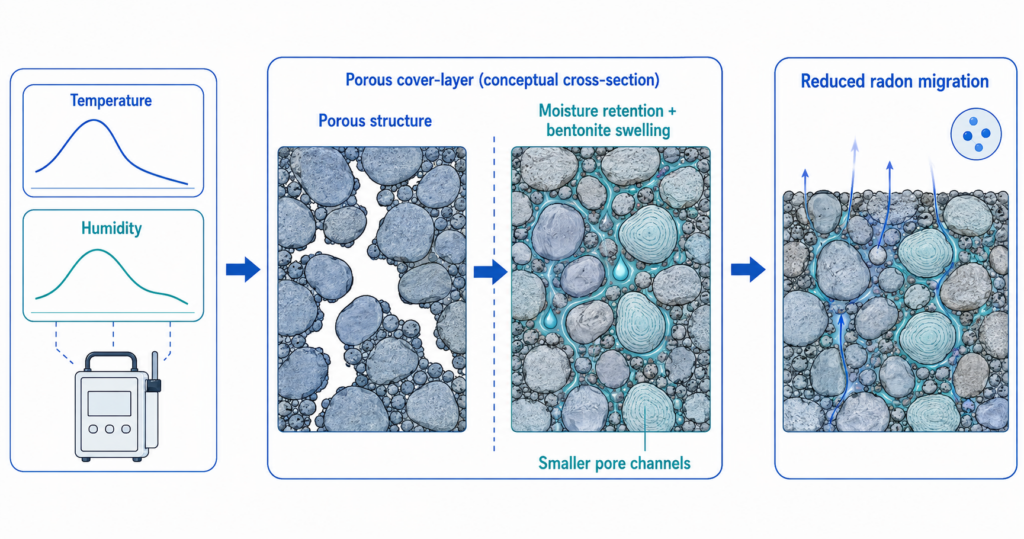
Temperature was more closely related to short-term radon exhalation variation under unsaturated moisture conditions.
The humidity monitoring showed a clearer difference. The red clay-bentonite cover layer generally had humidity values about 1% to 3% higher than the red clay cover layer. This indicated that bentonite improved water retention in the cover material.
The study also found that under unsaturated moisture conditions, humidity was not the dominant factor controlling short-term radon exhalation changes. Because the cover-layer humidity was below 40%, soil water did not fully block radon migration paths. Instead, soil temperature had a stronger relationship with radon exhalation variation. Higher temperature enhanced radon seepage and diffusion, making temperature the main factor affecting radon exhalation changes during the experiment.
The proposed mechanism is that bentonite absorbs water and expands, forming red clay-bentonite aggregates. These aggregates reduce pore size and improve water retention, thereby limiting radon migration more effectively than red clay alone.
What This Means for Uranium Tailings Pond Cover-Layer Monitoring
This study shows that cover-layer material selection is critical for uranium mill tailings pond remediation. A cover layer does not only act as a physical barrier; its pore structure, moisture behaviour, and response to environmental temperature can directly influence radon migration.
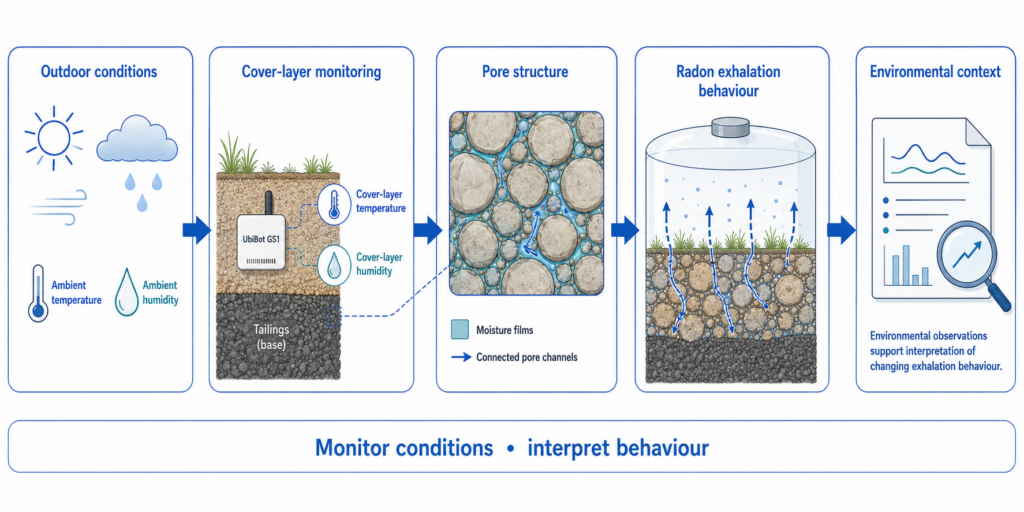
Environmental monitoring helps explain why radon exhalation changes across measurement periods.
For uranium tailings pond management, red clay-bentonite mixtures may offer advantages over red clay alone because bentonite can improve water retention and reduce pore connectivity. This helps slow radon transport through the cover layer.
The research also highlights the importance of monitoring temperature and humidity in cover-layer studies. Radon exhalation is not controlled only by the material itself. Outdoor temperature, sunshine, evaporation, and moisture distribution can all affect radon diffusion and seepage. Continuous UbiBot temperature and humidity data helped the researchers interpret why radon exhalation changed across measurement periods.
For environmental safety assessment, this means radon control studies should combine radiological measurements with environmental monitoring. A radon dataset alone can show how much radon is released, but temperature and humidity data help explain why the release rate changes.
Application Value of UbiBot Devices
UbiBot GS1 demonstrated practical value as an environmental monitoring tool in this uranium tailings cover-layer experiment.
First, it provided real-time temperature and humidity data from the cover layer. These data documented the physical environmental conditions under which radon measurements were taken.
Second, it supported comparative material analysis. By monitoring both red clay and red clay-bentonite cover layers under the same outdoor conditions, the researchers could compare how the two materials differed in temperature response and moisture retention.
Third, it helped connect environmental conditions with radon exhalation behaviour. UbiBot data were extracted at the same time as radon measurement, allowing the researchers to analyse whether temperature or humidity was more closely related to radon exhalation changes.
Fourth, it supported continuous monitoring under natural outdoor conditions. Cover layers in real uranium tailings ponds are exposed to changing weather, sunshine, evaporation, and temperature variation. UbiBot GS1 provided data relevant to these real-world environmental influences.
Fifth, UbiBot complemented specialised radon instruments. RAD7 measured radon concentration, while UbiBot measured the cover-layer environmental conditions. The combination produced a more complete dataset for understanding radon control mechanisms.
In this study, UbiBot’s value was not radon detection. Its value was in providing the temperature and humidity context needed to interpret radon exhalation and cover-layer performance.
Extended Application Scenarios
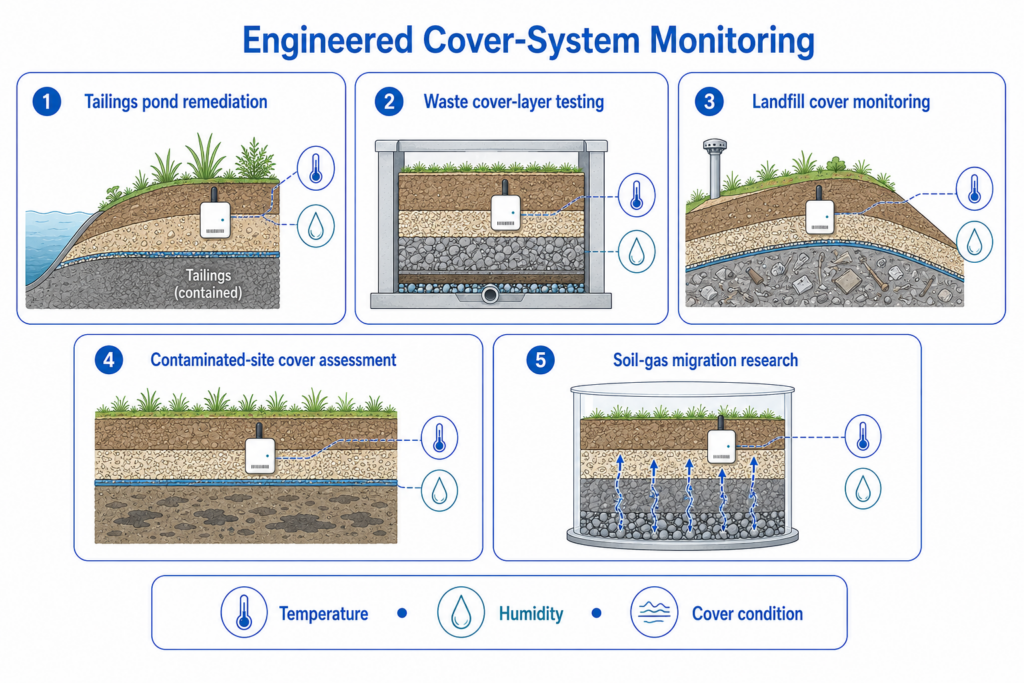
The same monitoring approach can support radioactive waste cover testing, landfill cover monitoring, contaminated-site assessment, and soil gas migration studies.
The monitoring approach used in this study can be extended to several related scenarios:
- Uranium mill tailings pond remediation
Used to monitor cover-layer temperature and humidity during radon reduction studies. - Radioactive waste cover-layer testing
Used to compare soil, clay, bentonite, sand, multilayer covers, and other materials under controlled or outdoor conditions. - Radon exhalation mechanism research
Used alongside radon monitors to analyse how environmental conditions influence radon migration. - Landfill and contaminated-site cover monitoring
Used to track temperature and humidity in barrier layers where moisture retention and gas migration matter. - Bentonite-modified soil studies
Used to evaluate how bentonite changes soil moisture behaviour under natural conditions. - Environmental safety monitoring
Used to provide background environmental data for radiation protection and contaminated-site management. - Soil gas migration experiments
Used to study how temperature and humidity influence gas diffusion, seepage, and emission from porous media. - Long-term cover-layer performance assessment
Used to monitor seasonal changes in engineered cover systems exposed to natural outdoor conditions.
FAQ
1. Which UbiBot product was used in the study?
The study used the UbiBot GS1 industrial temperature and humidity recorder.
2. What data did UbiBot collect?
UbiBot GS1 collected temperature and humidity data from the uranium mill tailings pond cover layer.
3. Where was the UbiBot device deployed?
It was used in the experimental model chamber to monitor the temperature and humidity of the red clay and red clay-bentonite cover layers.
4. What was the sampling frequency?
The paper describes UbiBot GS1 as continuously monitoring temperature and humidity. Radon concentration was sampled every 10 minutes during each 3-hour radon measurement period, and corresponding UbiBot temperature and humidity data were extracted at the same time.
5. How long did the experiment last?
The two cover-layer models were placed in the same natural environment for 7 days. Five radon measurement periods were used for analysis.
6. Did UbiBot measure radon?
No. Radon was measured using a RAD7 radon monitor. UbiBot GS1 measured cover-layer temperature and humidity.
7. How were the UbiBot data used?
The temperature and humidity data were used to analyse the environmental conditions of the cover layers and to interpret how temperature and humidity related to radon exhalation variation.
8. What cover materials were compared?
The study compared red clay cover material with a red clay-bentonite cover material prepared as a 1:1 mixture.
9. What was the main result?
The red clay-bentonite cover layer had a stronger radon reduction effect. Its average radon exhalation rate was only 0.32 times that of the red clay cover layer.
10. Why is this research important?
It provides experimental evidence and mechanism analysis for using bentonite-modified red clay as a radon-reducing cover layer in uranium mill tailings pond remediation.