
UBiBot Logo
UBiBot Logo
  • UBiBot Logo
  • Home
  • Products

    NEW

  • Pricing
  • Support
  • About Us
  • Download
  • magnifying-glass  Search
  • magnifying-glass header-close
  • Sign in Sign in
    Public Web Console Public Web Console
    On-Premises App Center On-Premises App Center
  • Home
  • Products

    NEW

  • Pricing
  • Support
  • About us
  • Download
  •  Public Web Console
  •  On-Premises App Center
  • Where to Buy

Learn Hub

Explore Knowledge Academic Research In-depth Tech

Share

LinkedIn

Facebook

X (Twitter)

Newsletter Signup

Table of contents

    UbiBot vs Eupry vs Dickson vs ELPRO: Which Remote Temperature Monitoring System Fits Your Site?

    Key Takeaway

    There is no single best remote temperature monitoring system for every site. UbiBot is the most flexible choice in this comparison for mixed commercial, warehouse, laboratory, server-room and small cold-storage deployments when buyers want direct cloud connectivity, multiple network options across the WS1 Pro and GS1 families, 300,000 local records, external sensor support and a basic cloud tier without a mandatory subscription. Eupry is stronger when GxP-oriented monitoring, calibration workflows and audit-ready reporting are the priority. Dickson Cobalt X2 is better suited to larger life-science facilities that can use LoRaWAN or Bluetooth gateways and need several sensor channels from one local touchscreen. ELPRO LIBERO Gx is the most specialized option for pharmaceutical transport where LTE-M/NB-IoT, shipment visibility and validated cold-chain workflows matter. The key purchasing decision is therefore architecture: connectivity, probe placement, local buffering, alarm workflow, software governance and recurring operating cost.
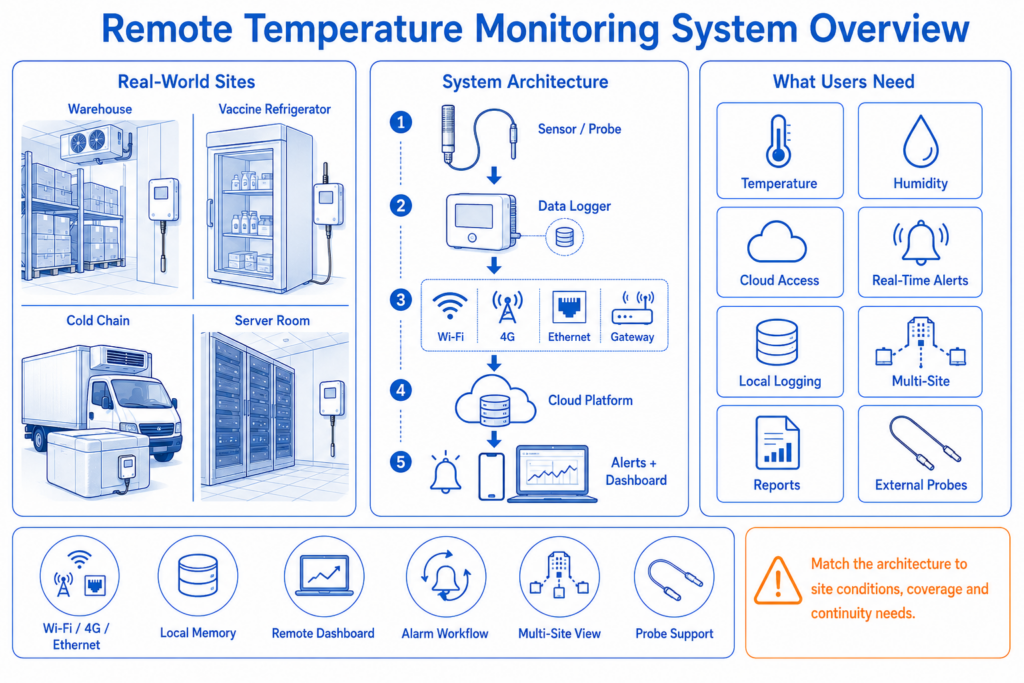
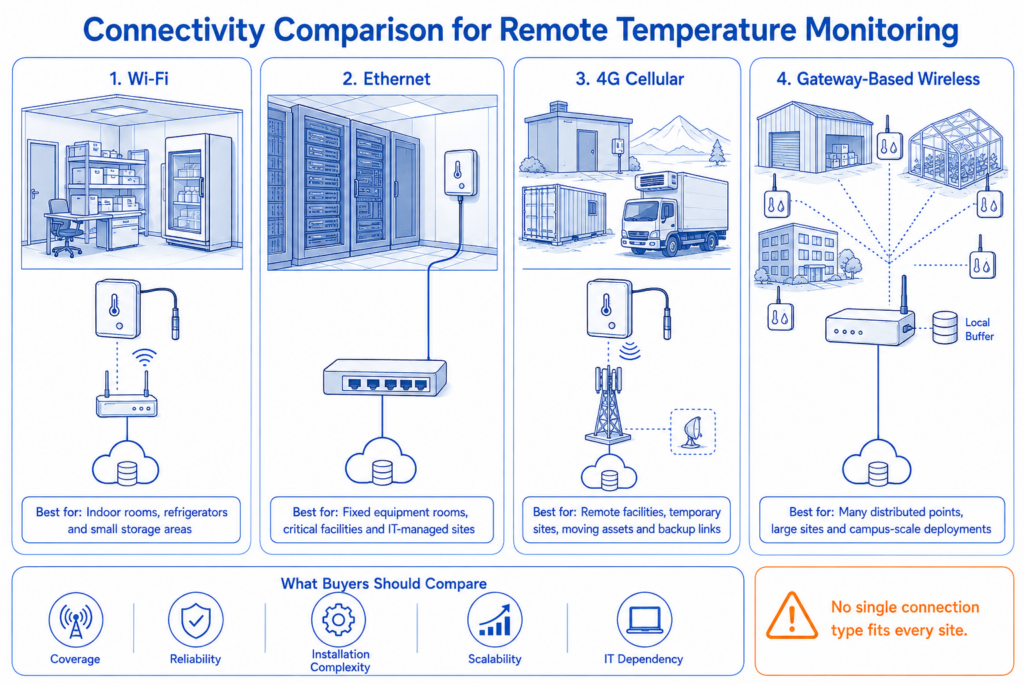
    Overview of a remote temperature monitoring system for warehouses, laboratories, cold chain transport and remote facilities

    A remote temperature monitoring system combines sensors, connectivity, cloud access and alerts to support different site types.

    Who Is This Comparison For?

    This comparison is written for facility managers, quality teams, warehouse operators, cold-chain managers, laboratory managers, IT and operations teams, and smaller businesses that need to see temperature data without being physically present at every site. The same search phrase — remote temperature monitoring system — can describe very different projects. A small food store may need two refrigerator probes and an email alert. A pharmaceutical company may need calibrated sensors, controlled user access, audit trails and formal validation. A logistics team may need cellular reporting while a shipment is moving between countries. A server-room operator may care more about network resilience and immediate notifications than about GxP documentation.

    The common operational problem is delayed awareness. Manual checks provide a reading only when a person is standing at the device. They do not show what happened overnight, how long an excursion lasted, or whether one branch site went offline. A cloud-connected system can automate sampling, preserve a continuous history, and notify responsible staff when values cross a threshold. That reduces routine inspection work, but only if the sensor is in the right location, the network path is reliable enough for remote alerts, and the escalation process is actually defined.

    Multi-site projects add another layer of difficulty. Warehouses may have stable Ethernet in offices but weak Wi-Fi between metal racks. Refrigerators may need an external probe so the logger can remain outside the cabinet. Remote greenhouses or equipment rooms may have cellular coverage but no local IT support. Laboratories may need temperature and humidity from the same account, while cold-chain transport may require location as well as temperature. Buyers therefore need to compare the whole monitoring architecture, not just temperature accuracy.

    What Matters Most When Choosing a Remote Temperature Monitoring System?

    Start with the monitoring job, not the brand

    A remote temperature monitoring project should begin with the asset, the acceptable temperature range, the number of monitoring points, and the action that must happen when a limit is exceeded. Warehouses, vaccine refrigerators, server rooms, greenhouses and refrigerated vehicles do not share the same installation constraints. A device that is simple in a small storeroom may become difficult to scale across fifty sites. Likewise, a GxP-oriented platform may be unnecessarily heavy for a non-regulated small business. Defining the monitoring job first prevents overbuying compliance features or underbuying resilience.

    Understand how a remote temperature monitoring system works
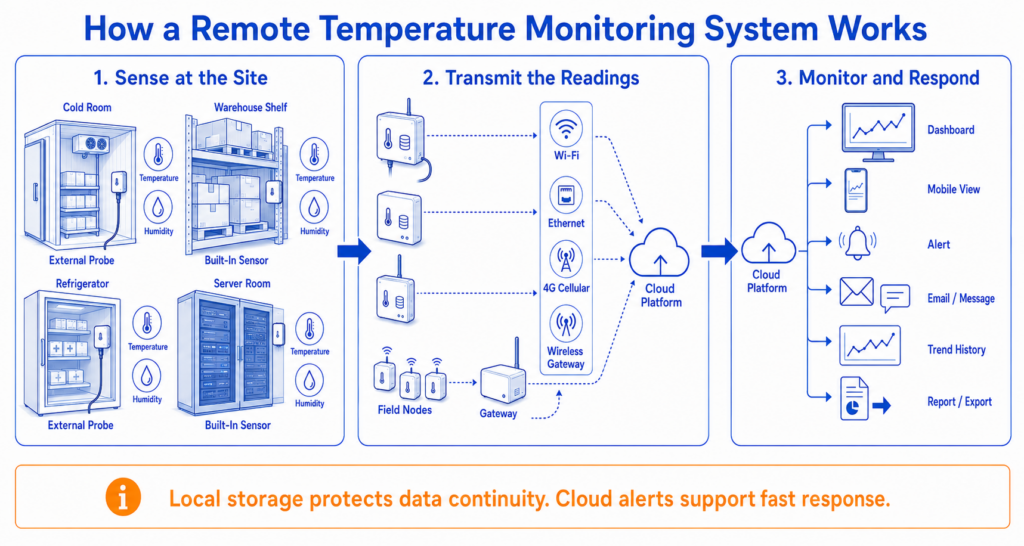
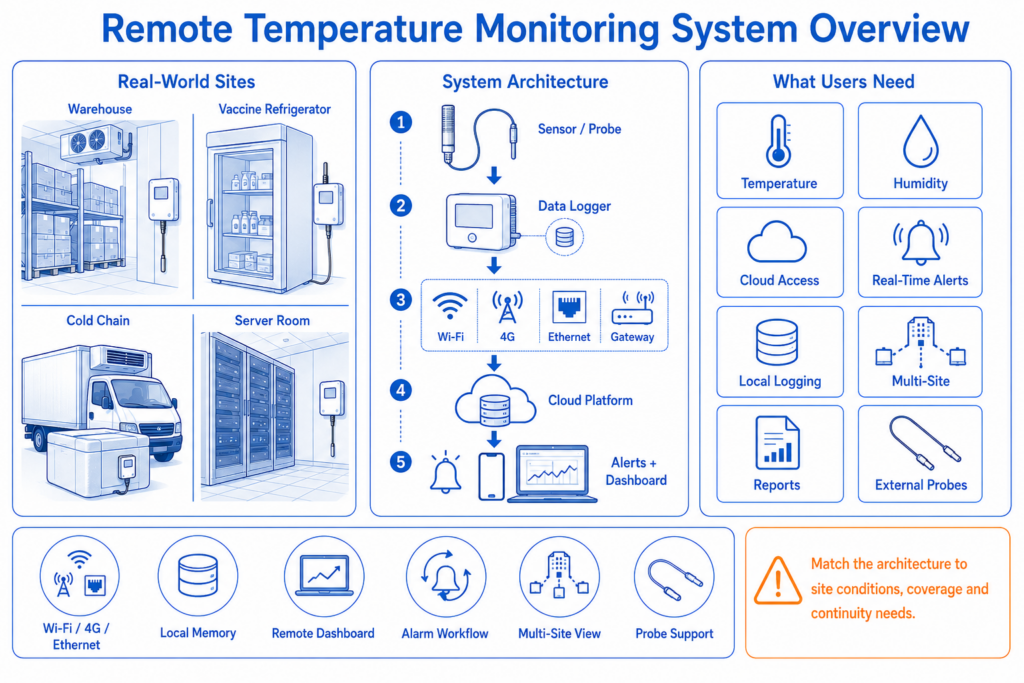
    Diagram showing how a remote temperature monitoring system collects data, uploads it to the cloud and sends alerts

    A typical remote temperature monitoring system measures conditions locally, transmits data through a network, and delivers cloud-based visibility and alerts.

    Most systems have four functional layers: the sensor measures temperature; the logger records and buffers the reading; the communication layer sends data through Wi-Fi, Ethernet, cellular or long-range radio; and the cloud or on-premises platform stores, visualizes and evaluates the data. An alert is only as reliable as the complete path between those layers. If the internet connection fails, a logger may continue recording locally while remote notifications stop. If the sensor is poorly positioned, a perfect cloud platform will still produce misleading data. This is why local memory, reconnect behavior and alarm testing should be evaluated together.

    Choose connectivity by site conditions
    Comparison of Wi-Fi, Ethernet, 4G and gateway-based connectivity for remote temperature monitoring systems

    Connectivity should be selected based on the site environment, IT conditions and deployment scale rather than by brand alone.

    Wi-Fi is convenient when coverage is stable and corporate IT permits IoT devices. Ethernet is attractive for fixed critical points where a cable can be installed and wireless coverage is unreliable. Cellular connectivity is useful for remote sites, temporary facilities and transport, but it adds SIM, coverage and data-plan considerations. LoRaWAN or another gateway architecture can be efficient for a large number of distributed battery-powered points because many sensors can share infrastructure. No connectivity method is universally superior; the best choice is the one that reduces failure points for the specific site.

    Treat external probes as an installation decision
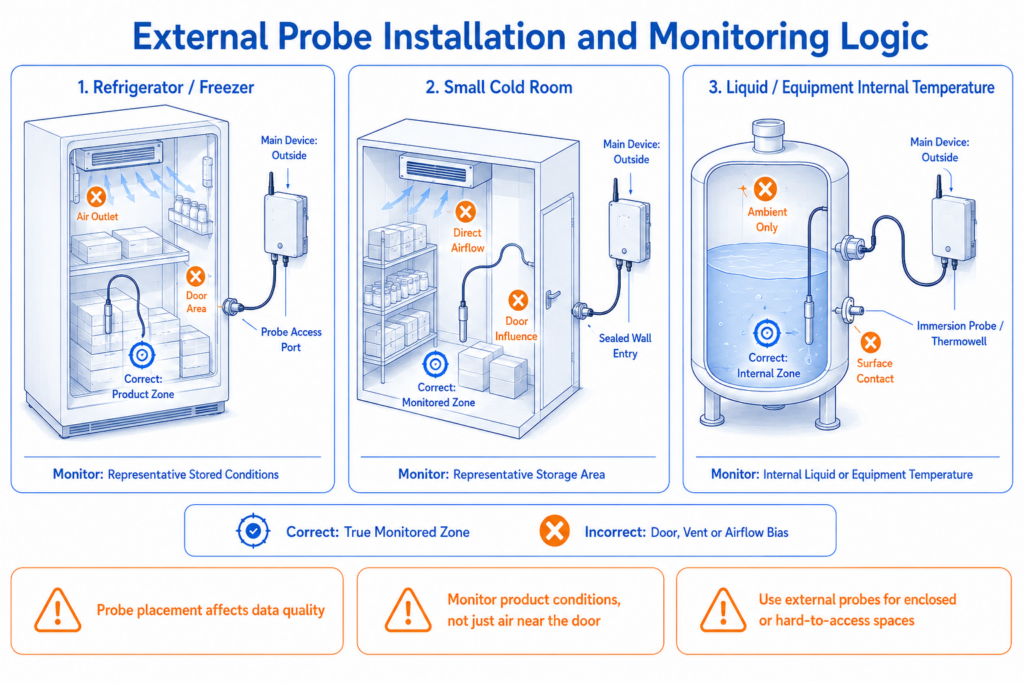
    External temperature probe placement in a refrigerator, cold room and storage environment for remote temperature monitoring

    External probes help monitor the actual product environment while allowing the main device to stay in a more accessible location.

    An external probe is often more important than the logger enclosure itself. In a refrigerator, freezer, insulated box, liquid bath, pipe or tightly controlled cabinet, the sensing element may need to sit where the product is while the logger, antenna, display and power source remain outside. Buyers should check probe range, cable length, connector type, calibration coverage and how many probes the exact logger can accept. They should also confirm whether the external probe and base unit are calibrated as a system or separately.

    Separate local recording from remote alarm capability

    Local storage protects the historical record during communication failures. Remote alarms support intervention while the problem is happening. They are different controls. Commissioning should include a deliberate network outage, a temperature excursion test and a reconnection test. The team should verify that readings continue locally, that the platform identifies missing communication, that buffered data uploads after reconnection, and that alert recipients know what to do. A system that stores every reading but fails to reach anyone at 2 a.m. may be inadequate for a high-risk asset.

    Evaluate cloud management, reports and integrations

    For one or two devices, a simple dashboard may be enough. At multi-site scale, user roles, device groups, site hierarchies, alarm ownership, scheduled reports and API access become more important. Quality teams may need audit evidence and calibration records; operations teams may need a fast mobile view; IT may want REST, MQTT, webhooks or data forwarding to another platform. These features often sit behind different software tiers, so the purchase specification should identify which functions are included and which add recurring cost.

    Match compliance effort to the regulated use case

    Regulated storage is a system-level responsibility. FDA 21 CFR Part 11 concerns electronic records and electronic signatures when applicable predicate rules require those records. EU GMP Annex 11 addresses computerized systems used in GMP activities. EU GDP and WHO guidance emphasize appropriate storage controls, monitoring, calibration and documented quality processes for medicinal products. EN 12830:2018 specifies performance and test requirements for temperature recorders used in transport, storage and distribution of temperature-sensitive goods. ISO/IEC 17025 is relevant to laboratory competence and calibration traceability. None of these frameworks means that a logger becomes automatically compliant merely because it records data and sends an alarm.

    Compare lifecycle cost, not only hardware price

    The purchase price is only one cost. A complete comparison should include external probes, gateways, mounting, cabling, cellular plans, software licenses, SMS or voice credits, calibration, spare sensors, validation work, API access, batteries and the labor needed to maintain dozens of points. A direct-connect device can be economical at low point counts. A gateway can become efficient when many sensors share it. A compliance-focused subscription may cost more but reduce manual reporting and calibration work. Buyers should model the cost structure over several years rather than choosing the lowest initial device price.

    Product Overview

    UbiBot WS1 Pro

    UbiBot WS1 Pro is a compact indoor remote temperature and humidity monitor with a 4.4-inch LCD. The built-in sensors cover -20°C to 60°C for temperature and 10% to 90% RH in non-condensing conditions, with published internal accuracy of ±0.2°C and ±2% RH. It also measures ambient light. The product family offers Wi-Fi and cellular connectivity depending on the version purchased, and the device stores up to 300,000 sensor records locally. Two Micro USB ports can support power and external sensors; UbiBot states that two DS18B20 temperature probes can be connected and that an RS485 sensor such as TH30S-B, PT100 or another supported probe can be used subject to the port arrangement. Power is supplied by four AA batteries or Micro USB. This combination makes WS1 Pro particularly practical for laboratories, refrigerators, small cold rooms, retail storage and other sites where a local display and flexible probe placement are useful.

    UbiBot GS1 variants

    The GS1 family is the more industrial UbiBot option. It combines a 4-inch display, 300,000-record local memory, internal temperature and humidity sensing, and external-sensor expansion on applicable variants. Connectivity is model-specific: GS1-AETH1RS provides 2.4 GHz Wi-Fi and RJ45 Ethernet and supports an optional PoE splitter, while GS1-AL4G1RS provides Wi-Fi and 4G cellular connectivity plus RS485 expansion. This distinction matters: buyers should not describe every GS1 as simultaneously supporting Wi-Fi, Ethernet and 4G. UbiBot markets the GS1 family for warehouses, logistics, agriculture and industrial environments. The current product pages also show IP65 protection for most GS1 variants, while the AETH1RS Ethernet variant is treated differently in the model comparison table, so the enclosure rating of the exact ordered model should be confirmed before outdoor or washdown deployment.

    Eupry DW2 Wi-Fi Data Logger with P1T external temperature sensor

    Eupry is positioned much more narrowly around GxP temperature compliance. Its DW2 Wi-Fi Data Logger product page lists 2.4 GHz Wi-Fi, up to 10,000 stored measurements, a -30°C to 50°C operating range as a standalone logger, ±0.5°C accuracy before calibration, and up to two years of battery life from two AA cells. The P1T external digital temperature sensor extends the sensing range to -100°C to 100°C, with typical accuracy published as ±0.3°C from -50°C to 50°C and ±0.5°C across the wider range. Eupry couples the hardware with a monitoring platform focused on calibration records, deviation handling, SMS and email alerts, and rapid audit reporting. Some Eupry solution pages describe 4G or 3G fallback in the overall monitoring solution, while the DW2 product page itself lists Wi-Fi; buyers should therefore confirm whether cellular resilience is delivered through an external connectivity solution rather than onboard cellular in the logger.

    Dickson Cobalt X2 with Smart DS Temperature Sensor and OCEAView

    Dickson Cobalt X is a multi-channel touchscreen logger designed for life sciences, laboratories, hospitals, storage and manufacturing. Cobalt X2 supports up to four wired or wireless sensor channels and communicates through LoRaWAN or Bluetooth Low Energy to the OCEAView monitoring solution. The 2.4-inch color touchscreen supports local interaction and alarm acknowledgement, and the logger has audible and visible alarm indicators. The selected Smart DS temperature sensor covers -40°C to 80°C and stores calibration information in sensor memory, which simplifies sensor exchange during recalibration. The reviewed Smart DS page does not publish a universal accuracy figure, so the exact calibration certificate and acceptance criteria should be specified during procurement. Cobalt X is a stronger fit when one local logger must aggregate several sensor channels and the site can support Dickson gateway or bridge infrastructure.

    ELPRO LIBERO GE and LIBERO GH with elproCLOUD

    ELPRO LIBERO Gx is different from the other products because it is optimized for pharmaceutical shipment monitoring rather than general fixed-site building monitoring. LIBERO GE combines an internal temperature sensor with support for an external Pt100 probe and is specified for LTE-M and NB-IoT cellular transmission. Its external probe system can cover very wide temperatures depending on the selected Pt100 configuration, including cryogenic applications, and the logger stores up to 31,000 values. LIBERO GH adds internal temperature and humidity sensing for shipment conditions. Both are tied closely to elproCLOUD and ELPRO cold-chain workflows, with real-time visibility, alarm notifications, reports, calibration and validation documentation. For a remote warehouse or server room, this may be more specialized than necessary; for global pharmaceutical distribution, the cellular and compliance-oriented architecture can be a better match.

    Side-by-Side Comparison Table

    Specifications below are based on official manufacturer pages reviewed in August 2026. Where the exact product page does not publish a value, the table says so instead of borrowing a figure from another model.

    Comparison item UbiBot WS1 Pro/ GS1 variants Eupry DW2 + P1T Dickson Cobalt X2 + Smart DS ELPRO LIBERO GE / GH
    Product positioning Cross-industry direct-connect monitoring. WS1 Pro for indoor/probe-based points; GS1 variants for industrial, Ethernet or cellular deployments. GxP-oriented Wi-Fi monitoring with interchangeable calibrated sensors and compliance software. Multi-channel LoRaWAN/BLE logger for life sciences and larger facilities using OCEAView. Cellular real-time pharmaceutical shipment monitoring; GE for temperature/external Pt100, GH for temperature/humidity.
    Measurement parameters WS1 Pro: temperature, RH, light plus supported external sensors. GS1: temperature/RH and supported external RS485 sensors by model. DW2 measures temperature; external Eupry sensors add temperature or temperature/RH depending on probe. Depends on connected sensor. Selected Smart DS measures temperature; Cobalt X supports other sensor types. GE: temperature plus location/light/tilt features; GH: temperature/RH plus shipment-context sensors.
    Measurement range Internal WS1 Pro / GS1: -20°C to 60°C; RH 10% to 90% non-condensing. External probe range depends on probe. DW2 standalone: -30°C to 50°C. P1T external sensor: -100°C to 100°C. Smart DS: -40°C to 80°C. GE internal: -30°C to 70°C; external Pt100 system up to -200°C to 400°C depending on probe. GH: -30°C to 70°C and 0% to 100% RH non-condensing.
    Accuracy Internal temperature ±0.2°C; RH ±2%. External-sensor accuracy depends on the selected probe. DW2 ±0.5°C before calibration. P1T typical ±0.3°C from -50°C to 50°C and ±0.5°C from -100°C to 100°C. Not publicly specified on the reviewed Smart DS product page; calibration information is stored in the sensor and calibration options are offered. Range-dependent. ELPRO publishes detailed accuracy bands for GE/GH; external Pt100 system accuracy depends on probe class and range.
    Connectivity WS1 Pro: Wi-Fi or cellular depending on version. GS1-AETH1RS: Wi-Fi + RJ45 Ethernet. GS1-AL4G1RS: Wi-Fi + 4G. DW2 product page: 2.4 GHz Wi-Fi. Some solution pages describe 4G/3G fallback at solution level; confirm architecture. LoRaWAN and Bluetooth Low Energy to OCEAView through compatible gateway/bridge infrastructure. LTE-M and NB-IoT cellular connectivity.
    External probe support Strong. WS1 Pro supports DS18B20 and supported RS485 probes. GS1 RS485 variants support multiple external-sensor options; exact port limits must be confirmed. Strong. P1T and other interchangeable probes are central to the system. Strong. Cobalt X supports multiple wired/wireless sensors; Smart DS uses flat cable and plug-and-play calibration data. GE supports external Pt100 through M8 connector. GH uses an internal T/RH sensor.
    Gateway requirement No separate gateway for the direct-connect WS1 Pro and GS1 variants compared here. No separate gateway for standard Wi-Fi operation; any cellular-fallback hardware/service should be confirmed. Yes for remote LoRaWAN/BLE-to-cloud operation: use a compatible Dickson gateway/bridge. No local gateway for LIBERO Gx cellular-to-cloud operation.
    Local display WS1 Pro: 4.4-inch LCD. GS1: 4-inch LCD. Status display for Wi-Fi and temperature state on the reviewed product page. 2.4-inch color resistive touchscreen with local alarm acknowledgement. Multifunction LCD.
    Power supply WS1 Pro: 4 AA batteries or Micro USB. GS1: internal lithium battery, Type-C/DC; AETH1RS can use optional PoE splitter. 2 AA batteries; up to 2 years stated under product conditions. 2 user-replaceable LS17500 lithium batteries or optional 5 V adapter; at least 1 year under standard usage. Non-replaceable alkaline battery; runtime depends on model, temperature and communication behavior.
    Local data storage 300,000 sensor records. Up to 10,000 measurements; Eupry also describes 30+ days of local retention during outages. Up to 4,000 readings per sensor channel; Cobalt X2 up to 16,000 total across four channels. Up to 31,000 measurement values for GE/GH.
    Cloud access UbiBot public IoT platform through web and apps; multi-device access and data sharing supported. Eupry monitoring platform for live monitoring, calibration and audit workflows. OCEAView Cloud or on-premises monitoring solution. elproCLOUD and, for cold-chain workflows, liberoMANAGER.
    Alert methods App, email, SMS, voice call, web notifications and other integrations including HTTP/WhatsApp; some channels use paid credits. SMS and email deviation alerts; recipient rules and compliance workflow in platform. Local audible/visual alerts plus remote phone, text and email alarms through the monitoring solution. Immediate email/SMS alarms through elproCLOUD plus logger alarm status.
    Data export / reports Charts, CSV/PDF export and scheduled reporting depending on platform service/plan. Digital audit reports and centralized calibration/deviation documentation. OCEAView reporting; exact export entitlement should be confirmed for the selected software deployment. PDF reports and automated reporting through elproCLOUD/liberoMANAGER.
    API / integration RESTful API, MQTT API and data-forwarding services; limits depend on selected service. Not publicly specified on the reviewed DW2 product page; confirm software tier and enterprise integration options. Not publicly specified on the Cobalt X product page; confirm OCEAView integration entitlement. Optional API integration is published for elproCLOUD/liberoMANAGER workflows.
    Subscription requirement No mandatory subscription for basic platform access; each device includes a free basic tier, with paid storage/services available. Monitoring software/service is part of the Eupry solution; universal public pricing and contract terms are not stated on the reviewed pages. OCEAView software and gateway infrastructure are part of the solution; commercial terms should be quoted for the deployment. elproCLOUD/usage-based service model applies; commercial terms depend on deployment and service package.
    Installation complexity Low to medium. Direct connection is simple, but network approval, probe routing and variant selection still matter. Low to medium for Wi-Fi points; regulated deployments add calibration, qualification and software-governance work. Medium. Requires sensor selection plus LoRaWAN/BLE gateway or bridge design and software setup. Low at the shipment level because cellular removes local network setup; higher process complexity for regulated global logistics.
    Best suited for Mixed commercial and industrial sites, smaller multi-site fleets, warehouses, labs, server rooms and remote points needing connectivity choice and lower base software burden. Pharma, biotech, laboratories and healthcare sites prioritizing GxP calibration and audit workflows. Life-science facilities with several sensor channels, large spaces and long-range wireless infrastructure. Pharmaceutical cold-chain transport and high-value shipments requiring cellular real-time visibility and GxP-oriented workflow.

    Connectivity and Deployment Comparison

    UbiBot offers the broadest connectivity menu here, but through different device variants rather than one universal radio stack. WS1 Pro is available in Wi-Fi and cellular versions; GS1-AETH1RS is useful for fixed sites that want Wi-Fi plus RJ45 Ethernet, while GS1-AL4G1RS is the GS1 choice when 4G matters. Ethernet can remove a radio dependency in dense warehouses or server rooms, while cellular is more practical at remote greenhouses or equipment rooms. Procurement teams should name the exact model instead of assuming one GS1 unit combines Wi-Fi, Ethernet and 4G.

    Eupry DW2 is fundamentally Wi-Fi based, which is simple when the customer controls the WLAN and values Eupry’s monitoring, audit and buffering workflow. Some Eupry solution pages refer to cellular fallback, but the DW2 product page does not present cellular as an onboard interface. Buyers needing WAN redundancy should confirm where the 4G/3G connection resides, how failover works and whether separate hardware or service is required.

    Dickson uses a different architecture. Cobalt X sends measurements over LoRaWAN or Bluetooth Low Energy into the OCEAView environment through gateway or bridge infrastructure. That adds an infrastructure component, but long-range radio can be advantageous across large facilities where Wi-Fi coverage at every monitoring point is difficult. Commissioning therefore includes gateway placement, radio coverage and backhaul design.

    ELPRO LIBERO Gx is optimized for moving assets. LTE-M and NB-IoT suit pharmaceutical shipments crossing warehouses, trucks and distribution handoffs without relying on each site’s local network. For a fixed small room with stable Wi-Fi or Ethernet, that specialization may be unnecessary. The practical rule is to match architecture to the asset: local-network devices for fixed sites, gateway radio for dense multi-point estates, and cellular for remote or moving assets.

    Sensor and External Probe Comparison

    UbiBot is strongest when one organization has a mixture of simple ambient points and probe-based applications. WS1 Pro can monitor room temperature and humidity with its internal sensors, then add DS18B20 or supported RS485 probes when the sensing point needs to move into a refrigerator, cold room or other constrained space. GS1 RS485 variants provide a similar path for more industrial installations. The operational benefit is that the display and networked device can remain accessible while the probe is positioned at the point that matters. The purchase team still needs to specify the exact probe, cable, accuracy and calibration points; the base logger specification is not enough.

    Eupry treats interchangeable external sensors as part of its compliance model. The P1T gives a much wider temperature range than the DW2 base unit and carries digital calibration information. That is valuable for laboratories and pharmaceutical storage because recalibration can focus on the sensing element rather than taking the complete logger out of service. The advantage is less about the widest range and more about the maintenance workflow around a calibrated system.

    Dickson Cobalt X is the most flexible in channel count. Cobalt X2 can support up to four wired or wireless sensors, so one touchscreen can supervise several parameters or nearby assets. The Smart DS temperature sensor uses a flat cable and stores calibration information on the sensor, which makes replacement easier. This approach is attractive in a laboratory cluster or life-science facility where temperature, humidity, CO2, pressure or contact status may be combined. It is more infrastructure than a single refrigerator needs, but it can reduce fragmentation in a complex site.

    ELPRO LIBERO GE is purpose-built for shipment temperatures that may exceed the useful range of an internal sensor. Its external Pt100 option can extend into ultra-low and cryogenic ranges depending on the selected probe class and configuration. LIBERO GH instead uses an internal temperature/humidity sensor for shipments where humidity matters. For either product, the transport application should drive the sensor choice; these are not general building sensor hubs.

    Cloud Platform, Alerts and Data Management

    A cloud platform is useful only when it shortens the time between a problem and a controlled response. UbiBot provides web and app access, device sharing, charts, alerts and data export. Official support materials state that no subscription is required for basic platform use: each device includes a free tier with 200 MB of lifetime storage and 1 GB of outbound traffic reset monthly. Paid capacity and messaging are available when the free allowance is not enough. Alert channels include app notifications, email, SMS, voice calls, web notifications and additional integrations such as HTTP and WhatsApp; SMS and voice use paid credits. For small businesses or distributed non-regulated sites, the ability to start without a mandatory software subscription can materially reduce entry cost.
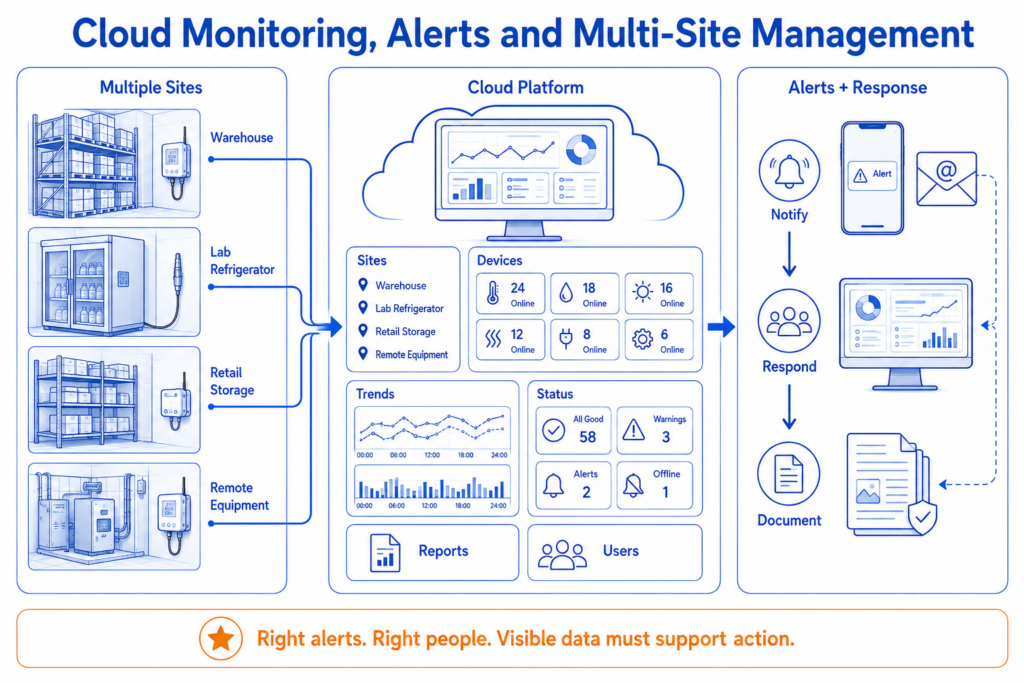
    Cloud-based multi-site temperature monitoring dashboard with alerts, reports and device management

    Cloud monitoring platforms centralize visibility, alerts and reporting across multiple devices and locations.

    Eupry takes the opposite commercial and operational position: the software, calibration process and audit workflow are central to the value proposition. The platform is designed to show live measurements, document deviations, manage calibration evidence and produce audit reports quickly. That is stronger than a generic dashboard when a QA team must show not only the temperature graph but also who handled the deviation and where the calibration evidence is stored. It also means the buyer should treat the software service as part of the system cost rather than comparing only logger prices.

    OCEAView gives Dickson users centralized remote monitoring around Cobalt X, including remote phone, text and email alarms as well as local audible and visual alarms. For large facilities, local acknowledgement at the touchscreen and remote escalation can work together. The exact reporting, retention, user-role and integration entitlements should be confirmed in the software quote, particularly if the system will support a validated life-science process.

    ELPRO elproCLOUD is built around regulated cold-chain visibility. ELPRO publishes audit trails, user/access management, email/SMS alarm notification, archived data search, reporting and optional API integration. For LIBERO Gx, that software context is a major reason to choose the product. A generic warehouse operator may not need the full governance model, but a pharmaceutical shipper may value a platform that is designed around shipment release, stability information and GxP documentation.

    Across all four brands, the alarm method itself is only part of the control. Define primary and backup recipients, acknowledgement rules, after-hours coverage, time delays, repeat notifications and responsibility for product disposition. Then test the path. A “real-time alert” is not a risk-control measure until the organization proves that the message reaches a person who can act.

    Total Deployment Cost and Recurring Burden

    UbiBot usually has the lightest base software burden. A small deployment can start with a WS1 Pro or GS1, use the included cloud tier and add paid messaging, storage or integrations only when needed. Costs increase when the project adds external probes, calibration, 4G data, PoE hardware, higher cloud usage or many alert recipients. The important point is that direct-connect models do not require a separate gateway.

    Eupry should be evaluated as a managed compliance system rather than as a commodity logger. Hardware, interchangeable probes, calibration, software service levels, mapping or qualification services and support all contribute to cost. In a regulated organization, some of that recurring cost can replace internal engineering time, spare-loggers and manual audit preparation. The economic comparison should therefore include labor saved, not only subscription expense.

    Dickson adds gateway or bridge infrastructure to the logger and sensor costs. That is a disadvantage for one or two points but can be efficient when many LoRaWAN devices share the same site infrastructure. Calibration choices, software, replacement sensors and gateway backhaul all belong in the lifecycle model. ELPRO is similarly service-oriented: LIBERO Gx hardware, cellular service, cloud workflow, calibration and transport-process integration are part of the operating model. Its value increases when the monitored item is a high-value shipment rather than a static room.

    For a defensible purchasing comparison, build a three- to five-year cost model with realistic point counts. Include the number of facilities, expected device growth, calibration frequency, battery service, cellular traffic, software users, report requirements and integration work. A low-cost device that creates manual work every month can be more expensive than a higher-cost system that automates the quality process.

    Brand-by-Brand Strengths and Trade-Offs

    UbiBot WS1 Pro and GS1

    UbiBot best fits organizations that want one cloud ecosystem across different site types without committing every location to a gateway or enterprise compliance stack. WS1 Pro is well matched to rooms, refrigerators and laboratories where Wi-Fi or cellular access, a large display and external probes are useful. GS1 adds industrial variants, including Ethernet and 4G options, plus RS485 expansion. The shared strengths are 300,000 local records, direct cloud access, multi-channel alert options, data export and open integration paths. The main trade-off is governance: the public platform is not automatically a validated GxP system, and the exact GS1 variant must be specified carefully because network interfaces and enclosure protection differ by model. UbiBot is therefore strongest where deployment flexibility and cost control matter more than a pre-packaged validation program.

    Eupry DW2 + P1T

    Eupry is the better fit when the buyer’s problem is not merely sensing temperature but operating a controlled GxP monitoring process. Interchangeable calibrated sensors, digital calibration records, deviation handling and audit reporting are central features. The DW2/P1T combination also covers a wide temperature range and retains data during connectivity loss. The trade-off is focus and commercial structure. A small retailer or server room may not need the compliance workflow, and buyers should verify the architecture behind any advertised cellular backup because the core DW2 product page lists Wi-Fi. Eupry earns its place when calibration and inspection readiness are operational requirements rather than optional extras.

    Dickson Cobalt X2 + Smart DS + OCEAView

    Dickson is strongest for larger controlled environments where a local touchscreen, several sensor channels, LoRaWAN coverage and mature life-science monitoring are useful. Cobalt X2 can aggregate up to four wired or wireless sensors, and Smart-Sensor technology keeps calibration information with the sensing element. Local audible/visual alarms complement remote OCEAView notifications. The trade-off is infrastructure: the system depends on gateway or bridge architecture for remote connectivity, so it is less plug-and-play than a direct Wi-Fi or Ethernet logger at a small site. It becomes more attractive as the number of sensors and monitored parameters grows.

    ELPRO LIBERO GE / GH + elproCLOUD

    ELPRO is the specialist choice for regulated transportation. LTE-M/NB-IoT connectivity, local buffering, real-time cloud visibility, calibrated sensors and shipment-oriented reporting are designed for products that move through the supply chain. LIBERO GE is particularly relevant when an external Pt100 is needed for ultra-low or cryogenic temperatures; GH adds humidity for shipment climate monitoring. The limitation is the same specialization: a stationary commercial storeroom with good Wi-Fi may be better served by a simpler fixed-site logger. ELPRO should be selected when the transport process, not just the storage room, is the critical monitoring scenario.

    Which Product Should You Choose?

    Choose this product When this purchasing condition matters most
    UbiBot WS1 Pro You need a straightforward indoor remote temperature monitoring system for rooms, refrigerators, labs or small cold rooms; Wi-Fi or cellular variants are available; a large LCD and external probes matter; and you want to start without a mandatory basic cloud subscription.
    UbiBot GS1-AETH1RS / GS1-AL4G1RS You need more industrial deployment options. Choose AETH1RS when Ethernet/optional PoE is useful; choose AL4G1RS when 4G and RS485 expansion are more important. Confirm the exact enclosure rating and model before ordering.
    Eupry DW2 + P1T Your priority is GxP-oriented monitoring, calibration workflow, deviation documentation and audit reporting across pharma, biotech, healthcare or laboratory sites.
    Dickson Cobalt X2 + Smart DS + OCEAView You manage a larger life-science facility, need several sensor channels from one local touchscreen, and can deploy LoRaWAN/BLE gateway infrastructure.
    ELPRO LIBERO GE / GH + elproCLOUD You monitor pharmaceutical shipments rather than only fixed rooms and need LTE-M/NB-IoT connectivity, shipment visibility, calibrated sensors and cold-chain governance.

    Decision tree for choosing a remote temperature monitoring system based on site conditions and monitoring needs

    The best remote temperature monitoring system depends on the monitored asset, site conditions, connectivity options and reporting requirements.

    Pros and Cons

    Product Scenario-specific advantages Scenario-specific limitations
    UbiBot WS1 Pro / GS1 Flexible Wi-Fi, 4G and Ethernet options across device variants; no gateway for direct-connect models; 300,000 local records; local display; external sensor expansion; free basic cloud tier; REST/MQTT/data-forwarding options. Connectivity and protection differ by exact model; paid credits apply to some alert channels; project-level calibration, validation and regulated-record controls must be defined by the buyer.
    Eupry DW2 + P1T GxP-focused monitoring and calibration workflow; wide external-sensor range; 30+ day outage retention described by Eupry; SMS/email alerts; digital audit reports; sensor replacement supports calibration continuity. Primarily Wi-Fi at logger level; cellular fallback architecture should be confirmed; software/service cost is part of the solution; may be more compliance infrastructure than non-regulated users need.
    Dickson Cobalt X2 + Smart DS Up to four sensor channels; LoRaWAN/BLE; color touchscreen; local audible/visual alarm; sensor-stored calibration information; broad life-science sensor ecosystem. Requires gateway/bridge architecture for remote monitoring; selected Smart DS product page does not publish a universal accuracy figure; system design and software terms add procurement complexity.
    ELPRO LIBERO GE / GH LTE-M/NB-IoT real-time transport connectivity; calibrated sensor options; 31,000-value buffer; shipment-oriented display and alarms; elproCLOUD audit trail and GxP workflow; GE supports external Pt100 for very wide ranges. Optimized for transport rather than general fixed-site monitoring; cellular coverage/service matters; battery runtime depends on communication and temperature; cloud/service structure is more specialized.

    Frequently Asked Questions

    What is the best remote temperature monitoring system for a small warehouse or business?

    For a small or medium site that already has Wi-Fi or Ethernet and does not require a pre-packaged GxP validation program, UbiBot is the most flexible starting point in this comparison. WS1 Pro works well for indoor rooms and probe-based assets; GS1-AETH1RS is useful where Ethernet is preferred. The final choice should still reflect temperature range, calibration and alarm requirements.

    Which system works best where Wi-Fi is unreliable or unavailable?

    For a fixed site with cabling, UbiBot GS1-AETH1RS can use Ethernet. For remote fixed sites, a UbiBot 4G-capable variant may be more practical. Dickson can avoid site-wide Wi-Fi by using LoRaWAN to a gateway. ELPRO LIBERO Gx uses LTE-M/NB-IoT for moving pharmaceutical shipments. The best option depends on whether the asset is fixed, distributed across a large building or moving through the supply chain.

    Can a remote temperature monitoring system keep recording when the internet is down?

    Yes, all systems compared here provide local storage or buffering, but capacity differs. UbiBot lists 300,000 sensor records, Eupry DW2 up to 10,000 measurements and 30+ days of outage retention, Cobalt X up to 4,000 readings per sensor channel, and LIBERO Gx up to 31,000 values. Remote alerts usually still need a working communication path.

    Can the temperature probe be placed inside a refrigerator or freezer while the logger stays outside?

    Yes, if the selected system supports an external probe with a suitable range and cable. UbiBot WS1 Pro supports external temperature probes, Eupry DW2 works with P1T and other external sensors, Dickson Smart DS uses a cabled sensor, and ELPRO LIBERO GE supports an external Pt100. Confirm the cable route, door seal, probe range and calibration coverage before installation.

    Is a cloud subscription required?

    UbiBot states that its basic public platform does not require a subscription and includes a free device-level allowance, although storage upgrades and some messaging services cost extra. Eupry, Dickson and ELPRO are more software- and service-centric solutions; pricing and license terms depend on the selected deployment and should be confirmed in a quote.

    Can multiple locations be managed from one account?

    Yes. All four vendors provide centralized monitoring platforms that can support multiple devices or sites. The practical difference is how devices connect and what governance features the software provides. Before purchase, confirm user limits, site grouping, alarm recipients, retention, reporting and API access for the selected tier.

    Which system is better for regulated pharmaceutical storage?

    Eupry is the strongest fixed-site choice in this comparison when calibration and GxP-oriented audit workflow are the main buying criteria. Dickson is also strong in life-science facilities with multi-sensor LoRaWAN architecture. UbiBot can be used as part of a pharmaceutical monitoring process, but the organization must establish the required calibration, validation, access control and record-governance controls. ELPRO is especially strong for regulated transport rather than only fixed storage.

    Are these products automatically compliant with GDP, GMP or FDA 21 CFR Part 11?

    No. Compliance applies to the configured system and the organization’s process, not to a temperature logger in isolation. A regulated project may require mapping, calibration, qualification or validation, access control, audit trails, data retention, backup, change control, alarm escalation and SOPs. Vendor compliance features can support those responsibilities but do not remove them.

    Final Verdict

    For the broad search intent behind “remote temperature monitoring system,” UbiBot is the most versatile general-purpose option in this comparison. It covers indoor and industrial use through different WS1 Pro and GS1 variants, offers direct Wi-Fi, cellular or Ethernet choices depending on model, provides large local memory, supports external sensors and lets smaller deployments begin on a free basic cloud tier. That combination is well suited to mixed warehouses, refrigerators, labs, server rooms, greenhouses and remote equipment spaces where the buyer values deployment flexibility and predictable entry cost.

    Eupry is the stronger choice when the quality process is the product: regulated fixed-site monitoring, calibration exchange, deviation management and audit-ready reporting. Dickson becomes more attractive as a life-science facility grows in sensor count and benefits from LoRaWAN, multiple channels and local touchscreen alarms. ELPRO LIBERO Gx should move to the top of the list when the monitored asset is a pharmaceutical shipment and wide-area cellular visibility is required.

    Before ordering, freeze the exact model and sensor configuration, test the network path, document alarm escalation, verify local buffering and reconnection, define calibration points, and confirm software licensing and regulatory responsibilities. The right system is the one whose architecture matches the site and operating process — not the one with the longest feature list.

    Official Sources Reviewed

    Use these sources for final pre-publication verification. Product pages and software terms can change by region and over time.

    UbiBot WS1 Pro official product page: https://www.ubibot.com/ubibot-ws1pro/

    UbiBot WS1 Pro official store specifications: https://store.ubibot.com/products/ws1-pro-sim-version

    UbiBot GS1 official product page: https://www.ubibot.com/ubibot-gs1/

    UbiBot GS1 official specifications: https://www.ubibot.com/ubibot-gs1-specifications/

    UbiBot GS1 official store page: https://store.ubibot.com/products/ubibot-gs1-temperature-and-humidity-sensing-device

    UbiBot official cloud platform: https://www.ubibot.com/big-data-platform/

    UbiBot official alerts page: https://www.ubibot.com/alerts/

    UbiBot support – free plan: https://helpdesk.ubibot.com/article/about-free-plan-subscription

    FDA Part 11 Scope and Application guidance: https://www.fda.gov/media/75414/download

    EU Good Distribution Practice Guidelines 2013/C 343/01: https://eur-lex.europa.eu/LexUriServ/LexUriServ.do?uri=OJ:C:2013:343:0001:0014:EN:PDF

    European Commission EudraLex Volume 4 – Annex 11 listing: https://health.ec.europa.eu/medicinal-products/eudralex/eudralex-volume-4_en

    WHO TRS 1025 Annex 7 – Good storage and distribution practices for medical products: https://www.who.int/publications/m/item/trs-1025-annex-7

    WHO TRS 961 Annex 9 – Model guidance for storage and transport of TTSPPs: https://cdn.who.int/media/docs/default-source/medicines/norms-and-standards/guidelines/distribution/trs961-annex9-modelguidanceforstoragetransport.pdf

    EN 12830:2018 scope reference (NEN): https://www.nen.nl/en/nen-en-12830-2018-en-249299

    Related Resources

    What Is an Environmental Monitoring System and How Does It Work?
    How to Build a Multi-Site Environmental Monitoring System: Sensors, Gateways, Audit Trails and Total Cost
    How to Monitor Pharmaceutical Cold Chain Shipments from Warehouse to Delivery?
    How to Deploy a Pharmaceutical Warehouse Environmental Monitoring System?
    University of Alberta Study Uses UbiBot WS1 Pro to Monitor Environmental Conditions in Hydroponic Lettuce Production
    National University of Singapore Study Uses UbiBot WS1 Pro for Surface Temperature Calibration in District-Scale Thermal Infrared Monitoring
    Shanghai Jiao Tong University and National University of Singapore Study Use UbiBot GS1-AETH1RS for Vertical Farming Environment Monitoring
    Polish Academy of Sciences Study Uses UbiBot WS1 Pro to Monitor Temperature and Humidity During PM Filter Conditioning
    menu-header-svg
    Search
    • Explore Knowledge
      • Comparison & Selection
      • Industry Solution
      • Product & Device
      • Criterion & Compliance
      • Deployment & Usage
      • Technology & Principle
    • Academic Research
    • In-depth Tech

    Comparison & Selection

    See More >>

    UbiBot vs Eupry vs Dickson vs ELPRO: Which Remote Temperature Monitoring System Fits Your Site?

    Key Takeaway

    There is no single best remote temperature monitoring system for every site. UbiBot is the most flexible choice in this comparison for mixed commercial, warehouse, laboratory, server-room and small cold-storage deployments when buyers want direct cloud connectivity, multiple network options across the WS1 Pro and GS1 families, 300,000 local records, external sensor support and a basic cloud tier without a mandatory subscription. Eupry is stronger when GxP-oriented monitoring, calibration workflows and audit-ready reporting are the priority. Dickson Cobalt X2 is better suited to larger life-science facilities that can use LoRaWAN or Bluetooth gateways and need several sensor channels from one local touchscreen. ELPRO LIBERO Gx is the most specialized option for pharmaceutical transport where LTE-M/NB-IoT, shipment visibility and validated cold-chain workflows matter. The key purchasing decision is therefore architecture: connectivity, probe placement, local buffering, alarm workflow, software governance and recurring operating cost.

    Overview of a remote temperature monitoring system for warehouses, laboratories, cold chain transport and remote facilities

    A remote temperature monitoring system combines sensors, connectivity, cloud access and alerts to support different site types.

    Who Is This Comparison For?

    This comparison is written for facility managers, quality teams, warehouse operators, cold-chain managers, laboratory managers, IT and operations teams, and smaller businesses that need to see temperature data without being physically present at every site. The same search phrase — remote temperature monitoring system — can describe very different projects. A small food store may need two refrigerator probes and an email alert. A pharmaceutical company may need calibrated sensors, controlled user access, audit trails and formal validation. A logistics team may need cellular reporting while a shipment is moving between countries. A server-room operator may care more about network resilience and immediate notifications than about GxP documentation.

    The common operational problem is delayed awareness. Manual checks provide a reading only when a person is standing at the device. They do not show what happened overnight, how long an excursion lasted, or whether one branch site went offline. A cloud-connected system can automate sampling, preserve a continuous history, and notify responsible staff when values cross a threshold. That reduces routine inspection work, but only if the sensor is in the right location, the network path is reliable enough for remote alerts, and the escalation process is actually defined.

    Multi-site projects add another layer of difficulty. Warehouses may have stable Ethernet in offices but weak Wi-Fi between metal racks. Refrigerators may need an external probe so the logger can remain outside the cabinet. Remote greenhouses or equipment rooms may have cellular coverage but no local IT support. Laboratories may need temperature and humidity from the same account, while cold-chain transport may require location as well as temperature. Buyers therefore need to compare the whole monitoring architecture, not just temperature accuracy.

    What Matters Most When Choosing a Remote Temperature Monitoring System?

    Start with the monitoring job, not the brand

    A remote temperature monitoring project should begin with the asset, the acceptable temperature range, the number of monitoring points, and the action that must happen when a limit is exceeded. Warehouses, vaccine refrigerators, server rooms, greenhouses and refrigerated vehicles do not share the same installation constraints. A device that is simple in a small storeroom may become difficult to scale across fifty sites. Likewise, a GxP-oriented platform may be unnecessarily heavy for a non-regulated small business. Defining the monitoring job first prevents overbuying compliance features or underbuying resilience.

    Understand how a remote temperature monitoring system works

    Diagram showing how a remote temperature monitoring system collects data, uploads it to the cloud and sends alerts

    A typical remote temperature monitoring system measures conditions locally, transmits data through a network, and delivers cloud-based visibility and alerts.

    Most systems have four functional layers: the sensor measures temperature; the logger records and buffers the reading; the communication layer sends data through Wi-Fi, Ethernet, cellular or long-range radio; and the cloud or on-premises platform stores, visualizes and evaluates the data. An alert is only as reliable as the complete path between those layers. If the internet connection fails, a logger may continue recording locally while remote notifications stop. If the sensor is poorly positioned, a perfect cloud platform will still produce misleading data. This is why local memory, reconnect behavior and alarm testing should be evaluated together.

    Choose connectivity by site conditions

    Comparison of Wi-Fi, Ethernet, 4G and gateway-based connectivity for remote temperature monitoring systems

    Connectivity should be selected based on the site environment, IT conditions and deployment scale rather than by brand alone.

    Wi-Fi is convenient when coverage is stable and corporate IT permits IoT devices. Ethernet is attractive for fixed critical points where a cable can be installed and wireless coverage is unreliable. Cellular connectivity is useful for remote sites, temporary facilities and transport, but it adds SIM, coverage and data-plan considerations. LoRaWAN or another gateway architecture can be efficient for a large number of distributed battery-powered points because many sensors can share infrastructure. No connectivity method is universally superior; the best choice is the one that reduces failure points for the specific site.

    Treat external probes as an installation decision

    External temperature probe placement in a refrigerator, cold room and storage environment for remote temperature monitoring

    External probes help monitor the actual product environment while allowing the main device to stay in a more accessible location.

    An external probe is often more important than the logger enclosure itself. In a refrigerator, freezer, insulated box, liquid bath, pipe or tightly controlled cabinet, the sensing element may need to sit where the product is while the logger, antenna, display and power source remain outside. Buyers should check probe range, cable length, connector type, calibration coverage and how many probes the exact logger can accept. They should also confirm whether the external probe and base unit are calibrated as a system or separately.

    Separate local recording from remote alarm capability

    Local storage protects the historical record during communication failures. Remote alarms support intervention while the problem is happening. They are different controls. Commissioning should include a deliberate network outage, a temperature excursion test and a reconnection test. The team should verify that readings continue locally, that the platform identifies missing communication, that buffered data uploads after reconnection, and that alert recipients know what to do. A system that stores every reading but fails to reach anyone at 2 a.m. may be inadequate for a high-risk asset.

    Evaluate cloud management, reports and integrations

    For one or two devices, a simple dashboard may be enough. At multi-site scale, user roles, device groups, site hierarchies, alarm ownership, scheduled reports and API access become more important. Quality teams may need audit evidence and calibration records; operations teams may need a fast mobile view; IT may want REST, MQTT, webhooks or data forwarding to another platform. These features often sit behind different software tiers, so the purchase specification should identify which functions are included and which add recurring cost.

    Match compliance effort to the regulated use case

    Regulated storage is a system-level responsibility. FDA 21 CFR Part 11 concerns electronic records and electronic signatures when applicable predicate rules require those records. EU GMP Annex 11 addresses computerized systems used in GMP activities. EU GDP and WHO guidance emphasize appropriate storage controls, monitoring, calibration and documented quality processes for medicinal products. EN 12830:2018 specifies performance and test requirements for temperature recorders used in transport, storage and distribution of temperature-sensitive goods. ISO/IEC 17025 is relevant to laboratory competence and calibration traceability. None of these frameworks means that a logger becomes automatically compliant merely because it records data and sends an alarm.

    Compare lifecycle cost, not only hardware price

    The purchase price is only one cost. A complete comparison should include external probes, gateways, mounting, cabling, cellular plans, software licenses, SMS or voice credits, calibration, spare sensors, validation work, API access, batteries and the labor needed to maintain dozens of points. A direct-connect device can be economical at low point counts. A gateway can become efficient when many sensors share it. A compliance-focused subscription may cost more but reduce manual reporting and calibration work. Buyers should model the cost structure over several years rather than choosing the lowest initial device price.

    Product Overview

    UbiBot WS1 Pro

    UbiBot WS1 Pro is a compact indoor remote temperature and humidity monitor with a 4.4-inch LCD. The built-in sensors cover -20°C to 60°C for temperature and 10% to 90% RH in non-condensing conditions, with published internal accuracy of ±0.2°C and ±2% RH. It also measures ambient light. The product family offers Wi-Fi and cellular connectivity depending on the version purchased, and the device stores up to 300,000 sensor records locally. Two Micro USB ports can support power and external sensors; UbiBot states that two DS18B20 temperature probes can be connected and that an RS485 sensor such as TH30S-B, PT100 or another supported probe can be used subject to the port arrangement. Power is supplied by four AA batteries or Micro USB. This combination makes WS1 Pro particularly practical for laboratories, refrigerators, small cold rooms, retail storage and other sites where a local display and flexible probe placement are useful.

    UbiBot GS1 variants

    The GS1 family is the more industrial UbiBot option. It combines a 4-inch display, 300,000-record local memory, internal temperature and humidity sensing, and external-sensor expansion on applicable variants. Connectivity is model-specific: GS1-AETH1RS provides 2.4 GHz Wi-Fi and RJ45 Ethernet and supports an optional PoE splitter, while GS1-AL4G1RS provides Wi-Fi and 4G cellular connectivity plus RS485 expansion. This distinction matters: buyers should not describe every GS1 as simultaneously supporting Wi-Fi, Ethernet and 4G. UbiBot markets the GS1 family for warehouses, logistics, agriculture and industrial environments. The current product pages also show IP65 protection for most GS1 variants, while the AETH1RS Ethernet variant is treated differently in the model comparison table, so the enclosure rating of the exact ordered model should be confirmed before outdoor or washdown deployment.

    Eupry DW2 Wi-Fi Data Logger with P1T external temperature sensor

    Eupry is positioned much more narrowly around GxP temperature compliance. Its DW2 Wi-Fi Data Logger product page lists 2.4 GHz Wi-Fi, up to 10,000 stored measurements, a -30°C to 50°C operating range as a standalone logger, ±0.5°C accuracy before calibration, and up to two years of battery life from two AA cells. The P1T external digital temperature sensor extends the sensing range to -100°C to 100°C, with typical accuracy published as ±0.3°C from -50°C to 50°C and ±0.5°C across the wider range. Eupry couples the hardware with a monitoring platform focused on calibration records, deviation handling, SMS and email alerts, and rapid audit reporting. Some Eupry solution pages describe 4G or 3G fallback in the overall monitoring solution, while the DW2 product page itself lists Wi-Fi; buyers should therefore confirm whether cellular resilience is delivered through an external connectivity solution rather than onboard cellular in the logger.

    Dickson Cobalt X2 with Smart DS Temperature Sensor and OCEAView

    Dickson Cobalt X is a multi-channel touchscreen logger designed for life sciences, laboratories, hospitals, storage and manufacturing. Cobalt X2 supports up to four wired or wireless sensor channels and communicates through LoRaWAN or Bluetooth Low Energy to the OCEAView monitoring solution. The 2.4-inch color touchscreen supports local interaction and alarm acknowledgement, and the logger has audible and visible alarm indicators. The selected Smart DS temperature sensor covers -40°C to 80°C and stores calibration information in sensor memory, which simplifies sensor exchange during recalibration. The reviewed Smart DS page does not publish a universal accuracy figure, so the exact calibration certificate and acceptance criteria should be specified during procurement. Cobalt X is a stronger fit when one local logger must aggregate several sensor channels and the site can support Dickson gateway or bridge infrastructure.

    ELPRO LIBERO GE and LIBERO GH with elproCLOUD

    ELPRO LIBERO Gx is different from the other products because it is optimized for pharmaceutical shipment monitoring rather than general fixed-site building monitoring. LIBERO GE combines an internal temperature sensor with support for an external Pt100 probe and is specified for LTE-M and NB-IoT cellular transmission. Its external probe system can cover very wide temperatures depending on the selected Pt100 configuration, including cryogenic applications, and the logger stores up to 31,000 values. LIBERO GH adds internal temperature and humidity sensing for shipment conditions. Both are tied closely to elproCLOUD and ELPRO cold-chain workflows, with real-time visibility, alarm notifications, reports, calibration and validation documentation. For a remote warehouse or server room, this may be more specialized than necessary; for global pharmaceutical distribution, the cellular and compliance-oriented architecture can be a better match.

    Side-by-Side Comparison Table

    Specifications below are based on official manufacturer pages reviewed in August 2026. Where the exact product page does not publish a value, the table says so instead of borrowing a figure from another model.

    Comparison item UbiBot WS1 Pro/ GS1 variants Eupry DW2 + P1T Dickson Cobalt X2 + Smart DS ELPRO LIBERO GE / GH
    Product positioning Cross-industry direct-connect monitoring. WS1 Pro for indoor/probe-based points; GS1 variants for industrial, Ethernet or cellular deployments. GxP-oriented Wi-Fi monitoring with interchangeable calibrated sensors and compliance software. Multi-channel LoRaWAN/BLE logger for life sciences and larger facilities using OCEAView. Cellular real-time pharmaceutical shipment monitoring; GE for temperature/external Pt100, GH for temperature/humidity.
    Measurement parameters WS1 Pro: temperature, RH, light plus supported external sensors. GS1: temperature/RH and supported external RS485 sensors by model. DW2 measures temperature; external Eupry sensors add temperature or temperature/RH depending on probe. Depends on connected sensor. Selected Smart DS measures temperature; Cobalt X supports other sensor types. GE: temperature plus location/light/tilt features; GH: temperature/RH plus shipment-context sensors.
    Measurement range Internal WS1 Pro / GS1: -20°C to 60°C; RH 10% to 90% non-condensing. External probe range depends on probe. DW2 standalone: -30°C to 50°C. P1T external sensor: -100°C to 100°C. Smart DS: -40°C to 80°C. GE internal: -30°C to 70°C; external Pt100 system up to -200°C to 400°C depending on probe. GH: -30°C to 70°C and 0% to 100% RH non-condensing.
    Accuracy Internal temperature ±0.2°C; RH ±2%. External-sensor accuracy depends on the selected probe. DW2 ±0.5°C before calibration. P1T typical ±0.3°C from -50°C to 50°C and ±0.5°C from -100°C to 100°C. Not publicly specified on the reviewed Smart DS product page; calibration information is stored in the sensor and calibration options are offered. Range-dependent. ELPRO publishes detailed accuracy bands for GE/GH; external Pt100 system accuracy depends on probe class and range.
    Connectivity WS1 Pro: Wi-Fi or cellular depending on version. GS1-AETH1RS: Wi-Fi + RJ45 Ethernet. GS1-AL4G1RS: Wi-Fi + 4G. DW2 product page: 2.4 GHz Wi-Fi. Some solution pages describe 4G/3G fallback at solution level; confirm architecture. LoRaWAN and Bluetooth Low Energy to OCEAView through compatible gateway/bridge infrastructure. LTE-M and NB-IoT cellular connectivity.
    External probe support Strong. WS1 Pro supports DS18B20 and supported RS485 probes. GS1 RS485 variants support multiple external-sensor options; exact port limits must be confirmed. Strong. P1T and other interchangeable probes are central to the system. Strong. Cobalt X supports multiple wired/wireless sensors; Smart DS uses flat cable and plug-and-play calibration data. GE supports external Pt100 through M8 connector. GH uses an internal T/RH sensor.
    Gateway requirement No separate gateway for the direct-connect WS1 Pro and GS1 variants compared here. No separate gateway for standard Wi-Fi operation; any cellular-fallback hardware/service should be confirmed. Yes for remote LoRaWAN/BLE-to-cloud operation: use a compatible Dickson gateway/bridge. No local gateway for LIBERO Gx cellular-to-cloud operation.
    Local display WS1 Pro: 4.4-inch LCD. GS1: 4-inch LCD. Status display for Wi-Fi and temperature state on the reviewed product page. 2.4-inch color resistive touchscreen with local alarm acknowledgement. Multifunction LCD.
    Power supply WS1 Pro: 4 AA batteries or Micro USB. GS1: internal lithium battery, Type-C/DC; AETH1RS can use optional PoE splitter. 2 AA batteries; up to 2 years stated under product conditions. 2 user-replaceable LS17500 lithium batteries or optional 5 V adapter; at least 1 year under standard usage. Non-replaceable alkaline battery; runtime depends on model, temperature and communication behavior.
    Local data storage 300,000 sensor records. Up to 10,000 measurements; Eupry also describes 30+ days of local retention during outages. Up to 4,000 readings per sensor channel; Cobalt X2 up to 16,000 total across four channels. Up to 31,000 measurement values for GE/GH.
    Cloud access UbiBot public IoT platform through web and apps; multi-device access and data sharing supported. Eupry monitoring platform for live monitoring, calibration and audit workflows. OCEAView Cloud or on-premises monitoring solution. elproCLOUD and, for cold-chain workflows, liberoMANAGER.
    Alert methods App, email, SMS, voice call, web notifications and other integrations including HTTP/WhatsApp; some channels use paid credits. SMS and email deviation alerts; recipient rules and compliance workflow in platform. Local audible/visual alerts plus remote phone, text and email alarms through the monitoring solution. Immediate email/SMS alarms through elproCLOUD plus logger alarm status.
    Data export / reports Charts, CSV/PDF export and scheduled reporting depending on platform service/plan. Digital audit reports and centralized calibration/deviation documentation. OCEAView reporting; exact export entitlement should be confirmed for the selected software deployment. PDF reports and automated reporting through elproCLOUD/liberoMANAGER.
    API / integration RESTful API, MQTT API and data-forwarding services; limits depend on selected service. Not publicly specified on the reviewed DW2 product page; confirm software tier and enterprise integration options. Not publicly specified on the Cobalt X product page; confirm OCEAView integration entitlement. Optional API integration is published for elproCLOUD/liberoMANAGER workflows.
    Subscription requirement No mandatory subscription for basic platform access; each device includes a free basic tier, with paid storage/services available. Monitoring software/service is part of the Eupry solution; universal public pricing and contract terms are not stated on the reviewed pages. OCEAView software and gateway infrastructure are part of the solution; commercial terms should be quoted for the deployment. elproCLOUD/usage-based service model applies; commercial terms depend on deployment and service package.
    Installation complexity Low to medium. Direct connection is simple, but network approval, probe routing and variant selection still matter. Low to medium for Wi-Fi points; regulated deployments add calibration, qualification and software-governance work. Medium. Requires sensor selection plus LoRaWAN/BLE gateway or bridge design and software setup. Low at the shipment level because cellular removes local network setup; higher process complexity for regulated global logistics.
    Best suited for Mixed commercial and industrial sites, smaller multi-site fleets, warehouses, labs, server rooms and remote points needing connectivity choice and lower base software burden. Pharma, biotech, laboratories and healthcare sites prioritizing GxP calibration and audit workflows. Life-science facilities with several sensor channels, large spaces and long-range wireless infrastructure. Pharmaceutical cold-chain transport and high-value shipments requiring cellular real-time visibility and GxP-oriented workflow.

    Connectivity and Deployment Comparison

    UbiBot offers the broadest connectivity menu here, but through different device variants rather than one universal radio stack. WS1 Pro is available in Wi-Fi and cellular versions; GS1-AETH1RS is useful for fixed sites that want Wi-Fi plus RJ45 Ethernet, while GS1-AL4G1RS is the GS1 choice when 4G matters. Ethernet can remove a radio dependency in dense warehouses or server rooms, while cellular is more practical at remote greenhouses or equipment rooms. Procurement teams should name the exact model instead of assuming one GS1 unit combines Wi-Fi, Ethernet and 4G.

    Eupry DW2 is fundamentally Wi-Fi based, which is simple when the customer controls the WLAN and values Eupry’s monitoring, audit and buffering workflow. Some Eupry solution pages refer to cellular fallback, but the DW2 product page does not present cellular as an onboard interface. Buyers needing WAN redundancy should confirm where the 4G/3G connection resides, how failover works and whether separate hardware or service is required.

    Dickson uses a different architecture. Cobalt X sends measurements over LoRaWAN or Bluetooth Low Energy into the OCEAView environment through gateway or bridge infrastructure. That adds an infrastructure component, but long-range radio can be advantageous across large facilities where Wi-Fi coverage at every monitoring point is difficult. Commissioning therefore includes gateway placement, radio coverage and backhaul design.

    ELPRO LIBERO Gx is optimized for moving assets. LTE-M and NB-IoT suit pharmaceutical shipments crossing warehouses, trucks and distribution handoffs without relying on each site’s local network. For a fixed small room with stable Wi-Fi or Ethernet, that specialization may be unnecessary. The practical rule is to match architecture to the asset: local-network devices for fixed sites, gateway radio for dense multi-point estates, and cellular for remote or moving assets.

    Sensor and External Probe Comparison

    UbiBot is strongest when one organization has a mixture of simple ambient points and probe-based applications. WS1 Pro can monitor room temperature and humidity with its internal sensors, then add DS18B20 or supported RS485 probes when the sensing point needs to move into a refrigerator, cold room or other constrained space. GS1 RS485 variants provide a similar path for more industrial installations. The operational benefit is that the display and networked device can remain accessible while the probe is positioned at the point that matters. The purchase team still needs to specify the exact probe, cable, accuracy and calibration points; the base logger specification is not enough.

    Eupry treats interchangeable external sensors as part of its compliance model. The P1T gives a much wider temperature range than the DW2 base unit and carries digital calibration information. That is valuable for laboratories and pharmaceutical storage because recalibration can focus on the sensing element rather than taking the complete logger out of service. The advantage is less about the widest range and more about the maintenance workflow around a calibrated system.

    Dickson Cobalt X is the most flexible in channel count. Cobalt X2 can support up to four wired or wireless sensors, so one touchscreen can supervise several parameters or nearby assets. The Smart DS temperature sensor uses a flat cable and stores calibration information on the sensor, which makes replacement easier. This approach is attractive in a laboratory cluster or life-science facility where temperature, humidity, CO2, pressure or contact status may be combined. It is more infrastructure than a single refrigerator needs, but it can reduce fragmentation in a complex site.

    ELPRO LIBERO GE is purpose-built for shipment temperatures that may exceed the useful range of an internal sensor. Its external Pt100 option can extend into ultra-low and cryogenic ranges depending on the selected probe class and configuration. LIBERO GH instead uses an internal temperature/humidity sensor for shipments where humidity matters. For either product, the transport application should drive the sensor choice; these are not general building sensor hubs.

    Cloud Platform, Alerts and Data Management

    A cloud platform is useful only when it shortens the time between a problem and a controlled response. UbiBot provides web and app access, device sharing, charts, alerts and data export. Official support materials state that no subscription is required for basic platform use: each device includes a free tier with 200 MB of lifetime storage and 1 GB of outbound traffic reset monthly. Paid capacity and messaging are available when the free allowance is not enough. Alert channels include app notifications, email, SMS, voice calls, web notifications and additional integrations such as HTTP and WhatsApp; SMS and voice use paid credits. For small businesses or distributed non-regulated sites, the ability to start without a mandatory software subscription can materially reduce entry cost.

    Cloud-based multi-site temperature monitoring dashboard with alerts, reports and device management

    Cloud monitoring platforms centralize visibility, alerts and reporting across multiple devices and locations.

    Eupry takes the opposite commercial and operational position: the software, calibration process and audit workflow are central to the value proposition. The platform is designed to show live measurements, document deviations, manage calibration evidence and produce audit reports quickly. That is stronger than a generic dashboard when a QA team must show not only the temperature graph but also who handled the deviation and where the calibration evidence is stored. It also means the buyer should treat the software service as part of the system cost rather than comparing only logger prices.

    OCEAView gives Dickson users centralized remote monitoring around Cobalt X, including remote phone, text and email alarms as well as local audible and visual alarms. For large facilities, local acknowledgement at the touchscreen and remote escalation can work together. The exact reporting, retention, user-role and integration entitlements should be confirmed in the software quote, particularly if the system will support a validated life-science process.

    ELPRO elproCLOUD is built around regulated cold-chain visibility. ELPRO publishes audit trails, user/access management, email/SMS alarm notification, archived data search, reporting and optional API integration. For LIBERO Gx, that software context is a major reason to choose the product. A generic warehouse operator may not need the full governance model, but a pharmaceutical shipper may value a platform that is designed around shipment release, stability information and GxP documentation.

    Across all four brands, the alarm method itself is only part of the control. Define primary and backup recipients, acknowledgement rules, after-hours coverage, time delays, repeat notifications and responsibility for product disposition. Then test the path. A “real-time alert” is not a risk-control measure until the organization proves that the message reaches a person who can act.

    Total Deployment Cost and Recurring Burden

    UbiBot usually has the lightest base software burden. A small deployment can start with a WS1 Pro or GS1, use the included cloud tier and add paid messaging, storage or integrations only when needed. Costs increase when the project adds external probes, calibration, 4G data, PoE hardware, higher cloud usage or many alert recipients. The important point is that direct-connect models do not require a separate gateway.

    Eupry should be evaluated as a managed compliance system rather than as a commodity logger. Hardware, interchangeable probes, calibration, software service levels, mapping or qualification services and support all contribute to cost. In a regulated organization, some of that recurring cost can replace internal engineering time, spare-loggers and manual audit preparation. The economic comparison should therefore include labor saved, not only subscription expense.

    Dickson adds gateway or bridge infrastructure to the logger and sensor costs. That is a disadvantage for one or two points but can be efficient when many LoRaWAN devices share the same site infrastructure. Calibration choices, software, replacement sensors and gateway backhaul all belong in the lifecycle model. ELPRO is similarly service-oriented: LIBERO Gx hardware, cellular service, cloud workflow, calibration and transport-process integration are part of the operating model. Its value increases when the monitored item is a high-value shipment rather than a static room.

    For a defensible purchasing comparison, build a three- to five-year cost model with realistic point counts. Include the number of facilities, expected device growth, calibration frequency, battery service, cellular traffic, software users, report requirements and integration work. A low-cost device that creates manual work every month can be more expensive than a higher-cost system that automates the quality process.

    Brand-by-Brand Strengths and Trade-Offs

    UbiBot WS1 Pro and GS1

    UbiBot best fits organizations that want one cloud ecosystem across different site types without committing every location to a gateway or enterprise compliance stack. WS1 Pro is well matched to rooms, refrigerators and laboratories where Wi-Fi or cellular access, a large display and external probes are useful. GS1 adds industrial variants, including Ethernet and 4G options, plus RS485 expansion. The shared strengths are 300,000 local records, direct cloud access, multi-channel alert options, data export and open integration paths. The main trade-off is governance: the public platform is not automatically a validated GxP system, and the exact GS1 variant must be specified carefully because network interfaces and enclosure protection differ by model. UbiBot is therefore strongest where deployment flexibility and cost control matter more than a pre-packaged validation program.

    Eupry DW2 + P1T

    Eupry is the better fit when the buyer’s problem is not merely sensing temperature but operating a controlled GxP monitoring process. Interchangeable calibrated sensors, digital calibration records, deviation handling and audit reporting are central features. The DW2/P1T combination also covers a wide temperature range and retains data during connectivity loss. The trade-off is focus and commercial structure. A small retailer or server room may not need the compliance workflow, and buyers should verify the architecture behind any advertised cellular backup because the core DW2 product page lists Wi-Fi. Eupry earns its place when calibration and inspection readiness are operational requirements rather than optional extras.

    Dickson Cobalt X2 + Smart DS + OCEAView

    Dickson is strongest for larger controlled environments where a local touchscreen, several sensor channels, LoRaWAN coverage and mature life-science monitoring are useful. Cobalt X2 can aggregate up to four wired or wireless sensors, and Smart-Sensor technology keeps calibration information with the sensing element. Local audible/visual alarms complement remote OCEAView notifications. The trade-off is infrastructure: the system depends on gateway or bridge architecture for remote connectivity, so it is less plug-and-play than a direct Wi-Fi or Ethernet logger at a small site. It becomes more attractive as the number of sensors and monitored parameters grows.

    ELPRO LIBERO GE / GH + elproCLOUD

    ELPRO is the specialist choice for regulated transportation. LTE-M/NB-IoT connectivity, local buffering, real-time cloud visibility, calibrated sensors and shipment-oriented reporting are designed for products that move through the supply chain. LIBERO GE is particularly relevant when an external Pt100 is needed for ultra-low or cryogenic temperatures; GH adds humidity for shipment climate monitoring. The limitation is the same specialization: a stationary commercial storeroom with good Wi-Fi may be better served by a simpler fixed-site logger. ELPRO should be selected when the transport process, not just the storage room, is the critical monitoring scenario.

    Which Product Should You Choose?

    Choose this product When this purchasing condition matters most
    UbiBot WS1 Pro You need a straightforward indoor remote temperature monitoring system for rooms, refrigerators, labs or small cold rooms; Wi-Fi or cellular variants are available; a large LCD and external probes matter; and you want to start without a mandatory basic cloud subscription.
    UbiBot GS1-AETH1RS / GS1-AL4G1RS You need more industrial deployment options. Choose AETH1RS when Ethernet/optional PoE is useful; choose AL4G1RS when 4G and RS485 expansion are more important. Confirm the exact enclosure rating and model before ordering.
    Eupry DW2 + P1T Your priority is GxP-oriented monitoring, calibration workflow, deviation documentation and audit reporting across pharma, biotech, healthcare or laboratory sites.
    Dickson Cobalt X2 + Smart DS + OCEAView You manage a larger life-science facility, need several sensor channels from one local touchscreen, and can deploy LoRaWAN/BLE gateway infrastructure.
    ELPRO LIBERO GE / GH + elproCLOUD You monitor pharmaceutical shipments rather than only fixed rooms and need LTE-M/NB-IoT connectivity, shipment visibility, calibrated sensors and cold-chain governance.

    Decision tree for choosing a remote temperature monitoring system based on site conditions and monitoring needs

    The best remote temperature monitoring system depends on the monitored asset, site conditions, connectivity options and reporting requirements.

    Pros and Cons

    Product Scenario-specific advantages Scenario-specific limitations
    UbiBot WS1 Pro / GS1 Flexible Wi-Fi, 4G and Ethernet options across device variants; no gateway for direct-connect models; 300,000 local records; local display; external sensor expansion; free basic cloud tier; REST/MQTT/data-forwarding options. Connectivity and protection differ by exact model; paid credits apply to some alert channels; project-level calibration, validation and regulated-record controls must be defined by the buyer.
    Eupry DW2 + P1T GxP-focused monitoring and calibration workflow; wide external-sensor range; 30+ day outage retention described by Eupry; SMS/email alerts; digital audit reports; sensor replacement supports calibration continuity. Primarily Wi-Fi at logger level; cellular fallback architecture should be confirmed; software/service cost is part of the solution; may be more compliance infrastructure than non-regulated users need.
    Dickson Cobalt X2 + Smart DS Up to four sensor channels; LoRaWAN/BLE; color touchscreen; local audible/visual alarm; sensor-stored calibration information; broad life-science sensor ecosystem. Requires gateway/bridge architecture for remote monitoring; selected Smart DS product page does not publish a universal accuracy figure; system design and software terms add procurement complexity.
    ELPRO LIBERO GE / GH LTE-M/NB-IoT real-time transport connectivity; calibrated sensor options; 31,000-value buffer; shipment-oriented display and alarms; elproCLOUD audit trail and GxP workflow; GE supports external Pt100 for very wide ranges. Optimized for transport rather than general fixed-site monitoring; cellular coverage/service matters; battery runtime depends on communication and temperature; cloud/service structure is more specialized.

    Frequently Asked Questions

    What is the best remote temperature monitoring system for a small warehouse or business?

    For a small or medium site that already has Wi-Fi or Ethernet and does not require a pre-packaged GxP validation program, UbiBot is the most flexible starting point in this comparison. WS1 Pro works well for indoor rooms and probe-based assets; GS1-AETH1RS is useful where Ethernet is preferred. The final choice should still reflect temperature range, calibration and alarm requirements.

    Which system works best where Wi-Fi is unreliable or unavailable?

    For a fixed site with cabling, UbiBot GS1-AETH1RS can use Ethernet. For remote fixed sites, a UbiBot 4G-capable variant may be more practical. Dickson can avoid site-wide Wi-Fi by using LoRaWAN to a gateway. ELPRO LIBERO Gx uses LTE-M/NB-IoT for moving pharmaceutical shipments. The best option depends on whether the asset is fixed, distributed across a large building or moving through the supply chain.

    Can a remote temperature monitoring system keep recording when the internet is down?

    Yes, all systems compared here provide local storage or buffering, but capacity differs. UbiBot lists 300,000 sensor records, Eupry DW2 up to 10,000 measurements and 30+ days of outage retention, Cobalt X up to 4,000 readings per sensor channel, and LIBERO Gx up to 31,000 values. Remote alerts usually still need a working communication path.

    Can the temperature probe be placed inside a refrigerator or freezer while the logger stays outside?

    Yes, if the selected system supports an external probe with a suitable range and cable. UbiBot WS1 Pro supports external temperature probes, Eupry DW2 works with P1T and other external sensors, Dickson Smart DS uses a cabled sensor, and ELPRO LIBERO GE supports an external Pt100. Confirm the cable route, door seal, probe range and calibration coverage before installation.

    Is a cloud subscription required?

    UbiBot states that its basic public platform does not require a subscription and includes a free device-level allowance, although storage upgrades and some messaging services cost extra. Eupry, Dickson and ELPRO are more software- and service-centric solutions; pricing and license terms depend on the selected deployment and should be confirmed in a quote.

    Can multiple locations be managed from one account?

    Yes. All four vendors provide centralized monitoring platforms that can support multiple devices or sites. The practical difference is how devices connect and what governance features the software provides. Before purchase, confirm user limits, site grouping, alarm recipients, retention, reporting and API access for the selected tier.

    Which system is better for regulated pharmaceutical storage?

    Eupry is the strongest fixed-site choice in this comparison when calibration and GxP-oriented audit workflow are the main buying criteria. Dickson is also strong in life-science facilities with multi-sensor LoRaWAN architecture. UbiBot can be used as part of a pharmaceutical monitoring process, but the organization must establish the required calibration, validation, access control and record-governance controls. ELPRO is especially strong for regulated transport rather than only fixed storage.

    Are these products automatically compliant with GDP, GMP or FDA 21 CFR Part 11?

    No. Compliance applies to the configured system and the organization’s process, not to a temperature logger in isolation. A regulated project may require mapping, calibration, qualification or validation, access control, audit trails, data retention, backup, change control, alarm escalation and SOPs. Vendor compliance features can support those responsibilities but do not remove them.

    Final Verdict

    For the broad search intent behind “remote temperature monitoring system,” UbiBot is the most versatile general-purpose option in this comparison. It covers indoor and industrial use through different WS1 Pro and GS1 variants, offers direct Wi-Fi, cellular or Ethernet choices depending on model, provides large local memory, supports external sensors and lets smaller deployments begin on a free basic cloud tier. That combination is well suited to mixed warehouses, refrigerators, labs, server rooms, greenhouses and remote equipment spaces where the buyer values deployment flexibility and predictable entry cost.

    Eupry is the stronger choice when the quality process is the product: regulated fixed-site monitoring, calibration exchange, deviation management and audit-ready reporting. Dickson becomes more attractive as a life-science facility grows in sensor count and benefits from LoRaWAN, multiple channels and local touchscreen alarms. ELPRO LIBERO Gx should move to the top of the list when the monitored asset is a pharmaceutical shipment and wide-area cellular visibility is required.

    Before ordering, freeze the exact model and sensor configuration, test the network path, document alarm escalation, verify local buffering and reconnection, define calibration points, and confirm software licensing and regulatory responsibilities. The right system is the one whose architecture matches the site and operating process — not the one with the longest feature list.

    Official Sources Reviewed

    Use these sources for final pre-publication verification. Product pages and software terms can change by region and over time.

    UbiBot WS1 Pro official product page: https://www.ubibot.com/ubibot-ws1pro/

    UbiBot WS1 Pro official store specifications: https://store.ubibot.com/products/ws1-pro-sim-version

    UbiBot GS1 official product page: https://www.ubibot.com/ubibot-gs1/

    UbiBot GS1 official specifications: https://www.ubibot.com/ubibot-gs1-specifications/

    UbiBot GS1 official store page: https://store.ubibot.com/products/ubibot-gs1-temperature-and-humidity-sensing-device

    UbiBot official cloud platform: https://www.ubibot.com/big-data-platform/

    UbiBot official alerts page: https://www.ubibot.com/alerts/

    UbiBot support – free plan: https://helpdesk.ubibot.com/article/about-free-plan-subscription

    FDA Part 11 Scope and Application guidance: https://www.fda.gov/media/75414/download

    EU Good Distribution Practice Guidelines 2013/C 343/01: https://eur-lex.europa.eu/LexUriServ/LexUriServ.do?uri=OJ:C:2013:343:0001:0014:EN:PDF

    European Commission EudraLex Volume 4 – Annex 11 listing: https://health.ec.europa.eu/medicinal-products/eudralex/eudralex-volume-4_en

    WHO TRS 1025 Annex 7 – Good storage and distribution practices for medical products: https://www.who.int/publications/m/item/trs-1025-annex-7

    WHO TRS 961 Annex 9 – Model guidance for storage and transport of TTSPPs: https://cdn.who.int/media/docs/default-source/medicines/norms-and-standards/guidelines/distribution/trs961-annex9-modelguidanceforstoragetransport.pdf

    EN 12830:2018 scope reference (NEN): https://www.nen.nl/en/nen-en-12830-2018-en-249299

    分享

    LinkedIn2

    Facebook2

    X

    Newsletter Signup

    Related Resources

    What Is an Environmental Monitoring System and How Does It Work?
    How to Build a Multi-Site Environmental Monitoring System: Sensors, Gateways, Audit Trails and Total Cost
    How to Monitor Pharmaceutical Cold Chain Shipments from Warehouse to Delivery?
    How to Deploy a Pharmaceutical Warehouse Environmental Monitoring System?
    University of Alberta Study Uses UbiBot WS1 Pro to Monitor Environmental Conditions in Hydroponic Lettuce Production
    National University of Singapore Study Uses UbiBot WS1 Pro for Surface Temperature Calibration in District-Scale Thermal Infrared Monitoring
    Shanghai Jiao Tong University and National University of Singapore Study Use UbiBot GS1-AETH1RS for Vertical Farming Environment Monitoring
    Polish Academy of Sciences Study Uses UbiBot WS1 Pro to Monitor Temperature and Humidity During PM Filter Conditioning
    menu-header-svg
    Search
    • Explore Knowledge
      • Comparison & Selection
      • Industry Solution
      • Product & Device
      • Criterion & Compliance
      • Deployment & Usage
      • Technology & Principle
    • Academic Research
    • In-depth Tech
    Enter Your Information

    Confirm

    Products

    Dashboards

    Support

    Purchase

    Company

    Smart Sensing

    UbiBot Web Console

    APP Download

    UbiBot Online Store

    News

    Smart Control

    UbiBot Space

    Product Docs & APIs

    Find Distributors

    About Us

    Smart Video

    UbiBot On-Premises

    Helpdesk & FAQ

    Volume Pricing

    Learn Hub

    LoRa Products

    Agency Web Console

    Video Center

    Contact Us

    Software & Platform


    Pricing


    Architecture

    External Sensors


    System Status

    Accessories


    Become a Distributor

    Global SIM


    Become an Affiliate

    Positioning System


    Products

    Dashboards

    Business Partners

    WS1

    UbiBot Web Console

    Volume Pricing

    WS1 Pro

    UbiBot Space

    Become a Distributor

    GS1

    UbiBot Support Desk

    Affiliates

    GS2

    Agency Web Console


    MS1


    SP1


    Accessories


    Docs

    Purchase

    Company

    Platform API

    Pricing

    News

    Q&A

    UbiBot Partners

    About us

    Privacy Policy

    Online Store

    Contact

    Terms of Service


    System Status

    Products

    Dashboards

    Smart Sensing

    UbiBot Web Console

    Smart Control

    UbiBot Space

    Smart Video

    UbiBot On-Premises

    LoRa Products

    Agency Web Console

    Software & Platform


    External Sensors


    Accessories


    Global SIM


    Positioning System


    Support

    Purchase

    APP Download

    UbiBot Online Store

    Product Docs & APIs

    Find Distributors

    Helpdesk & FAQ

    Volume Pricing

    Video Center


    Pricing


    Company

    News

    About Us

    Learn Hub

    Contact Us

    Architecture

    System Status

    Become a Distributor

    Become an Affiliate

    Language:
    English 日本語 (ベータ)  
    Language:

    English

    日本語 (ベータ)


    IoT Product Family:
    ubibotico     Wireless environmental sensing products and smart building solutions
    ubitrackico     UWB-based real-time indoor tracking solutions with 30cm accuracy

    IoT Product Family:

    ubibotico  Wireless environmental sensing products and smart building solutions
    ubitrackico  UWB-based real-time indoor tracking solutions with 30cm accuracy

    © 2013-2026 UbiBot.com. All rights reserved.

    Terms of Service | Privacy Policy | Compliance

    youtube facebook twitter