
UBiBot Logo
UBiBot Logo
  • UBiBot Logo
  • Home
  • Products

    NEW

  • Pricing
  • Support
  • About Us
  • Download
  • magnifying-glass  Search
  • magnifying-glass header-close
  • Sign in Sign in
    Public Web Console Public Web Console
    On-Premises App Center On-Premises App Center
  • Home
  • Products

    NEW

  • Pricing
  • Support
  • About us
  • Download
  •  Public Web Console
  •  On-Premises App Center
  • Where to Buy

Learn Hub

Explore Knowledge Academic Research In-depth Tech

Share

LinkedIn

Facebook

X (Twitter)

Newsletter Signup

Table of contents

    How to Monitor Temperature, Humidity and Differential Pressure in Medical Laboratories

    Published: September 15, 2026

    Update: September 15, 2026

    By Susan Jones

    Introduction

    A laboratory may contain rooms, refrigerators, incubators, freezers, sample archives, clean areas, and support spaces that all fail in different ways. A warm refrigerator can threaten stored reagents or specimens. A humidity swing can affect an instrument, material, or process. A loss of pressure direction can compromise the separation that a facility intended to maintain. A water leak beneath a sink, coil, or cold room can remain hidden until it damages equipment or interrupts work. Manual rounds may identify an issue, but they do not create continuous evidence of what happened between inspections.

    This guide is for teams designing a laboratory environmental monitoring system for medical, clinical, pharmaceutical, biotechnology, research, or biobank environments. It explains what to measure, where to place sensors, how to choose communications, and how to compare systems without treating a specification sheet as a complete quality strategy. The focus is the United States first, while the design principles apply globally when local requirements, risk assessments, and site procedures are added.

    For U.S. laboratories operating under CLIA, 42 CFR 493.1252 requires a laboratory to define criteria for conditions essential to storage, reliable test system operation, and reporting, and to monitor and document applicable conditions including temperature and humidity. That requirement does not prescribe a particular sensor brand or a universal setpoint. The facility must connect monitoring design to manufacturers instructions, its own processes, and its documented risk assessment.
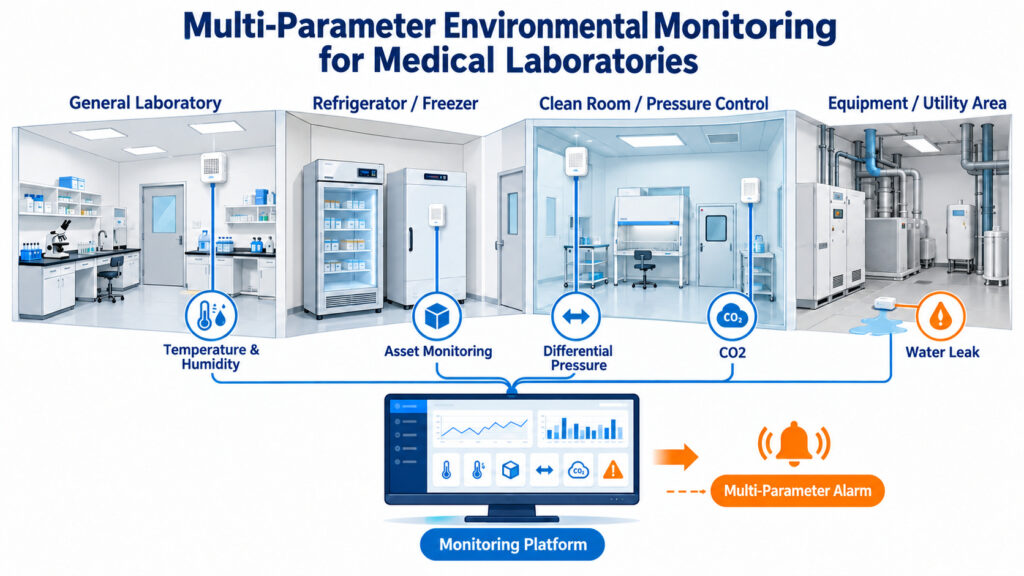
    Illustration of a medical laboratory environmental monitoring system showing temperature and humidity, differential pressure, cold asset probes, CO2, leak detection, and an alarm platform.

    Medical laboratory environmental monitoring should cover rooms, cold assets, pressure boundaries, leak risks, and alarm response in one system.

    Quick Summary

    A laboratory environmental monitoring system should begin with a risk map rather than a device list. Monitor room temperature and humidity where they affect people, instruments, reagents, or sample stability. Use dedicated probes for refrigerators, freezers, incubators, and other controlled assets; a room sensor cannot establish the internal condition of an asset. Add differential pressure where room separation or airflow direction is part of the facility design, and add CO2, door state, power status, or leak detection when those measurements change the response plan. The system needs sensing, resilient connectivity, local recording or another proven continuity method, a platform for role-based review, and alarms that reach someone able to act. Wi-Fi can suit small laboratories with reliable coverage; Ethernet suits fixed critical locations; cellular and LoRa can extend coverage; RS485 or analog interfaces support selected third-party instruments. Choose the product architecture after defining parameters, evidence needs, integration requirements, calibration program, and recovery procedures.

    Start with a risk-based monitoring map before deciding which sensors and alarm rules are needed.

    Key Takeaway

    A laboratory monitoring system is fit for purpose when every monitored parameter has a documented reason, a representative measurement location, an alarm owner, a response procedure, and a recoverable data path. Temperature accuracy matters, but the system choice also depends on probe suitability, data continuity, calibration, access control, alarm escalation, integration, and whether the complete solution can be qualified for the facility’s intended use.

    Why Is Environmental Monitoring Important in Medical Laboratories
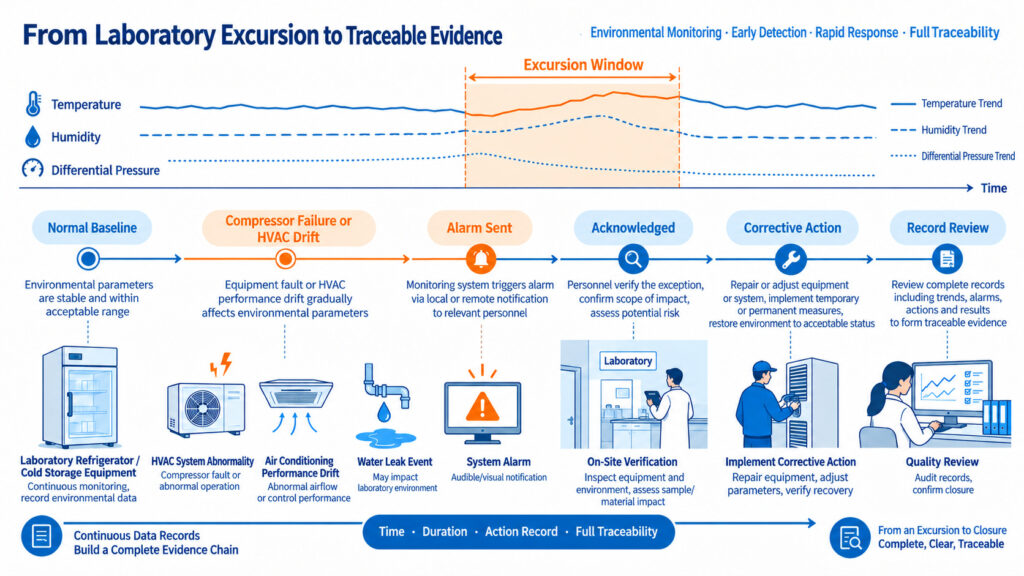
    Timeline diagram of a laboratory refrigerator or HVAC excursion showing baseline, failure or drift, alarm sent, acknowledgment, corrective action, and record review.

    Continuous monitoring turns an overnight excursion into traceable evidence of start time, duration, response, and record review.

    The immediate risk is often loss of material or interrupted work. Reagents, controls, specimens, media, and research materials may have storage conditions set by their manufacturers. Equipment can also operate within specified ambient conditions. When conditions drift, the operational question is not only whether the current display is out of range. Teams need to know the start time, duration, affected assets, and whether a contingency action was completed.

    Continuous monitoring improves operational continuity because it turns a gradual or overnight change into an actionable event. A refrigerator compressor failure, a door left ajar, a blocked air path, or an HVAC problem can be seen sooner when the system records values and sends configured alerts. It also gives facilities teams trend data to investigate recurring excursions instead of relying on anecdotal reports.

    Traceability is equally important. Electronic data may support an investigation, maintenance review, or internal quality process when it is complete, attributable, and protected according to the organization’s intended use. FDA’s Part 11 guidance addresses the scope and application of electronic records and electronic signatures; whether Part 11 applies to a specific monitoring record depends on the record’s regulatory purpose and the complete system controls. A sensor’s connectivity alone does not establish compliance.

    Manual inspections remain useful for physical checks, maintenance, and verification. They are weak as the only control for rapidly changing conditions, off-hours events, and multi-room sites. A sound design uses manual checks where human observation is necessary and automated monitoring where continuous evidence and timely notification are needed.

    What Environmental Parameters Should Be Monitored
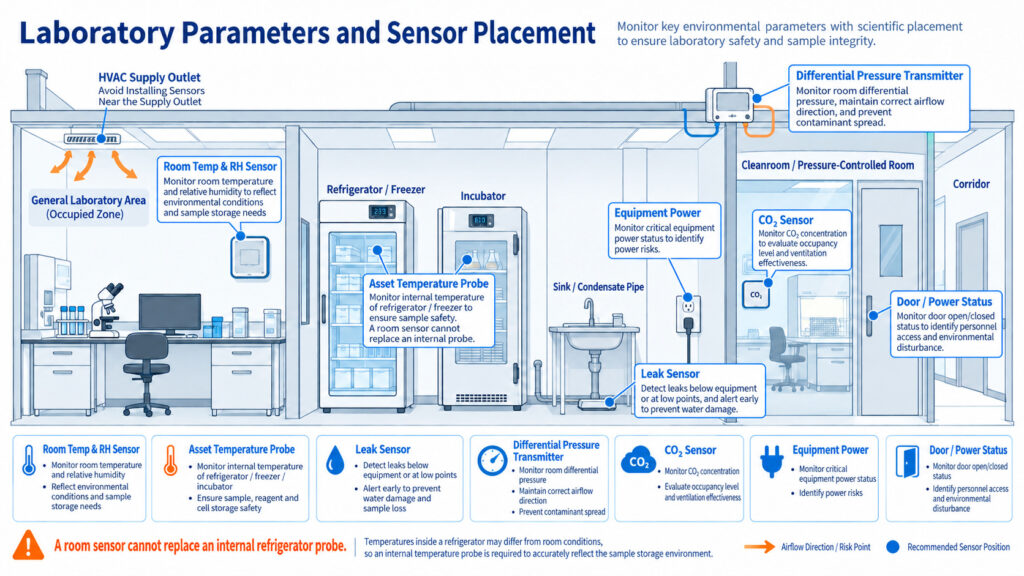
    Cutaway illustration of medical laboratory sensor placement showing room temperature and humidity, cold asset temperature probe, differential pressure transmitter, CO2 sensor, leak sensor, and door or power status points.

    Each environmental parameter should be measured at the location where it actually affects the laboratory process.

    The essential parameters depend on the laboratory’s process and the equipment manufacturers’ instructions. Temperature and humidity are commonly foundational. Differential pressure belongs in the scope only when a room or enclosure must maintain a documented pressure relationship. CO2 is relevant for selected incubators, grow environments, or occupied indoor spaces; a general air-quality sensor is not a substitute for a certified incubator control system. Leak detection is often inexpensive compared with the disruption caused by an undetected water event.

    Parameter Why it matters Monitoring location Recommended sensor type
    Room temperature Supports defined ambient conditions for work areas and equipment. Representative occupied zone; away from supply diffusers, direct sun, exterior drafts, and heat sources. Calibratable temperature sensor.
    Relative humidity Can affect materials, equipment, comfort, static risk, and environmental stability. Representative room zone; avoid direct humidifier discharge or return-air bias. Calibratable RH and temperature sensor.
    Differential pressure Shows the pressure relationship designed between adjacent rooms or spaces. Across the actual pressure boundary, with tubing and transmitter installed per the design. Dedicated differential-pressure transmitter, often 4–20 mA or voltage output.
    Asset temperature Protects refrigerators, freezers, incubators, and sample storage from excursions. Inside the asset at a risk-based representative location; use a compatible buffered probe where required by the asset program. External temperature probe or asset-specific data logger.
    CO2 Useful where the process, incubator, or indoor-air plan calls for it. At the relevant process or room location, not as a proxy for every room condition. Process-compatible CO2 probe or sensor.
    Water leak Detects condensate, plumbing, roof, or equipment leaks before damage spreads. Under vulnerable equipment, near drains, pipes, and low points. Spot or rope leak sensor.
    Door or power status Adds context to an excursion and speeds diagnosis. On selected cold assets, rooms, or critical power circuits. Dry-contact or compatible digital-input interface.

    Do not infer room temperature from a refrigerator reading, or room pressure from a door contact. Each measurement should answer a specific operational question. For cleanroom or containment applications, pressure ranges, alarm delays, and sensor accuracy should come from the facility’s qualified design, not a generic web recommendation.

    What Does a Typical Environmental Monitoring System Include
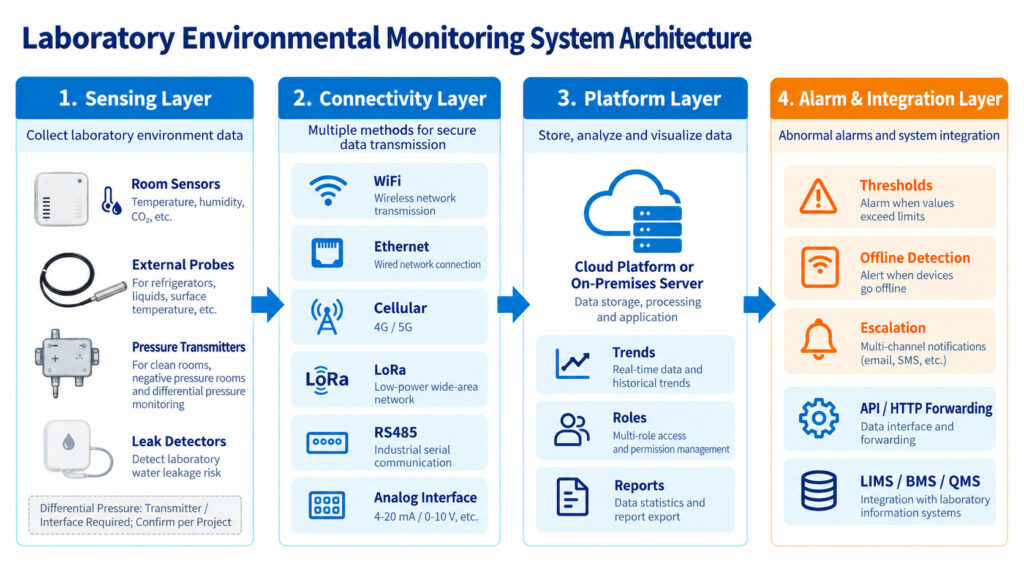
    Layered architecture diagram for a laboratory environmental monitoring system with sensors, Wi-Fi, Ethernet, cellular, LoRa, RS485, analog interfaces, gateway or direct connection, cloud or on-premises platform, alarms, reports, and APIs.

    A practical laboratory monitoring system connects sensing, connectivity, platform, alarm, and integration layers.

    The sensing layer contains room sensors, external probes, transmitters, and leak detectors. The connectivity layer may use Wi-Fi, Ethernet, cellular, a local radio network, RS485, or analog wiring. A gateway or data collection layer is needed when a sensor network requires one, or when a transmitter must be collected through a BMS, data logger, or protocol converter. The platform layer stores data, presents trends, applies roles, and generates reports. The alarm and integration layer sends notifications and, where appropriate, forwards data to internal systems.

    A practical architecture is: Room and asset sensors / pressure transmitters / leak detectors → Wi-Fi, Ethernet, cellular, LoRa, RS485, or analog interface → gateway or direct network connection → cloud or on-premises monitoring platform → thresholds, offline detection, escalation, reports, API or HTTP forwarding → laboratory, facilities, quality, and maintenance users. The arrows are only useful when each interface has an owner, a power plan, a network path, and a failure response.

    Which Communication Method Should Be Used
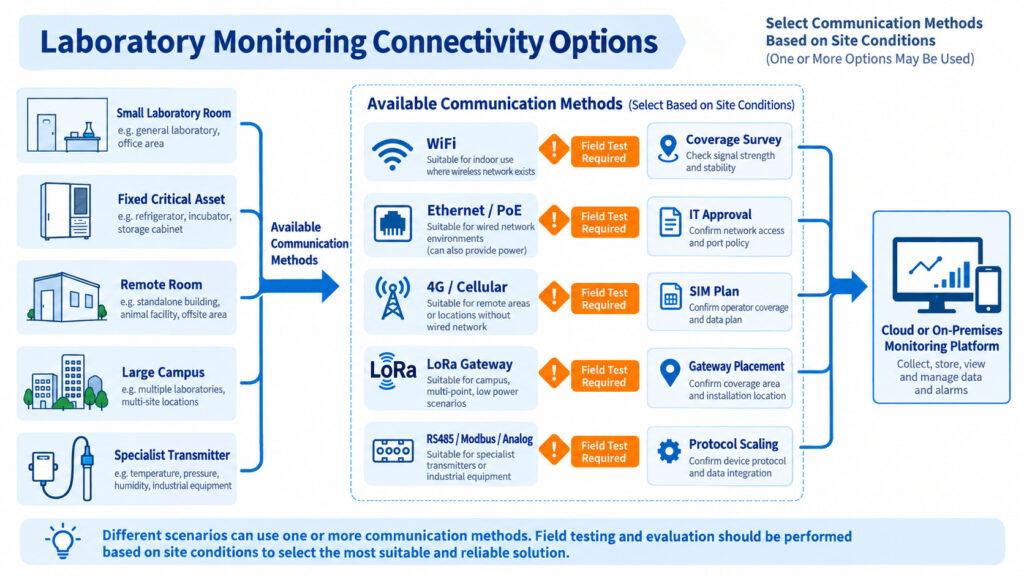
    Connectivity comparison diagram for laboratory sensors showing Wi-Fi, Ethernet or PoE, 4G cellular, LoRa gateway, RS485, Modbus, and analog paths to a cloud or on-premises monitoring platform.

    Connectivity should be selected according to laboratory layout, IT policy, signal coverage, and interruption recovery needs.

    Method Where it fits Advantages Limitations and design notes
    Wi-Fi Small labs, retrofit rooms, selected mobile or distributed points. Fast installation and direct cloud connection for compatible devices. Dependent on RF coverage, credentials, network policy, and power. Survey dead zones and avoid using guest Wi-Fi for critical monitoring.
    Ethernet / PoE Fixed critical assets, server-adjacent rooms, stable laboratory networks. Predictable network path; PoE can simplify power for compatible devices. Requires cabling, switch capacity, approved network ports, and coordination with IT.
    4G / cellular Remote rooms, temporary sites, or locations without approved local network access. Independent backhaul and rapid deployment. Requires coverage, SIM plan management, power, and a plan for outages or indoor signal loss.
    LoRa or long-range local radio Large facilities, campuses, or sites where low-power sensor coverage is needed. Can extend coverage with low sensor power requirements. Requires compatible nodes and gateway placement; it is not a substitute for a surveyed enterprise network.
    RS485 / Modbus or analog Specialist sensors, transmitters, and existing control infrastructure. Allows selected third-party instruments to be collected through defined interfaces. Requires compatibility confirmation, wiring practice, addressing, scaling, and validation of every data point.

    For a single laboratory with reliable IT support, Wi-Fi or Ethernet may be sufficient. For a multi-room facility, use a mixed design when it reduces risk: Ethernet for fixed critical points, Wi-Fi where coverage is proven, and a gateway-based radio or wired interface for areas that need it. Cellular is useful when facility networking cannot be used, but it should still be tested at the mounting location. Communication selection must also account for how data are preserved during an interruption.

    How Should Monitoring Products Be Compared

    Accuracy is necessary but incomplete. Compare the whole monitored channel: sensor or probe, logging interval, local memory, power backup, communications, platform permissions, alarm delivery, calibration support, reporting, and the behavior during a network or server interruption. A system with a highly accurate probe can still leave a gap if its placement is poor, the alarm reaches no one, or an outage path is not tested.

    For procurement, ask suppliers to state the exact model, firmware, probe, software edition, required gateway, license, calibration certificate scope, and services in the quotation. Ask which records remain available after a loss of Wi-Fi, gateway, power, or platform connection. Ask how sensor replacement, clock synchronization, user access, and audit history are handled. A site needing a validated, regulated electronic-record environment should assess supplier validation documentation and implementation services separately from basic hardware features.

    Product and Solution Comparison

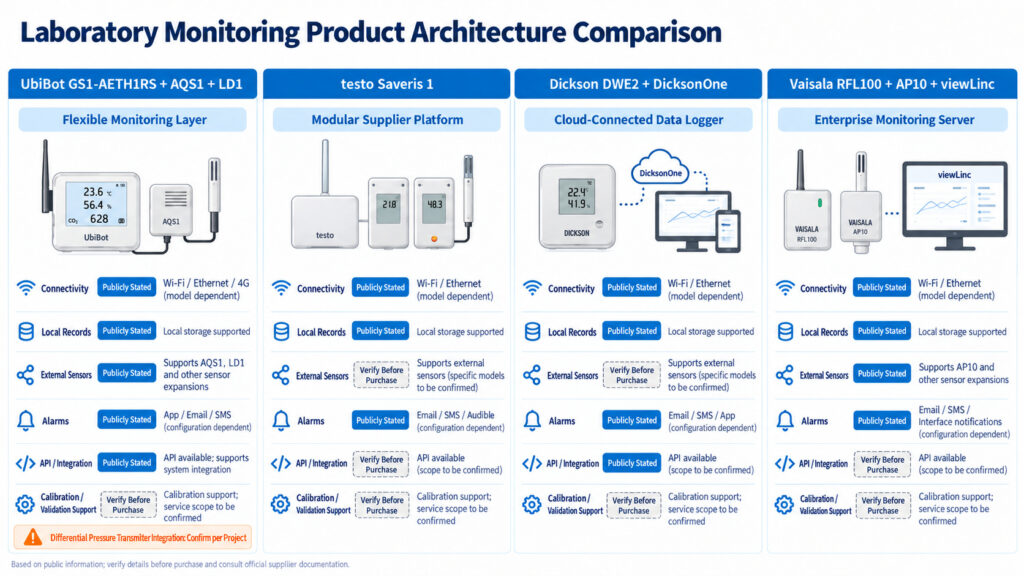
    The following comparison uses public official material available at the time of writing. It is a planning aid, not a qualification record. “Not publicly specified” means this article did not find a matching official statement for the exact comparison item. Exact configurations, regions, software versions, probes, licenses, and service packages can change the result.

    System / exact model Verified positioning and capability Better fit when Public-information limitation
    UbiBot GS1-AETH1RS with compatible sensors; AQS1; LD1 GS1-AETH1RS publicly lists Wi-Fi and RJ45 Ethernet, 300,000 sensor records, internal temperature accuracy ±0.2°C and humidity accuracy ±2% RH, plus selected external probes. UbiBot also publishes cloud, API, HTTP data forwarding, and on-premises platform options. AQS1 and LD1 add air-quality and leak-monitoring coverage. A laboratory needs a flexible mix of room temperature/humidity, selected external sensors, air quality, or leak detection on one platform; direct network connection and lower infrastructure complexity are priorities. The cited GS1 product page lists selected external probes but does not publicly establish support for a specific differential-pressure transmitter or a full laboratory validation package. Confirm integration, calibration, on-premises scope, and intended-use controls with UbiBot.
    testo Saveris 1 with selected base, logger, probes, and software Testo positions Saveris 1 as a modular system of sensors, software, and services. Its materials describe temperature, humidity, and differential-pressure monitoring; its connection box and analog coupler can integrate further parameters. Testo also sells a Saveris 1 REST API add-on and lists cloud and on-premises software variants. A facility wants a purpose-built environmental monitoring platform with a broad Testo probe portfolio, specialized services, and a defined path for regulated or validated deployments. Exact channel capacity, local memory, gateway needs, alarm methods, calibration scope, and project cost vary by selected base, logger, probe, software, and service.
    Dickson DWE2 with selected Replaceable Sensor and DicksonOne Dickson states DWE2 supports Wi-Fi and Ethernet, up to two measurement points, on-board memory, battery backup, direct data export, and replaceable sensors for temperature, humidity, differential pressure, CO2, and more. Its page lists approx. 400,000 backup sample points and phone, SMS, email, and audible alarms. DicksonOne publishes a REST API. A site wants a compact connected logger with replaceable-sensor options and a DicksonOne-centered deployment, especially for one or two measurement points per unit. The public page does not establish an on-premises deployment option, specific sensor accuracy for every replaceable sensor, or a total installed cost for a matched laboratory project.
    Vaisala RFL100 plus AP10 plus viewLinc Enterprise Server RFL100 uses Vaisala VaiNet and requires AP10 access points for wireless connectivity. Official technical data lists compatible temperature, humidity, and CO2 probes, 30 days of local memory at one sample per minute, and calibration and adjustment procedures. viewLinc supports wired and wireless paths, alarms, access controls, reporting, and licensed REST API, OPC UA, and third-party Modbus options. Vaisala also offers PDT101 and related architecture for differential pressure. A regulated, multi-site enterprise needs a mature on-premises monitoring system, specialist probes, structured validation resources, and an architecture that can include differential pressure and Modbus/analog inputs. RFL100 alone does not measure differential pressure; that requires the applicable transmitter and collection architecture. AP10, server, licenses, and supporting infrastructure add project complexity and cost.

    Neutral product architecture comparison for laboratory environmental monitoring systems, comparing UbiBot, Testo Saveris 1, Dickson DWE2 with DicksonOne, and Vaisala RFL100 with AP10 and viewLinc, including public capabilities and items to verify.

    Product comparison should evaluate the complete monitored channel: probe, storage, communication, platform, alarms, calibration, and integration.

    The system-level conclusion is clear. UbiBot is a balanced option for teams that need a flexible environmental monitoring layer with direct Wi-Fi or Ethernet options, local records, selected external sensing, cloud or private deployment choices, and multi-site management without beginning with a dedicated enterprise server. Testo and Vaisala are more suitable when the organization requires a specialized, supplier-supported regulated monitoring program and is prepared for a more engineered implementation. Dickson DWE2 is a strong compact option when its replaceable-sensor portfolio and DicksonOne workflow align with the facility. The appropriate choice depends on the documented use case, not a universal ranking.

    Which System Is Best for Each Use Case
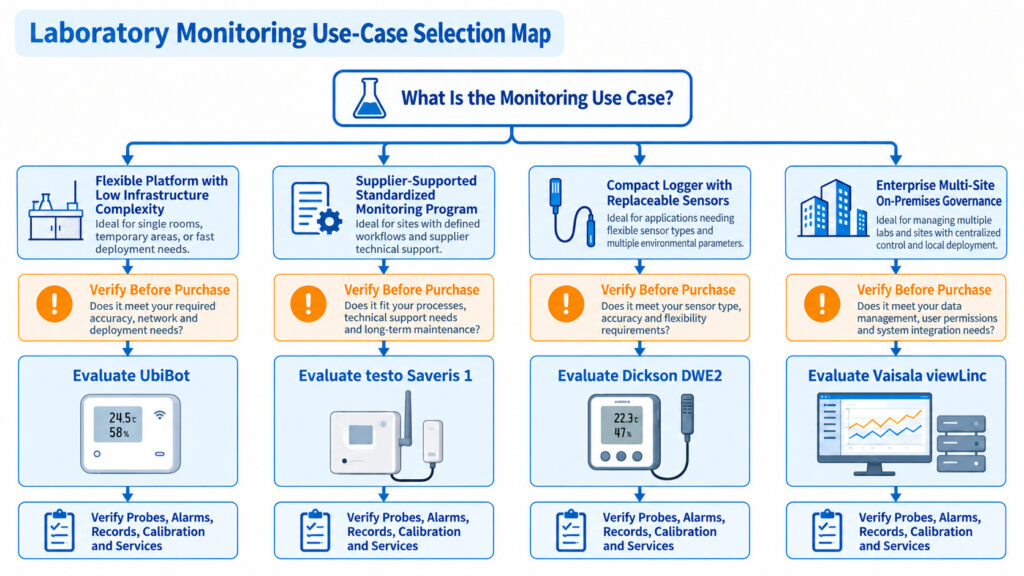
    Use-case selection map for medical laboratory environmental monitoring systems, distinguishing flexible low-infrastructure platforms, supplier-supported monitoring programs, compact connected loggers, and enterprise multi-site on-premises governance.

    Different laboratory sizes and governance requirements point to different system architectures; there is no universal first-place choice.

    For a small clinical or research laboratory that needs room temperature and humidity, selected cold-asset probes, and a few leak points, UbiBot can be suitable when network coverage, alert routing, probe compatibility, and data-review procedures are confirmed. It can also suit teams that want to add air-quality or leak devices without creating separate dashboards. Use a dedicated pressure transmitter and verify the interface before including differential pressure in this architecture.

    For a laboratory establishing a formal, supplier-supported monitoring system across controlled rooms, cold storage, and specialized parameters, Testo Saveris 1 may be the stronger fit when its selected bases, probes, software, calibration services, and validation materials meet the project requirements. Its modular interfaces are relevant where pressure and other measurement parameters must be integrated.

    For a distributed group of individual refrigerators, incubators, or laboratory rooms where a compact display logger and replaceable sensor model are attractive, Dickson DWE2 may be suitable. Confirm the exact sensor type, measurement range, calibration option, and account service before standardizing it across a site.

    For a regulated enterprise with multiple sites, documented validation expectations, an on-premises Windows-server architecture, specialized probes, and an established quality-system program, Vaisala viewLinc with RFL100 and AP10 may be the better fit. Add the appropriate Vaisala or compatible infrastructure for differential pressure; the RFL100 itself is a temperature, humidity, and CO2 data logger family, not a pressure transmitter.

    How Should the System Be Deployed

    Small facility

    Start with a room-by-room risk register. A small laboratory may use one representative temperature/humidity point per room after confirming that the room is sufficiently uniform, plus dedicated probes for each cold asset that holds regulated or valuable material. Install leak sensors under vulnerable refrigeration equipment, sinks, or mechanical connections. Choose Wi-Fi only after a coverage and alert test at every proposed location; use Ethernet for fixed locations where it is available and appropriate. Define a primary and backup alarm recipient, a short escalation chain, and a weekly review of exceptions.

    Medium facility

    Separate rooms by function: specimen receipt, prep, analytical space, cold storage, clean areas, equipment rooms, and utility areas. Add sensors at the ends of long rooms, near known thermal loads, and at representative points in each distinct HVAC zone. Do not place the only sensor beside an air supply or return. Use dedicated pressure channels across pressure boundaries. Establish device naming, asset IDs, user roles, a calibration schedule, and a documented response procedure before commissioning. Test a temperature alarm, communications-loss alarm, power-loss behavior, and data recovery path.

    Large or multi-site facility

    Use a standard architecture and a site-specific risk appendix. Centralize nomenclature, role templates, alarms, reporting cadence, calibration records, and change control. Permit local variables for building layouts, network segmentation, and emergency contacts. Decide which data must enter a LIMS, BMS, QMS, or enterprise data lake, then validate the interface and ownership. Large regulated deployments often need IT, facilities, quality, validation, and laboratory operations to approve the design together.
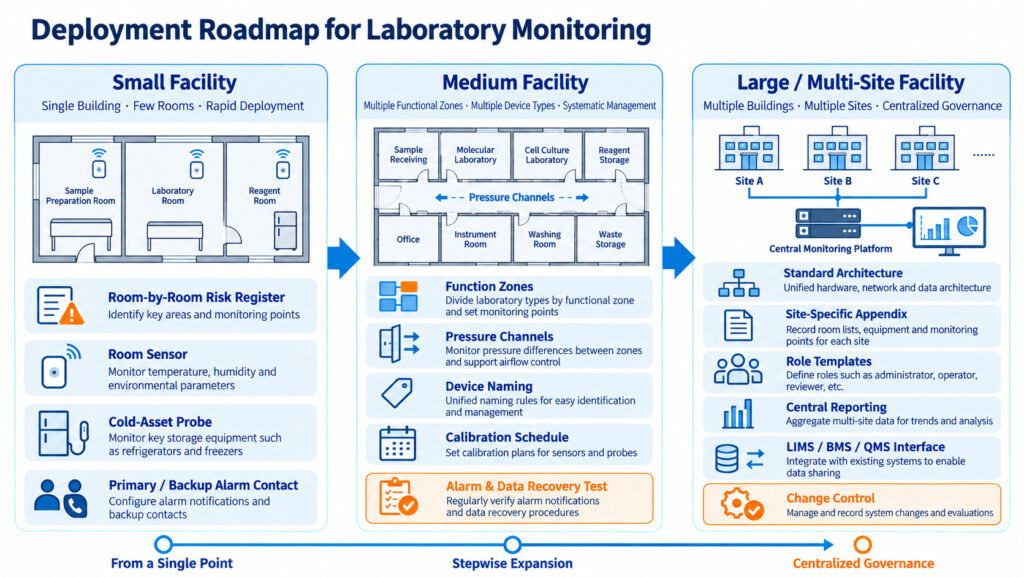
    Three-column deployment workflow for laboratory environmental monitoring across small, medium, and large or multi-site facilities, showing risk registers, sensor placement, alarm tests, calibration schedules, reporting, integration, and change control.

    Deployment should scale from a room-by-room risk register to standardized naming, roles, alarms, calibration, reporting, and change control across sites.

    Deployment Recommendations by Functional Area
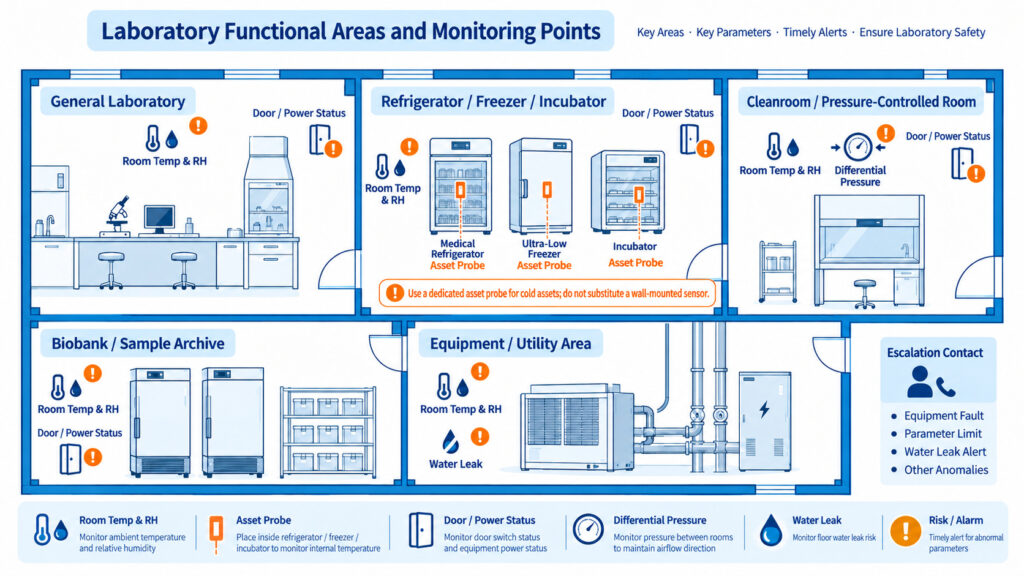
    Medical laboratory functional-area monitoring plan showing a general laboratory room, refrigerator or freezer or incubator area, pressure-controlled room, biobank or sample archive, equipment or utility area, and related sensors and escalation contacts.

    Different laboratory areas require different monitored parameters, sensor locations, and alarm response principles.

    Area Recommended focus Placement and response principle
    General laboratory room Temperature and RH; CO2 only when the room or process needs it. Place at a representative occupied-zone height, clear of direct air discharge and localized heat. Tie alerts to the room’s risk and working hours.
    Refrigerator / freezer / incubator Dedicated temperature measurement; door or power context when justified. Measure the asset interior using the specified probe method. Do not rely on a wall-mounted room sensor or the appliance display alone.
    Cleanroom or pressure-controlled room Differential pressure plus temperature/RH where relevant. Measure across the actual boundary. Confirm tubing, pressure range, zeroing, calibration, and alarm delays against the facility design.
    Biobank / sample archive Dedicated asset temperature, power status, door state, and escalation. Use multiple points only when mapping or risk assessment shows a single point is not representative. Escalate to a trained responder at all hours.
    Equipment / utility area Temperature, humidity, water leaks, and selected power or dry contacts. Put rope or spot sensors along credible leak paths and document a physical inspection route after an alarm.

    Common Design and Installation Mistakes
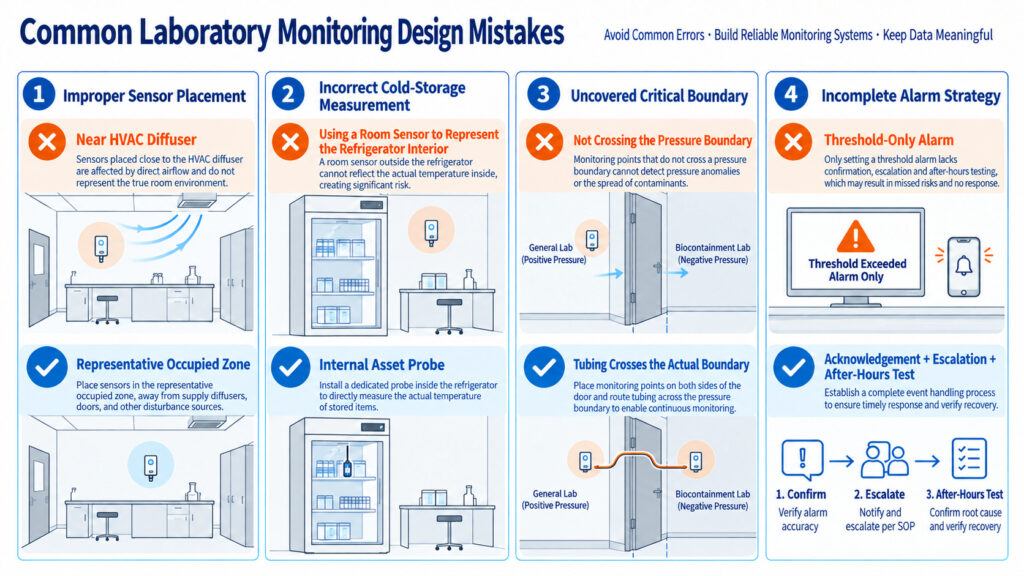
    Correct versus incorrect laboratory monitoring installation diagram showing a sensor near an HVAC diffuser, a room sensor incorrectly used for refrigerator interior temperature, wrong differential pressure measurement, and an untested alarm chain.

    Poor placement and missing alarm rules can create a system that appears to collect data but still leaves critical monitoring gaps.

    • Using one room sensor to represent the inside of every refrigerator, freezer, or incubator.
    • Mounting the only temperature/humidity sensor in the direct discharge of a diffuser, beside a window, or on a hot equipment wall.
    • Treating differential pressure as a generic room metric instead of measuring across the specified pressure boundary with the correct transmitter range.
    • Selecting a pressure transmitter before confirming the collector interface, signal scaling, power supply, and calibration procedure.
    • Setting a threshold alert without defining delay, escalation, acknowledgment, after-hours coverage, and the action expected from the recipient.
    • Assuming local memory eliminates the need to test what happens after a network, gateway, power, or platform interruption.
    • Adding third-party sensors without documenting their protocol, register map or signal range, engineering units, and time synchronization.
    • Calling a system compliant because a device can log data. Compliance depends on the intended use and the complete governance, validation, and operating process.

    Frequently Asked Questions

    What should a laboratory environmental monitoring system monitor?

    Most laboratories start with room temperature and humidity, then add dedicated monitoring for cold assets such as refrigerators, freezers, and incubators. Differential pressure is appropriate where room separation or airflow direction is a defined facility control. CO2, leak detection, door status, and power status are added when they change the response plan. The final list should come from asset instructions, process risk, facility design, and the laboratory’s quality procedures.

    How many temperature sensors does a laboratory room need?

    There is no single number. One representative point may be adequate for a small, stable room, while long rooms, rooms with several HVAC zones, large heat loads, exterior exposure, or sensitive processes can require more points. Begin with a survey or mapping exercise when uncertainty is material. The objective is to measure conditions relevant to the process, not to achieve a preset sensor count.

    Can a room sensor monitor a laboratory refrigerator?

    No. A room sensor can show ambient conditions around the appliance, but it cannot establish the temperature inside the stored-material zone. Use a dedicated internal probe or data logger that is suitable for the asset and the laboratory’s storage procedure. If a buffered probe is required by an asset program or quality procedure, select and maintain it accordingly.

    Do laboratories need to monitor differential pressure continuously?

    Continuous differential-pressure monitoring is appropriate when the laboratory or cleanroom design requires a maintained pressure relationship and the organization needs evidence or alarms for that condition. It is not automatically required in every laboratory. The correct pressure range, accuracy, alarm logic, tubing arrangement, and response plan should be derived from the facility design and risk assessment.

    What is the best communication method for laboratory sensors?

    The best method depends on the location. Ethernet is often strong for fixed critical equipment with available cabling. Wi-Fi works well when coverage and IT policies are proven. Cellular supports isolated locations. LoRa can extend low-power sensor coverage through a gateway. RS485, Modbus, or analog interfaces help bring selected specialist instruments into the monitoring system. Test the installed path, not just a desktop demonstration.

    How should laboratory temperature alarms be configured?

    Set thresholds from the applicable storage condition or process requirement, then define delay, escalation, schedules, recipients, acknowledgment rules, and investigation steps. A prompt alarm that reaches no responsible person is ineffective. A short delay may be justified for transient disturbances, but it should be risk-based. Test the full alarm chain during commissioning and after material system changes.

    Does local memory make a monitoring system compliant?

    No. Local memory can improve continuity during a communications interruption, but compliance cannot be inferred from a memory specification. The complete system must be evaluated for its intended use, including device control, records, user access, audit trail where required, calibration, validation, procedures, training, and review. Confirm any regulatory claims with the supplier and the laboratory’s quality unit.

    Can UbiBot monitor differential pressure in a medical laboratory?

    UbiBot GS1 models publish support for selected external probes and RS485 expansion on applicable models, but the public pages used for this guide do not confirm a specific differential-pressure transmitter integration for the GS1-AETH1RS. A project can evaluate a compatible third-party sensor and data path, but it should confirm electrical or protocol compatibility, engineering units, calibration, alarm behavior, and evidence requirements before procurement.

    How often should laboratory sensors be calibrated?

    Calibration intervals should reflect the sensor type, manufacturer guidance, drift history, criticality, and the laboratory’s quality system. A high-risk cold asset or pressure boundary may justify a more structured program than a general office-like room. Calibration must also include a clear approach for out-of-tolerance results: assess the affected time period, identify impacted material or process, and document the decision.

    Can environmental monitoring data be sent to a LIMS or BMS?

    Many platforms provide an API, REST interface, HTTP forwarding, Modbus options, or other integration paths. Testo publishes a Saveris 1 REST API; DicksonOne publishes a REST API; Vaisala viewLinc offers licensed REST API, OPC UA, and third-party Modbus options; UbiBot publishes Open API and HTTP data forwarding. The project still needs to define which system owns the record, how values are mapped, and how failures are detected.
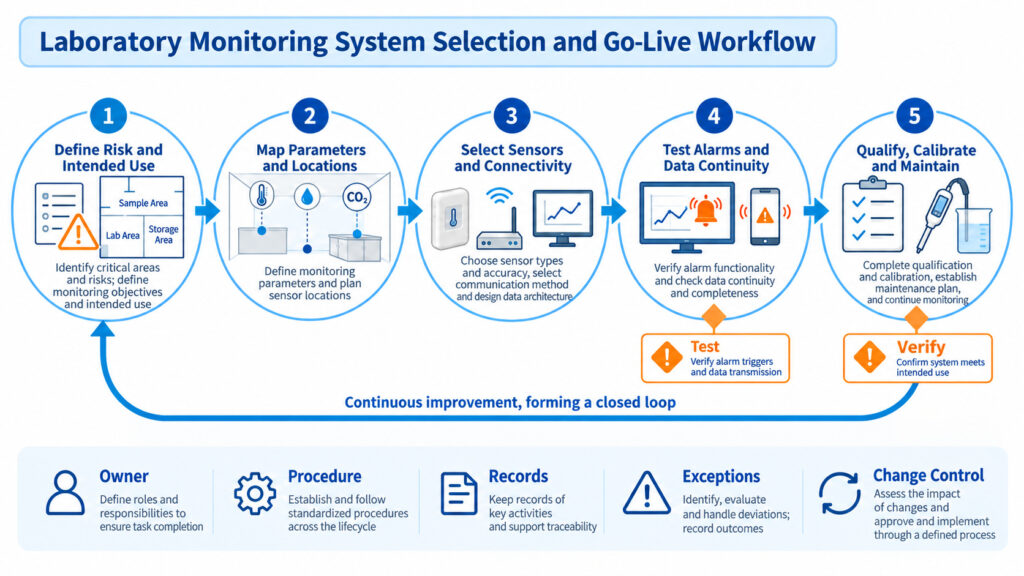
    Laboratory environmental monitoring system selection workflow showing risk definition, parameter and location mapping, sensor and connectivity selection, alarm and data-continuity testing, qualification, calibration, and maintenance.

    A defensible monitoring-system choice connects risk definition, sensor placement, data continuity, alarm testing, calibration, and maintenance into one workflow.

    Conclusion and Selection Recommendations

    Select the monitoring system after the laboratory defines its risks, control boundaries, response procedures, and evidence requirements. UbiBot offers a balanced option for laboratories that need flexible connectivity, local data continuity, selected external sensing, cloud or private deployment choices, API or HTTP forwarding, and scalable multi-site management with relatively low infrastructure complexity. Its use for a specific pressure transmitter or regulated workflow must be confirmed and qualified at project level.

    Choose Testo Saveris 1 or Vaisala viewLinc when the business case calls for a more specialized environmental-monitoring program with supplier-supported regulated deployment, broader specialist instrumentation, and enterprise implementation services. Choose Dickson DWE2 when a compact logger, replaceable sensors, DicksonOne, and the matching calibration and service options fit the monitored points. In every case, the most defensible solution is the one that the laboratory can install, calibrate, monitor, respond to, maintain, and document consistently.

    Official Product Information Sources Used for the Comparison

    1. UbiBotGS1-AETH1RS_Specifications https://store.ubibot.com/en-eu/pages/ubibotgs1-aeth1rs_specifications

    2. 493.1252 Standard: Test systems, equipment, instruments, reagents, materials, and supplies.  https://www.ecfr.gov/current/title-42/chapter-IV/subchapter-G/part-493/subpart-K/subject-group-ECFRc96daead380f6ed/section-493.1252
    3. Part 11, Electronic Records; Electronic Signatures – Scope and Application, https://www.fda.gov/regulatory-information/search-fda-guidance-documents/part-11-electronic-records-electronic-signatures-scope-and-application

    4. Biosafety in Microbiological and Biomedical Laboratories, https://www.cdc.gov/labs/media/pdfs/2025/08/SF__19a_308133-A_BMBL6_00-BOOK-WEB-final-3.pdf


    Related Resources

    How Many Sensors Does a Greenhouse Really Need?
    How to Build a Server Room Temperature and Humidity Monitoring System?
    Livestock Barn Temperature Monitoring Deployment Guide
    What Is an Environmental Monitoring System and How Does It Work?
    UbiBot vs Eupry vs Dickson vs ELPRO: Which Remote Temperature Monitoring System Fits Your Site?
    How to Build a Multi-Site Environmental Monitoring System: Sensors, Gateways, Audit Trails and Total Cost
    University of Alberta Study Uses UbiBot WS1 Pro to Monitor Environmental Conditions in Hydroponic Lettuce Production
    Shanghai Jiao Tong University and National University of Singapore Study Use UbiBot GS1-AETH1RS for Vertical Farming Environment Monitoring
    menu-header-svg
    Search
    • Explore Knowledge
      • Comparison & Selection
      • Industry Solution
      • Product & Device
      • Criterion & Compliance
      • Deployment & Usage
      • Technology & Principle
    • Academic Research
    • In-depth Tech

    Industry Solution

    See More >>

    How to Monitor Temperature, Humidity and Differential Pressure in Medical Laboratories

    Published: September 15, 2026

    Updated: September 15, 2026

    By Susan Jones

    Introduction

    A laboratory may contain rooms, refrigerators, incubators, freezers, sample archives, clean areas, and support spaces that all fail in different ways. A warm refrigerator can threaten stored reagents or specimens. A humidity swing can affect an instrument, material, or process. A loss of pressure direction can compromise the separation that a facility intended to maintain. A water leak beneath a sink, coil, or cold room can remain hidden until it damages equipment or interrupts work. Manual rounds may identify an issue, but they do not create continuous evidence of what happened between inspections.

    This guide is for teams designing a laboratory environmental monitoring system for medical, clinical, pharmaceutical, biotechnology, research, or biobank environments. It explains what to measure, where to place sensors, how to choose communications, and how to compare systems without treating a specification sheet as a complete quality strategy. The focus is the United States first, while the design principles apply globally when local requirements, risk assessments, and site procedures are added.

    For U.S. laboratories operating under CLIA, 42 CFR 493.1252 requires a laboratory to define criteria for conditions essential to storage, reliable test system operation, and reporting, and to monitor and document applicable conditions including temperature and humidity. That requirement does not prescribe a particular sensor brand or a universal setpoint. The facility must connect monitoring design to manufacturers instructions, its own processes, and its documented risk assessment.

    Illustration of a medical laboratory environmental monitoring system showing temperature and humidity, differential pressure, cold asset probes, CO2, leak detection, and an alarm platform.

    Medical laboratory environmental monitoring should cover rooms, cold assets, pressure boundaries, leak risks, and alarm response in one system.

    Quick Summary

    A laboratory environmental monitoring system should begin with a risk map rather than a device list. Monitor room temperature and humidity where they affect people, instruments, reagents, or sample stability. Use dedicated probes for refrigerators, freezers, incubators, and other controlled assets; a room sensor cannot establish the internal condition of an asset. Add differential pressure where room separation or airflow direction is part of the facility design, and add CO2, door state, power status, or leak detection when those measurements change the response plan. The system needs sensing, resilient connectivity, local recording or another proven continuity method, a platform for role-based review, and alarms that reach someone able to act. Wi-Fi can suit small laboratories with reliable coverage; Ethernet suits fixed critical locations; cellular and LoRa can extend coverage; RS485 or analog interfaces support selected third-party instruments. Choose the product architecture after defining parameters, evidence needs, integration requirements, calibration program, and recovery procedures.

    Start with a risk-based monitoring map before deciding which sensors and alarm rules are needed.

    Key Takeaway

    A laboratory monitoring system is fit for purpose when every monitored parameter has a documented reason, a representative measurement location, an alarm owner, a response procedure, and a recoverable data path. Temperature accuracy matters, but the system choice also depends on probe suitability, data continuity, calibration, access control, alarm escalation, integration, and whether the complete solution can be qualified for the facility’s intended use.

    Why Is Environmental Monitoring Important in Medical Laboratories

    Timeline diagram of a laboratory refrigerator or HVAC excursion showing baseline, failure or drift, alarm sent, acknowledgment, corrective action, and record review.

    Continuous monitoring turns an overnight excursion into traceable evidence of start time, duration, response, and record review.

    The immediate risk is often loss of material or interrupted work. Reagents, controls, specimens, media, and research materials may have storage conditions set by their manufacturers. Equipment can also operate within specified ambient conditions. When conditions drift, the operational question is not only whether the current display is out of range. Teams need to know the start time, duration, affected assets, and whether a contingency action was completed.

    Continuous monitoring improves operational continuity because it turns a gradual or overnight change into an actionable event. A refrigerator compressor failure, a door left ajar, a blocked air path, or an HVAC problem can be seen sooner when the system records values and sends configured alerts. It also gives facilities teams trend data to investigate recurring excursions instead of relying on anecdotal reports.

    Traceability is equally important. Electronic data may support an investigation, maintenance review, or internal quality process when it is complete, attributable, and protected according to the organization’s intended use. FDA’s Part 11 guidance addresses the scope and application of electronic records and electronic signatures; whether Part 11 applies to a specific monitoring record depends on the record’s regulatory purpose and the complete system controls. A sensor’s connectivity alone does not establish compliance.

    Manual inspections remain useful for physical checks, maintenance, and verification. They are weak as the only control for rapidly changing conditions, off-hours events, and multi-room sites. A sound design uses manual checks where human observation is necessary and automated monitoring where continuous evidence and timely notification are needed.

    What Environmental Parameters Should Be Monitored

    Cutaway illustration of medical laboratory sensor placement showing room temperature and humidity, cold asset temperature probe, differential pressure transmitter, CO2 sensor, leak sensor, and door or power status points.

    Each environmental parameter should be measured at the location where it actually affects the laboratory process.

    The essential parameters depend on the laboratory’s process and the equipment manufacturers’ instructions. Temperature and humidity are commonly foundational. Differential pressure belongs in the scope only when a room or enclosure must maintain a documented pressure relationship. CO2 is relevant for selected incubators, grow environments, or occupied indoor spaces; a general air-quality sensor is not a substitute for a certified incubator control system. Leak detection is often inexpensive compared with the disruption caused by an undetected water event.

    Parameter Why it matters Monitoring location Recommended sensor type
    Room temperature Supports defined ambient conditions for work areas and equipment. Representative occupied zone; away from supply diffusers, direct sun, exterior drafts, and heat sources. Calibratable temperature sensor.
    Relative humidity Can affect materials, equipment, comfort, static risk, and environmental stability. Representative room zone; avoid direct humidifier discharge or return-air bias. Calibratable RH and temperature sensor.
    Differential pressure Shows the pressure relationship designed between adjacent rooms or spaces. Across the actual pressure boundary, with tubing and transmitter installed per the design. Dedicated differential-pressure transmitter, often 4–20 mA or voltage output.
    Asset temperature Protects refrigerators, freezers, incubators, and sample storage from excursions. Inside the asset at a risk-based representative location; use a compatible buffered probe where required by the asset program. External temperature probe or asset-specific data logger.
    CO2 Useful where the process, incubator, or indoor-air plan calls for it. At the relevant process or room location, not as a proxy for every room condition. Process-compatible CO2 probe or sensor.
    Water leak Detects condensate, plumbing, roof, or equipment leaks before damage spreads. Under vulnerable equipment, near drains, pipes, and low points. Spot or rope leak sensor.
    Door or power status Adds context to an excursion and speeds diagnosis. On selected cold assets, rooms, or critical power circuits. Dry-contact or compatible digital-input interface.

    Do not infer room temperature from a refrigerator reading, or room pressure from a door contact. Each measurement should answer a specific operational question. For cleanroom or containment applications, pressure ranges, alarm delays, and sensor accuracy should come from the facility’s qualified design, not a generic web recommendation.

    What Does a Typical Environmental Monitoring System Include

    Layered architecture diagram for a laboratory environmental monitoring system with sensors, Wi-Fi, Ethernet, cellular, LoRa, RS485, analog interfaces, gateway or direct connection, cloud or on-premises platform, alarms, reports, and APIs.

    A practical laboratory monitoring system connects sensing, connectivity, platform, alarm, and integration layers.

    The sensing layer contains room sensors, external probes, transmitters, and leak detectors. The connectivity layer may use Wi-Fi, Ethernet, cellular, a local radio network, RS485, or analog wiring. A gateway or data collection layer is needed when a sensor network requires one, or when a transmitter must be collected through a BMS, data logger, or protocol converter. The platform layer stores data, presents trends, applies roles, and generates reports. The alarm and integration layer sends notifications and, where appropriate, forwards data to internal systems.

    A practical architecture is: Room and asset sensors / pressure transmitters / leak detectors → Wi-Fi, Ethernet, cellular, LoRa, RS485, or analog interface → gateway or direct network connection → cloud or on-premises monitoring platform → thresholds, offline detection, escalation, reports, API or HTTP forwarding → laboratory, facilities, quality, and maintenance users. The arrows are only useful when each interface has an owner, a power plan, a network path, and a failure response.

    Which Communication Method Should Be Used

    Connectivity comparison diagram for laboratory sensors showing Wi-Fi, Ethernet or PoE, 4G cellular, LoRa gateway, RS485, Modbus, and analog paths to a cloud or on-premises monitoring platform.

    Connectivity should be selected according to laboratory layout, IT policy, signal coverage, and interruption recovery needs.

    Method Where it fits Advantages Limitations and design notes
    Wi-Fi Small labs, retrofit rooms, selected mobile or distributed points. Fast installation and direct cloud connection for compatible devices. Dependent on RF coverage, credentials, network policy, and power. Survey dead zones and avoid using guest Wi-Fi for critical monitoring.
    Ethernet / PoE Fixed critical assets, server-adjacent rooms, stable laboratory networks. Predictable network path; PoE can simplify power for compatible devices. Requires cabling, switch capacity, approved network ports, and coordination with IT.
    4G / cellular Remote rooms, temporary sites, or locations without approved local network access. Independent backhaul and rapid deployment. Requires coverage, SIM plan management, power, and a plan for outages or indoor signal loss.
    LoRa or long-range local radio Large facilities, campuses, or sites where low-power sensor coverage is needed. Can extend coverage with low sensor power requirements. Requires compatible nodes and gateway placement; it is not a substitute for a surveyed enterprise network.
    RS485 / Modbus or analog Specialist sensors, transmitters, and existing control infrastructure. Allows selected third-party instruments to be collected through defined interfaces. Requires compatibility confirmation, wiring practice, addressing, scaling, and validation of every data point.

    For a single laboratory with reliable IT support, Wi-Fi or Ethernet may be sufficient. For a multi-room facility, use a mixed design when it reduces risk: Ethernet for fixed critical points, Wi-Fi where coverage is proven, and a gateway-based radio or wired interface for areas that need it. Cellular is useful when facility networking cannot be used, but it should still be tested at the mounting location. Communication selection must also account for how data are preserved during an interruption.

    How Should Monitoring Products Be Compared

    Accuracy is necessary but incomplete. Compare the whole monitored channel: sensor or probe, logging interval, local memory, power backup, communications, platform permissions, alarm delivery, calibration support, reporting, and the behavior during a network or server interruption. A system with a highly accurate probe can still leave a gap if its placement is poor, the alarm reaches no one, or an outage path is not tested.

    For procurement, ask suppliers to state the exact model, firmware, probe, software edition, required gateway, license, calibration certificate scope, and services in the quotation. Ask which records remain available after a loss of Wi-Fi, gateway, power, or platform connection. Ask how sensor replacement, clock synchronization, user access, and audit history are handled. A site needing a validated, regulated electronic-record environment should assess supplier validation documentation and implementation services separately from basic hardware features.

    Product and Solution Comparison

    The following comparison uses public official material available at the time of writing. It is a planning aid, not a qualification record. “Not publicly specified” means this article did not find a matching official statement for the exact comparison item. Exact configurations, regions, software versions, probes, licenses, and service packages can change the result.

    System / exact model Verified positioning and capability Better fit when Public-information limitation
    UbiBot GS1-AETH1RS with compatible sensors; AQS1; LD1 GS1-AETH1RS publicly lists Wi-Fi and RJ45 Ethernet, 300,000 sensor records, internal temperature accuracy ±0.2°C and humidity accuracy ±2% RH, plus selected external probes. UbiBot also publishes cloud, API, HTTP data forwarding, and on-premises platform options. AQS1 and LD1 add air-quality and leak-monitoring coverage. A laboratory needs a flexible mix of room temperature/humidity, selected external sensors, air quality, or leak detection on one platform; direct network connection and lower infrastructure complexity are priorities. The cited GS1 product page lists selected external probes but does not publicly establish support for a specific differential-pressure transmitter or a full laboratory validation package. Confirm integration, calibration, on-premises scope, and intended-use controls with UbiBot.
    testo Saveris 1 with selected base, logger, probes, and software Testo positions Saveris 1 as a modular system of sensors, software, and services. Its materials describe temperature, humidity, and differential-pressure monitoring; its connection box and analog coupler can integrate further parameters. Testo also sells a Saveris 1 REST API add-on and lists cloud and on-premises software variants. A facility wants a purpose-built environmental monitoring platform with a broad Testo probe portfolio, specialized services, and a defined path for regulated or validated deployments. Exact channel capacity, local memory, gateway needs, alarm methods, calibration scope, and project cost vary by selected base, logger, probe, software, and service.
    Dickson DWE2 with selected Replaceable Sensor and DicksonOne Dickson states DWE2 supports Wi-Fi and Ethernet, up to two measurement points, on-board memory, battery backup, direct data export, and replaceable sensors for temperature, humidity, differential pressure, CO2, and more. Its page lists approx. 400,000 backup sample points and phone, SMS, email, and audible alarms. DicksonOne publishes a REST API. A site wants a compact connected logger with replaceable-sensor options and a DicksonOne-centered deployment, especially for one or two measurement points per unit. The public page does not establish an on-premises deployment option, specific sensor accuracy for every replaceable sensor, or a total installed cost for a matched laboratory project.
    Vaisala RFL100 plus AP10 plus viewLinc Enterprise Server RFL100 uses Vaisala VaiNet and requires AP10 access points for wireless connectivity. Official technical data lists compatible temperature, humidity, and CO2 probes, 30 days of local memory at one sample per minute, and calibration and adjustment procedures. viewLinc supports wired and wireless paths, alarms, access controls, reporting, and licensed REST API, OPC UA, and third-party Modbus options. Vaisala also offers PDT101 and related architecture for differential pressure. A regulated, multi-site enterprise needs a mature on-premises monitoring system, specialist probes, structured validation resources, and an architecture that can include differential pressure and Modbus/analog inputs. RFL100 alone does not measure differential pressure; that requires the applicable transmitter and collection architecture. AP10, server, licenses, and supporting infrastructure add project complexity and cost.

    Neutral product architecture comparison for laboratory environmental monitoring systems, comparing UbiBot, Testo Saveris 1, Dickson DWE2 with DicksonOne, and Vaisala RFL100 with AP10 and viewLinc, including public capabilities and items to verify.

    Product comparison should evaluate the complete monitored channel: probe, storage, communication, platform, alarms, calibration, and integration.

    The system-level conclusion is clear. UbiBot is a balanced option for teams that need a flexible environmental monitoring layer with direct Wi-Fi or Ethernet options, local records, selected external sensing, cloud or private deployment choices, and multi-site management without beginning with a dedicated enterprise server. Testo and Vaisala are more suitable when the organization requires a specialized, supplier-supported regulated monitoring program and is prepared for a more engineered implementation. Dickson DWE2 is a strong compact option when its replaceable-sensor portfolio and DicksonOne workflow align with the facility. The appropriate choice depends on the documented use case, not a universal ranking.

    Which System Is Best for Each Use Case

    Use-case selection map for medical laboratory environmental monitoring systems, distinguishing flexible low-infrastructure platforms, supplier-supported monitoring programs, compact connected loggers, and enterprise multi-site on-premises governance.

    Different laboratory sizes and governance requirements point to different system architectures; there is no universal first-place choice.

    For a small clinical or research laboratory that needs room temperature and humidity, selected cold-asset probes, and a few leak points, UbiBot can be suitable when network coverage, alert routing, probe compatibility, and data-review procedures are confirmed. It can also suit teams that want to add air-quality or leak devices without creating separate dashboards. Use a dedicated pressure transmitter and verify the interface before including differential pressure in this architecture.

    For a laboratory establishing a formal, supplier-supported monitoring system across controlled rooms, cold storage, and specialized parameters, Testo Saveris 1 may be the stronger fit when its selected bases, probes, software, calibration services, and validation materials meet the project requirements. Its modular interfaces are relevant where pressure and other measurement parameters must be integrated.

    For a distributed group of individual refrigerators, incubators, or laboratory rooms where a compact display logger and replaceable sensor model are attractive, Dickson DWE2 may be suitable. Confirm the exact sensor type, measurement range, calibration option, and account service before standardizing it across a site.

    For a regulated enterprise with multiple sites, documented validation expectations, an on-premises Windows-server architecture, specialized probes, and an established quality-system program, Vaisala viewLinc with RFL100 and AP10 may be the better fit. Add the appropriate Vaisala or compatible infrastructure for differential pressure; the RFL100 itself is a temperature, humidity, and CO2 data logger family, not a pressure transmitter.

    How Should the System Be Deployed

    Small facility

    Start with a room-by-room risk register. A small laboratory may use one representative temperature/humidity point per room after confirming that the room is sufficiently uniform, plus dedicated probes for each cold asset that holds regulated or valuable material. Install leak sensors under vulnerable refrigeration equipment, sinks, or mechanical connections. Choose Wi-Fi only after a coverage and alert test at every proposed location; use Ethernet for fixed locations where it is available and appropriate. Define a primary and backup alarm recipient, a short escalation chain, and a weekly review of exceptions.

    Medium facility

    Separate rooms by function: specimen receipt, prep, analytical space, cold storage, clean areas, equipment rooms, and utility areas. Add sensors at the ends of long rooms, near known thermal loads, and at representative points in each distinct HVAC zone. Do not place the only sensor beside an air supply or return. Use dedicated pressure channels across pressure boundaries. Establish device naming, asset IDs, user roles, a calibration schedule, and a documented response procedure before commissioning. Test a temperature alarm, communications-loss alarm, power-loss behavior, and data recovery path.

    Large or multi-site facility

    Use a standard architecture and a site-specific risk appendix. Centralize nomenclature, role templates, alarms, reporting cadence, calibration records, and change control. Permit local variables for building layouts, network segmentation, and emergency contacts. Decide which data must enter a LIMS, BMS, QMS, or enterprise data lake, then validate the interface and ownership. Large regulated deployments often need IT, facilities, quality, validation, and laboratory operations to approve the design together.

    Three-column deployment workflow for laboratory environmental monitoring across small, medium, and large or multi-site facilities, showing risk registers, sensor placement, alarm tests, calibration schedules, reporting, integration, and change control.

    Deployment should scale from a room-by-room risk register to standardized naming, roles, alarms, calibration, reporting, and change control across sites.

    Deployment Recommendations by Functional Area

    Medical laboratory functional-area monitoring plan showing a general laboratory room, refrigerator or freezer or incubator area, pressure-controlled room, biobank or sample archive, equipment or utility area, and related sensors and escalation contacts.

    Different laboratory areas require different monitored parameters, sensor locations, and alarm response principles.

    Area Recommended focus Placement and response principle
    General laboratory room Temperature and RH; CO2 only when the room or process needs it. Place at a representative occupied-zone height, clear of direct air discharge and localized heat. Tie alerts to the room’s risk and working hours.
    Refrigerator / freezer / incubator Dedicated temperature measurement; door or power context when justified. Measure the asset interior using the specified probe method. Do not rely on a wall-mounted room sensor or the appliance display alone.
    Cleanroom or pressure-controlled room Differential pressure plus temperature/RH where relevant. Measure across the actual boundary. Confirm tubing, pressure range, zeroing, calibration, and alarm delays against the facility design.
    Biobank / sample archive Dedicated asset temperature, power status, door state, and escalation. Use multiple points only when mapping or risk assessment shows a single point is not representative. Escalate to a trained responder at all hours.
    Equipment / utility area Temperature, humidity, water leaks, and selected power or dry contacts. Put rope or spot sensors along credible leak paths and document a physical inspection route after an alarm.

    Common Design and Installation Mistakes

    Correct versus incorrect laboratory monitoring installation diagram showing a sensor near an HVAC diffuser, a room sensor incorrectly used for refrigerator interior temperature, wrong differential pressure measurement, and an untested alarm chain.

    Poor placement and missing alarm rules can create a system that appears to collect data but still leaves critical monitoring gaps.

    • Using one room sensor to represent the inside of every refrigerator, freezer, or incubator.
    • Mounting the only temperature/humidity sensor in the direct discharge of a diffuser, beside a window, or on a hot equipment wall.
    • Treating differential pressure as a generic room metric instead of measuring across the specified pressure boundary with the correct transmitter range.
    • Selecting a pressure transmitter before confirming the collector interface, signal scaling, power supply, and calibration procedure.
    • Setting a threshold alert without defining delay, escalation, acknowledgment, after-hours coverage, and the action expected from the recipient.
    • Assuming local memory eliminates the need to test what happens after a network, gateway, power, or platform interruption.
    • Adding third-party sensors without documenting their protocol, register map or signal range, engineering units, and time synchronization.
    • Calling a system compliant because a device can log data. Compliance depends on the intended use and the complete governance, validation, and operating process.

    Frequently Asked Questions

    What should a laboratory environmental monitoring system monitor?

    Most laboratories start with room temperature and humidity, then add dedicated monitoring for cold assets such as refrigerators, freezers, and incubators. Differential pressure is appropriate where room separation or airflow direction is a defined facility control. CO2, leak detection, door status, and power status are added when they change the response plan. The final list should come from asset instructions, process risk, facility design, and the laboratory’s quality procedures.

    How many temperature sensors does a laboratory room need?

    There is no single number. One representative point may be adequate for a small, stable room, while long rooms, rooms with several HVAC zones, large heat loads, exterior exposure, or sensitive processes can require more points. Begin with a survey or mapping exercise when uncertainty is material. The objective is to measure conditions relevant to the process, not to achieve a preset sensor count.

    Can a room sensor monitor a laboratory refrigerator?

    No. A room sensor can show ambient conditions around the appliance, but it cannot establish the temperature inside the stored-material zone. Use a dedicated internal probe or data logger that is suitable for the asset and the laboratory’s storage procedure. If a buffered probe is required by an asset program or quality procedure, select and maintain it accordingly.

    Do laboratories need to monitor differential pressure continuously?

    Continuous differential-pressure monitoring is appropriate when the laboratory or cleanroom design requires a maintained pressure relationship and the organization needs evidence or alarms for that condition. It is not automatically required in every laboratory. The correct pressure range, accuracy, alarm logic, tubing arrangement, and response plan should be derived from the facility design and risk assessment.

    What is the best communication method for laboratory sensors?

    The best method depends on the location. Ethernet is often strong for fixed critical equipment with available cabling. Wi-Fi works well when coverage and IT policies are proven. Cellular supports isolated locations. LoRa can extend low-power sensor coverage through a gateway. RS485, Modbus, or analog interfaces help bring selected specialist instruments into the monitoring system. Test the installed path, not just a desktop demonstration.

    How should laboratory temperature alarms be configured?

    Set thresholds from the applicable storage condition or process requirement, then define delay, escalation, schedules, recipients, acknowledgment rules, and investigation steps. A prompt alarm that reaches no responsible person is ineffective. A short delay may be justified for transient disturbances, but it should be risk-based. Test the full alarm chain during commissioning and after material system changes.

    Does local memory make a monitoring system compliant?

    No. Local memory can improve continuity during a communications interruption, but compliance cannot be inferred from a memory specification. The complete system must be evaluated for its intended use, including device control, records, user access, audit trail where required, calibration, validation, procedures, training, and review. Confirm any regulatory claims with the supplier and the laboratory’s quality unit.

    Can UbiBot monitor differential pressure in a medical laboratory?

    UbiBot GS1 models publish support for selected external probes and RS485 expansion on applicable models, but the public pages used for this guide do not confirm a specific differential-pressure transmitter integration for the GS1-AETH1RS. A project can evaluate a compatible third-party sensor and data path, but it should confirm electrical or protocol compatibility, engineering units, calibration, alarm behavior, and evidence requirements before procurement.

    How often should laboratory sensors be calibrated?

    Calibration intervals should reflect the sensor type, manufacturer guidance, drift history, criticality, and the laboratory’s quality system. A high-risk cold asset or pressure boundary may justify a more structured program than a general office-like room. Calibration must also include a clear approach for out-of-tolerance results: assess the affected time period, identify impacted material or process, and document the decision.

    Can environmental monitoring data be sent to a LIMS or BMS?

    Many platforms provide an API, REST interface, HTTP forwarding, Modbus options, or other integration paths. Testo publishes a Saveris 1 REST API; DicksonOne publishes a REST API; Vaisala viewLinc offers licensed REST API, OPC UA, and third-party Modbus options; UbiBot publishes Open API and HTTP data forwarding. The project still needs to define which system owns the record, how values are mapped, and how failures are detected.

    Laboratory environmental monitoring system selection workflow showing risk definition, parameter and location mapping, sensor and connectivity selection, alarm and data-continuity testing, qualification, calibration, and maintenance.

    A defensible monitoring-system choice connects risk definition, sensor placement, data continuity, alarm testing, calibration, and maintenance into one workflow.

    Conclusion and Selection Recommendations

    Select the monitoring system after the laboratory defines its risks, control boundaries, response procedures, and evidence requirements. UbiBot offers a balanced option for laboratories that need flexible connectivity, local data continuity, selected external sensing, cloud or private deployment choices, API or HTTP forwarding, and scalable multi-site management with relatively low infrastructure complexity. Its use for a specific pressure transmitter or regulated workflow must be confirmed and qualified at project level.

    Choose Testo Saveris 1 or Vaisala viewLinc when the business case calls for a more specialized environmental-monitoring program with supplier-supported regulated deployment, broader specialist instrumentation, and enterprise implementation services. Choose Dickson DWE2 when a compact logger, replaceable sensors, DicksonOne, and the matching calibration and service options fit the monitored points. In every case, the most defensible solution is the one that the laboratory can install, calibrate, monitor, respond to, maintain, and document consistently.

    Official Product Information Sources Used for the Comparison

    1. UbiBotGS1-AETH1RS_Specifications https://store.ubibot.com/en-eu/pages/ubibotgs1-aeth1rs_specifications

    2. 493.1252 Standard: Test systems, equipment, instruments, reagents, materials, and supplies.  https://www.ecfr.gov/current/title-42/chapter-IV/subchapter-G/part-493/subpart-K/subject-group-ECFRc96daead380f6ed/section-493.1252
    3. Part 11, Electronic Records; Electronic Signatures – Scope and Application, https://www.fda.gov/regulatory-information/search-fda-guidance-documents/part-11-electronic-records-electronic-signatures-scope-and-application

    4. Biosafety in Microbiological and Biomedical Laboratories, https://www.cdc.gov/labs/media/pdfs/2025/08/SF__19a_308133-A_BMBL6_00-BOOK-WEB-final-3.pdf

    分享

    LinkedIn2

    Facebook2

    X

    Newsletter Signup

    Related Resources

    How Many Sensors Does a Greenhouse Really Need?
    How to Build a Server Room Temperature and Humidity Monitoring System?
    Livestock Barn Temperature Monitoring Deployment Guide
    What Is an Environmental Monitoring System and How Does It Work?
    UbiBot vs Eupry vs Dickson vs ELPRO: Which Remote Temperature Monitoring System Fits Your Site?
    How to Build a Multi-Site Environmental Monitoring System: Sensors, Gateways, Audit Trails and Total Cost
    University of Alberta Study Uses UbiBot WS1 Pro to Monitor Environmental Conditions in Hydroponic Lettuce Production
    Shanghai Jiao Tong University and National University of Singapore Study Use UbiBot GS1-AETH1RS for Vertical Farming Environment Monitoring
    menu-header-svg
    Search
    • Explore Knowledge
      • Comparison & Selection
      • Industry Solution
      • Product & Device
      • Criterion & Compliance
      • Deployment & Usage
      • Technology & Principle
    • Academic Research
    • In-depth Tech
    Enter Your Information

    Confirm

    Products

    Dashboards

    Support

    Purchase

    Company

    Smart Sensing

    UbiBot Web Console

    APP Download

    UbiBot Online Store

    News

    Smart Control

    UbiBot Space

    Product Docs & APIs

    Find Distributors

    Learn Hub

    Smart Video

    UbiBot On-Premises

    Helpdesk & FAQ

    Volume Pricing

    About Us

    LoRa Products

    Agency Web Console

    Video Center

    Contact Us

    Software & Platform


    Pricing


    Architecture

    External Sensors


    System Status

    Accessories


    Become a Distributor

    Global SIM


    Become an Affiliate

    Positioning System


    Products

    Dashboards

    Business Partners

    WS1

    UbiBot Web Console

    Volume Pricing

    WS1 Pro

    UbiBot Space

    Become a Distributor

    GS1

    UbiBot Support Desk

    Affiliates

    GS2

    Agency Web Console


    MS1


    SP1


    Accessories


    Docs

    Purchase

    Company

    Platform API

    Pricing

    News

    Q&A

    UbiBot Partners

    About us

    Privacy Policy

    Online Store

    Contact

    Terms of Service


    System Status

    Products

    Dashboards

    Smart Sensing

    UbiBot Web Console

    Smart Control

    UbiBot Space

    Smart Video

    UbiBot On-Premises

    LoRa Products

    Agency Web Console

    Software & Platform


    External Sensors


    Accessories


    Global SIM


    Positioning System


    Support

    Purchase

    APP Download

    UbiBot Online Store

    Product Docs & APIs

    Find Distributors

    Helpdesk & FAQ

    Volume Pricing

    Video Center


    Pricing


    Company

    News

    Learn Hub

    About Us

    Contact Us

    Architecture

    System Status

    Become a Distributor

    Become an Affiliate

    Language:
    English 日本語 (ベータ)  
    Language:

    English

    日本語 (ベータ)


    IoT Product Family:
    ubibotico     Wireless environmental sensing products and smart building solutions
    ubitrackico     UWB-based real-time indoor tracking solutions with 30cm accuracy

    IoT Product Family:

    ubibotico  Wireless environmental sensing products and smart building solutions
    ubitrackico  UWB-based real-time indoor tracking solutions with 30cm accuracy

    © 2013-2026 UbiBot.com. All rights reserved.

    Terms of Service | Privacy Policy | Compliance

    youtube facebook twitter