

.svg)
Polish Academy of Sciences Study Uses UbiBot WS1 Pro to Monitor Temperature and Humidity During PM Filter Conditioning
Published: August 10, 2026
Update: August 28, 2026
By Allen Lee
Research Overview
| Paper Title | Assessment of water and ion content in particulate matter: Comparison of two methods for determining particulate mass on a filter |
| Publisher | Elsevier Inc. |
| Journey | Desalination and Water Treatment |
| Publish Time | Available online January 24, 2025; Desalination and Water Treatment 321, 2025, Article 101018 |
| Authors / Institutions | Kamila Widziewicz-Rzońca, Dmytro Chyzhykov, and Ewelina Cieślik from the Institute of Environmental Engineering, Polish Academy of Sciences; Dmytro Chyzhykov from the Silesian University of Technology; Grzegorz Majewski from Warsaw University of Life Sciences |
| UbiBot Product | UbiBot WS1 Pro measuring device with external temperature and humidity probe TH30S-B |
| Data Collected | Temperature and relative humidity in the weighing room used for filter conditioning and gravimetric measurements |
| Sampling Frequency | Every 5 minutes |
| Research Period | PM1 and PM2.5 samples were collected in Zabrze, Poland, in June 2023; filters were conditioned before and after exposure for 48 hours under controlled weighing-room conditions |
| Application Scenario | PM filter conditioning, gravimetric particulate mass determination, filter sub-sampling quality control, Karl Fischer water-content analysis, ion chromatography, air quality research uncertainty assessment |
| Original Link | https://doi.org/10.1016/j.dwt.2025.101018 |
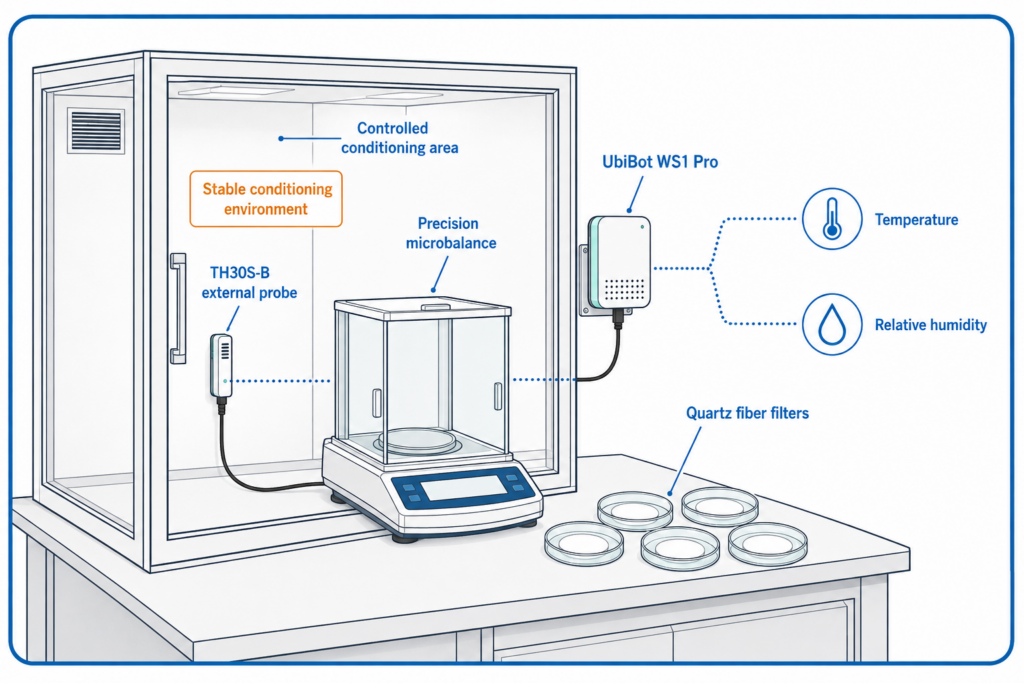
Study overview: UbiBot WS1 Pro with TH30S-B probe recorded weighing-room temperature and relative humidity during PM filter conditioning.
Research Background: What Problem Did This Study Address?
Particulate matter, or PM, is commonly measured by collecting airborne particles on filters and weighing the filters before and after sampling. In routine monitoring, whole filters are often used for mass determination. In research, however, a single filter may need to support multiple analyses, including carbon, ions, metals, PAHs, and water content. This often requires cutting the filter into smaller subsections.
Filter cutting can introduce uncertainty. Particulate material may be lost during cutting, unevenly distributed particles may make one subsection unrepresentative of the whole filter, and handling can affect water or chemical composition. These uncertainties are especially important when studying PM-bound water and water-soluble ions, because moisture and ion content can influence the apparent mass of particulate matter.
This study compared two methods for determining particulate mass and associated water and ion content on quartz fiber filters. One method estimated water and ion content computationally from filter subsections and related it to the total PM mass on the full filter. The other method directly weighed each one-tenth filter sector after cutting to assess PM mass distribution and potential material loss.
UbiBot WS1 Pro was used to record weighing-room temperature and relative humidity during filter conditioning and measurement. These environmental records helped ensure that mass differences were interpreted in the context of controlled humidity and temperature, rather than uncontrolled laboratory fluctuations.
The Specific Role of UbiBot in the Study
In this study, UbiBot WS1 Pro was used as an environmental monitoring device in the weighing room where PM filters were conditioned and measured. The paper does not state that UbiBot determined particulate mass, water content, or ion composition. Instead, UbiBot recorded the temperature and relative humidity conditions under which filter conditioning and gravimetric measurements were performed.
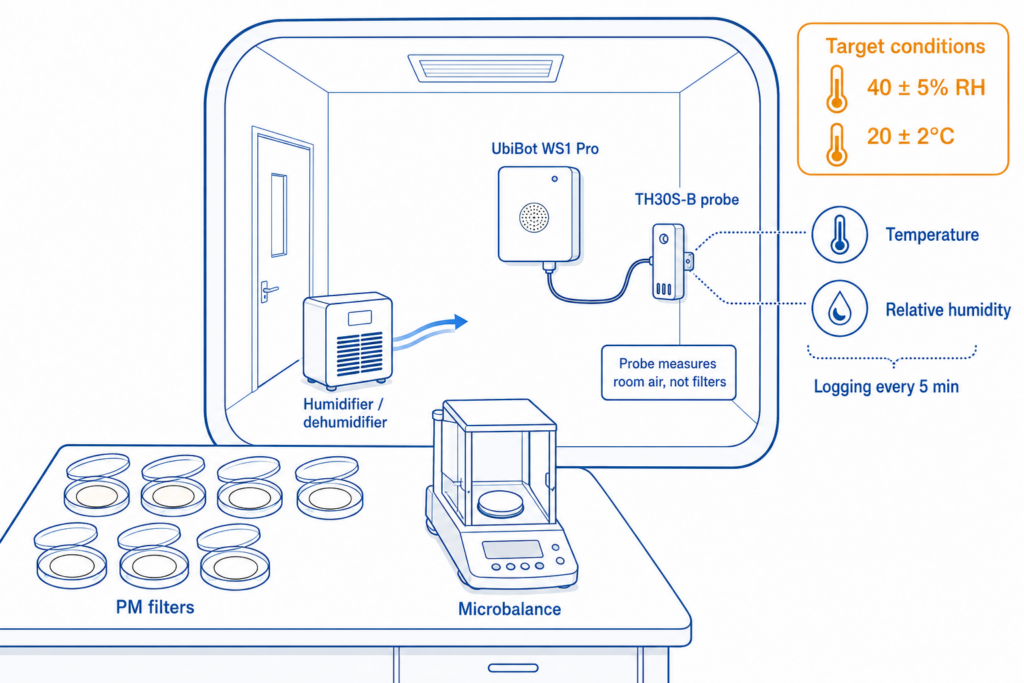
Controlled weighing-room conditions helped reduce uncertainty from humidity-sensitive PM filter handling.
The researchers used six Whatman quartz microfiber filters with a diameter of 150 mm. These filters had been exposed to PM1 and PM2.5 fractions at an urban background measurement site in Zabrze, Poland, in June 2023. Each PM sample was collected over three days using a high-volume sampler.
Before and after exposure, the filters were conditioned in a weighing room for 48 hours. The target conditions followed the EN 12341 gravimetric measurement framework: 40 ± 5% relative humidity and 20 ± 2 °C. These conditions were important because filter material and particulate matter can absorb or lose water if humidity and temperature fluctuate.
The room humidity was maintained by an HB CCS0401S humidifier/dehumidifier. During this stage, the UbiBot WS1 Pro measuring device, equipped with the TH30S-B external temperature and humidity probe, logged relative humidity and temperature every five minutes. The paper reports the probe accuracy as ±0.3 °C for temperature and ±2% for humidity.
These UbiBot data served as environmental quality-control records. They helped document that filter conditioning, cutting, weighing, and preparation for Karl Fischer analysis were conducted under controlled hygrothermal conditions.
The UbiBot data were used indirectly in the analytical workflow. The main measurements came from a Radwag MYA 5.5 Y.F1 microbalance, Karl Fischer coulometric titration, and ion chromatography. However, all these measurements depended on stable filter moisture conditions. By recording temperature and humidity every five minutes, UbiBot helped support the reliability and traceability of the gravimetric and chemical analyses.
Therefore, UbiBot’s specific role was environmental recording for PM filter preparation and measurement. It provided the temperature and relative humidity context needed to assess whether observed mass differences were caused by filter cutting and sub-sampling, rather than uncontrolled weighing-room conditions.
Research Methods and Data Collection Approach
The study used six exposed Whatman quartz fiber filters, each 150 mm in diameter. Three filters were used for PM1 and three for PM2.5. The filters were collected at an urban background site in Zabrze, Poland, in June 2023. Each sample represented three days of PM collection.
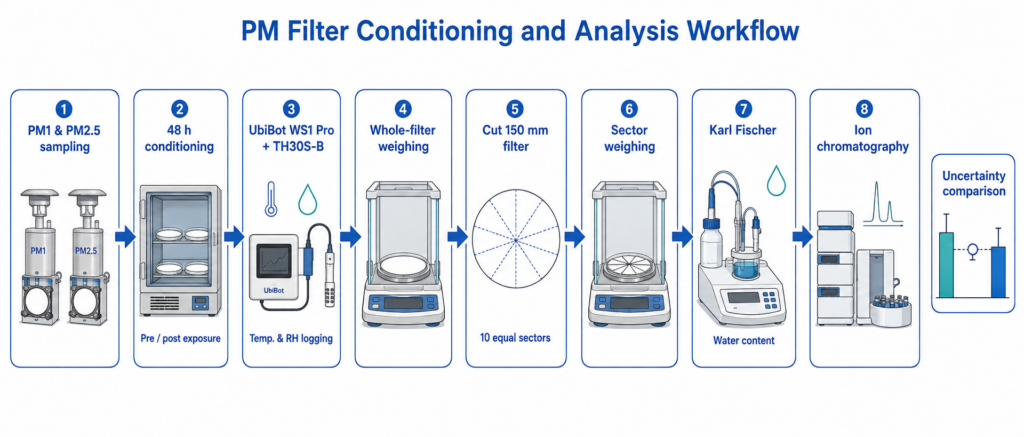
Research workflow from PM filter exposure and 48-hour conditioning to cutting, weighing, water analysis, and ion chromatography.
Before and after exposure, all filters were conditioned for 48 hours in the weighing room. The controlled environment was maintained at 40 ± 5% relative humidity and 20 ± 2 °C. UbiBot WS1 Pro with TH30S-B probe recorded room temperature and relative humidity every five minutes. The filters were weighed twice with a 24-hour interval using a Radwag microbalance with 1 µg resolution. An antistatic ionizer was used to reduce static effects.
After whole-filter mass determination, the filters were cut into ten equal sectors using a Teflon knife and a specially designed 3D-printed cutting plate. The paper’s Figure 1 shows the cutting plate and knife used for this sub-sampling process. Each sector was weighed twice, and the average sector mass was used to evaluate material loss caused by cutting.
The study compared two particulate mass calculation approaches.
The first was a computational method. In this method, water and ion contents measured in filter subsections were related to the total particulate mass collected on the whole filter. This method reduces direct handling and may reduce the risk of PM loss.
The second was a direct weighing method. In this method, each one-tenth sector was weighed after cutting. This allowed the researchers to evaluate mass distribution across the filter surface and quantify losses introduced by cutting.
For water analysis, Karl Fischer coulometric titration was used. Filter sectors were sealed in glass vials and analyzed with a Metrohm Karl Fischer coulometer and oven sample processor. The oven temperature was set to 250 °C to remove water from quartz filter samples.
For ion analysis, selected sectors were extracted in deionized water and analyzed by ion chromatography. The ions included Na+, NH4+, NO2+, K+, Mg2+, Ca2+, Cl−, NO3−, SO42−, PO43−, and F−. Statistical analyses included Shapiro–Wilk normality testing and t-tests for comparing sector mass distributions.
Key Research Findings
The study found that cutting filters into ten equal sectors caused measurable material loss. Across the six tested filters, the average material loss caused by cutting was approximately 2.42 ± 0.72 mg per filter.
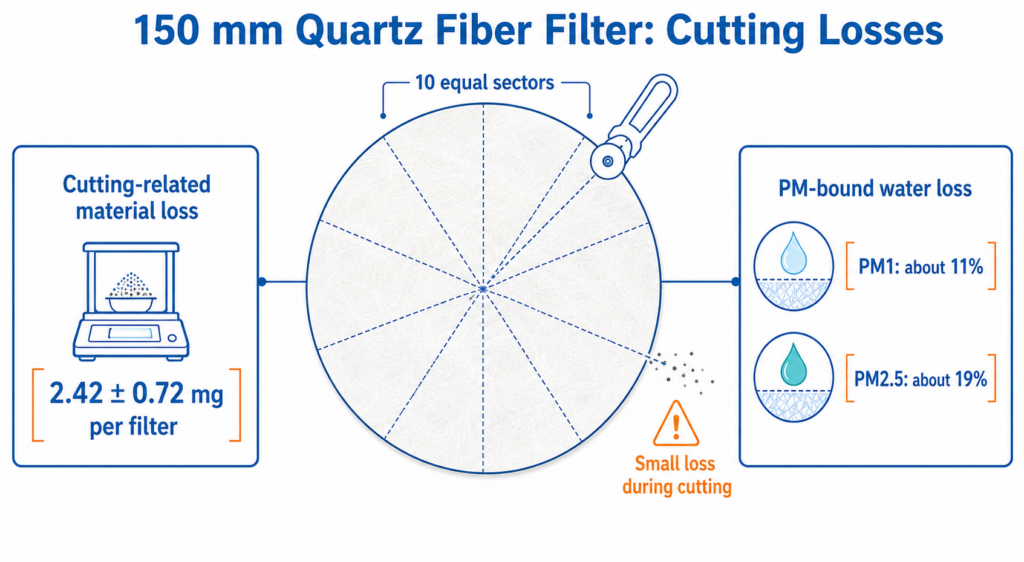
Cutting quartz filters into ten sectors introduced measurable material loss and uncertainty in PM mass, water-content, and ion estimates.
The cutting-related uncertainty varied by filter. For example, one PM1 filter collected from June 20 to 23 showed a mass difference of 3.09 mg between the weighing and calculation methods. Other filters showed smaller but still relevant differences. This confirmed that manual filter cutting can introduce uncertainty into PM mass estimation.
The study also found that filter sub-sampling affected PM-bound water estimation. Based on Karl Fischer titration, cutting led to estimated PM-bound water losses of about 11% for PM1 and 19% for PM2.5. The paper’s Figure 2 compares water content distribution using the computational method and the weighing method, showing lower water contents when the cutting-based weighing method was used.
Ion concentration estimates were also affected by the PM mass determination method. The differences were visible for major PM-bound ions such as NH4+ and SO42−. For PM1, the average NH4+ concentration was 577.08 ng/m³ using the computational method and 510.08 ng/m³ using the weighing method. For PM2.5, NH4+ was 675.72 ng/m³ using the computational method and 553.30 ng/m³ using the weighing method.
The study reported similar method-dependent differences for SO42−. For PM2.5, SO42− was estimated at 1334.92 ng/m³ using the computational method and 1095.94 ng/m³ using the weighing method.
The researchers concluded that larger particles in PM2.5 may be more prone to loss during cutting than smaller PM1 particles because larger particles are less strongly adhered to filter fibers and more easily dislodged by mechanical handling.
Overall, the paper highlighted the need for standardized and tightly controlled filter sub-sampling procedures. Without such control, filter cutting can affect PM mass, PM-bound water, and ion composition results.
What This Means for PM Filter Sub-Sampling and Air Quality Research
This study shows that PM filter sub-sampling is not a neutral preparation step. Cutting a filter can alter the measured mass of particulate matter and change the interpretation of water and ion content.
For air quality research, this matters because one filter is often divided for multiple chemical analyses. If the filter surface is not homogeneous, or if material is lost during cutting, the resulting chemical composition may not represent the full PM sample accurately.
For PM-bound water analysis, stable temperature and humidity conditions are especially important. Water content can change during handling, conditioning, and weighing. This is why controlled room conditions and five-minute environmental logging with UbiBot were relevant to the workflow.
For ion analysis, the study shows that concentration values can shift depending on whether PM mass is calculated from the whole filter or from the sum of cut sectors. This affects interpretation of PM chemical composition and may influence source apportionment, health exposure estimates, and regulatory research.
For laboratory practice, the findings support stricter quality control during cutting. The study suggests that improved cutting tools, standardized protocols, plate cleaning, and possibly stamping-like sub-sampling devices could reduce material loss and uncertainty.
Application Value of UbiBot Devices
UbiBot WS1 Pro demonstrated practical value as a laboratory environmental monitoring device in this PM filter study.
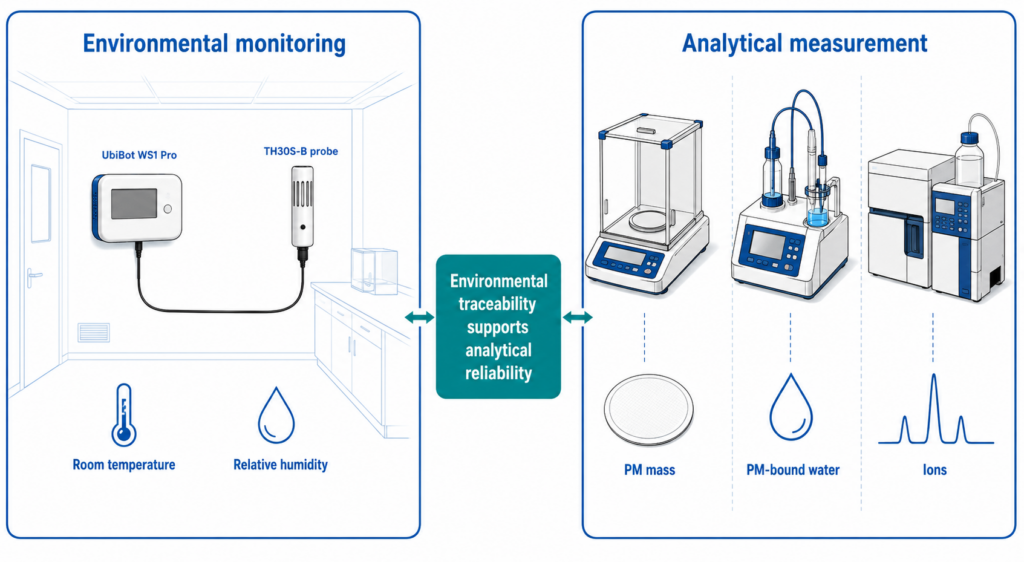
UbiBot supplied the environmental data layer; microbalance, Karl Fischer titration, and ion chromatography produced the analytical results.
First, it provided continuous temperature and relative humidity records during filter conditioning and weighing-room operations. Because filters were conditioned for 48 hours before and after exposure, these records supported environmental traceability.
Second, the device helped document compliance with controlled gravimetric conditions. The study required filter conditioning at 40 ± 5% RH and 20 ± 2 °C. UbiBot’s five-minute logging helped confirm the hygrothermal context of the measurement process.
Third, UbiBot data supported interpretation of PM mass and water-content uncertainty. Since moisture can influence filter mass, recording room humidity and temperature reduced the risk that observed mass changes would be misattributed.
Fourth, the external TH30S-B probe provided specified measurement accuracy suitable for laboratory monitoring: ±0.3 °C for temperature and ±2% for humidity.
Fifth, UbiBot complemented the main analytical instruments. It did not replace the microbalance, Karl Fischer titrator, or ion chromatograph. Instead, it supplied the environmental data layer that supported reliable filter preparation and analytical quality control.
Overall, UbiBot’s value in this paper lies in environmental condition recording for PM filter conditioning and mass-measurement reliability. It helped connect controlled laboratory conditions with the study’s assessment of filter cutting, particulate mass loss, water content, and ion composition uncertainty.
Extended Application Scenarios
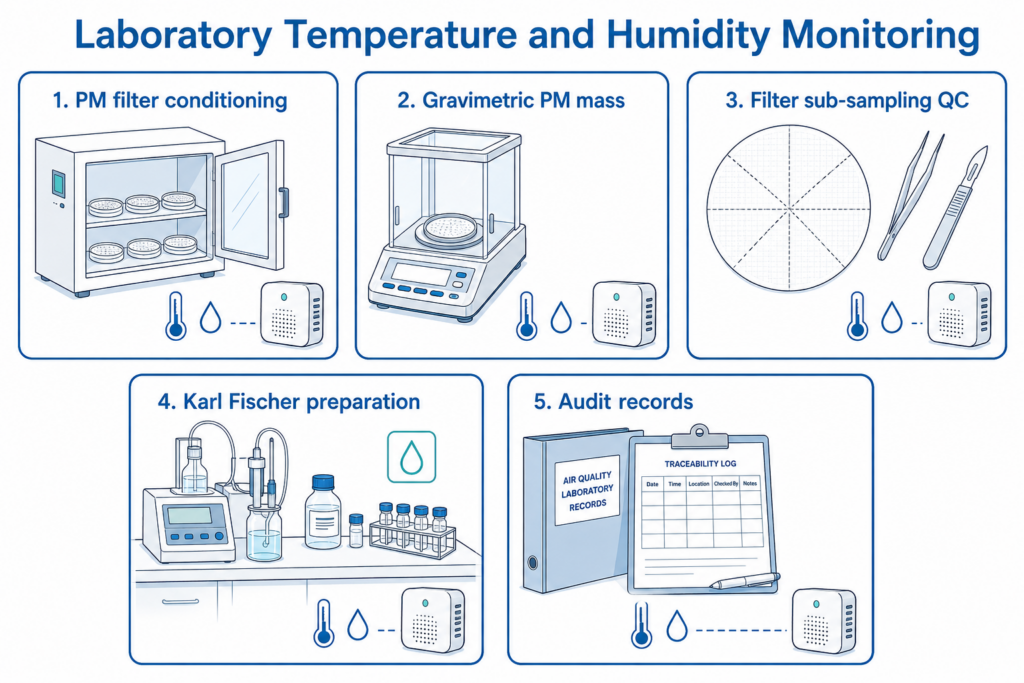
The same temperature and humidity monitoring approach can support PM filter conditioning rooms, gravimetric weighing, aerosol chemistry, and laboratory audit records.
The monitoring approach used in this study can be extended to several related scenarios:
- PM filter conditioning rooms
Used to record temperature and relative humidity during pre- and post-exposure filter conditioning. - Gravimetric PM mass measurement
Used to support controlled weighing conditions for PM10, PM2.5, and PM1 filters. - Filter sub-sampling quality control
Used to document environmental conditions during filter cutting and sector weighing. - Karl Fischer water-content analysis
Used to track weighing-room conditions before PM-bound water analysis. - Ion chromatography preparation
Used to support traceability when preparing PM filter extracts for ion analysis. - Air quality monitoring laboratories
Used as part of QA/QC workflows for national and research-grade PM measurement programs. - Aerosol chemistry research
Used to control and document humidity-sensitive PM sample handling. - Laboratory audit and compliance documentation
Used to provide time-series environmental records for measurement traceability.
FAQ
1. Which UbiBot product was used in the study?
The study used aUbiBot WS1 Pro measuring device with an external TH30S-B temperature and humidity probe.
2. What data did UbiBot collect?
UbiBot recorded temperature and relative humidity in the weighing room used for PM filter conditioning and gravimetric measurements.
3. Where was the UbiBot device deployed?
It was deployed in the weighing room where exposed and unexposed quartz fiber filters were conditioned, weighed, and prepared for subsequent analyses.
4. What was the sampling frequency?
Temperature and relative humidity were logged every five minutes.
5. How long were filters conditioned?
Filters were conditioned before and after exposure for 48 hours under controlled weighing-room conditions.
6. How were UbiBot data used?
The data documented the temperature and humidity conditions during filter conditioning and weighing. This supported quality control for gravimetric mass determination, filter cutting, Karl Fischer water analysis, and ion chromatography.
7. Did UbiBot measure particulate mass?
No. PM mass was measured using a Radwag microbalance. UbiBot monitored the room environment.
8. Did UbiBot measure water or ions in PM?
No. PM-bound water was measured using Karl Fischer coulometric titration, and ions were measured using ion chromatography. UbiBot provided environmental condition records.
9. What was the main finding about filter cutting?
Cutting 150 mm quartz filters into ten sectors caused an average material loss of about 2.42 mg per filter and introduced uncertainty into PM mass, water-content, and ion-concentration estimates.
10. Why is this research important?
It shows that filter sub-sampling can significantly affect PM chemical analysis. Controlled environmental monitoring and standardized cutting procedures are needed to improve the reliability of air quality research data.