

.svg)
Commercial Indoor Air Quality Monitors for CO2 PM2.5 TVOC and BMS Integration
Published: September 16, 2026
Update: September 16, 2026
By Nelly Damon
Introduction Why Choosing the Right Commercial IAQ Monitor Matters
This commercial indoor air quality monitoring system selection guide explains how to select CO2, PM2.5 and TVOC sensors, retain records and connect room data to a cloud platform, API or BMS. The right choice depends on the pollutants, room use and response workflow.
Who This Guide Is For
Facility managers need dependable trends and alarms. Engineers focus on coverage and BMS points, while consultants and buyers examine calibration evidence, platform fees and maintenance.
30 Second Summary
A commercial IAQ monitor combines sensing, time-stamped logging and communications. A complete system adds gateways, alarms, retention and integration. Consider UbiBot AQS1 when one powered device must track common particle, gas and climate parameters through Wi-Fi or 4G plus RS-485.
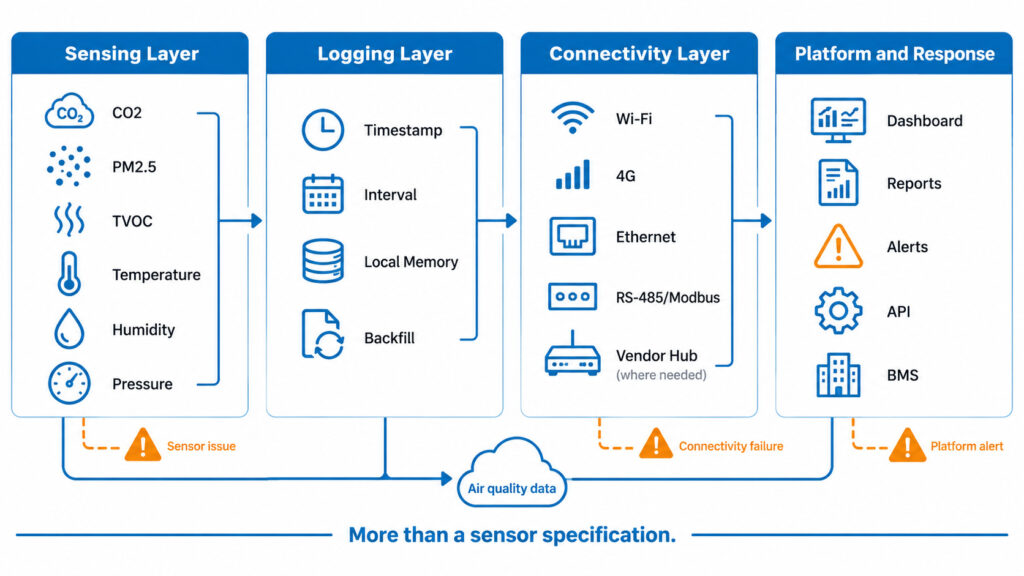
A complete commercial IAQ system combines sensing, logging, communication, dashboards, alerts, retention and integration.
What Is a Commercial Indoor Air Quality Monitor
A sensor measures a parameter; a logger adds timestamps and memory; and a gateway aggregates nodes. A monitoring system adds dashboards, alerts, reports and integration. A handheld meter supports surveys but does not replace continuous multi-room monitoring.
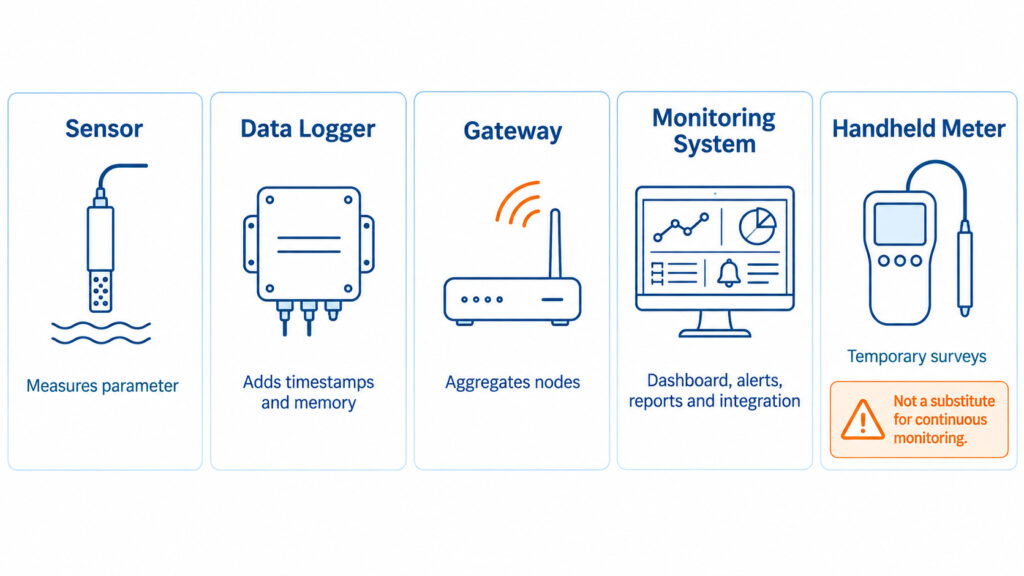
A sensor, logger, gateway and monitoring system solve different parts of the IAQ workflow.
What Problems Does an IAQ Monitoring System Solve
Continuous records reveal ventilation patterns, particle events and recurring comfort problems that spot checks miss. Local memory limits outage gaps, while remote alerts coordinate action across rooms or sites.
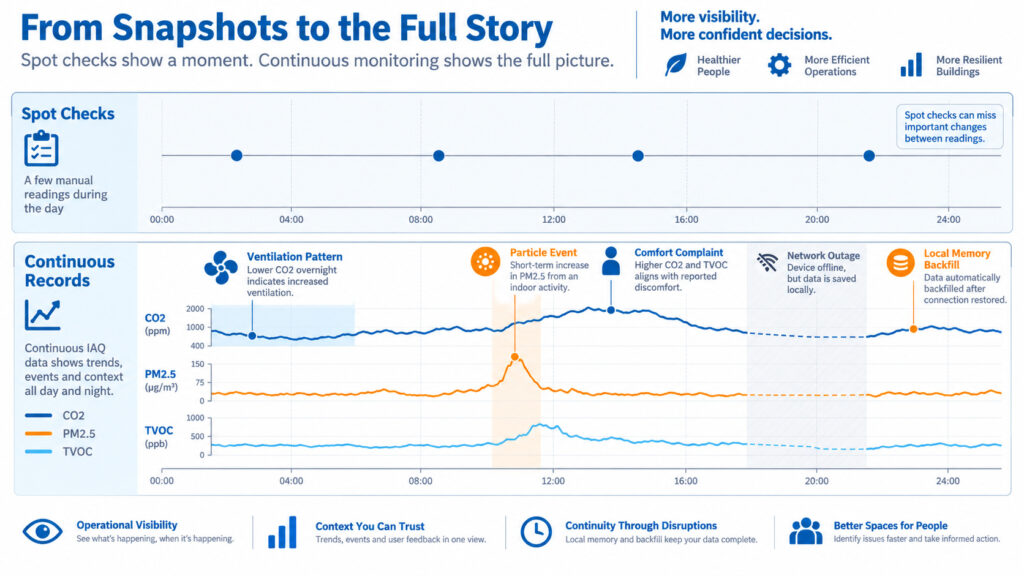
Continuous records reveal ventilation patterns, particle events and comfort problems that spot checks can miss.
Core Functions and System Components
Each point needs sensing, logging, power and communications. Wi-Fi devices may connect directly to cloud services; proprietary wireless sensors need the vendor hub. Ethernet or RS-485 can feed local systems. Check storage, backfill and alarm escalation.
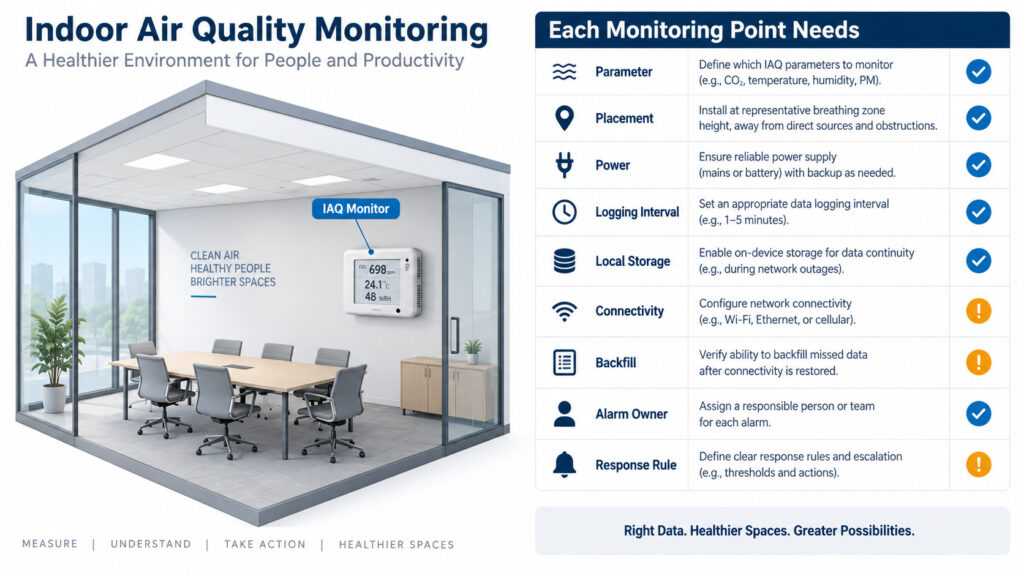
Each IAQ point needs a defined parameter, power path, communication path, storage behavior and alarm owner.
Which Sensors and Specifications Matter Most
Use CO2 to investigate occupied-space ventilation, PM2.5 for fine-particle events and TVOC for broad changes in mixed volatile compounds. TVOC does not identify a chemical. Compare accuracy windows, response, drift, intervals, calibration and operating limits. Placement, airflow and processing mean sensor accuracy is not total system accuracy.
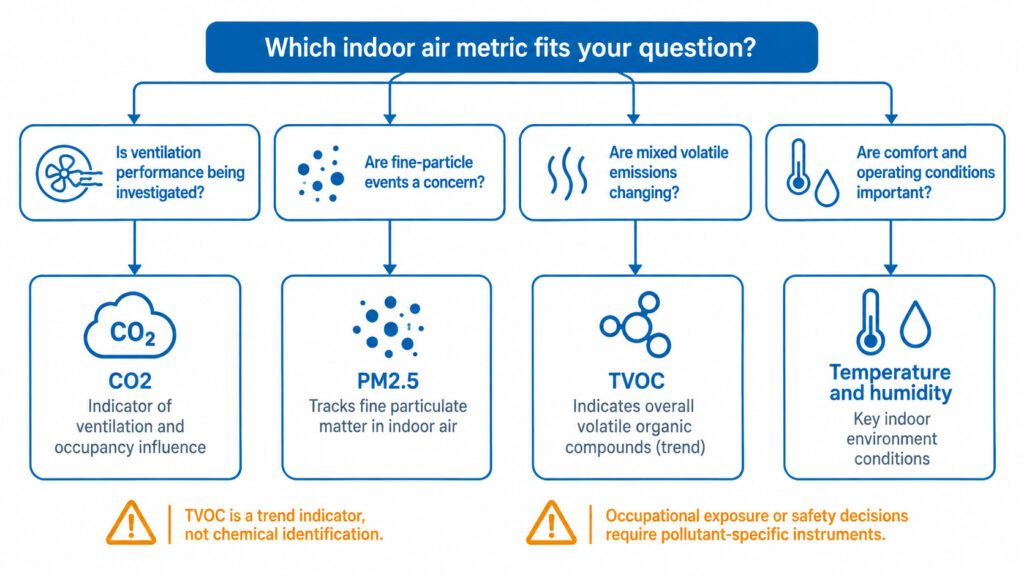
CO2, PM2.5, TVOC, temperature and humidity answer different building questions.
Which Connectivity Option Fits the Building
Wi-Fi suits powered rooms with managed coverage. 4G avoids local networks but adds data cost. Ethernet or PoE provides stable wiring; RS-485 Modbus RTU supports local BMS links. LoRa is radio modulation and LoRaWAN is a network protocol, so compatibility must be verified.
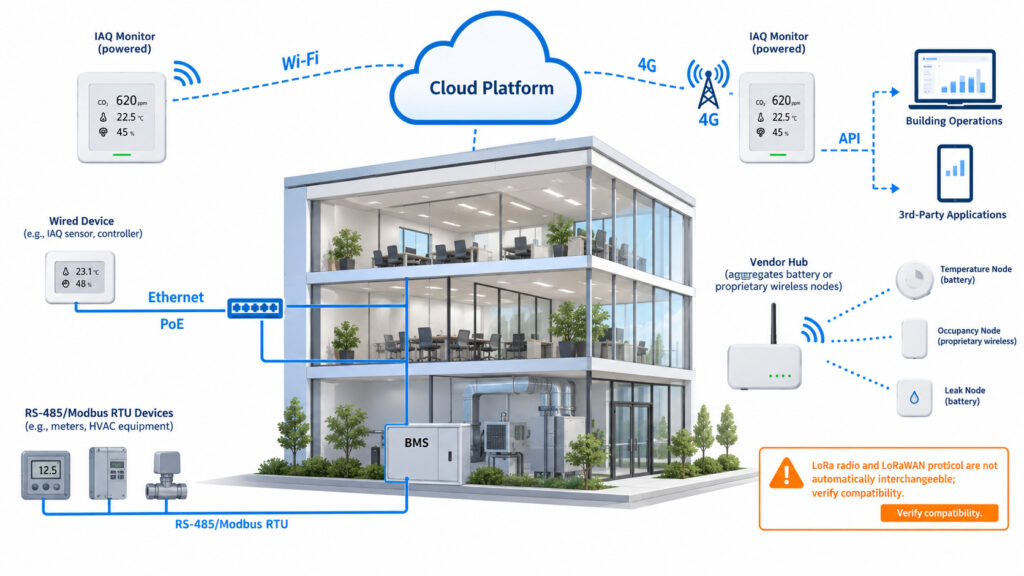
Connectivity should follow the building infrastructure, integration target and failure-recovery requirement.
Leading Commercial IAQ Models Compared
UbiBot AQS1 emphasizes broad sensing and integration. Airthings Space Pro supports battery deployment through a hub. Aranet4 PRO focuses on CO2 and climate. Kaiterra Sensedge Mini targets wired BMS projects, while testo 162 IAQ provides Wi-Fi logging and certificate options.
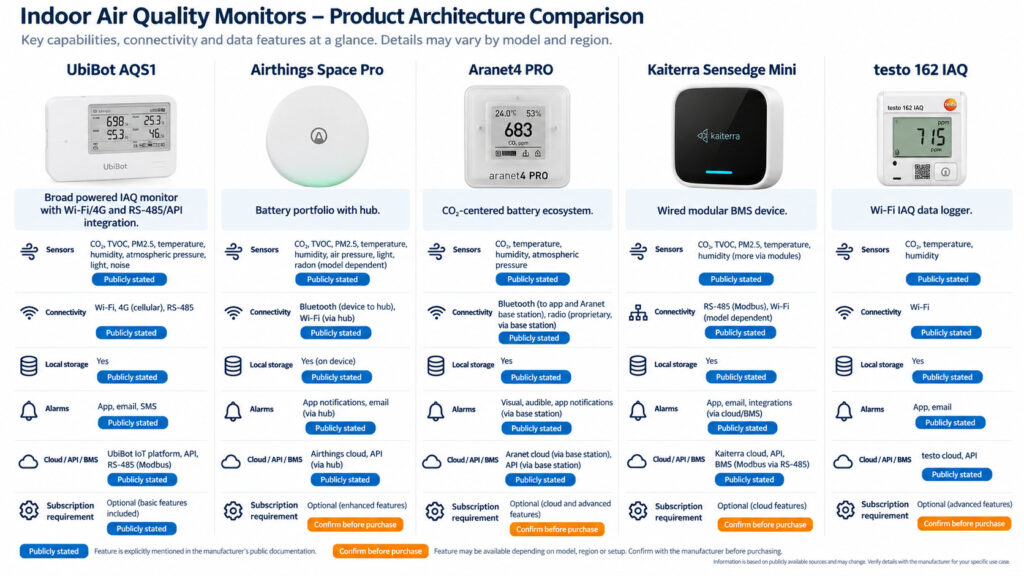
Product comparison should focus on architecture fit and public-information limits, not a universal ranking.
Best Options by Use Case
- Small office or classroom: start with CO2, temperature and humidity; add PM2.5 or TVOC when relevant sources exist.
- Multi-site portfolio: prioritize gateway capacity, local buffering, device health, centralized alerts, APIs and subscription terms.
- BMS-controlled building: use powered Ethernet, PoE, BACnet or RS-485/Modbus devices and obtain the register map.
- Workshop: trend PM and TVOC, but use pollutant-specific instruments for exposure or safety decisions.
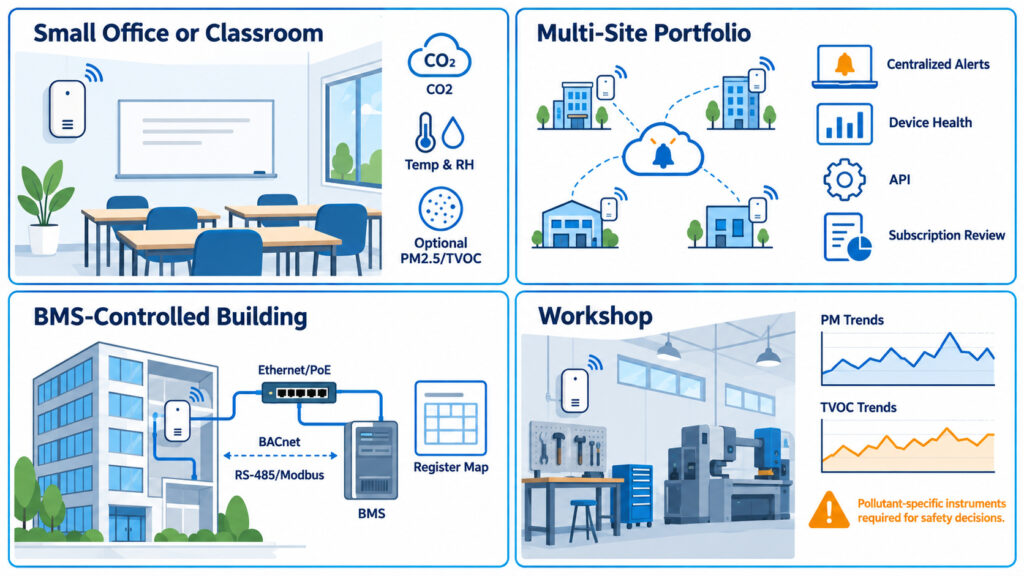
Use case, power model and integration target should drive the shortlist.
Deployment Scale and Total Cost of Ownership
Include gateways, SIMs, cloud seats, APIs, retention, calibration, batteries, modules, wiring, commissioning and IT support. Low-priced hardware can cost more if it requires manual exports or site visits.
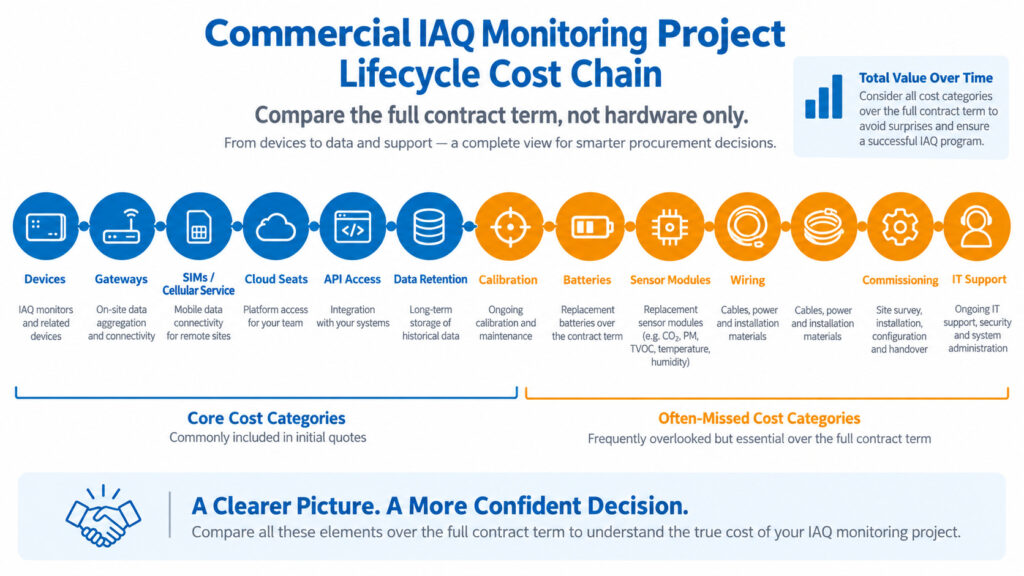
Lifecycle cost includes more than hardware: gateways, licenses, retention, calibration, wiring, batteries and integration also matter.
Common Buying Mistakes
Do not buy on price or range alone, treat sensor accuracy as system accuracy, or ignore calibration, offline data, alarm costs, expansion and regional SKUs. Comfort IAQ monitors are not occupational exposure instruments. LoRa and LoRaWAN are not interchangeable.
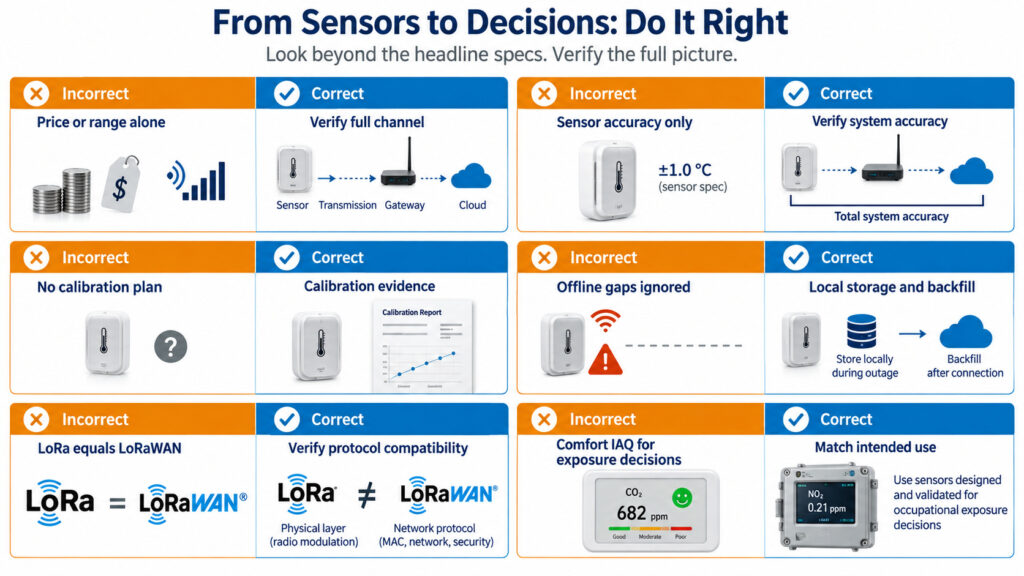
The most common buying mistakes turn a low-cost device into a high-maintenance monitoring program.
Where UbiBot Fits
AQS1 combines PM1.0, PM2.5, PM10, TVOC, CO2, temperature, humidity and pressure. Official sources list Wi-Fi or 4G configurations, RS-485, 300,000 sending records, cloud alerts and APIs. It uses a status light and voice prompts, not a numeric screen. Confirm the SKU, accuracy specification, calibration service and on-premises compatibility. Battery-first portfolios may suit another architecture.
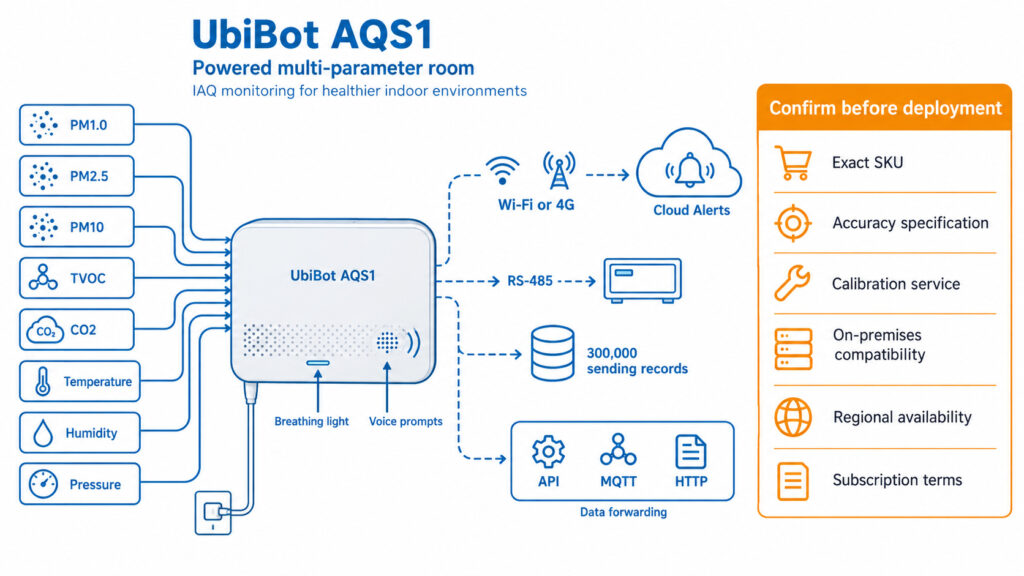
UbiBot AQS1 fits powered multi-parameter rooms that need broad sensing, cloud alerts and RS-485 or API integration, with SKU-level checks before deployment.
Conclusion How to Choose the Right System
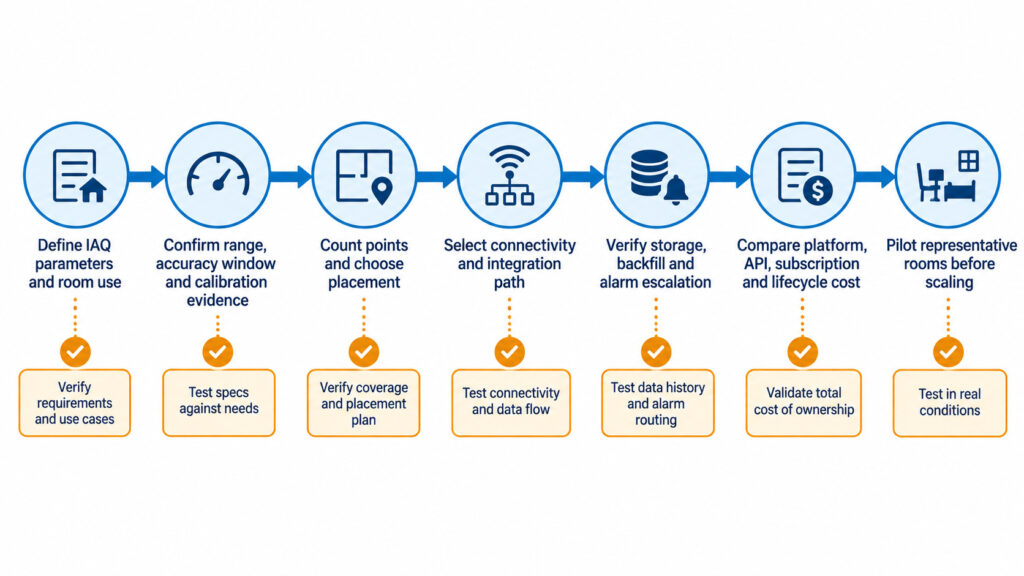
A defensible IAQ selection process starts with parameters and ends with representative-room pilots before scaling.
Define parameters, range, accuracy and calibration evidence first. Then confirm point count, communications, storage and backfill, alarms, platform, APIs and lifecycle cost. Review the current model-specific datasheet and pilot representative rooms before scaling.
Product Comparison Table
Specifications reviewed from official manufacturer information on September 16, 2026. A dash means the feature was not publicly specified in the reviewed source.
| Field | UbiBot AQS1 | Airthings Space Pro | Aranet4 PRO | Kaiterra Sensedge Mini | testo 162 IAQ |
| Product type | Powered multi-parameter IAQ monitor and logger | Battery commercial IAQ monitor used with Space Hub | Battery CO2 and climate sensor used with PRO base station | Wired modular IAQ monitor for building systems | Wi-Fi online IAQ data logger |
| Sensor configuration | PM1/2.5/10, TVOC, CO2, eCO2, temperature, RH, pressure | CO2, PM1/2.5, VOC, temperature, RH, pressure, light, noise; virtual virus risk | CO2, temperature, RH and pressure | CO2, temperature and RH plus selected PM, TVOC, O3, NO2 or CO modules | CO2, temperature, RH and pressure |
| Selected ranges | CO2 400-10,000 ppm; PM 0-500 ug/m3; TVOC 0-65,000 ppb; temp -20 to 60 C (-4 to 140 F) | CO2 400-5,000 ppm; PM2.5 1-1,000 ug/m3; operating 4 to 40 C (39 to 104 F) | CO2 0-9,999 ppm; temp 0 to 50 C (32 to 122 F); RH 0-85%; pressure 600-1,100 hPa | CO2 400-5,000 ppm, extended to 10,000; PM 0-1,000 ug/m3; TVOC 0-1,382 ppb; operating 0 to 50 C | CO2 0-5,000 ppm; temp 0 to 50 C (32 to 122 F); RH 0-100%; pressure 600-1,100 mbar |
| Selected accuracy | CO2 +/- (40 ppm + 3%) at 400-2,000 ppm; PM +/-10 ug/m3 at 0-100 and +/-10% at 100-500; temp +/-0.2 C; RH +/-2% in stated windows | CO2 +/-50 ppm +/-5% at 400-2,000 ppm under stated conditions; PM2.5 +/- (5 ug/m3 + 15%); temp +/-0.5 C; RH +/-3% | CO2 +/- (30 ppm + 3%); temp +/-0.3 C; RH +/-3%; pressure +3/-2 hPa | CO2 +/-40 ppm +/-3%; PM2.5 +/-3 ug/m3 at 0-30 or +/-10% above; TVOC +/-15% +/-4 ppb; temp +/-0.3 C; RH +/-3% | CO2 +/- (50 ppm + 3%) on mains or +/- (100 ppm + 3%) on battery; temp +/-0.5 C; RH +/-2% at 20-80% RH |
| Connectivity | 2.4 GHz Wi-Fi; 4G variant; RS-485. LoRa/LoRaWAN not specified for AQS1 | Airthings SmartLink and BLE; cellular-connected Space Hub | Aranet Sub-GHz ISM radio and BLE; requires regional PRO ecosystem | 2.4 GHz Wi-Fi, Ethernet, BACnet/IP, RS-485 Modbus/RTU, cloud or on-prem MQTT | Wi-Fi 802.11 b/g/n |
| Local storage | 300,000 sending records | Not publicly specified on product page | 3.5 to 30 days by interval; PRO base stores up to 10 years | 1 hour onboard | 32,000 readings across all channels |
| Power supply | USB-C 5V/2A or DC 12-24V/1A | 6 AA batteries, up to 4 years, or USB-C | 2 AA batteries; life varies by interval and radio settings | 12-30V DC or USB-C; PoE on SE000200P | 4 AA batteries or mains adapter |
| Alarm methods | App, email, SMS, voice, WhatsApp, HTTP and device/automation options; allowances or charges vary | Dashboard email and configured third-party integrations; device-offline alerts | Screen color/inversion and optional buzzer; remote alarms through base/cloud | Platform and integration dependent | Push, email and optional SMS through Smart Connect |
| Display | No numeric screen; breathing light and voice prompts | Customizable display | E-ink display | No user data display; status indication | Integrated display |
| Field | UbiBot AQS1 | Airthings Space Pro | Aranet4 PRO | Kaiterra Sensedge Mini | testo 162 IAQ |
| Product type | Powered multi-parameter IAQ monitor and logger | Battery commercial IAQ monitor used with Space Hub | Battery CO2 and climate sensor used with PRO base station | Wired modular IAQ monitor for building systems | Wi-Fi online IAQ data logger |
| Sensor configuration | PM1/2.5/10, TVOC, CO2, eCO2, temperature, RH, pressure | CO2, PM1/2.5, VOC, temperature, RH, pressure, light, noise; virtual virus risk | CO2, temperature, RH and pressure | CO2, temperature and RH plus selected PM, TVOC, O3, NO2 or CO modules | CO2, temperature, RH and pressure |
| Selected ranges | CO2 400-10,000 ppm; PM 0-500 ug/m3; TVOC 0-65,000 ppb; temp -20 to 60 C (-4 to 140 F) | CO2 400-5,000 ppm; PM2.5 1-1,000 ug/m3; operating 4 to 40 C (39 to 104 F) | CO2 0-9,999 ppm; temp 0 to 50 C (32 to 122 F); RH 0-85%; pressure 600-1,100 hPa | CO2 400-5,000 ppm, extended to 10,000; PM 0-1,000 ug/m3; TVOC 0-1,382 ppb; operating 0 to 50 C | CO2 0-5,000 ppm; temp 0 to 50 C (32 to 122 F); RH 0-100%; pressure 600-1,100 mbar |
| Selected accuracy | CO2 +/- (40 ppm + 3%) at 400-2,000 ppm; PM +/-10 ug/m3 at 0-100 and +/-10% at 100-500; temp +/-0.2 C; RH +/-2% in stated windows | CO2 +/-50 ppm +/-5% at 400-2,000 ppm under stated conditions; PM2.5 +/- (5 ug/m3 + 15%); temp +/-0.5 C; RH +/-3% | CO2 +/- (30 ppm + 3%); temp +/-0.3 C; RH +/-3%; pressure +3/-2 hPa | CO2 +/-40 ppm +/-3%; PM2.5 +/-3 ug/m3 at 0-30 or +/-10% above; TVOC +/-15% +/-4 ppb; temp +/-0.3 C; RH +/-3% | CO2 +/- (50 ppm + 3%) on mains or +/- (100 ppm + 3%) on battery; temp +/-0.5 C; RH +/-2% at 20-80% RH |
| Connectivity | 2.4 GHz Wi-Fi; 4G variant; RS-485. LoRa/LoRaWAN not specified for AQS1 | Airthings SmartLink and BLE; cellular-connected Space Hub | Aranet Sub-GHz ISM radio and BLE; requires regional PRO ecosystem | 2.4 GHz Wi-Fi, Ethernet, BACnet/IP, RS-485 Modbus/RTU, cloud or on-prem MQTT | Wi-Fi 802.11 b/g/n |
| Local storage | 300,000 sending records | Not publicly specified on product page | 3.5 to 30 days by interval; PRO base stores up to 10 years | 1 hour onboard | 32,000 readings across all channels |
| Power supply | USB-C 5V/2A or DC 12-24V/1A | 6 AA batteries, up to 4 years, or USB-C | 2 AA batteries; life varies by interval and radio settings | 12-30V DC or USB-C; PoE on SE000200P | 4 AA batteries or mains adapter |
| Alarm methods | App, email, SMS, voice, WhatsApp, HTTP and device/automation options; allowances or charges vary | Dashboard email and configured third-party integrations; device-offline alerts | Screen color/inversion and optional buzzer; remote alarms through base/cloud | Platform and integration dependent | Push, email and optional SMS through Smart Connect |
| Display | No numeric screen; breathing light and voice prompts | Customizable display | E-ink display | No user data display; status indication | Integrated display |
Specifications and platform features were reviewed using publicly available manufacturer information on September 16, 2026. Product configurations, regional availability and subscription terms may change. Confirm the latest specifications with each manufacturer before purchasing.
Frequently Asked Questions
Which IAQ Parameters Should a Commercial Building Monitor
CO2, temperature and humidity are a practical baseline for occupied rooms. Add PM2.5 where outdoor pollution or combustion matters and TVOC where materials or processes may create changing emissions. Use pollutant-specific instruments for safety or exposure decisions.
Is CO2 a Direct Measurement of Ventilation
No. CO2 is an indicator that must be interpreted with occupancy, outdoor concentration and the ventilation strategy. Set thresholds and response rules for the building rather than copying one universal value.
How Reliable Is a TVOC Reading
TVOC is useful for detecting trends in a mixed group of volatile compounds. It does not identify individual chemicals, and readings can change with humidity, sensor ageing and the target-gas profile.
Can an IAQ Monitor Connect to a BMS
Yes, if the selected model exposes a supported protocol such as RS-485 Modbus RTU, BACnet/IP, Ethernet or an API. Obtain the register map, update interval and failure-state behavior before commissioning.
Are LoRa and LoRaWAN the Same
No. LoRa describes the radio modulation, while LoRaWAN defines a network protocol and ecosystem. Proprietary sub-GHz devices and LoRa products are not automatically compatible with standard LoRaWAN gateways.
Why Does Local Storage Matter
It protects the measurement record when the network or cloud path is unavailable. Check capacity in records or days, overwrite behavior and whether the device automatically backfills data after reconnection.
How Often Should Commercial IAQ Sensors Be Calibrated
There is no universal interval. Follow the manufacturer, project risk, applicable program and observed drift. Define field checks, reference instruments, acceptance limits and records before deployment.
Do Commercial IAQ Systems Require a Subscription
Many do. Fees may cover device seats, data retention, APIs, alerts, reports or cellular service. Compare the full contract term and the features that remain available if a subscription ends.
Where Should an IAQ Monitor Be Installed
Place it in the occupied zone where readings represent normal room conditions. Avoid supply diffusers, doors, direct sunlight and unusually local sources unless the purpose is to investigate that source.
Can an IAQ Monitor Prove Regulatory Compliance
A monitor can support a compliance or certification workflow, but the device alone does not prove compliance. The project may still require suitable placement, calibration, validation, documented procedures and review of the applicable standard.
Sources and Specification Notice
- UbiBot AQS1 product page
- UbiBot AQS1 user manual
- UbiBot platform API documentation
- UbiBot alert methods
Specifications and platform features were reviewed using publicly available manufacturer information on September 16, 2026. Product configurations, regional availability and subscription terms may change. Confirm the latest specifications with each manufacturer before purchasing.