.svg)
What is the best real-time tracker for temperature-sensitive shipments?
Published: October 12, 2026
Update: October 12, 2026
By Jason Fallon
Quick Answer
There is no universal best real-time tracker for every temperature-sensitive shipment. Tive Solo 5G is a strong turnkey multi-sensor choice when temperature, humidity, shock, light and location must be managed in one shipment platform. Sensitech TempTale GEO APX Global and the ELPRO LIBERO G family are stronger starting points when cold-chain workflow, calibration evidence and life-science quality processes carry more weight. Frigga V5 Pro is attractive for long, multimodal and ocean-linked journeys, while ORBCOMM CT 3500 is fundamentally an installed reefer-telematics system rather than a parcel tracker. UbiBot GS1-PL4G1RS fits buyers who want a reusable, configurable 4G/GNSS monitoring node with 300,000 local records, external-probe expansion and open integration. The decisive question is not headline accuracy alone; it is which architecture fits the lane, cargo, intervention workflow, power model and data-governance requirements.
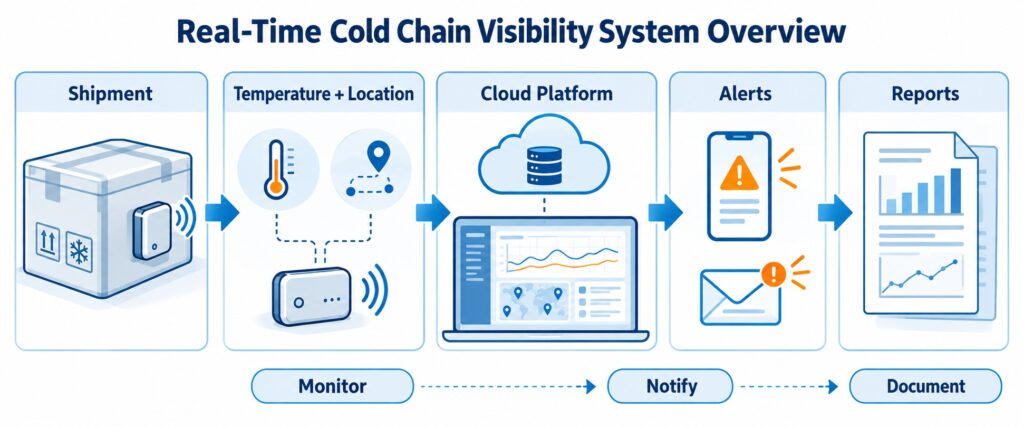
A real-time cold-chain tracking system links shipment conditions, location visibility, cloud monitoring, alerts and documentation into one operational workflow.
Who Is This Comparison For?
This guide is for pharmaceutical supply-chain QA teams, cold-chain logistics managers, 3PL quality managers, freight forwarders, clinical logistics teams and procurement specialists who need more than a passive temperature logger. Their operational problem is usually the same: an excursion discovered at delivery is too late to correct. A connected tracker should help teams see where a shipment is, what condition it is in, whether a threshold has been exceeded, and whether the record remains complete when coverage disappears. The shortlist changes by operating model. A pharmaceutical shipper may prioritize calibration, validated workflows and airline acceptance. A produce exporter may value humidity, light and ocean visibility. A reusable fleet program may prioritize battery serviceability, local memory, external probes and APIs. Installed reefer fleets need controller integration that shipment trackers do not provide.
What Matters Most in a Real-Time Tracker for Temperature-Sensitive Shipments?
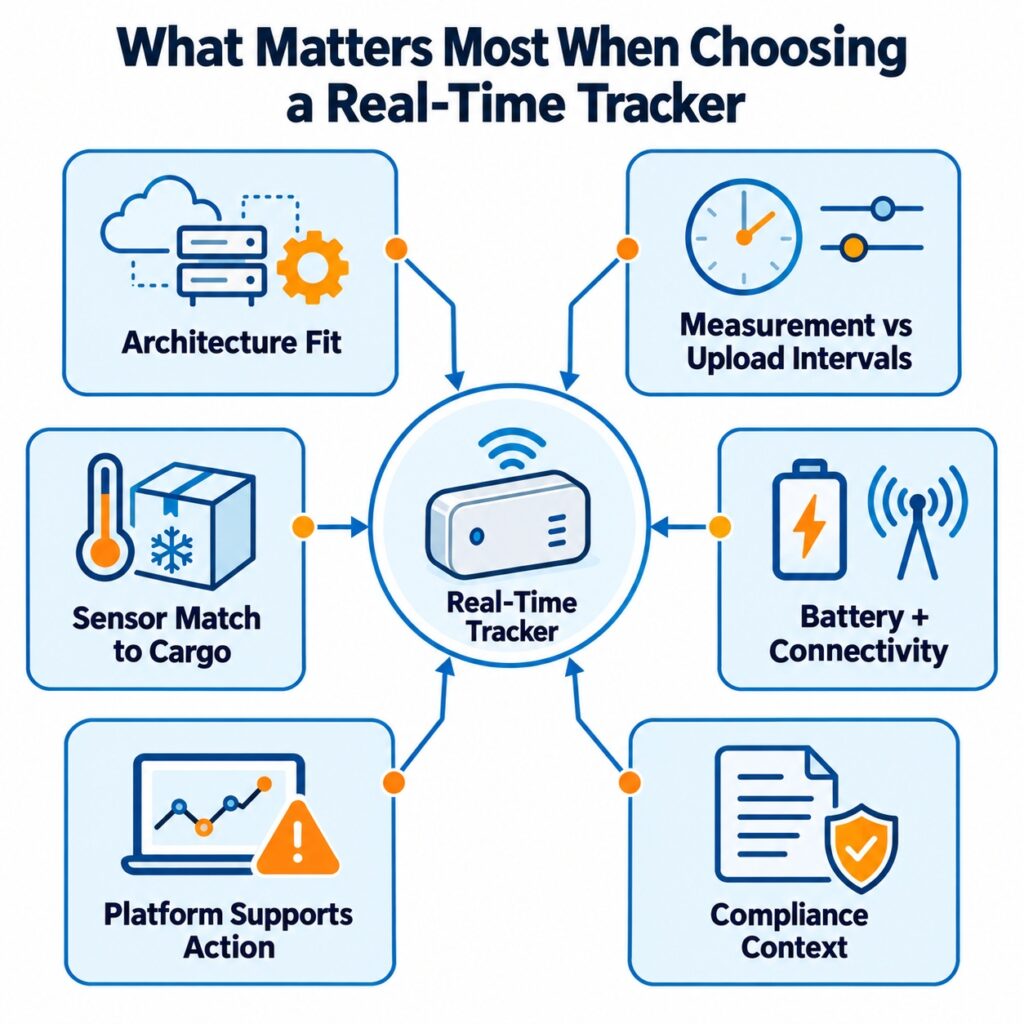
The best tracker is not defined by one specification alone; buyers must balance architecture, sensing fit, logging continuity, battery behavior, action workflow and compliance needs.
Choose the architecture before the brand
A shipment-level tracker travels with the goods and is fast to deploy across third-party carriers. A reusable industrial node stays with an asset or lane and can support external sensors and custom integrations. Installed reefer telematics connects to the refrigeration asset itself and can expose controller status or remote-control functions. These architectures may all show temperature and location, but they answer different operational questions.
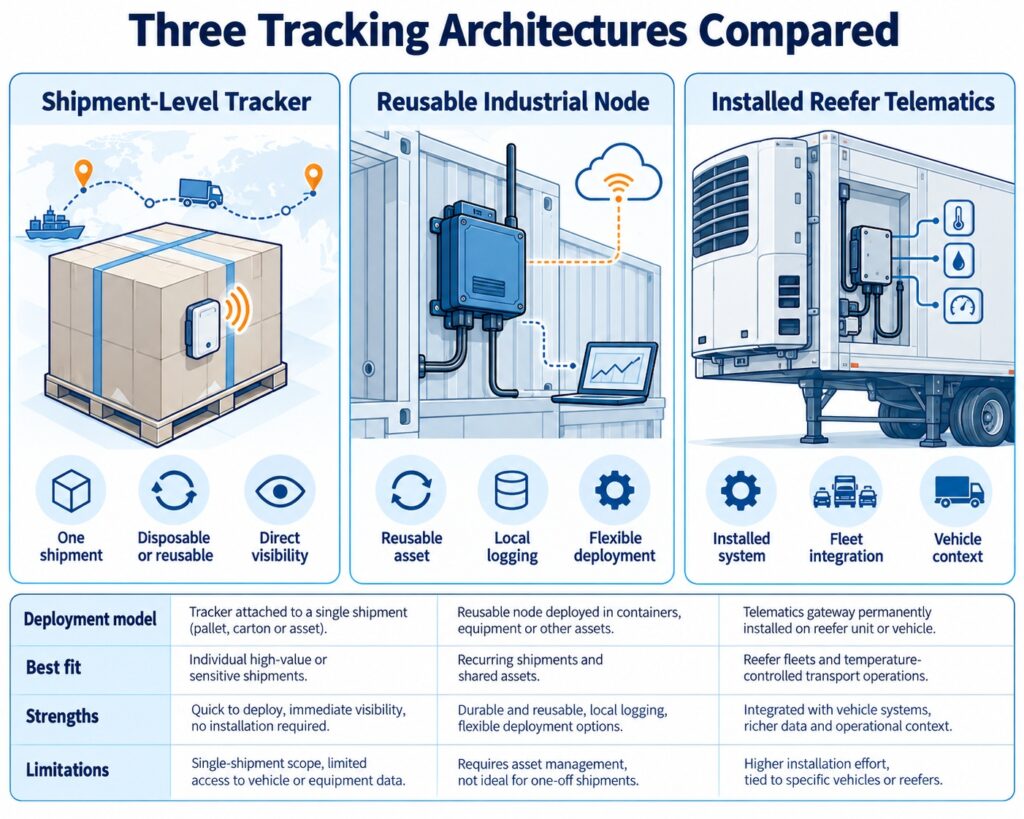
Shipment-level trackers, reusable industrial monitoring nodes and installed reefer telematics may all show temperature and location, but they solve different operational problems.
Separate measurement, logging and transmission intervals
Real-time visibility normally means periodic or event-driven transmission, not second-by-second streaming. The tracker should continue measuring and storing data locally when cellular service is unavailable, then backfill with the original timestamps. Buyers should compare measurement interval, upload interval, offline capacity and the recovery behavior as separate specifications.
Match the sensing chain to the cargo
Chilled, frozen, dry-ice and cryogenic shipments require different sensing ranges and probe designs. Accuracy must be assessed at the temperatures that matter, not only at room temperature. Humidity, light, shock and tilt are useful only when they explain a real failure mode. A wider sensor list does not replace suitable placement, calibration or a defined acceptance criterion.
Battery and connectivity are linked
Frequent GPS fixes and transmissions improve visibility but shorten operating life. Weak cellular coverage also increases power demand. Long-haul and ocean lanes therefore need a battery model tied to actual reporting intervals, not a single marketing number. Air shipments add another question: battery chemistry, UN 38.3 documentation, airline acceptance and any required radio behavior must be confirmed for the exact device.
The platform must support action
A useful system does more than draw a route on a map. It should route excursion alerts to responsible people, preserve the event history, support shipment or lane identifiers, generate reports and integrate with the systems that quality and operations already use. APIs, webhooks and data forwarding matter most when the tracker is part of a control-tower, TMS or quality workflow rather than another isolated dashboard.
Compliance is a system responsibility
EU GDP requires acceptable transport conditions to be maintained and temperature excursions to be investigated. WHO guidance treats monitoring, calibration and documented transport controls as part of a broader quality system. IATA guidance also matters when battery-powered tracking devices fly as cargo. A tracker may support those workflows, but hardware specifications alone do not make a shipment GDP-compliant, validated or airline-approved.
Product Overview
UbiBot GS1-PL4G1RS
A reusable industrial monitoring node with 4G LTE, Wi-Fi, multi-constellation GNSS, a 4-inch display, built-in temperature/humidity/light sensing, 300,000 local records and compatible external probes. It does not require a separate gateway for cloud connectivity. Its value is configurability and integration; buyers should separately confirm the selected probe calibration, airline acceptance and any regulated validation package.
Sensitech TempTale GEO APX Global
The current APX Global generation combines LTE Cat-1bis and Wi-Fi location support with temperature, humidity, light and location monitoring through SensiWatch. Sensitech publishes NIST-traceable temperature accuracy, IP64 protection and trip life up to 60 days for the base model or 120 days for the Extended model. It is a managed shipment-visibility architecture rather than an expandable industrial sensor host.
ELPRO LIBERO G family
The LIBERO G family covers single-use and multi-use pharmaceutical shipment monitoring. GL and GH target standard controlled-temperature lanes, GF targets frozen use, and GE/GF ext add external Pt100 capability for dry-ice and cryogenic ranges. The family uses LTE-M/NB-IoT, local memory, elproCLOUD or liberoMANAGER, configurable alarms and traceable calibration documentation. Exact range and battery details depend on the selected G model.
Tive Solo 5G
A compact tracker combining GPS, Wi-Fi geolocation, cellular positioning, temperature, humidity, shock and light. It connects over LTE-M with 2G fallback and does not need a local gateway. Tive publishes ±0.5°C temperature accuracy, IP67 protection and interval-dependent battery life. The Tive platform adds alert presets, reports, APIs and webhooks according to the selected service tier.
Frigga V5 Pro Series
A shipment-tracking family built around multi-mode positioning and long-distance visibility. Frigga publishes GPS, A-GPS, LBS, Wi-Fi positioning and ocean tracking, with model-dependent sensing for temperature, humidity, light, shock, tilt and movement. The family includes single-use and multi-use variants. Exact accuracy, memory and cellular-band specifications should be obtained for the selected V5 Pro SKU.
ORBCOMM CT 3500
An installed reefer-telematics device rather than a shipment card. It is designed for refrigerated containers and supports global cellular connectivity, GPS, reefer data access, alerts, reports and two-way control through ORBCOMM maritime platforms. Its hardware is IP67/IP69K and powered from reefer/vehicle systems with an internal battery. For owned container fleets, this controller-level architecture can solve problems that portable trackers cannot.
Side-by-Side Comparison Table
Specifications are based on current official manufacturer pages reviewed in October 2026. Family-level products are marked as model-dependent. Where a value could not be confirmed for the exact product, it is not inferred from another model.
| Comparison item | UbiBot GS1-PL4G1RS | Sensitech TempTale GEO APX Global | ELPRO LIBERO G family | Tive Solo 5G | Frigga V5 Pro Series | ORBCOMM CT 3500 |
|---|---|---|---|---|---|---|
| Product positioning | Reusable configurable IoT/GNSS monitoring node | Shipment-level real-time cold-chain tracker | Pharma-oriented real-time logger family | Multi-sensor shipment tracker | Multimodal shipment-tracker family | Installed reefer telematics |
| Measurement parameters | Temperature, RH, light; external probes | Location, temperature, RH, light; optional probe | Model-dependent: temperature; GH adds RH; GE/GF ext add external Pt100 | Temperature, RH, shock, light, location | Model-dependent: temperature, RH, light, shock, tilt, movement, location | Reefer/controller and connected-sensor data; GPS/accelerometer |
| Temperature range | Built-in -20 to 60 C | APX Global -10 to 55 C; Extended -30 to 55 C | Model-dependent; GE/GF ext Pt100 -200 to 400 C | -30 to 60 C; specialist probes for lower ranges | Model-dependent; common V5 Pro device -30 to 70 C; probe variant -40 to 80 C | Not a standalone cargo-temperature sensor specification |
| Published accuracy | Built-in temp +/-0.2 C | +/-0.5 C -10 to 45 C; wider bands model-dependent | Model-specific; published calibrated accuracy bands by model | Temperature +/-0.5 C | Not publicly specified for the family page reviewed | Depends on reefer/controller or connected sensors |
| Connectivity / location | 4G LTE + Wi-Fi; GPS/GLONASS/BeiDou/Galileo/QZSS | LTE Cat-1bis + Wi-Fi location support | LTE-M / NB-IoT; location | LTE-M with 2G fallback; GPS/Wi-Fi/cellular positioning | GPS/A-GPS/LBS/Wi-Fi/ocean tracking; exact cellular bands by SKU | Global LTE/3G/2G; GPS; BLE; optional other reefer-network paths |
| Gateway required | No | No local gateway | No local gateway | No | No for cellular master trackers; some kit architectures add beacons | Installed on reefer; not a portable gateway model |
| Local storage | 300,000 records | Confirm exact APX local capacity | 31,000 values on LIBERO G models | Offline backfill supported; exact record count not publicly specified | Dual local/platform report; exact capacity not publicly specified | >2,000 messages plus onboard files |
| Display | 4-inch LCD | Device interface / status; model-specific | LCD on LIBERO G | LED-based device; platform-centric | Model-dependent | Status LED; platform-centric |
| Power / operating life | 2900 mAh internal battery + USB-C / 12 V; GNSS runtime depends on settings | Up to 60 days base / 120 days Extended | Up to 14 months for multi-use G models; GS single-use 110 days | 30+ to 100+ days depending version and transmission interval | Model-dependent; vendor illustrates journeys up to 120 days | Vehicle/reefer power + internal 2.6 Ah battery |
| Environmental protection | IP65 per GS1 user guide | IP64 | Model-dependent (e.g. GF IP54) | IP67 | Model-dependent; confirm SKU | IP67 / IP69K |
| Cloud / alerts | UbiBot platform; app/email/SMS/voice; API/data forwarding | SensiWatch; real-time alerts, map, analytics | elproCLOUD/liberoMANAGER; email/SMS, reports | Tive platform; alerts, reports, collaboration | Frigga platform; real-time alerts, ocean events, reports | ORBCOMM Maritime/Reefer platforms; alerts, analytics, remote control |
| API / integration | Open API, HTTP data forwarding; other services by plan | Platform integrations; confirm entitlement | Confirm selected software/API entitlement | Public API + webhooks; advanced features by tier | Confirm commercial API package | Enterprise/backend integration supported |
| Reuse model | Reusable | Shipment-level; takeback program for current APX Global | Single-use and multi-use by model | Single- and multi-use variants | Single- and multi-use by model | Permanent or temporary installed asset device |
| Best suited for | Reusable custom projects, route studies, mobile assets, external-sensor expansion | Turnkey global shipment visibility | Pharma chilled/frozen/dry-ice/cryogenic temperature workflows | Broad multi-sensor multimodal visibility | Long-distance and ocean-linked shipments | Owned reefer fleets and containers needing controller-level monitoring |
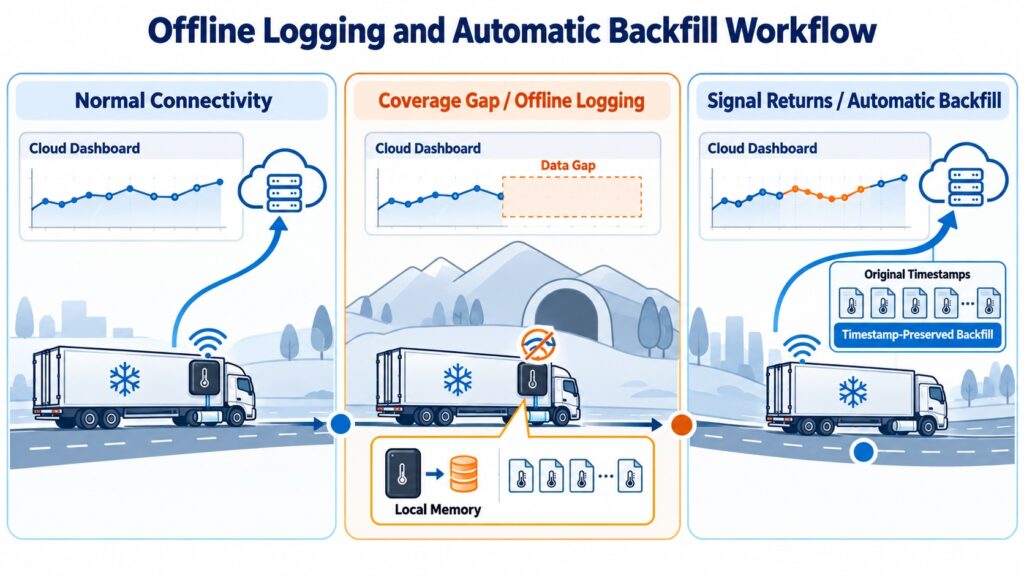
A strong real-time tracker should continue recording during coverage gaps and automatically upload the missing records with original timestamps when connectivity returns.
Connectivity and Deployment Comparison
Connectivity separates these systems more clearly than temperature range. UbiBot, Sensitech, ELPRO, Tive and Frigga are designed to travel with a shipment or reusable monitoring asset and reach cloud services over cellular networks. UbiBot also supports Wi-Fi, while its GNSS receiver uses GPS, GLONASS, BeiDou, Galileo and QZSS. Tive combines GPS, Wi-Fi geolocation and cellular triangulation. Sensitech APX Global uses LTE Cat-1bis with Wi-Fi location support. ELPRO LIBERO G uses LTE-M/NB-IoT. Frigga adds ocean-tracking logic to terrestrial positioning methods.
ORBCOMM CT 3500 is different: it is installed on a reefer and is designed to remain with the asset. That increases installation and asset-management effort, but it can expose reefer status and enable two-way control. For a shipper using third-party carriers, a portable tracker is usually easier. For a container owner, controller integration may be more valuable than a disposable tracker.
Offline behavior must be commissioned, not assumed. UbiBot publishes 300,000 local records. ELPRO publishes 31,000 values for LIBERO G models. Tive states that trackers continue measuring when offline and backfill after connectivity returns. For Frigga and the exact Sensitech APX configuration, buyers should confirm local capacity and recovery behavior in the current commercial specification. The same test should verify timestamps, missing-data handling and whether remote alerts are delayed during the outage.
Sensor and External Probe Comparison
Sensor scope should follow the cargo risk. UbiBot GS1-PL4G1RS measures temperature, humidity and light internally and supports compatible external probes such as PT100 and temperature/humidity probes. That is useful when a reusable node must monitor a cargo space, trailer or test lane rather than a single carton. The exact probe combination and full-system calibration still need to be specified.
Tive Solo 5G adds shock as a standard shipment signal and supports dry-ice and cryogenic probe options. Sensitech APX Global focuses on temperature, humidity, light and location, with an optional probe on the Extended architecture. ELPRO provides the broadest temperature-specialist family: standard, frozen, dry-ice and cryogenic applications are addressed by different LIBERO G variants and external Pt100 options. Frigga V5 Pro adds model-dependent shock, tilt and movement sensing. ORBCOMM CT 3500 should not be judged by a standalone sensor range because its role is to collect reefer/controller and connected-sensor data.
A procurement specification should name the exact temperature point, required accuracy, calibration points, sensor location and whether the measurement is intended to represent ambient air, package surface, product simulation or reefer performance.
Cloud Platform, Alerts and Data Management
The software layer determines whether live data leads to a controlled response. UbiBot provides dashboards, threshold and offline alerts, exports, API/data-forwarding functions and optional local deployment; app, email, SMS and voice methods are available with plan or credit dependencies. Tive provides shipment templates, condition and route alerts, reports, collaboration, APIs and webhooks, with advanced integration features tied to higher platform tiers. Sensitech pairs APX devices with SensiWatch for map-based visibility, alerts, corrective-action acknowledgement and analytics. ELPRO uses elproCLOUD or liberoMANAGER for real-time alerts, reports and regulated workflows. Frigga adds leg-level shipment views, ocean events and report export. ORBCOMM focuses on fleet and reefer operations with alerts, analytics and remote-control functions.
The right workflow should define who receives the first alarm, who can change limits, who contacts the carrier, how an excursion is documented, and how the tracker record is linked to shipment IDs, lane data and product-disposition decisions. A feature called “real-time alert” has limited value if the recipient, escalation path and corrective action are not defined before departure.
Total Deployment Cost and Recurring Burden
Total cost is driven by the deployment model, not the device price alone. A reusable UbiBot node adds charging or power, SIM/data service, probes, calibration and possible return logistics, but can be redeployed across lanes. ELPRO and some Sensitech/Tive configurations may carry platform, calibration or managed-service costs that support more standardized workflows. Frigga offers single-use and multi-use approaches, so cost per shipment depends on the selected SKU and return model. ORBCOMM requires installation and integration but is designed to stay with the reefer asset for long-term fleet operations.
Build the commercial model around cost per completed shipment or cost per monitored asset. Include tracker loss rate, reverse logistics, cellular coverage, air-freight restrictions, calibration, platform/API tier, support, accessories and labor needed to create shipments and resolve exceptions. Where public pricing is unavailable, compare the cost structure rather than inventing a total.
Brand-by-Brand Strengths and Trade-Offs
UbiBot GS1-PL4G1RS
Best suited to reusable route, vehicle, container or temporary studies that need GNSS, 4G/Wi-Fi, a local display, large memory, external sensors and open integration. The trade-off is that it is larger than parcel trackers and its public documentation does not establish the same turnkey pharma shipment-validation or airline program as specialist life-science platforms.
Sensitech TempTale GEO APX Global
Strong for organizations that want a mature shipment-visibility workflow and a current globally connected APX device with published temperature performance. It is less about third-party probe expansion or custom edge configuration and more about operating within the Sensitech ecosystem.
ELPRO LIBERO G family
Strongest where the transport temperature profile itself is the primary quality record, especially for pharmaceutical chilled, frozen, dry-ice or cryogenic lanes. The family offers model-specific calibration and probe options, but buyers must select the right variant and account for its software, battery and return model.
Tive Solo 5G
Strong for multimodal shipments that benefit from temperature, humidity, shock, light and multiple location methods in one compact tracker. Battery life varies substantially with reporting interval and version, so configuration should be tied to the lane rather than copied from a headline specification.
Frigga V5 Pro Series
Strong for long and ocean-linked logistics where multi-mode positioning, ocean-event visibility and a broad condition-sensor set are valuable. The family is diverse, so exact V5 Pro accuracy, memory, battery and connectivity details should be locked to a specific SKU before procurement.
ORBCOMM CT 3500
Strong for reefer-container owners that need machine-level monitoring, global connectivity and remote control over a long asset life. It is not the simplest choice for a shipper that only needs a tracker inside a third-party load, because installation and reefer integration are part of the architecture.
Which Product Should You Choose?
Choose UbiBot GS1-PL4G1RS when you need a reusable configurable node with 4G/Wi-Fi, GNSS, 300,000 local records, a display, external probes and APIs, and your project can separately manage calibration, air-transport approval and validation requirements.
Choose Sensitech TempTale GEO APX Global when you want a current turnkey shipment-visibility product integrated with SensiWatch and published global trip-life, temperature and alert specifications.
Choose ELPRO LIBERO G when pharmaceutical temperature evidence, calibrated model variants and specialized frozen/dry-ice/cryogenic choices are central to the lane.
Choose Tive Solo 5G when one portable tracker should combine temperature, humidity, shock, light and location with strong API and collaboration features.
Choose Frigga V5 Pro when ocean and multimodal positioning, long journeys and model-dependent condition sensing are major requirements.
Choose ORBCOMM CT 3500 when you own or manage refrigerated containers and need installed telematics, reefer data and remote control rather than a shipment-level tracker.
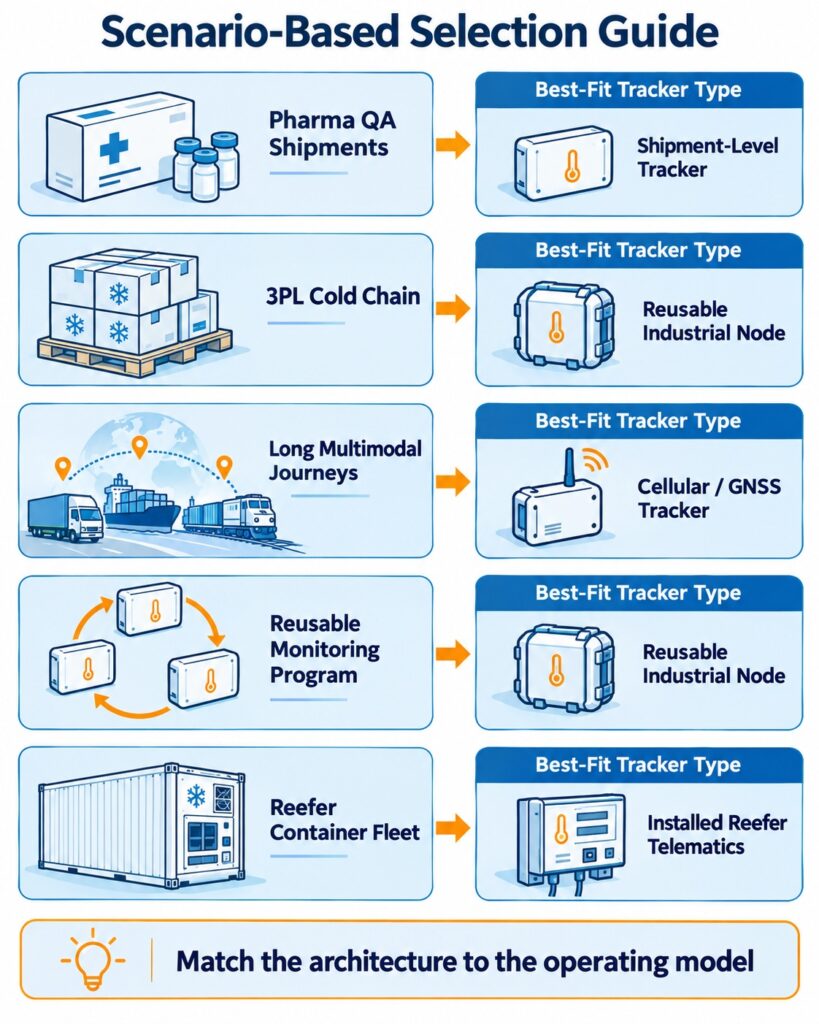
Different operating models lead to different best-fit choices, from pharmaceutical shipment monitoring and multimodal logistics to reusable fleet programs and reefer container operations.
Pros and Cons
| Product | Scenario-specific advantages | Scenario-specific limitations |
|---|---|---|
| UbiBot GS1-PL4G1RS | Large local memory; 4G/Wi-Fi; multi-constellation GNSS; display; external probes; API flexibility | Larger than parcel trackers; no built-in shock listed; calibration/airline/validation scope must be confirmed |
| Sensitech TempTale GEO APX Global | Turnkey shipment workflow; current global cellular design; published temperature accuracy; SensiWatch analytics | Less edge expandability; platform/service model and current commercial terms require quote |
| ELPRO LIBERO G | Strong model coverage from standard chilled to cryogenic; detailed calibration positioning; long multi-use runtime | Requires careful model selection; software/licensing and battery chemistry differ by variant |
| Tive Solo 5G | Temperature + RH + shock + light + location; IP67; strong API/webhook ecosystem; no gateway | Battery life depends strongly on reporting interval/version; advanced platform features depend on tier |
| Frigga V5 Pro | Five-mode positioning; ocean tracking; broad condition sensing; single/multi-use choices | Family-level public specs leave some accuracy, memory and cellular details to SKU confirmation |
| ORBCOMM CT 3500 | Deep reefer integration; rugged enclosure; global connectivity; two-way control | Installation/integration burden; not a simple shipment-level tracker for third-party carrier loads |
Frequently Asked Questions
What is the best real-time tracker for temperature-sensitive shipments?
The best tracker depends on the lane and quality process. Tive is strong for broad multi-sensor shipment visibility, Sensitech and ELPRO for structured cold-chain workflows, Frigga for multimodal/ocean visibility, ORBCOMM for installed reefer fleets, and UbiBot for a reusable configurable GNSS/4G node with external-sensor expansion.
Do real-time cold chain trackers keep recording without cellular coverage?
Many do, but the capacity and recovery process differ. Confirm local memory, original timestamps, backfill behavior and what happens to alerts while the device is offline. A dashboard connection is not the same thing as an uninterrupted data record.
Is GPS enough for a temperature-sensitive shipment?
No. Location can show where a shipment is, but it cannot prove cargo temperature, humidity, door activity or reefer performance. A useful tracker links condition data and location on the same timeline.
Which tracker is better for pharmaceutical shipments?
Sensitech and ELPRO are strong starting points when regulated workflow and calibration evidence dominate the decision. Tive also targets life-science logistics. UbiBot may support pharmaceutical transport monitoring, but project-specific calibration, validation and airline acceptance must be confirmed.
Can one tracker cover dry ice or cryogenic shipments?
Only if the exact model and probe are rated for the required range. ELPRO LIBERO GE/GF ext and Tive’s dedicated dry-ice or cryogenic probes are examples. Do not place a standard ambient tracker into a temperature range outside its device limits.
Does a real-time shipment tracker need a gateway?
The shipment-level products compared here generally communicate directly over cellular networks. ORBCOMM CT 3500 is installed telematics, not a local wireless-sensor gateway. Always verify the exact architecture and regional network coverage.
Are real-time trackers automatically GDP-compliant?
No. EU GDP and WHO guidance place responsibility on the transport and quality system. A tracker can provide evidence and alerts, but calibration, procedures, qualification, responsibilities and excursion handling still need to be defined.
What should be checked before using a tracker on an aircraft?
Confirm the exact battery chemistry, UN 38.3 evidence, airline/device acceptance, required radio behavior, labeling and current carrier rules. IATA guidance applies to battery-powered cargo tracking devices, but acceptance is not automatic for every device or airline.
Final Verdict
For most buyers, the right answer comes from architecture first. A shipment-level tracker such as Tive, Sensitech, ELPRO or Frigga is easiest to deploy when the device must travel with goods across third-party carriers and multimodal handoffs. ORBCOMM CT 3500 is better understood as a reefer-asset system for owners that need controller-level visibility and remote control.
UbiBot GS1-PL4G1RS occupies a useful middle ground. Its 4G/Wi-Fi connectivity, multi-constellation GNSS, 300,000-record memory, local display, external-sensor support and integration options suit reusable route monitoring, reefer-truck studies, mobile assets and custom cold-chain projects. It should not be presented as automatically equivalent to a specialist validated pharmaceutical tracker.
Before purchase, freeze the exact model and probe, verify the required temperature range and calibration points, test offline recovery, confirm cellular coverage and battery life at the intended reporting interval, review API/platform licensing, and obtain written confirmation for air-transport acceptance or regulated validation where those requirements apply.
Official Sources Reviewed
- UbiBot GS1-PL4G1RS specifications: https://store.ubibot.com/en-sg/pages/ubibotgs1-pl4g1rs_specifications — Sensors, GNSS, cellular bands, memory, power and external-probe support.
- UbiBot GS1 product page: https://www.ubibot.com/ubibot-gs1/ — Alerts, API, data forwarding and GS1 platform functions.
- UbiBot GS1 user guide: https://www.ubibot.com/wp-content/uploads/dlm_uploads/2021/03/GS1-User-Guide-%E6%97%A5%E6%9C%AC%E8%AA%9E-1.pdf — Model table including GS1-PL4G1RS network mode, IP65 and indicative battery life.