

.svg)
Vaccine Refrigerator Data Loggers Compared: UbiBot vs T&D vs Dickson vs Vaisala vs InTemp vs Rotronic
Published: September 30, 2026
Update: September 30, 2026
By Jason Fallon
Quick Answer
For a vaccine refrigerator, the most important choice is not the logger brand but whether the complete configuration matches current vaccine-storage requirements. CDC guidance updated in July 2026 recommends a digital data logger with a detachable buffered probe, out-of-range alarm, low-battery indication, current/minimum/maximum values, recommended uncertainty of +/-0.5 C, and a programmable logging interval of at least every 30 minutes. InTemp CX402-VFC and T&D TR75A2 are the most purpose-built options in this comparison for U.S. VFC-style workflows. Dickson DWE2 with a glycol sensor is strong for small and mid-size connected sites; Vaisala viewLinc and Rotronic RMS suit governed enterprise deployments. UbiBot WS1 Pro-WiFi V2 is compelling where large local memory, a visible display, flexible probes, cloud access and lower infrastructure burden matter, but buyers must verify the exact buffered probe and calibration evidence before using it in a CDC/VFC workflow.
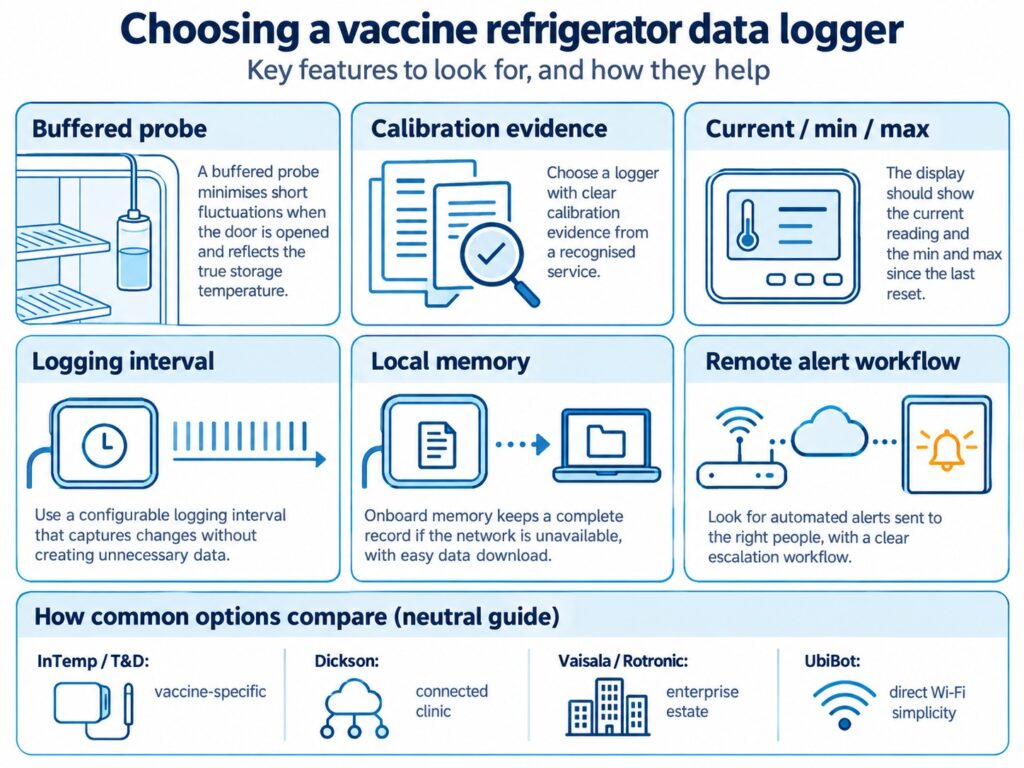
The right vaccine logger is defined by the full measurement workflow, not by brand name alone.
Who Is This Comparison For?
This comparison is written for vaccine coordinators, pharmacists, clinic managers, hospital pharmacy quality teams, public-health programme managers and procurement staff choosing a temperature data logger for vaccine refrigerators or medical freezers. Their buying problem is usually practical: a refrigerator can fail after hours, a door may be left open, a network can disappear, or staff may discover an excursion only when they review a manual log the next morning.
Small clinics often want one or two devices that are quick to deploy and easy to read locally. Pharmacy networks and hospitals need central dashboards, alarm escalation, calibration records and multi-site reporting. VFC providers in the United States have another layer: the device and probe configuration must satisfy current programme requirements, and the calibration documentation has to be current and traceable. The same hardware can therefore be a good fit in one organisation and an incomplete fit in another.
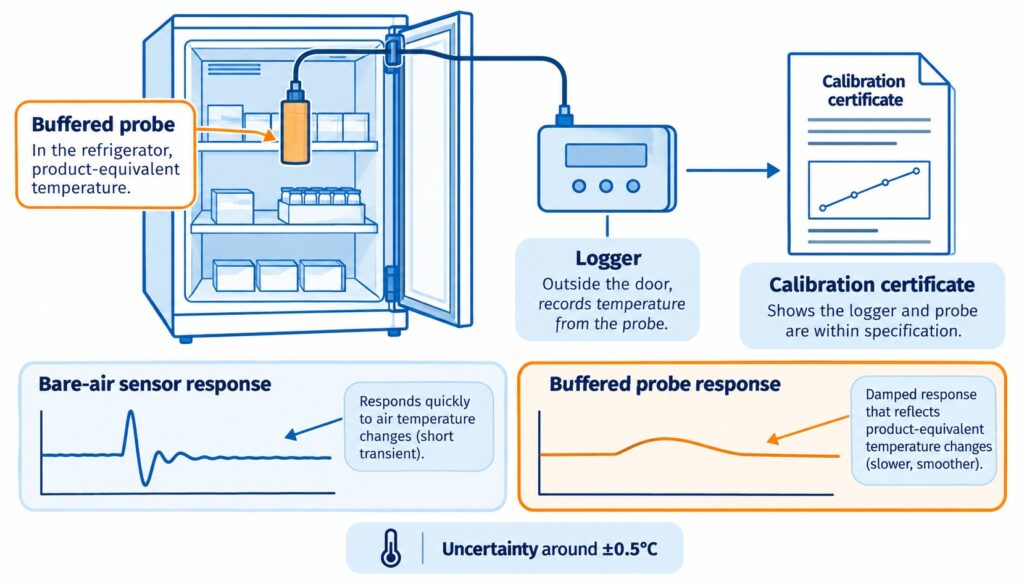
Small clinics, pharmacy networks and governed hospital systems often need different vaccine monitoring architectures.
Vaccine Temperature Data Logger Selection Guide: What Matters Most?
Start with the buffered probe and calibration evidence
For routine vaccine storage, CDC guidance is unusually clear about the measurement architecture. The temperature monitoring device should use a detachable probe that reflects vaccine temperature, typically by placing the probe in a thermal buffer such as glycol, glass beads, sand or Teflon. A fast-response bare-air sensor can react strongly to door openings and compressor cycles, while the buffered probe better represents the thermal behaviour of stored products. The current certificate of calibration testing matters as much as the nominal sensor accuracy because it documents the performance of the actual measurement chain used at the site.
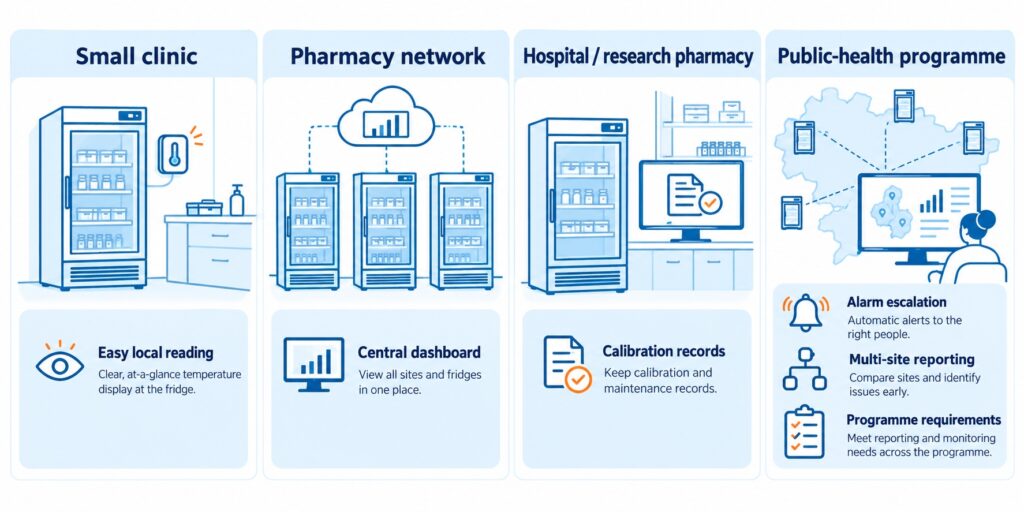
A buffered probe and current calibration evidence are more important than headline logger branding for vaccine storage.
Place the probe with the vaccines and keep the display accessible
The 2026 CDC toolkit recommends placing the buffered probe near the centre of the storage unit with vaccines surrounding it, away from walls, vents, floors, ceilings and doors unless the refrigerator manufacturer specifies another location. It also recommends keeping the active digital display outside the unit so staff can read temperatures without opening the door. This makes probe cable design, logger mounting and display readability genuine purchasing criteria rather than minor installation details.
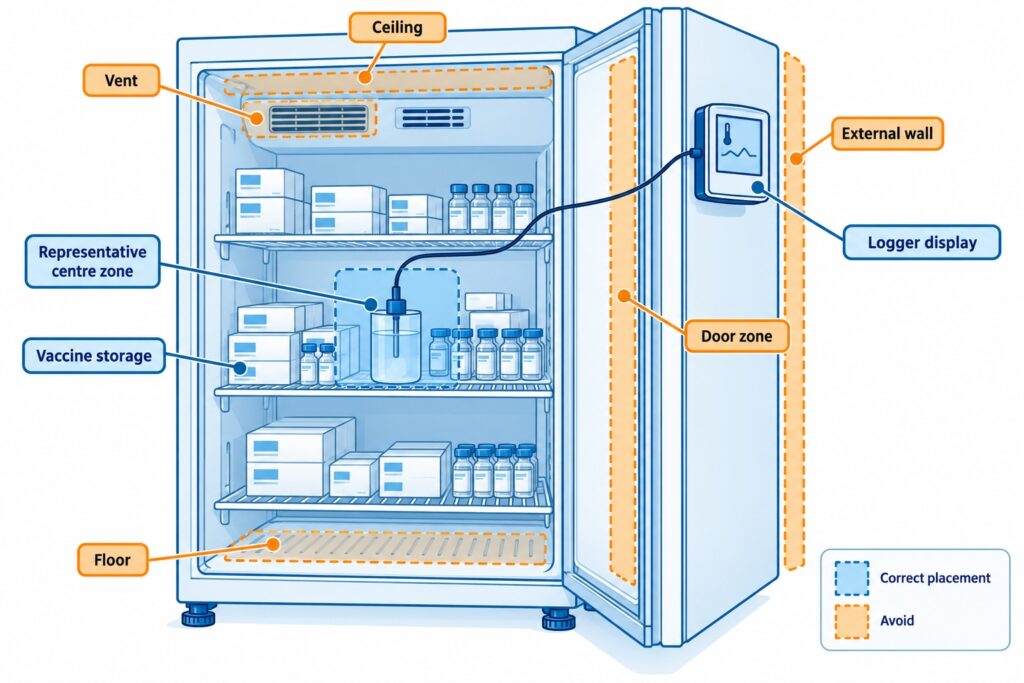
Place the buffered probe near the centre of the storage space, with vaccines around it and the display outside the unit.
Min/max history, logging interval and local memory answer different questions
A current temperature tells staff what is happening now. Minimum and maximum values help with routine checks. A continuous log shows when an excursion started, how long it lasted and how the refrigerator recovered. CDC calls for a logger that can measure and record at least every 30 minutes; many organisations choose a shorter interval. Local memory is important because the historical record should continue even when Wi-Fi, a gateway or the internet is unavailable.
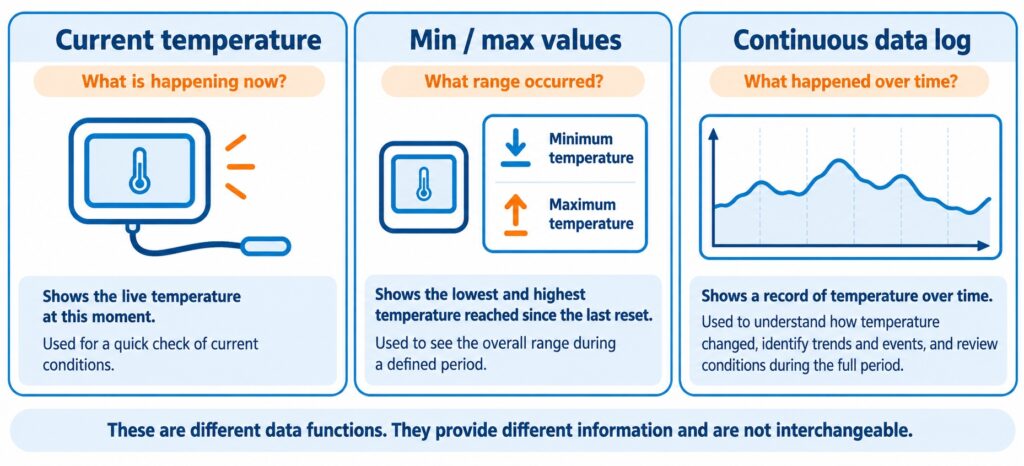
Current temperature, min/max review and a continuous log answer different operational questions.
Remote alarms are valuable, but they do not replace local recording
After-hours alerts can shorten response time, but a remote alarm depends on a functioning communication path. A good selection process therefore separates two failure modes: data continuity and notification continuity. Ask whether the logger continues recording offline, whether it reports the missed data after reconnection, whether it can alarm on low battery or communication loss, and whether primary and backup recipients can be assigned.
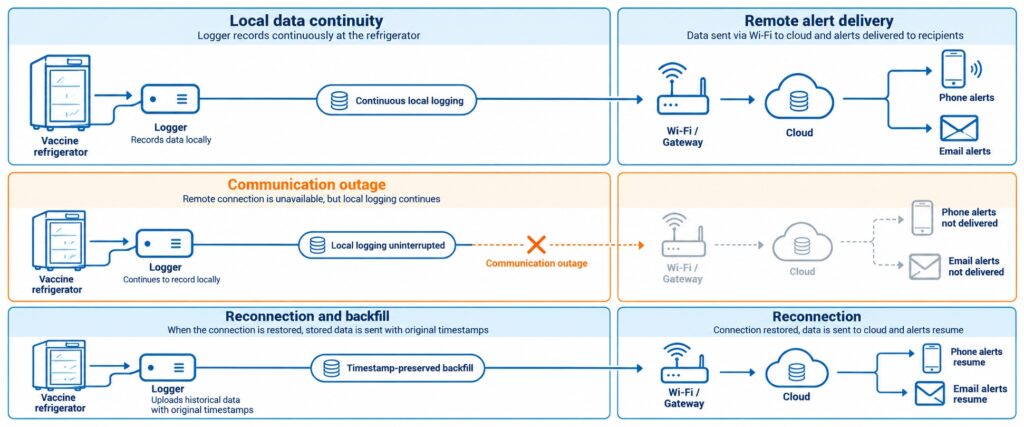
Data continuity and notification continuity are different; a vaccine logger should keep recording even when the network path fails.
The backup logger is part of the system
CDC now explicitly recommends having at least one backup digital data logger or other appropriate temperature monitoring device available in case the primary device fails, requires calibration or is otherwise unavailable. Budgeting only for the active logger understates the operational requirement. The backup should have suitable current calibration evidence and should be ready to deploy without a lengthy reconfiguration process.
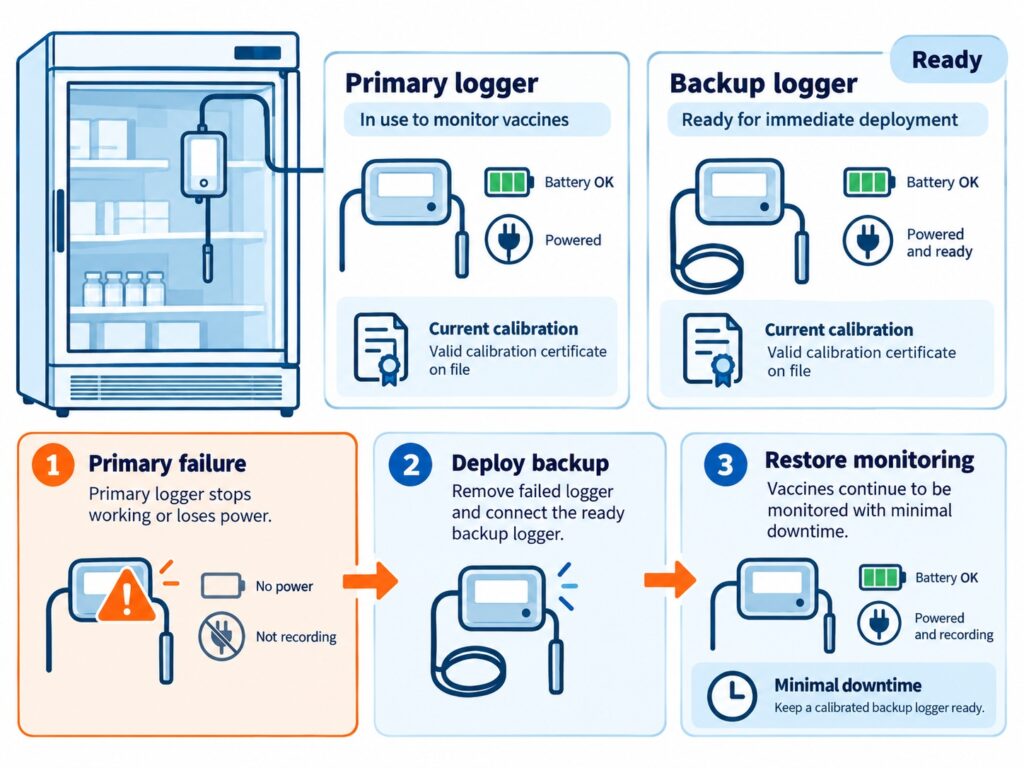
A backup digital data logger should be ready to replace the primary unit without a long reconfiguration delay.
Software governance matters more as the organisation grows
A single clinic may need only a readable display, reliable data download, clear alarms and simple reports. Larger organisations may also require permissions, audit trails, API integration, calibration scheduling and multi-site administration. Enterprise platforms such as viewLinc and RMS justify their added infrastructure mainly when these governance needs are real.
Product Overview
UbiBot WS1 Pro-WiFi + calibrated external temperature probe
UbiBot WS1 Pro-WiFi is a direct Wi-Fi logger with a 4.4-inch LCD, 300,000-record local memory, battery/USB power and support for external temperature probes, including DS18B20 and RS485 options such as PT100. The UbiBot platform provides remote dashboards, device sharing, exports and configurable alerts. Its strength is a comparatively simple direct-connect architecture with substantial local storage and no separate gateway requirement. For vaccine use, however, the internal sensor is not the deciding specification: the buyer must define the external probe, thermal buffer, calibration certificate, measurement uncertainty and placement that will be used in the refrigerator.
T&D TR75A2 / TR72A2
T&D positions the TR75A2 as a two-channel thermocouple logger for ultra-low and vaccine applications. It supports Wi-Fi, Bluetooth and USB, stores up to 30,000 readings per channel and includes a Vaccine Mode that T&D states meets or exceeds CDC requirements for VFC. Thermocouple sensors are not supplied by T&D, so the exact sensor, buffer and calibration still have to be specified. TR72A2 is a temperature/humidity logger with Wi-Fi, Bluetooth and USB, but its supplied temperature/humidity sensor covers 0 to 55 C and the product is not presented as the same vaccine-specific configuration as TR75A2.
Dickson DWE2 + glycol thermistor sensor / DicksonOne
Dickson DWE2 is a Wi-Fi/Ethernet display logger with replaceable sensors, onboard backup memory, local min/max display, audible/visible alarms and an average 72-hour battery backup. For vaccine refrigerators, Dickson offers RTHM and RTHM2 glycol-buffered thermistor sensors specifically described for drugs and vaccines, with NIST-traceable calibration options. DicksonOne is required for normal cloud operation, so the recurring software plan is part of the architecture rather than an optional afterthought.
Vaisala RFL100 + AP10 + viewLinc
Vaisala RFL100 is a battery-powered VaiNet data logger designed as part of the viewLinc monitoring system. It requires an AP10 access point, stores 30 days of one-minute samples per channel, and supports detachable temperature probes including models suitable for refrigerators and freezers. One AP10 can connect up to 32 RFL100 loggers. This architecture is more infrastructure-heavy than a direct Wi-Fi logger, but it is built for centrally governed, multi-point monitoring where the viewLinc software, access control and calibration workflow are part of the purchasing decision.
Onset InTemp CX402-VFC
The InTemp CX402-VFC series is the most explicitly vaccine-specific product in this comparison. It includes a glycol-buffered external probe, LCD display with current and daily min/max values, audible and visual alarms, battery operation and a three-year calibration certificate for the probe. Onset markets it specifically for CDC/VFC vaccine storage. Local access uses Bluetooth; remote notifications and automated downloads require an optional InTemp CX Gateway within Bluetooth range. This is a strong small-clinic fit when VFC-oriented configuration is more important than avoiding a gateway.
Rotronic RMS
Rotronic RMS spans several architectures rather than one single vaccine logger. The newer RMS-LOG-W-T10-D uses Wi-Fi, a large display, external temperature sensing, internal memory and battery backup for refrigerator monitoring. Higher-precision RMS-LOG-T30 models support two PT100 probes and store 44,000 data points, with LAN or 868/915 MHz variants. RMS Cloud and on-premises software are aimed at controlled environments and Rotronic publishes Part 11/GAMP-oriented positioning for RMS. For vaccine programmes, buyers still need to confirm the exact probe, buffer and calibration configuration rather than assuming the platform label alone establishes suitability.
Side-by-Side Comparison Table
The table compares representative configurations and architectures rather than claiming every product in a vendor portfolio has the same capabilities. Specifications are based on official manufacturer documentation reviewed in September 2026. Where an exact vaccine configuration depends on a probe, accessory, software tier or calibration option, that dependency is stated explicitly.
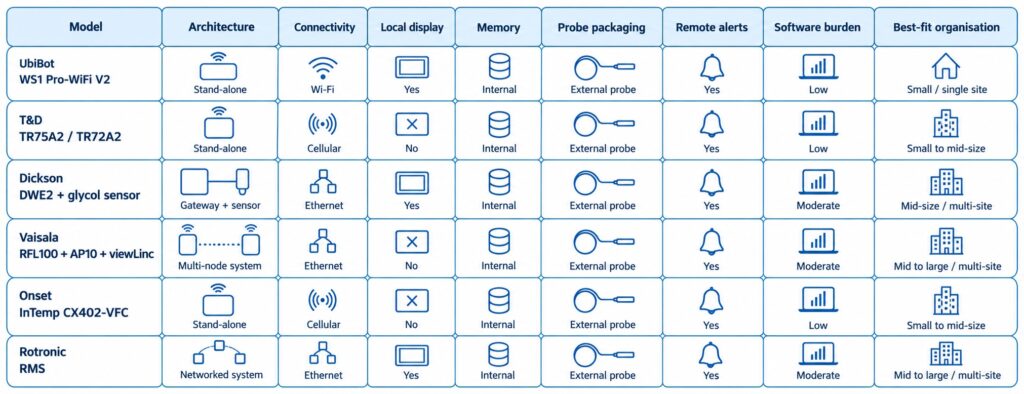
Compare the architecture, probe approach, alarms, memory and software burden before choosing a vaccine logger.
| Comparison item | UbiBot WS1 Pro-WiFi | T&D TR75A2 / TR72A2 | Dickson DWE2 + glycol sensor | Vaisala RFL100 + viewLinc | InTemp CX402-VFC | Rotronic RMS |
| Product positioning | Direct Wi-Fi logger with probe expansion | Wi-Fi/Bluetooth/USB logger family; TR75A2 vaccine/ULT oriented | Wi-Fi/Ethernet display logger with replaceable sensors | Enterprise VaiNet logger for viewLinc | VFC-focused Bluetooth logger with glycol probe | Enterprise RMS platform; Wi-Fi/LAN/RF variants |
| Vaccine-specific probe | Specify calibrated buffered external probe | Buyer supplies thermocouple; specify buffer/calibration | RTHM/RTHM2 glycol thermistor options | Detachable Vaisala probe; project-specific buffering | Included glycol-buffered VFC probe | External NTC/PT100/digital probe; specify buffer |
| Temperature range | Probe-dependent; internal -20 to 60 C | TR75A2 thermocouple family -199 to 1760 C; TR72A2 0 to 55 C | Sensor-dependent | Probe-dependent; HMP110T family -40 to 80 C | External probe -40 to 100 C | Model/probe-dependent |
| Accuracy / uncertainty | Internal +/-0.2 C; external chain must be verified | Thermocouple/calibration dependent | Sensor/calibration dependent | Probe/calibration dependent | +/-0.5 C from -25 to 80 C; +/-1.0 C outside | T30 logger electronics +/-0.1 C from -100 to 200 C, excluding probe |
| Connectivity | 2.4 GHz Wi-Fi | Wi-Fi, Bluetooth, USB | 2.4 GHz Wi-Fi or Ethernet | VaiNet RF to AP10 | Bluetooth; gateway for remote cloud workflow | Wi-Fi, LAN or 868/915 MHz depending on model |
| Gateway required | No | No for Wi-Fi upload | No | Yes, AP10 | Only for automated remote alerts/downloads | RF models yes; Wi-Fi/LAN models no |
| Local display | 4.4-inch LCD | LCD with min/max/alarm | LCD with min/max and local alarms | Local display | LCD with current/daily min/max | Model-dependent; Wi-Fi logger has large display |
| Power | AA/ER14505 batteries or USB | Battery; optional AC adapter | 12 VDC + ~72 h backup | 2 x AA; external power option | 2 x AAA | Model-dependent; battery backup common |
| Local memory | 300,000 records | 30,000 readings/channel | ~400,000 backup points | 30 days / 43,200 samples/channel | Up to 84,650 measurements | 44,000 data points/pairs on several models |
| Cloud / software | UbiBot IoT Platform | T&D WebStorage / Thermo / Graph | DicksonOne | viewLinc | InTempConnect | RMS Cloud or on-prem |
| Remote alerts | App/email; paid SMS/voice and integrations | Cloud warning notifications | Phone/SMS/email + local alarm | viewLinc alarm workflows | Gateway enables remote notifications | RMS software alarms |
| Subscription / software burden | Basic cloud without mandatory subscription; extras may cost | WebStorage advertised free | DicksonOne required | Enterprise software/cloud licensing | Gateway/enterprise features add cost | Project-dependent cloud/on-prem licensing |
| Best suited for | Direct Wi-Fi + large memory + flexible platform, with verified vaccine probe | T&D Vaccine Mode or wide-range/ULT thermocouple use | Buffered glycol sensor + Ethernet + strong local alarms | Large hospital/enterprise estates | U.S. VFC clinics wanting packaged glycol logger | Enterprise pharma/lab sites standardizing RMS |
| Key limitation / check | Base unit is not automatically VFC-ready; verify buffer/calibration | Thermocouple not supplied; specify buffer/calibration | Subscription and sensor/calibration add recurring cost | AP10/viewLinc infrastructure required | Remote alerts need nearby gateway | Exact logger/probe/software configuration must be frozen |
Connectivity and Deployment Comparison
For a single refrigerator, direct Wi-Fi is simple when the WLAN is reliable. UbiBot, T&D and Dickson can reach cloud services without a sensor gateway, reducing hardware count. Remote alerts still depend on the network path, so local memory and clean data recovery after reconnection remain essential.
Gateway architectures become more attractive as point counts grow. Vaisala RFL100 loggers share AP10 access points; Rotronic offers similar enterprise RF patterns. InTemp works locally over Bluetooth, while the CX Gateway adds automated remote alerts and uploads. These architectures add infrastructure but can simplify central administration.
No-gateway architecture is not automatically better. Small clinics may value simplicity; hospitals may prefer managed radio, standard access points and controlled software roles. The useful architecture is the one that records locally, recovers after outages and fits the organisation’s IT and quality model.
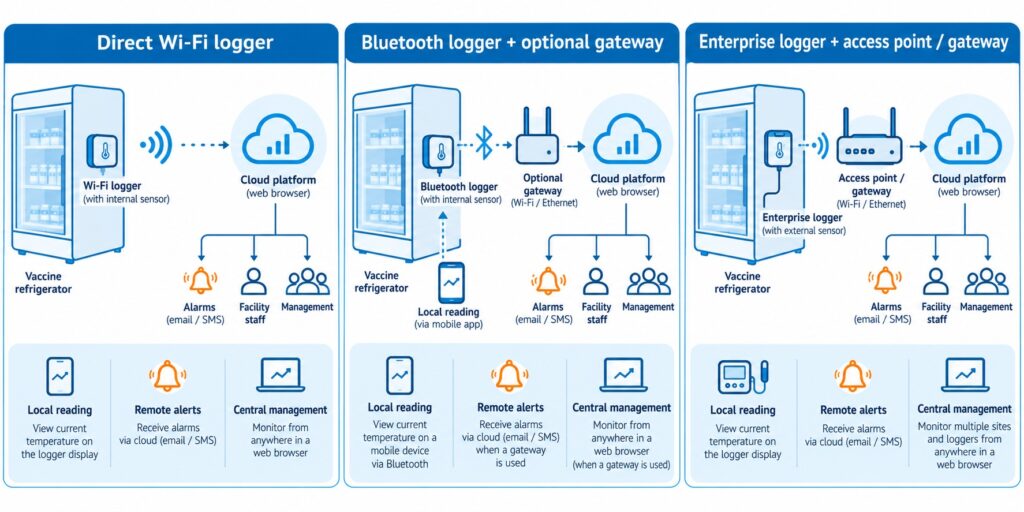
Direct Wi-Fi, gateway-based and enterprise access-point architectures each solve different deployment problems.
Sensor and External Probe Comparison
The external probe is the most important hardware decision in this article. CDC recommends a detachable probe that reflects vaccine temperature, commonly by using a thermal buffer. That requirement immediately changes how the products should be evaluated.
InTemp CX402-VFC has the clearest out-of-box story because the VFC models include a probe in a glycol bottle and calibration documentation. Dickson also offers dedicated glycol thermistor sensors for refrigerators and freezers, but the buyer still chooses the sensor and calibration option. T&D TR75A2 provides vaccine-specific software behaviour and a very wide thermocouple range, yet T&D does not supply the thermocouple itself; the selected sensor, buffer and calibration therefore remain part of the procurement specification.
UbiBot WS1 Pro can connect external DS18B20 sensors and RS485 probes such as PT100, which gives the buyer flexibility, but flexibility is not the same as a vaccine-ready probe assembly. A CDC/VFC deployment should not rely on the built-in air-temperature sensor alone. Specify the external sensor, thermal buffer, calibration points, certificate scope and cable routing, then confirm that the entire measurement chain meets the programme requirements.
Vaisala and Rotronic are strongest when the probe is part of an enterprise measurement system with calibration and lifecycle controls. Their architectures can support refrigerator/freezer sensing with detachable probes, but the final vaccine configuration is selected project by project. That makes them well suited to engineering-led hospital or pharmaceutical deployments, while a small clinic may prefer a more packaged DDL.
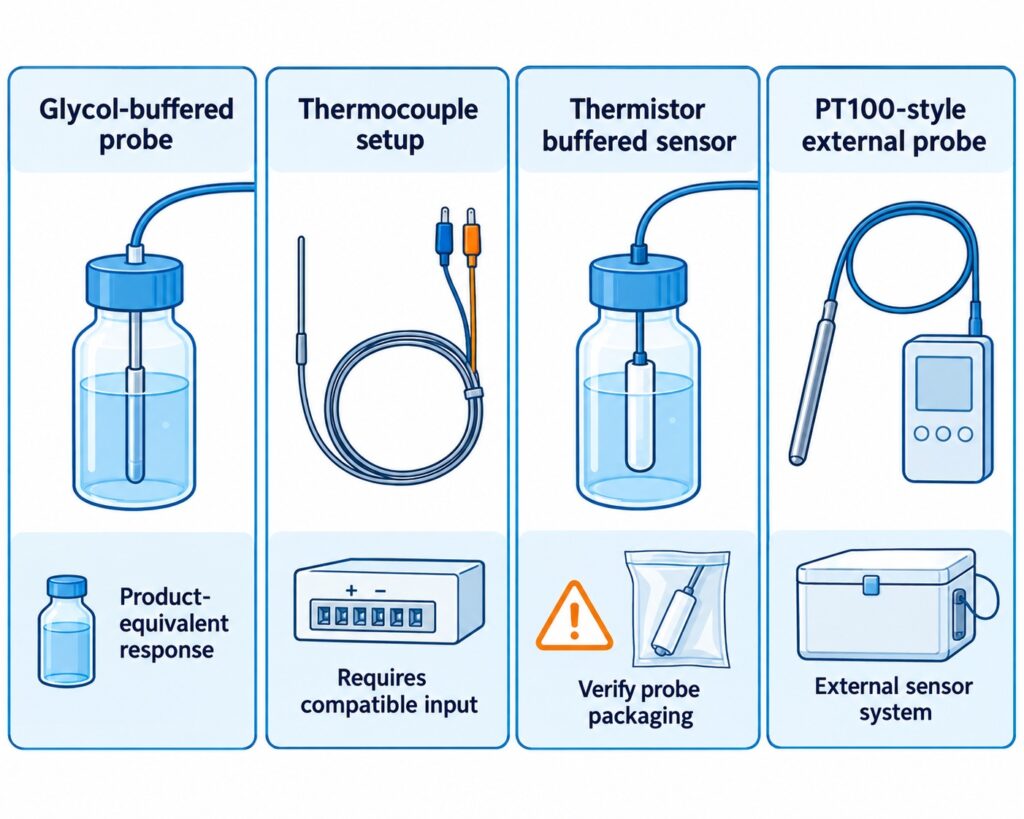
The probe package matters: glycol-buffered options, thermocouples, thermistors and PT100-based systems do not behave the same operationally.
Cloud Platform, Alerts and Data Management
Remote alerts solve a different problem from the local DDL. The logger protects the record; the cloud path shortens response time. UbiBot provides dashboards, trends, exports, sharing and configurable alerts through its platform. T&D can automatically upload recorded data and warnings to T&D WebStorage Service. DicksonOne adds phone, SMS and email notifications plus multi-location reporting. Vaisala viewLinc and Rotronic RMS are designed for centrally governed enterprise monitoring with user management and system administration.
InTemp is deliberately local-first unless a gateway is added. Staff can read the LCD and use the mobile app near the logger, while the CX Gateway enables remote notifications and automatic uploads. This can be a good design for VFC clinics because the vaccine-specific logger remains functional locally even if the cloud path is not the centre of the workflow.
Regardless of brand, define alarm ownership before deployment. Set the high/low limits from the vaccine manufacturer and programme requirements, assign a primary and backup responder, test after-hours delivery, and document what staff should do when an excursion occurs. Remote notifications should support the SOP, not replace it. The same applies to software claims such as 21 CFR Part 11: a vendor feature set can support regulated records, but compliance depends on the configured system, validation, procedures, access control and record lifecycle.
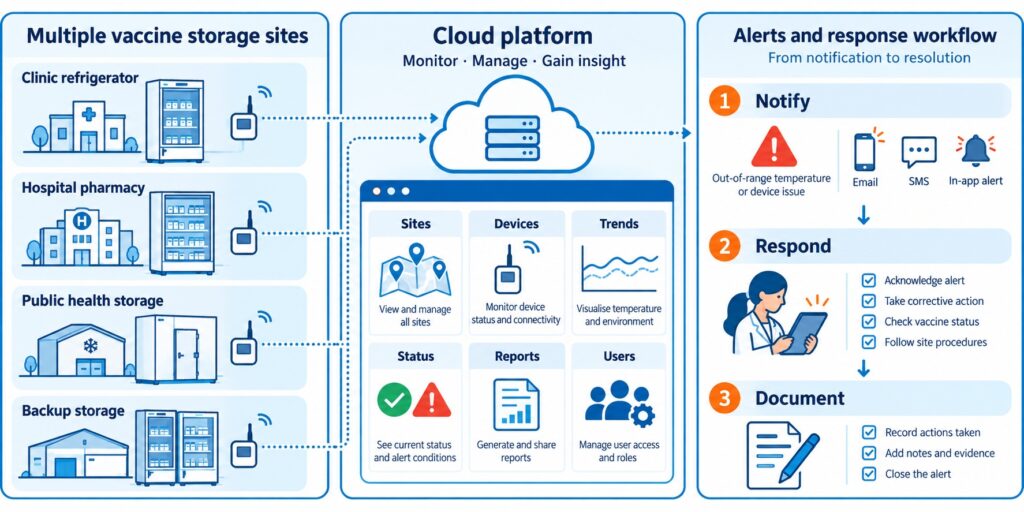
Visible cloud data should support action across multiple refrigerators, sites and response teams.
Total Deployment Cost and Recurring Burden
Cost includes more than the logger. UbiBot adds the selected buffered/calibrated probe, mounting, power, paid alert services if used and recalibration. T&D adds the thermocouple and calibration. Dickson adds a glycol sensor, calibration and DicksonOne. InTemp adds a gateway when remote automatic alerts are required.
Vaisala and Rotronic can add access points or gateways, server/cloud software, validation services and calibration. Their economics are usually stronger across larger estates than at one refrigerator.
Also budget for a backup DDL, batteries, recalibration, staff training and alarm tests. These are operational controls rather than optional accessories.
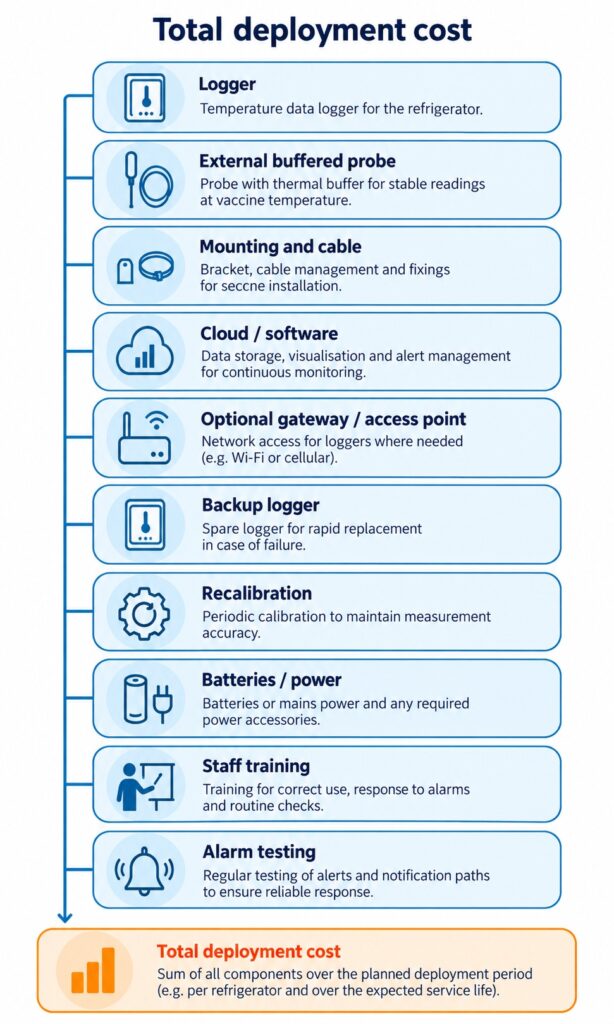
The real deployment cost includes probes, cloud or gateway services, recalibration, batteries, backup devices and staff time.
Brand-by-Brand Strengths and Trade-Offs
UbiBot WS1 Pro-WiFi
UbiBot is strongest when a clinic or pharmacy wants a readable display, very large local memory, direct Wi-Fi cloud access, flexible external sensing and a lower base software burden. It can also fit organisations that already use UbiBot across rooms, warehouses or laboratories. Its trade-off is that the vaccine-specific measurement chain is not packaged by default. The buyer must prove that the selected external probe, thermal buffer and calibration certificate satisfy the intended CDC/VFC or internal quality workflow.
T&D TR75A2 / TR72A2
T&D is attractive when a buyer values a compact logger, free cloud workflow and a dedicated Vaccine Mode on TR75A2. The wide thermocouple range also makes TR75A2 useful where refrigerated and ultra-low applications share a common platform. The limitation is sensor responsibility: T&D does not supply the thermocouple, so the organisation still has to specify the probe, buffer and calibration. TR72A2 is useful for temperature/humidity monitoring but should not be treated as equivalent to the vaccine-oriented TR75A2 configuration.
Dickson DWE2 / TWP + DicksonOne
Dickson fits sites that want purpose-built glycol sensor options, Ethernet as well as Wi-Fi, local audible alarms, substantial backup memory and a mature cloud monitoring workflow. It is easier to specify as a vaccine refrigerator system than a generic logger because Dickson sells the buffered sensors and calibration options in the same ecosystem. The trade-off is the mandatory DicksonOne subscription and higher recurring software burden.
Vaisala RFL100 + viewLinc
Vaisala is a strong enterprise choice for hospitals, research centres and regulated organisations that value central governance, long-range low-power radio, calibration-aware probes and a mature monitoring platform. Its AP10/viewLinc architecture scales well across many points but is usually more infrastructure than a single clinic refrigerator needs. Procurement should evaluate the full system and service package rather than the logger alone.
InTemp CX402-VFC
InTemp is the most straightforward choice here for a U.S. VFC clinic that wants a product explicitly designed around a glycol-buffered probe, min/max display, alarms and a multi-year calibration certificate. The product is deliberately packaged around that use case. Its trade-off is that remote automatic alerting depends on a nearby gateway, so the gateway placement and network path must be treated as part of the monitoring system.
Rotronic RMS
Rotronic RMS fits organisations that want an enterprise monitoring ecosystem with multiple logger types, cloud or on-premises software, long-term data management and high-accuracy probe options. It is particularly relevant when vaccine refrigerators are one element of a broader pharmaceutical or laboratory monitoring programme. The trade-off is configuration complexity: the exact logger, probe, buffering method, gateway/software path and calibration package must be engineered rather than assumed from the RMS brand alone.
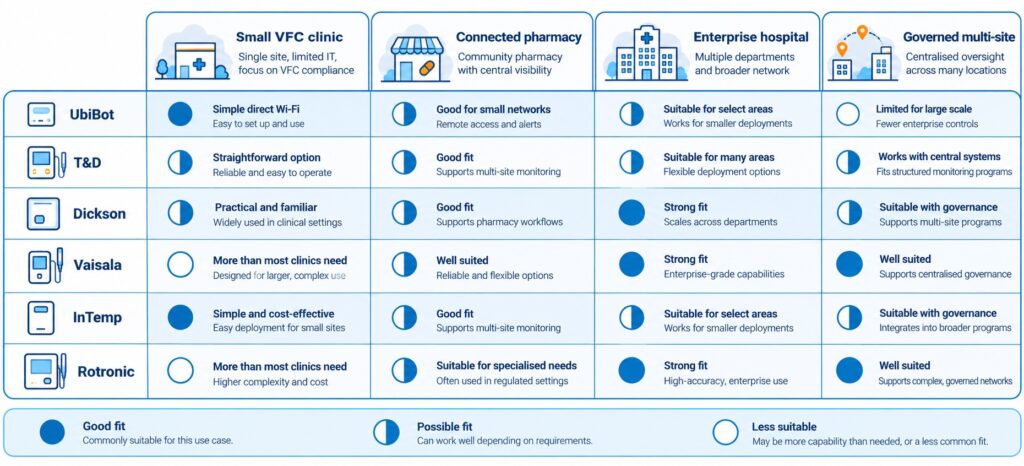
Different products fit different organisations, from small VFC clinics to larger governed estates.
Which Product Should You Choose?
| Choose this option | When this purchasing condition matters most |
| UbiBot WS1 Pro-WiFi | You want direct Wi-Fi, a large local memory, clear local display, flexible probes and cloud access, and your team can specify and document the buffered calibrated probe required for vaccine storage. |
| T&D TR75A2 | You want T&D Vaccine Mode, free cloud upload, two thermocouple channels or very wide temperature capability, and you are prepared to specify the thermocouple, buffer and calibration separately. |
| Dickson DWE2 + RTHM/RTHM2 | You want a direct Wi-Fi/Ethernet logger with a glycol-buffered sensor, strong local alarms, battery backup and DicksonOne reporting, and you accept a subscription. |
| Vaisala RFL100 + viewLinc | You are standardising many monitored points across a hospital or regulated enterprise and value governed infrastructure more than low initial complexity. |
| InTemp CX402-VFC | You are a U.S. VFC clinic and want a purpose-built vaccine logger with glycol probe, min/max display, alarms and included calibration evidence. |
| Rotronic RMS | You want an enterprise pharma/lab monitoring platform with flexible logger/probe architectures and cloud or on-premises software. |
Pros and Cons
| Product / system | Scenario-specific advantages | Scenario-specific limitations |
| UbiBot WS1 Pro-WiFi | 300,000 records; 4.4-inch display; direct Wi-Fi; flexible probes; cloud alerts/exports. | Buffered probe and calibration are not bundled by default; verify the full vaccine configuration. |
| T&D TR75A2 | Vaccine Mode; Wi-Fi/Bluetooth/USB; free cloud; 30,000 readings/channel; wide thermocouple range. | Thermocouple not supplied; buffer/calibration depend on the selected sensor. |
| Dickson DWE2 + glycol sensor | Glycol sensor options; Wi-Fi/Ethernet; local alarms; 72-hour backup; large memory. | DicksonOne subscription required; sensor/calibration choices add cost. |
| Vaisala RFL100 + viewLinc | Scalable VaiNet; 30-day buffer; detachable probes; enterprise governance. | AP10 and viewLinc infrastructure add complexity for a single refrigerator. |
| InTemp CX402-VFC | Glycol probe; min/max LCD; local alarms; battery power; multi-year calibration certificate. | Automated remote alerts/downloads require a nearby CX Gateway. |
| Rotronic RMS | Enterprise cloud/on-prem options; fail-safe storage; flexible probes; high-accuracy PT100 options. | No single vaccine package; probe, buffer, gateway/software and calibration must be specified. |
Frequently Asked Questions
What data logger should I use for a vaccine refrigerator?
Use a continuous digital data logger with a detachable buffered probe, current calibration evidence, out-of-range alarm, low-battery indication, current/minimum/maximum values and a programmable logging interval of at least every 30 minutes. The final choice depends on whether you need a packaged VFC workflow, direct Wi-Fi simplicity or an enterprise monitoring platform.
Does CDC require a buffered probe for vaccine refrigerators?
CDC recommends a detachable probe that best reflects vaccine temperatures and gives examples such as glycol, glass beads, sand or Teflon buffering. VFC programmes may impose specific requirements, so confirm the current programme rules for your jurisdiction.
Where should the vaccine refrigerator probe be placed?
For a typical storage unit, CDC recommends placing the buffered probe near the centre of the unit with vaccines surrounding it, away from walls, vents, floors, ceilings and doors unless the refrigerator manufacturer specifies another location.
How often should a vaccine data logger record temperature?
CDC guidance calls for a programmable recording interval that measures and records at least every 30 minutes. Shorter intervals may be used when the organisation, device capability or risk assessment requires them.
Can I use UbiBot WS1 Pro for a VFC vaccine refrigerator?
Potentially, but the base logger should not be treated as VFC-ready by itself. The site must verify the external buffered probe, calibration certificate, measurement uncertainty, logging interval, alarm workflow and applicable programme requirements.
Which product is the simplest VFC-focused option in this comparison?
InTemp CX402-VFC is the most packaged VFC-oriented option because it combines a glycol-buffered probe, min/max display, alarms and a multi-year probe calibration certificate. T&D TR75A2 also has a vendor-published Vaccine Mode, but the thermocouple sensor must be selected separately.
Do vaccine refrigerator data loggers need internet access?
No for local measurement and recording, provided the logger has local memory. Internet or gateway connectivity is needed for remote cloud access and notifications. Verify what happens during outages and how stored data are recovered after reconnection.
Do I need a backup data logger?
CDC recommends having at least one backup DDL or appropriate temperature monitoring device available in case the primary logger fails, malfunctions or needs calibration. The backup should be ready to deploy and have suitable current calibration evidence.
Final Verdict
For a vaccine refrigerator, the safest purchasing rule is to start from the measurement workflow, not the device brand. A detachable buffered probe, calibration evidence, local history, min/max review, out-of-range alarm and tested response process matter more than an attractive cloud dashboard. The logger should continue recording through network interruptions, and the organisation should have a backup device ready for failure or recalibration periods.
For U.S. VFC clinics, InTemp CX402-VFC and T&D TR75A2 have the clearest vendor-published vaccine-specific positioning, although the T&D thermocouple still needs to be specified. Dickson offers a strong connected clinic architecture when glycol sensors, Ethernet, local alarms and DicksonOne reporting are valuable. Vaisala and Rotronic are better aligned with larger governed estates where enterprise software, calibration management and multi-point infrastructure justify the additional complexity.
UbiBot WS1 Pro-WiFi is most attractive when the project values direct Wi-Fi, a visible local screen, 300,000 local records, flexible external probes and a lower base software burden. It can support a vaccine monitoring workflow, but the exact external probe, thermal buffer and calibration package must be defined and verified before the system is used for CDC/VFC or other regulated storage. Before ordering any option, freeze the complete bill of materials, verify calibration scope and interval, test alarm escalation and outage recovery, and confirm the current programme requirements that apply to the site.
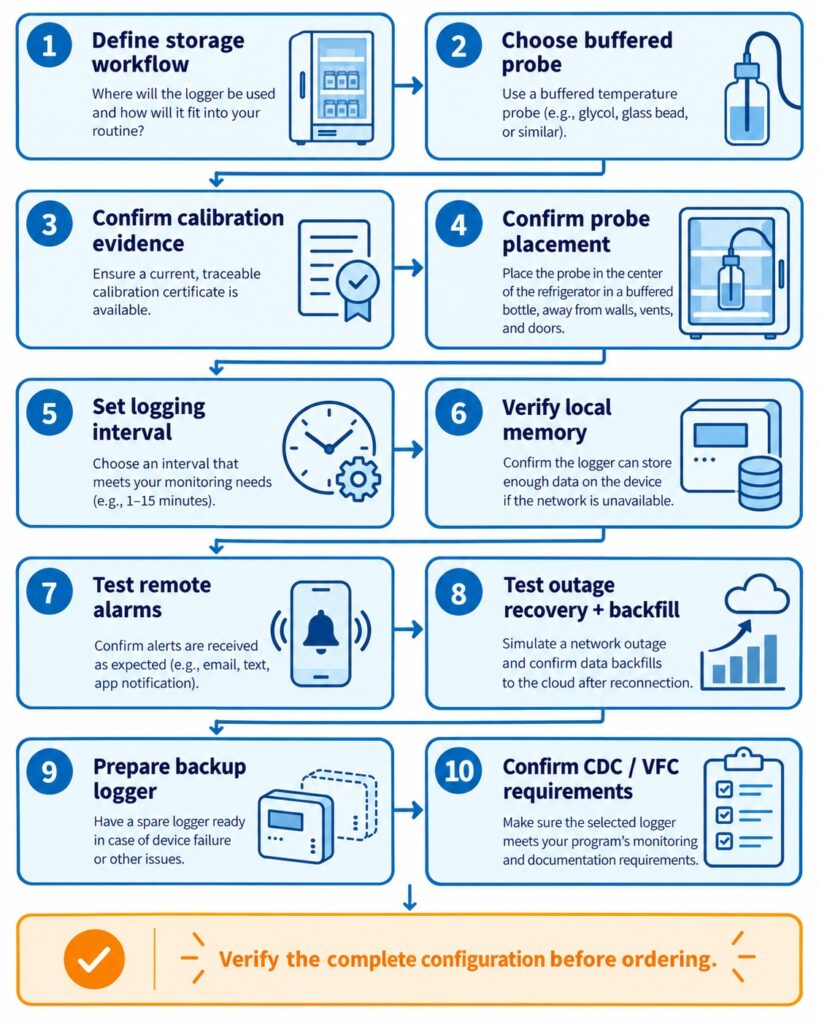
Freeze the full bill of materials, verify calibration scope, test alarms and confirm programme requirements before ordering.
Official Sources Reviewed
- CDC Vaccine Storage and Handling (updated July 14, 2026): https://www.cdc.gov/vaccines/hcp/storage-handling/
- CDC Vaccine Storage and Handling Toolkit – July 2026: https://www.cdc.gov/vaccines/hcp/downloads/storage-handling-toolkit.pdf
- CDC Pink Book, Chapter 5: Vaccine Storage and Handling: https://www.cdc.gov/pinkbook/hcp/table-of-contents/chapter-5-vaccine-storage-and-handling.html
- UbiBot WS1 Pro official product page: https://www.ubibot.com/ubibot-ws1pro/
- UbiBot WS1 Pro specifications: https://www.ubibot.com/ubibot-ws1pro-specifications/