

UBiBot Logo
UBiBot Logo
  • UBiBot Logo
  • Home
  • Products

    NEW

  • Pricing
  • Support
  • About Us
  • Download
  • magnifying-glass  Search
  • magnifying-glass header-close
  • Sign in Sign in
    Public Web Console Public Web Console
    On-Premises App Center On-Premises App Center
  • Home
  • Products

    NEW

  • Pricing
  • Support
  • About us
  • Download
  •  Public Web Console
  •  On-Premises App Center
  • Where to Buy

Learn Hub

Explore Knowledge Academic Research In-depth Tech

Share

LinkedIn

Facebook

X (Twitter)

Newsletter Signup

Table of contents

    What EN 12830 Means When Selecting a Cold-Chain Temperature Recorder?

    Published: September 21, 2026

    Update: September 21, 2026

    By Kyle Anderson

    EVIDENCE BOUNDARY
    EN 12830 is an equipment testing, performance, and suitability standard. A product standard claim does not by itself establish compliance for an entire warehouse, transport route, food-safety plan, GDP process, or customer quality system. Verify the exact model, sensor configuration, intended use, and supporting evidence.

    Introduction: What EN 12830 Means When Selecting a Cold-Chain Temperature Recorder

    A cold-chain temperature recorder may look straightforward on a specification sheet: a measuring range, an accuracy figure, memory capacity, connectivity, alarms, and a cloud dashboard. For a European procurement team, however, those features do not answer the whole question. Buyers also need evidence that the recorder has been assessed against a recognized standard for temperature-sensitive goods and that the exact device, sensor configuration, and intended use are covered by that evidence.

    That is where EN 12830 becomes important. BS EN 12830:2018 is the current BSI release titled “Temperature recorders for the transport, storage and distribution of temperature sensitive goods. Tests, performance, suitability.” The title itself is useful because it defines the standard’s role: it is about the recorder system and the evidence supporting its testing, performance, and suitability, not a general law governing every cold-chain operation.

    For exporters, cold-storage operators, distributors, tender teams, and quality managers, the practical question is therefore not simply “Does the logger measure temperature?” It is “Can we show that the selected recorder is suitable for the required temperature range, application, sensor arrangement, data-recording task, and procurement specification?” This guide explains how to ask that question without turning a product feature into an unsupported compliance claim.

    Quick Answer

    EN 12830 is a European temperature-recorder standard used to assess recorders for the transport, storage, and distribution of temperature-sensitive goods. When selecting a recorder, verify the exact product and sensor configuration covered by the manufacturer’s EN 12830 evidence, then compare the required temperature range, accuracy, recording method, data continuity, installation environment, and reporting workflow with the real application. EN 12830 evidence supports equipment suitability; it does not by itself make an entire cold-chain process compliant.

    What EN 12830 Is — and What It Is Not
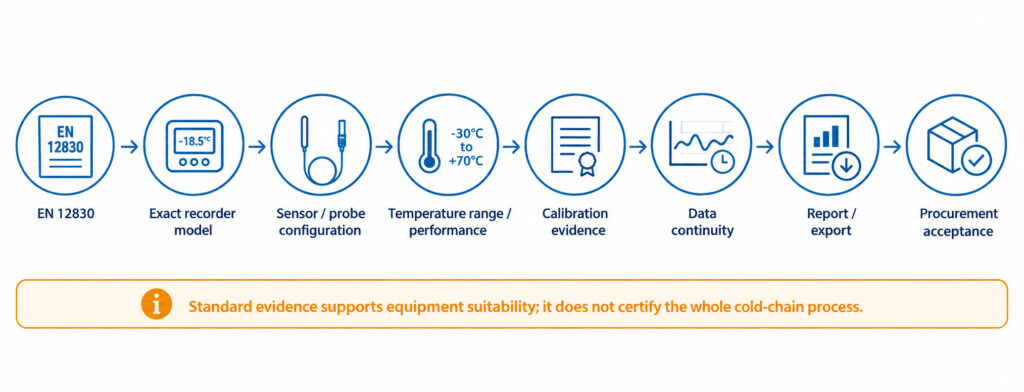
    What EN 12830 Means When Selecting a Cold-Chain Temperature Recorder

    EN 12830 should be translated from a standard reference into model-specific evidence, operating requirements, and acceptance criteria.

    BSI identifies BS EN 12830:2018 as the current British adoption of EN 12830. Its formal title focuses on temperature recorders used during transport, storage, and distribution of temperature-sensitive goods, with emphasis on tests, performance, and suitability. The current release was published in 2018, replacing the 1999 edition.

    This distinction matters because cold-chain procurement often mixes several different types of requirements. A food shipper may need to satisfy customer specifications, HACCP controls, contractual temperature limits, and applicable food-safety law. A pharmaceutical distributor may instead work under GDP, product-label storage conditions, qualification procedures, and electronic-record controls. EN 12830 does not replace those obligations. It provides a technical basis for evaluating the recorder used to generate temperature evidence within those systems.

    In other words, EN 12830 should be treated as an equipment-performance and suitability standard. It can strengthen a tender specification or equipment qualification decision, but it does not define the product’s permitted storage temperature, the organization’s corrective-action process, or every required logging interval. Those requirements come from the applicable product, regulation, quality system, customer agreement, or risk assessment.

    The scope also needs to be read at the level of the whole recording configuration. BSI standards-development material for the EN 12830 family describes a temperature recording system that may use sensors integrated into the recorder or remote external sensors. That is a useful procurement reminder: if the recorder is sold with different probe types, the relevant evidence should match the exact configuration being purchased, rather than the model name alone.

    What EN 12830 Changes in a Recorder Specification

    The main value of EN 12830 is that it shifts the procurement discussion from a list of attractive features to a question of demonstrable performance and fitness for use. A defensible specification should connect the application to the evidence available for the selected recorder.

    Start with the actual temperature profile, not the brochure headline

    The correct starting point is the operating scenario. A chilled-food warehouse, frozen distribution route, pharmaceutical shipping lane, and ambient-temperature storage room can all be “cold-chain” applications, yet their temperature ranges and risk profiles are different. The device range must therefore cover both normal operating conditions and foreseeable excursions with an appropriate margin.

    A broad advertised range is not automatically an advantage if the relevant sensor accuracy is weak in the range that actually matters. Conversely, a narrower device optimized for the intended range may be easier to justify. Procurement should therefore compare the range, sensor type, stated accuracy, resolution, environmental limits, and the calibration evidence required by the organization’s quality system.

    Verify the exact recorder-and-sensor configuration

    Many modern recorders support external probes. This can be useful when the electronics must remain outside a freezer, when a buffered probe is needed in a refrigerator, or when the monitored point is physically separated from the display or communications module. But external probes also create an evidence question: does the EN 12830 statement apply to the recorder alone, to a defined probe family, or to a specific system combination?
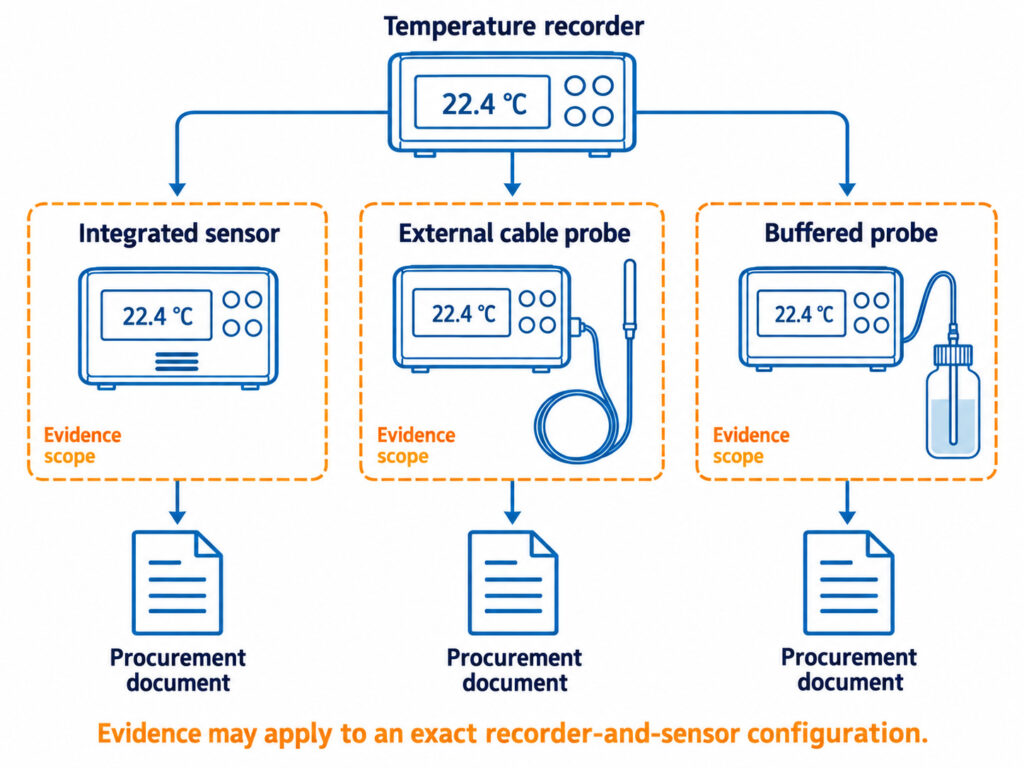
    EN 12830 recorder and external probe evidence scope for cold-chain monitoring

    When external probes are used, procurement should verify whether EN 12830 evidence covers the exact recorder-and-sensor configuration.

    The procurement file should retain the manufacturer specification, declaration or certificate that identifies the exact model and, where relevant, the sensor or probe configuration. If the public product page merely lists “EN 12830” without showing the detailed test scope, that is a reason to request supporting documentation, not a reason to assume the scope.

    Treat accuracy and calibration as related but different controls

    A product specification may state measurement accuracy, while a calibration certificate provides traceable evidence for an individual device or sensor at defined points. These are not interchangeable. EN 12830 evidence can support the technical suitability of a recorder design; the organization may still need initial calibration, periodic calibration, or verification under its own quality procedure.

    For regulated or contractually controlled cold chains, the acceptance criterion should therefore state both the performance expected from the recorder and the calibration evidence required at receipt and during use. If the intended range includes several critical setpoints, the calibration points should be chosen to challenge that real operating range rather than simply repeating a generic factory routine.

    Data continuity matters even when EN 12830 is the procurement trigger

    A recorder that measures correctly but loses data during a network outage may still create an operational problem. EN 12830 selection should therefore be combined with practical review of local memory, sampling interval, upload behavior, battery life, communication coverage, and data retrieval after connectivity loss.

    This is particularly important when comparing a Wi-Fi warehouse logger with a cellular in-transit logger. The first may be ideal in a stable facility network but unsuitable on a truck. The second may provide live shipment visibility but still needs a defined offline behavior when cellular service is unavailable. The user should know whether data are buffered locally, how they are recovered, and whether the final trip report remains complete.

    Reporting and export should match the evidence chain

    Cold-chain records are used for receiving decisions, customer disputes, deviation investigations, audits, and trend analysis. The recorder should therefore support a reporting method that preserves the essential context: device identity, time, temperature, alarm events, and the relationship between the record and the monitored shipment or storage area.

    A PDF report can be convenient for a receiving dock, while CSV or API access may be better for analysis or integration. The right format depends on the process. What matters is that the organization can demonstrate how the original measurements are retained, how reports are generated, and how data gaps or exceptions are handled.

    How to Turn EN 12830 into an Equipment-Selection Process

    The most reliable method is to build the procurement decision in stages rather than beginning with brand comparison.

    First, define the monitored object and use case. State whether the device will be used in a fixed cold room, refrigerator, freezer, warehouse, last-mile delivery route, export shipment, or multimodal transport. Record the required temperature range, expected trip duration, readout method, alarm requirement, environmental exposure, and whether the device is reusable or shipment-specific.

    Second, define the evidence package. For an EN 12830-based tender, request documentation that ties the standard claim to the exact model. Where the application depends on an external sensor, ask whether that configuration is included in the evidence. Add the organization’s own calibration-certificate requirement, because a standard reference on a webpage does not replace device-level calibration control.

    Third, compare the architecture with the site or route. Wi-Fi is useful where infrastructure is stable and the logger can reconnect predictably. Cellular is more appropriate for real-time transport visibility across locations, but coverage gaps and airline restrictions may affect communication. Ethernet or gateway-based systems can be attractive in permanent facilities. Local memory is valuable in every architecture because it reduces the risk that communications loss becomes a data-loss event.

    Fourth, challenge failure conditions before purchase. Ask what happens if Wi-Fi drops, cellular coverage disappears, power is lost, the battery runs low, the sensor is disconnected, or the cloud platform is temporarily unavailable. A recorder may still be technically suitable if the data are safely buffered and recovered, but that behavior should be known and tested.

    Fifth, define acceptance and lifecycle controls. On receipt, verify model, sensor configuration, firmware or software version where relevant, calibration status, clock settings, sampling interval, alarm thresholds, and report generation. During use, define periodic review, calibration or verification, battery replacement, device replacement, and retirement. For high-value goods, the logger should be treated as part of a controlled evidence process rather than as an accessory.
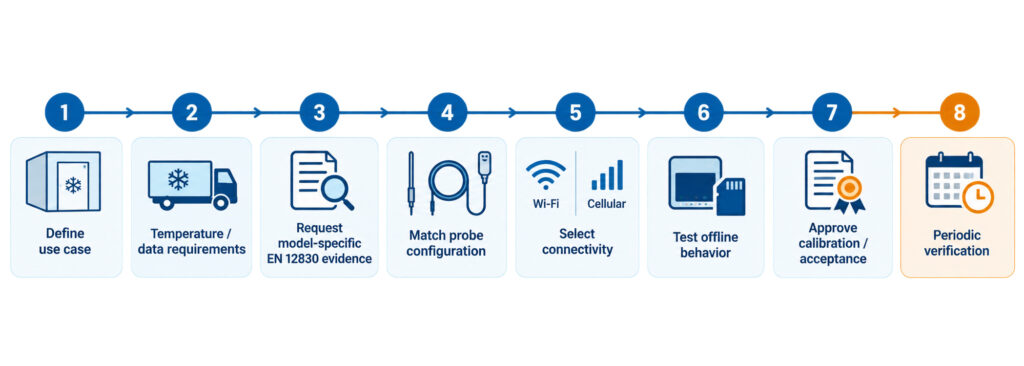
    EN 12830 cold-chain temperature recorder selection workflow

    A defensible recorder selection starts with the use case, then verifies evidence, architecture, failure behavior, and lifecycle controls.

    EN 12830 Procurement Checklist

    A compact checklist can prevent the most common mistake: buying a recorder because the web page contains the right acronym while leaving the actual evidence unresolved.

    Control question Why it matters Evidence to request
    Exact model evidence Does the supplier provide EN 12830 evidence tied to the proposed model and relevant sensor configuration? Certificate, declaration, test report, or controlled manufacturer document
    Application range Does the rated range and accuracy cover the real route/storage condition and foreseeable excursion? Specification, probe data, calibration range
    Sensor configuration Is the integrated or external probe arrangement the same as the proposed deployment? Probe model, wiring/configuration, evidence scope
    Calibration What calibration or periodic verification evidence will be required? Calibration certificate, SOP, recalibration/verification plan
    Recording continuity What happens during network or cloud loss? Local memory specification, offline/recovery test
    Time and identity Can records be tied to the correct device, time, shipment, or location? Device ID, timestamps, trip/area assignment procedure
    Reports and export Can the process produce the report or dataset required by QA, customers, or receiving staff? PDF/CSV/API sample and retention procedure
    Lifecycle control How are battery, replacement, firmware/software changes, and retirement controlled? Maintenance and change-control records

    Representative Product Comparison

    The comparison below is not a compliance ranking. It shows how several products represent different cold-chain monitoring architectures and where the public evidence is strong or incomplete. Product information was reviewed from current manufacturer pages in September 2026.
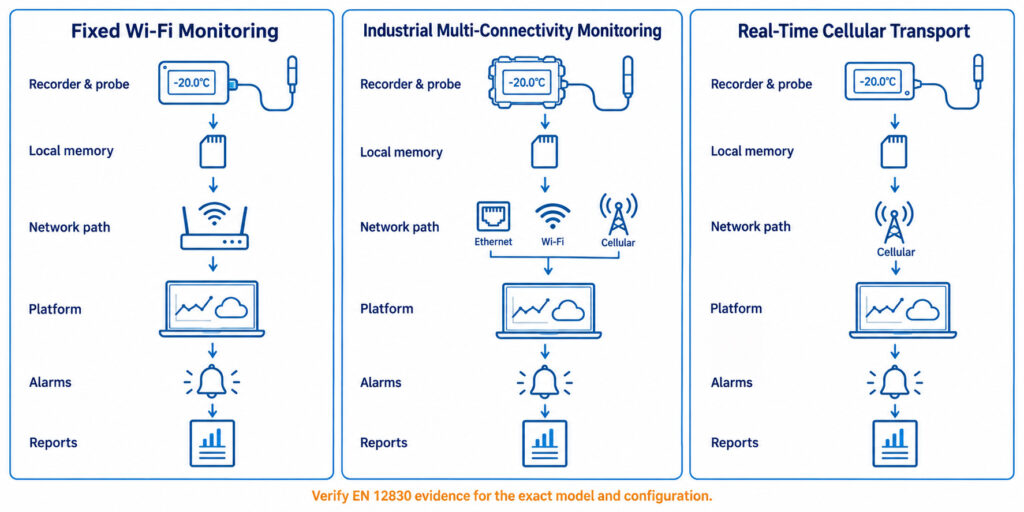
    Stationary Wi-Fi, industrial multi-connectivity, and real-time transport temperature recorder architectures

    Cold-chain recorder selection depends on the operating architecture as well as standards evidence.

    System Positioning Range / accuracy Data & connectivity Public EN 12830 evidence Procurement note
    UbiBot WS1 Fixed Wi-Fi monitoring -20 to 60°C internal; ±0.2°C (0 to 60°C) 300,000 records; Wi-Fi; external DS18B20 probe EN 12830 listed on UbiBot specification page Local storage and economical multi-point Wi-Fi deployment.
    UbiBot WS1 Pro Flexible facility monitoring -20 to 60°C internal; ±0.2°C (0 to 60°C) 300,000 records; Wi-Fi/cellular variants; multiple external probes EN 12830 listed on UbiBot specification page Display, probe flexibility, RS485 options, and cellular variants.
    UbiBot GS1 Industrial fixed monitoring -20 to 60°C operating environment 300,000 records; Wi-Fi/cellular/Ethernet/RS485 variants; IP65 on most variants EN 12830 listed on UbiBot specification page Industrial enclosure and multiple connectivity paths.
    Testo Saveris 2-T3 Wi-Fi + cloud fixed monitoring Probe-dependent: K -195 to +1350°C; T -200 to +400°C; J -100 to +750°C 10,000 values/channel; Wi-Fi; cloud; email/SMS alarms Exact EN 12830 scope not established from public product page reviewed Broad probe range; request EN 12830 evidence if tender requires it.
    DeltaTrak FlashLink Now 4G/5G 22393-01 Real-time transport -30 to 70°C Cellular; location/temperature/light; cloud/API; USB/PDF fallback Exact EN 12830 scope not established from public product page reviewed Transport-focused benchmark with offline report retrieval.
    Sensitech TempTale GEO X Real-time multimodal transport -30 to +55°C on current product page LTE Cat-M1 with 2G fallback; location and temperature Exact EN 12830 scope not established from public page reviewed; separate GxP vendor claims exist High-end shipment visibility; distinguish GxP claims from EN 12830 evidence.

    UbiBot WS1, WS1 Pro, and GS1 are relevant because UbiBot’s current specifications publicly list EN 12830 among their certifications. WS1 and WS1 Pro list an internal temperature range of -20°C to 60°C and temperature accuracy of ±0.2°C from 0°C to 60°C, with 300,000 local sensing records. WS1 supports an external DS18B20 temperature probe. WS1 Pro expands probe and interface options, while GS1 adds industrial variants with Wi-Fi, cellular, Ethernet, and RS485 combinations depending on model; most GS1 variants also list IP65 protection.

    Testo Saveris 2-T3 represents a Wi-Fi and cloud-based fixed-monitoring architecture with two external thermocouple probe connections. Testo lists an adjustable measurement rate from one minute to 24 hours, 10,000 stored values per channel, cloud transfer, and e-mail or optional SMS alarms. Its public product page shows a very broad probe-dependent temperature range. The public page reviewed for this article did not itself establish the exact EN 12830 certification scope for Saveris 2-T3, so buyers should request the relevant Testo evidence if EN 12830 is a tender requirement.

    DeltaTrak FlashLink Now 4G/5G 22393-01 represents a real-time in-transit architecture. DeltaTrak lists a -30°C to 70°C measurement range, global cellular connectivity, monitoring of location, temperature and light, cloud/API access, and a USB option for downloading trip data and PDF reports when communications are unavailable. The public product page reviewed did not establish EN 12830 certification for this exact model; its value in this comparison is as a transport-focused benchmark.

    Sensitech TempTale GEO X is another real-time transport benchmark. Sensitech lists global LTE Cat-M1 connectivity with 2G fallback, temperature and location visibility, and a -30°C to +55°C range on its current real-time product page. Sensitech also publishes life-science GxP positioning for the product, but that is a different evidence category from EN 12830. No EN 12830 statement for the exact TempTale GEO X model was established from the public page reviewed here.

    The comparison shows why procurement should separate three questions: “Does the recorder have the right technical architecture?”, “What standard or validation evidence exists for the exact model?”, and “Does that evidence match our intended use?” One product may be stronger for stationary multi-point monitoring, another for multimodal shipment visibility, and another for local continuity or integration flexibility.

    Common Procurement and Audit Deficiencies

    One recurring weakness is relying on the phrase “EN 12830 certified” without retaining the document that shows which model and configuration were tested. That creates a traceability gap during a customer audit or tender review. The preventive action is simple: retain the manufacturer evidence together with the approved procurement specification and device record.

    A second weakness is confusing EN 12830 with the entire cold-chain compliance framework. A recorder can have strong standards evidence while the warehouse still has poor sensor placement, the route lacks an excursion procedure, or the receiving team never reviews the trip record. Equipment suitability must sit inside an operational control system.

    A third weakness is selecting the communication method before defining the process. Wi-Fi devices are sometimes purchased for routes where the vehicle cannot provide reliable connectivity; cellular devices may be selected for fixed sites where Ethernet or a local gateway would be easier to govern. The architecture should follow the use case.

    A fourth weakness is failing to define offline behavior. Real-time visibility is valuable, but continuous transmission is not guaranteed on every route. Procurement should know whether data remain stored locally, how they are synchronized after reconnection, and how staff retrieve a complete record if the cloud service is unavailable.

    A fifth weakness is treating the factory specification as a replacement for calibration control. Even when EN 12830 evidence is available, many quality systems still require traceable calibration or periodic verification. The required interval is not created by the EN 12830 label alone; it should be set by the applicable quality system, risk, customer requirement, and equipment history.

    Frequently Asked Questions

    Is EN 12830 a legal requirement for every cold-chain temperature recorder in Europe?

    No. EN 12830 is a European standard for temperature recorders, but whether it is contractually or regulatorily required depends on the sector, country, product, transport activity, customer specification, and applicable legislation. It should not be described as a universal legal mandate for every temperature-sensitive shipment.

    What does EN 12830 tell a buyer that a normal data-logger specification does not?

    It gives a recognized framework for tests, performance, and suitability of temperature recording equipment. The buyer still needs to verify the exact product evidence and whether the recorder meets the intended operating conditions.

    Does an EN 12830 statement mean the whole cold-chain process is compliant?

    No. The standard relates to recording equipment. Storage conditions, shipment limits, monitoring procedures, corrective actions, records, calibration programs, and quality-system requirements come from other sources.

    Should I ask for an EN 12830 certificate or test evidence?

    Yes, when EN 12830 is part of the procurement requirement. Request evidence tied to the exact model and relevant probe configuration. A line on a product webpage is useful, but a tender or audit file should contain stronger supporting documentation where available.

    Is calibration still necessary for an EN 12830 recorder?

    Potentially yes. EN 12830 evidence and device calibration serve different purposes. Your quality system or customer requirements may call for initial or periodic calibration or verification. Related European standards such as EN 13486 address periodic verification of temperature recorders and thermometers.

    Is Wi-Fi, cellular, or local logging better for EN 12830 applications?

    There is no universally best communication method. Wi-Fi can suit fixed facilities, cellular can suit transport, and local memory is valuable when connectivity can fail. Communication architecture should be selected after the monitoring scenario and data-continuity requirements are defined.

    Can a real-time GPS temperature tracker replace a conventional temperature recorder?

    Only if it meets the required measurement, evidence, data-retention, and operational requirements for the intended use. GPS or location tracking adds logistics visibility, but it does not by itself establish temperature-recorder suitability.

    How should EN 12830 appear in a procurement specification?

    Write the requirement against the exact temperature-recorder function and ask bidders to provide evidence for the proposed model and sensor configuration. Add the required temperature range, accuracy, calibration documentation, recording interval, data continuity, report format, power/battery expectations, installation environment, and communications architecture. This is stronger than writing only “must be EN 12830 compliant.”

    Final Selection Guidance

    EN 12830 is most useful when it turns a vague request for a “reliable cold-chain logger” into an evidence-based equipment specification. Start with the monitored product and route, then define the temperature and data requirements, request model-specific EN 12830 evidence, check calibration and continuity controls, and finally compare connectivity and platform features. A strong procurement decision is not the recorder with the longest feature list; it is the recorder whose documented performance and system architecture fit the real cold-chain process.

    Source Notes and Applicability Boundary

    1. BSI — BS EN 12830:2018, current release and publication status. Source
    2. BSI Standards Development — EN 12830 project scope material. Source
    3. UbiBot — WS1, WS1 Pro and GS1 current specification pages. Source

    This article is for procurement-planning and educational purposes. EN 12830 applicability and required evidence depend on the product category, country, customer contract, quality system, and intended use. Full technical requirements should be checked against the licensed/current standard and applicable local regulation before tendering or regulated use.


    Related Resources

    Water Leak Detection for Data Centers and Warehouses
    Commercial Indoor Air Quality Monitors for CO2 PM2.5 TVOC and BMS Integration
    UbiBot vs Room Alert MAX vs Monnit vs HW Group: Which Is Better for Unattended Telecom Shelters?
    LoRa vs LoRaWAN Environmental Monitoring: Sensors, Gateways, Range, Battery Life and Interoperability
    Guide to Deploying a GxP Environmental Monitoring System in a Pharmaceutical Warehouse
    Using Cold-Chain Data to Support HACCP CCP Monitoring and ISO 22000 Audits
    How to Monitor Pharmaceutical Cold Chain Shipments from Warehouse to Delivery?
    National University of Singapore Study Uses UbiBot WS1 Pro for Surface Temperature Calibration in District-Scale Thermal Infrared Monitoring
    menu-header-svg
    Search
    • Explore Knowledge
      • Comparison & Selection
      • Industry Solution
      • Product & Device
      • Criterion & Compliance
      • Deployment & Usage
      • Technology & Principle
    • Academic Research
    • In-depth Tech

    Criterion & Compliance

    See More >>

    What EN 12830 Means When Selecting a Cold-Chain Temperature Recorder?

    Published: September 21, 2026

    Updated: September 21, 2026

    By Kyle Anderson

    EVIDENCE BOUNDARY
    EN 12830 is an equipment testing, performance, and suitability standard. A product standard claim does not by itself establish compliance for an entire warehouse, transport route, food-safety plan, GDP process, or customer quality system. Verify the exact model, sensor configuration, intended use, and supporting evidence.

    Introduction: What EN 12830 Means When Selecting a Cold-Chain Temperature Recorder

    A cold-chain temperature recorder may look straightforward on a specification sheet: a measuring range, an accuracy figure, memory capacity, connectivity, alarms, and a cloud dashboard. For a European procurement team, however, those features do not answer the whole question. Buyers also need evidence that the recorder has been assessed against a recognized standard for temperature-sensitive goods and that the exact device, sensor configuration, and intended use are covered by that evidence.

    That is where EN 12830 becomes important. BS EN 12830:2018 is the current BSI release titled “Temperature recorders for the transport, storage and distribution of temperature sensitive goods. Tests, performance, suitability.” The title itself is useful because it defines the standard’s role: it is about the recorder system and the evidence supporting its testing, performance, and suitability, not a general law governing every cold-chain operation.

    For exporters, cold-storage operators, distributors, tender teams, and quality managers, the practical question is therefore not simply “Does the logger measure temperature?” It is “Can we show that the selected recorder is suitable for the required temperature range, application, sensor arrangement, data-recording task, and procurement specification?” This guide explains how to ask that question without turning a product feature into an unsupported compliance claim.

    Quick Answer

    EN 12830 is a European temperature-recorder standard used to assess recorders for the transport, storage, and distribution of temperature-sensitive goods. When selecting a recorder, verify the exact product and sensor configuration covered by the manufacturer’s EN 12830 evidence, then compare the required temperature range, accuracy, recording method, data continuity, installation environment, and reporting workflow with the real application. EN 12830 evidence supports equipment suitability; it does not by itself make an entire cold-chain process compliant.

    What EN 12830 Is — and What It Is Not

    What EN 12830 Means When Selecting a Cold-Chain Temperature Recorder

    EN 12830 should be translated from a standard reference into model-specific evidence, operating requirements, and acceptance criteria.

    BSI identifies BS EN 12830:2018 as the current British adoption of EN 12830. Its formal title focuses on temperature recorders used during transport, storage, and distribution of temperature-sensitive goods, with emphasis on tests, performance, and suitability. The current release was published in 2018, replacing the 1999 edition.

    This distinction matters because cold-chain procurement often mixes several different types of requirements. A food shipper may need to satisfy customer specifications, HACCP controls, contractual temperature limits, and applicable food-safety law. A pharmaceutical distributor may instead work under GDP, product-label storage conditions, qualification procedures, and electronic-record controls. EN 12830 does not replace those obligations. It provides a technical basis for evaluating the recorder used to generate temperature evidence within those systems.

    In other words, EN 12830 should be treated as an equipment-performance and suitability standard. It can strengthen a tender specification or equipment qualification decision, but it does not define the product’s permitted storage temperature, the organization’s corrective-action process, or every required logging interval. Those requirements come from the applicable product, regulation, quality system, customer agreement, or risk assessment.

    The scope also needs to be read at the level of the whole recording configuration. BSI standards-development material for the EN 12830 family describes a temperature recording system that may use sensors integrated into the recorder or remote external sensors. That is a useful procurement reminder: if the recorder is sold with different probe types, the relevant evidence should match the exact configuration being purchased, rather than the model name alone.

    What EN 12830 Changes in a Recorder Specification

    The main value of EN 12830 is that it shifts the procurement discussion from a list of attractive features to a question of demonstrable performance and fitness for use. A defensible specification should connect the application to the evidence available for the selected recorder.

    Start with the actual temperature profile, not the brochure headline

    The correct starting point is the operating scenario. A chilled-food warehouse, frozen distribution route, pharmaceutical shipping lane, and ambient-temperature storage room can all be “cold-chain” applications, yet their temperature ranges and risk profiles are different. The device range must therefore cover both normal operating conditions and foreseeable excursions with an appropriate margin.

    A broad advertised range is not automatically an advantage if the relevant sensor accuracy is weak in the range that actually matters. Conversely, a narrower device optimized for the intended range may be easier to justify. Procurement should therefore compare the range, sensor type, stated accuracy, resolution, environmental limits, and the calibration evidence required by the organization’s quality system.

    Verify the exact recorder-and-sensor configuration

    Many modern recorders support external probes. This can be useful when the electronics must remain outside a freezer, when a buffered probe is needed in a refrigerator, or when the monitored point is physically separated from the display or communications module. But external probes also create an evidence question: does the EN 12830 statement apply to the recorder alone, to a defined probe family, or to a specific system combination?

    EN 12830 recorder and external probe evidence scope for cold-chain monitoring

    When external probes are used, procurement should verify whether EN 12830 evidence covers the exact recorder-and-sensor configuration.

    The procurement file should retain the manufacturer specification, declaration or certificate that identifies the exact model and, where relevant, the sensor or probe configuration. If the public product page merely lists “EN 12830” without showing the detailed test scope, that is a reason to request supporting documentation, not a reason to assume the scope.

    Treat accuracy and calibration as related but different controls

    A product specification may state measurement accuracy, while a calibration certificate provides traceable evidence for an individual device or sensor at defined points. These are not interchangeable. EN 12830 evidence can support the technical suitability of a recorder design; the organization may still need initial calibration, periodic calibration, or verification under its own quality procedure.

    For regulated or contractually controlled cold chains, the acceptance criterion should therefore state both the performance expected from the recorder and the calibration evidence required at receipt and during use. If the intended range includes several critical setpoints, the calibration points should be chosen to challenge that real operating range rather than simply repeating a generic factory routine.

    Data continuity matters even when EN 12830 is the procurement trigger

    A recorder that measures correctly but loses data during a network outage may still create an operational problem. EN 12830 selection should therefore be combined with practical review of local memory, sampling interval, upload behavior, battery life, communication coverage, and data retrieval after connectivity loss.

    This is particularly important when comparing a Wi-Fi warehouse logger with a cellular in-transit logger. The first may be ideal in a stable facility network but unsuitable on a truck. The second may provide live shipment visibility but still needs a defined offline behavior when cellular service is unavailable. The user should know whether data are buffered locally, how they are recovered, and whether the final trip report remains complete.

    Reporting and export should match the evidence chain

    Cold-chain records are used for receiving decisions, customer disputes, deviation investigations, audits, and trend analysis. The recorder should therefore support a reporting method that preserves the essential context: device identity, time, temperature, alarm events, and the relationship between the record and the monitored shipment or storage area.

    A PDF report can be convenient for a receiving dock, while CSV or API access may be better for analysis or integration. The right format depends on the process. What matters is that the organization can demonstrate how the original measurements are retained, how reports are generated, and how data gaps or exceptions are handled.

    How to Turn EN 12830 into an Equipment-Selection Process

    The most reliable method is to build the procurement decision in stages rather than beginning with brand comparison.

    First, define the monitored object and use case. State whether the device will be used in a fixed cold room, refrigerator, freezer, warehouse, last-mile delivery route, export shipment, or multimodal transport. Record the required temperature range, expected trip duration, readout method, alarm requirement, environmental exposure, and whether the device is reusable or shipment-specific.

    Second, define the evidence package. For an EN 12830-based tender, request documentation that ties the standard claim to the exact model. Where the application depends on an external sensor, ask whether that configuration is included in the evidence. Add the organization’s own calibration-certificate requirement, because a standard reference on a webpage does not replace device-level calibration control.

    Third, compare the architecture with the site or route. Wi-Fi is useful where infrastructure is stable and the logger can reconnect predictably. Cellular is more appropriate for real-time transport visibility across locations, but coverage gaps and airline restrictions may affect communication. Ethernet or gateway-based systems can be attractive in permanent facilities. Local memory is valuable in every architecture because it reduces the risk that communications loss becomes a data-loss event.

    Fourth, challenge failure conditions before purchase. Ask what happens if Wi-Fi drops, cellular coverage disappears, power is lost, the battery runs low, the sensor is disconnected, or the cloud platform is temporarily unavailable. A recorder may still be technically suitable if the data are safely buffered and recovered, but that behavior should be known and tested.

    Fifth, define acceptance and lifecycle controls. On receipt, verify model, sensor configuration, firmware or software version where relevant, calibration status, clock settings, sampling interval, alarm thresholds, and report generation. During use, define periodic review, calibration or verification, battery replacement, device replacement, and retirement. For high-value goods, the logger should be treated as part of a controlled evidence process rather than as an accessory.

    EN 12830 cold-chain temperature recorder selection workflow

    A defensible recorder selection starts with the use case, then verifies evidence, architecture, failure behavior, and lifecycle controls.

    EN 12830 Procurement Checklist

    A compact checklist can prevent the most common mistake: buying a recorder because the web page contains the right acronym while leaving the actual evidence unresolved.

    Control question Why it matters Evidence to request
    Exact model evidence Does the supplier provide EN 12830 evidence tied to the proposed model and relevant sensor configuration? Certificate, declaration, test report, or controlled manufacturer document
    Application range Does the rated range and accuracy cover the real route/storage condition and foreseeable excursion? Specification, probe data, calibration range
    Sensor configuration Is the integrated or external probe arrangement the same as the proposed deployment? Probe model, wiring/configuration, evidence scope
    Calibration What calibration or periodic verification evidence will be required? Calibration certificate, SOP, recalibration/verification plan
    Recording continuity What happens during network or cloud loss? Local memory specification, offline/recovery test
    Time and identity Can records be tied to the correct device, time, shipment, or location? Device ID, timestamps, trip/area assignment procedure
    Reports and export Can the process produce the report or dataset required by QA, customers, or receiving staff? PDF/CSV/API sample and retention procedure
    Lifecycle control How are battery, replacement, firmware/software changes, and retirement controlled? Maintenance and change-control records

    Representative Product Comparison

    The comparison below is not a compliance ranking. It shows how several products represent different cold-chain monitoring architectures and where the public evidence is strong or incomplete. Product information was reviewed from current manufacturer pages in September 2026.

    Stationary Wi-Fi, industrial multi-connectivity, and real-time transport temperature recorder architectures

    Cold-chain recorder selection depends on the operating architecture as well as standards evidence.

    System Positioning Range / accuracy Data & connectivity Public EN 12830 evidence Procurement note
    UbiBot WS1 Fixed Wi-Fi monitoring -20 to 60°C internal; ±0.2°C (0 to 60°C) 300,000 records; Wi-Fi; external DS18B20 probe EN 12830 listed on UbiBot specification page Local storage and economical multi-point Wi-Fi deployment.
    UbiBot WS1 Pro Flexible facility monitoring -20 to 60°C internal; ±0.2°C (0 to 60°C) 300,000 records; Wi-Fi/cellular variants; multiple external probes EN 12830 listed on UbiBot specification page Display, probe flexibility, RS485 options, and cellular variants.
    UbiBot GS1 Industrial fixed monitoring -20 to 60°C operating environment 300,000 records; Wi-Fi/cellular/Ethernet/RS485 variants; IP65 on most variants EN 12830 listed on UbiBot specification page Industrial enclosure and multiple connectivity paths.
    Testo Saveris 2-T3 Wi-Fi + cloud fixed monitoring Probe-dependent: K -195 to +1350°C; T -200 to +400°C; J -100 to +750°C 10,000 values/channel; Wi-Fi; cloud; email/SMS alarms Exact EN 12830 scope not established from public product page reviewed Broad probe range; request EN 12830 evidence if tender requires it.
    DeltaTrak FlashLink Now 4G/5G 22393-01 Real-time transport -30 to 70°C Cellular; location/temperature/light; cloud/API; USB/PDF fallback Exact EN 12830 scope not established from public product page reviewed Transport-focused benchmark with offline report retrieval.
    Sensitech TempTale GEO X Real-time multimodal transport -30 to +55°C on current product page LTE Cat-M1 with 2G fallback; location and temperature Exact EN 12830 scope not established from public page reviewed; separate GxP vendor claims exist High-end shipment visibility; distinguish GxP claims from EN 12830 evidence.

    UbiBot WS1, WS1 Pro, and GS1 are relevant because UbiBot’s current specifications publicly list EN 12830 among their certifications. WS1 and WS1 Pro list an internal temperature range of -20°C to 60°C and temperature accuracy of ±0.2°C from 0°C to 60°C, with 300,000 local sensing records. WS1 supports an external DS18B20 temperature probe. WS1 Pro expands probe and interface options, while GS1 adds industrial variants with Wi-Fi, cellular, Ethernet, and RS485 combinations depending on model; most GS1 variants also list IP65 protection.

    Testo Saveris 2-T3 represents a Wi-Fi and cloud-based fixed-monitoring architecture with two external thermocouple probe connections. Testo lists an adjustable measurement rate from one minute to 24 hours, 10,000 stored values per channel, cloud transfer, and e-mail or optional SMS alarms. Its public product page shows a very broad probe-dependent temperature range. The public page reviewed for this article did not itself establish the exact EN 12830 certification scope for Saveris 2-T3, so buyers should request the relevant Testo evidence if EN 12830 is a tender requirement.

    DeltaTrak FlashLink Now 4G/5G 22393-01 represents a real-time in-transit architecture. DeltaTrak lists a -30°C to 70°C measurement range, global cellular connectivity, monitoring of location, temperature and light, cloud/API access, and a USB option for downloading trip data and PDF reports when communications are unavailable. The public product page reviewed did not establish EN 12830 certification for this exact model; its value in this comparison is as a transport-focused benchmark.

    Sensitech TempTale GEO X is another real-time transport benchmark. Sensitech lists global LTE Cat-M1 connectivity with 2G fallback, temperature and location visibility, and a -30°C to +55°C range on its current real-time product page. Sensitech also publishes life-science GxP positioning for the product, but that is a different evidence category from EN 12830. No EN 12830 statement for the exact TempTale GEO X model was established from the public page reviewed here.

    The comparison shows why procurement should separate three questions: “Does the recorder have the right technical architecture?”, “What standard or validation evidence exists for the exact model?”, and “Does that evidence match our intended use?” One product may be stronger for stationary multi-point monitoring, another for multimodal shipment visibility, and another for local continuity or integration flexibility.

    Common Procurement and Audit Deficiencies

    One recurring weakness is relying on the phrase “EN 12830 certified” without retaining the document that shows which model and configuration were tested. That creates a traceability gap during a customer audit or tender review. The preventive action is simple: retain the manufacturer evidence together with the approved procurement specification and device record.

    A second weakness is confusing EN 12830 with the entire cold-chain compliance framework. A recorder can have strong standards evidence while the warehouse still has poor sensor placement, the route lacks an excursion procedure, or the receiving team never reviews the trip record. Equipment suitability must sit inside an operational control system.

    A third weakness is selecting the communication method before defining the process. Wi-Fi devices are sometimes purchased for routes where the vehicle cannot provide reliable connectivity; cellular devices may be selected for fixed sites where Ethernet or a local gateway would be easier to govern. The architecture should follow the use case.

    A fourth weakness is failing to define offline behavior. Real-time visibility is valuable, but continuous transmission is not guaranteed on every route. Procurement should know whether data remain stored locally, how they are synchronized after reconnection, and how staff retrieve a complete record if the cloud service is unavailable.

    A fifth weakness is treating the factory specification as a replacement for calibration control. Even when EN 12830 evidence is available, many quality systems still require traceable calibration or periodic verification. The required interval is not created by the EN 12830 label alone; it should be set by the applicable quality system, risk, customer requirement, and equipment history.

    Frequently Asked Questions

    Is EN 12830 a legal requirement for every cold-chain temperature recorder in Europe?

    No. EN 12830 is a European standard for temperature recorders, but whether it is contractually or regulatorily required depends on the sector, country, product, transport activity, customer specification, and applicable legislation. It should not be described as a universal legal mandate for every temperature-sensitive shipment.

    What does EN 12830 tell a buyer that a normal data-logger specification does not?

    It gives a recognized framework for tests, performance, and suitability of temperature recording equipment. The buyer still needs to verify the exact product evidence and whether the recorder meets the intended operating conditions.

    Does an EN 12830 statement mean the whole cold-chain process is compliant?

    No. The standard relates to recording equipment. Storage conditions, shipment limits, monitoring procedures, corrective actions, records, calibration programs, and quality-system requirements come from other sources.

    Should I ask for an EN 12830 certificate or test evidence?

    Yes, when EN 12830 is part of the procurement requirement. Request evidence tied to the exact model and relevant probe configuration. A line on a product webpage is useful, but a tender or audit file should contain stronger supporting documentation where available.

    Is calibration still necessary for an EN 12830 recorder?

    Potentially yes. EN 12830 evidence and device calibration serve different purposes. Your quality system or customer requirements may call for initial or periodic calibration or verification. Related European standards such as EN 13486 address periodic verification of temperature recorders and thermometers.

    Is Wi-Fi, cellular, or local logging better for EN 12830 applications?

    There is no universally best communication method. Wi-Fi can suit fixed facilities, cellular can suit transport, and local memory is valuable when connectivity can fail. Communication architecture should be selected after the monitoring scenario and data-continuity requirements are defined.

    Can a real-time GPS temperature tracker replace a conventional temperature recorder?

    Only if it meets the required measurement, evidence, data-retention, and operational requirements for the intended use. GPS or location tracking adds logistics visibility, but it does not by itself establish temperature-recorder suitability.

    How should EN 12830 appear in a procurement specification?

    Write the requirement against the exact temperature-recorder function and ask bidders to provide evidence for the proposed model and sensor configuration. Add the required temperature range, accuracy, calibration documentation, recording interval, data continuity, report format, power/battery expectations, installation environment, and communications architecture. This is stronger than writing only “must be EN 12830 compliant.”

    Final Selection Guidance

    EN 12830 is most useful when it turns a vague request for a “reliable cold-chain logger” into an evidence-based equipment specification. Start with the monitored product and route, then define the temperature and data requirements, request model-specific EN 12830 evidence, check calibration and continuity controls, and finally compare connectivity and platform features. A strong procurement decision is not the recorder with the longest feature list; it is the recorder whose documented performance and system architecture fit the real cold-chain process.

    Source Notes and Applicability Boundary

    1. BSI — BS EN 12830:2018, current release and publication status. Source
    2. BSI Standards Development — EN 12830 project scope material. Source
    3. UbiBot — WS1, WS1 Pro and GS1 current specification pages. Source

    This article is for procurement-planning and educational purposes. EN 12830 applicability and required evidence depend on the product category, country, customer contract, quality system, and intended use. Full technical requirements should be checked against the licensed/current standard and applicable local regulation before tendering or regulated use.

    分享

    LinkedIn2

    Facebook2

    X

    Newsletter Signup

    Related Resources

    Water Leak Detection for Data Centers and Warehouses
    Commercial Indoor Air Quality Monitors for CO2 PM2.5 TVOC and BMS Integration
    UbiBot vs Room Alert MAX vs Monnit vs HW Group: Which Is Better for Unattended Telecom Shelters?
    LoRa vs LoRaWAN Environmental Monitoring: Sensors, Gateways, Range, Battery Life and Interoperability
    Guide to Deploying a GxP Environmental Monitoring System in a Pharmaceutical Warehouse
    Using Cold-Chain Data to Support HACCP CCP Monitoring and ISO 22000 Audits
    How to Monitor Pharmaceutical Cold Chain Shipments from Warehouse to Delivery?
    National University of Singapore Study Uses UbiBot WS1 Pro for Surface Temperature Calibration in District-Scale Thermal Infrared Monitoring
    menu-header-svg
    Search
    • Explore Knowledge
      • Comparison & Selection
      • Industry Solution
      • Product & Device
      • Criterion & Compliance
      • Deployment & Usage
      • Technology & Principle
    • Academic Research
    • In-depth Tech
    Enter Your Information

    Confirm

    Products

    Dashboards

    Support

    Purchase

    Company

    Smart Sensing

    UbiBot Web Console

    APP Download

    UbiBot Online Store

    News

    Smart Control

    UbiBot Space

    Product Docs & APIs

    Find Distributors

    Learn Hub

    Smart Video

    UbiBot On-Premises

    Helpdesk & FAQ

    Volume Pricing

    About Us

    LoRa Products

    Agency Web Console

    Video Center

    Contact Us

    Software & Platform


    Pricing


    Architecture

    External Sensors


    System Status

    Accessories


    Become a Distributor

    Global SIM


    Become an Affiliate

    Positioning System


    Products

    Dashboards

    Business Partners

    WS1

    UbiBot Web Console

    Volume Pricing

    WS1 Pro

    UbiBot Space

    Become a Distributor

    GS1

    UbiBot Support Desk

    Affiliates

    GS2

    Agency Web Console


    MS1


    SP1


    Accessories


    Docs

    Purchase

    Company

    Platform API

    Pricing

    News

    Q&A

    UbiBot Partners

    About us

    Privacy Policy

    Online Store

    Contact

    Terms of Service


    System Status

    Products

    Dashboards

    Smart Sensing

    UbiBot Web Console

    Smart Control

    UbiBot Space

    Smart Video

    UbiBot On-Premises

    LoRa Products

    Agency Web Console

    Software & Platform


    External Sensors


    Accessories


    Global SIM


    Positioning System


    Support

    Purchase

    APP Download

    UbiBot Online Store

    Product Docs & APIs

    Find Distributors

    Helpdesk & FAQ

    Volume Pricing

    Video Center


    Pricing


    Company

    News

    Learn Hub

    About Us

    Contact Us

    Architecture

    System Status

    Become a Distributor

    Become an Affiliate

    Language:
    English 日本語 (ベータ)  
    Language:

    English

    日本語 (ベータ)


    IoT Product Family:
    ubibotico     Wireless environmental sensing products and smart building solutions
    ubitrackico     UWB-based real-time indoor tracking solutions with 30cm accuracy

    IoT Product Family:

    ubibotico  Wireless environmental sensing products and smart building solutions
    ubitrackico  UWB-based real-time indoor tracking solutions with 30cm accuracy

    © 2013-2026 UbiBot.com. All rights reserved.

    Terms of Service | Privacy Policy | Compliance

    youtube facebook twitter