

.svg)
UbiBot vs Room Alert MAX vs Monnit vs HW Group: Which Is Better for Unattended Telecom Shelters?
Published: September 9, 2026
Update: September 14, 2026
By Jason Fallon
Quick Answer
For an unattended telecom shelter with unreliable or unavailable site Wi-Fi, UbiBot GS1-AL4G1RS is the most direct fit in this comparison because it combines 4G LTE and Wi-Fi in the monitoring device itself, adds IP65 protection, 300,000 local records, a 4-inch display, RS485 probe expansion, cloud access, and no mandatory platform subscription. Monnit is stronger when a project needs many long-range wireless sensors sharing a cellular gateway across a large distributed network. Room Alert MAX is attractive where Ethernet or Wi-Fi already exists and teams value wireless temperature/humidity sensors, SNMPv3 and BACnet integration. HW Group STE2 R2 is a compact choice for LAN/Wi-Fi sites that need PoE, SNMP, direct email alerts and external sensors. The decisive difference is network architecture: direct cellular independence versus a base station, gateway, or existing local network.
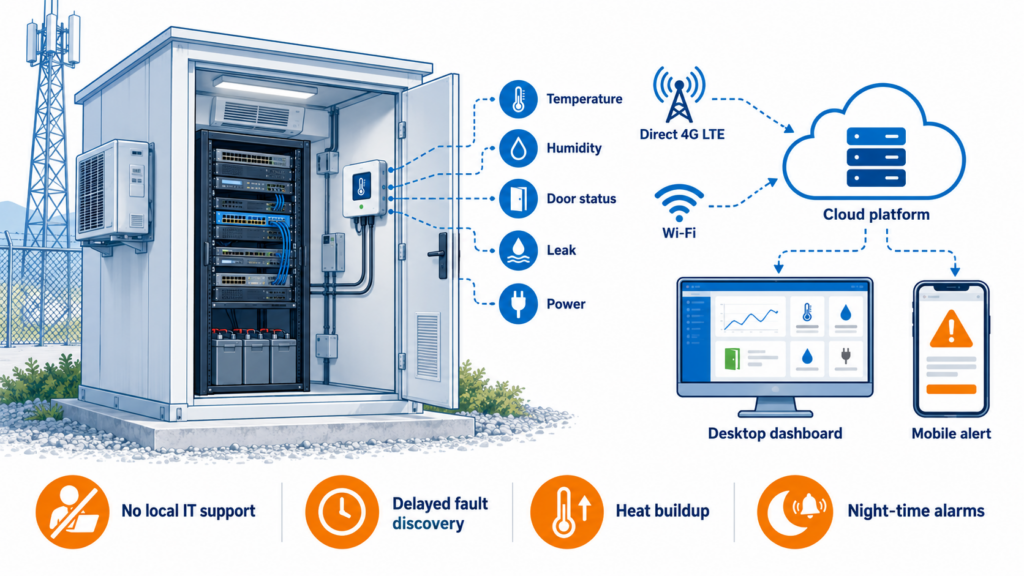
Monitoring for unattended communication cabinets goes beyond mere temperature measurement; it encompasses independent network connectivity, remote alarming, sensor placement, and continuous data logging.
Who Is This Comparison For?
This comparison is for telecom network operators, tower and shelter owners, edge-computing teams, facilities engineers, NOC teams, maintenance contractors, MSPs and procurement managers responsible for sites that may run for long periods without local staff. Typical locations include roadside telecom shelters, radio equipment rooms, edge-compute cabinets and remote utility communication rooms.
Their problem is delayed awareness at sites that are difficult to reach. A cooling fault can push temperatures up quickly, while a monitor that depends on the same failed local network may disappear when it is most needed. Across hundreds of sites, SIM charges, software fees, gateways, battery service and truck rolls also become material operating costs.
What Matters Most in Unattended Telecom Shelter Monitoring?
Independent connectivity is often the first filter
At a staffed data center, corporate Ethernet is usually available. An unattended shelter may have no usable LAN, restricted IoT access or a network owned by another team. Direct 4G can reduce that dependency. A cellular gateway can also provide independent backhaul for a sensor network, but it adds another powered component to install and maintain.
Environmental tolerance must match the installation location
Shelters can see dust, heat, condensation risk and temperature swings. An IP rating does not mean indefinite exposure to rain or condensation. UbiBot rates GS1-AL4G1RS IP65; Monnit markets its industrial enclosure for demanding indoor/outdoor use. Room Alert MAX warns against condensing environments for its T/H sensor, while STE2 R2 is IP40 and should normally remain protected.
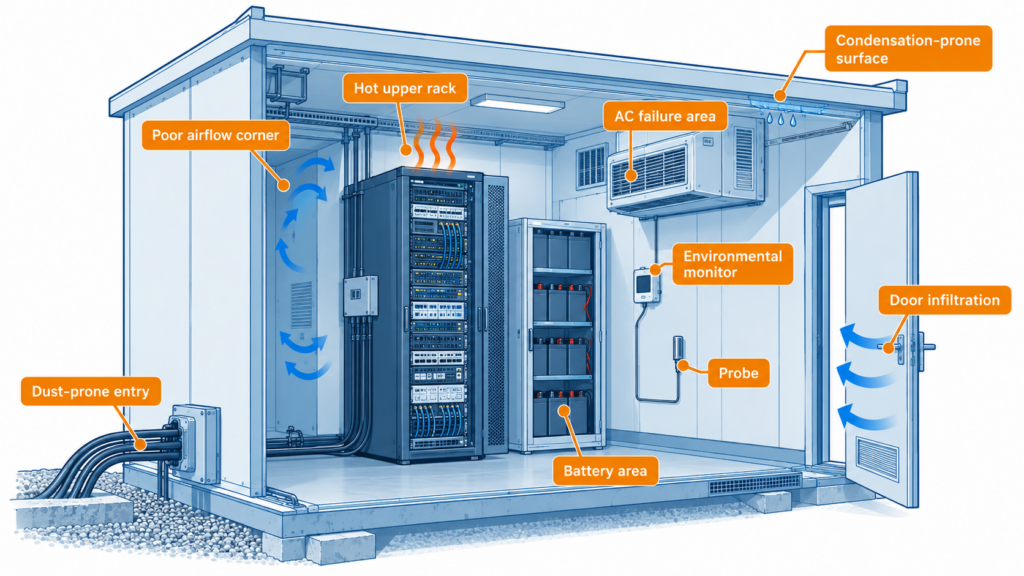
Heat accumulation, cooling failures, changes in access control, condensation risks, and dust exposure all amplify the operational risks of unmanned sites.
Local logging and power resilience protect the evidence
Remote alarms reduce response time; local storage preserves evidence when communication fails. UbiBot publishes 300,000 local records. Room Alert MAX and STE2 R2 do not publish an equivalent device-local record count on the exact pages reviewed. For Monnit, confirm the purchased sensor and gateway revision before relying on family-level buffering specifications.
Probe and sensor architecture affects placement
The useful temperature is the value that represents equipment risk. Sensors may need to sit at an air inlet, near the upper rack area, beside a battery bank or close to a return-air path. External probes help separate the sensing point from the logger. UbiBot supports RS485 probes, Monnit offers optional leads, STE2 R2 supports external 1-Wire/1W-UNI sensors, and Room Alert MAX can add wired AVTECH sensors through a separate adapter.
Alarm workflow matters more than the notification icon
An unattended site needs a defined response path: warning, critical alarm, primary recipient, backup recipient and escalation to the technician who can reach the site. Device-offline and power-loss alarms matter because they reveal loss of monitoring itself. Delay or repeat rules can also prevent a short door-opening event from being treated like a sustained cooling failure.
Use equipment limits and thermal guidance as a baseline, not a universal setpoint
ASHRAE guidance is a useful reference where the shelter contains conventional air-cooled IT equipment; the 2021 guidance lists 18 to 27 C as the recommended dry-bulb inlet range for classes A1-A4. Telecom radios, batteries and power systems may have different limits, so final alarm thresholds should follow installed-equipment specifications and site policy.
Product Overview
UbiBot GS1-AL4G1RS
UbiBot GS1-AL4G1RS combines 2.4 GHz Wi-Fi and 4G LTE with internal temperature, humidity and light sensing, 300,000 local records, a 4-inch LCD and RS485 probe expansion. The enclosure is IP65 and power options include the built-in 2500 mAh battery, USB-C 5 V and DC 5-12 V. UbiBot provides app/web cloud access, multiple alert channels and APIs. Basic cloud access has no mandatory subscription, although cellular data, SMS/voice credits and higher cloud tiers can add cost.
Room Alert MAX + MAX Temperature & Humidity Sensor
Room Alert MAX uses an Ethernet/Wi-Fi Base Station with low-energy wireless sensors. Its MAX Temperature & Humidity Sensor measures -40 to 125 C at +/-0.2 C and 0 to 100% RH at +/-1.8% RH, with 2+ years average battery life on two AA batteries or optional USB-C power. The Base Station supports PoE, SNMPv3 and BACnet. It is strong where site networking exists, but the reviewed MAX Base does not provide direct cellular backhaul.
Monnit Industrial Wireless Temperature Sensor MNS2-9-IN-TS-ST
Monnit MNS2-9-IN-TS-ST is an ALTA industrial wireless temperature sensor using sub-GHz radio. The standard temperature family covers -40 to 125 C with +/-1 C standard accuracy and user-calibrated accuracy to +/-0.25 C. The industrial version uses a 3 V battery and is marketed for demanding indoor/outdoor use, with up to seven years battery life under stated conditions. Remote monitoring requires an ALTA gateway; cellular gateways can provide LTE backhaul and serve many sensors.
HW Group STE2 R2
STE2 R2 is a compact LAN/Wi-Fi monitor with two RJ11 sensor ports, up to five external sensor values and two digital inputs. It supports Ethernet, 2.4 GHz Wi-Fi, PoE, SNMP, XML, direct email and optional SensDesk services. The standard package includes a 3 m temperature sensor. Its IP40 enclosure and lack of built-in cellular make it best for protected sites where LAN/Wi-Fi already exists.
Side-by-Side Comparison Table
Specifications reflect official manufacturer pages and documentation reviewed in September 2026. Exact cloud plans, cellular fees, firmware capabilities and regional radio variants can change. “Not publicly specified” means the exact reviewed product documentation did not state a value clearly enough to treat it as universal.
| Comparison item | UbiBot GS1-AL4G1RS | Room Alert MAX + MAX T/H Sensor | Monnit MNS2-9-IN-TS-ST + ALTA Gateway | HW Group STE2 R2 |
| Product positioning | Direct 4G/Wi-Fi industrial environmental monitor | Ethernet/Wi-Fi base station with wireless T/H sensors | Long-range industrial wireless temperature sensor with shared gateway | LAN/Wi-Fi SNMP thermometer and external-sensor monitor |
| Measurement parameters | Internal temperature, RH, light; external RS485 parameters | Temperature and RH with MAX sensor; heat index can be derived | Temperature on exact sensor; broader ALTA sensor portfolio available | Temperature included; other 1-Wire/1W-UNI sensors can add RH, CO2, current and more |
| Measurement range | Temp -20 to 60 C; RH 10-90% non-condensing; light 0-83,000 lux | MAX sensor: -40 to 125 C; 0-100% RH non-condensing | Standard temperature family: -40 to 125 C | Included standard temp sensor: -10 to 80 C; device operating -30 to 60 C |
| Accuracy | Temp +/-0.2 C from 0 to 60 C; RH +/-2% in stated range | Temp +/-0.2 C; RH +/-1.8% | Standard +/-1 C; user calibration can improve to +/-0.25 C | Official portfolio lists +/-0.5 C in the main standard-sensor range |
| Connectivity | 2.4 GHz Wi-Fi + 4G LTE | Base: Ethernet 10/100 PoE + Wi-Fi 2.4/5 GHz; sensors use 2.4 GHz low-energy wireless | ALTA sub-GHz sensor radio to gateway; gateway can be Ethernet or cellular | Ethernet 10/100 + Wi-Fi 2.4 GHz |
| External probe / expansion | RS485-compatible external probes; exact combinations must be confirmed | Wireless MAX T/H sensors; optional wired sensor adapter for AVTECH digital/switch sensors | Optional temperature leads from 3 to 100 ft; other ALTA sensor types available | 2 x RJ11; up to 5 sensor values total; 2 digital inputs |
| Gateway requirement | No separate gateway | MAX Base Station required for MAX wireless sensors | Yes – compatible ALTA gateway required | No separate gateway |
| Local display | 4-inch LCD | No numeric local display; status LED and local web interface | No local display on exact sensor | No local display; built-in web interface |
| Power | 2500 mAh battery; USB-C 5 V; DC 5-12 V. Manufacturer quotes 4-6 months on Wi-Fi only and 3-6 weeks syncing by SIM under stated conditions | Base: USB-C 5 V or PoE. Sensor: 2 AA batteries, average 2+ years, or USB-C | 3 V industrial battery; industrial temperature sensor family lists up to 7 years. Gateway power depends on model | 5 V adapter or PoE; no built-in battery backup publicly specified |
| Local data storage | 300,000 sensor records | Not publicly specified by manufacturer for MAX Base on reviewed documentation | Exact local record count for MNS2-9-IN-TS-ST not publicly specified on reviewed product page; confirm family buffering for purchased revision | Device-local history capacity not publicly specified; logging available through portal/PDMS workflows |
| Cloud / remote access | UbiBot public IoT platform; app and web console | Room Alert Account; local web interface also available | iMonnit cloud or on-premises options | HWg-cloud limited free service; SensDesk paid service; local web interface |
| Alert methods | App, email, SMS, voice, web, HTTP and other integrations; some channels use credits | Direct email via configured SMTP; Room Alert Account/Manager adds centralized alerting; SNMP traps available | Text, email, push or call through iMonnit, depending on account and gateway configuration | Direct email; SMS/voice through SensDesk or external SMS gateway |
| Data export / reports | CSV/PDF export and scheduled reporting subject to platform plan limits | Report export available on paid Room Alert Account tiers; exact Base-tier limits should be checked | History and reporting depend on iMonnit tier | PDF reports through portal; HWg-PDMS supports charts and Excel export |
| API / integration | RESTful API, HTTP/data forwarding; MQTT/on-premises options available | SNMPv3 and BACnet; REST API not publicly specified on reviewed MAX materials | REST and webhook APIs require iMonnit Premiere or Enterprise; gateway unlock/custom-host options available | SNMP and XML open API; HWg-Push |
| Subscription requirement | No mandatory subscription for basic UbiBot cloud; paid storage/traffic and paid alert credits optional | Free Base Room Alert Account exists; Professional/Enterprise/Ultimate tiers add advanced features | iMonnit Basic is free; Premiere/Enterprise are paid and required for API access | HWg-cloud has a limited free service; SensDesk is paid |
| Installation complexity | Low to medium: SIM/4G plus power and probe placement; no gateway | Medium: Base Station networking plus wireless sensor pairing and coverage testing | Medium to high at one site because gateway is required; efficient when many sensors share one gateway | Low where LAN/Wi-Fi and PoE are already available |
| Best suited for | Unattended shelters needing direct cellular independence, IP65, local memory and flexible probes | Protected sites with LAN/Wi-Fi, wireless sensor coverage, SNMP/BACnet and facility integration | Large distributed deployments needing many long-range sensors and cellular gateway backhaul | Protected LAN/Wi-Fi shelters needing PoE, SNMP, external sensors and direct email |
Connectivity and Deployment Comparison
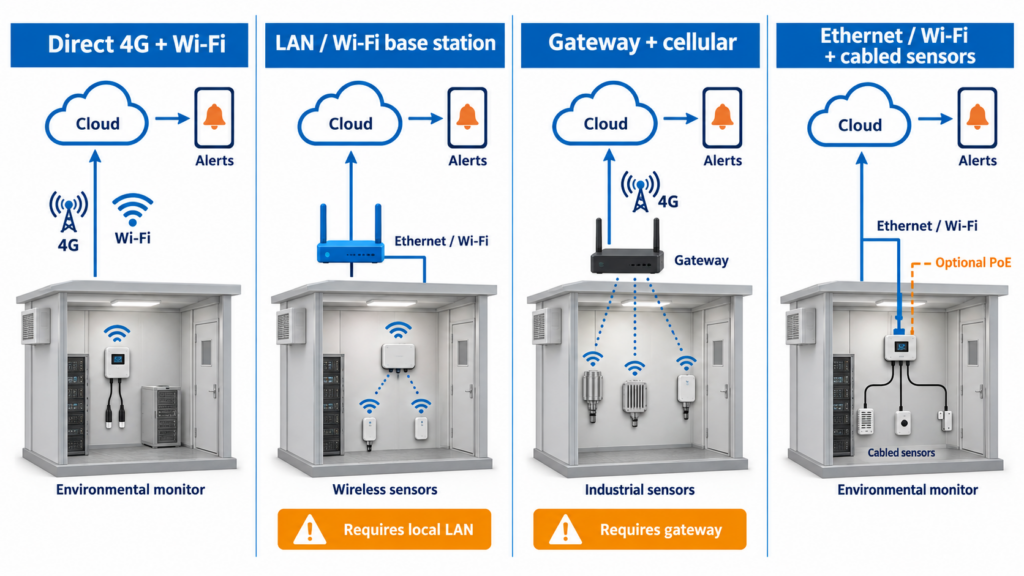
For unattended sites, the factor that truly determines the success or failure of a deployment is often not the parameters of a single sensor, but the connectivity architecture itself.
Connectivity is the clearest separator. UbiBot GS1-AL4G1RS can use its own 4G LTE link or Wi-Fi, reducing the need for a site LAN, VLAN or separate cellular router. SIM/data management remains a recurring task, and permanent power is preferable when cellular synchronization is frequent.
Room Alert MAX makes sensor placement easy within a room, but the Base Station still needs Ethernet or Wi-Fi for remote access. This works well in managed edge rooms where SNMPv3 or BACnet matters, but it is less independent at an isolated shelter.
Monnit separates the sensor network from the backhaul. ALTA sensors talk to a gateway over sub-GHz radio, while a cellular gateway can provide LTE backhaul. That is extra hardware at one small shelter, but it becomes efficient when many sensors share the same gateway. Regional radio frequency and gateway model must be selected correctly.
STE2 R2 is straightforward when Ethernet or Wi-Fi already exists. PoE simplifies power, and SNMP/XML suit NOC integration. It does not solve a no-network site on its own, so remote shelters without LAN/WLAN need added communications infrastructure.
Sensor and External Probe Comparison
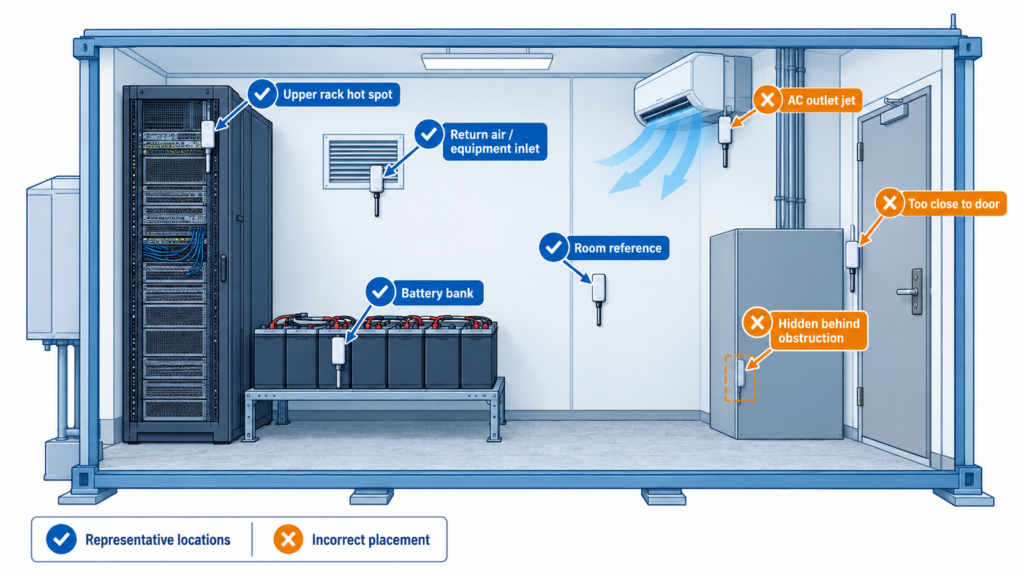
The installation location of the probe should reflect the equipment’s actual thermal environment, rather than being chosen merely for ease of installation.
For telecom shelters, sensor selection is mainly about placement and expansion. UbiBot can combine its internal T/RH sensing with compatible RS485 probes, but the final probe model and simultaneous combination should be defined in the purchase specification.
Room Alert MAX gives flexible wireless T/H placement inside a protected room. AVTECH warns against condensing environments. Wired door, dry-contact or other sensors require the MAX Wired Sensor Adapter.
Monnit MNS2-9-IN-TS-ST is temperature-only, but optional 3-100 ft leads help place the probe near critical airflow while keeping the enclosure accessible. Other Monnit sensor types are separate products and should not be treated as features of this exact model.
STE2 R2 includes a cabled temperature sensor and supports up to five 1-Wire/1W-UNI values plus two digital inputs, allowing a compact shelter to add humidity, door, flood or power-status monitoring.
Cloud Platform, Alerts and Data Management
UbiBot’s operational advantage is that the sensing device can also reach the cloud over 4G. The platform provides dashboards, history, sharing, exports and alert rules. Alert channels include app, email, SMS, voice, web and HTTP; SMS and voice use paid credits. REST APIs and data forwarding support integrations.
Room Alert MAX has a local web interface, direct SMTP email, Room Alert Account cloud management, SNMPv3 and BACnet. A free Base account exists, while paid tiers add more management and reporting. Buyers should compare the exact account tier needed for multi-site operations.
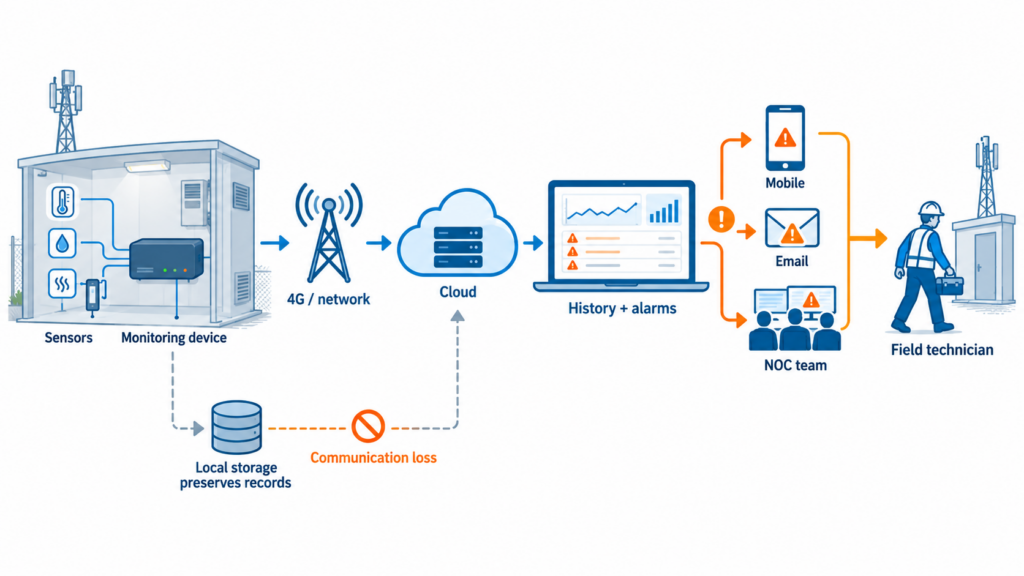
The value of remote monitoring lies not merely in visualizing data, but in ensuring that the right people receive timely notifications of anomalies and take appropriate action to resolve them.
iMonnit provides management, rules, notifications and history. Basic access is free; Premiere adds more users, history and control. REST and webhook APIs require Premiere or Enterprise, so software tier belongs in the recurring-cost model.
STE2 R2 can send email directly and exposes SNMP/XML. SensDesk portals add centralized graphs, alerts, device management and PDF reports; HWg-cloud offers a limited free service while SensDesk is paid.
Total Deployment Cost and Recurring Burden
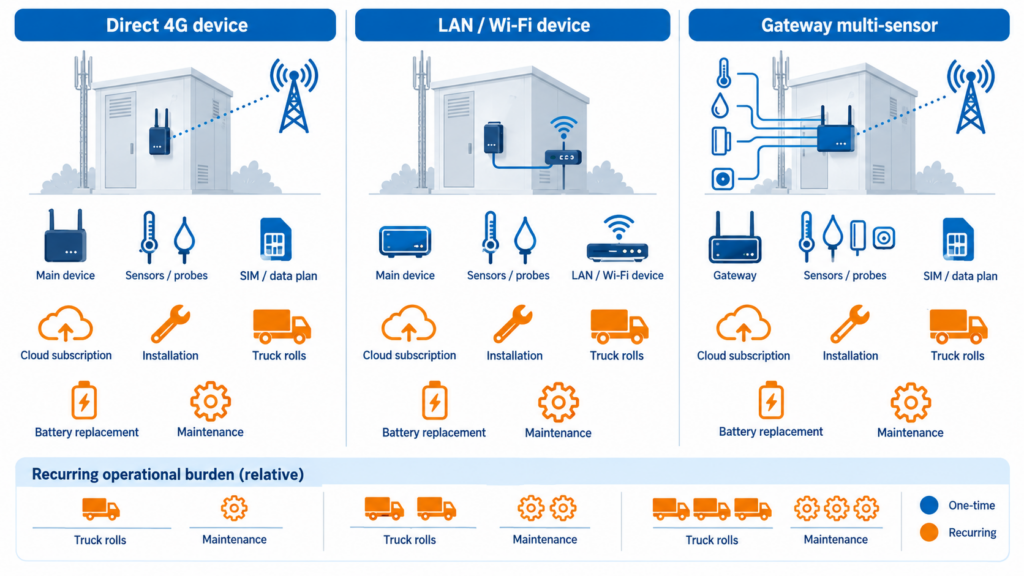
The long-term costs of unmanned sites are typically determined by a combination of connectivity methods, gateway dependencies, SIM cards, subscriptions, and on-site maintenance visits.
Cost should separate hardware from recurring operations. UbiBot needs the GS1, power, SIM/data service, any RS485 probes and optional paid cloud/alert capacity. Basic cloud access has no mandatory subscription, so recurring cost can stay low when the customer already has a suitable SIM plan.
Room Alert MAX requires the Base Station plus sensors/adapters and may add paid account tiers. Monnit needs sensors plus a gateway and, at network-poor sites, cellular service. STE2 R2 has low overhead on a networked site but may need external sensors, SensDesk, an SMS gateway or a protective enclosure.
Truck rolls can dominate lifecycle cost. Model battery changes, SIM/portal fees, calibration or verification, spare units, remote firmware administration and expected site visits over three to five years rather than comparing only device price.
Brand-by-Brand Strengths and Trade-Offs
UbiBot GS1-AL4G1RS
UbiBot is strongest for a small or medium unattended shelter where direct cellular independence is the priority. Its 4G, IP65 enclosure, local screen, large memory and RS485 expansion reduce supporting hardware. Trade-offs are SIM/data cost, shorter battery runtime when syncing by cellular, and the need to shelter the device from prolonged harsh exposure despite IP65.
Room Alert MAX
Room Alert MAX fits sites with reliable LAN/Wi-Fi that want wireless T/H sensors and SNMPv3/BACnet integration. Its published sensor accuracy and battery life are strong. The main limitation here is that the Base Station still depends on local Ethernet or Wi-Fi for remote backhaul.
Monnit Industrial Wireless Temperature Sensor
Monnit fits many-sensor deployments where long-range battery nodes can share a gateway. The industrial enclosure, long battery life and cellular gateway options support distributed infrastructure. The trade-off is added gateway, radio-planning and software complexity, with paid iMonnit tiers required for APIs.
HW Group STE2 R2
STE2 R2 is attractive when the shelter already has Ethernet/Wi-Fi and needs PoE, external sensors, SNMP/XML and direct email. Its IP40 enclosure, lack of direct cellular and unpublished device-local record count make it less suitable for exposed or network-poor sites.
Which Product Should You Choose?
| Choose this product | When this purchasing condition matters most |
| Choose UbiBot GS1-AL4G1RS | The shelter has weak or no site Wi-Fi/LAN, direct 4G is valuable, you want one device rather than a gateway architecture, and IP65 plus local memory and RS485 expansion fit the site. |
| Choose Room Alert MAX | The site already has managed Ethernet/Wi-Fi, you want wireless T/H sensors within the room, and SNMPv3/BACnet or Room Alert ecosystem integration matters more than cellular independence. |
| Choose Monnit ALTA | You need many long-range battery sensors, want to share a cellular or Ethernet gateway, and are willing to manage radio planning, gateway hardware and iMonnit software. |
| Choose HW Group STE2 R2 | The shelter already has LAN/Wi-Fi and PoE, you need SNMP/XML, direct email alerts, external 1-Wire sensors and digital inputs, and the device can stay in a protected IP40 location. |
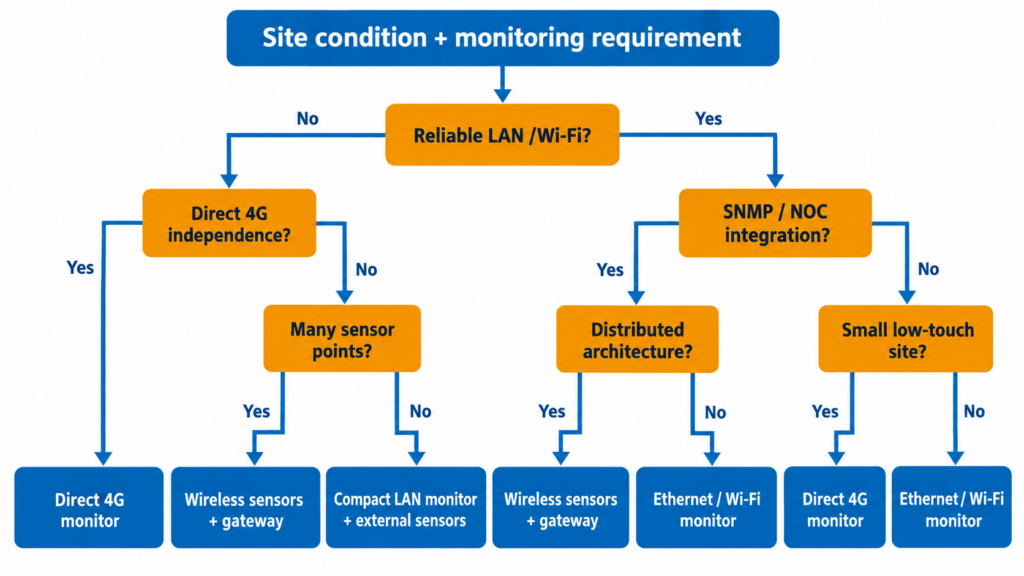
The key to selecting the right model is not which one offers the most parameters, but rather which one is best suited to the specific site’s network conditions, monitoring scope, and operations and maintenance model.
Pros and Cons
| Product | Scenario-specific advantages | Scenario-specific limitations |
| UbiBot GS1-AL4G1RS | Direct 4G + Wi-Fi; no separate gateway; IP65; 300,000 local records; 4-inch LCD; RS485 expansion; free basic cloud tier. | Cellular data cost; shorter battery runtime when syncing by SIM; outdoor long-term exposure should still be sheltered; exact probe combinations require confirmation. |
| Room Alert MAX + MAX T/H | Accurate wireless T/H sensor; PoE Ethernet + Wi-Fi Base Station; SNMPv3; BACnet; 2+ year sensor battery; strong facility-management ecosystem. | No direct cellular backhaul in reviewed Base Station; Base Station required; condensing environments are not recommended for MAX T/H sensor; advanced account features can add cost. |
| Monnit MNS2-9-IN-TS-ST | Industrial weatherproof/NEMA-rated enclosure; long-range ALTA radio; up to 7-year industrial-sensor battery; optional 3-100 ft leads; scalable cellular gateway architecture. | Gateway required; exact sensor is temperature-only; APIs require paid iMonnit tier; regional radio frequency must be selected correctly. |
| HW Group STE2 R2 | Ethernet + Wi-Fi; PoE; SNMP/XML; direct email; 2 RJ11 ports; up to 5 sensor values; 2 digital inputs; limited free portal option. | No direct 4G; IP40; no numeric display; device-local record capacity not publicly specified; SMS/voice usually needs portal or external SMS gateway. |
Frequently Asked Questions
Which monitor is best for an unattended telecom shelter without reliable Wi-Fi?
UbiBot GS1-AL4G1RS is the most direct fit among these four because it has built-in 4G LTE and Wi-Fi, so it does not require a separate gateway or site LAN for cloud connectivity. A Monnit system can also work without site Wi-Fi, but it needs a compatible cellular gateway.
Does UbiBot GS1-AL4G1RS require a gateway?
No. The device connects directly through 4G LTE or 2.4 GHz Wi-Fi. External RS485 probes connect to the GS1 interface subject to model and accessory compatibility.
Can Room Alert MAX send alerts if the site Wi-Fi is down?
Only if the Base Station still has another working network path, such as Ethernet. The reviewed Room Alert MAX Base Station supports Ethernet and Wi-Fi but does not include direct cellular backhaul.
Can Monnit work at a remote shelter with no local Internet connection?
Yes, when the ALTA sensor network is paired with a compatible Monnit cellular gateway. The sensor itself is not a standalone cellular device, so the gateway is part of the required architecture.
Which option is best for many sensors across a large distributed site?
Monnit is usually the most scalable architecture in this comparison when many long-range battery sensors can share one gateway. Room Alert MAX can also scale wirelessly within its Base Station coverage. UbiBot is simpler when each shelter needs an independent direct-4G monitor.
Which product supports SNMP for NOC integration?
Room Alert MAX supports SNMPv3. HW Group STE2 R2 supports SNMP. Monnit and UbiBot emphasize cloud/API integration; exact NOC integration should be selected according to the target platform and software tier.
Is IP65 enough for mounting a monitor outdoors?
Not by itself. IP65 indicates dust protection and resistance to water jets under test conditions. UbiBot still recommends sheltering GS1 from long-term rain, high humidity and intense sunlight. Any outdoor telecom installation should use a suitable enclosure, cable glands and condensation control.
What temperature alarm threshold should a telecom shelter use?
Use the operating limits and engineering policy for the installed equipment. ASHRAE datacom guidance can provide a useful reference for conventional IT equipment, but telecom radios, batteries and power systems may have different limits. Warning and critical thresholds should be validated for the specific shelter.
Final Verdict
For the narrow use case of an unattended telecom shelter or remote equipment room with limited local IT access, UbiBot GS1-AL4G1RS is the most balanced direct-connect option in this comparison. Its built-in 4G path, IP65 enclosure, local memory, on-device display, external-probe capability and no-mandatory-subscription cloud model reduce the amount of supporting infrastructure needed at one remote site.
That does not make it the universal winner. Monnit is better suited to a sensor-dense distributed architecture where a shared cellular gateway can serve many long-range battery nodes. Room Alert MAX is a strong managed-facility option where Ethernet or Wi-Fi already exists and SNMPv3/BACnet integration is important. STE2 R2 is an efficient protected-site choice when PoE, SNMP, direct email and external wired sensors are more important than cellular independence.
Before ordering, confirm the exact operating environment, enclosure and condensation exposure, 4G bands or regional radio frequency, SIM/data plan, power-loss behavior, sensor placement, calibration or verification policy, alarm escalation, local data retention, software tier and API requirements. Commission the full chain by testing a temperature excursion, a network outage, a power interruption and the final notification path to the person responsible for the site.
Official Sources Reviewed
UbiBot platform API quick start