

UBiBot Logo
UBiBot Logo
  • UBiBot Logo
  • Home
  • Products

    NEW

  • Pricing
  • Support
  • About Us
  • Download
  • magnifying-glass  Search
  • magnifying-glass header-close
  • Sign in Sign in
    Public Web Console Public Web Console
    On-Premises App Center On-Premises App Center
  • Home
  • Products

    NEW

  • Pricing
  • Support
  • About us
  • Download
  •  Public Web Console
  •  On-Premises App Center
  • Where to Buy

Learn Hub

Explore Knowledge Academic Research In-depth Tech

Share

LinkedIn

Facebook

X (Twitter)

Newsletter Signup

Table of contents

    How to Select Temperature Monitoring Devices for Pharmaceutical Storage and Transport Under USP <1079.3>

    Published: September 22, 2026

    Update: September 22, 2026

    By Kyle Anderson

    Quick Answer:

    USP <1079.3> focuses on the technologies, performance characteristics, and qualification of time, temperature, and humidity monitoring devices used in the pharmaceutical supply chain. Selecting a suitable device therefore requires more than checking a temperature range: the intended use, sensor performance, calibration evidence, data continuity, placement, communication architecture, and the ability to support excursion review all need to fit the storage or transport risk being controlled.

    Why Device Selection Matters in Pharmaceutical Storage and Transport

    Temperature monitoring in pharmaceutical storage and transport is not simply an operational convenience. The purpose of monitoring is to generate evidence that storage and distribution conditions remained suitable for the drug product, or to provide enough information for a quality assessment when conditions deviate from the intended range. A device that records a number is only useful if the measurement is appropriate for the product, the location, the duration of use, and the quality decision that may follow.

    USP General Chapter <1079>, Risks and Mitigation Strategies for the Storage and Transportation of Finished Drug Products, frames storage and distribution as a risk-management problem. USP <1079.3>, Monitoring Devices—Time, Temperature, and Humidity, then narrows the focus to monitoring technologies and the qualification of their performance. The public USP preview describes the chapter as covering electronic and chemical devices used to monitor supply-chain temperature and humidity, together with their performance characteristics and qualification recommendations.

    For QA teams, hospital pharmacies, wholesalers, specialty pharmacies, controlled-storage operators, and logistics providers, the practical question is therefore not ‘Which logger is compliant?’ but ‘Which monitoring system is suitable for this intended use, and what evidence will support that choice?’ This article translates that question into a procurement and deployment framework while keeping a clear boundary between USP guidance, operational best practice, and vendor capability.

    What USP <1079> and <1079.3> Are – and Who Should Use Them

    USP <1079> is a general chapter addressing risks and mitigation strategies for the storage and transportation of finished drug products. Its scope includes temperature-sensitive small molecules, vaccines, biologics, biotechnology products, radiopharmaceuticals, combination products, and other finished drug products moving through complex supply chains. The chapter emphasizes that storage and transportation conditions should be supported by stability data and labeling, and that supply-chain participants should understand the risks they control.
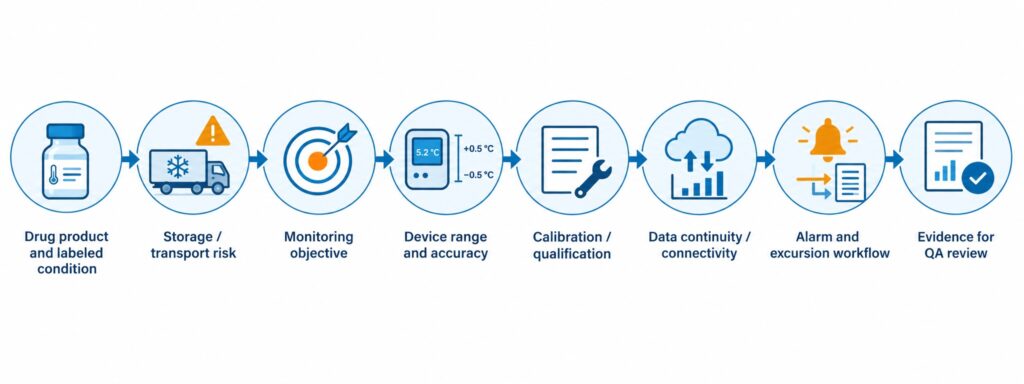
    USP 1079.3 pharmaceutical monitoring device selection framework

    A pharmaceutical monitoring-device decision should begin with intended use and risk, then move to measurement performance, qualification, data continuity, and excursion response.

    USP <1079.3> is more specific. The official USP-NF preview states that it provides background on the science and technology of temperature and humidity monitoring over time, describes available technologies and performance characteristics, and provides recommendations for qualifying device performance. It focuses on supply-chain monitoring devices rather than on every regulatory obligation that may govern a drug product. In other words, it is a technical and scientific framework for device selection and qualification, not a universal product-certification scheme.

    This distinction matters in procurement. A pharmaceutical organization may also be subject to FDA regulations, state requirements, customer quality agreements, internal SOPs, GDP expectations, or electronic-record controls. Those obligations should be identified separately. USP <1079.3> can support the technical justification for monitoring-device selection, but the complete compliance decision belongs to the regulated process and the organization using the system.

    Source / Framework Primary Role in This Article Procurement Implication
    USP <1079> Risk and mitigation framework for storage and transport Define the risk, product condition, process, and decision that the monitoring data must support.
    USP <1079.3> Monitoring-device technologies, performance characteristics, and qualification Evaluate sensor/recorder suitability and maintain evidence that performance is fit for intended use.
    Product labeling / stability data Defines product-specific storage and transport conditions Do not substitute a generic temperature range for the approved product condition.
    Applicable regulatory / quality system Defines legal, procedural, and record-control obligations Add SOP, retention, access-control, validation, and deviation requirements where applicable.

    Key Monitoring-Device Requirements to Translate into a Specification

    Start with the Intended Use, Not the Device Catalog

    The first selection decision is the use case. A fixed warehouse, a 2-8 C refrigerator, a -20 C freezer, an ultra-low-temperature unit, a parcel shipment, and a multi-day road journey do not create the same monitoring problem. The product condition, expected environmental range, duration, packaging configuration, and response process determine what the monitoring device must do.

    For example, a warehouse logger may be selected for long-term fixed installation, remote visibility, and local continuity during network interruptions. A transport logger may need a compact form factor, internal power, shipment-level identity, location awareness, or a reporting workflow suitable for receiving. The important point is that these are intended-use requirements; they should not be presented as universal USP mandates unless the applicable source explicitly says so.

    Match Measurement Range and Accuracy to the Risk

    A recorder’s advertised range does not, by itself, demonstrate that it is suitable. The useful range must include the conditions expected in the application, and the measurement performance must be adequate around the decision limits that matter. If a quality decision depends on whether a chamber stayed close to a narrow threshold, uncertainty and calibration performance near that threshold become more important than the device’s extreme upper or lower range.

    USP materials associated with the <1079> family emphasize calibration of monitoring devices to recognized standards. The parent <1079> material also notes that calibration frequency can depend on the manufacturer, workload, operational demands, and events such as damage or repair. This supports a risk-based calibration program rather than an invented universal interval.

    Decide What Must Be Recorded – and How Continuity Is Protected

    Pharmaceutical monitoring depends on the continuity and traceability of the record. Sampling interval, local memory, time synchronization, device identity, data export, and recovery after communication loss should therefore be considered together. A cloud dashboard is useful, but a temporary network failure should not automatically become a permanent gap in the underlying temperature history.

    For fixed sites, onboard memory or buffering can reduce the risk of lost records when Wi-Fi, Ethernet, cellular, or a gateway connection is temporarily unavailable. For transport, the recorder may need to preserve the complete trip history independently of live connectivity. The correct architecture depends on the intended use and the quality decision that the data must support.

    Qualification Must Address the Device in Its Real Configuration

    USP <1079.3> is especially relevant because it focuses on performance characteristics and qualification. A useful qualification question is not simply whether the sensor was calibrated at manufacture. Procurement and validation teams should ask whether the complete configuration – logger, probe, extension cable, protective buffer, network path, application software, and reporting method – performs as expected in the actual use case.

    If external probes are used, their type and placement matter. If the recorder is installed outside a refrigerator and the probe is inside, the cable route and door seal can affect installation. If the device is used in a warehouse, the permanent point should normally be justified by the facility’s qualification or temperature-mapping work rather than convenience alone.

    Alarm Functions Are Only Useful When They Connect to a Response Process

    Threshold alarms can shorten response time, but an alarm feature is not a complete control. The alarm must be based on a justified threshold, reach a responsible person, and lead to a defined response. Delays, escalation rules, communication-loss alarms, and after-hours coverage should be evaluated according to the operating risk.

    The quality system should also distinguish an alarm from a product-disposition decision. An excursion is normally reviewed using the recorded duration and magnitude, labeled conditions, stability information, and the organization’s quality procedures. A monitoring device can provide evidence for that review; it does not decide whether affected product remains acceptable.

    How to Turn USP <1079.3> into a Practical Selection and Deployment Process

    Define the Monitoring Question

    Start by documenting what the organization needs to know. Is the objective to demonstrate that a warehouse remained within a defined condition, to monitor a refrigerator continuously, to verify a transport lane, or to support investigation of a shipment excursion? The answer determines the required sensing range, logger form factor, record interval, connectivity, battery strategy, and reporting workflow.

    Use Mapping or Qualification Results to Choose Fixed Monitoring Points

    For controlled storage areas, monitoring-point placement should be evidence-based. USP <1079.4> addresses qualification of storage areas, and USP materials recommend calibrated monitors for temperature mapping. Mapping identifies representative and worst-case locations that can then inform permanent monitoring positions. The exact number of devices and placement pattern should come from the study design and risk assessment rather than a universal spacing formula.
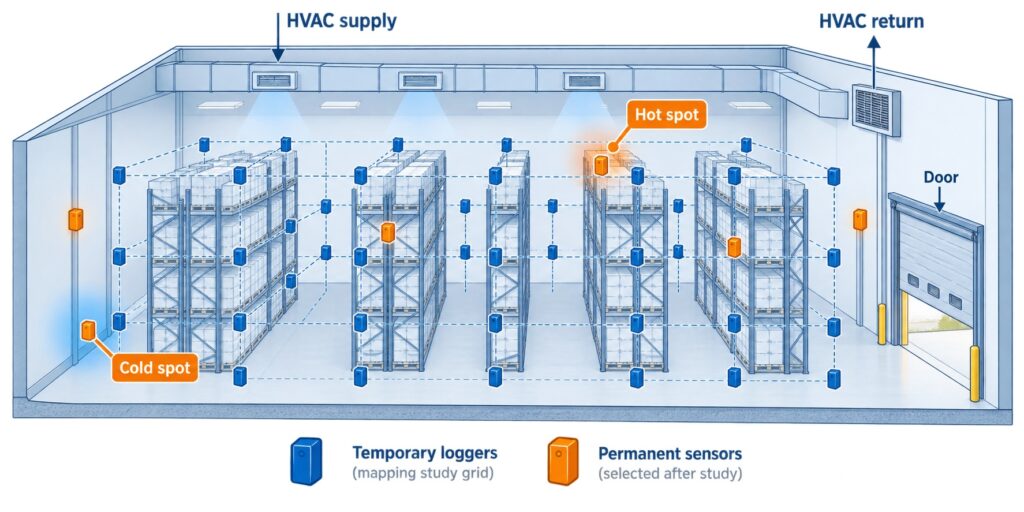
    Pharmaceutical warehouse mapping to permanent temperature monitoring points

    Mapping or qualification identifies representative and worst-case locations before permanent monitoring points are finalized.

    Define a Data-Continuity Architecture

    Connectivity should be selected around the site or lane. Wi-Fi may be suitable where a managed network is available. Ethernet can be attractive for fixed infrastructure. Cellular connectivity can support facilities or transport situations where local IT access is limited. A gateway architecture can centralize many sensors. Whatever architecture is chosen, the design should consider what happens when connectivity fails and how locally stored readings are reconciled afterward.

    Build Excursion Handling into the Monitoring Workflow

    A useful system makes it easy to establish when an excursion began, how long it lasted, how far the temperature moved, which device and probe generated the reading, and whether the record is complete. That information should feed the deviation or excursion process. The result may include product segregation, evidence review, stability assessment, supplier or manufacturer consultation, disposition, and corrective or preventive action when appropriate.

    Review the System Periodically

    Monitoring needs change. Refrigerators are replaced, racking moves, HVAC is modified, routes change, probe cables are damaged, software is updated, and alarm recipients change. Periodic review should therefore confirm that the monitoring system still matches the intended use. Requalification or remapping may be justified after significant changes, based on the organization’s risk assessment and applicable procedures.

    Procurement and Qualification Checklist

    Control Question Why It Matters Evidence to Request
    What product condition and use case is being controlled? Prevents selection from being driven by a generic logger specification. Label/storage condition, SOP, lane or equipment description.
    Does the range and stated accuracy fit the decision limits? Ensures measurement performance is meaningful where quality decisions are made. Current specification and calibration documentation.
    Can the device retain data during communication loss? Reduces the risk of permanent record gaps. Memory/buffering specification and recovery behavior.
    Is calibration traceability documented? Supports confidence in the measurement result. Calibration certificate, standards traceability, calibration procedure.
    Are the probe and logger qualified as used? The real installation can differ from the bench configuration. Configuration record, qualification protocol/report, probe identity.
    Are alarm thresholds, delays, and recipients governed by SOP? An alarm without action does not control the risk. Alarm matrix, escalation procedure, test record.
    Can records be exported and linked to device identity and time? Supports investigation, review, and auditability. Sample report/export and device-identification scheme.
    Does the system support the required electronic-record controls? Some regulated uses may require controls beyond basic logging. Current software documentation, validation package where applicable, access-control and audit-trail evidence.

    Pharmaceutical Temperature Monitoring Devices Selection Guide

    The comparison below is not a compliance ranking. It illustrates how different products address different monitoring architectures. Exact suitability depends on the intended use, probe selection, calibration evidence, software configuration, validation status, procedures, and the current product version.
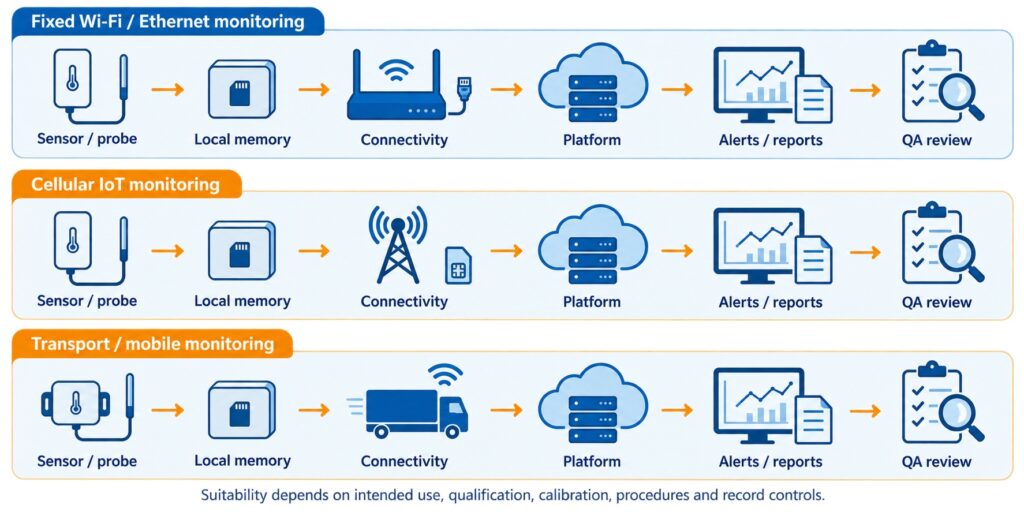
    Pharmaceutical temperature monitoring system architecture comparison

    Monitoring systems can use different architectures while serving the same core quality objective.

    System Representative Strengths Published Evidence Relevant to Selection Procurement Caution
    UbiBot GS1 / WS1 Pro / WS4 Multiple fixed and mobile deployment options; onboard memory; several connectivity paths depending on model; external-probe options on selected variants. GS1 and WS1 Pro publish 300,000-record onboard memory; GS1 offers Wi-Fi/4G/Ethernet/RS485 variants; WS4 variants include 4G/GNSS options and IP65 enclosure. Verify the exact model, probe, calibration evidence, platform controls, and any regulated-record requirement for the intended use.
    ELPRO ECOLOG-PRO xG Cellular IoT architecture for pharmaceutical rooms and equipment; temperature and humidity variants; external Pt100 option on 1TGe. Vendor publishes NB-IoT/LTE-M connectivity, calibration documentation, and GAMP 5 / Part 11 positioning for the solution. Treat regulated-environment statements as vendor claims requiring verification against the customer’s intended use and validation process.
    Vaisala RFL100 + viewLinc Enterprise wireless monitoring with interchangeable probe configurations and integration into the viewLinc system. Official user documentation supports temperature/humidity probes and two-temperature-probe configurations; viewLinc is required for system use. Evaluate gateway/network design, validation package, calibration service, and total system architecture rather than the logger alone.
    Dickson DWE2 + DicksonOne Wi-Fi/Ethernet fixed monitoring; replaceable sensors; local backup; cloud alarms and multi-location management. Vendor publishes about 400,000 sample-point backup capacity, selectable sampling, 72-hour battery backup, and phone/SMS/email/audible alarms. Requires a DicksonOne subscription; verify selected probe range/accuracy and suitability for the storage condition.

    Common Selection and Audit Weaknesses

    One recurring weakness is selecting a logger because its headline range looks broad while failing to define the accuracy and calibration evidence needed near the actual control limit. Another is treating the existence of cloud connectivity as proof that records are complete, even though network interruptions can create gaps if the device does not buffer locally. A third is installing fixed sensors where they are easy to mount rather than where mapping or qualification shows the environment is most representative or vulnerable.

    Organizations also create risk when alarms are configured without an escalation procedure, when probe identities are not linked to calibration records, or when the monitoring device is treated as the complete quality system. USP <1079.3> can strengthen the technical basis for device selection, but a defensible monitoring program still depends on documented intended use, procedures, trained personnel, qualification, calibration, excursion handling, and periodic review.
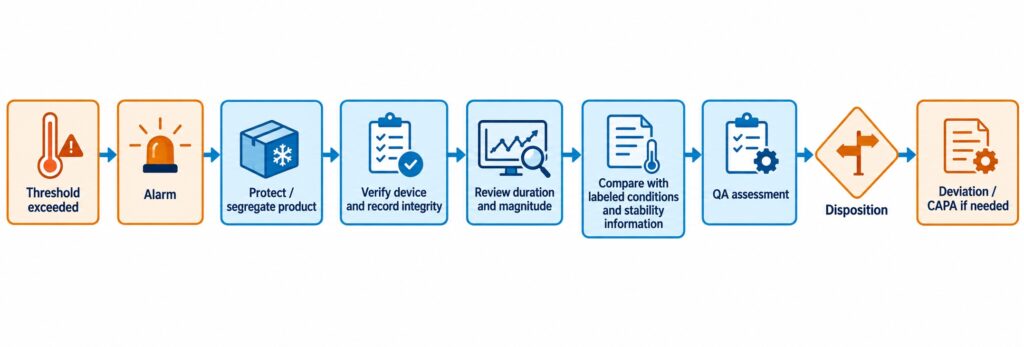
    Pharmaceutical temperature excursion evidence workflow, pharmaceutical temperature monitoring devices selection guide

    Monitoring data supports excursion investigation, but product disposition remains a quality decision.

    Frequently Asked Questions

    Is USP <1079.3> a certification for temperature data loggers?

    No. USP <1079.3> is a general chapter describing monitoring-device technologies, performance characteristics, and recommendations for qualifying performance. It should not be presented as a universal product-certification program.

    Does USP <1079.3> require one specific logging interval?

    The public USP preview does not establish one universal interval for every pharmaceutical storage or transport use. The interval should be justified by the product, process, risk, decision limits, route or equipment behavior, and applicable procedures or regulations.

    How often should a pharmaceutical temperature logger be calibrated?

    USP <1079> materials support calibration to recognized standards and indicate that calibration frequency may depend on the manufacturer, workload, operational demands, and events such as damage or repair. The organization should define and justify its calibration program.

    Do I need humidity monitoring as well as temperature monitoring?

    Only when humidity is relevant to the product, packaging, storage condition, stability risk, or quality system. USP <1079.3> covers both temperature and humidity monitoring devices, but the monitoring plan should follow the actual product and process risk.

    Can a wireless cloud logger replace temperature mapping?

    No. Continuous monitoring and temperature mapping answer different questions. Mapping characterizes spatial variation and can help select permanent points; routine monitoring then tracks those selected locations over time.

    Is real-time cellular monitoring required for pharmaceutical transport?

    Not universally. Real-time visibility can be operationally valuable, but the required architecture depends on the product, route, risk assessment, quality agreement, applicable regulation, and the evidence needed at receipt.

    Does a temperature excursion automatically mean the product must be rejected?

    No. The monitoring record provides the duration and magnitude of the excursion, but disposition should follow the organization’s quality process and available stability or manufacturer information.

    Can UbiBot, ELPRO, Vaisala, or Dickson be called USP compliant?

    That wording is too broad without a defined intended use and supporting evidence. The defensible approach is to compare documented capabilities and determine whether the configured system, calibration, procedures, and records support the specific regulated process.

    Source Notes and Applicability Boundary

    This article uses the official USP-NF preview of <1079.3> as the primary technical source for the monitoring-device discussion and USP <1079> for the broader storage-and-transport risk framework. The complete USP-NF text may require subscription access; users should verify the currently official version before using the chapter in a regulated procedure. Product statements are based on current manufacturer documentation and are included only to illustrate system architectures and published capabilities.

    This article is for informational and procurement-planning purposes. It does not replace legal advice, a quality agreement, product labeling, stability data, internal SOPs, supplier qualification, validation, or jurisdiction-specific regulatory requirements.


     

    Related Resources

    What Environmental Parameters Matter Beyond ISO Class in a Cleanroom?
    What EN 12830 Means When Selecting a Cold-Chain Temperature Recorder?
    Water Leak Detection for Data Centers and Warehouses
    Commercial Indoor Air Quality Monitors for CO2 PM2.5 TVOC and BMS Integration
    UbiBot vs Room Alert MAX vs Monnit vs HW Group: Which Is Better for Unattended Telecom Shelters?
    LoRa vs LoRaWAN Environmental Monitoring: Sensors, Gateways, Range, Battery Life and Interoperability
    Guide to Deploying a GxP Environmental Monitoring System in a Pharmaceutical Warehouse
    Using Cold-Chain Data to Support HACCP CCP Monitoring and ISO 22000 Audits
    menu-header-svg
    Search
    • Explore Knowledge
      • Comparison & Selection
      • Industry Solution
      • Product & Device
      • Criterion & Compliance
      • Deployment & Usage
      • Technology & Principle
    • Academic Research
    • In-depth Tech

    Criterion & Compliance

    See More >>

    How to Select Temperature Monitoring Devices for Pharmaceutical Storage and Transport Under USP <1079.3>

    Published: September 22, 2026

    Updated: September 22, 2026

    By Kyle Anderson

    Quick Answer:

    USP <1079.3> focuses on the technologies, performance characteristics, and qualification of time, temperature, and humidity monitoring devices used in the pharmaceutical supply chain. Selecting a suitable device therefore requires more than checking a temperature range: the intended use, sensor performance, calibration evidence, data continuity, placement, communication architecture, and the ability to support excursion review all need to fit the storage or transport risk being controlled.

    Why Device Selection Matters in Pharmaceutical Storage and Transport

    Temperature monitoring in pharmaceutical storage and transport is not simply an operational convenience. The purpose of monitoring is to generate evidence that storage and distribution conditions remained suitable for the drug product, or to provide enough information for a quality assessment when conditions deviate from the intended range. A device that records a number is only useful if the measurement is appropriate for the product, the location, the duration of use, and the quality decision that may follow.

    USP General Chapter <1079>, Risks and Mitigation Strategies for the Storage and Transportation of Finished Drug Products, frames storage and distribution as a risk-management problem. USP <1079.3>, Monitoring Devices—Time, Temperature, and Humidity, then narrows the focus to monitoring technologies and the qualification of their performance. The public USP preview describes the chapter as covering electronic and chemical devices used to monitor supply-chain temperature and humidity, together with their performance characteristics and qualification recommendations.

    For QA teams, hospital pharmacies, wholesalers, specialty pharmacies, controlled-storage operators, and logistics providers, the practical question is therefore not ‘Which logger is compliant?’ but ‘Which monitoring system is suitable for this intended use, and what evidence will support that choice?’ This article translates that question into a procurement and deployment framework while keeping a clear boundary between USP guidance, operational best practice, and vendor capability.

    What USP <1079> and <1079.3> Are – and Who Should Use Them

    USP <1079> is a general chapter addressing risks and mitigation strategies for the storage and transportation of finished drug products. Its scope includes temperature-sensitive small molecules, vaccines, biologics, biotechnology products, radiopharmaceuticals, combination products, and other finished drug products moving through complex supply chains. The chapter emphasizes that storage and transportation conditions should be supported by stability data and labeling, and that supply-chain participants should understand the risks they control.

    USP 1079.3 pharmaceutical monitoring device selection framework

    A pharmaceutical monitoring-device decision should begin with intended use and risk, then move to measurement performance, qualification, data continuity, and excursion response.

    USP <1079.3> is more specific. The official USP-NF preview states that it provides background on the science and technology of temperature and humidity monitoring over time, describes available technologies and performance characteristics, and provides recommendations for qualifying device performance. It focuses on supply-chain monitoring devices rather than on every regulatory obligation that may govern a drug product. In other words, it is a technical and scientific framework for device selection and qualification, not a universal product-certification scheme.

    This distinction matters in procurement. A pharmaceutical organization may also be subject to FDA regulations, state requirements, customer quality agreements, internal SOPs, GDP expectations, or electronic-record controls. Those obligations should be identified separately. USP <1079.3> can support the technical justification for monitoring-device selection, but the complete compliance decision belongs to the regulated process and the organization using the system.

    Source / Framework Primary Role in This Article Procurement Implication
    USP <1079> Risk and mitigation framework for storage and transport Define the risk, product condition, process, and decision that the monitoring data must support.
    USP <1079.3> Monitoring-device technologies, performance characteristics, and qualification Evaluate sensor/recorder suitability and maintain evidence that performance is fit for intended use.
    Product labeling / stability data Defines product-specific storage and transport conditions Do not substitute a generic temperature range for the approved product condition.
    Applicable regulatory / quality system Defines legal, procedural, and record-control obligations Add SOP, retention, access-control, validation, and deviation requirements where applicable.

    Key Monitoring-Device Requirements to Translate into a Specification

    Start with the Intended Use, Not the Device Catalog

    The first selection decision is the use case. A fixed warehouse, a 2-8 C refrigerator, a -20 C freezer, an ultra-low-temperature unit, a parcel shipment, and a multi-day road journey do not create the same monitoring problem. The product condition, expected environmental range, duration, packaging configuration, and response process determine what the monitoring device must do.

    For example, a warehouse logger may be selected for long-term fixed installation, remote visibility, and local continuity during network interruptions. A transport logger may need a compact form factor, internal power, shipment-level identity, location awareness, or a reporting workflow suitable for receiving. The important point is that these are intended-use requirements; they should not be presented as universal USP mandates unless the applicable source explicitly says so.

    Match Measurement Range and Accuracy to the Risk

    A recorder’s advertised range does not, by itself, demonstrate that it is suitable. The useful range must include the conditions expected in the application, and the measurement performance must be adequate around the decision limits that matter. If a quality decision depends on whether a chamber stayed close to a narrow threshold, uncertainty and calibration performance near that threshold become more important than the device’s extreme upper or lower range.

    USP materials associated with the <1079> family emphasize calibration of monitoring devices to recognized standards. The parent <1079> material also notes that calibration frequency can depend on the manufacturer, workload, operational demands, and events such as damage or repair. This supports a risk-based calibration program rather than an invented universal interval.

    Decide What Must Be Recorded – and How Continuity Is Protected

    Pharmaceutical monitoring depends on the continuity and traceability of the record. Sampling interval, local memory, time synchronization, device identity, data export, and recovery after communication loss should therefore be considered together. A cloud dashboard is useful, but a temporary network failure should not automatically become a permanent gap in the underlying temperature history.

    For fixed sites, onboard memory or buffering can reduce the risk of lost records when Wi-Fi, Ethernet, cellular, or a gateway connection is temporarily unavailable. For transport, the recorder may need to preserve the complete trip history independently of live connectivity. The correct architecture depends on the intended use and the quality decision that the data must support.

    Qualification Must Address the Device in Its Real Configuration

    USP <1079.3> is especially relevant because it focuses on performance characteristics and qualification. A useful qualification question is not simply whether the sensor was calibrated at manufacture. Procurement and validation teams should ask whether the complete configuration – logger, probe, extension cable, protective buffer, network path, application software, and reporting method – performs as expected in the actual use case.

    If external probes are used, their type and placement matter. If the recorder is installed outside a refrigerator and the probe is inside, the cable route and door seal can affect installation. If the device is used in a warehouse, the permanent point should normally be justified by the facility’s qualification or temperature-mapping work rather than convenience alone.

    Alarm Functions Are Only Useful When They Connect to a Response Process

    Threshold alarms can shorten response time, but an alarm feature is not a complete control. The alarm must be based on a justified threshold, reach a responsible person, and lead to a defined response. Delays, escalation rules, communication-loss alarms, and after-hours coverage should be evaluated according to the operating risk.

    The quality system should also distinguish an alarm from a product-disposition decision. An excursion is normally reviewed using the recorded duration and magnitude, labeled conditions, stability information, and the organization’s quality procedures. A monitoring device can provide evidence for that review; it does not decide whether affected product remains acceptable.

    How to Turn USP <1079.3> into a Practical Selection and Deployment Process

    Define the Monitoring Question

    Start by documenting what the organization needs to know. Is the objective to demonstrate that a warehouse remained within a defined condition, to monitor a refrigerator continuously, to verify a transport lane, or to support investigation of a shipment excursion? The answer determines the required sensing range, logger form factor, record interval, connectivity, battery strategy, and reporting workflow.

    Use Mapping or Qualification Results to Choose Fixed Monitoring Points

    For controlled storage areas, monitoring-point placement should be evidence-based. USP <1079.4> addresses qualification of storage areas, and USP materials recommend calibrated monitors for temperature mapping. Mapping identifies representative and worst-case locations that can then inform permanent monitoring positions. The exact number of devices and placement pattern should come from the study design and risk assessment rather than a universal spacing formula.

    Pharmaceutical warehouse mapping to permanent temperature monitoring points

    Mapping or qualification identifies representative and worst-case locations before permanent monitoring points are finalized.

    Define a Data-Continuity Architecture

    Connectivity should be selected around the site or lane. Wi-Fi may be suitable where a managed network is available. Ethernet can be attractive for fixed infrastructure. Cellular connectivity can support facilities or transport situations where local IT access is limited. A gateway architecture can centralize many sensors. Whatever architecture is chosen, the design should consider what happens when connectivity fails and how locally stored readings are reconciled afterward.

    Build Excursion Handling into the Monitoring Workflow

    A useful system makes it easy to establish when an excursion began, how long it lasted, how far the temperature moved, which device and probe generated the reading, and whether the record is complete. That information should feed the deviation or excursion process. The result may include product segregation, evidence review, stability assessment, supplier or manufacturer consultation, disposition, and corrective or preventive action when appropriate.

    Review the System Periodically

    Monitoring needs change. Refrigerators are replaced, racking moves, HVAC is modified, routes change, probe cables are damaged, software is updated, and alarm recipients change. Periodic review should therefore confirm that the monitoring system still matches the intended use. Requalification or remapping may be justified after significant changes, based on the organization’s risk assessment and applicable procedures.

    Procurement and Qualification Checklist

    Control Question Why It Matters Evidence to Request
    What product condition and use case is being controlled? Prevents selection from being driven by a generic logger specification. Label/storage condition, SOP, lane or equipment description.
    Does the range and stated accuracy fit the decision limits? Ensures measurement performance is meaningful where quality decisions are made. Current specification and calibration documentation.
    Can the device retain data during communication loss? Reduces the risk of permanent record gaps. Memory/buffering specification and recovery behavior.
    Is calibration traceability documented? Supports confidence in the measurement result. Calibration certificate, standards traceability, calibration procedure.
    Are the probe and logger qualified as used? The real installation can differ from the bench configuration. Configuration record, qualification protocol/report, probe identity.
    Are alarm thresholds, delays, and recipients governed by SOP? An alarm without action does not control the risk. Alarm matrix, escalation procedure, test record.
    Can records be exported and linked to device identity and time? Supports investigation, review, and auditability. Sample report/export and device-identification scheme.
    Does the system support the required electronic-record controls? Some regulated uses may require controls beyond basic logging. Current software documentation, validation package where applicable, access-control and audit-trail evidence.

    Pharmaceutical Temperature Monitoring Devices Selection Guide

    The comparison below is not a compliance ranking. It illustrates how different products address different monitoring architectures. Exact suitability depends on the intended use, probe selection, calibration evidence, software configuration, validation status, procedures, and the current product version.

    Pharmaceutical temperature monitoring system architecture comparison

    Monitoring systems can use different architectures while serving the same core quality objective.

    System Representative Strengths Published Evidence Relevant to Selection Procurement Caution
    UbiBot GS1 / WS1 Pro / WS4 Multiple fixed and mobile deployment options; onboard memory; several connectivity paths depending on model; external-probe options on selected variants. GS1 and WS1 Pro publish 300,000-record onboard memory; GS1 offers Wi-Fi/4G/Ethernet/RS485 variants; WS4 variants include 4G/GNSS options and IP65 enclosure. Verify the exact model, probe, calibration evidence, platform controls, and any regulated-record requirement for the intended use.
    ELPRO ECOLOG-PRO xG Cellular IoT architecture for pharmaceutical rooms and equipment; temperature and humidity variants; external Pt100 option on 1TGe. Vendor publishes NB-IoT/LTE-M connectivity, calibration documentation, and GAMP 5 / Part 11 positioning for the solution. Treat regulated-environment statements as vendor claims requiring verification against the customer’s intended use and validation process.
    Vaisala RFL100 + viewLinc Enterprise wireless monitoring with interchangeable probe configurations and integration into the viewLinc system. Official user documentation supports temperature/humidity probes and two-temperature-probe configurations; viewLinc is required for system use. Evaluate gateway/network design, validation package, calibration service, and total system architecture rather than the logger alone.
    Dickson DWE2 + DicksonOne Wi-Fi/Ethernet fixed monitoring; replaceable sensors; local backup; cloud alarms and multi-location management. Vendor publishes about 400,000 sample-point backup capacity, selectable sampling, 72-hour battery backup, and phone/SMS/email/audible alarms. Requires a DicksonOne subscription; verify selected probe range/accuracy and suitability for the storage condition.

    Common Selection and Audit Weaknesses

    One recurring weakness is selecting a logger because its headline range looks broad while failing to define the accuracy and calibration evidence needed near the actual control limit. Another is treating the existence of cloud connectivity as proof that records are complete, even though network interruptions can create gaps if the device does not buffer locally. A third is installing fixed sensors where they are easy to mount rather than where mapping or qualification shows the environment is most representative or vulnerable.

    Organizations also create risk when alarms are configured without an escalation procedure, when probe identities are not linked to calibration records, or when the monitoring device is treated as the complete quality system. USP <1079.3> can strengthen the technical basis for device selection, but a defensible monitoring program still depends on documented intended use, procedures, trained personnel, qualification, calibration, excursion handling, and periodic review.

    Pharmaceutical temperature excursion evidence workflow, pharmaceutical temperature monitoring devices selection guide

    Monitoring data supports excursion investigation, but product disposition remains a quality decision.

    Frequently Asked Questions

    Is USP <1079.3> a certification for temperature data loggers?

    No. USP <1079.3> is a general chapter describing monitoring-device technologies, performance characteristics, and recommendations for qualifying performance. It should not be presented as a universal product-certification program.

    Does USP <1079.3> require one specific logging interval?

    The public USP preview does not establish one universal interval for every pharmaceutical storage or transport use. The interval should be justified by the product, process, risk, decision limits, route or equipment behavior, and applicable procedures or regulations.

    How often should a pharmaceutical temperature logger be calibrated?

    USP <1079> materials support calibration to recognized standards and indicate that calibration frequency may depend on the manufacturer, workload, operational demands, and events such as damage or repair. The organization should define and justify its calibration program.

    Do I need humidity monitoring as well as temperature monitoring?

    Only when humidity is relevant to the product, packaging, storage condition, stability risk, or quality system. USP <1079.3> covers both temperature and humidity monitoring devices, but the monitoring plan should follow the actual product and process risk.

    Can a wireless cloud logger replace temperature mapping?

    No. Continuous monitoring and temperature mapping answer different questions. Mapping characterizes spatial variation and can help select permanent points; routine monitoring then tracks those selected locations over time.

    Is real-time cellular monitoring required for pharmaceutical transport?

    Not universally. Real-time visibility can be operationally valuable, but the required architecture depends on the product, route, risk assessment, quality agreement, applicable regulation, and the evidence needed at receipt.

    Does a temperature excursion automatically mean the product must be rejected?

    No. The monitoring record provides the duration and magnitude of the excursion, but disposition should follow the organization’s quality process and available stability or manufacturer information.

    Can UbiBot, ELPRO, Vaisala, or Dickson be called USP compliant?

    That wording is too broad without a defined intended use and supporting evidence. The defensible approach is to compare documented capabilities and determine whether the configured system, calibration, procedures, and records support the specific regulated process.

    Source Notes and Applicability Boundary

    This article uses the official USP-NF preview of <1079.3> as the primary technical source for the monitoring-device discussion and USP <1079> for the broader storage-and-transport risk framework. The complete USP-NF text may require subscription access; users should verify the currently official version before using the chapter in a regulated procedure. Product statements are based on current manufacturer documentation and are included only to illustrate system architectures and published capabilities.

    This article is for informational and procurement-planning purposes. It does not replace legal advice, a quality agreement, product labeling, stability data, internal SOPs, supplier qualification, validation, or jurisdiction-specific regulatory requirements.

     

    分享

    LinkedIn2

    Facebook2

    X

    Newsletter Signup

    Related Resources

    What Environmental Parameters Matter Beyond ISO Class in a Cleanroom?
    What EN 12830 Means When Selecting a Cold-Chain Temperature Recorder?
    Water Leak Detection for Data Centers and Warehouses
    Commercial Indoor Air Quality Monitors for CO2 PM2.5 TVOC and BMS Integration
    UbiBot vs Room Alert MAX vs Monnit vs HW Group: Which Is Better for Unattended Telecom Shelters?
    LoRa vs LoRaWAN Environmental Monitoring: Sensors, Gateways, Range, Battery Life and Interoperability
    Guide to Deploying a GxP Environmental Monitoring System in a Pharmaceutical Warehouse
    Using Cold-Chain Data to Support HACCP CCP Monitoring and ISO 22000 Audits
    menu-header-svg
    Search
    • Explore Knowledge
      • Comparison & Selection
      • Industry Solution
      • Product & Device
      • Criterion & Compliance
      • Deployment & Usage
      • Technology & Principle
    • Academic Research
    • In-depth Tech
    Enter Your Information

    Confirm

    Products

    Dashboards

    Support

    Purchase

    Company

    Smart Sensing

    UbiBot Web Console

    APP Download

    UbiBot Online Store

    News

    Smart Control

    UbiBot Space

    Product Docs & APIs

    Find Distributors

    Learn Hub

    Smart Video

    UbiBot On-Premises

    Helpdesk & FAQ

    Volume Pricing

    About Us

    LoRa Products

    Agency Web Console

    Video Center

    Contact Us

    Software & Platform


    Pricing


    Architecture

    External Sensors


    System Status

    Accessories


    Become a Distributor

    Global SIM


    Become an Affiliate

    Positioning System


    Products

    Dashboards

    Business Partners

    WS1

    UbiBot Web Console

    Volume Pricing

    WS1 Pro

    UbiBot Space

    Become a Distributor

    GS1

    UbiBot Support Desk

    Affiliates

    GS2

    Agency Web Console


    MS1


    SP1


    Accessories


    Docs

    Purchase

    Company

    Platform API

    Pricing

    News

    Q&A

    UbiBot Partners

    About us

    Privacy Policy

    Online Store

    Contact

    Terms of Service


    System Status

    Products

    Dashboards

    Smart Sensing

    UbiBot Web Console

    Smart Control

    UbiBot Space

    Smart Video

    UbiBot On-Premises

    LoRa Products

    Agency Web Console

    Software & Platform


    External Sensors


    Accessories


    Global SIM


    Positioning System


    Support

    Purchase

    APP Download

    UbiBot Online Store

    Product Docs & APIs

    Find Distributors

    Helpdesk & FAQ

    Volume Pricing

    Video Center


    Pricing


    Company

    News

    Learn Hub

    About Us

    Contact Us

    Architecture

    System Status

    Become a Distributor

    Become an Affiliate

    Language:
    English 日本語 (ベータ)  
    Language:

    English

    日本語 (ベータ)


    IoT Product Family:
    ubibotico     Wireless environmental sensing products and smart building solutions
    ubitrackico     UWB-based real-time indoor tracking solutions with 30cm accuracy

    IoT Product Family:

    ubibotico  Wireless environmental sensing products and smart building solutions
    ubitrackico  UWB-based real-time indoor tracking solutions with 30cm accuracy

    © 2013-2026 UbiBot.com. All rights reserved.

    Terms of Service | Privacy Policy | Compliance

    youtube facebook twitter