

.svg)
How to Deploy a GxP Environmental Monitoring System in a Pharmaceutical Warehouse ?
Published: October 9, 2026
Update: October 9, 2026
By Jimmy Lianson
Key Takeaway:
A GxP warehouse monitoring system should be designed from documented storage requirements and temperature-mapping evidence. Permanent sensing, alarms, data continuity, user access, calibration, and validation need to operate as one controlled lifecycle process—not as separate hardware and software tasks.
This GxP environmental monitoring system deployment guide begins after the organization has already decided to implement continuous monitoring. The deployment challenge is no longer whether temperature and humidity matter; it is how to turn warehouse risks into defensible monitoring points, reliable data paths, actionable alarms, and records that can withstand review. In practice, projects fail when permanent sensors are installed before mapping, networks are designed without outage behavior, alarm thresholds have no response workflow, or a cloud dashboard is treated as proof of GxP or 21 CFR Part 11 compliance.
For US drug-product warehousing, 21 CFR 211.142 requires written warehousing procedures and storage under appropriate conditions of temperature, humidity, and light so product quality is not affected. If electronic records are used to satisfy regulated record requirements, 21 CFR Part 11 adds controls around validation, record protection, authorized access, audit trails, and electronic signatures where applicable. EU GDP, EU GMP Annex 11 and Annex 15, and WHO temperature-mapping guidance reinforce the same implementation principle: the complete monitoring process must be risk-based, controlled, documented, and maintained over its lifecycle. [1-6]
The guidance below is intended for ambient pharmaceutical warehouses, controlled-temperature rooms, quarantine and returns areas, receiving and dispatch zones, and multi-site distribution networks. Product-specific storage instructions, marketing-authorisation conditions, local law, and the company quality system always take priority over any generic example in this article.
Define GxP Monitoring Requirements Before Buying Hardware
Deployment should start with a user requirements specification (URS) and a documented site survey. The URS converts product storage requirements, facility risks, IT constraints, alarm ownership, and record-use expectations into testable requirements before a device model is approved.
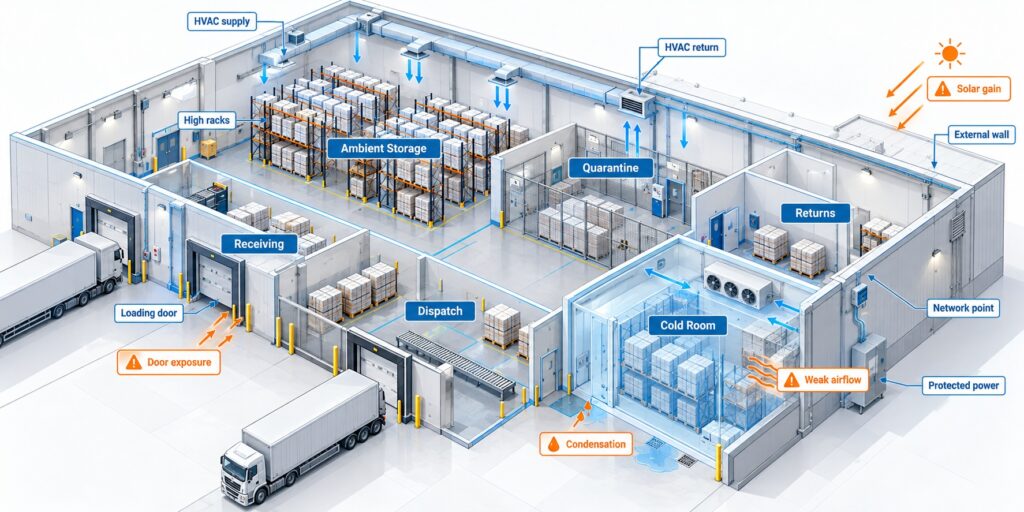
Pre-deployment survey points for a GxP pharmaceutical warehouse monitoring project
Start with storage regimes rather than device counts. Separate ambient storage, controlled-temperature rooms, refrigerated or frozen areas, quarantine stock, returns, sampling areas, receiving docks, dispatch lanes, and temporary staging. For each zone, record the approved temperature range, whether relative humidity is a formal requirement or an investigative parameter, the expected loading pattern, and any special risks such as freezing, condensation, direct solar gain, or frequent door opening.
The physical survey should document HVAC supply and return points, racking height, mezzanines, external walls and roofs, air curtains, evaporators, defrost cycles, lighting, occupancy, forklift routes, and known areas of weak airflow. The IT survey should document Ethernet availability, WiFi coverage, VLAN and firewall rules, power and backup power, permitted cloud services, API requirements, and whether an on-premises environment is mandatory. A monitoring point is only useful if its sensing, power, communications, record storage, and alarm path all remain available for the intended use.
Before procurement, the URS should also define measurement and upload intervals, outage data retention, alarm limits and delays, alarm acknowledgement and escalation, user roles, calibration traceability, report requirements, record retention, backup and restoration, change control, and validation deliverables. If Part 11 or Annex 11 is in scope, the URS should explicitly identify which electronic records are regulated and which platform functions must be validated. A general IoT dashboard should not be described as compliant simply because it stores sensor data.
Use Temperature Mapping to Select Permanent Monitoring Points
Permanent monitoring points should come from mapping evidence, not a fixed rule such as one sensor per square metre. WHO describes temperature mapping as measuring the three-dimensional distribution of temperature in storage areas, and EU GDP expects mapping under representative conditions before use, with monitoring equipment positioned according to the results. [3,6]
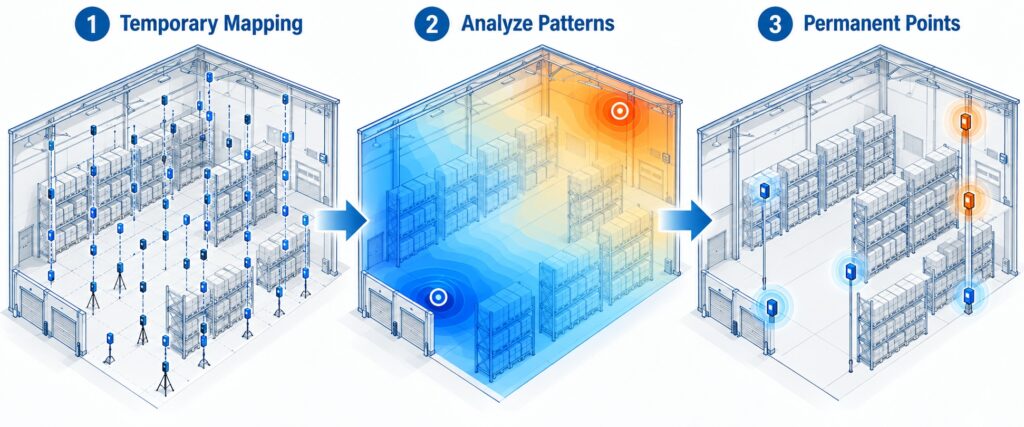
Use mapping evidence to convert temporary study points into permanent monitoring locations
A mapping protocol should define the warehouse configuration, temporary logger positions, study duration, sampling interval, loading condition, season, acceptance criteria, and operating events to be observed. The study should capture normal HVAC cycles, nights and weekends, door openings, refrigeration defrost events, and representative loading. Depending on risk, the study may also test power interruption, restart, an unusually high load, or a door-held-open condition.
Temporary mapping loggers should cover the full length, width, and storage height. High-bay warehouses can develop vertical stratification, while perimeter walls, roofs, dock doors, evaporators, supply-air jets, and weak return-air zones can create repeatable hot or cold locations. Permanent sensors should then be placed at mapped extremes and other independently controlled or operationally critical zones. Evidence determines location; floor area alone does not.
Installation height should follow the actual product-storage envelope. A sensor at eye level can be convenient but irrelevant if stock is stored near the floor and near the roof. Large spaces may require permanent points at more than one height; small rooms can justify fewer points only when mapping demonstrates uniformity. Receiving and dispatch areas should be interpreted separately because short-term exposure to outside conditions may be operationally normal even when long-term storage limits are tighter.
Humidity should be monitored and alarmed when product specifications, packaging, condensation risk, corrosion, mould prevention, HVAC control, or the site risk assessment makes RH relevant. US CGMP language explicitly includes humidity among appropriate storage conditions, but that does not create one universal RH limit for every product. Do not invent a GxP humidity threshold simply because the selected sensor can measure it. [1]
Avoid representative positions directly in supply air, against a warm or cold surface, in direct sunlight, above a heater, immediately beside a dock opening, on the floor, at the roof structure, or where cartons can block airflow. Those locations can be useful diagnostic points when the risk itself is being monitored, but they should not be confused with representative product-storage conditions.
Select Sensors, Probes, Power, and Communication Architecture
The correct device architecture follows from the mapped conditions and intended record use. Compare measurement range, accuracy, calibration options, local memory, power, environmental protection, network topology, alarm workflow, API requirements, and lifecycle maintenance together; a single accuracy number is not enough.
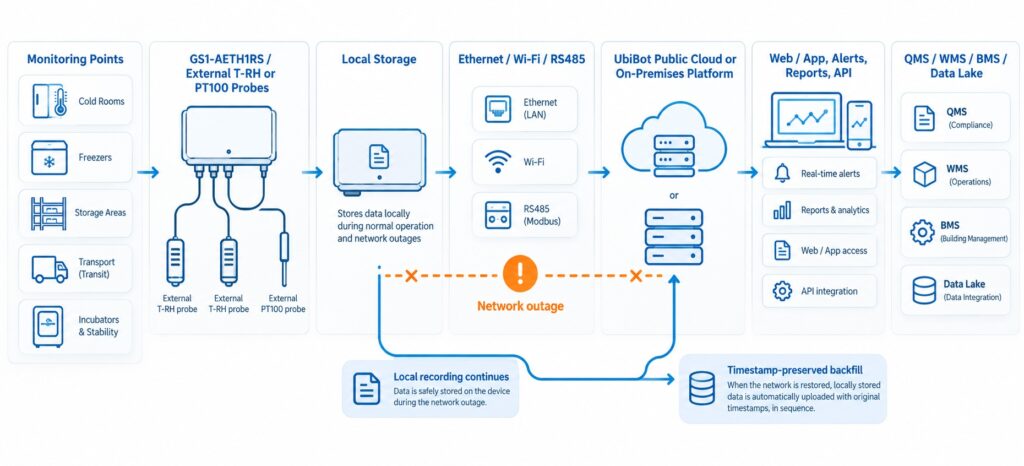
Sensor-to-record architecture for a pharmaceutical warehouse environmental monitoring system
For fixed warehouse monitoring, the UbiBot GS1-AETH1RS combines built-in temperature, humidity and light sensing with 2.4 GHz WiFi, RJ45 Ethernet, selected RS485 external probes, 300,000 local records, a display, and several power options including Type-C, DC 5–12 V, internal battery backup, and optional PoE via splitter. UbiBot lists a built-in temperature range of -20 to 60°C with ±0.2°C accuracy and a humidity operating range of 10 to 90% RH with ±2% RH accuracy. [7]
For an ambient pharmaceutical warehouse, an external T/RH probe can separate the sensing point from the logger and make replacement or protected mounting easier. UbiBot’s TH30S-B publishes a -40 to 80°C temperature range, 0 to 100% RH range, ±0.3°C and ±2% RH accuracy at 25°C and 60% RH, and RS485 Modbus communication. A PT100 option is more appropriate when the project needs temperature-only measurement across a wider range; it should not be selected merely because “PT100” sounds more precise—the actual probe and transmitter specification must be checked. [8]
Ethernet is often the simplest permanent architecture when warehouse network policy allows it. It avoids radio coverage changes caused by racks, metal stock, and building alterations. WiFi can reduce cabling in retrofit projects but should be surveyed with the warehouse loaded and doors in normal positions. RS485 is useful for industrial probes and BMS/PLC integration, but installers must control topology, addressing, baud rate, shielding, termination, and cable routes. Long-range proprietary radio or LoRaWAN can reduce cabling in large sites, but the gateway, frequency plan, coverage, and backhaul become additional validated components. Cellular IoT can simplify remote or independent sites but introduces SIM, coverage, roaming, and data-service dependencies.
Power design is equally important. Fixed monitoring points should normally use protected continuous power where possible, with batteries treated as backup rather than the primary long-term strategy. Commissioning should prove how the sensor, logger, network equipment, gateway if used, platform, and notification path behave during power loss. Backing up one component does not make the monitoring chain resilient.
Install Hardware and Build Data Continuity Into the Network
Installation should produce the same physical and digital result at every point. Standard brackets, labels, cable protection, photographs, device naming, and approved configuration templates reduce later maintenance errors and make audit review much easier.

Correct and biased sensor installation positions in pharmaceutical warehouse storage areas
Mount the sensing element where free air can circulate and where the location matches the approved mapping report. Protect external cables from pallets, forklifts, cleaning equipment, condensation, and accidental removal. Use drip loops where moisture can travel along a cable. If a point intentionally monitors a door, evaporator, or other risk source, label it as a diagnostic point so users do not interpret it as the warehouse average.
For Ethernet installations, assign switch ports, network segment, IP method, DNS requirements, outbound firewall rules, and cybersecurity approval before field installation. For WiFi, record the approved SSID, security method, expected signal level, and recovery behavior. For RS485, record the sensor address and serial number at the physical point and in the platform. Device names should map directly to the warehouse hierarchy—for example, Site-Building-Zone-Rack-Height—rather than using only a serial number.
Data continuity needs a deliberate outage test. Disconnect the network long enough to prove that the field device continues recording locally, then restore communication and confirm that records are backfilled with their original timestamps. UbiBot publishes 300,000 records of local storage for GS1-AETH1RS; this is useful, but the project still needs to verify how long that capacity lasts at the approved sampling interval and how recovered data are handled by the platform. [7]
Changes after installation also need control. New racking, a partition, HVAC rebalancing, changed dock use, a new refrigeration unit, firmware updates, or replacement probes can invalidate the original assumptions. The maintenance process should define which changes require engineering review, re-mapping, requalification, or documented impact assessment.
Configure the IoT Platform Around Alarm and Electronic-Record Workflows
The platform should be configured around the warehouse quality process, not left at default settings. Device groups, sampling and upload intervals, alarm thresholds, escalation routes, user roles, reporting, integration, and retention rules should be approved before routine use.
Create groups that reflect the controlled organisation: site, building, storage regime, zone, rack or room, and responsibility. Use the same point identifier on the physical label, mapping drawing, calibration record, alarm matrix, and software channel. This simple master-data discipline prevents a common audit problem: correct measurements that cannot be unambiguously tied to the correct physical location.
Sampling should be fast enough to detect a meaningful excursion without creating unnecessary noise. Upload frequency may be different from measurement frequency if the architecture supports it. Alarm limits should come from approved product and zone requirements, then be combined with a justified delay, recovery logic, escalation, offline alert, and power-loss alert. A short dock-door event should not be handled like a sustained HVAC failure, but an excessive alarm delay can hide a real excursion.
UbiBot supports App, email, SMS, voice, web and other alert channels, as well as device-offline alerts. Its public platform provides remote data access, while APIs and data forwarding can connect measurements to third-party systems; the on-premises platform supports local deployment, local storage, group/authority management and enterprise API integration. Availability and plan limits should be confirmed for the intended deployment. [9-11]
For regulated electronic records, the key question is not whether a vendor advertises “cloud monitoring,” but whether the configured system and procedures satisfy the applicable requirements. 21 CFR Part 11 requires controls such as system validation, accurate and complete copies, record protection, authorized access, time-stamped audit trails, authority checks, and controlled system documentation when Part 11 applies. EU Annex 11 similarly focuses on lifecycle control of computerised systems. UbiBot should therefore be positioned as monitoring infrastructure whose GxP/Part 11 suitability depends on the selected platform, configuration, validation evidence, procedures, and integration—not as an automatically compliant sensor. [2,4]
If the customer requires electronic signatures, formal audit-trail review, validated workflows, or tightly controlled change approval, those functions must be verified in the chosen system architecture. One valid approach may be to use UbiBot for field sensing and local continuity while forwarding data into a separately validated QMS, historian, or enterprise platform, but that integration itself must be specified, tested, and governed.
Commission, Validate, Maintain, and Scale the Complete System
A plausible temperature value on a dashboard is not acceptance evidence. Commissioning should test the complete path from sensing and power through local storage, network transport, platform processing, alerts, reports, user permissions, and the written response procedure.
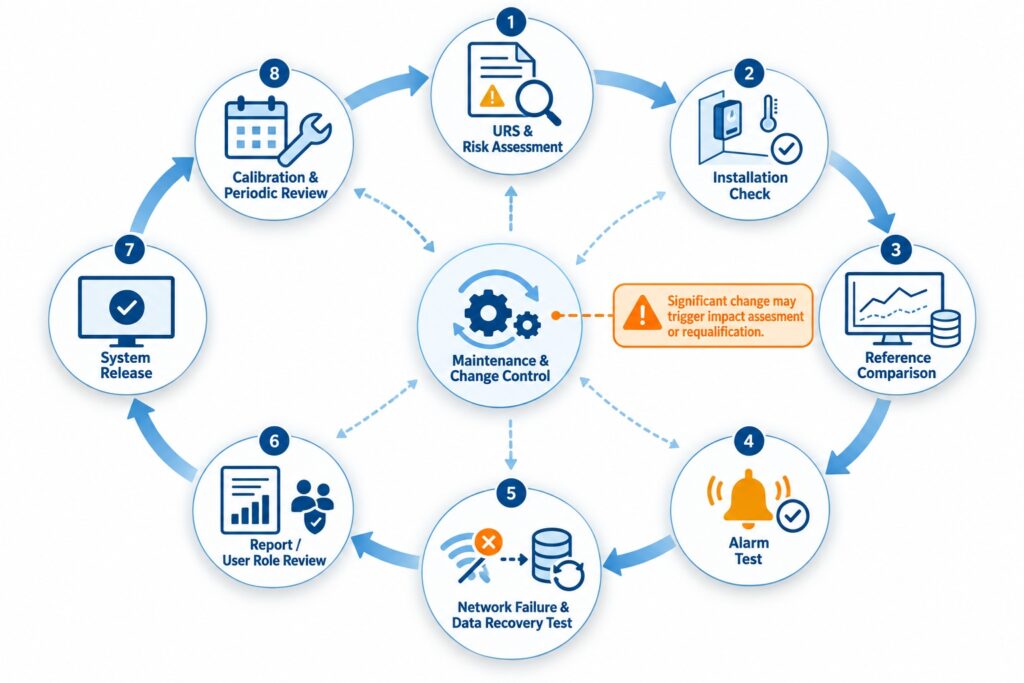
Commissioning and lifecycle control for a GxP warehouse monitoring system
A regulated project normally starts with the URS and risk assessment, then creates traceable evidence that the installed configuration meets the approved requirements. Depending on the company quality system, this may include design review, installation qualification, operational qualification, performance verification, alarm challenge tests, backup/restore testing, access-control tests, report review, time synchronization, and traceability from each requirement to the executed test. EU Annex 15 explicitly uses a lifecycle and risk-based approach to qualification and validation. [5]
At commissioning, compare each permanent point with a traceable reference under stable conditions. Record the device and probe serial numbers, reference instrument, certificate status, test points, observed error, acceptance criteria, date, and responsible person. Then challenge high and low alarms, delays, recovery behavior, offline alarms, power loss, and escalation to each responsible role. Interrupt communication and confirm local logging and backfill. Review report timestamps, time zones, units, account permissions, and device replacement behavior.
Routine maintenance should include physical inspection, cleaning, cable and connector checks, battery or backup-power status, communication health, calibration due dates, alarm-contact review, platform subscriptions, storage capacity, and periodic challenge testing. Reassess or repeat mapping after major HVAC work, warehouse expansion, new racking, insulation changes, altered loading patterns, or repeated unexplained excursions.
Scaling should add governance, not just devices. Small warehouses may use a limited number of Ethernet/WiFi monitors and a tightly controlled user group. Large distribution centres need standard naming, zone templates, maintenance dashboards and resilient networks. Multi-site networks need common device kits, permission models, calibration governance, regional network rules, API master data, and change control. The system should be easier to audit at 500 points than at 50—not ten times harder.
| Deployment scale | Typical architecture | Platform approach | Main implementation concern |
|---|---|---|---|
| Small warehouse / controlled room | A limited number of Ethernet/WiFi monitors; external probes where required; local backup. | Public cloud or controlled local deployment with a small user group. | Mapping evidence, correct point placement, alarm ownership. |
| Single large distribution centre | Multiple zones/heights; Ethernet backbone with WiFi/RS485 or qualified long-range wireless where justified. | Central groups, role-based access, alarm templates, automated reports and maintenance tracking. | Network resilience, consistent installation, calibration scheduling, HVAC/racking changes. |
| Multi-site pharmaceutical network | Standard device kit per site; regional network options; controlled API to QMS/WMS/data lake. | Central or on-premises platform with governed master data, permissions and retention rules. | Standardisation while meeting local regulation, cybersecurity, data residency and service response. |
| High-compliance / validated storage | Mapped extremes, calibrated probes, redundancy where justified, qualified power/network architecture. | Validated record environment with backup, restoration, auditability and controlled change. | Traceability from URS through validation, excursion response and periodic review. |
Verified Product Comparison for Pharmaceutical Warehouse Deployment
The systems below represent different deployment models rather than identical devices. Specifications were checked against current official manufacturer pages or data sheets in October 2026. Where a current source does not publish a value, the comparison says so instead of estimating it. Vendor compliance statements are presented as vendor claims and do not replace the customer’s validation of the configured system.
| Comparison item | UbiBot GS1-AETH1RS + TH30S-B | Testo Saveris 1 + testo 150 TUC4 + 0572 2165 | Vaisala viewLinc + RFL100 + HMP115 | ELPRO ECOLOG-PRO 1THGi + elproCLOUD | DicksonOne + DWE2 + RTRH | Rotronic RMS + RMS-LOG-L-D + RMS-HCD-S |
|---|---|---|---|---|---|---|
| Deployment model | Fixed WiFi/Ethernet logger with local memory and RS485 external probe; public or on-premises platform options. | Modular enterprise EMS; T/RH probe connects to TUC4; WLAN, Ethernet or UltraRange options. | Battery wireless logger using VaiNet to AP10 access point and viewLinc. | Direct cellular IoT T/RH logger using LTE-M/NB-IoT to elproCLOUD. | WiFi/Ethernet display logger with replaceable T/RH sensor and DicksonOne cloud. | Ethernet wall data logger with digital T/RH probe and RMS server/cloud. |
| Temperature range | GS1 built-in -20 to 60°C; TH30S-B -40 to 80°C. | Digital T/RH probe -30 to 50°C. | HMP115 -40 to 60°C. | -40 to 70°C. | RTRH -40 to 85°C. | RMS-HCD-S -40 to 85°C. |
| Temperature accuracy | GS1 built-in ±0.2°C; TH30S-B ±0.3°C at 25°C / 60% RH. | ±0.4°C (digital T/RH probe). | ±0.1°C at 15-25°C; ±0.2°C at 0-40°C. | ±0.4°C. | ±0.8°F from 20-120°F; ±1.8°F outside that band. | ±0.1°C at 10-30°C. |
| Humidity range / accuracy | GS1 built-in 10-90% RH, ±2% RH; TH30S-B 0-100% RH, ±2% RH at 25°C / 60% RH. | 0-100% RH; ±2% RH from 0-90% RH. | 0-100% RH; ±1.5% RH from 0-90% RH at 0-40°C. | 0-100% RH; ±2.5% RH from 0-90% RH at 23°C. | 0-95% RH; ±2% RH from 5-95% RH. | 0-100% RH; ±0.8% RH at 10-30°C. |
| Communication | 2.4 GHz WiFi + RJ45 Ethernet; selected RS485 probes; optional PoE splitter. | WLAN, Ethernet or proprietary UltraRange depending module. | VaiNet wireless to AP10; AP10 connects to viewLinc infrastructure. | LTE-M / NB-IoT direct cellular. | 2.4 GHz WiFi or Ethernet. | Ethernet / HTTP / Modbus TCP for RMS-LOG-L-D. |
| Local / offline data | 300,000 sensing records on GS1. | Minimum 16,000 readings per channel for testo 150 TUC4. | Local recording with automatic backfill; manufacturer documents up to 30 days before memory is filled. | 31,000 measurement values. | Approx. 400,000 sample points backup. | 44,000 pairs of measured values. |
| Power / backup | Internal lithium battery plus Type-C, DC 5-12 V; PoE supported with splitter. | 4 x AA batteries or mains option depending configuration. | Battery powered logger. | 2 x AA; published multi-month operation depends on mode and conditions. | AC/DC power with 72-hour average battery backup. | PoE or 24 VDC with internal battery backup. |
| Platform / record controls | UbiBot public cloud or on-premises platform; alerts, history, reports, APIs/data forwarding. Part 11 suitability must be assessed for intended use. | CFR On-Prem option publishes audit trail, ERES/e-signature concept, role controls, alarm escalation and reporting. | viewLinc provides real-time monitoring, alarming, trend data and reporting for GxP-regulated environments; validation packages available. | elproCLOUD; vendor states GAMP 5 validated and 21 CFR Part 11 compliant for xG solution. | DicksonOne offers audit trail, security controls, reports, alarms and vendor guidance for Part 11 support. | RMS offers reporting, alarm notification, audit/validation services, and vendor-stated Part 11 / GAMP 5 support. |
| Calibration / service model | Confirm certificate/traceability for selected GS1 and external probe; platform supports calibration settings. | Digital probe stores calibration/adjustment data; swap without data gaps; Testo offers GxP services. | HMP115 includes calibration certificate; accredited calibration options available. | Pre-calibrated; manufacturer validation and traceable calibration documentation published. | Replaceable sensors; calibration options and NIST/ISO 17025 services available. | Digital probe supports calibration/adjustment; traceable and ISO 17025 calibration services available. |
The comparison shows why procurement should begin with architecture and intended use rather than a brand ranking. UbiBot can reduce infrastructure complexity where Ethernet or approved WiFi already exists and the project values large local memory, RS485 expansion, API access, and optional on-premises deployment. The trade-off is that the customer must define and validate any GxP electronic-record controls that are not natively provided by the selected UbiBot platform configuration.
Testo Saveris 1, Vaisala viewLinc, DicksonOne, and Rotronic RMS are mature regulated-environment ecosystems with dedicated governance, validation, or audit features. They can be a better fit when a global quality organisation wants standardized vendor documentation and service support across many regulated sites. ELPRO ECOLOG-PRO xG takes a different route: direct cellular IoT can avoid local IT infrastructure and is useful for distributed storage, but the current xG workflow is based on elproCLOUD rather than the elproMONITOR software named in the original comparison brief.
The correct choice is therefore not “which sensor is best?” but “which complete sensor-to-record workflow fits this warehouse, its validation burden, its IT governance, and its total lifecycle cost?”
Frequently Asked Questions
How many temperature and humidity sensors does a pharmaceutical warehouse need?
There is no reliable universal number based only on floor area. The number and location should come from a documented mapping study, warehouse geometry, storage height, HVAC layout, door activity, product risk, and the number of independently controlled zones. Permanent monitors should cover mapped hot/cold locations and any operationally critical areas.
Where should permanent sensors be installed after warehouse temperature mapping?
Place them at representative locations that repeatedly show the most significant high and low conditions and in zones that require independent control. The sensing element should have free airflow and should not be directly in supply air, sunlight, against a wall, on the floor, at the roof structure, or where stock can block it unless that location is intentionally monitored as a risk point.
Does a pharmaceutical warehouse always need humidity monitoring?
No. Monitor RH when the product specification, packaging system, regulatory filing, condensation risk, HVAC strategy, or quality risk assessment makes it relevant. If there is no approved humidity limit, do not create one simply because the device can measure humidity.
Is Ethernet better than WiFi for GxP warehouse monitoring?
Ethernet is usually more predictable for permanent fixed points and easier to place on a controlled network. WiFi is valuable for retrofit projects and locations where cabling is impractical, but coverage should be tested with racks loaded and doors closed. The correct design can also include RS485, long-range wireless, or cellular links depending on the site.
What should happen if the network or cloud connection fails?
The field device or local architecture should continue recording for the required outage period, identify the communication problem, and backfill records with original timestamps after communication returns. This behavior should be challenged during commissioning rather than assumed from the specification sheet.
Does an IoT monitoring platform automatically make the system 21 CFR Part 11 compliant?
No. Part 11 applies to regulated electronic records and requires controls for the complete system and its use, including validation, record protection, authorized access, audit trails and electronic signatures where applicable. Platform features can support compliance, but the customer must assess and validate the deployed configuration and procedures.
How often should pharmaceutical warehouse sensors be calibrated?
The interval should be defined in the quality system using regulatory expectations, manufacturer guidance, sensor reliability, historical drift, and risk. Recalibration or accuracy checking is also appropriate after damage, repair, sensor replacement, unexplained drift, or a significant maintenance event.
When should a pharmaceutical warehouse be re-mapped?
Re-mapping or a documented impact assessment should follow changes that can alter environmental distribution, such as major HVAC work, new racking, changed loading patterns, insulation changes, warehouse expansion, refrigeration replacement, or repeated unexplained excursions.
A reliable pharmaceutical warehouse deployment begins with storage requirements and mapping evidence, then connects permanent sensor placement, network resilience, alarm governance, electronic-record controls, calibration, validation, and lifecycle maintenance. The correct architecture may be a small group of Ethernet monitors, a proprietary long-range wireless system, a direct cellular IoT network, or a full enterprise EMS. The choice should reflect the regulated use and operating model rather than one headline specification.
For sites that prioritize mixed Ethernet/WiFi connectivity, local data storage, RS485 probe expansion, API access, and optional on-premises deployment, the UbiBot GS1-AETH1RS can provide a practical monitoring foundation. Before any GxP-critical use, the project should confirm the exact probe and calibration package, current hardware revision, platform feature set, integration design, validation evidence, and the organization’s Part 11/Annex 11 requirements.
Product, Platform, and Regulatory Verification Sources
- 21 CFR 211.142 — Warehousing procedures (eCFR). https://www.ecfr.gov/current/title-21/chapter-I/subchapter-C/part-211/subpart-H/section-211.142
- 21 CFR Part 11 — Electronic Records; Electronic Signatures (eCFR). https://www.ecfr.gov/current/title-21/chapter-I/subchapter-A/part-11
- EU Guidelines on Good Distribution Practice of medicinal products for human use (2013/C 343/01). https://health.ec.europa.eu/system/files/2016-11/2013_c343_01_en_0.pdf
- EudraLex Volume 4, Annex 11 — Computerised Systems. https://health.ec.europa.eu/system/files/2016-11/annex11_01-2011_en_0.pdf
- EudraLex Volume 4, Annex 15 — Qualification and Validation. https://health.ec.europa.eu/document/download/7c6c5b3c-4902-46ea-b7ab-7608682fb68d_en?filename=2015-10_annex15.pdf
- WHO — How to temperature map cold chain equipment and storage areas, second edition. https://www.who.int/publications/i/item/9789240042773
- UbiBot GS1 specifications / GS1-AETH1RS official specifications. https://www.ubibot.com/ubibot-gs1-specifications/
- UbiBot TH30S-B Temperature & Humidity Probe official data sheet. https://www.ubibot.com/wp-content/uploads/2021/12/Specifications-TH30S-B-TemperatureHumidity-Probe.pdf
- UbiBot On-Premises Platform. https://www.ubibot.com/on-premises-platform/
- UbiBot alerts documentation. https://support.ubibot.com/hc/en-us/articles/360024111992-How-to-setup-alerts
- UbiBot Platform APIs and data forwarding. https://support.ubibot.com/hc/en-us/articles/360034842312-How-to-get-started-with-Platform-APIs