UBiBot Logo
UBiBot Logo
  • UBiBot Logo
  • Home
  • Products

    NEW

  • Pricing
  • Support
  • About Us
  • Download
  • magnifying-glass  Search
  • magnifying-glass header-close
  • Sign in Sign in
    Public Web Console Public Web Console
    On-Premises App Center On-Premises App Center
  • Home
  • Products

    NEW

  • Pricing
  • Support
  • About us
  • Download
  •  Public Web Console
  •  On-Premises App Center
  • Where to Buy

Learn Hub

Explore Knowledge Academic Research In-depth Tech

Share

LinkedIn

Facebook

X (Twitter)

Newsletter Signup

Table of contents

    How IoT Sensors in Autonomous Supply Chain Systems Create Real-Time Data Layers ?

    Published: October 13, 2026

    Update: October 13, 2026

    By Frank Hill

    Autonomous supply chains are no longer only a planning concept. They are becoming a technical architecture in which distributed actors, digital systems, and physical-world data work together to support faster decisions. The central question is not only how products move from supplier to wholesaler, retailer, and logistics provider. The more important question is how each digital participant knows what is happening to the product while that movement is taking place.

    A 2024 Computers in Industry paper, “On implementing autonomous supply chains: A multi-agent system approach,” provides a useful example. The University of Cambridge and Fetch.ai research team developed an agent-based autonomous supply chain prototype, or A2SC, using a multi-agent system. The case study focused on a meat supply chain, where agents represented supply chain participants and coordinated procurement, replenishment, logistics service selection, delivery monitoring, and evaluation.
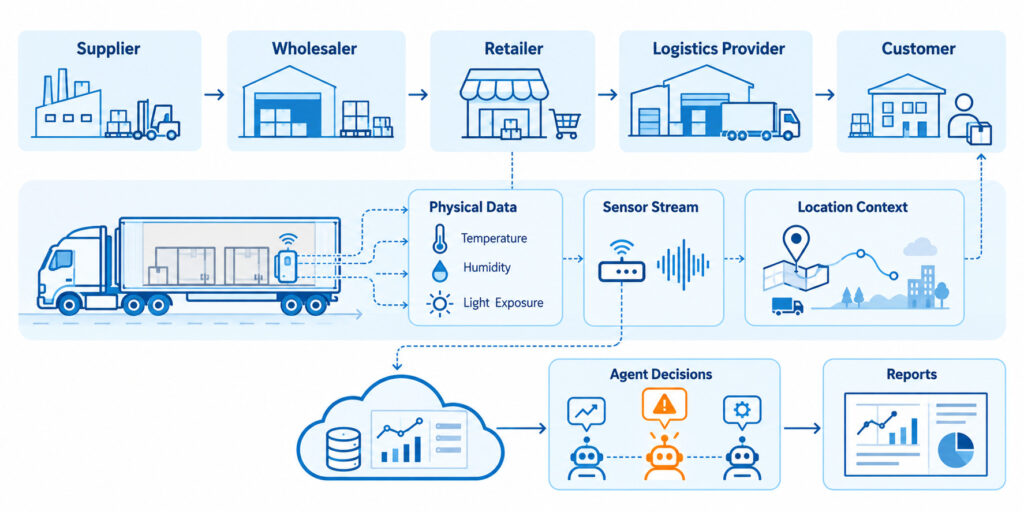
    Technical infographic showing IoT sensors feeding temperature, humidity, light, and location data into an autonomous supply chain sensing layer.

    Autonomous supply chains need more than order, inventory, and GPS milestones; they need physical condition data from IoT sensors.


    Learn More

    University of Cambridge Study Uses UbiBot WS1 for Perishable Food Supply Chain Monitoring in an Autonomous Supply Chain Prototype

    The technical lesson for logistics and cold chain teams is clear: autonomous supply chain systems require a sensing layer. In the paper, the prototype used UbiBot WS1 as the all-in-one sensor to collect environmental data, while a smartphone GPS app collected location data. The collected dataset included temperature, humidity, light, longitude, latitude, and elevation, captured once every five seconds during the journey. These data points were later used to simulate real-time data capture during delivery monitoring.

    That makes UbiBot WS1 more than a simple temperature and humidity logger in this context. It becomes an example of how an IoT sensor can feed the physical state of a moving shipment into a digital supply chain architecture. The value is not only in recording numbers. The value is in making temperature, humidity, light exposure, and location available to the digital layer that coordinates decisions.

    Why Autonomous Supply Chains Need More Than Order Data

    Traditional supply chain systems are strong at recording orders, invoices, purchase quantities, warehouse transactions, and shipment milestones. They are weaker at answering questions about physical exposure. Did the product experience high humidity during transfer? Was it exposed to light? Was the vehicle environment stable during the route? Did conditions change before or after the logistics provider took responsibility?
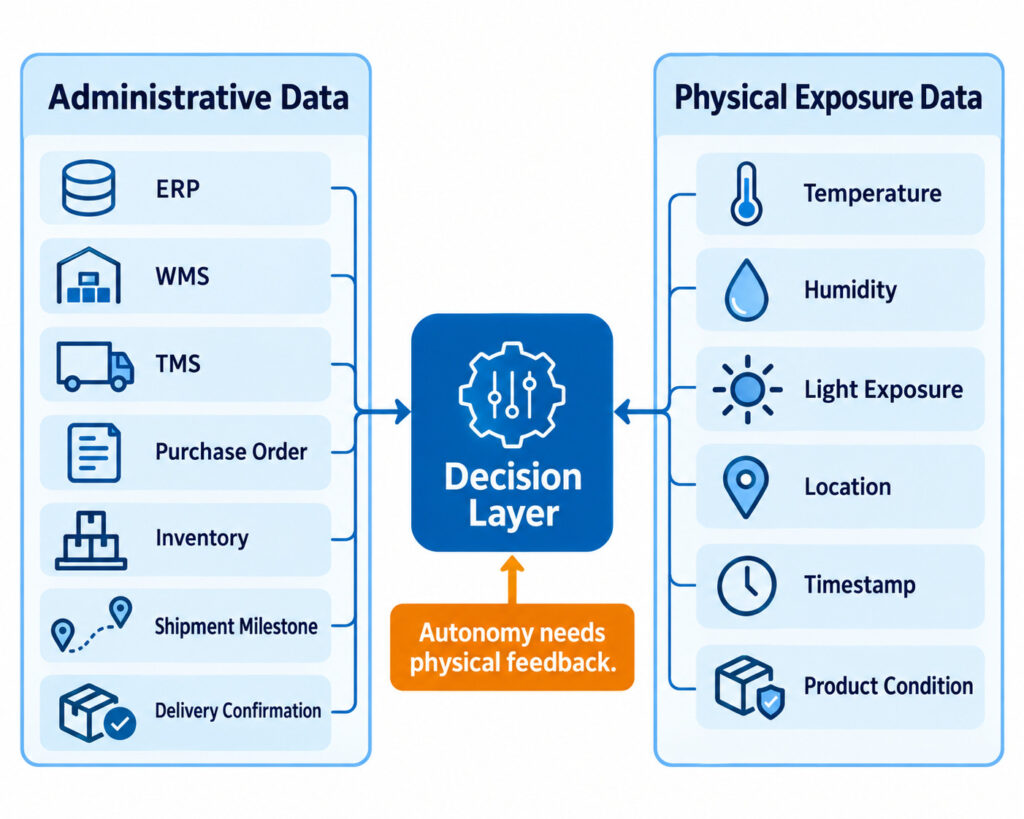
    Comparison infographic showing the difference between administrative supply chain data and physical exposure data from IoT sensors.

    ERP, WMS, TMS, and GPS data describe transactions and movement, while IoT sensors describe product exposure during the journey.

    These questions matter because autonomous supply chain logic depends on feedback from the physical world. A multi-agent system can select suppliers, negotiate orders, assign logistics services, and update delivery progress. But without product-level environmental data, the agents may only be optimizing a digital representation of the transaction, not the real condition of the goods.

    For perishable foods, pharmaceuticals, biologics, specialty chemicals, and humidity-sensitive materials, the physical environment is part of product quality. Temperature, humidity, and light exposure are not secondary data. They are part of the operational truth that determines whether a shipment stayed within acceptable conditions.

    How the A2SC Prototype Used IoT Data

    The A2SC prototype was designed as a loosely coupled architecture. It combined an agent network with a web-based interface application. The agent network was made of autonomous economic agents, while the interface used RESTful APIs and WebSockets to display real-time system state. The interface included four panels: ordering, logistics monitoring, streaming data, and an agent chat room.
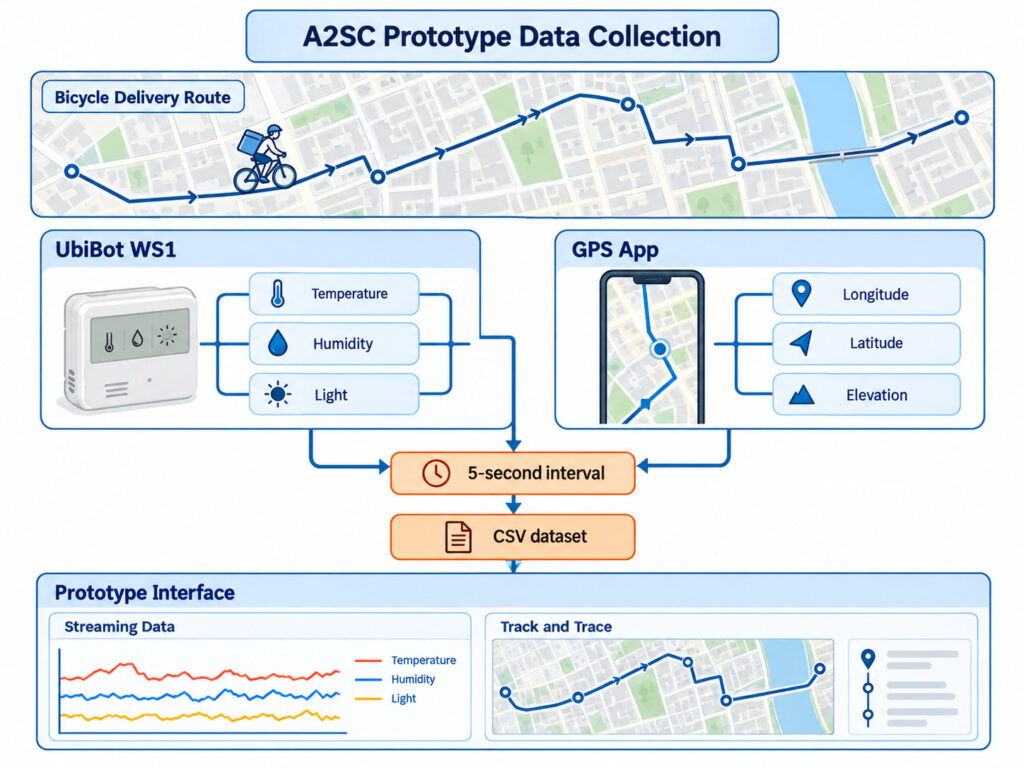
    Diagram explaining the A2SC prototype data collection method using UbiBot WS1 for environmental data and a smartphone GPS app for location data.

    In the A2SC prototype, UbiBot WS1 collected temperature, humidity, and light data, while a smartphone GPS app supplied location data for simulated delivery monitoring.

    The streaming data panel is the most relevant part for IoT monitoring. It displayed real-time charts of ambient conditions during transportation, including temperature, humidity, and lightness. The logistics monitoring panel visualized the real-time track and trace of the vehicle. Together, these panels show how physical movement and environmental exposure can be presented as live operational data.

    Because the research objective was to demonstrate technical methodology rather than build a production-grade refrigerated delivery system, the team used pre-collected IoT and GPS data to simulate real-time delivery monitoring. They selected multiple locations in Cambridge, UK, installed an all-in-one sensor and a smartphone with the myTracks GPS app on a bike, rode between selected locations, captured ambient and location data every five seconds, and saved the calibrated data as CSV files for prototype development.

    The resulting data stream contained two key layers. The first was the environmental layer: temperature, humidity, and light collected by UbiBot WS1. The second was the geolocation layer: longitude, latitude, and elevation collected by the smartphone GPS app. In an autonomous supply chain, these two layers can jointly describe what happened, where it happened, and when it happened.

    The Technical Principle: Sensors Become the Supply Chain Sensing Layer

    The sensing layer is the bridge between real-world product movement and the multi-agent digital system. In a multi-agent supply chain, each agent may represent an organization, role, or function, such as a supplier, wholesaler, retailer, logistics agent, 3PL provider, or administrator. These agents exchange messages, negotiate tasks, and coordinate actions.
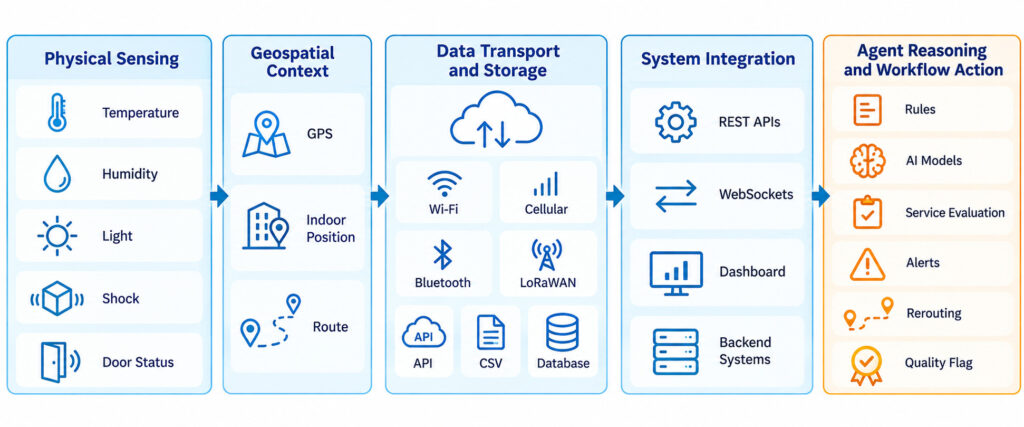
    A practical sensing layer connects physical sensors, geospatial context, data transport, system integration, and agent reasoning.

    For this kind of system, IoT sensor data can serve three technical functions. First, it provides observation. The system can observe environmental conditions during delivery rather than assume that conditions are acceptable. Second, it provides context. If a delay or delivery exception occurs, the environmental data helps explain whether the product was exposed to additional risk. Third, it provides evidence. After delivery, the data can be summarized in reports to evaluate service quality or compare logistics options.

    This is why IoT sensors in autonomous supply chain systems should not be treated as isolated devices. Their main value is architectural. They make the physical product flow visible to the digital decision layer. When temperature, humidity, light, and location data are timestamped and structured, they can become inputs for dashboards, reports, rule-based decisions, AI models, service-level evaluation, and future autonomous actions.

    How UbiBot WS1 Compares with Other IoT Sensors for Autonomous Supply Chain Data Layers

    The right sensor depends on the data-layer role. A technology-and-principles article should not claim that one product is universally best. Instead, it should compare how different devices support the sensing layer of an autonomous supply chain. UbiBot WS1, Sensitech TempTale GEO APX Global, Onset HOBO MX1104, and T&D TR-72nw represent four different approaches: cloud-connected environment sensing, enterprise shipment visibility, Bluetooth local data logging, and fixed-site Ethernet monitoring.

    Product Data Types Connectivity / Access Best Fit in ASC Data Layer Trade-off
    UbiBot WS1 Temperature, humidity, and ambient light; used in the paper as the all-in-one sensor for delivery-environment data. Wi-Fi connection with automatic cloud sync to the UbiBot IoT Platform. Lightweight sensing node for prototype validation, multi-point environmental monitoring, and cloud-connected logistics data layers. No built-in GPS in the cited experiment; location data was paired from a smartphone GPS app.
    Sensitech TempTale GEO APX Global Location, temperature, humidity, light, and optional probe. Real-time transmission to the SensiWatch platform for shipment visibility. Enterprise shipment-level visibility across road, ocean, and rail movements for perishable goods. More specialized for enterprise in-transit monitoring than for flexible research prototyping.
    Onset HOBO MX1104 Temperature, relative humidity, light intensity, and analog channels. Bluetooth access through HOBOconnect on mobile device or Windows laptop within local range. Strong local data-logging option when the priority is capturing environmental variables close to the product. Less aligned with cloud-native real-time agent networks unless paired with additional data-access workflows.
    T&D TR-72nw Two-channel temperature and humidity logging. Wired LAN / USB; automatic upload to T&D WebStorage Service or T&D Data Server. Reliable fixed-site monitoring for warehouses, facilities, equipment rooms, or transfer nodes. Does not capture light or location; less suitable for parcel-level mobile sensing unless the architecture is adapted.

    Why UbiBot WS1 Fits the Paper’s Technical Logic

    UbiBot WS1 fits the A2SC prototype because the paper needed a compact sensor for environmental monitoring during a moving delivery simulation. The prototype did not require a full enterprise shipment-visibility platform. It required temperature, humidity, and light data that could be paired with GPS data and replayed as a real-time stream inside the autonomous supply chain interface.

    This distinction is important. In the paper, GPS was not collected by UbiBot WS1. Location came from a smartphone GPS app. UbiBot WS1 provided the ambient sensing layer, and the smartphone provided the geolocation layer. Together, the two data streams helped simulate delivery monitoring for a meat supply chain.

    For an organization building an early autonomous supply chain proof of concept, this modular approach can be practical. Instead of deploying a complex end-to-end shipment visibility platform first, the team can begin with environmental sensing nodes, GPS data sources, APIs, WebSockets, and agent-based workflows. The architecture can then evolve toward stronger automation and intelligence.

    What Sensitech Adds: Enterprise Shipment Visibility

    Sensitech TempTale GEO APX Global is a strong benchmark when the key requirement is real-time visibility for shipments in transit. It monitors temperature, humidity, light, and location, and sends data to the SensiWatch platform. For perishable food and other high-value logistics operations, this integrated condition-plus-location design is closer to an enterprise shipment visibility layer.

    Compared with UbiBot WS1, Sensitech is more directly aligned with shipment-level monitoring across transport modes. It is a better fit when a company needs a purpose-built in-transit logistics solution with location built into the device ecosystem. UbiBot WS1 is better positioned as a flexible IoT sensing node for environmental monitoring, prototype development, multi-point deployment, and scenarios where GPS can come from another data source.

    What HOBO MX1104 Adds: Local Environmental Data Logging

    Onset HOBO MX1104 is useful when the priority is direct environmental data collection. It measures temperature, relative humidity, light intensity, and analog inputs, and uses Bluetooth for access through HOBOconnect. This makes it a strong option for field studies, audits, and near-range data collection where local access is acceptable.

    For autonomous supply chain systems, however, Bluetooth-only workflows may require additional steps before the data becomes available to real-time agent networks. If the architecture needs cloud sync or continuous backend access, UbiBot WS1 is more naturally aligned with Wi-Fi-based platform connectivity. If the architecture only needs local data retrieval, HOBO MX1104 can be a strong environmental logger.

    What T&D TR-72nw Adds: Fixed-Site Temperature and Humidity Monitoring

    T&D TR-72nw represents a different data-layer pattern. It is a two-channel temperature and humidity logger that connects by wired LAN and can automatically upload recorded data and warning notifications to T&D WebStorage Service or T&D Data Server. This makes it well suited for fixed monitoring points, such as warehouses, storage rooms, equipment rooms, handover nodes, and facility environments.

    For the A2SC paper’s moving meat-delivery scenario, TR-72nw is less directly aligned because it does not capture light or location and is oriented toward LAN-connected logging. However, in a real autonomous supply chain, fixed-site environmental nodes are still important. A complete system may combine mobile sensors in vehicles or packages with fixed sensors at warehouses and transfer points.

    Choosing Sensors by Data-Layer Function

    A practical autonomous supply chain may not use only one type of sensor. It may combine multiple sensor categories depending on where the data is needed. UbiBot WS1 can support cloud-connected temperature, humidity, and light monitoring. Sensitech can support integrated in-transit condition and location visibility. HOBO can support local environmental logging. T&D can support fixed-site temperature and humidity infrastructure.
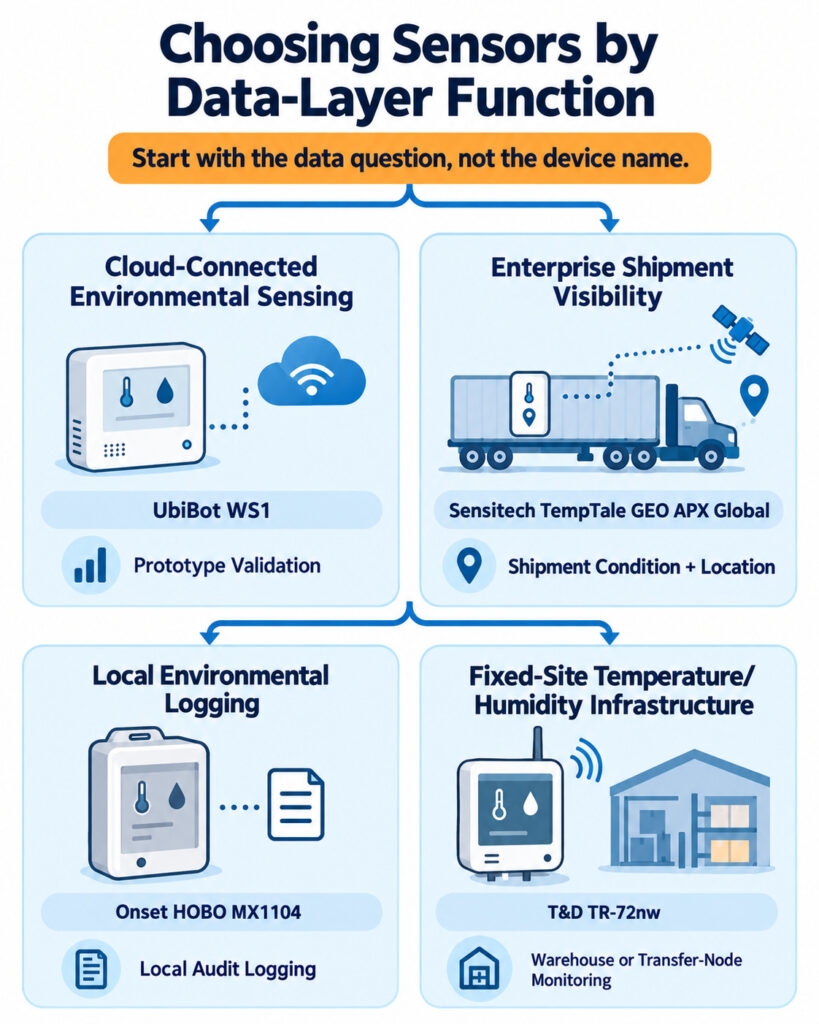
    Decision guide comparing UbiBot WS1, Sensitech TempTale GEO APX Global, Onset HOBO MX1104, and T&D TR-72nw by supply chain data-layer function.

    Sensor selection should start with the data-layer function: cloud-connected sensing, shipment visibility, local logging, or fixed-site monitoring.

    The selection should start with the data question, not the device name. If the system needs to know whether goods were exposed to humidity or light during a route, a sensor with those channels is required. If the system needs to correlate condition with movement, GPS or another location source must be included. If agents need to respond in near real time, the data pathway must support timely transmission to the backend. If the goal is post-delivery audit, local or batch data may be sufficient.

    What This Means for Supply Chain Digitalization

    The A2SC paper demonstrates that autonomous supply chain implementation is not only about artificial intelligence. It also depends on representing physical flow, information flow, and decision flow in a connected architecture. IoT environmental data makes the physical flow more visible.

    For technology teams, the key principle is to design sensor data as part of the system architecture. Sensor readings should be timestamped, structured, and connected to location, orders, agents, and delivery events. When this happens, environmental monitoring becomes more than a compliance or quality-control record. It becomes a real-time data layer for supply chain coordination.

    For business teams, the key benefit is better operational interpretation. A delivery status of “completed” does not automatically mean that product condition was acceptable. A delivery trace combined with temperature, humidity, and light records can show whether the product was transported under expected conditions, where risk occurred, and which logistics provider or handover point was involved.

    For future autonomous supply chains, this is the direction: not isolated dashboards, but connected data layers. IoT sensors, GPS sources, multi-agent systems, APIs, WebSockets, cloud platforms, and reporting tools all need to work together. UbiBot WS1 is one example of a sensing device that can provide environmental data for such a system, especially when paired with other sources such as GPS.

    FAQ

    What are IoT sensors in autonomous supply chain systems?

    They are connected devices that collect physical-world data, such as temperature, humidity, light, and sometimes location, so that digital supply chain systems can observe and respond to real operating conditions.

    Why did the paper use UbiBot WS1?

    The paper used UbiBot WS1 as the all-in-one sensor for collecting temperature, humidity, and light data during a simulated meat-delivery monitoring scenario.

    Did UbiBot WS1 collect GPS data in the paper?

    No. In the cited experiment, GPS data came from a smartphone running the myTracks app, while UbiBot WS1 collected environmental data.

    How often was data captured in the experiment?

    The paper states that ambient-condition and location data were captured once every five seconds during the bike journey used for data preparation.

    Why are temperature, humidity, and light important for autonomous supply chains?

    They describe product exposure. For perishable or sensitive goods, these parameters help determine whether the product experienced conditions that could affect quality or compliance.

    How does Sensitech differ from UbiBot WS1?

    Sensitech TempTale GEO APX Global is more shipment-visibility oriented because it combines condition monitoring with location and platform transmission. UbiBot WS1 is more flexible as a compact Wi-Fi environmental sensing node.

    How does HOBO MX1104 differ from UbiBot WS1?

    HOBO MX1104 is strong for local Bluetooth data logging of temperature, humidity, and light. UbiBot WS1 is more cloud-oriented through Wi-Fi sync to the UbiBot IoT Platform.

    How does T&D TR-72nw differ from UbiBot WS1?

    T&D TR-72nw is better suited to fixed temperature and humidity monitoring via wired LAN, while UbiBot WS1 includes temperature, humidity, and light for more flexible environmental monitoring.

    Can a multi-agent supply chain use several sensor brands?

    Yes. A complete system may combine mobile shipment sensors, fixed warehouse sensors, GPS sources, APIs, and cloud platforms, depending on data needs.

    What is the main technical takeaway?

    The main takeaway is that autonomous supply chains need a real-time sensing layer. IoT sensors make physical product conditions visible to the digital systems that coordinate decisions.

    Source Notes

    1. Research paper: Liming Xu, Stephen Mak, Maria Minaricova, and Alexandra Brintrup, “On implementing autonomous supply chains: A multi-agent system approach,” Computers in Industry 161 (2024) 104120.
    2. Product sources reviewed for the comparison: UbiBot WS1 specifications and product page; Sensitech TempTale GEO APX Global product page and launch material; Onset HOBO MX1104 catalog material; T&D TR-72nw product page.
    3. This article positions UbiBot WS1 according to the paper’s actual use: environmental sensing for temperature, humidity, and light. It does not claim that UbiBot WS1 collected GPS data or independently implemented the multi-agent system.

    Related Resources

    Which Greenhouse Environmental Parameters to Measure?
    How to Deploy a GxP Environmental Monitoring System in a Pharmaceutical Warehouse ?
    What Environmental Parameters Matter Beyond ISO Class in a Cleanroom?
    How to Select Temperature Monitoring Devices for Pharmaceutical Storage and Transport Under USP <1079.3>
    What EN 12830 Means When Selecting a Cold-Chain Temperature Recorder?
    Water Leak Detection for Data Centers and Warehouses
    Commercial Indoor Air Quality Monitors for CO2 PM2.5 TVOC and BMS Integration
    LoRa vs LoRaWAN Environmental Monitoring: Sensors, Gateways, Range, Battery Life and Interoperability
    menu-header-svg
    Search
    • Explore Knowledge
      • Comparison & Selection
      • Industry Solution
      • Product & Device
      • Criterion & Compliance
      • Deployment & Usage
      • Technology & Principle
    • Academic Research
    • In-depth Tech

    Technology & Principle

    See More >>

    How IoT Sensors in Autonomous Supply Chain Systems Create Real-Time Data Layers ?

    Published: October 13, 2026

    Updated: October 13, 2026

    By Frank Hill

    Autonomous supply chains are no longer only a planning concept. They are becoming a technical architecture in which distributed actors, digital systems, and physical-world data work together to support faster decisions. The central question is not only how products move from supplier to wholesaler, retailer, and logistics provider. The more important question is how each digital participant knows what is happening to the product while that movement is taking place.

    A 2024 Computers in Industry paper, “On implementing autonomous supply chains: A multi-agent system approach,” provides a useful example. The University of Cambridge and Fetch.ai research team developed an agent-based autonomous supply chain prototype, or A2SC, using a multi-agent system. The case study focused on a meat supply chain, where agents represented supply chain participants and coordinated procurement, replenishment, logistics service selection, delivery monitoring, and evaluation.

    Technical infographic showing IoT sensors feeding temperature, humidity, light, and location data into an autonomous supply chain sensing layer.

    Autonomous supply chains need more than order, inventory, and GPS milestones; they need physical condition data from IoT sensors.


    Learn More

    University of Cambridge Study Uses UbiBot WS1 for Perishable Food Supply Chain Monitoring in an Autonomous Supply Chain Prototype

    The technical lesson for logistics and cold chain teams is clear: autonomous supply chain systems require a sensing layer. In the paper, the prototype used UbiBot WS1 as the all-in-one sensor to collect environmental data, while a smartphone GPS app collected location data. The collected dataset included temperature, humidity, light, longitude, latitude, and elevation, captured once every five seconds during the journey. These data points were later used to simulate real-time data capture during delivery monitoring.

    That makes UbiBot WS1 more than a simple temperature and humidity logger in this context. It becomes an example of how an IoT sensor can feed the physical state of a moving shipment into a digital supply chain architecture. The value is not only in recording numbers. The value is in making temperature, humidity, light exposure, and location available to the digital layer that coordinates decisions.

    Why Autonomous Supply Chains Need More Than Order Data

    Traditional supply chain systems are strong at recording orders, invoices, purchase quantities, warehouse transactions, and shipment milestones. They are weaker at answering questions about physical exposure. Did the product experience high humidity during transfer? Was it exposed to light? Was the vehicle environment stable during the route? Did conditions change before or after the logistics provider took responsibility?

    Comparison infographic showing the difference between administrative supply chain data and physical exposure data from IoT sensors.

    ERP, WMS, TMS, and GPS data describe transactions and movement, while IoT sensors describe product exposure during the journey.

    These questions matter because autonomous supply chain logic depends on feedback from the physical world. A multi-agent system can select suppliers, negotiate orders, assign logistics services, and update delivery progress. But without product-level environmental data, the agents may only be optimizing a digital representation of the transaction, not the real condition of the goods.

    For perishable foods, pharmaceuticals, biologics, specialty chemicals, and humidity-sensitive materials, the physical environment is part of product quality. Temperature, humidity, and light exposure are not secondary data. They are part of the operational truth that determines whether a shipment stayed within acceptable conditions.

    How the A2SC Prototype Used IoT Data

    The A2SC prototype was designed as a loosely coupled architecture. It combined an agent network with a web-based interface application. The agent network was made of autonomous economic agents, while the interface used RESTful APIs and WebSockets to display real-time system state. The interface included four panels: ordering, logistics monitoring, streaming data, and an agent chat room.

    Diagram explaining the A2SC prototype data collection method using UbiBot WS1 for environmental data and a smartphone GPS app for location data.

    In the A2SC prototype, UbiBot WS1 collected temperature, humidity, and light data, while a smartphone GPS app supplied location data for simulated delivery monitoring.

    The streaming data panel is the most relevant part for IoT monitoring. It displayed real-time charts of ambient conditions during transportation, including temperature, humidity, and lightness. The logistics monitoring panel visualized the real-time track and trace of the vehicle. Together, these panels show how physical movement and environmental exposure can be presented as live operational data.

    Because the research objective was to demonstrate technical methodology rather than build a production-grade refrigerated delivery system, the team used pre-collected IoT and GPS data to simulate real-time delivery monitoring. They selected multiple locations in Cambridge, UK, installed an all-in-one sensor and a smartphone with the myTracks GPS app on a bike, rode between selected locations, captured ambient and location data every five seconds, and saved the calibrated data as CSV files for prototype development.

    The resulting data stream contained two key layers. The first was the environmental layer: temperature, humidity, and light collected by UbiBot WS1. The second was the geolocation layer: longitude, latitude, and elevation collected by the smartphone GPS app. In an autonomous supply chain, these two layers can jointly describe what happened, where it happened, and when it happened.

    The Technical Principle: Sensors Become the Supply Chain Sensing Layer

    The sensing layer is the bridge between real-world product movement and the multi-agent digital system. In a multi-agent supply chain, each agent may represent an organization, role, or function, such as a supplier, wholesaler, retailer, logistics agent, 3PL provider, or administrator. These agents exchange messages, negotiate tasks, and coordinate actions.

    A practical sensing layer connects physical sensors, geospatial context, data transport, system integration, and agent reasoning.

    For this kind of system, IoT sensor data can serve three technical functions. First, it provides observation. The system can observe environmental conditions during delivery rather than assume that conditions are acceptable. Second, it provides context. If a delay or delivery exception occurs, the environmental data helps explain whether the product was exposed to additional risk. Third, it provides evidence. After delivery, the data can be summarized in reports to evaluate service quality or compare logistics options.

    This is why IoT sensors in autonomous supply chain systems should not be treated as isolated devices. Their main value is architectural. They make the physical product flow visible to the digital decision layer. When temperature, humidity, light, and location data are timestamped and structured, they can become inputs for dashboards, reports, rule-based decisions, AI models, service-level evaluation, and future autonomous actions.

    How UbiBot WS1 Compares with Other IoT Sensors for Autonomous Supply Chain Data Layers

    The right sensor depends on the data-layer role. A technology-and-principles article should not claim that one product is universally best. Instead, it should compare how different devices support the sensing layer of an autonomous supply chain. UbiBot WS1, Sensitech TempTale GEO APX Global, Onset HOBO MX1104, and T&D TR-72nw represent four different approaches: cloud-connected environment sensing, enterprise shipment visibility, Bluetooth local data logging, and fixed-site Ethernet monitoring.

    Product Data Types Connectivity / Access Best Fit in ASC Data Layer Trade-off
    UbiBot WS1 Temperature, humidity, and ambient light; used in the paper as the all-in-one sensor for delivery-environment data. Wi-Fi connection with automatic cloud sync to the UbiBot IoT Platform. Lightweight sensing node for prototype validation, multi-point environmental monitoring, and cloud-connected logistics data layers. No built-in GPS in the cited experiment; location data was paired from a smartphone GPS app.
    Sensitech TempTale GEO APX Global Location, temperature, humidity, light, and optional probe. Real-time transmission to the SensiWatch platform for shipment visibility. Enterprise shipment-level visibility across road, ocean, and rail movements for perishable goods. More specialized for enterprise in-transit monitoring than for flexible research prototyping.
    Onset HOBO MX1104 Temperature, relative humidity, light intensity, and analog channels. Bluetooth access through HOBOconnect on mobile device or Windows laptop within local range. Strong local data-logging option when the priority is capturing environmental variables close to the product. Less aligned with cloud-native real-time agent networks unless paired with additional data-access workflows.
    T&D TR-72nw Two-channel temperature and humidity logging. Wired LAN / USB; automatic upload to T&D WebStorage Service or T&D Data Server. Reliable fixed-site monitoring for warehouses, facilities, equipment rooms, or transfer nodes. Does not capture light or location; less suitable for parcel-level mobile sensing unless the architecture is adapted.

    Why UbiBot WS1 Fits the Paper’s Technical Logic

    UbiBot WS1 fits the A2SC prototype because the paper needed a compact sensor for environmental monitoring during a moving delivery simulation. The prototype did not require a full enterprise shipment-visibility platform. It required temperature, humidity, and light data that could be paired with GPS data and replayed as a real-time stream inside the autonomous supply chain interface.

    This distinction is important. In the paper, GPS was not collected by UbiBot WS1. Location came from a smartphone GPS app. UbiBot WS1 provided the ambient sensing layer, and the smartphone provided the geolocation layer. Together, the two data streams helped simulate delivery monitoring for a meat supply chain.

    For an organization building an early autonomous supply chain proof of concept, this modular approach can be practical. Instead of deploying a complex end-to-end shipment visibility platform first, the team can begin with environmental sensing nodes, GPS data sources, APIs, WebSockets, and agent-based workflows. The architecture can then evolve toward stronger automation and intelligence.

    What Sensitech Adds: Enterprise Shipment Visibility

    Sensitech TempTale GEO APX Global is a strong benchmark when the key requirement is real-time visibility for shipments in transit. It monitors temperature, humidity, light, and location, and sends data to the SensiWatch platform. For perishable food and other high-value logistics operations, this integrated condition-plus-location design is closer to an enterprise shipment visibility layer.

    Compared with UbiBot WS1, Sensitech is more directly aligned with shipment-level monitoring across transport modes. It is a better fit when a company needs a purpose-built in-transit logistics solution with location built into the device ecosystem. UbiBot WS1 is better positioned as a flexible IoT sensing node for environmental monitoring, prototype development, multi-point deployment, and scenarios where GPS can come from another data source.

    What HOBO MX1104 Adds: Local Environmental Data Logging

    Onset HOBO MX1104 is useful when the priority is direct environmental data collection. It measures temperature, relative humidity, light intensity, and analog inputs, and uses Bluetooth for access through HOBOconnect. This makes it a strong option for field studies, audits, and near-range data collection where local access is acceptable.

    For autonomous supply chain systems, however, Bluetooth-only workflows may require additional steps before the data becomes available to real-time agent networks. If the architecture needs cloud sync or continuous backend access, UbiBot WS1 is more naturally aligned with Wi-Fi-based platform connectivity. If the architecture only needs local data retrieval, HOBO MX1104 can be a strong environmental logger.

    What T&D TR-72nw Adds: Fixed-Site Temperature and Humidity Monitoring

    T&D TR-72nw represents a different data-layer pattern. It is a two-channel temperature and humidity logger that connects by wired LAN and can automatically upload recorded data and warning notifications to T&D WebStorage Service or T&D Data Server. This makes it well suited for fixed monitoring points, such as warehouses, storage rooms, equipment rooms, handover nodes, and facility environments.

    For the A2SC paper’s moving meat-delivery scenario, TR-72nw is less directly aligned because it does not capture light or location and is oriented toward LAN-connected logging. However, in a real autonomous supply chain, fixed-site environmental nodes are still important. A complete system may combine mobile sensors in vehicles or packages with fixed sensors at warehouses and transfer points.

    Choosing Sensors by Data-Layer Function

    A practical autonomous supply chain may not use only one type of sensor. It may combine multiple sensor categories depending on where the data is needed. UbiBot WS1 can support cloud-connected temperature, humidity, and light monitoring. Sensitech can support integrated in-transit condition and location visibility. HOBO can support local environmental logging. T&D can support fixed-site temperature and humidity infrastructure.

    Decision guide comparing UbiBot WS1, Sensitech TempTale GEO APX Global, Onset HOBO MX1104, and T&D TR-72nw by supply chain data-layer function.

    Sensor selection should start with the data-layer function: cloud-connected sensing, shipment visibility, local logging, or fixed-site monitoring.

    The selection should start with the data question, not the device name. If the system needs to know whether goods were exposed to humidity or light during a route, a sensor with those channels is required. If the system needs to correlate condition with movement, GPS or another location source must be included. If agents need to respond in near real time, the data pathway must support timely transmission to the backend. If the goal is post-delivery audit, local or batch data may be sufficient.

    What This Means for Supply Chain Digitalization

    The A2SC paper demonstrates that autonomous supply chain implementation is not only about artificial intelligence. It also depends on representing physical flow, information flow, and decision flow in a connected architecture. IoT environmental data makes the physical flow more visible.

    For technology teams, the key principle is to design sensor data as part of the system architecture. Sensor readings should be timestamped, structured, and connected to location, orders, agents, and delivery events. When this happens, environmental monitoring becomes more than a compliance or quality-control record. It becomes a real-time data layer for supply chain coordination.

    For business teams, the key benefit is better operational interpretation. A delivery status of “completed” does not automatically mean that product condition was acceptable. A delivery trace combined with temperature, humidity, and light records can show whether the product was transported under expected conditions, where risk occurred, and which logistics provider or handover point was involved.

    For future autonomous supply chains, this is the direction: not isolated dashboards, but connected data layers. IoT sensors, GPS sources, multi-agent systems, APIs, WebSockets, cloud platforms, and reporting tools all need to work together. UbiBot WS1 is one example of a sensing device that can provide environmental data for such a system, especially when paired with other sources such as GPS.

    FAQ

    What are IoT sensors in autonomous supply chain systems?

    They are connected devices that collect physical-world data, such as temperature, humidity, light, and sometimes location, so that digital supply chain systems can observe and respond to real operating conditions.

    Why did the paper use UbiBot WS1?

    The paper used UbiBot WS1 as the all-in-one sensor for collecting temperature, humidity, and light data during a simulated meat-delivery monitoring scenario.

    Did UbiBot WS1 collect GPS data in the paper?

    No. In the cited experiment, GPS data came from a smartphone running the myTracks app, while UbiBot WS1 collected environmental data.

    How often was data captured in the experiment?

    The paper states that ambient-condition and location data were captured once every five seconds during the bike journey used for data preparation.

    Why are temperature, humidity, and light important for autonomous supply chains?

    They describe product exposure. For perishable or sensitive goods, these parameters help determine whether the product experienced conditions that could affect quality or compliance.

    How does Sensitech differ from UbiBot WS1?

    Sensitech TempTale GEO APX Global is more shipment-visibility oriented because it combines condition monitoring with location and platform transmission. UbiBot WS1 is more flexible as a compact Wi-Fi environmental sensing node.

    How does HOBO MX1104 differ from UbiBot WS1?

    HOBO MX1104 is strong for local Bluetooth data logging of temperature, humidity, and light. UbiBot WS1 is more cloud-oriented through Wi-Fi sync to the UbiBot IoT Platform.

    How does T&D TR-72nw differ from UbiBot WS1?

    T&D TR-72nw is better suited to fixed temperature and humidity monitoring via wired LAN, while UbiBot WS1 includes temperature, humidity, and light for more flexible environmental monitoring.

    Can a multi-agent supply chain use several sensor brands?

    Yes. A complete system may combine mobile shipment sensors, fixed warehouse sensors, GPS sources, APIs, and cloud platforms, depending on data needs.

    What is the main technical takeaway?

    The main takeaway is that autonomous supply chains need a real-time sensing layer. IoT sensors make physical product conditions visible to the digital systems that coordinate decisions.

    Source Notes

    1. Research paper: Liming Xu, Stephen Mak, Maria Minaricova, and Alexandra Brintrup, “On implementing autonomous supply chains: A multi-agent system approach,” Computers in Industry 161 (2024) 104120.
    2. Product sources reviewed for the comparison: UbiBot WS1 specifications and product page; Sensitech TempTale GEO APX Global product page and launch material; Onset HOBO MX1104 catalog material; T&D TR-72nw product page.
    3. This article positions UbiBot WS1 according to the paper’s actual use: environmental sensing for temperature, humidity, and light. It does not claim that UbiBot WS1 collected GPS data or independently implemented the multi-agent system.

    分享

    LinkedIn2

    Facebook2

    X

    Newsletter Signup

    Related Resources

    Which Greenhouse Environmental Parameters to Measure?
    How to Deploy a GxP Environmental Monitoring System in a Pharmaceutical Warehouse ?
    What Environmental Parameters Matter Beyond ISO Class in a Cleanroom?
    How to Select Temperature Monitoring Devices for Pharmaceutical Storage and Transport Under USP <1079.3>
    What EN 12830 Means When Selecting a Cold-Chain Temperature Recorder?
    Water Leak Detection for Data Centers and Warehouses
    Commercial Indoor Air Quality Monitors for CO2 PM2.5 TVOC and BMS Integration
    LoRa vs LoRaWAN Environmental Monitoring: Sensors, Gateways, Range, Battery Life and Interoperability
    menu-header-svg
    Search
    • Explore Knowledge
      • Comparison & Selection
      • Industry Solution
      • Product & Device
      • Criterion & Compliance
      • Deployment & Usage
      • Technology & Principle
    • Academic Research
    • In-depth Tech
    Enter Your Information

    Confirm

    Products

    Dashboards

    Support

    Purchase

    Company

    Smart Sensing

    UbiBot Web Console

    APP Download

    UbiBot Online Store

    News

    Smart Control

    UbiBot Space

    Product Docs & APIs

    Find Distributors

    Learn Hub

    Smart Video

    UbiBot On-Premises

    Helpdesk & FAQ

    Volume Pricing

    About Us

    LoRa Products

    Agency Web Console

    Video Center

    Contact Us

    Software & Platform


    Pricing


    Architecture

    External Sensors


    System Status

    Accessories


    Become a Distributor

    Global SIM


    Become an Affiliate

    Positioning System


    Products

    Dashboards

    Business Partners

    WS1

    UbiBot Web Console

    Volume Pricing

    WS1 Pro

    UbiBot Space

    Become a Distributor

    GS1

    UbiBot Support Desk

    Affiliates

    GS2

    Agency Web Console


    MS1


    SP1


    Accessories


    Docs

    Purchase

    Company

    Platform API

    Pricing

    News

    Q&A

    UbiBot Partners

    About us

    Privacy Policy

    Online Store

    Contact

    Terms of Service


    System Status

    Products

    Dashboards

    Smart Sensing

    UbiBot Web Console

    Smart Control

    UbiBot Space

    Smart Video

    UbiBot On-Premises

    LoRa Products

    Agency Web Console

    Software & Platform


    External Sensors


    Accessories


    Global SIM


    Positioning System


    Support

    Purchase

    APP Download

    UbiBot Online Store

    Product Docs & APIs

    Find Distributors

    Helpdesk & FAQ

    Volume Pricing

    Video Center


    Pricing


    Company

    News

    Learn Hub

    About Us

    Contact Us

    Architecture

    System Status

    Become a Distributor

    Become an Affiliate

    Language:
    English 日本語 (ベータ)  
    Language:

    English

    日本語 (ベータ)


    IoT Product Family:
    ubibotico     Wireless environmental sensing products and smart building solutions
    ubitrackico     UWB-based real-time indoor tracking solutions with 30cm accuracy

    IoT Product Family:

    ubibotico  Wireless environmental sensing products and smart building solutions
    ubitrackico  UWB-based real-time indoor tracking solutions with 30cm accuracy

    © 2013-2026 UbiBot.com. All rights reserved.

    Terms of Service | Privacy Policy | Compliance

    youtube facebook twitter