

.svg)
University of Amsterdam Study Uses UbiBot WS1 to Monitor Indoor Environment During a COVID-19 Social Distancing Art Fair Experiment
Published: August 10, 2026
Update: September 1, 2026
By Allen Lee
Research Overview
| Paper Title | Smart Distance Lab’s art fair, experimental data on social distancing during the COVID-19 pandemic |
| Publisher | Springer Nature |
| Journey | Scientific Data |
| Publish Time | July 2021; corrected publication 2022 |
| Authors / Institutions | Charlotte C. Tanis, Nina M. Leach, Sandra J. Geiger, Floor H. Nauta, Fabian Dablander, Frenk van Harreveld, Sanne de Wit, and Tessa F. Blanken from the University of Amsterdam; Gerard Kanters, Jop Knoppers, and Diederik A.W. Markus from Centillien B.V.; Rick R.M. Bouten and Quinten H. Oostvogel from Focus Technologies B.V.; Meier J. Boersma and Maya V. van der Steenhoven from Smart Distance Lab |
| UbiBot Product | UbiBot WS1 |
| Data Collected | Indoor temperature, relative humidity, and light intensity |
| Sampling Frequency | Every 5 minutes |
| Research Period | August 28 to August 30, 2020 |
| Application Scenario | Indoor environment monitoring, COVID-19 social distancing research, large-scale behavioural experiment, cultural event safety assessment, multi-modal behavioural dataset construction |
| Original Link | https://doi.org/10.1038/s41597-021-00971-2 |
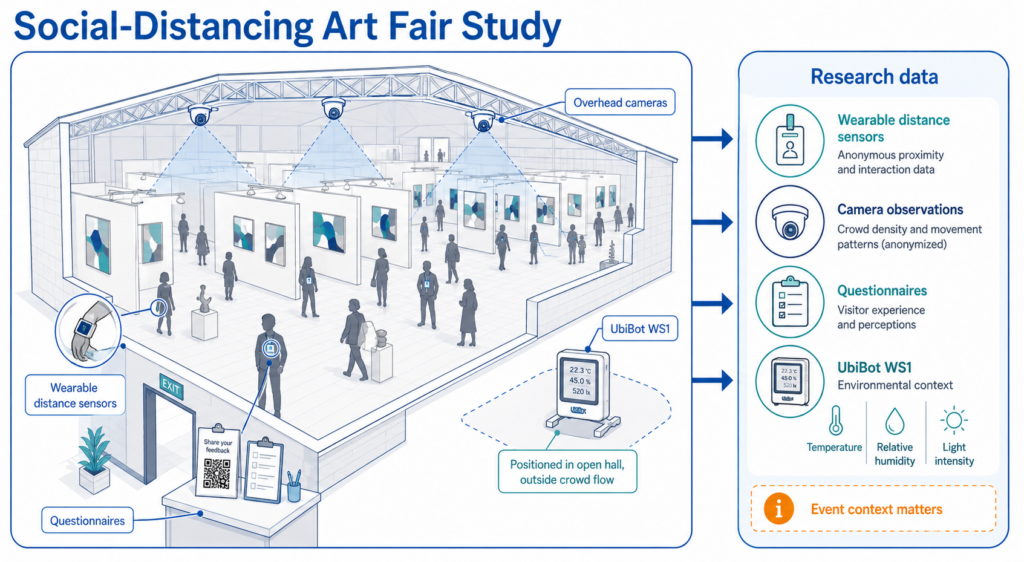
Study overview: UbiBot WS1 recorded indoor temperature, humidity, and light during a COVID-19 social distancing art fair experiment.
Research Background: What Problem Did This Study Address?
During the COVID-19 pandemic, social distancing became one of the most important behavioural measures for reducing virus transmission, especially before vaccines were widely available. Cultural venues, art fairs, theatres, museums, and live events faced a difficult problem: how could people safely attend public events while maintaining sufficient distance from one another?
This study addressed that problem through a large-scale field experiment called Smart Distance Lab: The Art Fair, held in Amsterdam, the Netherlands. Instead of relying only on self-reported behaviour, the research team collected multiple types of data during a real cultural event. These included questionnaire responses, wearable social distancing sensor data, camera-based movement data, and indoor environmental data.
The study tested different behavioural interventions, including walking directions, face masks, and buzzer feedback when visitors came within 1.5 metres of one another. The goal was to create an unprecedented multi-modal dataset that could help researchers understand social distancing behaviour, evaluate behavioural interventions, calibrate pedestrian models, and inform future event-safety studies.
UbiBot WS1 was used in this research to monitor the indoor environment during the art fair. It did not prove whether any behavioural intervention worked by itself. Instead, it collected continuous temperature, humidity, and light data that documented the environmental conditions under which the social distancing experiment took place.
The Specific Role of UbiBot in the Study
In this study, UbiBot WS1 was used as an indoor environmental monitoring device during Smart Distance Lab: The Art Fair. The research team used it to record the physical conditions of the event space while visitor movement, contact, and questionnaire data were collected through other methods.
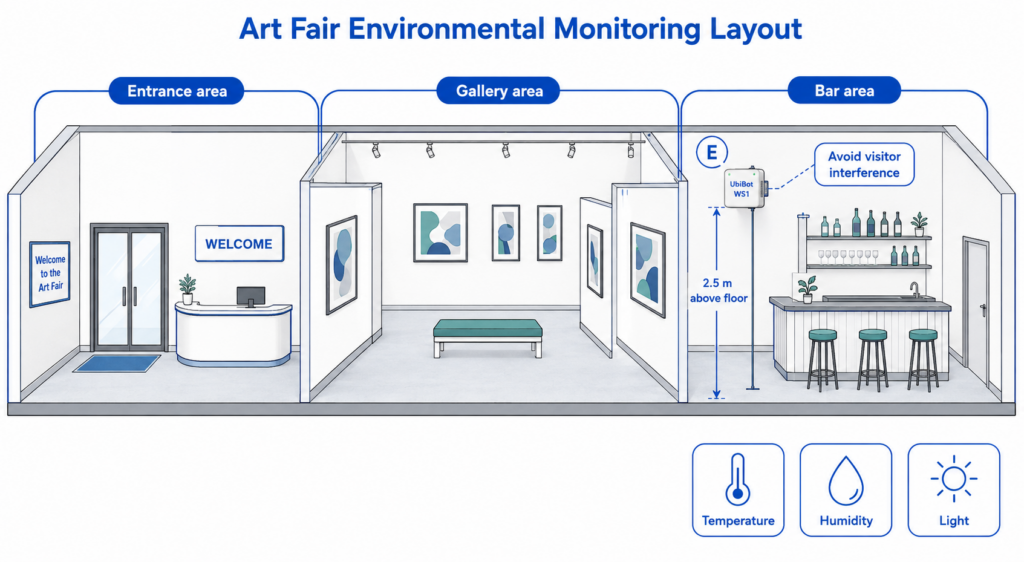
UbiBot WS1 was placed near the bar area at about 2.5 metres above ground level to record indoor conditions.
The art fair was held at the Kromhouthal in Amsterdam from August 28 to 30, 2020. The event space included three main areas: an entrance area of 500 m², a gallery area of 1,080 m², and a bar area of 1,338 m². According to the layout figure in the paper, the indoor environment was measured at the position marked with the red letter “E”, near the bar area of the venue.
The UbiBot WS1 collected three environmental parameters: temperature, relative humidity, and light intensity. The device used its internal sensors for these measurements. The paper reports that the internal temperature sensor had a precision of ±0.3 °C and a range from −20 °C to 60 °C. The humidity sensor had a precision of ±3 RH within a range of 10% to 90% relative humidity. The light sensor had a precision of ±2% within a range of 0.01 to 83K lux.
The environmental conditions were sampled every 5 minutes at an approximate height of 2.5 metres above ground level. This placement helped prevent visitors from accessing or interfering with the device.
The UbiBot data were not used as the primary measure of social distancing. Instead, they formed the environmental layer of the dataset. The social distancing contacts were recorded using wearable Social Distancing Sensors, movement paths were recorded by cameras, and attitudes or experiences were collected through questionnaires. UbiBot complemented these data sources by documenting the indoor conditions during the experiment.
In the final dataset, the environmental data table included timestamp, temperature in degrees Celsius, relative humidity, and light in lux. The reported environmental data ranges were 19.7–28.3 °C for temperature, 46–60% for relative humidity, and 0–626.9 lux for light. These data can be used by researchers to understand the context of the event and to support future analyses that combine behavioural and environmental conditions.
Research Methods and Data Collection Approach
The study was designed as a large-scale behavioural field experiment during an art fair. The researchers varied walking directions and supplementary interventions across time slots during the three-day event.
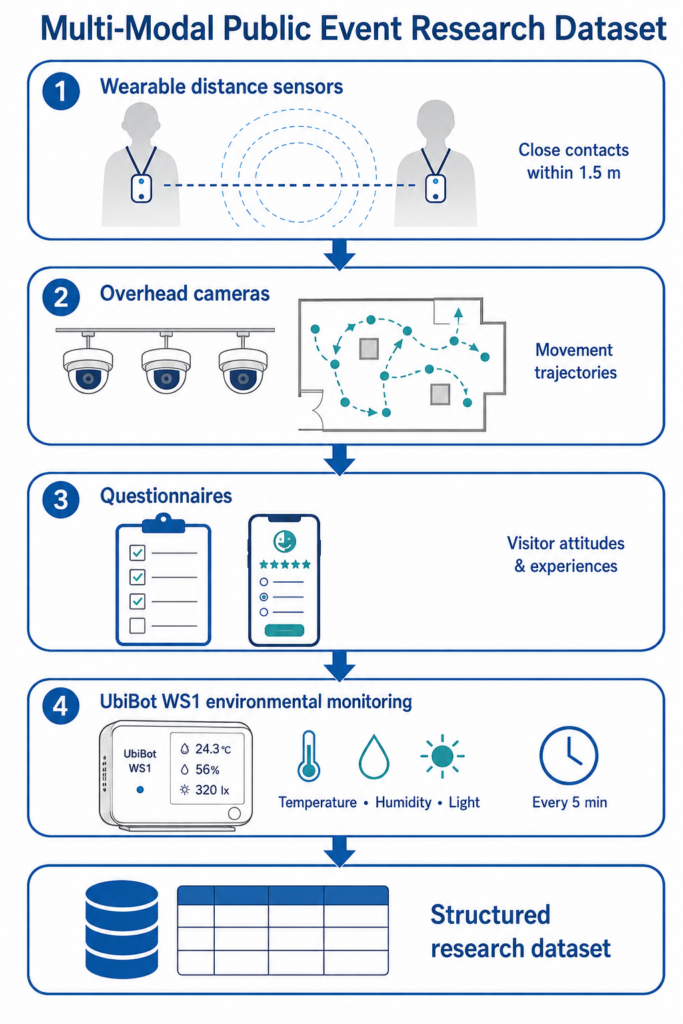
The dataset combined wearable contact data, camera movement data, questionnaires, and UbiBot indoor environmental records.
Three walking-direction conditions were used: bidirectional walking, unidirectional walking, and no walking direction. In the bidirectional and unidirectional conditions, arrows were placed on the floor to guide visitor movement. Supplementary interventions included face masks, buzzer feedback, or no supplementary intervention.
A total of 997 tickets were sold, and 839 visitors entered the fair. Of these, 639 visitors wore wearable Social Distancing Sensors. These sensors used ultra-wideband technology and registered contacts when another sensor was within 1.5 metres. In buzzer conditions, the sensors could alert visitors when they came too close to others.
Camera data were also collected. Six optical cameras were mounted at a height of 12 metres and configured at 640 × 480 pixels to prevent visitor recognition. The cameras recorded visitor movement and supported later construction of movement trajectories.
Questionnaire data were collected before and after the visit. The pre-questionnaire asked about demographics, perceived risk, social norms, knowledge, and attitudes toward distancing rules. The post-questionnaire asked about visitors’ experience during the event, including perceived difficulty of keeping distance, adherence to the 1.5 metre rule, stress, freedom, and whether they wore a face mask.
Indoor environmental data were collected continuously using UbiBot WS1. The device measured temperature, humidity, and light every 5 minutes during the full art fair. These data were stored as part of the public dataset, alongside sensor, camera, and questionnaire data.
Key Research Findings
The paper is a Data Descriptor, so its main contribution is the publication and documentation of a dataset rather than a single causal finding. The authors describe a unique multi-modal dataset on social distancing during a real cultural event held during the COVID-19 pandemic.
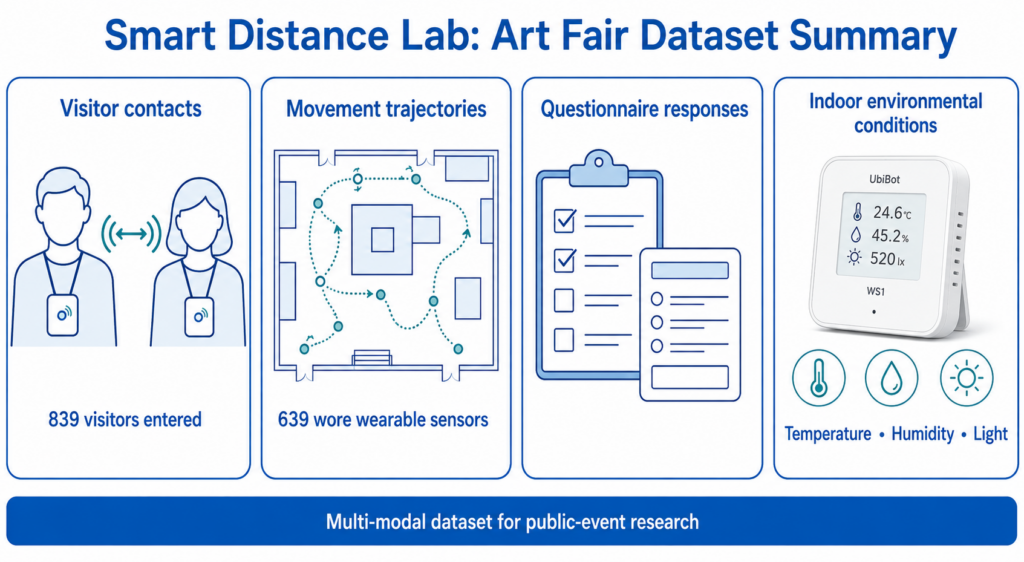
The study published a real-world multi-modal dataset for analysing social distancing behaviour during a cultural event.
The dataset includes several complementary data streams. Wearable sensors recorded close contacts between visitors within 1.5 metres. Camera data captured movement patterns and pedestrian trajectories. Questionnaires recorded psychological variables, including attitudes, risk perception, social norms, adherence, and visitor experience. UbiBot WS1 recorded indoor environmental conditions, including temperature, humidity, and light.
The study also documented the experimental conditions across different time slots. These conditions combined walking-direction interventions with supplementary interventions such as face masks or buzzer feedback. This makes the dataset useful for comparing how behavioural interventions may relate to contact patterns and social distancing behaviour.
The environmental data showed that the indoor temperature during the fair ranged from 19.7 °C to 28.3 °C, relative humidity ranged from 46% to 60%, and light ranged from 0 to 626.9 lux. These environmental records provide context for the behavioural experiment and can support later analyses that account for indoor conditions.
The authors note that the dataset can be used to study attitudes and behaviours during the COVID-19 pandemic, calibrate pedestrian models, validate social distancing measurements, and design future studies on behavioural interventions.
What This Means for Social Distancing and Event Safety Research
This study shows that event-safety research benefits from combining behavioural, spatial, psychological, and environmental data. During a pandemic, it is not enough to ask whether visitors intended to keep distance. Researchers also need to know where people moved, when close contacts occurred, what interventions were in place, and what the indoor environment was like during the event.
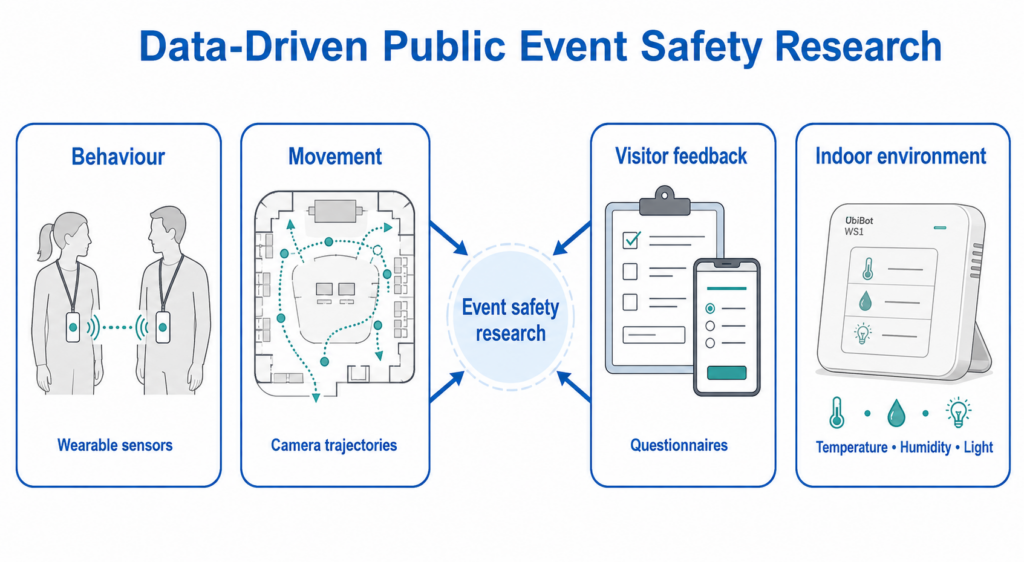
Event-safety research needs behavioural, spatial, psychological, and environmental data together.
For social distancing research, this dataset provides a rare real-world example. Most controlled experiments are conducted in artificial settings, while observational studies often lack intervention control. Smart Distance Lab combined a live event setting with structured experimental conditions.
For cultural venues and event organisers, the study demonstrates a data-driven approach to evaluating public-event safety. Wearable sensors and cameras can describe crowd movement and close-contact patterns, while environmental monitoring provides context about the venue conditions.
For modelling and simulation, the dataset can help calibrate pedestrian models and social distancing models. Environmental data from UbiBot WS1 can be used as part of the event context, especially when comparing conditions across time slots or integrating indoor environment variables into behavioural analyses.
Application Value of UbiBot Devices
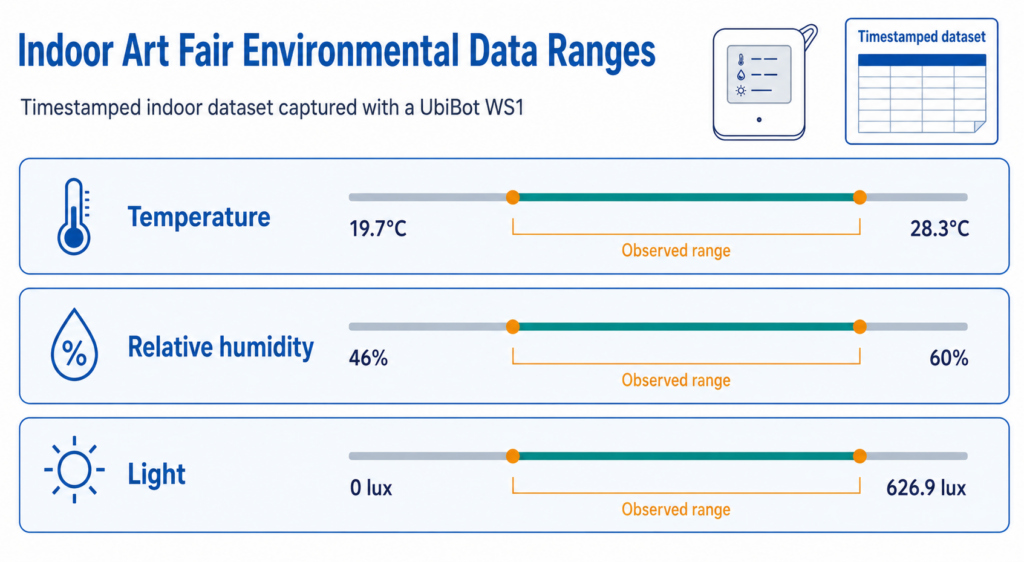
UbiBot documented the physical venue context, with temperature from 19.7°C to 28.3°C, relative humidity from 46% to 60%, and light from 0 to 626.9 lux.
UbiBot WS1 demonstrated practical value as a compact indoor environmental monitoring device in this field experiment.
First, it provided continuous environmental records during a real public event. By measuring temperature, humidity, and light every 5 minutes, UbiBot created a time-stamped indoor environment dataset that could be aligned with behavioural and movement data.
Second, it supported multi-modal research design. The study integrated wearable sensor data, camera trajectories, questionnaire data, and environmental data. UbiBot supplied the environmental component of this integrated dataset.
Third, the device was suitable for unobtrusive deployment. It was placed at an approximate height of 2.5 metres to prevent visitor access, allowing measurements to continue throughout the event without participant interaction.
Fourth, the environmental data helped document the experimental context. When analysing behaviour in real-world settings, temperature, humidity, and lighting conditions may be relevant background variables. UbiBot helped preserve this context for future researchers using the dataset.
Fifth, UbiBot enabled structured data output. The final dataset includes environmental variables such as timestamp, temperature, humidity, and light, making the data usable for later statistical analysis, model calibration, and cross-source data integration.
In this paper, UbiBot’s value lies in environmental recording rather than intervention testing. It helped researchers document the indoor physical conditions under which COVID-19 social distancing behaviour was measured.
Extended Application Scenarios
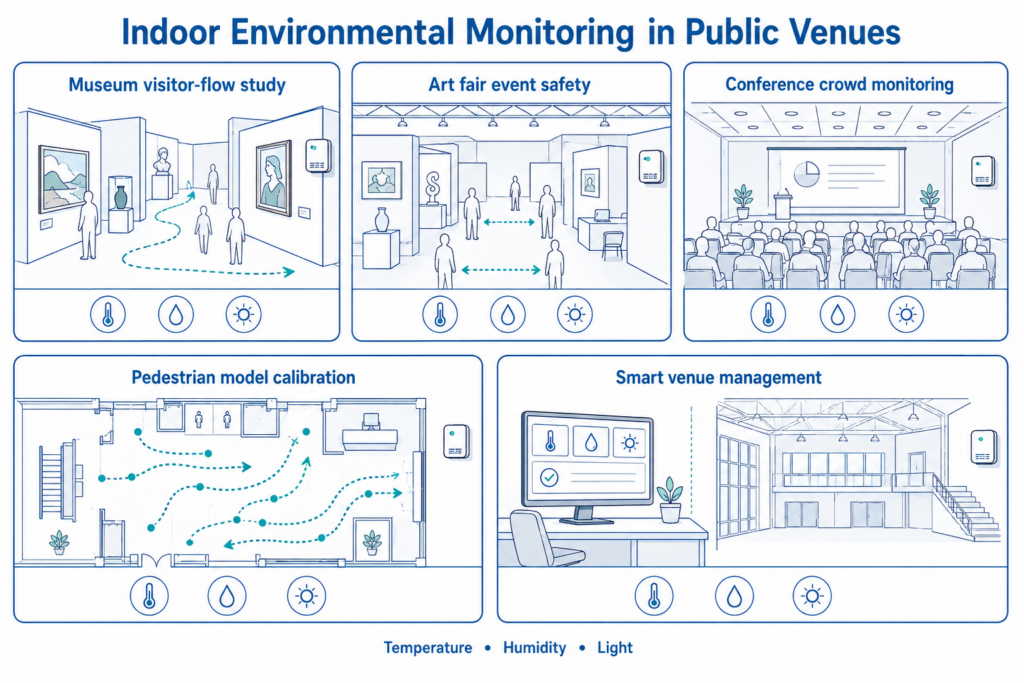
The same monitoring approach can support museum visitor-flow studies, public event safety research, pedestrian model calibration, and smart venue management.
The monitoring approach used in this study can be extended to several scenarios:
- Museum and gallery visitor-flow studies
Used to record indoor environmental conditions while analysing movement and crowding. - Public event safety research
Used to document venue conditions during concerts, exhibitions, fairs, and conferences. - Social distancing and crowd behaviour studies
Used alongside wearable sensors or camera systems to build multi-modal behavioural datasets. - Indoor comfort monitoring
Used to record temperature, humidity, and light during events where visitor comfort may influence behaviour. - Pedestrian model calibration
Used to provide environmental context for movement trajectory and contact-network data. - Smart venue management
Used to monitor physical venue conditions in real time during public gatherings. - Behavioural intervention studies
Used to record environmental background conditions when testing signage, route design, masks, alerts, or other behavioural interventions. - Post-event analytics
Used to combine environmental data with attendance, movement, and feedback data for venue evaluation.
FAQ
1. Which UbiBot product was used in the study?
The study used UbiBot WS1 for indoor environmental monitoring.
2. What data did UbiBot WS1 collect?
UbiBot WS1 collected temperature, relative humidity, and light intensity data.
3. Where was the UbiBot device deployed?
It was deployed inside the Smart Distance Lab art fair venue at the Kromhouthal in Amsterdam. The paper’s layout figure marks the environmental measurement point with the red letter “E”.
4. What was the sampling frequency?
The indoor environmental conditions were sampled every 5 minutes.
5. How long was the monitoring period?
The monitoring was conducted during the full art fair, from August 28 to August 30, 2020.
6. How were the UbiBot data used?
The data formed the environmental layer of the multi-modal dataset. They documented temperature, humidity, and light conditions during the social distancing experiment.
7. Did UbiBot measure social distancing directly?
No. Social distancing contacts were measured by wearable Social Distancing Sensors. UbiBot measured indoor environmental conditions.
8. What other data were collected in the study?
The study collected questionnaire responses, wearable sensor contact data, camera-based movement data, and indoor environmental data.
9. What were the recorded environmental ranges?
The environmental dataset reported temperature from 19.7 °C to 28.3 °C, relative humidity from 46% to 60%, and light from 0 to 626.9 lux.
10. Why is UbiBot relevant to this research?
UbiBot helped document the physical indoor conditions during the behavioural experiment, making the dataset more complete and useful for future analyses of event safety and social distancing behaviour.