

.svg)
Harbin Institute of Technology Uses UbiBot UB-DT-P1 Sensors to Monitor Residential Indoor Temperature in Severe Cold and Cold Regions of China
Published: August 10, 2026
Update: September 1, 2026
By Allen Lee
Research Overview
| Item | Content |
| Paper Title | Overheating of residential buildings in the severe cold and cold regions of China: The gap between building policy and performance |
| Publisher | Elsevier |
| Journey | Building and Environment |
| Publish Time | September 2022 |
| Authors / Institutions | Rui Bo, Yang Yu, Yitong Xu, and Haibo Guo from Harbin Institute of Technology, China; Wen-Shao Chang from the University of Sheffield, UK |
| UbiBot Product | UbiBot UB-DT-P1 (DS18B20) |
| Data Collected | Indoor operative temperature in living rooms, south-facing bedrooms, and north-facing bedrooms |
| Sampling Frequency | Every 5 minutes; the initial data point of each hour was extracted for analysis |
| Research Period | Field monitoring from May 1 to September 30, 2021; simulation extension using 2004–2018 typical meteorological year weather files |
| Application Scenario | Residential overheating assessment, indoor thermal comfort, building performance simulation validation, building policy evaluation, cold-climate housing design |
| Original Link | https://doi.org/10.1016/j.buildenv.2022.109601 |
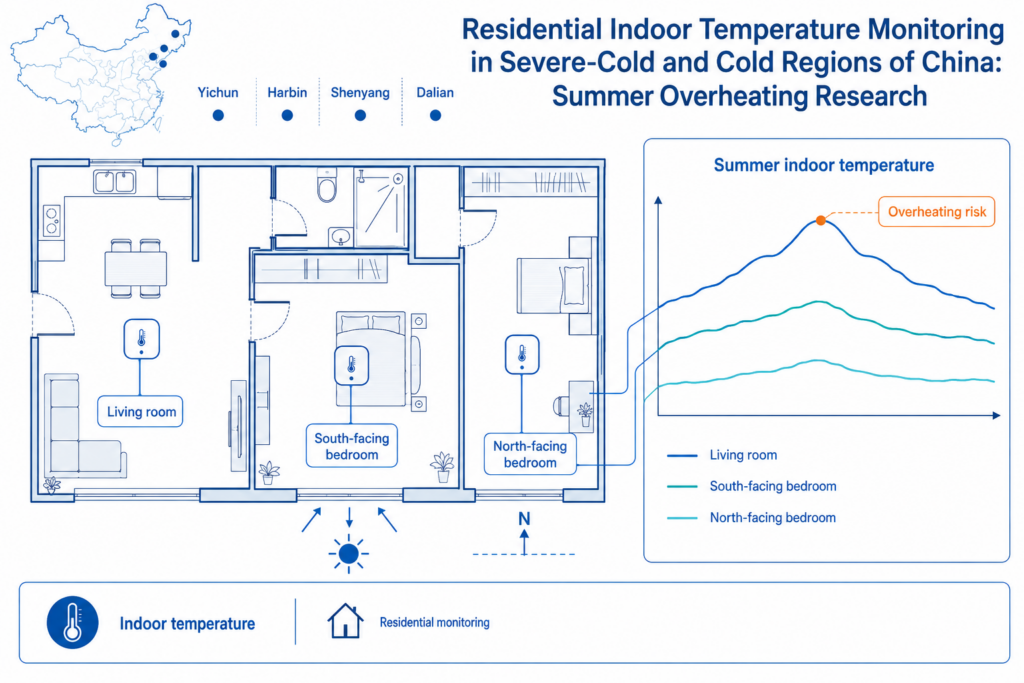
Study overview: UbiBot UB-DT-P1 sensors collected room-level indoor temperature data for residential overheating assessment.
Research Background: What Problem Did This Study Address?
Residential buildings in the severe cold and cold regions of China have traditionally been designed around winter heat retention. This design priority is understandable because cities such as Yichun, Harbin, Shenyang, and Dalian experience long heating seasons and low winter temperatures. As a result, local building standards have focused mainly on insulation, airtightness, and reducing heating demand.
However, climate warming and more frequent summer heat events have changed the performance challenge for these buildings. A dwelling designed to retain heat in winter may also trap heat in summer, especially when natural ventilation is insufficient. This can lead to indoor overheating, affecting sleep quality, thermal comfort, health, and energy demand if residents begin relying more on air-conditioning.
The study examined a gap between building policy and actual building performance. Current Chinese building codes for severe cold and cold regions contain limited requirements for summer heat protection, cooling-load control, shading, or overheating assessment. The authors therefore investigated whether newly built residential buildings in these regions already experience summer overheating, and whether existing policies should be revised.
To support this analysis, the research team combined field measurement with building performance simulation. UbiBot-DS18B20 sensors were used to collect real indoor temperature data in monitored homes. These data were then used to validate IESVE simulation models before extending the analysis with 15 years of typical weather data.
UbiBot- UB-DT-P1 (DS18B20)
The Specific Role of UbiBot UB-DT-P1 Indoor Temperature Monitoring
In this study, UbiBot-DS18B20 sensors were used as field measurement devices to collect real indoor temperature data from residential dwellings. The paper does not present UbiBot as independently proving the overheating conclusion. Instead, the sensors provided empirical indoor temperature records that supported model validation and overheating assessment.
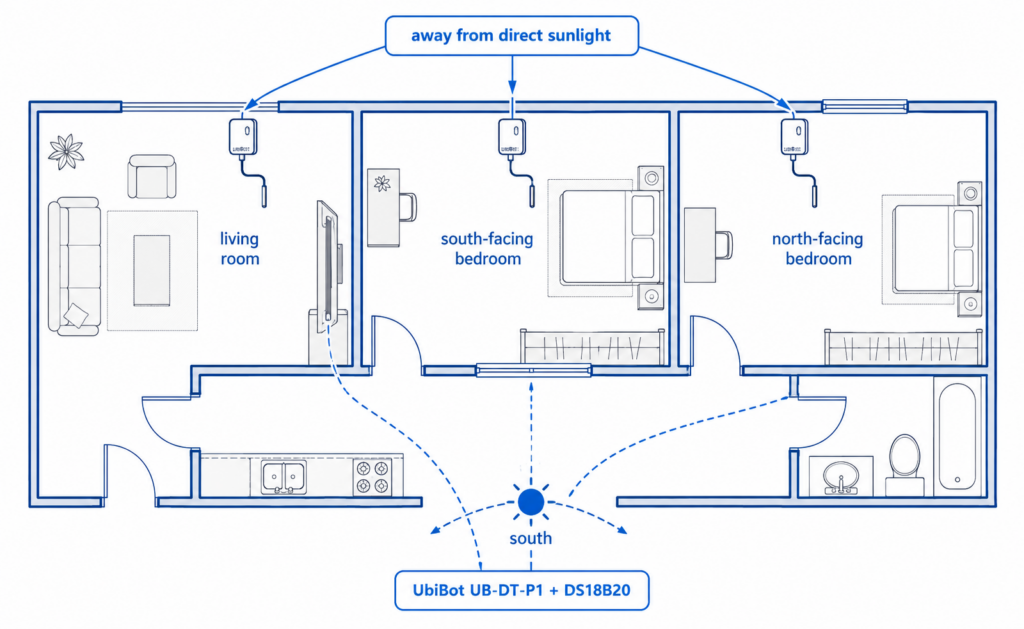
Sensors were placed in living rooms, south-facing bedrooms, and north-facing bedrooms, away from direct sunlight.
The research team selected one newly built reinforced concrete residential dwelling in each of four representative cities: Yichun, Harbin, Shenyang, and Dalian. These cities represent sub-regions IA, IB, IC, and IIA within China’s severe cold and cold climate zones. Each selected dwelling had one south-facing living room and two bedrooms, one facing south and the other facing north.
UbiBot-DS18B20 sensors were installed in the living room, south-facing bedroom, and north-facing bedroom of each monitored dwelling. The paper’s sensor layout figure, using Shenyang as an example, shows the devices placed on interior walls and away from direct sunlight. This deployment reduced distortion from solar radiation and allowed the sensors to record room-level indoor operative temperature.
The sensors collected data every 5 minutes from May 1 to September 30, 2021. The researchers then extracted the initial data point of each hour, producing 3672 hourly temperature datasets for each monitored room across the May-to-September summer period.
The UbiBot data were used in three main ways.
First, the data provided direct empirical evidence of indoor thermal conditions in real occupied dwellings. The researchers used the measured hourly temperatures to assess overheating in living rooms and bedrooms under CIBSE TM59 criteria.
Second, the measured data were used to validate building performance simulations created in IESVE. The team compared measured hourly indoor temperatures with simulated hourly temperatures. The goodness of fit was evaluated using Pearson’s correlation coefficient and root mean square error.
Third, after validation, the simulation models were used with 2004–2018 typical meteorological year weather files to evaluate overheating risk under longer-term typical climate conditions. In this workflow, UbiBot did not replace simulation. It supplied the measured field data that helped make the simulation-based analysis more reliable.
Research Methods and Data Collection Approach
The study combined field monitoring and building performance simulation.
For the field investigation, the researchers selected newly built reinforced concrete residential dwellings in Yichun, Harbin, Shenyang, and Dalian. Each dwelling included a south-facing living room, a south-facing bedroom, and a north-facing bedroom. The rooms were predominantly naturally ventilated during the summer monitoring period. The Dalian dwelling was slightly influenced by air-conditioning on weekends during September, which the paper specifically noted.
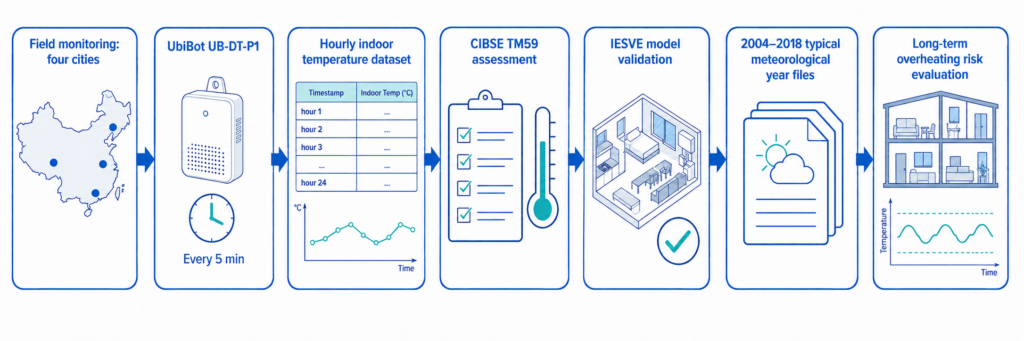
Research workflow from field monitoring to hourly datasets, overheating assessment, simulation validation, and long-term climate analysis.
UbiBot-DS18B20 sensors measured indoor operative temperature in the monitored rooms. The sensors had a measurement range from 10 °C to 55 °C and an accuracy of ±0.3 °C. They uploaded measurement data synchronously through the network. The research team collected temperature readings every 5 minutes and extracted hourly values for analysis.
For simulation, the researchers used IESVE software. The simulation model was based on the monitored dwelling in Shenyang, representing a typical newly built reinforced concrete apartment building in these regions. The model included a south-facing living room, a south-facing bedroom, and a north-facing bedroom. Building envelope parameters such as wall, roof, ground, and window U-values were set according to local standards for each sub-region.
Two types of weather files were used. Locally recorded 2021 weather files were used to produce simulations that could be compared with measured data. Typical meteorological year weather files from 2004 to 2018 were then used to extend the observation period and evaluate typical overheating risk over a longer climate period.
The study used CIBSE TM59 overheating criteria. For living rooms, the adaptive overheating criterion was applied. For bedrooms, the static threshold of 26 °C was applied during sleeping hours from 10 p.m. to 7 a.m. The main metric was hours of exceedance, which counted how long indoor operative temperature exceeded the relevant overheating threshold.
Key Research Findings
The 2021 measured data showed that overheating occurred in all monitored dwellings to varying degrees. The monitored homes did not simultaneously satisfy the CIBSE TM59 requirements for living rooms and bedrooms.
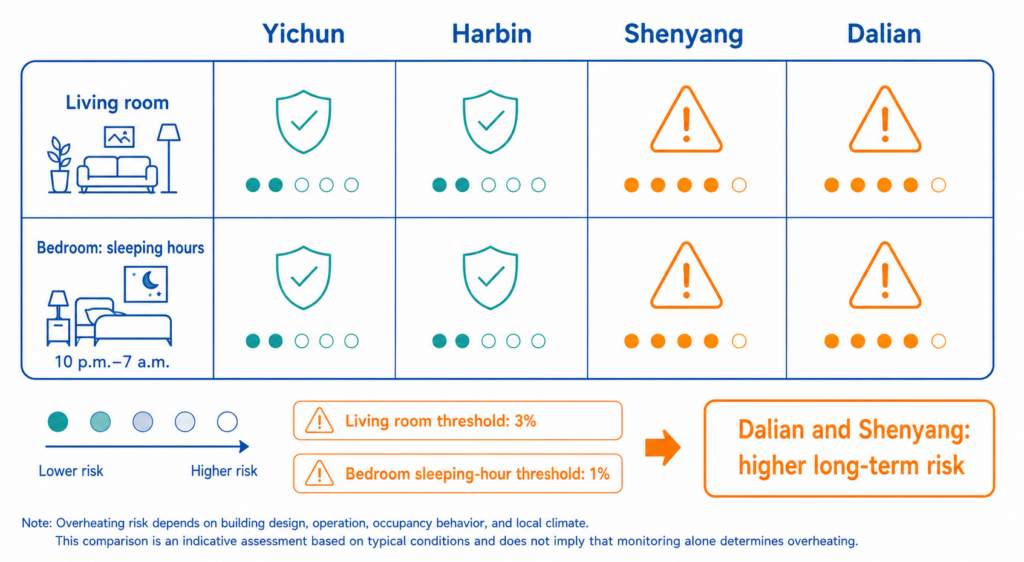
Bedrooms showed higher overheating risk than living rooms, especially during sleeping hours.
Bedrooms were the most problematic spaces. Based on the field monitoring data, bedroom overheating percentages were high across the four cities. On average, bedroom overheating reached 25.4% in Yichun, 39.8% in Harbin, 22.5% in Shenyang, and 50.5% in Dalian, compared with the 1% threshold for sleeping hours. Living-room overheating reached 12.6% in Yichun, 14.6% in Harbin, 5.7% in Shenyang, and 0% in Dalian, compared with the 3% adaptive threshold.
The validation results showed that the measured UbiBot data and IESVE simulation outputs had moderate to strong agreement. For south-facing bedrooms, Pearson’s correlation coefficients ranged from 0.86339 to 0.93099, while RMSE values ranged from 1.19910 °C to 2.02092 °C. This supported the use of the validated simulation models for longer-term analysis.
Using typical meteorological year weather data from 2004 to 2018, the study found that overheating occurred to varying degrees in all four cities. In south-facing bedrooms, overheating was recorded for 6 hours in Yichun, 191 hours in Harbin, 483 hours in Shenyang, and 578 hours in Dalian during the May-to-September period. These accounted for 0.4%, 12.4%, 31.6%, and 37.8% of sleeping-period hours, respectively.
The findings showed a clear climate gradient: overheating risk generally increased from the more northerly severe cold region toward the warmer cold-region city of Dalian. Bedrooms performed worse than living rooms, indicating that night-time thermal comfort and sleep conditions require special attention.
The paper also found a policy gap. Existing Chinese standards focus heavily on winter heat retention and heating-energy reduction, while summer overheating prevention, ventilation design, and solar heat gain control are not sufficiently addressed in severe cold and cold regions.
What This Means for Residential Overheating Assessment
This study suggests that residential overheating in China’s severe cold and cold regions should not be treated as a minor or future-only problem. Field measurements showed that overheating already occurs in real newly built homes, especially in bedrooms during sleeping hours.
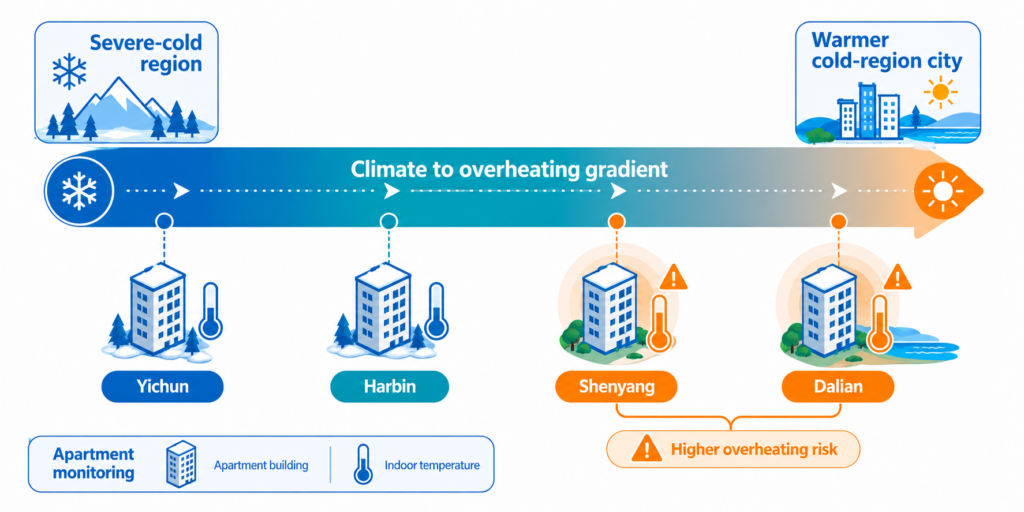
Overheating risk generally increased from the more northerly severe-cold regions toward Dalian.
For building research, the study demonstrates the importance of combining sensor-based monitoring with simulation. UbiBot-DS18B20 data allowed the researchers to compare simulated temperatures with real indoor measurements. Once the models were validated, simulation could be used more confidently to extend the analysis over longer weather periods.
For housing design, the findings indicate that winter-focused energy efficiency may create summer performance risks. Better insulation and airtightness reduce heating demand, but they may also reduce heat dissipation in summer if ventilation, shading, and solar heat gain control are not properly designed.
For policy, the study argues for a balance between winter heat retention and summer overheating prevention. Future standards for these regions may need to include summer ventilation requirements, solar heat gain coefficient limits, shading design guidance, infiltration-rate assumptions, and explicit overheating assessment criteria.
Application Value of UbiBot Devices
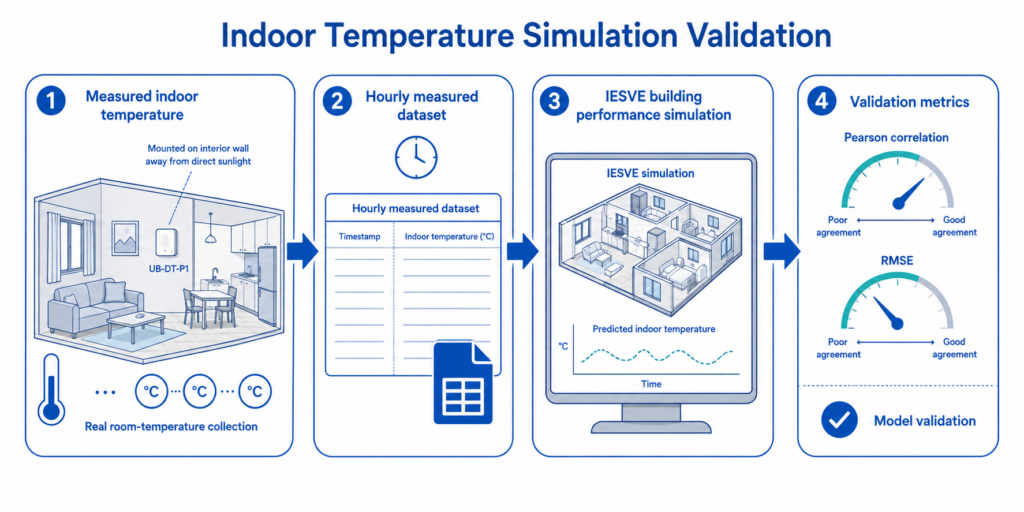
Measured UbiBot data helped validate IESVE simulations before longer-term overheating analysis.
UbiBot-DS18B20 sensors demonstrated practical value by providing continuous, room-level indoor temperature data from real residential buildings.
First, the sensors enabled high-frequency monitoring. By collecting data every 5 minutes, the system captured detailed temperature changes across the entire summer period. These records were then converted into hourly datasets for overheating assessment.
Second, the sensors supported multi-room comparison. By deploying sensors in living rooms, south-facing bedrooms, and north-facing bedrooms, the researchers could compare overheating differences by room function and orientation.
Third, UbiBot data supported simulation validation. The measured temperature records were compared with IESVE simulation outputs, helping the researchers evaluate the model before using it for longer-term overheating analysis.
Fourth, the sensors provided empirical evidence for building policy discussion. Instead of relying only on theoretical simulation, the study used monitored data from actual dwellings in four representative cities.
Fifth, the networked data upload function supported continuous data management. Overheating assessment depends on long-duration time-series records, and UbiBot’s monitoring workflow provided the type of dataset needed for this analysis.
Overall, the value of UbiBot in this study lies in connecting real residential performance with simulation-based overheating analysis and policy evaluation.
Extended Application Scenarios
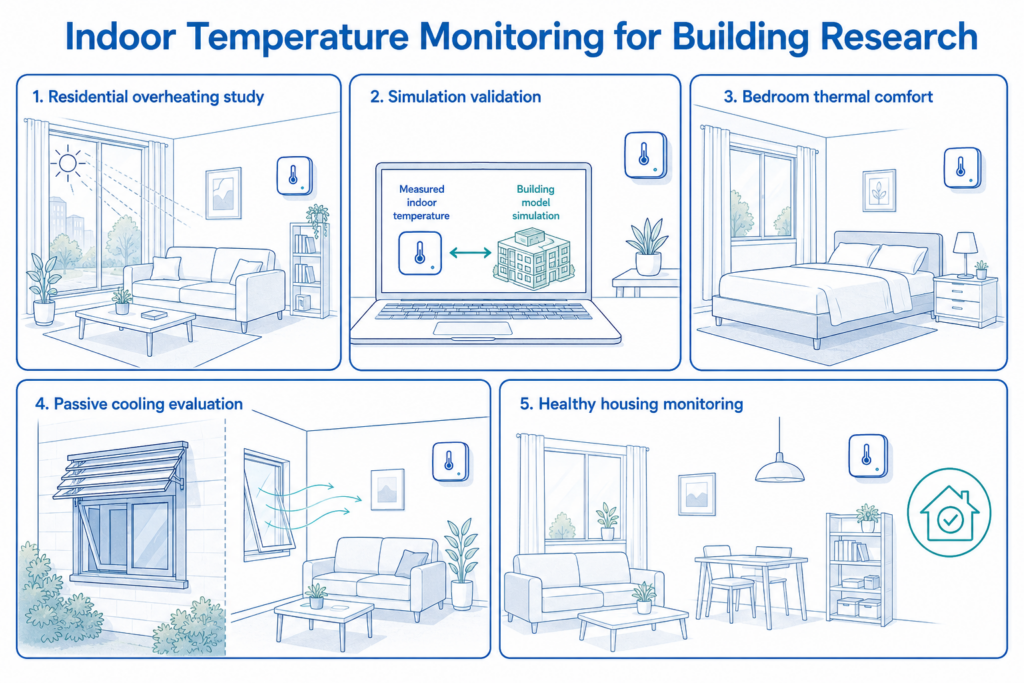
The same monitoring approach can support overheating studies, simulation validation, thermal comfort assessment, passive cooling evaluation, and healthy housing research.
The monitoring approach used in this study can be extended to several related scenarios:
- Residential overheating studies
Used to monitor summer indoor temperatures in apartments, houses, dormitories, and staff housing. - Building performance simulation validation
Used to provide measured data for validating IESVE, EnergyPlus, DesignBuilder, or other simulation tools. - Indoor thermal comfort assessment
Used to compare thermal conditions in bedrooms, living rooms, classrooms, offices, and care facilities. - Passive cooling strategy evaluation
Used before and after applying shading, night ventilation, window-opening strategies, envelope retrofit, or solar-control measures. - Building code and policy research
Used to provide empirical evidence for revising energy-efficiency standards and thermal comfort regulations. - Climate adaptation studies
Used to assess how existing housing stock responds to warming summers and more frequent heatwaves. - Healthy housing evaluation
Used to monitor night-time bedroom temperatures for vulnerable groups such as older adults, children, and people with health risks. - Post-occupancy evaluation
Used after building completion to compare expected thermal performance with actual indoor conditions.
FAQ
1. Which UbiBot product was used in the study?
The study used UbiBot-DS18B20 sensors for indoor temperature monitoring.
2. What data did the UbiBot sensors collect?
The sensors collected indoor operative temperature data in living rooms, south-facing bedrooms, and north-facing bedrooms.
3. Where were the sensors installed?
The sensors were placed on the interior walls of monitored rooms in newly built residential dwellings. They were positioned where direct sunlight could not reach them.
4. What was the sampling frequency?
The sensors collected data every 5 minutes. The researchers then extracted the initial data point of each hour for analysis.
5. How long did field monitoring last?
Field monitoring lasted from May 1 to September 30, 2021.
6. How were the UbiBot data used?
The measured temperature data were used to assess overheating in real dwellings and to validate IESVE building performance simulation models.
7. Did UbiBot prove that homes in cold regions overheat?
No. UbiBot collected real indoor temperature data. The research team used those data together with CIBSE TM59 criteria and validated simulations to analyse overheating risk.
8. Which cities were studied?
The study covered Yichun, Harbin, Shenyang, and Dalian, representing severe cold and cold regions of China.
9. What was the main finding?
The study found that summer overheating occurred in monitored and simulated dwellings, especially in bedrooms. Dalian and Shenyang showed the highest long-term overheating risk among the four cities.
10. Why is this research important for building policy?
It shows that current Chinese standards in severe cold and cold regions focus too heavily on winter heat retention and should also consider summer overheating, ventilation, shading, and solar heat gain control.