
UBiBot Logo
UBiBot Logo
  • UBiBot Logo
  • Home
  • Products

    NEW

  • Pricing
  • Support
  • About Us
  • Download
  • magnifying-glass  Search
  • magnifying-glass header-close
  • Sign in Sign in
    Public Web Console Public Web Console
    On-Premises App Center On-Premises App Center
  • Home
  • Products

    NEW

  • Pricing
  • Support
  • About us
  • Download
  •  Public Web Console
  •  On-Premises App Center
  • Where to Buy

Learn Hub

Explore Knowledge Academic Research In-depth Tech

Share

LinkedIn

Facebook

X (Twitter)

Newsletter Signup

Table of contents

    University of Cambridge Study Uses UbiBot WS1 for Perishable Food Supply Chain Monitoring in an Autonomous Supply Chain Prototype

    Research Overview

    Paper Title On implementing autonomous supply chains: A multi-agent system approach
    Publisher Elsevier
    Journey Computers in Industry
    Publish Time June 2024
    Authors / Institutions Liming Xu, Stephen Mak, and Alexandra Brintrup from the Institute for Manufacturing, Department of Engineering, University of Cambridge; Maria Minaricova from Fetch.ai
    UbiBot Product UbiBot WS1 smart sensor
    Data Collected Temperature, humidity, light, longitude, latitude, and elevation; UbiBot WS1 collected the ambient environmental data, while a smartphone GPS tracking app collected location data
    Sampling Frequency Once every 5 seconds during the data collection journey
    Research Period The exact data collection date is not specified; the collected data were used in the autonomous meat supply chain prototype described in the 2024 paper
    Application Scenario Perishable food logistics monitoring, autonomous supply chain prototype, meat transportation, multi-agent supply chain automation, IoT-based delivery monitoring
    Original Link https://doi.org/10.1016/j.compind.2024.104120

    Research Background: What Problem Did This Study Address?

    Global supply chains have become increasingly vulnerable to disruptions such as trade restrictions, the COVID-19 pandemic, geopolitical conflicts, transportation delays, and limited visibility across distributed business entities. Traditional supply chains still depend heavily on manual coordination, fragmented communication, and isolated digital systems. These limitations make it difficult for companies to respond quickly when supply, logistics, inventory, or delivery conditions change.

    This paper addresses the implementation challenge of autonomous supply chains. An autonomous supply chain is not only a supply chain with digital dashboards or automated single tasks. It requires interconnected processes, autonomous agents, distributed decision-making, and the ability to coordinate material and information flows across multiple organisations.

    The authors focus on how a multi-agent system can be used to implement an agent-based autonomous supply chain, referred to as A2SC. Instead of only discussing the concept theoretically, the paper develops a prototype around an autonomous meat supply chain. Meat is a perishable product, so logistics visibility is critical. Temperature, humidity, light exposure, and location data can help describe the transportation environment and support delivery monitoring.

    In this context, UbiBot WS1 was used during the prototype data preparation stage to collect ambient condition data. These data were later used to simulate real-time IoT monitoring in the autonomous meat supply chain prototype.

    The Specific Role of  UbiBot WS1 Perishable Food Monitoring

    In this study, UbiBot WS1 was used as an IoT environmental sensing device during the data preparation phase of the autonomous meat supply chain prototype. The researchers did not use UbiBot to prove that autonomous supply chains are effective. Instead, they used UbiBot to collect real ambient condition data that could be replayed or simulated as real-time monitoring data during the prototype demonstration.
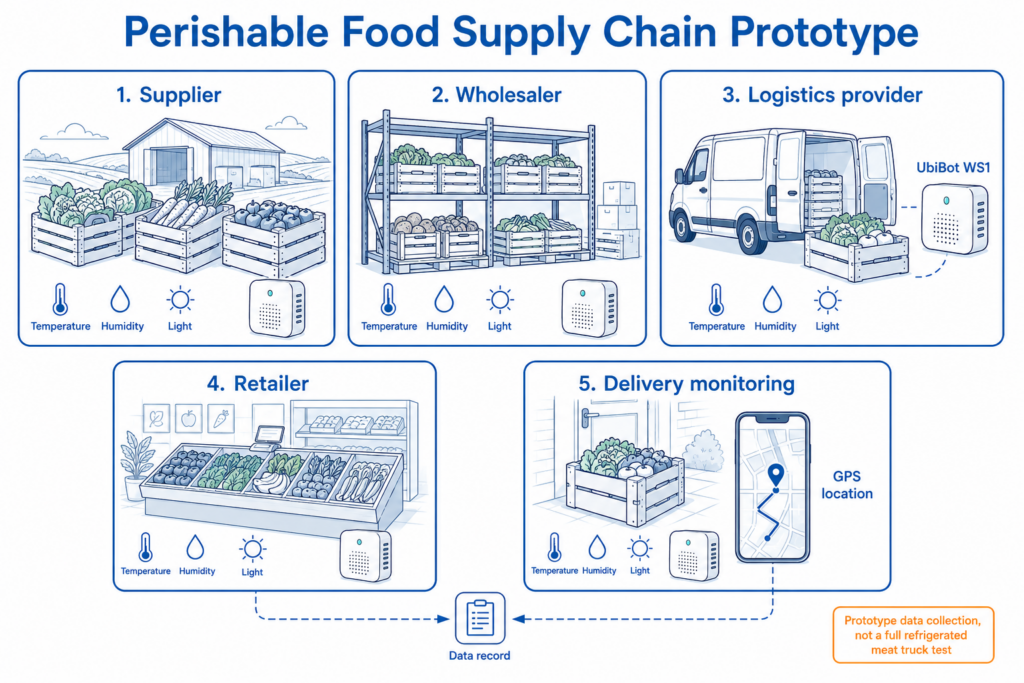
    The case study focused on a simplified autonomous meat supply chain in Cambridge, UK. The prototype involved several supply chain roles represented by software agents: supplier, wholesaler, retailer, logistics provider, third-party logistics provider, and admin agent. Because the case concerned perishable meat transportation, the prototype needed delivery monitoring data, including both vehicle location and the ambient conditions around the goods.

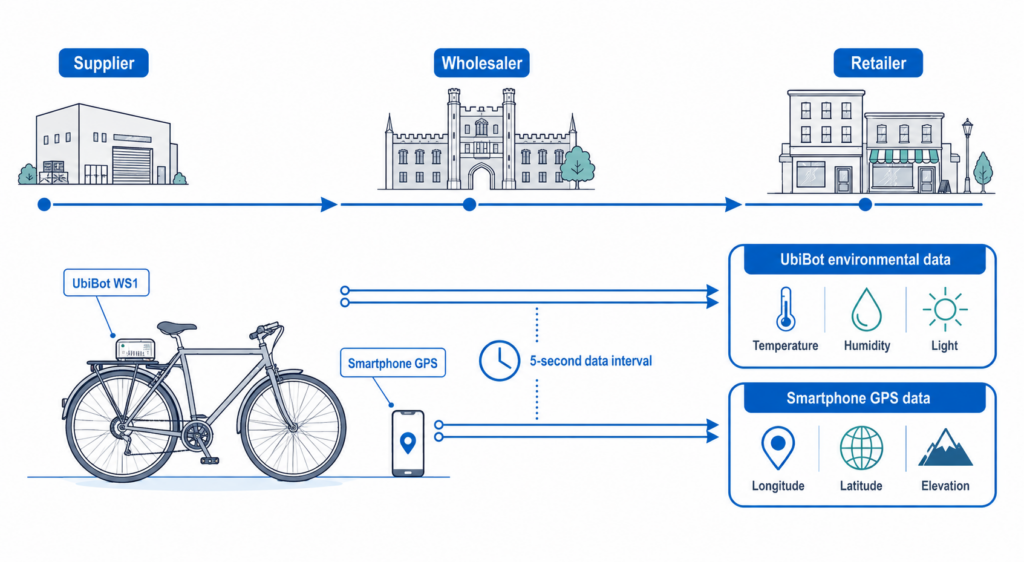
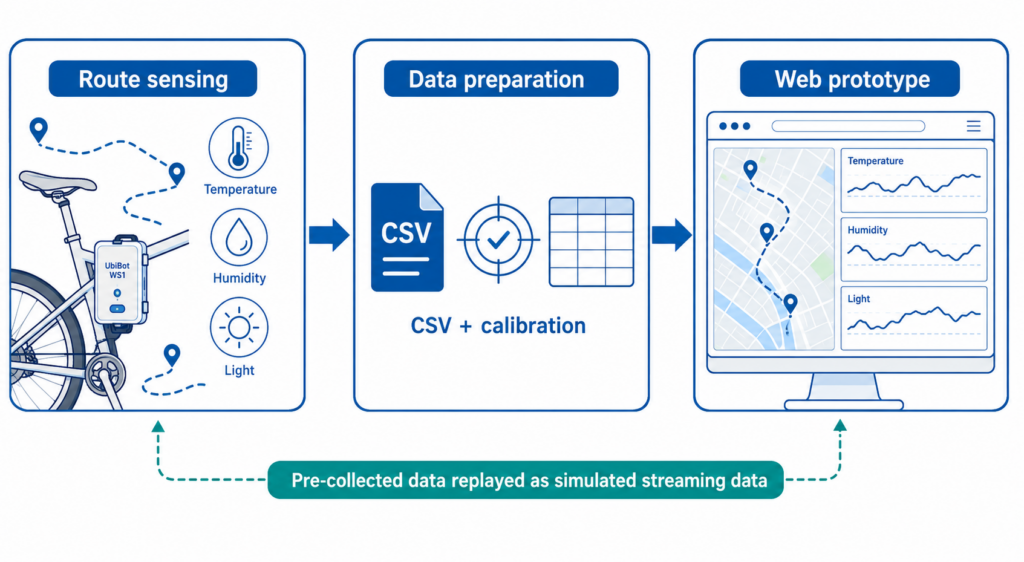
    Due to limited experimental conditions, the researchers did not conduct a full real-world refrigerated meat delivery experiment. Instead, they prepared a realistic dataset by collecting sensor and GPS data along selected routes in Cambridge. The paper states that an all-in-one sensor, UbiBot WS1 , and a smartphone with a GPS tracking app were installed on a bike. The bike was then ridden from one selected location to another, representing movements between supply chain locations such as supplier, wholesaler, and retailer.

    During this journey, UbiBot WS1 collected ambient environmental data, including temperature, humidity, and light. The smartphone GPS app collected geolocation data, including longitude, latitude, and elevation. These data points were captured once every 5 seconds. The collected data were then calibrated and saved as CSV files for use in prototype development.

    In the A2SC prototype, these data were used to simulate real-time delivery monitoring. During a delivery process, the third-party logistics agent could provide or stream the pre-collected sensor data to the system interface. The web interface then displayed vehicle movement on a map and visualised ambient conditions through real-time charts.

    Therefore, the role of UbiBot in this paper was to provide realistic IoT environmental data for a perishable food logistics monitoring scenario. The data supported the prototype’s demonstration of how autonomous agents could coordinate procurement, logistics, delivery monitoring, and delivery evaluation in an autonomous meat supply chain.

    Research Methods and Data Collection Approach

    The paper combines system methodology, prototype design, and case study implementation.
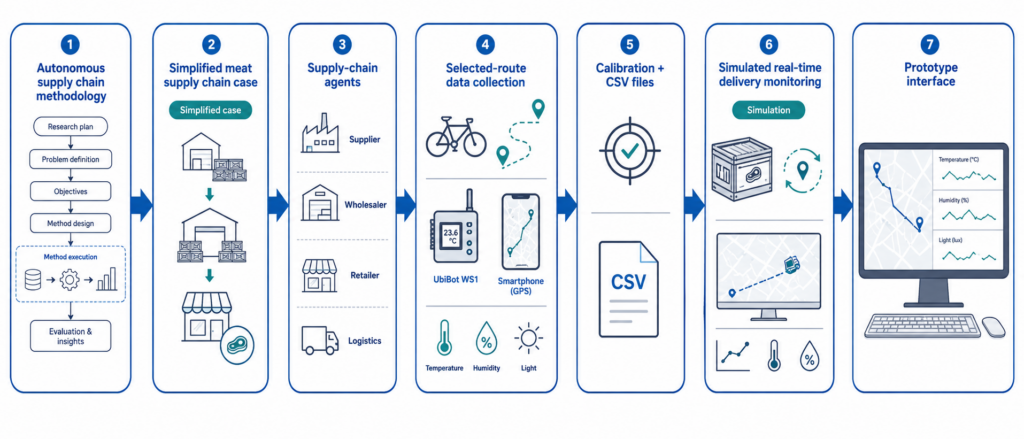
    First, the authors proposed an agent-based autonomous supply chain approach. They adapted multi-agent system design methods, especially Gaia and related variants, to analyse and design autonomous supply chain systems. The methodology included requirement analysis, system analysis, architectural design, detailed design, and implementation design.

    Second, the researchers developed a simplified autonomous meat supply chain case. The case was built around a hypothetical wholesaler called the Cambridge Meat Company. The company procures meat from suppliers and supplies local retailers or restaurants. The prototype focused on two integrated processes: replenishment and wholesale. Replenishment describes the wholesaler buying meat from suppliers. Wholesale describes retailers buying meat from the wholesaler.

    Third, the supply chain roles were implemented as autonomous software agents. These included supplier agents, wholesaler agents, retailer agents, logistics agents, third-party logistics agents, and an admin agent. These agents exchanged messages to coordinate procurement orders, proposals, delivery options, inventory updates, delivery tasks, and delivery monitoring.

    Fourth, the prototype used a web interface with four main panels: an ordering panel, a logistics monitoring map, a streaming data panel, and an agent chat room. The logistics monitoring panel showed the delivery route, while the streaming data panel visualised temperature, humidity, and light data during the simulated delivery.

    Fifth, because real refrigerated meat transport was not performed, the researchers prepared sensor and GPS data in advance. Multiple Cambridge locations were selected as supply chain locations. UUbiBot WS1  and a smartphone GPS tracking app were mounted on a bike. The bike was ridden between selected points, and data were collected once every 5 seconds. The resulting CSV files were used to simulate real-time sensor and location data during the delivery process.

    Key Research Findings

    The study demonstrated that a multi-agent system can be used to implement a working prototype of an autonomous supply chain with integrated processes.
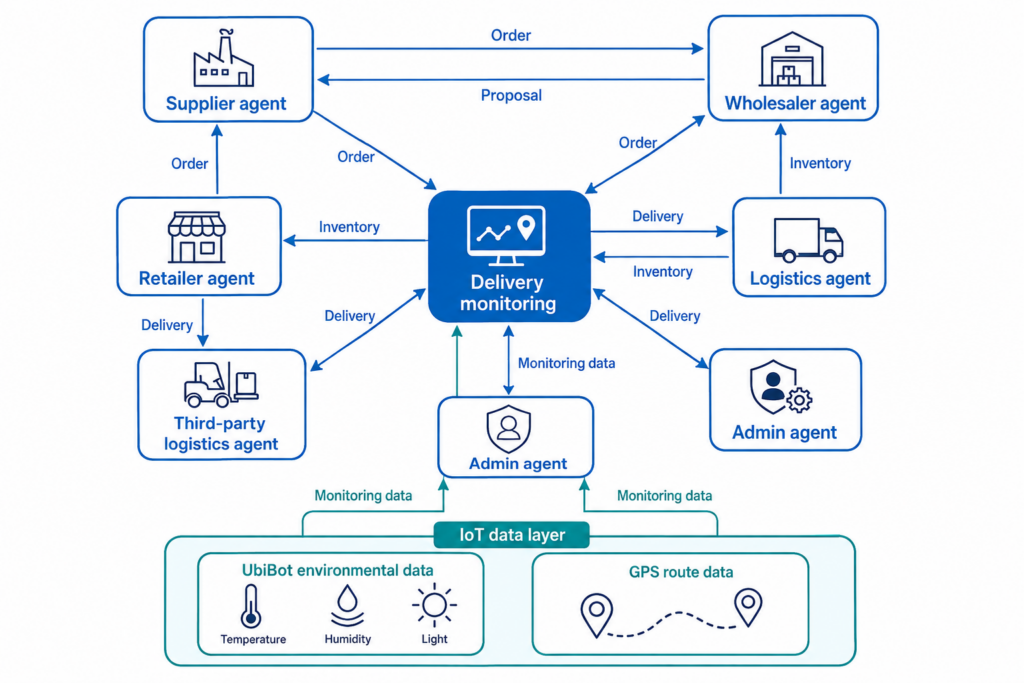
    The prototype showed how autonomous agents can coordinate replenishment and wholesale processes. In the replenishment process, a wholesaler agent can search for suitable supplier agents, negotiate procurement, request delivery options, select a delivery service, update inventory, and trigger delivery monitoring. In the wholesale process, a retailer agent can procure meat from a wholesaler agent, and the system can arrange logistics and update inventory accordingly.

    The study also showed how logistics monitoring can be integrated into agent-based supply chain automation. During simulated delivery, the system displayed vehicle movement on a map and showed environmental data such as temperature, humidity, and light in charts. These data were not merely decorative; they represented the type of sensor information that would be important for evaluating perishable food transportation.

    The prototype also demonstrated the use of agent communication protocols. The researchers used the contract net protocol for negotiation-style interactions and HTTP-based protocols for simpler direct interactions. Agents exchanged messages related to procurement orders, proposals, receipts, delivery orders, and monitoring updates.

    However, the paper also acknowledges limitations. The meat supply chain case was simplified and simulated. The prototype mainly automated information flows and digitally represented physical flows, while the financial flow was not included. The delivery data were pre-collected rather than streamed from an actual refrigerated meat transport operation. The prototype also lacked advanced disruption reconfiguration and higher-level planning capabilities.

    Overall, the research showed an early but concrete technical pathway for implementing autonomous supply chains. UbiBot’s contribution was to provide environmental sensing data that made the delivery monitoring component more realistic.

    What This Means for Perishable Food Supply Chain Monitoring
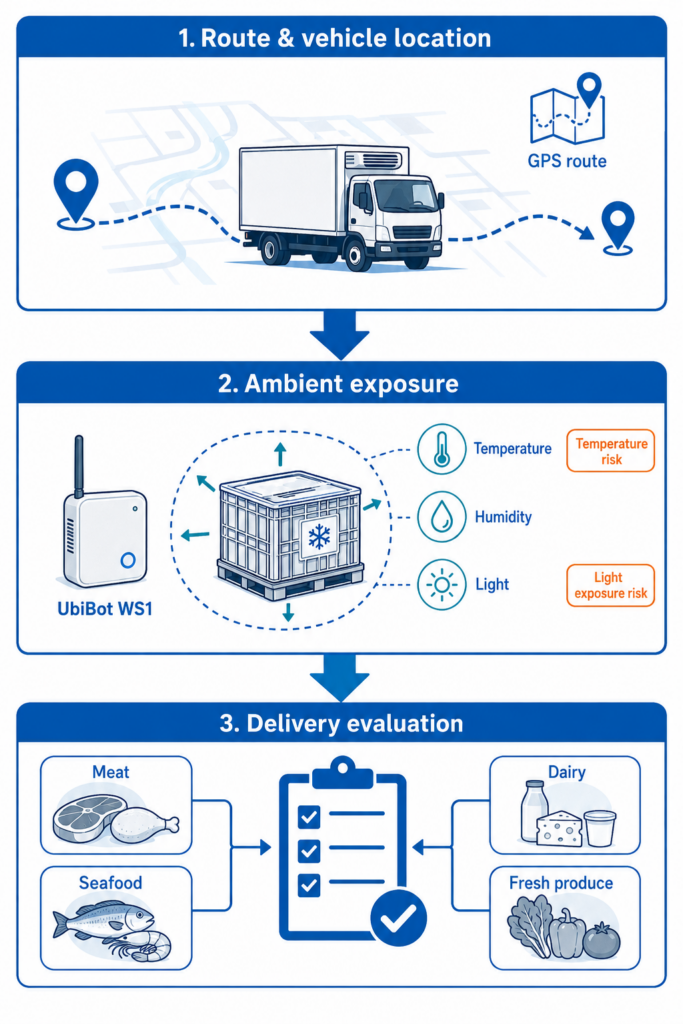
    This study is relevant to perishable food supply chains because products such as meat, seafood, dairy, and fresh produce depend heavily on transportation conditions. Temperature excursions, unexpected delays, humidity changes, or unsuitable exposure conditions can affect quality, safety, shelf life, and service evaluation.

    The autonomous meat supply chain prototype shows how IoT data can be connected with autonomous agents and logistics workflows. In a practical supply chain, real-time sensor data could help logistics agents monitor whether goods remain within acceptable environmental conditions during transportation. If combined with more advanced decision-making, the system could eventually support automatic rerouting, exception handling, supplier evaluation, logistics service scoring, or customer notification.

    For autonomous supply chains, the study also shows that automation is not only about replacing manual order entry. It requires connecting procurement, logistics, inventory, monitoring, and decision-making into integrated processes. IoT sensors such as UbiBot can provide the environmental data layer that allows these processes to reflect the real physical state of goods.

    For companies dealing with perishable goods, the implication is clear: supply chain automation requires reliable operational data. Temperature, humidity, light, location, and delivery status can all become inputs for more autonomous procurement and logistics systems.

    Application Value of UbiBot Devices

    In this research, UbiBot WS1 demonstrated value as a compact IoT environmental sensing device for logistics monitoring data collection.
    First, it provided ambient condition data relevant to perishable goods. Temperature, humidity, and light are important variables when monitoring products such as meat during transportation and storage.

    Second, the device supported time-series data collection. By recording data once every 5 seconds during the route, the researchers obtained a structured sequence of environmental readings that could be paired with GPS data.

    Third, UbiBot data helped simulate real-time logistics monitoring. The collected CSV files were used in the prototype to represent streaming sensor data during delivery. This allowed the system interface to visualise environmental changes as the delivery vehicle moved through the route.

    Fourth, UbiBot complemented GPS tracking. Location data alone can show where a delivery vehicle is, but it does not describe the environment around the goods. Combining UbiBot environmental data with GPS traces created a more complete delivery monitoring dataset.

    Fifth, the device helped connect physical-world sensing with autonomous supply chain software. In the prototype, environmental data were used by the delivery monitoring component and displayed in the system interface, showing how IoT sensor data can become part of an agent-based supply chain system.

    The value of UbiBot in this paper is therefore not that it automated the supply chain by itself. Its value lies in providing the real-world environmental data layer needed to support monitoring, simulation, and evaluation in a perishable food logistics scenario.

    Extended Application Scenarios
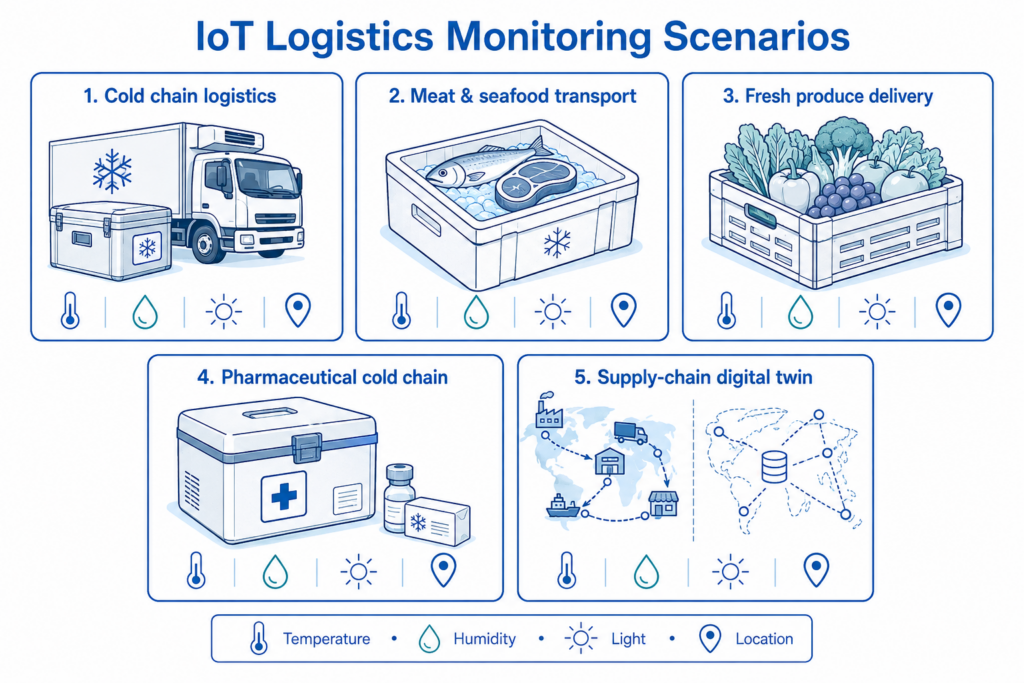
    The monitoring approach used in this study can be extended to several related scenarios:

    1. Cold chain logistics monitoring
      Used to record temperature, humidity, and light exposure during refrigerated transport.
    2. Meat and seafood transportation
      Used to monitor environmental conditions for perishable animal products during delivery.
    3. Fresh produce logistics
      Used to track produce-sensitive transport conditions in fruit, vegetable, and leafy green supply chains.
    4. Pharmaceutical cold chain
      Used to monitor temperature-sensitive medical products, vaccines, reagents, or laboratory samples.
    5. Autonomous supply chain prototypes
      Used to provide IoT data streams for agent-based or digital twin supply chain systems.
    6. Logistics service evaluation
      Used to compare delivery service quality based on environmental condition compliance.
    7. Smart inventory and warehouse receiving
      Used to connect inbound delivery condition records with warehouse receiving decisions.
    8. Supply chain digital twin systems
      Used to feed environmental and location data into a digital representation of goods movement.
    9. Exception and disruption management
      Used to trigger alerts when goods experience unsuitable temperature, humidity, light, or route conditions.
    10. Academic and industrial IoT demonstrations
      Used to build realistic datasets for supply chain automation and logistics monitoring research.

    FAQ

    1. Which UbiBot product was used in the study?

    The study used UbiBot WS1  as an all-in-one sensor.

    2. What data did UbiBot collect?

    UbiBot WS1  collected ambient temperature, humidity, and light data. A smartphone GPS app collected longitude, latitude, and elevation data.

    3. Where was UbiBot deployed?

    UbiBot WS1 was installed on a bike together with a smartphone GPS tracker. The bike was ridden between selected locations in Cambridge, UK, to simulate delivery routes in the autonomous meat supply chain prototype.

    4. What was the sampling frequency?

    The data were collected once every 5 seconds during the route.

    5. Was UbiBot used in an actual refrigerated meat truck?

    No. The paper states that, due to limited experimental conditions, the researchers did not carry out a full real-world refrigerated meat transport experiment. Instead, they collected sensor and GPS data using a bike and used the data to simulate real-time monitoring.

    6. How were the UbiBot data used?

    The collected data were calibrated, saved as CSV files, and used in the prototype to simulate real-time IoT data during the delivery monitoring process.

    7. Did UbiBot prove that autonomous supply chains work?

    No. UbiBot provided environmental sensing data. The researchers used those data as part of a multi-agent system prototype to demonstrate how delivery monitoring could be integrated into autonomous supply chain processes.

    8. What supply chain scenario did the paper study?

    The paper studied a simplified autonomous meat supply chain involving supplier, wholesaler, retailer, logistics provider, third-party logistics provider, and admin agents.

    9. Why are temperature, humidity, and light data important in this case?

    Meat is a perishable product. Ambient environmental conditions during transportation can affect product quality and logistics service evaluation.

    10. What is the broader value of this research?

    The research provides an early technical example of how multi-agent systems, IoT data, logistics monitoring, and web-based interfaces can be combined to implement autonomous supply chain prototypes.


    Related Resources

    University of Amsterdam Study Uses UbiBot WS1 to Monitor Indoor Environment During a COVID-19 Social Distancing Art Fair Experiment
    University of Cambridge Study Uses UbiBot WS1 for Glasshouse Environment Monitoring in Chlorella vulgaris Digestate Cultivation
    How Is UbiBot Referenced in Railway Digital Twin Research?
    Pennsylvania State University Study Uses UbiBot WS1 for Indoor Microenvironment Monitoring in Individualized Thermal Preference Research
    AGH University of Science and Technology Uses UbiBot WS1 Wi-Fi for Railway Turnout Weather and Rail Temperature Monitoring
    Chicken Farm Temperature and Humidity Monitoring
    Laboratory Temperature & Humidity Monitor
    Hot Spa & Ubibot in Cold Winter
    menu-header-svg
    Search
    • Explore Knowledge
      • Comparison & Selection
      • Industry Solution
      • Product & Device
      • Criterion & Compliance
      • Deployment & Usage
      • Technology & Principle
    • Academic Research
    • In-depth Tech

    Academic Research

    See More >>

    University of Cambridge Study Uses UbiBot WS1 for Perishable Food Supply Chain Monitoring in an Autonomous Supply Chain Prototype

    Research Overview

    Paper Title On implementing autonomous supply chains: A multi-agent system approach
    Publisher Elsevier
    Journey Computers in Industry
    Publish Time June 2024
    Authors / Institutions Liming Xu, Stephen Mak, and Alexandra Brintrup from the Institute for Manufacturing, Department of Engineering, University of Cambridge; Maria Minaricova from Fetch.ai
    UbiBot Product UbiBot WS1 smart sensor
    Data Collected Temperature, humidity, light, longitude, latitude, and elevation; UbiBot WS1 collected the ambient environmental data, while a smartphone GPS tracking app collected location data
    Sampling Frequency Once every 5 seconds during the data collection journey
    Research Period The exact data collection date is not specified; the collected data were used in the autonomous meat supply chain prototype described in the 2024 paper
    Application Scenario Perishable food logistics monitoring, autonomous supply chain prototype, meat transportation, multi-agent supply chain automation, IoT-based delivery monitoring
    Original Link https://doi.org/10.1016/j.compind.2024.104120

    Research Background: What Problem Did This Study Address?

    Global supply chains have become increasingly vulnerable to disruptions such as trade restrictions, the COVID-19 pandemic, geopolitical conflicts, transportation delays, and limited visibility across distributed business entities. Traditional supply chains still depend heavily on manual coordination, fragmented communication, and isolated digital systems. These limitations make it difficult for companies to respond quickly when supply, logistics, inventory, or delivery conditions change.

    This paper addresses the implementation challenge of autonomous supply chains. An autonomous supply chain is not only a supply chain with digital dashboards or automated single tasks. It requires interconnected processes, autonomous agents, distributed decision-making, and the ability to coordinate material and information flows across multiple organisations.

    The authors focus on how a multi-agent system can be used to implement an agent-based autonomous supply chain, referred to as A2SC. Instead of only discussing the concept theoretically, the paper develops a prototype around an autonomous meat supply chain. Meat is a perishable product, so logistics visibility is critical. Temperature, humidity, light exposure, and location data can help describe the transportation environment and support delivery monitoring.

    In this context, UbiBot WS1 was used during the prototype data preparation stage to collect ambient condition data. These data were later used to simulate real-time IoT monitoring in the autonomous meat supply chain prototype.

    The Specific Role of  UbiBot WS1 Perishable Food Monitoring

    In this study, UbiBot WS1 was used as an IoT environmental sensing device during the data preparation phase of the autonomous meat supply chain prototype. The researchers did not use UbiBot to prove that autonomous supply chains are effective. Instead, they used UbiBot to collect real ambient condition data that could be replayed or simulated as real-time monitoring data during the prototype demonstration.

    The case study focused on a simplified autonomous meat supply chain in Cambridge, UK. The prototype involved several supply chain roles represented by software agents: supplier, wholesaler, retailer, logistics provider, third-party logistics provider, and admin agent. Because the case concerned perishable meat transportation, the prototype needed delivery monitoring data, including both vehicle location and the ambient conditions around the goods.

    Due to limited experimental conditions, the researchers did not conduct a full real-world refrigerated meat delivery experiment. Instead, they prepared a realistic dataset by collecting sensor and GPS data along selected routes in Cambridge. The paper states that an all-in-one sensor, UbiBot WS1 , and a smartphone with a GPS tracking app were installed on a bike. The bike was then ridden from one selected location to another, representing movements between supply chain locations such as supplier, wholesaler, and retailer.

    During this journey, UbiBot WS1 collected ambient environmental data, including temperature, humidity, and light. The smartphone GPS app collected geolocation data, including longitude, latitude, and elevation. These data points were captured once every 5 seconds. The collected data were then calibrated and saved as CSV files for use in prototype development.

    In the A2SC prototype, these data were used to simulate real-time delivery monitoring. During a delivery process, the third-party logistics agent could provide or stream the pre-collected sensor data to the system interface. The web interface then displayed vehicle movement on a map and visualised ambient conditions through real-time charts.

    Therefore, the role of UbiBot in this paper was to provide realistic IoT environmental data for a perishable food logistics monitoring scenario. The data supported the prototype’s demonstration of how autonomous agents could coordinate procurement, logistics, delivery monitoring, and delivery evaluation in an autonomous meat supply chain.

    Research Methods and Data Collection Approach

    The paper combines system methodology, prototype design, and case study implementation.

    First, the authors proposed an agent-based autonomous supply chain approach. They adapted multi-agent system design methods, especially Gaia and related variants, to analyse and design autonomous supply chain systems. The methodology included requirement analysis, system analysis, architectural design, detailed design, and implementation design.

    Second, the researchers developed a simplified autonomous meat supply chain case. The case was built around a hypothetical wholesaler called the Cambridge Meat Company. The company procures meat from suppliers and supplies local retailers or restaurants. The prototype focused on two integrated processes: replenishment and wholesale. Replenishment describes the wholesaler buying meat from suppliers. Wholesale describes retailers buying meat from the wholesaler.

    Third, the supply chain roles were implemented as autonomous software agents. These included supplier agents, wholesaler agents, retailer agents, logistics agents, third-party logistics agents, and an admin agent. These agents exchanged messages to coordinate procurement orders, proposals, delivery options, inventory updates, delivery tasks, and delivery monitoring.

    Fourth, the prototype used a web interface with four main panels: an ordering panel, a logistics monitoring map, a streaming data panel, and an agent chat room. The logistics monitoring panel showed the delivery route, while the streaming data panel visualised temperature, humidity, and light data during the simulated delivery.

    Fifth, because real refrigerated meat transport was not performed, the researchers prepared sensor and GPS data in advance. Multiple Cambridge locations were selected as supply chain locations. UUbiBot WS1  and a smartphone GPS tracking app were mounted on a bike. The bike was ridden between selected points, and data were collected once every 5 seconds. The resulting CSV files were used to simulate real-time sensor and location data during the delivery process.

    Key Research Findings

    The study demonstrated that a multi-agent system can be used to implement a working prototype of an autonomous supply chain with integrated processes.

    The prototype showed how autonomous agents can coordinate replenishment and wholesale processes. In the replenishment process, a wholesaler agent can search for suitable supplier agents, negotiate procurement, request delivery options, select a delivery service, update inventory, and trigger delivery monitoring. In the wholesale process, a retailer agent can procure meat from a wholesaler agent, and the system can arrange logistics and update inventory accordingly.

    The study also showed how logistics monitoring can be integrated into agent-based supply chain automation. During simulated delivery, the system displayed vehicle movement on a map and showed environmental data such as temperature, humidity, and light in charts. These data were not merely decorative; they represented the type of sensor information that would be important for evaluating perishable food transportation.

    The prototype also demonstrated the use of agent communication protocols. The researchers used the contract net protocol for negotiation-style interactions and HTTP-based protocols for simpler direct interactions. Agents exchanged messages related to procurement orders, proposals, receipts, delivery orders, and monitoring updates.

    However, the paper also acknowledges limitations. The meat supply chain case was simplified and simulated. The prototype mainly automated information flows and digitally represented physical flows, while the financial flow was not included. The delivery data were pre-collected rather than streamed from an actual refrigerated meat transport operation. The prototype also lacked advanced disruption reconfiguration and higher-level planning capabilities.

    Overall, the research showed an early but concrete technical pathway for implementing autonomous supply chains. UbiBot’s contribution was to provide environmental sensing data that made the delivery monitoring component more realistic.

    What This Means for Perishable Food Supply Chain Monitoring

    This study is relevant to perishable food supply chains because products such as meat, seafood, dairy, and fresh produce depend heavily on transportation conditions. Temperature excursions, unexpected delays, humidity changes, or unsuitable exposure conditions can affect quality, safety, shelf life, and service evaluation.

    The autonomous meat supply chain prototype shows how IoT data can be connected with autonomous agents and logistics workflows. In a practical supply chain, real-time sensor data could help logistics agents monitor whether goods remain within acceptable environmental conditions during transportation. If combined with more advanced decision-making, the system could eventually support automatic rerouting, exception handling, supplier evaluation, logistics service scoring, or customer notification.

    For autonomous supply chains, the study also shows that automation is not only about replacing manual order entry. It requires connecting procurement, logistics, inventory, monitoring, and decision-making into integrated processes. IoT sensors such as UbiBot can provide the environmental data layer that allows these processes to reflect the real physical state of goods.

    For companies dealing with perishable goods, the implication is clear: supply chain automation requires reliable operational data. Temperature, humidity, light, location, and delivery status can all become inputs for more autonomous procurement and logistics systems.

    Application Value of UbiBot Devices

    In this research, UbiBot WS1 demonstrated value as a compact IoT environmental sensing device for logistics monitoring data collection.

    First, it provided ambient condition data relevant to perishable goods. Temperature, humidity, and light are important variables when monitoring products such as meat during transportation and storage.

    Second, the device supported time-series data collection. By recording data once every 5 seconds during the route, the researchers obtained a structured sequence of environmental readings that could be paired with GPS data.

    Third, UbiBot data helped simulate real-time logistics monitoring. The collected CSV files were used in the prototype to represent streaming sensor data during delivery. This allowed the system interface to visualise environmental changes as the delivery vehicle moved through the route.

    Fourth, UbiBot complemented GPS tracking. Location data alone can show where a delivery vehicle is, but it does not describe the environment around the goods. Combining UbiBot environmental data with GPS traces created a more complete delivery monitoring dataset.

    Fifth, the device helped connect physical-world sensing with autonomous supply chain software. In the prototype, environmental data were used by the delivery monitoring component and displayed in the system interface, showing how IoT sensor data can become part of an agent-based supply chain system.

    The value of UbiBot in this paper is therefore not that it automated the supply chain by itself. Its value lies in providing the real-world environmental data layer needed to support monitoring, simulation, and evaluation in a perishable food logistics scenario.

    Extended Application Scenarios

    The monitoring approach used in this study can be extended to several related scenarios:

    1. Cold chain logistics monitoring
      Used to record temperature, humidity, and light exposure during refrigerated transport.
    2. Meat and seafood transportation
      Used to monitor environmental conditions for perishable animal products during delivery.
    3. Fresh produce logistics
      Used to track produce-sensitive transport conditions in fruit, vegetable, and leafy green supply chains.
    4. Pharmaceutical cold chain
      Used to monitor temperature-sensitive medical products, vaccines, reagents, or laboratory samples.
    5. Autonomous supply chain prototypes
      Used to provide IoT data streams for agent-based or digital twin supply chain systems.
    6. Logistics service evaluation
      Used to compare delivery service quality based on environmental condition compliance.
    7. Smart inventory and warehouse receiving
      Used to connect inbound delivery condition records with warehouse receiving decisions.
    8. Supply chain digital twin systems
      Used to feed environmental and location data into a digital representation of goods movement.
    9. Exception and disruption management
      Used to trigger alerts when goods experience unsuitable temperature, humidity, light, or route conditions.
    10. Academic and industrial IoT demonstrations
      Used to build realistic datasets for supply chain automation and logistics monitoring research.

    FAQ

    1. Which UbiBot product was used in the study?

    The study used UbiBot WS1  as an all-in-one sensor.

    2. What data did UbiBot collect?

    UbiBot WS1  collected ambient temperature, humidity, and light data. A smartphone GPS app collected longitude, latitude, and elevation data.

    3. Where was UbiBot deployed?

    UbiBot WS1 was installed on a bike together with a smartphone GPS tracker. The bike was ridden between selected locations in Cambridge, UK, to simulate delivery routes in the autonomous meat supply chain prototype.

    4. What was the sampling frequency?

    The data were collected once every 5 seconds during the route.

    5. Was UbiBot used in an actual refrigerated meat truck?

    No. The paper states that, due to limited experimental conditions, the researchers did not carry out a full real-world refrigerated meat transport experiment. Instead, they collected sensor and GPS data using a bike and used the data to simulate real-time monitoring.

    6. How were the UbiBot data used?

    The collected data were calibrated, saved as CSV files, and used in the prototype to simulate real-time IoT data during the delivery monitoring process.

    7. Did UbiBot prove that autonomous supply chains work?

    No. UbiBot provided environmental sensing data. The researchers used those data as part of a multi-agent system prototype to demonstrate how delivery monitoring could be integrated into autonomous supply chain processes.

    8. What supply chain scenario did the paper study?

    The paper studied a simplified autonomous meat supply chain involving supplier, wholesaler, retailer, logistics provider, third-party logistics provider, and admin agents.

    9. Why are temperature, humidity, and light data important in this case?

    Meat is a perishable product. Ambient environmental conditions during transportation can affect product quality and logistics service evaluation.

    10. What is the broader value of this research?

    The research provides an early technical example of how multi-agent systems, IoT data, logistics monitoring, and web-based interfaces can be combined to implement autonomous supply chain prototypes.

    分享

    LinkedIn2

    Facebook2

    X

    Newsletter Signup

    Related Resources

    University of Amsterdam Study Uses UbiBot WS1 to Monitor Indoor Environment During a COVID-19 Social Distancing Art Fair Experiment
    University of Cambridge Study Uses UbiBot WS1 for Glasshouse Environment Monitoring in Chlorella vulgaris Digestate Cultivation
    How Is UbiBot Referenced in Railway Digital Twin Research?
    Pennsylvania State University Study Uses UbiBot WS1 for Indoor Microenvironment Monitoring in Individualized Thermal Preference Research
    AGH University of Science and Technology Uses UbiBot WS1 Wi-Fi for Railway Turnout Weather and Rail Temperature Monitoring
    Chicken Farm Temperature and Humidity Monitoring
    Laboratory Temperature & Humidity Monitor
    Hot Spa & Ubibot in Cold Winter
    menu-header-svg
    Search
    • Explore Knowledge
      • Comparison & Selection
      • Industry Solution
      • Product & Device
      • Criterion & Compliance
      • Deployment & Usage
      • Technology & Principle
    • Academic Research
    • In-depth Tech
    Enter Your Information

    Confirm

    Products

    Dashboards

    Support

    Purchase

    Company

    Smart Sensing

    UbiBot Web Console

    APP Download

    UbiBot Online Store

    News

    Smart Control

    UbiBot Space

    Product Docs & APIs

    Find Distributors

    About Us

    Smart Video

    UbiBot On-Premises

    Helpdesk & FAQ

    Volume Pricing

    Contact Us

    LoRa Products

    Agency Web Console

    Video Center

    Architecture

    Software & Platform


    Pricing


    System Status

    External Sensors


    Become a Distributor

    Accessories


    Become an Affiliate

    Global SIM


    Positioning System


    Products

    Dashboards

    Business Partners

    WS1

    UbiBot Web Console

    Volume Pricing

    WS1 Pro

    UbiBot Space

    Become a Distributor

    GS1

    UbiBot Support Desk

    Affiliates

    GS2

    Agency Web Console


    MS1


    SP1


    Accessories


    Docs

    Purchase

    Company

    Platform API

    Pricing

    News

    Q&A

    UbiBot Partners

    About us

    Privacy Policy

    Online Store

    Contact

    Terms of Service


    System Status

    Products

    Dashboards

    Smart Sensing

    UbiBot Web Console

    Smart Control

    UbiBot Space

    Smart Video

    UbiBot On-Premises

    LoRa Products

    Agency Web Console

    Software & Platform


    External Sensors


    Accessories


    Global SIM


    Positioning System


    Support

    Purchase

    APP Download

    UbiBot Online Store

    Product Docs & APIs

    Find Distributors

    Helpdesk & FAQ

    Volume Pricing

    Video Center


    Pricing


    Company

    News

    About Us

    Contact Us

    Architecture

    System Status

    Become a Distributor

    Become an Affiliate

    Language:
    English 日本語 (ベータ)  
    Language:

    English

    日本語 (ベータ)


    IoT Product Family:
    ubibotico     Wireless environmental sensing products and smart building solutions
    ubitrackico     UWB-based real-time indoor tracking solutions with 30cm accuracy

    IoT Product Family:

    ubibotico  Wireless environmental sensing products and smart building solutions
    ubitrackico  UWB-based real-time indoor tracking solutions with 30cm accuracy

    © 2013-2026 UbiBot.com. All rights reserved.

    Terms of Service | Privacy Policy | Compliance

    youtube facebook twitter