
UBiBot Logo
UBiBot Logo
  • UBiBot Logo
  • Home
  • Products

    NEW

  • Pricing
  • Support
  • About Us
  • Download
  • magnifying-glass  Search
  • magnifying-glass header-close
  • Sign in Sign in
    Public Web Console Public Web Console
    On-Premises App Center On-Premises App Center
  • Home
  • Products

    NEW

  • Pricing
  • Support
  • About us
  • Download
  •  Public Web Console
  •  On-Premises App Center
  • Where to Buy

Learn Hub

Explore Knowledge Academic Research In-depth Tech

Share

LinkedIn

Facebook

X (Twitter)

Newsletter Signup

Table of contents

    How to Monitor Pharmaceutical Cold Chain Shipments from Warehouse to Delivery?

    Introduction

    A pharmaceutical shipment can leave a qualified warehouse in specification and still arrive with an unresolved temperature event. The risk is rarely limited to the time spent inside a refrigerated truck. Product may wait on a staging floor, move through a cross-dock, sit in an airport cargo terminal, be loaded into an active or passive container, lose cellular visibility during flight, pass through customs, and then enter a final-mile vehicle before delivery. Each handoff creates a different combination of temperature exposure, connectivity, security, and data-ownership risk.

    This guide is written for pharmaceutical manufacturers, distributors, quality and GDP teams, 3PLs, freight forwarders, airport cargo operators, system integrators, and procurement teams. It explains how to decide what should be monitored, how shipment-level tracking differs from vehicle and facility monitoring, how cellular and local data storage should work together, how representative products from UbiBot, Tive, Sensitech, and ELPRO fit different operating models, and how to build a scalable monitoring architecture from warehouse release to delivery.

    The article is not a compliance certification. EU GDP, WHO guidance, USP supply-chain chapters, IATA temperature-control practices, product stability data, shipper-carrier quality agreements, and local law all influence the final design. A device can support records, alerts, and investigations; it does not make a shipment GDP-compliant by itself. [1][2][3][4]

    Quick Summary

    Pharmaceutical cold-chain monitoring should link the correct sensor to the correct object: a shipment tracker travels with a pallet or package, a reusable vehicle monitor stays with the truck, and a fixed facility monitor protects staging and transit areas. Temperature is usually essential; location, light/opening evidence, humidity, shock, tilt, device health, and power status are added when they answer a defined risk. Cellular connectivity provides in-transit visibility, but local memory protects the historical record during coverage gaps. Air cargo requires route- and airline-appropriate tracker operation. Selection should compare calibration, local data retention, location technology, alerts, platform governance, APIs, reuse model, battery strategy, and lifecycle cost – not temperature accuracy alone.
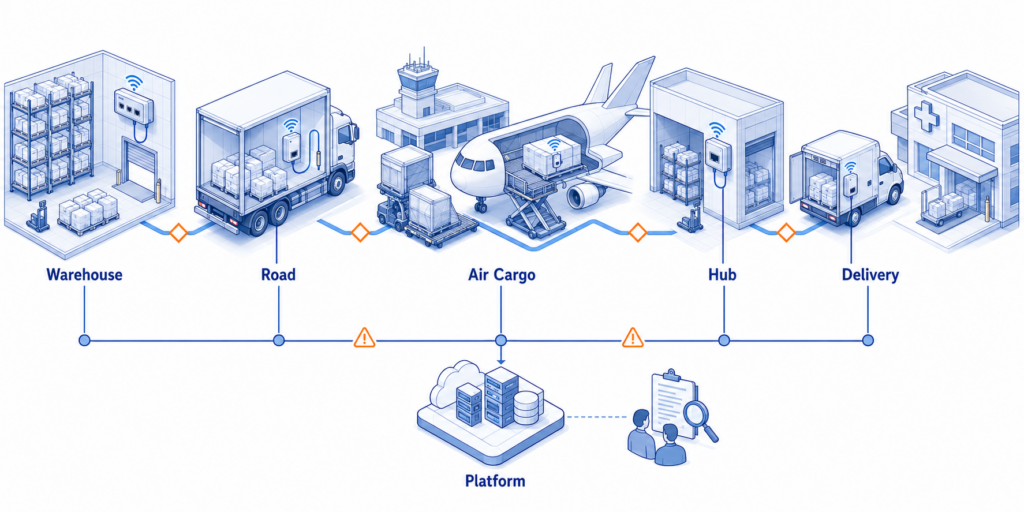
    A layered monitoring architecture should connect fixed warehouse conditions, reusable vehicle monitoring, shipment-level tracking and quality-system response without forcing one device to do every job.


    Key Takeaway

    The most reliable pharmaceutical shipment monitoring architecture separates three questions: what happened to the product, where and when it happened, and whether anyone could act before the excursion became a loss. Temperature, location, offline storage, alarm escalation, batch metadata, and handoff records must therefore be designed as one controlled workflow.


    Why Is Environmental Monitoring Important in Pharmaceutical Transport?

    Protect product quality and usable shelf life

    Finished medicines, biologics, vaccines, investigational products, and other time- and temperature-sensitive pharmaceuticals may be exposed to conditions that can affect stability or critical quality attributes. The acceptable range is product-specific and should come from approved labeling, stability data, packaging qualification, and the applicable quality system. WHO model guidance treats safe storage and distribution of time- and temperature-sensitive pharmaceutical products as a controlled supply-chain activity, while USP <1079> frames storage and transportation as integrated risk-management processes. [2][5]

    Create intervention time instead of post-delivery evidence only

    A passive logger can prove that an excursion happened. A real-time tracker can create an opportunity to intervene while the shipment is still moving: the quality team may contact a carrier, ask a ramp operator to move a pallet to controlled storage, redirect a vehicle, verify a container status, or prepare a receiving decision before arrival. Real-time visibility is therefore operationally valuable, but it should be treated as an additional control layer rather than a replacement for qualified packaging, refrigerated transport, route planning, and trained personnel.

    Preserve traceability across handoffs

    Pharmaceutical distribution involves multiple organizations that may not share the same IT systems. The monitoring record should make it possible to connect a sensor or tracker to the shipment identifier, batch or lot, route, packaging configuration, carrier, departure time, handoff points, and final receipt. Light events, location changes, or opening evidence can help explain when a shipment was accessed or moved. The data model matters as much as the device: a temperature curve without shipment identity or time-zone control is weak evidence during a deviation investigation.

    Support GDP-style transport control without oversimplifying compliance

    The EU GDP guideline requires medicinal products to be transported under conditions that maintain quality and integrity, with responsibilities defined and transport processes controlled. WHO technical supplements separately address road and air operations, transport-route profiling, and monitoring systems. IATA’s Temperature Control Regulations and CEIV Pharma program address pharmaceutical air-cargo handling, critical control points, infrastructure, training, and operational consistency. These sources support a risk-based monitoring strategy, but none of them turns a specific commercial tracker into an automatically compliant system. [1][2][3][4]

    Reduce the blind spots of manual checks

    Manual checks at warehouse release and receiving remain useful, but they show only isolated moments. They cannot reconstruct an overnight airport dwell, a missed connection, repeated road-side door openings, a long customs delay, or an offline cellular period. Continuous logging provides the time history needed to understand duration and recovery, while location and event data can show where the issue occurred. For regulated investigations, the organization must still define how data are reviewed, how missing records are handled, who owns the excursion, and which product expert makes the final disposition decision.

    What Environmental Parameters Should Be Monitored?

    Parameter Why It Matters Monitoring Location Recommended Sensor Type
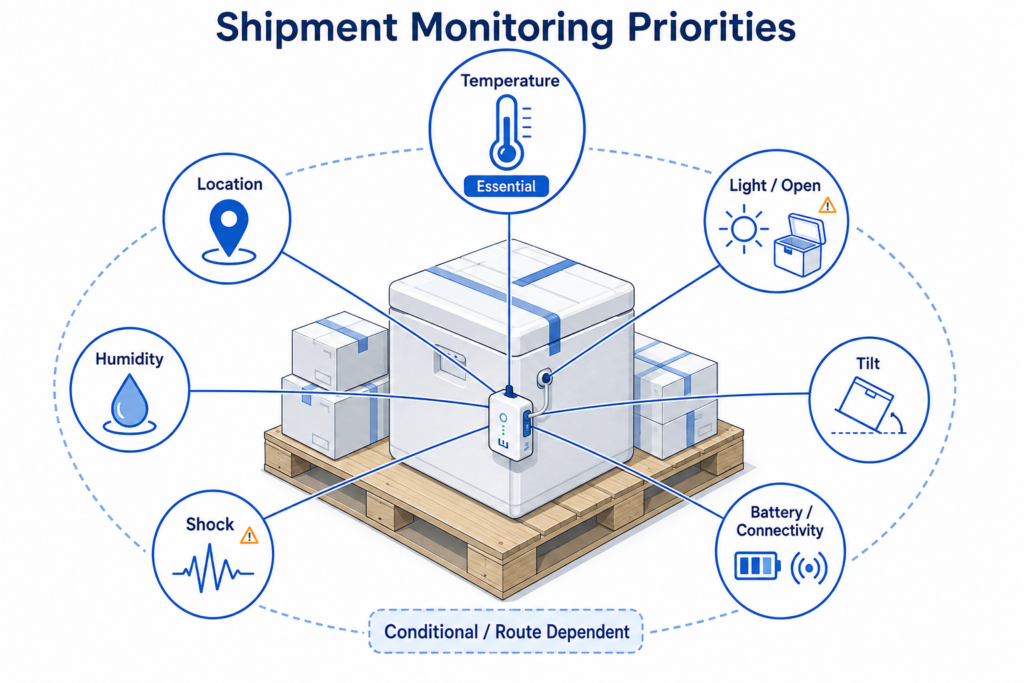
    Shipment temperature (essential) Primary evidence of the thermal environment experienced by the monitored shipment. Inside qualified packaging, pallet, tote, container, or representative product zone. Calibrated electronic temperature logger or real-time tracker matched to the required range.
    Location and route (often essential for real-time programs) Links an excursion to a stop, airport, handoff, delay, customs event, or route deviation. Tracker attached to the shipment or transport unit. GPS / Wi-Fi / cellular geolocation tracker, subject to route and airline acceptance.
    Light or opening evidence (conditional) Can indicate package opening, door access, exposure, or handling events; useful for security and root-cause analysis. On or inside shipment packaging where light change is meaningful. Integrated light sensor or dedicated door/contact input.
    Relative humidity (conditional) Relevant for moisture-sensitive products, packaging systems, some biologics, labels, and condensation risk. Inside packaging or transport space where humidity can affect the product or evidence. Calibrated temperature/RH tracker or separate RH logger.
    Shock, motion and tilt (shipment-level option) Adds evidence about impacts, orientation, rough handling, and movement. Attached to the pallet, package or high-value shipment. Multi-sensor shipment tracker.
    Vehicle or compartment temperature (vehicle-level) Builds reusable history of refrigerated transport and identifies recurring hot/cold zones. Representative points inside owned refrigerated vehicles. Reusable 4G monitor with external temperature probe(s).
    Staging / transit-area temperature (facility-level) Protects product while it waits outside the transport leg and supports handoff decisions. Warehouse staging, cross-dock, airport handling, controlled rooms. Fixed Wi-Fi/Ethernet monitor with calibrated external probe.
    Device health, battery and connectivity (essential for remote alerting) Shows when the monitoring path itself is unavailable and prevents silent loss of visibility. System level. Heartbeat, low-battery, offline, gateway and communication-health alarms.


    pharmaceutical-shipment-monitoring-parameters

    Temperature is the core measurement, while location, light, humidity, shock, tilt and device health should be added only when they answer a defined supply-chain risk.


    The first design decision is therefore not ‘Which tracker should we buy?’ but ‘What object must the data represent?’ A pallet-level tracker answers a different question from a truck sensor, and neither automatically replaces a fixed monitor in the dispatch warehouse. High-value lanes often use more than one layer because the evidence required for product disposition, carrier performance, and facility control is not identical.

    What Does a Typical Pharmaceutical Shipment Monitoring System Include?

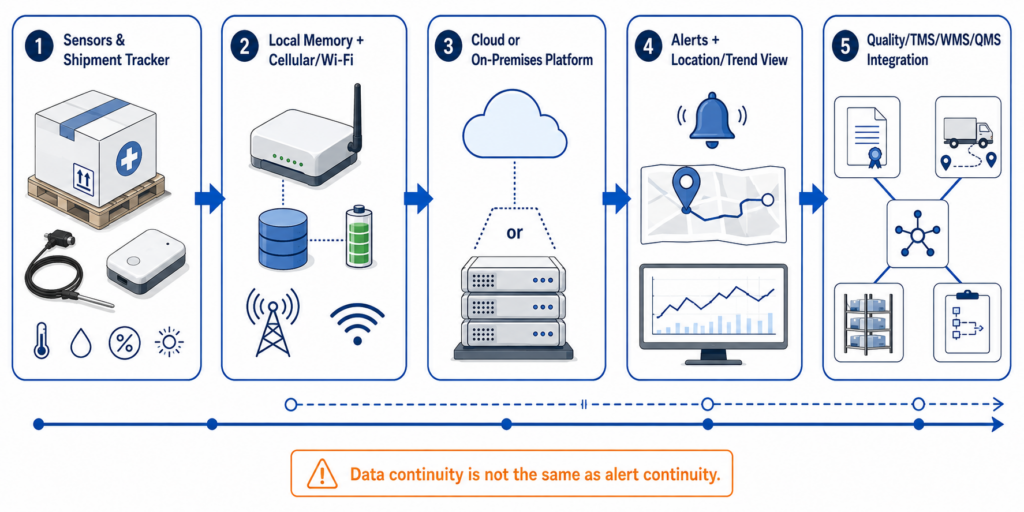
    A practical architecture has five interacting layers. The sensing layer measures shipment or transport conditions. The device layer stores readings and may calculate alarms or event flags. The connectivity layer transmits data through cellular, Wi-Fi, or a local vehicle/facility network. The platform layer associates readings with shipments, displays maps and trends, retains records, and manages users. The alarm and integration layer sends notifications and forwards selected data to quality, transport-management, warehouse, ERP, customer-visibility, or analytics systems.

    • Sensing layer: temperature plus optional humidity, light, shock, tilt, door/contact, vehicle status, or fixed staging-area sensors.
    • Device / collection layer: shipment tracker, reusable vehicle monitor, fixed facility logger, or telematics gateway with local memory and battery status.
    • Connectivity layer: cellular in transit, Wi-Fi at facilities, Ethernet for fixed zones, and local wired/wireless sensor networks where multiple points share one backhaul.
    • Platform layer: shipment identity, maps, trends, rules, users, retention, reports, multi-site visibility, and exception review.
    • Alarm and integration layer: email, SMS, mobile notifications, escalations, APIs, webhooks/data forwarding, and controlled handoff into quality or logistics workflows.


    Text-Based Architecture Flow

    Qualified packaging / pallet / vehicle / staging sensors -> shipment tracker or reusable monitor -> local memory -> cellular / depot Wi-Fi / vehicle gateway / fixed Ethernet -> cloud or on-premises platform -> temperature and device-health rules -> quality, logistics, receiving, carrier and customer workflows -> deviation assessment and product disposition.
     

    pharma-shipment-monitoring-data-flow

    A complete monitoring workflow combines sensing, local storage, connectivity, platform intelligence and controlled response.


    How a Pharmaceutical Warehouse Monitoring System Connects to Shipment Monitoring

    A pharmaceutical warehouse monitoring system protects fixed locations such as release staging, packing rooms, cold rooms, dispatch docks, cross-docks, and receiving areas. Shipment monitoring protects the product while responsibility and physical location change. The two systems should exchange identifiers and handoff times where practical. For example, a GS1-AETH1RS can monitor a fixed staging zone over Ethernet or Wi-Fi while a WS1 Pro-4G remains with an owned road vehicle, and a dedicated shipment tracker travels with selected high-value or multimodal loads. This layered model avoids asking one device to solve facility, vehicle, and chain-of-custody problems simultaneously.

    Which Communication Method Should Be Used?
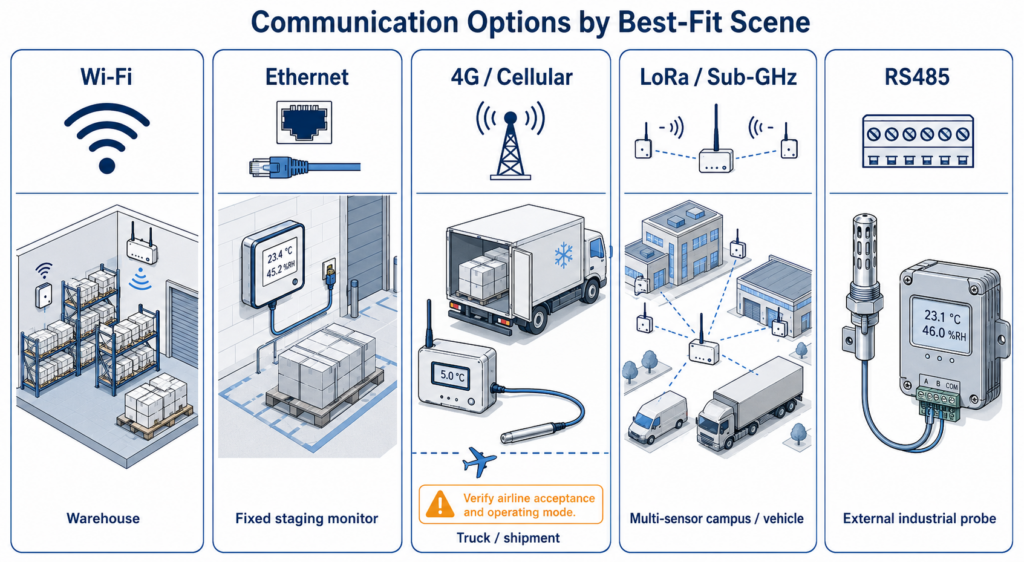
    pharmaceutical-cold-chain-network-selection

    Cellular is the primary remote path for road and shipment tracking, while Wi-Fi, Ethernet, LoRa and RS485 serve specific facility and local-sensor roles.


    Method Best fit Advantages Limitations / design checks
    Wi-Fi Warehouses, airport offices, depots, staging zones, device setup and synchronization. Low data cost; direct cloud connection; easy for fixed indoor points. Coverage is limited in transit; enterprise authentication and metal structures can complicate deployment.
    Ethernet Fixed warehouse, cross-dock, cold-room or dispatch points where a cable is available. Stable connection, predictable IT control, good for permanent monitoring. Not practical for moving shipments; requires cabling and power planning.
    4G / cellular Road vehicles, shipment trackers, remote handoffs and routes outside customer LANs. Direct remote visibility without a local gateway; broad regional coverage. Dead zones, roaming, SIM cost, regional band support, battery use and airline operating rules must be verified.
    LoRa / proprietary sub-GHz Many sensors inside a large warehouse, campus, yard, or vehicle network feeding a gateway. Long range and low node power; efficient for high point counts. Adds gateway and backhaul dependencies; not a substitute for global shipment geolocation.
    RS485 Fixed probes, industrial transmitters, reefer status or staging-area equipment connected to a nearby logger/controller. Stable wired sensor connection and broad industrial compatibility. Not an internet connection; requires wiring, addressing, termination and commissioning.


    For road transport, direct cellular is usually the simplest real-time path. For air cargo, tracker choice must consider airline acceptance, battery classification, operating mode during flight, and route coverage; a device that works well in a truck is not automatically appropriate inside an aircraft. IATA’s temperature-control resources are useful because they treat airfreight as a sequence of booking, acceptance, storage, handling, build-up, flight, and delivery control points rather than as one uninterrupted connected trip. [3][4]

    Offline behavior should be tested separately from communications. A tracker can preserve a complete temperature history even when cellular service disappears, while remote alerts are delayed until connectivity returns. Procurement teams should therefore document two service levels: data continuity and alert continuity. A good system states how many records are retained locally, how time is synchronized, how data are backfilled, how duplicates are handled, and how a user can recognize a gap in communication.
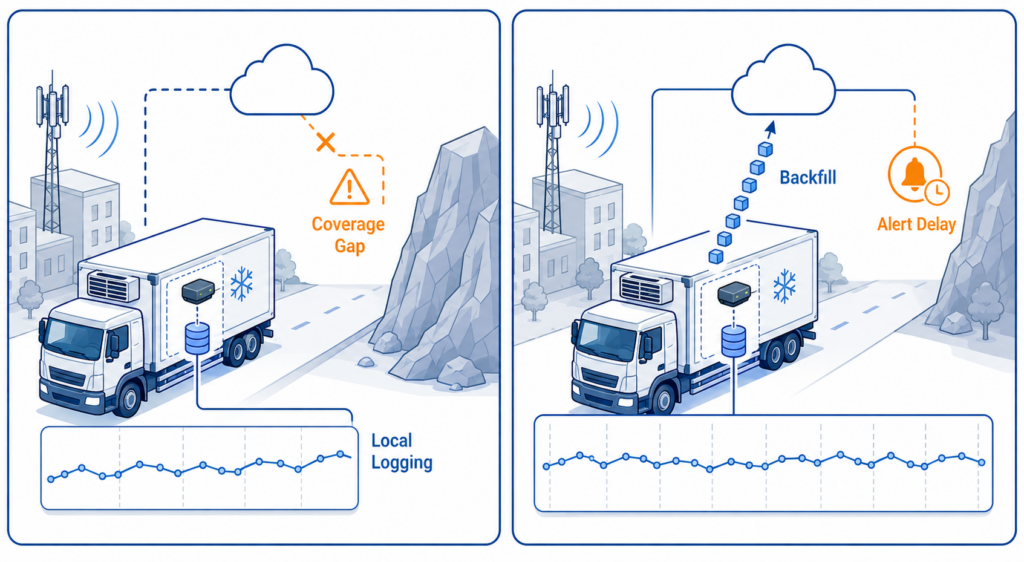
    pharmaceutical-cold-chain-offline-data-continuity

    Local memory can preserve the audit trail during a network outage even when live alerts are temporarily unavailable.

    How Should Monitoring Products Be Compared?

    Published temperature accuracy is important, but it is only one part of the measurement chain. Buyers should confirm the operating range, calibration points, uncertainty or traceability documentation, sensor response, packaging placement, thermal mass, enclosure limits, battery performance, and whether the sensor is measuring the product-relevant environment. A precise tracker attached to the outside of an insulated container may provide excellent logistics data and poor product-temperature evidence.

    The architecture can be more important than the sensor specification. A reusable vehicle monitor can be economical for an owned fleet because it stays installed and builds long-term compartment history. A shipment tracker is better when the cargo changes carriers, crosses borders, moves by air, or needs geolocation, light, shock, tilt, and handoff evidence. A fixed facility monitor is best for staging and transit rooms. The procurement decision should compare the total workflow rather than force these three categories into a single ranking.

    • Measurement chain: range, accuracy, calibration, sensor location, response time, enclosure and product/packaging relationship.
    • Data resilience: local memory, outage duration, backfill, time stamps, missing-data flags and battery backup.
    • Location and event context: GPS/Wi-Fi/cellular location, light, shock, tilt, door or motion evidence.
    • Connectivity and geography: supported cellular bands, roaming, airline acceptance, depot Wi-Fi, fixed Ethernet and gateway dependencies.
    • Software governance: shipment metadata, user roles, reports, audit evidence, retention, API/webhooks, cloud region and on-premises requirements.
    • Lifecycle model: reusable vs trip-oriented hardware, reverse logistics, calibration, subscription tiers, SIM/data fees, batteries and support.
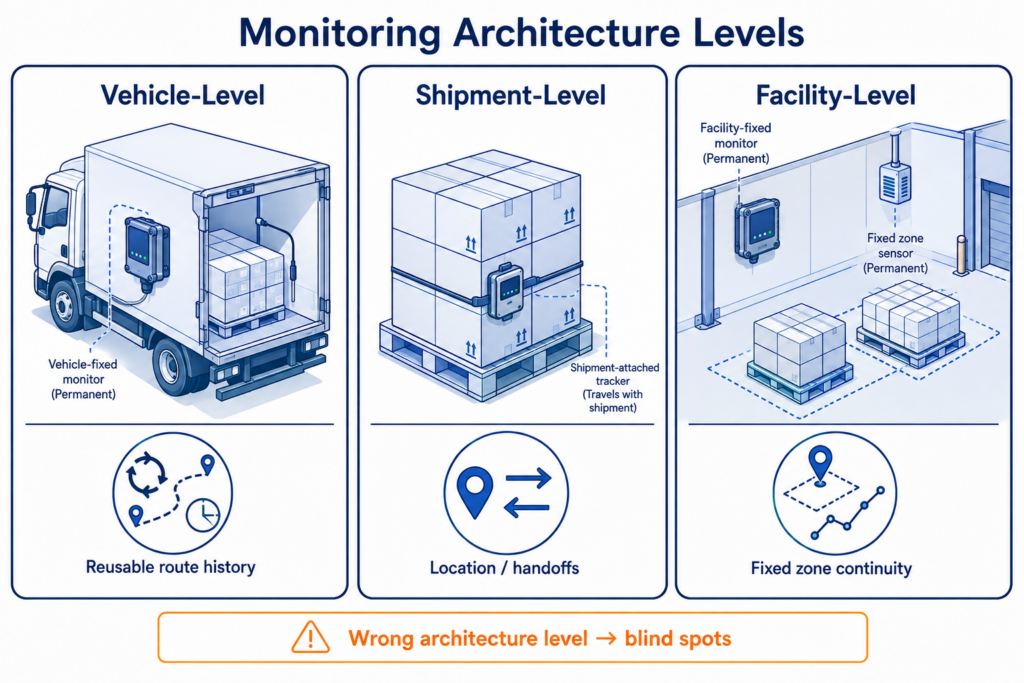
     

    vehicle-vs-shipment-vs-facility-monitoring

    Vehicle, shipment and facility monitoring overlap on temperature but solve different traceability and infrastructure problems.

    Product and Solution Comparison

    The comparison below uses representative official configurations reviewed in August 2026. UbiBot is positioned primarily as reusable vehicle and facility monitoring. Tive Solo 5G, Sensitech TempTale GEO APX Global, and ELPRO LIBERO GH are shipment-oriented trackers. They overlap on temperature monitoring but are not functionally interchangeable. Where an exact value was not found in the reviewed official source, the table states ‘Not publicly specified.’

    Hardware, Measurement and Data Resilience

    Comparison item UbiBot WS1 Pro-4G / GS1-AETH1RS Tive Solo 5G Sensitech TempTale GEO APX Global ELPRO LIBERO GH
    System positioning Reusable vehicle / facility environmental monitor Trip-oriented real-time shipment tracker Global real-time shipment condition and location monitor Reusable real-time shipment temperature/RH and location logger
    Measured parameters WS1 Pro: temperature, RH, light; external temperature and selected RS485 probes. GS1 fixed option adds similar environmental channels. Temperature, RH, light, shock, motion and location Location, temperature, humidity, light; optional probe on Extended model Temperature, humidity, location, light and movement/tilt
    Temperature range / accuracy WS1 Pro internal -20 to 60 C, +/-0.2 C. UB-DT-P1 -55 to 125 C, +/-0.5 C from -10 to 85 C. Official support page: -30 to 60 C; +/-0.5 C. Standard -10 to 55 C; Extended -30 to 55 C; +/-0.5 C from -10 to 45 C. Measurement -30 to 70 C; application range 0 to 55 C for GH; exact accuracy not clearly stated on reviewed public shop page.
    Connectivity / location 2.4 GHz Wi-Fi plus regional 4G on WS1 Pro; no native GPS. GS1-AETH1RS provides Wi-Fi + RJ45 Ethernet for fixed sites. LTE-M/2G plus GPS, Wi-Fi geolocation and cell-tower triangulation LTE Cat-1bis plus Wi-Fi location support LTE-M / NB-IoT with location reporting
    Dedicated gateway No for direct-connected WS1 Pro or GS1 No No No
    Local storage 300,000 sensing records Up to 25,000 records shown on current tracker comparison page Not publicly specified on reviewed APX Global product page 31,000 measurement values
    Offline data protection Local logging; synchronization behavior should be verified in route acceptance testing. Local record capacity is published; detailed offline/backfill behavior should be verified for the selected service tier. Not publicly specified on reviewed product page. Local memory; elproCLOUD configuration supports logging and communication intervals.
    External sensor support WS1 Pro supports two DS18B20 probes plus selected RS485 probe depending configuration; GS1 supports RS485 probes. Optional beacon / specialized probe ecosystem available in Tive portfolio; verify exact Solo 5G accessory compatibility. Optional probe on Extended model. GH uses internal temp/RH sensors; other LIBERO Gx models support external Pt100 for wider ranges.
    Local display 4.4-inch LCD on WS1 Pro; 4-inch LCD on GS1 No full data display on Solo 5G product page No full data display on APX Global product page Interactive LCD

    Platform, Governance and Deployment Fit

    Comparison item UbiBot WS1 Pro-4G / GS1-AETH1RS Tive Solo 5G Sensitech TempTale GEO APX Global ELPRO LIBERO GH
    Cloud / software UbiBot Public IoT Platform; On-Premises Platform available Tive Platform SensiWatch Platform elproCLOUD; liberoMANAGER
    API / integrations REST APIs and data forwarding; advanced functions depend on plan API and webhooks available by platform tier Not publicly specified on reviewed APX Global product page Not publicly specified for the reviewed GH product page; verify enterprise integration options with ELPRO
    Alerts Platform/app/email/HTTP; paid channels depend on plan and region Condition, geofence, ETA and route alerts; channels depend on tier Departure, arrival and exception alerts; mobile access Email/SMS and multi-level alarm profiles
    Calibration Factory calibration report and accredited-lab recalibration path; confirm probe-specific certificate and project points NIST-traceable, 3-point ISO/IEC 17025 certificate stated NIST-traceable temperature accuracy stated Calibrated dual sensor; production calibration certificate available
    Reuse model Reusable / permanent vehicle or facility installation Solo 5G is marketed as a single-use shipment tracker Trip-oriented monitor; Device Takeback program available Reusable multi-use logger, up to 14 months runtime
    Strongest fit Owned fleets, regional road routes, dispatch hubs and fixed transit areas needing low infrastructure and large local memory High-value or multimodal shipments needing location, shock and route visibility Enterprise global cold-chain programs and shipment analytics Reusable pharmaceutical shipment workflows needing temp/RH, location, display and airfreight-friendly battery design
    Main trade-off No native GPS/shock/tilt/handoff tracking; air-cargo use requires separate route and airline suitability review Per-shipment workflow and platform cost are higher than permanent vehicle monitoring Enterprise program orientation; detailed commercial/integration terms are quote-based Higher device/service complexity than a fixed vehicle monitor; select another LIBERO model for frozen/dry-ice/cryogenic ranges
    Deployment complexity Low-medium for owned vehicle/facility use Medium Medium-high / enterprise Medium-high
    Relative total cost tendency* Low-medium for repeated owned-fleet and facility use Medium-high per shipment/program High / enterprise program Medium-high depending service, reuse and calibration

    *Relative cost is an architectural estimate, not a vendor quotation. Hardware, cellular service, platform tiers, calibration, reverse logistics, support and validation terms vary by region and contract.

    Which System Is Best for Each Use Case?

    Owned road fleet and repeated distribution routes

    Use UbiBot WS1 Pro-4G with an external temperature probe when the organization owns or controls the vehicle, runs repeated routes, and primarily needs reusable cargo-space history, local display, large offline storage, and centralized monitoring. This is particularly practical for regional distributors, hospital supply networks, specialty-pharmacy fleets, and service routes where the same monitor can remain with the vehicle. It is not a shipment-level GPS tracker, so it should not be selected when chain-of-custody location, shock, tilt, or multimodal handoff evidence is the primary requirement.

    High-value multimodal or air-freight shipment

    Use a shipment tracker such as Tive Solo 5G, Sensitech TempTale GEO APX Global, or an appropriate ELPRO LIBERO Gx model when the sensor must travel with the goods across carriers and modes. These systems are built around shipment identity, route visibility, event alerts, and logistics workflows. For air transport, confirm the exact tracker SKU, airline acceptance, battery and radio operating mode, route-country support, and procedures for any periods when communication is intentionally unavailable.

    Enterprise global pharmaceutical distribution program

    Sensitech is well aligned with organizations that want a large-scale cold-chain visibility program through the SensiWatch platform and standardized global shipment workflows. ELPRO is strong where reusable pharmaceutical loggers, calibrated devices, local display, temperature/RH, and structured cloud governance are priorities. Tive is attractive when location, shock, route deviation, customer sharing, and flexible shipment analytics are central. The strongest choice depends on existing quality systems, carrier network, service contracts, and the organization’s tolerance for per-shipment operational complexity.

    Warehouse, cross-dock and controlled staging areas

    Use a fixed monitor such as UbiBot GS1-AETH1RS where the requirement is continuous facility monitoring rather than shipment tracking. Ethernet or Wi-Fi, a visible display, 300,000 local records, external RS485 probes, public cloud and on-premises options can make fixed deployment simpler than placing trip-oriented trackers around a warehouse. This fixed record should be linked operationally to shipment handoff times so quality teams can distinguish a facility exposure from an in-transit excursion.

    How Should the System Be Deployed?

    Small operation: one warehouse, owned vehicles, limited routes

    Start by documenting the release-to-receipt workflow. Use fixed monitoring in the dispatch/staging area, one reusable cellular monitor per controlled vehicle, and shipment trackers only for loads that justify chain-of-custody or multimodal visibility. Use an external probe when the communications unit needs to remain in a protected, signal-accessible location. Define one primary and one backup alert recipient, a route-specific high/low alarm profile, logging and transmission intervals, and a process for retrieving the complete record after a coverage gap. Test the system on representative summer and winter routes before broad rollout.

    Medium operation: multiple carriers, airport handoffs, regional distribution

    Separate facility, vehicle, and shipment telemetry in the data model. Give each shipment a stable identifier linked to batch/lot, packaging type, tracker serial number, route and carrier. Use shipment trackers for airfreight and third-party carrier legs, while reusable vehicle monitors can remain on owned road assets. Add monitoring to staging areas where dwell time can be significant. Configure exception ownership by handoff: warehouse quality owns release, the carrier or forwarder owns in-transit response, and receiving quality owns acceptance. Escalations should remain visible to the product owner so responsibility does not disappear between organizations.

    Large or global program: multi-site, multi-carrier, multi-modal

    Define the governance model before selecting hardware. Standardize tracker qualification, route classes, alarm rules, metadata fields, time zones, calibration intervals, data retention, user roles, and change control. Decide which events need immediate action and which are for later investigation. Integrate only stable, well-defined fields into TMS, WMS, QMS, ERP, customer portals, or data lakes. A global program should also document cellular roaming limits, country restrictions, airline handling, reverse logistics for reusable devices, device takeback for trip-oriented hardware, and the ownership of inactive or lost trackers.
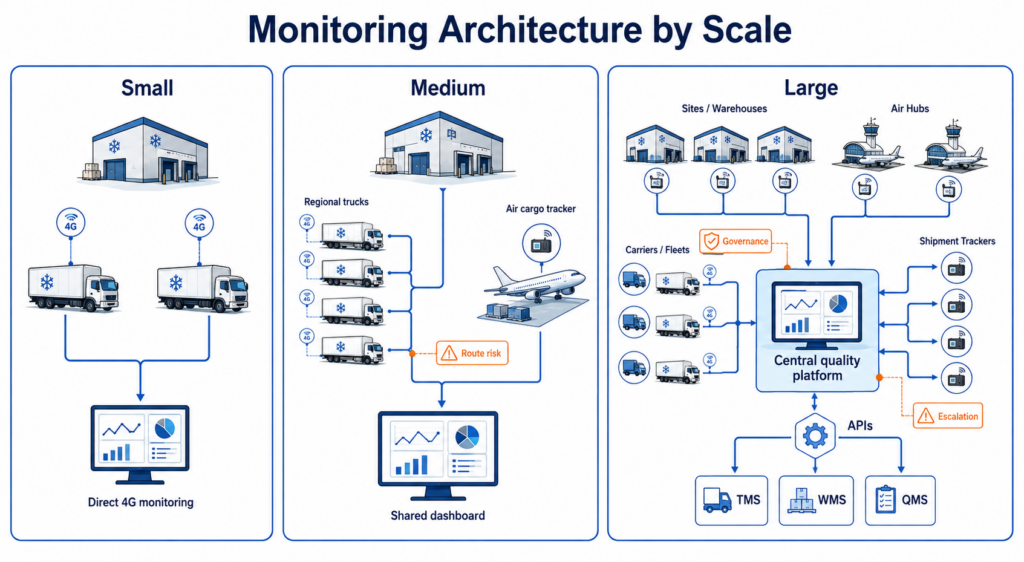
     

    pharmaceutical-cold-chain-deployment-by-scale

    Monitoring architecture should scale from direct reusable devices to multi-carrier shipment programs with shared governance and integrations.

    Deployment by Functional Area and Transport Stage

    Stage Deployment recommendation
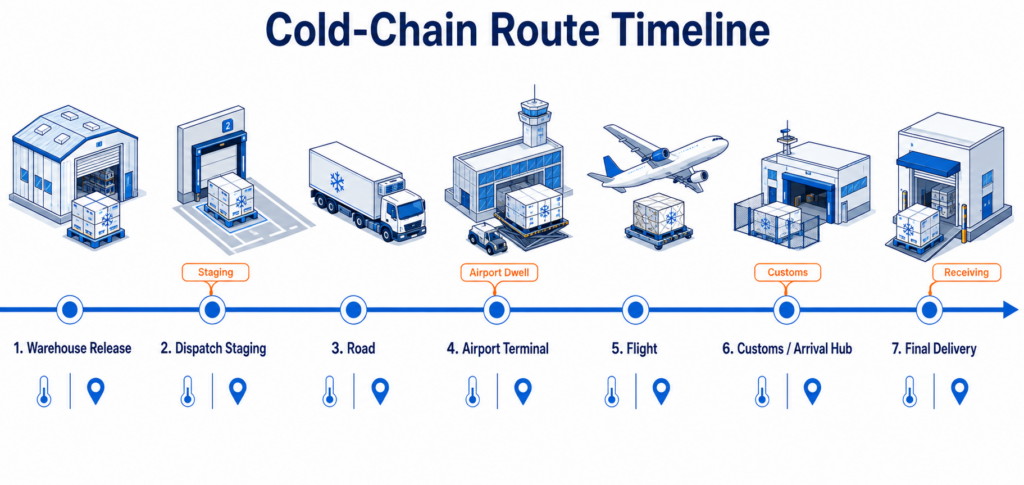
    Warehouse release / packing Verify product condition, packaging qualification, tracker identity, calibration status, battery, start time and shipment metadata. Fixed monitoring protects the staging environment.
    Dispatch staging / cross-dock Use fixed facility sensors for ambient/cold-room conditions; record handoff time into the shipment record.
    Road leg Use reusable cellular vehicle monitor for owned fleet; add shipment tracker when cargo-level location and handoff evidence are required.
    Airport acceptance / cargo terminal Confirm tracker status, airline procedures, temperature-controlled storage and exception ownership. Do not assume continuous cellular communication.
    Aircraft / flight leg Use only route- and airline-appropriate shipment trackers and operating modes; local logging must preserve the record when live communication is unavailable.
    Arrival hub / customs Prioritize dwell-time visibility, controlled storage, location and prompt exception escalation.
    Final-mile delivery Maintain temperature history through unloading and proof-of-delivery handoff; align receiving checks with the electronic record.
    Receiving / disposition Review shipment history, alarms, packaging condition and product-specific acceptance criteria; a sensor excursion is evidence for investigation, not an automatic product-disposition decision.


    pharmaceutical-cold-chain-critical-handoffs

    Most cold-chain risk is concentrated at staging, carrier transfer, airport dwell, customs and final receiving rather than only during the moving leg.

    Common Design and Installation Mistakes

    1. Using one technology for every layer. A shipment tracker, vehicle monitor, and warehouse monitoring system solve different problems and should not be treated as interchangeable.
    2. Placing the temperature sensor where it is easy to install rather than where it represents the product or qualified packaging environment.
    3. Assuming cellular coverage equals data integrity. Remote alerts may disappear during a dead zone even though the device continues logging locally.
    4. Ignoring batch, lot, shipment, route and handoff metadata. Temperature data without identity and ownership are difficult to use in a regulated deviation investigation.
    5. Setting instantaneous alarms without operational delays, which can create alert fatigue during loading and handoff, or setting delays so long that intervention is no longer possible.
    6. Using a road-vehicle IoT device as though it were automatically approved for active air-cargo operation. Airline acceptance, battery configuration and radio behavior must be confirmed for the specific route.
    7. Comparing products only on sensor accuracy while ignoring calibration, location capability, local memory, reverse logistics, platform tiers, user governance and integration cost.
    8. Failing to test the complete workflow before launch: start/stop, time zones, offline periods, alarm acknowledgement, receiving review, report export, calibration status and device return or reuse.
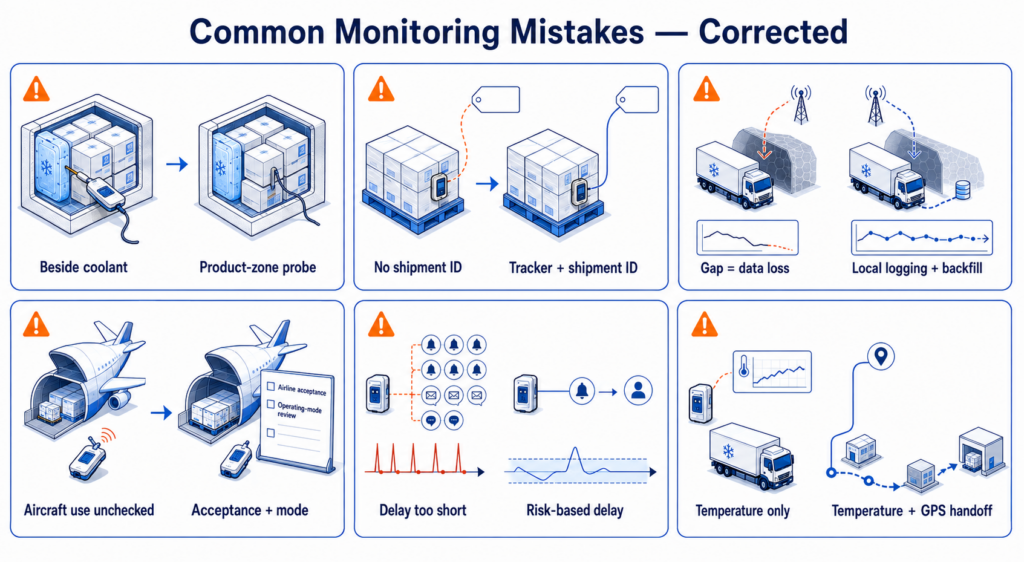
     

    pharmaceutical-shipment-monitoring-common-mistakes

    Wrong sensor placement, missing metadata, unrealistic alert rules and architecture mismatch can undermine otherwise accurate monitoring hardware.

    Frequently Asked Questions

    What is pharmaceutical shipment monitoring?

    Pharmaceutical shipment monitoring is the controlled collection of environmental and logistics data while a drug product moves through the supply chain. Depending on risk, the record may include temperature, location, humidity, light/opening evidence, shock, tilt, device health and handoff events. The monitoring device can travel with the shipment, remain with a vehicle, or protect a fixed transit area. A complete program also defines calibration, shipment identity, alarm escalation, data retention and product-disposition procedures.

    Does GDP require a real-time GPS tracker for every pharmaceutical shipment?

    No single global GDP rule requires the same real-time GPS tracker on every shipment. EU GDP and WHO guidance focus on maintaining required transport conditions, defining responsibilities, controlling routes and equipment, and retaining suitable evidence. The monitoring method should be based on product stability, packaging qualification, route risk, carrier agreements and the consequences of an excursion. Real-time location is especially useful for high-value, long, multimodal or disruption-prone routes, but passive logging may remain appropriate for lower-risk qualified lanes.

    What is the difference between shipment-level, vehicle-level and warehouse monitoring?

    Shipment-level monitoring travels with the pallet, package or container and can continue across carriers and transport modes. Vehicle-level monitoring stays with a truck and builds reusable history of the cargo compartment and repeated routes. Warehouse or facility monitoring protects fixed staging, cold-room, cross-dock and receiving areas. Large cold-chain programs often use all three because they answer different questions: what happened to the shipment, how the vehicle performed, and what conditions existed at the handoff facility.

    What happens when a pharmaceutical tracker loses cellular coverage?

    A well-designed tracker should continue logging locally during a cellular outage and upload the stored record later. That protects data continuity, but it does not guarantee alert continuity because the quality team cannot receive a live exception while the device is offline. Buyers should test memory capacity, time stamps, backfill order, duplicate handling, battery behavior and how the platform marks communication gaps. For critical routes, the response plan should not assume uninterrupted cellular service.

    Which data should be linked to the temperature record?

    At minimum, the organization should be able to identify the shipment, tracker, time period and route. Regulated workflows often benefit from linking batch or lot, product, packaging configuration, shipper, carrier, origin, destination, planned handoff points, alarm limits, tracker serial number, calibration status, dispatch time and receiving time. The exact metadata should be defined before integration so the same field means the same thing in the tracker platform, TMS, WMS and quality system.

    Can a reusable UbiBot monitor replace a pharmaceutical shipment tracker?

    Not when the requirement includes cargo-level GPS location, shock, tilt, cross-carrier handoff visibility or air-cargo-specific operating workflows. UbiBot WS1 Pro-4G is better positioned as a reusable vehicle or portable environmental monitor for owned road routes, while GS1-AETH1RS fits fixed transit and warehouse areas. Dedicated shipment trackers such as Tive, Sensitech and ELPRO are designed around trip identity and logistics visibility. A mixed architecture can use UbiBot for reusable infrastructure and shipment trackers for selected loads.

    How often should a cold-chain shipment record temperature?

    There is no universal interval for every pharmaceutical product or route. The interval should be selected through risk assessment and route qualification so the record can reconstruct meaningful excursions without creating unnecessary battery and data load. Shorter intervals provide more detail during fast-changing handoffs; longer intervals may be acceptable in stable qualified packaging. Logging and communication intervals can also differ: the device may record frequently while transmitting less often, with immediate communication triggered by an exception where the system supports it.

    How should air-cargo trackers be selected?

    Start with the route, airline and packaging design rather than the sensor specification alone. Verify the exact tracker SKU, battery type, airline acceptance, radio operating behavior during flight, supported countries and cellular bands, operating temperature, local memory, calibration, alarm workflow and placement inside or on the shipping system. IATA Temperature Control Regulations and CEIV Pharma resources help frame airfreight control points, but the shipper and logistics providers still need route-specific procedures and quality agreements.

    Should shipment temperature be measured inside the package or on the pallet?

    It depends on what the measurement is intended to represent. A tracker on the pallet can be excellent for route and ambient exposure data, while a probe inside qualified packaging may better represent the product environment. Packaging studies and product stability data should determine the appropriate position. A sensor placed next to a coolant pack, against an exterior wall or near a door can produce biased results. The final location should be documented so different shipments are monitored consistently.

    What should be tested before a global rollout?

    Run pilots on representative products, packaging systems, seasons, road routes and air lanes. Test tracker activation, shipment metadata, cellular dead zones, airline procedures, local logging, temperature alarms, light/opening events, battery life, time zones, location accuracy, notification delivery, acknowledgement, data backfill, report export, integration, receiving review and device return or reuse. Compare the system against traceable references and document acceptance criteria before scaling. Repeat testing after significant changes to route, packaging, tracker firmware, platform or carrier network.

    Conclusion and Selection Recommendations

    A pharmaceutical cold-chain monitoring program should be designed around the monitoring object and the decision that the data must support. Shipment trackers are strongest when the cargo must be followed across carriers, airports and handoffs. Reusable vehicle monitors are efficient when the same road assets run repeatedly. Fixed facility monitors protect the staging and transit spaces between transport legs. Trying to use one category as a universal substitute usually creates either unnecessary cost or a gap in evidence.

    UbiBot is a balanced option for organizations that want reusable road-vehicle or fixed transit-area monitoring with direct connectivity, large local memory, external probes, public cloud or on-premises deployment, and open integration options without a proprietary gateway. Tive, Sensitech, and ELPRO are more appropriate when shipment-level location, multimodal chain-of-custody, air-cargo workflows, shock/tilt evidence, or enterprise shipment analytics are the primary requirement. A mature global program may combine these architectures rather than force one product family to solve every layer of the cold chain.

    Before purchase, verify the exact regional model, operating range, calibration certificate, cellular bands, airline acceptance, battery arrangement, platform tier, API entitlement, data retention, user governance, and commercial terms. Monitoring supports quality and GDP-style distribution control; it does not by itself prove regulatory compliance or determine whether an exposed product remains suitable for use.

    Sources and Product Information Disclaimer

    This article is for industry education and procurement planning. It is not legal, regulatory, validation, pharmaceutical-quality, packaging-engineering, transport-engineering, or product-disposition advice. Product suitability depends on approved storage conditions, stability data, qualified packaging, route profile, carrier and airline procedures, sensor placement, calibration, connectivity, data governance, alarm response and the applicable quality agreement. Specifications, wireless bands, software features, subscriptions, integrations, calibration services and product availability may change by region and contract. Verify current official documentation before publication or procurement.

    Official References

    [1] European Commission – Guidelines of 5 November 2013 on Good Distribution Practice of medicinal products for human use (2013/C 343/01). https://health.ec.europa.eu/medicinal-products/eudralex/eudralex-volume-1_en – EU GDP framework for medicinal-product distribution and transport control.

    [2] World Health Organization – TRS 961, Annex 9: Model guidance for the storage and transport of time- and temperature-sensitive pharmaceutical products. https://www.who.int/publications/m/item/trs961-annex9-modelguidanceforstoragetransport – Global model guidance for TTSPP storage and distribution.

    [3] WHO distribution guidance library and technical supplements. https://www.who.int/teams/health-product-and-policy-standards/standards-and-specifications/norms-and-standards-for-pharmaceuticals/guidelines/distribution – Includes supplements on road/air transport, route profiling and transport monitoring.

    [4] IATA – Temperature Control Regulations (TCR). https://www.iata.org/en/publications/manuals/temperature-control-regulations/ – Air-cargo temperature-control practices, planning, booking, packing and handling.

    [5] IATA – CEIV Pharma. https://www.iata.org/en/services/certification/special-cargo/ceiv-pharma/ – Pharmaceutical air-cargo handling certification framework and ecosystem.

    [6] USP <1079> Risks and Mitigation Strategies for the Storage and Transportation of Finished Drug Products. https://doi.usp.org/USPNF/USPNF_M99798_06_01.html – Risk-based storage and transportation framework.

    [7] USP <1079.3> Monitoring Devices – Time, Temperature, and Humidity. https://doi.usp.org/USPNF/USPNF_M16680_02_01.html – Monitoring-device science, performance and qualification considerations.

    [8] UbiBot – WS1 Pro Specifications. https://www.ubibot.com/ubibot-ws1pro-specifications/ – Official WS1 Pro hardware, local memory and network specifications.

    [9] UbiBot – Temperature Sensor Comparison (UB-DT-P1). https://support.ubibot.com/hc/en-us/articles/45863713116825-Temperature-Sensor-Comparison – External probe range, accuracy and device compatibility.

    [10] UbiBot – GS1-AETH1RS product / specification pages. https://store.ubibot.com/products/ubibot-gs1-eth-wifi-and-ethernet-cable – Fixed Wi-Fi/Ethernet monitoring, local memory and RS485 probe support.

    [11] UbiBot – On-Premises Platform. https://www.ubibot.com/on-premises-platform/ – Private deployment, API and data-forwarding capabilities.

    [12] UbiBot – Public Cloud Pricing / free basic platform. https://www.ubibot.com/public-cloud-pricing/ – Current platform tiers and free-plan storage/traffic.

    [13] UbiBot – Calibration & Traceability Policy. https://support.ubibot.com/hc/en-us/articles/52513475103001-Calibration-Traceability-Policy – Factory calibration and accredited recalibration guidance.

    Related Resources

    How to Deploy a Pharmaceutical Warehouse Environmental Monitoring System?
    University of Alberta Study Uses UbiBot WS1 Pro to Monitor Environmental Conditions in Hydroponic Lettuce Production
    National University of Singapore Study Uses UbiBot WS1 Pro for Surface Temperature Calibration in District-Scale Thermal Infrared Monitoring
    Shanghai Jiao Tong University and National University of Singapore Study Use UbiBot GS1-AETH1RS for Vertical Farming Environment Monitoring
    Polish Academy of Sciences Study Uses UbiBot WS1 Pro to Monitor Temperature and Humidity During PM Filter Conditioning
    UbiBot vs Room Alert vs HW Group vs Monnit: Which Server Room Monitoring System Fits Your Facility?
    UbiBot vs HOBO vs SensorPush vs Testo: Which Museum Room Monitor Fits Your Collection?
    UbiBot vs ELPRO vs Dickson vs Testo: Which Monitoring System Fits a GDP Pharmaceutical Warehouse?
    menu-header-svg
    Search
    • Explore Knowledge
      • Comparison & Selection
      • Industry Solution
      • Product & Device
      • Criterion & Compliance
      • Deployment & Usage
      • Technology & Principle
    • Academic Research
    • In-depth Tech

    Industry Solution

    See More >>

    How to Monitor Pharmaceutical Cold Chain Shipments from Warehouse to Delivery?

    Introduction

    A pharmaceutical shipment can leave a qualified warehouse in specification and still arrive with an unresolved temperature event. The risk is rarely limited to the time spent inside a refrigerated truck. Product may wait on a staging floor, move through a cross-dock, sit in an airport cargo terminal, be loaded into an active or passive container, lose cellular visibility during flight, pass through customs, and then enter a final-mile vehicle before delivery. Each handoff creates a different combination of temperature exposure, connectivity, security, and data-ownership risk.

    This guide is written for pharmaceutical manufacturers, distributors, quality and GDP teams, 3PLs, freight forwarders, airport cargo operators, system integrators, and procurement teams. It explains how to decide what should be monitored, how shipment-level tracking differs from vehicle and facility monitoring, how cellular and local data storage should work together, how representative products from UbiBot, Tive, Sensitech, and ELPRO fit different operating models, and how to build a scalable monitoring architecture from warehouse release to delivery.

    The article is not a compliance certification. EU GDP, WHO guidance, USP supply-chain chapters, IATA temperature-control practices, product stability data, shipper-carrier quality agreements, and local law all influence the final design. A device can support records, alerts, and investigations; it does not make a shipment GDP-compliant by itself. [1][2][3][4]

    Quick Summary

    Pharmaceutical cold-chain monitoring should link the correct sensor to the correct object: a shipment tracker travels with a pallet or package, a reusable vehicle monitor stays with the truck, and a fixed facility monitor protects staging and transit areas. Temperature is usually essential; location, light/opening evidence, humidity, shock, tilt, device health, and power status are added when they answer a defined risk. Cellular connectivity provides in-transit visibility, but local memory protects the historical record during coverage gaps. Air cargo requires route- and airline-appropriate tracker operation. Selection should compare calibration, local data retention, location technology, alerts, platform governance, APIs, reuse model, battery strategy, and lifecycle cost – not temperature accuracy alone.

    A layered monitoring architecture should connect fixed warehouse conditions, reusable vehicle monitoring, shipment-level tracking and quality-system response without forcing one device to do every job.


    Key Takeaway

    The most reliable pharmaceutical shipment monitoring architecture separates three questions: what happened to the product, where and when it happened, and whether anyone could act before the excursion became a loss. Temperature, location, offline storage, alarm escalation, batch metadata, and handoff records must therefore be designed as one controlled workflow.


    Why Is Environmental Monitoring Important in Pharmaceutical Transport?

    Protect product quality and usable shelf life

    Finished medicines, biologics, vaccines, investigational products, and other time- and temperature-sensitive pharmaceuticals may be exposed to conditions that can affect stability or critical quality attributes. The acceptable range is product-specific and should come from approved labeling, stability data, packaging qualification, and the applicable quality system. WHO model guidance treats safe storage and distribution of time- and temperature-sensitive pharmaceutical products as a controlled supply-chain activity, while USP <1079> frames storage and transportation as integrated risk-management processes. [2][5]

    Create intervention time instead of post-delivery evidence only

    A passive logger can prove that an excursion happened. A real-time tracker can create an opportunity to intervene while the shipment is still moving: the quality team may contact a carrier, ask a ramp operator to move a pallet to controlled storage, redirect a vehicle, verify a container status, or prepare a receiving decision before arrival. Real-time visibility is therefore operationally valuable, but it should be treated as an additional control layer rather than a replacement for qualified packaging, refrigerated transport, route planning, and trained personnel.

    Preserve traceability across handoffs

    Pharmaceutical distribution involves multiple organizations that may not share the same IT systems. The monitoring record should make it possible to connect a sensor or tracker to the shipment identifier, batch or lot, route, packaging configuration, carrier, departure time, handoff points, and final receipt. Light events, location changes, or opening evidence can help explain when a shipment was accessed or moved. The data model matters as much as the device: a temperature curve without shipment identity or time-zone control is weak evidence during a deviation investigation.

    Support GDP-style transport control without oversimplifying compliance

    The EU GDP guideline requires medicinal products to be transported under conditions that maintain quality and integrity, with responsibilities defined and transport processes controlled. WHO technical supplements separately address road and air operations, transport-route profiling, and monitoring systems. IATA’s Temperature Control Regulations and CEIV Pharma program address pharmaceutical air-cargo handling, critical control points, infrastructure, training, and operational consistency. These sources support a risk-based monitoring strategy, but none of them turns a specific commercial tracker into an automatically compliant system. [1][2][3][4]

    Reduce the blind spots of manual checks

    Manual checks at warehouse release and receiving remain useful, but they show only isolated moments. They cannot reconstruct an overnight airport dwell, a missed connection, repeated road-side door openings, a long customs delay, or an offline cellular period. Continuous logging provides the time history needed to understand duration and recovery, while location and event data can show where the issue occurred. For regulated investigations, the organization must still define how data are reviewed, how missing records are handled, who owns the excursion, and which product expert makes the final disposition decision.

    What Environmental Parameters Should Be Monitored?

    Parameter Why It Matters Monitoring Location Recommended Sensor Type
    Shipment temperature (essential) Primary evidence of the thermal environment experienced by the monitored shipment. Inside qualified packaging, pallet, tote, container, or representative product zone. Calibrated electronic temperature logger or real-time tracker matched to the required range.
    Location and route (often essential for real-time programs) Links an excursion to a stop, airport, handoff, delay, customs event, or route deviation. Tracker attached to the shipment or transport unit. GPS / Wi-Fi / cellular geolocation tracker, subject to route and airline acceptance.
    Light or opening evidence (conditional) Can indicate package opening, door access, exposure, or handling events; useful for security and root-cause analysis. On or inside shipment packaging where light change is meaningful. Integrated light sensor or dedicated door/contact input.
    Relative humidity (conditional) Relevant for moisture-sensitive products, packaging systems, some biologics, labels, and condensation risk. Inside packaging or transport space where humidity can affect the product or evidence. Calibrated temperature/RH tracker or separate RH logger.
    Shock, motion and tilt (shipment-level option) Adds evidence about impacts, orientation, rough handling, and movement. Attached to the pallet, package or high-value shipment. Multi-sensor shipment tracker.
    Vehicle or compartment temperature (vehicle-level) Builds reusable history of refrigerated transport and identifies recurring hot/cold zones. Representative points inside owned refrigerated vehicles. Reusable 4G monitor with external temperature probe(s).
    Staging / transit-area temperature (facility-level) Protects product while it waits outside the transport leg and supports handoff decisions. Warehouse staging, cross-dock, airport handling, controlled rooms. Fixed Wi-Fi/Ethernet monitor with calibrated external probe.
    Device health, battery and connectivity (essential for remote alerting) Shows when the monitoring path itself is unavailable and prevents silent loss of visibility. System level. Heartbeat, low-battery, offline, gateway and communication-health alarms.


    pharmaceutical-shipment-monitoring-parameters

    Temperature is the core measurement, while location, light, humidity, shock, tilt and device health should be added only when they answer a defined supply-chain risk.


    The first design decision is therefore not ‘Which tracker should we buy?’ but ‘What object must the data represent?’ A pallet-level tracker answers a different question from a truck sensor, and neither automatically replaces a fixed monitor in the dispatch warehouse. High-value lanes often use more than one layer because the evidence required for product disposition, carrier performance, and facility control is not identical.

    What Does a Typical Pharmaceutical Shipment Monitoring System Include?

    A practical architecture has five interacting layers. The sensing layer measures shipment or transport conditions. The device layer stores readings and may calculate alarms or event flags. The connectivity layer transmits data through cellular, Wi-Fi, or a local vehicle/facility network. The platform layer associates readings with shipments, displays maps and trends, retains records, and manages users. The alarm and integration layer sends notifications and forwards selected data to quality, transport-management, warehouse, ERP, customer-visibility, or analytics systems.

    • Sensing layer: temperature plus optional humidity, light, shock, tilt, door/contact, vehicle status, or fixed staging-area sensors.
    • Device / collection layer: shipment tracker, reusable vehicle monitor, fixed facility logger, or telematics gateway with local memory and battery status.
    • Connectivity layer: cellular in transit, Wi-Fi at facilities, Ethernet for fixed zones, and local wired/wireless sensor networks where multiple points share one backhaul.
    • Platform layer: shipment identity, maps, trends, rules, users, retention, reports, multi-site visibility, and exception review.
    • Alarm and integration layer: email, SMS, mobile notifications, escalations, APIs, webhooks/data forwarding, and controlled handoff into quality or logistics workflows.


    Text-Based Architecture Flow

    Qualified packaging / pallet / vehicle / staging sensors -> shipment tracker or reusable monitor -> local memory -> cellular / depot Wi-Fi / vehicle gateway / fixed Ethernet -> cloud or on-premises platform -> temperature and device-health rules -> quality, logistics, receiving, carrier and customer workflows -> deviation assessment and product disposition.


    pharma-shipment-monitoring-data-flow

    A complete monitoring workflow combines sensing, local storage, connectivity, platform intelligence and controlled response.


    How a Pharmaceutical Warehouse Monitoring System Connects to Shipment Monitoring

    A pharmaceutical warehouse monitoring system protects fixed locations such as release staging, packing rooms, cold rooms, dispatch docks, cross-docks, and receiving areas. Shipment monitoring protects the product while responsibility and physical location change. The two systems should exchange identifiers and handoff times where practical. For example, a GS1-AETH1RS can monitor a fixed staging zone over Ethernet or Wi-Fi while a WS1 Pro-4G remains with an owned road vehicle, and a dedicated shipment tracker travels with selected high-value or multimodal loads. This layered model avoids asking one device to solve facility, vehicle, and chain-of-custody problems simultaneously.

    Which Communication Method Should Be Used?

    pharmaceutical-cold-chain-network-selection

    Cellular is the primary remote path for road and shipment tracking, while Wi-Fi, Ethernet, LoRa and RS485 serve specific facility and local-sensor roles.


    Method Best fit Advantages Limitations / design checks
    Wi-Fi Warehouses, airport offices, depots, staging zones, device setup and synchronization. Low data cost; direct cloud connection; easy for fixed indoor points. Coverage is limited in transit; enterprise authentication and metal structures can complicate deployment.
    Ethernet Fixed warehouse, cross-dock, cold-room or dispatch points where a cable is available. Stable connection, predictable IT control, good for permanent monitoring. Not practical for moving shipments; requires cabling and power planning.
    4G / cellular Road vehicles, shipment trackers, remote handoffs and routes outside customer LANs. Direct remote visibility without a local gateway; broad regional coverage. Dead zones, roaming, SIM cost, regional band support, battery use and airline operating rules must be verified.
    LoRa / proprietary sub-GHz Many sensors inside a large warehouse, campus, yard, or vehicle network feeding a gateway. Long range and low node power; efficient for high point counts. Adds gateway and backhaul dependencies; not a substitute for global shipment geolocation.
    RS485 Fixed probes, industrial transmitters, reefer status or staging-area equipment connected to a nearby logger/controller. Stable wired sensor connection and broad industrial compatibility. Not an internet connection; requires wiring, addressing, termination and commissioning.


    For road transport, direct cellular is usually the simplest real-time path. For air cargo, tracker choice must consider airline acceptance, battery classification, operating mode during flight, and route coverage; a device that works well in a truck is not automatically appropriate inside an aircraft. IATA’s temperature-control resources are useful because they treat airfreight as a sequence of booking, acceptance, storage, handling, build-up, flight, and delivery control points rather than as one uninterrupted connected trip. [3][4]

    Offline behavior should be tested separately from communications. A tracker can preserve a complete temperature history even when cellular service disappears, while remote alerts are delayed until connectivity returns. Procurement teams should therefore document two service levels: data continuity and alert continuity. A good system states how many records are retained locally, how time is synchronized, how data are backfilled, how duplicates are handled, and how a user can recognize a gap in communication.

    pharmaceutical-cold-chain-offline-data-continuity

    Local memory can preserve the audit trail during a network outage even when live alerts are temporarily unavailable.

    How Should Monitoring Products Be Compared?

    Published temperature accuracy is important, but it is only one part of the measurement chain. Buyers should confirm the operating range, calibration points, uncertainty or traceability documentation, sensor response, packaging placement, thermal mass, enclosure limits, battery performance, and whether the sensor is measuring the product-relevant environment. A precise tracker attached to the outside of an insulated container may provide excellent logistics data and poor product-temperature evidence.

    The architecture can be more important than the sensor specification. A reusable vehicle monitor can be economical for an owned fleet because it stays installed and builds long-term compartment history. A shipment tracker is better when the cargo changes carriers, crosses borders, moves by air, or needs geolocation, light, shock, tilt, and handoff evidence. A fixed facility monitor is best for staging and transit rooms. The procurement decision should compare the total workflow rather than force these three categories into a single ranking.

    • Measurement chain: range, accuracy, calibration, sensor location, response time, enclosure and product/packaging relationship.
    • Data resilience: local memory, outage duration, backfill, time stamps, missing-data flags and battery backup.
    • Location and event context: GPS/Wi-Fi/cellular location, light, shock, tilt, door or motion evidence.
    • Connectivity and geography: supported cellular bands, roaming, airline acceptance, depot Wi-Fi, fixed Ethernet and gateway dependencies.
    • Software governance: shipment metadata, user roles, reports, audit evidence, retention, API/webhooks, cloud region and on-premises requirements.
    • Lifecycle model: reusable vs trip-oriented hardware, reverse logistics, calibration, subscription tiers, SIM/data fees, batteries and support.


    vehicle-vs-shipment-vs-facility-monitoring

    Vehicle, shipment and facility monitoring overlap on temperature but solve different traceability and infrastructure problems.

    Product and Solution Comparison

    The comparison below uses representative official configurations reviewed in August 2026. UbiBot is positioned primarily as reusable vehicle and facility monitoring. Tive Solo 5G, Sensitech TempTale GEO APX Global, and ELPRO LIBERO GH are shipment-oriented trackers. They overlap on temperature monitoring but are not functionally interchangeable. Where an exact value was not found in the reviewed official source, the table states ‘Not publicly specified.’

    Hardware, Measurement and Data Resilience

    Comparison item UbiBot WS1 Pro-4G / GS1-AETH1RS Tive Solo 5G Sensitech TempTale GEO APX Global ELPRO LIBERO GH
    System positioning Reusable vehicle / facility environmental monitor Trip-oriented real-time shipment tracker Global real-time shipment condition and location monitor Reusable real-time shipment temperature/RH and location logger
    Measured parameters WS1 Pro: temperature, RH, light; external temperature and selected RS485 probes. GS1 fixed option adds similar environmental channels. Temperature, RH, light, shock, motion and location Location, temperature, humidity, light; optional probe on Extended model Temperature, humidity, location, light and movement/tilt
    Temperature range / accuracy WS1 Pro internal -20 to 60 C, +/-0.2 C. UB-DT-P1 -55 to 125 C, +/-0.5 C from -10 to 85 C. Official support page: -30 to 60 C; +/-0.5 C. Standard -10 to 55 C; Extended -30 to 55 C; +/-0.5 C from -10 to 45 C. Measurement -30 to 70 C; application range 0 to 55 C for GH; exact accuracy not clearly stated on reviewed public shop page.
    Connectivity / location 2.4 GHz Wi-Fi plus regional 4G on WS1 Pro; no native GPS. GS1-AETH1RS provides Wi-Fi + RJ45 Ethernet for fixed sites. LTE-M/2G plus GPS, Wi-Fi geolocation and cell-tower triangulation LTE Cat-1bis plus Wi-Fi location support LTE-M / NB-IoT with location reporting
    Dedicated gateway No for direct-connected WS1 Pro or GS1 No No No
    Local storage 300,000 sensing records Up to 25,000 records shown on current tracker comparison page Not publicly specified on reviewed APX Global product page 31,000 measurement values
    Offline data protection Local logging; synchronization behavior should be verified in route acceptance testing. Local record capacity is published; detailed offline/backfill behavior should be verified for the selected service tier. Not publicly specified on reviewed product page. Local memory; elproCLOUD configuration supports logging and communication intervals.
    External sensor support WS1 Pro supports two DS18B20 probes plus selected RS485 probe depending configuration; GS1 supports RS485 probes. Optional beacon / specialized probe ecosystem available in Tive portfolio; verify exact Solo 5G accessory compatibility. Optional probe on Extended model. GH uses internal temp/RH sensors; other LIBERO Gx models support external Pt100 for wider ranges.
    Local display 4.4-inch LCD on WS1 Pro; 4-inch LCD on GS1 No full data display on Solo 5G product page No full data display on APX Global product page Interactive LCD

    Platform, Governance and Deployment Fit

    Comparison item UbiBot WS1 Pro-4G / GS1-AETH1RS Tive Solo 5G Sensitech TempTale GEO APX Global ELPRO LIBERO GH
    Cloud / software UbiBot Public IoT Platform; On-Premises Platform available Tive Platform SensiWatch Platform elproCLOUD; liberoMANAGER
    API / integrations REST APIs and data forwarding; advanced functions depend on plan API and webhooks available by platform tier Not publicly specified on reviewed APX Global product page Not publicly specified for the reviewed GH product page; verify enterprise integration options with ELPRO
    Alerts Platform/app/email/HTTP; paid channels depend on plan and region Condition, geofence, ETA and route alerts; channels depend on tier Departure, arrival and exception alerts; mobile access Email/SMS and multi-level alarm profiles
    Calibration Factory calibration report and accredited-lab recalibration path; confirm probe-specific certificate and project points NIST-traceable, 3-point ISO/IEC 17025 certificate stated NIST-traceable temperature accuracy stated Calibrated dual sensor; production calibration certificate available
    Reuse model Reusable / permanent vehicle or facility installation Solo 5G is marketed as a single-use shipment tracker Trip-oriented monitor; Device Takeback program available Reusable multi-use logger, up to 14 months runtime
    Strongest fit Owned fleets, regional road routes, dispatch hubs and fixed transit areas needing low infrastructure and large local memory High-value or multimodal shipments needing location, shock and route visibility Enterprise global cold-chain programs and shipment analytics Reusable pharmaceutical shipment workflows needing temp/RH, location, display and airfreight-friendly battery design
    Main trade-off No native GPS/shock/tilt/handoff tracking; air-cargo use requires separate route and airline suitability review Per-shipment workflow and platform cost are higher than permanent vehicle monitoring Enterprise program orientation; detailed commercial/integration terms are quote-based Higher device/service complexity than a fixed vehicle monitor; select another LIBERO model for frozen/dry-ice/cryogenic ranges
    Deployment complexity Low-medium for owned vehicle/facility use Medium Medium-high / enterprise Medium-high
    Relative total cost tendency* Low-medium for repeated owned-fleet and facility use Medium-high per shipment/program High / enterprise program Medium-high depending service, reuse and calibration

    *Relative cost is an architectural estimate, not a vendor quotation. Hardware, cellular service, platform tiers, calibration, reverse logistics, support and validation terms vary by region and contract.

    Which System Is Best for Each Use Case?

    Owned road fleet and repeated distribution routes

    Use UbiBot WS1 Pro-4G with an external temperature probe when the organization owns or controls the vehicle, runs repeated routes, and primarily needs reusable cargo-space history, local display, large offline storage, and centralized monitoring. This is particularly practical for regional distributors, hospital supply networks, specialty-pharmacy fleets, and service routes where the same monitor can remain with the vehicle. It is not a shipment-level GPS tracker, so it should not be selected when chain-of-custody location, shock, tilt, or multimodal handoff evidence is the primary requirement.

    High-value multimodal or air-freight shipment

    Use a shipment tracker such as Tive Solo 5G, Sensitech TempTale GEO APX Global, or an appropriate ELPRO LIBERO Gx model when the sensor must travel with the goods across carriers and modes. These systems are built around shipment identity, route visibility, event alerts, and logistics workflows. For air transport, confirm the exact tracker SKU, airline acceptance, battery and radio operating mode, route-country support, and procedures for any periods when communication is intentionally unavailable.

    Enterprise global pharmaceutical distribution program

    Sensitech is well aligned with organizations that want a large-scale cold-chain visibility program through the SensiWatch platform and standardized global shipment workflows. ELPRO is strong where reusable pharmaceutical loggers, calibrated devices, local display, temperature/RH, and structured cloud governance are priorities. Tive is attractive when location, shock, route deviation, customer sharing, and flexible shipment analytics are central. The strongest choice depends on existing quality systems, carrier network, service contracts, and the organization’s tolerance for per-shipment operational complexity.

    Warehouse, cross-dock and controlled staging areas

    Use a fixed monitor such as UbiBot GS1-AETH1RS where the requirement is continuous facility monitoring rather than shipment tracking. Ethernet or Wi-Fi, a visible display, 300,000 local records, external RS485 probes, public cloud and on-premises options can make fixed deployment simpler than placing trip-oriented trackers around a warehouse. This fixed record should be linked operationally to shipment handoff times so quality teams can distinguish a facility exposure from an in-transit excursion.

    How Should the System Be Deployed?

    Small operation: one warehouse, owned vehicles, limited routes

    Start by documenting the release-to-receipt workflow. Use fixed monitoring in the dispatch/staging area, one reusable cellular monitor per controlled vehicle, and shipment trackers only for loads that justify chain-of-custody or multimodal visibility. Use an external probe when the communications unit needs to remain in a protected, signal-accessible location. Define one primary and one backup alert recipient, a route-specific high/low alarm profile, logging and transmission intervals, and a process for retrieving the complete record after a coverage gap. Test the system on representative summer and winter routes before broad rollout.

    Medium operation: multiple carriers, airport handoffs, regional distribution

    Separate facility, vehicle, and shipment telemetry in the data model. Give each shipment a stable identifier linked to batch/lot, packaging type, tracker serial number, route and carrier. Use shipment trackers for airfreight and third-party carrier legs, while reusable vehicle monitors can remain on owned road assets. Add monitoring to staging areas where dwell time can be significant. Configure exception ownership by handoff: warehouse quality owns release, the carrier or forwarder owns in-transit response, and receiving quality owns acceptance. Escalations should remain visible to the product owner so responsibility does not disappear between organizations.

    Large or global program: multi-site, multi-carrier, multi-modal

    Define the governance model before selecting hardware. Standardize tracker qualification, route classes, alarm rules, metadata fields, time zones, calibration intervals, data retention, user roles, and change control. Decide which events need immediate action and which are for later investigation. Integrate only stable, well-defined fields into TMS, WMS, QMS, ERP, customer portals, or data lakes. A global program should also document cellular roaming limits, country restrictions, airline handling, reverse logistics for reusable devices, device takeback for trip-oriented hardware, and the ownership of inactive or lost trackers.


    pharmaceutical-cold-chain-deployment-by-scale

    Monitoring architecture should scale from direct reusable devices to multi-carrier shipment programs with shared governance and integrations.

    Deployment by Functional Area and Transport Stage

    Stage Deployment recommendation
    Warehouse release / packing Verify product condition, packaging qualification, tracker identity, calibration status, battery, start time and shipment metadata. Fixed monitoring protects the staging environment.
    Dispatch staging / cross-dock Use fixed facility sensors for ambient/cold-room conditions; record handoff time into the shipment record.
    Road leg Use reusable cellular vehicle monitor for owned fleet; add shipment tracker when cargo-level location and handoff evidence are required.
    Airport acceptance / cargo terminal Confirm tracker status, airline procedures, temperature-controlled storage and exception ownership. Do not assume continuous cellular communication.
    Aircraft / flight leg Use only route- and airline-appropriate shipment trackers and operating modes; local logging must preserve the record when live communication is unavailable.
    Arrival hub / customs Prioritize dwell-time visibility, controlled storage, location and prompt exception escalation.
    Final-mile delivery Maintain temperature history through unloading and proof-of-delivery handoff; align receiving checks with the electronic record.
    Receiving / disposition Review shipment history, alarms, packaging condition and product-specific acceptance criteria; a sensor excursion is evidence for investigation, not an automatic product-disposition decision.


    pharmaceutical-cold-chain-critical-handoffs

    Most cold-chain risk is concentrated at staging, carrier transfer, airport dwell, customs and final receiving rather than only during the moving leg.

    Common Design and Installation Mistakes

    1. Using one technology for every layer. A shipment tracker, vehicle monitor, and warehouse monitoring system solve different problems and should not be treated as interchangeable.
    2. Placing the temperature sensor where it is easy to install rather than where it represents the product or qualified packaging environment.
    3. Assuming cellular coverage equals data integrity. Remote alerts may disappear during a dead zone even though the device continues logging locally.
    4. Ignoring batch, lot, shipment, route and handoff metadata. Temperature data without identity and ownership are difficult to use in a regulated deviation investigation.
    5. Setting instantaneous alarms without operational delays, which can create alert fatigue during loading and handoff, or setting delays so long that intervention is no longer possible.
    6. Using a road-vehicle IoT device as though it were automatically approved for active air-cargo operation. Airline acceptance, battery configuration and radio behavior must be confirmed for the specific route.
    7. Comparing products only on sensor accuracy while ignoring calibration, location capability, local memory, reverse logistics, platform tiers, user governance and integration cost.
    8. Failing to test the complete workflow before launch: start/stop, time zones, offline periods, alarm acknowledgement, receiving review, report export, calibration status and device return or reuse.


    pharmaceutical-shipment-monitoring-common-mistakes

    Wrong sensor placement, missing metadata, unrealistic alert rules and architecture mismatch can undermine otherwise accurate monitoring hardware.

    Frequently Asked Questions

    What is pharmaceutical shipment monitoring?

    Pharmaceutical shipment monitoring is the controlled collection of environmental and logistics data while a drug product moves through the supply chain. Depending on risk, the record may include temperature, location, humidity, light/opening evidence, shock, tilt, device health and handoff events. The monitoring device can travel with the shipment, remain with a vehicle, or protect a fixed transit area. A complete program also defines calibration, shipment identity, alarm escalation, data retention and product-disposition procedures.

    Does GDP require a real-time GPS tracker for every pharmaceutical shipment?

    No single global GDP rule requires the same real-time GPS tracker on every shipment. EU GDP and WHO guidance focus on maintaining required transport conditions, defining responsibilities, controlling routes and equipment, and retaining suitable evidence. The monitoring method should be based on product stability, packaging qualification, route risk, carrier agreements and the consequences of an excursion. Real-time location is especially useful for high-value, long, multimodal or disruption-prone routes, but passive logging may remain appropriate for lower-risk qualified lanes.

    What is the difference between shipment-level, vehicle-level and warehouse monitoring?

    Shipment-level monitoring travels with the pallet, package or container and can continue across carriers and transport modes. Vehicle-level monitoring stays with a truck and builds reusable history of the cargo compartment and repeated routes. Warehouse or facility monitoring protects fixed staging, cold-room, cross-dock and receiving areas. Large cold-chain programs often use all three because they answer different questions: what happened to the shipment, how the vehicle performed, and what conditions existed at the handoff facility.

    What happens when a pharmaceutical tracker loses cellular coverage?

    A well-designed tracker should continue logging locally during a cellular outage and upload the stored record later. That protects data continuity, but it does not guarantee alert continuity because the quality team cannot receive a live exception while the device is offline. Buyers should test memory capacity, time stamps, backfill order, duplicate handling, battery behavior and how the platform marks communication gaps. For critical routes, the response plan should not assume uninterrupted cellular service.

    Which data should be linked to the temperature record?

    At minimum, the organization should be able to identify the shipment, tracker, time period and route. Regulated workflows often benefit from linking batch or lot, product, packaging configuration, shipper, carrier, origin, destination, planned handoff points, alarm limits, tracker serial number, calibration status, dispatch time and receiving time. The exact metadata should be defined before integration so the same field means the same thing in the tracker platform, TMS, WMS and quality system.

    Can a reusable UbiBot monitor replace a pharmaceutical shipment tracker?

    Not when the requirement includes cargo-level GPS location, shock, tilt, cross-carrier handoff visibility or air-cargo-specific operating workflows. UbiBot WS1 Pro-4G is better positioned as a reusable vehicle or portable environmental monitor for owned road routes, while GS1-AETH1RS fits fixed transit and warehouse areas. Dedicated shipment trackers such as Tive, Sensitech and ELPRO are designed around trip identity and logistics visibility. A mixed architecture can use UbiBot for reusable infrastructure and shipment trackers for selected loads.

    How often should a cold-chain shipment record temperature?

    There is no universal interval for every pharmaceutical product or route. The interval should be selected through risk assessment and route qualification so the record can reconstruct meaningful excursions without creating unnecessary battery and data load. Shorter intervals provide more detail during fast-changing handoffs; longer intervals may be acceptable in stable qualified packaging. Logging and communication intervals can also differ: the device may record frequently while transmitting less often, with immediate communication triggered by an exception where the system supports it.

    How should air-cargo trackers be selected?

    Start with the route, airline and packaging design rather than the sensor specification alone. Verify the exact tracker SKU, battery type, airline acceptance, radio operating behavior during flight, supported countries and cellular bands, operating temperature, local memory, calibration, alarm workflow and placement inside or on the shipping system. IATA Temperature Control Regulations and CEIV Pharma resources help frame airfreight control points, but the shipper and logistics providers still need route-specific procedures and quality agreements.

    Should shipment temperature be measured inside the package or on the pallet?

    It depends on what the measurement is intended to represent. A tracker on the pallet can be excellent for route and ambient exposure data, while a probe inside qualified packaging may better represent the product environment. Packaging studies and product stability data should determine the appropriate position. A sensor placed next to a coolant pack, against an exterior wall or near a door can produce biased results. The final location should be documented so different shipments are monitored consistently.

    What should be tested before a global rollout?

    Run pilots on representative products, packaging systems, seasons, road routes and air lanes. Test tracker activation, shipment metadata, cellular dead zones, airline procedures, local logging, temperature alarms, light/opening events, battery life, time zones, location accuracy, notification delivery, acknowledgement, data backfill, report export, integration, receiving review and device return or reuse. Compare the system against traceable references and document acceptance criteria before scaling. Repeat testing after significant changes to route, packaging, tracker firmware, platform or carrier network.

    Conclusion and Selection Recommendations

    A pharmaceutical cold-chain monitoring program should be designed around the monitoring object and the decision that the data must support. Shipment trackers are strongest when the cargo must be followed across carriers, airports and handoffs. Reusable vehicle monitors are efficient when the same road assets run repeatedly. Fixed facility monitors protect the staging and transit spaces between transport legs. Trying to use one category as a universal substitute usually creates either unnecessary cost or a gap in evidence.

    UbiBot is a balanced option for organizations that want reusable road-vehicle or fixed transit-area monitoring with direct connectivity, large local memory, external probes, public cloud or on-premises deployment, and open integration options without a proprietary gateway. Tive, Sensitech, and ELPRO are more appropriate when shipment-level location, multimodal chain-of-custody, air-cargo workflows, shock/tilt evidence, or enterprise shipment analytics are the primary requirement. A mature global program may combine these architectures rather than force one product family to solve every layer of the cold chain.

    Before purchase, verify the exact regional model, operating range, calibration certificate, cellular bands, airline acceptance, battery arrangement, platform tier, API entitlement, data retention, user governance, and commercial terms. Monitoring supports quality and GDP-style distribution control; it does not by itself prove regulatory compliance or determine whether an exposed product remains suitable for use.

    Sources and Product Information Disclaimer

    This article is for industry education and procurement planning. It is not legal, regulatory, validation, pharmaceutical-quality, packaging-engineering, transport-engineering, or product-disposition advice. Product suitability depends on approved storage conditions, stability data, qualified packaging, route profile, carrier and airline procedures, sensor placement, calibration, connectivity, data governance, alarm response and the applicable quality agreement. Specifications, wireless bands, software features, subscriptions, integrations, calibration services and product availability may change by region and contract. Verify current official documentation before publication or procurement.

    Official References

    [1] European Commission – Guidelines of 5 November 2013 on Good Distribution Practice of medicinal products for human use (2013/C 343/01). https://health.ec.europa.eu/medicinal-products/eudralex/eudralex-volume-1_en – EU GDP framework for medicinal-product distribution and transport control.

    [2] World Health Organization – TRS 961, Annex 9: Model guidance for the storage and transport of time- and temperature-sensitive pharmaceutical products. https://www.who.int/publications/m/item/trs961-annex9-modelguidanceforstoragetransport – Global model guidance for TTSPP storage and distribution.

    [3] WHO distribution guidance library and technical supplements. https://www.who.int/teams/health-product-and-policy-standards/standards-and-specifications/norms-and-standards-for-pharmaceuticals/guidelines/distribution – Includes supplements on road/air transport, route profiling and transport monitoring.

    [4] IATA – Temperature Control Regulations (TCR). https://www.iata.org/en/publications/manuals/temperature-control-regulations/ – Air-cargo temperature-control practices, planning, booking, packing and handling.

    [5] IATA – CEIV Pharma. https://www.iata.org/en/services/certification/special-cargo/ceiv-pharma/ – Pharmaceutical air-cargo handling certification framework and ecosystem.

    [6] USP <1079> Risks and Mitigation Strategies for the Storage and Transportation of Finished Drug Products. https://doi.usp.org/USPNF/USPNF_M99798_06_01.html – Risk-based storage and transportation framework.

    [7] USP <1079.3> Monitoring Devices – Time, Temperature, and Humidity. https://doi.usp.org/USPNF/USPNF_M16680_02_01.html – Monitoring-device science, performance and qualification considerations.

    [8] UbiBot – WS1 Pro Specifications. https://www.ubibot.com/ubibot-ws1pro-specifications/ – Official WS1 Pro hardware, local memory and network specifications.

    [9] UbiBot – Temperature Sensor Comparison (UB-DT-P1). https://support.ubibot.com/hc/en-us/articles/45863713116825-Temperature-Sensor-Comparison – External probe range, accuracy and device compatibility.

    [10] UbiBot – GS1-AETH1RS product / specification pages. https://store.ubibot.com/products/ubibot-gs1-eth-wifi-and-ethernet-cable – Fixed Wi-Fi/Ethernet monitoring, local memory and RS485 probe support.

    [11] UbiBot – On-Premises Platform. https://www.ubibot.com/on-premises-platform/ – Private deployment, API and data-forwarding capabilities.

    [12] UbiBot – Public Cloud Pricing / free basic platform. https://www.ubibot.com/public-cloud-pricing/ – Current platform tiers and free-plan storage/traffic.

    [13] UbiBot – Calibration & Traceability Policy. https://support.ubibot.com/hc/en-us/articles/52513475103001-Calibration-Traceability-Policy – Factory calibration and accredited recalibration guidance.

    分享

    LinkedIn2

    Facebook2

    X

    Newsletter Signup

    Related Resources

    How to Deploy a Pharmaceutical Warehouse Environmental Monitoring System?
    University of Alberta Study Uses UbiBot WS1 Pro to Monitor Environmental Conditions in Hydroponic Lettuce Production
    National University of Singapore Study Uses UbiBot WS1 Pro for Surface Temperature Calibration in District-Scale Thermal Infrared Monitoring
    Shanghai Jiao Tong University and National University of Singapore Study Use UbiBot GS1-AETH1RS for Vertical Farming Environment Monitoring
    Polish Academy of Sciences Study Uses UbiBot WS1 Pro to Monitor Temperature and Humidity During PM Filter Conditioning
    UbiBot vs Room Alert vs HW Group vs Monnit: Which Server Room Monitoring System Fits Your Facility?
    UbiBot vs HOBO vs SensorPush vs Testo: Which Museum Room Monitor Fits Your Collection?
    UbiBot vs ELPRO vs Dickson vs Testo: Which Monitoring System Fits a GDP Pharmaceutical Warehouse?
    menu-header-svg
    Search
    • Explore Knowledge
      • Comparison & Selection
      • Industry Solution
      • Product & Device
      • Criterion & Compliance
      • Deployment & Usage
      • Technology & Principle
    • Academic Research
    • In-depth Tech
    Enter Your Information

    Confirm

    Products

    Dashboards

    Support

    Purchase

    Company

    Smart Sensing

    UbiBot Web Console

    APP Download

    UbiBot Online Store

    News

    Smart Control

    UbiBot Space

    Product Docs & APIs

    Find Distributors

    About Us

    Smart Video

    UbiBot On-Premises

    Helpdesk & FAQ

    Volume Pricing

    Learn Hub

    LoRa Products

    Agency Web Console

    Video Center

    Contact Us

    Software & Platform


    Pricing


    Architecture

    External Sensors


    System Status

    Accessories


    Become a Distributor

    Global SIM


    Become an Affiliate

    Positioning System


    Products

    Dashboards

    Business Partners

    WS1

    UbiBot Web Console

    Volume Pricing

    WS1 Pro

    UbiBot Space

    Become a Distributor

    GS1

    UbiBot Support Desk

    Affiliates

    GS2

    Agency Web Console


    MS1


    SP1


    Accessories


    Docs

    Purchase

    Company

    Platform API

    Pricing

    News

    Q&A

    UbiBot Partners

    About us

    Privacy Policy

    Online Store

    Contact

    Terms of Service


    System Status

    Products

    Dashboards

    Smart Sensing

    UbiBot Web Console

    Smart Control

    UbiBot Space

    Smart Video

    UbiBot On-Premises

    LoRa Products

    Agency Web Console

    Software & Platform


    External Sensors


    Accessories


    Global SIM


    Positioning System


    Support

    Purchase

    APP Download

    UbiBot Online Store

    Product Docs & APIs

    Find Distributors

    Helpdesk & FAQ

    Volume Pricing

    Video Center


    Pricing


    Company

    News

    About Us

    Learn Hub

    Contact Us

    Architecture

    System Status

    Become a Distributor

    Become an Affiliate

    Language:
    English 日本語 (ベータ)  
    Language:

    English

    日本語 (ベータ)


    IoT Product Family:
    ubibotico     Wireless environmental sensing products and smart building solutions
    ubitrackico     UWB-based real-time indoor tracking solutions with 30cm accuracy

    IoT Product Family:

    ubibotico  Wireless environmental sensing products and smart building solutions
    ubitrackico  UWB-based real-time indoor tracking solutions with 30cm accuracy

    © 2013-2026 UbiBot.com. All rights reserved.

    Terms of Service | Privacy Policy | Compliance

    youtube facebook twitter