

.svg)
How Is UbiBot Referenced in Purdue University Smart Packaging Research?
Published: August 10, 2026
Update: August 28, 2026
By Allen Lee
Research Overview
| Paper Title | Wireless Humidity Sensor for Smart Packaging via One-step Laser-Induced Patterning and Nanoparticle Formation on Metallized Paper |
| Publisher | Wiley-VCH GmbH |
| Journal | Advanced Electronic Materials |
| Publish Time | 2022 |
| Authors / Institutions | Sarath Gopalakrishnan, Sotoudeh Sedaghat, Akshay Krishnakumar, Zihao He, Haiyan Wang, and Rahim Rahimi; Purdue University, School of Electrical and Computer Engineering, Birck Nanotechnology Center, and School of Materials Engineering |
| UbiBot Product | UbiBot IoT sensors; referenced as commercially available IoT humidity monitoring systems, not used as experimental devices in this paper |
| Data Collected | The Purdue experiment collected resonant frequency changes from a paper-based wireless humidity sensor. UbiBot did not collect the research dataset in this study. The paper states that UbiBot IoT sensors can monitor humidity from 10% to 90% RH and operate from -20 C to +60 C with Wi-Fi communication. |
| Sampling Frequency | Not applicable to UbiBot in this paper; UbiBot was cited as a commercial reference, not deployed in the experiment. |
| Research Period | Not specified in the article for UbiBot; the paper reports laboratory characterization and a coffee bean package proof-of-concept test. |
| Application Scenario | Smart packaging, food package humidity monitoring, wireless passive humidity sensing, and IoT environmental monitoring references |
| Original Link | https://advanced.onlinelibrary.wiley.com/doi/abs/10.1002/aelm.202101149 |
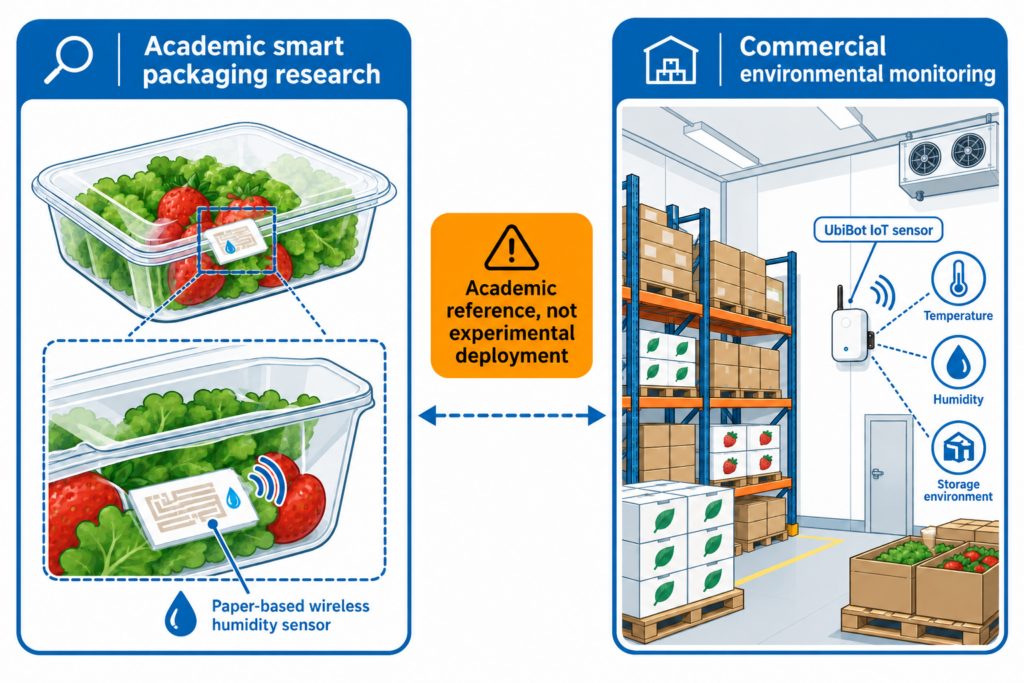
Study context: Purdue developed a paper-based wireless humidity sensor, while UbiBot was referenced as a commercial IoT humidity monitoring example.
What Did the Purdue University Study Investigate?
A Purdue University research team published a study in Advanced Electronic Materials on a low-cost wireless humidity sensor for smart packaging. The research focused on a paper-based sensor that can detect moisture changes inside sealed packages. The goal was to explore a practical way to monitor package quality, reduce food waste, and identify moisture problems before visible spoilage occurs.
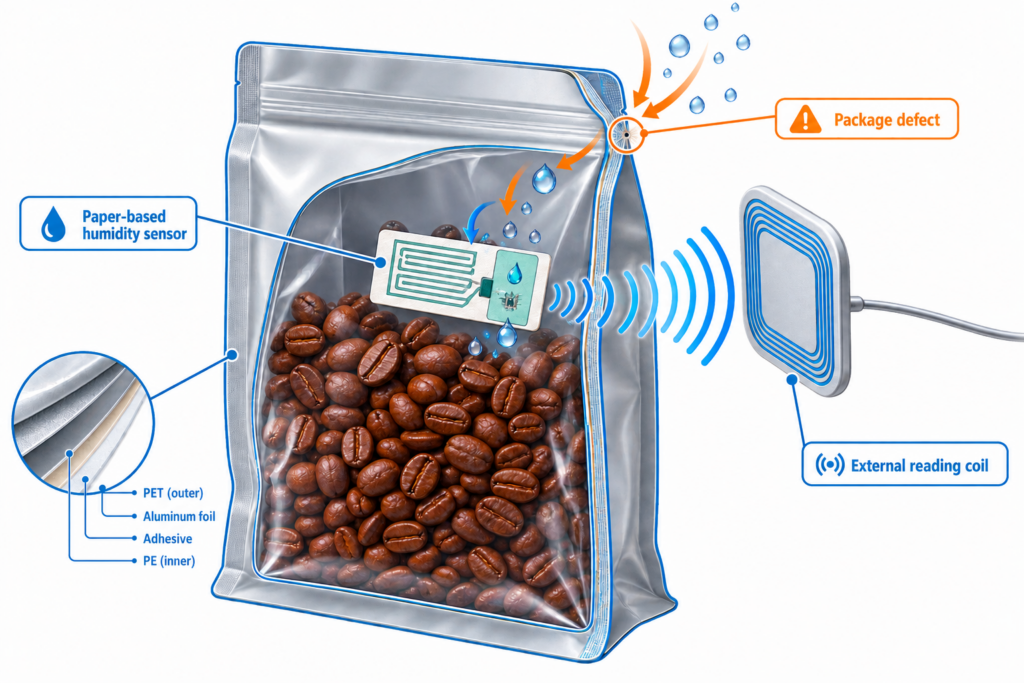
The Purdue study tested a low-cost, paper-based wireless humidity sensor for detecting moisture changes inside sealed packages.
The study developed a wireless passive humidity sensor based on an LC resonant circuit. The sensor was fabricated on metallized parchment paper by using laser ablation. This process removed selected parts of the aluminum layer and formed humidity-sensitive aluminum oxide nanostructures at the same time. Because the method uses inexpensive materials and scalable laser processing, it may support future low-cost smart packaging applications.
Purdue University did not use UbiBot sensors in the experiment. Instead, the paper mentioned UbiBot IoT sensors in the introduction as an example of commercially available IoT systems used for humidity sensing. This reference places UbiBot within the wider technology background of wireless temperature and humidity monitoring.
Where Is UbiBot Mentioned in the Paper?
UbiBot appears in the paper during the discussion of IoT-based ambient monitoring systems. The authors explain that the growth of IoT has enabled distributed environmental monitoring networks. In that context, they list UbiBot IoT sensors as one example of commercially available systems used for humidity sensing.
The paper states that UbiBot IoT sensors can operate in a temperature range from -20 C to +60 C, monitor humidity from 10% to 90% RH, and communicate with smart devices through Wi-Fi. It means that UbiBot can be considered as a real-world product reference when the authors explained the existing IoT humidity monitoring landscape.
Why Does This Reference Matter for UbiBot?
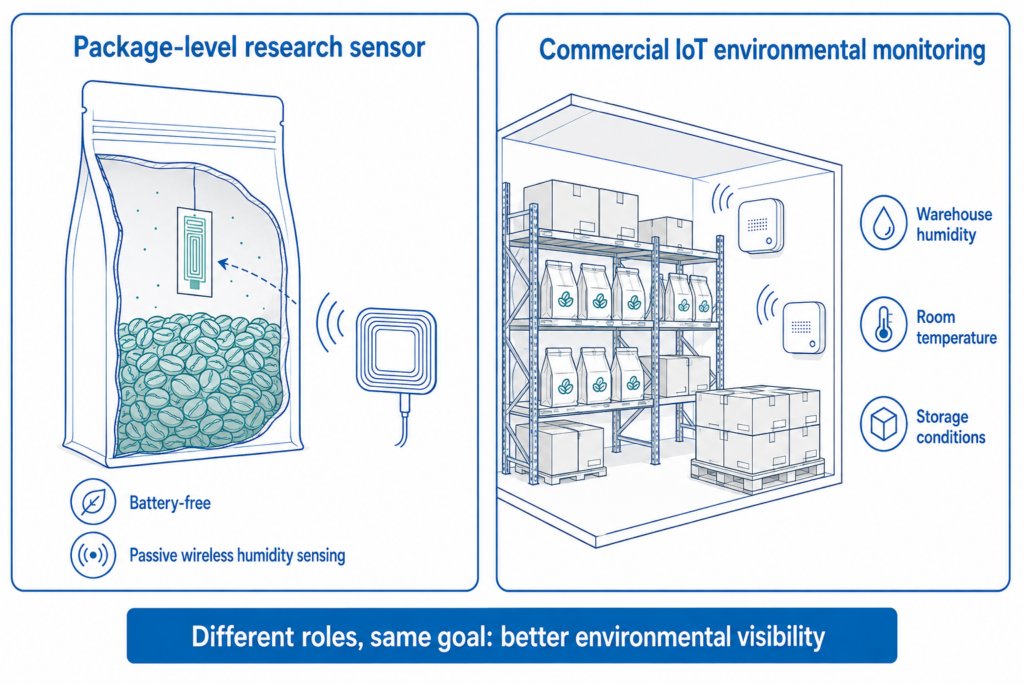
Purdue’s sensor focused on package-level humidity detection; UbiBot represents deployable IoT humidity monitoring for wider storage environments.
The value is academic visibility. When a Purdue University research team discussed commercial IoT humidity monitoring systems, UbiBot was named as one of the examples. This shows that UbiBot is recognizable in the broader field of wireless environmental monitoring.
This paper is a typical reference for users who is considering IoT sensors for commercial deployment, because it connects UbiBot with a real academic discussion about smart packaging, food storage, and IoT sensing. It also helps readers understand that UbiBot belongs to an existing category of deployable environmental monitoring systems, while the Purdue paper explores a new chipless and battery-free sensor design for package-level humidity detection.
How Did the Purdue Sensor Work?
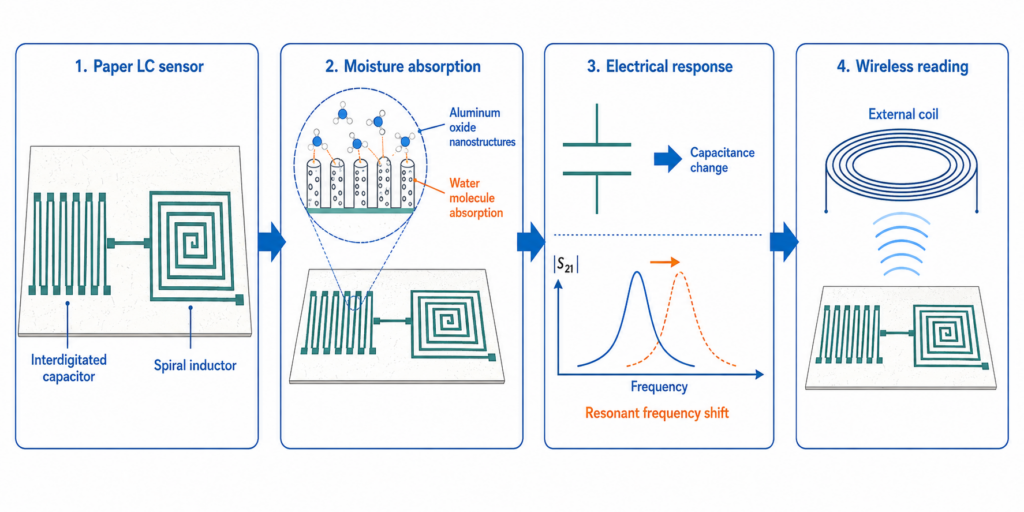
Humidity changed the sensor capacitance, causing a resonant-frequency shift that could be read wirelessly.
The sensor developed in the paper used a moisture-sensitive interdigitated capacitor connected to a spiral inductor. Together, these parts formed an LC resonant circuit. When the humidity level changed, the capacitance changed, and the resonant frequency shifted. The frequency shift could then be read wirelessly using an external coil.
The paper-based sensor was made on metallized parchment paper. During laser processing, the aluminum film was patterned into the sensor circuit. At the same time, laser exposure created aluminum oxide nanostructures on the paper surface. These nanostructures absorbed water molecules and improved humidity sensitivity.
The research reported a linear response from 0% to 85% relative humidity, with an average sensitivity of about -87 kHz per percent relative humidity. In a proof-of-concept test, the sensor was placed inside a package of roasted coffee beans. A sealed package kept a stable resonant frequency, while a defective package showed a clear frequency drop as moisture entered the package.
How Does UbiBot Connect With Smart Packaging and Food Storage?
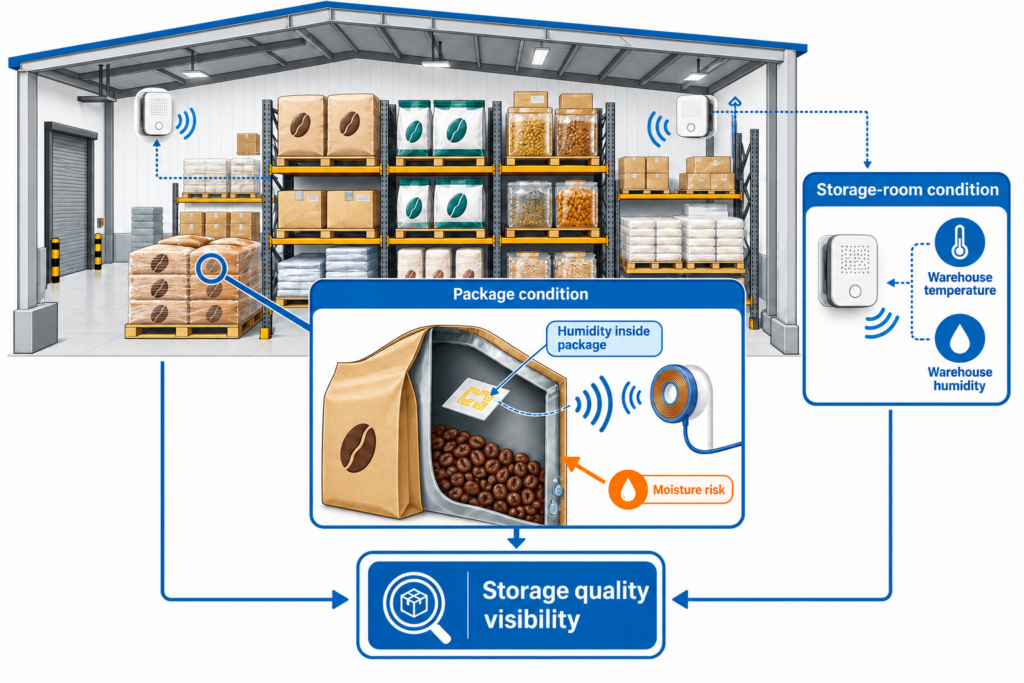
Package-level sensing shows what happens inside the package; IoT monitoring shows what happens around the package.
The Purdue sensor focuses on humidity inside sealed packages. UbiBot IoT sensors are better understood as a broader environmental monitoring solution for storage rooms, warehouses, cold chain spaces, logistics areas, laboratories, and food storage environments. These two technology directions are different, but they can support the same larger goal: better visibility into product storage conditions.
In a practical food supply chain, package-level sensing can show what happens inside a bag or container. UbiBot IoT monitoring can show what happens around the package, such as room temperature, warehouse humidity, or storage area changes. Together, these monitoring layers can help companies understand both the internal and external environment around sensitive products.
What Application Value Does UbiBot Show in This Research Context?
- Real-world IoT reference: UbiBot is mentioned as a commercial IoT humidity monitoring example in a peer-reviewed research paper.
- Wireless monitoring relevance: The paper connects UbiBot with Wi-Fi-based environmental sensing, which is useful for remote temperature and humidity monitoring.
- Food storage and packaging context: The research topic is smart packaging, but the same humidity problem also exists in warehouses, storage rooms, and supply chain environments.
- Bridge between lab research and industry use: Purdue explored a next-generation package sensor, while UbiBot represents an available IoT monitoring category for practical deployment.
What Does This Mean for Smart Packaging Users?
The study shows that future smart packaging may need more than a printed label or expiration date. Moisture can enter a package through defects, poor sealing, or changing storage conditions. Wireless humidity sensing can help detect these changes earlier.
For industry users, the message is clear: food quality management needs better environmental data. Package-level sensors can monitor the inside of a package, while IoT monitoring systems such as UbiBot can help monitor the wider storage and transportation environment. This makes UbiBot relevant to smart packaging discussions even though it was not the experimental device in the Purdue study.
Extended Application Scenarios for UbiBot
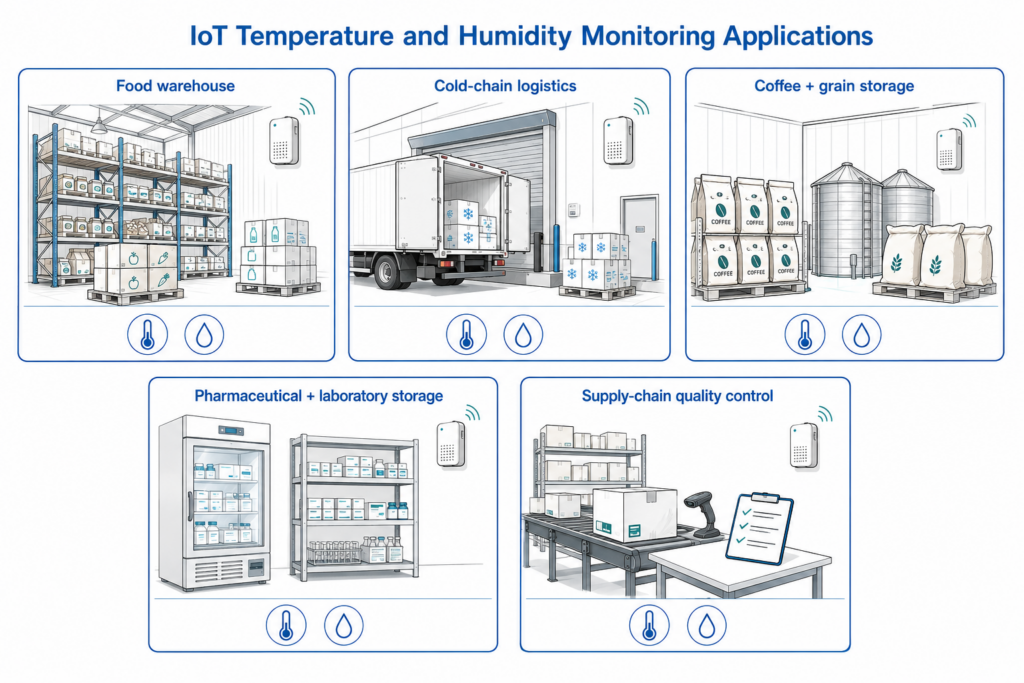
UbiBot’s commercial IoT monitoring role can extend to food warehouses, cold chain logistics, dry food storage, pharmaceutical storage, and supply-chain quality control.
- Food warehouse temperature and humidity monitoring
- Cold chain and logistics environmental monitoring
- Coffee, grain, cereal, and dry food storage monitoring
- Pharmaceutical and laboratory storage monitoring
- Smart packaging research and environmental data comparison
- Quality control in supply chain storage spaces
FAQ
Was UbiBot used in the Purdue University experiment?
No. The paper did not use UbiBot sensors as experimental devices. It referenced UbiBot IoT sensors as a commercial example of wireless humidity monitoring technology.
What did the Purdue study actually test?
The study tested a low-cost, paper-based, battery-free wireless humidity sensor for smart packaging. The sensor was placed inside a roasted coffee bean package to show how it could detect moisture changes caused by package defects.
Why is the UbiBot reference still valuable?
It shows that UbiBot is recognized in academic discussion as part of the commercial IoT humidity monitoring landscape. This supports UbiBot positioning in remote temperature and humidity monitoring, food storage, and supply chain environments.
How should UbiBot describe this paper publicly?
A safe description is: Purdue University research on wireless humidity sensors for smart packaging referenced UbiBot IoT sensors as commercially available examples of Wi-Fi temperature and humidity monitoring systems.