
UBiBot Logo
UBiBot Logo
  • UBiBot Logo
  • Home
  • Products

    NEW

  • Pricing
  • Support
  • About Us
  • Download
  • magnifying-glass  Search
  • magnifying-glass header-close
  • Sign in Sign in
    Public Web Console Public Web Console
    On-Premises App Center On-Premises App Center
  • Home
  • Products

    NEW

  • Pricing
  • Support
  • About us
  • Download
  •  Public Web Console
  •  On-Premises App Center
  • Where to Buy

Learn Hub

Explore Knowledge Academic Research In-depth Tech

Share

LinkedIn

Facebook

X (Twitter)

Newsletter Signup

Table of contents

    Using Cold-Chain Data to Support HACCP CCP Monitoring and ISO 22000 Audits

    Published: August 26, 2026

    Update: September 9, 2026

    By Kyle Anderson

    Evidence boundary

    HACCP temperature monitoring and ISO 22000 temperature records are not created by a device alone. Compliance depends on the food safety management system, the identified hazards and CCPs, critical limits, monitoring procedures, corrective-action records, verification activities, retained evidence, and the configured monitoring architecture. Vendor capabilities are treated as device or platform capabilities, not regulatory conclusions.

    Introduction: why cold-chain data matters

    In a food business, a cold-chain reading can be more than an operational value. When a refrigerator, cold room, truck, freezer, blast chiller or retail cabinet is tied to a hazard control, the temperature record may support a HACCP decision, an ISO 22000 audit, a customer specification, a corrective-action review, or a product-release decision. The risk is not only that food becomes unsafe. The risk is also that the business cannot prove what happened, who reviewed the deviation, and whether the corrective action was effective.

    This guide explains how to use automated temperature records without losing the logic of HACCP. It is written for food manufacturing QA teams, cold-storage managers, central kitchens, exporters, retail supply-chain quality teams and procurement teams that want to move beyond manual temperature logs. The goal is to connect HACCP temperature monitoring with CCP control, corrective action, verification, record retention and ISO 22000 audit evidence.

    Quick answer: cold-chain data supports HACCP and ISO 22000 when the business defines which temperature controls are critical, sets justified limits, records monitoring results reliably, acts on deviations, verifies the system, and retains records that show the control worked. Automated loggers can improve consistency, but they do not replace the HACCP plan, trained personnel, corrective-action procedures or management review.
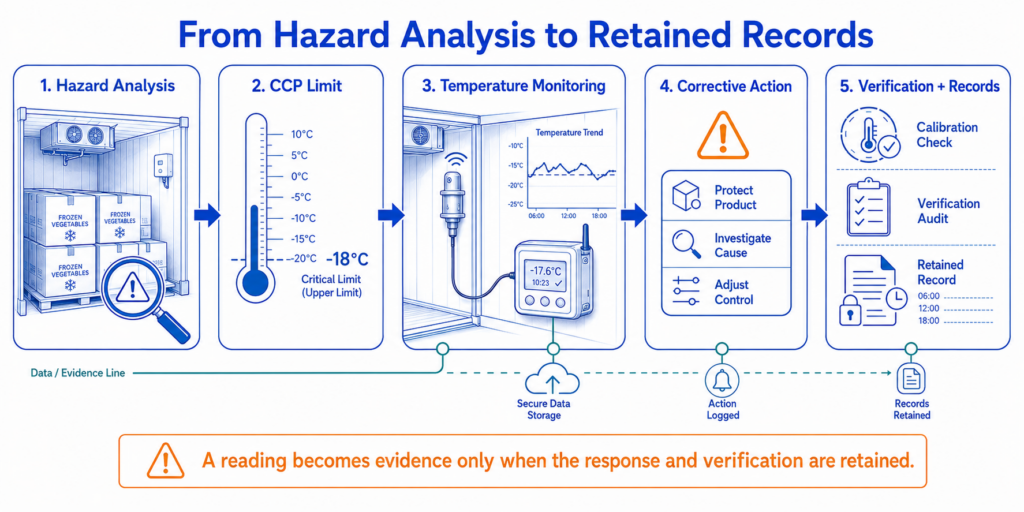
    HACCP temperature monitoring links hazards, limits, records, corrective action and verification.

    Cold-chain data becomes useful when it is connected to HACCP control logic.

    What HACCP and ISO 22000 are and who they apply to

    HACCP, or Hazard Analysis and Critical Control Point, is a structured method for identifying significant food-safety hazards and controlling them at points where control is essential. Codex Alimentarius CXC 1-1969, General Principles of Food Hygiene, is the foundational international text. FAO’s HACCP Toolbox explains HACCP through the familiar seven principles and twelve implementation steps, including hazard analysis, determination of CCPs, critical limits, monitoring, corrective action, verification and documentation.

    ISO 22000:2018 is a food safety management system standard for organizations in the food chain. ISO states that the standard integrates the principles of the Codex HACCP system and Codex application steps, and that certification is one way an organization may demonstrate that its food safety management system meets the standard. That makes ISO 22000 broader than a cold-room monitoring specification. It covers the management system, communication, prerequisite programmes, hazard control, verification and continual improvement.

    These frameworks can apply across processors, cold stores, central kitchens, exporters, distributors, retail supply chains and food-service operations. Their exact legal status depends on the country, customer contract, certification scheme and product category. A temperature logger may help produce evidence, but it is not itself a HACCP plan or an ISO 22000 food safety management system.

    Key requirements affecting temperature and cold-chain monitoring

    The first requirement is to decide whether temperature is a control measure, an operational prerequisite programme, a CCP monitoring parameter, or a supporting quality record. Not every cold-room temperature is automatically a CCP. A frozen-food storage room, a chilled ready-to-eat product process, or a cooked-food cooling step may have different hazard significance and different monitoring expectations. The HACCP team should document why a point is critical, which hazard it controls and what evidence is needed.

    When a temperature point is part of CCP monitoring, the record must be connected to a critical limit and a monitoring procedure. A reading without the limit, time, location, device identity and review trail is weak evidence. The record should show whether the process stayed within the defined limit or whether corrective action was required. If the source material or local regulation does not specify a universal logging interval, the business should not invent one as a regulatory rule; it should justify the interval based on hazard, process speed, product risk, storage stability and audit expectations.

    Corrective action is the second key connection. HACCP does not stop at detecting a temperature excursion. The business must decide what happens when the limit is exceeded: product is held, the affected lot or storage area is identified, the reading is checked against device status, the duration and magnitude are reviewed, product disposition is assessed, and the cause is corrected. If an automatic alarm is acknowledged but no product decision or root-cause review follows, the cold-chain data has not been turned into a complete HACCP record.

    Verification is the third connection. Automated records can help show that monitoring occurred, but verification asks whether the control system is working as intended. This may include reviewing trend data, confirming alarm response, checking calibration status, testing data recovery, comparing records against manual observations, and reviewing corrective-action effectiveness. ISO 22000 audits commonly expect the organization to demonstrate that records are controlled and that the food safety management system is maintained, not merely that readings exist.

    Finally, record retention and data integrity should be planned before procurement. Codex and ISO 22000 provide the system logic, while the exact retention period may be set by law, certification rules, customer requirements or company procedure. The record strategy should preserve the content and meaning of the data: time, location, sensor channel, units, limits, alarm state, reviewer action, corrective-action link and export history where relevant.
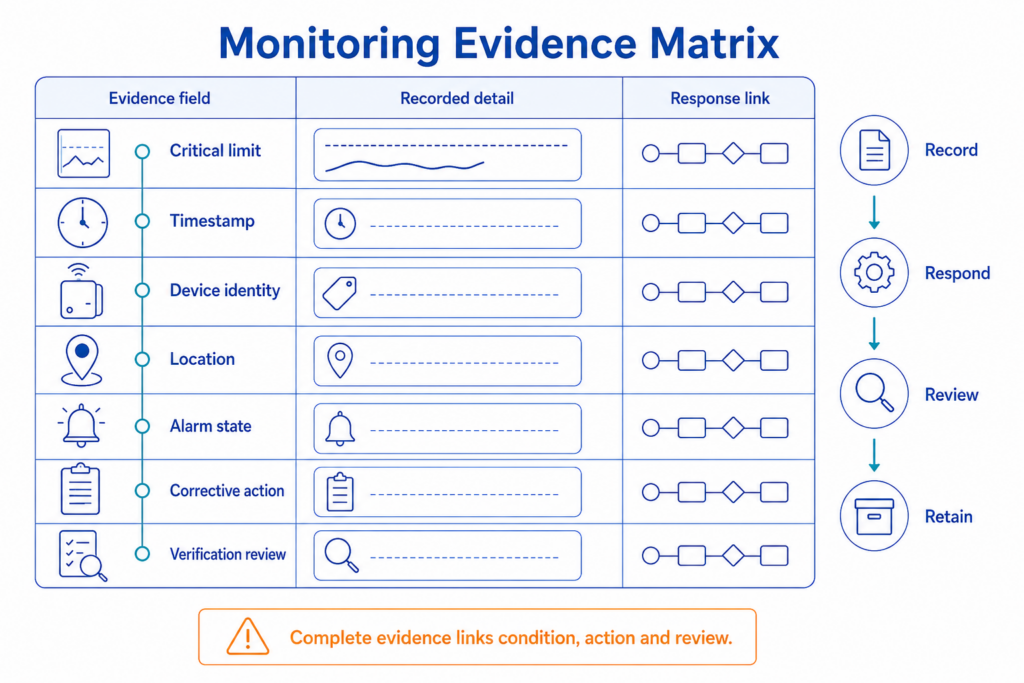
    Matrix showing how temperature data supports CCP monitoring and ISO 22000 audit evidence.

    A temperature reading needs context before it becomes audit evidence.

    How to translate requirements into an implementation plan

    A practical implementation starts with the HACCP study rather than the device catalogue. The team should identify chilled, frozen or controlled-temperature steps where a loss of control could create a food-safety hazard. For each step, it should decide whether the control is a CCP, an operational prerequisite programme or a supporting quality control. That decision determines the strictness of monitoring, the review frequency and the evidence expected during an audit.
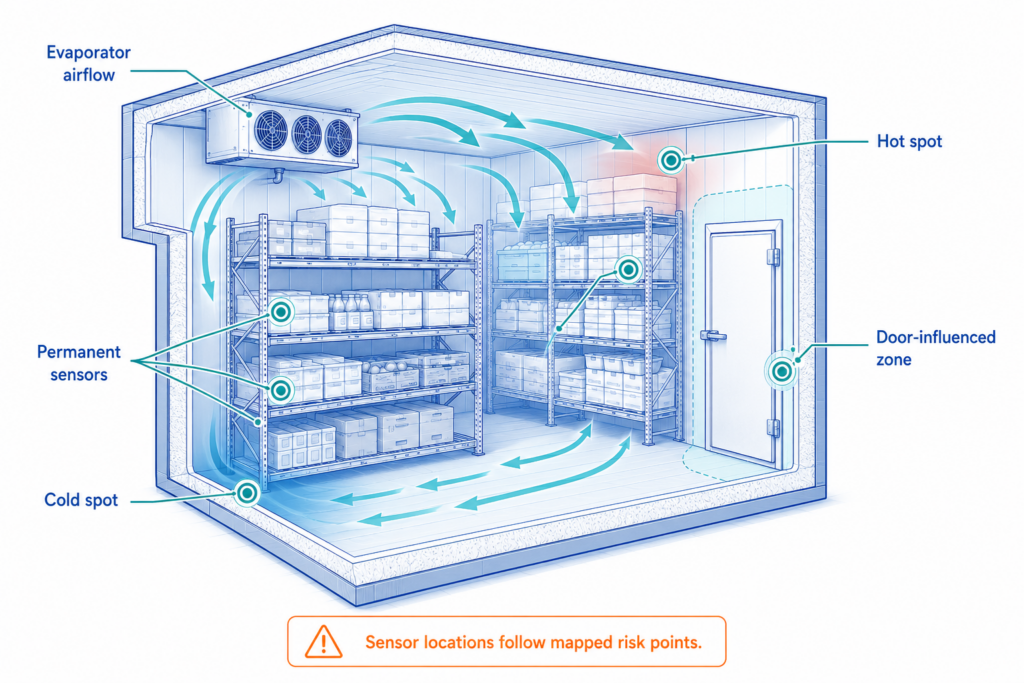
    Food cold-room sensor placement based on airflow, door effects and representative storage zones.

    Sensor placement should follow risk assessment or mapping, not convenience.

    Temperature mapping is useful when a cold room, freezer, warehouse or display area may have hot and cold locations. The goal is not to create a universal sensor-placement formula. It is to identify representative and worst-case positions, understand door effects, airflow, defrost cycles, loading patterns and seasonal variation, then choose permanent monitoring points that actually reflect product risk. Where mapping parameters are not specified by the prompt or official source, they should be defined in the site protocol and justified by risk assessment.

    The monitoring procedure should describe what is measured, where, with which device, at what interval, by whom it is reviewed and what action follows. For automated systems, the procedure should also cover local memory during network loss, alarm routing, escalation when the first responder does not act, data export, report review, device replacement and calibration. This is where many manual-log conversions fail: the business buys a cloud logger but does not update the HACCP plan, SOPs or verification schedule.

    For food warehouses and cold stores, device architecture should fit the site. Wi-Fi may be practical in a small preparation area, Ethernet may suit a fixed facility, cellular may help mobile or remote assets, and low-power wireless sensors may support dense multi-point monitoring. The key is not the network name; it is whether the chosen architecture preserves the record during outages, sends alarms to responsible people, and allows QA to review history without relying on informal screenshots.

    The closing step is management review. Trend data should reveal recurring door-open events, weak defrost recovery, slow response after loading, or repeated weekend alarms. Corrective action should then address the process, not just silence the alarm. In a mature ISO 22000 system, temperature records become part of evidence for monitoring, verification, improvement and management accountability.

    HACCP / ISO 22000 concept Cold-chain control question Monitoring evidence to retain
    Hazard analysis Which biological, chemical or quality-linked hazards require temperature control? HACCP study, product risk rationale and process-flow reference
    CCP or OPRP decision Is this point critical, operationally necessary, or supporting evidence? Decision rationale, critical limit or operating limit, responsible owner
    Monitoring Can the business prove the condition was checked at the planned time and location? Time-stamped readings, device/channel identity, limits and review evidence
    Corrective action What happened when the limit was exceeded? Hold/release decision, deviation record, product assessment and root cause
    Verification Is the monitoring system still effective? Trend review, calibration status, alarm tests, restore/export checks
    Record control Can audit evidence be retrieved without losing context? Reports, exports, metadata, retention and backup evidence

    Compliance checklist for QA, procurement and operations

    A checklist should be short enough to use before purchase and before an audit. The table below treats each control question as evidence to request, not as a promise that any single product automatically satisfies HACCP or ISO 22000.

    Control question Why it matters Evidence to request
    Is the temperature point linked to a hazard analysis and control decision? Prevents collecting data that cannot be interpreted during an audit. HACCP plan, CCP/OPRP decision and monitoring procedure
    Are critical limits or operating limits defined and justified? A temperature trend has little value without an agreed pass/fail basis. Limit rationale, product specification or customer requirement
    Is the device calibrated or checked on a defined schedule? Inaccurate readings can invalidate monitoring evidence. Calibration certificate or documented function check
    Can the system continue recording during network loss? Cloud visibility alone does not protect the original monitoring record. Local memory, buffering or recovery test evidence
    Are alarms connected to responsibility and corrective action? A notification is not a HACCP correction by itself. Escalation SOP, training record and sample deviation
    Can records be exported with time, location and device context? Auditors need reconstructable evidence, not isolated screenshots. Sample report, CSV/PDF export and retention procedure

    Common audit deficiencies and how to avoid them

    The supplied prompt does not provide named enforcement cases for HACCP temperature monitoring or ISO 22000 certification audits. The examples below are therefore framed as common audit patterns and preventive controls rather than verified legal cases.

    Common deficiency Risk created Preventive control
    Manual logs are transcribed from memory or filled in at the end of a shift. The record may not show actual control at the required time. Use automatic records for critical points or strengthen contemporaneous review and supervision.
    The site has alarms but no written response procedure. Staff may acknowledge an alert without protecting product or documenting a decision. Define hold, review, escalation and disposition steps in the SOP.
    CSV exports become the only audit record. Device identity, limits, metadata or alarm context may be lost. Define the system of record and test exports before relying on them.
    Calibration evidence is not linked to the channel used for a CCP. Reviewers cannot prove the instrument that generated the record was suitable. Maintain asset IDs, sensor channels, locations and certificate effective dates.
    Cold-room sensor placement is based on convenience. The data may miss hot spots, door effects or upper-rack variation. Use mapping or risk assessment to justify permanent point selection.

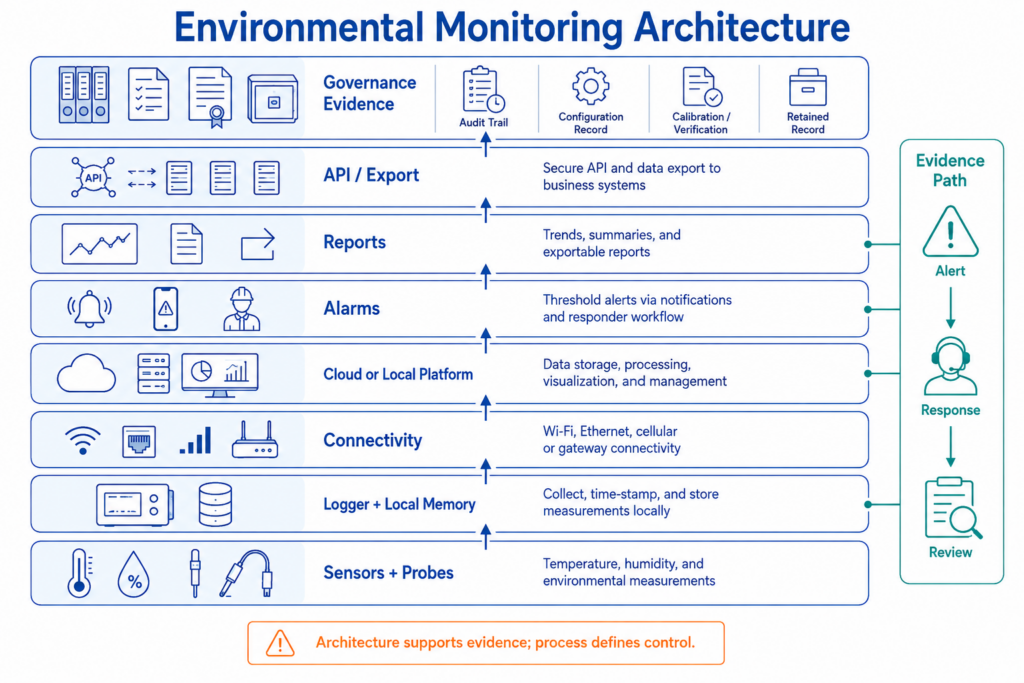
    Layered monitoring architecture for HACCP and ISO 22000 cold-chain records.

    Procurement should evaluate the full monitoring architecture, not sensor accuracy alone.

    Product Specification Comparison Table

    The comparison below is a procurement aid, not a compliance ranking. Public manufacturer evidence can show device and platform capabilities, but HACCP and ISO 22000 suitability depends on the configured process, documented controls, calibration, SOPs, record review and audit evidence.

    System Typical role in a food cold-chain programme Publicly evidenced capability to verify Procurement caution
    UbiBot GS1 / GS1-L / WS1 Pro Flexible monitoring layer for warehouses, cold rooms, preparation areas or distributed sites. UbiBot publishes GS1 and WS1 Pro specifications covering temperature/humidity monitoring, external-sensor options on relevant models, cloud upload and connectivity variants such as Wi-Fi, Ethernet, cellular or LoRa depending on model. Do not claim HACCP or ISO 22000 compliance from hardware alone. Verify model, probe, calibration, alarm, export and record-retention workflow for the site.
    Testo Saveris 2-T3 Wi-Fi cloud monitoring route often considered for cold-store or food-facility temperature records. Vendor materials should be checked for supported probes, cloud functions, logging behavior, EN 12830 statements if relevant and reporting options. Confirm exact model, regional availability, probe type and whether the evidence matches the intended HACCP record.
    Dickson DWE2 + DicksonOne Fixed cloud-connected monitoring for food storage, production support or multi-location environmental records. Dickson publishes DWE2 information describing Wi-Fi/Ethernet connectivity, replaceable sensors and transmission to DicksonOne. Confirm reporting, local memory, access control, calibration and export behavior for the exact account and device configuration.
    Monnit ALTA Wireless Standard Temperature Sensor Low-power wireless sensing route for distributed cold-chain points and threshold notifications. Monnit publishes ALTA standard temperature sensor documentation and related wireless-platform materials; NIST options may be available for selected sensor configurations. Verify gateway coverage, sample interval, calibration/NIST option, alert routing and whether it can support the required record context.

    Frequently Asked Questions

    Is HACCP temperature monitoring the same as general cold-room logging?

    No. General logging records conditions. HACCP monitoring is tied to a hazard analysis, a control decision, a limit, a review method and corrective action when the limit is not met.

    Does ISO 22000 require a specific data logger brand?

    No. ISO 22000 is a food safety management system standard. The organization must define and control monitoring, verification and records; the device is part of the evidence system.

    Can automated records replace manual logs?

    They can reduce manual burden and improve consistency, but only if the HACCP plan, SOPs, review process, corrective action and retention rules are updated to use the electronic records properly.

    How often should a logger record temperature?

    The prompt and official public sources reviewed here do not establish one universal interval for every HACCP or ISO 22000 site. The interval should be justified by hazard, product, process speed, storage stability and customer or local requirements.

    What should happen after a temperature alarm?

    The response should protect potentially affected food, check device status, review duration and magnitude, assess product disposition, record the deviation and investigate the cause when warranted.

    Is a CSV export enough for an audit?

    Possibly, but only when the export preserves the necessary meaning: time, location, device/channel identity, units, limits, alarm state and review context. Screenshots alone are usually weak evidence.

    Where should sensors be placed in a cold room?

    Placement should be justified through risk assessment or mapping. Door-influenced zones, airflow, upper racks, loading patterns and hot/cold spots matter more than a universal fixed formula.

    Can UbiBot devices be used in HACCP or ISO 22000 programmes?

    They may provide relevant monitoring capabilities when properly selected, configured, calibrated and governed. The organization remains responsible for the HACCP plan, ISO 22000 controls and audit evidence.

    Official Regulatory, Standard and Vendor References

    [1] Codex Alimentarius / FAO-WHO, General Principles of Food Hygiene, CXC 1-1969, current Codex code of practice page and PDF.

    [2] FAO, GHP and HACCP Toolbox for Food Safety: HACCP introduction, CCP determination and documentation/record-keeping sections.

    [3] ISO, ISO 22000:2018 Food safety management systems — Requirements for any organization in the food chain.

    [4] UbiBot, GS1 specifications; UbiBot, WS1 Pro specifications and product pages.

    Related Resources

    How to Build a Multi-Site Environmental Monitoring System: Sensors, Gateways, Audit Trails and Total Cost
    How to Monitor Pharmaceutical Cold Chain Shipments from Warehouse to Delivery?
    How Is UbiBot Referenced in Purdue University Smart Packaging Research?
    University of Cambridge Study Uses UbiBot WS1 for Perishable Food Supply Chain Monitoring in an Autonomous Supply Chain Prototype
    Why GPS Alone Is Not Enough for Reefer Fleet Monitoring
    How to Monitor Walk-In Coolers and Freezers for Food Safety and Excursion Alerts
    How to Choose a 21 CFR Part 11-Ready Environmental Monitoring System
    FSMA Sanitary Transportation Compliance for Refrigerated Fleets
    menu-header-svg
    Search
    • Explore Knowledge
      • Comparison & Selection
      • Industry Solution
      • Product & Device
      • Criterion & Compliance
      • Deployment & Usage
      • Technology & Principle
    • Academic Research
    • In-depth Tech

    Criterion & Compliance

    See More >>

    Using Cold-Chain Data to Support HACCP CCP Monitoring and ISO 22000 Audits

    Published: August 26, 2026

    Updated: September 9, 2026

    By Kyle Anderson

    Evidence boundary

    HACCP temperature monitoring and ISO 22000 temperature records are not created by a device alone. Compliance depends on the food safety management system, the identified hazards and CCPs, critical limits, monitoring procedures, corrective-action records, verification activities, retained evidence, and the configured monitoring architecture. Vendor capabilities are treated as device or platform capabilities, not regulatory conclusions.

    Introduction: why cold-chain data matters

    In a food business, a cold-chain reading can be more than an operational value. When a refrigerator, cold room, truck, freezer, blast chiller or retail cabinet is tied to a hazard control, the temperature record may support a HACCP decision, an ISO 22000 audit, a customer specification, a corrective-action review, or a product-release decision. The risk is not only that food becomes unsafe. The risk is also that the business cannot prove what happened, who reviewed the deviation, and whether the corrective action was effective.

    This guide explains how to use automated temperature records without losing the logic of HACCP. It is written for food manufacturing QA teams, cold-storage managers, central kitchens, exporters, retail supply-chain quality teams and procurement teams that want to move beyond manual temperature logs. The goal is to connect HACCP temperature monitoring with CCP control, corrective action, verification, record retention and ISO 22000 audit evidence.

    Quick answer: cold-chain data supports HACCP and ISO 22000 when the business defines which temperature controls are critical, sets justified limits, records monitoring results reliably, acts on deviations, verifies the system, and retains records that show the control worked. Automated loggers can improve consistency, but they do not replace the HACCP plan, trained personnel, corrective-action procedures or management review.

    HACCP temperature monitoring links hazards, limits, records, corrective action and verification.

    Cold-chain data becomes useful when it is connected to HACCP control logic.

    What HACCP and ISO 22000 are and who they apply to

    HACCP, or Hazard Analysis and Critical Control Point, is a structured method for identifying significant food-safety hazards and controlling them at points where control is essential. Codex Alimentarius CXC 1-1969, General Principles of Food Hygiene, is the foundational international text. FAO’s HACCP Toolbox explains HACCP through the familiar seven principles and twelve implementation steps, including hazard analysis, determination of CCPs, critical limits, monitoring, corrective action, verification and documentation.

    ISO 22000:2018 is a food safety management system standard for organizations in the food chain. ISO states that the standard integrates the principles of the Codex HACCP system and Codex application steps, and that certification is one way an organization may demonstrate that its food safety management system meets the standard. That makes ISO 22000 broader than a cold-room monitoring specification. It covers the management system, communication, prerequisite programmes, hazard control, verification and continual improvement.

    These frameworks can apply across processors, cold stores, central kitchens, exporters, distributors, retail supply chains and food-service operations. Their exact legal status depends on the country, customer contract, certification scheme and product category. A temperature logger may help produce evidence, but it is not itself a HACCP plan or an ISO 22000 food safety management system.

    Key requirements affecting temperature and cold-chain monitoring

    The first requirement is to decide whether temperature is a control measure, an operational prerequisite programme, a CCP monitoring parameter, or a supporting quality record. Not every cold-room temperature is automatically a CCP. A frozen-food storage room, a chilled ready-to-eat product process, or a cooked-food cooling step may have different hazard significance and different monitoring expectations. The HACCP team should document why a point is critical, which hazard it controls and what evidence is needed.

    When a temperature point is part of CCP monitoring, the record must be connected to a critical limit and a monitoring procedure. A reading without the limit, time, location, device identity and review trail is weak evidence. The record should show whether the process stayed within the defined limit or whether corrective action was required. If the source material or local regulation does not specify a universal logging interval, the business should not invent one as a regulatory rule; it should justify the interval based on hazard, process speed, product risk, storage stability and audit expectations.

    Corrective action is the second key connection. HACCP does not stop at detecting a temperature excursion. The business must decide what happens when the limit is exceeded: product is held, the affected lot or storage area is identified, the reading is checked against device status, the duration and magnitude are reviewed, product disposition is assessed, and the cause is corrected. If an automatic alarm is acknowledged but no product decision or root-cause review follows, the cold-chain data has not been turned into a complete HACCP record.

    Verification is the third connection. Automated records can help show that monitoring occurred, but verification asks whether the control system is working as intended. This may include reviewing trend data, confirming alarm response, checking calibration status, testing data recovery, comparing records against manual observations, and reviewing corrective-action effectiveness. ISO 22000 audits commonly expect the organization to demonstrate that records are controlled and that the food safety management system is maintained, not merely that readings exist.

    Finally, record retention and data integrity should be planned before procurement. Codex and ISO 22000 provide the system logic, while the exact retention period may be set by law, certification rules, customer requirements or company procedure. The record strategy should preserve the content and meaning of the data: time, location, sensor channel, units, limits, alarm state, reviewer action, corrective-action link and export history where relevant.

    Matrix showing how temperature data supports CCP monitoring and ISO 22000 audit evidence.

    A temperature reading needs context before it becomes audit evidence.

    How to translate requirements into an implementation plan

    A practical implementation starts with the HACCP study rather than the device catalogue. The team should identify chilled, frozen or controlled-temperature steps where a loss of control could create a food-safety hazard. For each step, it should decide whether the control is a CCP, an operational prerequisite programme or a supporting quality control. That decision determines the strictness of monitoring, the review frequency and the evidence expected during an audit.

    Food cold-room sensor placement based on airflow, door effects and representative storage zones.

    Sensor placement should follow risk assessment or mapping, not convenience.

    Temperature mapping is useful when a cold room, freezer, warehouse or display area may have hot and cold locations. The goal is not to create a universal sensor-placement formula. It is to identify representative and worst-case positions, understand door effects, airflow, defrost cycles, loading patterns and seasonal variation, then choose permanent monitoring points that actually reflect product risk. Where mapping parameters are not specified by the prompt or official source, they should be defined in the site protocol and justified by risk assessment.

    The monitoring procedure should describe what is measured, where, with which device, at what interval, by whom it is reviewed and what action follows. For automated systems, the procedure should also cover local memory during network loss, alarm routing, escalation when the first responder does not act, data export, report review, device replacement and calibration. This is where many manual-log conversions fail: the business buys a cloud logger but does not update the HACCP plan, SOPs or verification schedule.

    For food warehouses and cold stores, device architecture should fit the site. Wi-Fi may be practical in a small preparation area, Ethernet may suit a fixed facility, cellular may help mobile or remote assets, and low-power wireless sensors may support dense multi-point monitoring. The key is not the network name; it is whether the chosen architecture preserves the record during outages, sends alarms to responsible people, and allows QA to review history without relying on informal screenshots.

    The closing step is management review. Trend data should reveal recurring door-open events, weak defrost recovery, slow response after loading, or repeated weekend alarms. Corrective action should then address the process, not just silence the alarm. In a mature ISO 22000 system, temperature records become part of evidence for monitoring, verification, improvement and management accountability.

    HACCP / ISO 22000 concept Cold-chain control question Monitoring evidence to retain
    Hazard analysis Which biological, chemical or quality-linked hazards require temperature control? HACCP study, product risk rationale and process-flow reference
    CCP or OPRP decision Is this point critical, operationally necessary, or supporting evidence? Decision rationale, critical limit or operating limit, responsible owner
    Monitoring Can the business prove the condition was checked at the planned time and location? Time-stamped readings, device/channel identity, limits and review evidence
    Corrective action What happened when the limit was exceeded? Hold/release decision, deviation record, product assessment and root cause
    Verification Is the monitoring system still effective? Trend review, calibration status, alarm tests, restore/export checks
    Record control Can audit evidence be retrieved without losing context? Reports, exports, metadata, retention and backup evidence

    Compliance checklist for QA, procurement and operations

    A checklist should be short enough to use before purchase and before an audit. The table below treats each control question as evidence to request, not as a promise that any single product automatically satisfies HACCP or ISO 22000.

    Control question Why it matters Evidence to request
    Is the temperature point linked to a hazard analysis and control decision? Prevents collecting data that cannot be interpreted during an audit. HACCP plan, CCP/OPRP decision and monitoring procedure
    Are critical limits or operating limits defined and justified? A temperature trend has little value without an agreed pass/fail basis. Limit rationale, product specification or customer requirement
    Is the device calibrated or checked on a defined schedule? Inaccurate readings can invalidate monitoring evidence. Calibration certificate or documented function check
    Can the system continue recording during network loss? Cloud visibility alone does not protect the original monitoring record. Local memory, buffering or recovery test evidence
    Are alarms connected to responsibility and corrective action? A notification is not a HACCP correction by itself. Escalation SOP, training record and sample deviation
    Can records be exported with time, location and device context? Auditors need reconstructable evidence, not isolated screenshots. Sample report, CSV/PDF export and retention procedure

    Common audit deficiencies and how to avoid them

    The supplied prompt does not provide named enforcement cases for HACCP temperature monitoring or ISO 22000 certification audits. The examples below are therefore framed as common audit patterns and preventive controls rather than verified legal cases.

    Common deficiency Risk created Preventive control
    Manual logs are transcribed from memory or filled in at the end of a shift. The record may not show actual control at the required time. Use automatic records for critical points or strengthen contemporaneous review and supervision.
    The site has alarms but no written response procedure. Staff may acknowledge an alert without protecting product or documenting a decision. Define hold, review, escalation and disposition steps in the SOP.
    CSV exports become the only audit record. Device identity, limits, metadata or alarm context may be lost. Define the system of record and test exports before relying on them.
    Calibration evidence is not linked to the channel used for a CCP. Reviewers cannot prove the instrument that generated the record was suitable. Maintain asset IDs, sensor channels, locations and certificate effective dates.
    Cold-room sensor placement is based on convenience. The data may miss hot spots, door effects or upper-rack variation. Use mapping or risk assessment to justify permanent point selection.

    Layered monitoring architecture for HACCP and ISO 22000 cold-chain records.

    Procurement should evaluate the full monitoring architecture, not sensor accuracy alone.

    Product Specification Comparison Table

    The comparison below is a procurement aid, not a compliance ranking. Public manufacturer evidence can show device and platform capabilities, but HACCP and ISO 22000 suitability depends on the configured process, documented controls, calibration, SOPs, record review and audit evidence.

    System Typical role in a food cold-chain programme Publicly evidenced capability to verify Procurement caution
    UbiBot GS1 / GS1-L / WS1 Pro Flexible monitoring layer for warehouses, cold rooms, preparation areas or distributed sites. UbiBot publishes GS1 and WS1 Pro specifications covering temperature/humidity monitoring, external-sensor options on relevant models, cloud upload and connectivity variants such as Wi-Fi, Ethernet, cellular or LoRa depending on model. Do not claim HACCP or ISO 22000 compliance from hardware alone. Verify model, probe, calibration, alarm, export and record-retention workflow for the site.
    Testo Saveris 2-T3 Wi-Fi cloud monitoring route often considered for cold-store or food-facility temperature records. Vendor materials should be checked for supported probes, cloud functions, logging behavior, EN 12830 statements if relevant and reporting options. Confirm exact model, regional availability, probe type and whether the evidence matches the intended HACCP record.
    Dickson DWE2 + DicksonOne Fixed cloud-connected monitoring for food storage, production support or multi-location environmental records. Dickson publishes DWE2 information describing Wi-Fi/Ethernet connectivity, replaceable sensors and transmission to DicksonOne. Confirm reporting, local memory, access control, calibration and export behavior for the exact account and device configuration.
    Monnit ALTA Wireless Standard Temperature Sensor Low-power wireless sensing route for distributed cold-chain points and threshold notifications. Monnit publishes ALTA standard temperature sensor documentation and related wireless-platform materials; NIST options may be available for selected sensor configurations. Verify gateway coverage, sample interval, calibration/NIST option, alert routing and whether it can support the required record context.

    Frequently Asked Questions

    Is HACCP temperature monitoring the same as general cold-room logging?

    No. General logging records conditions. HACCP monitoring is tied to a hazard analysis, a control decision, a limit, a review method and corrective action when the limit is not met.

    Does ISO 22000 require a specific data logger brand?

    No. ISO 22000 is a food safety management system standard. The organization must define and control monitoring, verification and records; the device is part of the evidence system.

    Can automated records replace manual logs?

    They can reduce manual burden and improve consistency, but only if the HACCP plan, SOPs, review process, corrective action and retention rules are updated to use the electronic records properly.

    How often should a logger record temperature?

    The prompt and official public sources reviewed here do not establish one universal interval for every HACCP or ISO 22000 site. The interval should be justified by hazard, product, process speed, storage stability and customer or local requirements.

    What should happen after a temperature alarm?

    The response should protect potentially affected food, check device status, review duration and magnitude, assess product disposition, record the deviation and investigate the cause when warranted.

    Is a CSV export enough for an audit?

    Possibly, but only when the export preserves the necessary meaning: time, location, device/channel identity, units, limits, alarm state and review context. Screenshots alone are usually weak evidence.

    Where should sensors be placed in a cold room?

    Placement should be justified through risk assessment or mapping. Door-influenced zones, airflow, upper racks, loading patterns and hot/cold spots matter more than a universal fixed formula.

    Can UbiBot devices be used in HACCP or ISO 22000 programmes?

    They may provide relevant monitoring capabilities when properly selected, configured, calibrated and governed. The organization remains responsible for the HACCP plan, ISO 22000 controls and audit evidence.

    Official Regulatory, Standard and Vendor References

    [1] Codex Alimentarius / FAO-WHO, General Principles of Food Hygiene, CXC 1-1969, current Codex code of practice page and PDF.

    [2] FAO, GHP and HACCP Toolbox for Food Safety: HACCP introduction, CCP determination and documentation/record-keeping sections.

    [3] ISO, ISO 22000:2018 Food safety management systems — Requirements for any organization in the food chain.

    [4] UbiBot, GS1 specifications; UbiBot, WS1 Pro specifications and product pages.

    分享

    LinkedIn2

    Facebook2

    X

    Newsletter Signup

    Related Resources

    How to Build a Multi-Site Environmental Monitoring System: Sensors, Gateways, Audit Trails and Total Cost
    How to Monitor Pharmaceutical Cold Chain Shipments from Warehouse to Delivery?
    How Is UbiBot Referenced in Purdue University Smart Packaging Research?
    University of Cambridge Study Uses UbiBot WS1 for Perishable Food Supply Chain Monitoring in an Autonomous Supply Chain Prototype
    Why GPS Alone Is Not Enough for Reefer Fleet Monitoring
    How to Monitor Walk-In Coolers and Freezers for Food Safety and Excursion Alerts
    How to Choose a 21 CFR Part 11-Ready Environmental Monitoring System
    FSMA Sanitary Transportation Compliance for Refrigerated Fleets
    menu-header-svg
    Search
    • Explore Knowledge
      • Comparison & Selection
      • Industry Solution
      • Product & Device
      • Criterion & Compliance
      • Deployment & Usage
      • Technology & Principle
    • Academic Research
    • In-depth Tech
    Enter Your Information

    Confirm

    Products

    Dashboards

    Support

    Purchase

    Company

    Smart Sensing

    UbiBot Web Console

    APP Download

    UbiBot Online Store

    News

    Smart Control

    UbiBot Space

    Product Docs & APIs

    Find Distributors

    Learn Hub

    Smart Video

    UbiBot On-Premises

    Helpdesk & FAQ

    Volume Pricing

    About Us

    LoRa Products

    Agency Web Console

    Video Center

    Contact Us

    Software & Platform


    Pricing


    Architecture

    External Sensors


    System Status

    Accessories


    Become a Distributor

    Global SIM


    Become an Affiliate

    Positioning System


    Products

    Dashboards

    Business Partners

    WS1

    UbiBot Web Console

    Volume Pricing

    WS1 Pro

    UbiBot Space

    Become a Distributor

    GS1

    UbiBot Support Desk

    Affiliates

    GS2

    Agency Web Console


    MS1


    SP1


    Accessories


    Docs

    Purchase

    Company

    Platform API

    Pricing

    News

    Q&A

    UbiBot Partners

    About us

    Privacy Policy

    Online Store

    Contact

    Terms of Service


    System Status

    Products

    Dashboards

    Smart Sensing

    UbiBot Web Console

    Smart Control

    UbiBot Space

    Smart Video

    UbiBot On-Premises

    LoRa Products

    Agency Web Console

    Software & Platform


    External Sensors


    Accessories


    Global SIM


    Positioning System


    Support

    Purchase

    APP Download

    UbiBot Online Store

    Product Docs & APIs

    Find Distributors

    Helpdesk & FAQ

    Volume Pricing

    Video Center


    Pricing


    Company

    News

    Learn Hub

    About Us

    Contact Us

    Architecture

    System Status

    Become a Distributor

    Become an Affiliate

    Language:
    English 日本語 (ベータ)  
    Language:

    English

    日本語 (ベータ)


    IoT Product Family:
    ubibotico     Wireless environmental sensing products and smart building solutions
    ubitrackico     UWB-based real-time indoor tracking solutions with 30cm accuracy

    IoT Product Family:

    ubibotico  Wireless environmental sensing products and smart building solutions
    ubitrackico  UWB-based real-time indoor tracking solutions with 30cm accuracy

    © 2013-2026 UbiBot.com. All rights reserved.

    Terms of Service | Privacy Policy | Compliance

    youtube facebook twitter