

.svg)
Why GPS Alone Is Not Enough for Reefer Fleet Monitoring
Published: August 6, 2026
Update: September 14, 2026
By Frank Hill
Key Takeaway
Do not purchase a GPS tracker and assume that it is a reefer monitoring system. Choose an architecture that records cargo conditions locally, correlates those records with location and equipment events, and delivers actionable alerts and reports.
Introduction
A vehicle can follow the planned route and arrive on time while the cargo inside has already experienced a damaging temperature excursion. Conversely, a delayed reefer may still protect its load if the refrigeration unit, airflow, door discipline, and temperature controls continue to perform correctly. Location and cargo condition are related, but they are not the same measurement.
GPS-based fleet tracking answers questions such as where the vehicle is, whether it has deviated from its route, and when it may arrive. Reefer fleet monitoring must answer a wider set of questions: What temperature did the cargo area experience? Was the refrigeration unit powered and running? Were supply-air and return-air temperatures behaving normally? Was a door opened for too long? Did the monitoring device continue logging when cellular coverage disappeared?
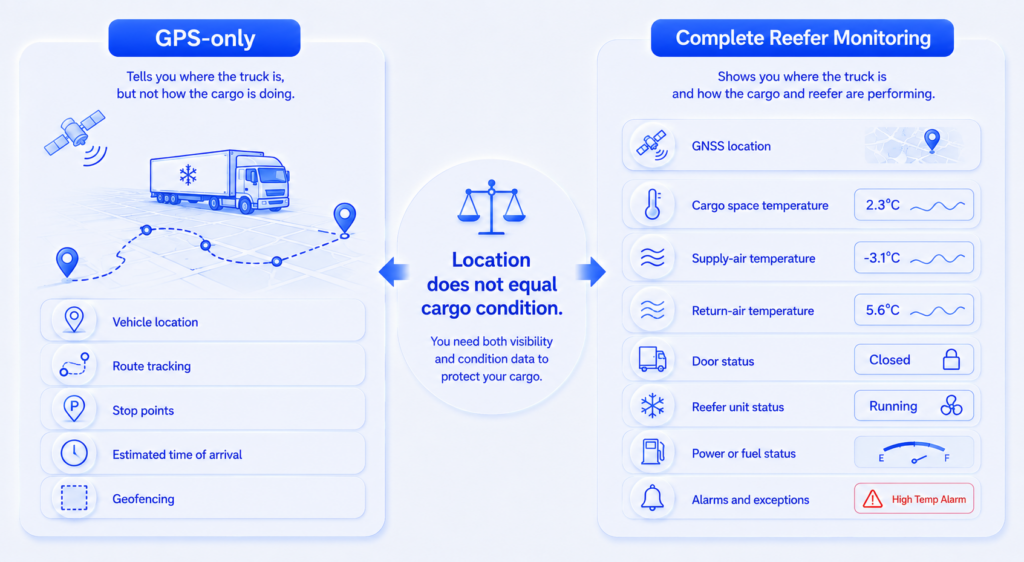
GPS vs complete feeler truck monitoring
This distinction matters for food safety and cold-chain operations. The U.S. FDA sanitary transportation rule requires covered parties to use vehicles and practices capable of maintaining the temperatures needed for safe transport, while allowing shippers and carriers to agree on an appropriate temperature-monitoring mechanism rather than prescribing one specific device. If a possible temperature-control failure becomes known, the food should not be distributed until its safety is assessed.
This article explains how a complete reefer monitoring system combines GNSS location, environmental sensing, refrigeration-unit data, edge storage, mobile communications, alerts, and software integration. It also compares installed reefer telematics with shipment-level real-time trackers and configurable IoT monitoring hosts.
Reefer Fleet Monitoring in 30 Seconds
| Question | Direct answer |
|---|---|
| What can GPS tell a fleet manager? | Vehicle or asset location, route progress, stops, geofence events, and estimated arrival information. |
| What can GPS not confirm? | Cargo temperature, airflow, door status, reefer operating state, controller alarms, fuel or power availability, and the duration of a temperature excursion. |
| What data should be combined with location? | At minimum, time-stamped temperature data. Depending on the operation, door, humidity, supply-air, return-air, cargo-probe, power, fuel, and reefer-fault data may also be required. |
| Why is local memory important? | Cellular coverage is not continuous. A device should keep logging locally and upload the missing records after communication returns. |
| Is the reefer setpoint the same as cargo temperature? | No. The setpoint is a control target. Actual supply air, return air, cargo temperature, and product temperature can differ. |
| Which architecture is best? | Installed reefer telematics, reusable vehicle monitors, single-use shipment trackers, and passive loggers solve different problems. Selection depends on asset ownership, route, risk, and integration needs. |
| What should buyers compare? | Sensor range and accuracy, probe placement, logging interval, offline capacity, location methods, network coverage, power design, alert logic, APIs, and operational workflow. |
1.Why Is GPS Alone Insufficient for Reefer Fleet Monitoring?
GPS measures location, not thermal performance. A coordinate can show that a truck is at a distribution center, parked at a border, or moving along a motorway. It cannot show whether the evaporator is circulating air, whether a door has been left open, whether the refrigeration unit has stopped, or whether the cargo temperature has exceeded its allowed limit.
This is important because temperature loss can develop without a route exception. A compressor fault, depleted reefer fuel supply, blocked airflow, poor loading pattern, damaged door seal, incorrect setpoint, or prolonged loading operation may affect cargo while the vehicle remains exactly where the transport plan expects it to be.
Location also cannot describe the severity of an event. A map may show a 45-minute stop, but it cannot determine whether the doors remained closed, whether the unit stayed powered, or whether the product experienced a meaningful excursion. To investigate the event, the operator needs a synchronized timeline of position, temperature, door activity, refrigeration status, and communications state.
FDA guidance reflects this operational distinction. Covered food transport operations must maintain adequate temperature control, but the regulation does not require one universal sensor or location technology. Shippers, loaders, carriers, and receivers must define responsibilities and use a monitoring approach appropriate to the food and transport operation.
2.What Does a Complete Reefer Monitoring Data Path Include?
A complete system follows the cargo condition from the physical environment to an operational decision. A typical data path is:
Typical data path: Reefer controller and cargo environment → temperature and event sensors → edge logger or telematics host → local memory → GNSS and mobile network → cloud or on-premises platform → alerts, reports, APIs, and corrective-action records.
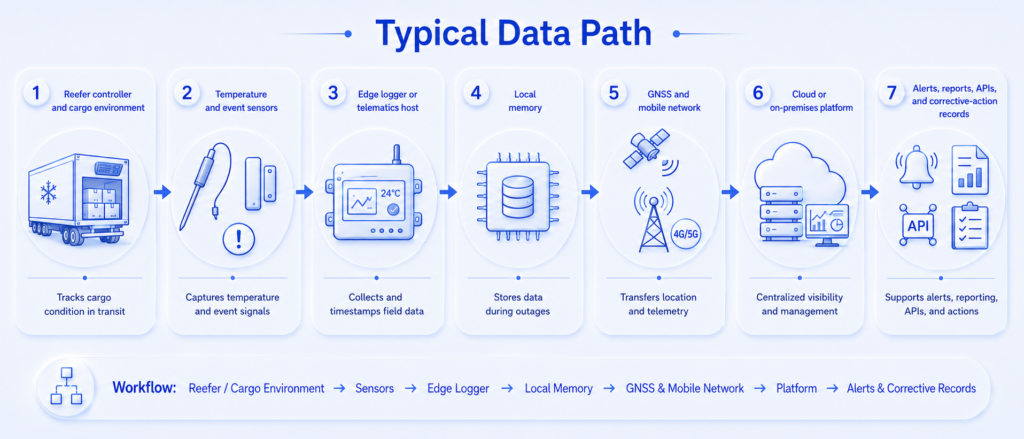
Complete reefer monitoring data path diagram
The sensing layer measures the condition of the vehicle and cargo. Depending on the equipment, this may include supply-air temperature, return-air temperature, one or more cargo probes, humidity, door status, refrigeration-unit alarms, setpoint, operating mode, power state, fuel level, and shock or tilt.
The edge device assigns timestamps, applies configured sampling and logging intervals, stores records, and may read data directly from the reefer controller. It also obtains location through GNSS or network-based positioning. The communications layer then transmits selected records through cellular, Wi-Fi, vessel-based networks, or another available channel.
The software layer turns the raw signals into a usable event history. It can correlate a geofence entry with a door opening, compare the reefer setpoint with actual temperatures, trigger an alert when an excursion persists beyond a delay, and forward records to a transportation management system, warehouse system, customer portal, or quality database.
3.How Does Reefer Monitoring Work?
GNSS provides one layer of context
GNSS receivers use signals from satellite constellations to calculate position. A device may support GPS alone or multiple constellations such as GPS, GLONASS, Galileo, BeiDou, and QZSS. Multiple constellations can improve availability, but metal containers, roofs, urban canyons, and indoor loading areas can still reduce satellite visibility.
For this reason, real-time shipment trackers often combine satellite positioning with Wi-Fi geolocation and cellular-tower positioning. Tive Solo 5G and Frigga V5 Pro, for example, use multiple location methods rather than relying on a single GPS fix.
Temperature sensors describe the cargo environment
Temperature data may come from the reefer controller, an independent probe, or both. Supply-air temperature describes the conditioned air leaving the refrigeration unit. Return-air temperature describes air coming back from the cargo space. A cargo probe measures a selected location inside the load area. These values should not be treated as interchangeable.
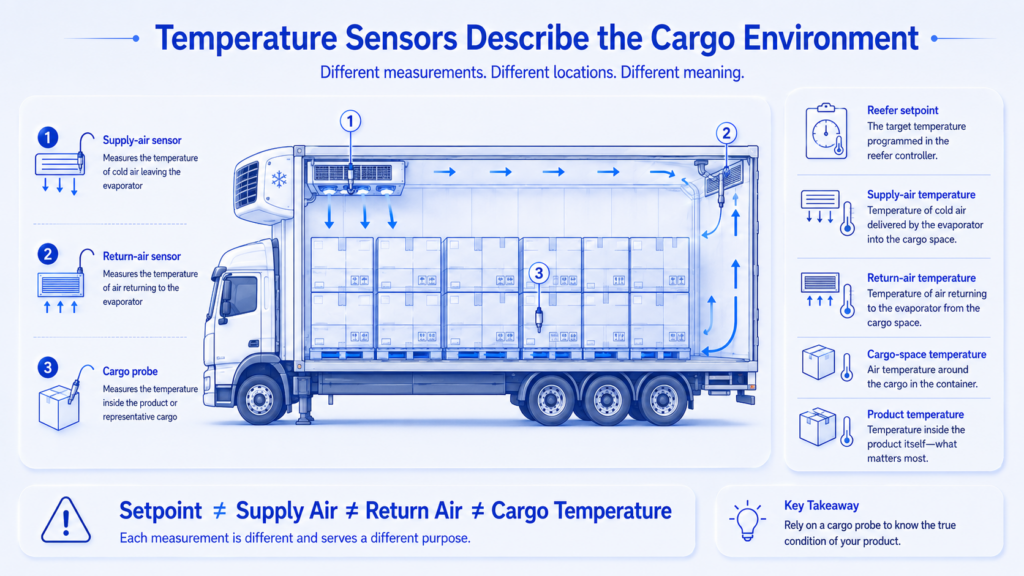
Temperature sensors describe the cargo environment
The controller setpoint is a requested operating target, not proof that the cargo has reached that temperature. Air temperature can change rapidly during a door opening, while the product may respond more slowly because of its thermal mass. The monitoring objective therefore determines whether the system should emphasize fast air response, product-simulating behaviour, or multiple points across the cargo space.
Reefer-controller integration adds equipment context
Installed telematics can communicate with the reefer controller and obtain operating mode, alarm codes, setpoint, air temperatures, and other machine data. Some platforms also support remote control. ORBCOMM positions the CT 3500 as an installed smart-reefer device that integrates with major reefer OEM models, supports additional wireless sensors, and can enable temperature alerts, remote data-log downloads, and remote temperature adjustment.
This controller-level integration can distinguish a cargo-space temperature change from a refrigeration-unit malfunction. A shipment-level tracker placed inside the trailer usually cannot read the machine controller, but it may provide an independent cargo record and remain with the shipment across handoffs.
Edge logging protects the record during coverage gaps
Road, rail, port, and maritime routes contain communications blind spots. A reliable device does not wait for a cellular connection before it measures. It samples the sensor, saves a timestamped record locally, and uploads buffered data when coverage returns.
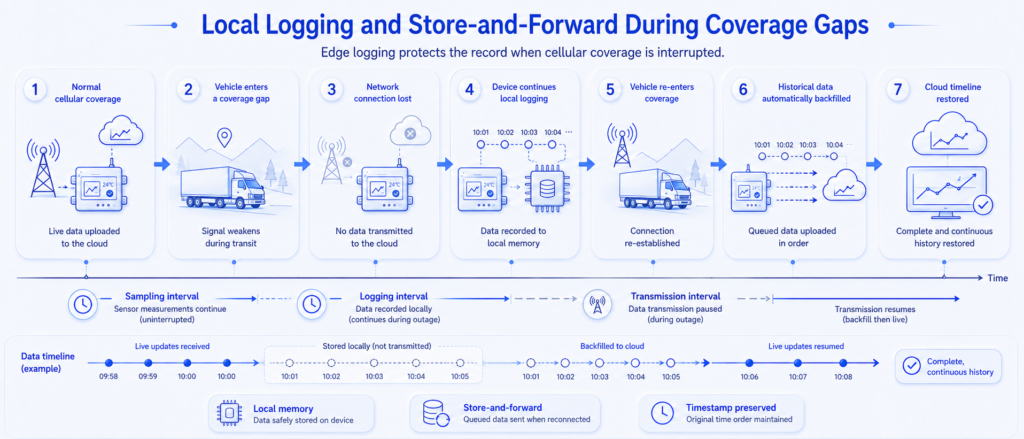
Edge logging protects the record during coverage gaps
This creates an important distinction between the logging interval and the transmission interval. A system may log every minute but transmit every 15 minutes to reduce power and data usage. When an excursion threshold is crossed, it may temporarily increase the reporting frequency or send an immediate alert.
Alert logic must combine condition, duration, and context
A useful alert is more than a temperature threshold. It can include a persistence delay, hysteresis, route stage, geofence, door status, equipment alarm, battery state, and communication status. For example, a short temperature rise during unloading may be expected, while the same rise in a sealed trailer on the motorway may require immediate intervention.
The system should preserve the original measurements as well as the alarm event. This allows a receiver, carrier, or quality team to review the exact temperature curve, route, stops, and relevant equipment events before deciding whether the load is acceptable.
4.What Monitoring Architectures Are Used in Reefer Operations?
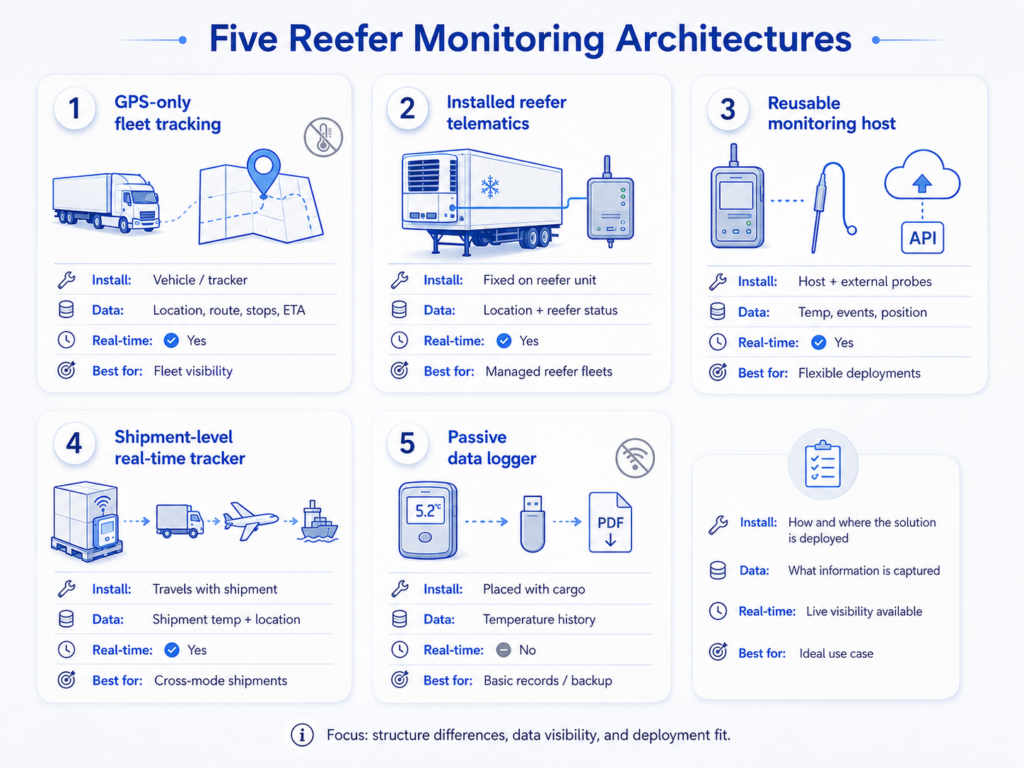
GPS-only fleet tracking
A GPS-only system tracks the tractor, trailer, or container and is useful for route control, estimated arrival times, geofences, theft detection, and asset utilization. It is not sufficient when the business decision depends on cargo temperature or refrigeration-unit performance.
Installed reefer telematics
Installed telematics is connected to the vehicle or reefer controller and can remain with the asset for years. It is well suited to fleet owners who need machine alarms, supply and return air, fuel, door events, maintenance information, and sometimes two-way control. Installation and OEM integration are more complex than placing a shipment tracker inside a load.
Reusable vehicle or cargo-area monitoring hosts
A configurable monitoring host can combine GNSS, mobile communications, built-in environmental sensors, external probes, local storage, and APIs without requiring deep reefer-controller integration. This architecture can suit fleets that need independent cargo monitoring, multi-sensor expansion, or integration with an existing platform.
Shipment-level real-time trackers
Single-use or reusable shipment trackers travel with the goods. They are easy to deploy across third-party carriers and multimodal routes. Many combine location, temperature, humidity, light, shock, and tilt. Their main limitation is that they normally observe the shipment rather than control or diagnose the reefer unit.
Passive data loggers
Passive loggers record temperature for later download but do not provide real-time alerts. They remain useful for low-cost verification, backup records, and lanes where intervention during transit is not possible. They should not be confused with a proactive telematics system.
5.Which Technical Parameters Affect Real-World Performance?
Location methods and accuracy
Location accuracy depends on the method and environment. Satellite fixes may reach meter-level performance with a clear sky view, while Wi-Fi and cellular positioning are less precise but may work when satellite reception is unavailable. Buyers should ask whether the platform identifies the location source and uncertainty rather than displaying every point as equally accurate.
Temperature range, accuracy, and calibration
The sensor range must cover the cargo profile and likely excursions. Accuracy must be evaluated at the temperatures that matter. A specification of ±0.5°C over a central range is not the same as ±0.5°C over the entire published operating range. Resolution only describes the smallest displayed or stored step; it does not establish accuracy.
For food-safety or contractual decisions, the calibration scope and traceability should also be reviewed. A shipment tracker, reefer controller, and independent cargo probe may show slightly different values because they measure different positions and use different sensors.
Sampling, logging, and transmission intervals
A short sampling interval captures rapid changes but increases memory, power, and data requirements. The logging interval determines the time resolution of the permanent record. The transmission interval determines remote visibility. These intervals should be documented separately.
Offline storage capacity
Storage should be converted from record count into days of operation. The available duration depends on the number of channels and logging interval. The system should also preserve the original timestamp and prevent duplicate or reordered records during backfill.
Power and battery design
Installed systems may use vehicle or reefer power with an internal backup battery. Shipment trackers depend on their own batteries, so battery life changes with temperature, cellular coverage, and transmission frequency. A battery-life claim should always be read together with the reporting interval and operating conditions.
Sensor placement and number of points
A single sensor cannot always represent a long or multi-zone trailer. Loading pattern, evaporator location, airflow paths, bulkheads, and door openings create gradients. Temperature mapping or operating experience should determine the number and placement of sensors.
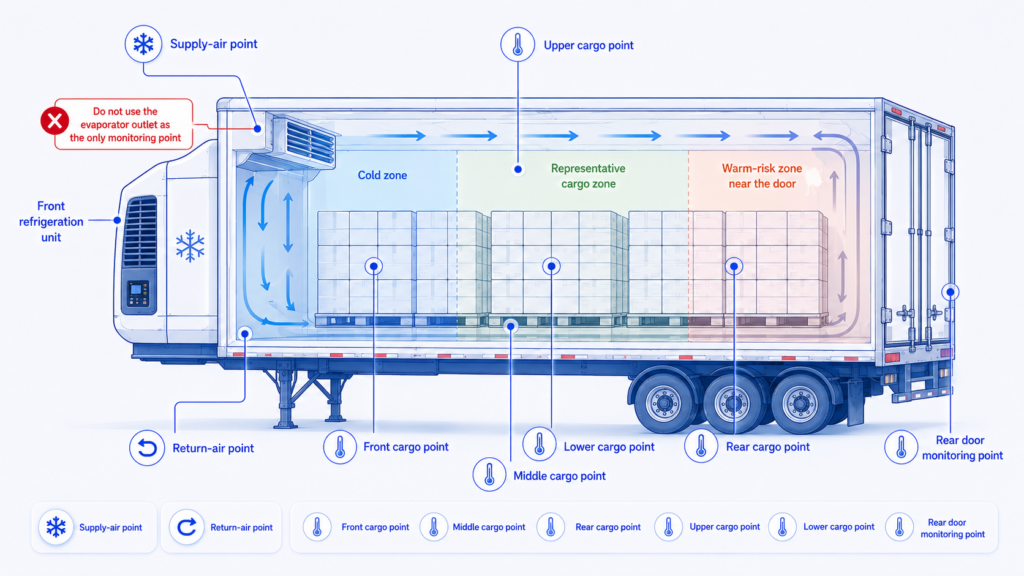
Sensor placement and number of points
Platform, alerts, and APIs
The platform should support alert acknowledgement, role-based access, reports, data export, and a clear audit history. APIs and data forwarding are important when the fleet wants to combine sensor data with dispatch, route, customer, or quality systems rather than operate another isolated dashboard.
6.How Should Similar Technologies Be Selected?
| Architecture | Best at | Main limitation | Typical deployment |
|---|---|---|---|
| GPS-only tracker | Route, ETA, geofence, theft and asset utilization | No cargo-condition or reefer-performance evidence | General fleet tracking where temperature is not a decision variable |
| Installed reefer telematics | Controller data, machine alarms, supply/return air and remote control | Installation, OEM integration and asset ownership requirements | Owned reefer fleets and marine container fleets |
| Configurable GNSS + environmental host | Independent cargo sensing, external probe expansion, local memory and system integration | May not read or control the native reefer controller | Fleet operators that need flexible condition monitoring and APIs |
| Shipment-level real-time tracker | Fast deployment across carriers and multimodal handoffs | Battery-limited and usually not connected to the reefer controller | High-value or sensitive shipments |
| Passive data logger | Low-cost retrospective temperature record | No real-time intervention | Backup monitoring and low-risk or high-volume lanes |
7.Representative Reefer and Shipment Monitoring Products Compared
The following products represent different technical architectures. ORBCOMM CT 3500 is an installed smart-reefer device; Tive Solo 5G, Frigga V5 Pro, and Sensitech TempTale GEO APX are shipment-level real-time trackers; UbiBot GS1-PL4G1RS is a configurable GNSS and environmental monitoring host with external-sensor expansion. The tables should therefore be read as an architecture comparison, not a simple ranking.
| Comparison field | UbiBot GS1-PL4G1RS | ORBCOMM CT 3500 | Tive Solo 5G | Frigga V5-(C)-Pro-(Li) | Sensitech TempTale GEO APX Extended |
|---|---|---|---|---|---|
| Product architecture | Reusable GNSS + environmental monitoring host with 4G/Wi-Fi, local memory and external sensors | Installed reefer-container telematics integrated with reefer controller and wireless sensors | Single- or multi-use shipment-level cellular tracker | Single-use multimodal shipment tracker | Single-use real-time temperature and location monitor |
| Primary monitoring scope | Location, built-in temperature/humidity/light, plus supported external probes | Location, reefer controller data, temperature alerts, remote log access and optional sensor data | Location, temperature, humidity, light and shock | Location, temperature, humidity, light, shock, tilt, movement and ocean-tracking events | Location, temperature and shipment event visibility through SensiWatch |
| Temperature range | Built-in: -20°C to 60°C; external-probe range depends on probe | Not stated in the official product documentation reviewed; reads reefer/controller and sensor data | -30°C to 60°C for current Solo 5G specification | -30°C to 70°C device range for V5-(C)-Pro-(Li) | -30°C to 55°C for APX Extended |
| Temperature accuracy | Built-in: ±0.2°C | Not stated in the official documentation reviewed | ±0.5°C | Not stated on the V5 Pro series page reviewed | ±1.0°C from -30°C to -10°C; ±0.5°C from -10°C to 45°C; ±1.0°C from 45°C to 55°C |
| Location technology | GPS, GLONASS, BeiDou, Galileo and QZSS | Cellular/location data within ORBCOMM smart-reefer platform; exact methods not stated on the CT 3500 product page | GPS, Wi-Fi geolocation and cellular triangulation | GPS satellite, A-GPS, LBS, Wi-Fi positioning and ocean tracking; stated accuracy ±10 m | Cellular LTE Cat-M1; APX Global also uses Wi-Fi location support |
Representative Product Comparison — Connectivity, Storage, and Platform
| Comparison field | UbiBot GS1-PL4G1RS | ORBCOMM CT 3500 | Tive Solo 5G | Frigga V5-(C)-Pro-(Li) | Sensitech TempTale GEO APX Extended |
|---|---|---|---|---|---|
| Connectivity | 4G cellular plus 2.4 GHz or dual-band Wi-Fi, depending configuration | Cellular, vessel-based connectivity and sensor links; integrates with ORBCOMM platforms | LTE-M with 2G fallback | Global cellular plus Bluetooth gateway functions; exact bands depend on model/market | LTE Cat-M1 for 4G/5G networks |
| Local storage / report backup | 300,000 sensor records | Remote reefer data-log access is supported; exact CT 3500 local capacity not stated in public documentation reviewed | Local measurement storage is provided; exact capacity not stated on the product page reviewed | Dual report: local PC download and cloud-platform export | Device and SensiWatch workflow; exact local record capacity not stated in the APX datasheet reviewed |
| Power model | Built-in 2500mAh lithium battery / Type-C USB 5V / DC 5V ~ 12V | Installed asset power with device battery support; exact public specification not stated | Lithium or non-lithium variants; battery life depends on reporting interval and model | Lithium or optional non-lithium, depending model; duration varies by route and configuration | Up to 30 days operating life, reporting-interval dependent |
| Platform and integration | UbiBot cloud, REST API, data forwarding, MQTT/HTTP options and optional on-premises platform | ORBCOMM Transportation/Reefer platforms with APIs, alerts, analytics and controller integration | Tive cloud with alerts, analytics, API and webhooks | Frigga cloud with alerts, route stages, ocean tracking and report export | SensiWatch platform with map view, alerts, corrective-action acknowledgement and analytics |
| Typical fit | Configurable reefer-truck or cargo monitoring where GNSS, external probes, local storage and API integration are priorities | Owned reefer-container fleets requiring controller-level monitoring and control | High-value multimodal shipments needing fast deployment and multiple condition sensors | Long-distance or ocean-linked shipments needing multi-mode location and broad event sensing | Food and perishable shipments requiring turnkey real-time temperature/location workflow |
How to Read the Product Comparison
ORBCOMM provides the deepest reefer-controller integration in this group. Its architecture is intended for operators that own or manage reefer assets and need machine-level status, remote data access, alarms, and control. This is a different problem from attaching a tracker to a shipment.
Tive, Frigga, and Sensitech focus on rapid shipment-level visibility. They are easier to deploy across third-party carriers and multimodal routes because they travel with the goods. Tive emphasizes multi-sensor real-time tracking and API integration; Frigga adds multi-mode positioning and ocean-tracking workflows; Sensitech pairs temperature and location monitoring with an established cold-chain platform and analytics.
UbiBot GS1-PL4G1RS sits between vehicle monitoring and configurable industrial IoT. It combines multi-constellation GNSS, 4G, built-in environmental sensing, external-probe support, 300,000 local records, API/data-forwarding functions, and optional on-premises deployment. These features can be useful when a fleet wants a reusable, configurable monitoring node. It should not be represented as a native substitute for a reefer-controller telematics system unless the required controller data and interfaces have been separately engineered and verified.
8.Which Architecture Fits Different Reefer Scenarios?
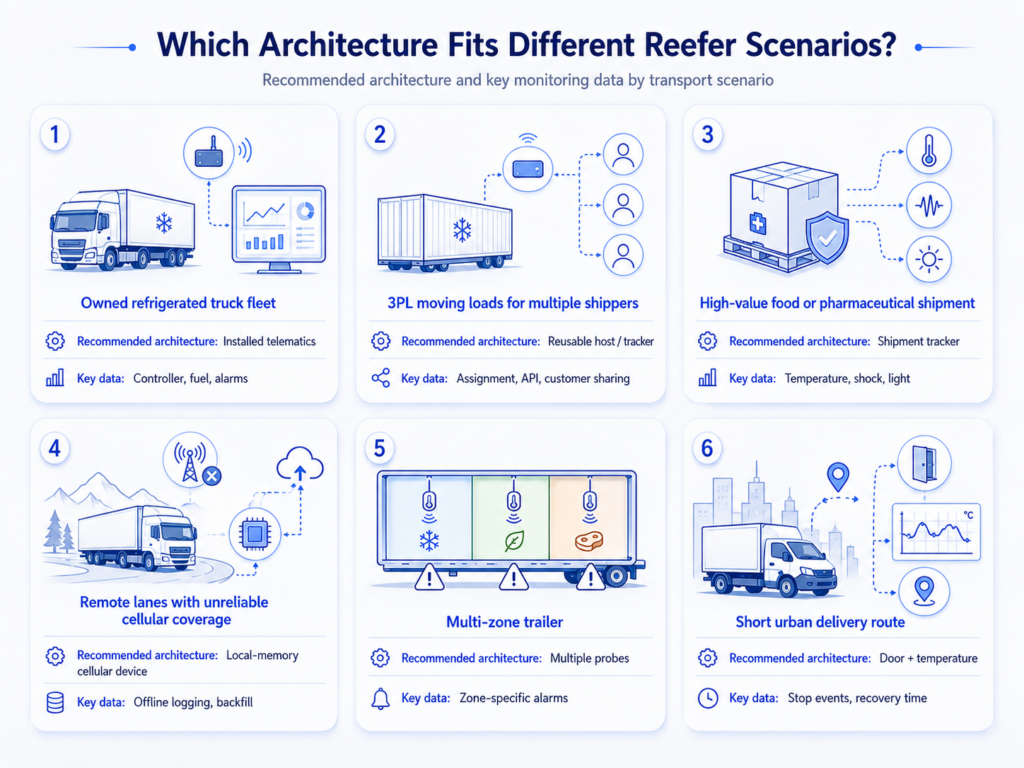
Owned refrigerated truck fleet
An owned fleet may benefit from installed reefer telematics because the operator can standardize installation, connect to controller data, schedule maintenance, and keep the device with the asset. Independent cargo probes can be added when the operator needs evidence that is separate from the controller.
3PL moving loads for multiple shippers
A 3PL may need a reusable monitoring host or shipment tracker that can be configured for different temperature profiles and integrated with its transport platform. API access, device assignment, customer data sharing, and exception workflows are important because the same vehicle may serve different shippers.
High-value food or pharmaceutical shipment
A shipment-level real-time tracker provides an independent record that travels with the goods through carrier handoffs. Multi-sensor data such as light, shock, and humidity may help investigate handling events beyond temperature alone.
Remote lanes with unreliable cellular coverage
The device should have sufficient local memory and a clear backfill process. The transmission interval may be extended to conserve battery, but the logging interval should remain appropriate for the product risk. Maritime operations may require vessel-based connectivity or route-event data because direct terrestrial coverage is unavailable at sea.
Multi-zone trailer
A single ambient sensor is rarely enough for a trailer divided into frozen, chilled, and ambient zones. Each zone requires appropriate sensing, identification, and alarm rules. The platform should preserve which probe belongs to which zone throughout loading and unloading.
Short urban delivery route
Door events and recovery time may be more important than long-distance location accuracy. The system should distinguish planned customer stops from unexpected openings and correlate each door event with cargo-space temperature recovery.
9.What Deployment Mistakes Reduce Monitoring Reliability?
Using the tractor GPS as evidence of cargo condition
The tractor may be separated from the trailer or the monitored load may be transferred. The device associated with the cargo or reefer asset must be identified clearly, and location data must be linked to the correct sensor record.
Treating the reefer setpoint as the measured temperature
A correct setpoint does not prove that conditioned air reached the cargo or that the load was pre-cooled. Store measured temperatures, not only controller settings.
Placing one probe near the evaporator
A probe close to the air outlet may show cold supply air while the rear of the trailer is warmer. Placement should be based on mapping, airflow, loading pattern, and the risk profile of the cargo.
Ignoring communications outages
A real-time dashboard can create false confidence if the device stops logging when it loses coverage. Commissioning should include a deliberate offline test, followed by verification that records are backfilled with correct timestamps.
Sending too many unactionable alerts
Alerts without delays, route context, or ownership become noise. Each alert needs a responsible role, escalation path, and defined corrective action.
Comparing products without considering architecture
An installed reefer-control system, a shipment tracker, and a passive logger may all measure temperature, but they solve different operational problems. Product comparisons should state what each device is connected to, who owns it, and what decisions it supports.
10.Frequently Asked Questions
Can a GPS tracker monitor reefer temperature?
Only if it also includes a temperature sensor or accepts data from a separate probe or reefer controller. A standard GPS tracker reports location but does not automatically provide cargo-condition data.
What is the difference between reefer telematics and shipment tracking?
Reefer telematics is usually installed on the asset and may read or control the refrigeration unit. Shipment tracking travels with the goods and provides an independent record of location and condition across carriers and modes.
Should a reefer system monitor supply air, return air, or cargo temperature?
The answer depends on the monitoring objective. Supply air helps evaluate cooling output, return air reflects conditions after air passes through the load, and cargo probes measure selected points in the load space. High-risk operations may use more than one.
How often should reefer temperature be recorded?
There is no single interval for every food and route. The shipper should define an interval that can detect meaningful excursions and meet contractual or regulatory requirements. Logging and transmission intervals should be specified separately.
What happens when a reefer tracker loses cellular coverage?
A suitable device continues logging locally and uploads the buffered records later. Buyers should verify storage capacity, timestamp handling, and whether alerts are delayed or generated locally during the outage.
Can temperature data prove that the food is safe?
Temperature records are important evidence, but they are only part of the assessment. Product type, time outside limits, packaging, initial condition, applicable procedures, and other evidence may be needed before a receiver accepts or rejects the load.
Is one temperature sensor enough for a reefer trailer?
It may be enough for a small, well-characterized space, but long trailers, multi-zone vehicles, and loads with blocked airflow often need more than one point. Mapping or operating data should guide sensor placement.
11.Conclusion
GPS alone is not enough for reefer fleet monitoring because location is only one part of cold-chain risk. A vehicle can be on route while the cargo experiences a temperature excursion, a door event, a reefer fault, a power failure, or an airflow problem.
A complete system combines time-stamped temperature and equipment data with GNSS location, local storage, mobile communications, alert logic, reports, and integration. The strongest monitoring design is the one that answers the operational question: where was the asset, what was happening inside it, what was the refrigeration unit doing, and was there enough reliable evidence to act?
Installed reefer telematics, configurable GNSS monitoring hosts, shipment-level real-time trackers, and passive data loggers each have valid roles. Selection should be based on asset ownership, temperature risk, sensor placement, required controller data, route coverage, battery or vehicle power, and system integration.
UbiBot GS1-PL4G1RS offers a configurable combination of multi-constellation GNSS, 4G, environmental sensing, external probes, local storage, APIs, and optional private deployment. Its value is strongest where operators need a reusable and extensible monitoring node. Native reefer-controller functions, validated food-safety workflows, and project-specific calibration must still be assessed separately.
12.Source and Specification Note
This article is based on current official regulatory guidance and manufacturer documentation reviewed in July 2026. Product models, network coverage, batteries, software features, and specifications may change. Where a manufacturer did not publish a parameter in the official material reviewed, the comparison states that it was not available rather than estimating it.
Food temperature requirements vary by product, jurisdiction, contract, and transport process. Monitoring technology supports evidence and intervention, but it does not replace shipper instructions, carrier procedures, receiver assessment, calibration, training, or food-safety decision-making.