

UBiBot Logo
UBiBot Logo
  • UBiBot Logo
  • Home
  • Products

    NEW

  • Pricing
  • Support
  • About Us
  • Download
  • magnifying-glass  Search
  • magnifying-glass header-close
  • Sign in Sign in
    Public Web Console Public Web Console
    On-Premises App Center On-Premises App Center
  • Home
  • Products

    NEW

  • Pricing
  • Support
  • About us
  • Download
  •  Public Web Console
  •  On-Premises App Center
  • Where to Buy

Learn Hub

Explore Knowledge Academic Research In-depth Tech

Share

LinkedIn

Facebook

X (Twitter)

Newsletter Signup

Table of contents

    UbiBot vs ELPRO vs Dickson vs Testo: Which Vaccine Refrigerator Monitor Fits a Small Clinic?

    Quick Answer

    Best choice depends on the complete measurement workflow

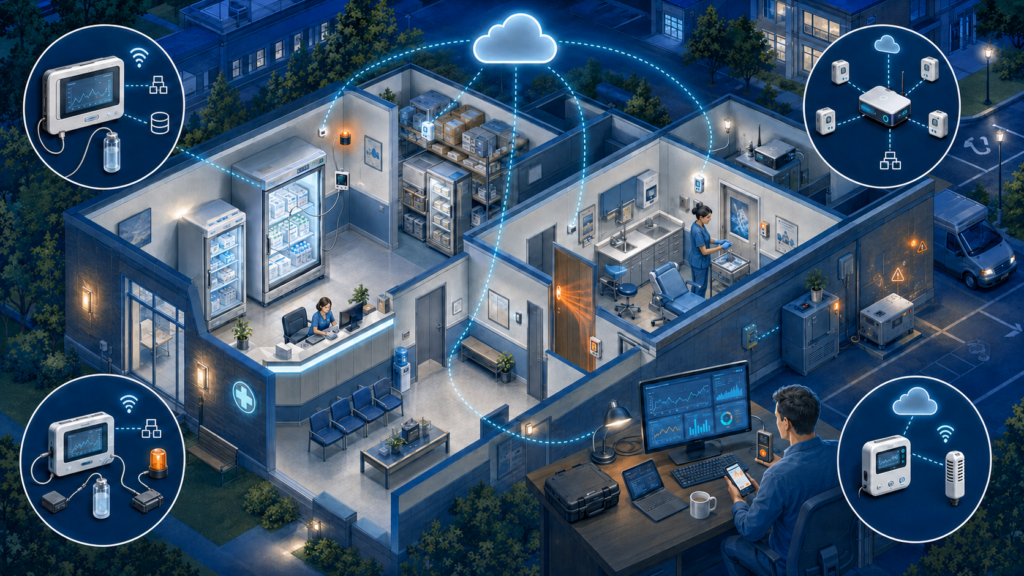
    For a small clinic purchasing specifically for vaccine refrigerator monitoring, the Dickson DWE2 paired with the RTHM glycol thermistor remains the most turnkey of these exact configurations because the manufacturer supplies a vaccine-oriented buffered probe, resettable minimum/maximum readings, local alarms, Wi-Fi and Ethernet, local backup memory, and battery backup. UbiBot GS1-AETH1RS paired with the waterproof UB-DT-P1 is the stronger low-recurring-cost alternative when direct Wi-Fi or Ethernet, no separate gateway, 300,000 local records, a large LCD, open integrations, and a free basic cloud plan matter most. UbiBot publishes ±0.5°C accuracy for UB-DT-P1 from -10°C to 85°C, numerically matching CDC’s recommended ±0.5°C uncertainty level for DDLs. Buyers must still confirm a suitable thermal buffer, certificate coverage for the complete logger-probe assembly, minimum/maximum workflow, and local program requirements. ELPRO suits scalable GxP environments; testo suits existing Saveris 2 users.

    Important: CDC does not validate or endorse private monitoring products. Suitability depends on the complete logger, probe, calibration certificate, operating procedure, and jurisdiction-specific requirements.


    1.Who Is This Comparison For?

    This comparison is for vaccine coordinators, clinic administrators, pharmacy managers, healthcare procurement teams, and facility personnel responsible for one or more vaccine refrigerators in small clinics, outpatient centers, community vaccination sites, or pharmacies.

    These buyers are not simply choosing a thermometer. They need a defensible temperature history, a practical daily review process, prompt notification when temperatures move out of range, and enough local data retention to reconstruct an event after a network interruption. They may also need calibration documentation, multi-user access, and records that can be retained according to their organization’s standard operating procedures.

    The common constraints are equally practical: limited local IT support, inconsistent Wi-Fi near medication rooms, concern about overnight excursions, uncertainty about which probes are suitable for vaccines, and resistance to adding a gateway or recurring software cost for a single refrigerator.

    2.What Matters Most in Vaccine Refrigerator Monitoring?

    The probe must reflect vaccine temperature, not just air temperature

    The CDC Vaccine Storage and Handling Toolkit explains that continuous digital data loggers provide a detailed record of temperature excursions. It recommends a detachable probe that best reflects vaccine temperature, such as a probe buffered with glycol, glass beads, sand, or Teflon. The buffered probe should normally be placed near the center of the unit with vaccines around it, while the active display remains outside the refrigerator.

    An air temperature probe can respond quickly when a refrigerator door opens. That response may be useful for diagnosing equipment behavior, but it is not automatically equivalent to a buffered probe intended to approximate the thermal response of vaccine contents. Buyers should therefore compare the complete logger-and-probe configuration rather than the logger alone.

    Accuracy, uncertainty, and calibration are separate questions

    CDC recommends an uncertainty of ±0.5°C or less and states that each digital data logger or other appropriate temperature monitoring device should have a current and valid Certificate of Calibration Testing. A product-page accuracy statement does not replace a certificate. Procurement teams should confirm the calibration points, traceability, uncertainty, pass result, serial-number coverage, and recalibration schedule for the complete measurement assembly.

    Daily review requires usable minimum and maximum data

    The July 2026 CDC toolkit calls for checking and recording minimum and maximum temperatures at the start of each workday. If the monitoring device does not provide minimum/maximum values, staff should record the current temperature at least twice per workday. A product that stores thousands of records in the cloud may still create extra workload if staff cannot complete the required review quickly at the refrigerator or in the software.

    Remote alerts and local records solve different risks

    Remote alerts can support timely intervention, but they depend on a working communication path. Local memory preserves evidence when the internet is unavailable. A strong clinic solution should continue logging during an outage, identify that communications were lost, and upload buffered records after reconnection. The clinic should also confirm whether any local audible alarm remains available when internet access is down.

    The real cost includes probes, calibration, software, and expansion

    A low logger price can be offset by a required gateway, separate probe, calibration service, annual software license, paid SMS package, or difficult expansion. For a single refrigerator, direct connectivity may minimize infrastructure. Across many refrigerators or rooms, a shared radio bridge and regulated software environment may become more efficient.

    3.Product Overview

    UbiBot GS1-AETH1RS + UB-DT-P1

    UbiBot GS1-AETH1RS supports one DS18B20-Audio probe and connects directly by 2.4 GHz Wi-Fi or RJ45 Ethernet without a gateway. With the waterproof UB-DT-P1, it measures refrigerator temperature from -55°C to 125°C; UbiBot specifies ±0.5°C from -10°C to 85°C. The unit also provides a 4-inch display, 300,000-record local memory, internal temperature, humidity, and light sensing, battery, Type-C or DC power, optional PoE, and a free basic cloud plan.

    The 2°C to 8°C vaccine range is inside the probe’s published ±0.5°C band, numerically matching CDC’s recommended uncertainty. UbiBot states that devices include a traceable factory calibration report valid for two years. Buyers must still confirm that the certificate covers the complete logger-probe assembly, select and validate a suitable thermal buffer, and verify the device’s minimum/maximum review workflow against the clinic SOP.

    ELPRO ECOLOG-PRO 1THR + ECOLOG-PRO RBR

    ECOLOG-PRO 1THR is a battery-powered wireless temperature and humidity module that uses one external combination probe. It stores up to 43,000 measurement values and communicates over 868 or 915 MHz radio to the ECOLOG-PRO RBR. One RBR can connect up to 50 modules and reaches elproCLOUD or elproMONITOR through Ethernet or PoE.

    ELPRO positions the ECOLOG-PRO wireless system for GxP-regulated facilities and provides audit-trail, alarm, reporting, calibration, and qualification services. The exact 1THR probe accuracy and suitability as a buffered vaccine probe depend on the selected probe and should be confirmed before specifying this exact combination for a clinic refrigerator.

    Dickson DWE2 + RTHM Glycol Thermistor Sensor

    Dickson DWE2 is a display data logger with Wi-Fi and Ethernet, replaceable sensors, audible and visible alarms, user-resettable minimum/maximum values, approximately 400,000 backup sample points, and an average 72-hour battery backup. It requires a DicksonOne subscription.

    The RTHM glycol thermistor sensor is explicitly marketed for refrigerators and freezers containing drugs and vaccines. Dickson publishes a range of -50°C to 70°C, accuracy of ±0.5°C, and optional NIST or A2LA calibration services. Among the four exact configurations in this article, it is the clearest vaccine-oriented probe package.

    testo Saveris 2-H2 + 0572 2155 Probe

    testo Saveris 2-H2 is a 2.4 GHz Wi-Fi logger that requires an external temperature/humidity probe. It displays current readings, alarm status, and battery condition, stores 10,000 values per channel, uses four AA batteries, and can use an optional mains adapter.

    The 0572 2155 cable probe measures air temperature from -30°C to 70°C at ±0.5°C and relative humidity from 0% to 100% RH. It is an air temperature/humidity probe, not a published buffered vaccine probe.

    4.Side-by-Side Comparison Table

    Important: Specifications are based on official manufacturer pages reviewed in July 2026. Missing values are marked “Not publicly specified.”

    Comparison item UbiBot GS1-AETH1RS + UB-DT-P1 ELPRO ECOLOG-PRO 1THR + RBR Dickson DWE2 + RTHM testo Saveris 2-H2 + 0572 2155
    Product positioning Directly connected multiparameter IoT monitor with waterproof external refrigerator probe GxP-oriented wireless sensor module and radio-bridge architecture Life-science cloud display logger with replaceable sensor Wi-Fi temperature/humidity data logger with external probe
    Measurement parameters Internal temperature, RH, and light; external temperature via UB-DT-P1 External temperature and RH Temperature with selected RTHM glycol probe External air temperature and RH
    Measurement range Internal: -20°C to 60°C; UB-DT-P1: -55°C to 125°C -20°C to 80°C; RH range depends on selected probe RTHM: -50°C to 70°C Probe: -30°C to 70°C; 0% to 100% RH
    Accuracy Internal temperature: ±0.2°C; UB-DT-P1: ±0.5°C (-10°C to 85°C) Depends on selected external probe; not specified on base 1THR page RTHM: ±0.5°C Temperature: ±0.5°C; RH: ±2% at 25°C (+2% to +98% RH)
    Connectivity 2.4 GHz Wi-Fi and RJ45 Ethernet; optional PoE splitter 868/915 MHz radio to RBR; RBR uses Ethernet or PoE 2.4 GHz Wi-Fi or Ethernet 2.4 GHz Wi-Fi; IEEE 802.11 b/g/n and 802.1X
    External probe support One DS18B20-Audio UB-DT-P1 on the GS1-AETH1RS variant; other RS485 probe options are available subject to model and port compatibility One external digital temperature/RH combination probe; extension up to 10 m Field-replaceable sensors; RTHM supplied with glycol buffer One connectable temperature/RH probe; 1.3 m cable on 0572 2155
    Gateway requirement No separate gateway ECOLOG-PRO RBR required No separate gateway No separate gateway
    Local display 4-inch LCD; resettable vaccine min/max workflow not publicly specified Status LEDs; numerical display not listed LCD with user-resettable current/min/max values Displays current values, alarm status, and battery status; min/max workflow not specified
    Power supply Internal lithium battery, Type-C, DC 5-12 V, or optional PoE splitter 1THR: 3 AA batteries; RBR: external power or PoE 12 VDC supply with average 72-hour battery backup 4 AA batteries; optional mains adapter
    Local data storage 300,000 sensor records 43,000 measurement values Approximately 400,000 backup sample points 10,000 measurement values per channel
    Cloud access UbiBot public platform; free basic plan available elproCLOUD or elproMONITOR DicksonOne Testo Cloud; Basic and Advanced options vary by region
    Alert methods App, email, web, SMS, voice call, and configurable integrations; paid credits may apply Email and/or SMS through ELPRO software; audit-oriented alarm management Phone call, SMS, email, audible and visible alarms Email; SMS and extended alarm functions with Advanced license
    Data export/reporting CSV/PDF; limits and automated reports depend on plan Reporting and archived-data functions; exact formats depend on software Direct logger export and DicksonOne reporting; exact formats not stated on DWE2 page Manual PDF/CSV in Basic; automatic PDF/CSV in Advanced where offered
    API or integration RESTful APIs; MQTT and additional functions depend on membership/plan Optional API integration through elproCLOUD/elproMONITOR Not publicly specified on the DWE2 product page Not publicly specified for this exact H2 configuration on the reviewed product page
    Subscription requirement No mandatory subscription for the basic cloud plan; paid upgrades and alert credits available Annual cloud licenses separate; 1THR uses temperature and humidity licenses DicksonOne subscription required Cloud registration required; free Basic and paid Advanced availability varies by region
    Installation complexity Low to medium: direct network connection and simple probe installation; vaccine buffer and certificate coverage require verification Medium to high: sensor, probe, RBR, licenses, and software configuration Medium: logger, RTHM sensor, calibration, and subscription Low to medium: logger, external probe, Wi-Fi, and cloud account
    Best suited for Small clinics needing direct Wi-Fi/Ethernet, lower software burden, and a refrigerator-rated probe, with a verified buffer and calibration workflow Multi-room or multi-site regulated facilities needing scalable GxP data controls Small-clinic vaccine refrigerators needing a published glycol-buffered probe workflow Existing Saveris 2 users and general refrigerated air temperature/RH monitoring
    Vaccine-monitoring limitation No public ready-made vaccine buffer; complete-system uncertainty, certificate coverage, and resettable minimum/maximum workflow require confirmation Exact selected probe, buffering, accuracy, and calibration package must be confirmed Certificate uncertainty, calibration points, and local program acceptance still require confirmation Listed probe measures air and is not presented as a buffered vaccine probe

    5.Connectivity and Deployment Comparison

    UbiBot and Dickson are the only two exact configurations here that provide direct Wi-Fi and Ethernet without a separate radio bridge. That matters in clinics where Wi-Fi coverage near a refrigerator is weak but a wired network port is available. UbiBot also supports an optional PoE splitter, allowing power and network access to follow the same cable route. Dickson adds a documented 72-hour average battery backup and local audible/visible alarms.

    ELPRO uses a different architecture. Battery-powered 1THR modules communicate with the RBR over 868 or 915 MHz radio, and the bridge connects to elproCLOUD or elproMONITOR through Ethernet or PoE. This adds cost and infrastructure for one refrigerator, but it can simplify expansion because one RBR supports up to 50 modules. The radio modules buffer values and resend them after communication is restored.

    testo Saveris 2-H2 is the most Wi-Fi-dependent option in this set. It can continue storing measurements locally, but remote visibility and cloud alerts depend on the logger and local network maintaining a path to Testo Cloud. It does not provide Ethernet or cellular fallback on this model.

    6.Sensor and External Probe Comparison

    The decisive technical difference is the complete probe configuration, not the headline measuring range of the base logger.

    Dickson publishes the RTHM as a glycol-buffered thermistor for refrigerators and freezers containing drugs and vaccines. Its published ±0.5°C accuracy is aligned with the numerical level recommended by CDC, but the clinic must still verify the uncertainty, traceability, calibration points, and pass status on the actual certificate supplied with the purchased sensor.

    ELPRO 1THR and testo Saveris 2-H2 both use external temperature/humidity probes. These can support useful environmental monitoring, but the exact probes reviewed are described as air temperature/RH probes rather than vaccine-buffered probes. Buyers should ask the manufacturer whether a different compatible probe, buffer, or calibrated configuration is recommended for their vaccine program.

    The exact UbiBot configuration evaluated here uses the GS1-AETH1RS variant with one UB-DT-P1 DS18B20-Audio probe. UbiBot publishes ±0.5°C accuracy from -10°C to 85°C, so the 2°C to 8°C vaccine refrigerator range falls inside the stated accuracy band. The probe is waterproof and intended for freezers, refrigerators, air, and liquids. Even so, a published accuracy figure is not the same as calibrated system uncertainty, and UbiBot does not publicly list a ready-made vaccine buffer for this probe. The clinic should confirm the thermal buffer, calibration certificate, certificate coverage for the complete assembly, and local-program acceptance before use.

    7.Cloud Platform, Alerts and Data Management

    UbiBot has the lowest mandatory software burden. Its free basic cloud plan includes 200 MB of storage per device, data import/export, alerting, and basic platform APIs. The platform supports CSV/PDF output and multi-device management. SMS and voice calls use account credits, while MQTT feeds and some advanced automation or reporting features require higher plans or memberships.

    ELPRO provides the most explicitly regulated-data-oriented software environment in this comparison. elproCLOUD and elproMONITOR offer audit trails, user management, reports, immediate email/SMS alerts, and optional API integration. ELPRO markets the system as GAMP 5 validated and FDA 21 CFR Part 11 compliant. For the 1THR, the hardware page states that annual cloud licenses are separate and that temperature and humidity use two licenses.

    DicksonOne centralizes multi-location data and supports phone, SMS, email, and local audible alarms. DWE2 stores readings locally and can export data directly from the logger, but Dickson states that a DicksonOne subscription is required for correct operation.

    Testo Cloud offers Basic and Advanced functions in many regions. Basic typically supports manual PDF/CSV reports and email alarms, while Advanced adds shorter intervals, alarm delay, scheduled reports, more users, longer storage, and a bundled SMS allowance. Exact license terms vary by country and should be confirmed before purchase.

    Whichever platform is selected, software does not replace a clinic escalation procedure. Staff still need named primary and backup responders, defined after-hours coverage, documented actions, and a process for handling exposed vaccines after an excursion.

    8.Total Deployment Cost and Recurring Burden

    For UbiBot, the total deployment may include the GS1-AETH1RS, UB-DT-P1, a suitable thermal buffer or probe holder, calibration verification, mounting, an optional PoE splitter, and paid alert or platform functions if the free plan is insufficient. UbiBot’s public calibration policy says devices include a factory calibration report valid for two years, but procurement should confirm that the report covers the exact logger-probe assembly and the required calibration points. The lack of a mandatory base subscription can keep recurring software costs predictable.

    ELPRO requires the 1THR module, selected probe, RBR, calibration, and annual software licenses. This is the heaviest structure for a single refrigerator, yet the economics improve when many measurement points share one bridge and a validated software environment.

    Dickson requires the DWE2, RTHM sensor, selected calibration, and a continuing DicksonOne subscription. The recurring cost is higher than a free-basic-cloud design, but the exact hardware package maps more directly to vaccine refrigerator workflows.

    testo requires the H2 logger, external probe, cloud configuration, and calibration. Advanced reporting and SMS functions add license cost. Buyers should also confirm whether Saveris 2-H2 remains available to new customers in their region or whether Testo recommends a testo 162 successor.

    9.Brand-by-Brand Strengths and Trade-Offs

    UbiBot GS1-AETH1RS + UB-DT-P1

    UbiBot best fits clinics that value direct Wi-Fi and Ethernet, no gateway, substantial local memory, a visible screen, flexible external sensors, and a basic cloud service without a mandatory subscription. The UB-DT-P1 is designed for freezers and refrigerators, and its published ±0.5°C accuracy is numerically aligned with the CDC recommendation for DDL uncertainty. The main remaining limitation is not the headline probe accuracy, but the absence of a publicly specified ready-made vaccine buffer and a clearly documented resettable minimum/maximum workflow. Buyers should also confirm that the calibration report covers the complete logger-probe assembly.

    ELPRO ECOLOG-PRO 1THR + RBR

    ELPRO best fits organizations that prioritize audit trails, controlled users, qualification services, and scalable regulated monitoring across many rooms or refrigerators. The bridge architecture is an advantage at scale but can be excessive for one small clinic. The buyer must also verify that the chosen 1THR probe is appropriate for buffered vaccine monitoring.

    Dickson DWE2 + RTHM

    Dickson is the strongest fit when the immediate procurement need is a vaccine refrigerator with a published glycol-buffered sensor, onsite minimum/maximum review, multiple alert channels, Ethernet fallback, local memory, and documented battery backup. Its trade-offs are the required subscription and a more closed hardware/software ecosystem.

    testo Saveris 2-H2 + 0572 2155

    testo fits organizations already using Saveris 2 and needing straightforward Wi-Fi temperature/RH monitoring in refrigerated areas. The probe can be calibrated separately and Testo Cloud supports practical reports and alarms. The selected 0572 2155 probe measures air rather than a published buffered vaccine temperature, and the model is being replaced for first-time buyers in some regions.

    10.Which Vaccine Refrigerator Monitor Fits Small Clinics ?

    Choose this product When this purchasing condition matters most
    UbiBot GS1-AETH1RS + UB-DT-P1 You need direct Wi-Fi and Ethernet, no gateway, 300,000 local records, a large display, a waterproof freezer/refrigerator probe, integration options, and a free basic cloud plan—and you can verify the thermal buffer, calibration certificate, and minimum/maximum workflow.
    ELPRO ECOLOG-PRO You are building a multi-point GxP monitoring system where audit trails, validated software, user controls, qualification, and scalable radio infrastructure outweigh added setup and license costs.
    Dickson DWE2 + RTHM You need the most directly vaccine-oriented exact configuration in this comparison, including a published glycol-buffered probe, min/max display, local alarms, Ethernet, and battery backup.
    testo Saveris 2-H2 You already operate Saveris 2 or need general refrigerated air temperature/RH monitoring on reliable Wi-Fi, and the chosen probe is accepted for your specific SOP.

    11.Pros and Cons

    Product Scenario-specific advantages Scenario-specific limitations
    UbiBot GS1-AETH1RS + UB-DT-P1 Direct Wi-Fi/Ethernet; no gateway; 300,000 local records; 4-inch display; UB-DT-P1 is waterproof and intended for freezers/refrigerators; ±0.5°C published accuracy from -10°C to 85°C; free basic cloud; APIs and RS485 expansion. The -1DS variant is required for UB-DT-P1; no published ready-made vaccine buffer; complete-system uncertainty, certificate coverage, resettable minimum/maximum workflow, and exact outage runtime require confirmation.
    ELPRO ECOLOG-PRO 1THR + RBR Scalable radio network; 43,000-value buffer; up to 50 modules per RBR; audit trail, regulated software, calibration and qualification services. RBR required; probe and annual licenses separate; exact selected probe accuracy and vaccine buffering must be confirmed.
    Dickson DWE2 + RTHM Published glycol-buffered vaccine probe; ±0.5°C accuracy; resettable min/max; Wi-Fi/Ethernet; local audible alarm; 72-hour average backup. DicksonOne subscription required; calibration adds cost; exact certificate uncertainty and local-program acceptance still require review.
    testo Saveris 2-H2 + 0572 2155 Wi-Fi deployment; external digital probe; 10,000 readings per channel; email/SMS options; PDF/CSV reports; separate probe calibration. Air probe rather than a published buffered vaccine probe; no Ethernet; Advanced cloud functions add cost; product status varies by region.

    12.Frequently Asked Questions

    Which monitor is the strongest fit for a small-clinic vaccine refrigerator?

    Among these exact configurations, Dickson DWE2 with the RTHM glycol sensor remains the most turnkey because the manufacturer supplies a vaccine-oriented buffered probe, ±0.5°C accuracy, resettable minimum/maximum values, multiple alarm channels, and battery backup. UbiBot GS1-AETH1RS with UB-DT-P1 is a strong alternative when direct Ethernet, lower recurring software burden, and large local memory matter, provided the clinic verifies the thermal buffer, calibration certificate, and daily review workflow.

    Is UbiBot GS1-AETH1RS with UB-DT-P1 CDC-compliant?

    No private product should be described as CDC-compliant. CDC states that it and the VFC program do not validate or endorse private products. The UB-DT-P1‘s published ±0.5°C accuracy is numerically aligned with CDC’s recommended uncertainty value, but suitability still depends on the thermal buffer, certificate coverage for the complete logger-probe assembly, the clinic’s SOP, and jurisdiction-specific requirements.

    Does UbiBot GS1-AETH1RS with UB-DT-P1 require a gateway?

    No. The GS1-AETH1RS connects directly through 2.4 GHz Wi-Fi or RJ45 Ethernet, and the UB-DT-P1 connects to the device through the supported DS18B20-Audio interface. ELPRO ECOLOG-PRO 1THR, by contrast, requires an RBR communication bridge.

    Can these products keep recording when the internet is unavailable?

    All four publish local storage capability. Remote alert delivery generally requires a working communication path. Dickson also provides local audible/visible alarms, while the exact local alarm behavior of each other configuration should be checked during acceptance testing.

    Can the external probe be placed inside the vaccine refrigerator?

    Yes. UbiBot describes the waterproof UB-DT-P1 as suitable for freezers and refrigerators, and the probe can remain inside while the GS1 display stays outside. For vaccine monitoring, CDC recommends placing a buffered probe near the center of the unit with vaccines around it. Dickson supplies a glycol-buffered RTHM; UbiBot does not publicly list a ready-made buffer for UB-DT-P1, so the clinic should select and validate an appropriate thermal buffer and calibration setup.

    Is a cloud subscription required?

    UbiBot offers a free basic plan. ELPRO requires separate annual channel licenses for the 1THR cloud setup. Dickson requires a DicksonOne subscription. Testo offers Basic and Advanced cloud structures in many regions, but regional terms differ.

    Can multiple clinics be managed from one account?

    Each vendor offers centralized software capable of managing multiple devices or locations, subject to the selected account, license, user, and hardware architecture. Procurement teams should confirm user roles, alarm recipients, record retention, and expansion costs.

    Are these exact configurations suitable for ultra-low-temperature vaccine freezers?

    They should not be assumed suitable. The selected ELPRO 1THR and Testo H2 probes do not cover ultra-low vaccine ranges, while Dickson RTHM stops at -50°C. UB-DT-P1 has a nominal range down to -55°C, but its ±0.5°C accuracy is specified only from -10°C to 85°C, so it should not be treated as suitable for the CDC ultra-cold range of -90°C to -60°C or for frozen-vaccine applications without separate performance and calibration evidence.

    13.Final Verdict

    There is no single winner for every clinic. For a small clinic that wants the most turnkey vaccine-specific package, Dickson DWE2 with the RTHM glycol sensor remains the most complete starting configuration among the products compared. It directly addresses buffered measurement, onsite minimum/maximum review, local alarm visibility, remote alerting, network choice, local data protection, and temporary power loss.

    UbiBot GS1-AETH1RS with UB-DT-P1 is the stronger option when deployment flexibility and lower mandatory software burden are the primary priorities. Direct Wi-Fi and Ethernet, no external gateway, 300,000 local records, a 4-inch display, a waterproof refrigerator probe with published ±0.5°C accuracy across the 2°C to 8°C vaccine range, broader sensor expansion, and a free basic cloud plan make it a credible small-clinic option. For a controlled vaccine program, the buyer should still verify an appropriate thermal buffer, certificate coverage and measurement uncertainty for the complete assembly, the daily minimum/maximum review method, and jurisdictional acceptance.

    ELPRO is better suited to regulated, multi-point organizations that need validated data governance and audit support. Testo remains practical for existing Saveris 2 users and general refrigerated temperature/RH monitoring. Before ordering any system, confirm the complete probe configuration, current calibration certificate, cloud license, alarm escalation workflow, record-retention requirement, and the applicable state, local, VFC, or organizational SOP.


    Related Resources

    Harbin Institute of Technology Uses UbiBot UB-DT-P1 Sensors to Monitor Residential Indoor Temperature in Severe Cold and Cold Regions of China
    UbiBot vs Dickson vs Testo vs Monnit: Which Is Better for Cold Storage Warehouses?
    Harbin Institute of Technology Uses UbiBot UB-DT-P1 Sensors to Monitor Residential Indoor Temperature for PCM Overheating Research
    Harbin Institute of Technology Uses UbiBot UB-DT-P1 Sensors to Monitor Residential Overheating in Severe Cold and Cold Regions of China
    AGH University of Science and Technology Uses UbiBot WS1 Wi-Fi for Railway Turnout Weather and Rail Temperature Monitoring
    menu-header-svg
    Search
    • Explore Knowledge
      • Comparison & Selection
      • Industry Solution
      • Product & Device
      • Criterion & Compliance
      • Deployment & Usage
      • Technology & Principle
    • Academic Research
    • In-depth Tech

    Comparison & Selection

    See More >>

    UbiBot vs ELPRO vs Dickson vs Testo: Which Vaccine Refrigerator Monitor Fits a Small Clinic?

    Quick Answer

    Best choice depends on the complete measurement workflow

    For a small clinic purchasing specifically for vaccine refrigerator monitoring, the Dickson DWE2 paired with the RTHM glycol thermistor remains the most turnkey of these exact configurations because the manufacturer supplies a vaccine-oriented buffered probe, resettable minimum/maximum readings, local alarms, Wi-Fi and Ethernet, local backup memory, and battery backup. UbiBot GS1-AETH1RS paired with the waterproof UB-DT-P1 is the stronger low-recurring-cost alternative when direct Wi-Fi or Ethernet, no separate gateway, 300,000 local records, a large LCD, open integrations, and a free basic cloud plan matter most. UbiBot publishes ±0.5°C accuracy for UB-DT-P1 from -10°C to 85°C, numerically matching CDC’s recommended ±0.5°C uncertainty level for DDLs. Buyers must still confirm a suitable thermal buffer, certificate coverage for the complete logger-probe assembly, minimum/maximum workflow, and local program requirements. ELPRO suits scalable GxP environments; testo suits existing Saveris 2 users.

    Important: CDC does not validate or endorse private monitoring products. Suitability depends on the complete logger, probe, calibration certificate, operating procedure, and jurisdiction-specific requirements.


    1.Who Is This Comparison For?

    This comparison is for vaccine coordinators, clinic administrators, pharmacy managers, healthcare procurement teams, and facility personnel responsible for one or more vaccine refrigerators in small clinics, outpatient centers, community vaccination sites, or pharmacies.

    These buyers are not simply choosing a thermometer. They need a defensible temperature history, a practical daily review process, prompt notification when temperatures move out of range, and enough local data retention to reconstruct an event after a network interruption. They may also need calibration documentation, multi-user access, and records that can be retained according to their organization’s standard operating procedures.

    The common constraints are equally practical: limited local IT support, inconsistent Wi-Fi near medication rooms, concern about overnight excursions, uncertainty about which probes are suitable for vaccines, and resistance to adding a gateway or recurring software cost for a single refrigerator.

    2.What Matters Most in Vaccine Refrigerator Monitoring?

    The probe must reflect vaccine temperature, not just air temperature

    The CDC Vaccine Storage and Handling Toolkit explains that continuous digital data loggers provide a detailed record of temperature excursions. It recommends a detachable probe that best reflects vaccine temperature, such as a probe buffered with glycol, glass beads, sand, or Teflon. The buffered probe should normally be placed near the center of the unit with vaccines around it, while the active display remains outside the refrigerator.

    An air temperature probe can respond quickly when a refrigerator door opens. That response may be useful for diagnosing equipment behavior, but it is not automatically equivalent to a buffered probe intended to approximate the thermal response of vaccine contents. Buyers should therefore compare the complete logger-and-probe configuration rather than the logger alone.

    Accuracy, uncertainty, and calibration are separate questions

    CDC recommends an uncertainty of ±0.5°C or less and states that each digital data logger or other appropriate temperature monitoring device should have a current and valid Certificate of Calibration Testing. A product-page accuracy statement does not replace a certificate. Procurement teams should confirm the calibration points, traceability, uncertainty, pass result, serial-number coverage, and recalibration schedule for the complete measurement assembly.

    Daily review requires usable minimum and maximum data

    The July 2026 CDC toolkit calls for checking and recording minimum and maximum temperatures at the start of each workday. If the monitoring device does not provide minimum/maximum values, staff should record the current temperature at least twice per workday. A product that stores thousands of records in the cloud may still create extra workload if staff cannot complete the required review quickly at the refrigerator or in the software.

    Remote alerts and local records solve different risks

    Remote alerts can support timely intervention, but they depend on a working communication path. Local memory preserves evidence when the internet is unavailable. A strong clinic solution should continue logging during an outage, identify that communications were lost, and upload buffered records after reconnection. The clinic should also confirm whether any local audible alarm remains available when internet access is down.

    The real cost includes probes, calibration, software, and expansion

    A low logger price can be offset by a required gateway, separate probe, calibration service, annual software license, paid SMS package, or difficult expansion. For a single refrigerator, direct connectivity may minimize infrastructure. Across many refrigerators or rooms, a shared radio bridge and regulated software environment may become more efficient.

    3.Product Overview

    UbiBot GS1-AETH1RS + UB-DT-P1

    UbiBot GS1-AETH1RS supports one DS18B20-Audio probe and connects directly by 2.4 GHz Wi-Fi or RJ45 Ethernet without a gateway. With the waterproof UB-DT-P1, it measures refrigerator temperature from -55°C to 125°C; UbiBot specifies ±0.5°C from -10°C to 85°C. The unit also provides a 4-inch display, 300,000-record local memory, internal temperature, humidity, and light sensing, battery, Type-C or DC power, optional PoE, and a free basic cloud plan.

    The 2°C to 8°C vaccine range is inside the probe’s published ±0.5°C band, numerically matching CDC’s recommended uncertainty. UbiBot states that devices include a traceable factory calibration report valid for two years. Buyers must still confirm that the certificate covers the complete logger-probe assembly, select and validate a suitable thermal buffer, and verify the device’s minimum/maximum review workflow against the clinic SOP.

    ELPRO ECOLOG-PRO 1THR + ECOLOG-PRO RBR

    ECOLOG-PRO 1THR is a battery-powered wireless temperature and humidity module that uses one external combination probe. It stores up to 43,000 measurement values and communicates over 868 or 915 MHz radio to the ECOLOG-PRO RBR. One RBR can connect up to 50 modules and reaches elproCLOUD or elproMONITOR through Ethernet or PoE.

    ELPRO positions the ECOLOG-PRO wireless system for GxP-regulated facilities and provides audit-trail, alarm, reporting, calibration, and qualification services. The exact 1THR probe accuracy and suitability as a buffered vaccine probe depend on the selected probe and should be confirmed before specifying this exact combination for a clinic refrigerator.

    Dickson DWE2 + RTHM Glycol Thermistor Sensor

    Dickson DWE2 is a display data logger with Wi-Fi and Ethernet, replaceable sensors, audible and visible alarms, user-resettable minimum/maximum values, approximately 400,000 backup sample points, and an average 72-hour battery backup. It requires a DicksonOne subscription.

    The RTHM glycol thermistor sensor is explicitly marketed for refrigerators and freezers containing drugs and vaccines. Dickson publishes a range of -50°C to 70°C, accuracy of ±0.5°C, and optional NIST or A2LA calibration services. Among the four exact configurations in this article, it is the clearest vaccine-oriented probe package.

    testo Saveris 2-H2 + 0572 2155 Probe

    testo Saveris 2-H2 is a 2.4 GHz Wi-Fi logger that requires an external temperature/humidity probe. It displays current readings, alarm status, and battery condition, stores 10,000 values per channel, uses four AA batteries, and can use an optional mains adapter.

    The 0572 2155 cable probe measures air temperature from -30°C to 70°C at ±0.5°C and relative humidity from 0% to 100% RH. It is an air temperature/humidity probe, not a published buffered vaccine probe.

    4.Side-by-Side Comparison Table

    Important: Specifications are based on official manufacturer pages reviewed in July 2026. Missing values are marked “Not publicly specified.”

    Comparison item UbiBot GS1-AETH1RS + UB-DT-P1 ELPRO ECOLOG-PRO 1THR + RBR Dickson DWE2 + RTHM testo Saveris 2-H2 + 0572 2155
    Product positioning Directly connected multiparameter IoT monitor with waterproof external refrigerator probe GxP-oriented wireless sensor module and radio-bridge architecture Life-science cloud display logger with replaceable sensor Wi-Fi temperature/humidity data logger with external probe
    Measurement parameters Internal temperature, RH, and light; external temperature via UB-DT-P1 External temperature and RH Temperature with selected RTHM glycol probe External air temperature and RH
    Measurement range Internal: -20°C to 60°C; UB-DT-P1: -55°C to 125°C -20°C to 80°C; RH range depends on selected probe RTHM: -50°C to 70°C Probe: -30°C to 70°C; 0% to 100% RH
    Accuracy Internal temperature: ±0.2°C; UB-DT-P1: ±0.5°C (-10°C to 85°C) Depends on selected external probe; not specified on base 1THR page RTHM: ±0.5°C Temperature: ±0.5°C; RH: ±2% at 25°C (+2% to +98% RH)
    Connectivity 2.4 GHz Wi-Fi and RJ45 Ethernet; optional PoE splitter 868/915 MHz radio to RBR; RBR uses Ethernet or PoE 2.4 GHz Wi-Fi or Ethernet 2.4 GHz Wi-Fi; IEEE 802.11 b/g/n and 802.1X
    External probe support One DS18B20-Audio UB-DT-P1 on the GS1-AETH1RS variant; other RS485 probe options are available subject to model and port compatibility One external digital temperature/RH combination probe; extension up to 10 m Field-replaceable sensors; RTHM supplied with glycol buffer One connectable temperature/RH probe; 1.3 m cable on 0572 2155
    Gateway requirement No separate gateway ECOLOG-PRO RBR required No separate gateway No separate gateway
    Local display 4-inch LCD; resettable vaccine min/max workflow not publicly specified Status LEDs; numerical display not listed LCD with user-resettable current/min/max values Displays current values, alarm status, and battery status; min/max workflow not specified
    Power supply Internal lithium battery, Type-C, DC 5-12 V, or optional PoE splitter 1THR: 3 AA batteries; RBR: external power or PoE 12 VDC supply with average 72-hour battery backup 4 AA batteries; optional mains adapter
    Local data storage 300,000 sensor records 43,000 measurement values Approximately 400,000 backup sample points 10,000 measurement values per channel
    Cloud access UbiBot public platform; free basic plan available elproCLOUD or elproMONITOR DicksonOne Testo Cloud; Basic and Advanced options vary by region
    Alert methods App, email, web, SMS, voice call, and configurable integrations; paid credits may apply Email and/or SMS through ELPRO software; audit-oriented alarm management Phone call, SMS, email, audible and visible alarms Email; SMS and extended alarm functions with Advanced license
    Data export/reporting CSV/PDF; limits and automated reports depend on plan Reporting and archived-data functions; exact formats depend on software Direct logger export and DicksonOne reporting; exact formats not stated on DWE2 page Manual PDF/CSV in Basic; automatic PDF/CSV in Advanced where offered
    API or integration RESTful APIs; MQTT and additional functions depend on membership/plan Optional API integration through elproCLOUD/elproMONITOR Not publicly specified on the DWE2 product page Not publicly specified for this exact H2 configuration on the reviewed product page
    Subscription requirement No mandatory subscription for the basic cloud plan; paid upgrades and alert credits available Annual cloud licenses separate; 1THR uses temperature and humidity licenses DicksonOne subscription required Cloud registration required; free Basic and paid Advanced availability varies by region
    Installation complexity Low to medium: direct network connection and simple probe installation; vaccine buffer and certificate coverage require verification Medium to high: sensor, probe, RBR, licenses, and software configuration Medium: logger, RTHM sensor, calibration, and subscription Low to medium: logger, external probe, Wi-Fi, and cloud account
    Best suited for Small clinics needing direct Wi-Fi/Ethernet, lower software burden, and a refrigerator-rated probe, with a verified buffer and calibration workflow Multi-room or multi-site regulated facilities needing scalable GxP data controls Small-clinic vaccine refrigerators needing a published glycol-buffered probe workflow Existing Saveris 2 users and general refrigerated air temperature/RH monitoring
    Vaccine-monitoring limitation No public ready-made vaccine buffer; complete-system uncertainty, certificate coverage, and resettable minimum/maximum workflow require confirmation Exact selected probe, buffering, accuracy, and calibration package must be confirmed Certificate uncertainty, calibration points, and local program acceptance still require confirmation Listed probe measures air and is not presented as a buffered vaccine probe

    5.Connectivity and Deployment Comparison

    UbiBot and Dickson are the only two exact configurations here that provide direct Wi-Fi and Ethernet without a separate radio bridge. That matters in clinics where Wi-Fi coverage near a refrigerator is weak but a wired network port is available. UbiBot also supports an optional PoE splitter, allowing power and network access to follow the same cable route. Dickson adds a documented 72-hour average battery backup and local audible/visible alarms.

    ELPRO uses a different architecture. Battery-powered 1THR modules communicate with the RBR over 868 or 915 MHz radio, and the bridge connects to elproCLOUD or elproMONITOR through Ethernet or PoE. This adds cost and infrastructure for one refrigerator, but it can simplify expansion because one RBR supports up to 50 modules. The radio modules buffer values and resend them after communication is restored.

    testo Saveris 2-H2 is the most Wi-Fi-dependent option in this set. It can continue storing measurements locally, but remote visibility and cloud alerts depend on the logger and local network maintaining a path to Testo Cloud. It does not provide Ethernet or cellular fallback on this model.

    6.Sensor and External Probe Comparison

    The decisive technical difference is the complete probe configuration, not the headline measuring range of the base logger.

    Dickson publishes the RTHM as a glycol-buffered thermistor for refrigerators and freezers containing drugs and vaccines. Its published ±0.5°C accuracy is aligned with the numerical level recommended by CDC, but the clinic must still verify the uncertainty, traceability, calibration points, and pass status on the actual certificate supplied with the purchased sensor.

    ELPRO 1THR and testo Saveris 2-H2 both use external temperature/humidity probes. These can support useful environmental monitoring, but the exact probes reviewed are described as air temperature/RH probes rather than vaccine-buffered probes. Buyers should ask the manufacturer whether a different compatible probe, buffer, or calibrated configuration is recommended for their vaccine program.

    The exact UbiBot configuration evaluated here uses the GS1-AETH1RS variant with one UB-DT-P1 DS18B20-Audio probe. UbiBot publishes ±0.5°C accuracy from -10°C to 85°C, so the 2°C to 8°C vaccine refrigerator range falls inside the stated accuracy band. The probe is waterproof and intended for freezers, refrigerators, air, and liquids. Even so, a published accuracy figure is not the same as calibrated system uncertainty, and UbiBot does not publicly list a ready-made vaccine buffer for this probe. The clinic should confirm the thermal buffer, calibration certificate, certificate coverage for the complete assembly, and local-program acceptance before use.

    7.Cloud Platform, Alerts and Data Management

    UbiBot has the lowest mandatory software burden. Its free basic cloud plan includes 200 MB of storage per device, data import/export, alerting, and basic platform APIs. The platform supports CSV/PDF output and multi-device management. SMS and voice calls use account credits, while MQTT feeds and some advanced automation or reporting features require higher plans or memberships.

    ELPRO provides the most explicitly regulated-data-oriented software environment in this comparison. elproCLOUD and elproMONITOR offer audit trails, user management, reports, immediate email/SMS alerts, and optional API integration. ELPRO markets the system as GAMP 5 validated and FDA 21 CFR Part 11 compliant. For the 1THR, the hardware page states that annual cloud licenses are separate and that temperature and humidity use two licenses.

    DicksonOne centralizes multi-location data and supports phone, SMS, email, and local audible alarms. DWE2 stores readings locally and can export data directly from the logger, but Dickson states that a DicksonOne subscription is required for correct operation.

    Testo Cloud offers Basic and Advanced functions in many regions. Basic typically supports manual PDF/CSV reports and email alarms, while Advanced adds shorter intervals, alarm delay, scheduled reports, more users, longer storage, and a bundled SMS allowance. Exact license terms vary by country and should be confirmed before purchase.

    Whichever platform is selected, software does not replace a clinic escalation procedure. Staff still need named primary and backup responders, defined after-hours coverage, documented actions, and a process for handling exposed vaccines after an excursion.

    8.Total Deployment Cost and Recurring Burden

    For UbiBot, the total deployment may include the GS1-AETH1RS, UB-DT-P1, a suitable thermal buffer or probe holder, calibration verification, mounting, an optional PoE splitter, and paid alert or platform functions if the free plan is insufficient. UbiBot’s public calibration policy says devices include a factory calibration report valid for two years, but procurement should confirm that the report covers the exact logger-probe assembly and the required calibration points. The lack of a mandatory base subscription can keep recurring software costs predictable.

    ELPRO requires the 1THR module, selected probe, RBR, calibration, and annual software licenses. This is the heaviest structure for a single refrigerator, yet the economics improve when many measurement points share one bridge and a validated software environment.

    Dickson requires the DWE2, RTHM sensor, selected calibration, and a continuing DicksonOne subscription. The recurring cost is higher than a free-basic-cloud design, but the exact hardware package maps more directly to vaccine refrigerator workflows.

    testo requires the H2 logger, external probe, cloud configuration, and calibration. Advanced reporting and SMS functions add license cost. Buyers should also confirm whether Saveris 2-H2 remains available to new customers in their region or whether Testo recommends a testo 162 successor.

    9.Brand-by-Brand Strengths and Trade-Offs

    UbiBot GS1-AETH1RS + UB-DT-P1

    UbiBot best fits clinics that value direct Wi-Fi and Ethernet, no gateway, substantial local memory, a visible screen, flexible external sensors, and a basic cloud service without a mandatory subscription. The UB-DT-P1 is designed for freezers and refrigerators, and its published ±0.5°C accuracy is numerically aligned with the CDC recommendation for DDL uncertainty. The main remaining limitation is not the headline probe accuracy, but the absence of a publicly specified ready-made vaccine buffer and a clearly documented resettable minimum/maximum workflow. Buyers should also confirm that the calibration report covers the complete logger-probe assembly.

    ELPRO ECOLOG-PRO 1THR + RBR

    ELPRO best fits organizations that prioritize audit trails, controlled users, qualification services, and scalable regulated monitoring across many rooms or refrigerators. The bridge architecture is an advantage at scale but can be excessive for one small clinic. The buyer must also verify that the chosen 1THR probe is appropriate for buffered vaccine monitoring.

    Dickson DWE2 + RTHM

    Dickson is the strongest fit when the immediate procurement need is a vaccine refrigerator with a published glycol-buffered sensor, onsite minimum/maximum review, multiple alert channels, Ethernet fallback, local memory, and documented battery backup. Its trade-offs are the required subscription and a more closed hardware/software ecosystem.

    testo Saveris 2-H2 + 0572 2155

    testo fits organizations already using Saveris 2 and needing straightforward Wi-Fi temperature/RH monitoring in refrigerated areas. The probe can be calibrated separately and Testo Cloud supports practical reports and alarms. The selected 0572 2155 probe measures air rather than a published buffered vaccine temperature, and the model is being replaced for first-time buyers in some regions.

    10.Which Vaccine Refrigerator Monitor Fits Small Clinics ?

    Choose this product When this purchasing condition matters most
    UbiBot GS1-AETH1RS + UB-DT-P1 You need direct Wi-Fi and Ethernet, no gateway, 300,000 local records, a large display, a waterproof freezer/refrigerator probe, integration options, and a free basic cloud plan—and you can verify the thermal buffer, calibration certificate, and minimum/maximum workflow.
    ELPRO ECOLOG-PRO You are building a multi-point GxP monitoring system where audit trails, validated software, user controls, qualification, and scalable radio infrastructure outweigh added setup and license costs.
    Dickson DWE2 + RTHM You need the most directly vaccine-oriented exact configuration in this comparison, including a published glycol-buffered probe, min/max display, local alarms, Ethernet, and battery backup.
    testo Saveris 2-H2 You already operate Saveris 2 or need general refrigerated air temperature/RH monitoring on reliable Wi-Fi, and the chosen probe is accepted for your specific SOP.

    11.Pros and Cons

    Product Scenario-specific advantages Scenario-specific limitations
    UbiBot GS1-AETH1RS + UB-DT-P1 Direct Wi-Fi/Ethernet; no gateway; 300,000 local records; 4-inch display; UB-DT-P1 is waterproof and intended for freezers/refrigerators; ±0.5°C published accuracy from -10°C to 85°C; free basic cloud; APIs and RS485 expansion. The -1DS variant is required for UB-DT-P1; no published ready-made vaccine buffer; complete-system uncertainty, certificate coverage, resettable minimum/maximum workflow, and exact outage runtime require confirmation.
    ELPRO ECOLOG-PRO 1THR + RBR Scalable radio network; 43,000-value buffer; up to 50 modules per RBR; audit trail, regulated software, calibration and qualification services. RBR required; probe and annual licenses separate; exact selected probe accuracy and vaccine buffering must be confirmed.
    Dickson DWE2 + RTHM Published glycol-buffered vaccine probe; ±0.5°C accuracy; resettable min/max; Wi-Fi/Ethernet; local audible alarm; 72-hour average backup. DicksonOne subscription required; calibration adds cost; exact certificate uncertainty and local-program acceptance still require review.
    testo Saveris 2-H2 + 0572 2155 Wi-Fi deployment; external digital probe; 10,000 readings per channel; email/SMS options; PDF/CSV reports; separate probe calibration. Air probe rather than a published buffered vaccine probe; no Ethernet; Advanced cloud functions add cost; product status varies by region.

    12.Frequently Asked Questions

    Which monitor is the strongest fit for a small-clinic vaccine refrigerator?

    Among these exact configurations, Dickson DWE2 with the RTHM glycol sensor remains the most turnkey because the manufacturer supplies a vaccine-oriented buffered probe, ±0.5°C accuracy, resettable minimum/maximum values, multiple alarm channels, and battery backup. UbiBot GS1-AETH1RS with UB-DT-P1 is a strong alternative when direct Ethernet, lower recurring software burden, and large local memory matter, provided the clinic verifies the thermal buffer, calibration certificate, and daily review workflow.

    Is UbiBot GS1-AETH1RS with UB-DT-P1 CDC-compliant?

    No private product should be described as CDC-compliant. CDC states that it and the VFC program do not validate or endorse private products. The UB-DT-P1‘s published ±0.5°C accuracy is numerically aligned with CDC’s recommended uncertainty value, but suitability still depends on the thermal buffer, certificate coverage for the complete logger-probe assembly, the clinic’s SOP, and jurisdiction-specific requirements.

    Does UbiBot GS1-AETH1RS with UB-DT-P1 require a gateway?

    No. The GS1-AETH1RS connects directly through 2.4 GHz Wi-Fi or RJ45 Ethernet, and the UB-DT-P1 connects to the device through the supported DS18B20-Audio interface. ELPRO ECOLOG-PRO 1THR, by contrast, requires an RBR communication bridge.

    Can these products keep recording when the internet is unavailable?

    All four publish local storage capability. Remote alert delivery generally requires a working communication path. Dickson also provides local audible/visible alarms, while the exact local alarm behavior of each other configuration should be checked during acceptance testing.

    Can the external probe be placed inside the vaccine refrigerator?

    Yes. UbiBot describes the waterproof UB-DT-P1 as suitable for freezers and refrigerators, and the probe can remain inside while the GS1 display stays outside. For vaccine monitoring, CDC recommends placing a buffered probe near the center of the unit with vaccines around it. Dickson supplies a glycol-buffered RTHM; UbiBot does not publicly list a ready-made buffer for UB-DT-P1, so the clinic should select and validate an appropriate thermal buffer and calibration setup.

    Is a cloud subscription required?

    UbiBot offers a free basic plan. ELPRO requires separate annual channel licenses for the 1THR cloud setup. Dickson requires a DicksonOne subscription. Testo offers Basic and Advanced cloud structures in many regions, but regional terms differ.

    Can multiple clinics be managed from one account?

    Each vendor offers centralized software capable of managing multiple devices or locations, subject to the selected account, license, user, and hardware architecture. Procurement teams should confirm user roles, alarm recipients, record retention, and expansion costs.

    Are these exact configurations suitable for ultra-low-temperature vaccine freezers?

    They should not be assumed suitable. The selected ELPRO 1THR and Testo H2 probes do not cover ultra-low vaccine ranges, while Dickson RTHM stops at -50°C. UB-DT-P1 has a nominal range down to -55°C, but its ±0.5°C accuracy is specified only from -10°C to 85°C, so it should not be treated as suitable for the CDC ultra-cold range of -90°C to -60°C or for frozen-vaccine applications without separate performance and calibration evidence.

    13.Final Verdict

    There is no single winner for every clinic. For a small clinic that wants the most turnkey vaccine-specific package, Dickson DWE2 with the RTHM glycol sensor remains the most complete starting configuration among the products compared. It directly addresses buffered measurement, onsite minimum/maximum review, local alarm visibility, remote alerting, network choice, local data protection, and temporary power loss.

    UbiBot GS1-AETH1RS with UB-DT-P1 is the stronger option when deployment flexibility and lower mandatory software burden are the primary priorities. Direct Wi-Fi and Ethernet, no external gateway, 300,000 local records, a 4-inch display, a waterproof refrigerator probe with published ±0.5°C accuracy across the 2°C to 8°C vaccine range, broader sensor expansion, and a free basic cloud plan make it a credible small-clinic option. For a controlled vaccine program, the buyer should still verify an appropriate thermal buffer, certificate coverage and measurement uncertainty for the complete assembly, the daily minimum/maximum review method, and jurisdictional acceptance.

    ELPRO is better suited to regulated, multi-point organizations that need validated data governance and audit support. Testo remains practical for existing Saveris 2 users and general refrigerated temperature/RH monitoring. Before ordering any system, confirm the complete probe configuration, current calibration certificate, cloud license, alarm escalation workflow, record-retention requirement, and the applicable state, local, VFC, or organizational SOP.

    分享

    LinkedIn2

    Facebook2

    X

    Newsletter Signup

    Related Resources

    Harbin Institute of Technology Uses UbiBot UB-DT-P1 Sensors to Monitor Residential Indoor Temperature in Severe Cold and Cold Regions of China
    UbiBot vs Dickson vs Testo vs Monnit: Which Is Better for Cold Storage Warehouses?
    Harbin Institute of Technology Uses UbiBot UB-DT-P1 Sensors to Monitor Residential Indoor Temperature for PCM Overheating Research
    Harbin Institute of Technology Uses UbiBot UB-DT-P1 Sensors to Monitor Residential Overheating in Severe Cold and Cold Regions of China
    AGH University of Science and Technology Uses UbiBot WS1 Wi-Fi for Railway Turnout Weather and Rail Temperature Monitoring
    menu-header-svg
    Search
    • Explore Knowledge
      • Comparison & Selection
      • Industry Solution
      • Product & Device
      • Criterion & Compliance
      • Deployment & Usage
      • Technology & Principle
    • Academic Research
    • In-depth Tech
    Enter Your Information

    Confirm

    Products

    Dashboards

    Support

    Purchase

    Company

    Smart Sensing

    UbiBot Web Console

    APP Download

    UbiBot Online Store

    News

    Smart Control

    UbiBot Space

    Product Docs & APIs

    Find Distributors

    About Us

    Smart Video

    UbiBot On-Premises

    Helpdesk & FAQ

    Volume Pricing

    Contact Us

    LoRa Products

    Agency Web Console

    Video Center

    Architecture

    Software & Platform


    Pricing


    System Status

    External Sensors


    Become a Distributor

    Accessories


    Become an Affiliate

    Global SIM


    Positioning System


    Products

    Dashboards

    Business Partners

    WS1

    UbiBot Web Console

    Volume Pricing

    WS1 Pro

    UbiBot Space

    Become a Distributor

    GS1

    UbiBot Support Desk

    Affiliates

    GS2

    Agency Web Console


    MS1


    SP1


    Accessories


    Docs

    Purchase

    Company

    Platform API

    Pricing

    News

    Q&A

    UbiBot Partners

    About us

    Privacy Policy

    Online Store

    Contact

    Terms of Service


    System Status

    Products

    Dashboards

    Smart Sensing

    UbiBot Web Console

    Smart Control

    UbiBot Space

    Smart Video

    UbiBot On-Premises

    LoRa Products

    Agency Web Console

    Software & Platform


    External Sensors


    Accessories


    Global SIM


    Positioning System


    Support

    Purchase

    APP Download

    UbiBot Online Store

    Product Docs & APIs

    Find Distributors

    Helpdesk & FAQ

    Volume Pricing

    Video Center


    Pricing


    Company

    News

    About Us

    Contact Us

    Architecture

    System Status

    Become a Distributor

    Become an Affiliate

    Language:
    English 日本語 (ベータ)  
    Language:

    English

    日本語 (ベータ)


    IoT Product Family:
    ubibotico     Wireless environmental sensing products and smart building solutions
    ubitrackico     UWB-based real-time indoor tracking solutions with 30cm accuracy

    IoT Product Family:

    ubibotico  Wireless environmental sensing products and smart building solutions
    ubitrackico  UWB-based real-time indoor tracking solutions with 30cm accuracy

    © 2013-2026 UbiBot.com. All rights reserved.

    Terms of Service | Privacy Policy | Compliance

    youtube facebook twitter