

.svg)
How to Deploy a Pharmaceutical Warehouse Environmental Monitoring System?
Published: August 11, 2026
Update: August 28, 2026
By Susan Jones
Introduction
A pharmaceutical warehouse is rarely one uniform environment. The same site may contain controlled ambient storage, refrigerated rooms, freezers, quarantine and returns areas, inbound staging, outbound marshalling, and loading docks that experience very different temperature and humidity behavior. A sensor that performs well in a small room can miss a warm upper rack, a cold spot near a supply diffuser, a door-side excursion, or a recurring gradient created by seasonal weather and material flow. The operational risk is not simply that a room becomes too warm or too cold; it is that the organization cannot prove what conditions products experienced, how long an excursion lasted, or whether the monitoring system itself was available when it mattered.
This guide is written for pharmaceutical warehouse managers, quality and GDP teams, cold-chain specialists, facilities and engineering teams, IT departments, system integrators, and procurement managers. It explains how to define monitoring zones, use temperature mapping to select routine sensor locations, choose wired or wireless communications, preserve records during network outages, compare representative monitoring architectures, and scale from one warehouse to multi-site distribution. It is global in scope: WHO guidance provides an international baseline, while EU GDP and U.S. CGMP examples illustrate how local regulatory frameworks shape implementation. Product labels, marketing authorizations, national rules, customer quality agreements, and approved SOPs always take precedence over generic guidance.
SCOPE BOUNDARY
This article supports system design and procurement planning. It does not certify any device, warehouse, software platform, or operating procedure as GDP-, GMP-, FDA-, or 21 CFR Part 11-compliant. Applicability depends on the complete facility, validated or verified workflow, approved limits, calibration, user controls, records, and local regulatory obligations.
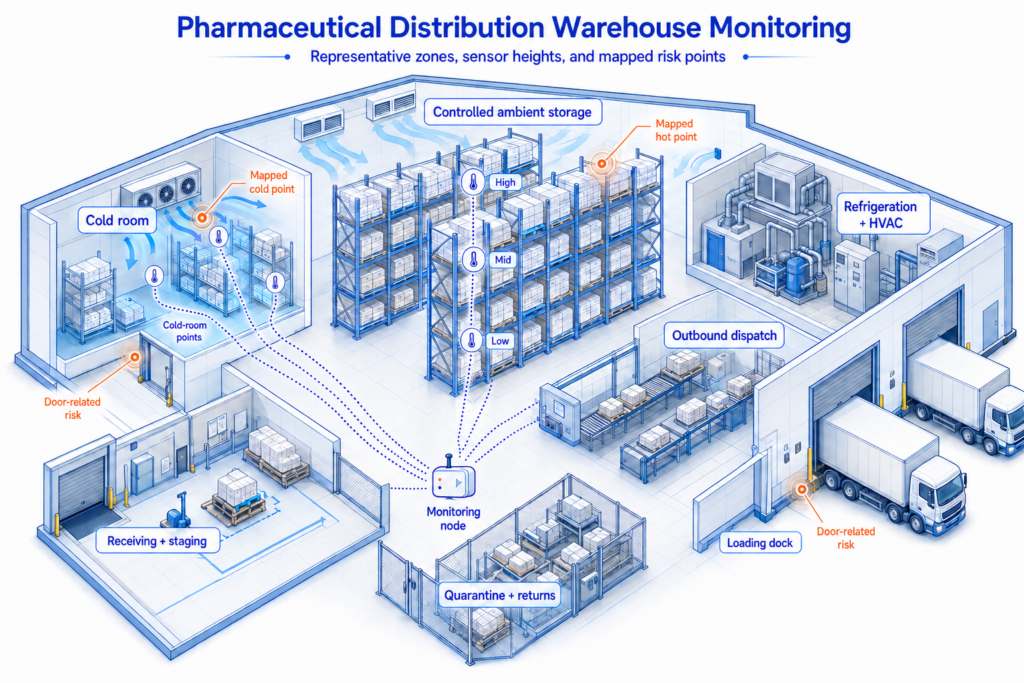
Pharmaceutical warehouse monitoring zones: controlled ambient storage, cold rooms, staging, quarantine, loading docks, and mechanical areas require different monitoring strategies.
Quick Summary
A pharmaceutical warehouse monitoring system should be designed around storage zones and mapped temperature behavior rather than a fixed number of sensors per square meter. Start by defining the approved conditions for each product and area, then conduct or review a representative temperature-mapping study. Place continuous monitors at locations that capture identified hot, cold, and operationally vulnerable points. Use Ethernet or managed Wi-Fi for fixed sites, LoRa for dense multi-point areas where cabling is difficult, cellular for remote buildings or backup paths, and RS485 for industrial probes and equipment interfaces. The system should keep local records during connectivity failures, escalate temperature and device-health alarms, retain calibration and configuration evidence, and support centralized review. Compare platforms by data continuity, governance, integration, calibration, lifecycle cost, and scalability—not accuracy alone.
Key Takeaway
The core design principle is simple: mapping tells you where the risk is; continuous monitoring tells you whether those mapped risks remain under control. A defensible system links sensor placement, calibration, local data retention, communications, alarms, user ownership, and deviation procedures into one documented workflow.
Why a Pharmaceutical Warehouse Monitoring System Matters
Protect product quality across different storage zones
Pharmaceutical products are stored under conditions defined by their approved labeling, product dossier, quality agreement, or company procedure. WHO good storage and distribution practices emphasize maintaining product quality throughout storage and distribution, while FDA Q7A states that facilities should store materials under appropriate conditions, including controlled temperature and humidity when necessary, and maintain records when those conditions are critical. [R1, R5] The practical implication is that a warehouse should not inherit one generic temperature target for every room. Controlled ambient areas, refrigerated rooms, freezers, quarantine areas, and temporary staging zones must be assessed against the products and processes they actually contain.
Reduce operational blind spots
A refrigeration or HVAC system can remain powered while the stored environment develops local gradients. High-bay racks, exterior walls, roof exposure, blocked airflow, open dock doors, evaporator discharge, defrost cycles, and changes in pallet loading can all produce locations that behave differently from a wall thermostat. Continuous monitoring creates a time-stamped record between manual inspections and provides an earlier opportunity to respond to deviations. It also helps facilities teams separate an equipment problem from a placement problem, a loading event, or a recurring seasonal pattern.
Create traceable evidence for investigations
When a deviation occurs, quality teams need more than the highest or lowest reading. They need to know which sensor generated the event, whether that sensor was within calibration, whether the communication path was available, how long the condition persisted, what neighboring points showed, whether data were backfilled after an outage, and who acknowledged the alarm. A useful monitoring system therefore combines measurement records with configuration control, device identity, timestamps, user ownership, alarm history, maintenance, and calibration evidence.
Support GDP and internal quality workflows without overclaiming compliance
EU GDP explicitly calls for suitable equipment and procedures to check the storage environment; it identifies temperature, light, humidity, and cleanliness as relevant factors. It also calls for an initial temperature-mapping exercise before use, monitoring devices positioned according to the mapping results, risk-based repeat mapping after significant changes, traceable calibration at defined intervals, and regularly tested alarm systems. [R4] These requirements describe a controlled system, not a single sensor specification. A connected logger can support the workflow, but compliance depends on the entire quality system and jurisdiction.
Why manual checks are not enough by themselves
Manual warehouse checks remain valuable for visual inspection and procedural discipline, but they are snapshots. They can miss overnight HVAC setbacks, short door-related excursions, weekend refrigeration faults, or localized gradients. Continuous logging fills the time gap, while periodic human review remains important because automation can also fail. The best operating model uses automatic monitoring to increase coverage and human procedures to verify that alarms, calibration, backup plans, and corrective actions remain effective.
What Environmental Parameters Should Be Monitored?
The monitoring plan should distinguish product-critical measurements from diagnostic or contextual measurements. Temperature is normally the primary variable for pharmaceutical storage. Humidity, door state, power, and equipment status become important where they explain product risk or system performance. Optional measurements should be added only when they answer a defined quality or engineering question.
| Parameter | Why It Matters | Monitoring Location | Recommended Sensor Type |
| Temperature — essential | Primary evidence that the storage zone remains within the approved product or area condition. | Mapped hot/cold locations in ambient storage; cold rooms; freezers; staging zones where product can dwell. | Calibrated temperature logger, PT100/RTD probe, or temperature/RH probe appropriate to the actual range. |
| Relative humidity — essential where specified | Supports moisture-sensitive product, packaging, or room requirements and helps explain condensation risk. | Controlled ambient rooms or zones where RH is specified by product, packaging, facility, or SOP. | Calibrated temperature/RH sensor with performance confirmed over the operating band. |
| Door / access status — conditional | Explains repeated temperature excursions and loading or picking behavior. | Cold-room doors, loading doors, high-frequency access points. | Magnetic contact, dry contact, or equipment signal synchronized with environmental data. |
| Power / refrigeration status — conditional | Identifies power loss or refrigeration/HVAC failure before the room drifts significantly. | Cold-room plant, compressors, air handlers, monitored circuits or UPS. | Dry-contact, current/voltage, relay, Modbus/RS485, or BMS status input. |
| Communication / device health — essential for remote alarms | Distinguishes a healthy environment from a missing data path and supports escalation when devices go offline. | System level: logger, gateway, network and platform. | Heartbeat, offline alarm, gateway status, battery status and communication-failure rule. |
| Light — optional / product dependent | Useful where light-sensitive products or open-door exposure is relevant; not a substitute for temperature control. | Specific storage or staging locations identified by risk assessment. | Light sensor or dedicated product-protection workflow. |
| Water leak — optional / facility risk | Provides early warning near cooling equipment, condensate lines, drains or sensitive stored inventory. | Mechanical rooms, evaporators, pipe routes or areas identified by facility risk assessment. | Point or rope-type leak sensor integrated with the monitoring/alarm platform. |
TEMPERATURE MAPPING VS. CONTINUOUS MONITORING
A mapping study is a qualification or characterization exercise used to identify spatial and operational temperature behavior. Continuous monitoring is the ongoing control record. Mapping should inform where routine monitors are installed; routine monitors do not replace a mapping study.
Warehouse Temperature Mapping: How It Changes Sensor Placement
WHO describes temperature mapping as recording and mapping temperatures in three-dimensional storage spaces, including dry stores, cold rooms, freezer rooms, refrigerators, and freezers. Its 2026 mapping tool notes that mapping and monitoring are integral to appropriate pharmaceutical storage. [R2] EU GDP similarly states that initial mapping should be performed before use under representative conditions and that routine monitoring devices should be placed according to the mapped extremes. [R4]
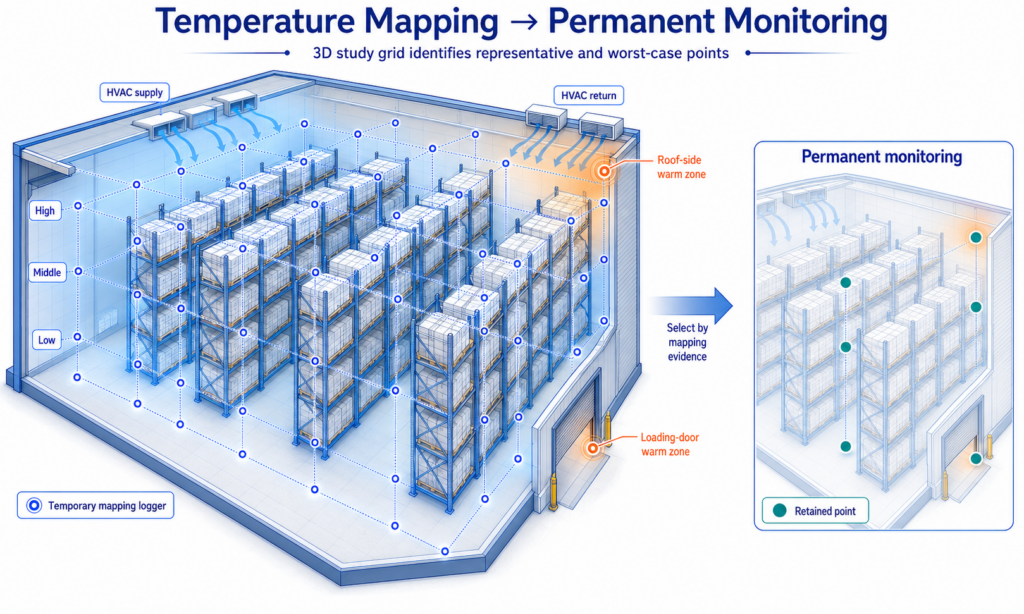
Temperature mapping identifies three-dimensional hot and cold zones that should guide permanent sensor placement.
For a high-bay warehouse, the mapping grid should represent height as well as floor area. Candidate points commonly include upper racks near the roof, lower racks near exterior walls, supply and return airflow paths, loading-door influence zones, corners with weak air movement, and product staging areas. Cold rooms additionally require attention to evaporator discharge, return air, door-side warming, defrost effects, and loaded versus lightly loaded operation. The final number of permanent monitoring points should be justified by the mapping results and risk assessment, not by a universal sensor-density formula.
Repeat mapping should be considered after changes that can alter airflow or heat load: racking changes, new HVAC equipment, modified setpoints, cold-room repairs, wall or door modifications, changed pallet density, new staging practices, or other significant facility changes. A seasonal assessment is often appropriate where outside conditions materially affect the building. The retained permanent sensors should then be placed where they provide early, representative evidence of the risks identified by the study.
What Does a Typical Environmental Monitoring System Include?
A scalable pharmaceutical warehouse monitoring system can be understood as five layers. The design may be compact in a small warehouse or distributed across hundreds of points in a regional network, but the functions remain similar.
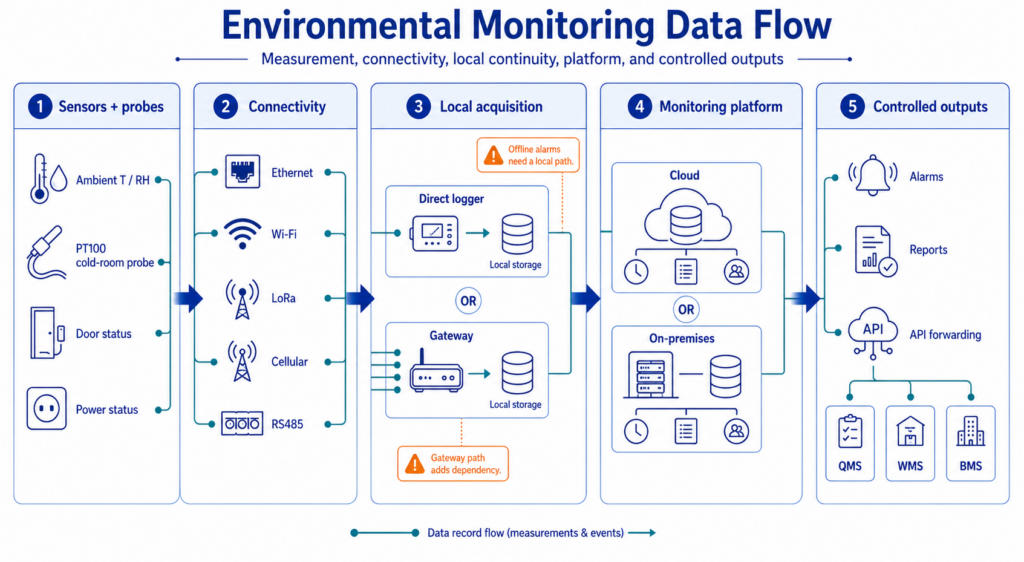
Five-layer pharmaceutical warehouse environmental monitoring architecture from sensing to quality-system integration.
1. Sensing layer
This layer contains ambient temperature/RH sensors, PT100 or RTD probes for refrigerated or specialized areas, and optional door, power, leak, or equipment-status inputs. Sensor selection should follow the actual range, required uncertainty, mounting environment, cleanability, cable routing, and calibration plan. The same platform may use different probe types across ambient and cold zones.
2. Connectivity layer
Ethernet and managed Wi-Fi are natural choices for fixed warehouses with established IT infrastructure. LoRa or another long-range radio can reduce cabling where many points are distributed across large storage areas. Cellular can provide an independent path for remote buildings or temporary sites. RS485 is a local industrial bus for external probes and controllers; it is not itself an internet connection.
3. Gateway or data-collection layer
Direct-connected devices may send data to a platform without a proprietary gateway. Long-range wireless nodes normally require one or more gateways, while industrial probes may feed a logger, controller, or PLC. Gateway count should be based on capacity, radio coverage, redundancy, backhaul availability, and the impact of a shared gateway failure.
4. Cloud or on-premises platform
The platform should provide real-time and historical trends, alarm rules, user permissions, reports, device health, data export, and retention appropriate to the organization. Large pharmaceutical organizations may also require local deployment, data residency, validated infrastructure, change control, or integration with QMS, BMS, WMS, LIMS, CMMS, or analytics tools.
5. Alarm and integration layer
Email, app notifications, SMS, voice, local audible indicators, relays, APIs, and data forwarding are different escalation paths, not interchangeable guarantees. A critical alarm requires a named owner, acknowledgement expectation, after-hours escalation, and a documented response procedure. Integrations should define which system is the system of record and how corrected, missing, or backfilled data are handled.
TEXT-BASED ARCHITECTURE FLOW
Ambient and cold-room sensors → direct-connected logger / RS485 probe / LoRa node → local memory → Ethernet, Wi-Fi, cellular or LoRa gateway → public cloud or on-premises platform → threshold + device-health alarms → quality, warehouse, facilities and IT teams → reports, API/data forwarding and deviation workflow.
Which Communication Method Should Be Used?
| Method | Best Fit | Advantages | Limitations / Design Checks |
| Wi-Fi | Small/medium warehouses with managed coverage; supplemental points in offices or dry areas. | Fast installation, no cable to each endpoint, direct platform connection. | Metal racks and insulated panels can attenuate signal; enterprise authentication, roaming, internet dependency and IT approval must be verified. |
| Ethernet | Fixed critical points, network rooms, stable warehouse reference locations. | Predictable local link, straightforward IT control, low latency, easy diagnostics. | Requires cabling and switch capacity; endpoint still needs appropriate power and enclosure. PoE capability is device/configuration-specific. |
| 4G / cellular | Remote depots, temporary facilities, isolated cold rooms, or independent backhaul. | Independent of local LAN/Wi-Fi; fast deployment where broadband is limited. | SIM/service cost, carrier coverage, building attenuation, regional band compatibility and power demand. |
| LoRa / sub-GHz | Large warehouses with many distributed battery-powered or low-data-rate nodes. | Long range and low power; reduces field cabling; many nodes can share a gateway. | Gateway becomes a shared dependency; radio survey, regional frequency selection, backhaul, capacity and redundancy planning are required. |
| RS485 / Modbus RTU | PT100/industrial probes, equipment transmitters, panels and fixed local sensor networks. | Robust wired bus, long local runs, industrial device selection, deterministic connection. | Requires addressing, termination, wiring, power, commissioning and compatibility checks; needs a logger/gateway/controller for remote access. |
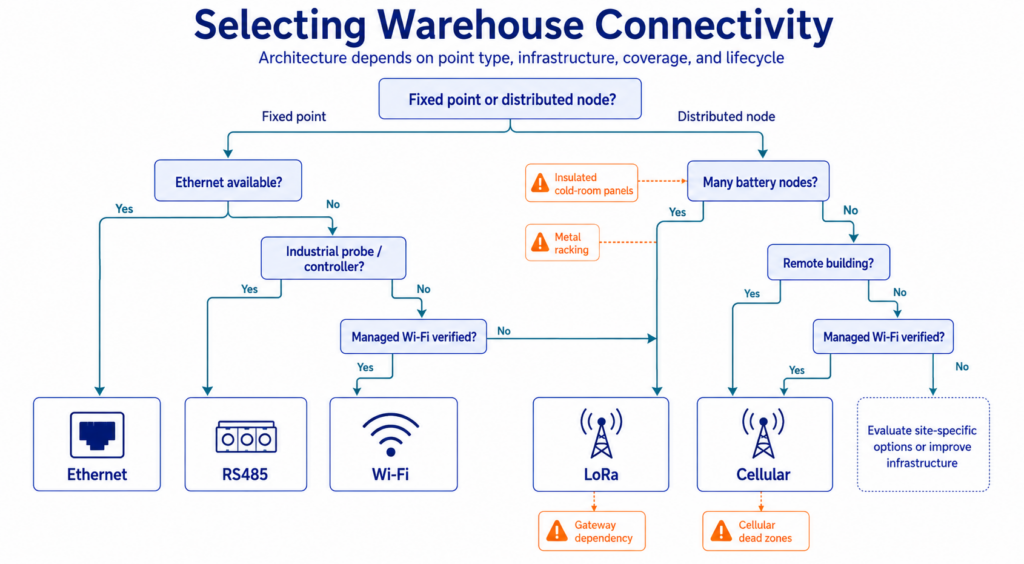
Choose warehouse communications according to point density, fixed infrastructure, radio conditions, and independence requirements.
For one or two controlled rooms, direct Ethernet or Wi-Fi usually minimizes infrastructure. In a large high-bay warehouse, a mixed architecture is often more practical: Ethernet for critical fixed reference points, LoRa for distributed aisle/rack locations, RS485 for industrial probes and equipment, and cellular only where it adds genuine independence. The communication choice should be validated against the actual building—especially insulated cold-room panels, dense racking, machinery, and IT security—not selected from theoretical range alone.
How Should Monitoring Products Be Compared?
Published sensor accuracy is necessary but insufficient. The complete measurement chain includes the sensor element, probe, cable, logger, mounting method, calibration points, environmental exposure, response time, and the location selected from the mapping study. A precise probe installed beside a supply vent can generate a repeatable but operationally misleading record. Procurement should therefore evaluate measurement performance and architecture together.
| Evaluation area | What procurement should verify |
| Measurement chain | Range and accuracy at the actual storage condition; calibration points; uncertainty; drift; probe/cable suitability; condensation and enclosure limits. |
| Data continuity | Local memory at sensor/logger/gateway; timestamp preservation; missing-data flags; reconnection and backfill behavior; backup power. |
| Alarm continuity | Local indication; remote channels; offline/device-health alarm; repeat and escalation logic; after-hours ownership; test method. |
| Network architecture | Direct Wi-Fi/Ethernet versus proprietary radio; gateway count/capacity; cellular options; RS485 expansion; radio survey; shared failure modes. |
| Software governance | Users and roles; audit/history functions; retention; export; cloud region; on-premises option; configuration change control. |
| Integration | REST/API availability, licensing, data forwarding, third-party ownership, time synchronization, identity mapping and cybersecurity review. |
| Calibration & service | Factory report, traceability, accredited calibration options, field exchange, replacement logistics, mapping/qualification services. |
| Lifecycle cost | Endpoint hardware, gateways, installation, subscriptions, SIMs, notification credits, calibration, battery replacement, validation and future expansion. |
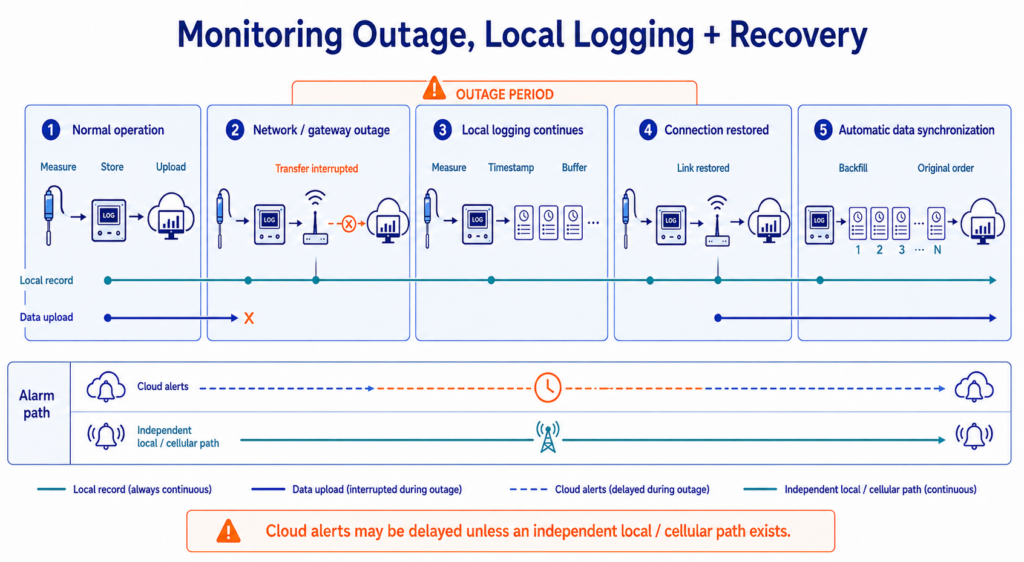
Local data continuity and real-time alarm continuity are separate reliability questions.
Product and Solution Comparison
The table compares representative current configurations based on official manufacturer information reviewed in August 2026. The original brief used the shortened names “Dickson DWE” and “SensoScientific B80-500-OT”; current official listings use DWE2 and B80-500-OTA. The systems do not serve identical governance levels, so the table is a decision aid rather than a ranking.
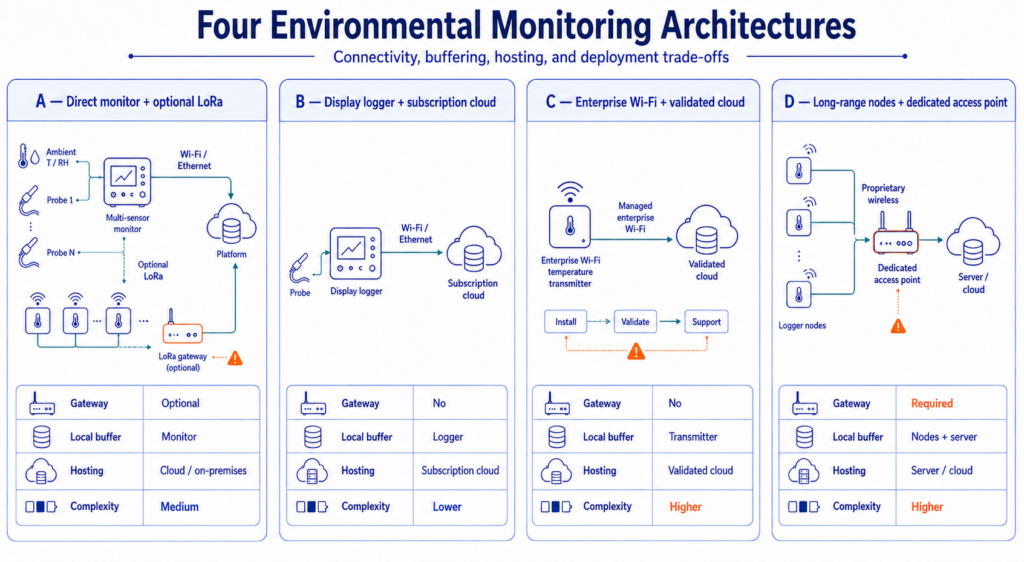
Four representative monitoring architectures solve different pharmaceutical warehouse deployment problems.
| Comparison item | UbiBot GS1-AETH1RS + PT100 / GS1-L + GW1 | Dickson DWE2 + RTRH-R | SensoScientific B80-500-OTA + RTD probe | Vaisala RFL100 + HMP115 + AP10 + viewLinc |
| System positioning | Flexible direct-connected or LoRa multi-zone architecture for fixed warehouses | Direct Wi-Fi/Ethernet display logger with replaceable sensor and DicksonOne cloud | Enterprise Wi-Fi temperature-monitoring transmitter with validated-cloud/service positioning | Enterprise long-range wireless continuous monitoring system for regulated multi-site environments |
| Measured parameters | GS1-AETH1RS: internal temperature, RH, light; supports PT100 and selected RS485 probes. GS1-L : internal T/RH/light + RS485 options. | RTRH-R: ambient temperature and RH | B80 configuration: temperature via RTD probe; humidity requires a different SensoScientific sensor/configuration | RFL100 with HMP115: temperature and RH |
| Published accuracy | GS1-AETH1RS internal: ±0.2°C, ±2% RH. PT100 complete-chain accuracy depends on selected probe/calibration. GS1-L internal: ±0.2°C (0–60°C), ±2% RH (10–90% RH). | RTRH-R: ±2% RH from 5–95% RH; temperature accuracy varies by range (manufacturer table). | B80: ±0.5°C; selected probe and calibration certificate should be confirmed. | HMP115: ±0.1°C at 15–25°C; ±0.2°C at 0–40°C; RH ±1.5% from 0–90% RH at 0–40°C. |
| Connectivity | GS1-AETH1RS: 2.4 GHz Wi-Fi + RJ45 Ethernet; RS485 external probes. GS1-L : LoRa to GW1; RS485 external probes. | 2.4 GHz Wi-Fi or Ethernet | B80-500-OTA: dual-band 2.4/5 GHz Wi-Fi family listing; exact regional enterprise WLAN deployment should be verified. | RFL100 proprietary VaiNet radio to AP10; AP10 uses Ethernet backhaul. |
| Dedicated gateway required | No for GS1-AETH1RS direct Wi-Fi/Ethernet. Yes for GS1-L LoRa deployment via GW1. | No | No proprietary radio gateway; uses site Wi-Fi. | Yes: AP10 for RFL100. |
| Local storage | GS1-AETH1RS: 300,000 records. GS1-L: 50,000 records. GW1: up to 300,000 records. | Approx. 400,000 backup sample points. | 4,000 readings on transmitter; manufacturer states unlimited cloud memory. | 30 days / 43,200 samples per channel. |
| Offline data protection | Large local buffers; exact synchronization/backfill behavior should be acceptance-tested for the chosen configuration. | On-board backup memory; Ethernet can be used when Wi-Fi fails; local export is supported on current product pages. | On-transmitter buffer; cloud delivery depends on Wi-Fi availability. | Local memory designed to cover communication outages; data are transferred through AP10/viewLinc after connectivity resumes, subject to retention window. |
| External sensor support | PT100 and selected RS485 probes; exact simultaneous-probe limits depend on model/configuration. | One replaceable sensor interface; DWE2 supports compatible Dickson sensors. | RTD probe family; other SensoScientific measurements use separate transmitter models. | Multiple compatible Vaisala probes; HMP115 used here for ambient T/RH. |
| Cloud platform | UbiBot Public IoT Platform; basic plan available without mandatory subscription, with paid expansion. | DicksonOne subscription workflow. | SensoScientific Validated Cloud; commercial terms by quote. | viewLinc Cloud or viewLinc Enterprise Server. |
| On-premises option | UbiBot On-Premises Platform available. | Not publicly specified for the DWE2/DicksonOne configuration reviewed. | Not publicly specified on the reviewed B80 product page. | viewLinc Enterprise Server provides on-premises enterprise architecture. |
| API / integrations | REST/API and data-forwarding options; feature availability depends on platform/service plan. | DicksonOne REST API keys available on compliant yearly plans. | Not publicly specified on the reviewed B80 product page. | Optional viewLinc Web/REST API license; other enterprise integration options available. |
| Alarm methods | Platform/app/email/web and service-plan-dependent notification options; local display on GS1. | Phone, SMS, email and audible alarms. | Onboard visual/audible; cloud alerts via SMS/text/voice/pager/fax/email. | Onscreen and remote alarms through viewLinc; enterprise notification options depend on configuration. |
| Calibration / validation support | Factory calibration report policy; project-specific accredited calibration should be confirmed. UbiBot recommends ISO/IEC 17025 recalibration for strict/regulated use. | NIST and A2LA calibration options for compatible sensors. | Manufacturer advertises NIST/A2LA calibration plus IQ/OQ/PQ and mapping services. | Traceable calibration options and validation/GxP services are core parts of the viewLinc ecosystem. |
| Typical use case | Small/medium fixed warehouses; mixed ambient/cold zones; distributed LoRa points; projects prioritizing flexible networks and platform choice. | Warehouses wanting direct Wi-Fi/Ethernet, visible logger and established cloud/calibration workflow. | Organizations prioritizing enterprise Wi-Fi security, centralized validated-cloud services and calibration/qualification support. | Large pharmaceutical distribution networks and validation-oriented continuous monitoring programs. |
| Deployment complexity | Low–medium for direct GS1; medium for LoRa multi-node design. | Low–medium. | Medium: enterprise Wi-Fi/security, services and cloud configuration. | High: AP10 radio architecture, server/cloud planning, validation and enterprise rollout. |
| Relative total cost category | Low–medium for direct fixed points; medium as LoRa gateways/RS485/calibration scope grows. | Medium, including subscription/calibration. | Medium–high; quote-based cloud/service scope. | High / enterprise, reflecting access points, software, calibration, validation and service scope. |
*Relative cost categories are architectural estimates, not quotations. Hardware, software, calibration, validation, notification, installation and regional service terms can change.
Which System Is Best for Each Use Case?
Small or medium warehouse with existing Ethernet or Wi-Fi
UbiBot GS1-AETH1RS is a strong fit when the facility wants direct Ethernet or Wi-Fi, a local display, substantial local storage, and RS485/PT100 expansion without introducing a proprietary wireless gateway. It is especially attractive when the same organization also wants an on-premises option or lightweight data forwarding. The project should still confirm the exact probe, calibration points, power design, cybersecurity requirements, and backfill behavior through acceptance testing.
Large warehouse with many distributed points and limited cabling
UbiBot GS1-L with GW1 can be considered when a LoRa architecture reduces installation effort across aisles, rack levels, or remote sections. A GW1 can serve up to 100 UbiBot LoRa endpoints according to current manufacturer material, but real design capacity should include radio coverage, message interval, gateway placement, redundancy, building construction and regional frequency. Monitored cold rooms may still use direct wired probes or separate critical reference devices.
Warehouse that wants a conventional cloud logger with calibration workflow
Dickson DWE2 with RTRH-R is well aligned with a fixed room or warehouse where Wi-Fi/Ethernet connectivity, a visible logger, substantial backup memory, remote alarms, and NIST/A2LA calibration options are primary requirements. DicksonOne provides a straightforward cloud operating model; buyers should include subscription cost and API-plan eligibility in lifecycle evaluation.
Enterprise Wi-Fi organization prioritizing regulated-industry services
SensoScientific B80-500-OTA is primarily a temperature transmitter configuration rather than a combined warehouse T/RH monitor, so a separate SensoScientific humidity device may be required for a full ambient program. Its strengths are enterprise Wi-Fi features, transmitter buffering, strong cloud-alert workflows, accredited calibration positioning, and manufacturer-provided qualification and mapping services. This can be valuable where service scope matters as much as endpoint hardware.
Large multi-site pharmaceutical network with formal validation expectations
Vaisala RFL100 + HMP115 + AP10 + viewLinc is the strongest enterprise benchmark in this comparison. RFL100 nodes use a dedicated VaiNet architecture, AP10 access points aggregate the radio network, and viewLinc supports centralized monitoring, alarms, reports, user governance and API options. The architecture carries higher infrastructure and implementation complexity, but that burden can be justified in large distribution networks that need an established validation and calibration ecosystem.
How Should the System Be Deployed?
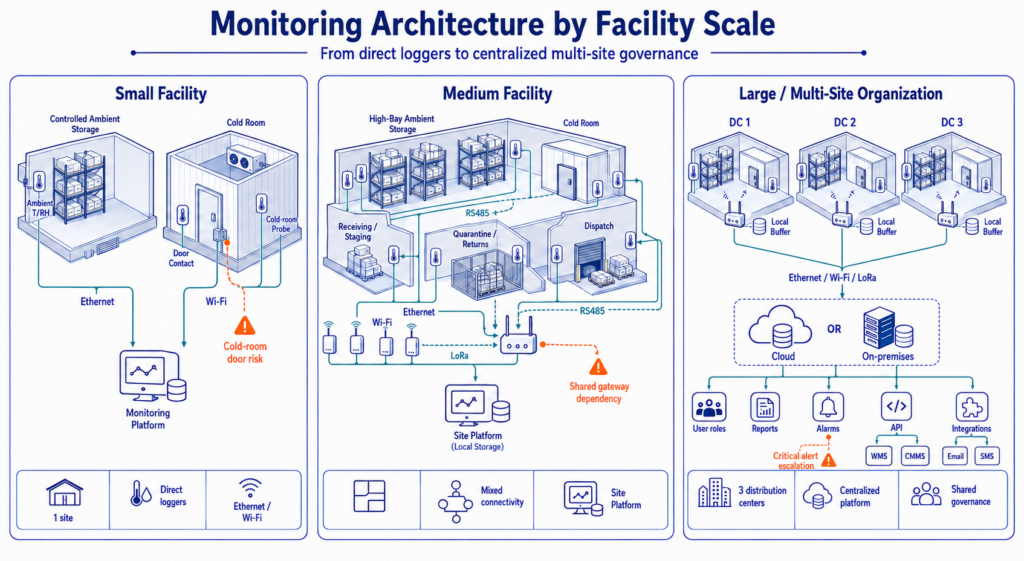
Deployment architecture should scale from a few direct-connected points to governed multi-site networks.
Small facility: one controlled ambient area plus one cold room
Begin with a documented zone list and current mapping evidence. Use at least one continuous monitor at each justified mapped risk location rather than placing a single sensor beside the thermostat. A direct Ethernet or Wi-Fi logger is usually the lowest-complexity architecture. For the cold room, route a suitable probe into the representative storage volume while keeping electronics in an environment within their operating limits. Configure temperature, device-offline, low-battery/power, and gateway alarms where applicable. Assign a primary responder and an alternate before go-live.
Medium facility: multiple storage zones and active staging
Separate controlled ambient storage, cold rooms, quarantine/returns, receiving, outbound staging, and any high-risk loading zones. Use mapping data to select retained hot and cold points across rack heights. Ethernet can anchor critical reference points; Wi-Fi can add flexible endpoints; RS485 can connect specialized probes; and LoRa can cover sections where pulling cable is disruptive. Standardize device names, threshold sources, time zones, calibration intervals, and alarm delays. Quality should own product-related alarm limits, while facilities can own equipment and power notifications.
Large or multi-site distribution network
Define governance before scaling hardware. Establish site and sensor naming, user roles, configuration approval, calibration logistics, data retention, server or cloud region, mapping schedule, time synchronization, change control, and API ownership. Use gateways where node density and cabling cost justify them, but avoid creating a single unprotected shared failure point. Consider redundant gateway coverage or mixed architectures for critical locations. Integrate with WMS, QMS, BMS, CMMS, or analytics only after defining data semantics, alarm ownership, and the treatment of backfilled or corrected records.
| Functional area | Deployment recommendation |
| Controlled ambient warehouse | Use mapping to retain representative hot/cold points across rack height and HVAC zones; monitor RH where specified; keep sensors away from local bias unless the point is intentionally worst-case. |
| Cold room / refrigerated storage | Use a probe/logger rated for the actual range; include mapped warm/cold points; consider door, power and refrigeration status; protect cable penetrations and condensation-prone electronics. |
| Receiving / inbound staging | Monitor where product can dwell before put-away; define maximum dwell assumptions and escalation ownership; do not assume dock temperature represents storage temperature. |
| Outbound staging / dispatch | Monitor if temperature-sensitive product can wait for loading; align alarms with dispatch response and transport handoff procedures. |
| Quarantine / returns | Apply the condition required by product status and quality procedure; maintain clear sensor/channel identity so records are not mixed with released stock. |
| High-bay racks | Place sensors at mapped elevations and risk zones rather than one wall height; reassess after racking, roof/HVAC or load-pattern changes. |
| Mechanical / refrigeration areas | Use status, power and leak signals to diagnose root cause; do not substitute equipment-room readings for product-zone monitoring. |
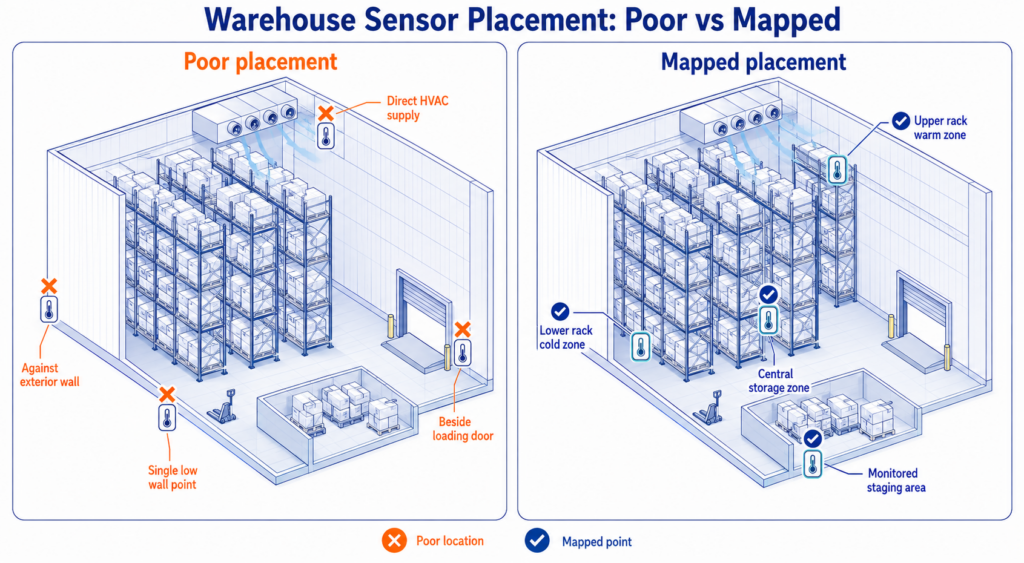
Permanent monitoring points should represent mapped risk zones, not convenient wall locations.
Common Design and Installation Mistakes
- Using one sensor for an entire warehouse without a temperature-mapping basis, especially in high-bay or multi-zone buildings.
- Placing routine sensors beside thermostats, supply diffusers, evaporators, dock doors or exterior surfaces because those locations are convenient rather than representative of mapped risk.
- Treating a mapping study as a permanent monitoring system—or treating continuous monitors as a substitute for initial or repeat mapping.
- Assuming local memory guarantees real-time alarms. A logger can preserve data during an outage while remote notifications are unavailable.
- Ignoring gateway and network health. A shared gateway, switch, access point or internet link can create a common failure mode across many otherwise healthy sensors.
- Buying on accuracy alone without confirming calibration points, uncertainty, probe range, condensation limits, cable routing and the complete measurement chain.
- Using one universal alarm limit across different product classes, cold rooms, staging areas and quarantine locations instead of controlled, documented limits tied to approved storage requirements.
- Scaling to multiple sites without standard names, user roles, time zones, calibration ownership, data retention, change control and alarm escalation procedures.
Frequently Asked Questions
What is a pharmaceutical warehouse monitoring system?
It is a documented combination of sensors, data loggers or transmitters, communications, local data retention, monitoring software, alarms, user controls, calibration records, and operating procedures used to show whether pharmaceutical storage areas remain within approved conditions. The system can cover controlled ambient rooms, cold rooms, staging areas and other zones. It supports quality and GDP workflows, but no single device makes a warehouse compliant; the complete facility, validation or verification approach, SOPs, calibration program and regulatory requirements determine suitability.
How many temperature sensors does a pharmaceutical warehouse need?
There is no universal sensor-per-square-meter rule that works for every warehouse. The number and location should be justified by temperature mapping, building geometry, rack height, HVAC design, exterior exposure, door activity, product flow and the consequences of an excursion. A high-bay warehouse often needs points at different elevations, while a cold room may need retained monitors at mapped warm and cold locations. Reassess the sensor plan after significant changes to racking, HVAC, refrigeration, doors or storage patterns.
What is the difference between temperature mapping and continuous monitoring?
Temperature mapping is a time-limited study used to characterize how temperatures vary throughout a three-dimensional storage area under representative conditions. It identifies gradients, hot spots, cold spots and operational effects. Continuous monitoring is the ongoing record used after qualification to detect excursions and document routine storage. WHO and EU GDP guidance treat the two as complementary: mapping informs where routine monitoring devices should be placed, while permanent monitors show whether identified risks remain controlled over time.
Where should sensors be placed in a pharmaceutical warehouse?
Place them according to mapping results and risk assessment, with attention to locations that experience temperature extremes or operational vulnerability. Typical candidates include upper and lower rack levels, exterior-wall zones, loading-door influence areas, weak-airflow corners and representative points near—but not directly in—HVAC or evaporator effects. The exact retained positions should be documented. A sensor should not be moved simply for convenience without assessing whether the new location still represents the mapped risk.
Should a pharmaceutical warehouse monitor humidity as well as temperature?
Monitor relative humidity when it is relevant to the product, packaging, storage-area specification or quality procedure. Temperature is usually the primary storage variable, but RH can matter for moisture-sensitive materials, packaging integrity, condensation risk or controlled-room requirements. Do not add RH merely because a device can measure it, and do not use a generic humidity limit across every area. Define the required range from approved product and facility documentation, then calibrate and place the RH sensor for that purpose.
Is Wi-Fi reliable enough for pharmaceutical warehouse monitoring?
It can be, provided the warehouse has managed coverage and the deployment is tested in the real building. Metal racking, insulated cold-room panels, machinery, roaming behavior and enterprise authentication can create weak zones that are not obvious from office Wi-Fi performance. Critical designs should verify signal strength, device reconnect behavior, local buffering, offline alarms and network maintenance procedures. Ethernet is often preferred for fixed reference points, while LoRa or other long-range radio can reduce cabling for distributed points.
What happens if the network or cloud connection fails?
A robust logger or node should continue recording locally, but the availability of real-time remote alarms may be reduced until communications recover. Data continuity and alarm continuity are separate design questions. Acceptance testing should verify local memory, timestamps, gateway buffering, backup power, missing-data flags, reconnection order, duplicate handling and whether an excursion that began offline is transmitted after recovery. Critical warehouses should also define a fallback response when the main alarm path is unavailable.
How often should warehouse temperature sensors be calibrated?
Use a documented risk- and reliability-based interval consistent with applicable GDP/GMP procedures, manufacturer recommendations, calibration history and measurement criticality. EU GDP calls for equipment used to control or monitor the storage environment to be calibrated at defined intervals based on risk and reliability, with traceability to national or international measurement standards. The calibration points should cover the actual operating range, and the procedure should address out-of-tolerance findings, replacement, certificate linkage and monitoring gaps during service.
Can one monitoring platform manage ambient warehouses and cold rooms?
Yes, if the platform supports the required sensor types, ranges, alarm logic and governance. The endpoint hardware may differ: ambient zones may use temperature/RH devices, cold rooms may use remote PT100/RTD probes, and mechanical areas may use door, power or equipment-status inputs. A shared platform can simplify multi-site visibility and reporting, but channel names, calibration records and alarm limits must clearly distinguish each measurement. The platform should not blur the difference between product-zone data and contextual facility signals.
When is LoRa useful in a pharmaceutical warehouse?
LoRa is useful when a large facility needs many distributed monitoring points and running network cable to every location is expensive or disruptive. It can work well across aisles, rack areas, separate rooms or campus buildings when the radio survey supports it. The trade-off is gateway dependency: capacity, placement, backhaul, power and redundancy must be engineered. Regional frequency rules also matter. LoRa should be selected for the building and node density, not because a theoretical range number looks attractive.
Do monitoring devices need API or on-premises capabilities?
Not every warehouse needs them. API access becomes valuable when environmental data must feed a QMS, WMS, BMS, CMMS, data lake or customer portal. On-premises deployment may be requested for data control, cybersecurity architecture, validation strategy or corporate IT policy. Procurement should define the integration use case before buying hardware, because vendors often license APIs or enterprise software separately. Also define data ownership, timestamps, sensor IDs, units, missing-data handling and change control before connecting systems.
Does a temperature monitoring system make a warehouse GDP compliant?
No. A monitoring system can provide functions that support a GDP-aligned process—continuous records, alarms, calibration evidence, mapping-based sensor placement and user controls—but compliance is determined by the complete distribution quality system and applicable jurisdiction. Storage requirements, qualification, calibration, training, deviation handling, documentation, change control, computer-system validation or verification and local regulatory obligations all matter. The safest procurement language is to describe supported functions and then verify the complete installation against the organization’s approved quality requirements.
Conclusion and Selection Recommendations
A pharmaceutical warehouse monitoring project should begin with the storage requirement and mapped risk, not with a product catalog. Define the approved conditions for each zone, establish or review mapping data, select permanent monitoring points, decide how records and alarms must behave during failures, and document who owns calibration, configuration, alarm response and change control. Only then should the organization choose the endpoint and platform architecture.
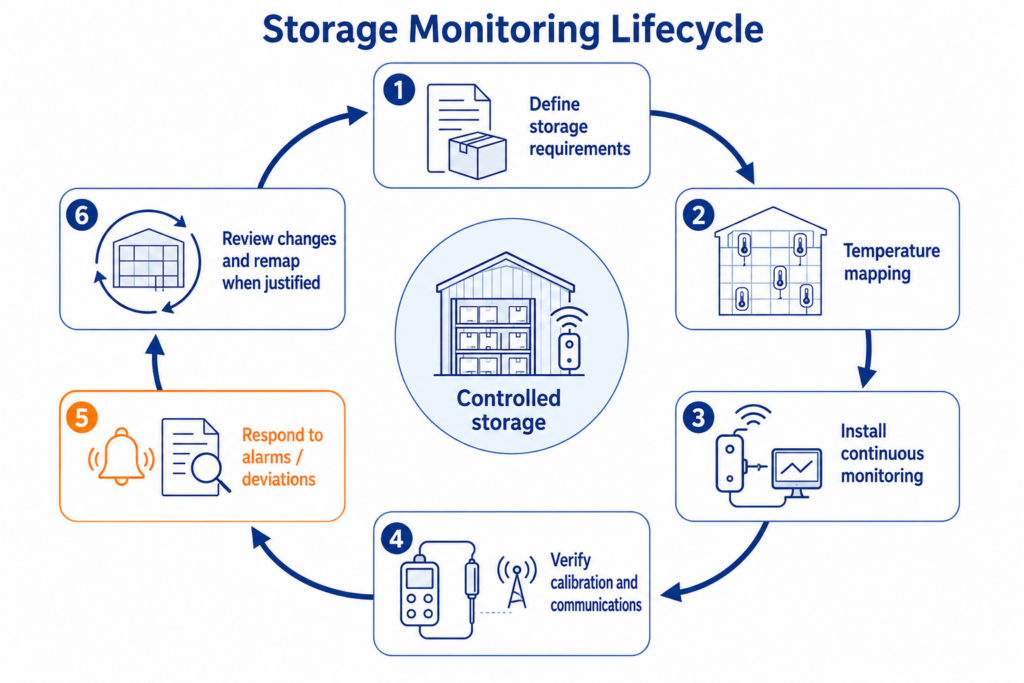
A mature pharmaceutical warehouse monitoring program connects mapping, continuous monitoring, alarms, calibration, and corrective action.
UbiBot is particularly competitive where a facility values network flexibility and incremental scale. GS1-AETH1RS can use direct Wi-Fi or Ethernet and accept selected RS485/PT100 probes without a proprietary radio gateway; GS1-L and GW1 add a LoRa path for larger distributed layouts. UbiBot also offers large local storage on theGS1-AETH1RS, public-cloud access without a mandatory base subscription, on-premises deployment and integration options. These characteristics can reduce infrastructure complexity in small and medium fixed facilities or create a mixed architecture across multiple warehouse zones.
That does not make UbiBot the default answer for every regulated project. Dickson provides a straightforward display-logger and cloud workflow with established calibration options. SensoScientific is stronger when enterprise Wi-Fi security, manufacturer-led calibration, mapping and validation services are priorities. Vaisala is the enterprise benchmark when a large multi-site organization is prepared to invest in dedicated access points, viewLinc software and a mature validation/calibration ecosystem. The procurement decision should match governance requirements, service expectations and lifecycle cost to the actual warehouse risk.
Sources and Product Information Disclaimer
This article is for industry education and procurement planning. It is not legal, regulatory, GDP, GMP, validation, quality-assurance or engineering advice. Product specifications, software functions, wireless bands, subscriptions, calibration services and model availability may vary by region, probe, firmware, software release and contract. Verify the final bill of materials, current official documents, calibration scope, data-retention design, alarm channels and local regulatory responsibilities before publication or procurement. Manufacturer statements about compliance or validation describe their own products or services; they do not automatically establish that a specific warehouse installation is compliant.
Official Sources Used for the Product Comparison Table
[1] UbiBot GS1-AETH1RS specifications — Official source. Wi-Fi/Ethernet, 300,000 records, internal accuracy and supported external probes.
[2] UbiBot GS1-L specifications — Official source. LoRa bands, 50,000 local records, RS485 and built-in sensor performance.
[3] UbiBot LoRa Gateway GW1 — Official source. Up to 100 endpoints, Wi-Fi/4G/Ethernet variants and gateway storage.
[4] UbiBot platform access without subscriptions — Official source. Free basic platform allowance and no mandatory subscription for base access.
[5] UbiBot On-Premises Platform — Official source. On-premises deployment and integration options.
[6] UbiBot Channel Feeds Data Forwarding — Official source. Third-party data forwarding.
[7] UbiBot Calibration & Traceability Policy — Official source. Factory report policy and ISO/IEC 17025 recalibration recommendation.
Official References
[1] WHO TRS 1025 — Annex 7: Good storage and distribution practices for medical products — Official source. Global baseline for good storage and distribution practices.
[2] WHO — Cold chain equipment and dry store temperature mapping tool (2026) — Official source. Defines mapping as a three-dimensional process and links mapping with appropriate pharmaceutical storage.
[3] WHO TRS 961 — Annex 9, Supplement 6: Temperature and humidity monitoring systems for fixed storage areas — Official source. Technical supplement for fixed-storage monitoring systems.
[4] European Commission — Guidelines on Good Distribution Practice of medicinal products for human use (2013/C 343/01) — Official source. Official EU GDP text covering environmental control, mapping, calibration and alarms.
[5] U.S. FDA — Q7A Good Manufacturing Practice Guidance for Active Pharmaceutical Ingredients — Official source. Storage and distribution guidance, including controlled temperature/humidity where necessary.