

.svg)
How Continuous Temperature Monitoring Protects Vaccine Refrigerators and Medical Freezers
Published: August 4, 2026
Update: September 14, 2026
By Frank Hill
Key Takeaway
Continuous monitoring replaces isolated temperature checks with a time-stamped history. A reliable system combines a suitable calibrated probe, frequent local logging, sufficient offline storage, actionable alarms, and traceable data management.
A vaccine refrigerator may appear normal during a morning inspection even if its temperature rose above the required range overnight. A medical freezer may return to its setpoint after a brief power interruption, leaving no visible sign that stored products experienced an excursion.
This is the central limitation of manual temperature checks: they show conditions at individual moments, not the full temperature history.
Continuous temperature monitoring creates a time-stamped record of what happened between inspections. It can show when an excursion started, how far the temperature moved, how long it remained outside the configured limits, and when normal conditions returned. This information helps vaccine coordinators, pharmacy managers, and quality teams respond more quickly and investigate events with better evidence.
The CDC recommends continuous digital data loggers for vaccine storage units and specifies recording intervals of at least every 30 minutes. It also recommends probes designed to reflect vaccine temperatures, out-of-range alarms, calibration documentation, and a measurement uncertainty of approximately +/-0.5 C. Storage conditions still depend on the individual vaccine’s approved labeling and the applicable local programme requirements; not every vaccine uses the same temperature range. [1]
This article explains how continuous monitoring works, why probe selection matters, how data remain available during network interruptions, and how different monitoring architectures compare.
Vaccine Refrigerators Continuous Temperature Monitoring in 30 Seconds
| Question | Direct answer |
|---|---|
| What does continuous temperature monitoring record? | It records a sequence of time-stamped temperatures, creating a history rather than a single current reading. |
| Why is a manual reading not enough? | A manual check cannot reveal excursions that occurred overnight, between inspections, or during a temporary equipment failure. |
| What type of probe is commonly used for refrigerated vaccines? | A calibrated detachable probe buffered with glycol, glass beads, sand, Teflon, or another thermal medium is commonly used to approximate product temperature more closely than a bare air probe. |
| What happens when the internet connection fails? | A properly designed logger continues recording locally and transmits the stored readings after connectivity returns. |
| How often should temperatures be recorded? | CDC guidance calls for recording at least every 30 minutes, although some systems sample or log more frequently. |
| What makes an alarm useful? | Useful alarms combine thresholds with delay settings, escalation rules, local indications, remote notifications, and device-offline detection. |
| What should buyers compare? | Probe type, accuracy, calibration, logging interval, local memory, outage behaviour, alert methods, connectivity, data export, and system integration. |
Selection takeaway: A reliable vaccine monitoring system combines an appropriate calibrated probe, frequent local logging, sufficient offline storage, actionable alarms, and traceable data management.
1.Why Do Vaccine Refrigerators Need Continuous Temperature Monitoring?
Continuous monitoring is needed because refrigeration equipment does not maintain one perfectly uniform and unchanging temperature.
Door openings introduce warmer air. Defrost cycles alter cabinet conditions. Airflow can create warmer and colder zones. A blocked vent, failing compressor, loose door seal, power interruption, or accidental thermostat adjustment may cause a gradual or sudden excursion. A staff member checking the display twice a day may never see the highest or lowest temperature reached between those checks.
A minimum/maximum thermometer provides more information than a current reading, but it still cannot reconstruct the complete event. It may show that a limit was exceeded without showing when the excursion began, how long it lasted, or whether the temperature changed rapidly or gradually.
A digital data logger creates a chronological temperature record. CDC guidance notes that continuous loggers provide information about the duration of out-of-range conditions, while WHO guidance recognises electronic loggers and remote systems as important tools for vaccine cold-chain monitoring. WHO also distinguishes between basic indicators, 30-day refrigerator loggers, and advanced remote equipment-monitoring systems because they serve different operational needs. [1][2]
Continuous monitoring does not independently determine whether an exposed vaccine remains usable. The recorded data support the investigation, but the decision must follow the vaccine manufacturer’s instructions, public-health guidance, and the organisation’s excursion-management procedure.
2.What Does a Complete Monitoring System Include?
Typical data path
Refrigerator or freezer environment -> temperature probe -> signal conversion -> data logger or monitoring host -> local memory -> Wi-Fi, Ethernet, cellular, or proprietary wireless network -> cloud or on-premises platform -> alarms, reports, APIs, and review records
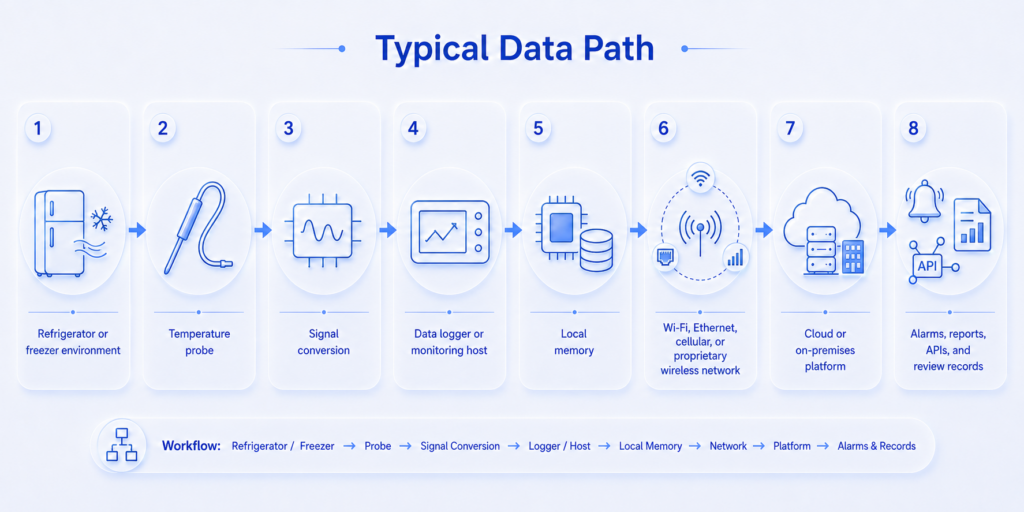
Typical data path schematic diagram
The probe senses temperature inside the storage unit. Depending on the design, it may contain a thermistor, resistance temperature detector, or digital temperature sensor. The logger converts or reads the probe signal, assigns a timestamp, and saves the result.
The communications link transfers records to a software platform. It does not normally perform the measurement itself. This distinction matters: a network outage should interrupt remote visibility, not temperature acquisition. Systems with adequate local memory can continue logging and later backfill missing cloud records.
The platform presents current readings, trends, alarm events, device status, and reports. More advanced platforms can support multiple facilities, user permissions, acknowledgement workflows, APIs, data forwarding, and local deployment.
UbiBot’s GS1 product family illustrates this layered architecture. The GS1-AETH1RS connects through Wi-Fi or Ethernet, while the GS1-AL4G1RS supports Wi-Fi and cellular networks. Both support external RS485 sensors and store up to 300,000 sensing records locally. UbiBot also provides a public cloud platform, APIs, data forwarding, and an optional on-premises platform. [3][4]
These capabilities do not by themselves make a configuration suitable for regulated vaccine storage. The selected probe, calibration, alarm configuration, installation, validation, procedures, and documented review process must all match the intended application.
3.How Does Continuous Temperature Monitoring Work?
The probe converts temperature into a measurable signal
A thermistor changes electrical resistance as its temperature changes. A platinum RTD, such as a PT100 or PT1000 element, also changes resistance but follows a more standardised resistance-temperature relationship and is commonly selected when stability and calibration are important.
A digital probe performs signal conversion inside the probe assembly and transmits a digital reading to the host. An RS485 probe can send temperature data over a longer wired connection using an industrial communication protocol such as Modbus RTU.
The sensor element is only one part of the measurement chain. The complete result may also be influenced by the probe enclosure, thermal buffer, cable, signal-conversion electronics, logger resolution, calibration, probe position, and airflow inside the cabinet.
This is why probe accuracy is not automatically the same as system accuracy. For higher-risk applications, the calibration documentation should make clear whether it applies to the probe alone or to the probe and logger as a complete channel.
Sampling, logging, and uploading are different operations
The sampling interval is how frequently the electronics read the sensor. The logging interval is how frequently a reading is written to memory. The upload interval is how frequently stored readings are transmitted to a remote platform.
A device might sample every minute, save a result every five minutes, and upload a group of readings every 30 minutes. Another system might log and transmit every minute. The correct settings depend on risk, battery life, network costs, memory, and the required time resolution.
A short upload interval improves remote visibility, but it does not guarantee that data will survive a network failure. That depends on local logging.
CDC recommends that vaccine digital data loggers be capable of measuring and recording at least every 30 minutes. Vaisala’s RFL100, for comparison, records one sample per channel every minute, while Berlinger’s Fridge-tag 2 L uses a standard five-minute logging interval. [1][5][8]
Local storage protects the temperature history
When the network fails, the most important question is not merely whether the device appears offline. It is whether the device continues measuring and saving data.
A logger with non-volatile memory can preserve records until communication resumes. The platform can then backfill the missing period in chronological order. Without local buffering, a brief router failure could create a permanent gap in the temperature history.
Vaisala’s RFL100 holds approximately 30 days of one-minute samples and automatically transfers buffered readings after communication is restored. DicksonOne TWP stores approximately one million backup sample points. UbiBot GS1 devices store up to 300,000 sensing records and continue collecting locally when network connectivity is unavailable. [3][5][6]
Local storage capacity should be evaluated in time, not only in record count. The actual number of offline days depends on the number of active channels and the configured logging interval.
Alarm processing turns data into action
A temperature threshold alone is rarely enough.
- a high-temperature threshold;
- a low-temperature threshold;
- an alarm delay;
- recovery logic or hysteresis;
- local audible or visual indication;
- email, app, SMS, or voice escalation;
- device-offline notification;
- power-loss or low-battery alerts.
The delay determines how long a condition must remain outside the limit before an alarm is issued. It can reduce notifications caused by short door openings, but an excessive delay could postpone action during a real equipment failure.
Alarm settings should therefore reflect the monitored product, probe response, refrigerator behaviour, and excursion procedure. They should not simply copy a default value without qualification.
UbiBot supports configurable thresholds, delayed alert logic, app notifications, email, SMS, voice calls, web notifications, audible alerts, and device-offline notifications. DicksonOne, ELPRO, Vaisala viewLinc, and other connected platforms also provide remote alarm and event-management functions, although their workflows and validation features differ. [4][6][7]
4.Air Probes, Buffered Probes, and Product-Simulating Probes
The probe does not merely measure “the refrigerator temperature.” Its construction determines what kind of thermal change it follows.
| Probe type | What it mainly reflects | Main advantage | Main limitation | Typical use |
|---|---|---|---|---|
| Bare air probe | Fast changes in surrounding air | Rapid detection of airflow and door-opening effects | May produce short spikes that do not represent product temperature | Equipment diagnostics and air-distribution studies |
| Glycol- or liquid-buffered probe | Slower thermal response similar to liquid products | Reduces short-lived air-temperature fluctuations | Slower response may delay detection of rapid air changes | Vaccine and pharmaceutical refrigerator monitoring |
| Glass-bead, sand, or solid thermal buffer | Product-simulating thermal mass without liquid spillage | Stable response and easier handling | Response depends on buffer size, material, and installation | Vaccine storage and routine refrigerator monitoring |
| Digital or software-buffered approach | Filtered or mathematically processed temperature behaviour | May simplify installation | Must be understood and qualified for the intended use | Product-specific or system-specific applications |
CDC recommends a detachable probe that best reflects vaccine temperatures, giving glycol, glass beads, sand, and Teflon as examples of buffering materials. A buffered probe follows cabinet changes more slowly than a bare air probe because the buffer adds thermal mass. [1]
A slower response does not make the sensor intrinsically more accurate. It changes the physical quantity represented by the measurement. A bare probe may accurately measure rapidly changing air temperature, while a buffered probe may better approximate the thermal behaviour of the stored vials.
For ultra-low-temperature equipment, the probe, cable, insulation, and logger interface must be rated for the actual temperature. WHO and NIST guidance also emphasises that monitoring equipment and probe selection must match the cold-chain application rather than treating all refrigerators and freezers as identical. [2][9]
5.Which Specifications Affect Monitoring Performance?
Measurement range
The probe range must cover normal storage conditions and credible excursions. A refrigerator probe does not necessarily need a cryogenic range, while an ultra-low freezer requires a sensor and cable assembly designed for much lower temperatures.
The range of the sensor tip may also differ from the operating range of the logger body. Vaisala, for example, specifies a much wider range for the TMP115 sensor tip than for the connected probe electronics and recommends leaving the probe body outside extreme environments when possible. [5]
Accuracy and measurement uncertainty
Accuracy describes how closely a measurement is expected to agree with the reference under defined conditions. Measurement uncertainty describes the quantified doubt associated with the result and its calibration chain.
CDC recommends approximately +/-0.5 C uncertainty for vaccine monitoring loggers. A calibration certificate should identify the instrument, calibration results, uncertainty, and traceability. NIST research has also examined the long-term calibration stability of vaccine data loggers and found that recalibration policies should consider manufacturer stability data and intermediate verification results rather than relying on an arbitrary interval alone. [1][9]
Calibration points should cover the actual operating range. A device calibrated only near room temperature provides limited evidence for a freezer application.
Resolution
Resolution is the smallest displayed or stored increment. A display that shows 0.1 C does not necessarily measure with +/-0.1 C accuracy.
Resolution is useful for trend analysis, but it should not be used as a substitute for calibration, uncertainty, stability, and range.
Response time
A fast-response probe detects air changes quickly. A buffered probe responds more slowly.
The appropriate response depends on the monitoring objective. If the goal is to detect airflow changes or door openings, fast response may be useful. If the goal is to approximate vaccine temperature, excessive sensitivity to brief air fluctuations may generate misleading alarms.
Local memory and outage duration
Memory should be large enough to cover the longest plausible network outage. Buyers should calculate offline duration from the available stored records, active channels, and records generated per day.
A device with 300,000 records may support a long offline period at a 30-minute interval, but much less time if many sensors log every minute.
Battery backup
Backup power prevents immediate shutdown during a power interruption, but the duration varies widely. A rechargeable battery that supports several hours may be adequate for short outages; remote or disaster-prone locations may need longer backup, an uninterruptible power supply, or cellular communication.
Data access and integration
PDF and CSV exports support reviews and investigations. APIs and data forwarding become important when temperature records must be integrated with quality systems, facility platforms, or central dashboards.
On-premises deployment may be required where policies prohibit external cloud storage. It should not be confused with compliance: local hosting provides data-control options, while validation and procedural compliance remain the user organisation’s responsibility.
6.Which Monitoring Architecture Should Be Used?
| Monitoring architecture | How it works | Main strengths | Main limitations | Suitable use |
|---|---|---|---|---|
| Standalone digital data logger | Stores readings internally for local display or USB/PDF download | Simple, independent of network, low infrastructure requirement | No immediate remote notification unless paired with another system | One refrigerator, small clinic, backup logger |
| Bluetooth logger | Transfers records to a nearby phone or tablet | Convenient local download and configuration | Remote visibility depends on a nearby mobile device or gateway | Small sites with routine local checks |
| Wi-Fi or Ethernet connected monitor | Sends records to a cloud or local server through the facility network | Remote dashboards, alarms, reports, multi-user access | Depends on network configuration and IT access | Clinics, pharmacies, laboratories |
| Cellular-connected monitor | Uses a mobile network rather than the site LAN | Useful where Wi-Fi is unavailable or restricted | Coverage, subscription, and power consumption must be considered | Remote sites and distributed facilities |
| Proprietary wireless monitoring system | Loggers communicate with dedicated access points and enterprise software | Long range, controlled architecture, validation and large-scale management | Higher infrastructure and platform complexity | Hospitals, pharmaceutical sites, large campuses |
| On-premises monitoring system | Devices send data to infrastructure controlled by the organisation | Local data ownership and integration | Requires deployment, maintenance, security, and validation resources | Regulated organisations with strict data-hosting policies |
A small clinic may value a standalone logger with a clear display and simple report download, while a pharmacy with several refrigerators may benefit from connected monitoring and remote alerts. Hospitals and pharmaceutical facilities may place greater emphasis on enterprise user management, audit trails, validation documentation, redundancy, and on-premises hosting. No architecture is universally best: the probe, local logging, communications, alarms, and review process must work together for the intended risk and operating model.
7.Representative Vaccine Temperature Monitoring Products Compared
The following products do not all use the same architecture. DicksonOne TWP is a connected touchscreen monitoring host; Vaisala RFL100 is a proprietary wireless logger used with access points and viewLinc; ELPRO ECOLOG-PRO xG is a cellular cloud logger; Berlinger Fridge-tag 2 L is primarily a standalone refrigerator logger; and UbiBot GS1 is a configurable IoT host used with selected external sensors.
The comparison should therefore be read as an architectural comparison rather than a simple ranking.
| Comparison field | UbiBot GS1 | DicksonOne TWP | Vaisala RFL100 / viewLinc | ELPRO ECOLOG-PRO xG | Berlinger Fridge-tag 2 L |
|---|---|---|---|---|---|
| Product architecture | IoT cloud-connected monitoring host with external RS485 or temperature probe | Cloud-connected touchscreen logger with interchangeable sensor pods | Battery wireless logger, VaiNet access point, enterprise or cloud software | Cellular IoT logger connected to elproCLOUD | Standalone electronic refrigerator logger |
| IP Rating | IP65 | IP21 | IP54 | ||
| Representative configuration | GS1-AETH1RS or GS1-AL4G1RS with a suitable calibrated external probe of UB-ATH-N1, UB-ATH-P1 | TWP with glycol thermistor or another compatible sensor | RFL100 with HMP110T, HMP115T, or TMP115 probe | ECOLOG-PRO 1TGe with external Pt100 | Fridge-tag 2 L with removable external probe |
| Probe type | Configuration-dependent, up to 22 alternative external probes can be used | Glycol-buffered thermistor available for vaccine and drug refrigerators. Up to 5 Probe Extensions (A898) can be used (50R Total) | Replaceable digital RTD probes: thermal dampener accessories available | External Pt100 supported | External temperature sensor |
| Measurement range | Build-in sensors Temperature: -20 ~ 60°C, ±0.2°C (0 ~ 60°C) Humidity: 0 ~ 100% RH, ±2% RH (10 ~ 90% RH) Light: 0 ~ 157k lux, ±10%External probes measurement range Temperature: -40 ~ 80°C Humidity: 0 ~ 100%RH |
Depends on selected sensor. Typical external probe of Smart DS is from -40° to +80°C | HMP110, HMP110T, and HMP110REF is from -40 to +80 °C, TMP115 is up to -196 to 90°C with the temperature-logger configuration: probe-dependent |
External Pt100 range stated as -200 to 400 C measurement range (depending on probe): -200 to +400 °C; measurement range of internal sensor: -40 to +70 °C |
External probe operating range -40 to 60 °C |
| Specified accuracy | Probe-dependent; UB-ATH-P1 is specified at ±0.1 °C from 20 ~ 60 °C. Measurement accuracy of typical air temperature & humidity sensor is as below: Temperature: Min. ±0.3°C (0 ~ 65°C), Max. ±0.1°C (20 ~ 60°C) Humidity: Min. ±3%RH (10 ~ 90%RH), Max. ±1.5%RH (0 ~ 80%RH) |
Probe-dependent, typical humidity accuracy is ±2.0RH from 5.0 to 95.0RH, temperature accuracy is ±44°C from -6.67 to 50°C | TMP115: ±0.25 C from 0 to 50 C; other probes differ | Internal sensor is ±1.0 °C for -30 to 20.1 °C and more. | ±0.5 C from -30 to 40 C; ±0.8 C outside that central range |
| Local storage | 300,000 sensing records | Approx 1,000,000 sample points (backup) | 30 days, 43,200 samples per channel | 31,000 values | 30-day display; PDF history configurable to 28, 56, 84, or 112 days |
| Connectivity | Wi-Fi + Ethernet or Wi-Fi + 4G, depending on GS1 model | Wi-Fi and Ethernet | VaiNet proprietary wireless through AP10 | LTE-M and NB-IoT (Global Roaming) | USB/PDF local download; no native continuous cloud connection stated |
| Network outage behaviour | Continues local logging; later synchronisation depends on configuration | Local backup memory | Automatic local buffering and backfill after reconnection | Cellular design reduces dependence on facility IT; detailed local-memory specification not stated on the main page reviewed | Operates independently of a network |
| Alarm methods | App, email, SMS, voice call, SMS, WhatsApp, Alexa, Google Home, command, audible and offline alerts, depending on plan and configuration | Audible/Visual (Phone, Text, and Email Alarms via DicksonOne Subscription) | viewLinc alarm and reporting workflow | Real-time cloud deviation notifications | 1 minute to 23 h 59 min, programmable high and low alarms |
| Cloud platform | UbiBot public platform | DicksonOne | viewLinc Cloud available | elproCLOUD | Not intrinsic to the standalone device |
| On-premises option | UbiBot on-premises platform available | Separate local Dickson architecture exists, but not as the standard DicksonOne TWP workflow | viewLinc Enterprise Server | ELPRO also provides local monitoring architectures, but xG is positioned as cloud cellular | Not applicable |
| API or integration | Full access to device communication protocols (HTTP / MQTT), data forwarding and on-premises integration | Cloud workflow; exact API availability not stated on the TWP page reviewed | Enterprise integration depends on viewLinc configuration | Cloud platform and regulated workflow; exact public API details not stated on the xG page reviewed | PDF and ASCII files |
| Typical fit | Flexible multi-sensor and multi-connectivity deployments where the organisation qualifies the probe and system | Cloud-connected vaccine, laboratory, or facility monitoring | Enterprise pharmaceutical, laboratory and hospital monitoring | Smaller regulated pharmaceutical or healthcare sites seeking cellular cloud monitoring | Straightforward standalone refrigerator monitoring |
UbiBot’s product pages confirm the GS1 models’ 300,000-record memory, external RS485 support, Wi-Fi/Ethernet or Wi-Fi/4G options, configurable alerts, APIs, and optional local platform.
DicksonOne’s strength is its connected monitoring workflow and availability of glycol-buffered thermistor sensors intended for refrigerators and freezers storing vaccines or drugs. The TWP also provides a large local backup memory and multiple remote alarm methods.
Vaisala RFL100 and viewLinc are designed for larger controlled-environment deployments. RFL100 provides one-minute sampling, 30 days of local memory, replaceable calibrated probes, long-range VaiNet communication, and automatic data backfill. The architecture is especially relevant where centralised enterprise monitoring and calibration traceability are priorities.
ELPRO ECOLOG-PRO xG uses LTE-M or NB-IoT, reducing dependence on a customer’s Wi-Fi network. The 1TGe version supports an external Pt100 probe and is positioned for refrigerators, freezers, ultra-low freezers, and other pharmaceutical equipment. ELPRO also positions the associated cloud workflow for regulated pharmaceutical use.
Berlinger Fridge-tag 2 L represents a different approach: a dedicated standalone refrigerator logger with a local display, programmable alarms, five-minute logging, an external probe option, and automatically generated PDF or ASCII reports. Its simplicity can be useful where remote cloud monitoring is not required.
8.How Should the Technology Be Selected for Different Settings?
A single vaccine refrigerator in a small clinic
A calibrated standalone logger may be sufficient if staff are always present, records are reviewed consistently, and remote alarms are not required. A connected logger becomes more valuable when the refrigerator is unattended overnight or during weekends.
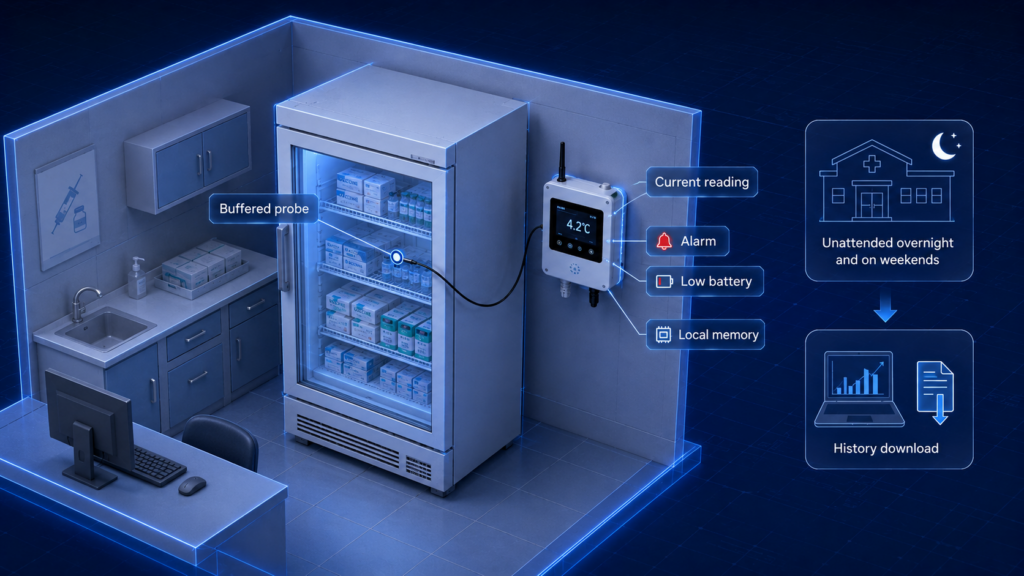
The system should provide a visible current reading, buffered probe, out-of-range alarm, low-battery warning, local memory, and downloadable history.
Several refrigerators in a pharmacy
A connected architecture reduces the need to visit each unit individually. Central dashboards, named devices, alarm escalation, historical reports, and user access become more important than the interface of a single logger.
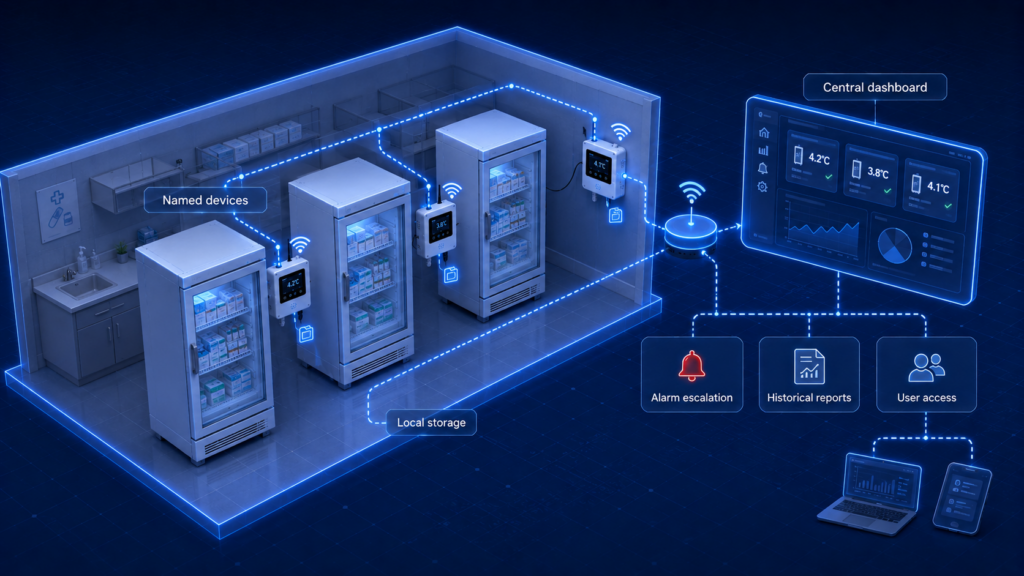
Wi-Fi or Ethernet may be appropriate where the network is stable. Each logger should still retain data locally.
A medical freezer in a laboratory
The sensor range and cable materials must match the freezer temperature. A standard refrigerator probe may be unsuitable for low-temperature or ultra-low-temperature equipment.
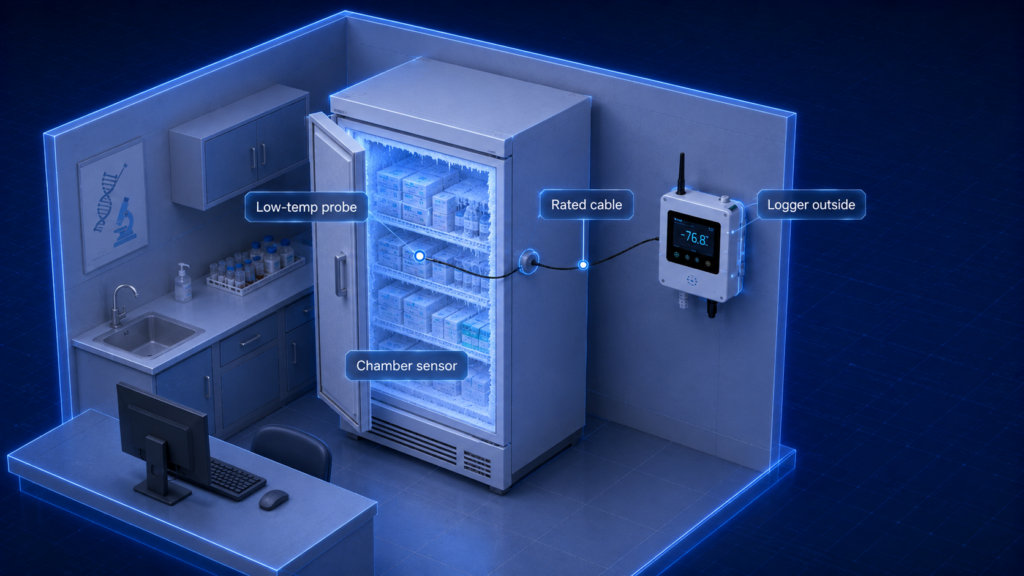
The logger body should normally remain outside the extreme environment, with only the rated probe and cable entering the chamber.
A hospital with multiple storage rooms
A proprietary enterprise wireless system or qualified on-premises platform may be preferable where the organisation requires central user management, calibration records, alarm acknowledgement, audit trails, redundant infrastructure, and controlled change management.
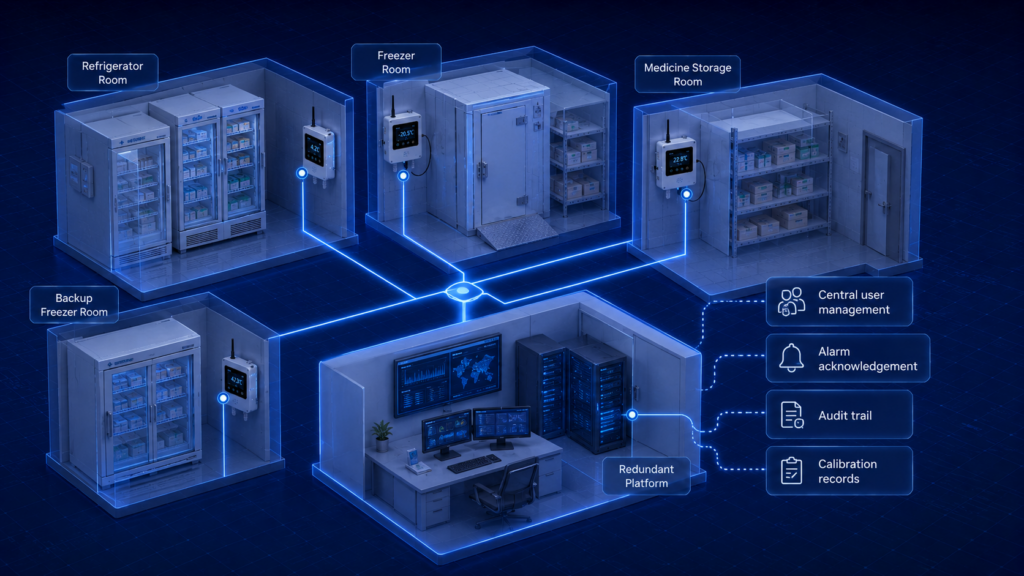
The larger system should be treated as part of the quality infrastructure rather than a collection of unrelated devices.
A remote clinic with unreliable Wi-Fi
A cellular logger can provide direct remote communication without relying on the facility LAN. Coverage, antenna placement, subscription costs, power consumption, and local memory still need to be evaluated.
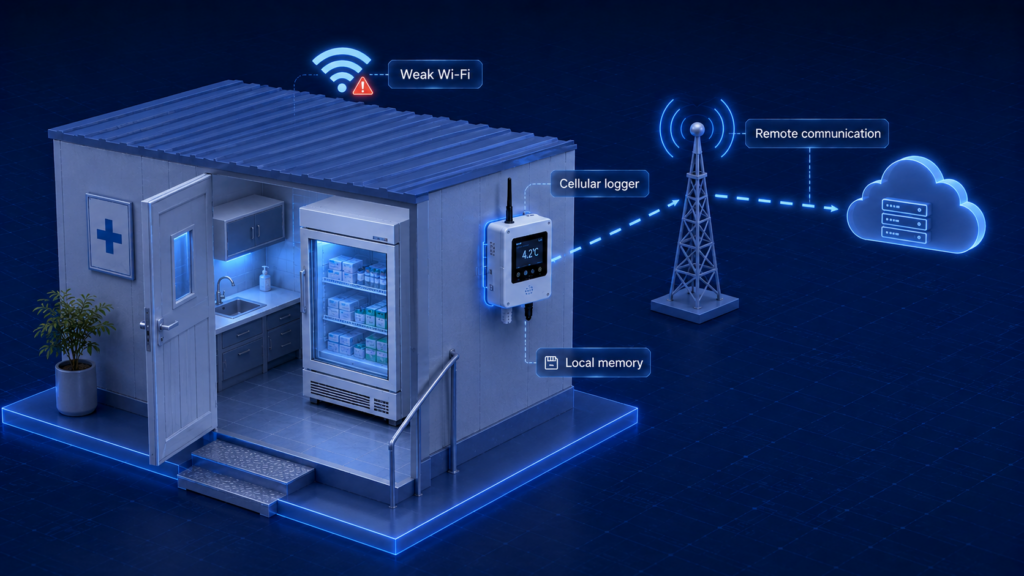
If neither Wi-Fi nor cellular service is reliable, a standalone logger with adequate memory and a disciplined review process may be more dependable than a poorly connected cloud system.
A regulated site requiring local data hosting
An on-premises platform can keep records within the organisation’s infrastructure and support integration with internal systems. It also transfers responsibility for server availability, backups, security, access control, validation, and maintenance to the organization.
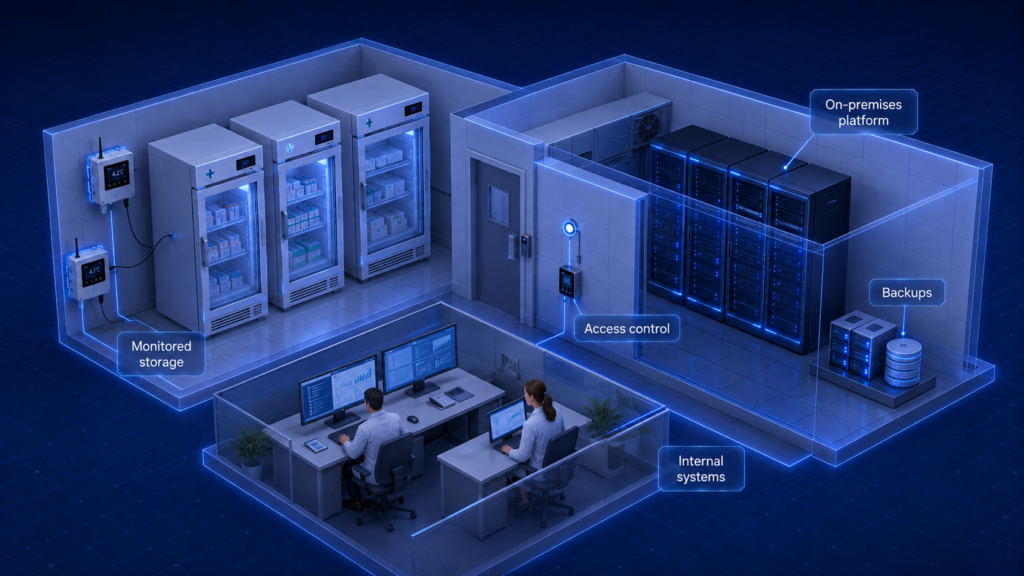
Local hosting is a deployment model, not automatic proof of regulatory compliance.
9.What Common Deployment Mistakes Reduce Reliability?
Placing the probe near the door, wall, cooling outlet, or evaporator
These locations may experience conditions that are not representative of the stored vaccines. Probe placement should be based on refrigerator design, temperature mapping, manufacturer instructions, and the position of the stored inventory.
Using a bare air probe without understanding its response
A bare probe may react strongly to every door opening. This can produce frequent short excursions that do not follow the thermal behaviour of the vaccines. A buffered probe may be more representative, but its slower response must be incorporated into alarm design.
Assuming a network outage stops measurement
In a well-designed system, network loss stops remote transmission but not local logging. Buyers should verify this behaviour during commissioning rather than assuming it from the presence of internal memory.
Configuring thresholds without alarm delays or escalation
A threshold-only alarm may produce excessive notifications. A long delay may hide a meaningful event. Alarm settings should be tested against normal door openings, defrost cycles, and credible equipment failures.
Calibrating only the replaceable probe
If the logger’s conversion electronics contribute to the result, probe-only calibration may not represent complete channel performance. The calibration scope and stored adjustment values should be documented.
Using calibration points outside the working range
A certificate showing good performance at room temperature does not establish accuracy at refrigerator or freezer temperatures. Calibration points should cover the intended operating range.
Confusing decimal places with accuracy
A display of 4.37 C does not prove that the measurement is accurate to 0.01 C. Resolution, accuracy, uncertainty, and calibration are different properties.
10.Frequently Asked Questions
What is continuous temperature monitoring for vaccine refrigerators?
Continuous temperature monitoring uses a data logger to record time-stamped temperatures at regular intervals. Unlike a manual reading, it creates a historical record showing when an excursion started, how long it lasted, and how the refrigerator recovered. The system may also provide local alarms, remote notifications, data exports, and device-status monitoring.
Is a minimum/maximum thermometer enough for vaccine storage?
A minimum/maximum thermometer can show the highest and lowest temperatures since it was reset, but it cannot provide the complete time history of an excursion. CDC recommends continuous digital data loggers for vaccine storage units because they provide a more useful record of excursion timing and duration. [1]
How often should vaccine refrigerator temperatures be recorded?
CDC recommends a digital data logger capable of measuring and recording at least every 30 minutes. A site may choose a shorter interval according to risk, procedures, device capability, memory, and programme requirements. The logging interval should not be confused with how frequently data are uploaded to a cloud platform. [1]
Should a vaccine refrigerator use an air probe or a buffered probe?
A buffered probe is generally preferred because its thermal response more closely represents the stored vaccines than rapidly changing cabinet air. CDC lists glycol, glass beads, sand, and Teflon as example buffering materials. The correct probe should still be selected and calibrated for the specific refrigerator and storage requirement. [1]
What happens if the monitoring system loses Wi-Fi?
The logger should continue measuring and storing readings locally. When connectivity returns, a connected system may automatically upload the missing records. Buyers should confirm the memory capacity, backfill process, timestamp handling, and offline alarm behaviour of the specific product.
How often should a vaccine temperature probe be calibrated?
There is no single recalibration interval suitable for every device and programme. The interval should consider applicable programme rules, manufacturer recommendations, calibration history, stability data, handling conditions, and intermediate checks. NIST research indicates that recalibration decisions can be supported by device stability evidence and periodic verification. [9]
Can the same logger be used for refrigerators and medical freezers?
Only if its probe, cable, accuracy, calibration, and operating range cover both applications. A logger body may need to remain outside a freezer even when the probe is rated for the internal temperature. Refrigerated, frozen, and ultra-low-temperature products should not be treated as one monitoring condition.
Does continuous monitoring determine whether vaccines remain usable after an excursion?
No. The monitoring system provides evidence about temperature, timing, and duration. The disposition decision must follow the vaccine manufacturer’s instructions, health-authority guidance, and the organisation’s documented excursion procedure.
11.Conclusion
Continuous temperature monitoring protects vaccine refrigerators and medical freezers by replacing isolated readings with a complete, time-stamped temperature history.
A reliable system is more than a sensor connected to the internet. It combines a suitable probe, signal acquisition, frequent local logging, sufficient memory, dependable communications, actionable alarms, calibration evidence, and controlled data management.
Probe type is particularly important. Bare air probes detect rapid cabinet changes, while buffered probes more closely follow the thermal behaviour of stored products. Neither approach is universally superior; each measures a different aspect of the storage environment.
The most appropriate architecture depends on the number of refrigerators, storage temperatures, network availability, alarm requirements, data-hosting policy, integration needs, and quality procedures. Standalone loggers, cloud-connected devices, cellular monitors, and enterprise platforms each have legitimate applications.
UbiBot GS1 configurations provide flexible connectivity, external sensor support, local storage, remote alerts, APIs, cloud management, and optional on-premises deployment. For vaccine use, however, the organisation must still verify the selected probe, thermal buffering, calibration, system uncertainty, installation, validation, and operating procedures.
Continuous monitoring supports faster response and better excursion assessment. It does not replace trained staff, manufacturer instructions, or a documented vaccine storage and handling programme.
12.Source and Specification Note
This article is based on CDC and WHO vaccine-storage guidance, NIST research, and current official manufacturer documentation. Product features, software capabilities, and specifications may change.
The temperature requirements for a specific vaccine must always be verified against its current manufacturer labeling and applicable national or programme guidance. Product inclusion in this article does not constitute endorsement by CDC, WHO, NIST, or UbiBot.
Where official documentation did not state a specification, the comparison identifies it as not stated rather than estimating the value.