

UBiBot Logo
UBiBot Logo
  • UBiBot Logo
  • Home
  • Products

    NEW

  • Pricing
  • Support
  • About Us
  • Download
  • magnifying-glass  Search
  • magnifying-glass header-close
  • Sign in Sign in
    Public Web Console Public Web Console
    On-Premises App Center On-Premises App Center
  • Home
  • Products

    NEW

  • Pricing
  • Support
  • About us
  • Download
  •  Public Web Console
  •  On-Premises App Center
  • Where to Buy

Learn Hub

Explore Knowledge Academic Research In-depth Tech

Share

LinkedIn

Facebook

X (Twitter)

Newsletter Signup

Table of contents

    CDC Vaccine Storage and Handling Guide for Digital Data Loggers

    A vaccine refrigerator can display an acceptable setpoint while the products inside are exposed to freezing, heat, or repeated short excursions. Door openings, poor airflow, loading patterns, defrost cycles, power loss, and an incorrectly positioned sensor can all create a misleading picture. A digital data logger (DDL) is therefore not merely a thermometer. It is one control within a broader storage-and-handling programme that also includes suitable equipment, trained staff, calibration, daily review, emergency planning, and documented excursion response.

    This guide converts current CDC storage-and-handling recommendations into practical system requirements for clinics, pharmacies, hospitals, mobile vaccination teams, and public-health providers. It also explains the separate role of VFC programme requirements and WHO cold-chain guidance, then compares representative monitoring architectures from UbiBot, Berlinger, ELPRO, and Dickson without treating any vendor as automatically compliant or approved.

    Quick answer

    CDC recommends—and the VFC programme requires—continuous DDL monitoring at intervals no less frequent than every 30 minutes. The selected system should include a detachable probe that best reflects vaccine temperature, an out-of-range alarm, low-battery indication, current/minimum/maximum display, recommended uncertainty of ±0.5°C (±1°F), and a current calibration certificate. Every storage unit and every transport unit needs monitoring, and the facility should maintain at least one backup device. Local and jurisdiction-specific requirements may add controls.
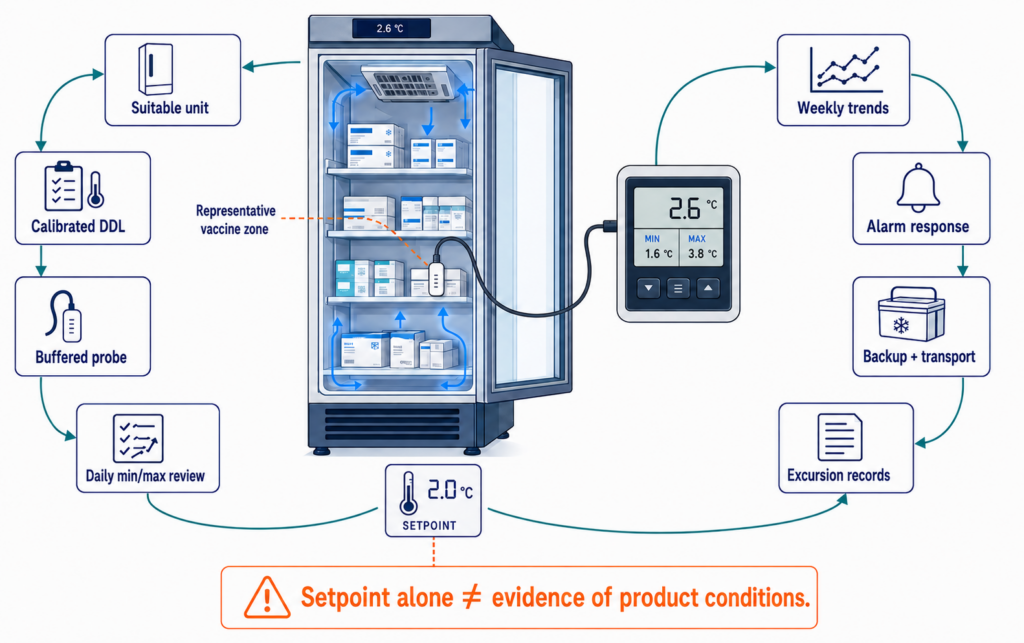
    Reliable vaccine temperature control depends on a complete system: suitable storage equipment, a calibrated logger and representative buffered probe, daily and weekly review, alarm response, transport controls, trained staff, backup equipment, records, and documented excursion decisions.

    1.What Is the CDC Toolkit, and Who Must Follow It?

    The CDC Vaccine Storage and Handling Toolkit is national best-practice guidance for vaccine providers. CDC updated the toolkit in July 2026 and directs VFC providers to use the current VFC Operations Guide as the primary programme source. State, local, territorial, and tribal immunization programmes may impose additional or more specific requirements. A clinic should therefore use the CDC toolkit as a technical foundation, then document the requirements that apply to its funding source, jurisdiction, vaccine products, accreditation, and internal quality system.

    The Pink Book states that every vaccine storage unit must have a reliable temperature-monitoring device and that CDC recommends—and VFC requires—a continuous DDL set to record at least every 30 minutes. The toolkit also addresses daily temperature review, transport, calibration, emergency handling, records, and excursion response. Product package inserts or emergency-use documents remain controlling for product-specific storage conditions; a generic 2°C to 8°C rule does not cover every vaccine.

    WHO guidance serves a different audience and regulatory context. WHO publishes vaccine supply-chain monitoring guidance and prequalifies selected immunization devices through the PQS programme. WHO PQS status can be valuable for international procurement, but it is not a substitute for CDC, VFC, state, or local acceptance in the United States.
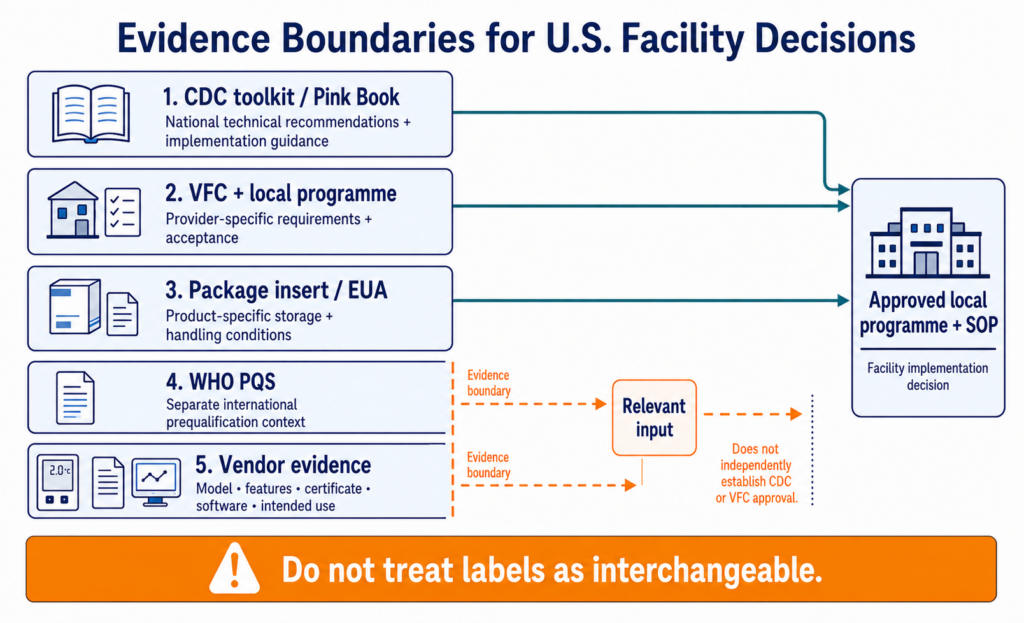
    CDC guidance, VFC and jurisdiction-specific programme requirements, product-specific instructions, WHO PQS prequalification, and vendor claims answer different questions and are not interchangeable evidence of acceptance.

    How to read compliance labels

    —Do not treat guidance, programme requirements, prequalification, and vendor marketing as interchangeable

    Label or source What it means What it does not prove
    CDC toolkit / Pink Book National recommendations and implementation guidance; the Pink Book identifies continuous DDL use as a VFC requirement. That a named commercial product is approved, certified, or suitable for every programme.
    VFC Operations Guide / local programme Programme-specific requirements for providers handling publicly funded vaccines; local programmes may add rules. That a requirement applies identically in every state or jurisdiction.
    Vaccine package insert / EUA Product-specific storage, handling, temperature, and excursion information. That another vaccine with a different label can be handled the same way.
    WHO PQS prequalification WHO verification that a device meets the applicable PQS specification for global immunization procurement. CDC/VFC approval, U.S. programme acceptance, or suitability for every use case.
    Vendor compliance claim Manufacturer description of product capabilities, calibration, software, or intended market. Regulatory acceptance of the customer’s configured system and procedures.

    2.Core Digital Data Logger Requirements

    Monitor every storage and transport unit, and keep a backup

    Each vaccine refrigerator, freezer, ultra-cold unit, portable container, or transport unit used under the provider’s control should have an appropriate monitoring device. The monitor in a refrigerator does not cover a separate freezer, transport cooler, or emergency storage unit. The facility should also keep at least one backup DDL or temperature-monitoring device available, calibrated, functional, and ready for immediate use. The backup should be included in inventory control, battery checks, training, and emergency drills rather than remaining unopened in a cabinet.

    Use continuous logging at an approved interval

    CDC recommends continuous logging, and the Pink Book states that the interval should be at least every 30 minutes. More frequent measurement may improve event reconstruction, but it can also increase data volume and battery or communications burden. The approved setting should be documented in the SOP and verified after firmware, software, or configuration changes. Cloud upload frequency and local measurement frequency are separate variables: a system can collect frequently while communicating less often, provided it retains all records and sends alarms with an acceptable delay.

    Use a detachable, thermally buffered probe

    The probe should best reflect vaccine temperature rather than transient air temperature. CDC gives examples such as glycol, glass beads, sand, or Teflon. A buffer slows the response to brief air changes caused by door openings and can better approximate the thermal behaviour of the stored product. The active display should remain outside the unit where staff can read it without opening the door, while the buffered probe is positioned near the centre with vaccines around it. Avoid the ceiling, floor, door, walls, vents, evaporator discharge, cooling plates, and locations without representative product load.

    A waterproof or high-accuracy probe is not automatically a vaccine-buffered probe. Procurement should define the probe, buffer material, volume, container, cable, connector, placement method, and calibration scope as one controlled assembly. If a manufacturer supplies a separate bottle or buffer accessory, verify that the certificate and intended-use documentation apply to the purchased configuration.
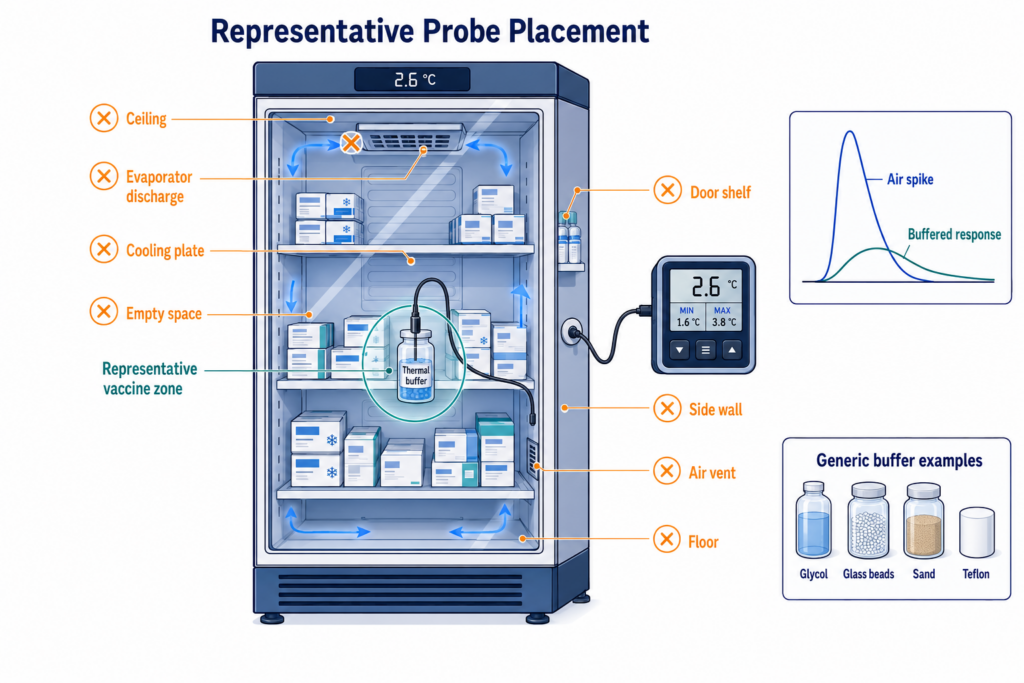
    The display stays outside the storage unit while the detachable buffered probe is placed near the centre of the vaccine load, away from doors, walls, vents, cooling plates, and other non-representative zones.

    Separate accuracy, uncertainty, and calibration evidence

    CDC recommends measurement uncertainty of ±0.5°C (±1°F) or less and requires a current, valid Certificate of Calibration Testing for the DDL or temperature-monitoring device. A product-page accuracy statement is not the same as measurement uncertainty on a certificate. The certificate should identify the model and serial number, test date, reference standards, results, stated uncertainty, and pass or in-tolerance status. The 2026 toolkit describes recognised evidence routes such as ISO/IEC 17025 conformity, an ILAC MRA-accredited laboratory, NIST traceability, or the applicable ASTM class.

    The toolkit advises recalibration according to manufacturer recommendations and notes a typical interval of two to three years. A more frequent interval may be justified by risk, programme policy, performance history, or the manufacturer. If calibration shows that the device is not accurate within ±0.5°C, replace it. A software offset or user-entered correction can assist an internal investigation but does not replace an external calibration certificate when one is required.
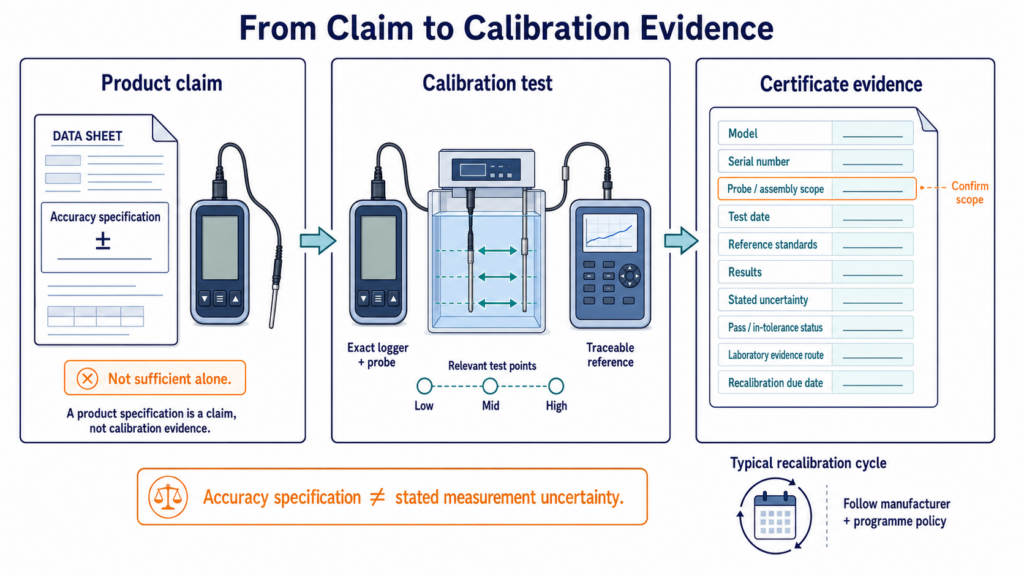
    A product-page accuracy statement is not the same as certificate uncertainty; acceptance depends on current calibration evidence tied to the exact device or measurement assembly, relevant test points, traceability, results, and pass status.

    Make current, minimum, and maximum data easy to review

    CDC calls for checking and recording minimum and maximum temperatures at the start of each workday. If the device does not provide minimum/maximum values, staff should record the current temperature at least twice per workday. The record should identify the date, time, reviewer, and actions taken. A cloud platform with millions of data points can still create an operational gap if staff cannot quickly find the relevant daily minimum and maximum values or document their review.

    Temperature data should be reviewed for trends and analysed at least weekly. Daily review supports immediate control; periodic review can identify increasing door-opening excursions, seasonal drift, equipment deterioration, repeated overnight alarms, or an apparently stable sensor that is not located in the representative vaccine zone.

    Preserve records and distinguish local continuity from remote alerting

    CDC guidance calls for retaining temperature logs for three years unless a programme, law, payer, accreditation body, or organisational policy requires longer. The record strategy should define the original data, exports, reports, metadata, time zone, device identity, probe identity, configuration history, calibration evidence, and excursion documentation. Local memory protects the history during an internet outage; remote alerts require a working communication path. Both functions should be tested independently.

    During acceptance testing, disconnect Wi-Fi, Ethernet, cellular service, a gateway, and mains power as applicable. Confirm that measurement continues, timestamps remain correct, data are not overwritten, reconnection produces complete and orderly backfill, duplicate alarms are controlled, and staff can determine when communications were lost. A large memory claim is not sufficient unless the recovery workflow is demonstrated.
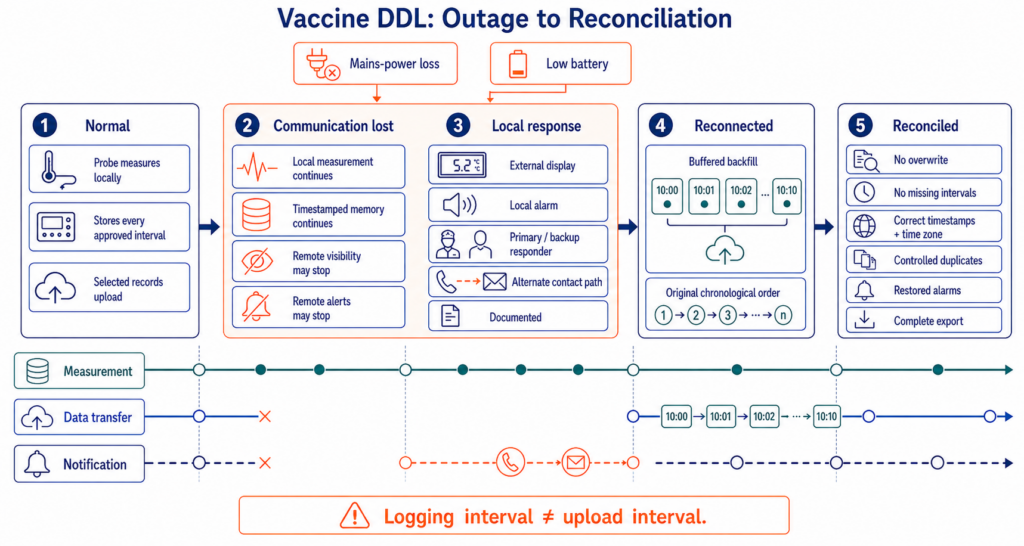
    Local measurement and memory can preserve the temperature history during a communications outage, while remote visibility and notifications may stop; both continuity and recovery must be tested independently.

    Treat alarms as a response system, not a notification feature

    An out-of-range alarm is only useful when limits, delays, recipients, escalation paths, after-hours coverage, and acknowledgement responsibilities are defined. Alarm thresholds must reflect the actual product and storage unit. Alert delays should distinguish short operational fluctuations from a meaningful excursion without masking risk. Test local audible or visual indicators, email, app, SMS, voice, and other channels actually used by the facility. Maintain a named primary and backup responder and document what happens when the first person does not acknowledge the event.
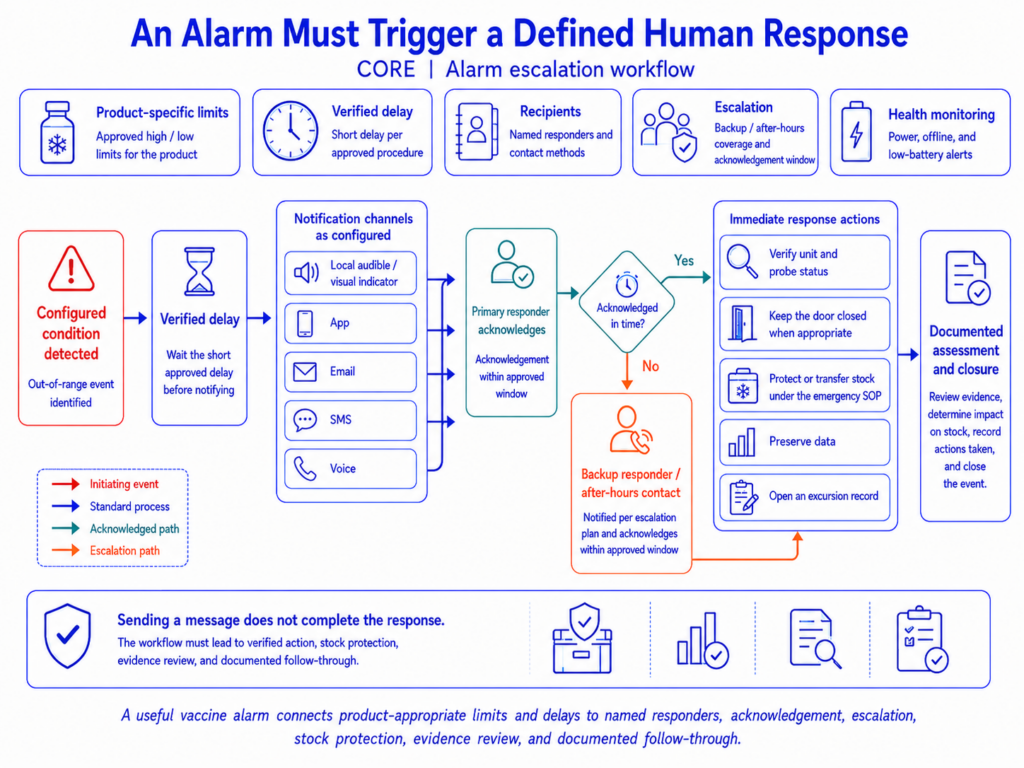
     A useful vaccine alarm connects product-appropriate limits and delays to named responders, acknowledgement, escalation, stock protection, evidence review, and documented follow-through.

    Apply separate controls to transport and temporary clinics

    Use a monitoring device in every transport container. CDC prefers continuous monitoring and requires the temperature history to be checked at the destination. For provider-packed transport, place the buffered probe with the vaccines and keep the display visible on top of the container. The 2026 toolkit states that VFC providers should review and document transport-unit data hourly when vaccines remain in a portable unit, using a DDL with a display and buffered probe. Confirm local programme instructions before transport.

    Original manufacturer shipping containers are generally intended for initial delivery and should not be reused for routine transport unless specifically authorised. A food or beverage cooler is not a substitute for a validated vaccine transport container. Transport procedures should define packing, coolant conditioning, probe placement, route duration, delays, arrival checks, handoff records, and response to out-of-range data.
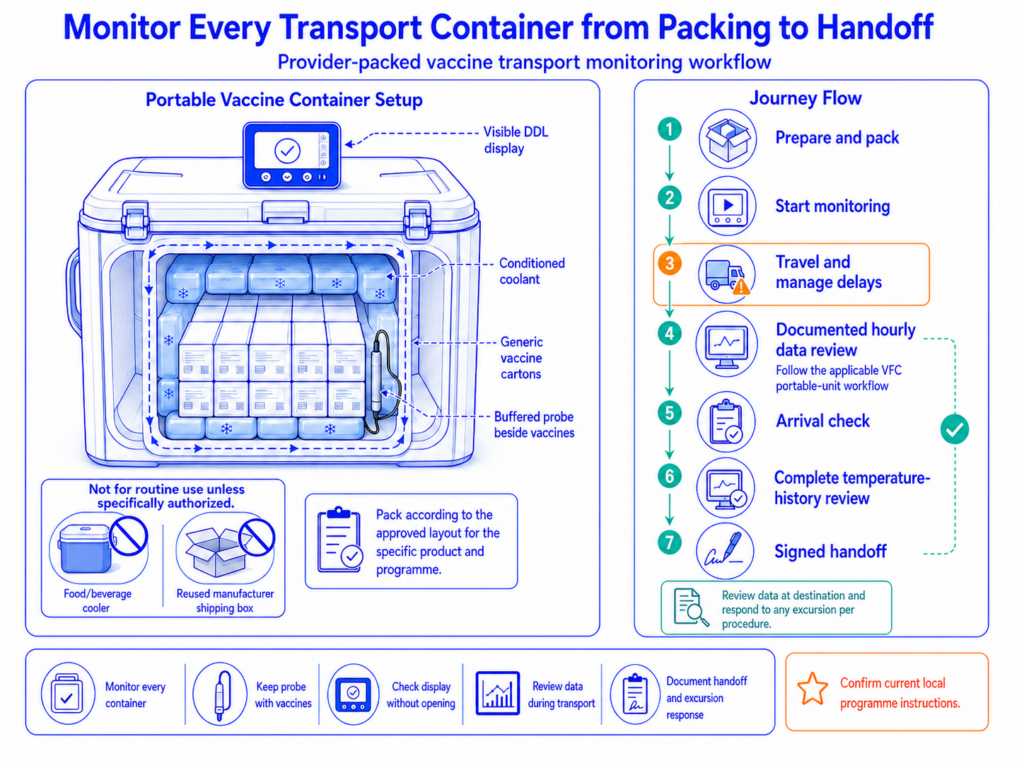
    Provider-managed transport requires an appropriate monitor in every container, a buffered probe with the vaccines, a visible display, defined packing and review procedures, destination data checks, and a documented handoff and excursion response.

    Requirement-to-control matrix

    —Translate CDC guidance into controlled procedures and evidence

    Requirement System control Operational control Evidence to retain
    Monitor every storage/transport unit Assigned logger, probe and unit ID Approved equipment inventory and location list Asset register, floor plan, transport checklist
    Continuous logging Approved local interval of 30 minutes or shorter Configuration change control Configuration report and challenge test
    Buffered detachable probe Controlled probe/buffer assembly Placement at representative vaccine zone Photo, installation record, probe specification
    ±0.5°C uncertainty and calibration Calibrated device and probe Certificate review and recalibration schedule Current certificate, review signature, due-date list
    Current/min/max review Usable display or software workflow Daily workday review; twice-daily current readings if no min/max Temperature log and reviewer identity
    Out-of-range and low-battery warning Configured alarms and health status Primary/backup responder and after-hours escalation Alarm tests, event logs, contact matrix
    Local continuity and retrieval Device or gateway memory Outage, restore and backfill testing Test protocol, screenshots, exported data
    Three-year records Controlled retention and export Weekly trend review and secure archive Reports, exports, review records, backup tests
    Transport control DDL in every container Packing, hourly review where applicable, destination check Transport form, handoff record, excursion assessment
    Backup device Ready calibrated spare Battery check, training and activation drill Backup inventory, certificate, drill record

    3.How to Implement a Vaccine DDL Programme

    Step 1: Define the regulatory and programme scope

    List vaccine sources, funding streams, state or local programme obligations, storage units, transport activities, off-site sessions, and products with special storage conditions. Document which requirements come from CDC, VFC, local programmes, package inserts, contracts, and internal policy.

    Step 2: Create a user requirement specification

    Specify temperature range, uncertainty, logging interval, probe and buffer, local display, minimum/maximum workflow, alarm channels, local memory, battery and power, record retention, users, reports, exports, calibration, transport use, network security, and backup-device requirements.

    Step 3: Select the complete monitoring configuration

    Evaluate the logger, probe, buffer, cable, mounting, power supply, network path, software plan, accessories, calibration certificate, and service model. Do not approve a base logger while leaving the probe and buffer undefined.

    Step 4: Review calibration evidence before use

    Match model and serial numbers, review test points, uncertainty, pass status, laboratory credentials, date, and recalibration due date. Confirm that the relevant probe or complete measurement assembly is covered.

    Step 5: Install and identify the device

    Place the display outside and the probe in the representative vaccine zone. Assign unique unit, logger, probe, and location IDs. Photograph the installation and prevent accidental relocation or cable damage.

    Step 6: Configure logging and alarms

    Approve the measurement interval, upload interval, temperature limits, delays, low-battery alerts, offline alerts, recipients, escalation, and report schedule. Protect settings from unauthorised changes.

    Step 7: Challenge the system

    Simulate high and low temperature, network loss, gateway loss, power failure, low battery, failed notification, and recovery. Verify local storage, backfill, timestamps, alarms, acknowledgement, escalation, and report generation.

    Step 8: Establish daily, weekly, and periodic review

    Document minimum/maximum review at the start of each workday, twice-daily current readings where necessary, weekly trend analysis, calibration status, alarm testing, battery checks, data backup, user review, and periodic SOP review.

    Step 9: Train staff and maintain emergency readiness

    Train primary and backup coordinators, transport staff, receiving staff, facilities, IT, and managers. Maintain written emergency contacts, alternative storage, backup DDLs, packing materials, transport instructions, and excursion decision pathways.
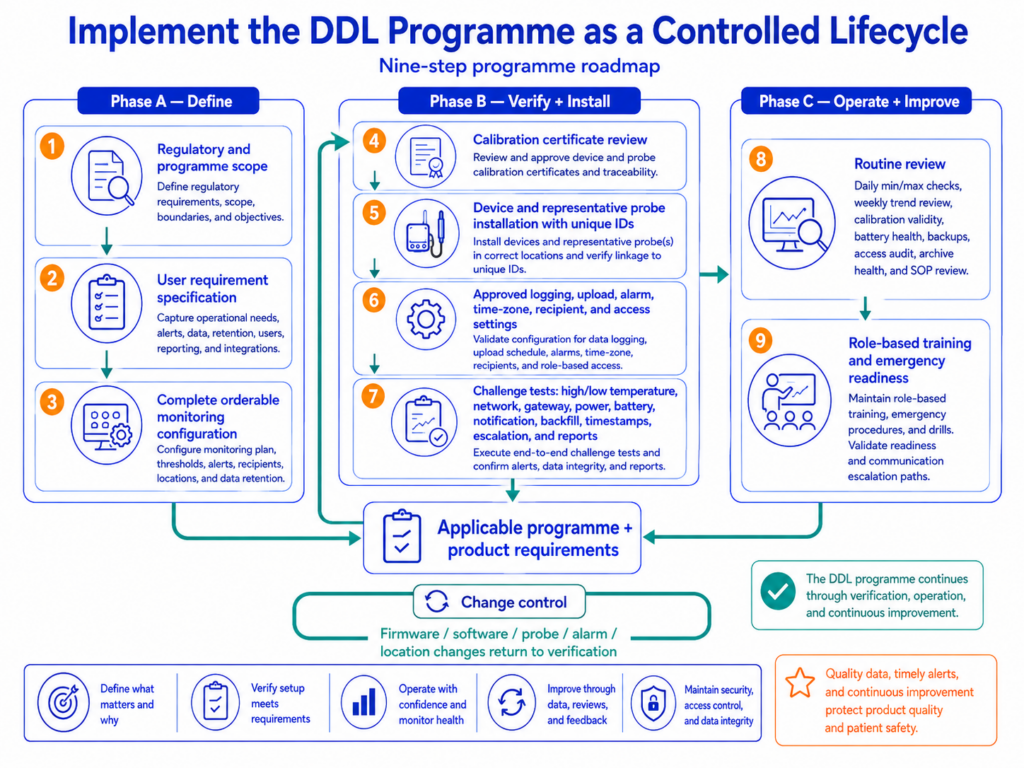
    A vaccine DDL programme moves from scope and user requirements through complete configuration, calibration review, installation, alarm setup, challenge testing, routine review, training, and emergency readiness.

    4.Compliance and Inspection Checklist

    Use the checklist as a procurement and inspection-preparation aid. It does not replace the current CDC toolkit, VFC Operations Guide, jurisdictional requirements, or product-specific instructions.

    Area Check Status Evidence / owner
    Scope All refrigerators, freezers, ultra-cold units, transport units and backup devices are listed. ☐ Asset register / vaccine coordinator
    Product requirements Storage conditions are linked to current package inserts or EUA information. ☐ Approved product list / pharmacy or programme
    DDL Each storage and transport unit has an assigned continuous logger. ☐ Unit-to-logger matrix
    Probe The detachable probe and thermal buffer are specified and installed correctly. ☐ Specification, photo, installation record
    Calibration Current certificate covers the purchased device/probe configuration and required uncertainty. ☐ Certificate and review record
    Configuration Logging interval, alarms, delays, units, time zone and recipients are approved. ☐ Configuration baseline
    Display Staff can review current, minimum and maximum values without opening the unit. ☐ SOP and user test
    Daily review Workday min/max review—or twice-daily current review—is recorded. ☐ Temperature log
    Weekly review Trend analysis and repeated excursion review are documented. ☐ Weekly report / QA review
    Alarms High/low, low battery, offline, power and escalation pathways are tested as applicable. ☐ Challenge-test record
    Data continuity Network and power interruptions do not erase records; backfill is verified. ☐ Outage and restore test
    Retention Temperature and excursion records are retained for at least three years or longer if required. ☐ Retention policy and archive test
    Backup At least one calibrated backup device is available and ready. ☐ Backup inventory and certificate
    Transport Packing, monitoring, hourly review where applicable, and destination checks are defined. ☐ Transport SOP and form
    Excursion Do-not-use segregation, documentation, manufacturer/programme contact and disposition are defined. ☐ Excursion SOP and drill
    Training Primary and backup coordinators and relevant staff have current training. ☐ Training matrix

    5.Common Inspection Findings and Corrective Actions

    Marketing language is treated as evidence of approval.

    Corrective action: Remove “CDC-compliant,” “VFC-approved,” and similar claims unless they accurately describe a programme decision. Retain the actual requirement, test evidence, certificate, and local approval basis.

    The probe measures air temperature only.

    Corrective action: Define a detachable buffered probe and verify its location and calibration. A fast air response may help diagnose door openings but does not automatically represent vaccine temperature.

    The buffer accessory is not included in the controlled configuration.

    Corrective action: Document material, volume, container, cable, serial numbers, installation, replacement, and certificate coverage.

    The certificate is expired, generic, or missing uncertainty.

    Corrective action: Review every certificate before use and track recalibration due dates. Replace a device that fails the required tolerance.

    The facility owns no ready backup DDL.

    Corrective action: Purchase, calibrate, label, test, and train staff on at least one backup. Include it in drills and inventory reviews.

    Staff rely on remote alerts but do not complete daily review.

    Corrective action: Keep daily minimum/maximum review and weekly trend analysis as explicit responsibilities, even when alerts are automated.

    A communication outage preserves data but suppresses notifications.

    Corrective action: Test data continuity and alarm delivery separately. Define local indicators and alternative contacts when remote communication is unavailable.

    The logger is placed near a door, vent, wall, cooling plate, or empty space.

    Corrective action: Relocate the buffered probe to a representative vaccine zone and document the position with a photograph and unit map.

    The same 2°C to 8°C rule is applied to every product.

    Corrective action: Use the package insert, EUA, manufacturer guidance, and programme direction for the specific product and storage stage.

    An excursion triggers immediate disposal.

    Corrective action: Label affected stock “DO NOT USE—TEMPERATURE EXCURSION,” store it correctly and separately, document the event, and consult the manufacturer and immunization programme before disposition.
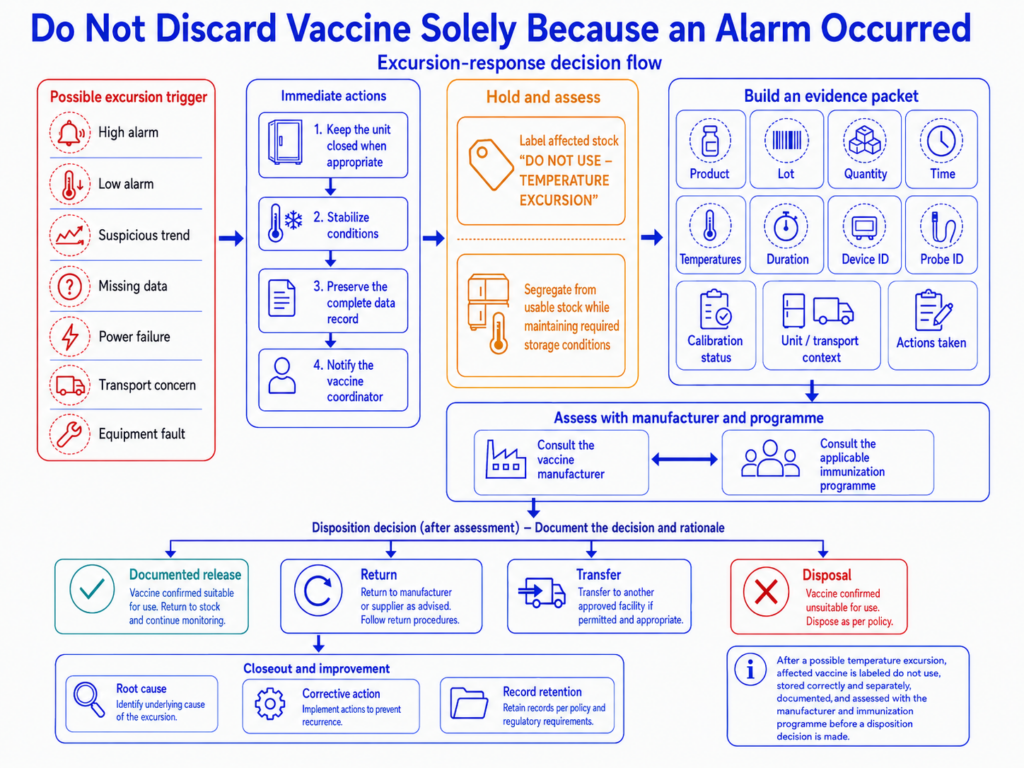
    After a possible temperature excursion, affected vaccine is labeled do not use, stored correctly and separately, documented, and assessed with the manufacturer and immunization programme before a disposition decision is made.

    6.How to Evaluate Vendor Evidence Before Purchase

    A standards-and-compliance review should not end with a feature checklist. Procurement should trace every important claim to an exact model, probe, buffer, certificate, software plan, and operating workflow. The following evidence hierarchy reduces the risk of buying a technically capable logger that cannot support the facility’s approved vaccine programme.

    Confirm the exact intended-use configuration

    Ask the vendor to identify the complete orderable configuration, including the logger, external probe, thermal buffer, cable length, mounting accessories, power supply, gateway if any, software licence, notification services, and calibration option. A product family page may combine capabilities from multiple variants. The purchase order and URS should identify the exact SKU and explain whether the configuration is intended for refrigerators, freezers, ultra-cold storage, transport, or only general environmental monitoring.

    Review the calibration certificate, not only the data sheet

    Request a sample certificate before purchase and the serial-number-specific certificate at delivery. Verify relevant temperature points, uncertainty, pass status, traceability, test date, and recalibration due date. Confirm whether the certificate covers only the sensing element, the detachable probe, or the complete logger-probe assembly. Where a separate thermal buffer is used, document how the facility has justified the assembled measurement system for its intended use.

    Demonstrate the daily review and failure workflow

    The vendor should demonstrate how a user retrieves current, minimum, and maximum values, records the workday review, recognises a communication failure, downloads or exports records, and reconstructs an excursion. Test the actual alert plan, not a marketing screenshot. Confirm what continues to function when the internet, cloud, gateway, mains power, or primary mobile network is unavailable, and how records are restored after service returns.

    Separate vendor functions from customer controls

    A vendor can supply a calibrated device, local memory, alarms, cloud software, access controls, or validation support. The customer still owns equipment assignment, probe placement, alarm limits, responder coverage, daily and weekly review, training, record retention, emergency storage, backup devices, excursion assessment, and change control. The approved procurement evaluation should state which controls are delivered by technology and which remain procedural.

    Obtain programme acceptance before go-live

    Provide the proposed configuration, certificate, SOP, daily review workflow, transport process, and validation or challenge-test evidence to the responsible vaccine coordinator and, where applicable, the state or local immunization programme. Resolve differences before storing publicly funded vaccine. A device can meet a published technical specification and still be unsuitable for a particular programme because the probe, buffer, records, calibration, or operating workflow does not satisfy local expectations.
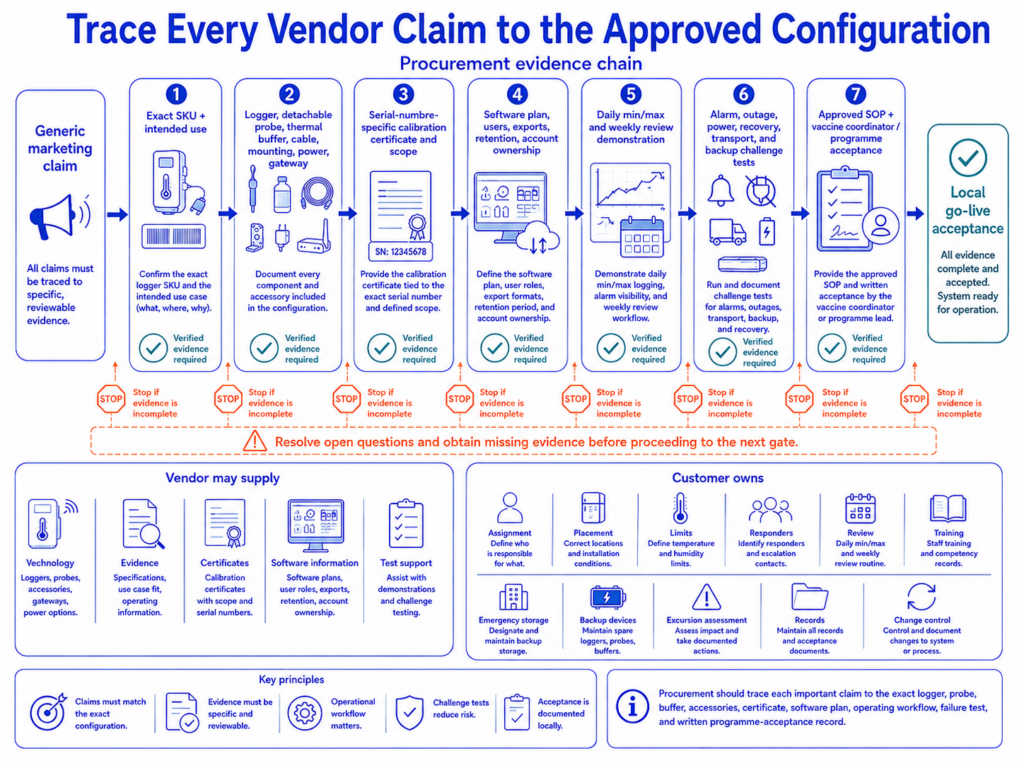
    Procurement should trace each important claim to the exact logger, probe, buffer, accessories, certificate, software plan, operating workflow, failure test, and written programme-acceptance record.

    Vendor evidence request list

    — Request evidence for the exact proposed configuration before commercial approval

    Evidence item Why it matters Minimum review Primary owner
    Exact bill of materials Prevents capabilities from different family variants being combined. Match SKU, probe, buffer, cable, accessory, gateway and software plan. Procurement / technical owner
    Sample and delivery calibration certificates Confirms whether uncertainty, test points and serial numbers are suitable. Review laboratory status, traceability, uncertainty, pass result and due date. Vaccine coordinator / quality
    Daily min/max workflow demonstration Shows whether staff can perform the required workday review efficiently. Observe current, min, max, reset or reporting functions and reviewer record. Operations / training
    Alarm and escalation demonstration Confirms that notifications support the actual response plan. Test high/low, low battery, offline, after-hours and backup contacts. Vaccine coordinator / facilities
    Outage and recovery specification Distinguishes local record continuity from remote availability. Verify memory, overwrite rules, timestamping, backfill and data export. IT / quality
    Data-retention and account-control description Supports record access throughout the required retention period. Confirm retention, user roles, exports, account ownership, backup and service termination. IT / records owner
    Lifecycle and change-notice policy Reduces uncontrolled impact from firmware, software or service changes. Confirm support period, battery/end-of-life, release notices and requalification triggers. Quality / IT / supplier manager
    Programme or jurisdiction acceptance record Documents the final local decision rather than relying on marketing language. Retain written approval, deviation, risk assessment or meeting decision as applicable. Programme lead / vaccine coordinator

    7.Representative Monitoring Architectures

    The table compares representative configurations using current official manufacturer and WHO information. It does not certify any product as CDC- or VFC-compliant. Exact probes, buffers, certificates, logging settings, software plans, and regional availability must be confirmed in the approved purchasing specification.

    Comparison area UbiBot WS1 Pro / GS1 + UB-DT-P1 Berlinger Fridge-tag 2 E + glycol-vial sensor ELPRO ECOLOG-PRO 1TGe + Pt100 + elproCLOUD Dickson DWE2 + RTHM + DicksonOne Compliance interpretation
    Architecture Direct Wi-Fi/4G WS1 Pro; Wi-Fi/Ethernet GS1 alternative; no proprietary radio gateway. Standalone 30-day logger with LCD and USB-generated PDF; external sensor option. Cellular LTE-M/NB-IoT logger sending to elproCLOUD; no site gateway. Wi-Fi or Ethernet display logger connected to DicksonOne. Architecture affects alarms, local continuity, IT burden and recurring cost; it does not establish acceptance.
    Probe / buffer UB-DT-P1 waterproof probe; published ±0.5°C from -10°C to 85°C. Ready-made vaccine buffer not publicly specified. External removable sensor and glycol-vial accessory; WHO PQS E006-040. 1TGe supports external Pt100. A vaccine-specific thermal buffer is not clearly specified on the reviewed xG page. RTHM is a glycol-buffered thermistor marketed for vaccine and drug refrigerators/freezers. Verify the exact probe, thermal buffer, installation and certificate coverage as one controlled assembly.
    Local visibility Large WS1 Pro or GS1  display; current values available. Resettable daily min/max workflow is not publicly specified. LCD with OK/ALARM indication and 30-day history; 60-day PDF on USB connection. Cloud is primary; local status depends on model. Confirm daily min/max workflow. LCD with current and resettable min/max; audible/visible alarm functions. CDC daily review requires usable current/min/max data or an approved twice-daily current-temperature process.
    Logging / continuity Up to 300,000 local records; platform sync after reconnection. One-minute logging; 60-day recording and automatic PDF; non-replaceable battery, about five-year operating life. At least 31,000 values published for xG; smart communication during deviation. Selectable intervals including 1 minute; about 400,000 backup sample points; 72-hour battery backup. Confirm the approved interval, overwrite behaviour, outage recovery, timestamp integrity and report access.
    Remote monitoring UbiBot cloud offers alerts, exports and APIs; basic tier available; SMS/voice and advanced functions may add cost. No native continuous cloud in the basic standalone configuration; third-party readout tools may be available. elproCLOUD with immediate deviation communication and vendor GxP/Part 11 positioning. DicksonOne phone/SMS/email alarms and multi-site reporting; subscription required. Remote alarm capability does not replace local records, daily review, or a tested escalation plan.
    Calibration / evidence Vendor calibration policy and report; confirm complete logger-probe certificate, uncertainty and vaccine-range points. WHO PQS prequalification; traceable calibration options. Confirm supplied certificate and U.S. programme requirements. ISO/IEC 17025 calibration available on request and vendor compliance services; confirm exact scope. NIST/A2LA options and calibration services; verify supplied certificate and uncertainty. A vendor claim or PQS status is not CDC/VFC approval. Review the actual certificate and programme rules.
    Strongest fit Flexible direct connectivity, local capacity, API integration and lower mandatory software burden where the customer can complete the vaccine-specific probe, buffer and evidence package. Vaccine-focused standalone monitoring, local decision display and WHO PQS procurement contexts. Remote cellular life-science monitoring where packaged cloud and compliance services are valued. Clinic/pharmacy fixed monitoring needing buffered probe, direct networking, local alarms and cloud workflow. Select based on intended use, local programme rules, operating model and evidence—not on feature count alone.
    Main caution No publicly specified VFC kit, ready-made buffer, or daily resettable min/max workflow for the reviewed configuration; product accuracy is not certificate uncertainty. Finite-life standalone device and limited remote functionality; WHO PQS is separate from U.S. acceptance. Exact buffer, daily min/max workflow, licence and certificate scope must be verified; vendor Part 11 positioning does not prove CDC/VFC acceptance. Subscription and calibration add cost; IP21 logger needs protected installation; confirm local programme acceptance. None of the configurations becomes compliant without approved SOPs, training, backup, review, excursion response and current calibration.

    8.How to position UbiBot responsibly

    UbiBot can provide useful monitoring building blocks: direct Wi-Fi, cellular or Ethernet options; a large display; substantial local memory; external temperature probes; remote alerts; cloud exports; APIs; and private-platform options. The UB-DT-P1 published accuracy of ±0.5°C from -10°C to 85°C is numerically consistent with the CDC recommended uncertainty level for refrigerated vaccine conditions. However, a product-page accuracy statement does not prove the uncertainty of the complete logger-probe-buffer system.

    For vaccine use, the procurement package should therefore confirm a suitable thermal buffer, certificate coverage for the exact device and probe, calibration points in the operating range, min/max review workflow, local alarm behaviour, backup device, power and network resilience, and state or local programme acceptance. Until those elements are documented, UbiBot should be described as a flexible monitoring platform that may support a vaccine storage workflow—not as a CDC-certified, VFC-approved, or turnkey vaccine-specific compliance kit.

    9.Frequently Asked Questions

    What does CDC recommend for a vaccine digital data logger?

    CDC recommends a continuous DDL with a detachable probe that best reflects vaccine temperature, an out-of-range alarm, low-battery indication, current/minimum/maximum display, recommended uncertainty of ±0.5°C, and a programmable interval that records at least every 30 minutes. The device should have a current calibration certificate.

    Does every vaccine refrigerator need its own DDL?

    Yes. Every storage unit needs an assigned monitoring device. A separate freezer, transport container, portable unit, or emergency storage unit requires its own appropriate monitoring. The facility should also maintain at least one ready backup device.

    Why does CDC recommend a buffered probe?

    A thermal buffer reduces the effect of short air-temperature changes and better approximates the temperature response of vaccine contents. Acceptable examples in CDC guidance include glycol, glass beads, sand, or Teflon. The exact buffer and calibration scope should be defined for the purchased system.

    Is ±0.5°C product accuracy enough?

    Not by itself. CDC refers to recommended uncertainty of ±0.5°C or less and requires a current calibration certificate. Review the actual certificate, test points, uncertainty, serial-number coverage, reference standards, date, and pass status for the complete configuration.

    How often should vaccine temperatures be recorded?

    The Pink Book states that continuous DDLs should be set to record at least every 30 minutes. A shorter interval may be selected, but the approved configuration should be documented and tested. Upload frequency can differ from local logging frequency if records are retained and alarms remain timely.

    How often must the calibration certificate be renewed?

    Follow the manufacturer schedule and applicable programme policy. The 2026 CDC toolkit describes two to three years as a typical recalibration interval. Higher-risk operations, performance history, or local requirements may justify a shorter interval.

    How long should vaccine temperature records be retained?

    CDC guidance calls for retaining temperature logs for three years. A state programme, contract, accreditation requirement, payer, or organisational policy may require longer, so the approved retention schedule should identify the controlling source.

    Can a cloud alarm replace daily minimum and maximum review?

    No. Automated alerts support rapid response, but CDC still calls for daily review and recording of minimum and maximum values. If the device does not provide min/max values, current temperature should be checked and recorded at least twice per workday.

    Is WHO PQS prequalification the same as VFC approval?

    No. WHO PQS is an international prequalification programme for immunization equipment. VFC providers must follow the current VFC Operations Guide and state or local programme requirements. CDC and VFC do not validate or endorse private products.

    What should happen after a temperature excursion?

    Label the affected stock “DO NOT USE—TEMPERATURE EXCURSION,” store it under appropriate conditions and separately from usable stock, document the event, and consult the vaccine manufacturer and immunization programme before making a disposition decision. Do not discard vaccine solely because an alarm occurred.

    10.Final Selection Guidance

    The best DDL is not the device with the longest specification list. It is the complete configuration that the organisation can install correctly, calibrate, review every workday, keep operating during failures, use during transport, support with a backup, and integrate into a documented excursion process.

    Berlinger provides the strongest vaccine-specific standalone benchmark in this comparison, including WHO PQS status and an external glycol-vial configuration. ELPRO provides a mature cellular and life-science cloud architecture, but the exact vaccine buffer and U.S. programme workflow require confirmation. Dickson offers a practical fixed clinic or pharmacy configuration with a glycol-buffered sensor, direct Wi-Fi/Ethernet, local min/max visibility, local alarms and cloud reporting. UbiBot offers flexible connectivity, local storage, display and integration options with a lower mandatory software burden, but the vaccine-specific buffer, calibration evidence and daily-review workflow must be completed and approved.

    Final takeaway

    Do not ask only whether a logger is accurate or connected. Ask whether the complete probe-and-buffer assembly is calibrated, whether staff can complete the required daily review, whether data and alarms survive realistic failures, whether a backup is ready, and whether the configured system meets the current requirements of the applicable immunization programme.

    11.Sources and Product Information Disclaimer

    This article is provided for informational, editorial, training, and procurement-planning purposes. It does not constitute legal, regulatory, medical, vaccine-handling, validation, quality-system, cybersecurity, or engineering advice. CDC guidance, VFC programme rules, state and local requirements, vaccine package inserts, manufacturer excursion assessments, and organisational procedures must be reviewed for the actual operation. CDC and VFC do not certify or endorse private monitoring products. WHO PQS status is a separate international prequalification and does not establish U.S. programme acceptance.

    Product descriptions are based on public manufacturer information reviewed in July 2026. Specifications, accessories, calibration certificates, software functions, licences, alert services, network support, ownership, product lifecycle, regional availability, and commercial terms may change. Verify the exact model, probe, buffer, certificate, software plan, logging configuration, installation, transport use, retention, and support arrangement before purchase or regulated use. The comparison does not imply uniform hands-on testing.

    12.Official Regulatory and Vendor References

    [1] Vaccine Storage and Handling Toolkit — U.S. Centers for Disease Control and Prevention. Official source  Current July 2026 toolkit covering storage units, DDLs, calibration, daily review, transport, emergency response, records, and excursions.

    [2] Vaccine Storage and Handling: Main Page — U.S. Centers for Disease Control and Prevention. Official source  Confirms current toolkit status, VFC Operations Guide priority, local-programme review, and the warning against misleading “CDC-compliant” or “VFC-compliant” claims.

    [3] Chapter 5: Vaccine Storage and Handling — CDC Pink Book. Official source  States that CDC recommends—and VFC requires—continuous DDL use with recording at least every 30 minutes and describes key DDL characteristics.

    [4] Vaccine Storage and Handling Resources — U.S. Centers for Disease Control and Prevention. Official source  Provider tools, temperature logs, emergency resources, and related implementation materials.

    [5] Vaccine Management Handbook: How to Monitor Temperatures in the Vaccine Supply Chain — World Health Organization. Official source  Global vaccine cold-chain monitoring guidance; separate from U.S. VFC requirements.

    [6] E006 Temperature Monitoring Devices — WHO Prequalification of Immunization Devices. Official source  WHO PQS category information and prequalified temperature-monitoring devices.

    [7] Fridge-tag 2 E, E006-040 — WHO Prequalification of Immunization Devices. Official source  Current WHO PQS product record, including 1-minute logging, ±0.5°C accuracy, IP64, 60-day recording, and status valid through 31 May 2027.

    [8] WS1 Pro 4G/WiFi Specifications — UbiBot. Official source  Official hardware, display, local storage, connectivity, power, and external-sensor information.

    [9] Temperature Sensor Comparison — UbiBot Support. Official source  Official UB-DT-P1 range, published accuracy, compatibility, and probe construction.

    [10] Calibration & Traceability Policy — UbiBot Support. Official source  Vendor calibration-report, traceability, recalibration, and self-calibration policy.

    [11] Public IoT Platform Pricing — UbiBot. Official source  Official cloud-plan, storage, alert, export, API, reporting, and paid-feature information.

    [12] GS1 Wi-Fi and Ethernet Product Information — UbiBot. Official source  Official fixed-monitor connectivity, display, local storage, external-probe, and optional PoE-splitter information. Confirm the exact 1DS variant for UB-DT-P1.


    Related Resources

    No related resources found

    menu-header-svg
    Search
    • Explore Knowledge
      • Comparison & Selection
      • Industry Solution
      • Product & Device
      • Criterion & Compliance
      • Deployment & Usage
      • Technology & Principle
    • Academic Research
    • In-depth Tech

    Criterion & Compliance

    See More >>

    CDC Vaccine Storage and Handling Guide for Digital Data Loggers

    A vaccine refrigerator can display an acceptable setpoint while the products inside are exposed to freezing, heat, or repeated short excursions. Door openings, poor airflow, loading patterns, defrost cycles, power loss, and an incorrectly positioned sensor can all create a misleading picture. A digital data logger (DDL) is therefore not merely a thermometer. It is one control within a broader storage-and-handling programme that also includes suitable equipment, trained staff, calibration, daily review, emergency planning, and documented excursion response.

    This guide converts current CDC storage-and-handling recommendations into practical system requirements for clinics, pharmacies, hospitals, mobile vaccination teams, and public-health providers. It also explains the separate role of VFC programme requirements and WHO cold-chain guidance, then compares representative monitoring architectures from UbiBot, Berlinger, ELPRO, and Dickson without treating any vendor as automatically compliant or approved.

    Quick answer

    CDC recommends—and the VFC programme requires—continuous DDL monitoring at intervals no less frequent than every 30 minutes. The selected system should include a detachable probe that best reflects vaccine temperature, an out-of-range alarm, low-battery indication, current/minimum/maximum display, recommended uncertainty of ±0.5°C (±1°F), and a current calibration certificate. Every storage unit and every transport unit needs monitoring, and the facility should maintain at least one backup device. Local and jurisdiction-specific requirements may add controls.

    Reliable vaccine temperature control depends on a complete system: suitable storage equipment, a calibrated logger and representative buffered probe, daily and weekly review, alarm response, transport controls, trained staff, backup equipment, records, and documented excursion decisions.

    1.What Is the CDC Toolkit, and Who Must Follow It?

    The CDC Vaccine Storage and Handling Toolkit is national best-practice guidance for vaccine providers. CDC updated the toolkit in July 2026 and directs VFC providers to use the current VFC Operations Guide as the primary programme source. State, local, territorial, and tribal immunization programmes may impose additional or more specific requirements. A clinic should therefore use the CDC toolkit as a technical foundation, then document the requirements that apply to its funding source, jurisdiction, vaccine products, accreditation, and internal quality system.

    The Pink Book states that every vaccine storage unit must have a reliable temperature-monitoring device and that CDC recommends—and VFC requires—a continuous DDL set to record at least every 30 minutes. The toolkit also addresses daily temperature review, transport, calibration, emergency handling, records, and excursion response. Product package inserts or emergency-use documents remain controlling for product-specific storage conditions; a generic 2°C to 8°C rule does not cover every vaccine.

    WHO guidance serves a different audience and regulatory context. WHO publishes vaccine supply-chain monitoring guidance and prequalifies selected immunization devices through the PQS programme. WHO PQS status can be valuable for international procurement, but it is not a substitute for CDC, VFC, state, or local acceptance in the United States.

    CDC guidance, VFC and jurisdiction-specific programme requirements, product-specific instructions, WHO PQS prequalification, and vendor claims answer different questions and are not interchangeable evidence of acceptance.

    How to read compliance labels

    —Do not treat guidance, programme requirements, prequalification, and vendor marketing as interchangeable

    Label or source What it means What it does not prove
    CDC toolkit / Pink Book National recommendations and implementation guidance; the Pink Book identifies continuous DDL use as a VFC requirement. That a named commercial product is approved, certified, or suitable for every programme.
    VFC Operations Guide / local programme Programme-specific requirements for providers handling publicly funded vaccines; local programmes may add rules. That a requirement applies identically in every state or jurisdiction.
    Vaccine package insert / EUA Product-specific storage, handling, temperature, and excursion information. That another vaccine with a different label can be handled the same way.
    WHO PQS prequalification WHO verification that a device meets the applicable PQS specification for global immunization procurement. CDC/VFC approval, U.S. programme acceptance, or suitability for every use case.
    Vendor compliance claim Manufacturer description of product capabilities, calibration, software, or intended market. Regulatory acceptance of the customer’s configured system and procedures.

    2.Core Digital Data Logger Requirements

    Monitor every storage and transport unit, and keep a backup

    Each vaccine refrigerator, freezer, ultra-cold unit, portable container, or transport unit used under the provider’s control should have an appropriate monitoring device. The monitor in a refrigerator does not cover a separate freezer, transport cooler, or emergency storage unit. The facility should also keep at least one backup DDL or temperature-monitoring device available, calibrated, functional, and ready for immediate use. The backup should be included in inventory control, battery checks, training, and emergency drills rather than remaining unopened in a cabinet.

    Use continuous logging at an approved interval

    CDC recommends continuous logging, and the Pink Book states that the interval should be at least every 30 minutes. More frequent measurement may improve event reconstruction, but it can also increase data volume and battery or communications burden. The approved setting should be documented in the SOP and verified after firmware, software, or configuration changes. Cloud upload frequency and local measurement frequency are separate variables: a system can collect frequently while communicating less often, provided it retains all records and sends alarms with an acceptable delay.

    Use a detachable, thermally buffered probe

    The probe should best reflect vaccine temperature rather than transient air temperature. CDC gives examples such as glycol, glass beads, sand, or Teflon. A buffer slows the response to brief air changes caused by door openings and can better approximate the thermal behaviour of the stored product. The active display should remain outside the unit where staff can read it without opening the door, while the buffered probe is positioned near the centre with vaccines around it. Avoid the ceiling, floor, door, walls, vents, evaporator discharge, cooling plates, and locations without representative product load.

    A waterproof or high-accuracy probe is not automatically a vaccine-buffered probe. Procurement should define the probe, buffer material, volume, container, cable, connector, placement method, and calibration scope as one controlled assembly. If a manufacturer supplies a separate bottle or buffer accessory, verify that the certificate and intended-use documentation apply to the purchased configuration.

    The display stays outside the storage unit while the detachable buffered probe is placed near the centre of the vaccine load, away from doors, walls, vents, cooling plates, and other non-representative zones.

    Separate accuracy, uncertainty, and calibration evidence

    CDC recommends measurement uncertainty of ±0.5°C (±1°F) or less and requires a current, valid Certificate of Calibration Testing for the DDL or temperature-monitoring device. A product-page accuracy statement is not the same as measurement uncertainty on a certificate. The certificate should identify the model and serial number, test date, reference standards, results, stated uncertainty, and pass or in-tolerance status. The 2026 toolkit describes recognised evidence routes such as ISO/IEC 17025 conformity, an ILAC MRA-accredited laboratory, NIST traceability, or the applicable ASTM class.

    The toolkit advises recalibration according to manufacturer recommendations and notes a typical interval of two to three years. A more frequent interval may be justified by risk, programme policy, performance history, or the manufacturer. If calibration shows that the device is not accurate within ±0.5°C, replace it. A software offset or user-entered correction can assist an internal investigation but does not replace an external calibration certificate when one is required.

    A product-page accuracy statement is not the same as certificate uncertainty; acceptance depends on current calibration evidence tied to the exact device or measurement assembly, relevant test points, traceability, results, and pass status.

    Make current, minimum, and maximum data easy to review

    CDC calls for checking and recording minimum and maximum temperatures at the start of each workday. If the device does not provide minimum/maximum values, staff should record the current temperature at least twice per workday. The record should identify the date, time, reviewer, and actions taken. A cloud platform with millions of data points can still create an operational gap if staff cannot quickly find the relevant daily minimum and maximum values or document their review.

    Temperature data should be reviewed for trends and analysed at least weekly. Daily review supports immediate control; periodic review can identify increasing door-opening excursions, seasonal drift, equipment deterioration, repeated overnight alarms, or an apparently stable sensor that is not located in the representative vaccine zone.

    Preserve records and distinguish local continuity from remote alerting

    CDC guidance calls for retaining temperature logs for three years unless a programme, law, payer, accreditation body, or organisational policy requires longer. The record strategy should define the original data, exports, reports, metadata, time zone, device identity, probe identity, configuration history, calibration evidence, and excursion documentation. Local memory protects the history during an internet outage; remote alerts require a working communication path. Both functions should be tested independently.

    During acceptance testing, disconnect Wi-Fi, Ethernet, cellular service, a gateway, and mains power as applicable. Confirm that measurement continues, timestamps remain correct, data are not overwritten, reconnection produces complete and orderly backfill, duplicate alarms are controlled, and staff can determine when communications were lost. A large memory claim is not sufficient unless the recovery workflow is demonstrated.

    Local measurement and memory can preserve the temperature history during a communications outage, while remote visibility and notifications may stop; both continuity and recovery must be tested independently.

    Treat alarms as a response system, not a notification feature

    An out-of-range alarm is only useful when limits, delays, recipients, escalation paths, after-hours coverage, and acknowledgement responsibilities are defined. Alarm thresholds must reflect the actual product and storage unit. Alert delays should distinguish short operational fluctuations from a meaningful excursion without masking risk. Test local audible or visual indicators, email, app, SMS, voice, and other channels actually used by the facility. Maintain a named primary and backup responder and document what happens when the first person does not acknowledge the event.

     A useful vaccine alarm connects product-appropriate limits and delays to named responders, acknowledgement, escalation, stock protection, evidence review, and documented follow-through.

    Apply separate controls to transport and temporary clinics

    Use a monitoring device in every transport container. CDC prefers continuous monitoring and requires the temperature history to be checked at the destination. For provider-packed transport, place the buffered probe with the vaccines and keep the display visible on top of the container. The 2026 toolkit states that VFC providers should review and document transport-unit data hourly when vaccines remain in a portable unit, using a DDL with a display and buffered probe. Confirm local programme instructions before transport.

    Original manufacturer shipping containers are generally intended for initial delivery and should not be reused for routine transport unless specifically authorised. A food or beverage cooler is not a substitute for a validated vaccine transport container. Transport procedures should define packing, coolant conditioning, probe placement, route duration, delays, arrival checks, handoff records, and response to out-of-range data.

    Provider-managed transport requires an appropriate monitor in every container, a buffered probe with the vaccines, a visible display, defined packing and review procedures, destination data checks, and a documented handoff and excursion response.

    Requirement-to-control matrix

    —Translate CDC guidance into controlled procedures and evidence

    Requirement System control Operational control Evidence to retain
    Monitor every storage/transport unit Assigned logger, probe and unit ID Approved equipment inventory and location list Asset register, floor plan, transport checklist
    Continuous logging Approved local interval of 30 minutes or shorter Configuration change control Configuration report and challenge test
    Buffered detachable probe Controlled probe/buffer assembly Placement at representative vaccine zone Photo, installation record, probe specification
    ±0.5°C uncertainty and calibration Calibrated device and probe Certificate review and recalibration schedule Current certificate, review signature, due-date list
    Current/min/max review Usable display or software workflow Daily workday review; twice-daily current readings if no min/max Temperature log and reviewer identity
    Out-of-range and low-battery warning Configured alarms and health status Primary/backup responder and after-hours escalation Alarm tests, event logs, contact matrix
    Local continuity and retrieval Device or gateway memory Outage, restore and backfill testing Test protocol, screenshots, exported data
    Three-year records Controlled retention and export Weekly trend review and secure archive Reports, exports, review records, backup tests
    Transport control DDL in every container Packing, hourly review where applicable, destination check Transport form, handoff record, excursion assessment
    Backup device Ready calibrated spare Battery check, training and activation drill Backup inventory, certificate, drill record

    3.How to Implement a Vaccine DDL Programme

    Step 1: Define the regulatory and programme scope

    List vaccine sources, funding streams, state or local programme obligations, storage units, transport activities, off-site sessions, and products with special storage conditions. Document which requirements come from CDC, VFC, local programmes, package inserts, contracts, and internal policy.

    Step 2: Create a user requirement specification

    Specify temperature range, uncertainty, logging interval, probe and buffer, local display, minimum/maximum workflow, alarm channels, local memory, battery and power, record retention, users, reports, exports, calibration, transport use, network security, and backup-device requirements.

    Step 3: Select the complete monitoring configuration

    Evaluate the logger, probe, buffer, cable, mounting, power supply, network path, software plan, accessories, calibration certificate, and service model. Do not approve a base logger while leaving the probe and buffer undefined.

    Step 4: Review calibration evidence before use

    Match model and serial numbers, review test points, uncertainty, pass status, laboratory credentials, date, and recalibration due date. Confirm that the relevant probe or complete measurement assembly is covered.

    Step 5: Install and identify the device

    Place the display outside and the probe in the representative vaccine zone. Assign unique unit, logger, probe, and location IDs. Photograph the installation and prevent accidental relocation or cable damage.

    Step 6: Configure logging and alarms

    Approve the measurement interval, upload interval, temperature limits, delays, low-battery alerts, offline alerts, recipients, escalation, and report schedule. Protect settings from unauthorised changes.

    Step 7: Challenge the system

    Simulate high and low temperature, network loss, gateway loss, power failure, low battery, failed notification, and recovery. Verify local storage, backfill, timestamps, alarms, acknowledgement, escalation, and report generation.

    Step 8: Establish daily, weekly, and periodic review

    Document minimum/maximum review at the start of each workday, twice-daily current readings where necessary, weekly trend analysis, calibration status, alarm testing, battery checks, data backup, user review, and periodic SOP review.

    Step 9: Train staff and maintain emergency readiness

    Train primary and backup coordinators, transport staff, receiving staff, facilities, IT, and managers. Maintain written emergency contacts, alternative storage, backup DDLs, packing materials, transport instructions, and excursion decision pathways.

    A vaccine DDL programme moves from scope and user requirements through complete configuration, calibration review, installation, alarm setup, challenge testing, routine review, training, and emergency readiness.

    4.Compliance and Inspection Checklist

    Use the checklist as a procurement and inspection-preparation aid. It does not replace the current CDC toolkit, VFC Operations Guide, jurisdictional requirements, or product-specific instructions.

    Area Check Status Evidence / owner
    Scope All refrigerators, freezers, ultra-cold units, transport units and backup devices are listed. ☐ Asset register / vaccine coordinator
    Product requirements Storage conditions are linked to current package inserts or EUA information. ☐ Approved product list / pharmacy or programme
    DDL Each storage and transport unit has an assigned continuous logger. ☐ Unit-to-logger matrix
    Probe The detachable probe and thermal buffer are specified and installed correctly. ☐ Specification, photo, installation record
    Calibration Current certificate covers the purchased device/probe configuration and required uncertainty. ☐ Certificate and review record
    Configuration Logging interval, alarms, delays, units, time zone and recipients are approved. ☐ Configuration baseline
    Display Staff can review current, minimum and maximum values without opening the unit. ☐ SOP and user test
    Daily review Workday min/max review—or twice-daily current review—is recorded. ☐ Temperature log
    Weekly review Trend analysis and repeated excursion review are documented. ☐ Weekly report / QA review
    Alarms High/low, low battery, offline, power and escalation pathways are tested as applicable. ☐ Challenge-test record
    Data continuity Network and power interruptions do not erase records; backfill is verified. ☐ Outage and restore test
    Retention Temperature and excursion records are retained for at least three years or longer if required. ☐ Retention policy and archive test
    Backup At least one calibrated backup device is available and ready. ☐ Backup inventory and certificate
    Transport Packing, monitoring, hourly review where applicable, and destination checks are defined. ☐ Transport SOP and form
    Excursion Do-not-use segregation, documentation, manufacturer/programme contact and disposition are defined. ☐ Excursion SOP and drill
    Training Primary and backup coordinators and relevant staff have current training. ☐ Training matrix

    5.Common Inspection Findings and Corrective Actions

    Marketing language is treated as evidence of approval.

    Corrective action: Remove “CDC-compliant,” “VFC-approved,” and similar claims unless they accurately describe a programme decision. Retain the actual requirement, test evidence, certificate, and local approval basis.

    The probe measures air temperature only.

    Corrective action: Define a detachable buffered probe and verify its location and calibration. A fast air response may help diagnose door openings but does not automatically represent vaccine temperature.

    The buffer accessory is not included in the controlled configuration.

    Corrective action: Document material, volume, container, cable, serial numbers, installation, replacement, and certificate coverage.

    The certificate is expired, generic, or missing uncertainty.

    Corrective action: Review every certificate before use and track recalibration due dates. Replace a device that fails the required tolerance.

    The facility owns no ready backup DDL.

    Corrective action: Purchase, calibrate, label, test, and train staff on at least one backup. Include it in drills and inventory reviews.

    Staff rely on remote alerts but do not complete daily review.

    Corrective action: Keep daily minimum/maximum review and weekly trend analysis as explicit responsibilities, even when alerts are automated.

    A communication outage preserves data but suppresses notifications.

    Corrective action: Test data continuity and alarm delivery separately. Define local indicators and alternative contacts when remote communication is unavailable.

    The logger is placed near a door, vent, wall, cooling plate, or empty space.

    Corrective action: Relocate the buffered probe to a representative vaccine zone and document the position with a photograph and unit map.

    The same 2°C to 8°C rule is applied to every product.

    Corrective action: Use the package insert, EUA, manufacturer guidance, and programme direction for the specific product and storage stage.

    An excursion triggers immediate disposal.

    Corrective action: Label affected stock “DO NOT USE—TEMPERATURE EXCURSION,” store it correctly and separately, document the event, and consult the manufacturer and immunization programme before disposition.

    After a possible temperature excursion, affected vaccine is labeled do not use, stored correctly and separately, documented, and assessed with the manufacturer and immunization programme before a disposition decision is made.

    6.How to Evaluate Vendor Evidence Before Purchase

    A standards-and-compliance review should not end with a feature checklist. Procurement should trace every important claim to an exact model, probe, buffer, certificate, software plan, and operating workflow. The following evidence hierarchy reduces the risk of buying a technically capable logger that cannot support the facility’s approved vaccine programme.

    Confirm the exact intended-use configuration

    Ask the vendor to identify the complete orderable configuration, including the logger, external probe, thermal buffer, cable length, mounting accessories, power supply, gateway if any, software licence, notification services, and calibration option. A product family page may combine capabilities from multiple variants. The purchase order and URS should identify the exact SKU and explain whether the configuration is intended for refrigerators, freezers, ultra-cold storage, transport, or only general environmental monitoring.

    Review the calibration certificate, not only the data sheet

    Request a sample certificate before purchase and the serial-number-specific certificate at delivery. Verify relevant temperature points, uncertainty, pass status, traceability, test date, and recalibration due date. Confirm whether the certificate covers only the sensing element, the detachable probe, or the complete logger-probe assembly. Where a separate thermal buffer is used, document how the facility has justified the assembled measurement system for its intended use.

    Demonstrate the daily review and failure workflow

    The vendor should demonstrate how a user retrieves current, minimum, and maximum values, records the workday review, recognises a communication failure, downloads or exports records, and reconstructs an excursion. Test the actual alert plan, not a marketing screenshot. Confirm what continues to function when the internet, cloud, gateway, mains power, or primary mobile network is unavailable, and how records are restored after service returns.

    Separate vendor functions from customer controls

    A vendor can supply a calibrated device, local memory, alarms, cloud software, access controls, or validation support. The customer still owns equipment assignment, probe placement, alarm limits, responder coverage, daily and weekly review, training, record retention, emergency storage, backup devices, excursion assessment, and change control. The approved procurement evaluation should state which controls are delivered by technology and which remain procedural.

    Obtain programme acceptance before go-live

    Provide the proposed configuration, certificate, SOP, daily review workflow, transport process, and validation or challenge-test evidence to the responsible vaccine coordinator and, where applicable, the state or local immunization programme. Resolve differences before storing publicly funded vaccine. A device can meet a published technical specification and still be unsuitable for a particular programme because the probe, buffer, records, calibration, or operating workflow does not satisfy local expectations.

    Procurement should trace each important claim to the exact logger, probe, buffer, accessories, certificate, software plan, operating workflow, failure test, and written programme-acceptance record.

    Vendor evidence request list

    — Request evidence for the exact proposed configuration before commercial approval

    Evidence item Why it matters Minimum review Primary owner
    Exact bill of materials Prevents capabilities from different family variants being combined. Match SKU, probe, buffer, cable, accessory, gateway and software plan. Procurement / technical owner
    Sample and delivery calibration certificates Confirms whether uncertainty, test points and serial numbers are suitable. Review laboratory status, traceability, uncertainty, pass result and due date. Vaccine coordinator / quality
    Daily min/max workflow demonstration Shows whether staff can perform the required workday review efficiently. Observe current, min, max, reset or reporting functions and reviewer record. Operations / training
    Alarm and escalation demonstration Confirms that notifications support the actual response plan. Test high/low, low battery, offline, after-hours and backup contacts. Vaccine coordinator / facilities
    Outage and recovery specification Distinguishes local record continuity from remote availability. Verify memory, overwrite rules, timestamping, backfill and data export. IT / quality
    Data-retention and account-control description Supports record access throughout the required retention period. Confirm retention, user roles, exports, account ownership, backup and service termination. IT / records owner
    Lifecycle and change-notice policy Reduces uncontrolled impact from firmware, software or service changes. Confirm support period, battery/end-of-life, release notices and requalification triggers. Quality / IT / supplier manager
    Programme or jurisdiction acceptance record Documents the final local decision rather than relying on marketing language. Retain written approval, deviation, risk assessment or meeting decision as applicable. Programme lead / vaccine coordinator

    7.Representative Monitoring Architectures

    The table compares representative configurations using current official manufacturer and WHO information. It does not certify any product as CDC- or VFC-compliant. Exact probes, buffers, certificates, logging settings, software plans, and regional availability must be confirmed in the approved purchasing specification.

    Comparison area UbiBot WS1 Pro / GS1 + UB-DT-P1 Berlinger Fridge-tag 2 E + glycol-vial sensor ELPRO ECOLOG-PRO 1TGe + Pt100 + elproCLOUD Dickson DWE2 + RTHM + DicksonOne Compliance interpretation
    Architecture Direct Wi-Fi/4G WS1 Pro; Wi-Fi/Ethernet GS1 alternative; no proprietary radio gateway. Standalone 30-day logger with LCD and USB-generated PDF; external sensor option. Cellular LTE-M/NB-IoT logger sending to elproCLOUD; no site gateway. Wi-Fi or Ethernet display logger connected to DicksonOne. Architecture affects alarms, local continuity, IT burden and recurring cost; it does not establish acceptance.
    Probe / buffer UB-DT-P1 waterproof probe; published ±0.5°C from -10°C to 85°C. Ready-made vaccine buffer not publicly specified. External removable sensor and glycol-vial accessory; WHO PQS E006-040. 1TGe supports external Pt100. A vaccine-specific thermal buffer is not clearly specified on the reviewed xG page. RTHM is a glycol-buffered thermistor marketed for vaccine and drug refrigerators/freezers. Verify the exact probe, thermal buffer, installation and certificate coverage as one controlled assembly.
    Local visibility Large WS1 Pro or GS1  display; current values available. Resettable daily min/max workflow is not publicly specified. LCD with OK/ALARM indication and 30-day history; 60-day PDF on USB connection. Cloud is primary; local status depends on model. Confirm daily min/max workflow. LCD with current and resettable min/max; audible/visible alarm functions. CDC daily review requires usable current/min/max data or an approved twice-daily current-temperature process.
    Logging / continuity Up to 300,000 local records; platform sync after reconnection. One-minute logging; 60-day recording and automatic PDF; non-replaceable battery, about five-year operating life. At least 31,000 values published for xG; smart communication during deviation. Selectable intervals including 1 minute; about 400,000 backup sample points; 72-hour battery backup. Confirm the approved interval, overwrite behaviour, outage recovery, timestamp integrity and report access.
    Remote monitoring UbiBot cloud offers alerts, exports and APIs; basic tier available; SMS/voice and advanced functions may add cost. No native continuous cloud in the basic standalone configuration; third-party readout tools may be available. elproCLOUD with immediate deviation communication and vendor GxP/Part 11 positioning. DicksonOne phone/SMS/email alarms and multi-site reporting; subscription required. Remote alarm capability does not replace local records, daily review, or a tested escalation plan.
    Calibration / evidence Vendor calibration policy and report; confirm complete logger-probe certificate, uncertainty and vaccine-range points. WHO PQS prequalification; traceable calibration options. Confirm supplied certificate and U.S. programme requirements. ISO/IEC 17025 calibration available on request and vendor compliance services; confirm exact scope. NIST/A2LA options and calibration services; verify supplied certificate and uncertainty. A vendor claim or PQS status is not CDC/VFC approval. Review the actual certificate and programme rules.
    Strongest fit Flexible direct connectivity, local capacity, API integration and lower mandatory software burden where the customer can complete the vaccine-specific probe, buffer and evidence package. Vaccine-focused standalone monitoring, local decision display and WHO PQS procurement contexts. Remote cellular life-science monitoring where packaged cloud and compliance services are valued. Clinic/pharmacy fixed monitoring needing buffered probe, direct networking, local alarms and cloud workflow. Select based on intended use, local programme rules, operating model and evidence—not on feature count alone.
    Main caution No publicly specified VFC kit, ready-made buffer, or daily resettable min/max workflow for the reviewed configuration; product accuracy is not certificate uncertainty. Finite-life standalone device and limited remote functionality; WHO PQS is separate from U.S. acceptance. Exact buffer, daily min/max workflow, licence and certificate scope must be verified; vendor Part 11 positioning does not prove CDC/VFC acceptance. Subscription and calibration add cost; IP21 logger needs protected installation; confirm local programme acceptance. None of the configurations becomes compliant without approved SOPs, training, backup, review, excursion response and current calibration.

    8.How to position UbiBot responsibly

    UbiBot can provide useful monitoring building blocks: direct Wi-Fi, cellular or Ethernet options; a large display; substantial local memory; external temperature probes; remote alerts; cloud exports; APIs; and private-platform options. The UB-DT-P1 published accuracy of ±0.5°C from -10°C to 85°C is numerically consistent with the CDC recommended uncertainty level for refrigerated vaccine conditions. However, a product-page accuracy statement does not prove the uncertainty of the complete logger-probe-buffer system.

    For vaccine use, the procurement package should therefore confirm a suitable thermal buffer, certificate coverage for the exact device and probe, calibration points in the operating range, min/max review workflow, local alarm behaviour, backup device, power and network resilience, and state or local programme acceptance. Until those elements are documented, UbiBot should be described as a flexible monitoring platform that may support a vaccine storage workflow—not as a CDC-certified, VFC-approved, or turnkey vaccine-specific compliance kit.

    9.Frequently Asked Questions

    What does CDC recommend for a vaccine digital data logger?

    CDC recommends a continuous DDL with a detachable probe that best reflects vaccine temperature, an out-of-range alarm, low-battery indication, current/minimum/maximum display, recommended uncertainty of ±0.5°C, and a programmable interval that records at least every 30 minutes. The device should have a current calibration certificate.

    Does every vaccine refrigerator need its own DDL?

    Yes. Every storage unit needs an assigned monitoring device. A separate freezer, transport container, portable unit, or emergency storage unit requires its own appropriate monitoring. The facility should also maintain at least one ready backup device.

    Why does CDC recommend a buffered probe?

    A thermal buffer reduces the effect of short air-temperature changes and better approximates the temperature response of vaccine contents. Acceptable examples in CDC guidance include glycol, glass beads, sand, or Teflon. The exact buffer and calibration scope should be defined for the purchased system.

    Is ±0.5°C product accuracy enough?

    Not by itself. CDC refers to recommended uncertainty of ±0.5°C or less and requires a current calibration certificate. Review the actual certificate, test points, uncertainty, serial-number coverage, reference standards, date, and pass status for the complete configuration.

    How often should vaccine temperatures be recorded?

    The Pink Book states that continuous DDLs should be set to record at least every 30 minutes. A shorter interval may be selected, but the approved configuration should be documented and tested. Upload frequency can differ from local logging frequency if records are retained and alarms remain timely.

    How often must the calibration certificate be renewed?

    Follow the manufacturer schedule and applicable programme policy. The 2026 CDC toolkit describes two to three years as a typical recalibration interval. Higher-risk operations, performance history, or local requirements may justify a shorter interval.

    How long should vaccine temperature records be retained?

    CDC guidance calls for retaining temperature logs for three years. A state programme, contract, accreditation requirement, payer, or organisational policy may require longer, so the approved retention schedule should identify the controlling source.

    Can a cloud alarm replace daily minimum and maximum review?

    No. Automated alerts support rapid response, but CDC still calls for daily review and recording of minimum and maximum values. If the device does not provide min/max values, current temperature should be checked and recorded at least twice per workday.

    Is WHO PQS prequalification the same as VFC approval?

    No. WHO PQS is an international prequalification programme for immunization equipment. VFC providers must follow the current VFC Operations Guide and state or local programme requirements. CDC and VFC do not validate or endorse private products.

    What should happen after a temperature excursion?

    Label the affected stock “DO NOT USE—TEMPERATURE EXCURSION,” store it under appropriate conditions and separately from usable stock, document the event, and consult the vaccine manufacturer and immunization programme before making a disposition decision. Do not discard vaccine solely because an alarm occurred.

    10.Final Selection Guidance

    The best DDL is not the device with the longest specification list. It is the complete configuration that the organisation can install correctly, calibrate, review every workday, keep operating during failures, use during transport, support with a backup, and integrate into a documented excursion process.

    Berlinger provides the strongest vaccine-specific standalone benchmark in this comparison, including WHO PQS status and an external glycol-vial configuration. ELPRO provides a mature cellular and life-science cloud architecture, but the exact vaccine buffer and U.S. programme workflow require confirmation. Dickson offers a practical fixed clinic or pharmacy configuration with a glycol-buffered sensor, direct Wi-Fi/Ethernet, local min/max visibility, local alarms and cloud reporting. UbiBot offers flexible connectivity, local storage, display and integration options with a lower mandatory software burden, but the vaccine-specific buffer, calibration evidence and daily-review workflow must be completed and approved.

    Final takeaway

    Do not ask only whether a logger is accurate or connected. Ask whether the complete probe-and-buffer assembly is calibrated, whether staff can complete the required daily review, whether data and alarms survive realistic failures, whether a backup is ready, and whether the configured system meets the current requirements of the applicable immunization programme.

    11.Sources and Product Information Disclaimer

    This article is provided for informational, editorial, training, and procurement-planning purposes. It does not constitute legal, regulatory, medical, vaccine-handling, validation, quality-system, cybersecurity, or engineering advice. CDC guidance, VFC programme rules, state and local requirements, vaccine package inserts, manufacturer excursion assessments, and organisational procedures must be reviewed for the actual operation. CDC and VFC do not certify or endorse private monitoring products. WHO PQS status is a separate international prequalification and does not establish U.S. programme acceptance.

    Product descriptions are based on public manufacturer information reviewed in July 2026. Specifications, accessories, calibration certificates, software functions, licences, alert services, network support, ownership, product lifecycle, regional availability, and commercial terms may change. Verify the exact model, probe, buffer, certificate, software plan, logging configuration, installation, transport use, retention, and support arrangement before purchase or regulated use. The comparison does not imply uniform hands-on testing.

    12.Official Regulatory and Vendor References

    [1] Vaccine Storage and Handling Toolkit — U.S. Centers for Disease Control and Prevention. Official source  Current July 2026 toolkit covering storage units, DDLs, calibration, daily review, transport, emergency response, records, and excursions.

    [2] Vaccine Storage and Handling: Main Page — U.S. Centers for Disease Control and Prevention. Official source  Confirms current toolkit status, VFC Operations Guide priority, local-programme review, and the warning against misleading “CDC-compliant” or “VFC-compliant” claims.

    [3] Chapter 5: Vaccine Storage and Handling — CDC Pink Book. Official source  States that CDC recommends—and VFC requires—continuous DDL use with recording at least every 30 minutes and describes key DDL characteristics.

    [4] Vaccine Storage and Handling Resources — U.S. Centers for Disease Control and Prevention. Official source  Provider tools, temperature logs, emergency resources, and related implementation materials.

    [5] Vaccine Management Handbook: How to Monitor Temperatures in the Vaccine Supply Chain — World Health Organization. Official source  Global vaccine cold-chain monitoring guidance; separate from U.S. VFC requirements.

    [6] E006 Temperature Monitoring Devices — WHO Prequalification of Immunization Devices. Official source  WHO PQS category information and prequalified temperature-monitoring devices.

    [7] Fridge-tag 2 E, E006-040 — WHO Prequalification of Immunization Devices. Official source  Current WHO PQS product record, including 1-minute logging, ±0.5°C accuracy, IP64, 60-day recording, and status valid through 31 May 2027.

    [8] WS1 Pro 4G/WiFi Specifications — UbiBot. Official source  Official hardware, display, local storage, connectivity, power, and external-sensor information.

    [9] Temperature Sensor Comparison — UbiBot Support. Official source  Official UB-DT-P1 range, published accuracy, compatibility, and probe construction.

    [10] Calibration & Traceability Policy — UbiBot Support. Official source  Vendor calibration-report, traceability, recalibration, and self-calibration policy.

    [11] Public IoT Platform Pricing — UbiBot. Official source  Official cloud-plan, storage, alert, export, API, reporting, and paid-feature information.

    [12] GS1 Wi-Fi and Ethernet Product Information — UbiBot. Official source  Official fixed-monitor connectivity, display, local storage, external-probe, and optional PoE-splitter information. Confirm the exact 1DS variant for UB-DT-P1.

    分享

    LinkedIn2

    Facebook2

    X

    Newsletter Signup

    Related Resources

    No related resources found

    menu-header-svg
    Search
    • Explore Knowledge
      • Comparison & Selection
      • Industry Solution
      • Product & Device
      • Criterion & Compliance
      • Deployment & Usage
      • Technology & Principle
    • Academic Research
    • In-depth Tech
    Enter Your Information

    Confirm

    Products

    Dashboards

    Support

    Purchase

    Company

    Smart Sensing

    UbiBot Web Console

    APP Download

    UbiBot Online Store

    News

    Smart Control

    UbiBot Space

    Product Docs & APIs

    Find Distributors

    About Us

    Smart Video

    UbiBot On-Premises

    Helpdesk & FAQ

    Volume Pricing

    Contact Us

    LoRa Products

    Agency Web Console

    Video Center

    Architecture

    Software & Platform


    Pricing


    System Status

    External Sensors


    Become a Distributor

    Accessories


    Become an Affiliate

    Global SIM


    Positioning System


    Products

    Dashboards

    Business Partners

    WS1

    UbiBot Web Console

    Volume Pricing

    WS1 Pro

    UbiBot Space

    Become a Distributor

    GS1

    UbiBot Support Desk

    Affiliates

    GS2

    Agency Web Console


    MS1


    SP1


    Accessories


    Docs

    Purchase

    Company

    Platform API

    Pricing

    News

    Q&A

    UbiBot Partners

    About us

    Privacy Policy

    Online Store

    Contact

    Terms of Service


    System Status

    Products

    Dashboards

    Smart Sensing

    UbiBot Web Console

    Smart Control

    UbiBot Space

    Smart Video

    UbiBot On-Premises

    LoRa Products

    Agency Web Console

    Software & Platform


    External Sensors


    Accessories


    Global SIM


    Positioning System


    Support

    Purchase

    APP Download

    UbiBot Online Store

    Product Docs & APIs

    Find Distributors

    Helpdesk & FAQ

    Volume Pricing

    Video Center


    Pricing


    Company

    News

    About Us

    Contact Us

    Architecture

    System Status

    Become a Distributor

    Become an Affiliate

    Language:
    English 日本語 (ベータ)  
    Language:

    English

    日本語 (ベータ)


    IoT Product Family:
    ubibotico     Wireless environmental sensing products and smart building solutions
    ubitrackico     UWB-based real-time indoor tracking solutions with 30cm accuracy

    IoT Product Family:

    ubibotico  Wireless environmental sensing products and smart building solutions
    ubitrackico  UWB-based real-time indoor tracking solutions with 30cm accuracy

    © 2013-2026 UbiBot.com. All rights reserved.

    Terms of Service | Privacy Policy | Compliance

    youtube facebook twitter