

UBiBot Logo
UBiBot Logo
  • UBiBot Logo
  • Home
  • Products

    NEW

  • Pricing
  • Support
  • About Us
  • Download
  • magnifying-glass  Search
  • magnifying-glass header-close
  • Sign in Sign in
    Public Web Console Public Web Console
    On-Premises App Center On-Premises App Center
  • Home
  • Products

    NEW

  • Pricing
  • Support
  • About us
  • Download
  •  Public Web Console
  •  On-Premises App Center
  • Where to Buy

Learn Hub

Explore Knowledge Academic Research In-depth Tech

Share

LinkedIn

Facebook

X (Twitter)

Newsletter Signup

Table of contents

    Water Leak Detection for Data Centers and Warehouses

    Published: September 20, 2026

    Update: September 20, 2026

    By Nelly Damon

    Why Choosing the Right Leak Detection System Matters

    A data center leak detection system selection guide should begin with the risk, not the device. A small drip beneath a raised floor, cooling unit or warehouse pipe can remain invisible until it reaches equipment, stock or electrical infrastructure. The practical choice is whether the project needs a single wet dry alarm point, broad-area coverage, or an alarm that also helps technicians find the leak.
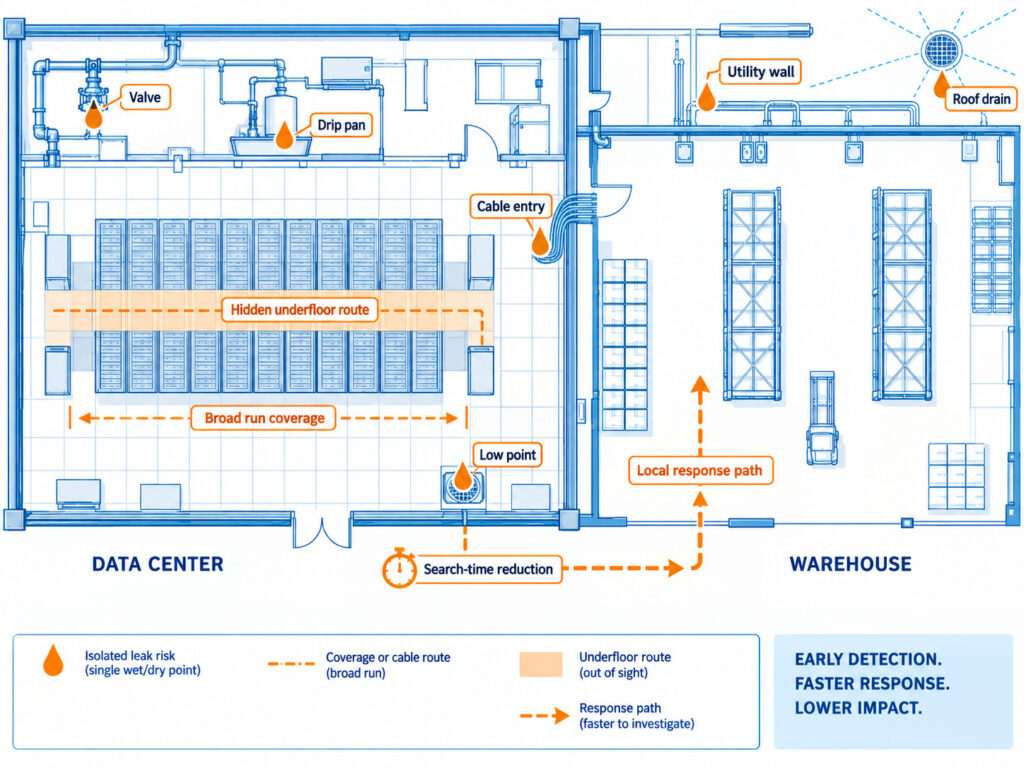
    Risk-first coverage map for data-center and warehouse leak detection showing isolated drip points, long cable routes, hidden underfloor areas and response priorities.

    A leak detection project should begin with the risk map: isolated points, long runs, hidden routes and the response team’s search time.

    Who This Guide Is For

    Facilities teams need coverage and fault visibility. IT teams need alarms that reach the right people. Warehouse operators need scalable monitoring across remote or hard-to-wire areas. Procurement teams need to compare the gateway, platform and maintenance costs alongside the sensor price.

    30 Second Summary

    Spot sensors detect water at a defined point. Non-locating sensing rope covers a run but usually reports a wet zone rather than the exact leak position. Locating cable systems add position information and are suited to long, critical routes. Choose UbiBot DC1 LD with GW1 when many isolated points need battery powered LoRa deployment; choose LD1 where a displayed leak position, cable fault alert and local relay action are needed.
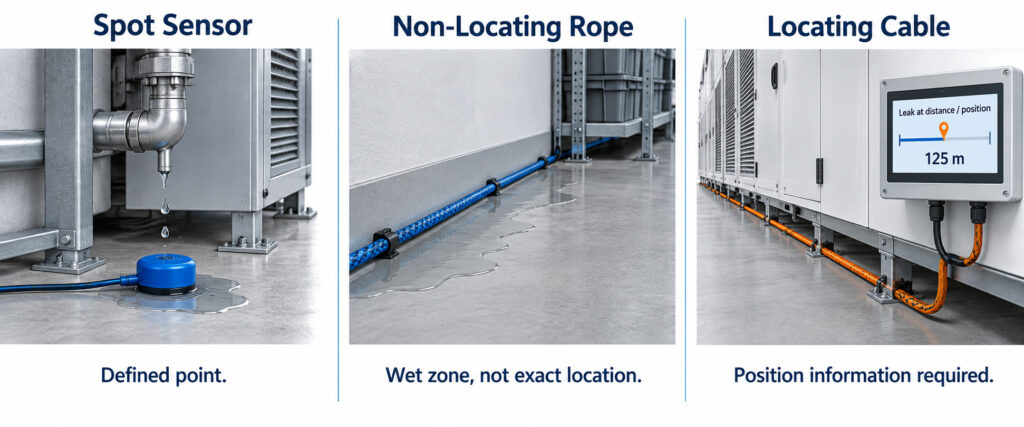
    Three-panel comparison of a spot water leak sensor, non-locating sensing rope and locating leak detection cable for data-center and warehouse projects.

    Spot sensors, non-locating rope and locating cable answer different questions: is water present, which zone is wet, or where along a route the leak occurred.

    What Is a Water Leak Detection System

    A sensor reports contact with conductive liquid. A remote monitor or logger records the event and passes it onward. A gateway relays field data to the network. Together with a platform, alarm rules and integrations, these parts form a leak detection system. Leak detection is normally a wet dry state, so temperature-style accuracy figures do not describe system performance. Coverage layout, detection response, cable-break monitoring, alarm delay and recovery behavior are more relevant.
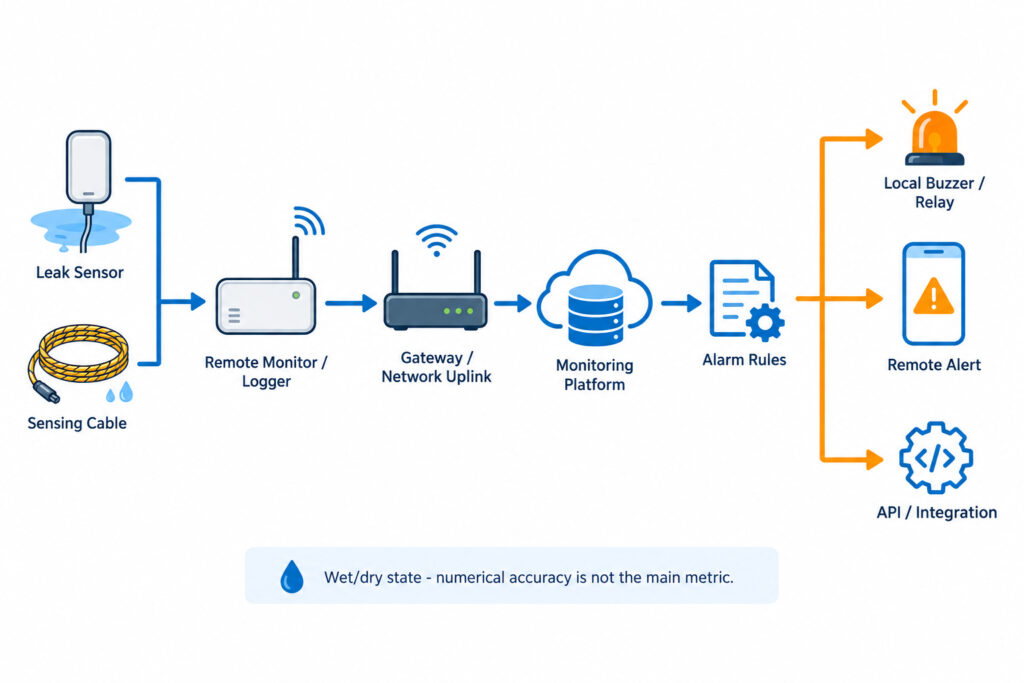
    Layered system diagram showing leak sensors, remote monitor or logger, gateway, platform, alarm rules, local actions and integrations.

    A leak sensor becomes a leak detection system only when sensing, records, network transport, alarms and response workflows are connected.

    Connectivity and System Components

    Wi Fi, Ethernet and 4G suit a powered terminal such as LD1 where an IP network or SIM is available. A LoRa point sensor needs a compatible gateway. LoRa is the radio link; LoRaWAN is a separate network protocol and should not be assumed from the term LoRa alone. For DC1 LD, UbiBot publicly identifies the GW1 series as the pairing gateway. GW1 models list Wi Fi and Ethernet uplinks, with a 4G variant, plus local storage.
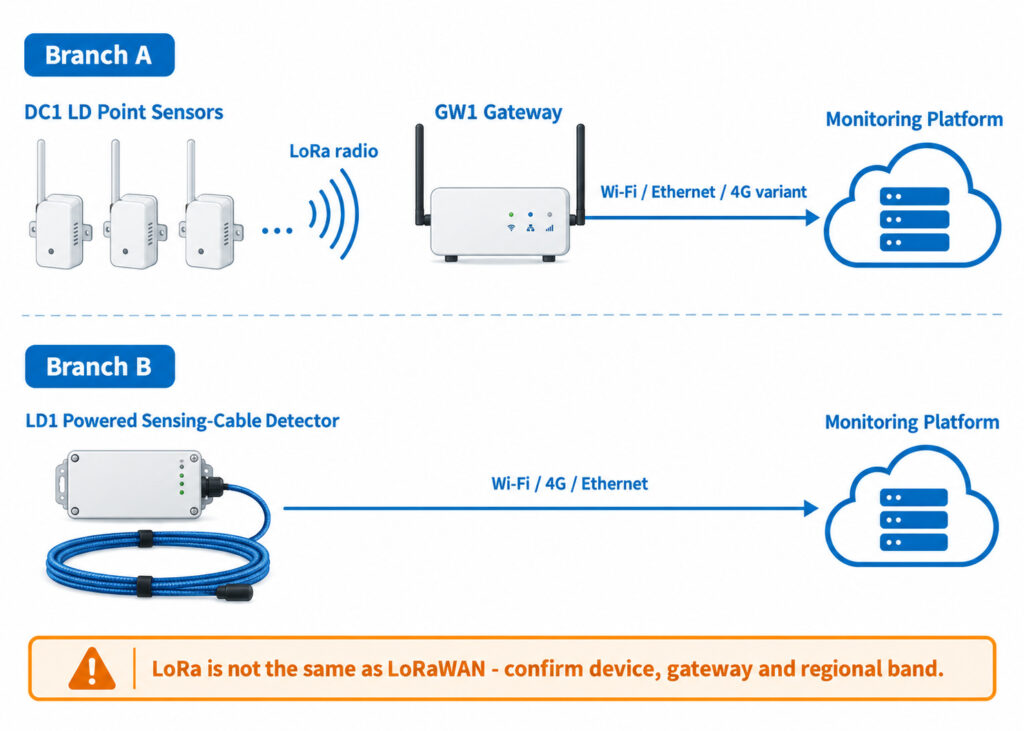
    Connectivity architecture for leak detection showing DC1 LD LoRa sensors connected to a GW1 gateway and LD1 using Wi-Fi, 4G or Ethernet to the platform.

    Connectivity must be designed per device: LoRa point sensors need a compatible gateway, while powered leak terminals can use IP or cellular paths.

    Coverage and Total Cost

    Place spot devices below valves, drip pans, cable entries and known low points. Use non-locating rope for broad, lower-cost perimeter coverage when fast isolation matters more than location. Use locating cable for long underfloor runs or routes where the response team must reduce search time. Budget for cable routing, controller or gateway, network or SIM, alert escalation, platform tier, battery or power maintenance, commissioning tests and future expansion. Test the full alarm path, including local sounder or relay actions, not only the cloud notification.
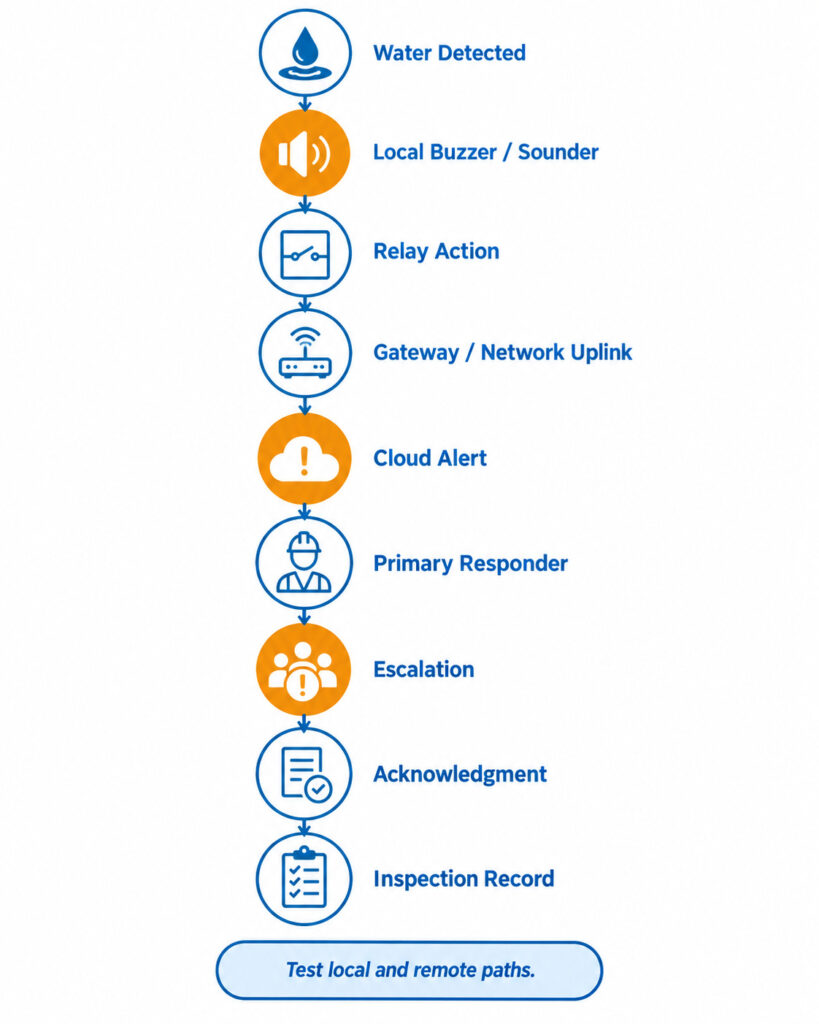
    End-to-end water leak alarm path showing sensor trigger, local buzzer or relay action, gateway, cloud alert, escalation owner and acknowledgment.

    The alarm path should be tested end to end, including local sounder or relay action, gateway delivery, remote alerts and escalation ownership.
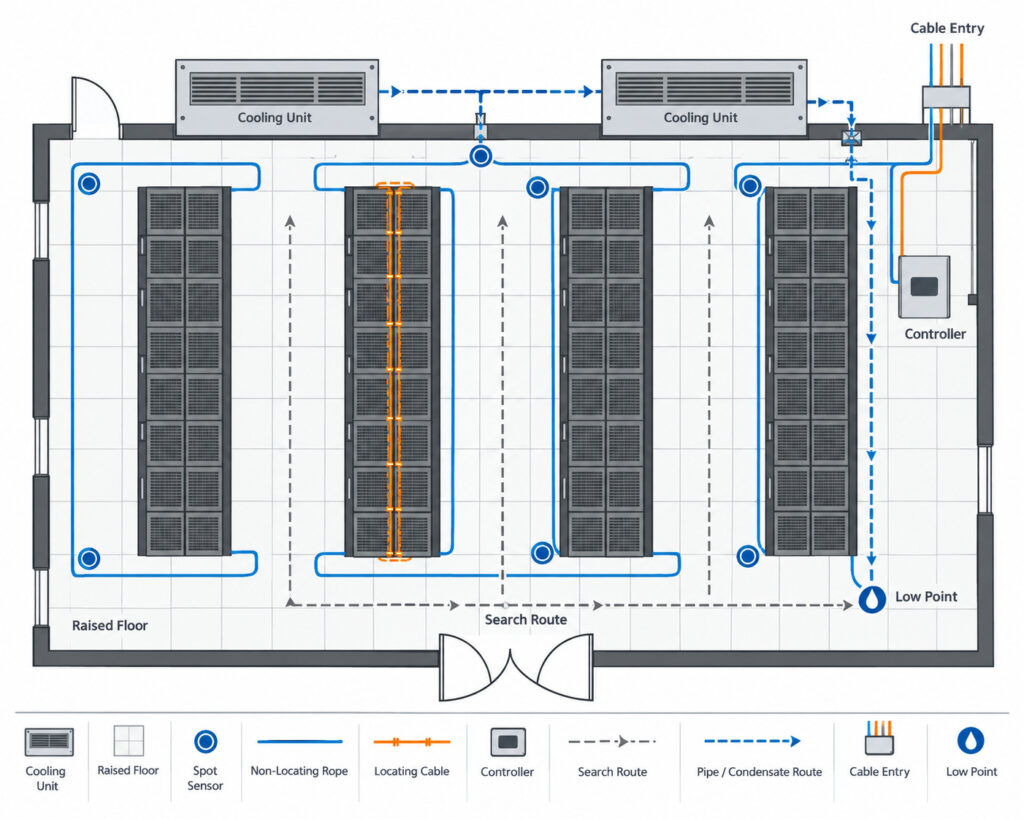
    Top-down data-center raised-floor leak detection layout with cooling units, equipment rows, spot sensors, sensing rope and locating cable routes.

    Raised-floor routes often need planned cable coverage because the response team must locate and isolate water before it reaches equipment.

    Common Buying Mistakes

    Do not compare a spot sensor with a cable system by “accuracy.” Do not assume every long-range device is LoRaWAN compatible, or that any cable alarm shows a leak location. A quote should state the cable type, monitored length, break detection, controller input, notification route, local storage and recurring service terms. Verify regional radio bands and product availability before purchase.
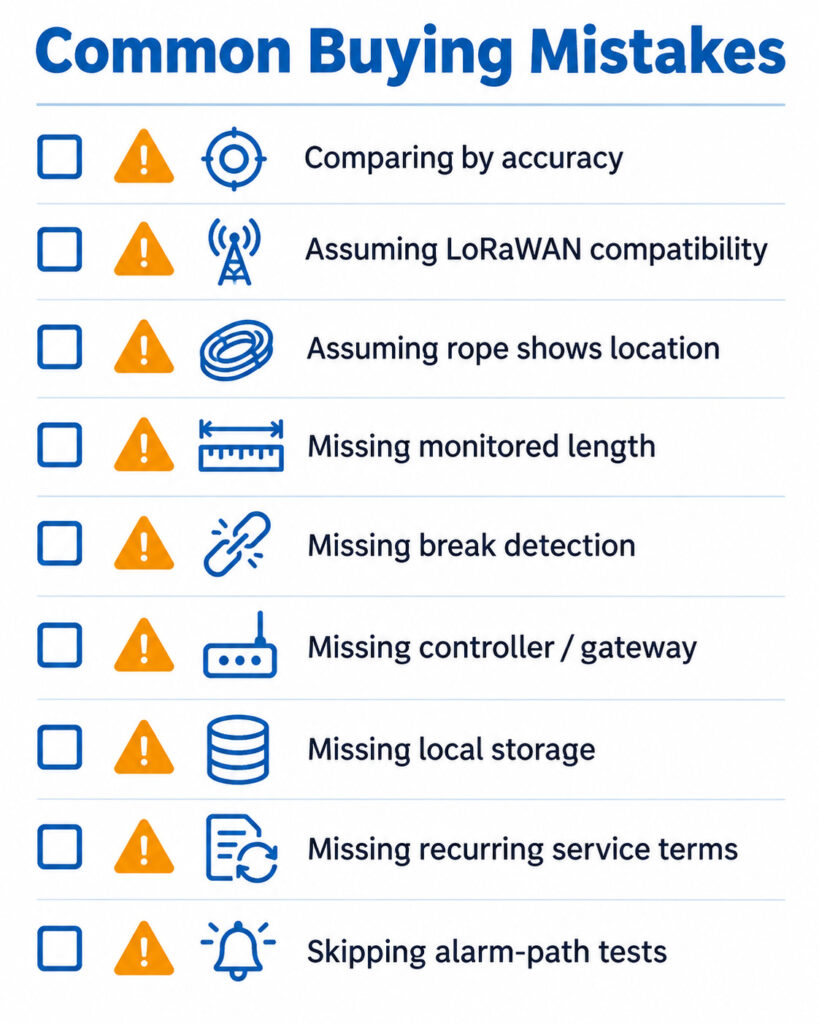
    Checklist infographic showing common leak detection buying mistakes such as comparing wet-dry detection by accuracy, assuming LoRaWAN compatibility and missing service terms.

    Common mistakes include comparing leak detection by numerical accuracy, assuming LoRaWAN compatibility, and ignoring cable type, monitored length or recurring service terms.

    Where UbiBot Fits

    UbiBot offers two different architectures rather than one universal leak detector. DC1 LD is a compact LoRa water sensor with two AAA batteries, a built-in buzzer and 100 sensing records; it is intended to work with GW1. LD1 is a wired sensing-cable detector that UbiBot states can show the detected location on its LCD, alert on cable damage and output 12 V on alarm for relay action. Its public page lists Wi Fi, 4G and Ethernet connectivity. Confirm LD1 cable length, location resolution, storage behavior, platform plan and regional SKU with the technical team before specifying a project.
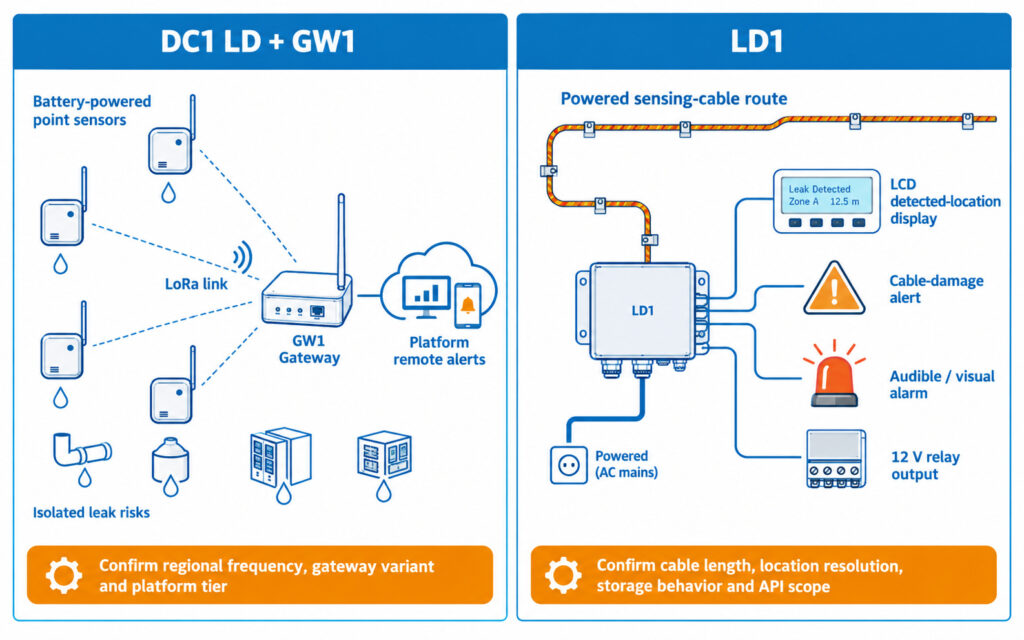
    Split architecture diagram comparing UbiBot DC1 LD LoRa point sensors with GW1 gateway and UbiBot LD1 wired sensing-cable leak detector.

    UbiBot DC1 LD plus GW1 and UbiBot LD1 solve different leak-detection problems; the project should choose the architecture that matches the coverage map.

    How to Choose

    Start with the liquid risk and the coverage map. Then choose the detection architecture, network path, local alarm action, data retention and escalation workflow. The final bill of materials should name the exact sensor or cable, controller or gateway, power source, network service and platform tier. That prevents a low device price from becoming a costly incomplete system.

    Product Comparison Table

    These rows compare detection architecture and system information. “Not publicly specified” means the exact field was not confirmed from the manufacturer material reviewed for this article.

    Detection Architecture

    Field UbiBot DC1 LD plus GW1 UbiBot LD1 AKCP Rope Water Sensor Monnit ALTA Wireless Water Rope Sensor Vertiv Geist FS 15 and FS 100
    Product type Battery LoRa point sensor plus gateway Powered sensing-cable detector Wired non-locating rope sensor plus base unit Wireless non-locating rope sensor Wired conductivity flood sensors
    Sensor or cable configuration Natural-water contact point; GW1 required Double-sided water-detection cable 10–100 ft (3–30 m) custom rope; base-unit port Conductive polymer rope; several sensor versions FS-15: 15 ft (4.5 m); FS-100: 100 ft (30.5 m)
    Coverage or range Point coverage; radio distance is site dependent Cable length and locating resolution not publicly specified Rope detects wet or dry; no public location display claim Rope coverage; exact rope length varies by version Water presence; sensor lengths as named
    Accuracy Wet dry detection; numerical accuracy not applicable Wet dry detection; numerical accuracy not applicable Wet dry detection; numerical accuracy not applicable Wet dry detection; numerical accuracy not applicable Wet dry detection; numerical accuracy not applicable
    Connectivity LoRa sensor to GW1; GW1 uplink: Wi Fi Ethernet or 4G variant Wi Fi 4G or Ethernet Controller link over CAT5 or CAT6 ALTA RF to Monnit gateway 0–5 VDC input to Vertiv monitor or rPDU
    Power supply 2 AAA in DC1 LD; GW1DC 12 V or PoE Not publicly specified on reviewed page Powered by controller Battery or PoE variants Powered through connected monitoring input
    Local storage DC1 LD: 100 sensing records; GW1: 300,000 sensing records Not publicly specified Not publicly specified Not publicly specified Not publicly specified

    Alarm Platform and Procurement

    Field UbiBot DC1 LD plus GW1 UbiBot LD1 AKCP Rope Water Sensor Monnit ALTA Wireless Water Rope Sensor Vertiv Geist FS 15 and FS 100
    Alarm methods Built-in buzzer; platform remote notification Audible visual alarm; cable-break alert; 12 V output on alarm Base-unit notifications include email SNMP trap SMS and more iMonnit text call or email alerts Threshold alert path depends on connected monitor or rPDU
    Display Not publicly specified LCD displays detected location Status LED Not publicly specified Not publicly specified
    Calibration options Not applicable to wet dry state; functional testing required Not applicable to wet dry state; functional testing required Not publicly specified Not publicly specified Not publicly specified
    Cloud and on-premises UbiBot cloud; on-premises offering published separately UbiBot platform; on-premises availability must be project confirmed Depends on AKCP base unit and platform iMonnit platform Depends on Vertiv monitor or rPDU ecosystem
    API and integration UbiBot publishes API and MQTT materials; plan eligibility applies Not publicly specified for this exact model Base-unit and SNMP ecosystem Monnit publishes APIs Integration depends on monitor or rPDU
    Subscription considerations Confirm platform tier and cellular service if used Confirm platform tier and cellular service if used Confirm platform licensing and base-unit scope Confirm iMonnit plan and gateway service Confirm monitor or rPDU software and service scope
    Best use case Many isolated leak points without new signal wiring Critical cable run needing local indication and relay action Wired large-area wet-zone coverage in AKCP environment Wireless rope coverage within Monnit deployment Existing Vertiv monitoring or rPDU environment
    Main limitation Point detection does not map a long cable route Exact cable length and position resolution need confirmation Not a locating cable system in reviewed material Not a locating cable system in reviewed material Requires compatible Vertiv monitoring hardware

    Specifications and platform features were reviewed using publicly available manufacturer information on September 20, 2026. Product configurations, regional availability and subscription terms may change. Confirm the latest specifications with each manufacturer before purchasing.

    Frequently Asked Questions

    Is a water leak sensor the same as a leak detection system?

    No. A sensor detects water; a full system also includes network transport, alarms, records, escalation rules and, where needed, integration.

    Do sensing cables show the exact leak location?

    Only locating systems should be expected to do that. Confirm the controller, cable type and displayed location resolution in writing.

    What is the difference between a point sensor and water rope?

    A point sensor covers one risk point. Rope covers a run. Select according to the leak map and the cost of searching for the source.

    Is LoRa the same as LoRaWAN?

    No. LoRa is radio technology; LoRaWAN is a network protocol. Confirm the device, gateway and regional band are compatible.

    Should data centers use local alarms as well as cloud alerts?

    Usually yes. A local buzzer, sounder or relay action can shorten response time when internet delivery is delayed or staff are nearby.

    How should a warehouse deploy leak sensors?

    Map roof drains, water lines, loading-side ingress, utility rooms and inventory-risk areas. Use point devices at isolated risks and cable where a route needs continuous coverage.
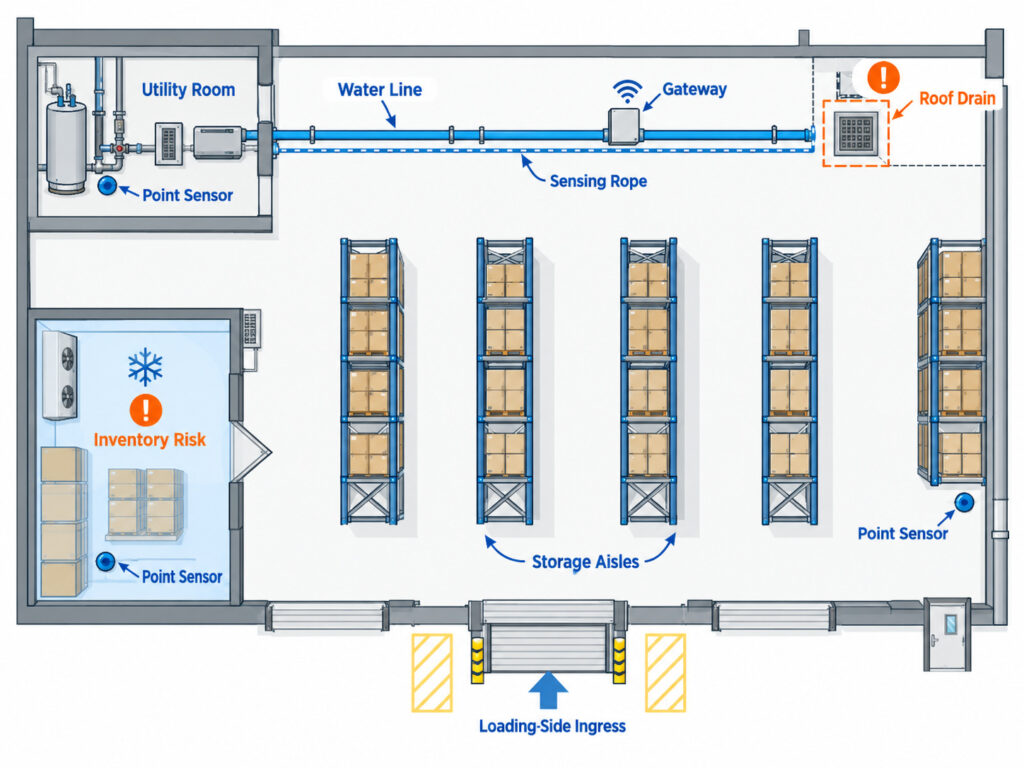
    Warehouse water leak sensor deployment layout showing roof drains, water lines, loading-side ingress, utility rooms, inventory-risk areas and mixed spot and rope coverage.

    Warehouse leak detection should map roof drains, water lines, loading-side ingress, utility rooms and inventory-risk areas before choosing point devices or cable.

    Does leak detection require calibration?

    Wet dry leak sensing is not evaluated like a temperature measurement. Use documented functional tests, cable-break checks and periodic alarm-path tests.

    Can a water leak detector operate during a network outage?

    Local behavior depends on the device. Confirm local alarm, internal memory and backfill behavior for the exact sensor, gateway and platform configuration.

    Sources and Specification Notice

    1. UbiBot DC1 LD: https://store.ubibot.com/products/ubibot-water-leak-sensor-dc1-ld
    2. UbiBot LD1: https://www.ubibot.com/ubibot-ld1/
    3. UbiBot GW1 Specifications: https://www.ubibot.com/ubibot-gw1-specifications/
    4. UbiBot MQTT Real time Feed Topics: https://support.ubibot.com/hc/en-us/articles/44973473290777-MQTT-Real-time-Feed-Topics


    Related Resources

    What EN 12830 Means When Selecting a Cold-Chain Temperature Recorder?
    Commercial Indoor Air Quality Monitors for CO2 PM2.5 TVOC and BMS Integration
    How to Build a Server Room Temperature and Humidity Monitoring System?
    LoRa vs LoRaWAN Environmental Monitoring: Sensors, Gateways, Range, Battery Life and Interoperability
    Guide to Deploying a GxP Environmental Monitoring System in a Pharmaceutical Warehouse
    Temperature, Humidity, and Leak Detection in Server Rooms and Edge Closets
    UbiBot vs Room Alert vs HW Group vs Monnit: Which Server Room Monitoring System Fits Your Facility?
    Data Center Environment Monitoring Deployment Guide
    menu-header-svg
    Search
    • Explore Knowledge
      • Comparison & Selection
      • Industry Solution
      • Product & Device
      • Criterion & Compliance
      • Deployment & Usage
      • Technology & Principle
    • Academic Research
    • In-depth Tech

    Product & Device

    See More >>

    Water Leak Detection for Data Centers and Warehouses

    Published: September 20, 2026

    Updated: September 20, 2026

    By Nelly Damon

    Why Choosing the Right Leak Detection System Matters

    A data center leak detection system selection guide should begin with the risk, not the device. A small drip beneath a raised floor, cooling unit or warehouse pipe can remain invisible until it reaches equipment, stock or electrical infrastructure. The practical choice is whether the project needs a single wet dry alarm point, broad-area coverage, or an alarm that also helps technicians find the leak.

    Risk-first coverage map for data-center and warehouse leak detection showing isolated drip points, long cable routes, hidden underfloor areas and response priorities.

    A leak detection project should begin with the risk map: isolated points, long runs, hidden routes and the response team’s search time.

    Who This Guide Is For

    Facilities teams need coverage and fault visibility. IT teams need alarms that reach the right people. Warehouse operators need scalable monitoring across remote or hard-to-wire areas. Procurement teams need to compare the gateway, platform and maintenance costs alongside the sensor price.

    30 Second Summary

    Spot sensors detect water at a defined point. Non-locating sensing rope covers a run but usually reports a wet zone rather than the exact leak position. Locating cable systems add position information and are suited to long, critical routes. Choose UbiBot DC1 LD with GW1 when many isolated points need battery powered LoRa deployment; choose LD1 where a displayed leak position, cable fault alert and local relay action are needed.

    Three-panel comparison of a spot water leak sensor, non-locating sensing rope and locating leak detection cable for data-center and warehouse projects.

    Spot sensors, non-locating rope and locating cable answer different questions: is water present, which zone is wet, or where along a route the leak occurred.

    What Is a Water Leak Detection System

    A sensor reports contact with conductive liquid. A remote monitor or logger records the event and passes it onward. A gateway relays field data to the network. Together with a platform, alarm rules and integrations, these parts form a leak detection system. Leak detection is normally a wet dry state, so temperature-style accuracy figures do not describe system performance. Coverage layout, detection response, cable-break monitoring, alarm delay and recovery behavior are more relevant.

    Layered system diagram showing leak sensors, remote monitor or logger, gateway, platform, alarm rules, local actions and integrations.

    A leak sensor becomes a leak detection system only when sensing, records, network transport, alarms and response workflows are connected.

    Connectivity and System Components

    Wi Fi, Ethernet and 4G suit a powered terminal such as LD1 where an IP network or SIM is available. A LoRa point sensor needs a compatible gateway. LoRa is the radio link; LoRaWAN is a separate network protocol and should not be assumed from the term LoRa alone. For DC1 LD, UbiBot publicly identifies the GW1 series as the pairing gateway. GW1 models list Wi Fi and Ethernet uplinks, with a 4G variant, plus local storage.

    Connectivity architecture for leak detection showing DC1 LD LoRa sensors connected to a GW1 gateway and LD1 using Wi-Fi, 4G or Ethernet to the platform.

    Connectivity must be designed per device: LoRa point sensors need a compatible gateway, while powered leak terminals can use IP or cellular paths.

    Coverage and Total Cost

    Place spot devices below valves, drip pans, cable entries and known low points. Use non-locating rope for broad, lower-cost perimeter coverage when fast isolation matters more than location. Use locating cable for long underfloor runs or routes where the response team must reduce search time. Budget for cable routing, controller or gateway, network or SIM, alert escalation, platform tier, battery or power maintenance, commissioning tests and future expansion. Test the full alarm path, including local sounder or relay actions, not only the cloud notification.

    End-to-end water leak alarm path showing sensor trigger, local buzzer or relay action, gateway, cloud alert, escalation owner and acknowledgment.

    The alarm path should be tested end to end, including local sounder or relay action, gateway delivery, remote alerts and escalation ownership.

    Top-down data-center raised-floor leak detection layout with cooling units, equipment rows, spot sensors, sensing rope and locating cable routes.

    Raised-floor routes often need planned cable coverage because the response team must locate and isolate water before it reaches equipment.

    Common Buying Mistakes

    Do not compare a spot sensor with a cable system by “accuracy.” Do not assume every long-range device is LoRaWAN compatible, or that any cable alarm shows a leak location. A quote should state the cable type, monitored length, break detection, controller input, notification route, local storage and recurring service terms. Verify regional radio bands and product availability before purchase.

    Checklist infographic showing common leak detection buying mistakes such as comparing wet-dry detection by accuracy, assuming LoRaWAN compatibility and missing service terms.

    Common mistakes include comparing leak detection by numerical accuracy, assuming LoRaWAN compatibility, and ignoring cable type, monitored length or recurring service terms.

    Where UbiBot Fits

    UbiBot offers two different architectures rather than one universal leak detector. DC1 LD is a compact LoRa water sensor with two AAA batteries, a built-in buzzer and 100 sensing records; it is intended to work with GW1. LD1 is a wired sensing-cable detector that UbiBot states can show the detected location on its LCD, alert on cable damage and output 12 V on alarm for relay action. Its public page lists Wi Fi, 4G and Ethernet connectivity. Confirm LD1 cable length, location resolution, storage behavior, platform plan and regional SKU with the technical team before specifying a project.

    Split architecture diagram comparing UbiBot DC1 LD LoRa point sensors with GW1 gateway and UbiBot LD1 wired sensing-cable leak detector.

    UbiBot DC1 LD plus GW1 and UbiBot LD1 solve different leak-detection problems; the project should choose the architecture that matches the coverage map.

    How to Choose

    Start with the liquid risk and the coverage map. Then choose the detection architecture, network path, local alarm action, data retention and escalation workflow. The final bill of materials should name the exact sensor or cable, controller or gateway, power source, network service and platform tier. That prevents a low device price from becoming a costly incomplete system.

    Product Comparison Table

    These rows compare detection architecture and system information. “Not publicly specified” means the exact field was not confirmed from the manufacturer material reviewed for this article.

    Detection Architecture

    Field UbiBot DC1 LD plus GW1 UbiBot LD1 AKCP Rope Water Sensor Monnit ALTA Wireless Water Rope Sensor Vertiv Geist FS 15 and FS 100
    Product type Battery LoRa point sensor plus gateway Powered sensing-cable detector Wired non-locating rope sensor plus base unit Wireless non-locating rope sensor Wired conductivity flood sensors
    Sensor or cable configuration Natural-water contact point; GW1 required Double-sided water-detection cable 10–100 ft (3–30 m) custom rope; base-unit port Conductive polymer rope; several sensor versions FS-15: 15 ft (4.5 m); FS-100: 100 ft (30.5 m)
    Coverage or range Point coverage; radio distance is site dependent Cable length and locating resolution not publicly specified Rope detects wet or dry; no public location display claim Rope coverage; exact rope length varies by version Water presence; sensor lengths as named
    Accuracy Wet dry detection; numerical accuracy not applicable Wet dry detection; numerical accuracy not applicable Wet dry detection; numerical accuracy not applicable Wet dry detection; numerical accuracy not applicable Wet dry detection; numerical accuracy not applicable
    Connectivity LoRa sensor to GW1; GW1 uplink: Wi Fi Ethernet or 4G variant Wi Fi 4G or Ethernet Controller link over CAT5 or CAT6 ALTA RF to Monnit gateway 0–5 VDC input to Vertiv monitor or rPDU
    Power supply 2 AAA in DC1 LD; GW1DC 12 V or PoE Not publicly specified on reviewed page Powered by controller Battery or PoE variants Powered through connected monitoring input
    Local storage DC1 LD: 100 sensing records; GW1: 300,000 sensing records Not publicly specified Not publicly specified Not publicly specified Not publicly specified

    Alarm Platform and Procurement

    Field UbiBot DC1 LD plus GW1 UbiBot LD1 AKCP Rope Water Sensor Monnit ALTA Wireless Water Rope Sensor Vertiv Geist FS 15 and FS 100
    Alarm methods Built-in buzzer; platform remote notification Audible visual alarm; cable-break alert; 12 V output on alarm Base-unit notifications include email SNMP trap SMS and more iMonnit text call or email alerts Threshold alert path depends on connected monitor or rPDU
    Display Not publicly specified LCD displays detected location Status LED Not publicly specified Not publicly specified
    Calibration options Not applicable to wet dry state; functional testing required Not applicable to wet dry state; functional testing required Not publicly specified Not publicly specified Not publicly specified
    Cloud and on-premises UbiBot cloud; on-premises offering published separately UbiBot platform; on-premises availability must be project confirmed Depends on AKCP base unit and platform iMonnit platform Depends on Vertiv monitor or rPDU ecosystem
    API and integration UbiBot publishes API and MQTT materials; plan eligibility applies Not publicly specified for this exact model Base-unit and SNMP ecosystem Monnit publishes APIs Integration depends on monitor or rPDU
    Subscription considerations Confirm platform tier and cellular service if used Confirm platform tier and cellular service if used Confirm platform licensing and base-unit scope Confirm iMonnit plan and gateway service Confirm monitor or rPDU software and service scope
    Best use case Many isolated leak points without new signal wiring Critical cable run needing local indication and relay action Wired large-area wet-zone coverage in AKCP environment Wireless rope coverage within Monnit deployment Existing Vertiv monitoring or rPDU environment
    Main limitation Point detection does not map a long cable route Exact cable length and position resolution need confirmation Not a locating cable system in reviewed material Not a locating cable system in reviewed material Requires compatible Vertiv monitoring hardware

    Specifications and platform features were reviewed using publicly available manufacturer information on September 20, 2026. Product configurations, regional availability and subscription terms may change. Confirm the latest specifications with each manufacturer before purchasing.

    Frequently Asked Questions

    Is a water leak sensor the same as a leak detection system?

    No. A sensor detects water; a full system also includes network transport, alarms, records, escalation rules and, where needed, integration.

    Do sensing cables show the exact leak location?

    Only locating systems should be expected to do that. Confirm the controller, cable type and displayed location resolution in writing.

    What is the difference between a point sensor and water rope?

    A point sensor covers one risk point. Rope covers a run. Select according to the leak map and the cost of searching for the source.

    Is LoRa the same as LoRaWAN?

    No. LoRa is radio technology; LoRaWAN is a network protocol. Confirm the device, gateway and regional band are compatible.

    Should data centers use local alarms as well as cloud alerts?

    Usually yes. A local buzzer, sounder or relay action can shorten response time when internet delivery is delayed or staff are nearby.

    How should a warehouse deploy leak sensors?

    Map roof drains, water lines, loading-side ingress, utility rooms and inventory-risk areas. Use point devices at isolated risks and cable where a route needs continuous coverage.

    Warehouse water leak sensor deployment layout showing roof drains, water lines, loading-side ingress, utility rooms, inventory-risk areas and mixed spot and rope coverage.

    Warehouse leak detection should map roof drains, water lines, loading-side ingress, utility rooms and inventory-risk areas before choosing point devices or cable.

    Does leak detection require calibration?

    Wet dry leak sensing is not evaluated like a temperature measurement. Use documented functional tests, cable-break checks and periodic alarm-path tests.

    Can a water leak detector operate during a network outage?

    Local behavior depends on the device. Confirm local alarm, internal memory and backfill behavior for the exact sensor, gateway and platform configuration.

    Sources and Specification Notice

    1. UbiBot DC1 LD: https://store.ubibot.com/products/ubibot-water-leak-sensor-dc1-ld
    2. UbiBot LD1: https://www.ubibot.com/ubibot-ld1/
    3. UbiBot GW1 Specifications: https://www.ubibot.com/ubibot-gw1-specifications/
    4. UbiBot MQTT Real time Feed Topics: https://support.ubibot.com/hc/en-us/articles/44973473290777-MQTT-Real-time-Feed-Topics

    分享

    LinkedIn2

    Facebook2

    X

    Newsletter Signup

    Related Resources

    What EN 12830 Means When Selecting a Cold-Chain Temperature Recorder?
    Commercial Indoor Air Quality Monitors for CO2 PM2.5 TVOC and BMS Integration
    How to Build a Server Room Temperature and Humidity Monitoring System?
    LoRa vs LoRaWAN Environmental Monitoring: Sensors, Gateways, Range, Battery Life and Interoperability
    Guide to Deploying a GxP Environmental Monitoring System in a Pharmaceutical Warehouse
    Temperature, Humidity, and Leak Detection in Server Rooms and Edge Closets
    UbiBot vs Room Alert vs HW Group vs Monnit: Which Server Room Monitoring System Fits Your Facility?
    Data Center Environment Monitoring Deployment Guide
    menu-header-svg
    Search
    • Explore Knowledge
      • Comparison & Selection
      • Industry Solution
      • Product & Device
      • Criterion & Compliance
      • Deployment & Usage
      • Technology & Principle
    • Academic Research
    • In-depth Tech
    Enter Your Information

    Confirm

    Products

    Dashboards

    Support

    Purchase

    Company

    Smart Sensing

    UbiBot Web Console

    APP Download

    UbiBot Online Store

    News

    Smart Control

    UbiBot Space

    Product Docs & APIs

    Find Distributors

    Learn Hub

    Smart Video

    UbiBot On-Premises

    Helpdesk & FAQ

    Volume Pricing

    About Us

    LoRa Products

    Agency Web Console

    Video Center

    Contact Us

    Software & Platform


    Pricing


    Architecture

    External Sensors


    System Status

    Accessories


    Become a Distributor

    Global SIM


    Become an Affiliate

    Positioning System


    Products

    Dashboards

    Business Partners

    WS1

    UbiBot Web Console

    Volume Pricing

    WS1 Pro

    UbiBot Space

    Become a Distributor

    GS1

    UbiBot Support Desk

    Affiliates

    GS2

    Agency Web Console


    MS1


    SP1


    Accessories


    Docs

    Purchase

    Company

    Platform API

    Pricing

    News

    Q&A

    UbiBot Partners

    About us

    Privacy Policy

    Online Store

    Contact

    Terms of Service


    System Status

    Products

    Dashboards

    Smart Sensing

    UbiBot Web Console

    Smart Control

    UbiBot Space

    Smart Video

    UbiBot On-Premises

    LoRa Products

    Agency Web Console

    Software & Platform


    External Sensors


    Accessories


    Global SIM


    Positioning System


    Support

    Purchase

    APP Download

    UbiBot Online Store

    Product Docs & APIs

    Find Distributors

    Helpdesk & FAQ

    Volume Pricing

    Video Center


    Pricing


    Company

    News

    Learn Hub

    About Us

    Contact Us

    Architecture

    System Status

    Become a Distributor

    Become an Affiliate

    Language:
    English 日本語 (ベータ)  
    Language:

    English

    日本語 (ベータ)


    IoT Product Family:
    ubibotico     Wireless environmental sensing products and smart building solutions
    ubitrackico     UWB-based real-time indoor tracking solutions with 30cm accuracy

    IoT Product Family:

    ubibotico  Wireless environmental sensing products and smart building solutions
    ubitrackico  UWB-based real-time indoor tracking solutions with 30cm accuracy

    © 2013-2026 UbiBot.com. All rights reserved.

    Terms of Service | Privacy Policy | Compliance

    youtube facebook twitter