

.svg)
LoRa vs LoRaWAN Environmental Monitoring: Sensors, Gateways, Range, Battery Life and Interoperability
Published: September 8, 2026
Update: September 8, 2026
By Nelly Damon
Why Does Choosing the Right LoRa Temperature Humidity Sensor Gateway Matter?
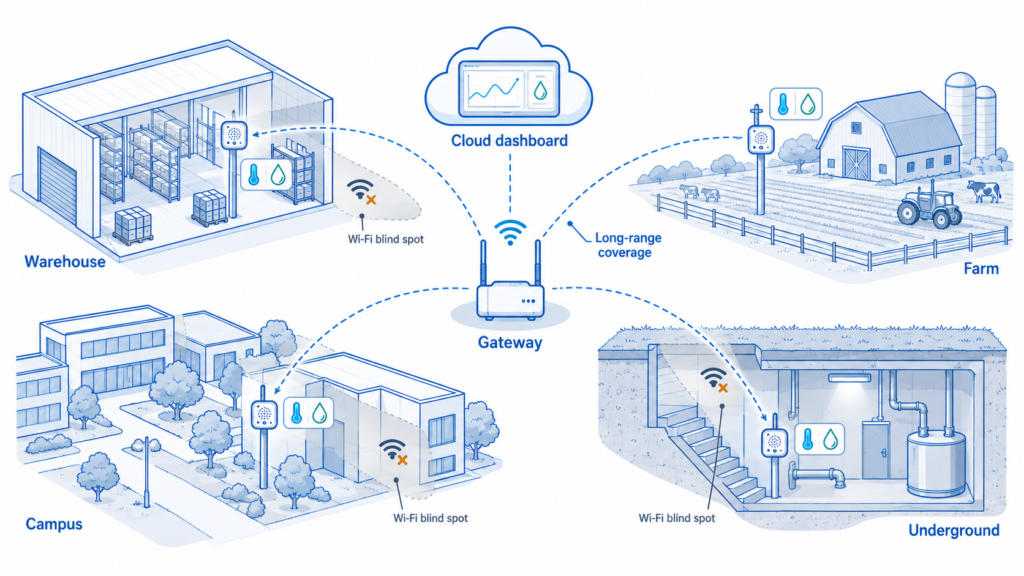
Choosing a LoRa temperature humidity sensor gateway turns a few sensors into a network-design decision. Warehouses, farms, campuses and underground spaces may have Wi-Fi dead zones, high cabling costs or hundreds of battery points. The wrong architecture can create coverage gaps, maintenance burden or incompatible devices.
Long-range environmental monitoring helps cover Wi-Fi blind spots in warehouses, farms, campuses and underground spaces.
Who Is This Guide For?
This guide is for facilities teams, cold-room operators, agriculture specialists, IT/OT engineers, system integrators and buyers comparing range, battery life, regional bands, gateway capacity, offline recovery and interoperability.
30-Second Summary
LoRa is the radio modulation; LoRaWAN is a standardized network protocol built on LoRa. Standard LoRaWAN devices are designed to join compatible LoRaWAN gateways and network servers. UbiBot GW1/GW1-O and DC1-L devices are presented by UbiBot as a LoRa ecosystem, so their interoperability should be evaluated within that documented boundary rather than assumed to be generic LoRaWAN.
For a turnkey UbiBot deployment, GW1 or outdoor GW1-O can aggregate up to 100 UbiBot LoRa nodes; selected nodes buffer data for later resend. Milesight, Dragino and TEKTELIC instead provide standard LoRaWAN sensor-and-gateway options.
What Is the Difference Between LoRa and LoRaWAN?
LoRa is the long-range radio modulation. LoRaWAN defines how end devices join a network and communicate through gateways and a network server. Two products can use LoRa radio without sharing the same LoRaWAN protocol or management model.
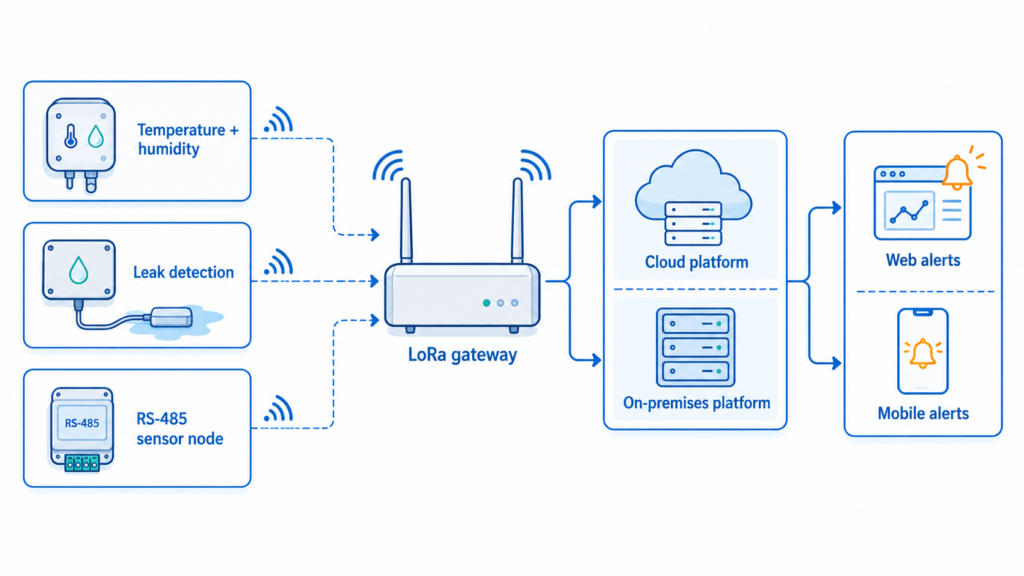
A LoRa environmental monitoring system typically includes sensors, a gateway, a platform and an alert workflow.
What Problems Does Long-Range Wireless Monitoring Solve?
Long-range low-power monitoring reduces Wi-Fi extension and cabling. It suits distributed temperature/humidity, leak detection, agriculture and large facilities, but the design still needs local records, alarm rules and a path to dashboards, APIs or local systems.
What Components Make Up the System?
A complete system includes sensors or RS-485 probes, wireless nodes, gateways, Ethernet/Wi-Fi/4G backhaul, software, alarms and integration interfaces. A sensor alone is not a monitoring system; the data path and platform determine whether readings become reliable records.
Which Sensor and Gateway Specifications Matter Most?
Compare measurement range, sensor accuracy, logger/input accuracy, local memory, retransmission, battery assumptions and calibration separately. Radio range changes with walls, metal, antenna placement, spreading factor and local rules, so pilot representative locations before fixing gateway count.
Which Connectivity Options Should Be Used?
Use Ethernet for stable fixed backhaul, Wi-Fi where coverage is managed, and 4G/LTE for remote or independent links. LoRa/LoRaWAN connects field nodes to gateways; RS-485/Modbus RTU connects wired industrial probes. Large sites often combine them.
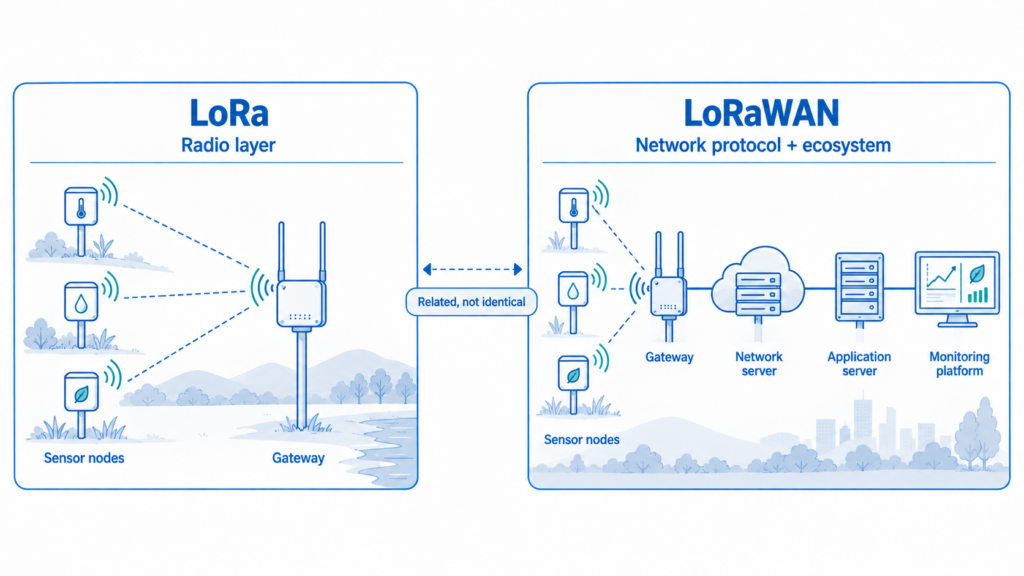
LoRa and LoRaWAN are related but not identical: LoRa is the radio layer, while LoRaWAN is the network protocol and ecosystem.
Which Options Fit Common Use Cases?
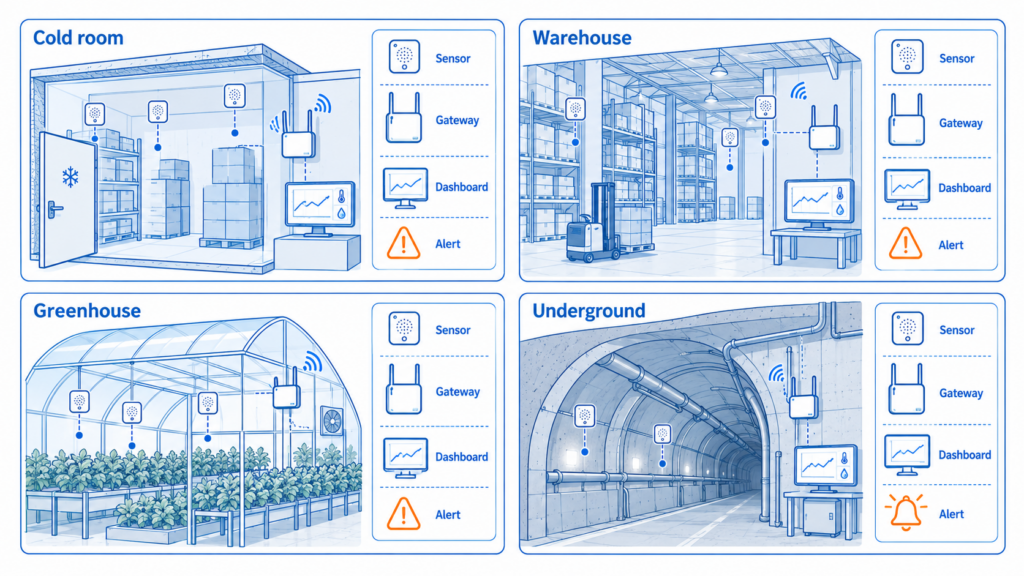
Warehouses can place gateways by building or RF zone; farms may need outdoor gateways; underground spaces need signal tests. Cold rooms require suitable probes and enclosures, not just long radio range. UbiBot adds DC1-L-TH for T/RH, DC1-LD for leaks and DC1-L-1RS for RS-485 sensors.
Long-range sensor and gateway choices should be matched to the environment, node density and power strategy of each site.
How Should Total Cost of Ownership Be Compared?
Compare lifecycle cost, not sensor price. Include gateways, batteries, SIM/data, cloud or server fees, calibration, installation, API work and expansion. Standard LoRaWAN can widen vendor choice; an integrated stack can reduce setup and support effort.
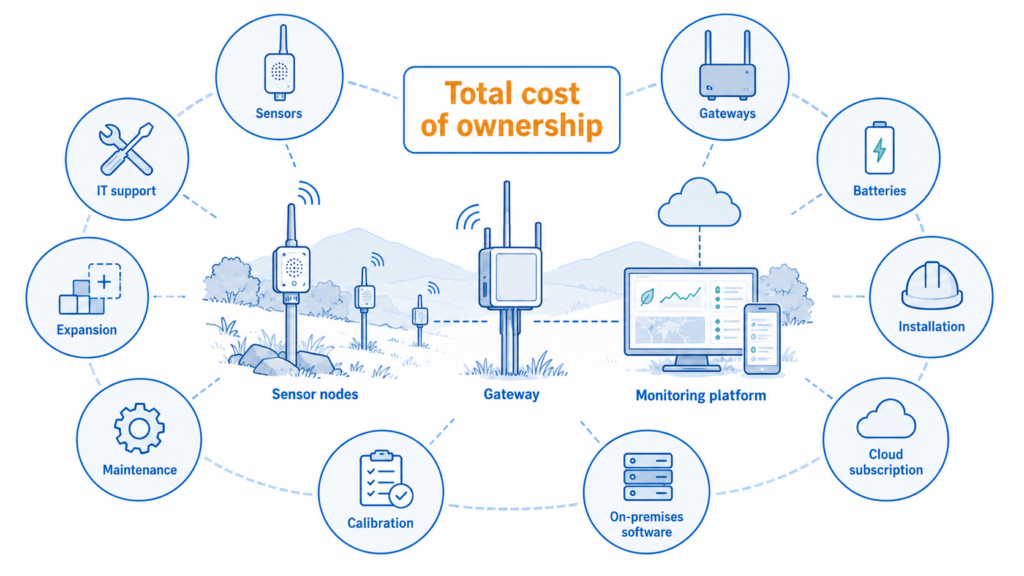
Total cost of ownership depends on more than hardware, including gateways, batteries, subscriptions, maintenance and scaling costs.
What Buying Mistakes Should You Avoid?
Avoid treating LoRa and LoRaWAN as synonyms, buying the wrong regional band, assuming outdoor range indoors, ignoring offline storage, using unsuitable cold-room probes, or overlooking platform/network-server costs. Confirm SKU, firmware and compatibility before purchase.
Where Does UbiBot Fit?
UbiBot fits projects wanting an integrated GW1/GW1-O, UbiBot LoRa nodes, local buffering, public/cloud or on-premises software and API/data forwarding. GW1 supports up to 100 UbiBot LoRa nodes. Current product pages describe these devices as LoRa, so universal LoRaWAN interoperability should not be assumed.
Conclusion: How Do You Choose the Right System?
Start with parameter, accuracy, point count, RF environment, regional band, offline retention and backhaul. Then choose between a vendor-integrated LoRa stack and a standard LoRaWAN architecture. Pilot representative locations, calculate lifecycle cost and verify the exact sensor-gateway-platform combination before scaling.
Pre-Purchase Decision Checklist
| Decision area | Confirm before purchase |
| Measurement | Required parameters, operating range, accuracy and calibration evidence |
| RF design | Regional band, obstruction profile, antenna position and pilot-test results |
| Data continuity | Node memory, gateway memory, retransmission and original timestamps |
| Scale | Nodes per gateway, reporting interval, airtime and future site expansion |
| Platform | Cloud/on-premises choice, alerts, API, network server and data ownership |
| TCO | Hardware, batteries, gateways, SIM/data, software, maintenance and integration |
Product Comparison Table
Comparison configurations: UbiBot GW1/GW1-O + DC1-L-TH/DC1-LD/DC1-L-1RS; Milesight EM300-TH + UG65; Dragino LHT65N + LG308N; TEKTELIC TUNDRA + KONA Micro. Values below come from official manufacturer pages or manuals reviewed on September 8, 2026.
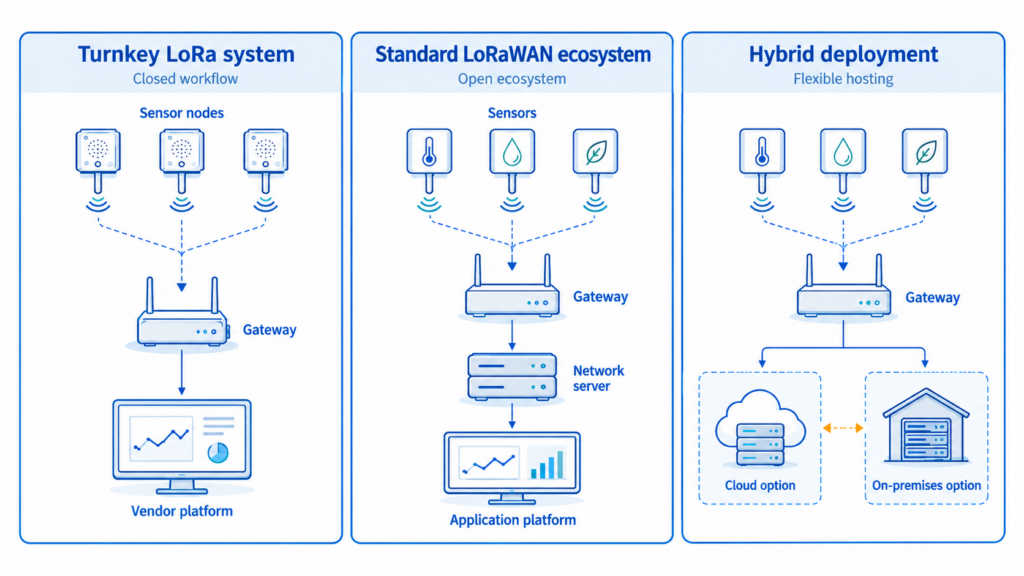
Different long-range monitoring architectures serve different deployment needs, from turnkey systems to standard LoRaWAN ecosystems.
| Comparison item | UbiBot | Milesight | Dragino | TEKTELIC |
| Product type | Integrated UbiBot LoRa gateway + sensor ecosystem | Standard LoRaWAN sensor + 8-channel gateway | Standard LoRaWAN sensor + SX1302 gateway | Standard LoRaWAN cold-chain sensor + KONA gateway |
| Sensor / probe configuration | DC1-L-TH T/RH; DC1-LD leak; DC1-L-1RS for RS-485 probes | EM300-TH built-in T/RH | LHT65N built-in T/RH; optional external temperature probe | TUNDRA ambient T/RH; optional external temperature probe |
| Measurement range | DC1-L-TH: -20 to 60°C; RH 0-100% | EM300-TH: -30 to 70°C; RH 0-100% | LHT65N: -40 to 85°C; RH 0-96%; ext. temp -55 to 125°C | TUNDRA operating -40 to 70°C; RH 5-95%; ext. probe -40 to 105°C |
| Published accuracy | DC1-L-TH ±0.2°C (0-60°C); ±2% RH (10-90% RH) | ±0.3°C (0-70°C), ±0.6°C (-30-0°C); ±3% RH (10-90% @25°C) | Typ. ±0.3°C; typ. ±3% RH; ext. probe ±0.5°C (-10 to 85°C) | Ambient temp varies by range (e.g. ±0.3°C -20 to 0°C); RH typ. ±2% (20-80% @25°C); ext. probe ±2°C |
| Radio / interoperability | LoRa; current official pages describe UbiBot GW1-series compatibility with UbiBot LoRa sensors; generic LoRaWAN compatibility not claimed | LoRaWAN; EM300-TH lists compatibility with standard LoRaWAN gateways/network servers | LoRaWAN v1.0.3 Class A; works with standard LoRaWAN gateway | LoRaWAN; TUNDRA datasheet states compatibility with standard LoRaWAN gateways/network servers |
| Regional bands | EU868, US915, AU915, IN865, RU864, KR920, AS923 | CN470, IN865, RU864, EU868, US915, AU915, KR920, AS923 variants | CN470, EU433, KR920, US915, EU868, AS923, AU915 | EU868, US915, AU915, AS923, IN865, KR920 (current TUNDRA guide) |
| Gateway backhaul / capacity | GW1: Wi-Fi/Ethernet or Wi-Fi/Ethernet/2G/3G/4G by model; up to 100 UbiBot LoRa nodes; GW1-O outdoor IP65 | UG65: Ethernet, Wi-Fi, optional 4G; official page states up to 2,000 devices | LG308N: Wi-Fi, Ethernet, 3G/4G; 10 programmable parallel demodulation paths | KONA Micro: Ethernet + LTE options; 8 receive channels; optional ~4 h battery backup |
| Local storage | DC1-L-TH and DC1-L-1RS: 50,000 records; DC1-LD: 100; GW1/GW1-O: 300,000 | EM300-TH: 2,800 historical records + retransmission | LHT65N: max 3,328 data-log records + resend/retrieval workflow | TUNDRA: 3,000 stored entries (current datasheet) |
| Power / battery | DC1-L-TH: AA/Li-SOCl2/lithium/DC; DC1-LD: 2xAAA; GW1 DC/PoE; GW1-O PoE or AC | EM300-TH: 4000 mAh Li-SOCl2; current page claims up to 10 years under stated conditions; UG65 PoE/DC | LHT65N: 2400 mAh non-rechargeable, up to 10 years depending on reporting | TUNDRA: 8500 mAh C-cell LTC, up to 15+ years depending on interval/temp; KONA Micro mains/PoE with optional backup |
| Alarm methods | UbiBot platform remote alerts; DC1-LD also has local buzzer | Milesight IoT Cloud supports real-time alerts/reports | Depends on selected LoRaWAN network/application server | Depends on selected TEKTELIC/third-party application stack |
| Display | No local display on listed nodes | No local display | Tri-color status LED; no measurement display | Status LEDs; no measurement display |
| Calibration options | UbiBot calibration resources/services available; confirm certificate scope for project | EN12830 listed for EM300-TH; calibration certificate option not established from reviewed page | Not publicly specified on reviewed product page | Not publicly specified on reviewed product page |
| Cloud platform | UbiBot Public IoT Platform | Milesight IoT Cloud / Development Platform | Choice of third-party LoRaWAN/IoT platform | TEKTELIC CORE/Locus or third-party stack, depending project |
| On-premises option | UbiBot On-Premises Platform available | UG65 includes embedded network-server functions; application stack depends deployment | LG308N supports flexible server integration; application hosting depends chosen stack | TEKTELIC offers embedded network-server options on KONA gateways; confirm exact Micro configuration |
| API / integration | REST API, MQTT, HTTP, data forwarding; OPP database/API integration | Gateway HTTP and MQTT API documentation published | Depends on chosen network server/application; gateway is open-source oriented | Depends on CORE/Locus/embedded LNS stack; TEKTELIC publishes integration options |
| Subscription considerations | Public platform has free/paid tiers; OPP quoted separately | Cloud/platform terms vary by region and plan | No single mandatory Dragino cloud identified; third-party platform/server may add cost | Platform/network-server licensing depends chosen architecture |
| Best use case | Turnkey UbiBot long-range monitoring with mixed UbiBot LoRa sensors, up to 100 nodes/gateway | Large standard-LoRaWAN sensor fleets and high gateway capacity | Integrator-led standard LoRaWAN projects requiring open server choice | Cold-chain/industrial LoRaWAN projects prioritizing interoperability and long battery life |
| Main limitation | Do not assume generic LoRaWAN interoperability without specific confirmation | Cloud licensing and exact architecture should be confirmed before rollout | More integration responsibility; platform and support model depend deployment | TUNDRA measurement accuracy varies by temperature range; verify fit for high-accuracy applications |
Table conclusion: Milesight, Dragino and TEKTELIC provide standard LoRaWAN endpoints and gateways, which is valuable when third-party interoperability is a core requirement. UbiBot is better framed as an integrated LoRa monitoring stack whose advantage is fast deployment with UbiBot nodes, gateway backhaul options, local buffering, cloud/on-premises paths and APIs. The trade-off is that generic LoRaWAN interoperability should not be assumed from the current official product pages.
Specification notice: Specifications and platform features were reviewed using publicly available manufacturer information on September 8, 2026. Product configurations, regional availability and subscription terms may change. Confirm the latest specifications with each manufacturer before purchasing.
Frequently Asked Questions
1. Is LoRa the same as LoRaWAN?
No. LoRa is the radio modulation, while LoRaWAN is a standardized network protocol that uses LoRa. A device can use LoRa without being a standard LoRaWAN endpoint.
2. Can a LoRa sensor connect to any LoRaWAN gateway?
Not automatically. The sensor must implement a compatible LoRaWAN protocol and regional band. UbiBot currently markets the listed GW1/DC1 products as LoRa devices, so third-party LoRaWAN compatibility should be confirmed rather than assumed.
3. How far can LoRa environmental sensors transmit?
Range depends heavily on antenna placement, obstructions, spreading factor and local radio limits. UbiBot publishes up to 1 km in clear line-of-sight conditions for GW1; Milesight publishes much longer line-of-sight figures for EM300-TH. Treat all range claims as planning references and verify on site.
4. What happens if the gateway or backhaul goes offline?
Use nodes with local data logging and a defined retransmission method. UbiBot DC1-L-TH and DC1-L-1RS store up to 50,000 records, Milesight EM300-TH stores 2,800, Dragino LHT65N up to 3,328, and TEKTELIC TUNDRA 3,000.
5. Which frequency band should I buy?
Buy the SKU intended for the country of deployment. Common bands include EU868, US915, AU915, AS923 and others, but allowed frequencies and channel plans differ by region.
6. Is LoRa suitable for cold rooms?
Yes, but radio range is only one factor. Confirm the logger enclosure, probe type, measurement range, calibration requirements, condensation exposure and battery behavior at low temperature.
7. How many sensors can one gateway support?
Capacity is architecture-specific. UbiBot publishes up to 100 UbiBot LoRa nodes per GW1-series gateway, while Milesight publishes up to 2,000 device connectivity for UG65. Actual practical capacity also depends on reporting interval and airtime.
8. Does a longer battery-life claim mean lower maintenance cost?
Not always. Battery life is affected by reporting interval, spreading factor, retries, temperature and radio conditions. Compare the assumptions behind each vendor estimate and include labor for access and replacement.
9. When should I choose UbiBot instead of a standard LoRaWAN stack?
Choose UbiBot when a packaged UbiBot gateway-node-platform workflow, mixed sensor options, local storage and public/on-premises integration path reduce project complexity. Choose standard LoRaWAN when cross-vendor gateway, network-server or device interoperability is a primary requirement.
Sources and Specification Notice
- UbiBot GW1 LoRa Gateway — official manufacturer/specification source
- UbiBot GW1-O Outdoor LoRa Gateway — official manufacturer/specification source
- UbiBot DC1-L-TH Temperature and Humidity Sensor — official manufacturer/specification source
- UbiBot DC1-LD Water Leak Sensor — official manufacturer/specification source
- UbiBot DC1-L-1RS LoRa Collector — official manufacturer/specification source
- UbiBot Public IoT Platform — official manufacturer/specification source
- UbiBot On-Premises Platform — official manufacturer/specification source
- UbiBot Platform API / Data Forwarding — official manufacturer/specification source