

.svg)
How to Build an Environmental Monitoring System for Food Processing Facilities
Published: August 3, 2026
Update: August 28, 2026
By Susan Jones
Introduction
Food processing facilities rarely operate under one uniform environmental condition. A chilled preparation room, an ambient packaging line, a freezer, a dry ingredient store, a finished-goods cold room, and a refrigeration plant room may all need different sensors, alarm limits, recording intervals, and response procedures. Manual checks can confirm a condition at one moment, but they may miss overnight refrigeration failures, repeated door-related warming, condensation, water leaks, ventilation problems, or a gradual drift that develops between inspections.
This guide is for food safety and quality teams, HACCP coordinators, plant managers, facilities and maintenance personnel, refrigeration engineers, IT departments, and procurement teams. It explains how to define the monitoring scope, separate food-safety measurements from operational context, select communications, compare representative products, and deploy a system across facilities of different sizes without treating a connected sensor as a complete compliance program.
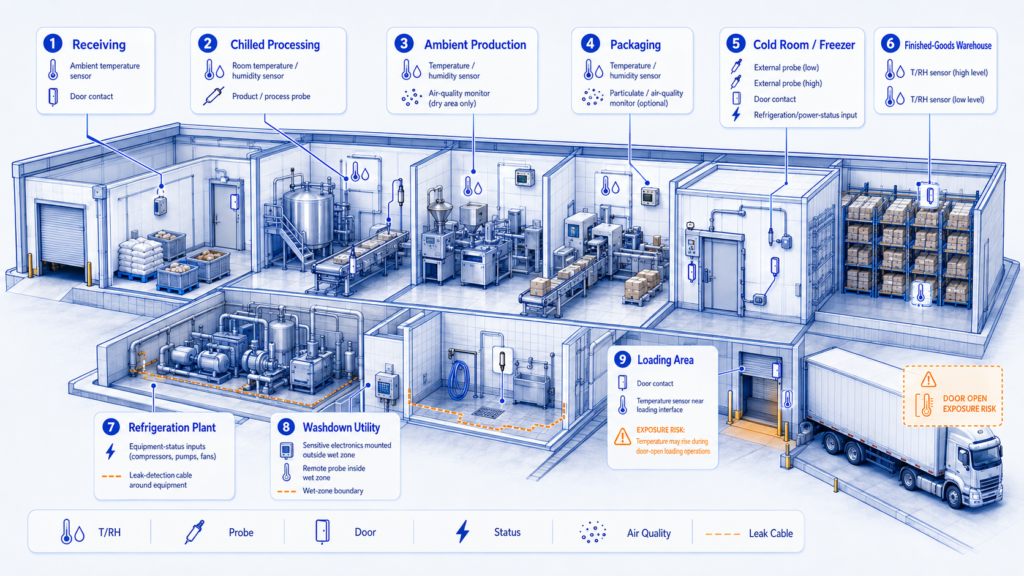
A food processing facility requires zone-specific monitoring because cold rooms, production areas, loading zones and utilities face different environmental risks.
Quick Summary
A food-processing environmental monitoring system should be designed around the facility hazard analysis, product requirements, process zones, utilities, and response workflow. Essential measurements often include cold-room and production-area temperature, with humidity, door, equipment-power, differential-pressure, air-quality, and water-leak data added where they answer a defined risk. Use local storage to preserve records during network outages, choose Ethernet or Wi-Fi for stable fixed sites, cellular for network-independent locations, LoRa for many distributed nodes, and RS485 for wired industrial probes. Physical IoT sensors can support preventive-control and HACCP records, but they do not replace product probes, sanitation verification, or microbiological environmental sampling.
Key Takeaway
The most effective food-plant monitoring system is not the one with the most sensor channels. It is the one that connects each measurement to a defined process risk, preserves trustworthy records through outages, sends actionable alarms to responsible staff, and remains practical to calibrate, clean, review, and scale.
1.Why Is Environmental Monitoring Important in Food Processing Facilities?
Temperature control can protect both safety and quality. Refrigeration may be a preventive control or critical control point when loss of control could permit pathogen growth or toxin formation, while other temperature measurements may be operational limits used to protect texture, shelf life, yield, packaging performance, or equipment reliability. FDA HACCP guidance emphasizes that critical limits must be scientifically based and distinguishes food-safety critical limits from operational limits. The monitoring system should preserve that distinction in channel names, alarm rules, reports, and user training.
The records also support traceability and investigation. A continuous trend can help determine whether a cold-room alarm was caused by a compressor fault, defrost cycle, loading activity, prolonged door opening, sensor placement, or a true product-risk event. Water-leak alerts can provide earlier warning of failed drain lines, condensate problems, damaged pipes, or refrigeration-system leaks before they cause downtime, slip hazards, packaging damage, or sanitation complications.
For facilities subject to FDA preventive-controls requirements, 21 CFR 117.145 requires written monitoring procedures and monitoring at an adequate frequency, with records documenting preventive-control monitoring. The regulation specifically permits affirmative or exception records for refrigeration temperature where time/temperature control is required to control pathogen growth or toxin production. Verification activities under 21 CFR 117.165 include calibration or accuracy checks of monitoring instruments and, where applicable, microbiological environmental monitoring for ready-to-eat foods. Connected temperature, humidity, air-quality, and leak sensors can support parts of this system, but only microbiological sampling can satisfy a pathogen environmental-monitoring procedure.
Manual observations remain useful for pre-operational checks, direct product measurements, sanitation inspections, and verification. Their limitation is coverage: they provide snapshots and depend on staff availability. Automated monitoring improves continuity and exception visibility, but the facility still needs documented responsibilities, corrective actions, record review, calibration, and a method to confirm that alarms are received and acted upon.
2.What Environmental Parameters Should Be Monitored?
| Parameter | Why it matters | Monitoring location | Recommended sensor type |
| Air or process-zone temperature (essential where defined) | Supports refrigeration, cooling, storage, process-control, and quality records. It may be a CCP, preventive-control record, or operational metric depending on the hazard analysis. | Cold processing rooms, packaging areas, ingredient staging, high-care rooms, finished-goods zones. | Calibrated room sensor or external digital/RTD probe selected for the actual range. |
| Cold-room / freezer temperature (essential for temperature-controlled product) | Identifies refrigeration loss, defrost behavior, door-related warming, and long-term drift. | Representative product zone; use multiple points for large rooms, door areas, racks, or mapped hot/cold locations. | External temperature probe or distributed calibrated logger; keep electronics outside harsh zones where appropriate. |
| Relative humidity (conditional) | Affects condensation, mold risk, dry ingredients, packaging, product weight, static, and comfort. | Dry stores, packaging rooms, proofing or curing areas, condensation-prone rooms. | Temperature/RH sensor rated for the environment and cleaning chemistry. |
| Water leakage (conditional but high value) | Provides early warning around evaporators, condensate drains, chillers, freezers, pipework, washdown systems, and utility rooms. | Below refrigeration equipment, along drain routes, under pipework, near floor penetrations and critical electrical areas. | Leak-detection rope or point sensor with local and remote alarm. |
| Equipment power or status (conditional) | Helps distinguish an environmental excursion from loss of compressor, fan, pump, defrost, or electrical power. | Refrigeration panels, cold-room plant, HVAC, pumps and critical utilities. | Dry contact, current, voltage, relay-state, or Modbus/RS485 input. |
| Door status (conditional) | Explains repeated excursions, supports operational improvement, and identifies doors left open. | Cold-room, freezer, loading-bay and high-traffic access points. | Magnetic door contact or digital input; light alone is only indirect context. |
| CO₂, PM and TVOC (optional operational context) | Can support ventilation, combustion, dust, occupancy, and indoor-air investigations, but does not prove hygienic air quality or microbial safety. | Selected production, packaging, employee, fermentation, dry-powder, or ventilation-assessment areas. | Dedicated air-quality monitor; verify suitability for dust, steam, aerosols, cleaning chemicals, and washdown. |
| Differential pressure (optional in controlled zones) | Supports pressure-cascade verification where hygienic zoning or customer specifications require it. | Between high-care and lower-care areas, airlocks, filter zones or controlled rooms. | Dedicated differential-pressure transmitter connected to a compatible logger or control system. |
| Environmental pathogen sampling (separate program) | Verifies sanitation and preventive-control effectiveness for applicable ready-to-eat operations. | Scientifically selected food-contact and non-food-contact sampling sites. | Microbiological swabs, laboratory methods and documented sampling plan—not a physical IoT sensor. |
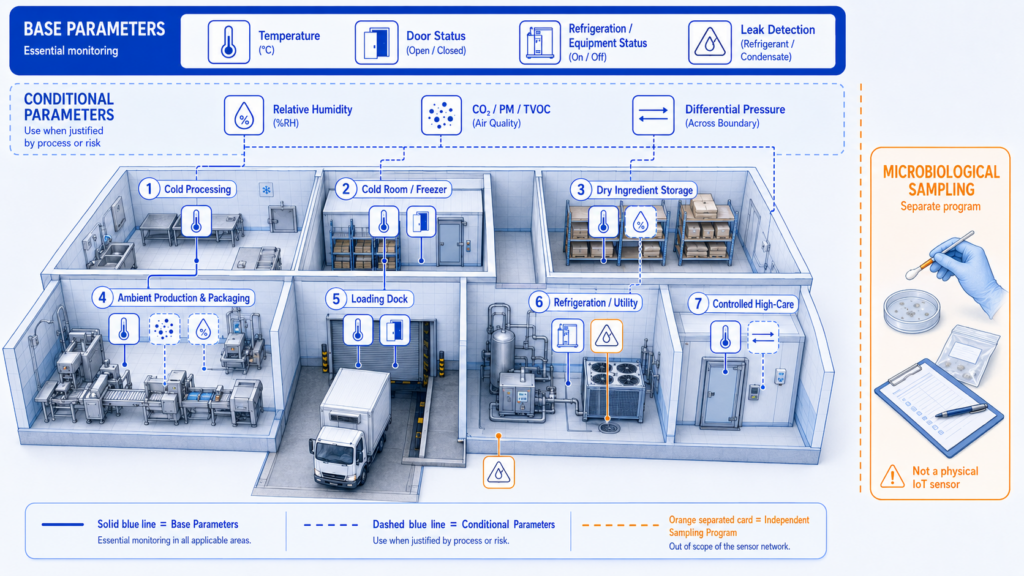
Temperature is usually the primary measurement, while humidity, leaks, door status, equipment status, air quality and differential pressure should be added only where they address a defined risk.
3.What Does a Typical Environmental Monitoring System Include?
A practical food-plant system has five layers. The sensing layer contains room sensors, cold-room probes, leak cables, door contacts, equipment-status inputs, and optional air-quality or pressure transmitters. The connectivity layer moves data through Ethernet, Wi-Fi, cellular, LoRa, or local RS485 wiring. The collection layer may be a direct-connected monitor, a wireless gateway, a PLC interface, or a combination. The platform layer stores history, manages users, shows trends, and creates reports. The alarm and integration layer sends notifications and forwards data to quality, maintenance, BMS, SCADA, ERP, or business-intelligence systems.
System architecture flow
Temperature / RH / air-quality / leak / door / equipment sensors -> direct monitors, RS485 devices or wireless nodes -> Ethernet, Wi-Fi, cellular or LoRa gateway -> public cloud or on-premises platform -> alarm escalation, record review, reports, APIs and corrective-action workflow
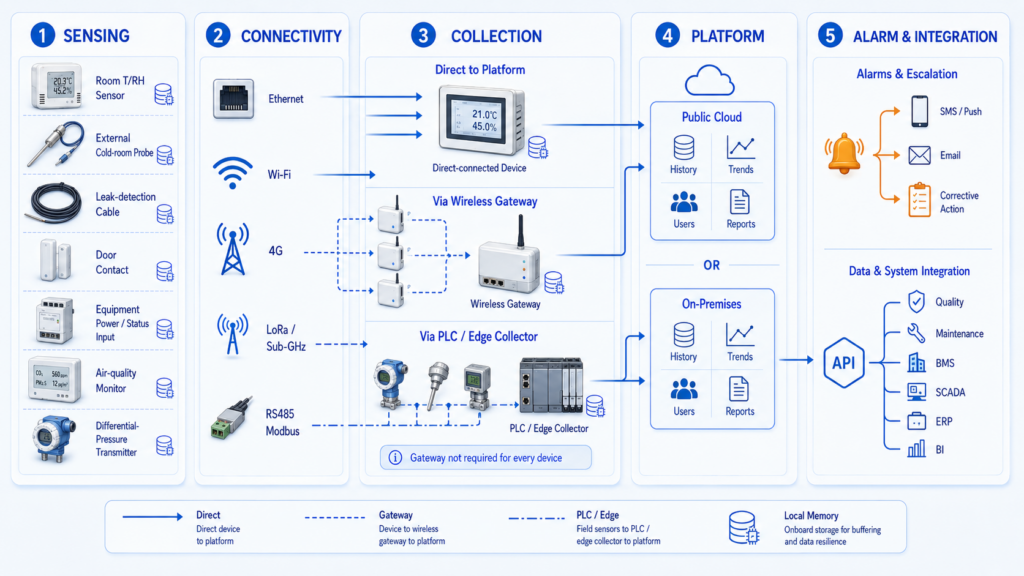
A complete monitoring system connects sensors, communication networks, data collection, cloud or on-premises platforms, alarms and operational workflows.
The monitoring platform should not be the only place where evidence exists. Devices or gateways need sufficient local memory to preserve readings during internet or server outages, and the facility should test how time stamps, missing-data indicators, duplicate handling, synchronization, and alarm status behave after reconnection. Data continuity and alarm continuity are separate questions: a device may save every reading while an outage still prevents a real-time notification.
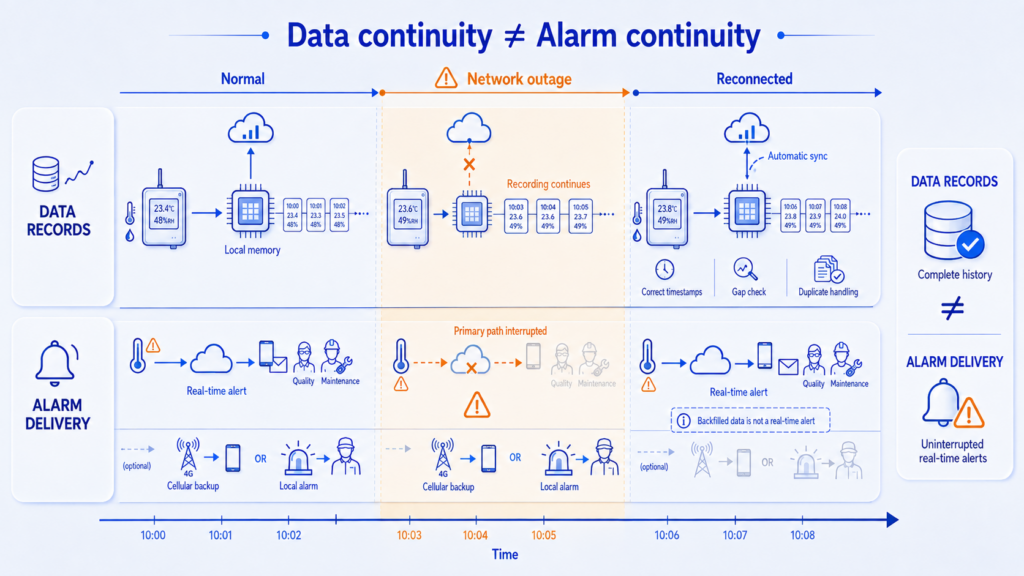
Local memory protects data during an outage, but real-time alarm delivery requires a separate resilient communication path.
4.Which Communication Method Should Be Used?
| Method | Best fit | Advantages | Limitations |
| Wi-Fi | Small and medium plants with managed coverage and limited cabling. | Fast deployment; uses existing infrastructure; direct cloud access. | Metal panels, insulated rooms, enterprise authentication, washdown areas and roaming can reduce reliability. |
| Ethernet | Fixed monitors, quality offices, plant rooms, cold-room exteriors and locations with reliable cabling. | Stable, low-latency connection; easier IT control; compatible with PoE accessories on some systems. | Cable installation cost; unsuitable for moving equipment; device must still be protected from moisture. |
| 4G / cellular | Remote buildings, temporary areas, sites outside corporate networks, or independent alarm paths. | Avoids local LAN dependency and can simplify remote deployment. | SIM and service cost; signal coverage; metal structures; regional frequency and carrier selection. |
| LoRa / proprietary sub-GHz | Many distributed battery nodes across large plants, warehouses or campuses. | Long range, low power and reduced cabling; one gateway can serve many nodes. | Requires gateway planning, regional frequency selection, radio survey and backhaul resilience. |
| RS485 | Wired industrial probes, meters, PLC panels and harsh or high-interference areas. | Stable local communication, long cable runs and broad industrial sensor selection. | Requires wiring, power, termination, address management and commissioning. |
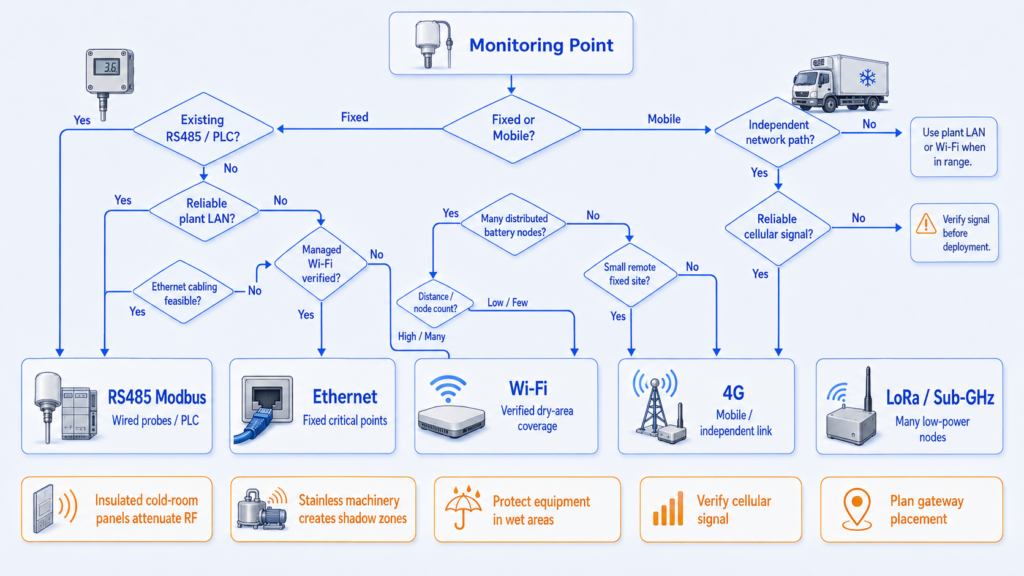
The appropriate communication method depends on plant layout, cabling, network coverage, node count and the need for independent connectivity.
A small plant may use direct Wi-Fi or Ethernet monitors. A larger facility may combine Ethernet-connected controllers in utility rooms, Wi-Fi in offices and dry production zones, RS485 for fixed industrial probes, and LoRa for battery-powered points that are difficult to wire. Cellular is most useful as an independent route or for remote facilities—not automatically as the primary network for every sensor.
5.How Should Monitoring Products Be Compared?
Published accuracy is important, but it does not define the quality of the complete system. Buyers should compare the full operating range, calibration points, uncertainty, drift, probe response, cable and enclosure limitations, cleanability, condensation exposure, and whether the selected location represents the product or process risk. A high-accuracy room sensor placed beside an evaporator or washdown jet can create a poor record.
The architecture also determines ongoing workload. Compare local storage, offline recording, gateway requirements, external sensor support, alarm channels, user permissions, cloud and on-premises options, APIs, calibration services, subscription models, and expansion cost. A direct-connected device may be simplest for a few zones; a gateway network may be more efficient for dozens of battery nodes; a panel-oriented system may be preferable when the plant already uses Modbus, PLCs, and industrial transmitters.
| Evaluation area | What the procurement team should verify |
| Measurement chain | Sensor, probe, cable, logger, mounting method, response time and calibration points for the actual operating range. |
| Environmental suitability | Condensation, washdown, dust, steam, cleaning chemicals, enclosure rating and whether electronics can remain outside the harsh zone. |
| Data continuity | Device and gateway memory, time stamps, missing-data flags, reconnection behavior, duplicate handling and backup power. |
| Alarm workflow | Threshold, delay, repeat interval, local alarm, remote channels, recipient escalation, acknowledgement and corrective-action records. |
| Network architecture | Coverage survey, enterprise authentication, Ethernet availability, cellular signal, gateway capacity, RS485 wiring and failure modes. |
| Software governance | User roles, change control, record retention, export, audit evidence, cloud region, on-premises option and software updates. |
| Lifecycle cost | Sensors, gateway, installation, calibration, subscription, SIM service, battery replacement, validation and expansion. |
6.Product and Solution Comparison
The table compares representative configurations rather than every product in each vendor portfolio. UbiBot is shown as a multi-device plant solution; Dickson as a direct climate-logging system; Sensaphone as a cellular and Modbus facility controller; and Monnit as a gateway-based distributed wireless network.
| Comparison item | UbiBot GS1-AETH1RS + AQS1 + LD1 | Dickson DWE2 + RTRH-R | Sensaphone Sentinel PRO Cellular + compatible sensors | Monnit MNS2-9-IN-HU-RH + ALTA Ethernet Gateway 4K |
| System positioning | Multi-parameter plant monitoring with direct-connected temperature/RH, air-quality and leak devices in one platform | Direct Wi-Fi/Ethernet environmental data logger for calibrated temperature/RH monitoring | Industrial cellular facility-monitoring controller for multiple analog, digital and Modbus inputs | Distributed long-range wireless temperature/RH network for many industrial points |
| Measured parameters in configuration | GS1: temperature, RH, light and compatible external probes. AQS1: temperature, RH, CO₂, PM1/2.5/10, TVOC and pressure. LD1: liquid leak and cable status. | Temperature and RH with RTRH-R; other replaceable DWE sensors are separate options | Depends on selected sensors: temperature, humidity, leaks, power, equipment status and up to 64 Modbus registers | Temperature and RH; other ALTA leak, door, gas, power and equipment sensors are separate devices |
| Published accuracy | GS1: ±0.2°C and ±2% RH.AQS1 and external-probe accuracy varies by channel/model | RTRH-R: ±2% RH; temperature accuracy is range-dependent on the current official sensor table | Depends on the selected third-party or Sensaphone-compatible sensor; controller-level accuracy not a substitute for sensor specifications | ±0.3°C and ±3% RH typical; ±0.5°C and ±5% RH maximum |
| Connectivity | GS1: 2.4 GHz Wi-Fi + RJ45 Ethernet. AQS1: 2.4 GHz Wi-Fi. LD1 variants support Wi-Fi, 4G or Ethernet. | 2.4 GHz Wi-Fi or Ethernet | Cellular; Modbus RTU/RS485 and Modbus TCP for connected equipment | Proprietary ALTA sub-GHz radio to Ethernet gateway; region-specific frequencies |
| Dedicated gateway requirement | No for the listed direct-connected devices | No | No | Yes |
| Local storage | GS1: 300,000 records; AQS1: 300,000 records; LD1 local record capacity not highlighted on the reviewed product page | Approximately 400,000 backup sample points | Cloud data logging; local controller record capacity not publicly specified on reviewed page | Sensor stores about 2,000-4,000 readings if gateway connection is lost |
| Offline data protection | GS1/AQS1preserve local readings and synchronize after reconnection; verify LD1 behavior by model and firmware | Backup memory plus 72-hour battery backup | Eight-hour rechargeable backup and power-failure monitoring; cloud path depends on cellular service | Non-volatile sensor buffering; gateway/backhaul behavior depends on selected gateway and software |
| External sensor / input expansion | GS1 supports selected RS485 and other probes; LD1 provides relay output; devices can be combined at platform level | One field-replaceable sensor type with up to three channels on DWE2 | 12 digital/analog inputs, 64 Modbus registers, dry contact, 4-20mA and two relay outputs | Add separate ALTA sensors; industrial sensor available with lead options and NIST calibration |
| Cloud platform | UbiBot Public IoT Platform; free basic tier plus paid plans | DicksonOne subscription required | Sensaphone cloud and mobile/web interface | iMonnit Basic or Premiere |
| On-premises option | UbiBot On-Premises Platform and developer integration options | Not publicly specified for the DWE2/DicksonOne configuration | Not publicly specified for the reviewed Sentinel PRO cloud configuration | iMonnit Express and Enterprise on-premises options |
| API / integration | REST/data forwarding; MQTT and advanced APIs depend on plan; on-premises integration available | Not publicly specified on the reviewed DWE2 product page | Modbus RTU/TCP and connected PLC/BAS integration | API access depends on iMonnit software tier; direct-data options may require gateway/software configuration |
| Alarm methods | Platform alerts including email/app; SMS, voice and other channels depend on plan; LD1 has local audible/visual alarm and relay output | Phone, SMS, email and audible alarms | Unlimited email, text or phone notifications; local status LEDs and relay outputs | Email and SMS in basic documentation; push/voice and advanced workflows depend on software tier |
| Calibration options | Factory calibration policy; project-specific external calibration should be confirmed for each device/probe | NIST and A2LA options for compatible sensors | Depends on selected sensors and project calibration plan | Optional 7-month ISO/IEC 17025 (NIST) certificate for the sensor |
| Typical use case | Plants needing climate, air-quality context and leak monitoring in one scalable platform with direct connections | Cold rooms, warehouses and production rooms requiring calibrated climate records and visible local data | Harsh, remote or multi-condition facilities with cellular independence, PLC/Modbus and equipment-status monitoring | Large plants with many wireless points, difficult cabling and long-range battery nodes |
| Deployment complexity | Low to medium; multiple device types require zone design but no proprietary gateway | Low to medium; subscription and sensor/calibration selection required | Medium to high; panel wiring, sensor selection, cellular service and Modbus commissioning | Medium; gateway, radio survey, frequency, heartbeat, software and sensor-count planning required |
| Relative total-cost category* | Low to medium for mixed small/medium deployments; higher with on-premises or many specialized probes | Medium, including logger, sensor, calibration and DicksonOne subscription | Medium to high, including controller, cellular service, sensors and commissioning | Medium; efficient at higher node counts but includes gateway and software-tier costs |
*Relative cost is an architectural estimate, not a current quotation. Costs vary by sensor count, calibration, communications, platform tier, installation, validation and support.
7.Which System Is Best for Each Use Case?
Use the UbiBot configuration when a plant wants temperature/RH monitoring, selected indoor-air-quality context, and water-leak detection under one platform without deploying a proprietary gateway for every zone. GS1-AETH1RS is useful where Ethernet and local display matter, AQS1 adds CO₂/PM/TVOC context in suitable indoor areas, and LD1 adds local and remote leak alarms around refrigeration or utilities. The main design task is choosing appropriate probes and protecting electronics from steam, condensation, chemicals, and washdown.
Use Dickson DWE2 with RTRH-R when the primary need is a calibrated, visible temperature/RH record for cold rooms, warehouses, chambers, or production areas, and the organization accepts a DicksonOne subscription. Dickson offers clearer sensor-calibration pathways than many general-purpose IoT products, but the selected DWE configuration is not a full plant leak, air-quality, equipment-status, or sanitation-monitoring system.
Use Sensaphone Sentinel PRO when the facility needs a rugged cellular controller, multiple digital or analog inputs, equipment-power and leak monitoring, Modbus data from refrigeration or process equipment, relay outputs, and remote alerts independent of the plant LAN. It is strongest as a facility and equipment monitoring hub; the project must still select and calibrate every connected sensor.
Use Monnit ALTA when many distributed battery-powered points must share long-range wireless infrastructure. Its industrial humidity sensor is suitable for more demanding environments than ordinary office sensors, and the wider ALTA portfolio can add leak, door, power and other conditions. The trade-off is a proprietary gateway architecture, software-tier choices, heartbeat planning, and radio validation around metal machinery, insulated panels and wet product.
8.How Should the System Be Deployed?
Small facility
Start with the highest-risk cold room, one representative production area, and any refrigeration or utility location where a leak could stop production. Direct Wi-Fi or Ethernet devices usually minimize infrastructure. Assign a named primary and backup alert recipient, use external probes where the electronics need to remain outside cold or wet zones, and confirm that the logging interval and report format match the food-safety plan rather than copying a generic default.
Medium facility
Divide the plant into receiving, cold processing, ambient production, finished-goods, cold-storage, packaging, and utility zones. Use multiple points where room mapping or airflow indicates gradients. Combine Ethernet for fixed critical monitors, Wi-Fi in suitable dry areas, RS485 for industrial probes, and leak cables around refrigeration and condensate systems. Establish role-based access so quality approves alarm limits, maintenance receives equipment and leak alerts, and supervisors review records.
Large or multi-site facility
Standardize channel names, units, calibration metadata, alarm classes, escalation rules, time zones, and data-retention policies across sites. A gateway-based wireless system may reduce cabling for hundreds of points, while cellular paths can protect remote buildings from local-network failure. Integrate selected data with quality, maintenance, BMS, SCADA, or enterprise systems, but preserve the monitoring platform as a traceable source rather than creating uncontrolled copies.
Recommendations by functional area
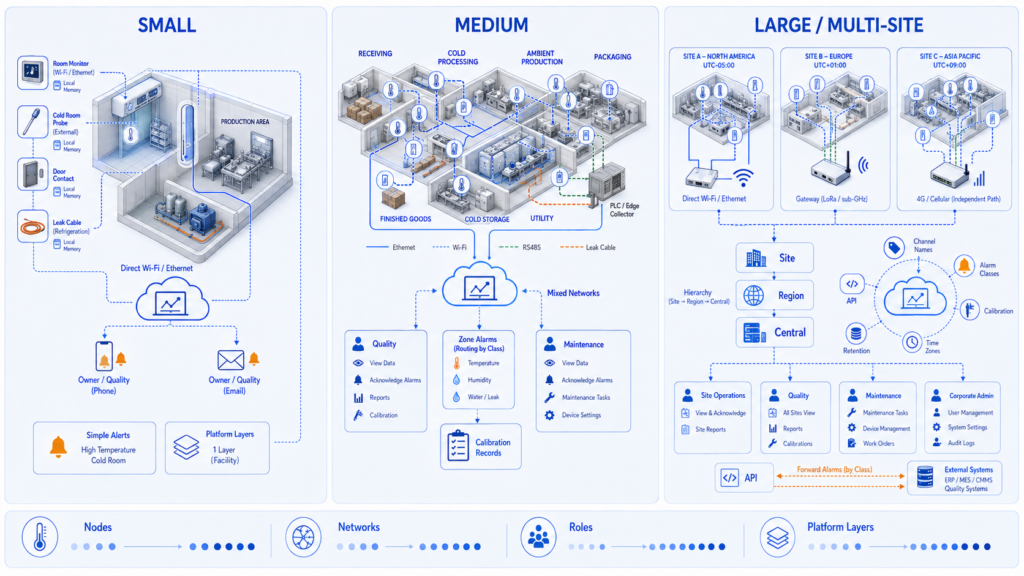
System architecture should scale from a few direct-connected points to zoned monitoring and standardized multi-site management.
| Functional area | Recommended monitoring approach |
| Receiving and ingredient staging | Ambient or product-specific temperature checks; door and dwell-time context where exposure risk is material. |
| Cold processing room | Representative room temperature/RH, product/process measurements where required, and alarms coordinated with operating tolerances. |
| Ambient production and packaging | Temperature/RH where packaging or product is sensitive; optional CO₂/PM/TVOC only for a defined ventilation or dust question. |
| Cold room / freezer | Mapped fixed probes at representative and high-risk locations; door context; refrigeration/power status; local offline logging. |
| Finished-goods warehouse | Zone-based temperature/RH determined by product requirements, building layout, rack height and airflow. |
| Refrigeration and utility room | Leak rope, power/status inputs, temperature, pump/compressor conditions and escalation to maintenance. |
| Washdown or condensation-prone area | Keep sensitive electronics outside the wet zone or use appropriately rated enclosures and remote probes; verify cleaning-chemical compatibility. |
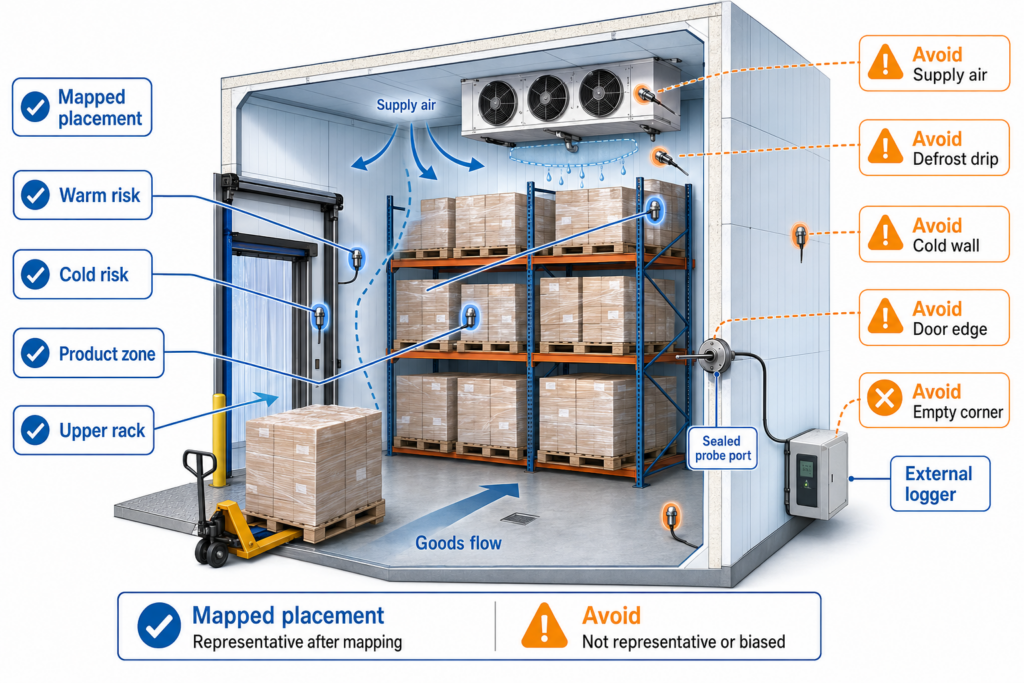
Cold-room sensor locations should be selected from mapped warm, cold and representative zones rather than placed beside doors, evaporators or walls for convenience.
9.Common Design and Installation Mistakes
- Treating every room-temperature reading as a HACCP critical-control record without linking it to the facility hazard analysis and scientifically supported limit.
- Using one sensor for a large cold room or warehouse without considering rack height, doors, evaporators, loading patterns, defrost cycles and mapped hot or cold locations.
- Placing sensors directly in supply air, against cold walls, beside heaters, above steam sources or where washdown water creates an unrepresentative reading.
- Describing CO₂, PM or TVOC monitoring as microbiological environmental monitoring or proof of hygienic air quality.
- Installing ordinary electronics inside condensing, high-pressure washdown, corrosive-cleaning or dusty areas without checking enclosure, cable and sensing-element limitations.
- Assuming local memory guarantees immediate alerts during an internet, gateway or cellular outage.
- Failing to define calibration points, acceptance criteria, replacement intervals and record review for every sensor and external probe.
- Sending every alert to everyone, creating alarm fatigue instead of severity levels, delays, escalation paths and documented corrective actions.
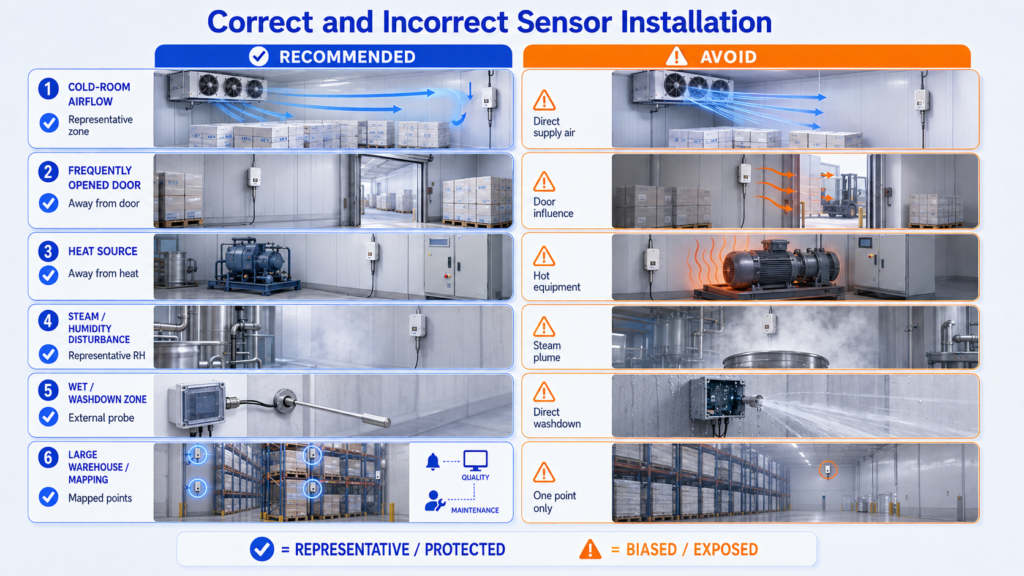
Good sensor placement avoids supply air, heaters, steam, direct washdown and other locations that produce unrepresentative or unreliable readings.
10.Frequently Asked Questions
Does HACCP require continuous environmental sensors in every food plant?
No universal HACCP rule requires the same continuous sensor system in every facility. Monitoring is determined by the hazard analysis, process, product and applicable regulation. A refrigeration step may require frequent or continuous records when loss of control could create a food-safety hazard, while other room measurements may support quality or maintenance. Seafood, juice, meat and poultry operations can have sector-specific HACCP requirements; many other FDA-regulated facilities operate under the FSMA preventive-controls framework.
What is the difference between HACCP monitoring and environmental monitoring?
HACCP monitoring is the planned observation or measurement of a critical control point to determine whether it remains within its critical limit. The term environmental monitoring can also mean physical conditions such as room temperature, humidity or leaks. Under 21 CFR Part 117, environmental monitoring often specifically refers to microbiological sampling for environmental pathogens or indicator organisms in applicable ready-to-eat operations. Connected physical sensors do not perform that microbiological verification.
Which parameters should a food processing plant monitor?
Most plants begin with temperatures that are linked to products, processes, rooms or cold storage. Relative humidity is added where condensation, dry ingredients, packaging or product quality is affected. Leak detection, door status, refrigeration power and equipment alarms are useful for operational continuity. CO₂, particles and TVOC can support ventilation or dust investigations. Differential pressure is relevant in selected controlled zones. Every parameter should have a defined decision or response.
How many temperature sensors are needed in a cold room?
There is no reliable one-sensor-per-square-foot rule. Quantity depends on room volume, rack height, evaporator locations, doors, loading patterns, product placement, defrost behavior and the consequence of failure. A mapping or distribution study should identify representative, warm and cold locations. Permanent monitoring points are then selected from those results. Large rooms, freezers, high racks and frequent-loading areas often need multiple probes rather than one wall-mounted logger.
Can one platform monitor cold rooms, production areas and water leaks?
Yes, when the platform supports different device and channel types and the facility defines separate alarm and record workflows. For example, temperature/RH devices can monitor cold rooms and production areas while leak detectors cover refrigeration and utility spaces. The platform should preserve channel identity, units, alarm class, calibration status and user responsibility. A unified dashboard is helpful, but it does not make all channels equivalent food-safety controls or eliminate the need for specialized sensors.
Is Ethernet better than Wi-Fi for food-factory monitoring?
Ethernet is usually more predictable for fixed critical monitors and can be easier to govern under plant IT policies. Wi-Fi reduces cabling and is practical in dry areas with verified coverage. Insulated cold-room panels, stainless equipment, moving stock and enterprise authentication can weaken or complicate Wi-Fi. Many facilities use both: Ethernet for fixed core points and Wi-Fi or sub-GHz wireless for less accessible locations. The final choice should follow a site survey and outage test.
Should food processors monitor CO₂, particles and TVOC?
Only when those measurements answer a defined operational, ventilation, combustion, occupancy, dust or worker-environment question. They are not universal HACCP requirements and do not directly measure pathogens, allergens or sanitation effectiveness. Sensor placement and contamination resistance are important because steam, aerosols, cleaning chemicals, powder and high humidity can affect readings or damage equipment. Air-quality data should be treated as context unless the facility has established a validated control or specification.
Can connected sensors replace a pathogen environmental-monitoring program?
No. FDA preventive-controls rules may require environmental monitoring for an environmental pathogen or indicator organism when contamination of ready-to-eat food is a hazard requiring a preventive control. That program involves scientifically selected sampling locations, timing, test organisms, methods, laboratory procedures and corrective actions. Temperature, humidity, CO₂, particles and leak sensors can provide useful context, but they cannot detect Listeria, Salmonella or other microorganisms without a microbiological sampling and testing method.
How often should environmental sensors be calibrated?
The interval should be risk-based and documented. Consider regulatory or customer requirements, manufacturer guidance, sensor stability, operating range, past calibration results, exposure to cleaning chemicals or condensation, and the consequence of an incorrect reading. Calibration points should cover the actual use range, especially cold rooms and process limits. The facility should also define interim accuracy checks, out-of-tolerance evaluation, replacement rules and how calibration records are linked to the device and channel.
What should be tested before the system goes live?
Test every meaningful failure and response path: high and low limits, alarm delays, door or power events, leak detection, local sound or light, email/SMS/phone delivery, acknowledgment, Wi-Fi or Ethernet loss, gateway or cellular outage, device power loss, local buffering, reconnection, time stamps, report export and user permissions. Compare readings with a traceable reference at relevant conditions. The pilot should end with approved settings, ownership, training and an acceptance checklist.
11.Conclusion and Selection Recommendations
A food processing environmental monitoring system should be built from the food-safety plan outward. Identify which conditions protect safety, which protect quality, which predict equipment failure, and which simply provide investigative context. Then choose sensors, locations, intervals, communication paths, alarm rules and records that fit those decisions. No single temperature, humidity or air-quality device can represent every production zone or every regulatory requirement.
UbiBot offers a balanced approach for small and medium plants that want direct Wi-Fi/Ethernet devices, local records, temperature/RH and external-probe expansion, air-quality context, leak detection, cloud or on-premises options, and unified multi-site visibility without a proprietary radio gateway for the listed configuration. Dickson is strong for calibrated climate logging, Sensaphone for rugged cellular and Modbus facility monitoring, and Monnit for large distributed wireless networks. The appropriate choice depends on plant architecture, calibration evidence, IT policy, node count, washdown exposure, and required software governance.
Before purchase, confirm exact models, sensor ranges, cleaning and condensation limits, calibration certificates, software tiers, data-retention needs, communications, alarm channels and integration responsibilities. The system should then be verified under real plant conditions and maintained as part of the facility quality and preventive-maintenance program.
12.Sources and Product Information Disclaimer
This article is for industry education and procurement planning. It is not legal, regulatory, food-safety, microbiological, validation, or engineering advice. It does not certify any product, facility, monitoring plan, electronic record, or software platform as compliant with HACCP, FDA, FSMA, 21 CFR Part 117, USDA requirements, GFSI schemes, or local regulations. Suitability depends on the food, process, hazard analysis, scientifically supported limits, sensor placement, calibration, sanitation program, record procedures, corrective actions, IT controls, and verification activities. Specifications may vary by region, sensor, probe, gateway, software version and subscription plan. The comparison is based on current official published information and does not represent a controlled hands-on test of the four systems.
13.Official References
21 CFR 117.145 — Monitoring — Written procedures, monitoring frequency and monitoring records for preventive controls. Official source
21 CFR 117.165 — Verification of implementation and effectiveness — Calibration, records review and microbiological environmental-monitoring requirements where applicable. Official source
21 CFR 117.305 — General requirements applying to records — Record accuracy, timing, detail and identification requirements. Official source
FDA HACCP Principles and Application Guidelines — Hazard analysis, critical limits, monitoring and prerequisite-program concepts. Official source
UbiBot GS1-AETH1RS official specifications — Temperature/RH accuracy, Ethernet/Wi-Fi, memory and external-probe support. Official source
UbiBot AQS1 official product page — Air-quality parameters, memory, power and operating conditions. Official source
UbiBot LD1 official product page — Leak cable, local alarms, relay output and network variants. Official source