

.svg)
How to Monitor Temperature and Humidity in Electronics Manufacturing
Published: August 3, 2026
Update: August 28, 2026
By Susan Jones
Introduction
Electronics plants contain several environments with different moisture and temperature risks. A receiving warehouse may hold moisture-sensitive devices in sealed packaging, an SMT line may expose open components to ambient air, a dry cabinet may need very low relative humidity, and a PCB inspection or test room may require stable conditions for repeatable measurements. A single wall sensor cannot represent all of these zones.
This guide is for quality teams, process engineers, ESD coordinators, component-storage managers, production supervisors, facilities and HVAC teams, IT departments, system integrators, and procurement specialists. It explains what to monitor, how to separate ambient room conditions from dry-storage controls, which communication methods fit different plant layouts, how to compare representative products, and how to deploy a system without treating humidity as a substitute for an ESD control program.
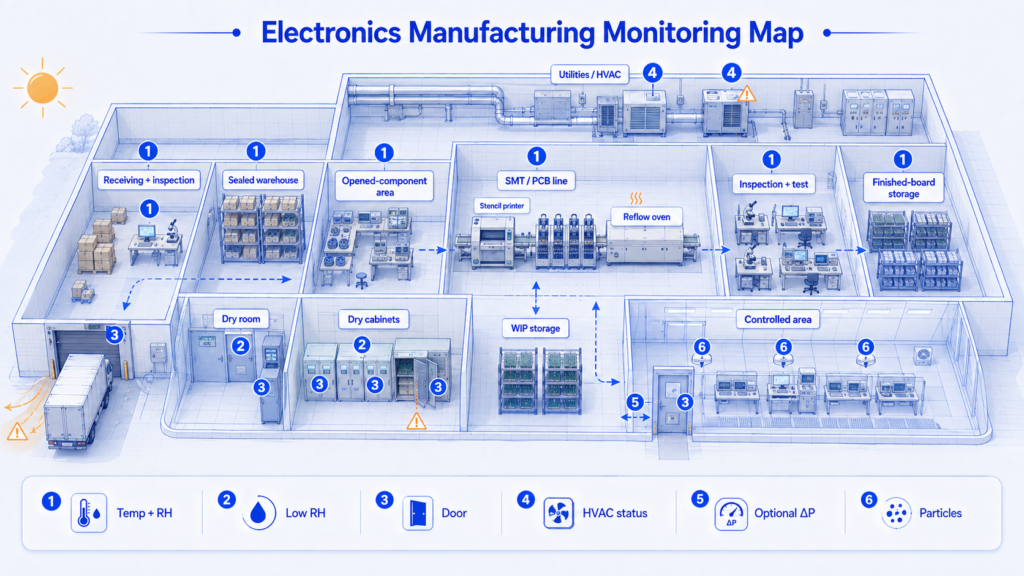
Electronics manufacturing facilities require zone-specific monitoring because component warehouses, SMT lines, inspection rooms, dry storage and utility systems face different temperature and humidity risks.
Quick Summary
Electronics manufacturing monitoring should distinguish ambient production areas, component warehouses, dry rooms, and individual dry cabinets. Essential measurements usually include temperature and relative humidity, with dew point, door status, equipment status, differential pressure, and particles added only where they answer a defined process risk. Use Ethernet for fixed critical points, Wi-Fi for verified dry indoor coverage, sub-GHz wireless for many distributed nodes, and RS485 for external industrial probes. Local storage and alarm testing matter as much as published accuracy. Humidity can influence charge accumulation, but recognized ESD programs rely on qualified controls, grounding, ionization, packaging, and verification—not humidity alone.
Key Takeaway
Build the monitoring plan around components and processes, not around one universal room-humidity target. The useful system is the one that measures the correct zone, remains traceable through network outages, alerts the right owner, and preserves evidence for storage, ESD, quality, and process investigations.
1.Why Electronics Manufacturing Humidity Monitoring Is Important?
Moisture-sensitive surface-mount devices can absorb moisture after dry packaging is opened. Their allowable exposure and handling depend on device classification, packaging, floor-life controls, baking rules, and the applicable company-approved standard. IPC currently lists J-STD-033D as no longer maintained and J-STD-033E as a project under development, so facilities should confirm the edition required by customer contracts, component suppliers, and internal procedures rather than assuming one revision applies everywhere.
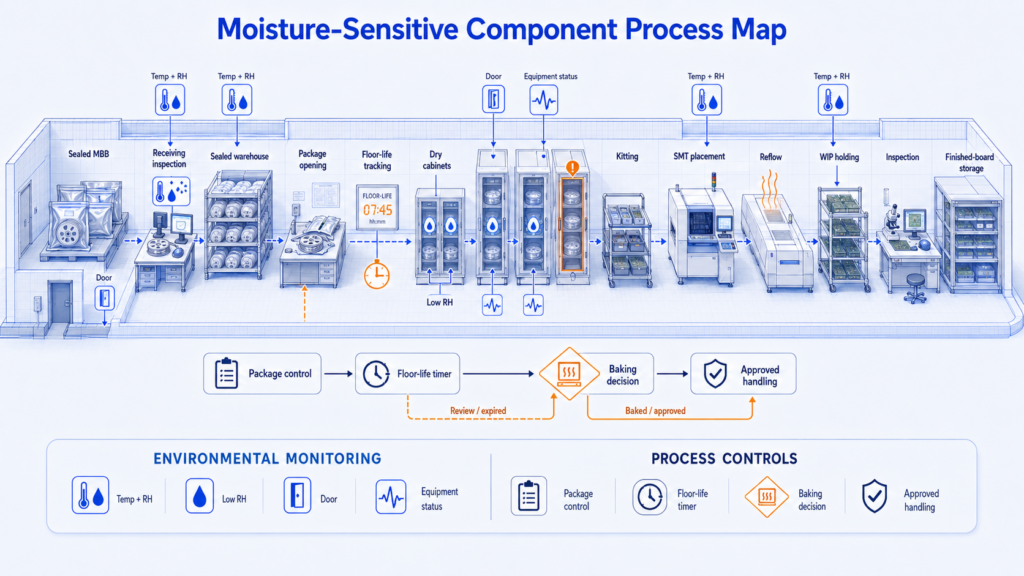
Environmental monitoring supports the moisture-sensitive-device workflow, but packaging state, floor-life tracking, dry storage and approved handling procedures remain separate controls.
Ambient conditions also affect storage materials, solder paste, adhesives, coatings, test repeatability, corrosion risk, condensation, and dimensional stability. Relative humidity changes with temperature, so a seemingly stable moisture content can produce a different RH reading after air temperature changes. Dew point and condensation margin can therefore be useful during seasonal transitions, HVAC setbacks, or movement between cold storage and warmer production areas.
Humidity is often discussed as an ESD control measure, but the ESD Association states that humidity may reduce charge accumulation without controlling it sufficiently. ANSI/ESD S20.20 and IEC 61340-5-1 establish administrative and technical ESD control programs based on qualified control items and verification. Environmental monitoring can provide valuable context and identify unusually dry conditions, but it cannot replace grounding, wrist straps, footwear/flooring systems, ionization, ESD packaging, training, or compliance verification.
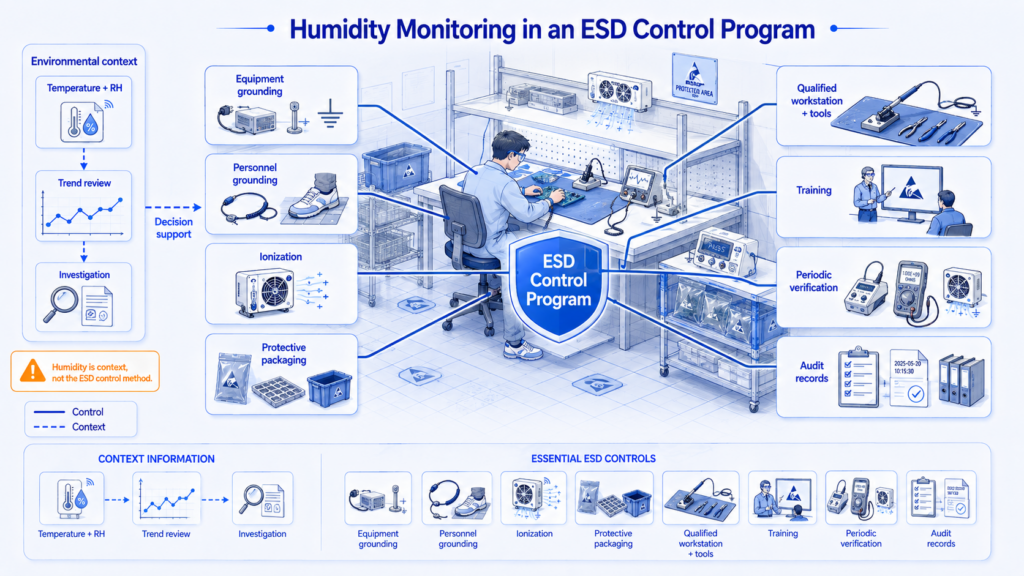
Humidity trends can provide useful ESD context, but electrostatic control still depends on qualified grounding, personnel controls, ionization, protective packaging, training and verification.
Continuous records improve investigations. When a component-storage alarm, dry-cabinet excursion, process defect, or customer complaint occurs, a time-stamped trend can show whether the event was local, seasonal, related to HVAC, caused by an open door, or associated with a network or power interruption. Manual checks still have a role, but they provide only snapshots and can miss nights, weekends, and short-duration changes.
2.What Environmental Parameters Should Be Monitored?
| Parameter | Why it matters | Monitoring location | Recommended sensor type |
| Ambient temperature (essential) | Affects RH, process stability, material behavior, storage conditions and measurement repeatability. | Receiving, component warehouse, SMT floor, inspection/test rooms, finished-goods storage. | Calibrated room sensor or external air probe placed away from local heat and airflow bias. |
| Ambient relative humidity (essential) | Provides context for moisture exposure, condensation, material storage and unusually dry ESD conditions. | Same representative production and storage zones as temperature. | Temperature/RH sensor with accuracy confirmed over the actual operating band. |
| Dry-cabinet or dry-room RH (essential where used) | Supports storage controls for opened moisture-sensitive components and other humidity-sensitive materials. | Inside each controlled cabinet or verified dry-room zone. | Dedicated low-RH sensor/controller; do not rely on a nearby room sensor. |
| Dew point / condensation margin (conditional) | Helps identify condensation risk during HVAC changes or movement between cold and warm areas. | Airlocks, receiving, cold-storage interfaces, coated-board or inspection areas. | Temperature/RH sensor with calculated dew point or dedicated dew-point transmitter. |
| Door or access status (conditional) | Explains repeated cabinet or room excursions and supports workflow improvement. | Dry cabinets, dry rooms, component stores and controlled inspection rooms. | Magnetic contact or digital input synchronized with environmental data. |
| Equipment / HVAC status (conditional) | Distinguishes environmental drift from loss of dehumidifier, HVAC, fan, compressor or power. | Dry-air systems, HVAC units, dehumidifiers and controlled storage equipment. | Dry contact, current, voltage, relay-state or Modbus/RS485 input. |
| Differential pressure (optional) | Supports pressure-cascade monitoring in clean or controlled production zones. | Between clean areas, airlocks and adjacent lower-control spaces. | Dedicated differential-pressure transmitter; use project-specific limits. |
| Particles (optional) | Supports cleanroom or contamination-control programs when particle classification is required. | Qualified cleanrooms or controlled zones at defined sampling positions. | Dedicated particle counter; not a substitute for temperature/RH monitoring. |
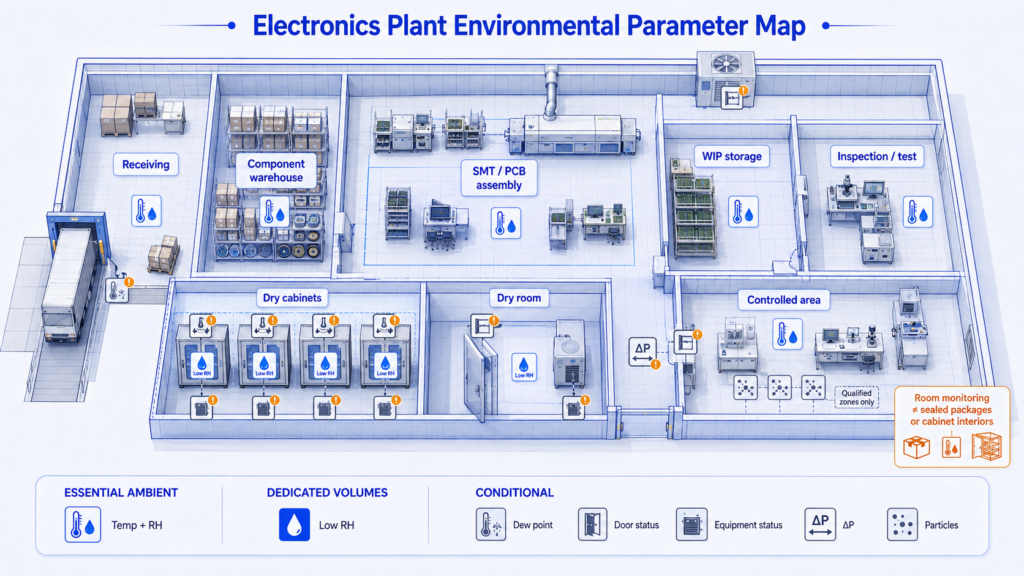
Ambient temperature and humidity are baseline measurements, while low-RH storage, dew point, door status, equipment status, differential pressure and particles should be added only where they address a defined process risk.
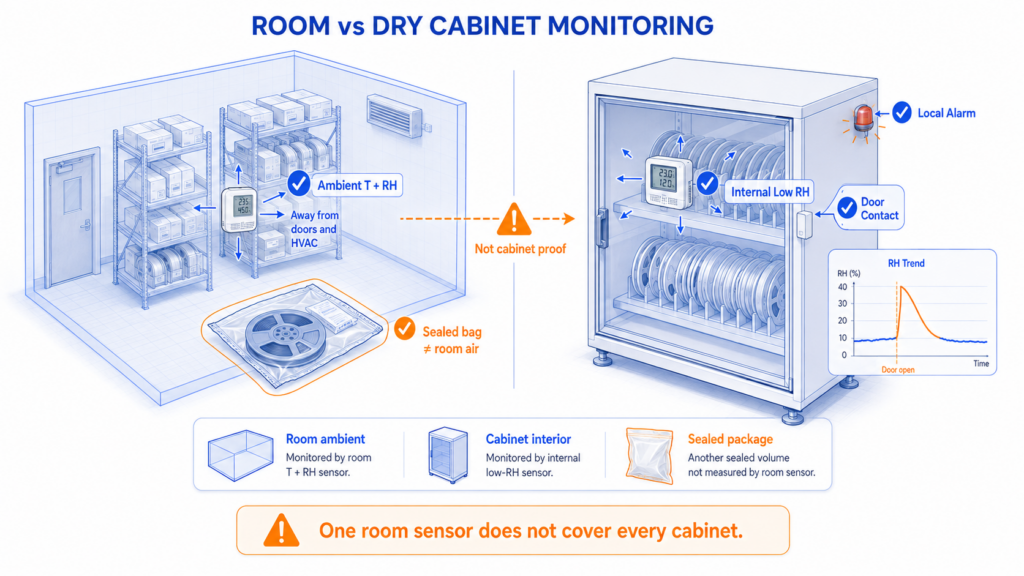
A room sensor cannot represent conditions inside a closed dry cabinet; each controlled storage volume requires its own internal low-RH measurement and alarm workflow.
3.What Does a Typical Monitoring System Include?
A practical system has five layers. The sensing layer includes ambient temperature/RH probes, dedicated dry-cabinet sensors, door contacts, equipment-status inputs, and optional pressure or particle instruments. The connectivity layer moves data through Ethernet, Wi-Fi, cellular, sub-GHz wireless, or RS485. The collection layer may be a direct-connected logger, a proprietary gateway, a PC transceiver, a PLC interface, or a combination. The platform layer stores records, manages users, displays trends, and creates reports. The alarm and integration layer sends notifications and forwards data to quality, maintenance, BMS, MES, QMS, or business-intelligence systems where appropriate.
System architecture flow
Ambient and controlled-storage sensors -> direct logger, RS485 device, wireless node or equipment controller -> Ethernet, Wi-Fi, cellular or gateway backhaul -> cloud or on-premises platform -> alarm escalation, trend review, reports, APIs and investigation workflow
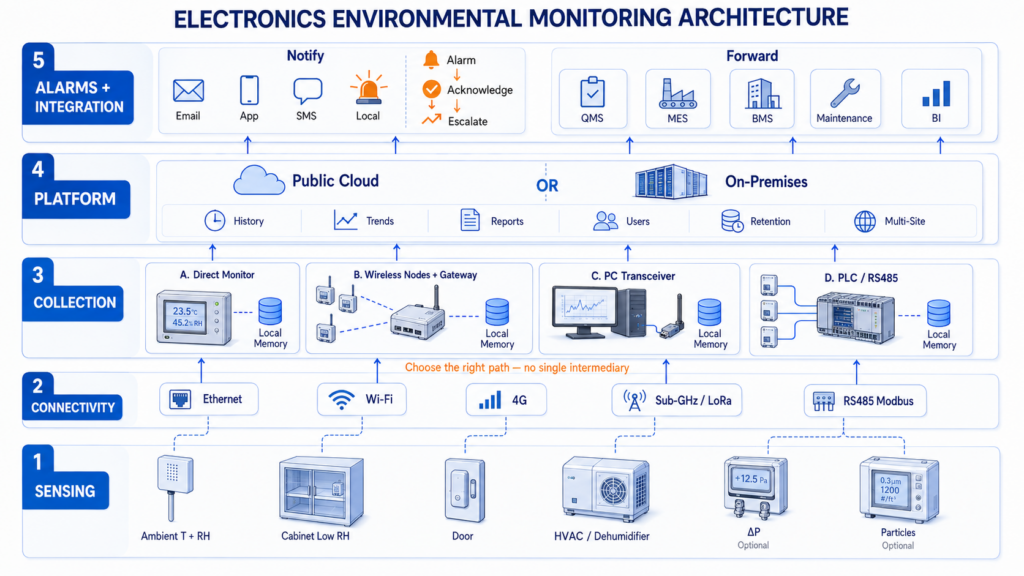
A complete electronics-manufacturing monitoring system connects zone-appropriate sensors, communication paths, data collection, cloud or on-premises platforms, alarms and quality or maintenance workflows.
The architecture should preserve evidence during failures. A device or gateway may continue logging while the internet is unavailable, but remote notifications may still stop. Acceptance testing should therefore examine both data continuity and alarm continuity, including time stamps, missing-data indicators, reconnection, duplicate handling, and the behavior of threshold alarms after a long outage.
| Area | Practical communication starting point |
| Component warehouse | Ethernet for fixed reference points; Wi-Fi or sub-GHz wireless for additional racks after a coverage survey. |
| SMT / assembly floor | Ethernet or verified enterprise Wi-Fi; keep sensors away from ovens and local exhaust. |
| Dry rooms and cabinets | RS485 or the equipment controller for the controlled volume; use a separate network path for records and alarms. |
| Remote or temporary building | Cellular or a local gateway with independent backhaul where plant LAN access is unavailable. |
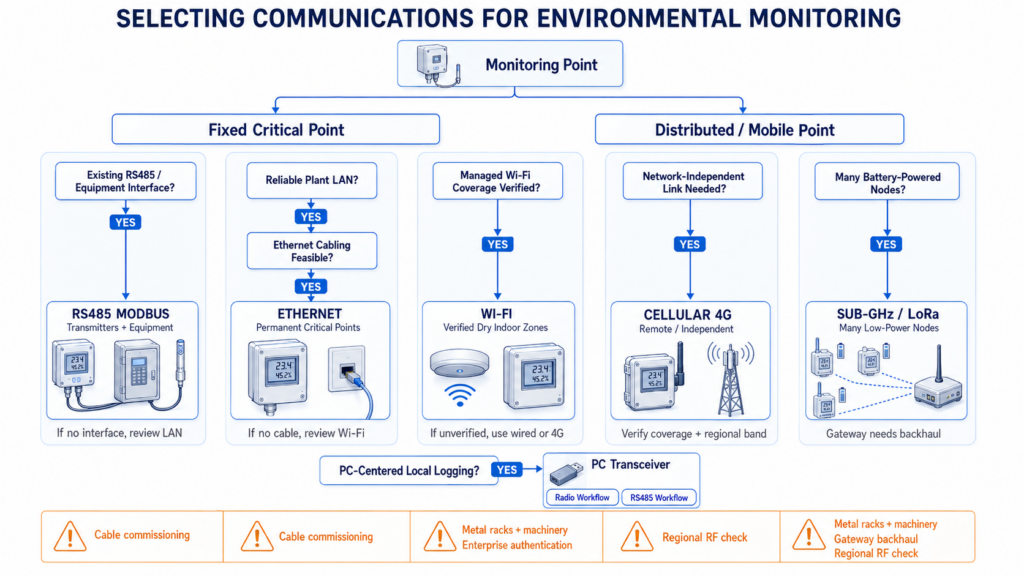
The correct communication method depends on point criticality, Ethernet availability, verified Wi-Fi coverage, node count, metal obstructions, industrial interfaces and the need for an independent path.
4.Which Communication Method Should Be Used?
| Method | Best fit | Advantages | Limitations |
| Wi-Fi | Dry indoor zones with verified coverage and manageable device counts. | Fast installation; no separate field wiring; direct cloud access. | Metal racks, machinery, enterprise authentication and roaming can complicate reliability. |
| Ethernet | Fixed critical monitors, warehouses, inspection rooms and locations with network drops. | Stable, low-latency connection; easier IT control; suitable for permanent points. | Installation cost; cable routing; device still needs power and environmental protection. |
| 4G / cellular | Remote buildings, temporary areas or an independent path outside the plant LAN. | Reduces dependence on corporate Wi-Fi and can simplify isolated deployments. | SIM/service cost, signal coverage, metal construction and regional carrier compatibility. |
| LoRa / proprietary sub-GHz | Many distributed battery nodes across a large plant or campus. | Long range, low power and reduced cabling; one gateway can serve many points. | Requires gateway, regional frequency planning, radio survey, heartbeat design and backhaul resilience. |
| RS485 | External industrial probes, dry-room transmitters, panels and fixed equipment. | Stable wired communication, long runs and broad industrial sensor selection. | Requires power, addressing, termination, commissioning and cable management. |
A small plant may use direct Ethernet and Wi-Fi monitors. A larger site may combine Ethernet for fixed core zones, proprietary sub-GHz nodes for distributed warehouses, RS485 for dry-room or cabinet transmitters, and cellular for remote buildings. The correct design is usually mixed rather than universal.
5.How Should Monitoring Products Be Compared?
Accuracy is only one selection factor. Buyers should compare the accuracy band, calibration points, low-RH performance, drift, response time, sensor placement, cable length, enclosure limits, non-condensing requirement, and whether the device measures the actual controlled volume. A high-accuracy room sensor does not prove conditions inside a closed dry cabinet, moisture-barrier bag, component reel, or oven queue.
The architecture determines maintenance and evidence quality. Compare local memory, outage behavior, gateway requirements, display, external-probe support, alarm channels, cloud and on-premises options, APIs, calibration services, software tiers, battery replacement, and expansion cost. A direct-connected system can be efficient for a few fixed zones; a gateway network may be better for hundreds of wireless points; a PC-centered logger can suit laboratories or facilities that prefer local software.
| Evaluation area | What the procurement team should verify |
| Measurement chain | Sensor, probe, cable, logger, mounting method, response time, calibration points and low-RH capability. |
| Area definition | Ambient room, dry room, dry cabinet, receiving, SMT line, inspection and finished-goods storage must be treated separately. |
| Data continuity | Device/gateway memory, backup power, time stamps, missing-data flags, reconnection and duplicate handling. |
| Alarm workflow | Threshold, delay, repeat interval, local indication, remote channels, acknowledgement and owner escalation. |
| Network architecture | Coverage survey, enterprise authentication, Ethernet availability, gateway capacity, RS485 commissioning and failure modes. |
| Software governance | User roles, change control, record retention, export, cloud region, on-premises option and API ownership. |
| Lifecycle cost | Sensors, gateway/transceiver, installation, calibration, subscription, battery, software support and future expansion. |
6.Product and Solution Comparison
Important: The table compares one representative configuration per vendor. Specifications are based on official manufacturer information reviewed in July 2026. Values not confirmed in public sources are marked “Not publicly specified.”
| Comparison item | UbiBot GS1-AETH1RS + UB-ATH-P1 | Monnit MNS2-9-IN-HU-RH + ALTA Ethernet Gateway 4K | OMEGA OM-CP-RFRHTEMP2000A + RFC1000-EXT | Dickson DWE2 + RTRH-R |
| System positioning | Direct-connected fixed monitor with internal climate channels, display and high-precision RS485 air probe | Industrial long-range wireless sensor network with Ethernet gateway and iMonnit software | PC-centered wireless temperature/RH data-logging system with local display | Direct Wi-Fi/Ethernet display logger with replaceable sensor and DicksonOne cloud |
| Measured parameters | Internal temperature, RH and light; external air temperature/RH via UB-ATH-P1 | Temperature and RH | Temperature and RH; software can calculate dew point | Temperature and RH |
| Published accuracy | Internal: ±0.2°C, ±2% RH; UB-ATH-P1: ±0.15°C (20-60°C), ±1.5% RH (0-80% RH) | Typical ±0.3°C and ±3% RH; maximum ±0.5°C and ±5% RH | ±0.5°C from 0-55°C; ±3% RH calibrated, ±2% RH typical at 25°C in stated range | RTRH-R table lists about ±0.4°C from 20-120°F with wider error outside; ±2% RH from 5-95% RH |
| Connectivity | 2.4 GHz Wi-Fi + RJ45 Ethernet; external probe uses RS485 | Proprietary ALTA sub-GHz radio to Ethernet Gateway 4K; region-specific frequencies | 2.45 GHz IEEE 802.15.4 to OM-CP-RFC1000-EXT transceiver; USB/PC software | 2.4 GHz Wi-Fi or Ethernet |
| Dedicated gateway / transceiver | No | Yes | Yes for wireless real-time operation | No |
| Local display | 4-inch display | No display on sensor | Displays current, minimum, maximum and average | Segmented LCD with resettable minimum/maximum |
| Local storage | 300,000 records | About 2,000-4,000 readings during gateway disconnection | 16,128 readings per channel | Approximately 400,000 backup sample points |
| Offline data protection | Local logging with synchronization after reconnection | Non-volatile sensor buffer; gateway/backhaul behavior depends on gateway/software | Logger retains local readings; central real-time view depends on transceiver and PC | Backup memory plus average 72-hour battery backup |
| External sensor support | Selected RS485 probes; this configuration uses UB-ATH-P1 | Separate ALTA sensors can be added for door, power, leak and other conditions | External humidity and RTD-based temperature elements are integral to the logger; other logger models require separate devices | One field-replaceable sensor; selected configuration uses RTRH-R |
| Cloud platform | UbiBot Public IoT Platform; free basic tier plus paid options | iMonnit Basic or Premiere | No direct cloud service publicly specified for this configuration; Windows software is central | DicksonOne subscription required |
| On-premises option | UbiBot On-Premises Platform and developer integration options | iMonnit Express / Enterprise options | Local PC software workflow | Not publicly specified for the DWE2/DicksonOne configuration |
| API / integration | REST/data forwarding; MQTT and advanced APIs depend on plan | API and direct-data options depend on software/gateway configuration | Not publicly specified | Not publicly specified on reviewed DWE2 page |
| Alarm methods | Platform email/app/web; paid channels depend on plan; local display | Software alerts depend on iMonnit tier and configuration | Audible buzzer, LED, and email/text through PC software | Phone, SMS, email and audible alarms |
| Calibration options | Factory calibration policy; ISO/IEC 17025 calibration should be confirmed for project use | Optional 7-month NIST/ISO 17025 certificate | Free NIST certification advertised | Optional NIST calibration for RTRH-R; Dickson also offers A2LA options on compatible sensors |
| Typical use case | Small/medium fixed facilities needing direct Ethernet/Wi-Fi, display, large memory and external RS485 probes | Large distributed facilities with many battery nodes and difficult cabling | Laboratory or production teams preferring local PC software and wireless logger networks | Fixed rooms, chambers and warehouses needing visible logger, cloud workflow and calibration options |
| Deployment complexity | Low to medium | Medium: gateway, radio survey, frequency and software-tier planning | Medium: transceiver, always-on PC/software and RF planning | Low to medium: sensor/calibration selection and subscription |
| Relative total-cost category* | Low to medium for direct fixed-zone deployments | Medium; efficient at higher node counts | Medium, including transceiver and PC workflow | Medium, including logger, sensor, calibration and subscription |
7.Which System Is Best for Each Use Case?
Use the UbiBot configuration when a small or medium electronics facility wants direct Ethernet or Wi-Fi, a visible local display, large local memory, a high-precision external air probe, and cloud or on-premises data options without a proprietary radio gateway. It is a balanced choice for component warehouses, SMT floor zones, inspection rooms, and multi-site rollouts. The project must still verify low-RH performance, probe placement, calibration evidence, and compatibility with enterprise network policies.
Use Monnit ALTA when a plant needs many distributed, battery-powered points across warehouses, production cells, remote buildings, or hard-to-wire areas. The industrial enclosure, long-range radio, regional variants, node buffering, and gateway scale are valuable at higher point counts. The trade-off is a proprietary gateway and software architecture, heartbeat planning, radio validation, and more components in the system.
Use the OMEGA configuration when local PC-based data acquisition, a large display, min/max/average visibility, audible alarms, NIST certification, and a wireless logger network are more important than direct cloud access. It can suit laboratories, quality rooms, or production teams that already maintain a Windows data-logging workstation. Confirm current software and operating-system support before procurement.
Use Dickson DWE2 with RTRH-R when a facility wants a straightforward fixed display logger, Wi-Fi or Ethernet, substantial backup memory, remote alarms, and selectable calibration documentation. It is well suited to rooms, warehouses and chambers, but buyers should account for the DicksonOne subscription and confirm whether its software governance and integration options meet internal requirements.
8.How Should the System Be Deployed?
Small facility
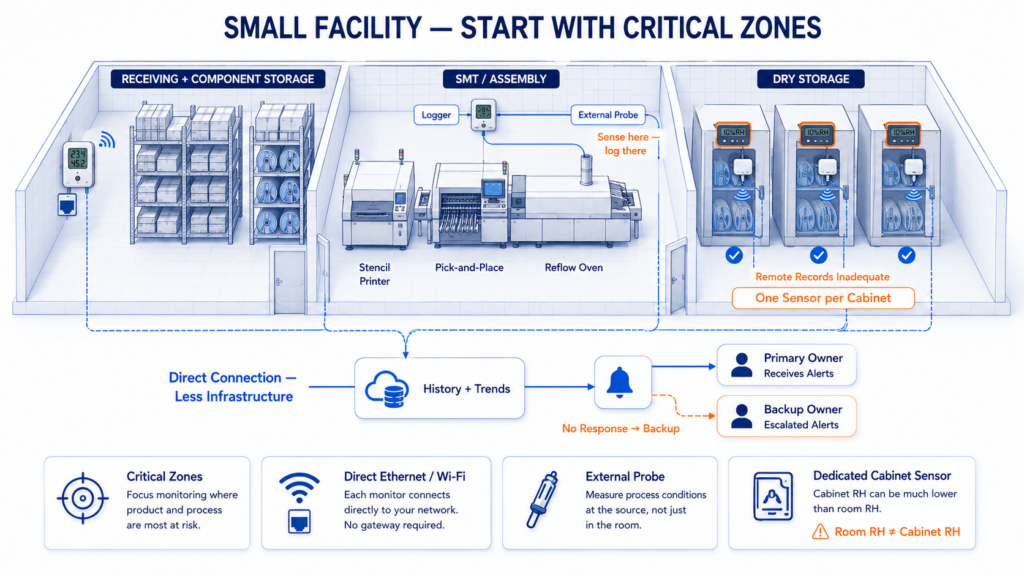
Begin with receiving/component storage, the main SMT or assembly area, and any dry-storage equipment whose internal controller does not provide adequate remote records. Direct Ethernet or Wi-Fi monitors minimize infrastructure. Set a named primary and backup alarm recipient, use external probes where the sensing point differs from the logger location, and retain a separate dedicated sensor inside each dry cabinet that requires controlled low humidity.
Medium facility
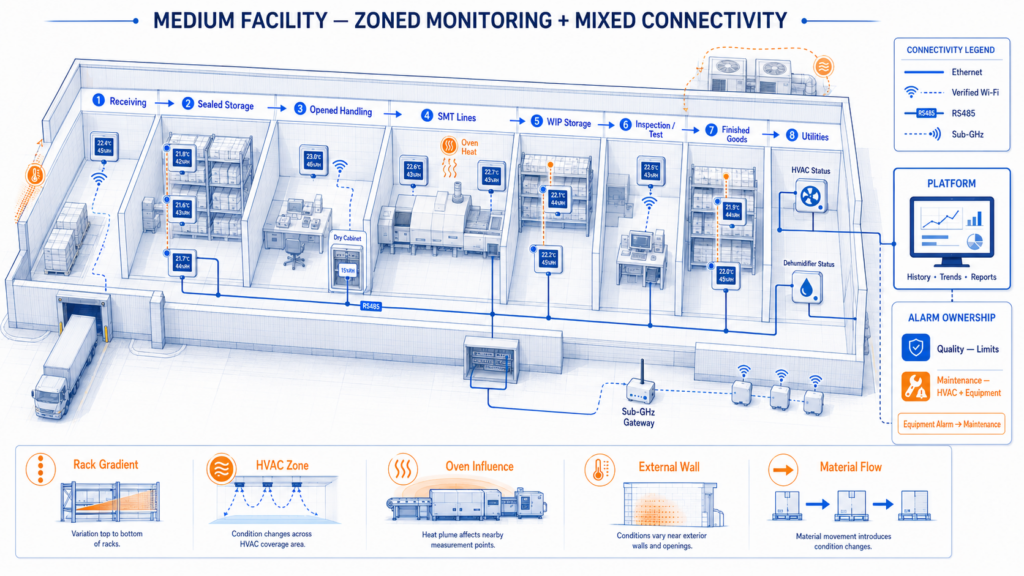
Divide the site into receiving, sealed-component storage, opened-component handling, SMT lines, WIP storage, inspection/test, finished-goods, and utilities. Use multiple sensors where racks, HVAC zones, ovens, exterior walls, or material flows create gradients. Combine Ethernet for fixed critical points, Wi-Fi in verified indoor areas, RS485 for dry-room and equipment transmitters, and sub-GHz wireless where cabling is difficult. Quality should own limits; maintenance should receive HVAC and equipment alarms.
Large or multi-site facility
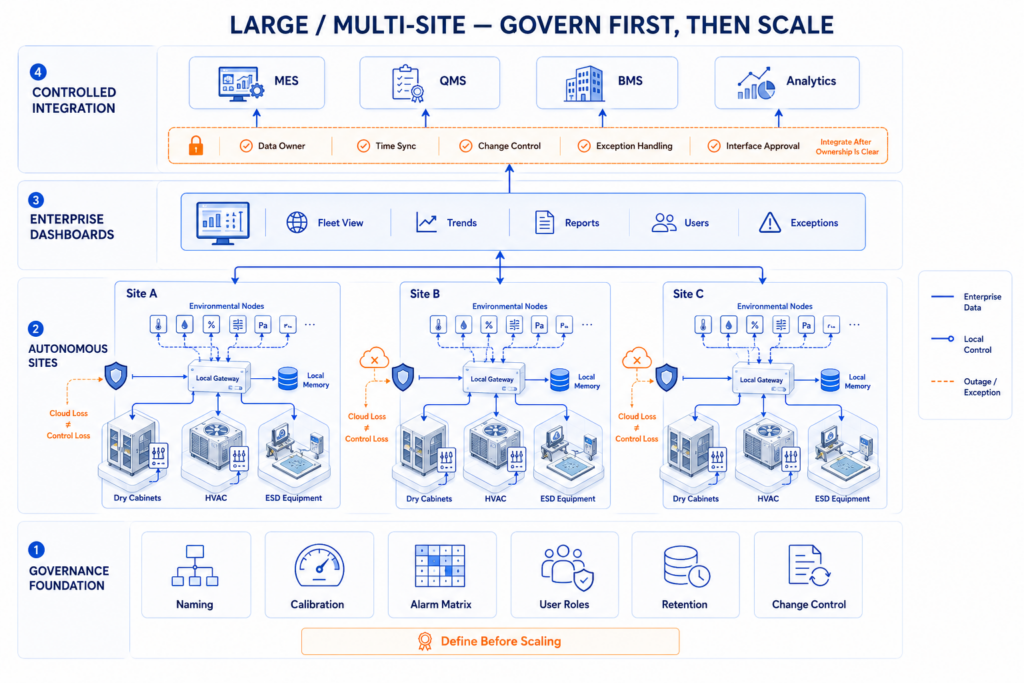
Create a common naming convention, calibration schedule, alarm matrix, user-role model, and data-retention policy before scaling. Use gateways where high node density justifies them, but preserve local memory at nodes or gateways. Separate enterprise dashboards from local operating controls so a cloud interruption does not disable dry cabinets, HVAC, or ESD equipment. Integrate with MES, QMS, BMS, or analytics only after defining data ownership, time synchronization, change control, and exception handling.
Deployment by functional area
| Area | Deployment recommendation |
| Receiving and component warehouse | Place sensors at representative rack heights and HVAC zones; track exterior-wall and loading-door influence; retain packaging and supplier requirements separately. |
| SMT / PCB assembly floor | Monitor representative work zones away from reflow ovens, localized exhaust, doors and direct supply air; correlate trends with defects and process changes. |
| Dry cabinets and dry rooms | Use dedicated internal low-RH sensors/controllers for each controlled volume; add door and equipment-status data where excursions matter. |
| Inspection and test rooms | Prioritize stability, calibrated accuracy and placement away from operators, equipment heat and direct airflow. |
| Clean or controlled areas | Add differential pressure and particles only where classification or process requirements justify them; maintain separate qualification records. |
| Utilities / HVAC | Monitor dehumidifiers, air handlers, dry-air systems, power and alarms; use this data to explain environmental excursions rather than replacing room sensors. |
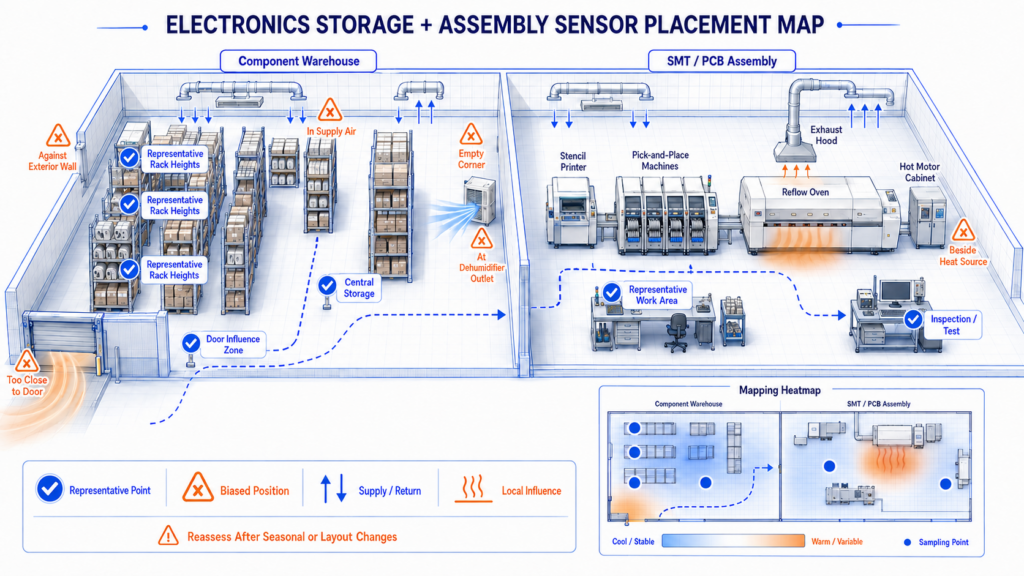
Permanent monitoring points should be selected from representative and risk-based locations identified through mapping, not installed beside doors, ovens, diffusers or dehumidifier outlets for convenience.
9.Common Design and Installation Mistakes
- Using one universal RH limit for receiving, assembly, component storage, inspection, dry rooms and dry cabinets.
- Treating humidity control as a complete ESD control program instead of qualified grounding, ionization, protective equipment, packaging and verification.
- Using a room sensor as evidence for conditions inside a dry cabinet, moisture-barrier bag or sealed container.
- Installing sensors beside reflow ovens, exterior doors, HVAC diffusers, dehumidifier outlets or other local sources that bias the reading.
- Buying a sensor with good room-range accuracy without confirming low-RH calibration performance for dry storage.
- Assuming local data storage guarantees real-time notification during an internet, gateway or power outage.
- Failing to synchronize time, channel names, device ownership, alarm acknowledgements and calibration records across sites.
- Skipping seasonal mapping and acceptance testing after changes to racks, HVAC, lines, walls, doors or material flow.
10.Frequently Asked Questions
What relative humidity should an electronics manufacturing facility maintain?
There is no universal value for every electronics plant. Ambient targets depend on component sensitivity, packaging state, process materials, ESD qualification, worker comfort, product specifications, customer requirements, and HVAC capability. Dry cabinets may operate far below room RH and need dedicated internal controls. Define limits separately for receiving, component storage, assembly, inspection, clean areas and dry storage, then document the technical source for each limit.
Does higher humidity prevent electrostatic discharge?
No. Higher humidity can reduce charge accumulation in some materials, but the ESD Association states that humidity is not relied on as the control method in ANSI/ESD S20.20. A compliant ESD program uses qualified grounding, personnel grounding, ionization, protective packaging, ESD control items, training and verification. Humidity monitoring can provide context and reveal unusually dry conditions, but it does not prove that electrostatic risk is controlled.
How should moisture-sensitive devices be monitored?
Control begins with device classification, packaging, opening time, floor-life tracking, dry storage, baking rules and the applicable approved procedure. Ambient room monitoring shows the surrounding environment, while each dry cabinet or dry room needs its own internal evidence. IPC lists J-STD-033D as no longer maintained and J-STD-033E as under development, so confirm the edition specified by customers, suppliers and internal quality documents.
Should every dry cabinet have its own humidity sensor?
Yes, when the cabinet is used as a controlled storage volume and its conditions affect component handling decisions. A room sensor cannot represent a closed cabinet, especially during door openings, equipment faults or high load. Use the cabinet controller or a validated independent sensor, verify performance at the low-RH operating range, record alarms and calibration, and define what happens when the cabinet cannot recover within the approved time.
Is Ethernet or Wi-Fi better for electronics manufacturing monitoring?
Ethernet is usually more predictable for permanent critical points and easier to manage under plant IT policies. Wi-Fi reduces cabling and can work well in dry indoor areas with verified coverage. Metal racks, production equipment and enterprise authentication can complicate Wi-Fi. Many plants use Ethernet for warehouses and quality rooms, Wi-Fi for secondary zones, and RS485 or sub-GHz wireless for probes and distributed points.
How many temperature and humidity sensors does a factory need?
Sensor quantity should follow zones and gradients, not floor area alone. Consider rack height, exterior walls, loading doors, HVAC supply and return paths, heat from ovens and equipment, line layout, dry-storage volumes, and material movement. Start with a mapping or pilot study, compare readings across seasons and production states, then retain monitoring points that represent worst-case and typical conditions. Reassess after major facility or process changes.
Can a room monitoring system replace MES, QMS or an ESD compliance system?
No. Environmental monitors collect conditions, create trends and send alarms. MES manages production execution; QMS manages controlled quality records, deviations and approvals; an ESD program includes technical controls, qualification and verification. APIs can forward environmental data into those systems, but the integration requires defined ownership, validated mappings where applicable, time synchronization, security, change control and procedures for missing or corrected data.
How often should temperature and humidity sensors be calibrated?
Use a documented risk-based interval. Consider manufacturer guidance, customer or quality requirements, historical drift, measurement criticality, low-RH use, exposure to contamination or cleaning, and the consequences of an incorrect reading. Calibration points should cover the actual operating range. The program should also define interim checks, out-of-tolerance assessment, replacement criteria and how each certificate is linked to the sensor, probe and channel.
What happens when the network connection fails?
A robust logger or wireless node should continue storing readings locally, but remote alarms may be delayed until connectivity returns. Test device memory, gateway memory, backup power, time stamps, missing-data flags, reconnection, duplicate handling and whether an active alarm is transmitted after recovery. For critical dry storage, local cabinet alarms and control functions should remain independent of cloud connectivity.
What should be tested before the system goes live?
Test high and low limits, alarm delays, door and equipment events, local indication, email/SMS/app delivery, acknowledgement, Ethernet or Wi-Fi loss, gateway or PC failure, power loss, local buffering, reconnection, time stamps, report export, user permissions and calibration status. Compare readings against a traceable reference at relevant temperature and RH conditions, including the low-RH range if dry cabinets or dry rooms are in scope.
11.Conclusion and Selection Recommendations
Electronics manufacturing monitoring should start with the product and process risk. Define which zones protect moisture-sensitive components, which support ESD and process investigations, which require dry-storage evidence, and which are simply operational context. Then select sensors, locations, communication paths, alarm rules, calibration points and records that match those decisions.
UbiBot provides a balanced option for small and medium fixed facilities that want direct Ethernet/Wi-Fi connectivity, substantial local memory, local visibility, high-precision external temperature/RH measurement, cloud or on-premises deployment, and integration options without a proprietary radio gateway. Monnit is well suited to large distributed wireless networks, OMEGA to PC-centered local data acquisition, and Dickson to visible fixed logging with a subscription cloud workflow and calibration options.
Before purchase, confirm the exact regional model, sensor range, low-RH performance, calibration certificate, software tier, network security, data retention, alarm channels and integration responsibility. Pilot the system under real production conditions and include it in the facility calibration, maintenance, change-control and quality-review processes.
12.Sources and Product Information Disclaimer
This article is for industry education and procurement planning. It is not legal, standards, ESD, quality, validation, process-engineering, or product-handling advice. It does not certify any product, facility, monitoring plan, electronic record, or software platform as compliant with ANSI/ESD S20.20, IEC 61340-5-1, IPC/JEDEC J-STD-033, ISO standards, customer specifications, or internal procedures. Suitability depends on the components, packaging state, manufacturing process, dry-storage controls, ESD program, sensor placement, calibration, IT controls, alarm response and approved quality procedures. Specifications may vary by region, sensor, gateway, firmware, software version and subscription plan. The comparison is based on current official published information and is not a controlled hands-on test.
13.Official References
ANSI/ESD S20.20-2021 — Administrative and technical requirements for an ESD control program. Official source
ESD Association — Does an ESD Control Program Require Humidity Controls? — Official clarification that humidity may reduce charge accumulation but is not the ESD control method. Official source
IEC 61340-5-1:2024 — International ESD control-program requirements. Official source
IPC Document Revision Table — Published revision status for IPC/JEDEC J-STD-033. Official source
IPC Status of Standardization — Project status for IPC/JEDEC J-STD-033E. Official source
UbiBot GS1-AETH1RS official product page — Connectivity, display, local storage, external probes and basic platform positioning. Official source
UbiBot GS1-AETH1RS official specifications — Internal temperature/RH accuracy, memory, network and power specifications. Official source
UbiBot UB-ATH-P1 official specifications — Range, accuracy, RS485, power, cable and compatibility. Official source
UbiBot Public IoT Platform pricing — Basic plan and paid platform capabilities. Official source
UbiBot On-Premises Platform — Local deployment and integration options. Official source
UbiBot Calibration Traceability Policy — Factory report, traceability and accredited recalibration guidance. Official source