
UBiBot Logo
UBiBot Logo
  • UBiBot Logo
  • Home
  • Products

    NEW

  • Pricing
  • Support
  • About Us
  • Download
  • magnifying-glass  Search
  • magnifying-glass header-close
  • Sign in Sign in
    Public Web Console Public Web Console
    On-Premises App Center On-Premises App Center
  • Home
  • Products

    NEW

  • Pricing
  • Support
  • About us
  • Download
  •  Public Web Console
  •  On-Premises App Center
  • Where to Buy

Learn Hub

Explore Knowledge Academic Research In-depth Tech

Share

LinkedIn

Facebook

X (Twitter)

Newsletter Signup

Table of contents

    How to Build a Multi-Site Environmental Monitoring System: Sensors, Gateways, Audit Trails and Total Cost

    Why Does a Multi-Site Environmental Monitoring System Matter?

    Monitoring one room with a standalone data logger is simple. Monitoring hundreds or thousands of points across laboratories, warehouses, production areas and regional facilities is an enterprise system problem. At that scale, measurement accuracy is only one part of the decision. Buyers also need to consider connectivity, local data storage, alarm escalation, calibration management, user permissions, audit trails, server or cloud architecture, system validation and integration with BMS, LIMS, ERP or QMS platforms. A Multi-Site Environmental Monitoring System should therefore be evaluated as a complete sensor-to-record workflow rather than a collection of temperature and humidity sensors.
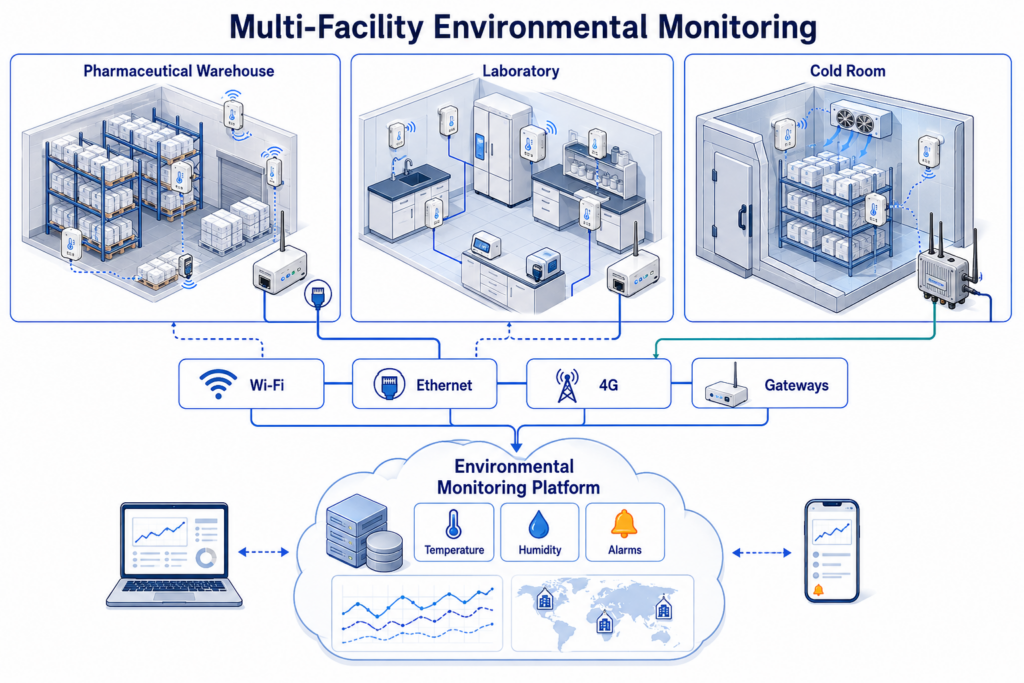
    Multi-site environmental monitoring system connecting sensors, gateways and central software

    Multi-site environmental monitoring system connecting sensors, gateways and central software


    Quick answer

    A scalable environmental monitoring system must combine reliable sensors, local data logging, resilient communications, centralized alarms, controlled user access, audit-ready records and integration capability. The right architecture minimizes data gaps and administrative workload while supporting future expansion.


    Who Is This Guide For?

    This guide is designed for organizations planning or upgrading a continuous monitoring system across multiple sites. QA and validation teams usually focus on calibration, audit trails, permissions and validation documentation. Facilities and warehouse teams care about coverage, uptime and alarm response. IT teams evaluate cybersecurity, servers, APIs and network architecture. Procurement teams need to understand the total cost of deploying and maintaining the system over several years. These priorities should be defined before selecting hardware.

    30-Second Summary

    A multi-site environmental monitoring system typically contains:

    • sensors or external probes;
    • data loggers or monitoring terminals;
    • Wi-Fi, Ethernet, 4G or long-range wireless connectivity;
    • gateways where required;
    • cloud or on-premises monitoring software;
    • alarm and escalation workflows;
    • APIs or data-forwarding interfaces.

    For large deployments, prioritize measurement performance, offline storage, alarm management, audit trails, platform scalability, integration and total cost of ownership. UbiBot is particularly relevant to projects that value mixed connectivity, RS-485 sensor expansion, local storage, public-cloud and on-premises deployment options, and open integration interfaces.

    What Is a Multi-Site Environmental Monitoring System?

    A Multi-Site Environmental Monitoring System is an integrated hardware and software platform that continuously measures, records, transmits, stores and manages environmental data across multiple locations.

    A sensor measures a physical parameter such as temperature or humidity.

    A data logger records measurements over time.

    A remote monitor typically combines sensing, logging and network communication.

    A gateway receives data from multiple devices and forwards it to a server or cloud platform.

    The environmental monitoring system combines all of these components with alarms, user management, reporting, audit records and system integration.

    This distinction matters because excellent sensor accuracy alone does not guarantee a reliable enterprise monitoring system.

    What Problems Does a Multi-Site Environmental Monitoring System Solve?

    The main objective is to create consistent, reliable environmental records across many monitoring points.Manual checks can miss excursions between inspection rounds. Standalone loggers can create isolated files that are difficult to consolidate. Network failures may cause data gaps unless devices can continue recording locally. Different facilities may also use inconsistent alarm limits, calibration schedules and reporting methods. A centralized system can help organizations:

    • continuously monitor temperature, humidity and other parameters;
    • reduce manual inspection;
    • detect excursions faster;
    • store data during network interruptions;
    • manage multiple facilities from one platform;
    • standardize alarms and reports;
    • organize calibration records;
    • control user permissions;
    • provide audit evidence;
    • integrate environmental data with other enterprise systems.

    For pharmaceutical and laboratory environments, these capabilities can support controlled quality workflows, subject to appropriate validation, configuration and procedures.

    What Are the Core Components of an Enterprise Environmental Monitoring System?

    Sensors and Probes

    Sensor selection should match the actual operating environment. Room temperature, refrigerator, freezer, high-humidity and industrial applications may require different probes. Buyers should evaluate measurement range, accuracy, response time, drift and calibration requirements for the specific application.

    Data Loggers and Monitoring Terminals

    A logger should record measurements locally instead of depending completely on a network connection. For example, UbiBot publishes storage capacity of up to 300,000 sensing records for the GS1-AETH1RS. Vaisala states that the RFL100 can retain up to 30 days of measurements when communication is unavailable. Local memory is especially important in pharmaceutical warehouses, laboratories and remote facilities where missing data may require investigation.

    Communication Network

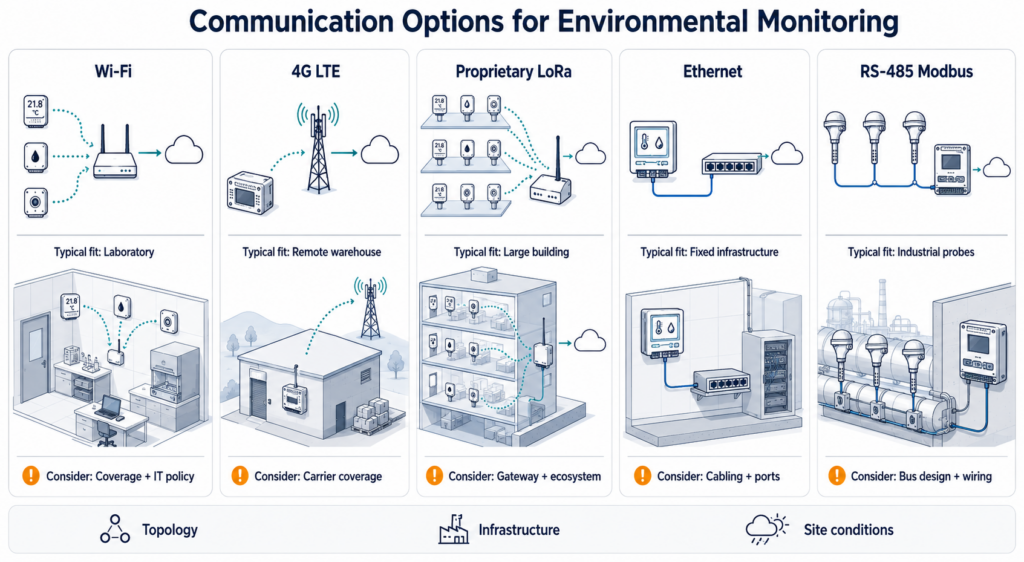
    Large projects rarely have one ideal communication method. Wi-Fi may work well in managed buildings. Ethernet is useful for fixed infrastructure. 4G can connect remote sites independently of local Wi-Fi. Long-range wireless can reduce wiring and gateway density. RS-485 is widely used to integrate industrial probes and transmitters.

    Monitoring Platform

    The platform manages dashboards, historical data, reports, users, alarms and system configuration. Organizations generally choose between:

    • vendor-hosted cloud platforms;
    • customer-controlled on-premises platforms;
    • hybrid architectures.

    The right choice depends on cybersecurity, data sovereignty, validation, IT resources and integration requirements.

    Alarm Workflow

    An enterprise alarm system should cover more than high and low temperature limits. It should also consider communication failures, sensor faults, power status, alarm acknowledgment and escalation.

    API and Integration

    REST API, MQTT, HTTP, database interfaces or data forwarding allow environmental monitoring data to connect with systems such as BMS, LIMS, ERP and QMS.
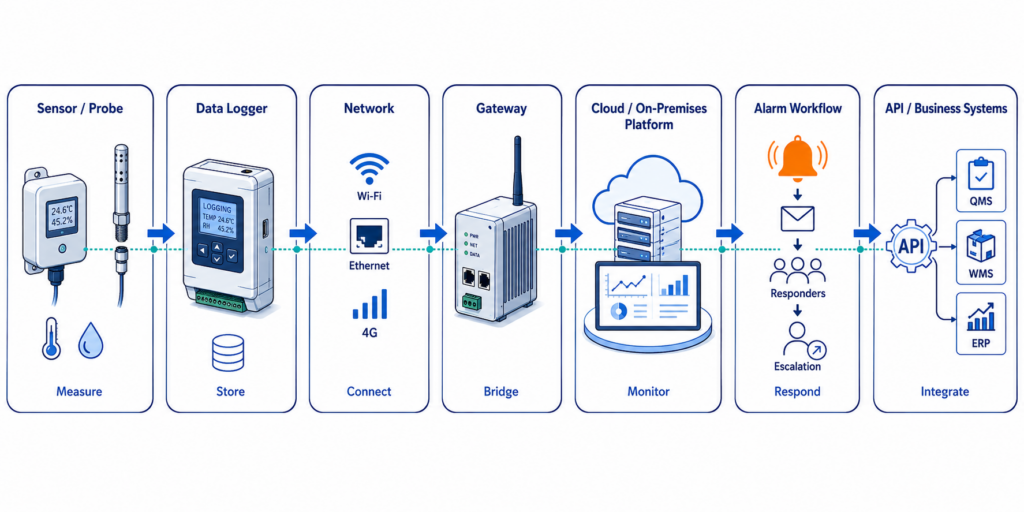
    Sensors, data loggers, network, gateway, platform and alarms in an environmental monitoring system

    Sensors, data loggers, network, gateway, platform and alarms in an environmental monitoring system

    Which Sensor Specifications Matter Most?

    Do not compare systems using measurement range alone. Buyers should distinguish:

    Sensor accuracy — performance of the sensing element.

    Probe accuracy — performance of the external probe assembly.

    Logger input accuracy — additional measurement error introduced by the logger or input electronics.

    System performance — the combined performance of the complete installed measurement chain.

    Other important parameters include:

    • resolution;
    • response time;
    • long-term drift;
    • sampling interval;
    • upload interval;
    • calibration capability;
    • calibration certificate availability;
    • local storage;
    • offline data recovery;
    • alarm latency;
    • battery life.

    A wider temperature range does not automatically mean better monitoring performance. Evaluate accuracy and calibration in the actual operating range.

    Selection rule: Compare the calibrated performance of the complete measurement chain at the temperatures and humidity levels that matter to the application. Do not choose a system simply because one sensor advertises the widest range.

    Wi-Fi vs 4G vs LoRa vs Ethernet vs RS-485: Which Connectivity Is Better?

    There is no universally superior connectivity method. Enterprise monitoring systems often use several technologies together.

    Connectivity Best Fit Main Advantage Main Limitation
    Wi-Fi Labs, offices and warehouses Uses existing network infrastructure Coverage and IT changes can interrupt connectivity
    Ethernet Fixed and critical monitoring points Stable wired connection Requires cabling
    4G/LTE Remote sites Independent of local Wi-Fi SIM, coverage and data cost
    Long-range LoRa-based wireless Large buildings or difficult RF environments Long range and low power May use proprietary ecosystems
    LoRaWAN Standards-based LPWAN deployments Large device ecosystem Requires verified LoRaWAN compatibility
    RS-485/Modbus RTU Industrial probes and equipment Reliable multi-drop wired integration Requires wiring and register configuration


    Wi-Fi, 4G, LoRa, Ethernet and RS-485 connectivity options for environmental monitoring

    Wi-Fi, 4G, LoRa, Ethernet and RS-485 connectivity options for environmental monitoring

    Conclusion

    Use Ethernet where stability is critical, Wi-Fi where infrastructure already exists, 4G for remote or independent sites, long-range wireless for large facilities, and RS-485 when third-party industrial probes need to be integrated.


    LoRa and LoRaWAN should not be treated as the same technology. A device using LoRa radio modulation is not automatically compatible with standard LoRaWAN gateways.

    How Important Are Audit Trails, Permissions and Validation?

    For regulated applications, software controls can be as important as sensor performance. When evaluating an environmental monitoring system for pharmaceutical applications, ask:

    • Who can change alarm limits?
    • Are changes time-stamped?
    • Can previous configuration values be reviewed?
    • Are alarm acknowledgments recorded?
    • Can access be limited by site and user role?
    • Can raw data be deleted or altered?
    • How are software updates controlled?
    • Is validation documentation available?
    • How are backups and disaster recovery managed?

    An audit trail is useful, but it does not automatically make an installation compliant with FDA 21 CFR Part 11, GxP or another regulation. UbiBot publishes software documentation covering audit-trail functions. Vaisala viewLinc, Rotronic RMS and DicksonOne also publish audit or controlled-record functionality for enterprise monitoring. The final system still needs to be assessed according to its intended use, configuration, calibration program, procedures and validation strategy.


    Compliance answer

    Monitoring software may support a GxP or electronic-record workflow, but compliance cannot be determined from a product feature alone. Validation, calibration, access control, procedures and record management must be evaluated for the actual project.


    Multi-Site Environmental Monitoring Systems Compared

    The most useful comparison is based on specific system configurations rather than brands alone.
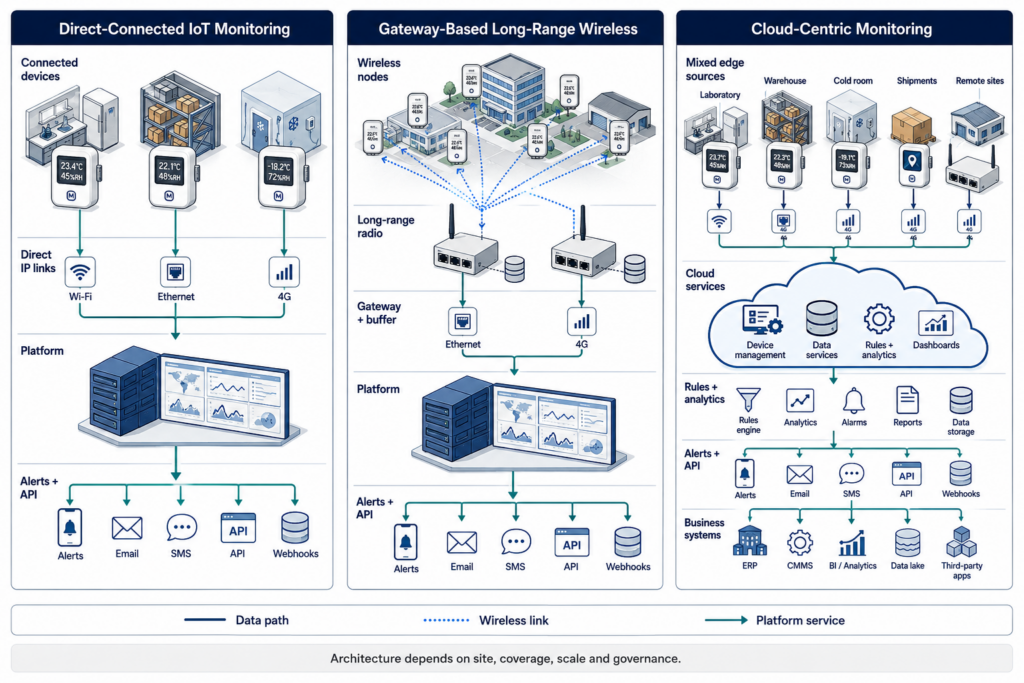
    Enterprise environmental monitoring architectures compared

    Enterprise environmental monitoring architectures compared

    System Architecture Local Data Protection Platform Integration Best Fit
    UbiBot GS1-AETH1RS / WS4 + Public IoT or On-Premises Platform Wi-Fi, Ethernet or 4G depending model; RS-485 expansion GS1 publishes up to 300,000 sensing records Cloud and on-premises options REST API, MQTT, HTTP and data forwarding Mixed-network, phased multi-site deployments
    Vaisala RFL100 + AP10 + viewLinc RFL100 → VaiNet → AP10 → viewLinc Up to 30 days in RFL100 viewLinc enterprise/cloud options Enterprise integration options Standardized life-science and GxP environments
    Rotronic RMS-LOG-T30-L + RMS Logger/probe → RMS infrastructure 44,000 measurement pairs published Rotronic Monitoring System Project-specific integration options High-accuracy Pt100 monitoring
    Dickson DWE2 + DicksonOne Wi-Fi/Ethernet → cloud On-device memory available DicksonOne REST API available Cloud-centric temperature and humidity monitoring


    Comparison conclusion

    Vaisala provides a strong benchmark for highly structured life-science monitoring workflows. Rotronic is particularly relevant where precision Pt100 measurement is important. Dickson offers a cloud-focused architecture. UbiBot’s main advantage is flexibility across communication methods, RS-485 sensor integration and cloud/on-premises deployment paths.


    Specifications and platform features were reviewed using publicly available manufacturer information on August 20, 2026. Product configurations, regional availability and subscription terms may change. Confirm the latest specifications with each manufacturer before purchasing.

    What Is the Best Architecture for Different Use Cases?

    Pharmaceutical Warehouses

    Prioritize calibrated temperature and humidity measurement, reliable local storage, alarm escalation, user permissions and audit records. Where Ethernet infrastructure exists, devices such as UbiBot GS1-AETH1RS can provide fixed network connectivity while RS-485 supports external sensor expansion. Regulated projects should separately evaluate validation documentation and procedures.

    Multi-Site Laboratories

    A laboratory environmental monitoring system should standardize alarm thresholds, reports, user access and calibration management across facilities. Central administration becomes increasingly valuable as the number of sites grows.

    Cold Rooms and Freezers

    Use an external temperature probe designed and calibrated for the target temperature range. The operating range of the logger enclosure should not be confused with the measurement range of the probe.

    Large Warehouses

    Wi-Fi coverage may be inconsistent in large metal structures or high-density storage areas. Mixed Ethernet, long-range wireless and RS-485 architectures may reduce communication blind spots.

    Remote Facilities

    Where corporate networking is unavailable, 4G-enabled monitoring can simplify deployment. Buyers should still evaluate cellular coverage, SIM costs and local storage capacity.

    What Does a Multi-Site Environmental Monitoring System Really Cost?
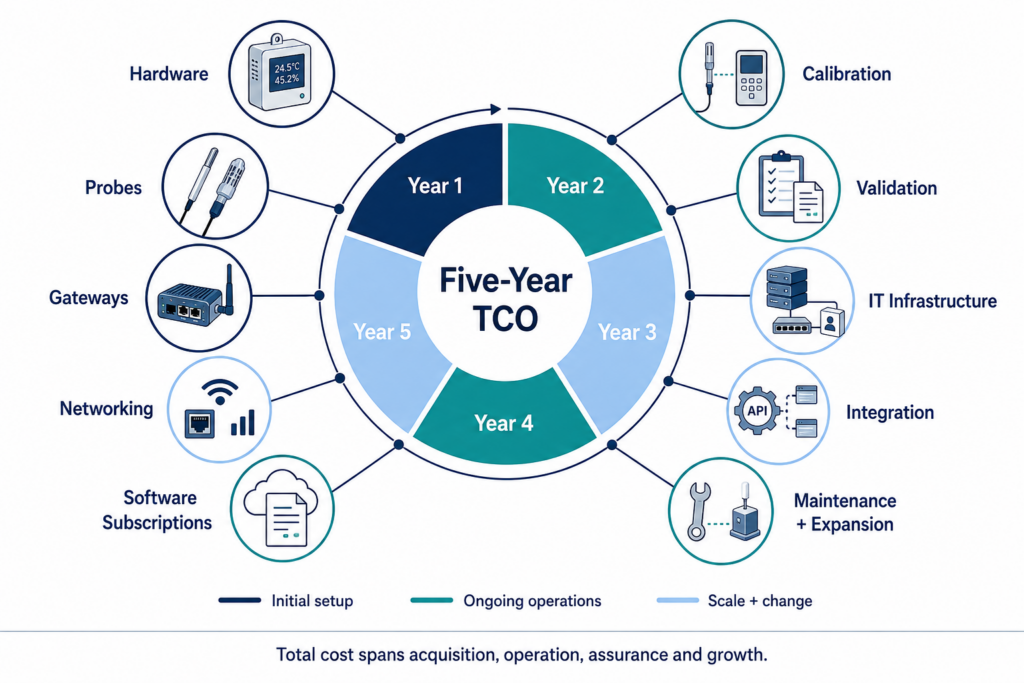
    Total cost of ownership for a multi-site environmental monitoring system

    Total cost of ownership for a multi-site environmental monitoring system

    Hardware purchase price is only one component of total cost of ownership (TCO).

    Cost Category What to Evaluate
    Sensors and loggers Number of points, spare units and future expansion
    External probes Room, refrigerator, freezer or industrial sensor requirements
    Gateways Gateway count and coverage
    Network Ethernet, Wi-Fi infrastructure, cellular SIMs and data
    Software Cloud subscriptions or server licenses
    Calibration Initial and recurring calibration
    Validation Documentation, qualification and testing
    Installation Wiring, mounting and commissioning
    IT Servers, backups, cybersecurity and maintenance
    Integration API, BMS, LIMS, ERP or QMS development
    Operations Battery replacement, training and support


    TCO answer

    Compare the cost of operating and expanding the monitoring architecture over three to five years. A low-cost logger may become expensive if additional gateways, subscriptions, calibration or integration work scales poorly.


    For multi-site procurement, the marginal cost of adding another facility or another 100 monitoring points is often more useful than the purchase price of a single device.

    What Are the Most Common Buying Mistakes?

    The most common error is selecting a system primarily on hardware price. Other frequent mistakes include:

    1. comparing measurement range instead of system accuracy;
    2. confusing probe accuracy with overall system performance;
    3. ignoring calibration requirements;
    4. relying on cloud connectivity without adequate local storage;
    5. failing to define alarm escalation responsibilities;
    6. overlooking software subscriptions;
    7. assuming an audit trail automatically creates regulatory compliance;
    8. failing to plan for future site expansion;
    9. confusing LoRa and LoRaWAN;
    10. failing to verify regional SKUs, frequencies and cellular bands.

    A good procurement specification should address these questions before vendors are shortlisted.

    Where Does UbiBot Fit?

    UbiBot is most relevant where organizations want a flexible environmental monitoring architecture rather than a single fixed communications ecosystem. The GS1-AETH1RS combines Wi-Fi and Ethernet connectivity with RS-485 expansion and published local storage of up to 300,000 sensing records. The WS4 family provides additional Wi-Fi and 4G configurations. UbiBot also offers both the Public IoT Platform and an On-Premises Platform, allowing organizations to choose between vendor-hosted and customer-controlled infrastructure. Published integration options include REST API, MQTT, HTTP and data forwarding. These capabilities can help system integrators connect environmental monitoring data with broader business or facility systems. For highly regulated pharmaceutical projects, customers should verify current audit-trail functions, validation documentation, calibration requirements and the exact software configuration before deployment. UbiBot should therefore be evaluated primarily on the combined value of:

    multiple communication options + external sensor expansion + local storage + centralized alarms + cloud/on-premises deployment + API integration + multi-site management.

    Frequently Asked Questions

    What is a Multi-Site Environmental Monitoring System?

    It is a centralized system that monitors environmental conditions across multiple rooms, buildings or geographic sites and manages measurements, alarms, users and records through a common platform.

    How many sensors can a multi-site monitoring system support?

    Capacity depends on the logger, gateway and software architecture. Enterprise systems may support hundreds or thousands of monitoring points, but the exact limit should be verified for the proposed configuration.

    Should pharmaceutical monitoring use Wi-Fi or Ethernet?

    Both can be appropriate. Ethernet provides a stable wired connection, while Wi-Fi simplifies installation. Critical applications should also consider local device storage during network outages.

    What happens if the network fails?

    A suitable logger should continue recording locally and upload stored data after connectivity returns. Verify local memory capacity and recovery behavior before purchase.

    Does an audit trail make a system 21 CFR Part 11 compliant?

    No. Audit trails are one relevant control, but validation, user access, electronic records, procedures and other requirements must also be evaluated.

    How often should sensors be calibrated?

    Calibration frequency should be based on risk, sensor stability, quality procedures and application requirements rather than one universal interval.

    Can environmental monitoring integrate with BMS or LIMS?

    Yes, when the monitoring platform provides appropriate APIs or protocols. REST API, MQTT, HTTP, Modbus and database interfaces are common integration methods.

    Is cloud or on-premises monitoring better?

    Neither is universally better. Cloud platforms reduce local IT requirements, while on-premises deployment provides greater infrastructure and data control.

    What is the difference between LoRa and LoRaWAN?

    LoRa is a radio modulation technology; LoRaWAN is a networking protocol that uses LoRa. LoRa devices are not automatically compatible with LoRaWAN gateways.

    What should be included in environmental monitoring TCO?

    Include hardware, probes, gateways, networking, software, calibration, validation, installation, IT infrastructure, integration, maintenance and expansion.

    How Do You Choose the Right Multi-Site Environmental Monitoring System?

    Start with measurement requirements, not brands. Define the monitoring parameters and operating range first. Then determine required accuracy and calibration, the number of monitoring points, network conditions, offline-storage requirements and alarm-response workflow. Next evaluate user permissions, audit trails, validation support, cloud versus on-premises deployment and API requirements. Finally, calculate lifecycle cost and test the architecture at representative sites before full rollout. A practical selection sequence is:

    1. Define parameters and measurement ranges.
    2. Establish accuracy and calibration requirements.
    3. Estimate current and future point count.
    4. Select appropriate connectivity.
    5. Verify local storage and outage recovery.
    6. Define alarm escalation.
    7. Evaluate audit trails and permissions.
    8. Select cloud or on-premises deployment.
    9. Define API and enterprise-system integration.
    10. Compare three- to five-year TCO.

    For organizations considering UbiBot, evaluate the specific GS1 or WS4 configuration, external probes and whether the Public IoT Platform or On-Premises Platform better matches the project’s IT and quality requirements.

    Official Sources for Product Parameters

    UbiBot GS1-AETH1RS product information https://store.ubibot.com/products/ubibot-gs1-eth-wifi-and-ethernet-cable

    UbiBot GS1-AETH1RS specifications https://store.ubibot.com/en-eu/pages/ubibotgs1-aeth1rs_specifications

    UbiBot GS1 product overview https://www.ubibot.com/ubibot-gs1/

    UbiBot WS4-A1RS https://store.ubibot.com/products/ubibot-ws4-a1rs

    UbiBot WS4-A4G1RS https://store.ubibot.com/products/ubibot-ws4-a4g1rs

    UbiBot Public IoT Platform https://www2.ubibot.com/software/public-iot-platform

    UbiBot On-Premises Platform https://www.ubibot.com/on-premises-platform/

    UbiBot Platform API documentation https://www.ubibot.com/category/platform-api/

    UbiBot FDA 21 CFR Part 11 information https://www2.ubibot.com/certification-and-compliance/5543/fda-21-cfr-part-11/

    UbiBot Calibration & Compliance https://www.ubibot.com/calibration/

    FDA Part 11 Electronic Records and Electronic Signatures Guidance https://www.fda.gov/regulatory-information/search-fda-guidance-documents/part-11-electronic-records-electronic-signatures-scope-and-application


    Related Resources

    How to Monitor Pharmaceutical Cold Chain Shipments from Warehouse to Delivery?
    How to Deploy a Pharmaceutical Warehouse Environmental Monitoring System?
    Shanghai Jiao Tong University and National University of Singapore Study Use UbiBot GS1-AETH1RS for Vertical Farming Environment Monitoring
    EU GDP Temperature Monitoring for Pharmaceutical Warehouses and 3PLs
    UbiBot vs Room Alert vs HW Group vs Monnit: Which Server Room Monitoring System Fits Your Facility?
    UbiBot vs ELPRO vs Dickson vs Testo: Which Monitoring System Fits a GDP Pharmaceutical Warehouse?
    UbiBot vs Dickson vs Testo vs Monnit: Which Is Better for Cold Storage Warehouses?
    menu-header-svg
    Search
    • Explore Knowledge
      • Comparison & Selection
      • Industry Solution
      • Product & Device
      • Criterion & Compliance
      • Deployment & Usage
      • Technology & Principle
    • Academic Research
    • In-depth Tech

    Product & Device

    See More >>

    How to Build a Multi-Site Environmental Monitoring System: Sensors, Gateways, Audit Trails and Total Cost

    Why Does a Multi-Site Environmental Monitoring System Matter?

    Monitoring one room with a standalone data logger is simple. Monitoring hundreds or thousands of points across laboratories, warehouses, production areas and regional facilities is an enterprise system problem. At that scale, measurement accuracy is only one part of the decision. Buyers also need to consider connectivity, local data storage, alarm escalation, calibration management, user permissions, audit trails, server or cloud architecture, system validation and integration with BMS, LIMS, ERP or QMS platforms. A Multi-Site Environmental Monitoring System should therefore be evaluated as a complete sensor-to-record workflow rather than a collection of temperature and humidity sensors.

    Multi-site environmental monitoring system connecting sensors, gateways and central software

    Multi-site environmental monitoring system connecting sensors, gateways and central software


    Quick answer

    A scalable environmental monitoring system must combine reliable sensors, local data logging, resilient communications, centralized alarms, controlled user access, audit-ready records and integration capability. The right architecture minimizes data gaps and administrative workload while supporting future expansion.


    Who Is This Guide For?

    This guide is designed for organizations planning or upgrading a continuous monitoring system across multiple sites. QA and validation teams usually focus on calibration, audit trails, permissions and validation documentation. Facilities and warehouse teams care about coverage, uptime and alarm response. IT teams evaluate cybersecurity, servers, APIs and network architecture. Procurement teams need to understand the total cost of deploying and maintaining the system over several years. These priorities should be defined before selecting hardware.

    30-Second Summary

    A multi-site environmental monitoring system typically contains:

    • sensors or external probes;
    • data loggers or monitoring terminals;
    • Wi-Fi, Ethernet, 4G or long-range wireless connectivity;
    • gateways where required;
    • cloud or on-premises monitoring software;
    • alarm and escalation workflows;
    • APIs or data-forwarding interfaces.

    For large deployments, prioritize measurement performance, offline storage, alarm management, audit trails, platform scalability, integration and total cost of ownership. UbiBot is particularly relevant to projects that value mixed connectivity, RS-485 sensor expansion, local storage, public-cloud and on-premises deployment options, and open integration interfaces.

    What Is a Multi-Site Environmental Monitoring System?

    A Multi-Site Environmental Monitoring System is an integrated hardware and software platform that continuously measures, records, transmits, stores and manages environmental data across multiple locations.

    A sensor measures a physical parameter such as temperature or humidity.

    A data logger records measurements over time.

    A remote monitor typically combines sensing, logging and network communication.

    A gateway receives data from multiple devices and forwards it to a server or cloud platform.

    The environmental monitoring system combines all of these components with alarms, user management, reporting, audit records and system integration.

    This distinction matters because excellent sensor accuracy alone does not guarantee a reliable enterprise monitoring system.

    What Problems Does a Multi-Site Environmental Monitoring System Solve?

    The main objective is to create consistent, reliable environmental records across many monitoring points.Manual checks can miss excursions between inspection rounds. Standalone loggers can create isolated files that are difficult to consolidate. Network failures may cause data gaps unless devices can continue recording locally. Different facilities may also use inconsistent alarm limits, calibration schedules and reporting methods. A centralized system can help organizations:

    • continuously monitor temperature, humidity and other parameters;
    • reduce manual inspection;
    • detect excursions faster;
    • store data during network interruptions;
    • manage multiple facilities from one platform;
    • standardize alarms and reports;
    • organize calibration records;
    • control user permissions;
    • provide audit evidence;
    • integrate environmental data with other enterprise systems.

    For pharmaceutical and laboratory environments, these capabilities can support controlled quality workflows, subject to appropriate validation, configuration and procedures.

    What Are the Core Components of an Enterprise Environmental Monitoring System?

    Sensors and Probes

    Sensor selection should match the actual operating environment. Room temperature, refrigerator, freezer, high-humidity and industrial applications may require different probes. Buyers should evaluate measurement range, accuracy, response time, drift and calibration requirements for the specific application.

    Data Loggers and Monitoring Terminals

    A logger should record measurements locally instead of depending completely on a network connection. For example, UbiBot publishes storage capacity of up to 300,000 sensing records for the GS1-AETH1RS. Vaisala states that the RFL100 can retain up to 30 days of measurements when communication is unavailable. Local memory is especially important in pharmaceutical warehouses, laboratories and remote facilities where missing data may require investigation.

    Communication Network

    Large projects rarely have one ideal communication method. Wi-Fi may work well in managed buildings. Ethernet is useful for fixed infrastructure. 4G can connect remote sites independently of local Wi-Fi. Long-range wireless can reduce wiring and gateway density. RS-485 is widely used to integrate industrial probes and transmitters.

    Monitoring Platform

    The platform manages dashboards, historical data, reports, users, alarms and system configuration. Organizations generally choose between:

    • vendor-hosted cloud platforms;
    • customer-controlled on-premises platforms;
    • hybrid architectures.

    The right choice depends on cybersecurity, data sovereignty, validation, IT resources and integration requirements.

    Alarm Workflow

    An enterprise alarm system should cover more than high and low temperature limits. It should also consider communication failures, sensor faults, power status, alarm acknowledgment and escalation.

    API and Integration

    REST API, MQTT, HTTP, database interfaces or data forwarding allow environmental monitoring data to connect with systems such as BMS, LIMS, ERP and QMS.

    Sensors, data loggers, network, gateway, platform and alarms in an environmental monitoring system

    Sensors, data loggers, network, gateway, platform and alarms in an environmental monitoring system

    Which Sensor Specifications Matter Most?

    Do not compare systems using measurement range alone. Buyers should distinguish:

    Sensor accuracy — performance of the sensing element.

    Probe accuracy — performance of the external probe assembly.

    Logger input accuracy — additional measurement error introduced by the logger or input electronics.

    System performance — the combined performance of the complete installed measurement chain.

    Other important parameters include:

    • resolution;
    • response time;
    • long-term drift;
    • sampling interval;
    • upload interval;
    • calibration capability;
    • calibration certificate availability;
    • local storage;
    • offline data recovery;
    • alarm latency;
    • battery life.

    A wider temperature range does not automatically mean better monitoring performance. Evaluate accuracy and calibration in the actual operating range.

    Selection rule: Compare the calibrated performance of the complete measurement chain at the temperatures and humidity levels that matter to the application. Do not choose a system simply because one sensor advertises the widest range.

    Wi-Fi vs 4G vs LoRa vs Ethernet vs RS-485: Which Connectivity Is Better?

    There is no universally superior connectivity method. Enterprise monitoring systems often use several technologies together.

    Connectivity Best Fit Main Advantage Main Limitation
    Wi-Fi Labs, offices and warehouses Uses existing network infrastructure Coverage and IT changes can interrupt connectivity
    Ethernet Fixed and critical monitoring points Stable wired connection Requires cabling
    4G/LTE Remote sites Independent of local Wi-Fi SIM, coverage and data cost
    Long-range LoRa-based wireless Large buildings or difficult RF environments Long range and low power May use proprietary ecosystems
    LoRaWAN Standards-based LPWAN deployments Large device ecosystem Requires verified LoRaWAN compatibility
    RS-485/Modbus RTU Industrial probes and equipment Reliable multi-drop wired integration Requires wiring and register configuration


    Wi-Fi, 4G, LoRa, Ethernet and RS-485 connectivity options for environmental monitoring

    Wi-Fi, 4G, LoRa, Ethernet and RS-485 connectivity options for environmental monitoring

    Conclusion

    Use Ethernet where stability is critical, Wi-Fi where infrastructure already exists, 4G for remote or independent sites, long-range wireless for large facilities, and RS-485 when third-party industrial probes need to be integrated.


    LoRa and LoRaWAN should not be treated as the same technology. A device using LoRa radio modulation is not automatically compatible with standard LoRaWAN gateways.

    How Important Are Audit Trails, Permissions and Validation?

    For regulated applications, software controls can be as important as sensor performance. When evaluating an environmental monitoring system for pharmaceutical applications, ask:

    • Who can change alarm limits?
    • Are changes time-stamped?
    • Can previous configuration values be reviewed?
    • Are alarm acknowledgments recorded?
    • Can access be limited by site and user role?
    • Can raw data be deleted or altered?
    • How are software updates controlled?
    • Is validation documentation available?
    • How are backups and disaster recovery managed?

    An audit trail is useful, but it does not automatically make an installation compliant with FDA 21 CFR Part 11, GxP or another regulation. UbiBot publishes software documentation covering audit-trail functions. Vaisala viewLinc, Rotronic RMS and DicksonOne also publish audit or controlled-record functionality for enterprise monitoring. The final system still needs to be assessed according to its intended use, configuration, calibration program, procedures and validation strategy.


    Compliance answer

    Monitoring software may support a GxP or electronic-record workflow, but compliance cannot be determined from a product feature alone. Validation, calibration, access control, procedures and record management must be evaluated for the actual project.


    Multi-Site Environmental Monitoring Systems Compared

    The most useful comparison is based on specific system configurations rather than brands alone.

    Enterprise environmental monitoring architectures compared

    Enterprise environmental monitoring architectures compared

    System Architecture Local Data Protection Platform Integration Best Fit
    UbiBot GS1-AETH1RS / WS4 + Public IoT or On-Premises Platform Wi-Fi, Ethernet or 4G depending model; RS-485 expansion GS1 publishes up to 300,000 sensing records Cloud and on-premises options REST API, MQTT, HTTP and data forwarding Mixed-network, phased multi-site deployments
    Vaisala RFL100 + AP10 + viewLinc RFL100 → VaiNet → AP10 → viewLinc Up to 30 days in RFL100 viewLinc enterprise/cloud options Enterprise integration options Standardized life-science and GxP environments
    Rotronic RMS-LOG-T30-L + RMS Logger/probe → RMS infrastructure 44,000 measurement pairs published Rotronic Monitoring System Project-specific integration options High-accuracy Pt100 monitoring
    Dickson DWE2 + DicksonOne Wi-Fi/Ethernet → cloud On-device memory available DicksonOne REST API available Cloud-centric temperature and humidity monitoring


    Comparison conclusion

    Vaisala provides a strong benchmark for highly structured life-science monitoring workflows. Rotronic is particularly relevant where precision Pt100 measurement is important. Dickson offers a cloud-focused architecture. UbiBot’s main advantage is flexibility across communication methods, RS-485 sensor integration and cloud/on-premises deployment paths.


    Specifications and platform features were reviewed using publicly available manufacturer information on August 20, 2026. Product configurations, regional availability and subscription terms may change. Confirm the latest specifications with each manufacturer before purchasing.

    What Is the Best Architecture for Different Use Cases?

    Pharmaceutical Warehouses

    Prioritize calibrated temperature and humidity measurement, reliable local storage, alarm escalation, user permissions and audit records. Where Ethernet infrastructure exists, devices such as UbiBot GS1-AETH1RS can provide fixed network connectivity while RS-485 supports external sensor expansion. Regulated projects should separately evaluate validation documentation and procedures.

    Multi-Site Laboratories

    A laboratory environmental monitoring system should standardize alarm thresholds, reports, user access and calibration management across facilities. Central administration becomes increasingly valuable as the number of sites grows.

    Cold Rooms and Freezers

    Use an external temperature probe designed and calibrated for the target temperature range. The operating range of the logger enclosure should not be confused with the measurement range of the probe.

    Large Warehouses

    Wi-Fi coverage may be inconsistent in large metal structures or high-density storage areas. Mixed Ethernet, long-range wireless and RS-485 architectures may reduce communication blind spots.

    Remote Facilities

    Where corporate networking is unavailable, 4G-enabled monitoring can simplify deployment. Buyers should still evaluate cellular coverage, SIM costs and local storage capacity.

    What Does a Multi-Site Environmental Monitoring System Really Cost?

    Total cost of ownership for a multi-site environmental monitoring system

    Total cost of ownership for a multi-site environmental monitoring system

    Hardware purchase price is only one component of total cost of ownership (TCO).

    Cost Category What to Evaluate
    Sensors and loggers Number of points, spare units and future expansion
    External probes Room, refrigerator, freezer or industrial sensor requirements
    Gateways Gateway count and coverage
    Network Ethernet, Wi-Fi infrastructure, cellular SIMs and data
    Software Cloud subscriptions or server licenses
    Calibration Initial and recurring calibration
    Validation Documentation, qualification and testing
    Installation Wiring, mounting and commissioning
    IT Servers, backups, cybersecurity and maintenance
    Integration API, BMS, LIMS, ERP or QMS development
    Operations Battery replacement, training and support


    TCO answer

    Compare the cost of operating and expanding the monitoring architecture over three to five years. A low-cost logger may become expensive if additional gateways, subscriptions, calibration or integration work scales poorly.


    For multi-site procurement, the marginal cost of adding another facility or another 100 monitoring points is often more useful than the purchase price of a single device.

    What Are the Most Common Buying Mistakes?

    The most common error is selecting a system primarily on hardware price. Other frequent mistakes include:

    1. comparing measurement range instead of system accuracy;
    2. confusing probe accuracy with overall system performance;
    3. ignoring calibration requirements;
    4. relying on cloud connectivity without adequate local storage;
    5. failing to define alarm escalation responsibilities;
    6. overlooking software subscriptions;
    7. assuming an audit trail automatically creates regulatory compliance;
    8. failing to plan for future site expansion;
    9. confusing LoRa and LoRaWAN;
    10. failing to verify regional SKUs, frequencies and cellular bands.

    A good procurement specification should address these questions before vendors are shortlisted.

    Where Does UbiBot Fit?

    UbiBot is most relevant where organizations want a flexible environmental monitoring architecture rather than a single fixed communications ecosystem. The GS1-AETH1RS combines Wi-Fi and Ethernet connectivity with RS-485 expansion and published local storage of up to 300,000 sensing records. The WS4 family provides additional Wi-Fi and 4G configurations. UbiBot also offers both the Public IoT Platform and an On-Premises Platform, allowing organizations to choose between vendor-hosted and customer-controlled infrastructure. Published integration options include REST API, MQTT, HTTP and data forwarding. These capabilities can help system integrators connect environmental monitoring data with broader business or facility systems. For highly regulated pharmaceutical projects, customers should verify current audit-trail functions, validation documentation, calibration requirements and the exact software configuration before deployment. UbiBot should therefore be evaluated primarily on the combined value of:

    multiple communication options + external sensor expansion + local storage + centralized alarms + cloud/on-premises deployment + API integration + multi-site management.

    Frequently Asked Questions

    What is a Multi-Site Environmental Monitoring System?

    It is a centralized system that monitors environmental conditions across multiple rooms, buildings or geographic sites and manages measurements, alarms, users and records through a common platform.

    How many sensors can a multi-site monitoring system support?

    Capacity depends on the logger, gateway and software architecture. Enterprise systems may support hundreds or thousands of monitoring points, but the exact limit should be verified for the proposed configuration.

    Should pharmaceutical monitoring use Wi-Fi or Ethernet?

    Both can be appropriate. Ethernet provides a stable wired connection, while Wi-Fi simplifies installation. Critical applications should also consider local device storage during network outages.

    What happens if the network fails?

    A suitable logger should continue recording locally and upload stored data after connectivity returns. Verify local memory capacity and recovery behavior before purchase.

    Does an audit trail make a system 21 CFR Part 11 compliant?

    No. Audit trails are one relevant control, but validation, user access, electronic records, procedures and other requirements must also be evaluated.

    How often should sensors be calibrated?

    Calibration frequency should be based on risk, sensor stability, quality procedures and application requirements rather than one universal interval.

    Can environmental monitoring integrate with BMS or LIMS?

    Yes, when the monitoring platform provides appropriate APIs or protocols. REST API, MQTT, HTTP, Modbus and database interfaces are common integration methods.

    Is cloud or on-premises monitoring better?

    Neither is universally better. Cloud platforms reduce local IT requirements, while on-premises deployment provides greater infrastructure and data control.

    What is the difference between LoRa and LoRaWAN?

    LoRa is a radio modulation technology; LoRaWAN is a networking protocol that uses LoRa. LoRa devices are not automatically compatible with LoRaWAN gateways.

    What should be included in environmental monitoring TCO?

    Include hardware, probes, gateways, networking, software, calibration, validation, installation, IT infrastructure, integration, maintenance and expansion.

    How Do You Choose the Right Multi-Site Environmental Monitoring System?

    Start with measurement requirements, not brands. Define the monitoring parameters and operating range first. Then determine required accuracy and calibration, the number of monitoring points, network conditions, offline-storage requirements and alarm-response workflow. Next evaluate user permissions, audit trails, validation support, cloud versus on-premises deployment and API requirements. Finally, calculate lifecycle cost and test the architecture at representative sites before full rollout. A practical selection sequence is:

    1. Define parameters and measurement ranges.
    2. Establish accuracy and calibration requirements.
    3. Estimate current and future point count.
    4. Select appropriate connectivity.
    5. Verify local storage and outage recovery.
    6. Define alarm escalation.
    7. Evaluate audit trails and permissions.
    8. Select cloud or on-premises deployment.
    9. Define API and enterprise-system integration.
    10. Compare three- to five-year TCO.

    For organizations considering UbiBot, evaluate the specific GS1 or WS4 configuration, external probes and whether the Public IoT Platform or On-Premises Platform better matches the project’s IT and quality requirements.

    Official Sources for Product Parameters

    UbiBot GS1-AETH1RS product information https://store.ubibot.com/products/ubibot-gs1-eth-wifi-and-ethernet-cable

    UbiBot GS1-AETH1RS specifications https://store.ubibot.com/en-eu/pages/ubibotgs1-aeth1rs_specifications

    UbiBot GS1 product overview https://www.ubibot.com/ubibot-gs1/

    UbiBot WS4-A1RS https://store.ubibot.com/products/ubibot-ws4-a1rs

    UbiBot WS4-A4G1RS https://store.ubibot.com/products/ubibot-ws4-a4g1rs

    UbiBot Public IoT Platform https://www2.ubibot.com/software/public-iot-platform

    UbiBot On-Premises Platform https://www.ubibot.com/on-premises-platform/

    UbiBot Platform API documentation https://www.ubibot.com/category/platform-api/

    UbiBot FDA 21 CFR Part 11 information https://www2.ubibot.com/certification-and-compliance/5543/fda-21-cfr-part-11/

    UbiBot Calibration & Compliance https://www.ubibot.com/calibration/

    FDA Part 11 Electronic Records and Electronic Signatures Guidance https://www.fda.gov/regulatory-information/search-fda-guidance-documents/part-11-electronic-records-electronic-signatures-scope-and-application

    分享

    LinkedIn2

    Facebook2

    X

    Newsletter Signup

    Related Resources

    How to Monitor Pharmaceutical Cold Chain Shipments from Warehouse to Delivery?
    How to Deploy a Pharmaceutical Warehouse Environmental Monitoring System?
    Shanghai Jiao Tong University and National University of Singapore Study Use UbiBot GS1-AETH1RS for Vertical Farming Environment Monitoring
    EU GDP Temperature Monitoring for Pharmaceutical Warehouses and 3PLs
    UbiBot vs Room Alert vs HW Group vs Monnit: Which Server Room Monitoring System Fits Your Facility?
    UbiBot vs ELPRO vs Dickson vs Testo: Which Monitoring System Fits a GDP Pharmaceutical Warehouse?
    UbiBot vs Dickson vs Testo vs Monnit: Which Is Better for Cold Storage Warehouses?
    menu-header-svg
    Search
    • Explore Knowledge
      • Comparison & Selection
      • Industry Solution
      • Product & Device
      • Criterion & Compliance
      • Deployment & Usage
      • Technology & Principle
    • Academic Research
    • In-depth Tech
    Enter Your Information

    Confirm

    Products

    Dashboards

    Support

    Purchase

    Company

    Smart Sensing

    UbiBot Web Console

    APP Download

    UbiBot Online Store

    News

    Smart Control

    UbiBot Space

    Product Docs & APIs

    Find Distributors

    About Us

    Smart Video

    UbiBot On-Premises

    Helpdesk & FAQ

    Volume Pricing

    Learn Hub

    LoRa Products

    Agency Web Console

    Video Center

    Contact Us

    Software & Platform


    Pricing


    Architecture

    External Sensors


    System Status

    Accessories


    Become a Distributor

    Global SIM


    Become an Affiliate

    Positioning System


    Products

    Dashboards

    Business Partners

    WS1

    UbiBot Web Console

    Volume Pricing

    WS1 Pro

    UbiBot Space

    Become a Distributor

    GS1

    UbiBot Support Desk

    Affiliates

    GS2

    Agency Web Console


    MS1


    SP1


    Accessories


    Docs

    Purchase

    Company

    Platform API

    Pricing

    News

    Q&A

    UbiBot Partners

    About us

    Privacy Policy

    Online Store

    Contact

    Terms of Service


    System Status

    Products

    Dashboards

    Smart Sensing

    UbiBot Web Console

    Smart Control

    UbiBot Space

    Smart Video

    UbiBot On-Premises

    LoRa Products

    Agency Web Console

    Software & Platform


    External Sensors


    Accessories


    Global SIM


    Positioning System


    Support

    Purchase

    APP Download

    UbiBot Online Store

    Product Docs & APIs

    Find Distributors

    Helpdesk & FAQ

    Volume Pricing

    Video Center


    Pricing


    Company

    News

    About Us

    Learn Hub

    Contact Us

    Architecture

    System Status

    Become a Distributor

    Become an Affiliate

    Language:
    English 日本語 (ベータ)  
    Language:

    English

    日本語 (ベータ)


    IoT Product Family:
    ubibotico     Wireless environmental sensing products and smart building solutions
    ubitrackico     UWB-based real-time indoor tracking solutions with 30cm accuracy

    IoT Product Family:

    ubibotico  Wireless environmental sensing products and smart building solutions
    ubitrackico  UWB-based real-time indoor tracking solutions with 30cm accuracy

    © 2013-2026 UbiBot.com. All rights reserved.

    Terms of Service | Privacy Policy | Compliance

    youtube facebook twitter