
UBiBot Logo
UBiBot Logo
  • UBiBot Logo
  • Home
  • Products

    NEW

  • Pricing
  • Support
  • About Us
  • Download
  • magnifying-glass  Search
  • magnifying-glass header-close
  • Sign in Sign in
    Public Web Console Public Web Console
    On-Premises App Center On-Premises App Center
  • Home
  • Products

    NEW

  • Pricing
  • Support
  • About us
  • Download
  •  Public Web Console
  •  On-Premises App Center
  • Where to Buy

Learn Hub

Explore Knowledge Academic Research In-depth Tech

Share

LinkedIn

Facebook

X (Twitter)

Newsletter Signup

Table of contents

    How to Choose a 21 CFR Part 11-Ready Environmental Monitoring System

    The Record Matters as Much as the Sensor

    In a regulated facility, an environmental reading may influence product release, batch disposition, storage acceptance, excursion investigations, deviation reports, or CAPA. A sensor can be accurate and still produce records that are difficult to defend during an inspection if users share accounts, audit trails are incomplete, exports lose metadata, backups are untested, or system changes are not controlled.

    This is why a “connected temperature logger” and a Part 11-ready environmental monitoring system are not the same thing. The first measures and transmits conditions. The second must preserve trustworthy electronic records across their lifecycle and provide evidence that the configured system is fit for its intended use.

    This guide translates FDA 21 CFR Part 11, the current EU GMP Annex 11, and MHRA data-integrity expectations into procurement questions, system requirements, implementation steps, and a practical vendor-evidence checklist. It does not treat any device, cloud account, or software certificate as automatic proof that a regulated organization is compliant.

    Quick answer

    Choose the system only after defining which records are regulated, who relies on them, how long they must be retained, whether electronic signatures are used, and what happens during network, power, cloud, or hardware failure. Evaluate hardware, software, procedures, supplier evidence, validation, cybersecurity, and data governance as one controlled system.
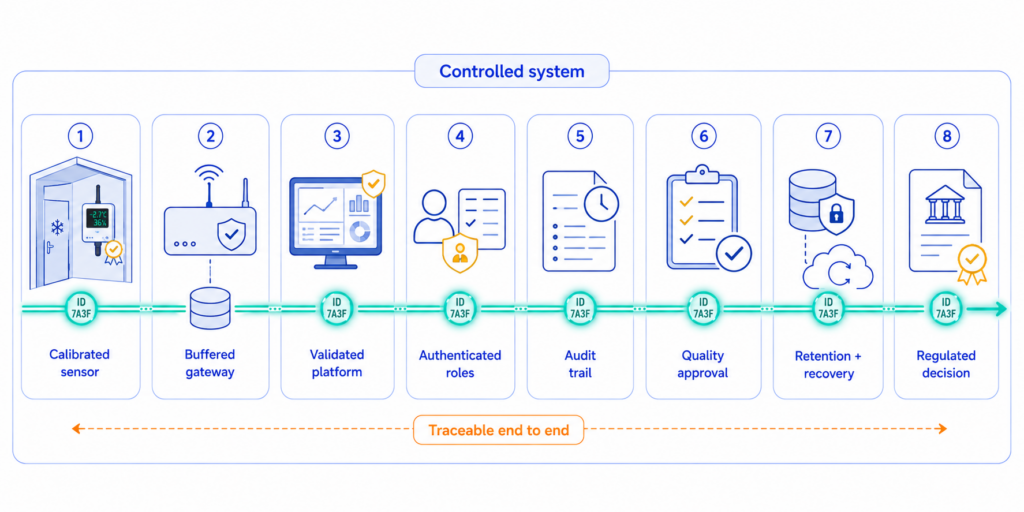
    A defensible environmental-monitoring record depends on the entire controlled system—from a calibrated sensor and authenticated user to validated software, review, retention, and tested recovery.

    1.What Part 11, Annex 11, and MHRA Data Integrity Actually Cover

    The three frameworks overlap, but they are not interchangeable. Their legal status, geographic scope, and emphasis differ. A procurement specification should identify which framework applies and which records are in scope instead of combining the terms into a generic “GxP compliant” label.

    Framework Practical scope
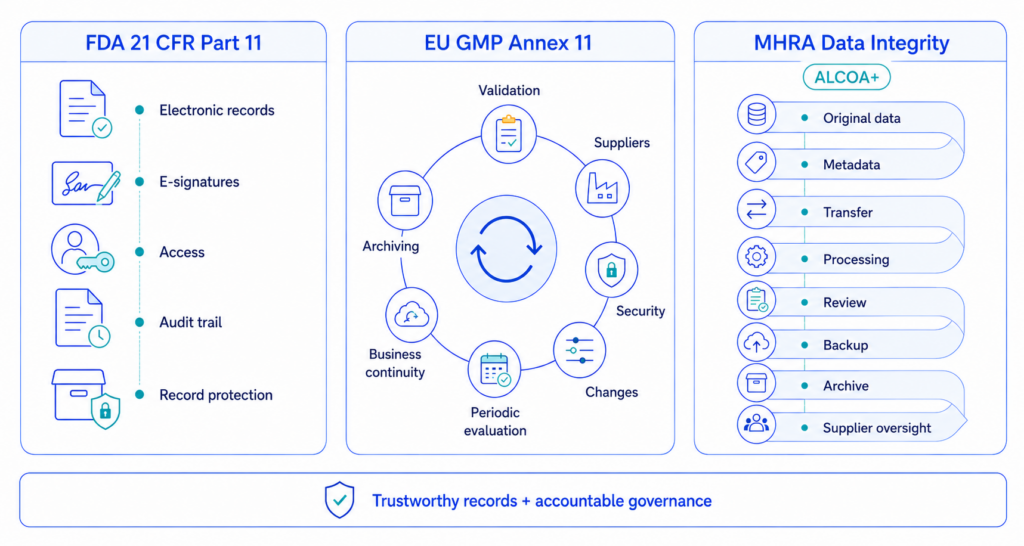
    FDA 21 CFR Part 11 U.S. regulation for electronic records and electronic signatures that fall under FDA predicate-rule requirements. FDA’s 2003 guidance applies a narrow interpretation of scope and confirms that Part 11 remains in effect.
    EU GMP Annex 11 EU GMP guidance for computerised systems used in GMP-regulated activities. The January 2011 revision remains the current published Annex 11 as of July 2026. A revised draft was consulted on in 2025 but is not yet the operative text.
    MHRA GxP Data Integrity Guidance UK regulatory guidance across GMP, GDP, GLP, GCP, and pharmacovigilance. It focuses on data governance, ALCOA principles, metadata, original records, lifecycle control, supplier oversight, and risk-based review.

    Part 11 focuses on regulated electronic records and signatures, Annex 11 governs computerised systems through their lifecycle, and MHRA guidance emphasizes data integrity and governance across the full data lifecycle.

    Part 11 does not apply to every digital reading

    FDA’s scope guidance asks organizations to identify records required by predicate rules and determine whether electronic or paper records are relied upon for regulated activities. A cloud dashboard used only for convenience may be outside Part 11, while the same dashboard may become a Part 11 system if its electronic records are relied upon for release, disposition, investigation, or required recordkeeping. That decision should be documented in an SOP, system specification, or data-governance record.

    Annex 11 is broader than electronic signatures

    Annex 11 takes a lifecycle view of computerised systems. It addresses quality-risk management, personnel, suppliers and service providers, validation, data handling, accuracy checks, data storage, printouts, audit trails, change and configuration management, periodic evaluation, security, incident management, electronic signatures, business continuity, and archiving. Treating Annex 11 as merely the “EU version of Part 11” misses this broader system-governance scope.

    MHRA expects data governance across the full lifecycle

    MHRA defines data integrity through attributes commonly summarized as ALCOA and the additional expectations that data remain complete, consistent, enduring, and available. The guidance emphasizes original records, metadata, data transfer, data processing, audit trails, access rights, backup, archive, validation for intended purpose, and oversight of cloud or outsourced service providers. The organization remains accountable even when the data platform is supplied or hosted by a third party.

    2.Key Requirements That Affect Environmental Monitoring

    Define the intended use, record scope, and system boundary

    The first compliance question is not “Does the vendor have a certificate?” It is “What regulated decision will this system support?” Define the monitored areas, parameters, alarm workflows, record users, review and approval steps, retention periods, integrations, and whether the system is the original record, a copy, or one component of a hybrid process. Include sensors, gateways, mobile apps, cloud services, APIs, databases, reports, spreadsheets, identity systems, notification providers, and downstream quality systems in the boundary where they affect record integrity.
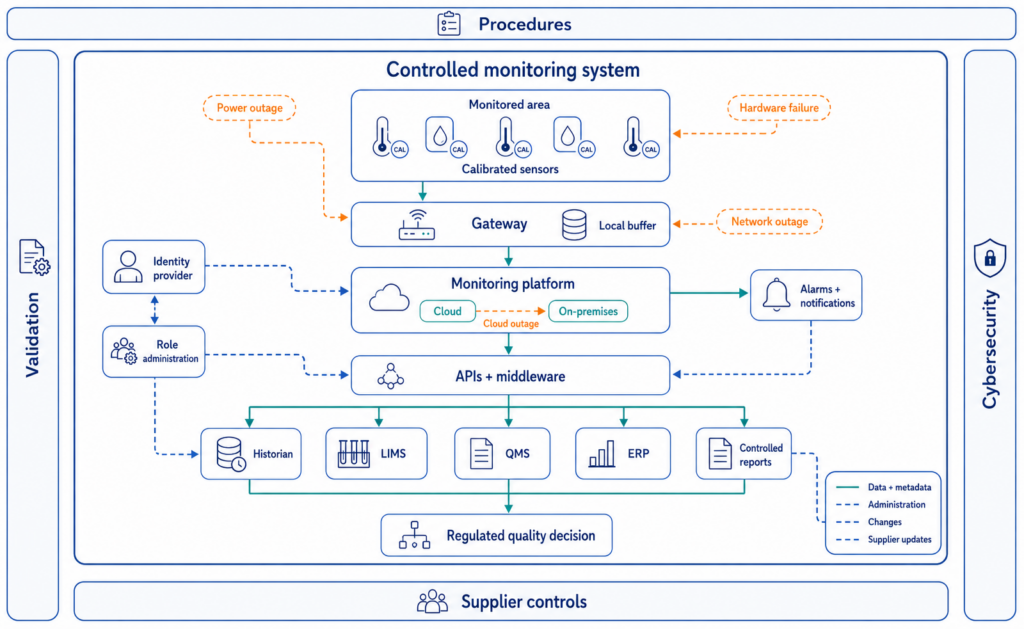
    The validated boundary extends beyond sensors to gateways, software, identity, notifications, interfaces, downstream systems, procedures, and supplier services wherever they can affect record integrity.

    Validate the configured system for its intended purpose

    Part 11 and Annex 11 do not make validation a vendor-only activity. Vendor testing, software certificates, IQ/OQ templates, and GAMP documentation can reduce effort, but the regulated user must show that the installed and configured system performs as intended. Validation should be risk-based and should cover critical functions such as data capture, time synchronization, alarm generation, audit trails, access control, report generation, record export, interfaces, backup, restoration, and recovery after communication failure.

    Protect original records, metadata, and context

    A temperature value without its timestamp, device identity, sensor channel, calibration status, alarm state, user actions, and configuration history may not be sufficient to reconstruct the activity. MHRA treats metadata as an integral part of the original record. Environmental-monitoring designs should therefore preserve device and channel identifiers, units, timestamps and time zones, alarm thresholds, acknowledgement comments, calibration status, changes to configuration, and the relationship between raw readings and generated reports.

    A reading becomes reconstructable evidence only when its value is preserved with time, device and channel identity, calibration status, alarm context, user actions, and configuration history.

    Restrict access and separate responsibilities

    Part 11 expects access to be limited to authorized individuals and includes authority and operational checks. Annex 11 and MHRA guidance also emphasize security and appropriate user rights. The system should support unique accounts, defined roles, controlled administrator privileges, password or identity-management policies, failed-login handling, timely removal of access, and periodic review of users. Shared accounts are difficult to reconcile with attributable records and should not be used for regulated actions.

    Generate audit trails that can actually be reviewed
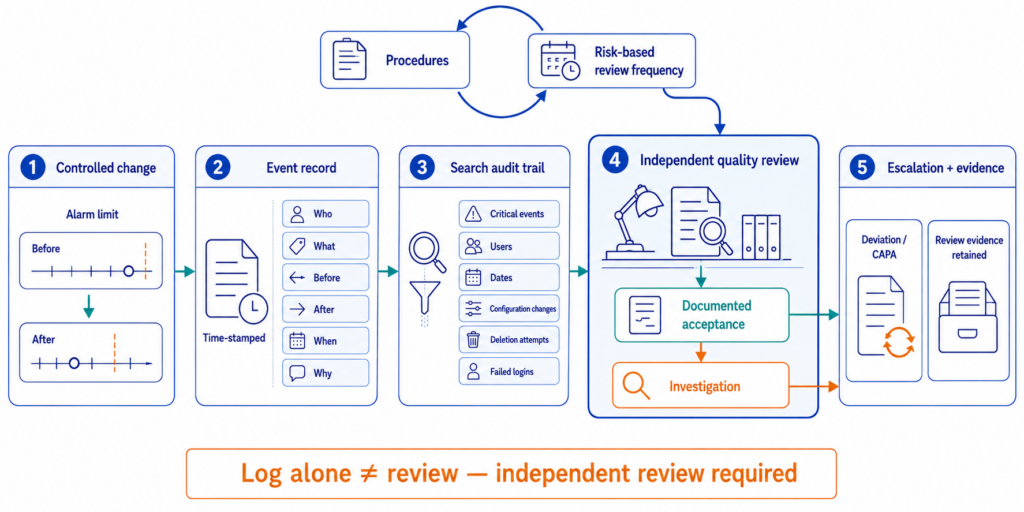
    An audit trail is useful only when it records who acted, what changed, before-and-after values, when and why—and supports review, investigation, escalation, and retained evidence.

    A compliance claim is not established by showing that an audit log exists. The audit trail should identify who performed the action, what changed, the previous and new values where relevant, when the action occurred, and—where the process requires it—why the change was made. Reviewers need filters, search, export, human-readable reports, and procedures that define which events are reviewed, how often, by whom, and what triggers investigation. Audit-trail configuration and review should be tested during validation.

    Use electronic signatures only with the required meaning and linkage
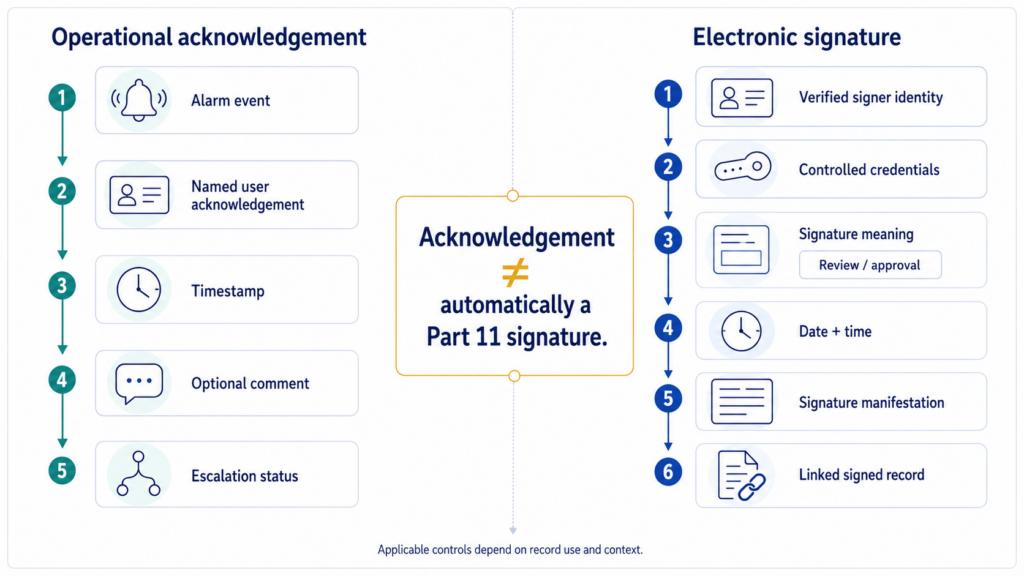
    An alarm acknowledgement is not automatically a Part 11 electronic signature; a formal signature requires verified identity, signature meaning, date and time, credential controls, and unbreakable linkage to the record.

    Part 11 electronic signatures are intended to be equivalent to handwritten signatures and must be linked to their records. A typed name, checkbox, email reply, or alarm acknowledgement is not automatically a compliant electronic signature. When signatures are required, confirm the signer identity, signature components, meaning of the signature, date and time, record linkage, credential controls, and accountability policy. Some monitoring systems provide acknowledgements but not full electronic-signature workflows; this distinction must be documented.

    Preserve records, produce complete copies, and test recovery

    The retention period usually comes from the applicable predicate rule, GMP/GDP requirement, product record, study requirement, or company procedure—not from Part 11 itself. The system should preserve records and metadata for the required period and produce accurate, complete, human-readable and, where appropriate, machine-readable copies. Backup is not the same as archive: backups support recovery from loss, while archives preserve records for long-term retrieval. Both controls need defined ownership, monitoring, and periodic testing.

    Control cloud, open-system, and integration risks

    Backup, archive, and business continuity solve different problems: restoring lost data, preserving records for long-term retrieval, and sustaining monitoring and response during outages.

    Part 11 requires additional controls for open systems, including measures such as encryption and appropriate digital-signature standards where necessary. Cloud monitoring adds supplier, connectivity, identity, update, data-location, backup, and service-continuity dependencies. APIs and middleware introduce another risk: the transfer must preserve content, meaning, metadata, ordering, timestamps, and error handling. Validating only the sensor or cloud screen is insufficient when regulated records move into a historian, LIMS, QMS, ERP, spreadsheet, or customer database.

    3.Convert Regulations into a System Requirement Matrix

    Regulatory expectation System / process control Evidence to retain
    Record scope Document the predicate rule, regulated decision, original record, metadata, and hybrid-system boundary. Intended-use statement; data-flow diagram; record inventory; SOP
    Validation Risk-based evidence that the configured system performs consistently and accurately for intended use. URS; risk assessment; traceability matrix; IQ/OQ/PQ or equivalent; test evidence
    Access control Unique users, least privilege, authority checks, administrator segregation, and periodic access review. Role matrix; account procedures; access-review records; authentication settings
    Audit trail Secure, time-stamped history for relevant creation, modification, deletion, configuration, and review events. Audit-trail specification; sample reports; review SOP; test scripts
    Electronic signatures Identity, signature meaning, date/time, credential control, and unbreakable record linkage where signatures are used. Signature workflow; policy; signature manifestation; test evidence
    Record protection Retention, ready retrieval, complete copies, readable exports, and preservation of content and meaning. Retention matrix; export tests; archive procedure; inspection-readiness test
    Backup and recovery Scheduled backup, monitored completion, restoration testing, disaster recovery, and business continuity. Backup logs; restore evidence; recovery objectives; contingency test
    Time control Synchronized clocks, defined time zone, daylight-saving behavior, and traceable timestamp changes. Time-source configuration; NTP evidence; multi-site time-zone SOP
    Interfaces Validated transfer of data and metadata with detection, reconciliation, retry, and exception handling. Interface specification; mapping; error tests; reconciliation records
    Supplier lifecycle Supplier assessment, release/change notification, security, service levels, subcontractor control, and exit plan. Quality agreement; supplier audit; release notes; SLA; data-return plan

    Decision rule

    A system should be rejected or redesigned when a critical record cannot be reconstructed, a user action cannot be attributed, a required audit-trail event cannot be reviewed, data cannot be restored, or the supplier cannot provide enough evidence to support the regulated user’s validation and quality-system responsibilities.

    4.Implementation Path: From Procurement to Validated Operation

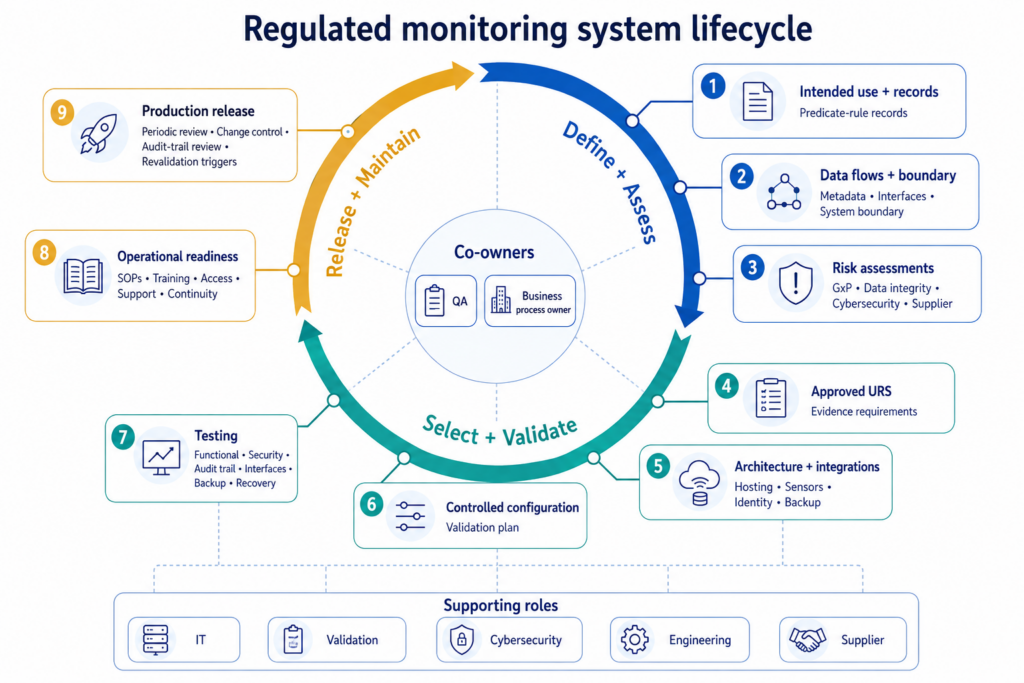
    The implementation path should be controlled by QA and the business process owner, with defined participation from validation, IT, cybersecurity, engineering, and the supplier. The sequence below prevents the common mistake of buying hardware first and trying to create a compliance rationale afterward.

    1 Define intended use and predicate-rule records
    2 Map data flows, metadata, interfaces, and system boundaries
    3 Perform GxP, data-integrity, cybersecurity, and supplier risk assessments
    4 Approve URS and vendor evidence requirements
    5 Select architecture, hosting model, sensors, identity, backup, and integrations
    6 Configure under change control and create the validation plan
    7 Execute installation, functional, security, audit-trail, interface, backup, and recovery testing
    8 Approve SOPs, training, access, support, and business-continuity arrangements
    9 Release to production with periodic review, audit-trail review, change control, and revalidation triggers


    A controlled implementation moves from intended use and record scope through risk assessment, requirements, architecture, configuration, validation testing, release, and ongoing periodic review.

    Supplier qualification and evidence package

    Request more than a marketing statement. The package should identify software versions, hosting model, system architecture, release and patch process, security controls, audit-trail functions, electronic-signature capability, backup and disaster-recovery arrangements, validation documentation, data-return and exit procedures, support responsibilities, and subcontractors. For SaaS, define how vendor changes are communicated and assessed before or after release, and how the customer maintains validated status.

    Configuration and validation

    Create a requirements traceability matrix linking each GxP requirement to configuration, procedure, and test evidence. Challenge high-risk scenarios: changed alarm limits, deleted or disabled devices, user-role changes, failed logins, clock changes, missed data uploads, duplicate records, network outages, power loss, cloud unavailability, export to CSV/PDF, API retries, restoration from backup, and historical retrieval. Test the actual production configuration rather than relying only on generic vendor demonstrations.

    Operating controls after go-live

    Validated status must be maintained. Establish user-access reviews, audit-trail reviews, backup monitoring, restore tests, periodic evaluation, calibration and maintenance, incident handling, supplier-update assessment, vulnerability management, change control, revalidation triggers, and training. When a device is replaced or a sensor is recalibrated, preserve the link between the physical asset, channel, certificate, location, and electronic record history.

    5.Part 11 / Annex 11 Procurement and Audit Checklist

    Control question Evidence to request Owner / status
    ☐ Is the regulated intended use and predicate-rule record scope documented? Approved intended-use statement and record inventory Owner: ____
    Status: ____
    ☐ Is the original electronic record, metadata, and system of record defined? Data-flow diagram and data-governance SOP Owner: ____
    Status: ____
    ☐ Can every regulated action be attributed to a unique user? Role matrix, account records, access-review evidence Owner: ____
    Status: ____
    ☐ Does the audit trail capture relevant old/new values, user, timestamp, and reason? Audit-trail specification, sample report, test results Owner: ____
    Status: ____
    ☐ Is audit-trail review risk-based, proceduralized, and documented? Review SOP, schedule, completed review records Owner: ____
    Status: ____
    ☐ Do electronic signatures show identity, date/time, meaning, and record linkage? Signature policy, screenshots, functional tests Owner: ____
    Status: ____
    ☐ Can the system provide accurate and complete copies without losing metadata? PDF/CSV/API export tests and reconciliation Owner: ____
    Status: ____
    ☐ Are retention, archive, destruction, and legal-hold rules defined? Retention schedule, archive and destruction procedures Owner: ____
    Status: ____
    ☐ Are backups monitored and restorations tested? Backup logs, restore test, DR/BCP exercise Owner: ____
    Status: ____
    ☐ Are timestamps synchronized and time zones documented? NTP settings, time-zone configuration, test evidence Owner: ____
    Status: ____
    ☐ Are cloud and interface suppliers covered by quality and service agreements? Supplier assessment, SLA, quality agreement, exit plan Owner: ____
    Status: ____
    ☐ Are configuration changes, patches, and vendor releases assessed under change control? Change records, release assessment, regression tests Owner: ____
    Status: ____
    ☐ Are calibration and device identity linked to each monitored channel? Asset register, calibration certificates, channel mapping Owner: ____
    Status: ____
    ☐ Can the organization continue monitoring and respond during outages? Local buffering test, alarm contingency, manual backup process Owner: ____
    Status: ____

    6.Common Audit Deficiencies and How to Avoid Them

    This article does not rely on a named enforcement case. The examples below are composite audit patterns derived from the regulatory controls and regulator guidance cited in the reference section.

    Audit deficiency Risk Preventive control
    “The system has an audit trail” but no one reviews it Unauthorized or unexplained changes may remain undetected. Define critical events, review frequency, reviewer independence, evidence, and escalation.
    Shared operator or administrator accounts Actions are not attributable and role segregation is weakened. Use unique identities, least privilege, emergency-access controls, and periodic account review.
    CSV export becomes the working record Metadata, audit-trail context, formulas, and version history may be lost. Define the system of record; validate exports and downstream processing; control spreadsheets.
    Backup jobs succeed but restoration is never tested The organization cannot demonstrate recoverability or business continuity. Run documented restore and disaster-recovery tests using representative records.
    Automatic SaaS updates occur without quality assessment Validated functions may change without impact analysis or regression testing. Require release notification, change assessment, regression strategy, and supplier agreement.
    Alarm acknowledgement is treated as an electronic signature The event may lack signature meaning, credential controls, or record linkage. Define whether acknowledgement or signature is required; validate the correct workflow.
    Sensor calibration is detached from the digital record Reviewers cannot prove which calibrated instrument generated a reading. Maintain asset/channel identity, certificate linkage, effective dates, and replacement history.
    Cloud platform is unavailable and remote alarms stop Data may buffer locally, but the response process fails. Test local alarms, alternate communication, manual review, escalation, and post-outage reconciliation.

    7.Representative Environmental Monitoring Architectures

    The following comparison is not a certification ranking. It separates public regulatory evidence from hardware capability and identifies questions that must be resolved in the supplier and validation package. Specifications and vendor statements were reviewed in July 2026.

    UbiBot: flexible hardware and deployment paths
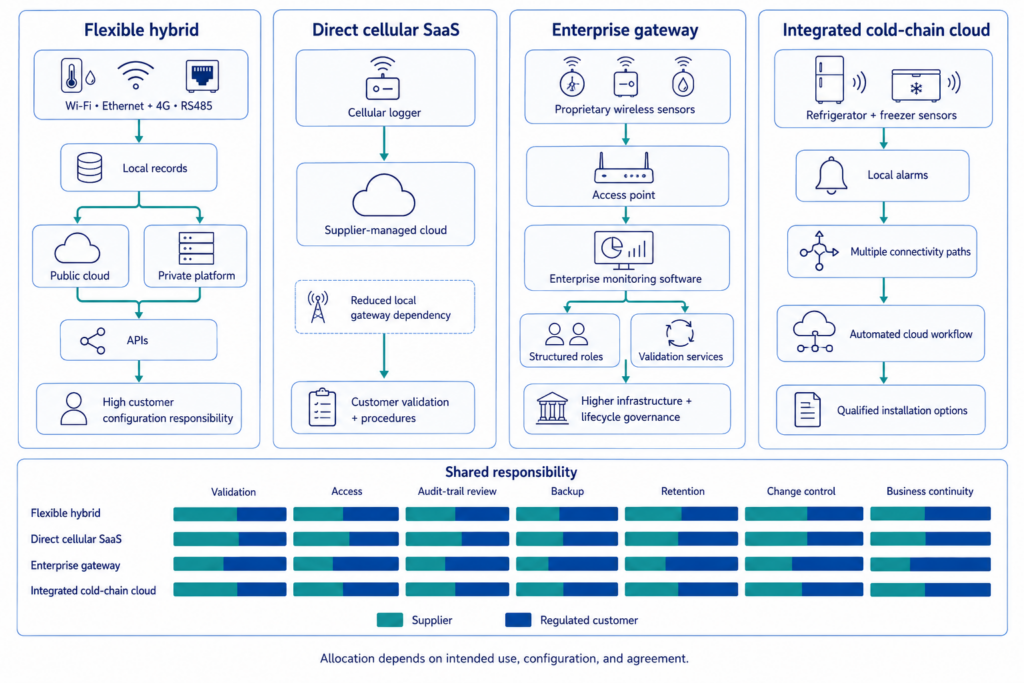
    Environmental-monitoring architectures shift responsibility among the device, network, platform, integrations, supplier, and customer; cloud, cellular, enterprise, or private deployment does not by itself establish compliance.

    UbiBot combines direct-connected environmental hardware, substantial local records, external-sensor support, public-cloud access, private deployment, and APIs. Its public Part 11 page describes a field-change audit trail with old and new values, user identity, date, and time. The decisive procurement question is whether the selected platform version and workflow provide all controls and validation evidence required for the intended regulated record, especially electronic signatures, administrator segregation, backup and restoration, audit-trail review, retention, supplier change control, and Annex 11 lifecycle governance.

    ELPRO: packaged cellular monitoring and compliance positioning

    ECOLOG-PRO xG connects directly through cellular IoT networks and is positioned by ELPRO as GAMP 5 validated with an FDA 21 CFR Part 11-compliant audit trail. This can reduce local IT and gateway dependency for distributed storage assets. Buyers should still define the exact elproCLOUD workflow, role model, electronic-signature use, validation deliverables, retention, service levels, and how supplier changes are assessed under the customer quality system.

    Vaisala: mature enterprise validation and lifecycle support

    Vaisala publishes the most detailed compliance and validation evidence in this benchmark set. viewLinc materials describe secure audit trails, access controls, encryption, authority levels, Active Directory integration, IQ/OQ services, a validation certificate, and GxP documentation. The trade-off is a more structured architecture, licensing, access-point infrastructure, and validation-service scope that should be budgeted and governed throughout the lifecycle.

    Sensitech: integrated stationary cold-chain workflow

    SmartMonitor SITE L is positioned for stationary refrigerators and freezers with local alarms, multiple connectivity options, external sensors, and automated data flow to SmartView. Sensitech states alignment with FDA 21 CFR Part 11, GAMP 5, PQS, and cGxP workflows and offers qualified installation services. Procurement should request detailed evidence for audit-trail events, electronic signatures or controlled acknowledgements, user roles, retention, backup, change notification, data residency, and Annex 11 applicability.

    8.Representative System Comparison

    Comparison area UbiBot GS1 / WS4 + Platform or OPP ELPRO ECOLOG-PRO xG + elproCLOUD Vaisala RFL100 + AP10 + viewLinc Sensitech SmartMonitor SITE L + SmartView
    System positioning Flexible monitoring hardware with public cloud, private deployment, APIs, or customer-built regulated platform. Cellular IoT monitoring package positioned for regulated medical storage and cloud compliance workflows. Enterprise continuous monitoring architecture with proprietary wireless, access point, regulated software, and validation services. Stationary real-time monitoring for refrigerators/freezers with validated cloud data flow and cold-chain workflow.
    Hardware / connectivity GS1: Wi-Fi, Ethernet, RS485, 300,000 local records; WS4 variants add multi-probe and 4G options depending on model. Direct LTE-M / NB-IoT logger; product-specific sensors and local buffering. RFL100 via VaiNet to AP10; AP10 uses Ethernet/PoE or AC; up to 32 RFL100 devices per AP10. Wi-Fi, cellular, and BLE; supports internal parameters and up to four external SmartSensors; local acoustic/visual alarms.
    Public Part 11 evidence UbiBot publishes a Part 11 page stating that field changes are written to a separate audit-trail database with old/new value, user, date, and time. Full validation scope must be confirmed. Vendor states GAMP 5 validated and FDA 21 CFR Part 11 compliant audit trail. Vendor provides detailed Part 11/Annex 11 application notes, secure audit trail, access controls, encryption, validation certificate, and IQ/OQ/GxP documentation. Vendor states automated validated data flows and alignment with FDA 21 CFR Part 11, GAMP 5, PQS, and cGxP workflows.
    Audit trail / access controls Publicly described field-change audit trail and user authentication. Granularity, review functions, administrator controls, and version-specific evidence should be verified. Audit trail, user assessment and deviation workflows are publicly described; exact role and review configuration should be scoped. Secure audit trail, access controls, authority levels, Active Directory option, reports and event logging are publicly described. Public product page states validated data flow; detailed audit-trail and role matrix should be requested in supplier documentation.
    Electronic signatures Public evidence reviewed does not fully specify a complete Part 11 electronic-signature workflow and signature/record linkage for all platform actions. Verify signature meanings, credential controls, and record linkage in the selected elproCLOUD workflow and validation package. Part 11/Annex 11 support is documented; confirm the exact signature workflow, configuration, and applicable version in the validation package. Verify whether the selected SmartView workflow provides electronic signatures or controlled acknowledgements for the intended regulated action.
    Validation support Hardware specifications, APIs, private deployment, Part 11 vendor statement, and compliance document are available. Public evidence for a complete IQ/OQ/PQ package and Annex 11 lifecycle package should be confirmed. GAMP 5 validation positioning, calibration, cloud compliance, and related services are offered. IQ/OQ services, validation certificate, GxP documentation package, and sample protocols are publicly offered. Vendor states qualified installation services (IQ/OQ/PQ) and validated data flows; exact deliverables and responsibilities should be contracted.
    Hosting and integration Public cloud, On-Premises Platform, and developer integration options. Customer-built or private systems require validation of interfaces, security, backup, and change control. elproCLOUD with optional API and vendor-managed service model. viewLinc Cloud or Enterprise Server; API and OPC UA integration options. SmartView cloud ecosystem; verify data residency, API/export, retention, service continuity, and exit arrangements.
    Best fit Organizations valuing flexible hardware, mixed Wi-Fi/Ethernet/4G/RS485, local continuity, APIs, or private deployment—and prepared to define and validate the complete regulated configuration. Rapid regulated cold-storage deployments seeking packaged cellular hardware and vendor compliance positioning. Enterprise life-science sites needing mature validation evidence, structured access control, multi-site scale, and lifecycle services. Cold-chain organizations seeking an integrated stationary-monitoring and cloud workflow with installation qualification services.
    Key caution Do not treat hardware, an audit-trail page, or private deployment as automatic Part 11/Annex 11 compliance. Confirm signatures, validation package, backup/restore, access matrix, audit-trail review, and change management. Vendor Part 11 claims do not replace user validation, predicate-rule analysis, Annex 11 assessment, SOPs, or supplier oversight. Higher infrastructure, licensing, and validation-service burden; the organization still owns procedures and validated-state maintenance. Request detailed public or contractual evidence for audit trail, signatures, role controls, retention, backup, system changes, and Annex 11 applicability.

    How should UbiBot be positioned?

    UbiBot should be positioned as a flexible sensing, connectivity, local-storage, and integration layer with several deployment paths—not as a universal substitute for a fully packaged enterprise validation programme. UbiBot’s public website states that its platform maintains a field-change audit trail with old and new values, user, date, and time, and it offers public-cloud, on-premises, and developer-integration options. These are relevant controls. Before a regulated customer relies on the system, however, the exact software version, audit-trail scope, signature workflow, role model, backup and restore evidence, retention, supplier-change process, cybersecurity controls, and validation deliverables should be documented and tested.

    For some users, the practical architecture may be UbiBot hardware sending data into a customer-controlled validated platform through documented APIs. In that case the interface, retries, timestamps, device identity, metadata, configuration changes, and exception handling become part of the validated system. Private deployment provides greater control over infrastructure and data location, but it also transfers more responsibility for administration, patching, backup, disaster recovery, security, and lifecycle validation to the customer.

    9.Frequently Asked Questions

    Does FDA certify environmental monitoring systems as Part 11 compliant?

    No. FDA establishes regulatory criteria for electronic records and signatures; it does not provide a general product certification that makes every implementation compliant. Vendor documentation can support the user’s assessment and validation, but the regulated organization remains responsible for its configured system and procedures.

    Is an audit trail enough for Part 11?

    No. Part 11 also addresses access, operational and authority checks, record protection, copies, documentation controls, training, accountability, and electronic-signature controls where signatures are used. Audit-trail review must also be defined and performed.

    Does every environmental record fall under Part 11?

    No. Determine whether the record is required by a predicate rule and whether the electronic record is relied upon for regulated activities. Document the decision and the system of record.

    Is EU GMP Annex 11 the same as Part 11?

    No. Annex 11 is broader and covers the lifecycle governance of computerised systems, including suppliers, validation, security, incidents, change management, periodic evaluation, business continuity, and archiving. The 2011 Annex 11 remains current as of July 2026; a 2025 revision draft is not yet operative.

    Can alarm acknowledgement count as an electronic signature?

    Only when the workflow meets the applicable signature requirements, including identity, date/time, meaning, credential controls, and record linkage. Many systems provide acknowledgements that are useful operationally but are not intended as formal Part 11 signatures.

    Does on-premises deployment automatically improve compliance?

    It can improve control over data location and infrastructure, but it also increases customer responsibility for security, user administration, backup, recovery, patching, change control, validation, and business continuity. Hosting location alone does not establish compliance.

    Can a CSV or PDF be the regulated record?

    Possibly, but only when the record strategy is justified and preserves required content and meaning. Dynamic electronic records and metadata may contain information that a static export cannot preserve. Define the original record and validate the export and review process.

    How often should audit trails be reviewed?

    Neither Part 11 nor Annex 11 provides one universal frequency for every system. Establish a risk-based schedule based on data criticality, user ability to change records, process risk, and predicate-rule requirements. Critical events may require event-driven review in addition to periodic review.

    10.Final Selection Guidance

    The strongest procurement decision is not the product with the longest compliance feature list. It is the architecture for which the organization can define the regulated record, control users and changes, review audit trails, protect and retrieve data, recover from failure, manage suppliers, and maintain a validated state throughout the system lifecycle.

    ELPRO, Vaisala, and Sensitech publish more packaged life-science compliance and validation positioning for the benchmark configurations reviewed. UbiBot offers flexible sensing hardware, direct connectivity, local records, public and private platform options, APIs, and a public Part 11 audit-trail statement. This can be a viable foundation for a regulated solution, especially where the customer wants private deployment or integration flexibility, but the full evidence package and configured controls must be verified against the intended use.

    11.Final takeaway

    Do not ask only whether a platform is “Part 11 compliant.” Ask which records are in scope, which controls are software functions, which controls depend on procedures, what validation evidence is available, and how the organization will maintain the validated state after upgrades, staff changes, incidents, and supplier changes.

    12.Sources and Product Information Disclaimer

    This article is for educational, procurement-planning, and editorial purposes. It is not legal, regulatory, validation, cybersecurity, or quality-system advice. Part 11 applicability depends on FDA predicate rules and actual business practice. EU and UK requirements depend on the applicable regulated activity, current legislation, guidance, licenses, and competent-authority expectations. The current EU Annex 11 remains the January 2011 revision as of July 2026; the 2025 revised draft consultation is not yet an operative requirement.

    Product descriptions are based on public manufacturer information reviewed in July 2026. Vendor statements such as “Part 11 compliant,” “GAMP 5 validated,” “cGxP compliant,” or “audit ready” are vendor claims and do not replace customer validation, supplier qualification, quality agreements, procedures, training, risk assessment, periodic review, or inspection readiness. Exact models, versions, licenses, hosting, interfaces, validation documents, signatures, audit trails, retention, backup, service levels, and regional availability must be confirmed before purchase or regulated use.

    13.Official Regulatory and Vendor References

    OFFICIAL REGULATIONS AND REGULATOR GUIDANCE

    [1] 21 CFR Part 11 — Electronic Records; Electronic Signatures — Current U.S. regulatory text.

    [2] FDA Guidance: Part 11, Electronic Records; Electronic Signatures — Scope and Application — FDA’s current interpretation of scope and enforcement discretion.

    [3] EudraLex Volume 4 — Annex 11: Computerised Systems — Current published Annex 11 status and official access point.

    [4] European Commission 2025 Consultation on Revised Chapter 4, Annex 11 and New Annex 22 — Draft-revision status; consultation closed.

    [5] MHRA Guidance on GxP Data Integrity — UK regulator guidance across GxP sectors.

    OFFICIAL VENDOR INFORMATION

    [6] UbiBot FDA 21 CFR Part 11 statement — Vendor description of audit-trail controls.

    [7] UbiBot GS1-AETH1RS specifications — Hardware, connectivity, external probes, and local records.

    [8] UbiBot On-Premises Platform — Private deployment, local storage, APIs, and customer control.

    Related Resources

    No related resources found

    menu-header-svg
    Search
    • Explore Knowledge
      • Comparison & Selection
      • Industry Solution
      • Product & Device
      • Criterion & Compliance
      • Deployment & Usage
      • Technology & Principle
    • Academic Research
    • In-depth Tech

    Criterion & Compliance

    See More >>

    How to Choose a 21 CFR Part 11-Ready Environmental Monitoring System

    The Record Matters as Much as the Sensor

    In a regulated facility, an environmental reading may influence product release, batch disposition, storage acceptance, excursion investigations, deviation reports, or CAPA. A sensor can be accurate and still produce records that are difficult to defend during an inspection if users share accounts, audit trails are incomplete, exports lose metadata, backups are untested, or system changes are not controlled.

    This is why a “connected temperature logger” and a Part 11-ready environmental monitoring system are not the same thing. The first measures and transmits conditions. The second must preserve trustworthy electronic records across their lifecycle and provide evidence that the configured system is fit for its intended use.

    This guide translates FDA 21 CFR Part 11, the current EU GMP Annex 11, and MHRA data-integrity expectations into procurement questions, system requirements, implementation steps, and a practical vendor-evidence checklist. It does not treat any device, cloud account, or software certificate as automatic proof that a regulated organization is compliant.

    Quick answer

    Choose the system only after defining which records are regulated, who relies on them, how long they must be retained, whether electronic signatures are used, and what happens during network, power, cloud, or hardware failure. Evaluate hardware, software, procedures, supplier evidence, validation, cybersecurity, and data governance as one controlled system.

    A defensible environmental-monitoring record depends on the entire controlled system—from a calibrated sensor and authenticated user to validated software, review, retention, and tested recovery.

    1.What Part 11, Annex 11, and MHRA Data Integrity Actually Cover

    The three frameworks overlap, but they are not interchangeable. Their legal status, geographic scope, and emphasis differ. A procurement specification should identify which framework applies and which records are in scope instead of combining the terms into a generic “GxP compliant” label.

    Framework Practical scope
    FDA 21 CFR Part 11 U.S. regulation for electronic records and electronic signatures that fall under FDA predicate-rule requirements. FDA’s 2003 guidance applies a narrow interpretation of scope and confirms that Part 11 remains in effect.
    EU GMP Annex 11 EU GMP guidance for computerised systems used in GMP-regulated activities. The January 2011 revision remains the current published Annex 11 as of July 2026. A revised draft was consulted on in 2025 but is not yet the operative text.
    MHRA GxP Data Integrity Guidance UK regulatory guidance across GMP, GDP, GLP, GCP, and pharmacovigilance. It focuses on data governance, ALCOA principles, metadata, original records, lifecycle control, supplier oversight, and risk-based review.

    Part 11 focuses on regulated electronic records and signatures, Annex 11 governs computerised systems through their lifecycle, and MHRA guidance emphasizes data integrity and governance across the full data lifecycle.

    Part 11 does not apply to every digital reading

    FDA’s scope guidance asks organizations to identify records required by predicate rules and determine whether electronic or paper records are relied upon for regulated activities. A cloud dashboard used only for convenience may be outside Part 11, while the same dashboard may become a Part 11 system if its electronic records are relied upon for release, disposition, investigation, or required recordkeeping. That decision should be documented in an SOP, system specification, or data-governance record.

    Annex 11 is broader than electronic signatures

    Annex 11 takes a lifecycle view of computerised systems. It addresses quality-risk management, personnel, suppliers and service providers, validation, data handling, accuracy checks, data storage, printouts, audit trails, change and configuration management, periodic evaluation, security, incident management, electronic signatures, business continuity, and archiving. Treating Annex 11 as merely the “EU version of Part 11” misses this broader system-governance scope.

    MHRA expects data governance across the full lifecycle

    MHRA defines data integrity through attributes commonly summarized as ALCOA and the additional expectations that data remain complete, consistent, enduring, and available. The guidance emphasizes original records, metadata, data transfer, data processing, audit trails, access rights, backup, archive, validation for intended purpose, and oversight of cloud or outsourced service providers. The organization remains accountable even when the data platform is supplied or hosted by a third party.

    2.Key Requirements That Affect Environmental Monitoring

    Define the intended use, record scope, and system boundary

    The first compliance question is not “Does the vendor have a certificate?” It is “What regulated decision will this system support?” Define the monitored areas, parameters, alarm workflows, record users, review and approval steps, retention periods, integrations, and whether the system is the original record, a copy, or one component of a hybrid process. Include sensors, gateways, mobile apps, cloud services, APIs, databases, reports, spreadsheets, identity systems, notification providers, and downstream quality systems in the boundary where they affect record integrity.

    The validated boundary extends beyond sensors to gateways, software, identity, notifications, interfaces, downstream systems, procedures, and supplier services wherever they can affect record integrity.

    Validate the configured system for its intended purpose

    Part 11 and Annex 11 do not make validation a vendor-only activity. Vendor testing, software certificates, IQ/OQ templates, and GAMP documentation can reduce effort, but the regulated user must show that the installed and configured system performs as intended. Validation should be risk-based and should cover critical functions such as data capture, time synchronization, alarm generation, audit trails, access control, report generation, record export, interfaces, backup, restoration, and recovery after communication failure.

    Protect original records, metadata, and context

    A temperature value without its timestamp, device identity, sensor channel, calibration status, alarm state, user actions, and configuration history may not be sufficient to reconstruct the activity. MHRA treats metadata as an integral part of the original record. Environmental-monitoring designs should therefore preserve device and channel identifiers, units, timestamps and time zones, alarm thresholds, acknowledgement comments, calibration status, changes to configuration, and the relationship between raw readings and generated reports.

    A reading becomes reconstructable evidence only when its value is preserved with time, device and channel identity, calibration status, alarm context, user actions, and configuration history.

    Restrict access and separate responsibilities

    Part 11 expects access to be limited to authorized individuals and includes authority and operational checks. Annex 11 and MHRA guidance also emphasize security and appropriate user rights. The system should support unique accounts, defined roles, controlled administrator privileges, password or identity-management policies, failed-login handling, timely removal of access, and periodic review of users. Shared accounts are difficult to reconcile with attributable records and should not be used for regulated actions.

    Generate audit trails that can actually be reviewed

    An audit trail is useful only when it records who acted, what changed, before-and-after values, when and why—and supports review, investigation, escalation, and retained evidence.

    A compliance claim is not established by showing that an audit log exists. The audit trail should identify who performed the action, what changed, the previous and new values where relevant, when the action occurred, and—where the process requires it—why the change was made. Reviewers need filters, search, export, human-readable reports, and procedures that define which events are reviewed, how often, by whom, and what triggers investigation. Audit-trail configuration and review should be tested during validation.

    Use electronic signatures only with the required meaning and linkage

    An alarm acknowledgement is not automatically a Part 11 electronic signature; a formal signature requires verified identity, signature meaning, date and time, credential controls, and unbreakable linkage to the record.

    Part 11 electronic signatures are intended to be equivalent to handwritten signatures and must be linked to their records. A typed name, checkbox, email reply, or alarm acknowledgement is not automatically a compliant electronic signature. When signatures are required, confirm the signer identity, signature components, meaning of the signature, date and time, record linkage, credential controls, and accountability policy. Some monitoring systems provide acknowledgements but not full electronic-signature workflows; this distinction must be documented.

    Preserve records, produce complete copies, and test recovery

    The retention period usually comes from the applicable predicate rule, GMP/GDP requirement, product record, study requirement, or company procedure—not from Part 11 itself. The system should preserve records and metadata for the required period and produce accurate, complete, human-readable and, where appropriate, machine-readable copies. Backup is not the same as archive: backups support recovery from loss, while archives preserve records for long-term retrieval. Both controls need defined ownership, monitoring, and periodic testing.

    Control cloud, open-system, and integration risks

    Backup, archive, and business continuity solve different problems: restoring lost data, preserving records for long-term retrieval, and sustaining monitoring and response during outages.

    Part 11 requires additional controls for open systems, including measures such as encryption and appropriate digital-signature standards where necessary. Cloud monitoring adds supplier, connectivity, identity, update, data-location, backup, and service-continuity dependencies. APIs and middleware introduce another risk: the transfer must preserve content, meaning, metadata, ordering, timestamps, and error handling. Validating only the sensor or cloud screen is insufficient when regulated records move into a historian, LIMS, QMS, ERP, spreadsheet, or customer database.

    3.Convert Regulations into a System Requirement Matrix

    Regulatory expectation System / process control Evidence to retain
    Record scope Document the predicate rule, regulated decision, original record, metadata, and hybrid-system boundary. Intended-use statement; data-flow diagram; record inventory; SOP
    Validation Risk-based evidence that the configured system performs consistently and accurately for intended use. URS; risk assessment; traceability matrix; IQ/OQ/PQ or equivalent; test evidence
    Access control Unique users, least privilege, authority checks, administrator segregation, and periodic access review. Role matrix; account procedures; access-review records; authentication settings
    Audit trail Secure, time-stamped history for relevant creation, modification, deletion, configuration, and review events. Audit-trail specification; sample reports; review SOP; test scripts
    Electronic signatures Identity, signature meaning, date/time, credential control, and unbreakable record linkage where signatures are used. Signature workflow; policy; signature manifestation; test evidence
    Record protection Retention, ready retrieval, complete copies, readable exports, and preservation of content and meaning. Retention matrix; export tests; archive procedure; inspection-readiness test
    Backup and recovery Scheduled backup, monitored completion, restoration testing, disaster recovery, and business continuity. Backup logs; restore evidence; recovery objectives; contingency test
    Time control Synchronized clocks, defined time zone, daylight-saving behavior, and traceable timestamp changes. Time-source configuration; NTP evidence; multi-site time-zone SOP
    Interfaces Validated transfer of data and metadata with detection, reconciliation, retry, and exception handling. Interface specification; mapping; error tests; reconciliation records
    Supplier lifecycle Supplier assessment, release/change notification, security, service levels, subcontractor control, and exit plan. Quality agreement; supplier audit; release notes; SLA; data-return plan

    Decision rule

    A system should be rejected or redesigned when a critical record cannot be reconstructed, a user action cannot be attributed, a required audit-trail event cannot be reviewed, data cannot be restored, or the supplier cannot provide enough evidence to support the regulated user’s validation and quality-system responsibilities.

    4.Implementation Path: From Procurement to Validated Operation

    The implementation path should be controlled by QA and the business process owner, with defined participation from validation, IT, cybersecurity, engineering, and the supplier. The sequence below prevents the common mistake of buying hardware first and trying to create a compliance rationale afterward.

    1 Define intended use and predicate-rule records
    2 Map data flows, metadata, interfaces, and system boundaries
    3 Perform GxP, data-integrity, cybersecurity, and supplier risk assessments
    4 Approve URS and vendor evidence requirements
    5 Select architecture, hosting model, sensors, identity, backup, and integrations
    6 Configure under change control and create the validation plan
    7 Execute installation, functional, security, audit-trail, interface, backup, and recovery testing
    8 Approve SOPs, training, access, support, and business-continuity arrangements
    9 Release to production with periodic review, audit-trail review, change control, and revalidation triggers


    A controlled implementation moves from intended use and record scope through risk assessment, requirements, architecture, configuration, validation testing, release, and ongoing periodic review.

    Supplier qualification and evidence package

    Request more than a marketing statement. The package should identify software versions, hosting model, system architecture, release and patch process, security controls, audit-trail functions, electronic-signature capability, backup and disaster-recovery arrangements, validation documentation, data-return and exit procedures, support responsibilities, and subcontractors. For SaaS, define how vendor changes are communicated and assessed before or after release, and how the customer maintains validated status.

    Configuration and validation

    Create a requirements traceability matrix linking each GxP requirement to configuration, procedure, and test evidence. Challenge high-risk scenarios: changed alarm limits, deleted or disabled devices, user-role changes, failed logins, clock changes, missed data uploads, duplicate records, network outages, power loss, cloud unavailability, export to CSV/PDF, API retries, restoration from backup, and historical retrieval. Test the actual production configuration rather than relying only on generic vendor demonstrations.

    Operating controls after go-live

    Validated status must be maintained. Establish user-access reviews, audit-trail reviews, backup monitoring, restore tests, periodic evaluation, calibration and maintenance, incident handling, supplier-update assessment, vulnerability management, change control, revalidation triggers, and training. When a device is replaced or a sensor is recalibrated, preserve the link between the physical asset, channel, certificate, location, and electronic record history.

    5.Part 11 / Annex 11 Procurement and Audit Checklist

    Control question Evidence to request Owner / status
    ☐ Is the regulated intended use and predicate-rule record scope documented? Approved intended-use statement and record inventory Owner: ____
    Status: ____
    ☐ Is the original electronic record, metadata, and system of record defined? Data-flow diagram and data-governance SOP Owner: ____
    Status: ____
    ☐ Can every regulated action be attributed to a unique user? Role matrix, account records, access-review evidence Owner: ____
    Status: ____
    ☐ Does the audit trail capture relevant old/new values, user, timestamp, and reason? Audit-trail specification, sample report, test results Owner: ____
    Status: ____
    ☐ Is audit-trail review risk-based, proceduralized, and documented? Review SOP, schedule, completed review records Owner: ____
    Status: ____
    ☐ Do electronic signatures show identity, date/time, meaning, and record linkage? Signature policy, screenshots, functional tests Owner: ____
    Status: ____
    ☐ Can the system provide accurate and complete copies without losing metadata? PDF/CSV/API export tests and reconciliation Owner: ____
    Status: ____
    ☐ Are retention, archive, destruction, and legal-hold rules defined? Retention schedule, archive and destruction procedures Owner: ____
    Status: ____
    ☐ Are backups monitored and restorations tested? Backup logs, restore test, DR/BCP exercise Owner: ____
    Status: ____
    ☐ Are timestamps synchronized and time zones documented? NTP settings, time-zone configuration, test evidence Owner: ____
    Status: ____
    ☐ Are cloud and interface suppliers covered by quality and service agreements? Supplier assessment, SLA, quality agreement, exit plan Owner: ____
    Status: ____
    ☐ Are configuration changes, patches, and vendor releases assessed under change control? Change records, release assessment, regression tests Owner: ____
    Status: ____
    ☐ Are calibration and device identity linked to each monitored channel? Asset register, calibration certificates, channel mapping Owner: ____
    Status: ____
    ☐ Can the organization continue monitoring and respond during outages? Local buffering test, alarm contingency, manual backup process Owner: ____
    Status: ____

    6.Common Audit Deficiencies and How to Avoid Them

    This article does not rely on a named enforcement case. The examples below are composite audit patterns derived from the regulatory controls and regulator guidance cited in the reference section.

    Audit deficiency Risk Preventive control
    “The system has an audit trail” but no one reviews it Unauthorized or unexplained changes may remain undetected. Define critical events, review frequency, reviewer independence, evidence, and escalation.
    Shared operator or administrator accounts Actions are not attributable and role segregation is weakened. Use unique identities, least privilege, emergency-access controls, and periodic account review.
    CSV export becomes the working record Metadata, audit-trail context, formulas, and version history may be lost. Define the system of record; validate exports and downstream processing; control spreadsheets.
    Backup jobs succeed but restoration is never tested The organization cannot demonstrate recoverability or business continuity. Run documented restore and disaster-recovery tests using representative records.
    Automatic SaaS updates occur without quality assessment Validated functions may change without impact analysis or regression testing. Require release notification, change assessment, regression strategy, and supplier agreement.
    Alarm acknowledgement is treated as an electronic signature The event may lack signature meaning, credential controls, or record linkage. Define whether acknowledgement or signature is required; validate the correct workflow.
    Sensor calibration is detached from the digital record Reviewers cannot prove which calibrated instrument generated a reading. Maintain asset/channel identity, certificate linkage, effective dates, and replacement history.
    Cloud platform is unavailable and remote alarms stop Data may buffer locally, but the response process fails. Test local alarms, alternate communication, manual review, escalation, and post-outage reconciliation.

    7.Representative Environmental Monitoring Architectures

    The following comparison is not a certification ranking. It separates public regulatory evidence from hardware capability and identifies questions that must be resolved in the supplier and validation package. Specifications and vendor statements were reviewed in July 2026.

    UbiBot: flexible hardware and deployment paths

    Environmental-monitoring architectures shift responsibility among the device, network, platform, integrations, supplier, and customer; cloud, cellular, enterprise, or private deployment does not by itself establish compliance.

    UbiBot combines direct-connected environmental hardware, substantial local records, external-sensor support, public-cloud access, private deployment, and APIs. Its public Part 11 page describes a field-change audit trail with old and new values, user identity, date, and time. The decisive procurement question is whether the selected platform version and workflow provide all controls and validation evidence required for the intended regulated record, especially electronic signatures, administrator segregation, backup and restoration, audit-trail review, retention, supplier change control, and Annex 11 lifecycle governance.

    ELPRO: packaged cellular monitoring and compliance positioning

    ECOLOG-PRO xG connects directly through cellular IoT networks and is positioned by ELPRO as GAMP 5 validated with an FDA 21 CFR Part 11-compliant audit trail. This can reduce local IT and gateway dependency for distributed storage assets. Buyers should still define the exact elproCLOUD workflow, role model, electronic-signature use, validation deliverables, retention, service levels, and how supplier changes are assessed under the customer quality system.

    Vaisala: mature enterprise validation and lifecycle support

    Vaisala publishes the most detailed compliance and validation evidence in this benchmark set. viewLinc materials describe secure audit trails, access controls, encryption, authority levels, Active Directory integration, IQ/OQ services, a validation certificate, and GxP documentation. The trade-off is a more structured architecture, licensing, access-point infrastructure, and validation-service scope that should be budgeted and governed throughout the lifecycle.

    Sensitech: integrated stationary cold-chain workflow

    SmartMonitor SITE L is positioned for stationary refrigerators and freezers with local alarms, multiple connectivity options, external sensors, and automated data flow to SmartView. Sensitech states alignment with FDA 21 CFR Part 11, GAMP 5, PQS, and cGxP workflows and offers qualified installation services. Procurement should request detailed evidence for audit-trail events, electronic signatures or controlled acknowledgements, user roles, retention, backup, change notification, data residency, and Annex 11 applicability.

    8.Representative System Comparison

    Comparison area UbiBot GS1 / WS4 + Platform or OPP ELPRO ECOLOG-PRO xG + elproCLOUD Vaisala RFL100 + AP10 + viewLinc Sensitech SmartMonitor SITE L + SmartView
    System positioning Flexible monitoring hardware with public cloud, private deployment, APIs, or customer-built regulated platform. Cellular IoT monitoring package positioned for regulated medical storage and cloud compliance workflows. Enterprise continuous monitoring architecture with proprietary wireless, access point, regulated software, and validation services. Stationary real-time monitoring for refrigerators/freezers with validated cloud data flow and cold-chain workflow.
    Hardware / connectivity GS1: Wi-Fi, Ethernet, RS485, 300,000 local records; WS4 variants add multi-probe and 4G options depending on model. Direct LTE-M / NB-IoT logger; product-specific sensors and local buffering. RFL100 via VaiNet to AP10; AP10 uses Ethernet/PoE or AC; up to 32 RFL100 devices per AP10. Wi-Fi, cellular, and BLE; supports internal parameters and up to four external SmartSensors; local acoustic/visual alarms.
    Public Part 11 evidence UbiBot publishes a Part 11 page stating that field changes are written to a separate audit-trail database with old/new value, user, date, and time. Full validation scope must be confirmed. Vendor states GAMP 5 validated and FDA 21 CFR Part 11 compliant audit trail. Vendor provides detailed Part 11/Annex 11 application notes, secure audit trail, access controls, encryption, validation certificate, and IQ/OQ/GxP documentation. Vendor states automated validated data flows and alignment with FDA 21 CFR Part 11, GAMP 5, PQS, and cGxP workflows.
    Audit trail / access controls Publicly described field-change audit trail and user authentication. Granularity, review functions, administrator controls, and version-specific evidence should be verified. Audit trail, user assessment and deviation workflows are publicly described; exact role and review configuration should be scoped. Secure audit trail, access controls, authority levels, Active Directory option, reports and event logging are publicly described. Public product page states validated data flow; detailed audit-trail and role matrix should be requested in supplier documentation.
    Electronic signatures Public evidence reviewed does not fully specify a complete Part 11 electronic-signature workflow and signature/record linkage for all platform actions. Verify signature meanings, credential controls, and record linkage in the selected elproCLOUD workflow and validation package. Part 11/Annex 11 support is documented; confirm the exact signature workflow, configuration, and applicable version in the validation package. Verify whether the selected SmartView workflow provides electronic signatures or controlled acknowledgements for the intended regulated action.
    Validation support Hardware specifications, APIs, private deployment, Part 11 vendor statement, and compliance document are available. Public evidence for a complete IQ/OQ/PQ package and Annex 11 lifecycle package should be confirmed. GAMP 5 validation positioning, calibration, cloud compliance, and related services are offered. IQ/OQ services, validation certificate, GxP documentation package, and sample protocols are publicly offered. Vendor states qualified installation services (IQ/OQ/PQ) and validated data flows; exact deliverables and responsibilities should be contracted.
    Hosting and integration Public cloud, On-Premises Platform, and developer integration options. Customer-built or private systems require validation of interfaces, security, backup, and change control. elproCLOUD with optional API and vendor-managed service model. viewLinc Cloud or Enterprise Server; API and OPC UA integration options. SmartView cloud ecosystem; verify data residency, API/export, retention, service continuity, and exit arrangements.
    Best fit Organizations valuing flexible hardware, mixed Wi-Fi/Ethernet/4G/RS485, local continuity, APIs, or private deployment—and prepared to define and validate the complete regulated configuration. Rapid regulated cold-storage deployments seeking packaged cellular hardware and vendor compliance positioning. Enterprise life-science sites needing mature validation evidence, structured access control, multi-site scale, and lifecycle services. Cold-chain organizations seeking an integrated stationary-monitoring and cloud workflow with installation qualification services.
    Key caution Do not treat hardware, an audit-trail page, or private deployment as automatic Part 11/Annex 11 compliance. Confirm signatures, validation package, backup/restore, access matrix, audit-trail review, and change management. Vendor Part 11 claims do not replace user validation, predicate-rule analysis, Annex 11 assessment, SOPs, or supplier oversight. Higher infrastructure, licensing, and validation-service burden; the organization still owns procedures and validated-state maintenance. Request detailed public or contractual evidence for audit trail, signatures, role controls, retention, backup, system changes, and Annex 11 applicability.

    How should UbiBot be positioned?

    UbiBot should be positioned as a flexible sensing, connectivity, local-storage, and integration layer with several deployment paths—not as a universal substitute for a fully packaged enterprise validation programme. UbiBot’s public website states that its platform maintains a field-change audit trail with old and new values, user, date, and time, and it offers public-cloud, on-premises, and developer-integration options. These are relevant controls. Before a regulated customer relies on the system, however, the exact software version, audit-trail scope, signature workflow, role model, backup and restore evidence, retention, supplier-change process, cybersecurity controls, and validation deliverables should be documented and tested.

    For some users, the practical architecture may be UbiBot hardware sending data into a customer-controlled validated platform through documented APIs. In that case the interface, retries, timestamps, device identity, metadata, configuration changes, and exception handling become part of the validated system. Private deployment provides greater control over infrastructure and data location, but it also transfers more responsibility for administration, patching, backup, disaster recovery, security, and lifecycle validation to the customer.

    9.Frequently Asked Questions

    Does FDA certify environmental monitoring systems as Part 11 compliant?

    No. FDA establishes regulatory criteria for electronic records and signatures; it does not provide a general product certification that makes every implementation compliant. Vendor documentation can support the user’s assessment and validation, but the regulated organization remains responsible for its configured system and procedures.

    Is an audit trail enough for Part 11?

    No. Part 11 also addresses access, operational and authority checks, record protection, copies, documentation controls, training, accountability, and electronic-signature controls where signatures are used. Audit-trail review must also be defined and performed.

    Does every environmental record fall under Part 11?

    No. Determine whether the record is required by a predicate rule and whether the electronic record is relied upon for regulated activities. Document the decision and the system of record.

    Is EU GMP Annex 11 the same as Part 11?

    No. Annex 11 is broader and covers the lifecycle governance of computerised systems, including suppliers, validation, security, incidents, change management, periodic evaluation, business continuity, and archiving. The 2011 Annex 11 remains current as of July 2026; a 2025 revision draft is not yet operative.

    Can alarm acknowledgement count as an electronic signature?

    Only when the workflow meets the applicable signature requirements, including identity, date/time, meaning, credential controls, and record linkage. Many systems provide acknowledgements that are useful operationally but are not intended as formal Part 11 signatures.

    Does on-premises deployment automatically improve compliance?

    It can improve control over data location and infrastructure, but it also increases customer responsibility for security, user administration, backup, recovery, patching, change control, validation, and business continuity. Hosting location alone does not establish compliance.

    Can a CSV or PDF be the regulated record?

    Possibly, but only when the record strategy is justified and preserves required content and meaning. Dynamic electronic records and metadata may contain information that a static export cannot preserve. Define the original record and validate the export and review process.

    How often should audit trails be reviewed?

    Neither Part 11 nor Annex 11 provides one universal frequency for every system. Establish a risk-based schedule based on data criticality, user ability to change records, process risk, and predicate-rule requirements. Critical events may require event-driven review in addition to periodic review.

    10.Final Selection Guidance

    The strongest procurement decision is not the product with the longest compliance feature list. It is the architecture for which the organization can define the regulated record, control users and changes, review audit trails, protect and retrieve data, recover from failure, manage suppliers, and maintain a validated state throughout the system lifecycle.

    ELPRO, Vaisala, and Sensitech publish more packaged life-science compliance and validation positioning for the benchmark configurations reviewed. UbiBot offers flexible sensing hardware, direct connectivity, local records, public and private platform options, APIs, and a public Part 11 audit-trail statement. This can be a viable foundation for a regulated solution, especially where the customer wants private deployment or integration flexibility, but the full evidence package and configured controls must be verified against the intended use.

    11.Final takeaway

    Do not ask only whether a platform is “Part 11 compliant.” Ask which records are in scope, which controls are software functions, which controls depend on procedures, what validation evidence is available, and how the organization will maintain the validated state after upgrades, staff changes, incidents, and supplier changes.

    12.Sources and Product Information Disclaimer

    This article is for educational, procurement-planning, and editorial purposes. It is not legal, regulatory, validation, cybersecurity, or quality-system advice. Part 11 applicability depends on FDA predicate rules and actual business practice. EU and UK requirements depend on the applicable regulated activity, current legislation, guidance, licenses, and competent-authority expectations. The current EU Annex 11 remains the January 2011 revision as of July 2026; the 2025 revised draft consultation is not yet an operative requirement.

    Product descriptions are based on public manufacturer information reviewed in July 2026. Vendor statements such as “Part 11 compliant,” “GAMP 5 validated,” “cGxP compliant,” or “audit ready” are vendor claims and do not replace customer validation, supplier qualification, quality agreements, procedures, training, risk assessment, periodic review, or inspection readiness. Exact models, versions, licenses, hosting, interfaces, validation documents, signatures, audit trails, retention, backup, service levels, and regional availability must be confirmed before purchase or regulated use.

    13.Official Regulatory and Vendor References

    OFFICIAL REGULATIONS AND REGULATOR GUIDANCE

    [1] 21 CFR Part 11 — Electronic Records; Electronic Signatures — Current U.S. regulatory text.

    [2] FDA Guidance: Part 11, Electronic Records; Electronic Signatures — Scope and Application — FDA’s current interpretation of scope and enforcement discretion.

    [3] EudraLex Volume 4 — Annex 11: Computerised Systems — Current published Annex 11 status and official access point.

    [4] European Commission 2025 Consultation on Revised Chapter 4, Annex 11 and New Annex 22 — Draft-revision status; consultation closed.

    [5] MHRA Guidance on GxP Data Integrity — UK regulator guidance across GxP sectors.

    OFFICIAL VENDOR INFORMATION

    [6] UbiBot FDA 21 CFR Part 11 statement — Vendor description of audit-trail controls.

    [7] UbiBot GS1-AETH1RS specifications — Hardware, connectivity, external probes, and local records.

    [8] UbiBot On-Premises Platform — Private deployment, local storage, APIs, and customer control.

    分享

    LinkedIn2

    Facebook2

    X

    Newsletter Signup

    Related Resources

    No related resources found

    menu-header-svg
    Search
    • Explore Knowledge
      • Comparison & Selection
      • Industry Solution
      • Product & Device
      • Criterion & Compliance
      • Deployment & Usage
      • Technology & Principle
    • Academic Research
    • In-depth Tech
    Enter Your Information

    Confirm

    Products

    Dashboards

    Support

    Purchase

    Company

    Smart Sensing

    UbiBot Web Console

    APP Download

    UbiBot Online Store

    News

    Smart Control

    UbiBot Space

    Product Docs & APIs

    Find Distributors

    About Us

    Smart Video

    UbiBot On-Premises

    Helpdesk & FAQ

    Volume Pricing

    Contact Us

    LoRa Products

    Agency Web Console

    Video Center

    Architecture

    Software & Platform


    Pricing


    System Status

    External Sensors


    Become a Distributor

    Accessories


    Become an Affiliate

    Global SIM


    Positioning System


    Products

    Dashboards

    Business Partners

    WS1

    UbiBot Web Console

    Volume Pricing

    WS1 Pro

    UbiBot Space

    Become a Distributor

    GS1

    UbiBot Support Desk

    Affiliates

    GS2

    Agency Web Console


    MS1


    SP1


    Accessories


    Docs

    Purchase

    Company

    Platform API

    Pricing

    News

    Q&A

    UbiBot Partners

    About us

    Privacy Policy

    Online Store

    Contact

    Terms of Service


    System Status

    Products

    Dashboards

    Smart Sensing

    UbiBot Web Console

    Smart Control

    UbiBot Space

    Smart Video

    UbiBot On-Premises

    LoRa Products

    Agency Web Console

    Software & Platform


    External Sensors


    Accessories


    Global SIM


    Positioning System


    Support

    Purchase

    APP Download

    UbiBot Online Store

    Product Docs & APIs

    Find Distributors

    Helpdesk & FAQ

    Volume Pricing

    Video Center


    Pricing


    Company

    News

    About Us

    Contact Us

    Architecture

    System Status

    Become a Distributor

    Become an Affiliate

    Language:
    English 日本語 (ベータ)  
    Language:

    English

    日本語 (ベータ)


    IoT Product Family:
    ubibotico     Wireless environmental sensing products and smart building solutions
    ubitrackico     UWB-based real-time indoor tracking solutions with 30cm accuracy

    IoT Product Family:

    ubibotico  Wireless environmental sensing products and smart building solutions
    ubitrackico  UWB-based real-time indoor tracking solutions with 30cm accuracy

    © 2013-2026 UbiBot.com. All rights reserved.

    Terms of Service | Privacy Policy | Compliance

    youtube facebook twitter