

.svg)
FSMA Sanitary Transportation Compliance for Refrigerated Fleets
Published: August 3, 2026
Update: September 9, 2026
By Kyle Anderson
A refrigerated vehicle can maintain a stable controller setpoint and still expose food to unsafe conditions. Product may be loaded before a compartment is fully pre-cooled, pallets may block airflow, doors may remain open during multi-stop delivery, the sensor may sit beside the evaporator rather than in a representative cargo zone, or a refrigeration fault may occur where cellular coverage is weak. In an audit or rejected-load investigation, a dashboard screenshot alone does not answer the central questions: who specified the required conditions, who verified the vehicle, what evidence shows those conditions were maintained, and what happened when a deviation was detected?
The FDA Food Safety Modernization Act rule on Sanitary Transportation of Human and Animal Food addresses these questions through responsibilities for shippers, loaders, carriers, and receivers. The rule is codified in 21 CFR Part 1, Subpart O. It focuses on practices that prevent food from becoming unsafe during transportation, including vehicle condition, temperature control, communication, training, and records. It does not create a universal refrigerated-food temperature, require GPS, or prescribe one type of electronic logger for every load.
This guide translates the rule into implementable controls for refrigerated fleets. It distinguishes binding regulatory requirements from FDA guidance, industry good practice, and vendor-published product capability. It also compares representative monitoring architectures without suggesting that any device is approved by FDA or that all products perform the same operational role.
1.What Is the FSMA Sanitary Transportation Rule, and Who Must Comply?
FDA published the final Sanitary Transportation rule in April 2016. The binding requirements apply generally to shippers, loaders, receivers, and carriers engaged in covered transportation operations by motor vehicle or rail vehicle within the United States, whether or not the food is offered for or enters interstate commerce. A business may perform more than one role; a distributor that arranges transportation, loads vehicles, operates its own fleet, and receives returned product must assess the requirements attached to each function.
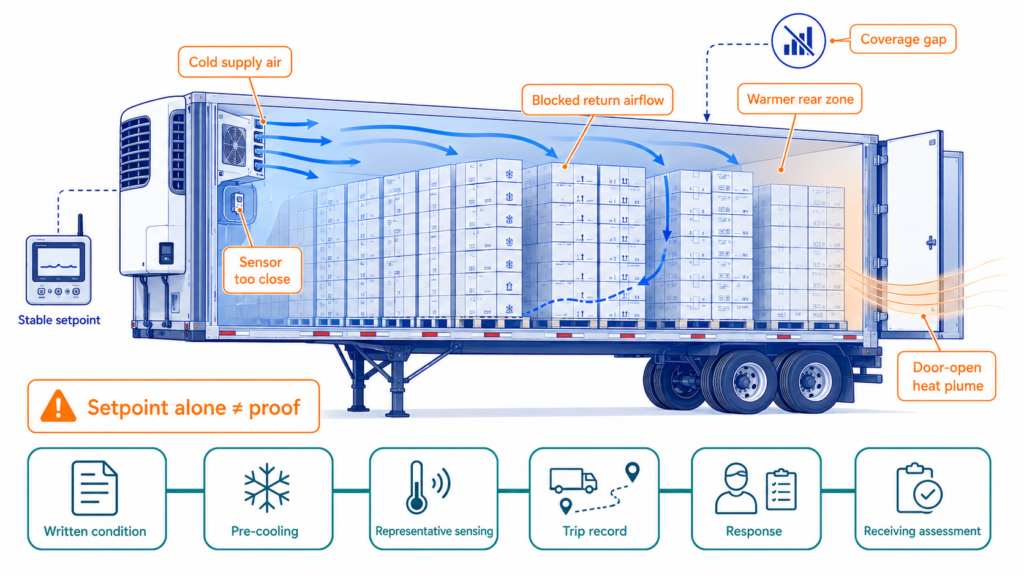
A stable reefer setpoint does not prove that food remained under adequate temperature control; defensible evidence connects the shipper’s specification, vehicle condition, representative sensing, trip history, response, and receiving assessment.
The rule is risk-based and food-safety focused. Temperature-control provisions apply when food requires temperature control for safety under the conditions of shipment. A cold specification used only to protect appearance, shelf life, or commercial quality is important operationally, but it is not automatically the same as a temperature control required by this rule. The shipper should document the regulatory and hazard-analysis basis for each temperature-controlled transport profile rather than apply a generic “refrigerated” label to every product.
Coverage also depends on exclusions, exemptions, and waivers. The rule excludes certain activities and products, including some transportation of food completely enclosed by a container when temperature control for safety is not required. FDA has also issued waivers for specified Grade A milk operations, certain food-establishment deliveries, and certain shellfish operations. Revenue-based non-covered business criteria and other exclusions require current legal review. A company should document why an operation is covered, excluded, exempt, or waived; it should not assume that a retail destination, sealed case, short route, or intrastate movement automatically removes the operation from scope.
Compliance boundary
The regulation is binding. FDA’s Small Entity Compliance Guide, FAQs, fact sheets, and training materials explain FDA’s current thinking and practical application, but guidance does not create additional legally enforceable duties unless it cites a regulatory requirement.
2.How Are Responsibilities Divided Across the Transportation Chain?
The most important FSMA implementation document is often not the logger specification; it is the responsibility matrix and written agreement. Tasks may be reassigned by written agreement to another person covered by the rule, but responsibilities cannot disappear through vague contract language. Where one legal entity performs several roles, the rule allows common integrated procedures that ensure sanitary transportation, provided those procedures are controlled and retained as required.
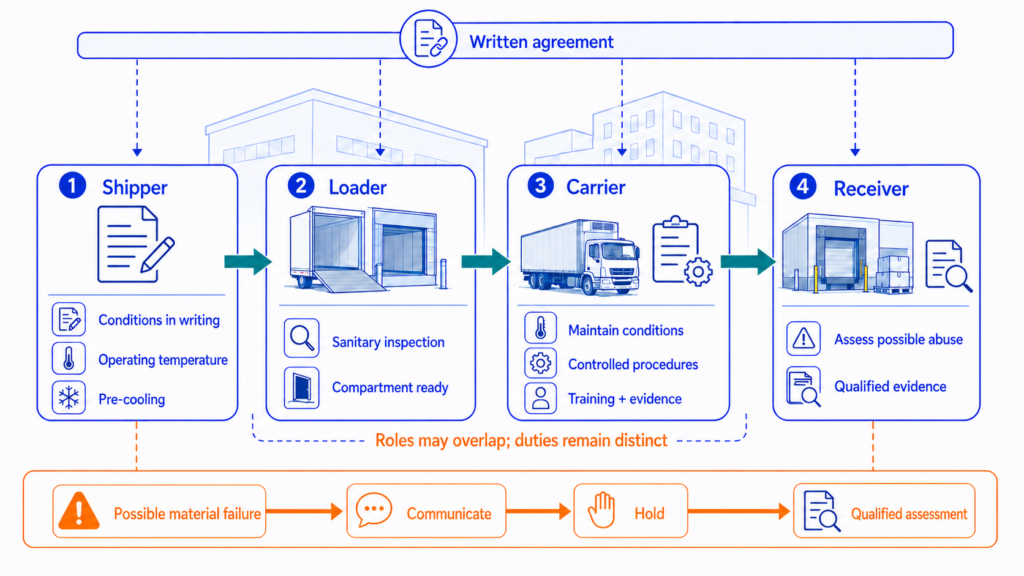
FSMA duties follow functions—not job titles—and written agreements may assign tasks, but they cannot erase responsibility across the shipper, loader, carrier, and receiver.
| Role | Primary control responsibilities |
| Shipper | Defines the sanitary conditions and, for food requiring temperature control for safety, communicates the operating temperature and any necessary pre-cooling requirement. Establishes written procedures to ensure suitable vehicles, adequate temperature control, and—where relevant—control of previous cargo for bulk transport. |
| Loader | Before loading exposed food, determines that the vehicle or equipment is in appropriate sanitary condition. Before loading food requiring temperature control for safety, verifies that the refrigerated compartment is adequately prepared, including proper pre-cooling when necessary. |
| Carrier | When a written shipper-carrier agreement assigns sanitary conditions to the carrier, ensures the vehicle meets specifications, pre-cools as specified, maintains agreed temperature conditions, provides evidence on request, follows written cleaning/inspection and temperature-control procedures, and trains relevant personnel. |
| Receiver | On receipt of food requiring temperature control for safety, takes steps to assess whether the food was subjected to significant temperature abuse. Relevant evidence may include product temperature, vehicle ambient temperature, controller setting, time-temperature history, and sensory inspection. |
| All covered persons | If aware of a possible material failure of temperature control or another condition that may render food unsafe, do not sell or distribute it until a qualified individual determines that the condition did not render the food unsafe. Communicate with other parties and preserve the evidence used for disposition. |
3.Key Requirements That Affect Refrigerated-Fleet Monitoring
Vehicle and transportation equipment must be suitable and sanitary
Under 21 CFR 1.906, vehicles and transportation equipment must be designed and maintained so they can protect food from becoming unsafe during transportation. For refrigerated fleets, this means more than an operating refrigeration unit. The organisation should control compartment condition, doors and seals, drainage, cleanability, pest evidence, residues from previous cargo, air-delivery paths, return-air obstruction, damaged insulation, and equipment maintenance. A temperature logger does not compensate for a compartment that cannot reliably hold the required conditions.
The shipper must communicate the operating temperature
For food requiring temperature control for safety, the shipper generally specifies the operating temperature to the carrier and, when necessary, the loader, unless the shipper uses another compliant measure to ensure adequate control. FDA defines operating temperature as a condition sufficient to meet the rule under foreseeable variation, including seasonal weather, defrost cycles, and multiple loading or unloading stops. The written specification should therefore distinguish the product acceptance range, the vehicle operating setpoint, alarm limits, start-up delay, pre-cooling requirement, and any allowable short operational variation.
Pre-cooling and loading verification must be documented
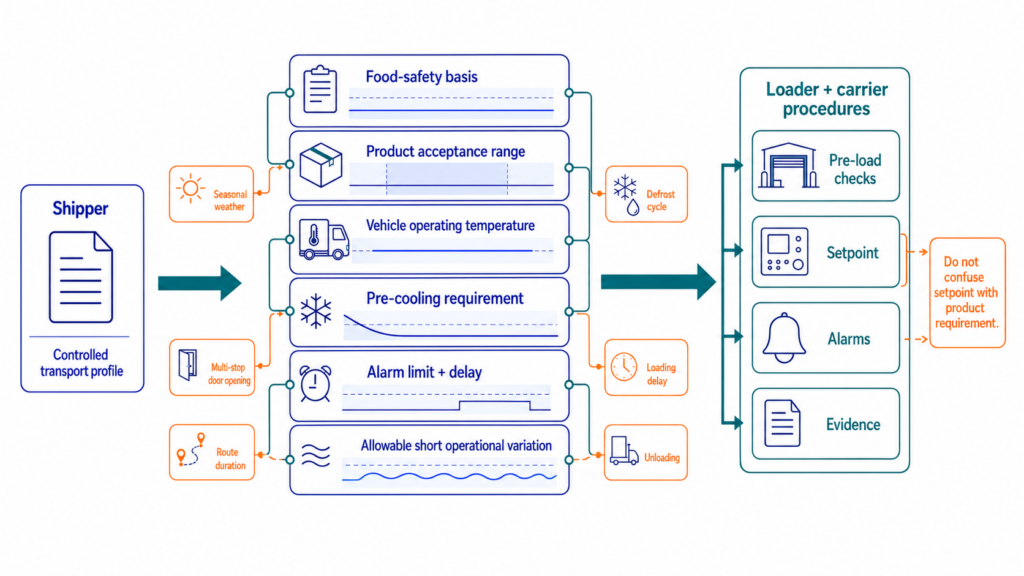
A defensible transport profile separates product acceptance limits, vehicle operating temperature, pre-cooling, alarm limits and delays, and allowable short variation under foreseeable conditions.
A loader must verify that a refrigerated compartment is adequately prepared before loading food that requires temperature control for safety. A controller display can support this check, but the loader’s procedure should define what evidence is acceptable: compartment temperature, time at setpoint, air-return reading, portable reference measurement, cleanliness check, and confirmation that the refrigeration unit is operating. The record should identify the vehicle, compartment, shipment, date and time, person performing the check, result, and action taken if the condition is unacceptable.
The monitoring mechanism is flexible, but evidence must be usable
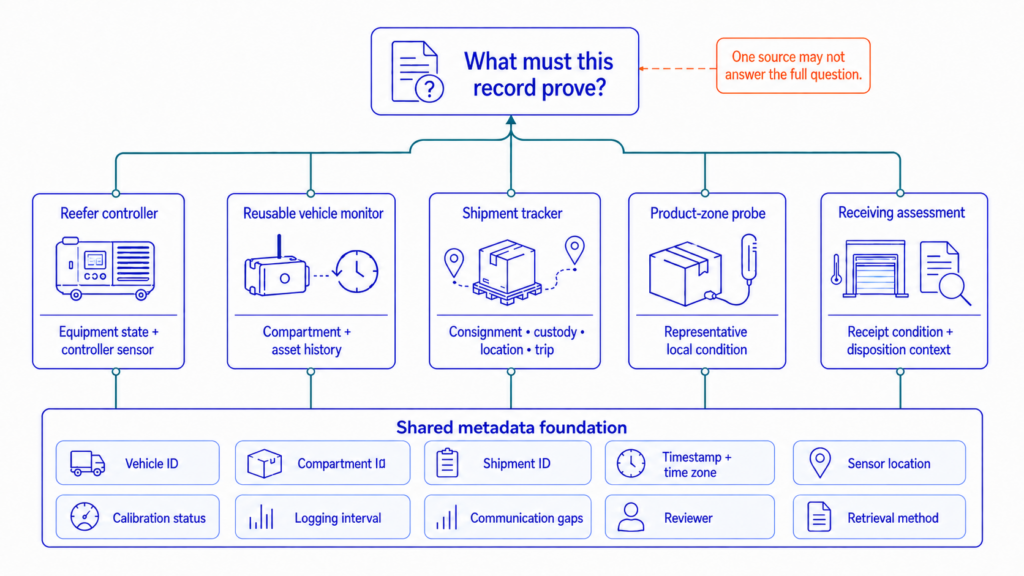
Temperature evidence is fit for purpose only when the chosen mechanism represents the condition in question and remains linked to the vehicle, compartment, shipment, time, calibration status, and review.
The final rule does not require one temperature indicating or recording device during transport. FDA allows the shipper and carrier to agree on an appropriate mechanism. When requested after transportation, a carrier responsible under the written agreement must provide the operating temperature and demonstrate that conditions were maintained. FDA gives examples such as ambient measurements at loading and unloading or time-temperature data collected during the shipment.
This flexibility is not permission to collect data that cannot be interpreted. The monitoring plan should define sensor location, measurement interval, time synchronisation, calibration status, vehicle and shipment linkage, local memory, communication gaps, data retrieval, alarm delays, and who reviews the record. A reefer controller, reusable vehicle monitor, shipment tracker, probe in the product zone, and receiving thermometer answer different questions. The plan may combine them when one source alone cannot provide sufficient evidence.
Training applies when the carrier has assigned sanitary responsibilities
When a written contract makes the carrier responsible, in whole or in part, for sanitary conditions, carrier personnel involved in transportation operations must receive adequate training. The training must cover awareness of potential food-safety problems, basic sanitary transportation practices, and carrier responsibilities under the rule. Training is required at hiring and as necessary thereafter, and records must identify the date, type of training, and persons trained. FDA offers a free training module, but firms may provide their own role-specific training.
Records must be controlled, retained, and retrievable
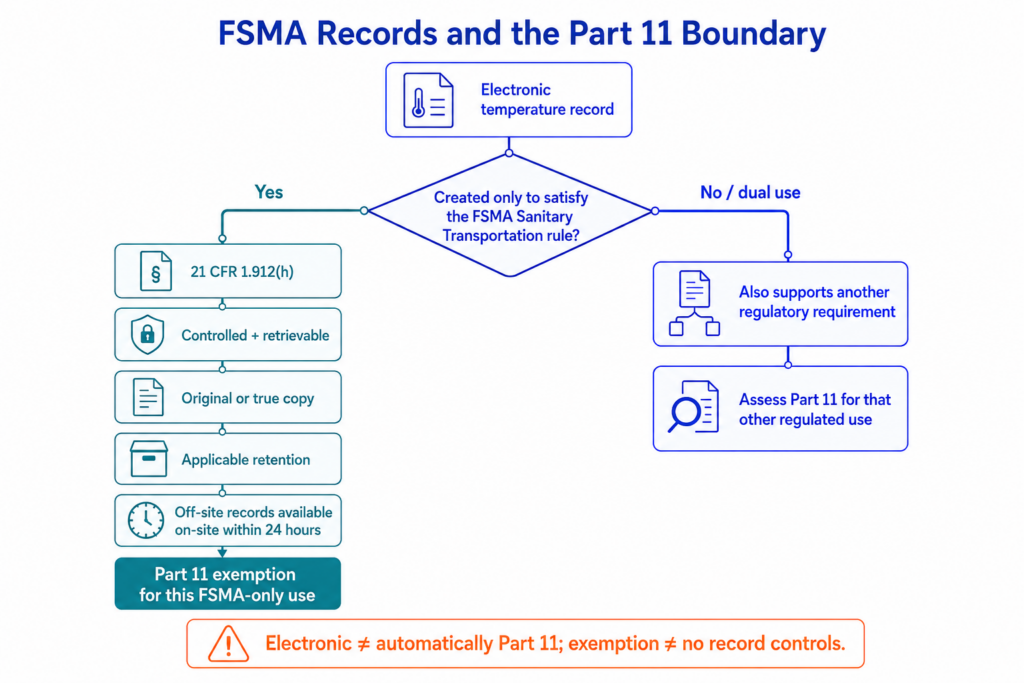
Electronic records created solely for the Sanitary Transportation rule are exempt from Part 11, but the same data may still require a Part 11 assessment when it also satisfies another applicable regulatory requirement.
Section 1.912 requires records for shipper specifications, written agreements, written procedures, and carrier training. Retention generally extends for 12 months beyond the period in which procedures or agreements are in use, beyond termination of certain agreements, or beyond the period in which a trained person performs the relevant duties. Off-site records must be retrievable and provided to FDA on site within 24 hours of request; certain carrier cleaning and inspection procedures must remain on site while in use.
Records may be original records, true copies, or electronic records. Records created solely to satisfy the Sanitary Transportation rule are exempt from 21 CFR Part 11 under 21 CFR 1.912(h). However, the same data may still be subject to Part 11 if it also satisfies another applicable statutory or regulatory requirement. This distinction should be reflected in the organisation’s record-classification and electronic-system assessment.
3.Rule-to-Control Mapping
| Regulatory reference | Requirement translated | Operational control | Evidence to retain |
| 21 CFR 1.900 / 1.904 | Applicability, defined roles, exclusions and covered operations | Scope assessment; role matrix; exemption/waiver rationale; product and route inventory | Approved applicability memo and responsibility matrix |
| 21 CFR 1.906 | Suitable, cleanable, maintained vehicles and equipment | Vehicle qualification; sanitation and maintenance SOPs; compartment inspection | Vehicle inspection, cleaning, maintenance and release records |
| 21 CFR 1.908(a) | General sanitary operations and action after possible material failure | Segregation; temperature control; communication; hold-and-assess process | Incident record, hold status, qualified assessment and disposition |
| 21 CFR 1.908(b) | Shipper specifications and written procedures | Operating-temperature profile; pre-cooling requirement; contract language; shipment instructions | Current specification, agreement, revision history and transmission evidence |
| 21 CFR 1.908(c) | Loader sanitary and pre-cooling verification | Pre-load checklist; compartment temperature verification; clean-release decision | Vehicle/compartment ID, timestamp, checker and result |
| 21 CFR 1.908(d) | Receiver assessment of significant temperature abuse | Receiving checks; time-temperature review; product inspection; escalation | Receiving log, excursion review and acceptance/rejection evidence |
| 21 CFR 1.908(e) | Carrier controls where assigned by written agreement | Pre-cooling; in-transit control; evidence on request; written cleaning and temperature procedures | Trip data, operating temperature, route/event evidence and carrier SOPs |
| 21 CFR 1.910 | Carrier personnel training | Initial and refresher training tied to assigned responsibilities | Date, training type, attendees and competency evidence |
| 21 CFR 1.912 | Record form, retention, availability and electronic-record boundary | Retention schedule; access control; true-copy process; 24-hour retrieval test | Controlled records index, archive test and retrieval evidence |
4.How to Turn the Rule into an Implementable Fleet Programme
A compliant programme should be designed from the food-safety requirement outward. Buying a tracker first and writing the procedure around its default settings is a common source of weak evidence. The following sequence keeps regulatory roles, product risk, hardware, software, and records aligned.
| Step | Control stage | Required decision | Typical controlled output |
| 1 | Define scope and roles | List products, routes, vehicles, rail operations, transfer points, subcontractors, and legal entities. Determine which operations are covered and which party performs each shipper, loader, carrier, and receiver task. | Applicability memo and RACI |
| 2 | Define transport conditions | For each product profile, document the safety basis, written operating temperature, pre-cooling requirement, maximum route duration, loading/unloading conditions, and receiving criteria. | Transport profile and acceptance criteria |
| 3 | Control agreements and SOPs | Write agreements that assign responsibilities without ambiguity. Align shipper instructions, loader checklists, carrier procedures, receiver assessments, escalation, and record retention. | Approved agreements and SOPs |
| 4 | Qualify vehicles and monitoring points | Verify refrigeration capacity, airflow, insulation, door seals, sanitation, maintenance, and sensor positions under representative loading. Document why each monitor represents the condition being controlled. | Vehicle qualification and sensor map |
| 5 | Select monitoring architecture | Decide whether the evidence requires a reusable vehicle monitor, reefer-controller data, shipment-level tracker, external probe, receiving measurement, or a hybrid. Define logging interval, local memory, GNSS, communication, calibration, and data ownership. | URS and approved configuration |
| 6 | Configure alarms and response | Use limits and delays justified by product risk and operating conditions. Identify primary and backup responders, permitted interventions, communication with drivers and customers, and hold/disposition authority. | Alarm matrix and response workflow |
| 7 | Test failure modes | Challenge high/low temperature, door events where monitored, network loss, GPS loss, power loss, weak signal, sensor removal, device restart, clock accuracy, data buffering, recovery upload, alert escalation, and report retrieval. | Acceptance-test protocol and results |
| 8 | Train and operate | Train each role on the exact procedures and devices used. Confirm that drivers and dispatchers understand that an alarm is a trigger for action, not proof that food is unsafe or safe. | Training and competency records |
| 9 | Review and improve | Trend excursions, false alarms, route risks, delayed responses, refrigeration faults, sensor drift, missed records, supplier performance, rejected loads, and corrective actions. Reassess after vehicle, route, product, device, platform, or contract changes. | Trend review, CAPA and change control |
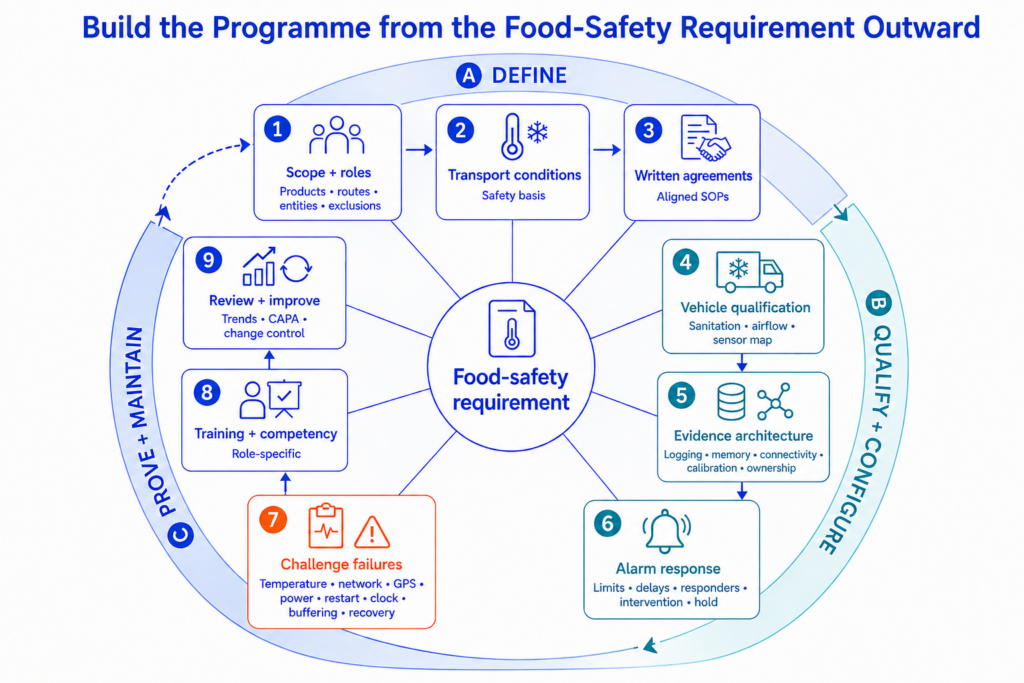
A robust programme defines scope and roles, transport conditions, agreements, vehicle qualification, monitoring architecture, alarm response, failure-mode tests, training, and continual review before it relies on device data.
Monitoring Architecture: Vehicle-Level, Shipment-Level, or Hybrid?
A vehicle-level monitor is installed repeatedly in the same truck or compartment and is usually owned and maintained by the fleet. It is well suited to refrigeration performance, route operations, fixed sensor placement, recurring drivers, and long-term asset history. A shipment-level tracker travels with a pallet, case, tote, or consignment and is better suited to multi-carrier handoffs, third-party lanes, product-level custody, light events, and route visibility. A hybrid design may use both: a reusable fleet monitor to manage the vehicle and a shipment tracker for high-risk or high-value loads.
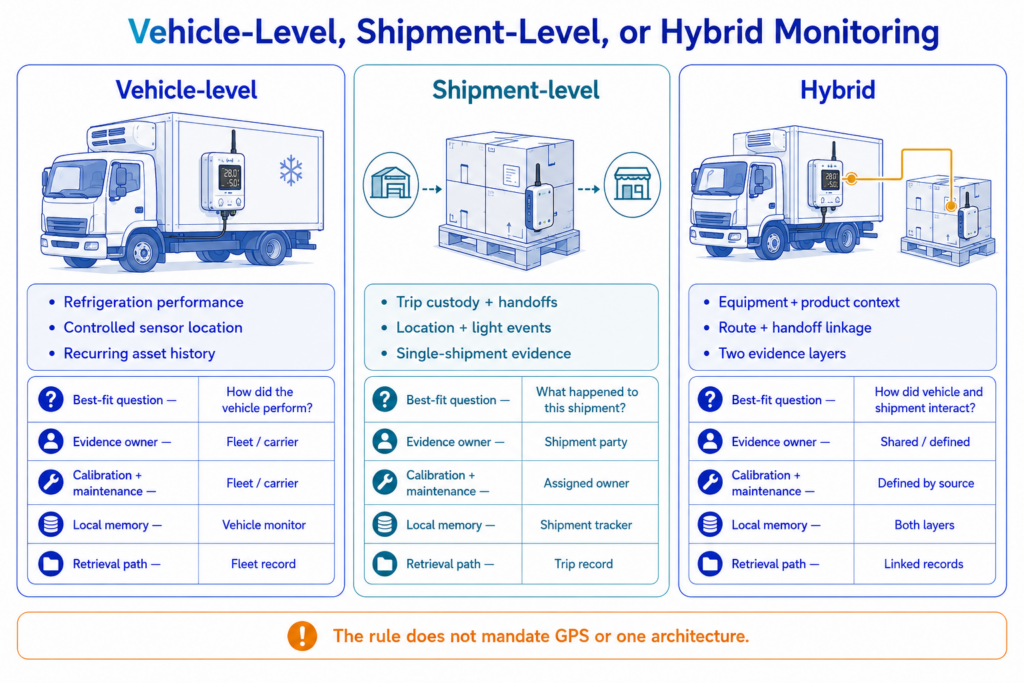
Vehicle-level monitors track recurring equipment and compartment performance, shipment-level trackers follow individual consignments and handoffs, and hybrid designs connect both evidence layers.
The rule does not require GPS, but location and timestamp data can improve investigations by connecting a deviation to a stop, door opening, route delay, cross-dock, or power interruption. Location data should be treated as supporting context unless the procedure defines it as a controlled record. The system design should also state what happens when cellular transmission fails. Remote visibility may stop while local logging continues; these are separate control objectives.
Sensor Placement, Calibration, and Data Interpretation
A single sensor beside the refrigeration discharge may show cold supply air while the rear of the loaded compartment warms. A sensor on a door may overreact to short openings. A probe embedded in product or a thermal buffer may respond too slowly for operational control. The monitoring plan should define which condition each sensor represents and should use vehicle mapping or route trials where load pattern, airflow, door frequency, and compartment geometry create material variation. Sensor locations should be controlled by vehicle and compartment ID, not left to driver preference.
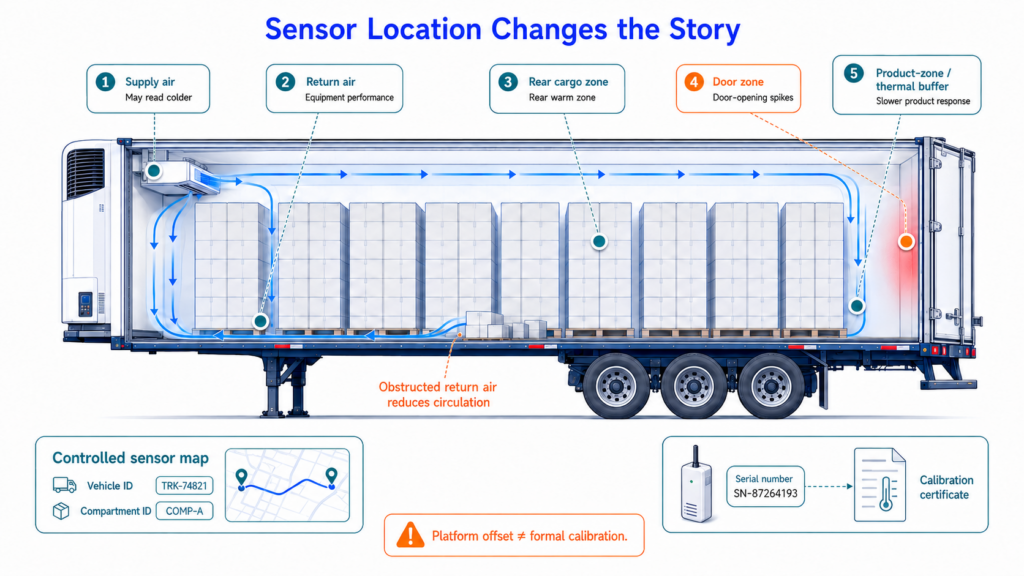
Supply-air, door-zone, rear-compartment, product-zone, and thermal-buffer measurements respond differently; sensor number and location should be justified by vehicle design, airflow, load pattern, door activity, product risk, and the purpose of the evidence.
Calibration should cover the relevant operating range and include traceability, error, uncertainty where required, serial-number identification, and an interval justified by manufacturer guidance, drift history, handling, and risk. Platform offset adjustments may be useful for internal checks but do not automatically replace a formal calibration certificate. Receiving personnel should interpret time-temperature records with product requirements, duration, measurement uncertainty, loading history, and qualified food-safety assessment rather than use one isolated ambient reading as the sole disposition criterion.
5.FSMA Sanitary Transportation Compliance Checklist
| Check | Control area | Verification question |
| ☐ | Applicability and scope | Covered roles, products, routes, legal entities, exclusions, waivers, and revenue criteria have been assessed and approved. |
| ☐ | Responsibility allocation | Written agreements clearly assign shipper, loader, carrier, and receiver duties; subcontractors and 3PLs are included. |
| ☐ | Operating temperature | The shipper’s written temperature and pre-cooling specifications are current, product-specific, controlled, and transmitted before use. |
| ☐ | Vehicle suitability | Each vehicle and compartment is suitable, maintained, cleanable, sanitary, and released under an approved inspection process. |
| ☐ | Pre-cooling verification | The loader records vehicle/compartment ID, temperature evidence, date/time, person, result, and action before loading. |
| ☐ | Monitoring method | The agreed mechanism is documented, representative, calibrated, time-synchronised, linked to the shipment, and capable of producing understandable evidence. |
| ☐ | Data continuity | Local storage, network-loss behaviour, recovery upload, missing-data indication, clock handling, and data ownership have been tested. |
| ☐ | Alarm response | Limits, delays, contacts, escalation, driver actions, hold criteria, qualified assessment, and after-hours coverage are documented and challenged. |
| ☐ | Carrier procedures | Where responsibility is assigned, carrier cleaning/inspection, temperature-control, previous-cargo, and bulk-cleaning procedures are current. |
| ☐ | Training | Carrier personnel receive initial and necessary refresher training; records identify date, training type, and persons trained. |
| ☐ | Receiving assessment | Receiving procedures assess significant temperature abuse using appropriate product, ambient, controller, trip, and sensory evidence. |
| ☐ | Incident control | Possible material failures trigger hold, communication, qualified assessment, disposition, investigation, and corrective action. |
| ☐ | Records and retrieval | Retention periods are defined, records are original or true copies, off-site records can be produced within 24 hours, and on-site procedures remain available where required. |
| ☐ | Verification and change control | Periodic review covers excursions, alarm performance, sensor calibration, route/vehicle changes, platform updates, contracts, and supplier performance. |
6.Common Audit Gaps and Corrective Actions
| Audit gap | Why it fails | Corrective action |
| Responsibilities are implied but not written | A contract says “maintain cold chain” without identifying who specifies temperature, verifies pre-cooling, reviews alarms, or provides trip evidence. | Create a role-by-role agreement and align it with the SOP, dispatch system, loader checklist, and receiving process. |
| Setpoint is confused with product requirement | The reefer controller setpoint is treated as the only specification, without a documented safety basis or foreseeable variation. | Define product range, operating temperature, pre-cooling, alarm limits, and acceptable operational variation separately. |
| Monitoring point is not representative | The only sensor is near the evaporator, door, ceiling, or empty-air space and has not been justified under loaded conditions. | Map or challenge representative load patterns and control the approved sensor location by vehicle/compartment. |
| Real-time alerts replace local evidence | The platform sends notifications, but the device has insufficient local memory or missing data after a coverage gap. | Test offline logging, recovery upload, timestamp continuity, duplicate handling, and missing-data visibility. |
| Alarm acknowledgement is treated as disposition | A driver or dispatcher closes an alert without assessing product impact or documenting corrective action. | Separate operational acknowledgement from qualified food-safety assessment, hold status, investigation, and final disposition. |
| Receiving checks are too narrow | Receiver records only current product or vehicle temperature and ignores trip history, duration, controller data, route events, and sensory evidence. | Use a risk-based receiving checklist and define when additional review or qualified assessment is required. |
| Training records are incomplete | Drivers received informal instruction, but the record lacks date, subject, attendees, or connection to assigned carrier duties. | Use controlled curricula, attendance/competency records, refresher triggers, and role-specific training. |
| Records cannot be produced promptly | Procedures or agreements are archived in disconnected systems and cannot be retrieved on site within 24 hours. | Maintain a controlled records index, owner, retention rule, archive location, and periodic retrieval test. |
| Electronic system claims are overstated | A vendor dashboard is described as “FSMA certified” or “Part 11 compliant” without assessing intended use or record scope. | Describe capabilities and vendor claims separately; validate only where required by another applicable regulation and the intended use. |
Minimum audit evidence package
Keep one controlled package that links the applicability assessment, responsibility matrix, product transport specifications, shipper-carrier agreements, vehicle qualification, sanitation and maintenance procedures, pre-cooling checks, approved sensor map, calibration evidence, acceptance tests, training records, trip data, receiving assessments, deviation investigations, qualified disposition decisions, CAPA, and the records-retention index.
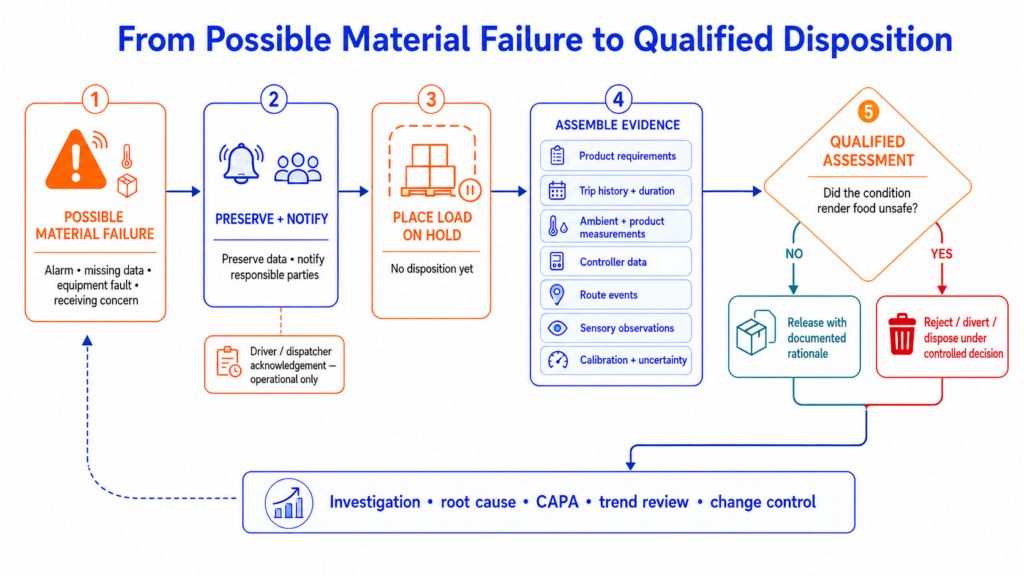
After a possible material failure of temperature control, the affected food should be held until a qualified individual assesses the evidence and documents release, rejection, or other disposition, followed by investigation and corrective action.
7.Representative Monitoring Architectures
The products below are not direct substitutes. UbiBot WS4/GS1 are reusable fleet or vehicle monitors with environmental sensing, location and external-sensor expansion. Sensitech and DeltaTrak are shipment-level real-time trackers designed to travel with a consignment. ELPRO ECOLOG-PRO xG is officially positioned for rooms and equipment rather than as a direct shipment tracker; it is included as a regulated cellular-monitoring benchmark because it appears in the research shortlist. Where an ELPRO in-transit logger is required, the current LIBERO G family should be evaluated separately rather than assuming ECOLOG-PRO xG is transport-qualified.
| Comparison area | UbiBot WS4 / GS1 | Sensitech TempTale GEO X | DeltaTrak FlashLink Now | ELPRO ECOLOG-PRO xG |
| Primary architecture | Reusable 4G/GNSS vehicle or compartment monitor; WS4 is compact, GS1 adds larger display and Wi-Fi | Shipment-level real-time tracker with integrated cellular and location workflow | Shipment-level real-time in-transit logger with cellular/cloud workflow | Cellular IoT room/equipment logger; stationary regulated-monitoring benchmark |
| Representative models | WS4-P4G1RS; GS1-PL4G1RS | TempTale GEO X | FlashLink Now 4G/5G, model 22393-01 | ECOLOG-PRO 1TGi / 1THGi / 1TGe |
| Published parameters | Built-in temperature, RH, light; WS4 also vibration; RS485 external sensors; GNSS | Temperature, humidity, light, and location on vendor platform | Temperature, light, and location | Temperature or temperature/RH; 1TGe supports external Pt100 |
| Connectivity | 4G; GS1 also 2.4 GHz Wi-Fi; GNSS; no proprietary gateway | LTE Cat-M1 for 4G/5G networks with 2G fallback; platform and Bluetooth support | Global 4G/5G cellular; cloud; USB/PDF fallback | LTE-M / NB-IoT to elproCLOUD; no local gateway |
| Published temperature range | Built-in -20°C to 60°C; external-probe range depends on selected probe | -30°C to 55°C for GEO X | -30°C to 70°C | Internal xG range varies by model; external Pt100 can extend much wider on 1TGe |
| Local continuity | 300,000 sensing records with automatic sync after reconnection | Device stores trip data and supports automated platform workflow; exact retention/configuration should be confirmed | USB access and PDF trip report if communications are unavailable | At least 31,000 values; loop memory and automatic cellular transmission |
| Display / local visibility | WS4 LCD; GS1 4-inch display | LCD status interface | Model literature describes local device access; confirm current display configuration | Local device display/status interface |
| Location context | Integrated GNSS for vehicle or asset trajectory | Real-time shipment location | Real-time shipment location | Not a direct shipment-location equivalent; contact ELPRO for transport positioning needs |
| Platform and integration | UbiBot public cloud, on-premises options, exports, APIs; paid functions depend on plan | Sensitech platform, alerts, analytics, shipment workflow | FlashTrak Cloud Service, sharing, alerts, API integration | elproCLOUD, immediate alarms, reports, audit trail and optional API |
| Strongest fit | Owned refrigerated fleets needing reusable hardware, direct 4G/GNSS, local storage, display, and RS485 expansion | High-value or multi-carrier shipments needing global location and condition visibility | Domestic/export shipments needing a simple trip device, shared receiver visibility, and offline PDF access | Stationary cold rooms, equipment, staging or regulated storage; packaged compliance-oriented cloud workflow |
| Key caution | No automatic FSMA compliance; confirm probe, calibration, vehicle mounting, power, network behaviour, alarm process and actual route coverage | Shipment tracker does not replace vehicle sanitation, pre-cooling, loader verification, receiving assessment or carrier procedures | Trip logger does not replace fleet qualification, sanitation, contractual responsibility or qualified food-safety disposition | Officially positioned for stationary monitoring; do not describe as a fleet tracker without written vendor confirmation of the exact transport use |
8.Frequently Asked Questions
Does FSMA require a continuous temperature data logger in every refrigerated truck?
No. The rule requires adequate temperature control where necessary for food safety and allows a flexible monitoring mechanism agreed by the shipper and carrier. A continuous logger is often useful evidence, but it is not universally mandated by model or technology.
Does FSMA require GPS or real-time cellular tracking?
No. GPS and real-time connectivity can improve response and investigation, but the rule does not require them. The organisation should justify whether delayed trip data, real-time alerts, location context, or a hybrid is appropriate.
Who sets the operating temperature?
The shipper generally specifies the operating temperature and any necessary pre-cooling requirement in writing to the carrier and, when necessary, the loader, unless another compliant measure ensures adequate temperature control.
Can the shipper transfer all responsibility to the carrier?
Tasks can be assigned by written agreement to another person covered by the rule. The agreement must be specific, and responsibilities cannot simply disappear. If a task is assigned to a person not covered by the rule, FDA may still hold the covered person responsible.
How long must sanitary transportation records be retained?
Retention depends on record type. Written procedures and many agreements are generally kept for 12 months beyond use or termination. Carrier training records are kept for 12 months beyond when the person stops performing the relevant duties. Confirm the exact section for each record.
Are electronic records under this rule subject to 21 CFR Part 11?
Records established or maintained only for the Sanitary Transportation rule are exempt from Part 11 under 21 CFR 1.912(h). If the same records are also required under another applicable regulation, Part 11 may still apply to that other use.
What should happen after a possible material failure of temperature control?
Do not sell or distribute the affected food until a qualified individual determines that the condition did not render it unsafe. Place the load on hold, communicate with the relevant parties, preserve data, assess the food, document the decision, and investigate the cause.
Is one sensor enough for a refrigerated trailer?
The rule does not specify a universal sensor count. The number and location should be justified by vehicle design, airflow, load pattern, door activity, compartment arrangement, product risk, and the purpose of the evidence. Mapping or route trials may show that more than one point is needed.
Can reefer-controller data serve as compliance evidence?
It can be part of the agreed mechanism, but the organisation should verify what the controller measures, where its sensor is located, how data are retained, how it links to the shipment, and whether it represents the food zone. Additional evidence may be necessary.
Does using UbiBot, Sensitech, DeltaTrak, or ELPRO make a fleet FSMA compliant?
No. Product capability is one component. Compliance depends on scope, role allocation, suitable vehicles, written specifications, sanitation, pre-cooling, loading and receiving controls, training, records, monitoring configuration, calibration, response procedures, and ongoing verification.
9.Final Selection Guidance
The strongest system is the architecture that produces evidence appropriate to the organisation’s legal role and operating risk. An owned fleet may benefit from reusable vehicle monitors that remain mounted, preserve long-term asset history, use direct 4G/GNSS, and accept external sensors. High-value or subcontracted shipments may need a tracker that travels with the load and preserves location, light, handoff, and trip-specific data. Cross-docks and staging rooms may need separate stationary monitoring. Many mature programmes use more than one layer.
UbiBot WS4-P4G1RS and GS1-PL4G1RS can support reusable refrigerated-fleet monitoring through 4G, GNSS, substantial local storage, display, alerts, cloud access, and RS485 expansion. Sensitech TempTale GEO X and DeltaTrak FlashLink Now are more directly aligned to shipment-level real-time visibility. ELPRO ECOLOG-PRO xG provides a mature cellular regulated-monitoring architecture for rooms and equipment but should not be represented as a direct transport tracker without confirmation; ELPRO’s transport-oriented model family should be evaluated separately.
10.Final takeaway
Do not ask only which logger has the most features. Ask which party must prove what, which condition each sensor represents, how evidence survives communication and power failures, how personnel respond, how records are retrieved, and whether the configured system remains aligned with the written agreements and food-safety procedures.
11.Sources and Product Information Disclaimer
This article is provided for educational, procurement-planning, and editorial purposes. It does not constitute legal, regulatory, food-safety, validation, engineering, or contractual advice. Applicability depends on the operation, food, safety requirements, business roles, current revenue criteria, exclusions, waivers, written agreements, and FDA interpretation. State, local, USDA, product-specific, customer, insurance, and contractual requirements may also apply.
Product descriptions are based on public manufacturer information reviewed in July 2026. Specifications, firmware, platform functions, subscriptions, network coverage, SIM service, calibration, battery life, accessories, APIs, data retention, product lifecycle, regional availability, and vendor compliance statements may change. Verify the exact model, sensor, probe, mounting, power, communication, software plan, route coverage, calibration, operating limits, and support agreement before purchase or use. The comparison does not imply uniform hands-on testing.
12.Official Regulatory and Vendor References
[1] 21 CFR Part 1, Subpart O — Sanitary Transportation of Human and Animal Food — Current regulatory text governing scope, vehicles/equipment, operations, training, records, waivers and related definitions.
[2] FSMA Final Rule on Sanitary Transportation of Human and Animal Food — FDA — Official rule hub, Federal Register materials, fact sheets, guidance and supporting resources.
[3] Small Entity Compliance Guide: Sanitary Transportation of Human and Animal Food — FDA — Official plain-language guidance on covered parties, responsibilities, training, records, exemptions and practical implementation.
[4] Frequently Asked Questions on FSMA — Sanitary Transportation section — FDA — Official clarifications on role responsibilities, temperature-control mechanisms, receiving assessment, material failures, records and electronic-record treatment.
[5] Training for Carriers Covered by the Sanitary Transportation Rule — FDA — Official carrier training module and training-scope explanation.
[6] Clarification on Food Establishment Waiver — FDA — Official guidance on the food-establishment waiver boundary.
[7] UbiBot WS4-P4G1RS — Official Product Information — Official 4G, GNSS, RS485, display, IP65, local memory, sensor and power information.
[8] UbiBot GS1-PL4G1RS — Official Product Information — Official Wi-Fi/4G, GNSS, display, local memory, RS485 probe support, IP65 and cloud information.
[9] UbiBot Public IoT Platform Pricing — Official platform, storage, alert, export, API and paid-feature information.
[10] UbiBot Calibration & Traceability Policy — Vendor calibration-report, traceability, validity and recalibration guidance.