

UBiBot Logo
UBiBot Logo
  • UBiBot Logo
  • Home
  • Products

    NEW

  • Pricing
  • Support
  • About Us
  • Download
  • magnifying-glass  Search
  • magnifying-glass header-close
  • Sign in Sign in
    Public Web Console Public Web Console
    On-Premises App Center On-Premises App Center
  • Home
  • Products

    NEW

  • Pricing
  • Support
  • About us
  • Download
  •  Public Web Console
  •  On-Premises App Center
  • Where to Buy

Learn Hub

Explore Knowledge Academic Research In-depth Tech

Share

LinkedIn

Facebook

X (Twitter)

Newsletter Signup

Table of contents

    Real-Time Cold Chain Trackers Compared: Cellular, GPS, Temperature, Humidity, Shock and Light

    30-second summary

    What it is

    A battery-powered device that records shipment conditions and periodically sends data through cellular networks to a cloud platform. Many models also estimate or measure location using GNSS, Wi-Fi geolocation or cellular triangulation.

    What to prioritize

    Required sensors, qualified temperature range, calibration, sampling and upload intervals, local memory, airline suitability, coverage by route, platform workflow, API access and total cost per completed shipment.

    1.Why does choosing the right real time cold chain tracker matter?

    A real-time cold chain tracker is useful only when its data can support a decision. Knowing that a shipment was warm after delivery may help with investigation, but it cannot help an operations team intervene while the product is still in transit. A connected tracker can add location, live alerts and condition data, yet these benefits depend on cellular coverage, sensor placement, reporting intervals, battery performance and a platform that people can actually use.
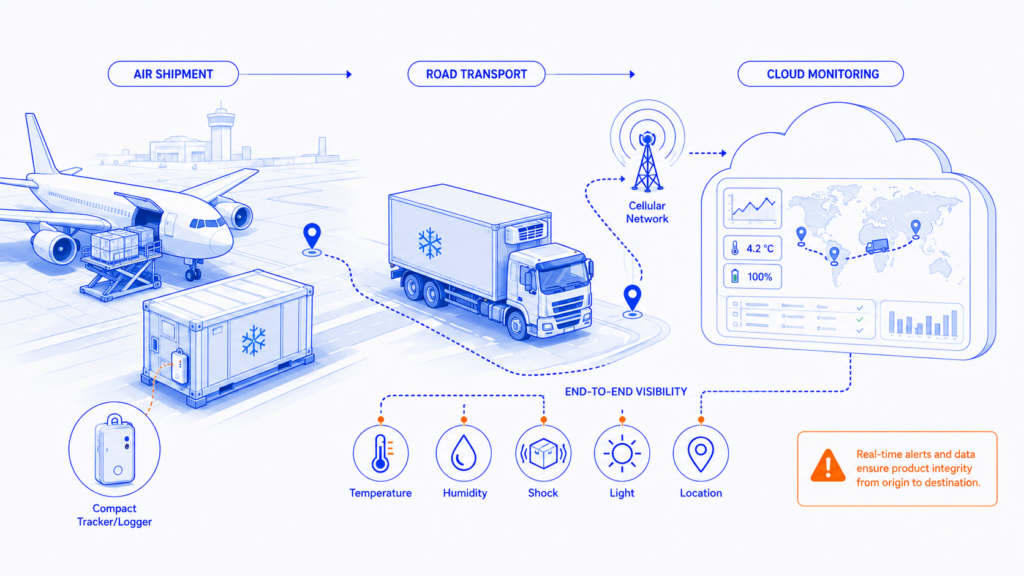
    The buying decision is therefore broader than comparing temperature range. A pharmaceutical shipper may need traceable calibration, a validated platform, automatic flight mode and a clear deviation workflow. A food exporter may place more weight on humidity, door-opening evidence and cost per trip. A reusable fleet operator may value charging, local memory and API access more than a disposable form factor. The wrong device can create false confidence, incomplete records or avoidable reverse-logistics expense.

    This guide compares the UbiBot GS1-PL4G1RS with Tive Solo 5G, Sensitech TempTale GEO X and GEO X Probe, ELPRO LIBERO GE and GF ext, and Controlant Saga Card. The models do not serve identical markets. Some are multi-sensor shipment trackers, some are specialist life-science loggers, and one is a compact pharma device still described publicly as being piloted. The useful question is not which model wins every specification, but which system fits the lane, product, risk and quality process.

    2.Who is this guide for?

    This guide is written for teams that need to select or specify connected tracking devices rather than simply purchase a temperature logger. Quality and validation teams will be most concerned with calibration, record integrity, auditability and deviation review. Logistics operations will focus on coverage, alerts, airline acceptance and battery life. IT and integration teams will examine APIs, webhooks, data ownership and private deployment. Procurement will need a complete cost model that includes connectivity, subscriptions, calibration, return logistics and service support.

    Practical selection rule: use a specialist, calibrated and workflow-validated tracker when shipment release depends directly on its record. Use a configurable environmental and location monitor such as UbiBot GS1 when the priority is reusable multi-site monitoring, local display, large onboard storage, external RS-485 sensors and flexible cloud or on-premises integration – provided the project team separately confirms calibration, airline acceptance and validation requirements.

    3.What is a real-time cold chain tracker?

    A real-time cold chain tracker is a connected data logger that records one or more shipment conditions and transmits selected data while goods are moving. The word “real-time” normally means periodic or event-driven updates, not continuous second-by-second streaming. A device may measure every five minutes but upload every thirty minutes or every six hours to preserve battery life. It should retain measurements locally when the network is unavailable and upload them later.

    A sensor is only the element that measures temperature, humidity, light or acceleration. A data logger adds time-stamped storage. A transmitter sends readings but may have little local memory. A remote monitor combines sensing, storage, communications and alerts. A gateway collects data from nearby wireless tags. A complete cold chain monitoring system also includes a cloud or local platform, user permissions, alarm workflows, reports, APIs and the procedures used to investigate excursions.

    Location can also be misunderstood. GNSS or GPS can provide precise outdoor coordinates when the antenna has a usable view of satellites. Wi-Fi geolocation estimates position from nearby networks. Cellular triangulation estimates position from network infrastructure and is usually less precise. The strongest systems combine methods so that one location source can compensate when another is unavailable.

    4.What problems does a connected shipment tracker solve?

    The main operational value is earlier visibility. When a refrigerated truck stops unexpectedly, a container is opened, or a shipment approaches a temperature limit, a connected device can notify the responsible team before delivery. Location and condition data also help distinguish a refrigeration problem from a customs delay, an unplanned handover, a route deviation or poor loading practice.

    A tracker can also reduce manual work. Instead of waiting for a USB logger to return, a platform can associate a device with a shipment, show its route, record alarms, generate reports and pass data into a transport management, quality or control-tower system. For reusable devices, a platform may also support charging, calibration and return cycles. These functions matter because a technically accurate sensor can still create an inefficient process if activation, device recovery or data review is difficult.

    Connected trackers do not eliminate every data gap. Cellular radios may be disabled during flight, blocked inside metal containers or unavailable in remote regions. A tracker therefore needs sufficient local memory, accurate timestamps and a defined reconnection process. The organization also needs escalation rules: who receives the alert, how quickly they respond, which carrier contact is used and how the final disposition decision is documented.

    5.What components make up a real-time tracking system?

    A complete system begins with the sensor configuration. Ambient sensors measure the air around the logger. External probes can be placed closer to the product or inside dry-ice and cryogenic packaging while the radio remains in a more suitable environment. Shock and tilt sensors detect mechanical events, while light sensors can indicate that packaging or a container door was opened.

    The logger records the measurements, stores them locally and controls the measurement interval. The communications module sends data through LTE-M, NB-IoT, conventional cellular networks or another supported technology. GNSS, Wi-Fi scanning and cellular triangulation may provide location. The cloud platform then applies thresholds, sends alerts, displays the route and produces reports. APIs or webhooks connect the data to enterprise systems.

    For a large reusable monitor such as the UbiBot GS1-PL4G1RS, an RS-485 interface can extend the system with probes for temperature, humidity, CO2, soil conditions or wind speed. This is valuable for vehicles, mobile assets and temporary monitoring projects, but it is different from a compact parcel-level tracker. External cables, power arrangements and mounting need to be included in the deployment design.

    6.Which sensors and specifications matter most?

    Temperature range must match the product and the complete measurement chain

    The required range depends on the lane and packaging system. Chilled products may use 2°C to 8°C (35.6°F to 46.4°F), frozen products may require temperatures below -20°C (-4°F), dry-ice shipments operate near -78.5°C (-109.3°F), and cryogenic shipments may approach -196°C (-320.8°F). A wide probe range does not prove that the entire system has the same accuracy across that range. The probe class, logger input, cable, connector, calibration points, placement and response time all affect system performance.

    UbiBot lists the built-in GS1 temperature range as -20°C to 60°C (-4°F to 140°F) with stated temperature accuracy of ±0.2°C. ELPRO publishes separate accuracy bands for its internal sensor and for the complete logger-plus-Pt100 system. Sensitech publishes different ranges for the ambient TempTale GEO X and the probe version. This model-specific approach is more useful than comparing a single headline number.

    Humidity is useful only when the product or packaging is humidity-sensitive

    Relative humidity helps explain condensation, packaging damage, desiccation risk and produce quality. It is important for many foods, biologics in secondary packaging and products transported through humid climates. It also increases power and calibration requirements. Tive Solo 5G and UbiBot GS1 include humidity sensing. The public product information reviewed for TempTale GEO X, ELPRO GE/GF ext and Saga Card does not position humidity as a standard function of those exact models.

    Shock, movement and light answer different questions

    Shock data can indicate a drop or severe impact, but a threshold must be matched to the product and packaging. Tive publishes shock sensing for Solo 5G, including a 12G sensitivity specification. ELPRO lists movement or tilt rather than a full shock profile. Saga Card uses an accelerometer to detect movement state. The UbiBot GS1-PL4G1RS does not list a built-in shock sensor, so it should not be presented as a temperature-humidity-shock-light tracker without an independently verified external solution.

    Light sensing is usually interpreted as evidence that a box, pallet cover or vehicle door was opened. It does not prove unauthorized access on its own. Packaging material, sensor placement and ambient conditions can create false or missed events, so light alerts should be combined with location and handling records.

    Sampling interval and upload interval are not the same

    The measurement interval determines how often the device records a value. The communication interval determines how often it attempts to upload. Shorter intervals produce more detail and faster alerts but reduce battery life and increase data use. A common design is frequent local sampling with less frequent routine uploads, plus an immediate connection attempt when an alarm occurs. Buyers should verify how each device behaves in flight mode, low-power mode and poor coverage.
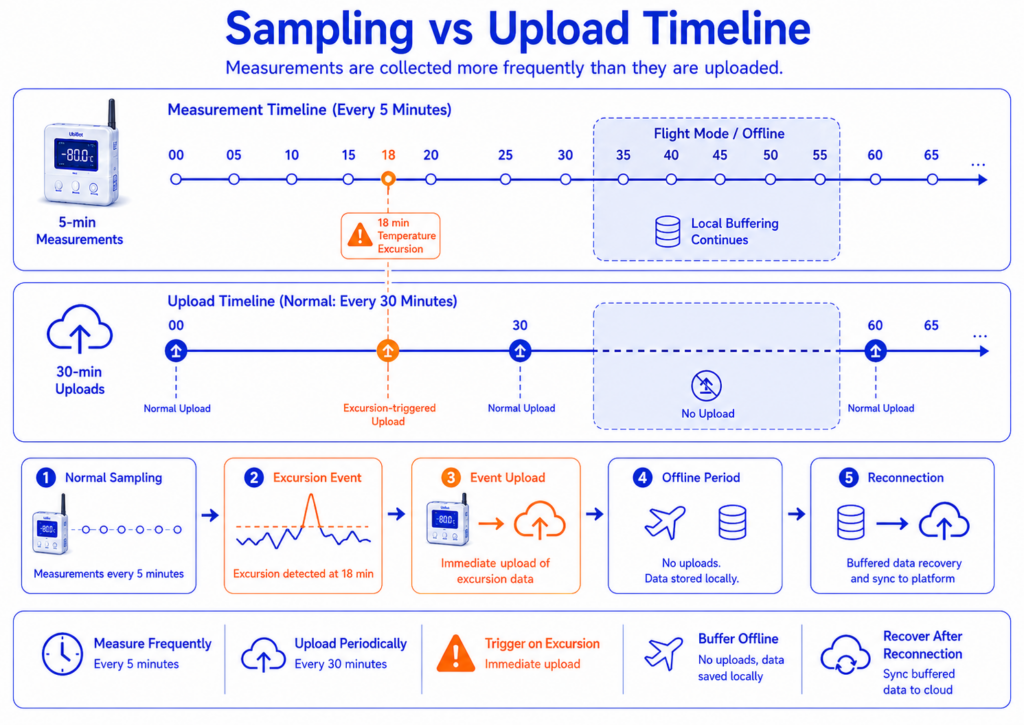
    Sampling vs upload timeline

    Local memory protects the record when networks fail

    A shipment tracker should continue recording when cellular coverage disappears. UbiBot publishes capacity for 300,000 sensor records on the GS1-PL4G1RS. ELPRO publishes 31,000 temperature values for LIBERO GE and GF ext. Controlant publishes more than 150 days of temperature measurements for its standard Saga logger family, but the detailed Saga Card memory specification was not publicly stated on the page reviewed. Public pages for Tive Solo 5G and Sensitech TempTale GEO X did not provide an easily comparable local-memory figure, so buyers should obtain it in writing.

    Calibration and validation serve different purposes

    Calibration compares the measurement system with a traceable reference and documents the result. Validation demonstrates that the configured system and workflow perform as intended for a defined use. Tive states that Solo 5G can be supplied with a three-point ISO 17025 traceable certificate. ELPRO specifies a three-point traceable calibration certificate and manufacturer validation documentation. Sensitech states that the TempTale GEO X life-science configuration is GxP validated and built for FDA 21 CFR Part 11 and EU Annex 11 workflows. These vendor claims should be reviewed against the buyer’s quality requirements and current documentation.

    UbiBot supports data collection, alerts, export, API integration and on-premises deployment, but those functions do not by themselves make GS1 a validated pharmaceutical shipment system. A project may be able to configure GS1 to support a monitoring workflow, subject to appropriate calibration, validation, controlled procedures and airline approval. The same distinction applies to any general-purpose IoT monitor.

    7.How should connectivity be evaluated?

    Cellular connectivity is the primary backhaul for moving shipments

    Cellular networks are the practical choice for road, rail, sea and multimodal shipments because the tracker does not depend on a vehicle gateway. Coverage must be evaluated by route, roaming agreement and radio technology. A claim such as “global coverage” does not guarantee service inside every container, airport warehouse or rural corridor. The modem may also switch between LTE-M, NB-IoT, 4G, 3G or 2G depending on device and region.

    The term “5G temperature tracker” needs careful interpretation. Some products use LTE-M on infrastructure marketed for 4G and 5G networks or are described as 5G-ready. This is not the same as a full 5G NR broadband connection, and it is usually not necessary for low-data-rate temperature monitoring. Coverage, roaming and power consumption matter more than the label.

    GPS or GNSS improves route visibility but is not always available

    GNSS is most accurate outdoors and near windows. Inside aircraft holds, metal containers, warehouses or insulated packaging, a tracker may rely on Wi-Fi geolocation or cellular triangulation. Tive publishes approximate accuracy values by location method, illustrating why the platform should label the source and estimated radius instead of presenting every point as equally precise. UbiBot GS1-PL4G1RS supports multiple GNSS constellations and also transmits location through its cellular connection.

    Wi-Fi helps at facilities but is not an end-to-end shipment network

    Wi-Fi may reduce cellular use at warehouses, laboratories or cross-dock points and can assist geolocation. It should not be the only connection for an uncontrolled route. The UbiBot GS1 combines Wi-Fi and 4G, which can be practical for reusable vehicle or asset monitoring when the same device moves between company facilities and public networks.

    LoRa, LoRaWAN, Ethernet and RS-485 play supporting roles

    LoRa or LoRaWAN can be effective inside a port, warehouse campus or private vehicle fleet where gateways are controlled. They are not a replacement for global cellular roaming unless gateway coverage exists throughout the lane. LoRa is a radio modulation; LoRaWAN is a network protocol and ecosystem, so the terms should not be treated as interchangeable.

    Ethernet is useful for fixed gateways and on-site servers, not for a parcel moving through a public logistics network. RS-485/Modbus RTU is a wired sensor interface. In the GS1-PL4G1RS, RS-485 expands the types of environmental probes that can be connected, while 4G or Wi-Fi remains the route to the platform.

    8.Leading real-time cold chain trackers compared

    The following tables compare the exact models requested. Blank or unavailable public specifications are shown as “not publicly specified” rather than inferred. Product configuration, country availability, platform licensing and service packages can change.

    Model Use model and sensing Published temperature capability Location and connectivity Local operation Air-transport position
    Ubibot GS1-PL4G1RS Reusable industrial monitor; built-in temperature, humidity and light; GNSS; RS-485 external probes. No built-in shock sensor listed. -20°C to 60°C (-4°F to 140°F); stated built-in accuracy ±0.2°C. External Pt100 supported; system accuracy depends on probe and configuration. 4G plus 2.4 GHz Wi-Fi; GPS, GLONASS, BeiDou, Galileo and QZSS. 300,000 records; 4-inch display; internal lithium battery plus USB-C 5 V and optional 12 V power. No public automatic flight-mode or airline-approval statement found for this exact model. Confirm before air use.
    Tive Solo 5G Single- or multi-use tracker; temperature, humidity, light, shock and motion. Public page shows -30°C to 60°C in one section and -20°C to 60°C in another; stated accuracy ±0.5°C. Dry-ice and cryogenic probes available. LTE-M with 2G fallback; GPS, Wi-Fi geolocation and cellular triangulation; vendor states broad multi-network coverage. Programmable measurement; public page cites 50+ to 100+ days depending on transmission interval; IP67. Comparable local-memory figure not publicly specified. Lithium and non-lithium versions; vendor publishes broad airline acceptance. Confirm exact model and carrier list.
    Sensitech TempTale GEO X / GEO X Probe Life-science and industrial real-time temperature/location monitor; Probe version provides internal and ambient temperature. GEO X: -30°C to 55°C (-22°F to 131°F). Probe: -95°C to 55°C (-139°F to 131°F). Accuracy not stated on the public portfolio page. LTE Cat-M1 for 4G/5G networks with 2G fallback; platform-based multimodal automation. Built-in battery management; delivered charged. Public page does not provide a directly comparable memory, display or runtime figure. Public page positions the system for multimodal life-science shipments. Confirm airline and battery details for the selected SKU.
    ELPRO LIBERO GE Reusable temperature, location, light and tilt logger with optional external Pt100 probe. Internal measurement -30°C to 70°C; recommended application 0°C to 55°C. External system range -200°C to 400°C with published accuracy bands. LTE-M and NB-IoT; automatic uploads to elproCLOUD. 31,000 values; LCD; 5-60 min measurement; up to 14 months from start under defined conditions. Automatic flight detection; non-lithium alkaline batteries are stated as exempt from DGR declaration.
    ELPRO LIBERO GF ext Reusable frozen/cryogenic logger; temperature, location, light and tilt; external Pt100 probe. Internal measurement -40°C to 70°C; application -35°C to 55°C. External system range -200°C to 400°C with published accuracy bands. LTE-M and NB-IoT; intended to maintain communication in frozen applications. 31,000 values; LCD; 5-60 min measurement; up to 14 months from start under defined conditions. Automatic flight detection; lithium-metal batteries, UN3091 contained in equipment. Declaration requirements must be managed.
    Controlant Saga Card Compact pharma-focused device; temperature, location, light opening detection and accelerometer-based movement. Not publicly specified on the Saga Card page reviewed. Cellular IoT modem and Controlant Platform; country/region/city visibility described publicly. 10 g, highly recyclable form factor. Battery life, memory, accuracy and user display not publicly specified. Described by Controlant as flight-ready. Detailed approval list and final commercial specification should be confirmed.

    Table 1. Core device capabilities. “Real-time” update frequency and battery life depend on configuration, coverage, temperature and alert activity.

    Model Calibration / validation Alerts and platform API / deployment Best-fit use case Main limitation to verify
    UbiBot GS1-PL4G1RS Calibration service and project documentation should be confirmed for the selected sensors. No claim of a validated pharma shipment workflow is made here. App, email and IFTTT alerts; public IoT platform; CSV/PDF export, 200 MB free cloud storage listed for product. REST API, MQTT services by membership, data forwarding, and on-premises platform options. Reusable vehicle, route, container or mobile-asset monitoring where local display, large memory and external sensor expansion matter. Airline approval, flight mode, battery documentation, pharma validation package and exact probe calibration.
    Tive Solo 5G Vendor states NIST traceability and a three-point ISO 17025 calibration certificate. Tive cloud with configurable condition and location alerts; shipment visibility and analytics. API access is marketed; exact licensing and limits should be quoted. Parcel, pallet and lane monitoring where humidity, shock and light are needed with location. Public page contains differing range, frequency and carrier-count statements; confirm selected version.
    Sensitech TempTale GEO X / Probe Vendor states GxP validation for life-science configuration and design for FDA 21 CFR Part 11 and EU Annex 11 workflows. SensiWatch platform, map view, alert acknowledgment and corrective-action capture. Integration and licensing details should be confirmed in proposal. Life-science shipments where established release workflows and probe options are required. Humidity, shock and light are not listed as functions of these exact models; detailed public performance figures are limited.
    ELPRO LIBERO GE Three-point traceable calibration certificate and manufacturer validation documentation; optional customer points. Seven temperature thresholds; event-driven communication; LCD OK/ALARM; PDF reporting through elproCLOUD/liberoMANAGER. Platform integration and licensing should be confirmed; public materials focus on ELPRO ecosystem. Reusable ambient, refrigerated, dry-ice or cryogenic shipment monitoring when a non-lithium flight-oriented option is preferred. Direct real-time communication is limited when the device itself is below 0°C; buffered data transmits later.
    ELPRO LIBERO GF ext Same traceable calibration and validation positioning as the GE family. Seven temperature thresholds; event-driven communication; LCD and elproCLOUD reporting. Platform integration and licensing should be confirmed. Frozen, dry-ice and cryogenic lanes needing an external Pt100 and communication below 0°C. Lithium-metal battery creates UN3091 air-shipping obligations.
    Controlant Saga Card Controlant positions its wider platform and Saga family for pharma; detailed Saga Card validation documents were not public on the reviewed page. Controlant Platform; opening and movement visibility, real-time inventory use cases. Controlant offers validated APIs and webhooks at platform level; Saga Card-specific package should be confirmed. Secondary-packaging, clinical-supply and patient-level pharma visibility where a 10 g form factor matters. The public page states the innovation is being piloted; commercial availability, accuracy, range, battery, memory and pricing are not publicly specified.

    Specifications and platform features were reviewed using publicly available manufacturer information on July 24, 2026. Product configurations, regional availability and subscription terms may change. Confirm the latest specifications with each manufacturer before purchasing.

    Air-transport warning

    A tracker that contains a battery and radio must be reviewed for the exact air lane, airline and device configuration. IATA guidance covers battery-powered cargo tracking devices and data loggers, but airline acceptance is not automatic. Confirm battery chemistry, UN38.3 documentation, dangerous-goods classification, automatic flight mode or radio shutdown behavior, labeling and the carrier’s current approval before loading the device.

    9.How do the models differ in practice?

    Tive Solo 5G is the broadest standard multi-sensor tracker in this group. It combines temperature, humidity, shock, light and multiple location methods in a compact platform-oriented product. That makes it suitable when a single device must explain both climate and handling events. Its public page also illustrates the trade-off between upload frequency and battery life. Buyers should resolve the conflicting public range, measurement-frequency and airline-count statements for the exact version quoted.

    Sensitech TempTale GEO X is narrower in sensor scope but stronger in the way it is positioned for life-science workflows. The probe model extends the temperature range and records internal and ambient temperature. It is a logical shortlist item when validated release processes and an established cold-chain service model are more important than humidity or shock.

    ELPRO LIBERO GE and GF ext are specialist reusable temperature systems. They publish detailed range, accuracy, calibration, local memory and battery information. The GE variant uses non-lithium alkaline batteries and is designed around flight detection, while GF ext is intended for frozen conditions and uses lithium-metal batteries that require UN3091 handling. The distinction is operationally important: the device that communicates better in deep cold may create more air-freight documentation work.

    Controlant Saga Card addresses a different scale. It is designed to move visibility from pallet level toward cases and cartons in pharmaceutical supply chains. Its 10 g form factor, light detection and movement sensing are attractive, but the public page still describes the product as being piloted. It should therefore be treated as a strategic supplier conversation rather than a fully transparent off-the-shelf comparison until detailed commercial specifications are supplied.

    UbiBot GS1-PL4G1RS is the most industrial and expandable device in the group. It has a large display, substantial local storage, Wi-Fi plus 4G, multi-constellation GNSS, and RS-485 support for external sensors. Those strengths make it useful for reusable vehicle, mobile-asset and temporary monitoring systems. It is physically larger than parcel trackers, does not list a built-in shock sensor, and does not publicly present the same airline or GxP package as the specialist pharma products. Its advantage is flexibility, not automatic equivalence to a validated shipment-release system.

    10.Which tracker type is best for each use case?

    High-value pharmaceutical pallets

    For high-value pharmaceutical pallets, prioritize traceable calibration, route coverage, automatic flight behavior, a validated platform, deviation review and integration with release workflows. Sensitech, ELPRO and Controlant position products and platforms directly for life sciences. Tive can be considered when multi-sensor evidence such as humidity, shock and light is important. UbiBot GS1 may support operational monitoring but requires a separate project-level assessment for calibration, validation and air transport.

    Parcel and last-mile medicine deliveries

    Parcel-level tracking favors small, low-cost and easy-to-activate devices. Single-use or return-optional products reduce reverse logistics, while a card-like device can fit secondary packaging. Tive Solo 5G and Controlant Saga Card align more closely with this requirement than the larger GS1. The buyer should model waste, recycling, data access and the cost of failed device recovery rather than assuming single-use is always cheaper.

    Dry-ice and cryogenic shipments

    Use an external probe designed and calibrated for the target range while keeping the radio and battery in a viable environment. ELPRO GE/GF ext and Sensitech GEO X Probe publish extended low-temperature capabilities. Tive offers dry-ice and cryogenic probe options. A UbiBot Pt100 can extend measurement range, but range alone is not enough; confirm complete-system accuracy, cable feed-through, response time, battery behavior, calibration points and packaging qualification.

    Reefer trucks and reusable mobile assets

    Reusable vehicle monitoring often benefits from local power, a visible screen, large memory and external probes. UbiBot GS1-PL4G1RS fits this pattern well because it can use USB-C or 12 V power, connect by 4G or Wi-Fi, show readings locally and integrate RS-485 sensors. It is more suitable as a reusable mobile monitoring terminal than as a disposable parcel tracker. Tive and specialist cold-chain products may still be preferable when carrier-independent item-level visibility is required.

    Food, produce and humidity-sensitive cargo

    Temperature alone may not explain quality loss in produce, seafood, chocolate, packaging materials or other moisture-sensitive goods. A tracker with humidity, temperature and light can provide a more complete record. Tive Solo 5G and UbiBot GS1 provide these standard measurements. Shock data may also be useful for fragile products, but the threshold and sensor placement should be validated against actual damage modes.

    Cross-dock, warehouse and temporary lane studies

    Temporary studies often need more than a shipment card. Teams may deploy multiple environmental probes, power the device locally, compare indoor and outdoor conditions, or integrate vehicle and warehouse data. UbiBot’s platform, local storage and external sensor ecosystem can be useful here. A specialist shipment tracker may provide a cleaner managed workflow but less flexibility for third-party industrial sensors.

    11.How should deployment scale and total cost of ownership be calculated?

    The correct cost unit is usually cost per successfully monitored shipment or cost per monitored asset-month, not the device purchase price. A low-cost tracker can become expensive if it requires manual data handling, creates repeated coverage gaps or is rarely returned. A higher-priced reusable device may be economical when it completes many cycles and the organization has reliable reverse logistics.

    Build the model around hardware, probes, chargers, mounts, SIM or network charges, platform licensing, data retention, alerts, API access, calibration, replacement batteries, device cleaning, return freight, loss rate, validation, IT integration and support. For regulated shipments, include the labor required to review alarms and release product. For disposable devices, include waste handling and sustainability reporting. For reusable devices, include the working capital tied up while devices are in transit or waiting to return.

    Upload frequency has a direct cost effect. More frequent transmissions improve intervention time but consume battery and data. The economic optimum depends on product value, expected excursion speed and response capability. There is little value in a two-minute alert if nobody can act for six hours, just as a six-hour upload may be too slow for a short high-risk lane.

    Cost category Questions to ask Common hidden cost
    Device model Single-use, reusable or supplier-managed? Loss, non-return and idle inventory
    Connectivity Which countries, networks and roaming partners cover the actual lane? No-data zones and premium roaming
    Platform What is included in alerts, storage, reports, users and dashboards? Per-device, per-shipment or API fees
    Calibration Is the certificate traceable and valid at the required points? Recalibration, replacement and documentation
    Air transport Is the exact battery and radio configuration approved by the carrier? Shipment delay, relabeling or device removal
    Integration Can data be pushed into TMS, ERP, QMS or control-tower systems? Development, validation and maintenance
    Operations Who activates, stops, charges, retrieves and reviews the device? Labor and training

    12.What buying mistakes should be avoided?

    The most common mistake is buying from a headline specification. A device may advertise a very wide temperature range while the standard internal sensor, battery or radio has a much narrower operating range. Another mistake is treating sensor accuracy as system accuracy without including the probe, logger input, cable and calibration uncertainty.

    Buyers also underestimate network and airline constraints. A cellular tracker needs local network support and a valid roaming arrangement. A lithium-powered tracker may be acceptable on one carrier and require additional declaration or a different configuration on another. Automatic flight detection should be verified, not assumed.

    A third error is ignoring offline behavior. Ask what the device records when the radio is disabled, how many readings it stores, whether timestamps remain reliable, and how delayed data are shown after reconnection. The platform should distinguish a live reading from a buffered historical upload.

    Finally, do not compare subscription costs without matching scope. One platform may include calibration management, validated reports, corrective-action capture and live support. Another may provide lower-cost raw data, dashboards and open APIs. Both can be good choices for different operating models.

    13.Where does UbiBot GS1-PL4G1RS fit?

    UbiBot GS1-PL4G1RS fits projects that need a reusable, expandable environmental and location monitor rather than a thin disposable package tracker. Its built-in temperature, humidity and light sensing, 300,000-record memory, four-inch display, 4G/Wi-Fi communication and multi-constellation GNSS provide a useful base for vehicles, reusable containers, temporary routes and mobile equipment. RS-485 support allows the system to add Pt100, air temperature and humidity, CO2, soil or wind sensors for broader industrial monitoring.
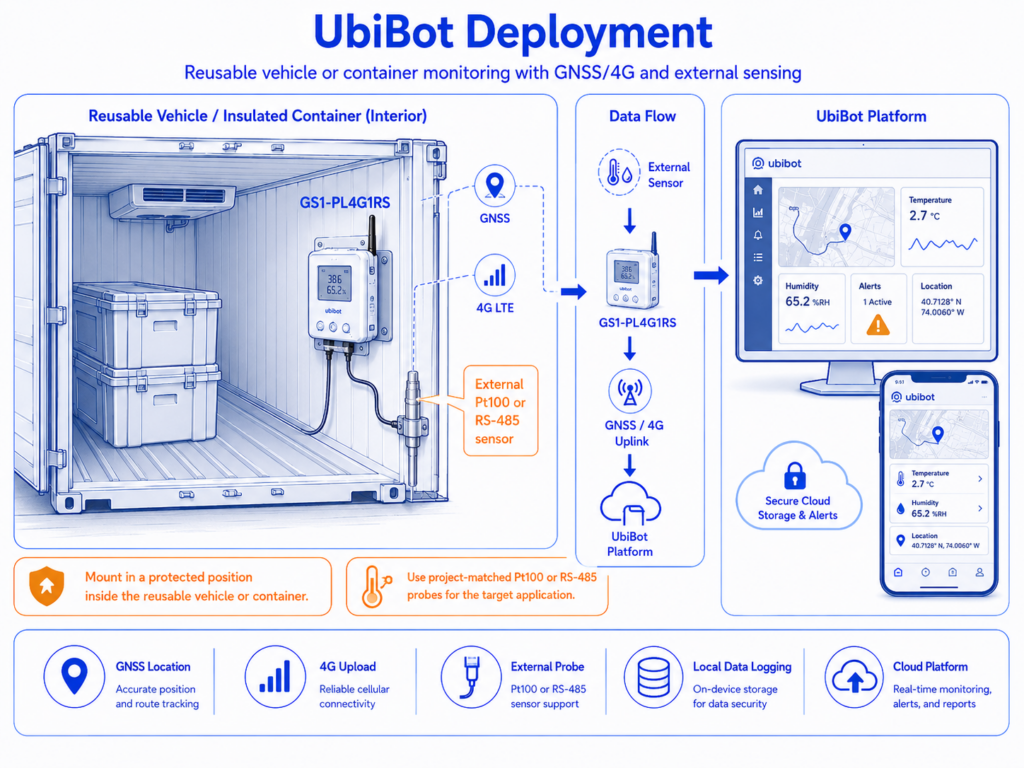
    UbiBot deployment

    The UbiBot Public IoT Platform supports web and mobile access, alerts, PDF/CSV export, REST APIs and data forwarding. UbiBot also offers on-premises deployment and developer-level HTTP/MQTT options, which can reduce platform lock-in for enterprises and system integrators. The public product page lists 200 MB of free cloud storage, while some advanced services and MQTT access depend on current pricing plans or membership.

    The limitations should be stated just as clearly. GS1 is larger and heavier than item-level trackers. It does not list built-in shock measurement. The public materials reviewed did not establish automatic flight mode, specific airline approval or a complete GxP shipment-validation package for the GS1-PL4G1RS. Its internal lithium-battery capacity is also presented inconsistently across regional UbiBot pages. Before using it for pharmaceutical air transport, the buyer should confirm the exact SKU, battery documents, carrier acceptance, probe calibration and system-validation approach in writing.
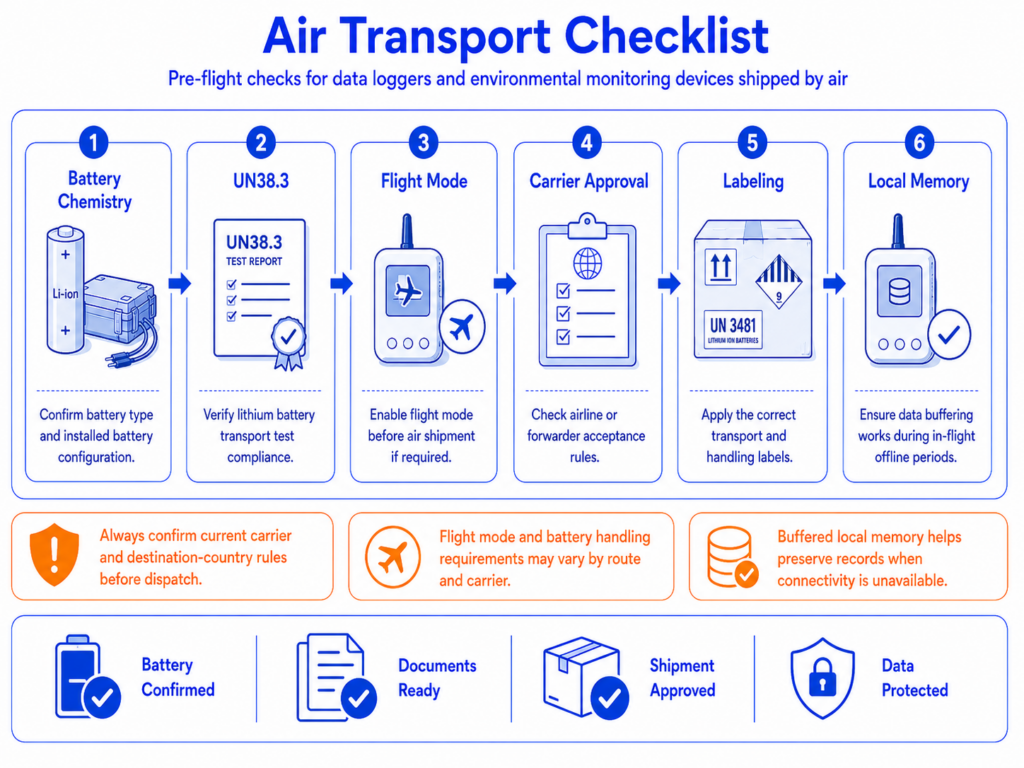
    Air transport checklist

    14.Frequently asked questions

    What is the difference between a real-time cold chain tracker and a temperature data logger?

    A data logger records time-stamped measurements for later retrieval. A real-time tracker adds cellular communication, location and remote alerts. Most connected trackers still depend on local memory because they cannot communicate continuously in aircraft, metal containers or areas without coverage.

    Does a cold chain tracker need GPS?

    Not always. GPS or multi-constellation GNSS is valuable for precise outdoor location, but Wi-Fi geolocation and cellular triangulation can provide position when satellite signals are blocked. Choose the location method based on the route and the level of accuracy needed for intervention.

    Does “5G tracker” mean the device uses full 5G NR?

    Usually not. Many low-power trackers use LTE-M or other cellular technologies on networks that coexist with 4G and 5G infrastructure. Verify the modem bands, roaming partners and country coverage rather than relying on the 5G label.

    Can a cellular temperature tracker be used on an aircraft?

    Only after the exact device, battery and operating mode have been accepted for the lane and carrier. Check automatic flight mode, radio shutdown behavior, UN38.3 documentation, dangerous-goods classification, labels and the airline approval list. IATA guidance does not replace carrier approval.

    Should I choose a single-use or reusable tracker?

    Choose single-use when return logistics are unreliable or last-mile recovery would cost more than the device. Choose reusable when devices can complete enough cycles to offset charging, calibration, return freight and loss. Supplier-managed reuse can shift some of that work to the vendor.
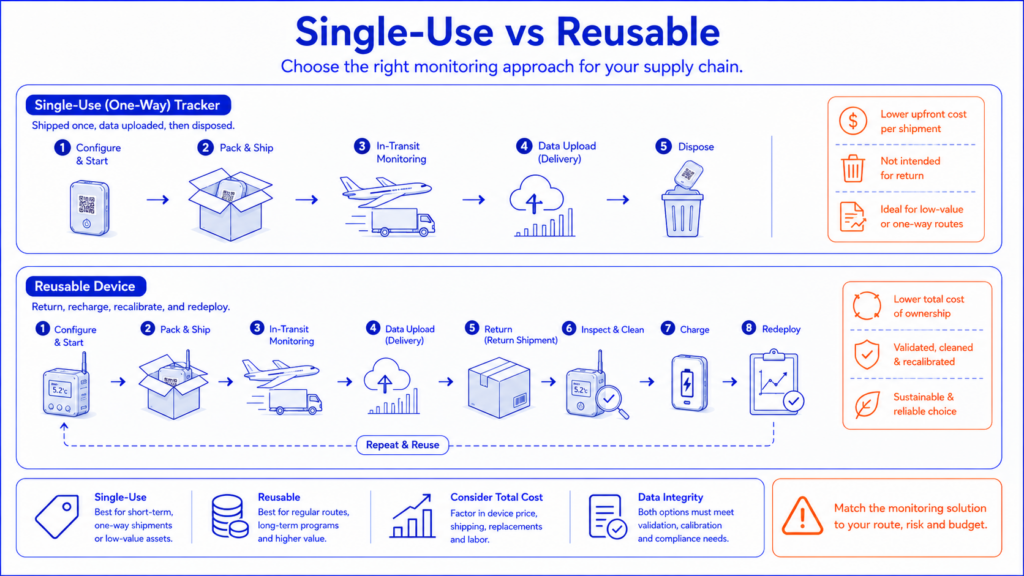
    Single-use vs reusable

    When are humidity, shock and light sensors necessary?

    Use humidity when moisture affects product or packaging quality, shock when impact can damage the load, and light when opening events matter. Extra sensors add cost and data, so each parameter should be tied to a defined risk and response procedure.

    What happens when the tracker loses cellular coverage?

    A suitable tracker continues measuring and stores data locally. It should upload buffered records after reconnection without replacing the original timestamps. Confirm memory capacity, clock behavior, retry logic and how the platform labels delayed uploads.

    How accurate is GPS location on a shipment tracker?

    Accuracy depends on method and environment. Outdoor GNSS can be within tens of meters, Wi-Fi geolocation is typically less precise, and cellular triangulation may be hundreds of meters. Metal containers and indoor storage can reduce performance.

    Can UbiBot GS1-PL4G1RS be used for pharmaceutical shipments?

    It can support environmental and location monitoring, especially for reusable vehicles or containers, but suitability is project-specific. Confirm traceable calibration, validation, air-transport approval, alarm procedures, data integrity and the exact external probe configuration before relying on it for product release.

    What type of tracker is needed for dry ice or cryogenic shipments?

    Use an external probe rated and calibrated for the required temperature while keeping the logger body within its operating range. Verify complete-system accuracy, cable feed-through, response time, battery behavior and whether communication is possible at the logger’s actual temperature.

    Why does API access matter?

    APIs or webhooks allow shipment data to flow into a transport management system, ERP, quality system or control tower. They reduce manual exports and support automated escalation, but licensing, rate limits, validation and long-term maintenance must be included in the cost.

    How should sampling and upload intervals be set?

    Sample often enough to detect the fastest meaningful excursion, then select an upload interval that balances intervention time, battery and network cost. Event-driven uploads can provide faster alerts while routine transmissions remain less frequent.

    15.How do you choose the right system?

    Start with the product stability profile and the decisions the data must support. Define temperature and any additional parameters, the required calibrated range, acceptable uncertainty and alarm logic. Map the route, transport modes and expected coverage gaps. Decide whether the device must be single-use, reusable or supplier-managed, and whether it must operate in frozen, dry-ice or cryogenic conditions.

    Next, verify local memory, timestamps, flight behavior, battery documentation, airline acceptance, alert escalation, reporting and platform integration. Obtain written confirmation for country coverage, exact SKU, calibration and subscription terms. Run a route trial before broad deployment, including poor-coverage sections, handovers and the final product-release process.

    Choose UbiBot GS1-PL4G1RS when the project benefits from a reusable industrial monitor with local display, large storage, Wi-Fi/4G, GNSS, external RS-485 sensors and flexible public-cloud or on-premises integration. Choose a specialist life-science tracker when validated shipment workflows, airline programs, probe packages or managed device services are the dominant requirements. The right system is the one that produces a complete, actionable and defensible record at an acceptable cost per shipment.

    16.Sources and specification notice

    Only manufacturer, IATA and WHO sources were used for the factual comparison. Vendor compliance statements are reported as vendor claims and should be reviewed against current certificates, validation packages and the buyer’s quality system.

    [1] UbiBot. GS1-PL4G1RS product page. https://store.ubibot.com/en-eu/products/gs1-pl4g1rs Product features, sensors, storage, communications, display, alerts and regional listing.

    [2] UbiBot. GS1-PL4G1RS technical specifications. https://store.ubibot.com/en-sg/pages/ubibotgs1-pl4g1rs_specifications Bands, GNSS constellations, dimensions, power and probe support.

    [3] UbiBot. UbiBot IoT Platform for Smart Industrial Wireless Sensors. https://www.ubibot.com/big-data-platform/ Public cloud, on-premises and developer integration options.

    [4] UbiBot. Instant Notifications. https://www.ubibot.com/alerts/ Alert methods and current allowance information.

    [5] UbiBot. UbiBot Pricing Plans. https://www.ubibot.com/public-cloud-pricing/ Current paid services and data-forwarding pricing; verify at publication.

    [6] World Health Organization. Model guidance for storage and transport of time- and temperature-sensitive pharmaceutical products. https://www.who.int/publications/m/item/trs961-annex9-modelguidanceforstoragetransport International good-practice framework; local rules take precedence.

    Related Resources

    Vaccine Refrigerator Temperature Data Loggers: Buffered Probes, Calibration, Alarms and CDC/VFC Buying Checklist
    How to Choose a Wireless Temperature and Humidity Data Logger: Wi-Fi, 4G, Alerts, Accuracy and Cloud Costs
    menu-header-svg
    Search
    • Explore Knowledge
      • Comparison & Selection
      • Industry Solution
      • Product & Device
      • Criterion & Compliance
      • Deployment & Usage
      • Technology & Principle
    • Academic Research
    • In-depth Tech

    learn

    See More >>

    Real-Time Cold Chain Trackers Compared: Cellular, GPS, Temperature, Humidity, Shock and Light

    30-second summary

    What it is

    A battery-powered device that records shipment conditions and periodically sends data through cellular networks to a cloud platform. Many models also estimate or measure location using GNSS, Wi-Fi geolocation or cellular triangulation.

    What to prioritize

    Required sensors, qualified temperature range, calibration, sampling and upload intervals, local memory, airline suitability, coverage by route, platform workflow, API access and total cost per completed shipment.

    1.Why does choosing the right real time cold chain tracker matter?

    A real-time cold chain tracker is useful only when its data can support a decision. Knowing that a shipment was warm after delivery may help with investigation, but it cannot help an operations team intervene while the product is still in transit. A connected tracker can add location, live alerts and condition data, yet these benefits depend on cellular coverage, sensor placement, reporting intervals, battery performance and a platform that people can actually use.

    The buying decision is therefore broader than comparing temperature range. A pharmaceutical shipper may need traceable calibration, a validated platform, automatic flight mode and a clear deviation workflow. A food exporter may place more weight on humidity, door-opening evidence and cost per trip. A reusable fleet operator may value charging, local memory and API access more than a disposable form factor. The wrong device can create false confidence, incomplete records or avoidable reverse-logistics expense.

    This guide compares the UbiBot GS1-PL4G1RS with Tive Solo 5G, Sensitech TempTale GEO X and GEO X Probe, ELPRO LIBERO GE and GF ext, and Controlant Saga Card. The models do not serve identical markets. Some are multi-sensor shipment trackers, some are specialist life-science loggers, and one is a compact pharma device still described publicly as being piloted. The useful question is not which model wins every specification, but which system fits the lane, product, risk and quality process.

    2.Who is this guide for?

    This guide is written for teams that need to select or specify connected tracking devices rather than simply purchase a temperature logger. Quality and validation teams will be most concerned with calibration, record integrity, auditability and deviation review. Logistics operations will focus on coverage, alerts, airline acceptance and battery life. IT and integration teams will examine APIs, webhooks, data ownership and private deployment. Procurement will need a complete cost model that includes connectivity, subscriptions, calibration, return logistics and service support.

    Practical selection rule: use a specialist, calibrated and workflow-validated tracker when shipment release depends directly on its record. Use a configurable environmental and location monitor such as UbiBot GS1 when the priority is reusable multi-site monitoring, local display, large onboard storage, external RS-485 sensors and flexible cloud or on-premises integration – provided the project team separately confirms calibration, airline acceptance and validation requirements.

    3.What is a real-time cold chain tracker?

    A real-time cold chain tracker is a connected data logger that records one or more shipment conditions and transmits selected data while goods are moving. The word “real-time” normally means periodic or event-driven updates, not continuous second-by-second streaming. A device may measure every five minutes but upload every thirty minutes or every six hours to preserve battery life. It should retain measurements locally when the network is unavailable and upload them later.

    A sensor is only the element that measures temperature, humidity, light or acceleration. A data logger adds time-stamped storage. A transmitter sends readings but may have little local memory. A remote monitor combines sensing, storage, communications and alerts. A gateway collects data from nearby wireless tags. A complete cold chain monitoring system also includes a cloud or local platform, user permissions, alarm workflows, reports, APIs and the procedures used to investigate excursions.

    Location can also be misunderstood. GNSS or GPS can provide precise outdoor coordinates when the antenna has a usable view of satellites. Wi-Fi geolocation estimates position from nearby networks. Cellular triangulation estimates position from network infrastructure and is usually less precise. The strongest systems combine methods so that one location source can compensate when another is unavailable.

    4.What problems does a connected shipment tracker solve?

    The main operational value is earlier visibility. When a refrigerated truck stops unexpectedly, a container is opened, or a shipment approaches a temperature limit, a connected device can notify the responsible team before delivery. Location and condition data also help distinguish a refrigeration problem from a customs delay, an unplanned handover, a route deviation or poor loading practice.

    A tracker can also reduce manual work. Instead of waiting for a USB logger to return, a platform can associate a device with a shipment, show its route, record alarms, generate reports and pass data into a transport management, quality or control-tower system. For reusable devices, a platform may also support charging, calibration and return cycles. These functions matter because a technically accurate sensor can still create an inefficient process if activation, device recovery or data review is difficult.

    Connected trackers do not eliminate every data gap. Cellular radios may be disabled during flight, blocked inside metal containers or unavailable in remote regions. A tracker therefore needs sufficient local memory, accurate timestamps and a defined reconnection process. The organization also needs escalation rules: who receives the alert, how quickly they respond, which carrier contact is used and how the final disposition decision is documented.

    5.What components make up a real-time tracking system?

    A complete system begins with the sensor configuration. Ambient sensors measure the air around the logger. External probes can be placed closer to the product or inside dry-ice and cryogenic packaging while the radio remains in a more suitable environment. Shock and tilt sensors detect mechanical events, while light sensors can indicate that packaging or a container door was opened.

    The logger records the measurements, stores them locally and controls the measurement interval. The communications module sends data through LTE-M, NB-IoT, conventional cellular networks or another supported technology. GNSS, Wi-Fi scanning and cellular triangulation may provide location. The cloud platform then applies thresholds, sends alerts, displays the route and produces reports. APIs or webhooks connect the data to enterprise systems.

    For a large reusable monitor such as the UbiBot GS1-PL4G1RS, an RS-485 interface can extend the system with probes for temperature, humidity, CO2, soil conditions or wind speed. This is valuable for vehicles, mobile assets and temporary monitoring projects, but it is different from a compact parcel-level tracker. External cables, power arrangements and mounting need to be included in the deployment design.

    6.Which sensors and specifications matter most?

    Temperature range must match the product and the complete measurement chain

    The required range depends on the lane and packaging system. Chilled products may use 2°C to 8°C (35.6°F to 46.4°F), frozen products may require temperatures below -20°C (-4°F), dry-ice shipments operate near -78.5°C (-109.3°F), and cryogenic shipments may approach -196°C (-320.8°F). A wide probe range does not prove that the entire system has the same accuracy across that range. The probe class, logger input, cable, connector, calibration points, placement and response time all affect system performance.

    UbiBot lists the built-in GS1 temperature range as -20°C to 60°C (-4°F to 140°F) with stated temperature accuracy of ±0.2°C. ELPRO publishes separate accuracy bands for its internal sensor and for the complete logger-plus-Pt100 system. Sensitech publishes different ranges for the ambient TempTale GEO X and the probe version. This model-specific approach is more useful than comparing a single headline number.

    Humidity is useful only when the product or packaging is humidity-sensitive

    Relative humidity helps explain condensation, packaging damage, desiccation risk and produce quality. It is important for many foods, biologics in secondary packaging and products transported through humid climates. It also increases power and calibration requirements. Tive Solo 5G and UbiBot GS1 include humidity sensing. The public product information reviewed for TempTale GEO X, ELPRO GE/GF ext and Saga Card does not position humidity as a standard function of those exact models.

    Shock, movement and light answer different questions

    Shock data can indicate a drop or severe impact, but a threshold must be matched to the product and packaging. Tive publishes shock sensing for Solo 5G, including a 12G sensitivity specification. ELPRO lists movement or tilt rather than a full shock profile. Saga Card uses an accelerometer to detect movement state. The UbiBot GS1-PL4G1RS does not list a built-in shock sensor, so it should not be presented as a temperature-humidity-shock-light tracker without an independently verified external solution.

    Light sensing is usually interpreted as evidence that a box, pallet cover or vehicle door was opened. It does not prove unauthorized access on its own. Packaging material, sensor placement and ambient conditions can create false or missed events, so light alerts should be combined with location and handling records.

    Sampling interval and upload interval are not the same

    The measurement interval determines how often the device records a value. The communication interval determines how often it attempts to upload. Shorter intervals produce more detail and faster alerts but reduce battery life and increase data use. A common design is frequent local sampling with less frequent routine uploads, plus an immediate connection attempt when an alarm occurs. Buyers should verify how each device behaves in flight mode, low-power mode and poor coverage.

    Sampling vs upload timeline

    Local memory protects the record when networks fail

    A shipment tracker should continue recording when cellular coverage disappears. UbiBot publishes capacity for 300,000 sensor records on the GS1-PL4G1RS. ELPRO publishes 31,000 temperature values for LIBERO GE and GF ext. Controlant publishes more than 150 days of temperature measurements for its standard Saga logger family, but the detailed Saga Card memory specification was not publicly stated on the page reviewed. Public pages for Tive Solo 5G and Sensitech TempTale GEO X did not provide an easily comparable local-memory figure, so buyers should obtain it in writing.

    Calibration and validation serve different purposes

    Calibration compares the measurement system with a traceable reference and documents the result. Validation demonstrates that the configured system and workflow perform as intended for a defined use. Tive states that Solo 5G can be supplied with a three-point ISO 17025 traceable certificate. ELPRO specifies a three-point traceable calibration certificate and manufacturer validation documentation. Sensitech states that the TempTale GEO X life-science configuration is GxP validated and built for FDA 21 CFR Part 11 and EU Annex 11 workflows. These vendor claims should be reviewed against the buyer’s quality requirements and current documentation.

    UbiBot supports data collection, alerts, export, API integration and on-premises deployment, but those functions do not by themselves make GS1 a validated pharmaceutical shipment system. A project may be able to configure GS1 to support a monitoring workflow, subject to appropriate calibration, validation, controlled procedures and airline approval. The same distinction applies to any general-purpose IoT monitor.

    7.How should connectivity be evaluated?

    Cellular connectivity is the primary backhaul for moving shipments

    Cellular networks are the practical choice for road, rail, sea and multimodal shipments because the tracker does not depend on a vehicle gateway. Coverage must be evaluated by route, roaming agreement and radio technology. A claim such as “global coverage” does not guarantee service inside every container, airport warehouse or rural corridor. The modem may also switch between LTE-M, NB-IoT, 4G, 3G or 2G depending on device and region.

    The term “5G temperature tracker” needs careful interpretation. Some products use LTE-M on infrastructure marketed for 4G and 5G networks or are described as 5G-ready. This is not the same as a full 5G NR broadband connection, and it is usually not necessary for low-data-rate temperature monitoring. Coverage, roaming and power consumption matter more than the label.

    GPS or GNSS improves route visibility but is not always available

    GNSS is most accurate outdoors and near windows. Inside aircraft holds, metal containers, warehouses or insulated packaging, a tracker may rely on Wi-Fi geolocation or cellular triangulation. Tive publishes approximate accuracy values by location method, illustrating why the platform should label the source and estimated radius instead of presenting every point as equally precise. UbiBot GS1-PL4G1RS supports multiple GNSS constellations and also transmits location through its cellular connection.

    Wi-Fi helps at facilities but is not an end-to-end shipment network

    Wi-Fi may reduce cellular use at warehouses, laboratories or cross-dock points and can assist geolocation. It should not be the only connection for an uncontrolled route. The UbiBot GS1 combines Wi-Fi and 4G, which can be practical for reusable vehicle or asset monitoring when the same device moves between company facilities and public networks.

    LoRa, LoRaWAN, Ethernet and RS-485 play supporting roles

    LoRa or LoRaWAN can be effective inside a port, warehouse campus or private vehicle fleet where gateways are controlled. They are not a replacement for global cellular roaming unless gateway coverage exists throughout the lane. LoRa is a radio modulation; LoRaWAN is a network protocol and ecosystem, so the terms should not be treated as interchangeable.

    Ethernet is useful for fixed gateways and on-site servers, not for a parcel moving through a public logistics network. RS-485/Modbus RTU is a wired sensor interface. In the GS1-PL4G1RS, RS-485 expands the types of environmental probes that can be connected, while 4G or Wi-Fi remains the route to the platform.

    8.Leading real-time cold chain trackers compared

    The following tables compare the exact models requested. Blank or unavailable public specifications are shown as “not publicly specified” rather than inferred. Product configuration, country availability, platform licensing and service packages can change.

    Model Use model and sensing Published temperature capability Location and connectivity Local operation Air-transport position
    Ubibot GS1-PL4G1RS Reusable industrial monitor; built-in temperature, humidity and light; GNSS; RS-485 external probes. No built-in shock sensor listed. -20°C to 60°C (-4°F to 140°F); stated built-in accuracy ±0.2°C. External Pt100 supported; system accuracy depends on probe and configuration. 4G plus 2.4 GHz Wi-Fi; GPS, GLONASS, BeiDou, Galileo and QZSS. 300,000 records; 4-inch display; internal lithium battery plus USB-C 5 V and optional 12 V power. No public automatic flight-mode or airline-approval statement found for this exact model. Confirm before air use.
    Tive Solo 5G Single- or multi-use tracker; temperature, humidity, light, shock and motion. Public page shows -30°C to 60°C in one section and -20°C to 60°C in another; stated accuracy ±0.5°C. Dry-ice and cryogenic probes available. LTE-M with 2G fallback; GPS, Wi-Fi geolocation and cellular triangulation; vendor states broad multi-network coverage. Programmable measurement; public page cites 50+ to 100+ days depending on transmission interval; IP67. Comparable local-memory figure not publicly specified. Lithium and non-lithium versions; vendor publishes broad airline acceptance. Confirm exact model and carrier list.
    Sensitech TempTale GEO X / GEO X Probe Life-science and industrial real-time temperature/location monitor; Probe version provides internal and ambient temperature. GEO X: -30°C to 55°C (-22°F to 131°F). Probe: -95°C to 55°C (-139°F to 131°F). Accuracy not stated on the public portfolio page. LTE Cat-M1 for 4G/5G networks with 2G fallback; platform-based multimodal automation. Built-in battery management; delivered charged. Public page does not provide a directly comparable memory, display or runtime figure. Public page positions the system for multimodal life-science shipments. Confirm airline and battery details for the selected SKU.
    ELPRO LIBERO GE Reusable temperature, location, light and tilt logger with optional external Pt100 probe. Internal measurement -30°C to 70°C; recommended application 0°C to 55°C. External system range -200°C to 400°C with published accuracy bands. LTE-M and NB-IoT; automatic uploads to elproCLOUD. 31,000 values; LCD; 5-60 min measurement; up to 14 months from start under defined conditions. Automatic flight detection; non-lithium alkaline batteries are stated as exempt from DGR declaration.
    ELPRO LIBERO GF ext Reusable frozen/cryogenic logger; temperature, location, light and tilt; external Pt100 probe. Internal measurement -40°C to 70°C; application -35°C to 55°C. External system range -200°C to 400°C with published accuracy bands. LTE-M and NB-IoT; intended to maintain communication in frozen applications. 31,000 values; LCD; 5-60 min measurement; up to 14 months from start under defined conditions. Automatic flight detection; lithium-metal batteries, UN3091 contained in equipment. Declaration requirements must be managed.
    Controlant Saga Card Compact pharma-focused device; temperature, location, light opening detection and accelerometer-based movement. Not publicly specified on the Saga Card page reviewed. Cellular IoT modem and Controlant Platform; country/region/city visibility described publicly. 10 g, highly recyclable form factor. Battery life, memory, accuracy and user display not publicly specified. Described by Controlant as flight-ready. Detailed approval list and final commercial specification should be confirmed.

    Table 1. Core device capabilities. “Real-time” update frequency and battery life depend on configuration, coverage, temperature and alert activity.

    Model Calibration / validation Alerts and platform API / deployment Best-fit use case Main limitation to verify
    UbiBot GS1-PL4G1RS Calibration service and project documentation should be confirmed for the selected sensors. No claim of a validated pharma shipment workflow is made here. App, email and IFTTT alerts; public IoT platform; CSV/PDF export, 200 MB free cloud storage listed for product. REST API, MQTT services by membership, data forwarding, and on-premises platform options. Reusable vehicle, route, container or mobile-asset monitoring where local display, large memory and external sensor expansion matter. Airline approval, flight mode, battery documentation, pharma validation package and exact probe calibration.
    Tive Solo 5G Vendor states NIST traceability and a three-point ISO 17025 calibration certificate. Tive cloud with configurable condition and location alerts; shipment visibility and analytics. API access is marketed; exact licensing and limits should be quoted. Parcel, pallet and lane monitoring where humidity, shock and light are needed with location. Public page contains differing range, frequency and carrier-count statements; confirm selected version.
    Sensitech TempTale GEO X / Probe Vendor states GxP validation for life-science configuration and design for FDA 21 CFR Part 11 and EU Annex 11 workflows. SensiWatch platform, map view, alert acknowledgment and corrective-action capture. Integration and licensing details should be confirmed in proposal. Life-science shipments where established release workflows and probe options are required. Humidity, shock and light are not listed as functions of these exact models; detailed public performance figures are limited.
    ELPRO LIBERO GE Three-point traceable calibration certificate and manufacturer validation documentation; optional customer points. Seven temperature thresholds; event-driven communication; LCD OK/ALARM; PDF reporting through elproCLOUD/liberoMANAGER. Platform integration and licensing should be confirmed; public materials focus on ELPRO ecosystem. Reusable ambient, refrigerated, dry-ice or cryogenic shipment monitoring when a non-lithium flight-oriented option is preferred. Direct real-time communication is limited when the device itself is below 0°C; buffered data transmits later.
    ELPRO LIBERO GF ext Same traceable calibration and validation positioning as the GE family. Seven temperature thresholds; event-driven communication; LCD and elproCLOUD reporting. Platform integration and licensing should be confirmed. Frozen, dry-ice and cryogenic lanes needing an external Pt100 and communication below 0°C. Lithium-metal battery creates UN3091 air-shipping obligations.
    Controlant Saga Card Controlant positions its wider platform and Saga family for pharma; detailed Saga Card validation documents were not public on the reviewed page. Controlant Platform; opening and movement visibility, real-time inventory use cases. Controlant offers validated APIs and webhooks at platform level; Saga Card-specific package should be confirmed. Secondary-packaging, clinical-supply and patient-level pharma visibility where a 10 g form factor matters. The public page states the innovation is being piloted; commercial availability, accuracy, range, battery, memory and pricing are not publicly specified.

    Specifications and platform features were reviewed using publicly available manufacturer information on July 24, 2026. Product configurations, regional availability and subscription terms may change. Confirm the latest specifications with each manufacturer before purchasing.

    Air-transport warning

    A tracker that contains a battery and radio must be reviewed for the exact air lane, airline and device configuration. IATA guidance covers battery-powered cargo tracking devices and data loggers, but airline acceptance is not automatic. Confirm battery chemistry, UN38.3 documentation, dangerous-goods classification, automatic flight mode or radio shutdown behavior, labeling and the carrier’s current approval before loading the device.

    9.How do the models differ in practice?

    Tive Solo 5G is the broadest standard multi-sensor tracker in this group. It combines temperature, humidity, shock, light and multiple location methods in a compact platform-oriented product. That makes it suitable when a single device must explain both climate and handling events. Its public page also illustrates the trade-off between upload frequency and battery life. Buyers should resolve the conflicting public range, measurement-frequency and airline-count statements for the exact version quoted.

    Sensitech TempTale GEO X is narrower in sensor scope but stronger in the way it is positioned for life-science workflows. The probe model extends the temperature range and records internal and ambient temperature. It is a logical shortlist item when validated release processes and an established cold-chain service model are more important than humidity or shock.

    ELPRO LIBERO GE and GF ext are specialist reusable temperature systems. They publish detailed range, accuracy, calibration, local memory and battery information. The GE variant uses non-lithium alkaline batteries and is designed around flight detection, while GF ext is intended for frozen conditions and uses lithium-metal batteries that require UN3091 handling. The distinction is operationally important: the device that communicates better in deep cold may create more air-freight documentation work.

    Controlant Saga Card addresses a different scale. It is designed to move visibility from pallet level toward cases and cartons in pharmaceutical supply chains. Its 10 g form factor, light detection and movement sensing are attractive, but the public page still describes the product as being piloted. It should therefore be treated as a strategic supplier conversation rather than a fully transparent off-the-shelf comparison until detailed commercial specifications are supplied.

    UbiBot GS1-PL4G1RS is the most industrial and expandable device in the group. It has a large display, substantial local storage, Wi-Fi plus 4G, multi-constellation GNSS, and RS-485 support for external sensors. Those strengths make it useful for reusable vehicle, mobile-asset and temporary monitoring systems. It is physically larger than parcel trackers, does not list a built-in shock sensor, and does not publicly present the same airline or GxP package as the specialist pharma products. Its advantage is flexibility, not automatic equivalence to a validated shipment-release system.

    10.Which tracker type is best for each use case?

    High-value pharmaceutical pallets

    For high-value pharmaceutical pallets, prioritize traceable calibration, route coverage, automatic flight behavior, a validated platform, deviation review and integration with release workflows. Sensitech, ELPRO and Controlant position products and platforms directly for life sciences. Tive can be considered when multi-sensor evidence such as humidity, shock and light is important. UbiBot GS1 may support operational monitoring but requires a separate project-level assessment for calibration, validation and air transport.

    Parcel and last-mile medicine deliveries

    Parcel-level tracking favors small, low-cost and easy-to-activate devices. Single-use or return-optional products reduce reverse logistics, while a card-like device can fit secondary packaging. Tive Solo 5G and Controlant Saga Card align more closely with this requirement than the larger GS1. The buyer should model waste, recycling, data access and the cost of failed device recovery rather than assuming single-use is always cheaper.

    Dry-ice and cryogenic shipments

    Use an external probe designed and calibrated for the target range while keeping the radio and battery in a viable environment. ELPRO GE/GF ext and Sensitech GEO X Probe publish extended low-temperature capabilities. Tive offers dry-ice and cryogenic probe options. A UbiBot Pt100 can extend measurement range, but range alone is not enough; confirm complete-system accuracy, cable feed-through, response time, battery behavior, calibration points and packaging qualification.

    Reefer trucks and reusable mobile assets

    Reusable vehicle monitoring often benefits from local power, a visible screen, large memory and external probes. UbiBot GS1-PL4G1RS fits this pattern well because it can use USB-C or 12 V power, connect by 4G or Wi-Fi, show readings locally and integrate RS-485 sensors. It is more suitable as a reusable mobile monitoring terminal than as a disposable parcel tracker. Tive and specialist cold-chain products may still be preferable when carrier-independent item-level visibility is required.

    Food, produce and humidity-sensitive cargo

    Temperature alone may not explain quality loss in produce, seafood, chocolate, packaging materials or other moisture-sensitive goods. A tracker with humidity, temperature and light can provide a more complete record. Tive Solo 5G and UbiBot GS1 provide these standard measurements. Shock data may also be useful for fragile products, but the threshold and sensor placement should be validated against actual damage modes.

    Cross-dock, warehouse and temporary lane studies

    Temporary studies often need more than a shipment card. Teams may deploy multiple environmental probes, power the device locally, compare indoor and outdoor conditions, or integrate vehicle and warehouse data. UbiBot’s platform, local storage and external sensor ecosystem can be useful here. A specialist shipment tracker may provide a cleaner managed workflow but less flexibility for third-party industrial sensors.

    11.How should deployment scale and total cost of ownership be calculated?

    The correct cost unit is usually cost per successfully monitored shipment or cost per monitored asset-month, not the device purchase price. A low-cost tracker can become expensive if it requires manual data handling, creates repeated coverage gaps or is rarely returned. A higher-priced reusable device may be economical when it completes many cycles and the organization has reliable reverse logistics.

    Build the model around hardware, probes, chargers, mounts, SIM or network charges, platform licensing, data retention, alerts, API access, calibration, replacement batteries, device cleaning, return freight, loss rate, validation, IT integration and support. For regulated shipments, include the labor required to review alarms and release product. For disposable devices, include waste handling and sustainability reporting. For reusable devices, include the working capital tied up while devices are in transit or waiting to return.

    Upload frequency has a direct cost effect. More frequent transmissions improve intervention time but consume battery and data. The economic optimum depends on product value, expected excursion speed and response capability. There is little value in a two-minute alert if nobody can act for six hours, just as a six-hour upload may be too slow for a short high-risk lane.

    Cost category Questions to ask Common hidden cost
    Device model Single-use, reusable or supplier-managed? Loss, non-return and idle inventory
    Connectivity Which countries, networks and roaming partners cover the actual lane? No-data zones and premium roaming
    Platform What is included in alerts, storage, reports, users and dashboards? Per-device, per-shipment or API fees
    Calibration Is the certificate traceable and valid at the required points? Recalibration, replacement and documentation
    Air transport Is the exact battery and radio configuration approved by the carrier? Shipment delay, relabeling or device removal
    Integration Can data be pushed into TMS, ERP, QMS or control-tower systems? Development, validation and maintenance
    Operations Who activates, stops, charges, retrieves and reviews the device? Labor and training

    12.What buying mistakes should be avoided?

    The most common mistake is buying from a headline specification. A device may advertise a very wide temperature range while the standard internal sensor, battery or radio has a much narrower operating range. Another mistake is treating sensor accuracy as system accuracy without including the probe, logger input, cable and calibration uncertainty.

    Buyers also underestimate network and airline constraints. A cellular tracker needs local network support and a valid roaming arrangement. A lithium-powered tracker may be acceptable on one carrier and require additional declaration or a different configuration on another. Automatic flight detection should be verified, not assumed.

    A third error is ignoring offline behavior. Ask what the device records when the radio is disabled, how many readings it stores, whether timestamps remain reliable, and how delayed data are shown after reconnection. The platform should distinguish a live reading from a buffered historical upload.

    Finally, do not compare subscription costs without matching scope. One platform may include calibration management, validated reports, corrective-action capture and live support. Another may provide lower-cost raw data, dashboards and open APIs. Both can be good choices for different operating models.

    13.Where does UbiBot GS1-PL4G1RS fit?

    UbiBot GS1-PL4G1RS fits projects that need a reusable, expandable environmental and location monitor rather than a thin disposable package tracker. Its built-in temperature, humidity and light sensing, 300,000-record memory, four-inch display, 4G/Wi-Fi communication and multi-constellation GNSS provide a useful base for vehicles, reusable containers, temporary routes and mobile equipment. RS-485 support allows the system to add Pt100, air temperature and humidity, CO2, soil or wind sensors for broader industrial monitoring.

    UbiBot deployment

    The UbiBot Public IoT Platform supports web and mobile access, alerts, PDF/CSV export, REST APIs and data forwarding. UbiBot also offers on-premises deployment and developer-level HTTP/MQTT options, which can reduce platform lock-in for enterprises and system integrators. The public product page lists 200 MB of free cloud storage, while some advanced services and MQTT access depend on current pricing plans or membership.

    The limitations should be stated just as clearly. GS1 is larger and heavier than item-level trackers. It does not list built-in shock measurement. The public materials reviewed did not establish automatic flight mode, specific airline approval or a complete GxP shipment-validation package for the GS1-PL4G1RS. Its internal lithium-battery capacity is also presented inconsistently across regional UbiBot pages. Before using it for pharmaceutical air transport, the buyer should confirm the exact SKU, battery documents, carrier acceptance, probe calibration and system-validation approach in writing.

    Air transport checklist

    14.Frequently asked questions

    What is the difference between a real-time cold chain tracker and a temperature data logger?

    A data logger records time-stamped measurements for later retrieval. A real-time tracker adds cellular communication, location and remote alerts. Most connected trackers still depend on local memory because they cannot communicate continuously in aircraft, metal containers or areas without coverage.

    Does a cold chain tracker need GPS?

    Not always. GPS or multi-constellation GNSS is valuable for precise outdoor location, but Wi-Fi geolocation and cellular triangulation can provide position when satellite signals are blocked. Choose the location method based on the route and the level of accuracy needed for intervention.

    Does “5G tracker” mean the device uses full 5G NR?

    Usually not. Many low-power trackers use LTE-M or other cellular technologies on networks that coexist with 4G and 5G infrastructure. Verify the modem bands, roaming partners and country coverage rather than relying on the 5G label.

    Can a cellular temperature tracker be used on an aircraft?

    Only after the exact device, battery and operating mode have been accepted for the lane and carrier. Check automatic flight mode, radio shutdown behavior, UN38.3 documentation, dangerous-goods classification, labels and the airline approval list. IATA guidance does not replace carrier approval.

    Should I choose a single-use or reusable tracker?

    Choose single-use when return logistics are unreliable or last-mile recovery would cost more than the device. Choose reusable when devices can complete enough cycles to offset charging, calibration, return freight and loss. Supplier-managed reuse can shift some of that work to the vendor.

    Single-use vs reusable

    When are humidity, shock and light sensors necessary?

    Use humidity when moisture affects product or packaging quality, shock when impact can damage the load, and light when opening events matter. Extra sensors add cost and data, so each parameter should be tied to a defined risk and response procedure.

    What happens when the tracker loses cellular coverage?

    A suitable tracker continues measuring and stores data locally. It should upload buffered records after reconnection without replacing the original timestamps. Confirm memory capacity, clock behavior, retry logic and how the platform labels delayed uploads.

    How accurate is GPS location on a shipment tracker?

    Accuracy depends on method and environment. Outdoor GNSS can be within tens of meters, Wi-Fi geolocation is typically less precise, and cellular triangulation may be hundreds of meters. Metal containers and indoor storage can reduce performance.

    Can UbiBot GS1-PL4G1RS be used for pharmaceutical shipments?

    It can support environmental and location monitoring, especially for reusable vehicles or containers, but suitability is project-specific. Confirm traceable calibration, validation, air-transport approval, alarm procedures, data integrity and the exact external probe configuration before relying on it for product release.

    What type of tracker is needed for dry ice or cryogenic shipments?

    Use an external probe rated and calibrated for the required temperature while keeping the logger body within its operating range. Verify complete-system accuracy, cable feed-through, response time, battery behavior and whether communication is possible at the logger’s actual temperature.

    Why does API access matter?

    APIs or webhooks allow shipment data to flow into a transport management system, ERP, quality system or control tower. They reduce manual exports and support automated escalation, but licensing, rate limits, validation and long-term maintenance must be included in the cost.

    How should sampling and upload intervals be set?

    Sample often enough to detect the fastest meaningful excursion, then select an upload interval that balances intervention time, battery and network cost. Event-driven uploads can provide faster alerts while routine transmissions remain less frequent.

    15.How do you choose the right system?

    Start with the product stability profile and the decisions the data must support. Define temperature and any additional parameters, the required calibrated range, acceptable uncertainty and alarm logic. Map the route, transport modes and expected coverage gaps. Decide whether the device must be single-use, reusable or supplier-managed, and whether it must operate in frozen, dry-ice or cryogenic conditions.

    Next, verify local memory, timestamps, flight behavior, battery documentation, airline acceptance, alert escalation, reporting and platform integration. Obtain written confirmation for country coverage, exact SKU, calibration and subscription terms. Run a route trial before broad deployment, including poor-coverage sections, handovers and the final product-release process.

    Choose UbiBot GS1-PL4G1RS when the project benefits from a reusable industrial monitor with local display, large storage, Wi-Fi/4G, GNSS, external RS-485 sensors and flexible public-cloud or on-premises integration. Choose a specialist life-science tracker when validated shipment workflows, airline programs, probe packages or managed device services are the dominant requirements. The right system is the one that produces a complete, actionable and defensible record at an acceptable cost per shipment.

    16.Sources and specification notice

    Only manufacturer, IATA and WHO sources were used for the factual comparison. Vendor compliance statements are reported as vendor claims and should be reviewed against current certificates, validation packages and the buyer’s quality system.

    [1] UbiBot. GS1-PL4G1RS product page. https://store.ubibot.com/en-eu/products/gs1-pl4g1rs Product features, sensors, storage, communications, display, alerts and regional listing.

    [2] UbiBot. GS1-PL4G1RS technical specifications. https://store.ubibot.com/en-sg/pages/ubibotgs1-pl4g1rs_specifications Bands, GNSS constellations, dimensions, power and probe support.

    [3] UbiBot. UbiBot IoT Platform for Smart Industrial Wireless Sensors. https://www.ubibot.com/big-data-platform/ Public cloud, on-premises and developer integration options.

    [4] UbiBot. Instant Notifications. https://www.ubibot.com/alerts/ Alert methods and current allowance information.

    [5] UbiBot. UbiBot Pricing Plans. https://www.ubibot.com/public-cloud-pricing/ Current paid services and data-forwarding pricing; verify at publication.

    [6] World Health Organization. Model guidance for storage and transport of time- and temperature-sensitive pharmaceutical products. https://www.who.int/publications/m/item/trs961-annex9-modelguidanceforstoragetransport International good-practice framework; local rules take precedence.

    分享

    LinkedIn2

    Facebook2

    X

    Newsletter Signup

    Related Resources

    Vaccine Refrigerator Temperature Data Loggers: Buffered Probes, Calibration, Alarms and CDC/VFC Buying Checklist
    How to Choose a Wireless Temperature and Humidity Data Logger: Wi-Fi, 4G, Alerts, Accuracy and Cloud Costs
    menu-header-svg
    Search
    • Explore Knowledge
      • Comparison & Selection
      • Industry Solution
      • Product & Device
      • Criterion & Compliance
      • Deployment & Usage
      • Technology & Principle
    • Academic Research
    • In-depth Tech
    Enter Your Information

    Confirm

    Products

    Dashboards

    Support

    Purchase

    Company

    Smart Sensing

    UbiBot Web Console

    APP Download

    UbiBot Online Store

    News

    Smart Control

    UbiBot Space

    Product Docs & APIs

    Find Distributors

    About Us

    Smart Video

    UbiBot On-Premises

    Helpdesk & FAQ

    Volume Pricing

    Contact Us

    LoRa Products

    Agency Web Console

    Video Center

    Architecture

    Software & Platform


    Pricing


    System Status

    External Sensors


    Become a Distributor

    Accessories


    Become an Affiliate

    Global SIM


    Positioning System


    Products

    Dashboards

    Business Partners

    WS1

    UbiBot Web Console

    Volume Pricing

    WS1 Pro

    UbiBot Space

    Become a Distributor

    GS1

    UbiBot Support Desk

    Affiliates

    GS2

    Agency Web Console


    MS1


    SP1


    Accessories


    Docs

    Purchase

    Company

    Platform API

    Pricing

    News

    Q&A

    UbiBot Partners

    About us

    Privacy Policy

    Online Store

    Contact

    Terms of Service


    System Status

    Products

    Dashboards

    Smart Sensing

    UbiBot Web Console

    Smart Control

    UbiBot Space

    Smart Video

    UbiBot On-Premises

    LoRa Products

    Agency Web Console

    Software & Platform


    External Sensors


    Accessories


    Global SIM


    Positioning System


    Support

    Purchase

    APP Download

    UbiBot Online Store

    Product Docs & APIs

    Find Distributors

    Helpdesk & FAQ

    Volume Pricing

    Video Center


    Pricing


    Company

    News

    About Us

    Contact Us

    Architecture

    System Status

    Become a Distributor

    Become an Affiliate

    Language:
    English 日本語 (ベータ)  
    Language:

    English

    日本語 (ベータ)


    IoT Product Family:
    ubibotico     Wireless environmental sensing products and smart building solutions
    ubitrackico     UWB-based real-time indoor tracking solutions with 30cm accuracy

    IoT Product Family:

    ubibotico  Wireless environmental sensing products and smart building solutions
    ubitrackico  UWB-based real-time indoor tracking solutions with 30cm accuracy

    © 2013-2026 UbiBot.com. All rights reserved.

    Terms of Service | Privacy Policy | Compliance

    youtube facebook twitter