
UBiBot Logo
UBiBot Logo
  • UBiBot Logo
  • Home
  • Products

    NEW

  • Pricing
  • Support
  • About Us
  • Download
  • magnifying-glass  Search
  • magnifying-glass header-close
  • Sign in Sign in
    Public Web Console Public Web Console
    On-Premises App Center On-Premises App Center
  • Home
  • Products

    NEW

  • Pricing
  • Support
  • About us
  • Download
  •  Public Web Console
  •  On-Premises App Center
  • Where to Buy

Learn Hub

Explore Knowledge Academic Research In-depth Tech

Share

LinkedIn

Facebook

X (Twitter)

Newsletter Signup

Table of contents

    Temperature, Humidity, and Leak Detection in Server Rooms and Edge Closets

    Key Takeaway

    Choose the monitoring architecture only after defining the physical risks. A reliable system measures at equipment inlets, places leak sensing where water can travel, continues recording during outages, and sends alarms through channels that are actually staffed.

    Introduction

    A server room can look normal from the doorway while a rack intake is already overheating. The room thermostat may still show an acceptable average, yet the upper third of a cabinet may be several degrees warmer because recirculated exhaust air is entering the equipment. A small chilled-water leak may begin beneath a raised floor or behind a wall and remain invisible until it reaches power distribution or network equipment.

    Temperature, humidity, and leak detection are therefore not three unrelated accessories. Together, they describe whether cooling air is reaching IT equipment, whether the moisture level creates condensation or electrostatic risk, and whether water has entered an area where even a small leak can cause a major outage.

    ASHRAE guidance focuses on conditions at the air inlet of data-processing equipment rather than only the room average. The accessible ASHRAE handbook chapter summarizing the fourth-edition thermal guidelines lists a recommended dry-bulb inlet range of 64.4 to 80.6°F (18 to 27°C) for classes A1 through A4 and expresses the moisture envelope partly in dew point rather than relative humidity. It also warns that prolonged exposure near the limits of the allowable envelope may reduce equipment reliability and longevity.

    This article explains how environmental monitoring works in small server rooms, racks, and edge closets; where sensors should be placed; why dew point can be more useful than a single relative-humidity reading; how water-leak cables work; and how different monitoring architectures affect reliability, integration, and maintenance.

    Quick Answer: Server Room Environmental Monitoring in 30 Seconds

    Question Direct answer
    What should be monitored? At minimum: equipment-inlet temperature, humidity or dew point, water leaks, power/device status, and sensor connectivity.
    Where should temperature sensors go? At representative rack intake points, especially the lower, middle, and upper portions of critical racks—not only on a room wall.
    Why is room temperature alone insufficient? Room averages can hide cabinet hot spots, blocked airflow, exhaust recirculation, and vertical temperature gradients.
    Why monitor humidity and dew point? Relative humidity changes with temperature; dew point better represents the actual moisture content and condensation risk.
    Which leak sensor is best? Point sensors protect a small known risk location; rope or locating cable covers pipe routes, perimeter zones, and larger floor areas.
    What happens during a network outage? A robust system keeps logging locally and sends stored data after connectivity returns.
    What should buyers compare? Sensor accuracy, placement, local memory, Ethernet/PoE, wireless range, leak coverage, alert escalation, open protocols, API access, and cloud/on-premises options.

    1.Why Do Server Rooms and Edge Closets Need Environmental Monitoring?

    Environmental monitoring is needed because IT failures are often local, fast-moving, and invisible to a building thermostat. A small edge closet may have no dedicated facilities staff, no raised floor, and little cooling redundancy. A fan failure, blocked return path, closed louver, overloaded rack, or after-hours HVAC schedule can raise inlet temperatures rapidly even when the rest of the building remains comfortable.

    Temperature monitoring protects against heat-related shutdowns and accelerated component ageing. The important value is the temperature of the air entering the equipment. A sensor at the back of a rack measures hot exhaust, while a wall sensor may represent a well-mixed room average. Neither automatically describes what the server fans are ingesting.

    Moisture monitoring serves a different purpose. Excess moisture increases the likelihood of condensation and corrosion, particularly when cold surfaces or liquid-cooling components fall below the local dew point. Very dry conditions can contribute to electrostatic-discharge risk, although ASHRAE notes that modern ESD controls and equipment design have changed the interpretation of very low relative humidity. The same ASHRAE chapter recommends tracking moisture with dew point because it remains more consistent across temperature gradients than relative humidity.

    Leak detection addresses water from chilled-water piping, condensate drains, overhead plumbing, roof ingress, sprinklers, humidifiers, and nearby mechanical equipment. The damage can occur before water reaches a room drain. A sensor should therefore be placed where water is likely to originate or travel, not simply at the most convenient wall outlet.

    Real-time sensor networks can also support energy optimisation. A U.S. Department of Energy demonstration used wireless sensors to capture floor-to-ceiling temperature, humidity, pressure, leak, and equipment-status data; the resulting operational changes reduced cooling load and improved power usage effectiveness at the demonstration site. The result does not imply identical savings at every facility, but it illustrates why spatial environmental data can be more useful than a single thermostat.

    2.What Does a Complete Monitoring System Include?

    A complete monitoring system follows a chain from the physical condition to a response by people or automation. Each link matters:

    Typical data path

    Server room or cabinet → temperature / humidity / leak sensor → signal conversion → monitoring host or gateway → local memory → Ethernet, Wi-Fi, cellular, or proprietary radio → cloud or on-premises platform → alarms, reports, APIs, and corrective action
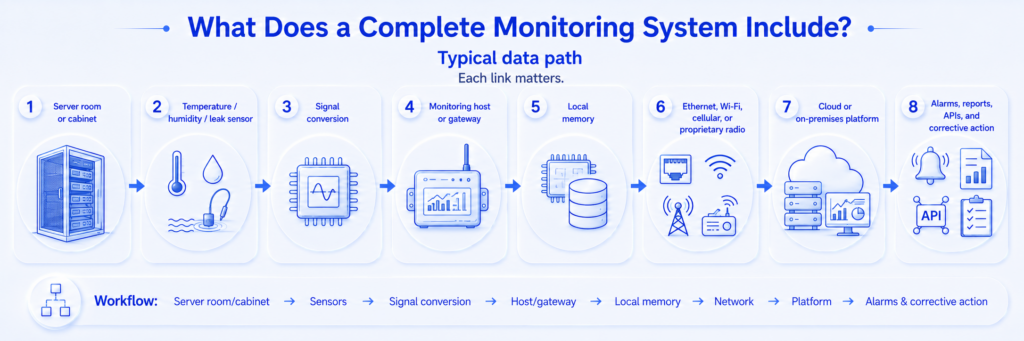
    Typical data path of a complete monitoring system for server rooms and edge closets

    The sensors convert environmental conditions into electrical or digital signals. A monitoring host timestamps the readings, applies threshold logic, stores data, and forwards it through the selected network. The platform then provides trend charts, alarm histories, device-health information, reports, user permissions, and integration with other systems.

    This separation explains why connectivity is not the same as measurement. Losing Ethernet should not stop a local sensor from sampling. It should only interrupt remote visibility. A design with local storage can preserve the event history and synchronise it later; a design without buffering may leave a permanent data gap.

    For distributed edge sites, the platform layer is often as important as the sensor. IT teams may need a common dashboard across hundreds of closets, while facilities teams may need SNMP, BACnet, Modbus, MQTT, REST APIs, data forwarding, or integration with a building-management or DCIM platform. The right architecture depends on who owns the alarm and which system initiates the response.

    3.How Do the Core Technologies Work?

    Temperature sensing and rack heat patterns

    Most electronic environmental monitors use a thermistor, semiconductor sensor, or resistance temperature detector. The sensing element changes an electrical property as temperature changes; the device converts that response into a digital value and applies calibration coefficients.

    The measurement is local to the sensor. It does not automatically represent the whole room. In a rack, temperature can vary vertically and from front to back. Cold air may reach the lower intake while hot exhaust recirculates into the upper intake. For this reason, critical racks commonly need more than one intake measurement point. A room sensor remains useful for overall HVAC trends, but it should not replace equipment-inlet sensing.
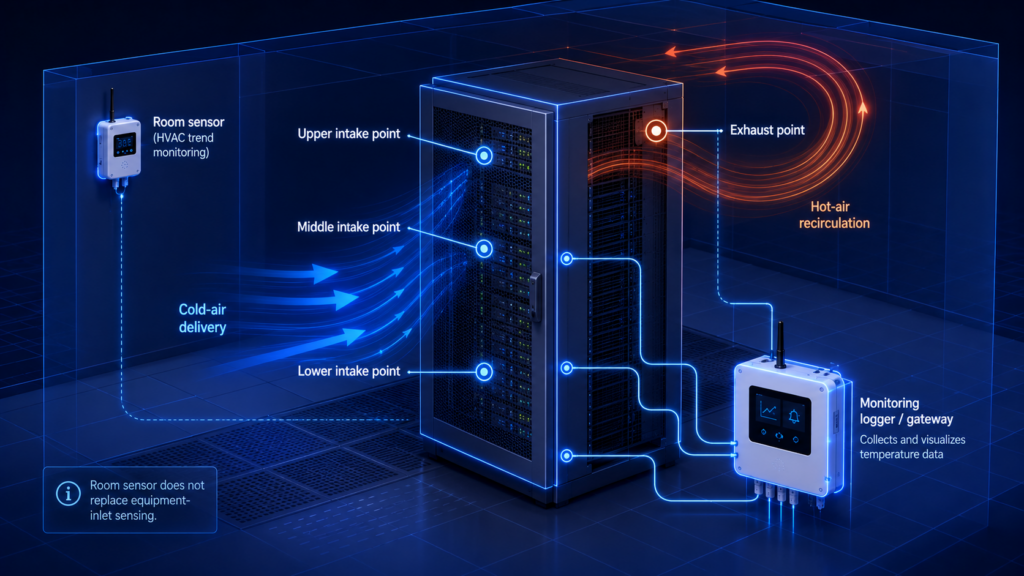
    Rack inlet temperature sensor placement

    Sensor response time also affects what the graph shows. A fast, exposed sensor reveals short door openings or supply-air changes quickly. A sensor inside a thick enclosure responds more slowly. Neither is inherently better; the response should match the event the operator wants to detect.

    Relative humidity, dew point, and condensation

    Relative humidity is the ratio between the water vapour currently in the air and the maximum amount the air could hold at the same temperature. Because warmer air can hold more water vapour, relative humidity can change even when the actual moisture content remains almost constant.

    Dew point is the temperature at which the air becomes saturated and condensation begins. It is therefore useful when evaluating whether a chilled pipe, cooling coil, liquid-cooling manifold, or other surface could fall below the local moisture threshold. Two areas can have different relative humidity readings but similar dew points if their temperatures differ.
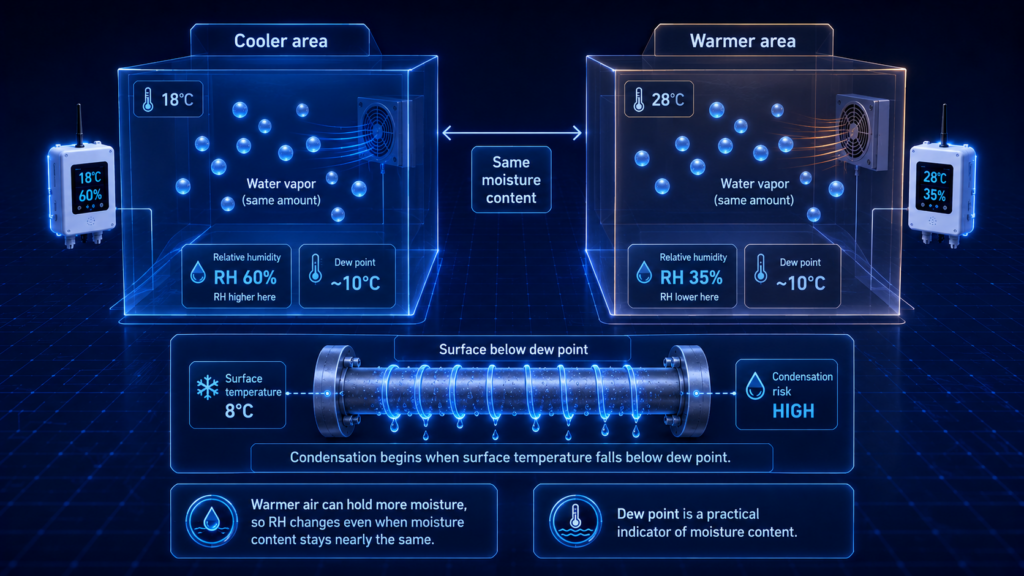
    Relative humidity vs dew point data center

    A monitoring platform can calculate dew point from measured temperature and relative humidity. The result is only as reliable as the two input sensors, so accuracy, placement, calibration, and airflow still matter. ASHRAE specifically notes that dew point is more consistent throughout a data center than relative humidity and is a practical way to monitor moisture content.

    Conductive point sensors and leak-detection cable

    Many water sensors use conductivity. When water bridges two conductive surfaces, the electrical circuit changes and the device reports a wet condition. A point sensor protects a small location such as a drip pan, floor drain, pipe joint, or the base of a cooling unit.
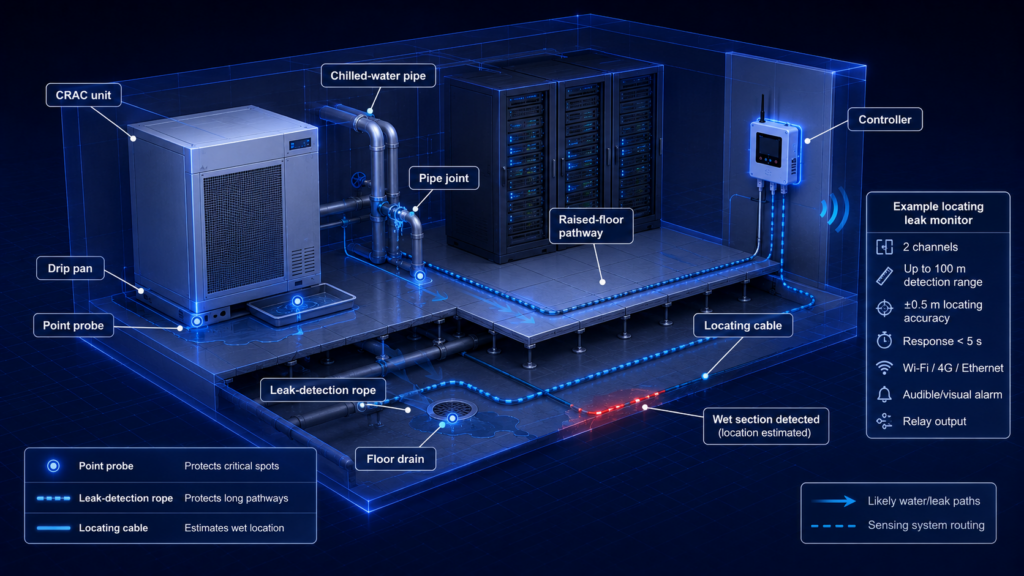
    Server room water leak sensor types

    Leak rope or sensing cable extends this principle over a longer path. Conductive elements run through or around the cable. When water contacts the cable, the controller detects the change. Some systems only report wet or dry status; locating systems estimate the distance from the controller to the wet section. Cable should be routed along likely water paths and tested after installation. It should not be placed where routine condensation, floor cleaning, or metal contact will cause nuisance alarms.

    The UbiBot LD1 is an example of a separate locating leak monitor within the same ecosystem as the GS1 environmental logger. Its official specifications state two-channel detection, up to 100 m of detection range, ±0.5 m locating accuracy, and a response time below five seconds. It connects by Wi-Fi, 4G, or Ethernet depending on the model and can provide local audible/visual alarms and relay output.

    Local logging, time stamps, and alarm logic

    A sensor reading becomes operationally useful only when it is stored with a trustworthy timestamp. The logger needs a real-time clock, local memory, and a defined sampling or recording interval. The platform should identify missing data, offline devices, and late uploads rather than silently drawing a continuous line through a gap.

    Alarm logic should distinguish between a threshold crossing and a sustained event. A delay can suppress short fluctuations, while hysteresis prevents an alarm from repeatedly turning on and off around the same threshold. Escalation rules determine who is notified if the first recipient does not respond. Device-offline, power-loss, low-battery, and sensor-disconnection alarms are often as important as high-temperature alarms because they identify loss of monitoring itself.

    4.What Monitoring Architectures Are Available?

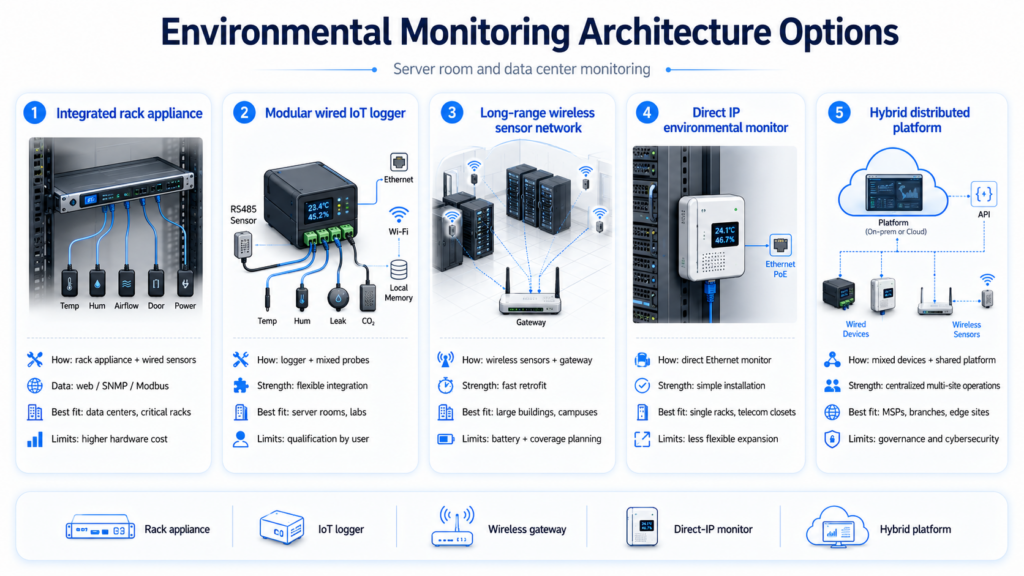
    Architecture How it works Strengths Limitations Best fit
    Integrated rack appliance A 1U or compact network appliance connects several wired sensors and exposes data through web, SNMP, Modbus, or a management platform. Controlled wiring, rack mounting, enterprise protocols, optional access control. Higher per-site hardware cost; sensor cabling and appliance configuration are required. Data centers, critical rooms, and racks already using enterprise infrastructure.
    Modular wired IoT logger A general-purpose logger uses built-in sensors plus RS485 probes. Ethernet/Wi-Fi, local memory, and cloud or private software. Flexible sensor mix, local display, open integration options, cloud or on-premises choice. Leak monitoring may use a separate device; system qualification is the user’s responsibility. Small and medium server rooms, laboratories, distributed facilities.
    Long-range wireless sensor network Battery sensors send data to an Ethernet or cellular gateway over a proprietary sub-GHz radio network. Fast retrofit, minimal cabling, broad facility coverage, many sensor types. Requires gateway coverage planning, battery management, and radio testing around metal racks. Large buildings, campuses, and many remote closets.
    Direct IP environmental monitor A compact monitor contains temperature/humidity sensors and connects directly to Ethernet, often using PoE. Simple installation, local web interface, direct SNMP/email alerts. Fewer sensors or less flexible expansion than larger appliances; product lifecycle must be checked. Single racks, telecom closets, and small rooms.
    Hybrid distributed platform Multiple wired and wireless device types report to a shared cloud or on-premises platform and API. Centralised multi-site operations, mixed connectivity, automation and data integration. Requires governance for device naming, alarm ownership, cybersecurity, and change control. MSPs, retail networks, branches, and distributed edge computing.

    Server room monitoring architecture comparison

    No architecture is universally superior. A rack appliance may be appropriate where SNMP and access control are already standard. A wireless network may be easier to deploy across dozens of closets. A modular IoT logger can be attractive when Ethernet, local storage, RS485 expansion, cloud dashboards, APIs, and private deployment are required in one product family.

    5.Which Parameters Determine Real-World Performance?

    Measurement range, accuracy, and resolution

    Range defines where the sensor can operate. Accuracy defines the expected closeness to a reference under stated conditions. Resolution defines the smallest displayed or reported increment. A device that shows 0.01°C is not necessarily accurate to ±0.01°C.

    Accuracy should be checked at the expected server-room temperature and humidity, not only at a single laboratory condition. The UbiBot UB-ATH-P1, for example, specifies ±0.15°C from 20 to 60°C and ±1.5% RH from 0 to 80% RH. AKCP specifies ±0.5°C from -10 to 75°C for its temperature/humidity sensor on the sensorProbe+ series and humidity accuracy at 25°C from ±2% RH minimum to ±5% RH maximum. These figures are not directly interchangeable because the test conditions and specification formats differ.

    Sampling interval, local storage, and outage tolerance

    A one-minute graph is useful only if the system actually stores one-minute records. Buyers should distinguish sensor sampling, local logging, and cloud upload intervals. They should also calculate how long the device can remain offline before memory wraps around.

    The UbiBot GS1-AETH1RS stores 300,000 sensing records locally and supports a minimum one-minute data-sync interval. The time represented by 300,000 records depends on the number of active channels and the recording interval. [4]

    Connectivity, power, and redundancy

    Ethernet is usually preferred in server rooms because it provides predictable coverage and can be combined with PoE. Wi-Fi may be suitable where network policies permit it. Cellular connectivity is useful for remote edge sites or as an independent path, but coverage, subscription, antenna placement, and data cost must be considered.

    Monitoring devices also need power resilience. A small internal battery can preserve measurements during short outages, while PoE can simplify cabling and centralise backup through a UPS-backed switch. Battery status, external-power loss, and device-offline alarms should be tested during commissioning.

    Protocols, cybersecurity, and system integration

    SNMP remains common for IT alarms. Modbus and BACnet are useful for facilities and building-management systems. MQTT and REST APIs support application integration and data pipelines. Protocol support should be evaluated together with encryption, authentication, network segmentation, firmware updates, account management, and the organisation’s cybersecurity policy.

    UbiBot provides a RESTful platform API, JSON data forwarding, MQTT/HTTP integration options in its broader platform offering, and an on-premises platform that supports local storage, APIs, and private-network deployment. The availability of these options does not remove the need for access control, backup, validation, and secure configuration by the customer.

    6.How Should Sensors Be Selected and Placed?

    Monitoring objective Recommended sensor approach Placement principle Common mistake
    Detect rack inlet hot spots Two or three temperature points on critical rack fronts; add rear/exhaust measurement only for airflow analysis. Measure the air entering equipment at lower, middle, and upper positions where justified by rack density. Mounting one sensor on a distant wall and treating it as the rack temperature.
    Track moisture and condensation risk Calibrated temperature/RH sensor with platform dew-point calculation. Use representative room or intake airflow; add sensors near liquid-cooling or chilled surfaces when risk warrants. Using a fixed RH threshold without considering temperature and dew point.
    Detect a known drip source Point water sensor or short probe lead. Place beneath a drain pan, pipe joint, pump, humidifier, or cooling unit. Placing the sensor on a high or protected surface where water will not reach it.
    Cover a larger water path Water rope or locating leak cable. Route along chilled-water lines, room perimeter, raised-floor pathways, and low points. Installing cable where routine cleaning or condensation causes repeated false alarms.
    Monitor many remote closets Battery wireless sensors with an Ethernet/cellular gateway, or independent Ethernet loggers per site. Survey radio/network coverage and define local buffering and alarm ownership. Assuming metal cabinets and concrete walls will not affect radio range.

    7.Representative Monitoring Products Compared

    The products below represent different architectures, so the comparison is not a simple ranking. UbiBot uses a modular GS1 environmental logger plus a separate LD1 leak monitor; APC uses a rack appliance; AKCP uses a modular IP sensor hub; Vertiv Watchdog 15 is a compact direct-IP monitor that is now listed as discontinued in several regional Vertiv catalogues; and Monnit ALTA uses long-range wireless sensors with a gateway and iMonnit software.

    How to read the comparison

    The table compares complete monitoring architectures rather than identical devices. Evaluate sensor coverage, local buffering, protocols, platform ownership, lifecycle status, and deployment effort together; do notcure.

    Comparison field UbiBot GS1 + UB-ATH-P1 + LD1 APC NetBotz Rack Monitor 250A AKCP sensorProbe2+ Vertiv Geist Watchdog 15-P Monnit ALTA system
    Architecture GS1 Ethernet/Wi-Fi logger with RS485 probe; separate locating leak monitor in the same platform ecosystem. Current 250-series 1U rack appliance with included temperature/humidity sensor and six universal sensor ports. Compact IP sensor hub: two sensor ports enabled by default, up to four with licensing; supports wired AKCP sensors. Compact direct-IP monitor with onboard temperature, humidity, and dew point plus four external-sensor capacity; listed as discontinued in several regions. Sub-GHz battery sensors report to Ethernet or cellular gateways and iMonnit software.
    Temperature / humidity sensing GS1 built-in: ±0.2°C from 0 to 60°C and ±2% RH from 10 to 90% RH.

    UB-ATH-P1: ±0.15°C from 20–60°C; ±1.5% RH from 0–80% RH.

    Included temperature/humidity sensor; detailed accuracy was not stated in the official product page reviewed. Compatible TH sensor: -55–75°C; ±0.5°C from -10–75°C on sensorProbe+; 0.1°C resolution. Humidity 0–100% RH; accuracy at 25°C stated as ±2% minimum to ±5% maximum. Onboard temperature, humidity, and dew point; detailed accuracy was not stated in the accessible official product page reviewed. ALTA humidity sensors monitor temperature, RH, and dew point. Current category page states ±3% RH across 10–90% RH; temperature accuracy was not stated there.
    Leak detection LD1: two-channel locating cable, up to 100 m, ±0.5 m locating accuracy,Supports fluid spot-leak sensors and NetBotz leak-rope accessories.Compatible with AKCP spot-water and water-rope sensors.Supports additional external sensors; water sensor options depend on the supported Vertiv sensor catalogue.Water-detection disc, point probe, and water-rope sensors available; 10 ft rope versions are common.
    Connectivity / protocols GS1-AETH1RS: 2.4 GHz Wi-Fi and RJ45 Ethernet; RS485 Modbus probes. LD1 variants support Wi-Fi, 4G, or Ethernet. REST API, data forwarding, cloud and on-premises options. 10/100 Ethernet; HTTPS, SNMP/SNMPv3, and Modbus listed for current 250A. Ethernet; optional PoE and cellular. SNMPv1/2c/3, HTTPS, MQTT/MQTTS, Modbus TCP/RS485, BACnet, syslog, VPN and more. Ethernet/PoE; secure web interface; email, SNMP, and email-to-SMS alerts. Proprietary ALTA radio to Ethernet or cellular gateways; iMonnit dashboard and alerting.
    Local storage / outage behaviour GS1 stores 300,000 sensing records. LD1 and platform behavior depend on configuration. Official product page reviewed did not state local environmental-data capacity. Official pages reviewed did not state local logging capacity for the sensorProbe2+. Official product page reviewed did not state local logging capacity. Automated data logging is supported; exact gateway buffering details were not stated on the official overview pages reviewed.
    Expansion RS485 probes for temperature, humidity, CO₂ and other variables; LD1 can also accept selected external sensors and relay accessories. Six universal sensor ports: supports temperature, humidity, fluid spot leak, smoke, door contacts and access-control accessories. Up to four intelligent sensors or up to 20 dry contacts; virtual sensors, expansion and access-control options. Four additional sensors through supported accessories and splitters. 80+ sensor categories; ALTA XL gateways advertise 2,000+ ft range through 18+ walls under stated conditions.
    Platform / integration UbiBot cloud; REST APIs, JSON data forwarding, MQTT/HTTP options, on-premises platform and direct private integration options. Local network management and EcoStruxure IT ecosystem; SNMP/Modbus support. AKCPPro Server plus open IT/facilities protocols. Local web interface and network alerts; no special software required for basic use. iMonnit cloud or local software options, alerts by text, email, push, or call depending on plan/configuration.
    Typical fit Distributed server rooms needing Ethernet, local buffering, RS485 expansion, cloud or private deployment, and a shared platform across multiple sensor types. Enterprise racks and edge rooms already standardised on Schneider Electric / EcoStruxure infrastructure. Server rooms requiring modular wired sensors, broad protocol support, and direct BMS/NMS integration. Existing installations and simple direct-IP room/rack monitoring; lifecycle status should be checked for new projects. Retrofit projects with many closets or sensors where long-range wireless coverage reduces cabling.

    APC NetBotz 250A is the most rack-centric product in the comparison. Its six universal sensor ports, rack mounting, IT protocols, and access-control ecosystem are appropriate where environmental monitoring is part of a broader rack-management standard.

    AKCP sensorProbe2+ provides the broadest protocol list among the compact appliances reviewed. It is particularly relevant for sites that need SNMP, Modbus, BACnet, MQTT, optional cellular connectivity, and a large catalogue of wired sensors.

    Vertiv Watchdog 15 remains a useful reference for the direct-IP monitor category because it integrates temperature, humidity, dew point, PoE, web access, and external sensors in a compact form. However, Vertiv lists the model as discontinued in several regional catalogues, so a new project should confirm the current successor and support lifecycle.

    Monnit ALTA represents the wireless-sensor-network approach. Its strengths are retrofit speed, long-range proprietary radio, extensive sensor selection, and Ethernet or cellular gateways. Metal racks, walls, and site geometry still require a coverage survey rather than reliance on a headline range figure.

    The UbiBot configuration is differentiated by combining an Ethernet/Wi-Fi GS1 logger, RS485 probe expansion, substantial local record storage, a separate two-channel locating leak monitor, cloud management, APIs, data forwarding, and optional on-premises deployment. The architecture is modular rather than a single rack appliance, so buyers should evaluate the GS1 and LD1 as an integrated system and document which device owns each alarm and data stream.

    8.How Should the Technology Be Applied in Different Environments?

    Single network closet or branch office

    A compact Ethernet or PoE monitor with one rack-inlet temperature/humidity sensor and a point water sensor may be sufficient. Local audible indication is useful because the site may not have a staffed operations centre. The main requirement is dependable remote escalation and a clear procedure for who responds after hours.

    Small server room with several racks

    Use several temperature points at critical rack intakes, plus one representative room moisture sensor. A leak rope should cover cooling equipment, chilled-water or condensate routes, and low points where water will collect. Ethernet is normally preferable, and the switch port should be backed by the UPS where possible.

    Distributed edge sites managed by an MSP

    Central device naming, tenant separation, alarm routing, dashboards, API integration, and device-health monitoring become essential. A mixed Ethernet/cellular strategy may be appropriate. Local buffering prevents an ISP outage from erasing the environmental history.
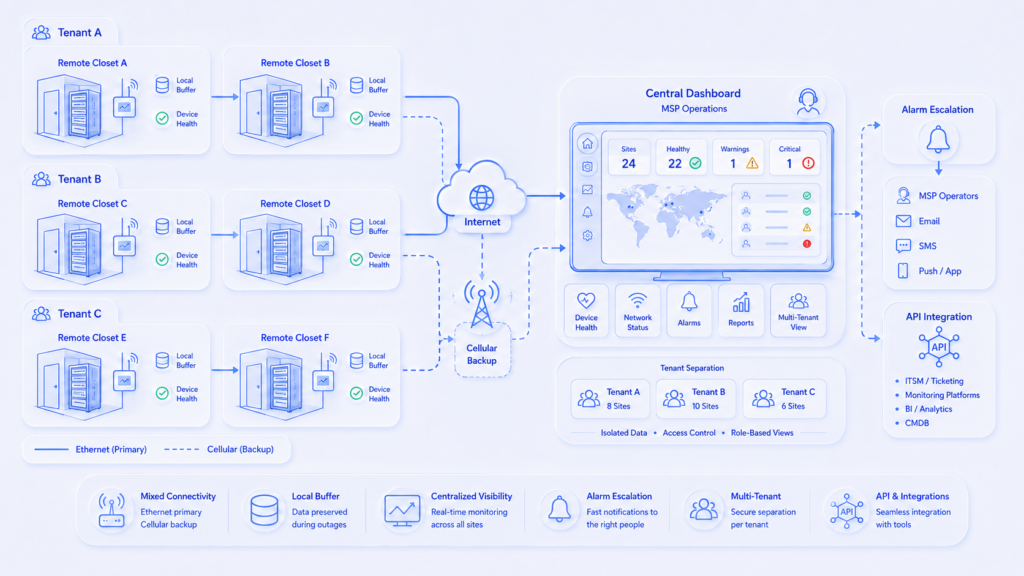
    Distributed edge sites managed by an MSP

    Telecom racks in a warehouse or retail site

    The closet may share building HVAC and may be exposed to dust, loading-door cycles, or after-hours temperature setbacks. Monitor equipment inlet conditions, door status, and power loss. A wireless network can simplify retrofit, but the site survey must include metal shelving and refrigeration equipment that may block radio signals.

    Liquid-cooled or high-density equipment

    Add leak detection near manifolds, hose connections, coolant distribution units, heat exchangers, and under-rack piping. Moisture monitoring should include dew point because coolant temperatures below local dew point can create condensation. Sensor and alarm design should follow the equipment manufacturer and facility engineering plan.

    9.Which Deployment Mistakes Reduce Reliability?

    Using one wall sensor as the entire thermal model

    A wall sensor may miss the temperature at rack intakes. Place sensors according to airflow and load distribution, not only convenience.

    Placing a sensor in the hot exhaust and calling it room temperature

    Rear-rack sensors are useful for airflow and cooling analysis, but their readings should be labelled as exhaust measurements. Alarm thresholds for inlet and exhaust locations should not be identical by default.

    Setting humidity alarms without considering dew point

    Relative humidity can rise when temperature falls even if moisture content is unchanged. Evaluate condensation risk using dew point and surface temperature, particularly around chilled or liquid-cooled components.

    Installing leak cable without testing water pathways

    Water follows slope, seams, cable penetrations, raised-floor channels, and pipe insulation. A cable routed around the room perimeter may miss a leak that travels directly into a rack. Test the route and document the zone map.

    Assuming wireless range from a brochure

    Metal cabinets, reinforced walls, electrical rooms, and floor-to-floor separation can reduce radio performance. Perform a survey and test the final installed positions.

    Ignoring sensor, device, and network-health alarms

    A green temperature graph is not trustworthy if the probe is disconnected or the logger has been offline for six hours. Configure device-offline, power-loss, low-battery, sensor-fault, and memory warnings alongside environmental thresholds.

    Failing to assign alarm ownership

    An alert that reaches nobody with authority is only a notification. Define acknowledgement, escalation, after-hours coverage, maintenance dispatch, and post-event review.

    10.Frequently Asked Questions

    What temperature should a server room be?

    The correct target depends on the equipment class and manufacturer. The accessible ASHRAE handbook chapter summarising the 2015 fourth-edition thermal guidelines lists a recommended equipment-inlet range of 18–27°C (64.4–80.6°F) for classes A1–A4. Operators should monitor inlet conditions and confirm current ASHRAE guidance and equipment specifications rather than using a general office thermostat as the control point.

    Where should temperature sensors be placed in a server rack?

    Place sensors where they represent the air entering the IT equipment. Critical racks may need lower, middle, and upper intake measurements because vertical gradients and exhaust recirculation can create local hot spots. A rear-rack sensor is useful for exhaust analysis but should not replace intake monitoring.

    Should a server room monitor relative humidity or dew point?

    Both can be useful, but dew point is often the better indicator of actual moisture content and condensation risk. Relative humidity changes as temperature changes. ASHRAE notes that dew point is more consistent throughout a data center and is a practical moisture-control metric.

    What is the difference between a point leak sensor and leak rope?

    A point sensor detects water at one small location. Leak rope covers a longer route and can protect pipe runs, room perimeters, cooling equipment, or raised-floor pathways. Locating cable can also estimate where along the cable the leak occurred.

    Can Wi-Fi sensors be used in server rooms?

    Yes, when the network policy, coverage, interference, and security controls are acceptable. Ethernet or PoE is often preferred for fixed critical devices, while wireless sensors can reduce cabling across many racks or closets. Local storage remains important regardless of the transport network.

    How often should server-room sensors record data?

    The interval should be short enough to capture the expected failure and response time. One to five minutes is common for operational monitoring, but the correct setting depends on thermal dynamics, local memory, network traffic, alarm delay, and organisational risk. Sampling, local logging, and cloud upload intervals may be different.

    Does leak detection automatically shut off water?

    Not necessarily. Many systems only send an alarm. Automatic shutoff requires a compatible relay, valve or pump-control design, safety review, and tested logic. The UbiBot LD1 can provide a 12 V output for relay-based control, but the complete control circuit must be engineered for the application.

    11.Conclusion

    Temperature, humidity, and leak detection protect server rooms and edge closets by revealing local conditions that a building thermostat cannot see. Temperature sensors identify whether cooling air reaches the equipment. Humidity and dew-point monitoring describe moisture and condensation risk. Point sensors and leak cable detect water before it reaches critical electronics.

    The monitoring system is only as reliable as its full data chain: sensor placement, measurement accuracy, timestamped local storage, resilient connectivity, alarm logic, and human response. Open protocols, APIs, cloud dashboards, and on-premises options matter because environmental data must reach the teams and systems that can act on it.

    UbiBot, APC, AKCP, Vertiv, and Monnit represent different design choices rather than a single hierarchy. UbiBot offers a modular path combining Ethernet/Wi-Fi monitoring, RS485 expansion, local storage, locating leak detection, APIs, and optional private deployment. APC and AKCP are strong benchmarks for rack appliances and enterprise protocols. Vertiv Watchdog illustrates the compact direct-IP model, while Monnit demonstrates the benefits of long-range wireless sensing. The appropriate choice depends on site count, sensor density, protocol requirements, network policy, lifecycle support, and who owns the alarm response.

    12.Source and Specification Note

    This article is based on official guidance and manufacturer documentation available at the time of writing. Product specifications, model availability, software capabilities, and licensing may change. “Official documentation reviewed did not state” means that the parameter was not found in the official pages or documents used for this comparison; it should not be interpreted as proof that the capability is absent.

    ASHRAE environmental guidance must be applied together with the current equipment class, manufacturer limits, facility design, altitude, contamination conditions, and operational requirements. Product inclusion is for technical comparison and does not constitute endorsement by ASHRAE, the U.S. Department of Energy, or UbiBot.


    Related Resources

    No related resources found

    menu-header-svg
    Search
    • Explore Knowledge
      • Comparison & Selection
      • Industry Solution
      • Product & Device
      • Criterion & Compliance
      • Deployment & Usage
      • Technology & Principle
    • Academic Research
    • In-depth Tech

    learn

    See More >>

    Temperature, Humidity, and Leak Detection in Server Rooms and Edge Closets

    Key Takeaway

    Choose the monitoring architecture only after defining the physical risks. A reliable system measures at equipment inlets, places leak sensing where water can travel, continues recording during outages, and sends alarms through channels that are actually staffed.

    Introduction

    A server room can look normal from the doorway while a rack intake is already overheating. The room thermostat may still show an acceptable average, yet the upper third of a cabinet may be several degrees warmer because recirculated exhaust air is entering the equipment. A small chilled-water leak may begin beneath a raised floor or behind a wall and remain invisible until it reaches power distribution or network equipment.

    Temperature, humidity, and leak detection are therefore not three unrelated accessories. Together, they describe whether cooling air is reaching IT equipment, whether the moisture level creates condensation or electrostatic risk, and whether water has entered an area where even a small leak can cause a major outage.

    ASHRAE guidance focuses on conditions at the air inlet of data-processing equipment rather than only the room average. The accessible ASHRAE handbook chapter summarizing the fourth-edition thermal guidelines lists a recommended dry-bulb inlet range of 64.4 to 80.6°F (18 to 27°C) for classes A1 through A4 and expresses the moisture envelope partly in dew point rather than relative humidity. It also warns that prolonged exposure near the limits of the allowable envelope may reduce equipment reliability and longevity.

    This article explains how environmental monitoring works in small server rooms, racks, and edge closets; where sensors should be placed; why dew point can be more useful than a single relative-humidity reading; how water-leak cables work; and how different monitoring architectures affect reliability, integration, and maintenance.

    Quick Answer: Server Room Environmental Monitoring in 30 Seconds

    Question Direct answer
    What should be monitored? At minimum: equipment-inlet temperature, humidity or dew point, water leaks, power/device status, and sensor connectivity.
    Where should temperature sensors go? At representative rack intake points, especially the lower, middle, and upper portions of critical racks—not only on a room wall.
    Why is room temperature alone insufficient? Room averages can hide cabinet hot spots, blocked airflow, exhaust recirculation, and vertical temperature gradients.
    Why monitor humidity and dew point? Relative humidity changes with temperature; dew point better represents the actual moisture content and condensation risk.
    Which leak sensor is best? Point sensors protect a small known risk location; rope or locating cable covers pipe routes, perimeter zones, and larger floor areas.
    What happens during a network outage? A robust system keeps logging locally and sends stored data after connectivity returns.
    What should buyers compare? Sensor accuracy, placement, local memory, Ethernet/PoE, wireless range, leak coverage, alert escalation, open protocols, API access, and cloud/on-premises options.

    1.Why Do Server Rooms and Edge Closets Need Environmental Monitoring?

    Environmental monitoring is needed because IT failures are often local, fast-moving, and invisible to a building thermostat. A small edge closet may have no dedicated facilities staff, no raised floor, and little cooling redundancy. A fan failure, blocked return path, closed louver, overloaded rack, or after-hours HVAC schedule can raise inlet temperatures rapidly even when the rest of the building remains comfortable.

    Temperature monitoring protects against heat-related shutdowns and accelerated component ageing. The important value is the temperature of the air entering the equipment. A sensor at the back of a rack measures hot exhaust, while a wall sensor may represent a well-mixed room average. Neither automatically describes what the server fans are ingesting.

    Moisture monitoring serves a different purpose. Excess moisture increases the likelihood of condensation and corrosion, particularly when cold surfaces or liquid-cooling components fall below the local dew point. Very dry conditions can contribute to electrostatic-discharge risk, although ASHRAE notes that modern ESD controls and equipment design have changed the interpretation of very low relative humidity. The same ASHRAE chapter recommends tracking moisture with dew point because it remains more consistent across temperature gradients than relative humidity.

    Leak detection addresses water from chilled-water piping, condensate drains, overhead plumbing, roof ingress, sprinklers, humidifiers, and nearby mechanical equipment. The damage can occur before water reaches a room drain. A sensor should therefore be placed where water is likely to originate or travel, not simply at the most convenient wall outlet.

    Real-time sensor networks can also support energy optimisation. A U.S. Department of Energy demonstration used wireless sensors to capture floor-to-ceiling temperature, humidity, pressure, leak, and equipment-status data; the resulting operational changes reduced cooling load and improved power usage effectiveness at the demonstration site. The result does not imply identical savings at every facility, but it illustrates why spatial environmental data can be more useful than a single thermostat.

    2.What Does a Complete Monitoring System Include?

    A complete monitoring system follows a chain from the physical condition to a response by people or automation. Each link matters:

    Typical data path

    Server room or cabinet → temperature / humidity / leak sensor → signal conversion → monitoring host or gateway → local memory → Ethernet, Wi-Fi, cellular, or proprietary radio → cloud or on-premises platform → alarms, reports, APIs, and corrective action

    Typical data path of a complete monitoring system for server rooms and edge closets

    The sensors convert environmental conditions into electrical or digital signals. A monitoring host timestamps the readings, applies threshold logic, stores data, and forwards it through the selected network. The platform then provides trend charts, alarm histories, device-health information, reports, user permissions, and integration with other systems.

    This separation explains why connectivity is not the same as measurement. Losing Ethernet should not stop a local sensor from sampling. It should only interrupt remote visibility. A design with local storage can preserve the event history and synchronise it later; a design without buffering may leave a permanent data gap.

    For distributed edge sites, the platform layer is often as important as the sensor. IT teams may need a common dashboard across hundreds of closets, while facilities teams may need SNMP, BACnet, Modbus, MQTT, REST APIs, data forwarding, or integration with a building-management or DCIM platform. The right architecture depends on who owns the alarm and which system initiates the response.

    3.How Do the Core Technologies Work?

    Temperature sensing and rack heat patterns

    Most electronic environmental monitors use a thermistor, semiconductor sensor, or resistance temperature detector. The sensing element changes an electrical property as temperature changes; the device converts that response into a digital value and applies calibration coefficients.

    The measurement is local to the sensor. It does not automatically represent the whole room. In a rack, temperature can vary vertically and from front to back. Cold air may reach the lower intake while hot exhaust recirculates into the upper intake. For this reason, critical racks commonly need more than one intake measurement point. A room sensor remains useful for overall HVAC trends, but it should not replace equipment-inlet sensing.

    Rack inlet temperature sensor placement

    Sensor response time also affects what the graph shows. A fast, exposed sensor reveals short door openings or supply-air changes quickly. A sensor inside a thick enclosure responds more slowly. Neither is inherently better; the response should match the event the operator wants to detect.

    Relative humidity, dew point, and condensation

    Relative humidity is the ratio between the water vapour currently in the air and the maximum amount the air could hold at the same temperature. Because warmer air can hold more water vapour, relative humidity can change even when the actual moisture content remains almost constant.

    Dew point is the temperature at which the air becomes saturated and condensation begins. It is therefore useful when evaluating whether a chilled pipe, cooling coil, liquid-cooling manifold, or other surface could fall below the local moisture threshold. Two areas can have different relative humidity readings but similar dew points if their temperatures differ.

    Relative humidity vs dew point data center

    A monitoring platform can calculate dew point from measured temperature and relative humidity. The result is only as reliable as the two input sensors, so accuracy, placement, calibration, and airflow still matter. ASHRAE specifically notes that dew point is more consistent throughout a data center than relative humidity and is a practical way to monitor moisture content.

    Conductive point sensors and leak-detection cable

    Many water sensors use conductivity. When water bridges two conductive surfaces, the electrical circuit changes and the device reports a wet condition. A point sensor protects a small location such as a drip pan, floor drain, pipe joint, or the base of a cooling unit.

    Server room water leak sensor types

    Leak rope or sensing cable extends this principle over a longer path. Conductive elements run through or around the cable. When water contacts the cable, the controller detects the change. Some systems only report wet or dry status; locating systems estimate the distance from the controller to the wet section. Cable should be routed along likely water paths and tested after installation. It should not be placed where routine condensation, floor cleaning, or metal contact will cause nuisance alarms.

    The UbiBot LD1 is an example of a separate locating leak monitor within the same ecosystem as the GS1 environmental logger. Its official specifications state two-channel detection, up to 100 m of detection range, ±0.5 m locating accuracy, and a response time below five seconds. It connects by Wi-Fi, 4G, or Ethernet depending on the model and can provide local audible/visual alarms and relay output.

    Local logging, time stamps, and alarm logic

    A sensor reading becomes operationally useful only when it is stored with a trustworthy timestamp. The logger needs a real-time clock, local memory, and a defined sampling or recording interval. The platform should identify missing data, offline devices, and late uploads rather than silently drawing a continuous line through a gap.

    Alarm logic should distinguish between a threshold crossing and a sustained event. A delay can suppress short fluctuations, while hysteresis prevents an alarm from repeatedly turning on and off around the same threshold. Escalation rules determine who is notified if the first recipient does not respond. Device-offline, power-loss, low-battery, and sensor-disconnection alarms are often as important as high-temperature alarms because they identify loss of monitoring itself.

    4.What Monitoring Architectures Are Available?

    Architecture How it works Strengths Limitations Best fit
    Integrated rack appliance A 1U or compact network appliance connects several wired sensors and exposes data through web, SNMP, Modbus, or a management platform. Controlled wiring, rack mounting, enterprise protocols, optional access control. Higher per-site hardware cost; sensor cabling and appliance configuration are required. Data centers, critical rooms, and racks already using enterprise infrastructure.
    Modular wired IoT logger A general-purpose logger uses built-in sensors plus RS485 probes. Ethernet/Wi-Fi, local memory, and cloud or private software. Flexible sensor mix, local display, open integration options, cloud or on-premises choice. Leak monitoring may use a separate device; system qualification is the user’s responsibility. Small and medium server rooms, laboratories, distributed facilities.
    Long-range wireless sensor network Battery sensors send data to an Ethernet or cellular gateway over a proprietary sub-GHz radio network. Fast retrofit, minimal cabling, broad facility coverage, many sensor types. Requires gateway coverage planning, battery management, and radio testing around metal racks. Large buildings, campuses, and many remote closets.
    Direct IP environmental monitor A compact monitor contains temperature/humidity sensors and connects directly to Ethernet, often using PoE. Simple installation, local web interface, direct SNMP/email alerts. Fewer sensors or less flexible expansion than larger appliances; product lifecycle must be checked. Single racks, telecom closets, and small rooms.
    Hybrid distributed platform Multiple wired and wireless device types report to a shared cloud or on-premises platform and API. Centralised multi-site operations, mixed connectivity, automation and data integration. Requires governance for device naming, alarm ownership, cybersecurity, and change control. MSPs, retail networks, branches, and distributed edge computing.

    Server room monitoring architecture comparison

    No architecture is universally superior. A rack appliance may be appropriate where SNMP and access control are already standard. A wireless network may be easier to deploy across dozens of closets. A modular IoT logger can be attractive when Ethernet, local storage, RS485 expansion, cloud dashboards, APIs, and private deployment are required in one product family.

    5.Which Parameters Determine Real-World Performance?

    Measurement range, accuracy, and resolution

    Range defines where the sensor can operate. Accuracy defines the expected closeness to a reference under stated conditions. Resolution defines the smallest displayed or reported increment. A device that shows 0.01°C is not necessarily accurate to ±0.01°C.

    Accuracy should be checked at the expected server-room temperature and humidity, not only at a single laboratory condition. The UbiBot UB-ATH-P1, for example, specifies ±0.15°C from 20 to 60°C and ±1.5% RH from 0 to 80% RH. AKCP specifies ±0.5°C from -10 to 75°C for its temperature/humidity sensor on the sensorProbe+ series and humidity accuracy at 25°C from ±2% RH minimum to ±5% RH maximum. These figures are not directly interchangeable because the test conditions and specification formats differ.

    Sampling interval, local storage, and outage tolerance

    A one-minute graph is useful only if the system actually stores one-minute records. Buyers should distinguish sensor sampling, local logging, and cloud upload intervals. They should also calculate how long the device can remain offline before memory wraps around.

    The UbiBot GS1-AETH1RS stores 300,000 sensing records locally and supports a minimum one-minute data-sync interval. The time represented by 300,000 records depends on the number of active channels and the recording interval. [4]

    Connectivity, power, and redundancy

    Ethernet is usually preferred in server rooms because it provides predictable coverage and can be combined with PoE. Wi-Fi may be suitable where network policies permit it. Cellular connectivity is useful for remote edge sites or as an independent path, but coverage, subscription, antenna placement, and data cost must be considered.

    Monitoring devices also need power resilience. A small internal battery can preserve measurements during short outages, while PoE can simplify cabling and centralise backup through a UPS-backed switch. Battery status, external-power loss, and device-offline alarms should be tested during commissioning.

    Protocols, cybersecurity, and system integration

    SNMP remains common for IT alarms. Modbus and BACnet are useful for facilities and building-management systems. MQTT and REST APIs support application integration and data pipelines. Protocol support should be evaluated together with encryption, authentication, network segmentation, firmware updates, account management, and the organisation’s cybersecurity policy.

    UbiBot provides a RESTful platform API, JSON data forwarding, MQTT/HTTP integration options in its broader platform offering, and an on-premises platform that supports local storage, APIs, and private-network deployment. The availability of these options does not remove the need for access control, backup, validation, and secure configuration by the customer.

    6.How Should Sensors Be Selected and Placed?

    Monitoring objective Recommended sensor approach Placement principle Common mistake
    Detect rack inlet hot spots Two or three temperature points on critical rack fronts; add rear/exhaust measurement only for airflow analysis. Measure the air entering equipment at lower, middle, and upper positions where justified by rack density. Mounting one sensor on a distant wall and treating it as the rack temperature.
    Track moisture and condensation risk Calibrated temperature/RH sensor with platform dew-point calculation. Use representative room or intake airflow; add sensors near liquid-cooling or chilled surfaces when risk warrants. Using a fixed RH threshold without considering temperature and dew point.
    Detect a known drip source Point water sensor or short probe lead. Place beneath a drain pan, pipe joint, pump, humidifier, or cooling unit. Placing the sensor on a high or protected surface where water will not reach it.
    Cover a larger water path Water rope or locating leak cable. Route along chilled-water lines, room perimeter, raised-floor pathways, and low points. Installing cable where routine cleaning or condensation causes repeated false alarms.
    Monitor many remote closets Battery wireless sensors with an Ethernet/cellular gateway, or independent Ethernet loggers per site. Survey radio/network coverage and define local buffering and alarm ownership. Assuming metal cabinets and concrete walls will not affect radio range.

    7.Representative Monitoring Products Compared

    The products below represent different architectures, so the comparison is not a simple ranking. UbiBot uses a modular GS1 environmental logger plus a separate LD1 leak monitor; APC uses a rack appliance; AKCP uses a modular IP sensor hub; Vertiv Watchdog 15 is a compact direct-IP monitor that is now listed as discontinued in several regional Vertiv catalogues; and Monnit ALTA uses long-range wireless sensors with a gateway and iMonnit software.

    How to read the comparison

    The table compares complete monitoring architectures rather than identical devices. Evaluate sensor coverage, local buffering, protocols, platform ownership, lifecycle status, and deployment effort together; do notcure.

    Comparison field UbiBot GS1 + UB-ATH-P1 + LD1 APC NetBotz Rack Monitor 250A AKCP sensorProbe2+ Vertiv Geist Watchdog 15-P Monnit ALTA system
    Architecture GS1 Ethernet/Wi-Fi logger with RS485 probe; separate locating leak monitor in the same platform ecosystem. Current 250-series 1U rack appliance with included temperature/humidity sensor and six universal sensor ports. Compact IP sensor hub: two sensor ports enabled by default, up to four with licensing; supports wired AKCP sensors. Compact direct-IP monitor with onboard temperature, humidity, and dew point plus four external-sensor capacity; listed as discontinued in several regions. Sub-GHz battery sensors report to Ethernet or cellular gateways and iMonnit software.
    Temperature / humidity sensing GS1 built-in: ±0.2°C from 0 to 60°C and ±2% RH from 10 to 90% RH.

    UB-ATH-P1: ±0.15°C from 20–60°C; ±1.5% RH from 0–80% RH.

    Included temperature/humidity sensor; detailed accuracy was not stated in the official product page reviewed. Compatible TH sensor: -55–75°C; ±0.5°C from -10–75°C on sensorProbe+; 0.1°C resolution. Humidity 0–100% RH; accuracy at 25°C stated as ±2% minimum to ±5% maximum. Onboard temperature, humidity, and dew point; detailed accuracy was not stated in the accessible official product page reviewed. ALTA humidity sensors monitor temperature, RH, and dew point. Current category page states ±3% RH across 10–90% RH; temperature accuracy was not stated there.
    Leak detection LD1: two-channel locating cable, up to 100 m, ±0.5 m locating accuracy,Supports fluid spot-leak sensors and NetBotz leak-rope accessories.Compatible with AKCP spot-water and water-rope sensors.Supports additional external sensors; water sensor options depend on the supported Vertiv sensor catalogue.Water-detection disc, point probe, and water-rope sensors available; 10 ft rope versions are common.
    Connectivity / protocols GS1-AETH1RS: 2.4 GHz Wi-Fi and RJ45 Ethernet; RS485 Modbus probes. LD1 variants support Wi-Fi, 4G, or Ethernet. REST API, data forwarding, cloud and on-premises options. 10/100 Ethernet; HTTPS, SNMP/SNMPv3, and Modbus listed for current 250A. Ethernet; optional PoE and cellular. SNMPv1/2c/3, HTTPS, MQTT/MQTTS, Modbus TCP/RS485, BACnet, syslog, VPN and more. Ethernet/PoE; secure web interface; email, SNMP, and email-to-SMS alerts. Proprietary ALTA radio to Ethernet or cellular gateways; iMonnit dashboard and alerting.
    Local storage / outage behaviour GS1 stores 300,000 sensing records. LD1 and platform behavior depend on configuration. Official product page reviewed did not state local environmental-data capacity. Official pages reviewed did not state local logging capacity for the sensorProbe2+. Official product page reviewed did not state local logging capacity. Automated data logging is supported; exact gateway buffering details were not stated on the official overview pages reviewed.
    Expansion RS485 probes for temperature, humidity, CO₂ and other variables; LD1 can also accept selected external sensors and relay accessories. Six universal sensor ports: supports temperature, humidity, fluid spot leak, smoke, door contacts and access-control accessories. Up to four intelligent sensors or up to 20 dry contacts; virtual sensors, expansion and access-control options. Four additional sensors through supported accessories and splitters. 80+ sensor categories; ALTA XL gateways advertise 2,000+ ft range through 18+ walls under stated conditions.
    Platform / integration UbiBot cloud; REST APIs, JSON data forwarding, MQTT/HTTP options, on-premises platform and direct private integration options. Local network management and EcoStruxure IT ecosystem; SNMP/Modbus support. AKCPPro Server plus open IT/facilities protocols. Local web interface and network alerts; no special software required for basic use. iMonnit cloud or local software options, alerts by text, email, push, or call depending on plan/configuration.
    Typical fit Distributed server rooms needing Ethernet, local buffering, RS485 expansion, cloud or private deployment, and a shared platform across multiple sensor types. Enterprise racks and edge rooms already standardised on Schneider Electric / EcoStruxure infrastructure. Server rooms requiring modular wired sensors, broad protocol support, and direct BMS/NMS integration. Existing installations and simple direct-IP room/rack monitoring; lifecycle status should be checked for new projects. Retrofit projects with many closets or sensors where long-range wireless coverage reduces cabling.

    APC NetBotz 250A is the most rack-centric product in the comparison. Its six universal sensor ports, rack mounting, IT protocols, and access-control ecosystem are appropriate where environmental monitoring is part of a broader rack-management standard.

    AKCP sensorProbe2+ provides the broadest protocol list among the compact appliances reviewed. It is particularly relevant for sites that need SNMP, Modbus, BACnet, MQTT, optional cellular connectivity, and a large catalogue of wired sensors.

    Vertiv Watchdog 15 remains a useful reference for the direct-IP monitor category because it integrates temperature, humidity, dew point, PoE, web access, and external sensors in a compact form. However, Vertiv lists the model as discontinued in several regional catalogues, so a new project should confirm the current successor and support lifecycle.

    Monnit ALTA represents the wireless-sensor-network approach. Its strengths are retrofit speed, long-range proprietary radio, extensive sensor selection, and Ethernet or cellular gateways. Metal racks, walls, and site geometry still require a coverage survey rather than reliance on a headline range figure.

    The UbiBot configuration is differentiated by combining an Ethernet/Wi-Fi GS1 logger, RS485 probe expansion, substantial local record storage, a separate two-channel locating leak monitor, cloud management, APIs, data forwarding, and optional on-premises deployment. The architecture is modular rather than a single rack appliance, so buyers should evaluate the GS1 and LD1 as an integrated system and document which device owns each alarm and data stream.

    8.How Should the Technology Be Applied in Different Environments?

    Single network closet or branch office

    A compact Ethernet or PoE monitor with one rack-inlet temperature/humidity sensor and a point water sensor may be sufficient. Local audible indication is useful because the site may not have a staffed operations centre. The main requirement is dependable remote escalation and a clear procedure for who responds after hours.

    Small server room with several racks

    Use several temperature points at critical rack intakes, plus one representative room moisture sensor. A leak rope should cover cooling equipment, chilled-water or condensate routes, and low points where water will collect. Ethernet is normally preferable, and the switch port should be backed by the UPS where possible.

    Distributed edge sites managed by an MSP

    Central device naming, tenant separation, alarm routing, dashboards, API integration, and device-health monitoring become essential. A mixed Ethernet/cellular strategy may be appropriate. Local buffering prevents an ISP outage from erasing the environmental history.

    Distributed edge sites managed by an MSP

    Telecom racks in a warehouse or retail site

    The closet may share building HVAC and may be exposed to dust, loading-door cycles, or after-hours temperature setbacks. Monitor equipment inlet conditions, door status, and power loss. A wireless network can simplify retrofit, but the site survey must include metal shelving and refrigeration equipment that may block radio signals.

    Liquid-cooled or high-density equipment

    Add leak detection near manifolds, hose connections, coolant distribution units, heat exchangers, and under-rack piping. Moisture monitoring should include dew point because coolant temperatures below local dew point can create condensation. Sensor and alarm design should follow the equipment manufacturer and facility engineering plan.

    9.Which Deployment Mistakes Reduce Reliability?

    Using one wall sensor as the entire thermal model

    A wall sensor may miss the temperature at rack intakes. Place sensors according to airflow and load distribution, not only convenience.

    Placing a sensor in the hot exhaust and calling it room temperature

    Rear-rack sensors are useful for airflow and cooling analysis, but their readings should be labelled as exhaust measurements. Alarm thresholds for inlet and exhaust locations should not be identical by default.

    Setting humidity alarms without considering dew point

    Relative humidity can rise when temperature falls even if moisture content is unchanged. Evaluate condensation risk using dew point and surface temperature, particularly around chilled or liquid-cooled components.

    Installing leak cable without testing water pathways

    Water follows slope, seams, cable penetrations, raised-floor channels, and pipe insulation. A cable routed around the room perimeter may miss a leak that travels directly into a rack. Test the route and document the zone map.

    Assuming wireless range from a brochure

    Metal cabinets, reinforced walls, electrical rooms, and floor-to-floor separation can reduce radio performance. Perform a survey and test the final installed positions.

    Ignoring sensor, device, and network-health alarms

    A green temperature graph is not trustworthy if the probe is disconnected or the logger has been offline for six hours. Configure device-offline, power-loss, low-battery, sensor-fault, and memory warnings alongside environmental thresholds.

    Failing to assign alarm ownership

    An alert that reaches nobody with authority is only a notification. Define acknowledgement, escalation, after-hours coverage, maintenance dispatch, and post-event review.

    10.Frequently Asked Questions

    What temperature should a server room be?

    The correct target depends on the equipment class and manufacturer. The accessible ASHRAE handbook chapter summarising the 2015 fourth-edition thermal guidelines lists a recommended equipment-inlet range of 18–27°C (64.4–80.6°F) for classes A1–A4. Operators should monitor inlet conditions and confirm current ASHRAE guidance and equipment specifications rather than using a general office thermostat as the control point.

    Where should temperature sensors be placed in a server rack?

    Place sensors where they represent the air entering the IT equipment. Critical racks may need lower, middle, and upper intake measurements because vertical gradients and exhaust recirculation can create local hot spots. A rear-rack sensor is useful for exhaust analysis but should not replace intake monitoring.

    Should a server room monitor relative humidity or dew point?

    Both can be useful, but dew point is often the better indicator of actual moisture content and condensation risk. Relative humidity changes as temperature changes. ASHRAE notes that dew point is more consistent throughout a data center and is a practical moisture-control metric.

    What is the difference between a point leak sensor and leak rope?

    A point sensor detects water at one small location. Leak rope covers a longer route and can protect pipe runs, room perimeters, cooling equipment, or raised-floor pathways. Locating cable can also estimate where along the cable the leak occurred.

    Can Wi-Fi sensors be used in server rooms?

    Yes, when the network policy, coverage, interference, and security controls are acceptable. Ethernet or PoE is often preferred for fixed critical devices, while wireless sensors can reduce cabling across many racks or closets. Local storage remains important regardless of the transport network.

    How often should server-room sensors record data?

    The interval should be short enough to capture the expected failure and response time. One to five minutes is common for operational monitoring, but the correct setting depends on thermal dynamics, local memory, network traffic, alarm delay, and organisational risk. Sampling, local logging, and cloud upload intervals may be different.

    Does leak detection automatically shut off water?

    Not necessarily. Many systems only send an alarm. Automatic shutoff requires a compatible relay, valve or pump-control design, safety review, and tested logic. The UbiBot LD1 can provide a 12 V output for relay-based control, but the complete control circuit must be engineered for the application.

    11.Conclusion

    Temperature, humidity, and leak detection protect server rooms and edge closets by revealing local conditions that a building thermostat cannot see. Temperature sensors identify whether cooling air reaches the equipment. Humidity and dew-point monitoring describe moisture and condensation risk. Point sensors and leak cable detect water before it reaches critical electronics.

    The monitoring system is only as reliable as its full data chain: sensor placement, measurement accuracy, timestamped local storage, resilient connectivity, alarm logic, and human response. Open protocols, APIs, cloud dashboards, and on-premises options matter because environmental data must reach the teams and systems that can act on it.

    UbiBot, APC, AKCP, Vertiv, and Monnit represent different design choices rather than a single hierarchy. UbiBot offers a modular path combining Ethernet/Wi-Fi monitoring, RS485 expansion, local storage, locating leak detection, APIs, and optional private deployment. APC and AKCP are strong benchmarks for rack appliances and enterprise protocols. Vertiv Watchdog illustrates the compact direct-IP model, while Monnit demonstrates the benefits of long-range wireless sensing. The appropriate choice depends on site count, sensor density, protocol requirements, network policy, lifecycle support, and who owns the alarm response.

    12.Source and Specification Note

    This article is based on official guidance and manufacturer documentation available at the time of writing. Product specifications, model availability, software capabilities, and licensing may change. “Official documentation reviewed did not state” means that the parameter was not found in the official pages or documents used for this comparison; it should not be interpreted as proof that the capability is absent.

    ASHRAE environmental guidance must be applied together with the current equipment class, manufacturer limits, facility design, altitude, contamination conditions, and operational requirements. Product inclusion is for technical comparison and does not constitute endorsement by ASHRAE, the U.S. Department of Energy, or UbiBot.

    分享

    LinkedIn2

    Facebook2

    X

    Newsletter Signup

    Related Resources

    No related resources found

    menu-header-svg
    Search
    • Explore Knowledge
      • Comparison & Selection
      • Industry Solution
      • Product & Device
      • Criterion & Compliance
      • Deployment & Usage
      • Technology & Principle
    • Academic Research
    • In-depth Tech
    Enter Your Information

    Confirm

    Products

    Dashboards

    Support

    Purchase

    Company

    Smart Sensing

    UbiBot Web Console

    APP Download

    UbiBot Online Store

    News

    Smart Control

    UbiBot Space

    Product Docs & APIs

    Find Distributors

    About Us

    Smart Video

    UbiBot On-Premises

    Helpdesk & FAQ

    Volume Pricing

    Contact Us

    LoRa Products

    Agency Web Console

    Video Center

    Architecture

    Software & Platform


    Pricing


    System Status

    External Sensors


    Become a Distributor

    Accessories


    Become an Affiliate

    Global SIM


    Positioning System


    Products

    Dashboards

    Business Partners

    WS1

    UbiBot Web Console

    Volume Pricing

    WS1 Pro

    UbiBot Space

    Become a Distributor

    GS1

    UbiBot Support Desk

    Affiliates

    GS2

    Agency Web Console


    MS1


    SP1


    Accessories


    Docs

    Purchase

    Company

    Platform API

    Pricing

    News

    Q&A

    UbiBot Partners

    About us

    Privacy Policy

    Online Store

    Contact

    Terms of Service


    System Status

    Products

    Dashboards

    Smart Sensing

    UbiBot Web Console

    Smart Control

    UbiBot Space

    Smart Video

    UbiBot On-Premises

    LoRa Products

    Agency Web Console

    Software & Platform


    External Sensors


    Accessories


    Global SIM


    Positioning System


    Support

    Purchase

    APP Download

    UbiBot Online Store

    Product Docs & APIs

    Find Distributors

    Helpdesk & FAQ

    Volume Pricing

    Video Center


    Pricing


    Company

    News

    About Us

    Contact Us

    Architecture

    System Status

    Become a Distributor

    Become an Affiliate

    Language:
    English 日本語 (ベータ)  
    Language:

    English

    日本語 (ベータ)


    IoT Product Family:
    ubibotico     Wireless environmental sensing products and smart building solutions
    ubitrackico     UWB-based real-time indoor tracking solutions with 30cm accuracy

    IoT Product Family:

    ubibotico  Wireless environmental sensing products and smart building solutions
    ubitrackico  UWB-based real-time indoor tracking solutions with 30cm accuracy

    © 2013-2026 UbiBot.com. All rights reserved.

    Terms of Service | Privacy Policy | Compliance

    youtube facebook twitter