

.svg)
How to Monitor Temperature in Refrigerated Trucks in Real Time
Published: August 3, 2026
Update: August 28, 2026
By Susan Jones
Introduction
A refrigerated truck can leave a depot at the correct setpoint and still arrive with damaged or rejected cargo. Warm air enters during loading, door openings create short but repeated excursions, airflow changes as pallets are added, refrigeration units cycle or fail, and a sensor placed near the evaporator may report a temperature that does not represent the product zone. When the only evidence is a driver check or the refrigeration controller display, operators may discover the problem after delivery, when corrective action is no longer possible.
This guide is for fleet managers, food distributors, carriers, third-party logistics providers, quality teams, and system integrators that need a practical refrigerated truck temperature monitoring system. It explains what to monitor, how to select cellular and local communication methods, how to protect data during coverage gaps, where different product architectures fit, and why a reusable vehicle monitor is not the same as a cargo-level GPS shipment tracker.
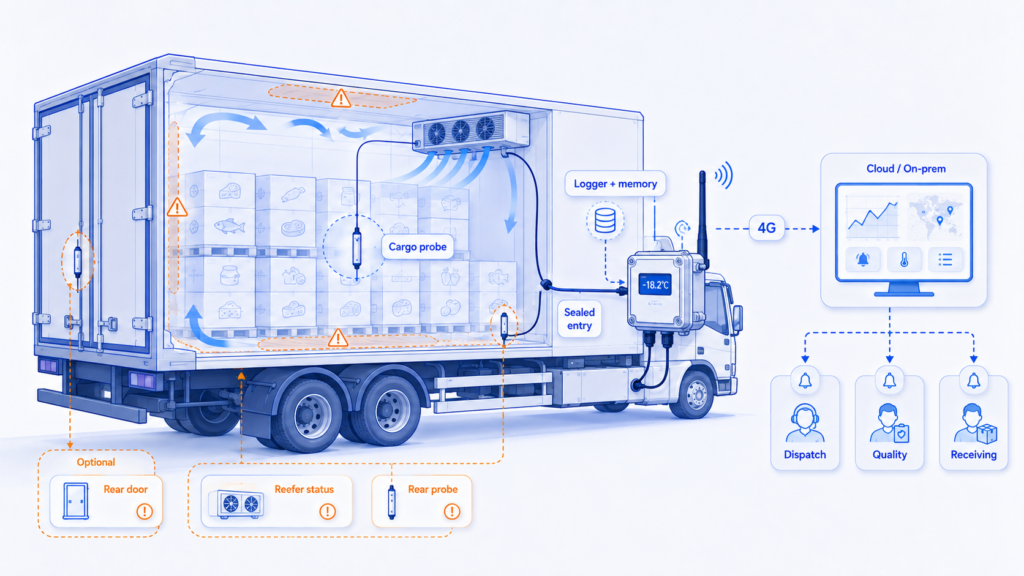
A refrigerated-truck monitoring system should measure representative cargo-zone conditions, preserve records through coverage gaps, and connect alerts to dispatch, quality and receiving teams.
Quick Summary
A reliable refrigerated-transport monitoring system combines representative cargo-zone temperature sensing, local data storage, cellular or depot connectivity, excursion alerts, and a documented response workflow. For owned fleets that repeatedly use the same vehicles, a reusable 4G monitor with an external probe can provide low-infrastructure, long-term vehicle visibility. For high-value loads, contract carriers, multimodal routes, or product-level chain-of-custody requirements, shipment trackers such as Tive, Sensitech, or ELPRO add location, light, shock, tilt, and trip-specific workflows. The correct architecture depends on whether the business needs to monitor the vehicle, the shipment, or both.
Key Takeaway
Real-time refrigerated transport monitoring is not simply a thermometer with a SIM card. The design must define what the sensor represents, how data is retained when cellular coverage fails, who receives alerts, what action is possible while the truck is moving, and whether the business needs reusable vehicle monitoring, shipment-level location tracking, or a hybrid of both.
1.Why Is Environmental Monitoring Important in Refrigerated Truck Temperature Monitoring?
The first objective is product protection. Temperature-sensitive foods may lose safety margin, shelf life, texture, appearance, or commercial value when exposed to unsuitable conditions. Monitoring does not replace refrigeration, but it creates evidence of how the cargo space behaved during loading, transit, stops, and unloading. Real-time alerts can also create an intervention window: a dispatcher may contact the driver, check a door, inspect the refrigeration unit, or redirect a load before a deviation becomes irreversible.
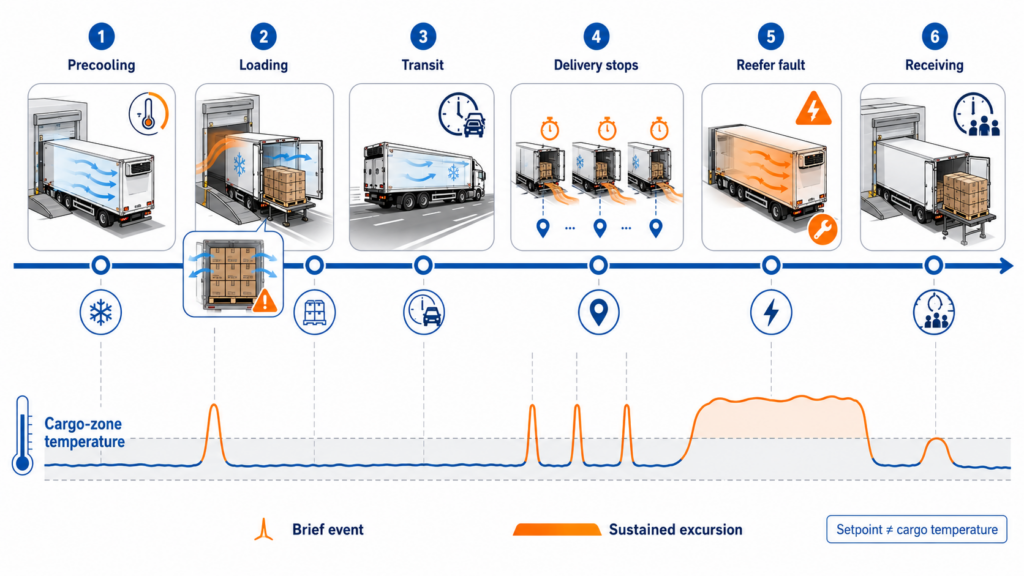
Temperature risk changes during precooling, loading, transit, delivery stops and unloading, so continuous records reveal events that isolated driver checks can miss.
The second objective is operational traceability. A single setpoint on the reefer controller does not prove the temperature experienced by the cargo. A monitoring record can help distinguish a refrigeration failure from prolonged door opening, incomplete precooling, poor airflow, a loading delay, or a sensor-location problem. That evidence supports receiving decisions, carrier discussions, customer claims, route improvement, and preventive maintenance.
In the United States, the FDA Sanitary Transportation rule requires covered shippers, loaders, carriers, and receivers to use sanitary transportation practices. For foods requiring temperature control for safety, vehicles must be capable of maintaining the necessary conditions, and the responsible parties must define and follow appropriate temperature-control procedures. The rule does not mandate GPS or a particular real-time tracker for every load; the monitoring method should be selected according to the food, the written agreement, and the transportation operation.
Manual checks remain useful, especially during pre-trip inspection and receiving, but they provide isolated observations. They cannot reliably reconstruct conditions between stops, during overnight parking, or through areas without staff oversight. Continuous records and exception alerts reduce this blind period, provided the system is tested and the alert recipient has authority to act.
2.What Environmental Parameters Should Be Monitored?
| Parameter | Why it matters | Monitoring location | Recommended sensor type |
| Cargo-zone temperature (essential) | Shows whether the load area remains within the product-specific operating range. | Representative product zone; avoid direct evaporator discharge, walls, floor contact, and unrepresentative hot spots unless intentionally mapped. | Calibrated digital temperature probe or logger; external probe where the communications unit remains outside the compartment. |
| Air temperature at more than one point (conditional) | Large or multi-compartment bodies can have meaningful gradients and door-side warm zones. | Front, center, rear-door area, upper/lower zones, or separate compartments based on a route study. | Multiple reusable probes or distributed wireless loggers. |
| Relative humidity (optional) | Useful for produce, bakery products, packaging condition, condensation risk, and some mixed loads. | Representative cargo air, protected from direct condensation. | Combined temperature/RH sensor rated for the expected environment. |
| Door/opening context (optional) | Repeated door openings can explain short excursions during delivery routes. | Door switch or light-exposure location. | Dedicated door contact preferred; light data may provide context but is not a direct door-position measurement. |
| Reefer power/status (optional) | Helps distinguish cargo warming from loss of refrigeration power or equipment operation. | Refrigeration unit electrical or status interface. | Digital input, current sensor, voltage sensor, or telematics integration. |
| Location and route (shipment-level) | Links excursions to specific stops, dwell time, route deviations, or handoffs. | Tracker attached to shipment, pallet, container, or vehicle. | GPS/Wi-Fi/cellular shipment tracker. |
| Shock/tilt/light (shipment-level) | Adds evidence of impact, handling, tampering, opening, or package exposure. | Tracker attached to cargo or packaging. | Multi-sensor shipment tracker. |
3.What Does a Typical Refrigerated Truck Monitoring System Include?
A practical system has five layers. The sensing layer measures cargo-zone temperature and any optional humidity, door, power, or equipment-status inputs. The connectivity layer moves data through 4G/cellular during the route, Wi-Fi at a depot, or a local radio network where multiple sensors share a vehicle gateway. The collection layer may be the monitor itself, a shipment tracker, a telematics unit, or a gateway. The platform layer stores history, displays routes and trends, manages users, and generates reports. The alarm and integration layer sends notifications and can forward data to a transport-management system, warehouse system, quality platform, or customer portal.
System architecture flow
Sensors and probes in the cargo zone -> reusable vehicle monitor or shipment tracker -> cellular network / depot Wi-Fi / vehicle gateway -> cloud or on-premises platform -> alerts, reports, APIs, dispatch, quality and receiving teams
Local storage is essential because real-time cellular coverage is not continuous on every route. The monitor should keep recording through coverage gaps and synchronize later. This protects the temperature history, but it does not guarantee immediate intervention while the device is offline. Monitoring design must therefore distinguish data continuity from alert continuity.
4.Which Communication Method Should Be Used?
| Method | Best fit | Advantages | Limitations |
| Wi-Fi | Depots, loading bays, parked vehicles, local setup or data synchronization. | Low data cost; convenient where managed Wi-Fi is reliable. | Poor route coverage; metal bodies and enterprise authentication can complicate connection. |
| Ethernet | Fixed cold rooms, dock gateways, telematics cabinets, or depot infrastructure. | Stable and low-latency fixed connection. | Rarely practical as the primary connection for a moving trailer. |
| 4G / cellular | Refrigerated trucks, last-mile routes, mobile assets and remote fleets. | Direct remote transmission without a local gateway; broad coverage. | SIM and data costs; dead zones; signal attenuation; battery impact; regional band selection. |
| LoRa / proprietary sub-GHz | Several wireless sensors inside one vehicle or yard, connected through a shared gateway. | Low-power multi-point sensing and reduced cabling. | Requires gateway planning; gateway backhaul and vehicle power become additional failure points. |
| RS485 | Wired probes, reefer status, door inputs and industrial sensors within a vehicle. | Stable local communication, long cable runs, multiple industrial sensor types. | Requires wiring, power, address management and careful installation in a moving vehicle. |
For an owned truck with one or two monitoring points, direct cellular connectivity is usually the simplest route architecture. For several sensors in a trailer, a local wired or low-power radio network may be more efficient. For cargo moving through third-party carriers, air, ocean, or multiple handoffs, a self-contained shipment tracker is often easier because it travels with the goods rather than depending on vehicle infrastructure.
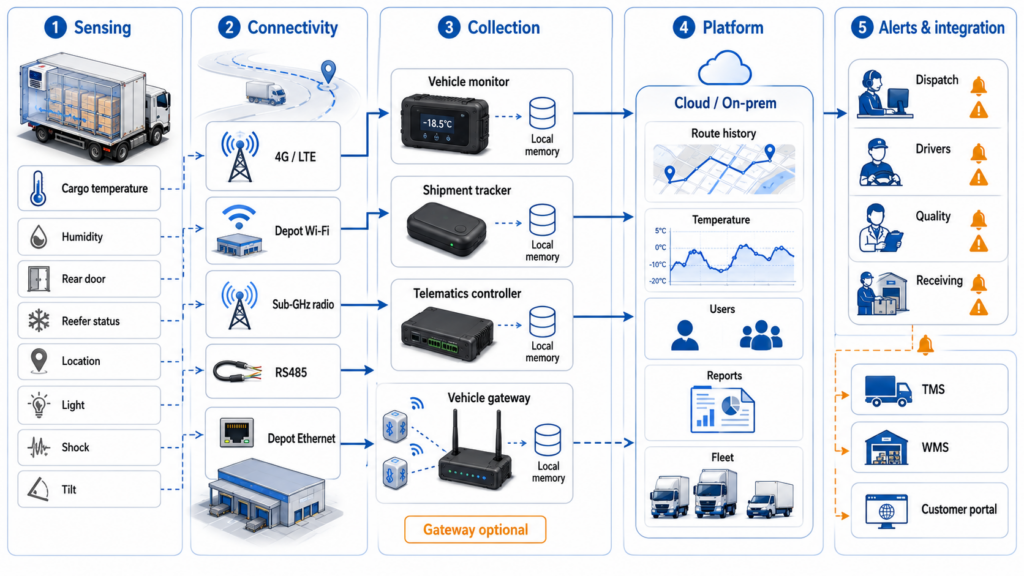
Communication design depends on whether the monitored asset is moving, how many sensors share the vehicle, whether depot infrastructure is available and how much network independence the route requires.
5.How Should Monitoring Products Be Compared?
Accuracy matters, but it is only one part of the measurement chain. Buyers should compare the stated accuracy across the actual operating range, calibration documentation, response time, placement, thermal buffering, enclosure protection, and whether the sensor measures the cargo zone or an unrepresentative air stream. A precise probe in the wrong location can produce a misleading record.
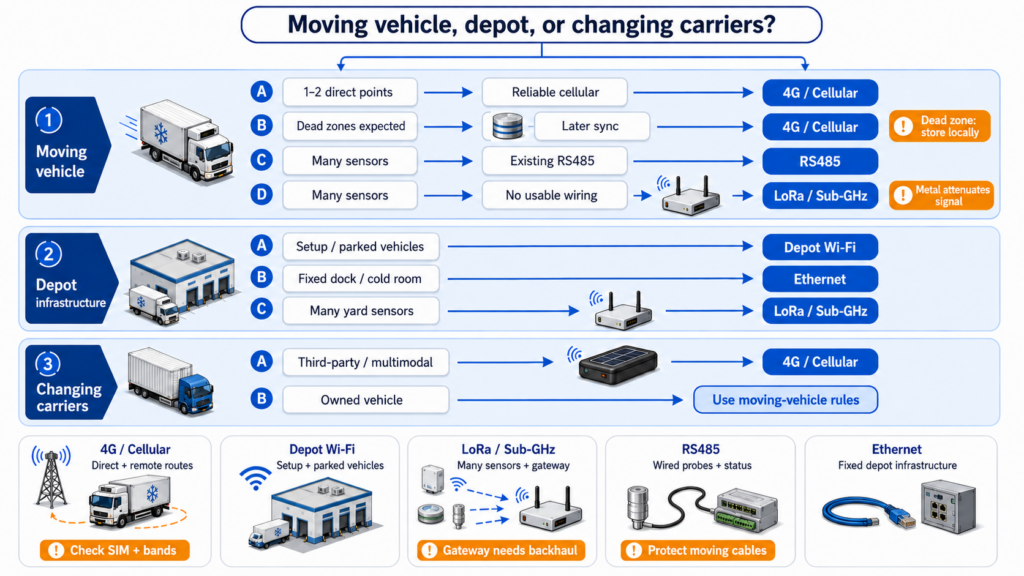
Vehicle-level monitoring stays with the truck and builds reusable cargo-space history, while shipment-level tracking travels with the load and adds route, handoff and handling evidence.
Architecture is equally important. A permanent fleet monitor may be the most economical way to watch the same vehicle every day, but it may not provide product-level location, shock, tilt, or handoff evidence. A shipment tracker provides richer chain-of-custody information, but may introduce per-trip device, data, platform, and reverse-logistics costs. The comparison should also cover local storage, offline behavior, gateway requirements, report workflows, alert channels, APIs, regional cellular support, battery strategy, calibration, and scalability.
6.Product and Solution Comparison
The table compares one representative configuration from each vendor. UbiBot is positioned as a reusable vehicle or compartment monitor. Tive, Sensitech and ELPRO are primarily shipment-level visibility systems. They overlap on temperature monitoring, but they are not fully interchangeable.
| Comparison item | UbiBot WS1 Pro 4G/WiFi + UB-DT-P1 | Tive Solo 5G | Sensitech TempTale GEO APX Global | ELPRO LIBERO GH |
| System positioning | Reusable vehicle/cargo-space environmental monitor | Real-time shipment location and condition tracker | Global real-time shipment location and condition monitor | Reusable real-time shipment temperature/RH logger |
| Measured parameters | Temperature, RH and light; external temperature and selected RS485 sensors | Temperature, RH, light, shock, motion and location | Location, temperature, RH and light; optional probe on Extended model | Temperature, RH, location, light and movement/tilt |
| Temperature range / accuracy | Internal -20 to 60 C, +/-0.2 C; UB-DT-P1 -55 to 125 C, +/-0.5 C from -10 to 85 C | Current support specification: -30 to 60 C, +/-0.5 C; verify exact SKU | Standard -10 to 55 C; Extended -30 to 55 C; +/-0.5 C from -10 to 45 C | Measurement -30 to 70 C; accessible product page does not clearly state accuracy |
| Connectivity and location | 2.4 GHz Wi-Fi plus regional 2G/3G/4G; no GPS on WS1 Pro | LTE-M/2G, GPS, Wi-Fi geolocation and cellular triangulation | LTE Cat-1bis with Wi-Fi location support | LTE-M and NB-IoT with location reporting |
| Dedicated gateway | No | No | No | No |
| Local storage | 300,000 sensor records | Not publicly specified on the reviewed product page | Not publicly specified on the reviewed product page | 31,000 measurement values |
| Offline data protection | Records locally and synchronizes after reconnection | Offline record capacity not publicly specified | Offline record capacity not publicly specified | Local memory; cloud communication and missing-data alarms supported |
| External sensor support | Two UB-DT-P1 probes and one supported RS485 probe, depending configuration | Temperature beacon and dry-ice/cryogenic probes supported | Optional probe on Extended model | GH has internal sensors; other LIBERO models support external Pt100 probes |
| Local display | 4.4-inch LCD | No full data display publicly specified | No full data display publicly specified | Interactive LCD |
| Cloud / software | UbiBot public platform; optional on-premises platform | Tive Platform | SensiWatch Platform | elproCLOUD and liberoMANAGER |
| API / integrations | REST APIs, data forwarding; MQTT and advanced APIs depend on plan | API and webhooks on Premium tier | Not publicly specified on the reviewed APX product page | Optional API and enterprise workflows |
| Alerts | App, email and HTTP; paid SMS, voice and WhatsApp options | Condition, geofence, ETA and route alerts; channels depend on tier | Departure, arrival and exception alerts; mobile access | Email and SMS; multi-level limit and issue profiles |
| Calibration | Factory calibration policy; confirm probe-specific certificate and project points | NIST-traceable, three-point ISO/IEC 17025 certificate stated | NIST-traceable accuracy stated | Calibrated dual sensor and production calibration certificate available |
| Reuse model | Reusable/permanent installation | Single-use and multi-use options | Trip-oriented monitor; takeback program available | Reusable, up to 14-month runtime |
| Strongest fit | Owned fleets, repeated routes, vehicle-level environmental history and lower infrastructure burden | High-value or multimodal shipments needing location, shock and route visibility | Enterprise global cold-chain programs and shipment-level analytics | Reusable life-science and high-value shipment workflows with strong cloud governance |
| Main trade-off | No native GPS, shock or shipment handoff tracking; enclosure and vehicle installation need planning | Higher shipment-program complexity and platform tier costs than a fixed vehicle monitor | Quote-based enterprise program; less suited to simple permanent vehicle monitoring | GH is better suited to chilled/ambient use; frozen transport may require another LIBERO model |
| Relative project-cost tendency* | Low to medium for repeated owned-fleet use | Medium to high, depending tracker and platform tier | High / enterprise program | Medium to high, depending service and reverse logistics |
7.Which System Is Best for Each Use Case?
Use UbiBot WS1 Pro 4G/WiFi with an external temperature probe when the business owns or controls the refrigerated vehicle, uses the same truck repeatedly, and primarily needs long-term cargo-space temperature history, remote alarms, local display, offline recording, and centralized fleet visibility. It is especially practical for local distributors, grocery delivery fleets, catering logistics, regional food carriers, and service vehicles where a reusable monitor can remain installed. The installation must protect the device from condensation and confirm cellular coverage, probe routing, power, and calibration.
Use Tive Solo 5G when the load itself needs to be followed across carriers or transport modes, or when location, shock, light, humidity, route deviation and customer sharing are central to the workflow. Its shipment templates, geofencing, reports, APIs and visibility tools are more extensive than a vehicle-only environmental monitor, but they also create a more formal per-shipment operating model.
Use Sensitech TempTale GEO APX Global for enterprise programs that require global shipment visibility, standardized exception management, analytics, and a platform designed around food, life-science and industrial cold chains. Its strongest value is the integrated shipment program rather than simple permanent monitoring of one truck. Use ELPRO LIBERO GH when reusable shipment monitoring, temperature/RH, location, tilt, local display, calibrated hardware and structured cloud workflows are priorities. For frozen or cryogenic loads, select the appropriate LIBERO model rather than assuming GH covers every temperature range.
8.How Should the System Be Deployed?
Small fleet or local delivery operation
Install one reusable cellular monitor per vehicle and use an external probe in the representative cargo zone. Use regulated USB power where practical and retain batteries as backup, but test actual runtime in the selected network mode. Configure high and low temperature rules with delay periods that avoid nuisance alarms from brief door openings while still supporting timely intervention. Assign alerts to both dispatch and an operational contact who can reach the driver.
Medium fleet with multi-stop routes
Use route-specific alarm profiles and consider two or more probes in long bodies, multi-compartment trucks, or vehicles with frequent rear-door openings. Add door or reefer-status inputs where root-cause information is important. Create standard vehicle names, route identifiers, driver escalation rules, maintenance ownership, and receiving reports. Review recurring warm zones by vehicle and route rather than treating every excursion as an isolated event.
Large, outsourced, or multi-modal operation
Separate vehicle telemetry from shipment telemetry. Permanent monitors can provide fleet-level equipment history, while shipment trackers provide cargo-level location and handoff evidence across carriers. Integrate alerts and data into the transport-management, quality, or customer-service workflow. Define ownership of the device, SIM or platform account, calibration, report retention, corrective action, and reverse logistics before rollout.
Recommendations by functional area
| Area | Recommended approach |
| Cargo compartment | Representative temperature probe; multiple points for long or multi-zone vehicles. |
| Rear door / delivery zone | Optional door contact or secondary probe to understand multi-stop warming. |
| Reefer unit | Power/status or telematics integration for equipment diagnostics. |
| Cab / driver interface | Visible alert or mobile workflow only where it will not distract the driver. |
| Depot and loading dock | Wi-Fi or Ethernet infrastructure for setup, synchronization, checks and report review. |
| Receiving site | Documented acceptance check using cargo, vehicle and shipment records as appropriate. |
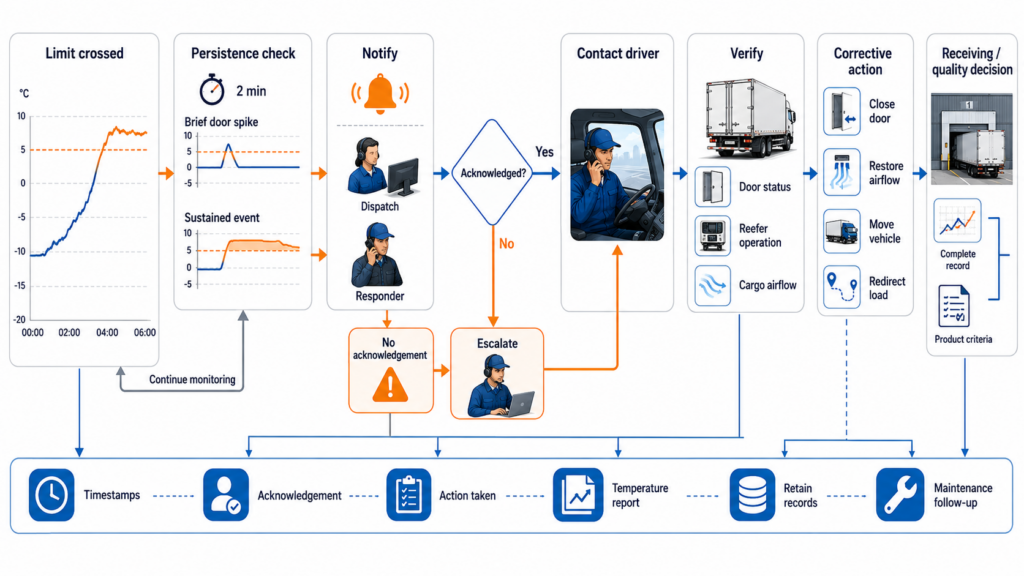
An effective alarm links a persistent excursion to a named response path: verify the event, contact the driver, inspect the vehicle, protect the load and document the receiving decision.
9.Common Design and Installation Mistakes
Reliable refrigerated-transport monitoring depends on representative placement, tested connectivity, appropriate alarm logic and clear ownership—not simply installing a connected sensor in the truck.
- Placing the only sensor in direct supply air from the evaporator and assuming it represents the cargo.
- Installing the communications unit deep inside a metal body without testing cellular signal or using an external probe arrangement.
- Using one monitoring point for a long, multi-compartment, heavily loaded, or high-frequency delivery vehicle without a route study.
- Confusing a refrigeration setpoint or controller display with an independent cargo-zone record.
- Setting instant alerts so tightly that every door opening creates alarm fatigue, or setting delays so long that intervention becomes impossible.
- Assuming local storage guarantees real-time notification during a coverage outage.
- Failing to assign ownership for calibration, battery replacement, SIM service, alarm acknowledgment, report retention and corrective action.
- Comparing a reusable vehicle monitor with a shipment tracker without recognizing that GPS, shock, tilt and chain-of-custody functions solve a different problem.
10.Frequently Asked Questions
Does FSMA require a real-time temperature tracker in every refrigerated truck?
No. The FDA Sanitary Transportation rule requires adequate temperature control and written sanitary transportation procedures for covered operations, but it does not prescribe GPS or one specific real-time device for every load. The shipper and carrier can agree on an appropriate monitoring mechanism. Real-time monitoring is valuable when the business needs faster intervention, remote visibility, and stronger event evidence, but the selected system must still fit the food, route, responsibilities and written procedures.
Where should a temperature sensor be placed in a refrigerated truck?
The sensor should represent the cargo zone, not simply the coldest air leaving the evaporator. Avoid direct contact with walls, floors, ice, product surfaces or supply-air discharge unless that point is intentionally being studied. Long vehicles, multiple compartments and frequent delivery stops may require more than one location. The best positions should be established through a loaded-route or temperature-distribution study and then documented for consistent installation.
Is one sensor enough for a refrigerated vehicle?
It may be enough for a small, stable compartment with a well-understood airflow pattern and a low-risk load, but it should not be assumed. Long trailers, mixed loads, separate temperature zones, high pallet density and repeated door openings can create meaningful gradients. Start with a risk assessment and a route study. Add sensors where the operation needs to distinguish front, center, rear-door, upper, lower or compartment-specific conditions.
What is the difference between vehicle-level and shipment-level monitoring?
Vehicle-level monitoring stays with the truck and builds a reusable history of the cargo space, refrigeration behavior and repeated routes. Shipment-level monitoring travels with the pallet, package or load and may continue across different trucks, carriers, warehouses, air cargo or ocean legs. Shipment trackers commonly add GPS, Wi-Fi location, light, shock, tilt and handoff visibility. Many large operations use both because they answer different operational and claims questions.
What happens when the truck loses cellular coverage?
A well-designed monitor continues logging locally and uploads stored records after reconnection. This preserves the temperature history, but real-time alerts may be delayed until coverage returns. Buyers should verify local memory, time stamps, reconnection behavior, duplicate handling and how the platform identifies missing communication. Critical routes may require carrier diversity, a more suitable antenna location, driver procedures or another independent control rather than assuming cellular service is continuous.
Should a refrigerated truck monitor use the internal sensor or an external probe?
An internal sensor is simple when the entire device can be installed in a representative, dry and signal-accessible location. An external probe is useful when the sensing point must be inside the refrigerated compartment while the display, cellular modem or power connection remains outside or in a protected area. Probe cables, door seals, condensation, strain relief and calibration coverage must be considered. The complete monitor-and-probe assembly should be verified at the actual operating range.
Can the same system monitor chilled and frozen loads?
Only when the full device and probe combination is rated for the required range. A logger may have a wide measuring sensor but a narrower operating range for its electronics or battery. For example, an external probe may monitor a colder zone while the main unit remains outside the compartment. Frozen, dry-ice and cryogenic transport may require specialized probes, batteries, enclosures and calibration points. Always verify the exact model rather than relying on a product-family name.
How often should refrigerated truck temperature data be recorded?
The correct interval depends on product risk, trip length, door-opening frequency, route conditions, battery strategy and customer requirements. Shorter intervals show events in more detail but increase data volume and communication load. A business should choose a logging interval that can reconstruct meaningful excursions and a separate transmission interval that supports intervention. Alarm logic should also define persistence or delay so brief operational events do not create unnecessary escalation.
Does real-time monitoring replace receiving checks?
No. Receiving teams may still need to assess product condition, cargo or vehicle temperature, packaging, odors, seals and shipment records. The FDA rule recognizes that receivers of temperature-controlled food may need to assess whether significant temperature abuse occurred. Real-time history improves that decision, but it does not replace product-specific acceptance criteria or a qualified person’s judgment when a possible control failure has occurred.
How should a fleet test the system before deployment?
Run a pilot on representative routes, vehicle types and load patterns. Test precooling, loading, door openings, weak cellular coverage, power loss, battery operation, high and low alarms, notification delivery, acknowledgment, data buffering, reconnection and report export. Compare monitor readings with a traceable reference and confirm that drivers, dispatchers, quality teams and receivers understand their roles. The pilot should produce a written configuration and acceptance checklist before fleet-wide rollout.
11.Conclusion and Selection Recommendations
The best refrigerated truck temperature monitoring system is determined by the monitoring object and operating model. An owned fleet that needs a reusable record of cargo-space temperature can benefit from a direct 4G monitor with substantial local storage, an external probe, a visible display and a platform that supports repeated vehicle use. UbiBot WS1 Pro fits that lower-infrastructure vehicle-level role, provided the installation, enclosure, calibration, power, cellular coverage and alarm workflow are verified.
Tive Solo 5G, Sensitech TempTale GEO APX Global and ELPRO LIBERO GH are stronger when the cargo itself must be tracked across routes, handoffs or modes. Their location and shipment-management capabilities justify their additional program complexity for high-value or externally managed loads. A mature cold-chain design may combine permanent vehicle monitors with shipment trackers on selected loads rather than forcing one architecture to solve every problem.
Specifications, cellular coverage, software tiers, calibration services and commercial terms vary by region and may change. Confirm the exact model, probe, carrier, platform plan, operating range and regulatory responsibility before purchase. Monitoring supports food-safety and quality procedures; it does not by itself certify compliance or determine whether a temperature-exposed load remains safe.
12.Disclaimer and Editorial Scope
This article is provided for general educational and procurement-planning purposes. It is not legal, regulatory, food-safety, quality-assurance, or engineering advice, and it does not certify any device, vehicle, carrier, route, or monitoring program as compliant with the FDA FSMA Sanitary Transportation rule, 21 CFR Part 1 Subpart O, UNECE ATP, or any customer, national, state, or local requirement.
Product suitability depends on the transported product, required temperature range, vehicle and refrigeration design, sensor placement, calibration status, logging and alarm settings, cellular coverage, power arrangement, data-retention policy, written agreements, standard operating procedures, and site acceptance testing. Temperature records should be interpreted together with receiving inspections, product requirements, and corrective-action procedures.
The compared products do not perform identical functions. UbiBot is discussed primarily as a reusable vehicle or compartment environmental monitor, while Tive, Sensitech, and ELPRO also provide shipment-level location and condition-tracking capabilities. Specifications, software plans, network availability, certifications, and commercial terms may change. Verify the exact model and current official documentation before purchase or deployment. Product comparisons are based on publicly available manufacturer information; no uniform hands-on test is implied unless expressly stated.
13.Official References
FDA FSMA Final Rule on Sanitary Transportation of Human and Animal Food — U.S. requirements and responsibilities for sanitary food transportation. Official source
FDA Small Entity Compliance Guide for Sanitary Transportation — Practical explanation of 21 CFR Part 1, Subpart O. Official source
UNECE ATP Agreement and Handbook — International transport of perishable foodstuffs where applicable. Official source
UbiBot WS1 Pro 4G/WiFi official specifications — Hardware, connectivity, local storage and external sensor support. Official source