

UBiBot Logo
UBiBot Logo
  • UBiBot Logo
  • Home
  • Products

    NEW

  • Pricing
  • Support
  • About Us
  • Download
  • magnifying-glass  Search
  • magnifying-glass header-close
  • Sign in Sign in
    Public Web Console Public Web Console
    On-Premises App Center On-Premises App Center
  • Home
  • Products

    NEW

  • Pricing
  • Support
  • About us
  • Download
  •  Public Web Console
  •  On-Premises App Center
  • Where to Buy

Learn Hub

Explore Knowledge Academic Research In-depth Tech

Share

LinkedIn

Facebook

X (Twitter)

Newsletter Signup

Table of contents

    Vaccine Refrigerator Temperature Data Loggers: Buffered Probes, Calibration, Alarms and CDC/VFC Buying Checklist

    30-Second Summary: What Should You Buy?

    Quick answer

    A vaccine refrigerator data logger should continuously record temperature through a probe that reflects product temperature, not only fast-changing air temperature.

    For routine refrigerated vaccines, prioritize a buffered probe, a current traceable calibration certificate, documented system uncertainty around the critical 2°C to 8°C (36°F to 46°F) range, minimum/maximum display, local memory and alarms that reach responsible staff.

    A purpose-built kit such as Lascar EL-Wi-Fi-VACX or the testo 162 Refrigerator Kit can reduce configuration work for a small site. LogTag UTRED30-WiFi and T&D TR71A2 offer flexible dual-channel workflows but still require the correct probe, buffer and calibration setup.

    UbiBot is most compelling when a project needs Wi-Fi or regional 4G options, large local storage, multiple sites, public cloud or on-premises deployment, APIs and mixed environmental sensors. The exact UbiBot vaccine configuration must be validated before use.

    1.Why Does the Right Vaccine Temperature Data Logger Matter?

    A vaccine refrigerator can appear to be operating normally while its internal temperature moves outside the permitted range overnight, during a power interruption or after repeated door openings. Without a continuous temperature history, staff may know that an excursion occurred but not how long it lasted, how severe it was or which inventory was affected. That uncertainty can lead to vaccine wastage, delayed clinics, manufacturer investigations and, in some cases, revaccination.

    A suitable vaccine temperature data logger is therefore more than a thermometer. It combines a probe that represents vaccine temperature, a recording device, a clear local display, alarm logic, retained data and a process for reviewing and documenting excursions. CDC guidance updated in July 2026 recommends digital data loggers for routine vaccine storage and calls for features such as a detachable buffered probe, current/minimum/maximum display, out-of-range alarm, low-battery indicator, programmable readings at least every 30 minutes and recommended uncertainty of +/-0.5°C (+/-1°F). [1][3]

    The equipment still has to fit the facility. A small clinic with one refrigerator may value a purpose-built glycol probe kit and simple cloud alerts. A hospital network may need hundreds of points, user permissions, API integration and central reporting. A remote site may require 4G because local Wi-Fi is unreliable. The correct choice depends on the full monitoring workflow rather than the logger price alone.

    2.Who Is This Guide For?

    This guide is written for people who select, operate or approve temperature monitoring equipment for vaccines and other temperature-sensitive medicines. Vaccine coordinators and clinic managers usually focus on daily minimum/maximum checks, alarm response and simple reporting. QA and validation teams look more closely at calibration traceability, measurement uncertainty, audit records and change control. Facilities and IT teams care about power continuity, network security, device management and integrations. Procurement teams need a clear view of hardware, cloud subscriptions, recalibration and replacement costs.

    The article uses current CDC guidance as a practical reference because many buyers search for a “CDC-compliant digital data logger.” Outside the United States, the same technical questions remain relevant, but the buyer should also follow the vaccine manufacturer package insert, national immunization program requirements and local pharmaceutical quality rules.

    3.What Is a Vaccine Refrigerator Temperature Data Logger?

    A vaccine refrigerator temperature data logger is a temperature monitoring device that measures and stores readings at programmed intervals, retains a time-stamped history and helps staff identify how long a storage unit was outside its required range. CDC distinguishes a DDL from a simple minimum/maximum thermometer because the DDL preserves all recorded values, not only the warmest and coldest points. [1]

    The terms sensor, probe, logger, remote monitor and monitoring system are often mixed together, but they describe different parts of the solution. The sensor is the element that detects temperature. A probe places that sensor at the measurement point, often inside the refrigerator while the logger and display remain outside. The logger records the readings. A remote monitor adds network communication and alerts. A complete environmental monitoring system adds centralized software, users, reporting, APIs, alarm escalation, maintenance and calibration records.

    For vaccine storage, the distinction matters. A general room sensor can be accurate in air and still be unsuitable as the sole vaccine refrigerator monitor because it may react too quickly to door openings and may not have the required calibration documentation. Conversely, a wide-range industrial probe may cover extremely low temperatures but may not provide sufficient uncertainty at 2°C to 8°C. The complete system must be evaluated in the target range.

    4.What Problems Does a Vaccine DDL Solve?

    The first problem is missed information. Manual checks show the temperature only when a person is present. A DDL reveals overnight drift, compressor cycling, intermittent power loss and the duration of an excursion. That duration is important because vaccine manufacturers and immunization programs assess both the magnitude and total time of exposure when deciding whether affected products remain viable. [2]

    The second problem is delayed response. A local alarm can warn staff nearby, while a connected logger can send an app, email, SMS or voice notification to a responsible person after hours. The value of remote monitoring depends on alarm routing, acknowledgement and escalation. A notification that no one owns is not an alarm system.

    The third problem is fragmented records. Multi-site organizations may have paper logs, separate vendor accounts and inconsistent calibration dates. A central platform can standardize thresholds, export reports, compare sites and feed data into quality or facility systems. It also introduces new questions about subscriptions, data retention, cybersecurity and supplier lock-in.

    5.What Does CDC Recommend for Vaccine Temperature Monitoring in 2026?

    CDC guidance is not a product approval list. It is a set of equipment and operating expectations that facilities can use when evaluating a proposed monitoring workflow. Every vaccine storage unit should have a suitable temperature monitoring device, and facilities should keep a backup device available. [1][3]

    Feature to verify Why it matters Procurement question
    Detachable buffered probe Glycol, glass beads, sand, Teflon or another suitable buffer slows the response so the reading better represents vaccine temperature rather than a short air-temperature spike. Confirm the probe and buffer are compatible, correctly positioned and calibration-tested as used.
    Out-of-range alarm Alerts staff before a small excursion becomes a prolonged one. Check local alarm, remote channels, delay, acknowledgement and escalation.
    Low-battery indication Reduces the chance of silent monitoring failure. Verify battery warning behavior and the power-failure plan.
    Current, minimum and maximum display Supports daily checks without downloading the full record. Confirm whether min/max is visible on the device, in the app or both, and how it resets.
    Recommended uncertainty +/- 0.5°C (+/-1°F) Provides sufficient confidence near the storage limits. Evaluate the complete calibrated system, not only the probe datasheet.
    Programmable interval at least every 30 minutes Captures the timing and duration of excursions. Select an interval that meets the local program and risk assessment.
    Current calibration certificate Demonstrates traceability and performance at the time of use. Check calibration points, uncertainty, due date, serial number and issuing laboratory.
    Data retrieval and retained history Allows excursion investigation and trend review. cry, export format, retention and access control.

    CDC also instructs facilities to check and record minimum and maximum temperatures at the start of each workday, retain temperature logs for three years, place a buffered probe near the center of the stored vaccines and keep the active display outside the unit when possible. Temperature excursions require immediate documentation, quarantine of affected stock and consultation with the immunization program or vaccine manufacturer. [2][3]

    For general reference, the July 2026 CDC toolkit lists refrigerator storage at 2°C to 8°C (36°F to 46°F), freezer storage at -50°C to -15°C (-58°F to +5°F) and ultra-cold storage at -90°C to -60°C (-130°F to -76°F). Individual vaccine instructions may differ and always take precedence. [3]

    5.What Are the Core Components of a Vaccine Monitoring System?
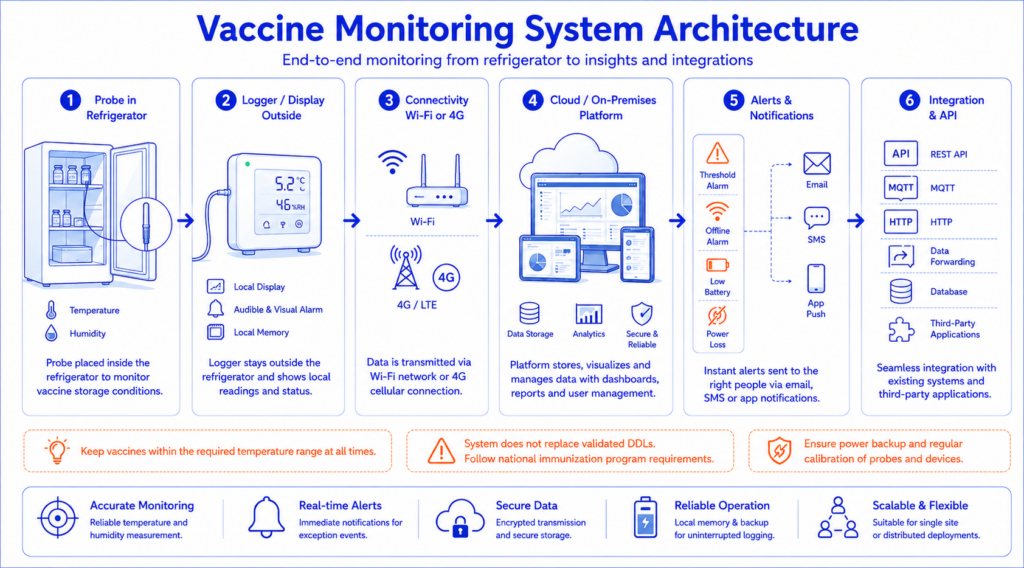
    Vaccine monitoring system architecture

    The probe and thermal buffer

    The probe is the part placed with the vaccines. For conventional refrigerator and freezer units, a buffered probe generally produces a more representative product-temperature signal than an unbuffered air sensor. The buffer can be liquid, loose media or a solid material. The selected method should be consistent, documented and suitable for the target range.

    The logger, display and local memory

    The logger time-stamps the readings and stores them. The display should allow staff to review current and minimum/maximum values without opening the refrigerator. Local memory protects the record when Wi-Fi, cellular service or the cloud is unavailable. Storage capacity should be assessed against the sampling interval and the longest realistic outage.

    Connectivity and remote alarms

    Wi-Fi is common in clinics and pharmacies, but enterprise authentication may exclude some devices. Cellular connectivity is useful where Wi-Fi is unreliable or where the monitoring network must be independent of the facility network. LoRa or LoRaWAN may fit campuses with many low-power points and a gateway. Ethernet and RS-485 are useful in fixed installations and building integrations.

    Cloud or on-premises software

    Software turns readings into a managed workflow. Buyers should look beyond graphs and check user permissions, alarm history, report export, calibration offsets, audit records, API availability, data retention and backup. A cloud service can be quick to deploy, while an on-premises platform may be preferred for local data control or isolated networks.

    SOPs, people and response time

    No hardware replaces a vaccine storage and handling SOP. The facility must define who receives an alarm, who can acknowledge it, what happens when the primary contact is unavailable, how affected stock is labeled and who contacts the manufacturer or immunization program. The monitoring system should support that procedure rather than create a separate, informal process.
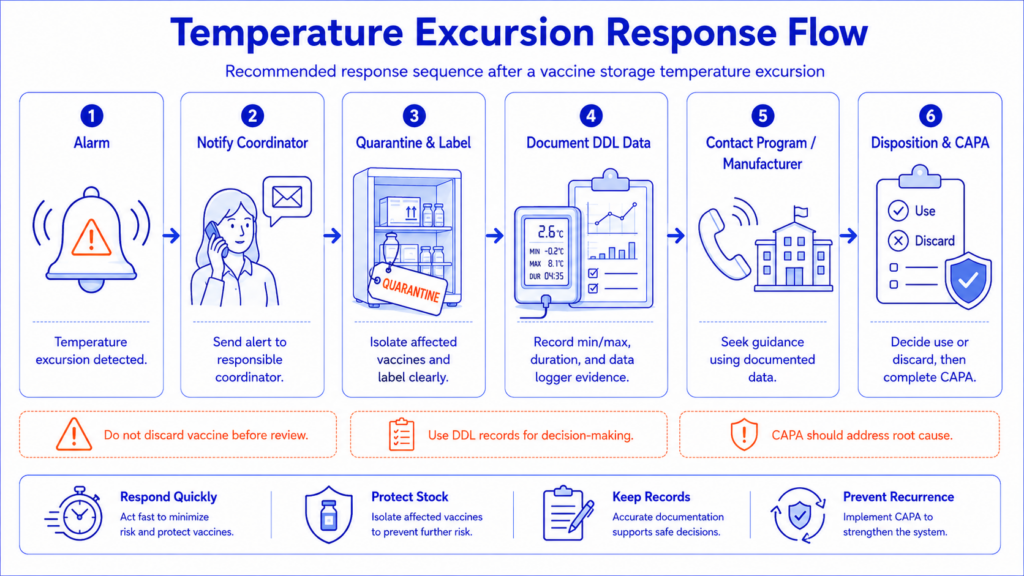
    Temperature excursion response flow

    6.Which Sensor and Logger Specifications Matter Most?

    Why is a buffered probe more important than a fast air sensor?

    A fast air sensor reacts immediately when the refrigerator door opens. That response is useful for diagnosing airflow, but it can exaggerate short events that do not reflect the thermal condition of the vaccine. A buffered probe slows the response and more closely represents the temperature of stored products. CDC therefore recommends a detachable probe in a suitable buffer for most conventional storage units. [1]
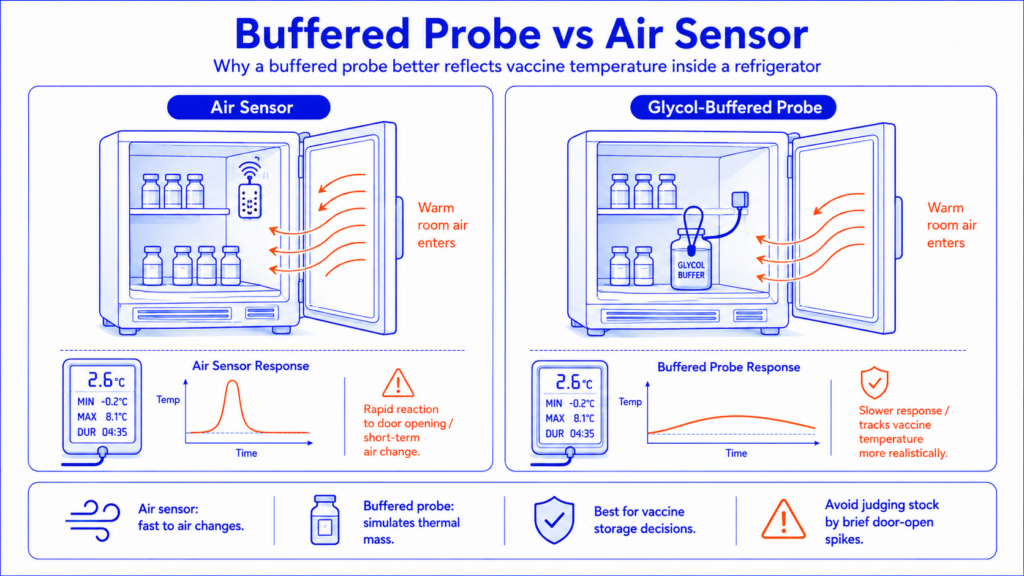
    Buffered probe vs air sensor

    Some purpose-built vaccine units use non-buffered embedded sensors because the chamber has limited exposure to room air. In that case, follow the storage-unit manufacturer instructions and verify that the complete monitoring system can be calibration-tested. A buffer is not a universal substitute for understanding the storage unit.

    How should accuracy, uncertainty and range be compared?

    Sensor accuracy, logger input accuracy and system uncertainty are not interchangeable. A probe may be specified at +/-0.5°C, while the logger input, cable, calibration method, buffer and installation add further uncertainty. A certificate that covers the complete device-and-probe assembly at relevant points is more useful than a broad nominal range.
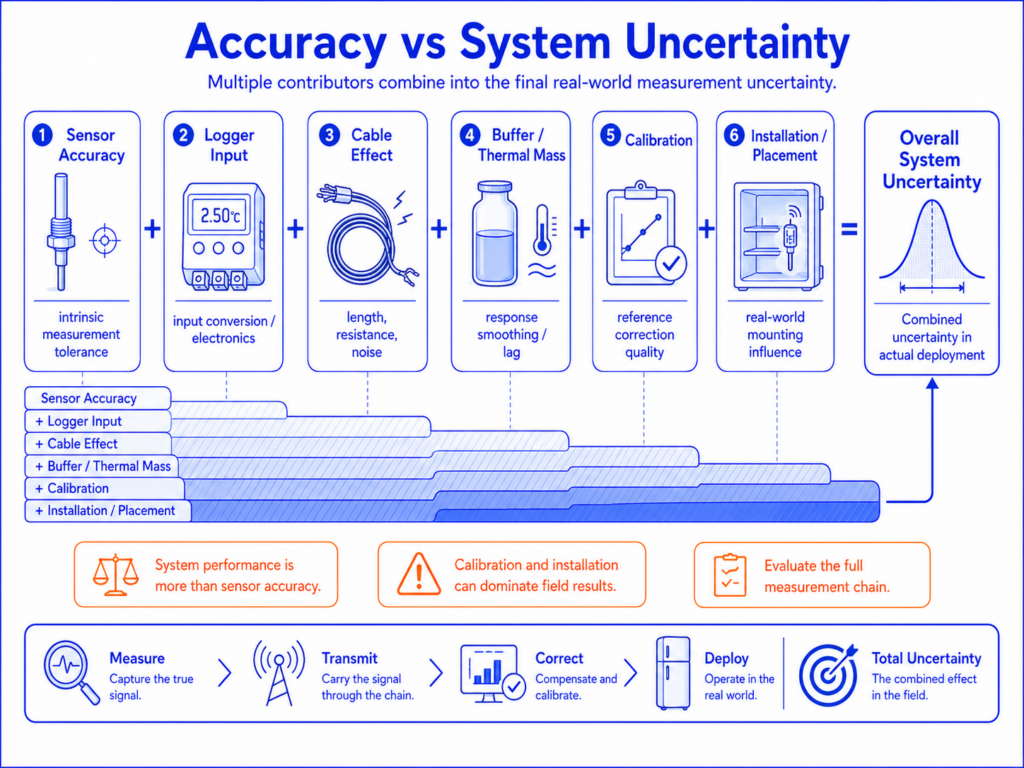
    Accuracy vs system uncertainty

    Critical buying principle

    For routine 2°C to 8°C vaccine storage, performance around 2°C, 5°C and 8°C matters more than the ability to measure -200°C or +400°C.

    A broad-range probe is not automatically a vaccine probe. Confirm system uncertainty, calibration points and the intended buffer assembly.

    UbiBot publishes a -55°C to +125°C (-67°F to +257°F) range and +/-0.5°C accuracy from -10°C to +85°C for its UB-DT-P1 probe. That nominal accuracy is at the CDC recommended uncertainty threshold, so a vaccine project should not assume the final system meets the requirement without calibration of the complete configuration. [6]

    UbiBot also publishes a -200°C to +400°C range for its industrial PT100 probe, but the stated accuracy is +/-(2% + 1°C). Based on that published figure, the probe is not the obvious choice for routine 2°C to 8°C vaccine refrigerator monitoring unless project-specific calibration and validation demonstrate acceptable performance. Its wide range may be more relevant to industrial or extreme-temperature applications. [7]

    What should be checked about logging and offline storage?

    The reading interval determines how much detail is available during an excursion. CDC recommends a programmable interval that records at least every 30 minutes, while many facilities choose five or ten minutes for faster diagnosis. A shorter interval consumes more memory and may increase battery or network usage, but it does not require every reading to be uploaded immediately.

    Offline storage is separate from cloud retention. UbiBot WS1 Pro and WS4 specifications list 300,000 sensing records in onboard memory. LogTag UTRED30-WiFi stores 16,000 readings per channel, T&D TR71A2 stores 30,000 data sets, and testo 162 T2 stores 10,000 values per channel. Lascar states that EL-WiFi-VACX stores readings during Wi-Fi loss and can hold up to 30 days at a 10-second sample interval. [4][5]

    What should be checked about calibration certificates?

    A useful certificate identifies the logger or probe serial number, calibration date, calibration points, measured error, uncertainty, traceability and next due date. CDC recommends current and valid calibration documentation and describes indicators such as ISO/IEC 17025 conformity, an ILAC MRA-accredited laboratory or traceability to NIST standards. CDC states that calibration testing should generally be performed every two to three years or according to the manufacturer schedule. [3]

    UbiBot states that devices are delivered with a factory calibration report valid for two years and recommends local ISO 17025 accredited recalibration for regulated industries. It also offers software offset tools, but correctly notes that an internal offset does not replace an external calibration certificate. For critical cold-chain monitoring, UbiBot recommends verification every 12 to 18 months. [9]

    The buyer should confirm that the certificate covers the exact probe and logger combination used in the refrigerator. A certificate for an internal room sensor does not automatically cover an external probe, and a certificate for a replaceable probe does not automatically cover the entire system unless the manufacturer or laboratory states that it does.

    How should alarms, power and door events be evaluated?

    An alarm specification should answer four questions: what condition triggers it, how long the condition must persist, who receives it and what happens if the first recipient does not respond. Local sound and light are helpful during working hours. Remote app, email, SMS or voice alerts are more important overnight. Alarm delays can reduce nuisance alerts but can also hide short excursions, so the settings must match the SOP.

    Power strategy matters as much as battery life. A mains-powered logger with battery backup may offer frequent communication without rapid battery depletion. A battery-only device can be easier to install but may need a longer upload interval. Facilities should also monitor storage-unit power and, where justified, door status. A temperature alarm indicates the consequence; a power or door event may identify the cause earlier.

    7.Which Connectivity Option Is Best for Vaccine Refrigerators?

    Connection Best fit Main advantage Main limitation
    Wi-Fi Clinics, pharmacies and laboratories with reliable managed wireless coverage No cellular fee; direct cloud access; common ecosystem Coverage gaps, enterprise authentication and router changes can interrupt uploads
    4G/LTE Remote sites, temporary clinics, mobile storage or independent monitoring networks Works without facility Wi-Fi; useful as a separate communication path SIM, regional bands, coverage and recurring data charges must be checked
    LoRa Vendor-specific long-range sensor networks with a local gateway Low power and long range inside campuses or warehouses Proprietary compatibility may limit third-party gateway use
    LoRaWAN Standards-based multi-vendor networks with LoRaWAN gateways and network servers Scalable low-power ecosystem More network components and integration responsibility
    Ethernet Fixed sites requiring wired reliability and controlled IT infrastructure Stable connection and easier network governance Cabling cost and limited placement flexibility
    RS-485 / Modbus RTU Industrial integration, gateways and building systems Long wired runs and multi-drop integration Not a cloud connection by itself; requires a logger, gateway or controller

    For a single clinic refrigerator, Wi-Fi is usually the simplest option if signal quality and network security are confirmed. For a remote pharmacy, emergency storage location or facility that does not permit IoT devices on the corporate network, a regional 4G logger can be easier to govern. Large hospital campuses may use gateways or wired integration, but the network design must not obscure local memory and alarm behavior.

    LoRa and LoRaWAN are not synonyms. A vendor-specific LoRa sensor may only work with its matching gateway and platform, while a LoRaWAN device is designed for a standards-based network stack. Compatibility must be confirmed at device, gateway, frequency plan, network server and application levels.

    8.Which Vaccine Refrigerator Data Logger Models Should You Compare?

    The following comparison uses specific models and configurations rather than comparing brands in general. The UbiBot entry is a project configuration based on WS1 Pro and a UB-DT-P1 probe placed in an appropriate buffer and calibration-tested for the application. It is not presented as a factory-supplied vaccine kit. WS4 alternatives are discussed later because the exact external probe compatibility depends on the selected RS-485 SKU.

    Product Comparison: Vaccine Refrigerator Temperature Data Loggers

    Comparison point UbiBot WS1 Pro
    External probe UB-DT-P1
    LogTag UTRED30-WiFi T&D TR71A2
    TR-0106 probes
    Lascar EL-WiFi-VACX testo 162 Refrigerator Kit
    Product type Configurable Wi-Fi or regional 4G logger with external probe and cloud/on-premises options Dual-channel Wi-Fi temperature logger with external probes Two-channel Wi-Fi/Bluetooth/USB temperature logger with Vaccine Mode Purpose-built Wi-Fi vaccine monitoring kit Wi-Fi refrigerator kit with two-channel logger, two ribbon probes and two glycol vials
    Probe configuration UB-DT-P1 external probe; vaccine project requires suitable buffer and calibration of the used assembly. WSA probe options depend on SKU. Up to two ST100 or CP100K external probes; selected buffered arrangement must be confirmed Two supplied TR-0106 thermistor probes; buffer and project calibration must be arranged Replaceable digital thermistor probe supplied in a glycol-filled bottle Two NTC ribbon probes plus two vials intended to be filled with glycol
    Published measurement range UB-DT-P1: -55°C to +125°C (-67°F to +257°F). WS1 Pro built-in: -20°C to +60°C. -40°C to +99°C (-40°F to +210°F) Supplied sensor: -40°C to +110°C; optional sensor: -60°C to +155°C -40°C to +60°C (-40°F to +140°F) Logger input -50°C to +150°C; supplied ribbon probe: -40°C to +125°C
    Published accuracy UB-DT-P1: +/-0.5°C from -10°C to +85°C. Final buffered system uncertainty must be calibrated and verified. Better than +/-0.5°C from -20°C to +40°C; ranges outside this band have wider limits Supplied probe: average +/-0.3°C from -20°C to +80°C, average +/-0.5°C at outer portions of range +/-0.1°C from -10°C to +60°C; +/-0.5°C over -40°C to +60°C Logger: +/-0.5°C +/-1 digit; supplied ribbon probe: +/-0.2°C from -25°C to +80°C
    Connectivity WS1 Pro Wi-Fi 2.4 GHz or regional 4G variants. WS4 offers dual-band Wi-Fi and 4G variants. Wi-Fi 802.11 b/g/n, USB, Bluetooth Wi-Fi 2.4 GHz, Bluetooth 4.2, USB Wi-Fi 2.4 GHz; PC/mobile setup Wi-Fi 802.11 b/g/n
    Local storage 300,000 sensing records 32,000 total; 16,000 per channel plus 30-day statistics 30,000 data sets Stores data during Wi-Fi loss; up to 30 days at 10-second sampling 10,000 values per channel
    Power 4 x AA or 5 V USB; V2 also supports specified Li-SOC12 cells. Exact battery life depends on upload interval and network. 5 V USB normally; 2 x AAA backup plus CR2032 backup logging cell 2 x AA batteries or 5 V USB / optional AC adapter; approx. 5 days to 18 months depending on upload interval Rechargeable internal battery or permanent 5 V USB power 4 x AA batteries; published battery life 12 months
    Alarms Platform-based email/app/SMS/voice and other channels subject to plan/credits; local display. Confirm device-side min/max and alarm workflow for exact SKU. Audible alarm, red LED, display alarm, min/max and cloud notifications LCD ALM icon, cloud warning notifications and configurable Vaccine Mode behavior Onboard warning light and sounder plus email alerts Push, email and optional SMS; threshold and system notifications through Smart Connect
    Display WS1 Pro: 4.4-inch LCD; WS4: 2.4-inch LCD Active LCD with current and min/max information and recent alarm history LCD with current values, min/max and ALM icon On-device temperature display plus light/sound status Large display for local inspection
    Calibration Factory report stated as valid for two years; local ISO 17025 recalibration recommended for regulated use. External probe/system certificate must be confirmed. Factory calibration; certificate available on request Calibration service and probe-specific documentation should be confirmed with distributor/lab Traceable certificate supplied at 2°C and 8°C; replaceable calibratable probe Test protocol supplied; ISO calibration certificate available as an option
    Cloud platform UbiBot Public IoT Platform: Web/app dashboards, export, alerts, APIs, MQTT and data forwarding LogTag Online; local LogTag Analyzer and automatic PDF/CSV download Free T&D WebStorage Service plus T&D apps and Windows software EasyLog Cloud with remote multi-site management testo Smart Connect / Smart App; license required
    On-premises option Yes, UbiBot On-Premises Platform is available for customer infrastructure Local Analyzer software; full on-premises remote platform not specified in reviewed product materials Local Windows software and T&D Data Server are available; enterprise on-premises scope should be confirmed Not publicly specified in reviewed product materials Not publicly specified in reviewed product materials
    API / integration Public platform APIs, MQTT APIs, HTTP/data forwarding; on-premises integration options Not publicly specified in reviewed product materials T&D WebStorage Service API is referenced by the manufacturer Not publicly specified for this product in reviewed materials Not publicly specified for this kit in reviewed materials
    Subscription considerations Free plan listed; paid public-cloud plans from USD 15/month at review date. SMS/voice may use credits. Confirm current terms. Some LogTag Online functions require paid activation codes; public price not stated in reviewed materials T&D WebStorage Service is described as free of charge Starter plan listed as free; Professional listed at USD 1.98 per Wi-Fi logger/month, subject to account minimum/term A paid Data Monitoring License is required; current regional price should be requested
    Best fit Multi-site or mixed-environment projects needing Wi-Fi/4G, large local memory, API, public cloud or on-premises deployment Clinics wanting strong local display, automatic PDF reports, dual probes and independent USB retrieval Sites wanting flexible sensors, Vaccine Mode and free cloud service Small to medium sites wanting a ready-made glycol probe and supplied traceable certificate Sites wanting a two-probe refrigerator kit, glycol vials, door-contact option and enterprise Wi-Fi support
    Main limitations Not a standard vaccine kit; buffered probe, complete-system calibration, min/max workflow and project validation must be confirmed. Compatible probe and buffer selection is separate; advanced cloud features may require paid activation Standard probes are not supplied in a vaccine buffer; configuration and calibration are the user/project responsibility Wi-Fi only; cloud account features and costs depend on plan; no reviewed on-premises option Paid cloud license; Wi-Fi only; API/on-premises options were not specified in reviewed kit materials

    * UbiBot comparison configuration: WS1 Pro V2 + UB-DT-P1 external probe placed in a suitable buffer and calibration-tested as used. This is a project configuration, not a factory-packaged vaccine kit.

    Specifications and platform features were reviewed using publicly available manufacturer information on July 24, 2026. Product configurations, regional availability and subscription terms may change. Confirm the latest specifications with each manufacturer before purchasing.

    9.How Should the Comparison Be Interpreted?

    The table does not identify a universal winner. Lascar and Testo provide purpose-built refrigerator kits with glycol accessories, which can reduce the number of parts a small clinic must specify. Lascar also supplies a traceable certificate at 2°C and 8°C with the standard kit according to its datasheet. Testo supplies two probe channels and supports an optional door-contact workflow, but its cloud platform requires a paid license.

    LogTag UTRED30-WiFi is strong where local evidence matters: it supports two probes, displays current and minimum/maximum values, retains 30 days of statistics and can produce PDF and CSV files through USB if Wi-Fi is unavailable. The buyer still needs to select the correct external probe and buffered arrangement.

    T&D TR71A2 combines two channels, a dedicated Vaccine Mode, enterprise Wi-Fi support, local min/max display and a free cloud service. Its supplied probes are general thermistor probes rather than a complete glycol kit, so buffer construction and calibration remain part of the project.

    UbiBot has a different value proposition. WS1 Pro and WS4 provide large local storage, flexible communication models, external sensor expansion and access to public cloud, on-premises and API-based architectures. That flexibility is useful for multi-site organizations or mixed monitoring programs. It also means the buyer carries more responsibility for the vaccine-specific probe, calibration and validation package. [4][5][8][9]

    10.What Is the Best Option for Each Use Case?

    Single clinic or pharmacy refrigerator

    For one or two refrigerators, the lowest-risk procurement route is usually a purpose-built kit with a buffered probe, visible min/max information, a current certificate and straightforward remote alarms. Lascar EL-WiFi-VACX and the testo 162 Refrigerator Kit are designed around this workflow. LogTag and T&D can also work well when the probe and buffer are deliberately specified.
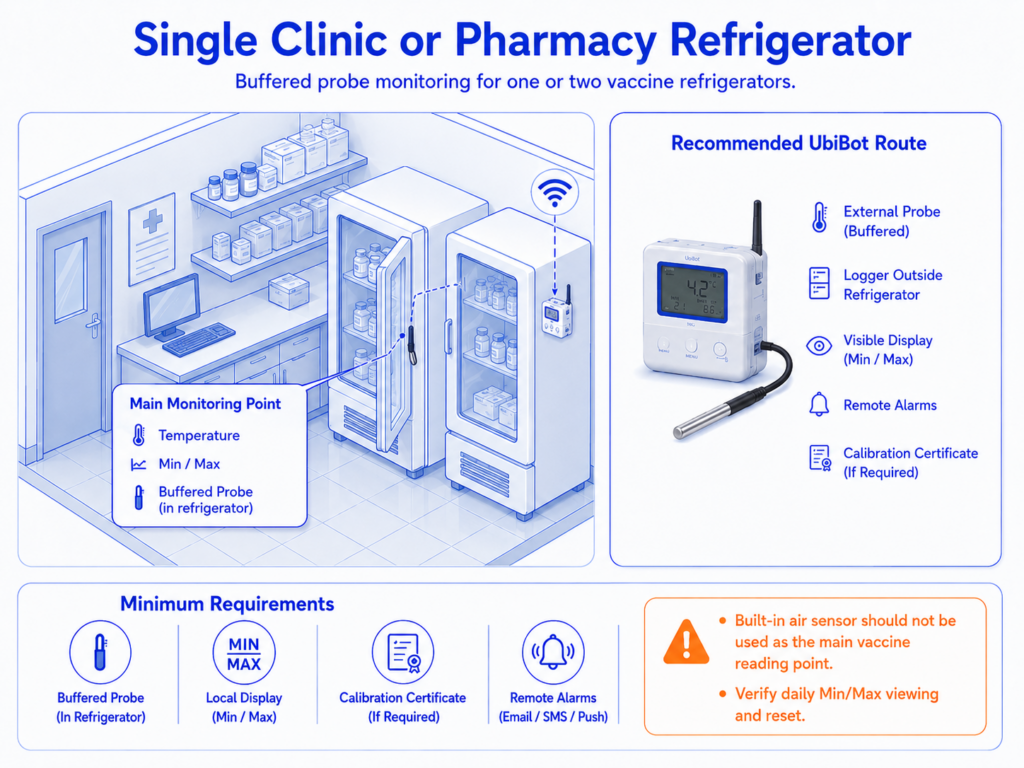
    UbiBot may be appropriate when the clinic already uses the UbiBot platform, needs a large display or requires 4G. In that case, use an external probe rather than the built-in air sensor, place the logger outside the refrigerator and obtain a certificate for the actual buffered configuration. The facility should verify how daily min/max values are viewed and reset.

    Multi-refrigerator pharmacy, hospital or immunization network

    A network with many units should prioritize centralized user management, alarm escalation, consistent reports and calibration scheduling. Platform cost becomes more important than the price of one logger. T&D offers free cloud storage, Lascar prices Professional cloud service per Wi-Fi logger, Testo requires a license and LogTag uses paid activation codes for advanced features. UbiBot provides a free tier plus paid plans and can also support on-premises deployment. [8]
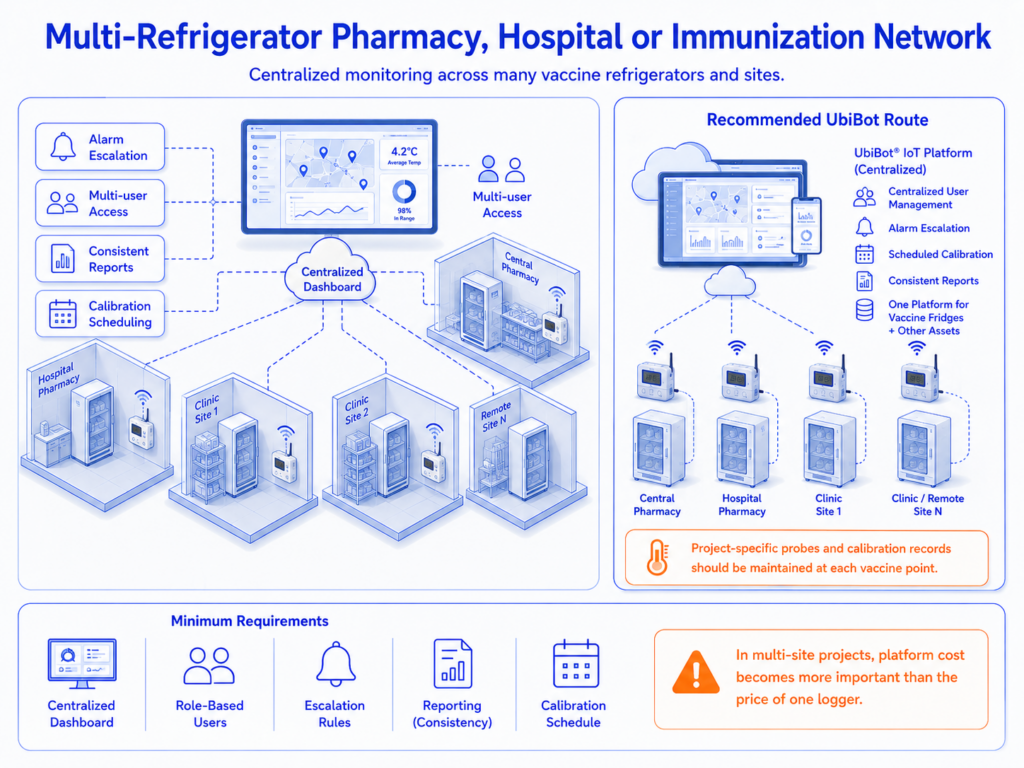
    UbiBot is a stronger candidate in this scenario when the organization wants one platform for vaccine refrigerators, warehouse temperature, ambient humidity, leak detection or other assets. The architecture can be standardized across sites while the vaccine refrigerator points use project-specific probes and calibration records.

    Pharmaceutical warehouse or controlled distribution site

    Warehouses often need more than a refrigerator logger. They may require room mapping, cold rooms, backup generators, door events, multiple alarm levels, API integration and private infrastructure. The selection should be made as part of a broader environmental monitoring system, with validation and change control appropriate to the organization.
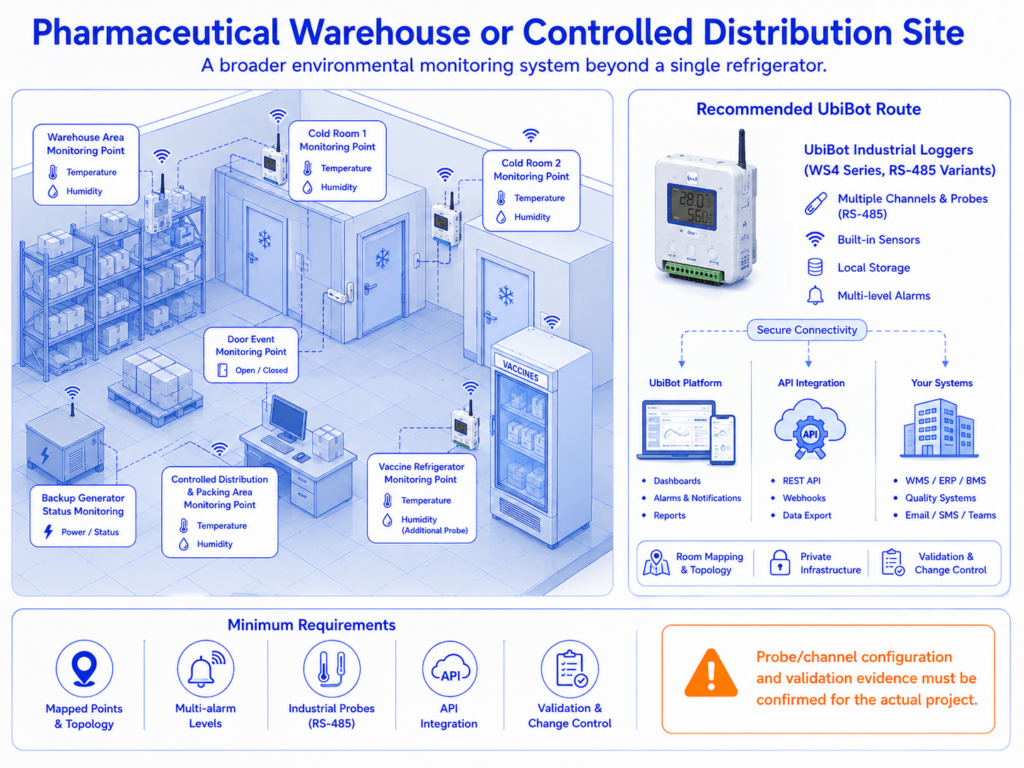
    UbiBot WS4 RS-485 variants can connect external industrial probes and offer IP65 protection, 300,000 records and Wi-Fi or 4G options depending on SKU. This can support a unified warehouse and refrigerator architecture. The exact probe, channel configuration and validation evidence must be confirmed because the published WS4 materials do not present a standard vaccine refrigerator kit. [5]

    Remote clinic, temporary vaccination site or unreliable Wi-Fi

    Cellular communication can provide a more independent link than facility Wi-Fi. It is especially useful for temporary clinics, rural sites and emergency storage locations. The buyer must confirm regional LTE bands, carrier coverage, SIM terms and the amount of data retained when cellular service fails.
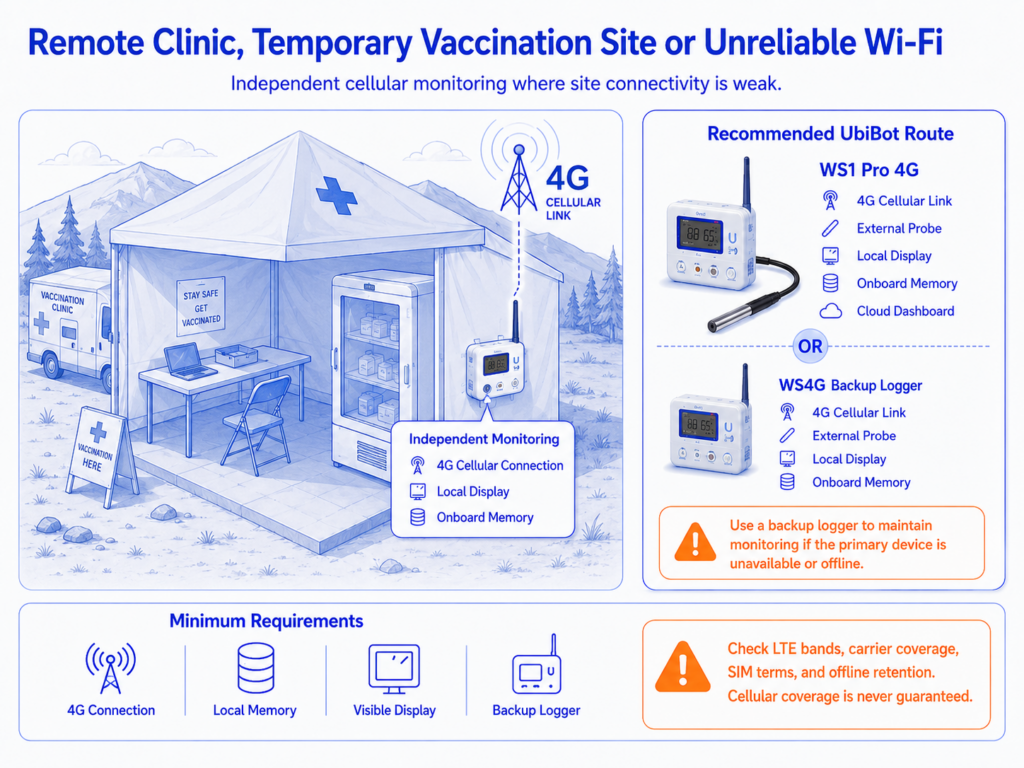
    A regional UbiBot WS1 Pro 4G or WS4 4G configuration can fit this use case if the complete probe and calibration package is validated. A local display and onboard memory remain essential because cellular coverage is never guaranteed. A backup logger should also be available, as recommended by CDC. [1][4][5]

    Freezers and ultra-cold storage

    Do not extend a refrigerator configuration into a freezer or ultra-cold freezer without rechecking every specification. The probe range, cable material, buffer, logger operating temperature, calibration points, response time and alarm behavior may all change. CDC specifically warns that some DDLs cannot monitor ultra-cold conditions and that a probe intended for the target environment is required. [1]
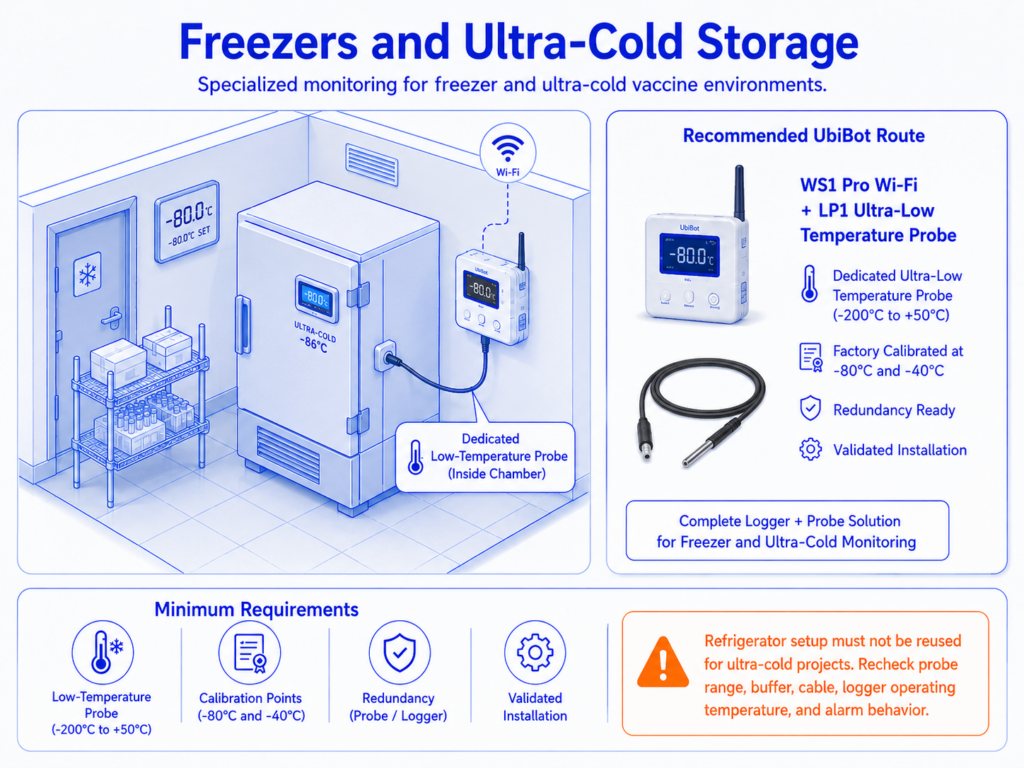
    UbiBot PT100 has a very broad published range, but its published accuracy should not be interpreted as proof of suitability for a specific vaccine. Ultra-cold projects need a dedicated probe and logger combination calibrated at relevant temperatures, with redundancy and a validated installation. A range number alone is not a procurement decision.

    11.How Much Does a Vaccine Monitoring System Really Cost?

    Total cost of ownership includes much more than the initial logger. A low-cost device can become expensive if it requires separate cloud licenses, frequent battery changes, specialist calibration or manual report preparation. A higher-priced kit can be economical if it reduces validation work and staff time.
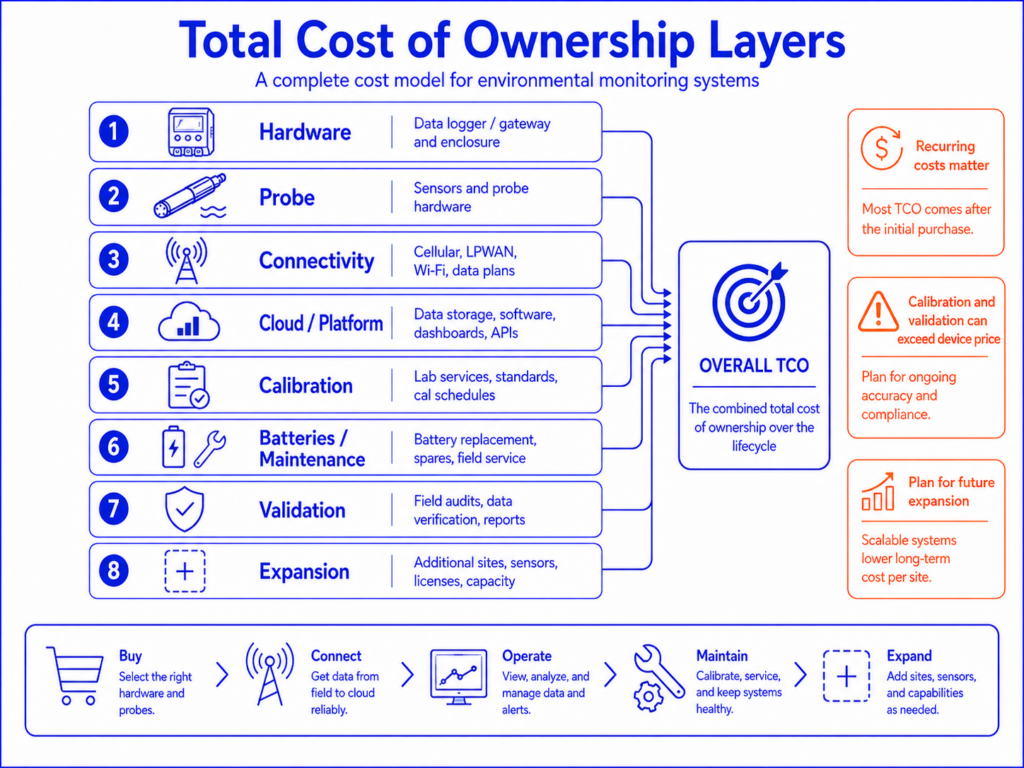
    Total cost of ownership layers

    Cost layer What it includes Question to ask
    Hardware Logger, display, probe, buffer vial, mounting accessories and backup device Is the probe and calibration certificate included or purchased separately?
    Connectivity Wi-Fi commissioning, cellular SIM/data, gateway, Ethernet or RS-485 installation Will corporate IT permit the device, and what happens after a router or password change?
    Cloud and software Subscription, users, SMS, voice calls, reports, API, data retention and dashboards Which functions are free, which are paid and how are prices calculated?
    Calibration Initial certificate, recalibration, replacement probe, shipping and downtime Can the probe be calibrated separately without removing the logger from service?
    Power and maintenance Batteries, adapters, backup power, inspection and replacement What is the realistic life at the selected upload interval and signal strength?
    Validation and quality URS, risk assessment, installation checks, SOPs, training and change control Who owns evidence that the configured system meets the intended use?
    Expansion Additional refrigerators, sites, user accounts, integrations and private infrastructure Does the architecture remain manageable at 10, 100 or 1,000 points?

    At the review date, UbiBot listed a free public-cloud plan and paid plans from USD 15 per month. T&D described its WebStorage Service as free. EasyLog Cloud listed a free Starter tier and a Professional price of USD 1.98 per Wi-Fi logger per month, subject to the selected account and term. Testo stated that a Data Monitoring License is required. LogTag indicated that some cloud functions require paid activation codes, but a public price was not shown in the reviewed materials. These terms can change and should be confirmed for the target country. [8]

    12.What Are the Most Common Buying Mistakes?

    Buying a room sensor instead of a vaccine DDL. A general wireless temperature sensor may provide useful ambient data but lack a buffered probe, daily min/max workflow, suitable certificate or retained excursion history.

    Treating measurement range as accuracy. A probe capable of -200°C may still be less suitable at 5°C than a narrower, well-calibrated vaccine probe. Compare uncertainty at the actual storage range.

    Using probe accuracy as system accuracy. Logger input, cable, buffer, calibration and installation can add error. Ask for the uncertainty of the complete configured system.

    Ignoring the certificate details. A certificate without the correct serial number, calibration points, uncertainty, traceability or due date may not support the intended quality process.

    Assuming Wi-Fi equals continuous monitoring. Wi-Fi can fail while the logger continues recording. Confirm local memory, automatic backfill and how staff know that the device is offline.

    Choosing alarms without escalation. Email alone may be insufficient after hours. Define primary and backup contacts, delay, repeat behavior and acknowledgement.

    Forgetting power-failure and door events. Temperature is the outcome. Power and door data can explain the cause and support faster intervention.

    Ignoring platform fees. SMS credits, user accounts, data retention, reports, APIs and multiple sites can change the long-term cost.

    Assuming a vendor compliance phrase is an approval. CDC states that it does not validate products for compliance. Local program requirements and the actual project configuration control the decision. [3]

    Failing to plan for recalibration. A monitoring program needs a spare device or replaceable probe so calibration does not leave the refrigerator unmonitored.

    Not checking regional SKU and network support. 4G bands, SIM arrangements, radio approvals, cloud terms and accessories vary by country. Confirm the exact part number before purchase.

    13.Where Does UbiBot Fit in a Vaccine Monitoring Project?

    UbiBot fits best when the buyer needs a configurable monitoring architecture rather than a single-purpose vaccine kit. WS1 Pro provides a large LCD, 300,000-record local memory, Wi-Fi or regional cellular variants and external probe interfaces. WS4 adds IP65 protection, dual-band Wi-Fi on relevant models, 4G and RS-485 configurations, a rechargeable battery and the same published memory capacity. The platform can be used through public cloud, on-premises deployment or API and data-forwarding services. [4][5][8]

    Assessment Practical interpretation
    Strong fit Multi-site monitoring, unreliable Wi-Fi requiring 4G, mixed environmental sensors, long local history, centralized dashboards, public cloud/on-premises choice and API integration.
    Configuration required Buffered probe, calibration points, certificate for the used assembly, daily min/max workflow, alarm escalation, power strategy and backup logger.
    Do not assume That the built-in room sensor is a vaccine probe; that UB-DT-P1 nominal accuracy proves complete-system uncertainty; that PT100 range proves refrigerator suitability; or that a product certificate automatically satisfies local VFC/GxP requirements.
    Best procurement approach Define the user requirement first, select the exact logger/probe/buffer configuration, obtain calibration evidence, run an installation and alarm test, document the SOP and confirm regional platform terms.

    For a small clinic that wants the least configuration work, a purpose-built vaccine kit may be the simpler choice. For a hospital, pharmaceutical company or international organization that wants one monitoring infrastructure across refrigerators, rooms, warehouses and remote sites, UbiBot can offer broader architectural flexibility. That advantage should be judged against the additional validation responsibility.

    14.Frequently Asked Questions

    What is the best vaccine temperature data logger?

    The best logger is the one whose complete probe, logger, calibration, alarm and data workflow meets the intended storage range and local requirements. Purpose-built glycol probe kits reduce configuration work; configurable platforms provide more connectivity and integration options.

    Does CDC approve or certify vaccine data loggers?

    No. CDC provides guidance and VFC-related requirements but states that it does not validate products or services for compliance. Buyers should compare the exact product configuration with current CDC, state/local program and vaccine manufacturer requirements. [3]

    Does a vaccine refrigerator probe have to be in glycol?

    Not always, but a buffered probe is recommended for most conventional vaccine storage units. CDC lists glycol, glass beads, sand and Teflon as examples. Some purpose-built units may use an embedded air sensor when the unit design and manufacturer instructions support it. [1]

    How accurate should a vaccine data logger be?

    CDC recommends uncertainty of +/-0.5°C (+/-1°F). Evaluate the calibrated uncertainty of the complete system at relevant temperatures, not only the probe accuracy printed in a datasheet. [1]

    How often should vaccine temperatures be recorded?

    CDC recommends a programmable logger that measures and records at least every 30 minutes. Many organizations choose a shorter interval based on risk, memory and alarm needs. Daily minimum and maximum temperatures should also be checked and documented. [1][2]

    How often should a vaccine data logger be calibrated?

    CDC states that calibration testing should generally occur every two to three years or according to the manufacturer schedule. Regulated or high-risk organizations may use shorter intervals. UbiBot recommends 12 to 18 months for critical pharmaceutical or cold-chain monitoring. [3][9]

    Will data be lost if Wi-Fi goes down?

    A suitable logger should continue recording locally and upload stored readings after reconnection. The memory size, overwrite behavior, offline warning and backfill process differ by model, so they must be tested during commissioning.

    Does every vaccine refrigerator need its own logger?

    Yes, each storage unit needs an appropriate temperature monitoring device. A dual-channel logger may monitor two probes, but the facility should confirm that the wiring, display and data records clearly identify each storage space. CDC also recommends a backup device. [1]

    Can a normal Wi-Fi temperature sensor be used in a vaccine refrigerator?

    Not simply because it measures temperature. The facility must verify buffered measurement, calibrated uncertainty, min/max display, local memory, alarm behavior, certificate validity and the applicable program requirements. Food or household thermometers are not recommended for vaccine storage. [1][3]

    Can UbiBot be used for vaccine refrigerator monitoring?

    UbiBot can be configured to support a vaccine monitoring workflow, particularly when Wi-Fi/4G flexibility, large local memory, APIs or multi-site management are needed. The buyer must select a suitable external probe and buffer, obtain current calibration documentation for the used system and validate the daily min/max and alarm workflow. It should not be described as automatically CDC or VFC compliant.

    What should staff do after a temperature excursion?

    Notify the vaccine coordinator, label affected vaccines “DO NOT USE – TEMPERATURE EXCURSION,” keep them under appropriate conditions, document the event and contact the immunization program or vaccine manufacturer for guidance. Do not discard or administer affected vaccines until instructed. [2]

    Can the same logger be used for refrigerators, freezers and ultra-cold units?

    Only if the exact probe, logger operating range, uncertainty, cable, buffer and calibration cover every target condition. Ultra-cold storage commonly requires a dedicated probe and validation. A broad nominal range is not enough.

    15.How Do You Choose the Right System?

    Start with the vaccine and storage-unit requirements, not the product catalog. Confirm the required temperature range, then define the acceptable uncertainty and calibration points. Decide whether the probe must be buffered and where it will be placed. Establish the recording interval, daily min/max procedure and data-retention period. Next, choose the communication path and verify local memory during outages. Design the alarm escalation and power strategy. Finally, compare cloud subscriptions, calibration logistics, integration needs and expansion cost.

    For a simple refrigerator, a purpose-built kit may provide the clearest path. For a multi-site or mixed-asset program, a configurable platform can reduce fragmentation. UbiBot should be considered where its Wi-Fi/4G options, 300,000-record local storage, public cloud, on-premises platform and APIs align with the project. The final choice must be the specific logger, probe, buffer and software configuration that can be documented and defended.

    Final procurement checklist

    1. Define storage range and product-specific requirements.
    2. Select a probe that reflects vaccine temperature and can be calibration-tested.
    3. Verify complete-system uncertainty at relevant calibration points.
    4. Confirm current/min/max display, alarm, low-battery indication and at least 30-minute logging.
    5. Test offline recording, data recovery, network change and power interruption.
    6. Review calibration certificate, due date and spare-device plan.
    7. Calculate cloud, cellular, alerts, calibration and expansion costs.
    8. Document SOPs, alarm ownership, excursion response and change control.

    16.Sources and Specification Notice

    Specifications and platform features were reviewed using publicly available official guidance and manufacturer information on July 24, 2026. Product configurations, regional availability, calibration services and subscription terms may change. Confirm the latest specifications with each manufacturer and the applicable immunization program before purchasing.

    [1] CDC – Temperature Monitoring Equipment – DDL features, buffered probes, uncertainty, placement and device limitations.

    [2] CDC – Vaccine Temperature Monitoring – Daily min/max checks, record retention and excursion response.

    [3] CDC – Vaccine Storage and Handling Toolkit, July 2026 – Current storage ranges, DDL, calibration and VFC guidance.

    [4] UbiBot – WS1 Pro Specifications – Display, power, memory, network, built-in sensors and external interfaces.

    [5] UbiBot – WS4 Specifications – WS4 variants, power, memory, IP65, connectivity and sensor options.

    [6] UbiBot – UB-DT-P1 Temperature Probe Specifications – Probe range, accuracy, cable and protection.

    [7] UbiBot – PT100 Industrial-grade Temperature Probe Specifications – Probe range, published accuracy and interface.

    [8] UbiBot – Public IoT Platform and Pricing – Cloud functions, APIs, data forwarding and plan information.

    [9] UbiBot – Calibration and Traceability Policy – Factory report, recalibration options and recommended intervals.

    Related Resources

    Real-Time Cold Chain Trackers Compared: Cellular, GPS, Temperature, Humidity, Shock and Light
    How to Choose a Wireless Temperature and Humidity Data Logger: Wi-Fi, 4G, Alerts, Accuracy and Cloud Costs
    menu-header-svg
    Search
    • Explore Knowledge
      • Comparison & Selection
      • Industry Solution
      • Product & Device
      • Criterion & Compliance
      • Deployment & Usage
      • Technology & Principle
    • Academic Research
    • In-depth Tech

    learn

    See More >>

    Vaccine Refrigerator Temperature Data Loggers: Buffered Probes, Calibration, Alarms and CDC/VFC Buying Checklist

    30-Second Summary: What Should You Buy?

    Quick answer

    A vaccine refrigerator data logger should continuously record temperature through a probe that reflects product temperature, not only fast-changing air temperature.

    For routine refrigerated vaccines, prioritize a buffered probe, a current traceable calibration certificate, documented system uncertainty around the critical 2°C to 8°C (36°F to 46°F) range, minimum/maximum display, local memory and alarms that reach responsible staff.

    A purpose-built kit such as Lascar EL-Wi-Fi-VACX or the testo 162 Refrigerator Kit can reduce configuration work for a small site. LogTag UTRED30-WiFi and T&D TR71A2 offer flexible dual-channel workflows but still require the correct probe, buffer and calibration setup.

    UbiBot is most compelling when a project needs Wi-Fi or regional 4G options, large local storage, multiple sites, public cloud or on-premises deployment, APIs and mixed environmental sensors. The exact UbiBot vaccine configuration must be validated before use.

    1.Why Does the Right Vaccine Temperature Data Logger Matter?

    A vaccine refrigerator can appear to be operating normally while its internal temperature moves outside the permitted range overnight, during a power interruption or after repeated door openings. Without a continuous temperature history, staff may know that an excursion occurred but not how long it lasted, how severe it was or which inventory was affected. That uncertainty can lead to vaccine wastage, delayed clinics, manufacturer investigations and, in some cases, revaccination.

    A suitable vaccine temperature data logger is therefore more than a thermometer. It combines a probe that represents vaccine temperature, a recording device, a clear local display, alarm logic, retained data and a process for reviewing and documenting excursions. CDC guidance updated in July 2026 recommends digital data loggers for routine vaccine storage and calls for features such as a detachable buffered probe, current/minimum/maximum display, out-of-range alarm, low-battery indicator, programmable readings at least every 30 minutes and recommended uncertainty of +/-0.5°C (+/-1°F). [1][3]

    The equipment still has to fit the facility. A small clinic with one refrigerator may value a purpose-built glycol probe kit and simple cloud alerts. A hospital network may need hundreds of points, user permissions, API integration and central reporting. A remote site may require 4G because local Wi-Fi is unreliable. The correct choice depends on the full monitoring workflow rather than the logger price alone.

    2.Who Is This Guide For?

    This guide is written for people who select, operate or approve temperature monitoring equipment for vaccines and other temperature-sensitive medicines. Vaccine coordinators and clinic managers usually focus on daily minimum/maximum checks, alarm response and simple reporting. QA and validation teams look more closely at calibration traceability, measurement uncertainty, audit records and change control. Facilities and IT teams care about power continuity, network security, device management and integrations. Procurement teams need a clear view of hardware, cloud subscriptions, recalibration and replacement costs.

    The article uses current CDC guidance as a practical reference because many buyers search for a “CDC-compliant digital data logger.” Outside the United States, the same technical questions remain relevant, but the buyer should also follow the vaccine manufacturer package insert, national immunization program requirements and local pharmaceutical quality rules.

    3.What Is a Vaccine Refrigerator Temperature Data Logger?

    A vaccine refrigerator temperature data logger is a temperature monitoring device that measures and stores readings at programmed intervals, retains a time-stamped history and helps staff identify how long a storage unit was outside its required range. CDC distinguishes a DDL from a simple minimum/maximum thermometer because the DDL preserves all recorded values, not only the warmest and coldest points. [1]

    The terms sensor, probe, logger, remote monitor and monitoring system are often mixed together, but they describe different parts of the solution. The sensor is the element that detects temperature. A probe places that sensor at the measurement point, often inside the refrigerator while the logger and display remain outside. The logger records the readings. A remote monitor adds network communication and alerts. A complete environmental monitoring system adds centralized software, users, reporting, APIs, alarm escalation, maintenance and calibration records.

    For vaccine storage, the distinction matters. A general room sensor can be accurate in air and still be unsuitable as the sole vaccine refrigerator monitor because it may react too quickly to door openings and may not have the required calibration documentation. Conversely, a wide-range industrial probe may cover extremely low temperatures but may not provide sufficient uncertainty at 2°C to 8°C. The complete system must be evaluated in the target range.

    4.What Problems Does a Vaccine DDL Solve?

    The first problem is missed information. Manual checks show the temperature only when a person is present. A DDL reveals overnight drift, compressor cycling, intermittent power loss and the duration of an excursion. That duration is important because vaccine manufacturers and immunization programs assess both the magnitude and total time of exposure when deciding whether affected products remain viable. [2]

    The second problem is delayed response. A local alarm can warn staff nearby, while a connected logger can send an app, email, SMS or voice notification to a responsible person after hours. The value of remote monitoring depends on alarm routing, acknowledgement and escalation. A notification that no one owns is not an alarm system.

    The third problem is fragmented records. Multi-site organizations may have paper logs, separate vendor accounts and inconsistent calibration dates. A central platform can standardize thresholds, export reports, compare sites and feed data into quality or facility systems. It also introduces new questions about subscriptions, data retention, cybersecurity and supplier lock-in.

    5.What Does CDC Recommend for Vaccine Temperature Monitoring in 2026?

    CDC guidance is not a product approval list. It is a set of equipment and operating expectations that facilities can use when evaluating a proposed monitoring workflow. Every vaccine storage unit should have a suitable temperature monitoring device, and facilities should keep a backup device available. [1][3]

    Feature to verify Why it matters Procurement question
    Detachable buffered probe Glycol, glass beads, sand, Teflon or another suitable buffer slows the response so the reading better represents vaccine temperature rather than a short air-temperature spike. Confirm the probe and buffer are compatible, correctly positioned and calibration-tested as used.
    Out-of-range alarm Alerts staff before a small excursion becomes a prolonged one. Check local alarm, remote channels, delay, acknowledgement and escalation.
    Low-battery indication Reduces the chance of silent monitoring failure. Verify battery warning behavior and the power-failure plan.
    Current, minimum and maximum display Supports daily checks without downloading the full record. Confirm whether min/max is visible on the device, in the app or both, and how it resets.
    Recommended uncertainty +/- 0.5°C (+/-1°F) Provides sufficient confidence near the storage limits. Evaluate the complete calibrated system, not only the probe datasheet.
    Programmable interval at least every 30 minutes Captures the timing and duration of excursions. Select an interval that meets the local program and risk assessment.
    Current calibration certificate Demonstrates traceability and performance at the time of use. Check calibration points, uncertainty, due date, serial number and issuing laboratory.
    Data retrieval and retained history Allows excursion investigation and trend review. cry, export format, retention and access control.

    CDC also instructs facilities to check and record minimum and maximum temperatures at the start of each workday, retain temperature logs for three years, place a buffered probe near the center of the stored vaccines and keep the active display outside the unit when possible. Temperature excursions require immediate documentation, quarantine of affected stock and consultation with the immunization program or vaccine manufacturer. [2][3]

    For general reference, the July 2026 CDC toolkit lists refrigerator storage at 2°C to 8°C (36°F to 46°F), freezer storage at -50°C to -15°C (-58°F to +5°F) and ultra-cold storage at -90°C to -60°C (-130°F to -76°F). Individual vaccine instructions may differ and always take precedence. [3]

    5.What Are the Core Components of a Vaccine Monitoring System?

    Vaccine monitoring system architecture

    The probe and thermal buffer

    The probe is the part placed with the vaccines. For conventional refrigerator and freezer units, a buffered probe generally produces a more representative product-temperature signal than an unbuffered air sensor. The buffer can be liquid, loose media or a solid material. The selected method should be consistent, documented and suitable for the target range.

    The logger, display and local memory

    The logger time-stamps the readings and stores them. The display should allow staff to review current and minimum/maximum values without opening the refrigerator. Local memory protects the record when Wi-Fi, cellular service or the cloud is unavailable. Storage capacity should be assessed against the sampling interval and the longest realistic outage.

    Connectivity and remote alarms

    Wi-Fi is common in clinics and pharmacies, but enterprise authentication may exclude some devices. Cellular connectivity is useful where Wi-Fi is unreliable or where the monitoring network must be independent of the facility network. LoRa or LoRaWAN may fit campuses with many low-power points and a gateway. Ethernet and RS-485 are useful in fixed installations and building integrations.

    Cloud or on-premises software

    Software turns readings into a managed workflow. Buyers should look beyond graphs and check user permissions, alarm history, report export, calibration offsets, audit records, API availability, data retention and backup. A cloud service can be quick to deploy, while an on-premises platform may be preferred for local data control or isolated networks.

    SOPs, people and response time

    No hardware replaces a vaccine storage and handling SOP. The facility must define who receives an alarm, who can acknowledge it, what happens when the primary contact is unavailable, how affected stock is labeled and who contacts the manufacturer or immunization program. The monitoring system should support that procedure rather than create a separate, informal process.

    Temperature excursion response flow

    6.Which Sensor and Logger Specifications Matter Most?

    Why is a buffered probe more important than a fast air sensor?

    A fast air sensor reacts immediately when the refrigerator door opens. That response is useful for diagnosing airflow, but it can exaggerate short events that do not reflect the thermal condition of the vaccine. A buffered probe slows the response and more closely represents the temperature of stored products. CDC therefore recommends a detachable probe in a suitable buffer for most conventional storage units. [1]

    Buffered probe vs air sensor

    Some purpose-built vaccine units use non-buffered embedded sensors because the chamber has limited exposure to room air. In that case, follow the storage-unit manufacturer instructions and verify that the complete monitoring system can be calibration-tested. A buffer is not a universal substitute for understanding the storage unit.

    How should accuracy, uncertainty and range be compared?

    Sensor accuracy, logger input accuracy and system uncertainty are not interchangeable. A probe may be specified at +/-0.5°C, while the logger input, cable, calibration method, buffer and installation add further uncertainty. A certificate that covers the complete device-and-probe assembly at relevant points is more useful than a broad nominal range.

    Accuracy vs system uncertainty

    Critical buying principle

    For routine 2°C to 8°C vaccine storage, performance around 2°C, 5°C and 8°C matters more than the ability to measure -200°C or +400°C.

    A broad-range probe is not automatically a vaccine probe. Confirm system uncertainty, calibration points and the intended buffer assembly.

    UbiBot publishes a -55°C to +125°C (-67°F to +257°F) range and +/-0.5°C accuracy from -10°C to +85°C for its UB-DT-P1 probe. That nominal accuracy is at the CDC recommended uncertainty threshold, so a vaccine project should not assume the final system meets the requirement without calibration of the complete configuration. [6]

    UbiBot also publishes a -200°C to +400°C range for its industrial PT100 probe, but the stated accuracy is +/-(2% + 1°C). Based on that published figure, the probe is not the obvious choice for routine 2°C to 8°C vaccine refrigerator monitoring unless project-specific calibration and validation demonstrate acceptable performance. Its wide range may be more relevant to industrial or extreme-temperature applications. [7]

    What should be checked about logging and offline storage?

    The reading interval determines how much detail is available during an excursion. CDC recommends a programmable interval that records at least every 30 minutes, while many facilities choose five or ten minutes for faster diagnosis. A shorter interval consumes more memory and may increase battery or network usage, but it does not require every reading to be uploaded immediately.

    Offline storage is separate from cloud retention. UbiBot WS1 Pro and WS4 specifications list 300,000 sensing records in onboard memory. LogTag UTRED30-WiFi stores 16,000 readings per channel, T&D TR71A2 stores 30,000 data sets, and testo 162 T2 stores 10,000 values per channel. Lascar states that EL-WiFi-VACX stores readings during Wi-Fi loss and can hold up to 30 days at a 10-second sample interval. [4][5]

    What should be checked about calibration certificates?

    A useful certificate identifies the logger or probe serial number, calibration date, calibration points, measured error, uncertainty, traceability and next due date. CDC recommends current and valid calibration documentation and describes indicators such as ISO/IEC 17025 conformity, an ILAC MRA-accredited laboratory or traceability to NIST standards. CDC states that calibration testing should generally be performed every two to three years or according to the manufacturer schedule. [3]

    UbiBot states that devices are delivered with a factory calibration report valid for two years and recommends local ISO 17025 accredited recalibration for regulated industries. It also offers software offset tools, but correctly notes that an internal offset does not replace an external calibration certificate. For critical cold-chain monitoring, UbiBot recommends verification every 12 to 18 months. [9]

    The buyer should confirm that the certificate covers the exact probe and logger combination used in the refrigerator. A certificate for an internal room sensor does not automatically cover an external probe, and a certificate for a replaceable probe does not automatically cover the entire system unless the manufacturer or laboratory states that it does.

    How should alarms, power and door events be evaluated?

    An alarm specification should answer four questions: what condition triggers it, how long the condition must persist, who receives it and what happens if the first recipient does not respond. Local sound and light are helpful during working hours. Remote app, email, SMS or voice alerts are more important overnight. Alarm delays can reduce nuisance alerts but can also hide short excursions, so the settings must match the SOP.

    Power strategy matters as much as battery life. A mains-powered logger with battery backup may offer frequent communication without rapid battery depletion. A battery-only device can be easier to install but may need a longer upload interval. Facilities should also monitor storage-unit power and, where justified, door status. A temperature alarm indicates the consequence; a power or door event may identify the cause earlier.

    7.Which Connectivity Option Is Best for Vaccine Refrigerators?

    Connection Best fit Main advantage Main limitation
    Wi-Fi Clinics, pharmacies and laboratories with reliable managed wireless coverage No cellular fee; direct cloud access; common ecosystem Coverage gaps, enterprise authentication and router changes can interrupt uploads
    4G/LTE Remote sites, temporary clinics, mobile storage or independent monitoring networks Works without facility Wi-Fi; useful as a separate communication path SIM, regional bands, coverage and recurring data charges must be checked
    LoRa Vendor-specific long-range sensor networks with a local gateway Low power and long range inside campuses or warehouses Proprietary compatibility may limit third-party gateway use
    LoRaWAN Standards-based multi-vendor networks with LoRaWAN gateways and network servers Scalable low-power ecosystem More network components and integration responsibility
    Ethernet Fixed sites requiring wired reliability and controlled IT infrastructure Stable connection and easier network governance Cabling cost and limited placement flexibility
    RS-485 / Modbus RTU Industrial integration, gateways and building systems Long wired runs and multi-drop integration Not a cloud connection by itself; requires a logger, gateway or controller

    For a single clinic refrigerator, Wi-Fi is usually the simplest option if signal quality and network security are confirmed. For a remote pharmacy, emergency storage location or facility that does not permit IoT devices on the corporate network, a regional 4G logger can be easier to govern. Large hospital campuses may use gateways or wired integration, but the network design must not obscure local memory and alarm behavior.

    LoRa and LoRaWAN are not synonyms. A vendor-specific LoRa sensor may only work with its matching gateway and platform, while a LoRaWAN device is designed for a standards-based network stack. Compatibility must be confirmed at device, gateway, frequency plan, network server and application levels.

    8.Which Vaccine Refrigerator Data Logger Models Should You Compare?

    The following comparison uses specific models and configurations rather than comparing brands in general. The UbiBot entry is a project configuration based on WS1 Pro and a UB-DT-P1 probe placed in an appropriate buffer and calibration-tested for the application. It is not presented as a factory-supplied vaccine kit. WS4 alternatives are discussed later because the exact external probe compatibility depends on the selected RS-485 SKU.

    Product Comparison: Vaccine Refrigerator Temperature Data Loggers

    Comparison point UbiBot WS1 Pro
    External probe UB-DT-P1
    LogTag UTRED30-WiFi T&D TR71A2
    TR-0106 probes
    Lascar EL-WiFi-VACX testo 162 Refrigerator Kit
    Product type Configurable Wi-Fi or regional 4G logger with external probe and cloud/on-premises options Dual-channel Wi-Fi temperature logger with external probes Two-channel Wi-Fi/Bluetooth/USB temperature logger with Vaccine Mode Purpose-built Wi-Fi vaccine monitoring kit Wi-Fi refrigerator kit with two-channel logger, two ribbon probes and two glycol vials
    Probe configuration UB-DT-P1 external probe; vaccine project requires suitable buffer and calibration of the used assembly. WSA probe options depend on SKU. Up to two ST100 or CP100K external probes; selected buffered arrangement must be confirmed Two supplied TR-0106 thermistor probes; buffer and project calibration must be arranged Replaceable digital thermistor probe supplied in a glycol-filled bottle Two NTC ribbon probes plus two vials intended to be filled with glycol
    Published measurement range UB-DT-P1: -55°C to +125°C (-67°F to +257°F). WS1 Pro built-in: -20°C to +60°C. -40°C to +99°C (-40°F to +210°F) Supplied sensor: -40°C to +110°C; optional sensor: -60°C to +155°C -40°C to +60°C (-40°F to +140°F) Logger input -50°C to +150°C; supplied ribbon probe: -40°C to +125°C
    Published accuracy UB-DT-P1: +/-0.5°C from -10°C to +85°C. Final buffered system uncertainty must be calibrated and verified. Better than +/-0.5°C from -20°C to +40°C; ranges outside this band have wider limits Supplied probe: average +/-0.3°C from -20°C to +80°C, average +/-0.5°C at outer portions of range +/-0.1°C from -10°C to +60°C; +/-0.5°C over -40°C to +60°C Logger: +/-0.5°C +/-1 digit; supplied ribbon probe: +/-0.2°C from -25°C to +80°C
    Connectivity WS1 Pro Wi-Fi 2.4 GHz or regional 4G variants. WS4 offers dual-band Wi-Fi and 4G variants. Wi-Fi 802.11 b/g/n, USB, Bluetooth Wi-Fi 2.4 GHz, Bluetooth 4.2, USB Wi-Fi 2.4 GHz; PC/mobile setup Wi-Fi 802.11 b/g/n
    Local storage 300,000 sensing records 32,000 total; 16,000 per channel plus 30-day statistics 30,000 data sets Stores data during Wi-Fi loss; up to 30 days at 10-second sampling 10,000 values per channel
    Power 4 x AA or 5 V USB; V2 also supports specified Li-SOC12 cells. Exact battery life depends on upload interval and network. 5 V USB normally; 2 x AAA backup plus CR2032 backup logging cell 2 x AA batteries or 5 V USB / optional AC adapter; approx. 5 days to 18 months depending on upload interval Rechargeable internal battery or permanent 5 V USB power 4 x AA batteries; published battery life 12 months
    Alarms Platform-based email/app/SMS/voice and other channels subject to plan/credits; local display. Confirm device-side min/max and alarm workflow for exact SKU. Audible alarm, red LED, display alarm, min/max and cloud notifications LCD ALM icon, cloud warning notifications and configurable Vaccine Mode behavior Onboard warning light and sounder plus email alerts Push, email and optional SMS; threshold and system notifications through Smart Connect
    Display WS1 Pro: 4.4-inch LCD; WS4: 2.4-inch LCD Active LCD with current and min/max information and recent alarm history LCD with current values, min/max and ALM icon On-device temperature display plus light/sound status Large display for local inspection
    Calibration Factory report stated as valid for two years; local ISO 17025 recalibration recommended for regulated use. External probe/system certificate must be confirmed. Factory calibration; certificate available on request Calibration service and probe-specific documentation should be confirmed with distributor/lab Traceable certificate supplied at 2°C and 8°C; replaceable calibratable probe Test protocol supplied; ISO calibration certificate available as an option
    Cloud platform UbiBot Public IoT Platform: Web/app dashboards, export, alerts, APIs, MQTT and data forwarding LogTag Online; local LogTag Analyzer and automatic PDF/CSV download Free T&D WebStorage Service plus T&D apps and Windows software EasyLog Cloud with remote multi-site management testo Smart Connect / Smart App; license required
    On-premises option Yes, UbiBot On-Premises Platform is available for customer infrastructure Local Analyzer software; full on-premises remote platform not specified in reviewed product materials Local Windows software and T&D Data Server are available; enterprise on-premises scope should be confirmed Not publicly specified in reviewed product materials Not publicly specified in reviewed product materials
    API / integration Public platform APIs, MQTT APIs, HTTP/data forwarding; on-premises integration options Not publicly specified in reviewed product materials T&D WebStorage Service API is referenced by the manufacturer Not publicly specified for this product in reviewed materials Not publicly specified for this kit in reviewed materials
    Subscription considerations Free plan listed; paid public-cloud plans from USD 15/month at review date. SMS/voice may use credits. Confirm current terms. Some LogTag Online functions require paid activation codes; public price not stated in reviewed materials T&D WebStorage Service is described as free of charge Starter plan listed as free; Professional listed at USD 1.98 per Wi-Fi logger/month, subject to account minimum/term A paid Data Monitoring License is required; current regional price should be requested
    Best fit Multi-site or mixed-environment projects needing Wi-Fi/4G, large local memory, API, public cloud or on-premises deployment Clinics wanting strong local display, automatic PDF reports, dual probes and independent USB retrieval Sites wanting flexible sensors, Vaccine Mode and free cloud service Small to medium sites wanting a ready-made glycol probe and supplied traceable certificate Sites wanting a two-probe refrigerator kit, glycol vials, door-contact option and enterprise Wi-Fi support
    Main limitations Not a standard vaccine kit; buffered probe, complete-system calibration, min/max workflow and project validation must be confirmed. Compatible probe and buffer selection is separate; advanced cloud features may require paid activation Standard probes are not supplied in a vaccine buffer; configuration and calibration are the user/project responsibility Wi-Fi only; cloud account features and costs depend on plan; no reviewed on-premises option Paid cloud license; Wi-Fi only; API/on-premises options were not specified in reviewed kit materials

    * UbiBot comparison configuration: WS1 Pro V2 + UB-DT-P1 external probe placed in a suitable buffer and calibration-tested as used. This is a project configuration, not a factory-packaged vaccine kit.

    Specifications and platform features were reviewed using publicly available manufacturer information on July 24, 2026. Product configurations, regional availability and subscription terms may change. Confirm the latest specifications with each manufacturer before purchasing.

    9.How Should the Comparison Be Interpreted?

    The table does not identify a universal winner. Lascar and Testo provide purpose-built refrigerator kits with glycol accessories, which can reduce the number of parts a small clinic must specify. Lascar also supplies a traceable certificate at 2°C and 8°C with the standard kit according to its datasheet. Testo supplies two probe channels and supports an optional door-contact workflow, but its cloud platform requires a paid license.

    LogTag UTRED30-WiFi is strong where local evidence matters: it supports two probes, displays current and minimum/maximum values, retains 30 days of statistics and can produce PDF and CSV files through USB if Wi-Fi is unavailable. The buyer still needs to select the correct external probe and buffered arrangement.

    T&D TR71A2 combines two channels, a dedicated Vaccine Mode, enterprise Wi-Fi support, local min/max display and a free cloud service. Its supplied probes are general thermistor probes rather than a complete glycol kit, so buffer construction and calibration remain part of the project.

    UbiBot has a different value proposition. WS1 Pro and WS4 provide large local storage, flexible communication models, external sensor expansion and access to public cloud, on-premises and API-based architectures. That flexibility is useful for multi-site organizations or mixed monitoring programs. It also means the buyer carries more responsibility for the vaccine-specific probe, calibration and validation package. [4][5][8][9]

    10.What Is the Best Option for Each Use Case?

    Single clinic or pharmacy refrigerator

    For one or two refrigerators, the lowest-risk procurement route is usually a purpose-built kit with a buffered probe, visible min/max information, a current certificate and straightforward remote alarms. Lascar EL-WiFi-VACX and the testo 162 Refrigerator Kit are designed around this workflow. LogTag and T&D can also work well when the probe and buffer are deliberately specified.

    UbiBot may be appropriate when the clinic already uses the UbiBot platform, needs a large display or requires 4G. In that case, use an external probe rather than the built-in air sensor, place the logger outside the refrigerator and obtain a certificate for the actual buffered configuration. The facility should verify how daily min/max values are viewed and reset.

    Multi-refrigerator pharmacy, hospital or immunization network

    A network with many units should prioritize centralized user management, alarm escalation, consistent reports and calibration scheduling. Platform cost becomes more important than the price of one logger. T&D offers free cloud storage, Lascar prices Professional cloud service per Wi-Fi logger, Testo requires a license and LogTag uses paid activation codes for advanced features. UbiBot provides a free tier plus paid plans and can also support on-premises deployment. [8]

    UbiBot is a stronger candidate in this scenario when the organization wants one platform for vaccine refrigerators, warehouse temperature, ambient humidity, leak detection or other assets. The architecture can be standardized across sites while the vaccine refrigerator points use project-specific probes and calibration records.

    Pharmaceutical warehouse or controlled distribution site

    Warehouses often need more than a refrigerator logger. They may require room mapping, cold rooms, backup generators, door events, multiple alarm levels, API integration and private infrastructure. The selection should be made as part of a broader environmental monitoring system, with validation and change control appropriate to the organization.

    UbiBot WS4 RS-485 variants can connect external industrial probes and offer IP65 protection, 300,000 records and Wi-Fi or 4G options depending on SKU. This can support a unified warehouse and refrigerator architecture. The exact probe, channel configuration and validation evidence must be confirmed because the published WS4 materials do not present a standard vaccine refrigerator kit. [5]

    Remote clinic, temporary vaccination site or unreliable Wi-Fi

    Cellular communication can provide a more independent link than facility Wi-Fi. It is especially useful for temporary clinics, rural sites and emergency storage locations. The buyer must confirm regional LTE bands, carrier coverage, SIM terms and the amount of data retained when cellular service fails.

    A regional UbiBot WS1 Pro 4G or WS4 4G configuration can fit this use case if the complete probe and calibration package is validated. A local display and onboard memory remain essential because cellular coverage is never guaranteed. A backup logger should also be available, as recommended by CDC. [1][4][5]

    Freezers and ultra-cold storage

    Do not extend a refrigerator configuration into a freezer or ultra-cold freezer without rechecking every specification. The probe range, cable material, buffer, logger operating temperature, calibration points, response time and alarm behavior may all change. CDC specifically warns that some DDLs cannot monitor ultra-cold conditions and that a probe intended for the target environment is required. [1]

    UbiBot PT100 has a very broad published range, but its published accuracy should not be interpreted as proof of suitability for a specific vaccine. Ultra-cold projects need a dedicated probe and logger combination calibrated at relevant temperatures, with redundancy and a validated installation. A range number alone is not a procurement decision.

    11.How Much Does a Vaccine Monitoring System Really Cost?

    Total cost of ownership includes much more than the initial logger. A low-cost device can become expensive if it requires separate cloud licenses, frequent battery changes, specialist calibration or manual report preparation. A higher-priced kit can be economical if it reduces validation work and staff time.

    Total cost of ownership layers

    Cost layer What it includes Question to ask
    Hardware Logger, display, probe, buffer vial, mounting accessories and backup device Is the probe and calibration certificate included or purchased separately?
    Connectivity Wi-Fi commissioning, cellular SIM/data, gateway, Ethernet or RS-485 installation Will corporate IT permit the device, and what happens after a router or password change?
    Cloud and software Subscription, users, SMS, voice calls, reports, API, data retention and dashboards Which functions are free, which are paid and how are prices calculated?
    Calibration Initial certificate, recalibration, replacement probe, shipping and downtime Can the probe be calibrated separately without removing the logger from service?
    Power and maintenance Batteries, adapters, backup power, inspection and replacement What is the realistic life at the selected upload interval and signal strength?
    Validation and quality URS, risk assessment, installation checks, SOPs, training and change control Who owns evidence that the configured system meets the intended use?
    Expansion Additional refrigerators, sites, user accounts, integrations and private infrastructure Does the architecture remain manageable at 10, 100 or 1,000 points?

    At the review date, UbiBot listed a free public-cloud plan and paid plans from USD 15 per month. T&D described its WebStorage Service as free. EasyLog Cloud listed a free Starter tier and a Professional price of USD 1.98 per Wi-Fi logger per month, subject to the selected account and term. Testo stated that a Data Monitoring License is required. LogTag indicated that some cloud functions require paid activation codes, but a public price was not shown in the reviewed materials. These terms can change and should be confirmed for the target country. [8]

    12.What Are the Most Common Buying Mistakes?

    Buying a room sensor instead of a vaccine DDL. A general wireless temperature sensor may provide useful ambient data but lack a buffered probe, daily min/max workflow, suitable certificate or retained excursion history.

    Treating measurement range as accuracy. A probe capable of -200°C may still be less suitable at 5°C than a narrower, well-calibrated vaccine probe. Compare uncertainty at the actual storage range.

    Using probe accuracy as system accuracy. Logger input, cable, buffer, calibration and installation can add error. Ask for the uncertainty of the complete configured system.

    Ignoring the certificate details. A certificate without the correct serial number, calibration points, uncertainty, traceability or due date may not support the intended quality process.

    Assuming Wi-Fi equals continuous monitoring. Wi-Fi can fail while the logger continues recording. Confirm local memory, automatic backfill and how staff know that the device is offline.

    Choosing alarms without escalation. Email alone may be insufficient after hours. Define primary and backup contacts, delay, repeat behavior and acknowledgement.

    Forgetting power-failure and door events. Temperature is the outcome. Power and door data can explain the cause and support faster intervention.

    Ignoring platform fees. SMS credits, user accounts, data retention, reports, APIs and multiple sites can change the long-term cost.

    Assuming a vendor compliance phrase is an approval. CDC states that it does not validate products for compliance. Local program requirements and the actual project configuration control the decision. [3]

    Failing to plan for recalibration. A monitoring program needs a spare device or replaceable probe so calibration does not leave the refrigerator unmonitored.

    Not checking regional SKU and network support. 4G bands, SIM arrangements, radio approvals, cloud terms and accessories vary by country. Confirm the exact part number before purchase.

    13.Where Does UbiBot Fit in a Vaccine Monitoring Project?

    UbiBot fits best when the buyer needs a configurable monitoring architecture rather than a single-purpose vaccine kit. WS1 Pro provides a large LCD, 300,000-record local memory, Wi-Fi or regional cellular variants and external probe interfaces. WS4 adds IP65 protection, dual-band Wi-Fi on relevant models, 4G and RS-485 configurations, a rechargeable battery and the same published memory capacity. The platform can be used through public cloud, on-premises deployment or API and data-forwarding services. [4][5][8]

    Assessment Practical interpretation
    Strong fit Multi-site monitoring, unreliable Wi-Fi requiring 4G, mixed environmental sensors, long local history, centralized dashboards, public cloud/on-premises choice and API integration.
    Configuration required Buffered probe, calibration points, certificate for the used assembly, daily min/max workflow, alarm escalation, power strategy and backup logger.
    Do not assume That the built-in room sensor is a vaccine probe; that UB-DT-P1 nominal accuracy proves complete-system uncertainty; that PT100 range proves refrigerator suitability; or that a product certificate automatically satisfies local VFC/GxP requirements.
    Best procurement approach Define the user requirement first, select the exact logger/probe/buffer configuration, obtain calibration evidence, run an installation and alarm test, document the SOP and confirm regional platform terms.

    For a small clinic that wants the least configuration work, a purpose-built vaccine kit may be the simpler choice. For a hospital, pharmaceutical company or international organization that wants one monitoring infrastructure across refrigerators, rooms, warehouses and remote sites, UbiBot can offer broader architectural flexibility. That advantage should be judged against the additional validation responsibility.

    14.Frequently Asked Questions

    What is the best vaccine temperature data logger?

    The best logger is the one whose complete probe, logger, calibration, alarm and data workflow meets the intended storage range and local requirements. Purpose-built glycol probe kits reduce configuration work; configurable platforms provide more connectivity and integration options.

    Does CDC approve or certify vaccine data loggers?

    No. CDC provides guidance and VFC-related requirements but states that it does not validate products or services for compliance. Buyers should compare the exact product configuration with current CDC, state/local program and vaccine manufacturer requirements. [3]

    Does a vaccine refrigerator probe have to be in glycol?

    Not always, but a buffered probe is recommended for most conventional vaccine storage units. CDC lists glycol, glass beads, sand and Teflon as examples. Some purpose-built units may use an embedded air sensor when the unit design and manufacturer instructions support it. [1]

    How accurate should a vaccine data logger be?

    CDC recommends uncertainty of +/-0.5°C (+/-1°F). Evaluate the calibrated uncertainty of the complete system at relevant temperatures, not only the probe accuracy printed in a datasheet. [1]

    How often should vaccine temperatures be recorded?

    CDC recommends a programmable logger that measures and records at least every 30 minutes. Many organizations choose a shorter interval based on risk, memory and alarm needs. Daily minimum and maximum temperatures should also be checked and documented. [1][2]

    How often should a vaccine data logger be calibrated?

    CDC states that calibration testing should generally occur every two to three years or according to the manufacturer schedule. Regulated or high-risk organizations may use shorter intervals. UbiBot recommends 12 to 18 months for critical pharmaceutical or cold-chain monitoring. [3][9]

    Will data be lost if Wi-Fi goes down?

    A suitable logger should continue recording locally and upload stored readings after reconnection. The memory size, overwrite behavior, offline warning and backfill process differ by model, so they must be tested during commissioning.

    Does every vaccine refrigerator need its own logger?

    Yes, each storage unit needs an appropriate temperature monitoring device. A dual-channel logger may monitor two probes, but the facility should confirm that the wiring, display and data records clearly identify each storage space. CDC also recommends a backup device. [1]

    Can a normal Wi-Fi temperature sensor be used in a vaccine refrigerator?

    Not simply because it measures temperature. The facility must verify buffered measurement, calibrated uncertainty, min/max display, local memory, alarm behavior, certificate validity and the applicable program requirements. Food or household thermometers are not recommended for vaccine storage. [1][3]

    Can UbiBot be used for vaccine refrigerator monitoring?

    UbiBot can be configured to support a vaccine monitoring workflow, particularly when Wi-Fi/4G flexibility, large local memory, APIs or multi-site management are needed. The buyer must select a suitable external probe and buffer, obtain current calibration documentation for the used system and validate the daily min/max and alarm workflow. It should not be described as automatically CDC or VFC compliant.

    What should staff do after a temperature excursion?

    Notify the vaccine coordinator, label affected vaccines “DO NOT USE – TEMPERATURE EXCURSION,” keep them under appropriate conditions, document the event and contact the immunization program or vaccine manufacturer for guidance. Do not discard or administer affected vaccines until instructed. [2]

    Can the same logger be used for refrigerators, freezers and ultra-cold units?

    Only if the exact probe, logger operating range, uncertainty, cable, buffer and calibration cover every target condition. Ultra-cold storage commonly requires a dedicated probe and validation. A broad nominal range is not enough.

    15.How Do You Choose the Right System?

    Start with the vaccine and storage-unit requirements, not the product catalog. Confirm the required temperature range, then define the acceptable uncertainty and calibration points. Decide whether the probe must be buffered and where it will be placed. Establish the recording interval, daily min/max procedure and data-retention period. Next, choose the communication path and verify local memory during outages. Design the alarm escalation and power strategy. Finally, compare cloud subscriptions, calibration logistics, integration needs and expansion cost.

    For a simple refrigerator, a purpose-built kit may provide the clearest path. For a multi-site or mixed-asset program, a configurable platform can reduce fragmentation. UbiBot should be considered where its Wi-Fi/4G options, 300,000-record local storage, public cloud, on-premises platform and APIs align with the project. The final choice must be the specific logger, probe, buffer and software configuration that can be documented and defended.

    Final procurement checklist

    1. Define storage range and product-specific requirements.
    2. Select a probe that reflects vaccine temperature and can be calibration-tested.
    3. Verify complete-system uncertainty at relevant calibration points.
    4. Confirm current/min/max display, alarm, low-battery indication and at least 30-minute logging.
    5. Test offline recording, data recovery, network change and power interruption.
    6. Review calibration certificate, due date and spare-device plan.
    7. Calculate cloud, cellular, alerts, calibration and expansion costs.
    8. Document SOPs, alarm ownership, excursion response and change control.

    16.Sources and Specification Notice

    Specifications and platform features were reviewed using publicly available official guidance and manufacturer information on July 24, 2026. Product configurations, regional availability, calibration services and subscription terms may change. Confirm the latest specifications with each manufacturer and the applicable immunization program before purchasing.

    [1] CDC – Temperature Monitoring Equipment – DDL features, buffered probes, uncertainty, placement and device limitations.

    [2] CDC – Vaccine Temperature Monitoring – Daily min/max checks, record retention and excursion response.

    [3] CDC – Vaccine Storage and Handling Toolkit, July 2026 – Current storage ranges, DDL, calibration and VFC guidance.

    [4] UbiBot – WS1 Pro Specifications – Display, power, memory, network, built-in sensors and external interfaces.

    [5] UbiBot – WS4 Specifications – WS4 variants, power, memory, IP65, connectivity and sensor options.

    [6] UbiBot – UB-DT-P1 Temperature Probe Specifications – Probe range, accuracy, cable and protection.

    [7] UbiBot – PT100 Industrial-grade Temperature Probe Specifications – Probe range, published accuracy and interface.

    [8] UbiBot – Public IoT Platform and Pricing – Cloud functions, APIs, data forwarding and plan information.

    [9] UbiBot – Calibration and Traceability Policy – Factory report, recalibration options and recommended intervals.

    分享

    LinkedIn2

    Facebook2

    X

    Newsletter Signup

    Related Resources

    Real-Time Cold Chain Trackers Compared: Cellular, GPS, Temperature, Humidity, Shock and Light
    How to Choose a Wireless Temperature and Humidity Data Logger: Wi-Fi, 4G, Alerts, Accuracy and Cloud Costs
    menu-header-svg
    Search
    • Explore Knowledge
      • Comparison & Selection
      • Industry Solution
      • Product & Device
      • Criterion & Compliance
      • Deployment & Usage
      • Technology & Principle
    • Academic Research
    • In-depth Tech
    Enter Your Information

    Confirm

    Products

    Dashboards

    Support

    Purchase

    Company

    Smart Sensing

    UbiBot Web Console

    APP Download

    UbiBot Online Store

    News

    Smart Control

    UbiBot Space

    Product Docs & APIs

    Find Distributors

    About Us

    Smart Video

    UbiBot On-Premises

    Helpdesk & FAQ

    Volume Pricing

    Contact Us

    LoRa Products

    Agency Web Console

    Video Center

    Architecture

    Software & Platform


    Pricing


    System Status

    External Sensors


    Become a Distributor

    Accessories


    Become an Affiliate

    Global SIM


    Positioning System


    Products

    Dashboards

    Business Partners

    WS1

    UbiBot Web Console

    Volume Pricing

    WS1 Pro

    UbiBot Space

    Become a Distributor

    GS1

    UbiBot Support Desk

    Affiliates

    GS2

    Agency Web Console


    MS1


    SP1


    Accessories


    Docs

    Purchase

    Company

    Platform API

    Pricing

    News

    Q&A

    UbiBot Partners

    About us

    Privacy Policy

    Online Store

    Contact

    Terms of Service


    System Status

    Products

    Dashboards

    Smart Sensing

    UbiBot Web Console

    Smart Control

    UbiBot Space

    Smart Video

    UbiBot On-Premises

    LoRa Products

    Agency Web Console

    Software & Platform


    External Sensors


    Accessories


    Global SIM


    Positioning System


    Support

    Purchase

    APP Download

    UbiBot Online Store

    Product Docs & APIs

    Find Distributors

    Helpdesk & FAQ

    Volume Pricing

    Video Center


    Pricing


    Company

    News

    About Us

    Contact Us

    Architecture

    System Status

    Become a Distributor

    Become an Affiliate

    Language:
    English 日本語 (ベータ)  
    Language:

    English

    日本語 (ベータ)


    IoT Product Family:
    ubibotico     Wireless environmental sensing products and smart building solutions
    ubitrackico     UWB-based real-time indoor tracking solutions with 30cm accuracy

    IoT Product Family:

    ubibotico  Wireless environmental sensing products and smart building solutions
    ubitrackico  UWB-based real-time indoor tracking solutions with 30cm accuracy

    © 2013-2026 UbiBot.com. All rights reserved.

    Terms of Service | Privacy Policy | Compliance

    youtube facebook twitter