

.svg)
Food Factory Temperature Monitoring Deployment Guide
Published: July 28, 2026
Update: August 28, 2026
By Jimmy Lianson
Key Takeaway
This article covers ambient temperature and humidity monitoring across food processing rooms, cold stores, packaging areas, and supporting spaces. It does not replace validated product-core measurements, cooking or cooling CCP instruments, or other process-specific controls defined in a HACCP plan.
Introduction
Once a food manufacturer has decided to deploy continuous environmental monitoring, the project quickly becomes an implementation problem. The team must decide which rooms need representative monitoring, which points are exposed to local heat or moisture, whether the existing WiFi network will remain reliable during production, and how alarms will be linked to the plant’s HACCP and corrective-action procedures.
A single food factory may contain raw-material receiving, chilled preparation, cooking, cooling, high-care packaging, dry storage, cold rooms, freezers, and loading areas. These zones do not share the same operating limits or the same sensor-placement logic. A useful deployment therefore starts with the process flow and risk controls, then works outward to hardware, communications, cloud configuration, validation, and maintenance.
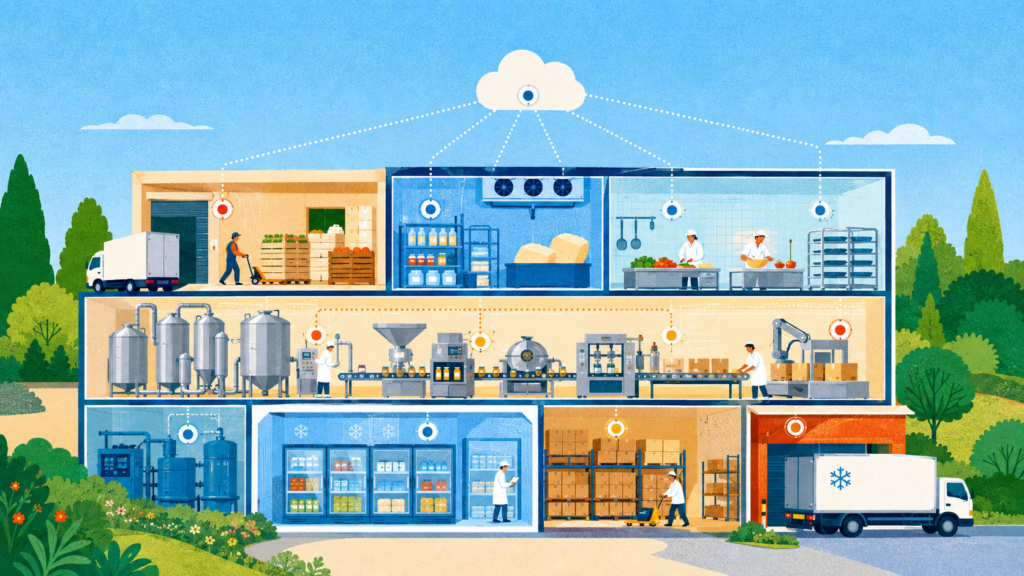
Typical Food Factory Plant
1.Map the Process Before Installing Sensors
The first deployment task is to map where environmental conditions matter to food safety, product quality, and operational control. The monitoring plan should follow the real movement of ingredients and finished products rather than treating the factory as one uniform building.
Start with the plant process flow: receiving, raw-material storage, preparation, processing, cooling, packaging, finished-goods storage, and dispatch. Mark rooms where temperature or humidity is already controlled by an HVAC, refrigeration, dehumidification, or ventilation system. Then identify doors, air curtains, steam sources, washdown zones, ovens, chillers, evaporators, compressors, and other sources of local variation.
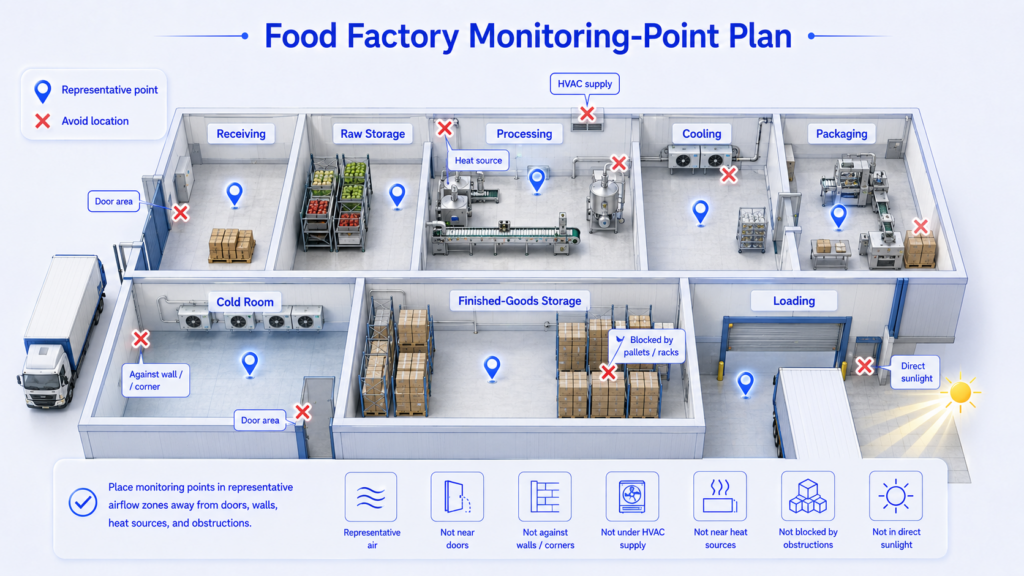
Food factory monitoring-point plan
The survey should also confirm what the environmental system is expected to prove. Ambient monitoring can show that a room, cold store, or packaging area remained within its approved operating range. It cannot automatically prove that a food reached the required core temperature during cooking, cooled within a validated time, or remained below a product-specific critical limit. Those controls need appropriate process probes and procedures defined by the facility’s HACCP plan.
This distinction matters for compliance. The Codex General Principles of Food Hygiene, including the integrated HACCP framework, emphasize Good Hygiene Practices, hazard analysis, monitoring, corrective action, verification, and records. FDA HACCP guidance likewise treats monitoring as a planned sequence of measurements that produces an accurate record, while 21 CFR Part 117 requires written monitoring procedures and records for preventive controls when applicable. EU Regulation (EC) No 852/2004 places primary responsibility on food business operators and requires HACCP-based procedures, temperature control, and cold-chain maintenance where relevant. ISO 22000:2018 provides a food safety management system framework but does not prescribe one universal temperature threshold for every food process. [1][2][3][4][5]
Before purchasing devices, document the approved limits for each zone, the action to take when a limit is exceeded, the responsible role, the record-retention period, and whether the data will be used for operational trending, a prerequisite programme, a preventive control, or a CCP-related verification activity. This prevents the cloud platform from becoming a separate alarm system with no connection to the food safety plan.
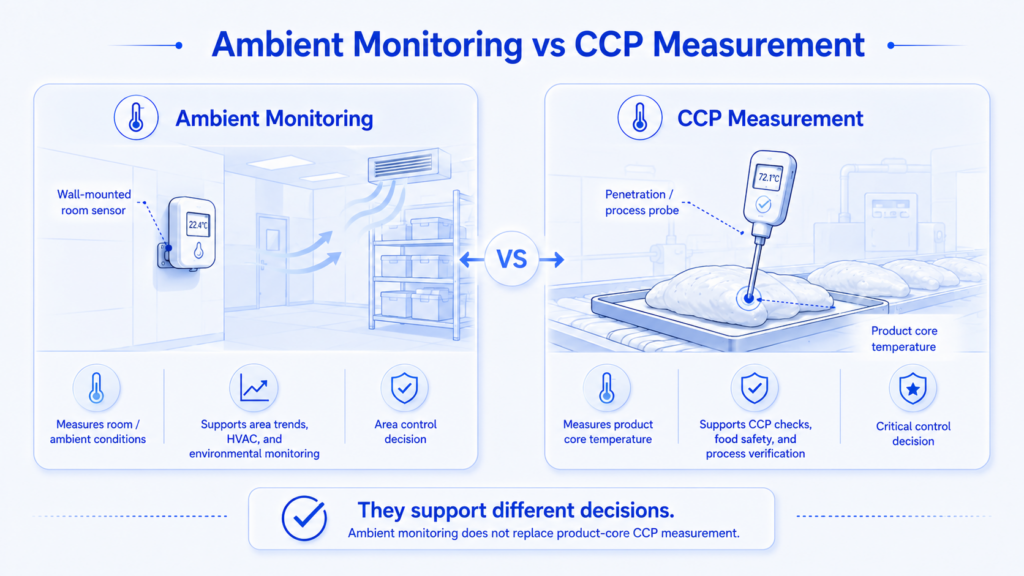
Ambient monitoring versus CCP measurement
2.Plan Monitoring Points Around Risk, Airflow, and Workflow
Monitoring points should represent the conditions experienced by ingredients, products, packaging, or critical work areas. They should not be selected simply because a wall has an available power socket or a strong WiFi signal.
In an ambient production room, a useful starting position is within the occupied and product-handling zone, away from direct supply air, return grilles, steam, radiant heat, exterior walls, and frequent door openings. A height of roughly 1.2 to 1.7 metres may be appropriate for many room-monitoring applications, but it is not a universal rule. The final height should reflect the process, equipment, staff activity, product level, airflow, and cleaning practice.
Cold rooms and freezers need a different approach. Temperature can vary between the evaporator discharge, return-air path, door, centre of the load, upper racks, and lower racks. The permanent sensor should be positioned where it represents stored product conditions rather than the coldest supply-air point. Larger rooms often need front, centre, and rear coverage, with vertical separation where rack height or airflow creates a meaningful gradient. A temperature-mapping exercise using temporary loggers should be used to confirm permanent positions before the monitoring layout is finalized.
Processing and packaging areas may require several types of point. A room sensor can monitor the general environment, while a separate external probe may be needed inside a cabinet, cooler, proofing chamber, ingredient bin, or enclosed process space. High-care and ready-to-eat areas may also need tighter control of condensation and relative humidity. In dry-ingredient or powder areas, humidity can affect caking, flow, packaging, and cleaning conditions even when it is not itself a CCP.
Avoid mounting sensors directly above wash stations, beside steam vents, against metal refrigeration panels, over heaters, or where forklifts, trolleys, pallets, hoses, or cleaning tools can strike them. Door-side monitoring can be valuable for identifying infiltration, but it should normally be treated as a risk point rather than the only reading for the room. A point near an evaporator can help diagnose refrigeration performance, but it should not be used as the sole evidence of product-storage conditions.
When the same production area changes use by shift or season, sensor placement should be reviewed against the highest-risk configuration. Movable racks, temporary partitions, seasonal lines, and new packaging equipment can change airflow enough to invalidate an old placement decision.
3.Select the Sensor, Probe, and Communication Architecture
Device selection should follow the measurement plan. The correct choice depends on whether the project needs ambient room data, an external probe, a direct WiFi connection, a gateway-based network, local memory, battery backup, washdown resistance, or integration with an existing plant system.
For general room monitoring in a food processing plant, the UbiBot GS1-A is a direct-to-cloud 2.4 GHz WiFi temperature and humidity monitor. Its built-in temperature sensor covers -20°C to 60°C with stated accuracy of ±0.2°C from 0°C to 60°C. The humidity sensor covers 0% to 100% RH with stated accuracy of ±2% RH from 10% to 90% RH. The operating environment is specified as 10% to 90% RH, non-condensing. The device stores up to 300,000 records locally, uses a 2500 mAh rechargeable battery, supports Type-C or DC 5-12 V power, and is rated IP65. The GS1-A does not support an external probe, but the other models like GS1-A1RS and GS1A-AL4G1RS under GS1 series support external probes. [6]
That combination makes the GS1-A suitable for fast retrofit monitoring in production rooms, dry stores, packaging areas, corridors, and other representative ambient locations with reliable WiFi. It should not be selected for measuring food core temperature, liquid temperature, or a closed cabinet that requires a remote probe. It should also be protected from direct high-pressure cleaning, steam, persistent condensation, chemical exposure, and physical impact even though the enclosure is IP65.
A gateway-based wireless network can be more effective when a factory needs many points across a large site. The Monnit ALTA Industrial Wireless Humidity Sensor, for example, sends temperature and humidity data over Monnit’s proprietary ALTA radio to a separate gateway. This reduces the number of devices that must join the factory WiFi network and can provide long sensor battery life, but the project must install, power, and maintain the gateway and verify radio paths through metal walls, insulated panels, machinery, and cold rooms. [8]
WiFi is usually the simplest retrofit option when the plant already has stable 2.4 GHz coverage and an IT process for onboarding IoT devices. Ethernet or RS485 can be preferable for fixed installations where cabling is practical, deterministic communications are required, or the data must enter a PLC, SCADA, or building-management system. LoRa can cover large production campuses, warehouses, or remote utility areas through a gateway, but radio planning remains necessary. Cellular communication is useful for detached sites, temporary facilities, or backup paths, although it introduces SIM management, signal testing, and recurring data costs.
Power must be considered at the same time as communications. Battery operation can speed up pilot deployment and reduce cabling, but shorter synchronization intervals, weak WiFi, low temperatures, and frequent reconnect attempts reduce battery life. UbiBot publishes an estimated GS1-A battery life of four to six months under its stated test conditions, and actual service intervals should be confirmed during the pilot. Permanent factory installations are generally easier to maintain when reliable fixed power is available and the battery serves as backup rather than the primary long-term energy source. [6]
4.Install the Hardware and Configure the Cloud Platform
A monitoring project is not complete when devices appear online. The physical installation, network configuration, cloud naming, alarm workflow, and user permissions must be standardized before the system is released to operations.
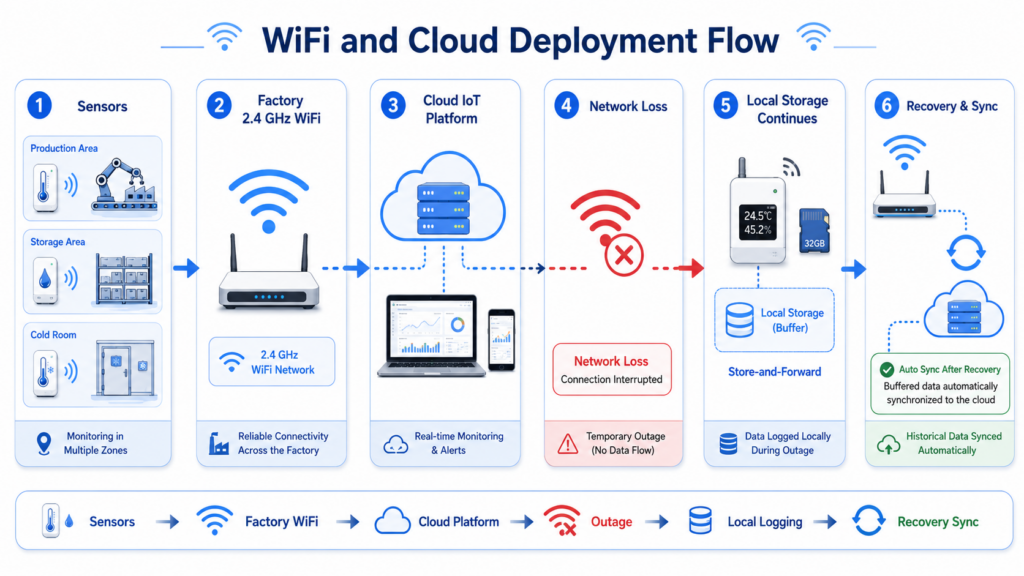
Wi–Fi and cloud deployment flow
Mount each logger on a clean, stable surface with free airflow around the sensing area. Use brackets that allow inspection and removal for calibration without creating hygiene traps. Place the device outside direct spray paths and protect cables from abrasion, washdown, doors, mobile equipment, and sharp stainless-steel edges. Where a probe passes through an insulated panel or enclosure, use an appropriate sealed penetration and avoid creating a condensation path.
Carry out the WiFi survey while the plant is operating. Machinery, people, stock, insulated panels, cold-room doors, and cleaning activities can change signal conditions compared with an empty building. Test the intended mounting point with doors closed and production equipment running. The UbiBot GS1-A uses 2.4 GHz WiFi and does not support 5 GHz WiFi or WPA2-Enterprise authentication, so the network design must provide a compatible SSID and security method. [6]
Use a naming convention that ties the physical point to the digital record. A format such as Site – Building – Area – Line – Position is easier to audit than serial numbers alone. The same identifier should appear on the device label, layout drawing, calibration record, maintenance register, and cloud platform.
On the platform, group devices by site, production zone, cold store, packaging area, or responsibility. Set the local recording interval and cloud synchronization interval separately where the system allows it. A shorter recording interval creates more detail, while a shorter upload interval improves alert speed but increases network traffic and power consumption. During commissioning, shorter intervals can help identify door events, HVAC cycles, and local disturbances. The final settings should be based on risk, product requirements, response time, and record-retention needs.
Alarm thresholds should come from approved operating limits, not copied values from another factory. Configure high and low limits, time delay, recovery or hysteresis, offline warnings, low-battery warnings, and escalation contacts. A short steam-cleaning event may need a different alarm delay from a cold-room failure. The delay should filter known transient events without hiding a sustained loss of control.
The UbiBot public platform supports real-time and historical data, CSV and PDF export, customizable alerts, data sharing, forwarding, and API access. UbiBot also offers on-premises deployment for organizations that require local storage or tighter control of infrastructure. Some functions, such as sub-accounts, automated reports, advanced APIs, offline alerts, SMS, or voice notifications, depend on the selected plan or regional service. These commercial details should be confirmed before the user and escalation model is finalized. [7]
Create role-based access rather than sharing one account. Operations staff may need current conditions and acknowledgements; quality personnel may need reports, configuration review, and audit records; maintenance staff may need device status and battery warnings; IT staff may need integration and network access. Only authorized roles should be able to change limits, intervals, notification rules, or device assignments.
5.Commission, Validate, and Maintain the System
Commissioning should test the full monitoring chain: sensor, location, power, local storage, network, cloud, alarm, response procedure, and record output. A plausible value on the display is not enough.
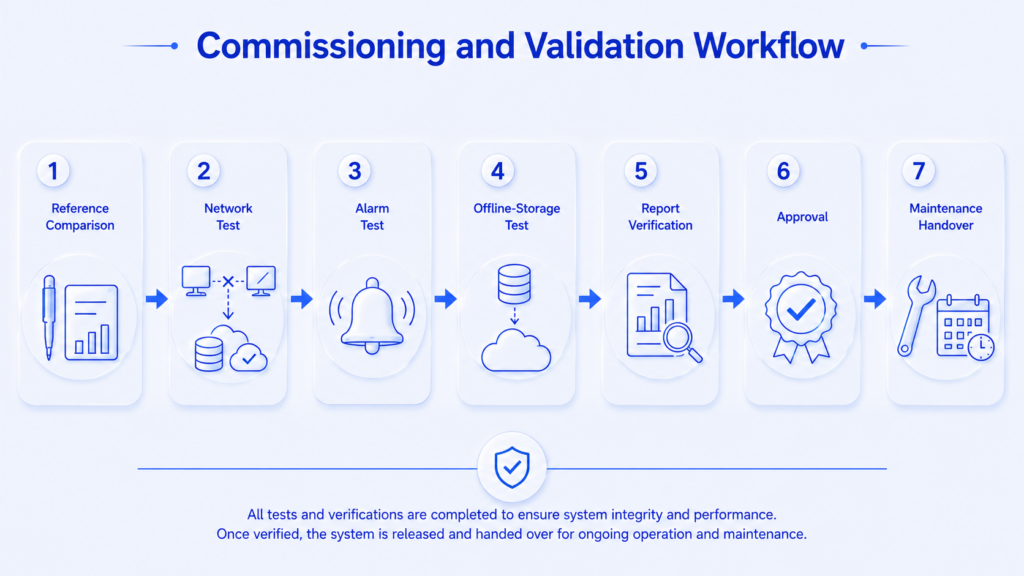
Commissioning and validation workflow
Begin with a side-by-side comparison against a suitable calibrated reference instrument after both devices have stabilized in the same environment. Record the device ID, location, reference ID, test time, observed values, permitted difference, and result. This installation check is not a substitute for formal calibration, but it can identify damaged sensors, incorrect locations, configuration errors, or obvious drift before production use.
Trigger a controlled high or low alarm and confirm the delay, notification channel, recipients, timestamp, acknowledgement, and escalation. Disconnect WiFi long enough to confirm that the logger continues recording locally, then restore the network and verify that missing records synchronize in the correct sequence. Test low-power or power-loss alerts where applicable, and confirm that report exports contain the expected timezone, units, device names, and complete data range.
Verification and calibration should be defined in the plant’s SOPs. FDA HACCP guidance identifies equipment calibration and working condition as part of verification evidence, while food safety systems generally require monitoring equipment to remain fit for its intended purpose. The calibration interval should be risk-based and may be shortened after impact, repair, unexplained drift, extreme exposure, or a failed comparison. [2]
Routine maintenance should include enclosure inspection, battery or power checks, cleaning in accordance with the manufacturer’s instructions, WiFi health review, alarm-contact review, calibration status, and comparison of adjacent points for unexpected divergence. Any relocation, line change, HVAC modification, rack change, or cold-room repair should trigger a review of sensor placement and alarm settings.
Deployment scale reference
| Factory scale | Typical architecture | Platform configuration | Primary implementation concern |
|---|---|---|---|
| Small plant or pilot | A limited number of direct WiFi loggers in selected rooms and stores | Public cloud, simple groups, named alert contacts | Representative placement and reliable WiFi at each point |
| Medium multi-zone plant | WiFi loggers plus selected external probe or gateway devices | Zone templates, role-based access, scheduled reports | Consistent naming, alarm ownership, calibration and maintenance |
| Large or multi-building site | Mixed WiFi, Ethernet/RS485, LoRa or gateway architecture with redundancy | Central governance, API integration, multi-site permissions, data retention policy | Network segmentation, change control, scale, and integration with food safety systems |
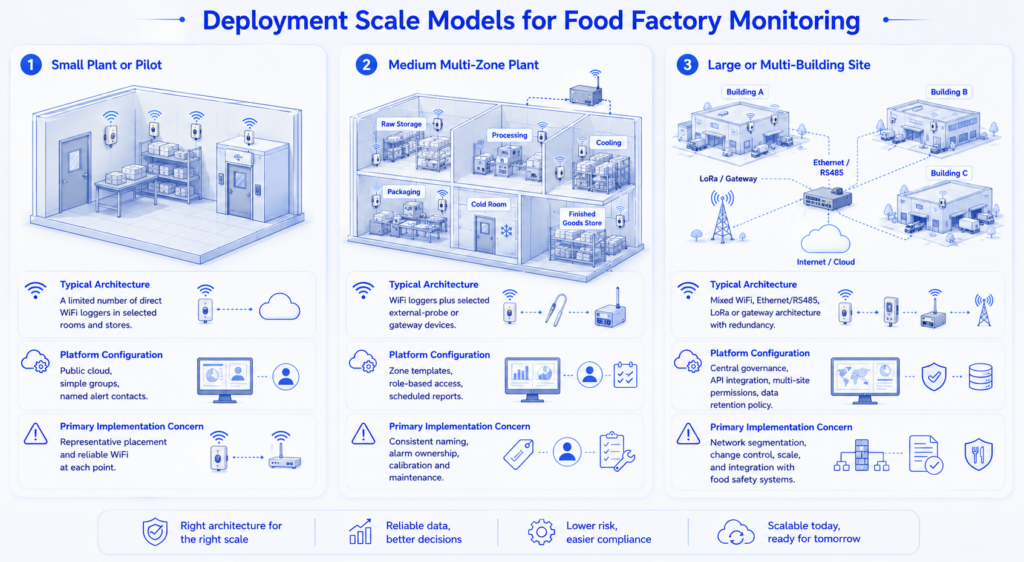
Small, medium, and large factory architectures
6.Comparing Food Factory Monitoring Devices
The products below represent four deployment routes: a direct-to-WiFi ambient monitor, a gateway-based industrial wireless network, a WiFi logger with a separate probe, and a powered compliance-oriented cloud logger. They are not identical substitutes, so the comparison focuses on implementation decisions rather than a single overall ranking.
| Comparison item | UbiBot GS1-A | Monnit ALTA Industrial Wireless Humidity Sensor + ALTA Gateway | testo Saveris 2-H2 (0572 2035) + probe 0572 2155 | Dickson DWE2 + RTRH-R |
|---|---|---|---|---|
| Deployment route | Direct 2.4 GHz WiFi ambient monitor | Proprietary ALTA wireless sensor connected to a separate gateway | Direct 2.4 GHz WiFi logger with external temperature/RH probe | Powered WiFi or Ethernet logger with field-replaceable sensor |
| Temperature range and accuracy | -20 to 60°C; ±0.2°C from 0 to 60°C | Leaded: -25 to 70°C; industrial non-leaded: -40 to 70°C; ±0.3°C typical, ±0.5°C maximum | Probe: -30 to 70°C; ±0.5°C | Sensor: -40 to 85°C; official page lists ±0.8°F from 20 to 120°F and ±1.8°F over the remaining range |
| Humidity range and accuracy | 0 to 100% RH sensing; ±2% RH from 10 to 90% RH; operating environment 10 to 90% RH non-condensing | 0 to 100% RH non-condensing; ±3% RH typical, ±5% RH maximum | 0 to 100% RH; ±2% RH at 25°C from 2 to 98% RH | 5 to 95% RH non-condensing; ±2% RH from 5 to 95% RH |
| Connectivity | 2.4 GHz WiFi; no 5 GHz or WPA2-Enterprise | ALTA FHSS radio to gateway; regional radio versions | 2.4 GHz WiFi, IEEE 802.11 b/g/n and 802.1x; MQTT and SNTP | 2.4 GHz WiFi or Ethernet |
| Local storage | Up to 300,000 records | 2,000 to 4,000 readings during gateway loss | 10,000 readings per channel | Approximately 400,000 backup sample points |
| Power | 2500 mAh rechargeable lithium battery; Type-C or DC 5-12 V; published 4-6 months under stated test conditions | 3.6 V lithium-thionyl-chloride battery; 10+ years expected for industrial model | 4 AA batteries; technical table states 12 months typical; optional mains unit | 120-240 VAC / 12 VDC with about 72 hours battery backup |
| Enclosure | IP65; protect from direct washdown, steam, condensation, and chemical exposure | IP65; NEMA 1, 2, 4, 4X, 12 and 13 | Logger IP54; probe connected by 1.3 m cable | Logger IP21 |
| Probe flexibility | No external probe on GS1-A | Leaded and non-leaded options; 3, 10 and 25 ft lead options listed | External probe required; probe can be calibrated separately | Field-replaceable remote sensor; extension cable options |
| Cloud and alerts | UbiBot public cloud, app/web, alerts, export, API and optional on-premises platform | iMonnit software and alerts; gateway required | Testo Cloud; email and optional SMS; cloud license and plan conditions apply | DicksonOne subscription; phone, SMS, email and audible alarms |
| Calibration | Calibration and traceability support should be confirmed for the purchased project and region | Optional 7-month ISO 17025 / NIST certificate options | ISO and DAkkS certificate options | NIST and A2LA calibration options |
| Best fit and main limitation | Fast ambient WiFi deployment with large local memory; no external probe | Large multi-point wireless network and long sensor battery life; gateway adds infrastructure | External-probe monitoring for cold, storage, and work areas; requires separate probe and cloud service | Fixed compliance-oriented installation with WiFi/Ethernet and replaceable sensor; powered logger has IP21 enclosure |
The UbiBot GS1-A has the simplest architecture of the four when a plant wants a reusable ambient monitor that connects directly to an existing 2.4 GHz WiFi network. Its large local memory reduces the risk of data gaps during temporary outages. The trade-off is that the GS1-A cannot accept an external probe, and its network compatibility must be checked before installation.
The Monnit system separates the sensor network from the plant IP network. That can be useful for a large site with many points and can reduce WiFi onboarding work, but the project depends on gateway placement and proprietary radio coverage. The industrial enclosure and long expected battery life are advantages in distributed facilities, while metal structures and cold-room panels still require site testing.
The testo Saveris 2-H2 is designed around an external digital probe, which can be helpful when the logger should remain accessible while the measurement point is inside a cabinet, cold area, or controlled space. The cloud license, external probe, and IP54 logger enclosure should be included in the installation and lifecycle cost.
The Dickson DWE2 is a fixed, powered logger with WiFi or Ethernet, a large backup memory, several alarm channels, and replaceable sensors. It fits facilities that prioritize controlled infrastructure and calibration options, but the IP21 logger requires a protected indoor location and the DicksonOne subscription is part of the operating model.
7.Frequently Asked Questions
How many temperature sensors does a food factory need?
There is no reliable sensor-per-square-metre rule for every plant. The number should follow the process zones, airflow, room size, rack height, doors, heat and moisture sources, and the risk identified by mapping. Each separately controlled or materially different area should have representative coverage.
Where should a HACCP temperature monitor be installed?
Install the sensor where it represents the approved control point or environmental zone defined by the food safety plan. For ambient monitoring, avoid direct supply air, steam, heaters, exterior walls, and frequent door openings. For a CCP such as cooking or cooling, use the validated process measurement method rather than relying on a room sensor.
Can a WiFi temperature logger keep recording when the network fails?
A logger with local memory can continue recording during a temporary outage and upload the stored data when connectivity returns. This behaviour must be tested during commissioning. Alarm delivery will normally be delayed while the device or cloud connection is offline.
Is an IP65 sensor suitable for direct food-factory washdown?
IP65 indicates dust protection and resistance to low-pressure water jets under test conditions. It does not mean the device should be placed in direct high-pressure washdown, steam, chemical spray, or persistent condensation. Use a protected location or suitable enclosure and follow the manufacturer’s cleaning instructions.
Can ambient monitoring replace product-core temperature checks?
No. Ambient data describes the surrounding room or storage environment. Product-core, cooking, cooling, pasteurization, or other validated CCP measurements require probes and procedures suitable for that process. Ambient monitoring can support investigation and verification, but it should not be treated as equivalent evidence.
How often should food factory temperature sensors be calibrated?
The interval should be defined by the facility’s risk assessment, HACCP or preventive-control plan, customer requirements, manufacturer guidance, and past performance. Calibration or additional verification should also follow impact, repair, unexplained drift, extreme exposure, or a failed comparison.
How should temperature and humidity alarm limits be set?
Use product specifications, approved room limits, validated process requirements, and the facility’s food safety plan. Configure delays and escalation carefully so routine door openings or cleaning do not create unnecessary alarms while sustained loss of control is still detected early.
Can food factory sensor data be integrated with MES, SCADA, BMS, or HACCP software?
Yes, when the selected platform provides API, MQTT, data forwarding, database access, or a suitable gateway. The integration should preserve device identity, timestamps, units, alarm status, and data completeness, and it should be tested with the plant’s real naming and record workflows.
8.A Practical Deployment Decision
A successful food factory temperature monitoring deployment begins with the process map and the food safety plan, not the device catalogue. The project team should define what each point is expected to represent, confirm the approved limits and response procedure, select an architecture that fits the plant network and cleaning environment, and validate the full path from measurement to alarm and record.
Direct WiFi devices such as the UbiBot GS1-A can reduce installation effort in ambient production and storage areas where compatible 2.4 GHz coverage already exists. Gateway systems can scale across larger sites, external-probe loggers can reach enclosed or difficult locations, and Ethernet or RS485 solutions may fit fixed industrial infrastructure. The best design is the one that remains representative, maintainable, auditable, and connected to real operational action after the pilot is over.
9.Official Product and Regulatory Sources
[1] Codex Alimentarius / FAO-WHO. General Principles of Food Hygiene (CXC 1-1969), revised 2022 and published in updated format in 2023. https://www.fao.org/fao-who-codexalimentarius/publications/en/
[2] U.S. Food and Drug Administration. HACCP Principles & Application Guidelines. https://www.fda.gov/food/hazard-analysis-critical-control-point-haccp/haccp-principles-application-guidelines
[3] Electronic Code of Federal Regulations / LII. 21 CFR 117.145 – Monitoring. https://www.law.cornell.edu/cfr/text/21/117.145
[4] EUR-Lex. Regulation (EC) No 852/2004 on the hygiene of foodstuffs. https://eur-lex.europa.eu/eli/reg/2004/852/oj/eng
[5] International Organization for Standardization. ISO 22000:2018 – Food safety management systems. https://www.iso.org/standard/65464.html
[6] UbiBot. GS1 official specifications, GS1-A product page, and battery guidance. https://www.ubibot.com/ubibot-gs1-specifications/
[7] UbiBot. Public IoT Platform, pricing, API, alerts, export, and on-premises platform. https://www.ubibot.com/public-cloud-pricing/