

.svg)
Guide to Deploying a Cold-Chain Temperature Monitoring System
Published: July 29, 2026
Update: August 28, 2026
By Jimmy Lianson
Key Takeaway
A successful cold chain temperature monitoring deployment connects four elements: representative sensor placement, reliable local recording, appropriate route communication, and a documented response process.
Introduction
Once a company has decided to monitor refrigerated transport, purchasing a temperature data logger is only the beginning. The more difficult work is determining what temperature the system should measure, where the sensors should be installed, how data will be transmitted from a metal vehicle, and what should happen when a temperature excursion occurs.
A cold chain temperature monitoring system must also continue recording when cellular coverage is unavailable. It should distinguish a short door-opening event from a sustained refrigeration failure, preserve records until they reach the cloud, and give operations teams enough information to respond before a shipment is rejected.
The correct deployment therefore depends on the cargo, route, vehicle, refrigeration system, and compliance requirements. A refrigerated food shipment, a pharmaceutical shipment, and a frozen product load may use similar hardware, but they should not automatically use the same sensor positions, alarm limits, or reporting intervals.
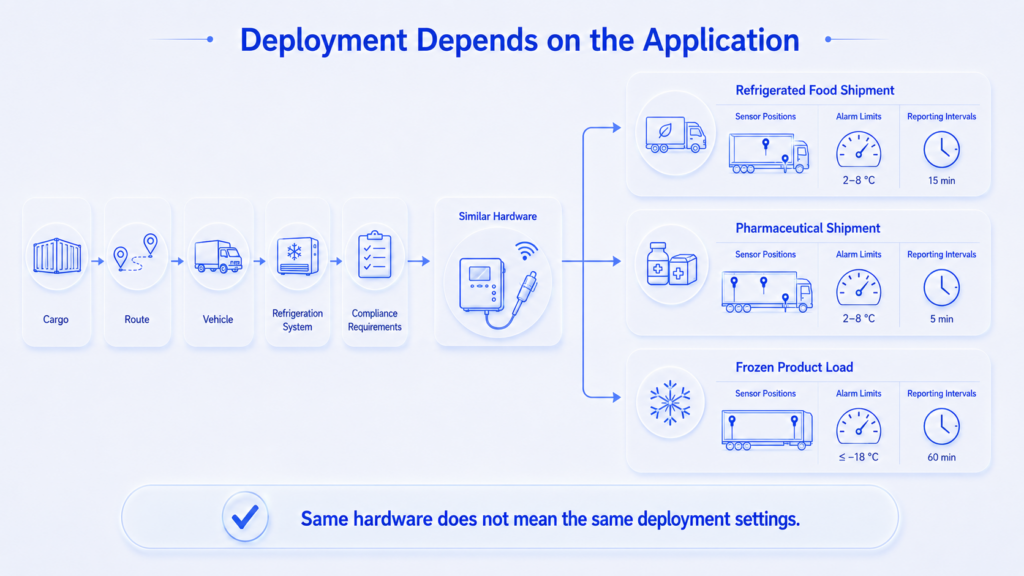
Deployment process diagram
1.Start with the Cargo, Route, and Vehicle Survey
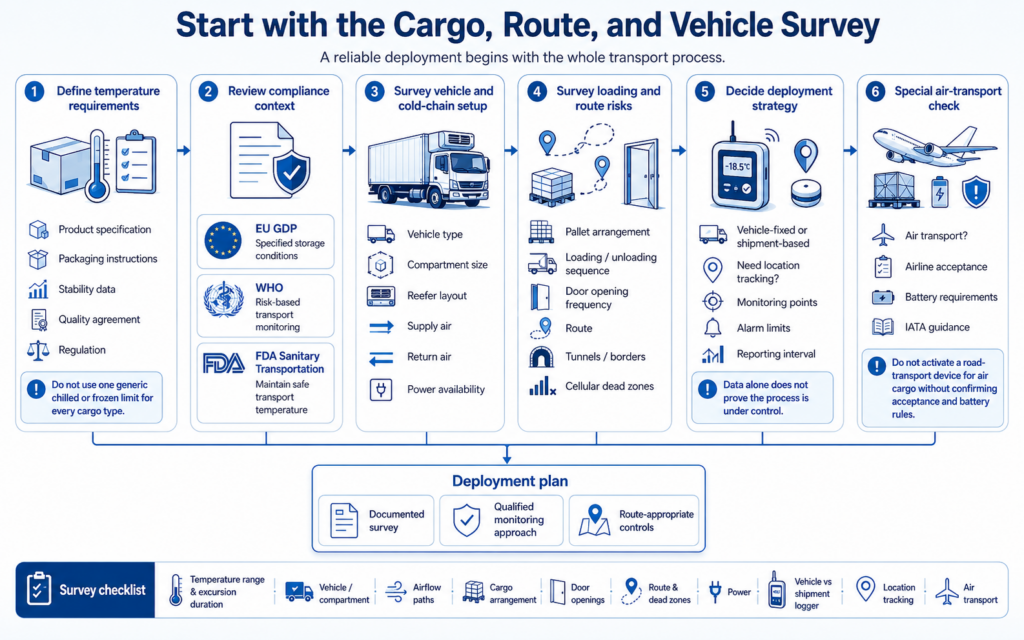
A reliable deployment begins with a survey of the entire transport process rather than an isolated inspection of the vehicle.
The first question is not which logger to purchase, but which temperature limits must be maintained. These limits should come from the product specification, packaging instructions, stability data, quality agreement, or applicable regulation. A generic chilled or frozen threshold should not be applied to every cargo category.
For pharmaceutical products transported in the European Union, the EU Good Distribution Practice guidelines require the specified storage conditions to be maintained during transportation. They also call for a risk-based approach to route planning, documented procedures for handling excursions, and regular calibration of transport temperature-monitoring equipment, at least annually.
The WHO guidance for time- and temperature-sensitive pharmaceutical products similarly treats vehicle qualification, route profiling, and transport temperature monitoring as connected activities. A logger installed without understanding the expected route and seasonal conditions may collect data, but it does not by itself demonstrate that the transport process is under control.
For food transported by road or rail in the United States, the FDA Sanitary Transportation rule requires vehicles and transport equipment to be capable of maintaining the temperatures needed for safe transportation. The rule does not prescribe one specific type of logger; the shipper and carrier may agree on an appropriate temperature-monitoring mechanism. Covered parties must still be able to demonstrate that requested conditions were maintained when required.
Cargo, route, and vehicle survey process
During the site and route survey, the deployment team should document:
- The required temperature range and permitted excursion duration.
- Vehicle type, compartment dimensions, and refrigeration-unit layout.
- Supply-air and return-air paths.
- Normal pallet, crate, or tote arrangement.
- Loading and unloading sequence.
- Frequency and duration of door openings.
- Planned routes, tunnels, border crossings, and cellular dead zones.
- Availability of vehicle power.
- Whether the logger will remain with the vehicle or travel with each shipment.
- Whether location tracking is required in addition to temperature monitoring.
- Whether the route includes air transport.
The final point is particularly important. Battery-powered cargo tracking devices and data loggers carried by air are subject to airline procedures and applicable dangerous-goods rules. IATA publishes specific guidance covering battery-powered cargo tracking devices and data loggers. A device that is suitable for road transport should not automatically be activated inside air cargo without confirming airline acceptance and the applicable battery requirements.
2.Plan Monitoring Points Around Real Temperature Risks
The sensor should represent the cargo environment, not the nearest convenient mounting surface. Refrigerated vehicles can contain significant temperature differences between the refrigeration unit, the centre of the load, and the rear doors.
A sensor mounted directly in the cold-air discharge may report a lower temperature than the cargo experiences. A sensor fixed against a metal wall or roof may respond to the vehicle body rather than the air surrounding the products. A logger placed beside the rear door may detect every loading event but may overstate conditions across the rest of the compartment.
For a small single-compartment refrigerated vehicle, the primary monitoring point should normally be located within the representative cargo zone, away from the floor, ceiling, sidewalls, and direct refrigeration discharge. When the load or risk level justifies additional points, the deployment can include a second sensor near the rear-door area and another near the return-air path. The door-side sensor helps identify warm-air entry during deliveries, while the return-air position can help show the temperature of air returning from the loaded compartment.
Larger trailers require more than one monitoring point. A practical layout may place sensors toward the front, centre, and rear of the cargo area, with additional vertical separation where the load height or airflow pattern may create upper and lower temperature differences. Multi-compartment vehicles should have at least one representative point in each independently controlled compartment.
These positions are starting points, not universal prescriptions. Final placement should be confirmed by a temperature-mapping or route-profiling study using a larger number of temporary loggers. The study should include representative loading patterns and, where risk warrants, both warm-season and cold-season operation. WHO temperature-mapping guidance defines mapping as recording temperature distribution in three-dimensional spaces, reinforcing that a single measurement cannot automatically represent an entire enclosure.
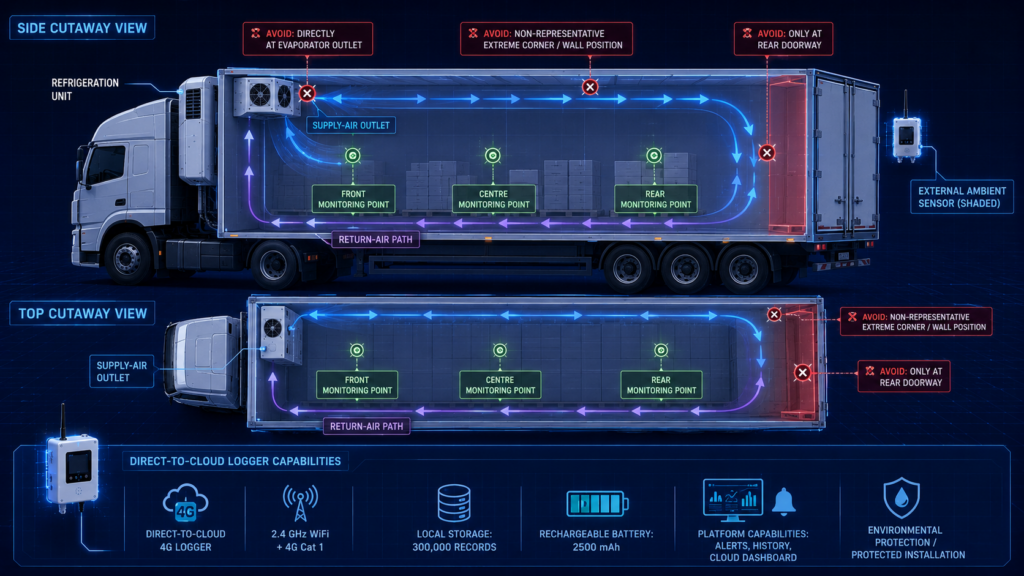
Refrigerated truck sensor placement diagram
The system must also distinguish between air temperature and product temperature. An exposed sensor reacts quickly to door openings and refrigeration cycles. A buffered or inserted probe reacts more slowly and may more closely approximate the thermal response of the product. Neither measurement is inherently superior; they answer different questions. The deployment team should decide which value is needed for control, which is needed for investigation, and whether both should be recorded.
Sensor locations should generally avoid:
- Direct contact with walls, ceilings, or floors.
- Direct supply-air discharge.
- Refrigeration coils and local heat sources.
- Areas where cargo can crush or cover the device.
- Condensation drains and standing water.
- Positions that drivers or warehouse staff may remove accidentally.
- Unprotected locations exposed to impact during loading.
An ambient external sensor can also be useful for route analysis. Comparing outside temperature with compartment temperature helps explain refrigeration load and makes it easier to distinguish equipment performance from unusually severe weather.
3.Select the Logger, Probe, and Communication Architecture
The monitoring device should be selected after the measurement points and operating process have been defined. Range, accuracy, and communication are important, but they should be evaluated together with local storage, power, environmental protection, and platform capabilities.
For reusable refrigerated trucks, a direct-to-cloud 4G logger can simplify deployment because each vehicle connects independently without a vehicle-mounted gateway. The UbiBot GS1-A4G supports 2.4 GHz WiFi and 4G Cat 1 communication, stores up to 300,000 records locally, and uses a built-in 2500 mAh rechargeable lithium battery. Its built-in temperature sensor measures from -20°C to 60°C, with stated accuracy of ±0.2°C from 0°C to 60°C. Its humidity sensor measures from 0% to 100% RH, with stated accuracy of ±2% RH from 10% to 90% RH.
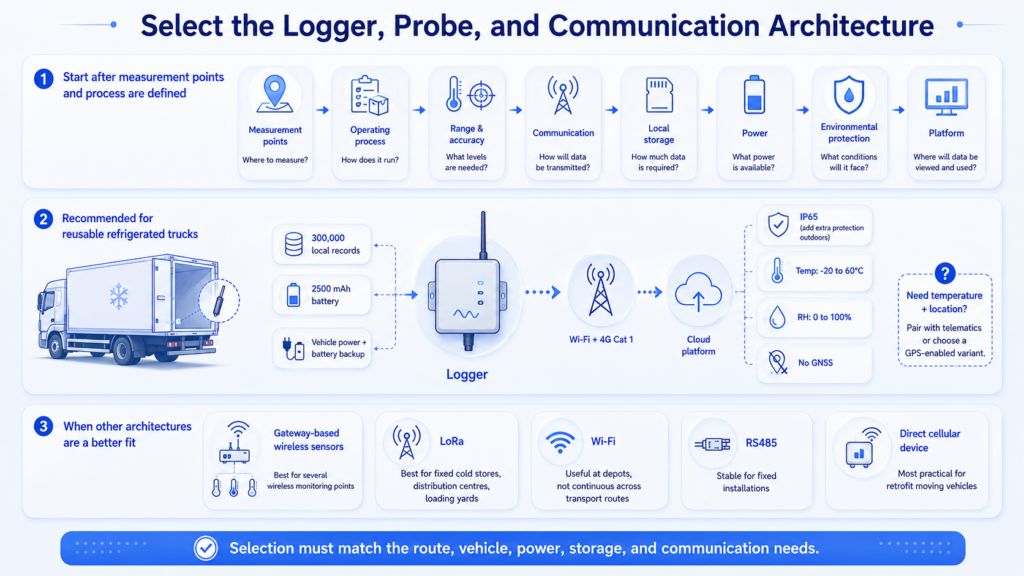
Logger, probe, and communication architecture selection process
The GS1-A4G is an IP65-rated device, but UbiBot recommends additional protection against continuous rain, high humidity, and direct sunlight during prolonged outdoor exposure. Inside a refrigerated compartment, the unit should still be protected against direct wash-down, impact, and persistent condensation.
Battery-life calculations need to reflect actual communication settings. UbiBot’s GS1 model comparison states an estimated operating period of three to six weeks when the GS1-A4G synchronizes through a SIM connection, while WiFi-only operation can extend battery life to four to six months. Actual results depend on synchronization frequency, signal quality, and ambient conditions. A permanent vehicle installation should therefore use protected vehicle power where practical, while retaining the internal battery as temporary backup.
The GS1-A4G does not include GNSS positioning. Companies that need temperature and location in the same device should either combine it with the vehicle’s telematics platform or evaluate a GPS-enabled GS1 variant, such as the GS1-P4G or GS1-PL4G1RS. The product selection must therefore distinguish real-time environmental monitoring from real-time shipment location tracking.
A gateway-based architecture may be more appropriate when a vehicle or facility needs several wireless monitoring points. Monnit’s ALTA industrial temperature sensors communicate with an ALTA IoT Gateway, which then uses 4G LTE Cat-M1/NB2 to transfer sensor data to iMonnit. This architecture supports a larger distributed sensor network, but it introduces an additional powered gateway and a proprietary radio layer between each sensor and the cloud.
LoRa can be effective in distribution centres, loading yards, and fixed cold stores where a gateway covers multiple sensors. It is less suitable as the only communication method for a truck travelling beyond the gateway’s coverage area. WiFi is useful at depots but rarely provides continuous communication across a transport route. RS485 is stable for fixed installations, but additional wiring and moving-vehicle constraints usually make direct cellular devices more practical for retrofit projects.
4.Install the Hardware and Test Connectivity
The logger should be mounted where it can sense representative air while remaining protected from cargo movement, water, and physical damage. The installation should be repeatable across the fleet so that data from different vehicles can be compared.
A protective bracket or perforated guard can prevent accidental impact without sealing the sensor away from airflow. The logger should remain accessible for inspection, charging, and maintenance, but it should not be placed where it is routinely touched or moved during loading.
Metal vehicle bodies can weaken cellular signals. Before final mounting, test the device in the actual closed and loaded compartment rather than beside an open door. If the device uses an external antenna, position and secure it according to the manufacturer’s installation requirements. Avoid routing antenna and power cables where pallets, doors, or cleaning equipment can damage them.
Where continuous monitoring is required, connect the logger to a protected vehicle power source installed by a qualified technician. The wiring should not interfere with refrigeration controls, vehicle safety systems, or normal maintenance access. Battery-only deployment may be suitable for temporary trials, seasonal vehicles, or short routes, but the maintenance plan must include charging or replacement before the expected operating period ends.
Commission each device before assigning it to a live shipment. Confirm the SIM or network service, check that the regional LTE bands are supported, verify the time zone, and allow the device to complete at least one full record-and-upload cycle. The UbiBot GS1-A4G supports 4G Cat 1 across multiple LTE bands, but regional operator compatibility and roaming arrangements should still be checked before a fleet is deployed across several countries.
A practical naming convention makes the platform easier to manage. Instead of names such as “GS1-001,” use a structure such as Region – Depot – Vehicle – Compartment – Sensor Position. For example: EU-West – Rotterdam – Truck-028 – Chilled – Rear. The physical label on the device should match the cloud name, maintenance record, and calibration certificate.
5.Configure the IoT Cloud Platform and Alarm Workflow
The cloud platform should be configured as an operational system, not simply as a screen for viewing charts. Device grouping, alarm responsibilities, data retention, and escalation rules should be agreed before the fleet goes live.
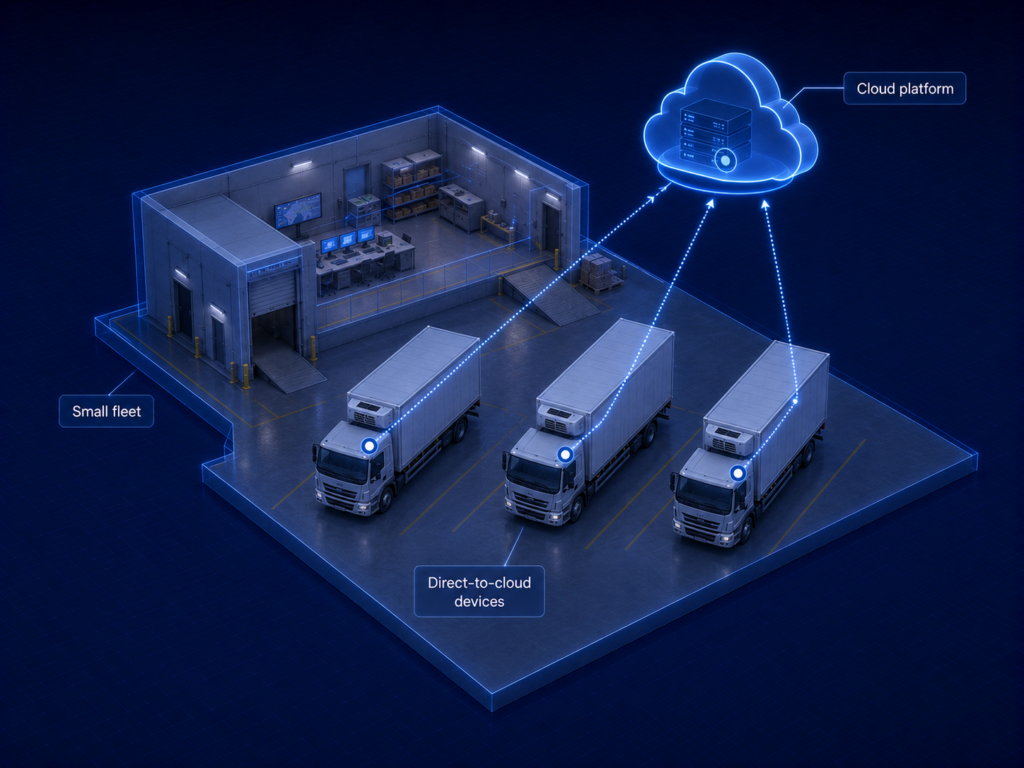
A small fleet using independent direct-to-cloud devices
Start by grouping devices according to business structure. A large operator may group devices by country, distribution centre, fleet, customer, or cargo type. A smaller operator may only need separate groups for chilled, frozen, and controlled-ambient vehicles.
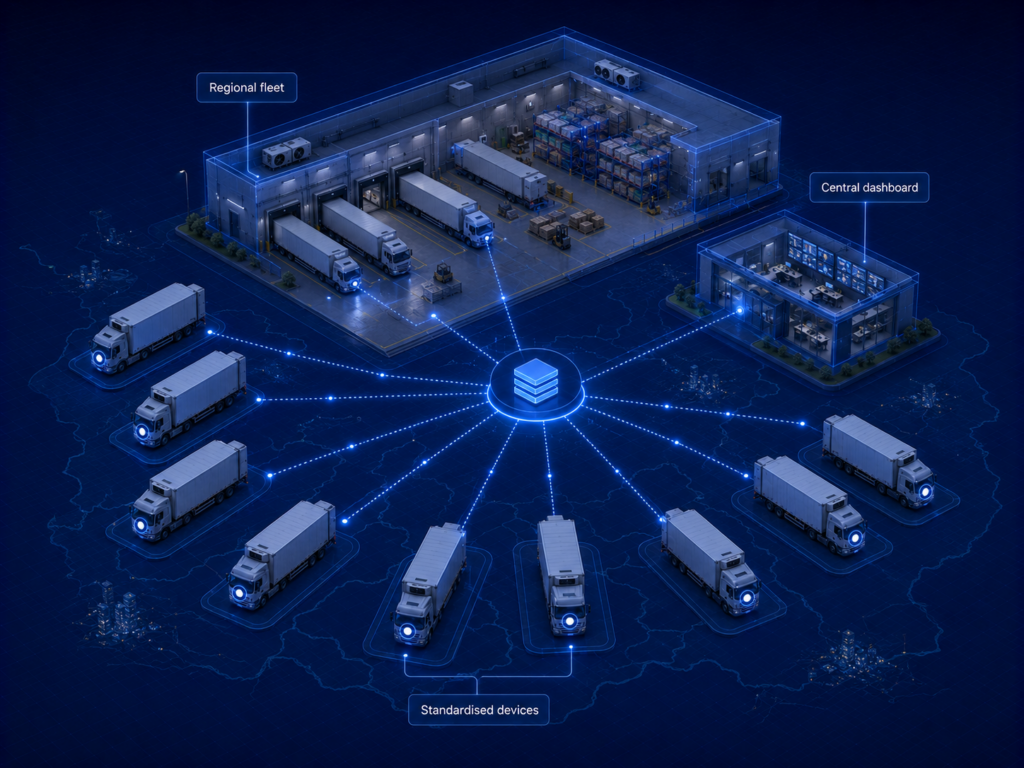
A regional fleet using standardized devices and a central dashboard
The recording interval determines the detail retained locally, while the upload interval affects alert speed, battery consumption, and cellular data use. High-risk cargo may justify faster synchronization than stable, long-distance loads. During the pilot stage, use a shorter interval to understand door openings, refrigeration cycles, and route behaviour. The final interval should then be defined by risk assessment, product requirements, and operational response capability.
Alarm limits should never be copied blindly from another customer or vehicle. Configure them from the approved product range and quality procedure. A short temperature spike during unloading may not require the same response as a sustained refrigeration failure. Alarm delays can reduce unnecessary notifications, but an excessive delay may conceal a genuine excursion. The delay must therefore reflect product stability, delivery practice, and the time available for corrective action.
A practical alarm configuration may include:
- High-temperature limit.
- Low-temperature or freezing limit.
- Time delay before escalation.
- Recovery or hysteresis setting.
- Device-offline warning.
- Low-battery warning.
- Sensor-error warning.
- Escalation to a second contact if the first alert is not acknowledged.
The UbiBot public IoT platform supports real-time and historical data viewing, alerts, CSV and PDF exports, multi-device management, and API-based integration. Public-cloud, on-premises, and developer-integration options are available, although storage, sub-accounts, automated reports, and advanced API functions can depend on the selected plan.
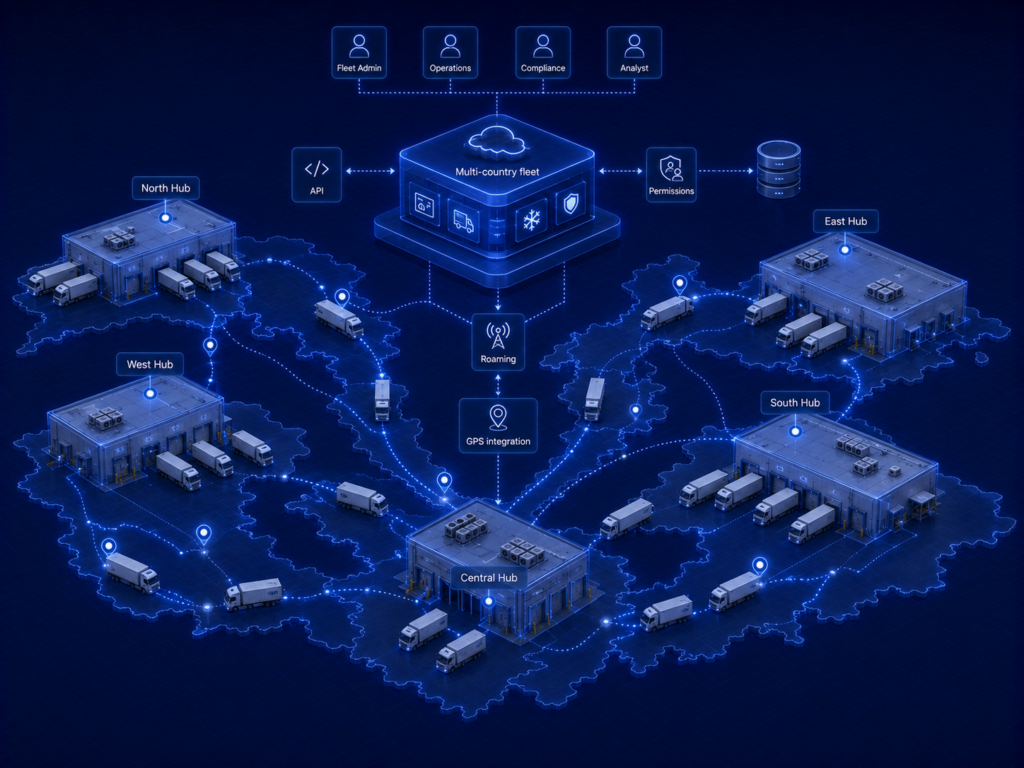
A multi-country fleet using API, permissions, roaming, and GPS integration
For a cold chain operation, the platform deployment should define:
- Who receives the first alert.
- Who is authorised to change alarm limits.
- Who investigates an excursion.
- How corrective action is recorded.
- How drivers, dispatchers, and quality teams share access.
- How long records must be retained.
- Whether reports are exported manually or transferred through an API.
- Whether temperature data should be linked to shipment, route, or vehicle IDs.
Where a transport management system, warehouse management system, or customer portal already exists, the API integration should be tested with real shipment identifiers. Sending data into a separate dashboard without matching it to the correct load can create more administrative work rather than improving traceability.
6.Validate the System Before Full Fleet Rollout
A device that displays a plausible temperature is not necessarily ready for operational use. The completed installation should be tested as a system, including the sensor, network, platform, alerts, power supply, and response procedure.
Begin with a side-by-side comparison against a calibrated reference instrument at a stable temperature. Record the device serial number, reference instrument, test time, and observed difference. This commissioning check does not replace formal calibration, but it can detect configuration mistakes, damaged sensors, or major offsets before deployment.
The acceptance test should also include a controlled alarm event. Change the test environment enough to cross the configured threshold, then confirm that the platform records the excursion and sends the correct notification to each intended contact. Repeat the test for an offline condition by temporarily interrupting connectivity. The logger should continue recording locally and synchronize the missing records after communication returns.
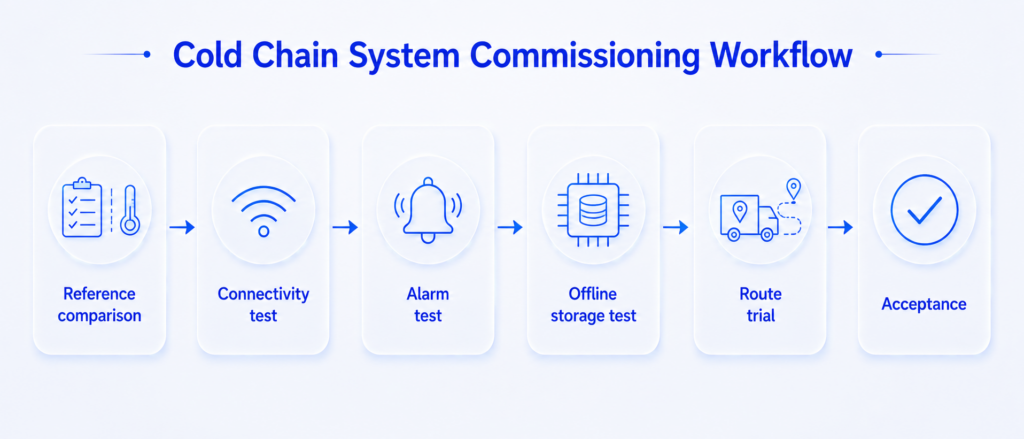
Cold Chain System Commissioning Workflow
For pharmaceutical operations subject to EU GDP, monitoring equipment used in vehicles or containers should be maintained and calibrated at regular intervals, at least annually. Route risk assessment, documented excursion handling, and evidence that the required conditions were maintained should be incorporated into the quality system.
For food transport under the FDA rule, the shipper and carrier should document who is responsible for temperature control and how requested conditions will be demonstrated. The FDA uses a flexible approach rather than mandating one specific temperature recorder, but written procedures and appropriate records remain important.
The scale of deployment changes the system architecture:
| Deployment scale | Typical architecture | Platform approach | Main implementation concern |
|---|---|---|---|
| Small fleet or pilot | One direct-to-cloud logger per vehicle, with additional points only where mapping identifies risk | Public cloud with individual alerts | Correct placement and proving cellular coverage |
| Regional fleet | Standardised sensor kit for each vehicle, shared naming and alarm templates | Central dashboard with user roles and fleet groups | Consistency across vehicles and maintenance teams |
| Multi-country operation | Multiple points, cellular roaming, vehicle telematics or GPS integration, API connection | Central platform, automated reports, and system integration | Regional network compatibility, governance, and data ownership |
| High-compliance pharmaceutical network | Qualified routes, calibrated devices, controlled settings, and documented excursion workflow | Validated or controlled platform environment | Calibration, audit records, and change control |
A fleet should be expanded only after the pilot has covered normal loading, door-opening events, weak-signal routes, and at least one realistic refrigeration disturbance. The pilot is also the correct time to determine whether the chosen sensor responds too quickly, too slowly, or at the wrong location for the operational question.
7.Comparison of Cold Chain Monitoring Devices
The products below represent four different deployment routes: a reusable direct-to-cloud 4G monitor, a gateway-based wireless system, a purpose-built real-time shipment tracker, and a standalone USB logger. Specifications should be checked against the latest official product pages before publication.
| Comparison item | UbiBot GS1-A4G | Monnit ALTA Industrial Temperature Sensor + ALTA IoT Gateway | Sensitech TempTale GEO APX Global | Lascar EL-USB-2-LCD |
|---|---|---|---|---|
| Deployment model | Reusable direct-to-cloud vehicle or compartment monitor | Wireless sensor connected to a separate cellular gateway | Shipment-level real-time location and condition monitor | Standalone offline USB data logger |
| Temperature range | -20° to 60°C | -40°C to 125°C with leaded probe | -10°C to 55°C; Extended: -30°C to 55°C | -35°C to 80°C |
| Temperature accuracy | ±0.2°C from 0° to 60°C | ±1°C; calibrated accuracy ±0.25°C | ±0.5°C from -10°C to 45°C; ±1°C outside that band | 0.55°C typical from 5°C to 60°C |
| Humidity measurement | 0-100% RH; ±2% RH from 10-90% RH | Not included in the standard temperature sensor | Humidity sensor included; range and accuracy not publicly specified | 0-100% RH; 2.25% RH typical from 20-80% RH |
| Communication | 2.4 GHz WiFi and 4G Cat 1 | Proprietary ALTA RF to LTE Cat-M1/NB2 gateway | LTE Cat-1bis with WiFi-assisted location | USB download only |
| Location tracking | Not included on GS1-A4G; GPS-enabled GS1 variants available | Not included as a standard sensor function | Included | Not included |
| Local data storage | Up to 300,000 records | 2,000-4,000 readings on the sensor during gateway loss | Not publicly specified | More than 16,000 readings |
| Power and operating life | 2500 mAh rechargeable lithium battery; Type-C or DC 5-12 V | Industrial lithium battery; published expected life of 10+ years, plus powered gateway | Up to 60 days; Extended up to 120 days | Non-rechargeable 1/2 AA lithium battery; published life of two years |
| Environmental rating | IP65 | Industrial sensor IP65; industrial gateway option available | IP64 | Not publicly specified |
| Platform and alerts | UbiBot web/app platform, alerts, reports, API, and optional on-premises deployment | iMonnit platform with gateway-based alerts and management | SensiWatch platform with real-time alerts, maps, and shipment analytics | Local EasyLog software after USB download |
| Calibration option | Confirm certificate requirements with supplier for the selected project | Optional ISO 17025/NIST certification | NIST-traceable published temperature accuracy | Calibration certificate available separately |
Source note: Product values are compiled from official pages and data sheets available at the time of drafting. Reconfirm all specifications before publication or procurement.
The UbiBot GS1-A4G is most suitable when an operator wants a reusable, independent environmental monitor in each vehicle without installing a separate wireless gateway. Its local storage and cloud connectivity support continuous monitoring during temporary network loss.
The Monnit architecture is stronger where several sensors must report through one gateway. It can support multiple vehicle or facility points and offers long sensor battery life, but the gateway adds hardware, power, and network-planning requirements. It is not a single “4G temperature sensor”; it is a sensor-and-gateway system.
TempTale GEO APX Global is designed around shipment visibility. It combines temperature and location with a dedicated cold chain platform and is suitable where each consignment requires real-time map-based tracking. Its deployment model is different from a permanent reusable vehicle monitor.
The Lascar EL-USB-2-LCD is an offline logger. It offers broad temperature and humidity ranges and long battery life, but data must be downloaded manually through USB. It can be useful where post-trip evidence is sufficient, but it cannot provide a real-time cargo temperature alert while the vehicle is still on the road.
8.Frequently Asked Questions
Where should a temperature sensor be placed in a refrigerated truck?
Place the primary sensor in a representative cargo-air location, away from direct supply air, walls, ceilings, floors, and doors. Additional sensors can be positioned near the rear door, centre of the load, and return-air path where temperature mapping identifies meaningful differences.
Is one sensor enough for a refrigerated vehicle?
One sensor may be sufficient for a small, stable, and previously mapped compartment, but it cannot automatically represent a large trailer or multi-compartment vehicle. Vehicle dimensions, airflow, door use, cargo arrangement, and risk level should determine the number of points.
Should the logger measure air temperature or product temperature?
Air-temperature sensors respond quickly to refrigeration cycles and door openings. Buffered or inserted probes respond more slowly and may better represent product thermal behaviour. Select the measurement method according to the decision the data must support.
Can WiFi be used for cold chain transport monitoring?
WiFi can upload data at depots, warehouses, or fixed loading locations, but it does not normally provide continuous route coverage. Cellular communication is more practical for real-time road transport, while local storage protects data during temporary network gaps.
What happens when the 4G signal is lost?
A suitable transport logger should continue recording locally. When communication returns, it should upload the missing records in their original sequence. This process must be tested during commissioning rather than assumed from a normal online demonstration.
How often should cold chain temperature sensors be calibrated?
The interval depends on the quality system, cargo, and jurisdiction. EU GDP states that transport monitoring equipment should be calibrated at regular intervals, at least once a year. Other operations should establish a risk-based interval and review it after damage, repair, or unexplained drift.
Can a 4G temperature logger be used during air transport?
Only after confirming the airline’s acceptance, battery classification, and wireless-device requirements. Air transport procedures may require wireless communication to be disabled or may restrict particular battery-powered tracking devices. IATA provides specific guidance for cargo tracking devices and data loggers.
How should cold chain alarm limits be configured?
Use the approved product temperature range rather than a generic cold chain value. The alarm configuration should define high and low limits, permitted delay, recovery behaviour, responsible contacts, and the actions required after an excursion.
Direct-to-cloud devices such as the UbiBot GS1-A4G can simplify reusable refrigerated-vehicle monitoring, particularly where operators need remote temperature and humidity data without adding a separate gateway. Projects requiring shipment-level GPS, air-freight operation, or validated pharmaceutical workflows should select the hardware and platform only after those requirements have been confirmed.